I am staring into the void. A bit dramatic, right? I thought so, too. Yet, as I type the words, they feel so real. Let me be absolutely clear, I have never desired the advice of others, until you, Polly. Like a misguided, pathetic, helpless whelp of a...More »
The cover of the May 2000 issue of The Economist featured an Africa-shaped photo cutout with a young, armed man popping out of it. “The Hopeless Continent,” the magazine deemed it, asking, “Does Africa have some inherent character flaw that keeps it backward and incapable of development?”
Today, few would write off Africa—or developing nations on any continent—as hopeless. Instead, the health of the developing world has been very much a story of hope. Since 2000, new malaria infections have halved in sub-Saharan Africa. Child mortality and AIDS deaths have fallen precipitously. Between the 1870s and the 1970s, famines killed about a million people per year around the world. Since 1980, that number has gone down to an average of about 75,000 annually. (Indeed, in 2011 even The Economisttook note, publishing a new cover story titled “Africa Rising.”)
In a new report from their foundation, Bill and Melinda Gates write that it’s this type of progress that could be reversed if funding for global health is cut—including by the U.S. government.
President Trump’s budget proposal, released in May, recommended slashing global health funding by 26 percent and humanitarian funding by 44 percent, or $4.2 billion. It eliminated global family planning. The proposal will likely be watered down by Congress this fall, but global-health advocates are nonetheless worried that even minor cuts could have massive, and tragic, effects.
If Congress agrees to the proposed cuts, they would mean “almost 800,000 people would face preventable death due to lost support for vaccination programs, 3 million people would be left without access to lifesaving HIV/AIDS treatment, and 3 million children would be at higher risk of malnutrition due to an inability to access nutrition services,” said Gawain Kripke, Oxfam America's policy director. He said the effects of the proposed cuts are already being felt, with projects canceled or delayed because of the uncertainty.
Amanda Glassman, a senior fellow with the Center for Global Development, is also concerned about proposed cuts to international financial institutions, such as the African Development Bank, whose proposed funding also shrank this year.
The Gateses began writing their report before the White House released its budget proposal, but it includes the U.S. budget as a potential threat to progress on global-health metrics.
“Seeing a zero in a line item on a spreadsheet for global health, I have never seen that before,” Melinda Gates told me recently in her Seattle office. “If a government starts defunding stuff, it means something doesn’t matter to them. And that is the signal I think you’re seeing from this administration.”
For the report, Christopher Murray, the director of the Institute for Health Metrics and Evaluation and a global-health professor at the University of Washington, projected what would happen if progress on various global-health issues stalled. He looked at trends in issues such as infant mortality or infectious disease between 1990 and 2016, and then examined what would happen if all countries performed as badly as poorly performing countries—those in the 85th percentile—on those metrics by 2030.
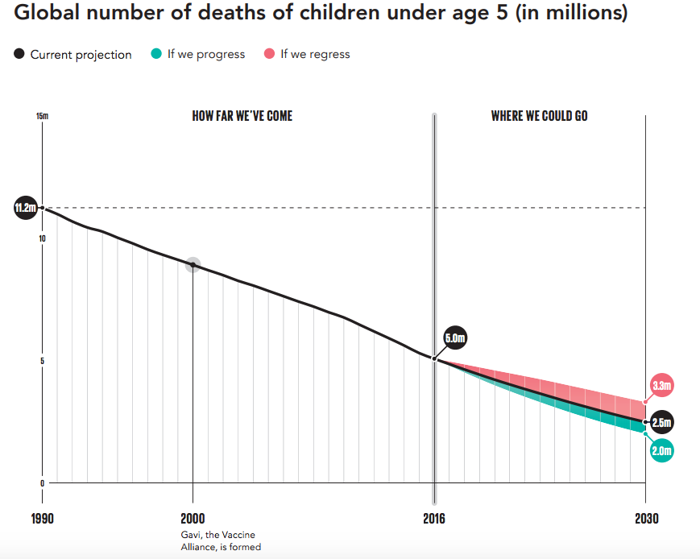
For example, he found that child deaths have fallen from 11.2 million to 5 million between 1990 and 2016, and they are on track to halve again by 2030. But under the “regress” scenario, there would be 3.3 million deaths, compared to 2.5 million if we stay the course. There are now 29 new cases of malaria per 1,000 people each year, but that could rise to 39, he found. Aid funding is part of what could send a country on a downward trajectory, but there’s also economic growth, the education of young girls, and vaccination rates.
Gates Foundation
Gates said the foundation would not be able to fill the gap created by a reduction in aid spending by the U.S. government, the world’s largest donor. Oxfam’s Kripke concurred, saying, “the simple fact is that wealthy philanthropists don’t have enough money to fill the gap, even if they wanted to.”
To those who say the United States should focus its funds on domestic problems, rather than supporting health abroad, Gates brings up the 2014 outbreak of Ebola, which made its way to the United States. “If we don’t make these investments in global health, my argument to people is, you’re going to see a lot more things like Ebola in our own country, and we’ll be dealing with them in our own health clinics because borders are porous,” she said.
Beyond his budget proposal, President Trump has also reinstated the Mexico City policy, which bans U.S.-government global family-planning funds from going to any organization that performs or promotes abortion. He also broadened the policy’s scope so that it applies to all global-health assistance, or $8 billion, rather than just the $600 million in family-planning funding. We won’t see the effects of the policy for about six months, according to Gates, but she says it’s already causing turmoil among nongovernmental organizations. “The NGOs don’t know where their funding is coming from,” she said. “They don’t know whether they should pause on ordering supplies.”
The Mexico City policy has been in effect under past Republican administrations, but it was reversed by President Obama in 2009. Any Republican president would have been likely to reinstate it, but Gates said it was the extent of Trump’s version that prompted her to speak out against it, even though she has not been vocally pro-choice in the past. In 2014, Gates wrote that she struggles with abortion, “but I’ve decided not to engage on it publicly—and the Gates Foundation has decided not to fund abortion.”
Still, in January of this year, she wrote on Facebook that “I’m concerned about the impact that the expansion of the Mexico City policy could have on millions of women and girls around the world. I’ve spent the past 16 years talking to women in developing countries who’ve told me—again and again—that their futures depend on the ability to use contraceptives.”
In our interview, she added that “when you start applying [the Mexico City policy] broadly to other global-health areas, like HIV/AIDS, like malaria services—that to me is where we all have to speak out and say that is just not okay. And that’s why I chose to use my voice more strongly on it this time.”
Not everyone believes the future of foreign aid is quite so bleak. Last week, the Senate Appropriations Committee rejected many of Trump’s proposed cuts to humanitarian and family-planning assistance—including the Mexico City policy.
The policy and some foreign-aid cuts could still survive the Congressional budgetary process, but the strong rebuke in the Senate bodes well for the foreign-aid budget, according to Andrew Natsios, a professor at Texas A&M University who served as USAID administrator under George W. Bush.
“We should be cautious, we should be vigilant, and we should watch what happens,” he said. A more significant threat to global development, according to Natsios, is a proposal to merge USAID into the State Department, as well as an uptick he’s noticed in retirements of experienced foreign-service officers.
In some ways, though, Congress’s reluctance to make the foreign-aid cuts is a testament to the power of the Gateses’ and others’ advocacy efforts. In March, Bill Gates reportedly met with several Congressional leaders to discuss foreign aid.
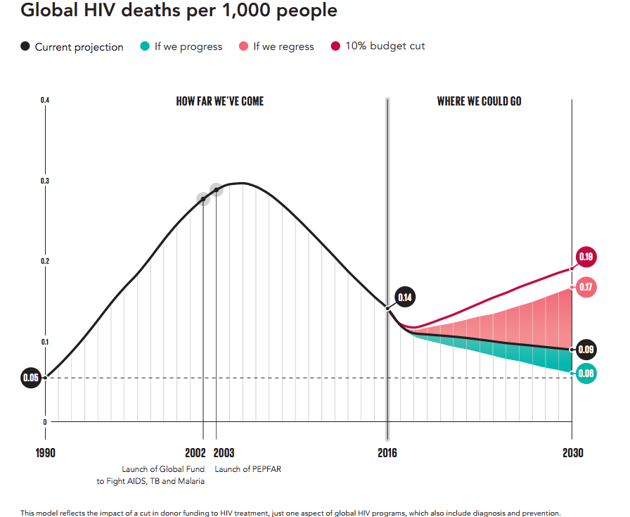
The United States is not the only crucial source of global-health dollars. Also important is making sure middle-income countries maintain their funding levels, Gates told me. “We are constantly going out to governments, whether it’s in Africa, whether it’s in India, whether it’s in the United States, or the United Kingdom, and saying, you have to keep up this funding,” Gates said. The “youth boom” in the global South—the number of Africans between the ages of 15 and 24 is set to double by 2045—heightens the risk that HIV infections could rise if funds run dry. According to the foundation’s report, a 10-percent cut in funding for HIV treatment could cause 5 million additional deaths by 2030.
Gates Foundation
For Africa, it’s been a decade of hope, but the priorities laid out by the Trump administration make it less clear whether the continent can continue to put its hope in international donors.
Before I left, I asked Gates whether anything that the Trump administration has said or done since releasing its proposed budget has given her hope.
I bought a pair of these handmade raffia shoes from Oscar and Shades on Etsy and they’re in heavy rotation. They were cheaper when I bought them, they’re $66 now, but I still think it’s worth it for a pair of handmade shoes. I’m sure they’re like $5 wherever they come from, so if you know, go ahead and send me back a pair on your next trip.
That said, they’re super comfy, pretty soft against your feet and don’t chafe anywhere. And because they’re like sandals, zero foot sweat, but still dapper AF. Recommend.
If you use Instagram, you have seen an exhortation from a friend or colleague to check out some article or event. These calls to action inevitably end, “Link in Bio.”
That’s shorthand, of course, for the single link that Instagram allows users to drop into their profiles. Because other links can’t be added to posts, that single link is an endorsement: It must be the one URL in the world that you are willing to attach to yourself at that moment.
For years, I’ve wondered why Instagram doesn’t allow links elsewhere. It would be so simple. (I reached out to Instagram for comment, but they didn’t respond.) The Ringer’s Alyssa Bereznak dressed down the company in a post titled, appropriately, “‘Link in Bio’ Is the Worst Thing About Instagram.”
“A network that hosts millions of people won’t let them do something that is second nature for digital natives. So its users have concocted their own clunky loophole to get around the problem,” Bereznak writes. “It’s as if there were a permanent snowstorm in a city, and the mayor refused to clear the sidewalks. Inevitably, pedestrians would just stomp out their own inelegant roundabout paths to navigate the dirty, urine-filled slush.”
And yet, Instagram crushes on, adding users by the hundred millions. The reason is simple: People, like myself, like Instagram. It is a plain like, uncomplicated. In 2015, when my colleague Rob Meyer wrote the definitive post about liking Instagram, “I Like Instagram,” he laid out its excellent lack of features:
It is a silly, idiosyncratic piece of software, but so simple. It says: Here is a picture. Here is a picture of a weird bird my friend saw. Here is a picture of my friend celebrating Eid with her brother. Here is a picture of an acquaintance flying over the city where I used to live.
With every photo, I have two options. I can scroll by, or I can say “I saw this and liked it.” Either way, then I scroll some more. It is a place to look at pictures and, maybe, video. It does not do much else. It doesn’t need to. It is so simple as to be almost serene.
It was true back then! The app’s simplicity seemed to be its heart. But many things have changed about Instagram in the intervening two years. There are now stories, daring you to step into their circles. The formerly chronological feed has been Facebooked. Even back then, Instagram had already added private messaging to its basic function of picture posting.
But the basic feeling people have about Instagram remains the same. They might be annoyed by certain aspects of the app, but they still like it, basically, and in the flat way that Meyer captured perfectly. “Oh, that was nice” is something one could imagine saying after looking at Instagram.
Not so for Facebook or Twitter. On those platforms, I feel like I’ve been snookered into emoting. The reason for this, I would argue, is simple: Instagram has never become a full participant in the web. By refusing to allow hyperlinks, it has maintained a distinct space on the internet. Twitter and Facebook expanded to become a messy, permeable front end for the whole of the web (even as they try to claw ever more video minutes/ads into their players).
And what is on the web right now is, more or less, politics. The Trump era has meant that Americans are talking about politics perpetually, endlessly, circuitously, directly, boringly, excitedly. Given the circumstances and stakes, that’s not necessarily a bad thing. But as “the conversation” goes, so follows the content, bucketing arguments, relating to your feelings, connecting popular culture with political theater. I don’t know anyone who isn’t exhausted, at least some of the time.
Then there is Instagram, where the documentation that life goes on doesn’t feel out of place. Like a recipe book written in 1944, Instagram declares: Still gotta eat! Like sunset pics from 1968: Still the world turns!
You can trace this right back to Link in Bio. Mobile apps are supposed to let the users do what they want, what they demand. Their paths of desire must be seamless and easy. Friction is the enemy.
But what if friction is necessary for the long-term health of these social systems? What if the platforms sometimes need to do the thing that generates lower short-run “engagement”? What if social networks now need dampening, not amplification?
The outright denial of user desire is also a good reminder of what these spaces actually are. The New York Times’ John Herrman calls the big platforms a “commercial simulation” of freedom. Instagram does not pretend to be part of the public sphere. It is not the natural home of #theresistance. It’s a place for the Sunday’s-best version of your personal life to have space on the internet.
In recent months, Instagram has experimented with letting verified users link out to the web from inside their stories. It solves the Link-in-Bio problem like that. But once the web starts to creep in, will its exhausting dynamics follow?
I evicted a longtime resident of my To Cook list this week with this corn chowder. I have no argument with traditional corn chowder — it has cream, bacon, and potatoes and thus would be impossible not to love as soup or salad — but I adore to the point of boring everyone around me with my gushing, Mexican-style corn either elote-style (on the the cob rolled in butter, mayo, lime juice and coated with salty crumbled cotija cheese and chile powder or a chile-lime seasoning blend) or esquites-style (all of the above, but in a cup). This corn chowder attempts to celebrate the best of both.
This year I’ve spent my working hours in a distant American past, reading contemporaneous accounts of abolitionism, civil war, and Reconstruction in the deepest reaches of our archives.
Over the last few months this position has sometimes felt disjointed from the constant stream of news coming out of Congress and the White House. But this week the two eras collided violently when efforts to take down Confederate monuments were met with protests by white supremacists and neo-Nazis. Confederate generals became the subject of articles, protests, and presidential flim flam, and Frederick Douglass reemerged on our homepage as a powerful political voice.
So, though it was writtenmore than 150 years ago, William Cullen Bryant’s “The Death of Slavery” feels relevant today. In the poem, published in our July 1866 issue,Bryant hails the abolitionist victory at the close of the Civil War by addressing his words to the institution of slavery itself—that “great Wrong,” that “scourge,” finally at the end of its “cruel reign.”
Like The Atlantic’s founders, Bryant was fiercely opposed to slavery. He repeatedly gave voice to his abolitionism in the editorials he penned as the longtime editor of the New York Evening Post, and was an emphatic supporter of the anti-slavery Free-Soil and Republican Parties and particularly of Abraham Lincoln’s 1860 presidential campaign. The grand moral language and triumphant tone of “The Death of Slavery” evince the fervent outrage with which he viewed America’s “peculiar institution,” and the equally fervent exultation he felt when it finally ended.
The last stanza of the poem, in which Bryant addresses the physical remnants of slavery, feels particularly resonant at the end of this long and difficult week. It reads:
I see the better years that hasten by
Carry thee back into that shadowy past,
Where, in the dusty spaces, void and vast,
The graves of those whom thou hast murdered lie.
The slave-pen, through whose door
Thy victims pass no more,
Is there, and there shall the grim block remain
At which the slave was sold; while at thy feet
Scourges and engines of restraint and pain
Moulder and rust by thine eternal seat.
There, ’mid the symbols that proclaim thy crimes,
Dwell thou, a warning to the coming times.
The answer to this beautiful questioner is... good.
Dear Polly,
Eight months ago my boyfriend/favorite human in the world was diagnosed with ALS (also known as Lou Gehrig’s disease) at the age of 32. ALS affects all the voluntary muscles in the body — he will eventually lose the ability to use his hands and arms, the ability...More »
I have a weird family question that I couldn’t find an answer to, so I turn to you.
I’m 30 years old, raised by my mom and my stepdad. Hopefully brief context: my stepdad and I have never got along. There were many instances of emotional abuse – he’s the kind of guy who would excitedly volunteer to tell me when I was in trouble because he delighted in bringing me bad news, and was jealous enough of my relationship with my mom that he would come up with chores for me to do whenever he caught me sitting and talking or reading with her. There were also a few occasions of drunky physical abuse; I got slapped and thrown around a fair bit. He’s still incredibly rude to me a lot of the time, which is why we don’t really talk. They live in another state and that’s the way I like it.
By contrast, my relationship with my mother is… good, but problematic. She is the strongest, classiest, most brilliant and brave woman I’ve ever known, and I practically worship her, but I also know that I can’t be around her and retain my adulthood at all. She loves me ferociously but spent most of my childhood pushing me away. “Love me from afar!” was her favorite line. We can talk for years about books, movies, history, science, ideas… but I cannot tell her things that matter to me, because she will either ridicule them or simply tell me, “Oh, honey, you know I don’t care about that.” Yes, she actually says exactly that.
So! Here’s my issue:
Every time I talk to them on the phone (usually about twice a month for an hour or more – my mom and I LOVE to talk) one or the other of them will say something like, “Do you think we were good parents?” I never know how to answer that question. I don’t think they were great parents, but at this point, there’s nothing they can do about that, and they’re not likely to agree with a lot of my criticisms anyway. Answering that question honestly would ultimately involve me DEFENDING my memories of neglect and abuse. I’m happy with my life now; I have a family I love and I am finally discovering the person I want to be. Why make both them and me feel like crap when it doesn’t really matter now?
But it keeps coming up. They won’t stop asking, and I hate comforting them about it when I can’t feel genuine doing it. How can I make this question go away without opening up a whole can of emotional nonsense when my life is finally getting better?
Thank you for your time! Loving From Afar (she/her pronouns)
Dear Loving From Afar (WUT? Ugh, your MOM),
A lot of people who were emotionally abused as kids walk in your same shoes. How to reconcile the demogorgons of our childhoods with the mellower, grayer, almost fragile-seeming fellow adults in front of us now?
This question that your parents keep asking you is deeply strange. If they are concerned about how they treated you and they wanted to have an actual honest conversation about it, your stepdad could say (for example): “I’m in the ‘make amends’ step of recovery and I’d like to apologize for [specific things] I did back when I was drinking.” They could tell you specifically what they want to talk about and why instead of making you play some weird guessing game. They could include, I dunno, an actual apology? None of this is an apology. Their question is a trap, so, good job for knowing that it’s a trap.
Possible answers:
“You’ve been asking this question a lot. Is there something specific from the past that you want to talk about?”
“You’ve asked this a lot. What’s prompting this?”
“Wow, what a question. What’s really on your mind?”
“Wow, what a question. Is there something specific that’s bothering you?”
“I could have done with 100% less being slapped around by [Stepdad] – is that what you want to talk about?”
“If I said ‘not really’ what would you say?”
“Wait, are you asking me to reassure you about your parenting? I have no idea how to do that.”
“This feels like a trap.“
“I don’t know how to answer that, but I’m a pretty happy adult.”
“Do they make comment cards for family relationships now? Let’s talk about something else.”
“What an awkward question. Why on earth would you ask me that?“
“No, but we can’t change the past. Why do you want to talk about this now?“
“Do you think you were good parents?”
“Wow. What brought this on?”
“I don’t know how to answer that.”
Edited to add: “Oh, Mom, you know I’m not interested in talking about any of that.”
If a lot of the scripts above look like answering a question with a question, yes, correct! Think of this as “If you’re going to bring this up, then you’re going to be the ones to do the work of explaining why.” Your parents are almost certain to pass on answering your counter-question or give a “no reason” non-answer, which gives you an opening to ignore the question entirely, like, “Ok, I have no idea how to answer that, but if you think of something specific you want to talk about let me know.” Return awkwardness to sender!
This is such a fucked up question from fucked-up people that there’s no right answer.But (good news?), that means there’s also no wrong way to answer. Answering honestly and giving them an opportunity to have an honest conversation doesn’t mean you have now agreed to discuss or defend or rehash anything. Alternately, saying “If I say ‘sure,’ will you stop asking me?” doesn’t undo all the true things that happened.
My thinking is, no matter how you answer you’re gonna feel weird and bad for a little afterward while because these people are experts at making you feel weird and bad, so you might as well be genuine and honor the life and the self you’ve created. Maybe your script is: “Not really, but I like our relationship how it is now.”
HBO’s prospective series Confederate will offer an alternative history of post-Civil War America. It will ask the question, according to co-creator David Benioff, “What would the world have looked like … if the South had won?” A swirl of virtual protests and op-eds have greeted this proposed premise. In response, HBO has expressed “great respect” for its critics but also said it hopes that they will “reserve judgment until there is something to see.”
This request sounds sensible at first pass. Should one not “reserve judgment” of a thing until after it has been seen? But HBO does not actually want the public to reserve judgment so much as it wants the public to make a positive judgment. A major entertainment company does not announce a big new show in hopes of garnering dispassionate nods of acknowledgement. HBO executives themselves judged Confederate before they’d seen it—they had to, as no television script actually exists. HBO hoped to communicate that approval to its audience through the announcement. And had that communication been successful, had Confederate been greeted with rapturous anticipation, it is hard to imagine the network asking its audience to tamp down and wait.
HBO’s motives aside, the plea to wait supposes that a problem of conception can be fixed in execution. We do not need to wait to observe that this supposition is, at best, dicey. For over a century, Hollywood has churned out well-executed, slickly produced epics which advanced the Lost Cause myth of the Civil War. These are true “alternative histories,” built on “alternative facts,” assembled to depict the Confederacy as a wonderland of virtuous damsels and gallant knights, instead of the sprawling kleptocratic police state it actually was. From last century’s The Birth of a Nation to this century’s Gods and Generals, Hollywood has likely done more than any other American institution to obstruct a truthful apprehension of the Civil War, and thus modern America’s very origins. So one need not wait to observe that any foray by HBO into the Civil War must be met with a spirit of pointed inquiry and a withholding of all benefit of the doubt.
Skepticism must be the order of the day. So that when Benioff asks “what would the world have looked like … if the South had won,” we should not hesitate to ask what Benioff means by “the South.” He obviously does not mean the minority of white Southern unionists, who did win. And he does not mean those four million enslaved blacks, whom the Civil War ultimately emancipated, yet whose victory was tainted. Comprising 40 percent of the Confederacy’s population, this was the South’s indispensable laboring class, its chief resource, its chief source of wealth, and the sole reason why a Confederacy existed in the first place. But they are not the subject of Benioff’s inquiry, because he is not so much asking about “the South” winning, so much as he is asking about “the white South” winning.
The distinction matters. For while the Confederacy, as a political entity, was certainly defeated, and chattel slavery outlawed, the racist hierarchy which Lee and Davis sought to erect, lives on. It had to. The terms of the white South’s defeat were gentle. Having inaugurated a war which killed more Americans than all other American wars combined, the Confederacy’s leaders were back in the country’s political leadership within a decade. Within two, they had effectively retaken control of the South.
Knowing this, we do not have to wait to point out that comparisons between Confederate and The Man in the High Castle are fatuous. Nazi Germany was also defeated. But while its surviving leadership was put on trial before the world, not one author of the Confederacy was convicted of treason. Nazi Foreign Minister Joachim von Ribbentrop was hanged at Nuremberg. Confederate General John B. Gordon became a senator. Germany has spent the decades since World War II in national penance for Nazi crimes. America spent the decades after the Civil War transforming Confederate crimes into virtues. It is illegal to fly the Nazi flag in Germany. The Confederate flag is enmeshed in the state flag of Mississippi.
The symbols point to something Confederate’s creators don’t seem to understand—the war is over for them, not for us. At this very hour, black people all across the South are still fighting the battle which they joined during Reconstruction—securing equal access to the ballot—and resisting a president whose resemblance to Andrew Johnson is uncanny. Confederate is the kind of provocative thought experiment that can be engaged in when someone else’s lived reality really is fantasy to you, when your grandmother is not in danger of losing her vote, when the terrorist attack on Charleston evokes honest sympathy, but inspires no direct fear. And so we need not wait to note that Confederate’s interest in Civil War history is biased, that it is premised on a simplistic view of white Southern defeat, instead of the more complicated morass we have all around us.
And one need not wait to ask if Benioff and D.B. Weiss are, at any rate, the candidates to help lead us out of that morass or deepen it. A body of work exists in the form of their hit show Game of Thrones. We do not have to wait to note the persistent criticism of that show is its depiction of rape. Rape—generational rape, mass rape—is central to the story of enslavement. For 250 years the bodies of enslaved black women were regarded as property, to be put to whatever use—carnal and otherwise—that their enslavers saw fit. Why HBO believes that this duo, given their past work, is the best team to revisit that experience is a question one should not wait to ask.
And all this must be added to a basic artistic critique—Confederate is a shockingly unoriginal idea, especially for the allegedly avant garde HBO. “What if the white South had won?” may well be the most trod-upon terrain in the field of American alternative history. There are novels about it, comic books about it, games about it, and a mockumentary about it. It’s been barely a year since Ben Winters published Underground Airlines.
Storytellers have the right to answer any question they choose. But we do not need to wait to examine all the questions that are not being chosen: What if John Brown had succeeded? What if the Haitian Revolution had spread to the rest of the Americas? What if black soldiers had been enlisted at the onset of the Civil War? What if Native Americans had halted the advance of whites at the Mississippi? And we need not wait to note that more interesting than asking what the world would be like if the white South had won is asking why so many white people are enthralled with a world where the dreams of Harriet Tubman were destroyed by the ambitions of Robert E. Lee.
The problem of Confederate can’t be redeemed by production values, crisp writing, or even complicated characters. That is not because its conceivers are personally racist, or seek to create a show that endorses slavery. Far from it, I suspect. Indeed, the creators have said that their hope is to use science fiction to “show us how this history is still with us in a way no strictly realistic drama ever could.” And that really is the problem. African Americans do not need science-fiction, or really any fiction, to tell them that that “history is still with us.” It’s right outside our door. It’s in our politics. It’s on our networks. And Confederate is not immune. The show’s very operating premise, the fact that it roots itself in a long white tradition of imagining away emancipation, leaves one wondering how “lost” the Lost Cause really was.
It’s good that the show-runners have brought on two noted and talented black writers—Nichelle Tramble Spellman and Malcolm Spellman. But one wonders: If black writers, in general, were to have HBO’s resources and support to create an alternative world, would they choose the world dreamed up by the progenitors of the Ku Klux Klan? Or would they address themselves to other less trod areas of Civil War history in the desire to say something new, in the desire to not, yet again, produce a richly imagined and visually beguiling lie?
We have been living with the lie for so long. And we cannot fix the lie by asking “What if the white South won?” and waiting for an answer, because the lie is not in the answer, but in the question itself.
Olga Khazan’s recent article “Why Do Women Bully Each Other at Work?” examines women’s workplace relationships and includes several firsthand accounts from female professionals of being undermined or verbally assaulted by female superiors. As researchers who have studied these dynamics, we couldn’t help but notice that, save for one example of a young employee at a consulting firm who found herself begrudging a colleague her six-week maternity leave, all of Khazan’s interview subjects told their stories from the perspective of a junior staffer stung by a senior one.
Which led us to wonder: Is it possible that gender-based expectations make it difficult for more-senior women to provide constructive criticism to their female reports?
At least part of the “queen bee” label Khazan discusses (and critiques)—a label often assigned, fairly or not, to female bosses considered to be “catty” or “bitchy”—emerges from biased interpretations of women’s behavior. Consider Shannon, the lawyer interviewed by Khazan who in one breath describes a female partner as being passive-aggressive, and in the next recalls a time when the same partner told her, in a strikingly non-passive-aggressive way, to be more confident. Shannon uses these examples to illustrate a problematic relationship, but could it be that one woman’s criticism is another woman’s attempt at mentoring?
This reminded us of a story related by Sheryl Sandberg in Lean In: Sandberg once listened in shock as a junior woman, to whom she considered herself a mentor, claimed to never have had anyone looking out for her career. When Sandberg pressed the junior woman on how she defined mentorship, she concluded that the woman expected not a mentor but a therapist.
In a paper published in 2014 in the Journal of Management, we proposed that women’s workplace relationships with one another are subject to two stereotypes—one that describes how they’re believed to act and one that prescribes how they should act. The first suggests that women’s relationships with each other are fraught with tension and “cattiness.” The second dictates that they should be nurturing and supportive of each other. These stereotypes put women in a bind: If they mentor their junior counterparts, as Sandberg says she did, that guidance can go unnoticed because it’s what they’re expected to provide anyway. But the moment they make a firm demand or give critical feedback to a younger colleague, they risk being labeled a queen bee.
These stereotypes also shape women’s unrealistic expectations of other women: If one subscribes to the first stereotype, she enters the workplace expecting women to be her worst enemies, whereas if she subscribes to the second stereotype—as many feminists appear to—she expects consistent and unquestioning support from other women. The standards to which women in positions of power are then held are nearly impossible to meet while fulfilling the requirements of their jobs—among the most important of which is holding colleagues accountable for their performance regardless of their gender.
Supporting the theory we laid out in that 2014 piece, one of us (Leah) has a working paper demonstrating that, in a hypothetical scenario, a woman who criticizes the job performance of a junior woman is viewed by both male and female research subjects as jealous and threatened by her junior colleague—a finding that does not emerge when either employee is a man. In another study, women said they’d feel more let down by a hypothetical workplace scenario in which they imagined a woman acting toward them in an unsupportive way, compared to when they imagined a male coworker doing the same; men reacted similarly regardless of the critical colleague’s gender.
These results suggest that the same workplace behavior is judged differently when it involves two women, compared to two men or one man and one woman. This conclusion is bolstered anecdotally among Khazan’s interviewees. “Many women told me that men had undermined them as well,” she writes, “but it somehow felt different—worse—when it happened at the hands of a woman, a supposed ally.”
In any discussion of the queen-bee stereotype, it’s important to note the implications of believing that professional women undermine each other because their work environments are male-dominated, as some research cited in Khazan’s article suggests they do. From that belief follows the problematic conclusion that if only an organization could become more egalitarian, its female employees would revert to their supposedly natural feminine state of being warm and supportive—a stereotype that is just as constricting as any other.
Indeed, women shouldn’t be expected to nurture others more than men, and they’re no less entitled to criticizing and challenging their colleagues. In conversations about women’s relationships with one another at work, it’s important to keep this in mind before labeling anyone too harsh or competitive.
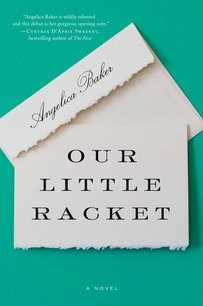
I read all 512 pages of Angelica Baker’s debut novel greedily, in one dizzying weekend, unable to put it down. Which is fitting, in a way: Our Little Racket follows the sudden downfall of a Lehman Brothers–esque CEO through the eyes of his wife, their teenage daughter, and the other women surrounding them, and as such it’s very much a story of greed and its out-of-control consequences. But the book gets beyond moneymaking hubris to a more basic kind of desire—the fretful, shapeless longing of those who are sidelined to be seen somehow as indispensable.
Binge-watchers of Big Little Lies will enjoy the elegantly cutthroat politics of suburban life in wealthy Greenwich, Connecticut, while fans of Elena Ferrante will like the sharp portrayal of the delicate power balances in women’s friendships. But any reader will appreciate the tightly woven drama of this book, which brings its five protagonists out of the margins of the crisis and into an explosive confrontation of their own.
Book I’m hoping to read: Love in the Time of Cholera by Gabriel García Márquez
For Selin, the Turkish-American protagonist and narrator of Elif Batuman’s The Idiot, arriving at Harvard in the fall of 1995 is an occasion of great flourishing. Intellectual and experiential horizons are broadened. New technology, in the form of, yes, email—“a glowing list of messages from all the people you knew, and from people you didn’t know … like the universal handwriting of thought or of the world”—makes apparent the complexities of our ever-evolving epistolary media. But it’s also a time of emotional confusion: Selin falls for a bland, apparently brilliant, Hungarian mathematician named Ivan. Several years her senior, he treats her as an odd curiosity, someone to be intrigued by but never quite taken with.
Penguin Press
While Selin’s on-again, off-again pursuit of Ivan gives The Idiot its narrative spine, for me, the novel’s true pleasures are in the rapid maturation of her powers of observation. “Why was ‘plain’ a euphemism for ‘ugly,’ when the very hallmark of human beauty was its plainness, the symmetry and simplicity that always seemed so young and so innocent,” Selin muses. It’s a work of peculiar discovery, a portrait of the artist as a young Turkish-American woman obsessed with language and its powers. And Selin’s infatuation with Ivan, too, offers her a way to work out her nascent theories of love, life, and meaningful expression.
My anxious, sweaty, early college days were full of unrequited longings, both romantic and cerebral—I wanted my opinions about Bergman, Chekhov, and colonialism to be valued and important. The Idiot took me back to that awkward time, full of pain and strangeness, but also of promise and delight.
Book I’m hoping to read: Neuromancer by William Gibson
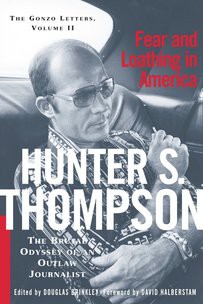
Fear and Loathing in America by Hunter S. Thompson
Fear and Loathing in America is a collection of Hunter S. Thompson’s private and business letters between 1968 and 1976. There are other earlier and later collections, but in these years he’s in his prime. “The Battle of Aspen” (Rolling Stone, 1970) is one of my favorite pieces of his, and here you see how it came together, and how it shaped his understanding of journalism’s role in political power.
Simon and Schuster
Thompson carbon-copied all of his letters and reportedly imagined they’d be published one day, which slightly ruins the idea that you’re looking inside his head when reading them. His letters have the same energy and humor of his columns. But to whatever degree his persona involved conscious performance, it’s one he kept up for thousands of pages of private correspondence. I come out believing the reason his work resonated with so many people was because it was authentic. It’s possible the crisis of faith in journalism today would be helped if there were more writers as relatable, unpretentious, and candid as he was.
There are, of course, parallels between his feelings about Richard Nixon then and many people’s feelings about Donald Trump today. It can be cathartic to wade through HST’s despair for democracy and the American idea, and to realize that it was not less intense than many people’s today, and to see how he coped and didn't, and to remember that he and the country made it through.
Book I’m hoping to read: Things That Happened Before the Earthquake by Chiara Barzini
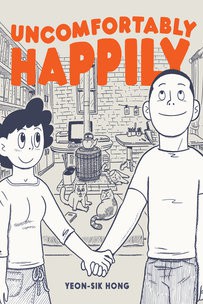
This hefty graphic novel by the Korean cartoonist Yeon-Sik Hong is one of the simplest stories I’ve read this year. It has no real suspense or plot, no grand reveal. Based on Hong’s own experience moving with his wife Sohmi from Seoul to the countryside, Uncomfortably Happily is a candid, engrossing tale of two comic artists looking for comfort in solitude and minimalist living, even as the twin shadows of poverty and stress loom.
Drawn & Quarterly
While they are thrilled to leave the smog and noisy crowds behind, the couple relocate largely out of financial necessity; on page after page, the irritable Hong agonizes over his meager paychecks and unfulfilled creative dreams. Uncomfortably Happily, which is plainly but engagingly drawn, spends as much time, though, on the daily indignities and triumphs of living in the mountains. Divided into seasons, the book reflects the duo's newfound connection to the patterns and whims of nature: In the winter, the couple experiment with burning coal to save money. In the spring, they begin the tricky work of loosening the soil and planting sesame, lettuce, and mugwort. They fret over trespassers, chores, and commuting to the city. They adopt a dog, buy some chickens, and clean up the mess when the dog kills the chickens. Sometimes, they treat themselves to grilled meat for dinner or go for a swim.
I appreciated the book’s contemplative, and realist, mode, and its unromantic look at oft-romanticized lifestyles: that of the country-dweller and that of the artist. Beyond that, I just found it therapeutic to follow the quietly charming Hong and Sohmi week to week, not doing much more than making do.
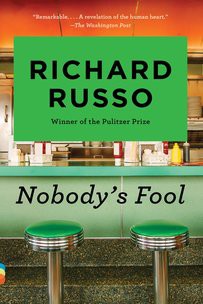
At 549 pages, Nobody’s Fool is not a short novel, but it could be easy to dismiss as slight. The setting is unremarkable, and the action, such as it is, unfolds slowly. But Richard Russo, who would go on to win a Pulitzer Prize for his 2001 book Empire Falls, creates compelling characters and writes with such humanity and humor that the book is pure delight. The story is built around Sully, a down-on-his-luck everyman who lives in a blue-collar town in upstate New York; his son Peter, a college professor whose career and marriage are failing; his aging landlady Miss Beryl; his dim-witted best friend Rub Squeers; his anxious ex-wife Vera; and a menagerie of other townspeople who bring a boisterous joy to the happenings. Russo’s mastery of dialogue, gift for observation, and penchant for amusing cul-de-sacs more than compensate for any lack of pyrotechnics in the plot.
Book I’m hoping to read: Hue 1968: A Turning Point of the American War in Vietnam by Mark Bowden
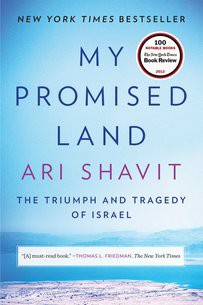
Now is a time to be reading about Israel. Every day, it seems, some new controversy brings the little Middle Eastern country back into the American discourse; while U.S. politics are going through a period of chaotic scramble, the politics of U.S.-Israel-Palestine appear to be on the same steady path toward crisis. Ari Shavit’s book is not a political argument, exactly: It is about the history, and fraughtness, and hope of the land of Israel, and all the ugliness, ambition, joy, and sadness with which the country came to be. He tells the story of Israel's founding and evolution through original interviews and personal narrative, inviting readers along on a journey of historical reckoning that is profoundly ambivalent in its conclusions. That the author himself has become a troubled figure in recent months only adds to the long list of questions I'm wrestling with as I approach the end of the book.
Book I’m hoping to read: Far From the Tree by Andrew Solomon
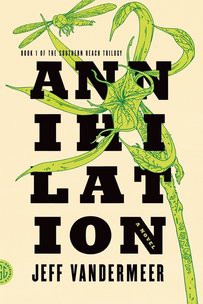
I spent a night in a seaside tent shortly after finishing Annihilation, and it transformed the familiar-to-campers morning symphony of bird songs, buzzing insects, and crashing waves into something new and not altogether comforting. In this hypnotic and deadpan hybrid of sci-fi, science non-fiction, psychological thriller, and horror, Jeff VanderMeer imagines a group of scientists venturing into a stretch of the American coastline that’s been taken over by a mysterious something rebuffing the influence of humankind. Our narrator, referred to only as “the biologist,” describes a vibrant wilderness that defies her understanding not only of science but also of her own perception. To say much more about her expedition’s mind-bending findings would spoil the book, the first of a trilogy. But trust me: Once you begin Annihilation, you’ll see the flora and fauna around you with more clarity—which is to say, with proper awe at its unknowability.
Book I’m hoping to read: A Separation by Katie Kitamura
There’s a thin line between trashy summer reads and meaty, good summer reads. How many times can you flop on the beach with a thriller like The Girl on the Train and not feel like you are bingeing on candy and your brain is turning into a big cavity? I'm always on the lookout for a page-turner that isn’t too indulgent, and Jennifer Haigh’s Heat and Light fits the bill. It has a weighty topic—fracking in Pennsylvania—but deftly tackles the human dimensions of the subject and creates tension that keeps the reader occupied. Through the eyes of a farmer, a prison guard, an activist, a housewife, and a man employed by the drilling industry, the book looks at how a small town reacts to fracking among its farms. This would be easy to do in black and white—fracking bad, environmentalists good—but Haigh brings texture to her characters, making the reader really consider the pros and cons of outside business coming into small, dying towns. In short, you can take Haigh's book to the beach and leave the guilt behind; it’s well written, and will definitely make you think.
Book I’m hoping to read:The Sympathizer by Viet Thanh Nguyen
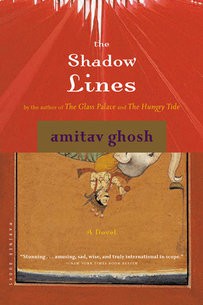
There are certain books that occupy such a place in my consciousness that a simple glimpse of its spine fills me with joy and transports me to where I was when I first read it. The Shadow Lines is such a book. I picked it up recently after nearly two decades to see whether it held up; as before, I was quickly engrossed. The novel is funny, sad, wistful, and ultimately tragic: An unnamed narrator describes his hero worship of one cousin, his unrequited love for another, and the friendship between two families, one English and the other Indian, forged during the war. Amitav Ghosh’s writing luxuriates in what seem like the certainties of the past, but contain memories that are misremembered, half-remembered, and deliberately concealed—the shadow lines of the title. The book can be difficult to follow: It moves back and forth in time, between places, among multiple story arcs, often on the same page. But it’s precisely those qualities, and Ghosh’s incisive observations along the way, that make reading it an arresting experience, as I once again discovered.
Book I’m hoping to read: July 1914: Countdown to War by Sean McMeekin
Bianca Bosker was the executive technology editor at The Huffington Post when she abruptly quit her job and took a $10-an-hour gig as a “cellar rat,” hauling cases of wine for a Manhattan restaurant. Her endgame: to immerse herself in the world of “cork dorks,” master sommeliers and obsessives who devote their lives to studying, sampling, and selling wine. Cork Dork is an account of Bosker’s journey from a casual wine drinker to the sommelier at Terroir Tribeca. But it’s also an enlightening and wacky introduction to the wine industry itself, with its manifold highs (1989 Chateau d’Yquem) and lows (highly processed wines like Yellow Tail and Sledgehammer that contain additives like powdered egg whites or bentonite clay).
Penguin Books
Bosker’s mission seems journalistic, at first—she wants to ascertain what actually makes a super-nosed oenophile, and whether such rarefied powers of perception are within the grasp of the average Cabernet drinker. This involves an alarming number of days where she’s hungover by 2 p.m. after attending tastings to bolster her limited education. But she ends up thoroughly absorbed in the weird world she documents, even as she maintains an outsider’s ability to skewer its more ridiculous elements. Cork Dork is, somehow, both an entry-level guide to the ever-growing business of wine and a masterclass in the strange, immensely skilled fanatics who make it their life’s work.
Book I’m hoping to read: The Ministry of Utmost Happiness by Arundhati Roy
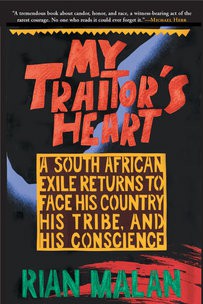
Years ago, an editor instructed me to read My Traitor’s Heart, Rian Malan’s 1990 reported memoir about Late Apartheid South Africa. I can’t recall what the context for that recommendation was, but I didn’t get around to picking up the book until this summer, when the timing felt fortuitous: What better moment to read about a society tearing itself apart, wracked with police violence against people of color, with a progressive bloc standing by, wringing its hands solemnly but unable or unwilling to formulate an effective response?
Grove Press
But it’s unfair to distill My Traitor’s Heart to, or read it as, merely a parable for the present era in American politics. For someone of my generation, who grew up with the Apartheid regime as a sort of cardboard bogeyman, Malan’s vivid reportage makes the horror of South Africa under P.W. Botha come alive in sickening ways. And Malan, the renegade son of a deeply connected Afrikaner family and a disenchanted former Marxist, is at his best when he is skewering the illusions and pieties of white South Africans who opposed the racist regime. He is especially unsparing in enumerating the faults of one young liberal: himself.
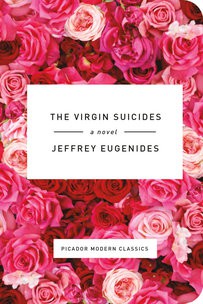
As much as I love discovering new books, I find myself coming back to Jeffrey Eugenides’s first novel, The Virgin Suicides, at least once a year. And more often than not, it happens to be during the summer: The June months that bookend the story feel even more poignant when I’m sitting in the same muggy, buzzing weather as the Lisbon sisters and the boys so enthralled by them.
Picador
The Virgin Suicides turns what could easily be a dark and depressing tale into an engrossing, lyrical story about youth, innocence, and that ever elusive idea of teenage girlhood. Told from the perspective of a group of middle-aged men looking back on their past, Eugenides’s novel attempts to explore what it is that brought the five Lisbon sisters to kill themselves. The narrators fail to reach a solid conclusion, but learn more about the sisters as people, concluding that “the girls were really women in disguise, that they understood love and even death, and that our job was merely to create the noise that seemed to fascinate them.”
It’s easy to forget the particulars of what it means to be a teenager—“Obviously, Doctor, you’ve never been a 13-year-old girl,” says the youngest Lisbon sister, Cecilia, when chastised for not knowing how tough life can really be—but Eugenides’s writing has a way of making those isolating high-school years feel familiar, relatable, and not all that long ago.
Book I’m hoping to read: The Underground Railroad by Colson Whitehead
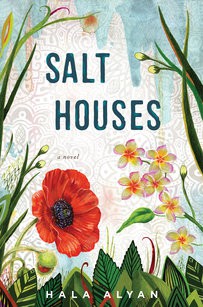
In her debut novel, Salt Houses, Hala Alyan pulls readers into the daily ups and downs of displaced people, using themes of memory, inheritance, ongoing loss, and rebuilding. The Palestinian American author was inspired by her own family’s experiences being forced to relocate: As she notes of that past in an interview on NPR’s Morning Edition, “A lot of the times it’s something that's really not brought up, which then leaves it to the later generations to reimagine, reconceptualize, kind of recreate what it was that was lost.”
Houghton Mifflin Harcourt
Alyan—who has published three books of poetry—moves the reader lyrically through multiple storylines, continents, and political contexts to depict how families carry their history, through major turning points as well as the everyday. Starting in Nablus, Palestine, in 1963, Salt Houses paints a detailed and emotional portrait of the struggles and triumphs of creating home and reconciling that which no longer exists. It poses difficult and personal questions about what displaced people can give to their children, what they want to be remembered and what—consciously or unconsciously—slips through the cracks.
Book I’m hoping to read: The Sobbing School by Joshua Bennett
Near a Thousand Tables: A History of Food by Felipe Fernández-Armesto
If there’s one thing watching a lot of HGTV has taught me—and there is, now that I think about it, pretty much only one thing that watching a lot of HGTV has taught me—it’s that the kitchen is the most important room in the home. Bedrooms are great, Joanna and Chip will enthuse; bathrooms are necessary, Property Brother One and Property Brother Two will concede; living rooms (pardon, Family Spaces that have been laid out, ideally, according to a whimsical Open Concept) are definitely, Tarek and Christina will tell you, a crucial component of the whole deal. But the kitchen: That’s the non-negotiable. It’s the place where everyone, finally, comes together—the warm and beating heart of the home, whatever kind of home it may be.
Free Press
HGTV’s kitchen-centricism is a (sort of) new idea—remember when fancy dining rooms were the thing to aspire to?—that is also an extremely old one. Food, after all, has been for millennia a driver of community. Consuming it and preparing it, in particular, have long encouraged cooperation and, with it, culture. Our DIY relationship with our meals is in fact, Felipe Fernández-Armesto argues in his 2001 book Near a Thousand Tables: A History of Food, part of what makes us human. “Cooking deserves its place as one of the great revolutionary innovations in history,” the Notre Dame history professor writes, "not because of the way it transforms food—there are plenty of other ways of doing that—but because of the way it transformed society.”
Fernández-Armesto makes his case with eloquence and, especially, with wit (“Lego cookery,” he calls the cuisine that calls itself “fusion”; “food-Fordism,” he dubs fast food, as a phenomenon). But Near a Thousand Tables isn’t (merely) another takedown of our current, highly industrialized food system. Fernández-Armesto instead considers food as a constant companion to human history; he examines it in relation to imperialism and to class. He sweeps across cultures and cuisines and eras with polymathic ease. The result, I should note, is definitely not traditional beach reading. But in another way, Near a Thousand Tables is a fitting book for summer, with the season's park picnics and family barbecues and time spent outdoors, among food both actual and potential. Its lessons have made me appreciate, even more fully, the things I cook and consume. Even if those things aren’t served, sadly, on a fashionable breakfast bar.
Book I’m hoping to read: The Mothers by Brit Bennett
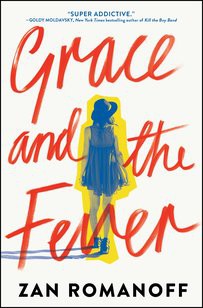
Grace and the Fever is the story of a girl who meets a member of her favorite boy band, Fever Dream, and gets drawn into their world. But there’s a twist—she’s super-active in the online community of fans who believe two of the band’s members are in a hidden gay relationship. (The storyline is seemingly inspired by the real-life conspiracy theory that One Direction’s Harry Styles and Louis Tomlinson are secretly in love.)
Knopf Books for Young Readers
A fun, escapist read, Zan Romanoff’s book also evokes that particular feeling of teenage summers—of a compressed period of change, of a self that’s blooming in the heat. It’s a story of how people find themselves through the things they love, but also of the dangers of giving too much weight to the mythologies they create around them. “You can see something very clearly without knowing what it is,” Romanoff writes. “You can know what something is without understanding what it means. Something can be real, and not at all true.”
When Grace discovers the truth about the band she adores, she has to reconcile it with the story she’s been telling herself. She also has to reconcile the many different stories she’s been telling about who she is—to her friends, to the band, to her online compatriots. Romanoff’s sensitive and thoughtful portrayal of fandom gives it a literary weight equal to the importance it has in fans' lives.
Maurice Sendak’s illustrations are so fantastic that it’s easy to overlook the brilliance of his design choices. Such decisions are quite meaningful, in fact. A story is subtly shaped by a book’s physical contours; there are layered meanings in the interplay between text and art; there’s utility built into the very act of turning the page—a gap in time and space that must be closed by the reader.
Doubleday
“My heartbeat actually changed with the excitement of discovering the picture-book medium with all its complexities,” the art historian Jane Doonan tells Jonathan Cott in his new book, There’s a Mystery There. Cott’s ode to Sendak is an engrossing extension of the 1976 Rolling Stone cover story he wrote about the illustrator, who died in 2012. To make sense of Sendak’s legacy, Cott revisits their conversations from that time and also turns to a panel of scholars, including Doonan.
What emerges is a clearer picture of Sendak the man, and also a riveting excavation of his approach to art. Sendak often described his work as an exploration of how children understand their own feelings of fear, anger, frustration, and boredom. But Cott sees more nuance than that, comparing the emotional resonance of Sendak’s work to a sense of “being outside and inside … at the same time.” This is why it makes sense in Sendak’s universe for a whale to spout chicken soup with rice, and for a glass milk bottle to be a skyscraper, and for a child’s bedroom to be suddenly canopied by trees. In childhood, the smallest and most ordinary spaces are infinite. And when the potential for adventure is everywhere, the distance between a precarious journey and a reassuring homecoming collapses.
Reading Cott’s book, I was struck by the wish to have known Sendak as a boy. Through his beloved canon, I realized, we already do.
Book I’m hoping to read: Gender and Jim Crow: Women and the Politics of White Supremacy in North Carolina, 1896-1920 by Glenda Gilmore
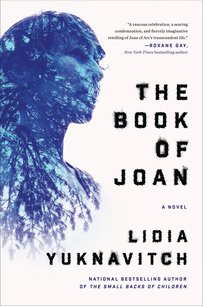
Lidia Yuknavitch’s latest novel, a futuristic reimagination of the story of Joan of Arc, opens on a gruesomely detailed scene of burning flesh. In The Book of Joan, skin serves as canvas, screen, and page: Grafting artists are the Dickenses of their era, etching epic sagas and love tales onto their hairless clients’ scalps, necks, and thighs. The narrator, Christine, is one such artist, and she is methodically burning onto her own body a text, the titular “book”: the biography of a young environmental activist named Joan who has become a symbol of resistance as the world’s wealthy elites have their way with an ecologically devastated Earth. The “book” is a way for Christine to document the truth about Joan amid widespread propaganda that would cast her as a terrorist. It is also, as it were, a weapon of protest in a world taken over by sly, false narratives—ones that can move mass opinion, to toxic, even apocalyptic effect.
If this plotline sounds a bit self-serious, Yuknavitch smartly cuts it with mordant humor. She gives Christine, her wry narrator, the nickname “Christ.” She makes Joan crotchety, powerful but not particularly charismatic, and the horrid, dictatorial Jean de Men—a dangerously effective raconteur determined to squelch Joan—essentially, a popular romance novelist. Throughout, Yuknavitch is interested in examining what happens when language is torqued away from average people, and what results when they try to torque it back in their direction. With The Book of Joan, she proffers a thought-provoking meditation on the influence of story—on how it can manipulate and inspire, and how it can be used to resist.
Book I’m hoping to read: Notes of a Crocodile by Qiu Miaojin
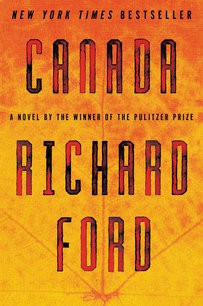
What if your parents were bank robbers? That's essentially the premise of this 2012 novel by Richard Ford, the writer best known for his four Frank Bascombe books, including the Pulitzer-winning Independence Day. While those works more broadly explored the anxieties and pieties of late-20th-century America, in Canada, Ford examines a different set of questions—about criminality, marriage, and the lessons a child learns from his parents—with impressive range.
Ecco
Where the Bascombe books star a middle-aged, middle-class Southern transplant to the Northeast, Canada is the story of a working-class family in mid-century Montana told from the perspective of an orphaned teenager, Dell Parsons, who is sent north of the border after his parents are arrested. How do you cope with a rupture that sudden? How do you start over? What lessons do you learn from your parents, and what do you discard? In the narrator Parsons, Ford has created a new voice, one that’s entirely distinct from the now-familiar Bascombe. He's more wistful than wry, but no less engaging. And though Canada is tighter in scope than Ford's earlier works, it moves quickly and grabs you from the start.
Book I’m hoping to read: Anything Is Possible by Elizabeth Strout
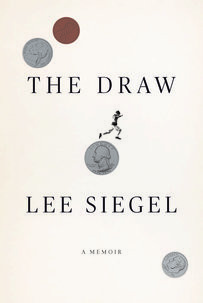
Published earlier this year, The Draw, a memoir by the cultural critic Lee Siegel, is deeply unsettling. The first 20 pages reveals the heart of the trauma: Siegel’s father, unable to repay advances on his salary, has gone bankrupt, while his mother devolves into a screaming, slapping hurricane of disappointment. From then on, Siegel spends his adolescence shrinking from his mother’s increasingly erratic power trips and struggling to accept his father’s shrinking sense of self. With uncomfortable composure and clarity, Siegel dissects his parents—labeling faults, diagnosing neuroses—and himself.
This book upset me, but I couldn’t put it down. Siegel’s clinical judgements and fluid transitions, combined with his almost humdrum childhood experiences, make The Draw an engrossing read.
Book I’m hoping to read: Presence in the Modern World by Jacques Ellul
—Katie Martin, designer
Invisible Planets edited by Ken Liu
I'm a lifelong sci-fi fan, and as any lifelong sci-fi fan can tell you, the repetition of themes and tropes sometimes cripples the genre. So when I was introduced to Liu Cixin's The Three-Body Problem, the space-opera trilogy to which it belonged, and Chinese science fiction in general, it was like a window opened onto a new universe. Just the act of seeing fictional futures through an international lens added depth to my understanding of the genre. And it didn't hurt that the work was thrilling and fresh.
Tor Books
In between his own award-winning sci-fi and fantasy work, Ken Liu has been the chief promoter of the Chinese-American science fiction cultural exchange, so it's no wonder that he translated and edited Invisible Planets, a speculative fiction collection from new and classic Chinese authors. Included are a short story from Liu Cixin and a trippy time-bending Hugo-award-winning novella “Folding Beijing” from Hao Jingfang. Also of interest are the collection’s essays on Chinese sci-fi identity and the prominent role the genre has played in developing cultural identity.
Book I’m hoping to read: The Stone Sky by N.K. Jemisin
Moonglow is not a memoir and, despite what its cover would have you believe, it’s also not quite a novel. It falls somewhere in the nameless space between the two, recounting the story of a writer named Michael Chabon and his maternal grandparents in a way that feels true but that doesn’t always adhere to the facts.
Harper
The book centers on stories Chabon’s grandfather tells while lying on his deathbed, high on painkillers: stories about his childhood, his military service during World War II, his NASA career, his time in jail, his marriage. To the narration of these remembered episodes, Chabon brings the same vivid descriptive voice and engaging character development I loved in his earlier novels, crafting moving portraits of his grandparents as they grapple with the damage left by the war and navigate the fluctuations of their lives together. But Chabon abandons the more straightforward plot progressions he laid out in those books, instead jumping around in space and time and veering off on tangents in the distracted, non-linear style of real memory.
The resulting work is something new from Chabon, something beautiful, compelling, and sincere in the way of the very best family stories—and the best books.
Book I’m hoping to read: The Association of Small Bombs by Karan Mahajan
Thomas Friedman’s latest book has a simple thesis: that the characterizing feature of the 21st century is the convergence of the planet’s three largest forces (technology, globalization, and climate change), and that these accelerations are transforming the workplace, politics, geopolitics, ethics, and community. Friedman convincingly builds one big case for “being late”—for, essentially, pausing to reflect on and take stock of our current period of history. His methodical, explanatory approach, similar to the one he uses in his New York Times columns, will appeal to those who have a tendency to get caught up in the daily news cycle and don't take a moment to see broader patterns emerge.
Book I’m hoping to read: Option B: Facing Adversity, Building Resilience, and Finding Joy by Sheryl Sandberg
At one point in her powerful memoir, the New Yorker writer Ariel Levy observes that she had “managed to solve the Jane Austen problems that women have been confronting for centuries … in an entirely unconventional way.” And for a blip, that’s true. But then comes a crueler set of rules: those of nature, including fertility. Levy explores her friends’ battles with conception—before losing her own child. The book tracks her overwhelming grief and her efforts to accept it. (In one poignant passage, she writes of finding companionship from her cats, who are “no more baffled by agony than they were by dishwashing.”)
If you’re looking for sugared-up platitudes about life and its meaning, maybe pass on this one. It left me with a sadness hangover. But Levy’s memoir offers comfort for the realist: "Death comes for us,” she reminds the reader. “You may get 10 minutes on this earth or you may get 80 years but nobody gets out alive.” That rule very much still applies.
Book I’m hoping to read: Exit West by Mohsin Hamid
When I read it earlier this year, I fell hard for Elif Batuman's debut novel, The Idiot. So I was excited, this summer, to delve into her earlier book, The Possessed: Adventures With Russian Books and the People Who Read Them. The nonfiction collection’s unusual subtitle gives some indication of its genre-defying contents: Published in 2010, it’s a first-person account of Batuman’s years as a graduate student in Russian literature that manages to be laugh-out-loud funny.
Farrar, Straus, and Giroux
In The Possessed, as in The Idiot, Batuman punctuates the mundane with singular, sometimes self-deprecating, wit. “Air travel,” she writes, “is like death: Everything is taken from you.” Her ear for the absurd is matched by her ability to distill it into unflinchingly honest, delightfully readable prose replete with memorable characters. In Batuman’s capable hands, obsessive grad students appear as worthy of study as their dissertation subjects. Describing a private tour of the Hermitage Museum’s 18th-century wing, she contrasts her experience with that of a friend who, unlike Batuman, specializes in the period: “I soon felt the full weight of historical boredom on my soul. When I left the museum, she was gazing with a kind of rapt criticalness at the upholstery of an armchair embroidered in 1790 by pupils from the Smolny School for Aristocratic Young Ladies.” Happily, this book, as much about the accident-strewn path to adulthood as about history, is never boring.
Book I’m hoping to read: Fear City by Kim Phillips-Fein
Mohsin Hamid’s novel Exit West is many things: It’s a window into the daily lives, mundane and beautiful and horrifying, of Nadia and Saeed, two students living through their unnamed country’s civil war. The bombs, death, tragedy, and fear intersperse with work and a budding romance. It’s also a story of magical escape, which starts when Nadia and Saeed utilize mystical doors that instantly transport them away from one danger and often into another—first Greece, then the United Kingdom, and eventually the United States. Finally, it reflects on what it takes to make a new place home, and whether that is even possible.
Riverhead Books
While Hamid’s plot takes the reader along a geographic journey, it’s his protagonists’ emotional and psychological arcs that provide the story’s real narrative. Hamid weaves in acknowledgements of the physical and external hardships and dangers associated with refugee life, but his complicated portrayal of how two people, bound by extreme circumstance, must try to reinvent themselves in new places prove to be the most illuminating part of Exit West.
Through their meeting and subsequent flight, Hamid uses Nadia and Saeed to explore questions of religion, love, family, gender, and migration. It’s a tall task that the book delivers on gracefully and thoughtfully.
Book I’m hoping to read: The Color of Law: A Forgotten History of How Our Government Segregated America by Richard Rothstein
Compared to whites, African Americans are more likely to suffer from a constellation of health problems referred to as “cardiovascular and metabolic diseases:” high blood pressure, diabetes, and stroke. Things like diet, exercise, and smoking contribute to those conditions, but when researchers control for those behaviors, the disparity persists. Now scientists are examining an unexpected factor that could be driving these disparities in heart disease: sleep.
Think of sleep as a time when the body tidies up its hormonal systems. People who consistently don’t get enough sleep have increases in ghrelin, a hunger hormone, and decreases in leptin, a hormone that helps people feel sated. That might lead to increased eating during the day. Even if it doesn’t, sleep deprivation wreaks havoc on other key hormones and proteins, like insulin and the inflammatory markers C-reactive protein and interleukin-6—which are, in turn, linked to cardiovascular and metabolic diseases.
David Curtis, a human development researcher at Auburn University, decided to try to determine whether differences in sleep could explain some of these racial disparities in cardiometabolic diseases. He and researchers from Northwestern University and the University of Wisconsin recruited 426 white and African American men and women and equipped them with Fitbit-type devices that can monitor sleep. They took some biological measurements, such as blood pressure, waist circumference, and insulin resistance, and then measured how long they slept each night for seven nights. It wasn’t enough just to be in bed: The wrist-bands they wore also measured how often the participants woke up in the night.
In the resulting study, published this week in the Proceedings of the National Academy of Sciences, they found that African-Americans got about 40 minutes less sleep each night than the white participants did, and their sleep was about 10 percent less “efficient”—meaning they were more likely to wake up in the middle of the night or to have a hard time falling asleep. They also had higher biological risk factors for cardiovascular disease—things like higher blood pressure and a larger waist circumference. But the most surprising thing was how those two were related: According to their model, about half of the racial difference in cardiometabolic disease risk could be explained by the sleep deprivation among African Americans—and really, only explained by sleep deprivation among black women, not men. When they looked at the data by sex, the relationship was only significant for the women in the sample.
“The study and its conclusions are in line with previously published data showing similar patterns that African Americans have shorter habitual sleep duration and poorer habitual sleep quality,” said Garth Graham, the president of the Aetna Foundation and former director of minority health at the Department of Health and Human Services. A meta-analysis of 14 studies found that African-Americans sleep worse and for shorter periods of time than white people do.
Of course, cardiovascular disease can also cause sleep disorders, like sleep apnea, that can make people sleep fitfully. To control for that, Curtis and his co-authors excluded people with sleep disorders and those who already had heart disease and diabetes. Even in these, relatively healthy subjects, sleep deprivation still explained cardiometabolic disease risk.
So what’s causing these racial differences in sleep time and quality? This study doesn’t say, but based on past research, Curtis speculates that it could be neighborhood crime or economic stress. People don’t feel safe in their neighborhoods, or they feel too worried about money to sleep. In past studies, Curtis and his colleagues have found that people in disadvantaged neighborhoods are more likely to wake up in the night, and in many major cities black families are more likely than white families to live in concentrated poverty. Perceived racial discrimination is also associated with sleep disturbances.
It’s unclear why the relationship between sleep and health risks was stronger for women than for men. Pregnancy could have something to do with it. Or, it could be that “being a black female in the United States is inherently more stressful than being just a female or being just black,” Curtis said. “There are multiple identities that are disadvantaged in society, and that can lead to health risks.”
Curtis sees his findings as pointing to an important sleep gap between black and white Americans. Knowing it exists can help build the case for public-health interventions on sleep, just like those already in existence for food and exercise. For example, interventions like tai chi or cognitive behavioral therapy might help people sleep better in the short term, even if it doesn’t resolve the root cause of their worries.
“If our society is committed to reducing racial health disparities,” Curtis said, “our national health promotion efforts need to consider sleep seriously.”
Leaving aside everything else that is wrong and immoralabout this proposed ban, at the moment there are something like 11,000 trans people currently serving openly in the US services and reserves. They are there legally, and it is currently their right to serve openly. Trump’s ban, at first glance, appears to take away their right to serve their country, and takes away their jobs, their incomes, their benefits for themselves and their families — for no other reason than something which yesterday was not illegal nor an impediment to serving their country with passion and distinction.
Make no mistake: Trump is affirmatively and explicitly taking away a right from American citizens, a right they already had and enjoyed. This is a big right: The right to serve in one’s military openly, without fear of punishment for who you are.
If Trump will take away one right from Americans, he’s not going to have a problem taking away other rights as well. Why would he? Trump is the living embodiment of “If you give a mouse a cookie” — if he gets away with one thing, he’ll go ahead and try to get away with something else. He’s already trying, of course.
I don’t think it will come as a surprise to anyone that I support the right of transgender people to serve openly in the military, a thing they already have done, any more than it will come as a surprise that I support the rights of transgender people generally. But as important as it is for me to explicitly say I support transgender rights, I think it’s also worth asking people who oppose these rights, or other rights enjoyed by people not exactly like them, whether they are comfortable taking away fundamental rights these American citizens already have — and if so, what leads them to believe that their own rights, rights they already enjoy, are not also placed in jeopardy by that precedent.
If the answer boils down to “well, that will never happen to me,” as it inevitably will, it’s worth examining why they think they will forever be immune. The answer will be instructive for everyone.
And also, they’re wrong. If you can take away an existing right of an American simply because of who they are, then you can take away a right of any American simply because of who they are — or what they are, or where their ancestors came from, or what they believe, and so on.
I said on Twitter this morning, “Today, as has almost every day in this administration, offers each us of a chance to understand the dimensions our own moral character.” And so it does. And so it will, every day, I expect, until it is done.
For teenagers aspiring to make it onto a high-school sports team, the summer-vacation days of sleeping in are drawing to a close. By mid-August, many hopeful athletes will be exerting themselves before a cadre of school coaches, striving to demonstrate their fitness or conceal their summer sloth. Younger kids, too, soon will be back on the playing fields—if they ever left—and will begin training for their miniature versions of various varsity sports.
Maggie Moriarty was one of those kids. Long before she began competing for the women’s lacrosse team at Holy Cross College, she shined on dozens of youth and school athletic squads. As a tiny, ponytailed 5-year-old, Moriarty played soccer on the town league, adding lacrosse and basketball the next year. Her athletic prowess followed her to high school, where every fall she played varsity soccer as the team’s scrappy midfielder, and every spring she excelled from the attack position as a four-year varsity lacrosse player. By the time she graduated in 2016, she held her high school’s record for assists.
As is true for many serious young athletes, sports have shaped Moriarty’s life and identity. She recalls vividly one soccer game during sophomore year, when her team tied a local rival in the county tournament and it was her turn to take the penalty kicks. Moriarty blew a shot, the team lost, and she crumbled, a puddle of sweat and tears. She also remembers the jubilation she felt as a high-school senior when her lacrosse team clawed its way back from a three-goal deficit and seized the state championship.
Her coaches have been towering influences, providing guidance, leadership, and comfort when needed, as with that ill-fated penalty kick. (“My soccer coach gave me huge hugs after that game,” she said.) Her most influential coaches guided her for years, some through outside clubs as well as school. Her high-school lacrosse coach, she said, played an especially pivotal role in her life: “He had more of an impact on me than any of my teachers.”
Moriarty estimated that as many as 20 coaches guided her various sports teams before college. What united all her head coaches, across sports, was gender: All were male.
Much attention and worry has been devoted to the decline of female coaches at the collegiate level since Title IX was passed in 1972. This landmark legislation prohibited discrimination on the basis of sex in all educational programs that receive federal funds, and its passage compelled colleges to ramp up the number of athletic teams for girls to stay on par with what they offered boys. While nudging a record number of girls into athletics, Title IX also contributed to an unexpected and steady drop in the number of female collegiate coaches of women’s teams, from 90 percent in 1972 to 43 percent in 2014. In response to Title IX, many colleges combined male and female athletic departments, which in turn often meant that men now oversaw women’s teams; the law also meant pay parity for women’s-team coaches, the now-lucrative salaries attracting male coaches to female sports. These phenomena, among others, pushed women out of college coaching.
What’s gained scant notice is the even greater scarcity of women coaches in youth sports organizations and secondary schools. According to a 2015 survey conducted by the Sports and Fitness Industry Association, one of the few national organizations that carries out research on youth sports, only 27 percent of the more than 6.5 million adults who coach youth teams up to age 14 are women. Scarce data of any kind is collected on coaches, but a 2014 report on high-school coaches in Minnesota found a similar discrepancy: Across the state, just 21 percent of high-school head coaches, and 28 percent of assistant coaches, were women. The same study found that 42 percent of girls’ teams, 2 percent of boys’ teams, and 21 percent of co-ed teams were headed by a woman. As for assistant coaches, the numbers were similarly small, except the all-boys’ teams had no female assistant coaches at all. Enormous numbers of children experience this imbalance in athletic role models: The Aspen Institute’s Project Play surmises that up to 57 percent of kids ages 6 to 12 play team sports annually, even if it’s just one season a year.
These early—and for many prolonged—experiences with predominantly male leadership can leave lasting impressions on both boys and girls.
Given the historical context of youth sports, perhaps the lopsided numbers of male and female coaches makes sense. Early promoters of organized athletics for kids believed that team competitions would help boys develop the critical manly attributes they would need to contribute to an industrial society. Luther Halsey Gulick, a social reformer and leading figure at a Massachusetts YMCA who rose to prominence in the 19th century, added team sports to the Y’s slim menu of athletic options and introduced interscholastic sports to New York City’s public schools. He had an evangelical mindset: “The fundamental qualities to be cultivated in the boy are those of muscular strength, the despising of pain, driving straight to the mark, and the smashing down of obstacles,” he wrote in A Philosophy of Play, which was published in 1920, shortly after his death. “The world needs power and the barbaric virtues of manhood, together with the type of group loyalty which is based upon these savage virtues.”
Military leaders and heads of business also seized on the benefits of organized youth sports, said Tom Farrey, the head of the Sports & Society Program at the Aspen Institute and author of Game On, via email. Athletic teams would divert aimless city boys into healthy pursuits and shape them into reliable workers, solid soldiers, and fellow patriots. Sports would serve as an introduction into this respectable world, with the coach acting as a boy’s first boss or commanding officer.
Few youth coaches today would bluntly encourage the cultivation of savage virtues. Still, a century later, most boys playing sports see the same face of leadership in the people at the helm of their teams.
Why so relatively few women decide to coach for high-school or youth sports teams is unclear. After all, thousands of girls who grew up playing sports under Title IX are qualified to coach, and many are parents themselves. But the management of such teams, all of it volunteer, typically splits along gender lines. According to a 2009 study by the sociologists Michael Messner and Suzel Bozada-Deas, men typically coach, and women typically serve as “team moms,” organizing the snack schedule, managing logistics, and collecting money for coaches’ gifts, among other administrative work. In the researchers’ view, this imbalance stems from “institutional gender regimes” that divide the work between men and women based on traditional roles. The well-documented gender gap in confidence may also be part of the answer. And some mothers who might otherwise enjoy leading their child’s athletic team are vetoed by their offspring. “My kids didn’t even want me to cheer; I’m their mother!” said Kathleen Feeney, a mom whose two sons who played on ample youth sports and high school teams.
Yet the preponderance of male coaches, even kind and gentle ones, has consequences for boys. “Boys are denied the ability to see women operate in leadership roles that males most respect,” Farrey said. “This has deep implications for our society as boys grow into adulthood, work with, and decide whether to empower, women,” he added. Exposure to female coaches can pay dividends for boys.
Consider Leland Jones, a 20-year old junior at the University of California, Berkeley, who grew up in New Jersey and graduated from high school as one of the state’s top distance runners. Until the ninth grade, Jones had been coached only by men. But as a freshman, he and his teammates were trained by a small squad of coaches that included a nationally ranked woman runner who assisted both girls’ and boys’ cross-country teams. Jones never doubted her mettle. She sometimes came to practice with ice bags the size of grapefruits taped to her quads, the better to relieve the muscle pain from her own early-morning workout. Other times, she joined in the teams’ hardest runs—multiple half-miles at race pace, repeat sprints up extreme hills—before stretching with the group and offering training advice or racing strategies. It was her zeal for running as well as her kindheartedness that made her such an effective coach, Jones said. “She was definitely a role model,” he added.
Of course, for girls, the absence of women coaches means a dearth of female role models in powerful leadership positions. And same-sex role models matter, particularly for women. The University of Toronto social psychologist Penelope Lockwood, who has studied the impact of race and gender in role modeling, found that girls benefit from same-gender role models more acutely than boys. Female role models act as “inspirational examples of success” and “guides to the potential accomplishments for which other women can strive,” Lockwood concluded.
Naturally, the lack of female coaches also signals to girls that coaching is not a career option that’s open to them. If the overwhelming majority of coaches they encounter are men, young women would logically conclude that sports and coaching are better left to the males. And the research bears that out: Girls who were coached by men were less likely to pursue coaching careers than those led by women. “When you only see men in positions of power, you conclude ‘sports are not for me’,” said Nicole LaVoi, the co-director of the Tucker Center for Research on Girls & Women in Sport at the University of Minnesota.
More generally, girls who see just males in charge of teams may develop the distorted belief that leadership roles are reserved for men—and that aspiring to lead means adopting a masculine style of governance. To be sure, men don’t manage with punishment and threats any more than women lead with lollipops and cuddles. But research shows that men and women, in general, have different leadership styles: A 2013 symposium at Harvard Business School on women leaders that included a meta-analysis of the research on male and female managers found that women have a “more participative, androgynous, and transformational leadership style,” while men “adopt a top-down, ‘command and control’ style.” Also notable was that male and female leaders differed in their ideals and outlook, with women favoring “benevolence” and “universalism” more than their male counterparts. If female athletes have only male coaches, they’re apt to experience a kind of leadership that can controvert what feels natural to them and insinuate that they lack the faculties to lead.
And if female athletes have only male coaches, they could also be apt to disengage with sports altogether. Indeed, Risa Isard, the senior program associate at the Aspen Sports & Society Program, wonders if the scarcity of female coaches at younger levels helps explain why girls still trail the number of boys who start and continue playing—even though more girls play sports today than ever before. By age 14, girls drop out of sports at twice the rate of boys, just at the time when girls stop speaking up and asserting themselves. And non-participation has a health consequence: Compared to girls who play sports, inactive females have worse grades, graduate from high school at lower rates, and are more likely to become pregnant. “Girls respond well to female coaches, and good coaches keep kids in sports,” Isard said. Thus, the shortage of female coaches has a potential health consequence for those girls who connect better to fellow females, and who opt out or quit when women coaches are absent.
For the majority of sporty girls and boys who will rarely if ever answer to a female head coach, the absence of women leaders in this slice of their lives may feel inconsequential. It’s just sports, after all. With any luck, boys and girls have ample role models of both genders in other places—at home, in school, at work. But athletics are deeply important to many Americans, a reality that’s visible in the genuflecting before professional and college players, and in the robust participation rates for kids in club, town, and school teams. And sports are a window into society, revealing the larger culture’s values and hang-ups. In this regard, it would be strange to think of sports as any different from business or politics, where many more men than women similarly go on to lead.
Farrey of the Aspen Sports & Society Program wonders how the country would be different if young men who played sports were coached by qualified women. “Would we have more female CEOs and senators if every male in America had an effective female coach growing up? Would Hillary have been elected President? My guess is absolutely, yes.”
Atlantic Media Chairman David G. Bradley announced to The Atlantic staff today that Emerson Collective, the organization founded and run by Laurene Powell Jobs, has agreed to acquire majority ownership of The Atlantic.
The acquisition includes its flagship magazine, digital properties, live events business, and consulting services. Emerson Collective will partner with Bradley, who through Atlantic Media will hold a minority stake and continue to run The Atlantic for at least the next three to five years.
The Atlantic leadership – President, Bob Cohn; Publisher, Hayley Romer; and Editor in Chief, Jeffrey Goldberg – will continue to run day-to-day operations of the company.
Michael Finnegan continues as president of Atlantic Media, working closely with Bradley in oversight of the privately held holding company, which also includes Quartz, National Journal Group, and Government Executive Media Group.
The decision to enter into this partnership is personal for Bradley, 64, who explains in a letter to The Atlantic staff today: " Against the odds, The Atlantic is prospering. While I will stay at the helm some years, the most consequential decision of my career now is behind me: who next will take stewardship of this 160-year-old national treasure? To me, the answer, in the form of Laurene, feels incomparably right.”
When Bradley began more than a year ago considering future owners of The Atlantic, he researched more than 600 possible investors. Powell Jobs and Emerson Collective were at the top of the list and the only prospect he approached.
“What a privilege it is to partner with David Bradley and become a steward of The Atlantic, one of the country's most important and enduring journalistic institutions,” said Powell Jobs. “The Atlantic was co-founded 160 years ago by a group of abolitionists including Ralph Waldo Emerson, who is a primary inspiration for our own work at Emerson Collective. Emerson and his partners, including Henry Wadsworth Longfellow, Oliver Wendell Holmes, and Harriet Beecher Stowe, created a magazine whose mission was to bring about equality for all people; to illuminate and defend the American idea; to celebrate American culture and literature; and to cover our marvelous, and sometimes messy, democratic experiment.”
She added, “Emerson Collective is excited to work with David, with his first-rate leadership team, and with his enormously talented staff, to ensure that The Atlantic continues to fulfill its critical mission at this critical time."
Peter Lattman, managing director of media at Emerson Collective, will become vice chairman of The Atlantic. He will continue in his role at Emerson.
Emerson Collective is an organization dedicated to removing barriers to opportunity so people can live to their full potential. Established and led by Powell Jobs, 53, it centers its work on education, immigration reform, the environment and other social justice initiatives. Emerson Collective has a substantial portfolio of media investments and grants, ranging from film and television production companies to nonprofit journalism organizations.
The partnership between Atlantic Media and Emerson Collective – the terms of which will not be disclosed – comes at a time of significant growth and success for The Atlantic. In the eighteen years since acquiring the flagship magazine from Mortimer B. Zuckerman, Bradley has led the company through a sustained surge in both its editorial and business operations. Digital readership has grown from two million in early 2009 to a monthly average of 33 million unique visitors for the first half of 2017. The company, which early in Bradley’s ownership recorded losses of more than $10 million a year, now, generates profits well above $10 million per year.
In recent years, The Atlantic has transformed its business in response to convulsions in the media world. A decade ago, 85 percent of the company's revenues came from print advertising and print circulation. Since then, revenues have quadrupled while the sources of those funds have flipped: 20 percent of revenue now comes from print, with 80 percent from digital advertising, the AtlanticLive events business, and the Atlantic Media Strategies consulting services.
The company's success has been fueled by a confluence of factors: commitment to editorial excellence across all its publishing platforms; remarkable audience growth; product and sales innovation, including development of a first-in-class branded content studio, Atlantic Re:think; and a multi-platform strategy that delivers Atlantic journalism wherever and however audiences want to consume it.
TheAtlantic.com audience increased 36 percent in the first half of 2017 over the same period last year, punctuated by a spike to a record 42.3 million monthly unique visitors in May. Video plays are up 120 percent year over year. Last week, The Atlantic introduced a podcast, Radio Atlantic, that shot to number one in the iTunes store. Meantime, even as the digital business grows and other platforms proliferate, the print magazine remains central to The Atlantic's rise and core to its future. Circulation has grown to 530,000 readers and, despite an industry decline of 12 percent at the newsstand last year, The Atlantic grew single-copy newsstand sales by 19 percent.
Evercore Partners and Ropes & Gray advised The Atlantic. Emerson Collective was advised by Wilson Sonsini Goodrich & Rosati.
The effort to repeal Barack Obama’s health-care bill is not over, and neither presumably is the public career of John McCain. But each crossed an important threshold yesterday, and Senator McCain gave us a clearer idea of who he is and what he stands for.
The repeal effort isn’t over, because debate and further voting is now under way to determine whether the bill will pass and, more basically, to define what it would actually do. McCain will have more votes to cast, on this measure and others, and it’s possible that in the end he will turn against this bill because of its provisions (whatever they turn out to be) or because of the rushed and secretive process that led to it. Just this afternoon, McCain voted No on a “straight repeal” bill that would eliminate Obamacare without any replacement.
If in the end John McCain makes as decisive a stand against this proposal as he did in favor of it last night, then the historical verdict on this stage of his career will be more complex than it would be right now. At the moment the story would be that McCain, soon after his diagnosis and treatment for aggressive brain cancer, responded to this memento mori by flying back to Washington to help take medical coverage away from other people.
There’s still time. But yesterday was important, for the bill and for McCain.
* * *
Not even U.S. senators are often in a position where just one of them, strictly on his or her own, can directly affect the welfare of tens of millions of people. John McCain was in that position yesterday. By definition, in a vote this close, every vote is the “decisive” one. But McCain built drama by holding his vote until the very end. He wanted to take center stage. And he did so—by voting Yes, to let this bill proceed.
He voted to keep alive a bill opposed not by some but by all major medical-professional and health-related groups. A bill that an organization of nuns called “the most harmful legislation to American families in our lifetimes." A bill with absolutely no across-the-aisle Democratic amendments, as compared with well over 100 Republican amendments in the original Obamacare plan, and with virtually no open hearings or debates. A bill whose support level in opinion polls is roughly half that of Donald Trump himself. A bill—well, the litany is familiar, all leading up to the point that it’s a bill that John McCain could have chosen to stop yesterday, and didn’t.
If he had stayed home in Arizona, the bill would have died. If he had voted No, at least this effort at repeal would have ended. Of course, perhaps Senate Majority Leader Mitch McConnell could have squeezed either Susan Collins or Lisa Murkowski, the two Republican defectors, to switch their votes, so he could still eke out a 50-50 tie, allowing Mike Pence to make it 51-50. Perhaps if McConnell had failed yesterday, he would have kept looking for some other way to get an anti-Obamacare “win,” despite the distortion the crusade is causing in everything else the Senate has to do. Perhaps McCain thought he was saving his influence within the GOP for later—later stages of deliberation on this bill, later encounters with Trump. Perhaps, perhaps. For certain, McCain made a choice yesterday, and he did something no one looking back on this moment will admire.
(Whenever I hear about politicians saving influence “for later,” I cannot help thinking of the unfortunate Ricky Ray Rector, the man whose name is a shorthand for the most heartless thing Bill Clinton did in his drive for the presidency. Rector was a murderer who tried to blow his own brains out when about to be captured by police. He survived but with profound mental disabilities. An Arkansas jury nonetheless convicted him and sentenced him to death; the U.S. Supreme Court declined to hear his case. Young Arkansas governor Bill Clinton, then in a very tight contest in the Democratic primaries of 1992, and all too aware that only four years earlier Michael Dukakis had been badly hurt by a “soft on crime,” Willie Horton race-baiting campaign, approved the execution and went to Little Rock to be in the state when it occurred. When Rector was offered a last meal before being put to death, he told the jailers that he wanted to save his dessert “for later.” When politicians talk about “saving” their influence, this for later is what I hear.)
* * *
John McCain himself went out of his way to highlight why his choice was so sad, and so hypocritical. As David Graham noted yesterday, McCain immediately followed his vote with one of his trademark speeches on the need to take the high road in politics—the need to stop doing things in a rushed and secretive way, to stop simply looking for partisan wins. Elevated words, of the kind McCain is accustomed to being complimented on. But the words were entirely at odds with his actions of just minutes before—when he had the chance to stop a rushed and secretive push toward a partisan win, and he whiffed. Later that same evening, just hours after he somberly declared that “I will not vote for this bill as it is today,” McCain went right ahead and voted for that bill as it was yesterday, one of only 43 Republicans to do so.
And he didn’t need to do this, any of it. What leverage does anyone have over John McCain at this stage in his life and career? Even though his mother is still alive at 105, John McCain knows that he is not going to run for another term in the senate five years from now. What primary challenge does he have to worry about? What hostile PACs or donors? What attack ads? He knows that Donald Trump wants a “win,” but what conceivable loyalty does McCain owe the man who mocked him as a loser? What does he have to fear from McConnell? What’s the evidence that if he opposed the leadership now he’d been in worse shape later on?
Given the obvious unease many of the Republicans have about voting for this unpopular measure—on the one hand, it’s what they promised, on the other hand, most of the public opposes it—might McCain actually have won their quiet gratitude, by being the one who could afford to take a hit for stopping this reckless bill? And how profoundly different would his high-road speech have sounded, had it followed a break-from-the-pack No vote?
In the actions that matter, namely the vote he cast, McCain resembled the normal down-the-line Republican senators—Jim Inhofe of Oklahoma, let’s say, or John Thune of South Dakota, or Richard Shelby of Alabama. The difference is that McCain so clearly wants the press to think better of him for his “we shouldn’t do it this way” speech. Mitch McConnell can be bottomlessly hypocritical, as when complaining about Democratic “obstruction” in approving Trump nominees after his unprecedented stonewalling of Merrick Garland’s nomination. But McConnell is not asking anyone to think he’s noble. He just gets the job done.
We shouldn’t do it this way, McCain said to his colleagues, of the closed, rushed, and railroaded process that led to this bill. He was right. But it was in his power to stop it from being done this way, in an enormously consequential case, and he didn’t.
"You enjoy long walks from cars to helicopters, or from helicopters to shipyards"
"The number of pages in my last prenuptial agreement were greater than my current bodyweight in imperial pounds"
Brighton Park is a predominantly Latino community on the southwest side of Chicago. It’s a neighborhood threatened by poverty, gang violence, ICE raids, and isolation—in a city where income, race, and zip code can determine access to jobs, schools, healthy food, and essential services. It is against this backdrop that the Chicago teacher Xian Franzinger Barrett arrived at the neighborhood’s elementary school in 2014.
Recognizing the vast economic and racial inequalities his students faced, he chose what some might consider a radical approach for his writing and social-studies classes, weaving in concepts such as racism, classism, oppression, and prejudice. Barrett said it was vital to reject the oft-perpetuated narrative that society is fair and equal to address students’ questions and concerns about their current conditions. And Brighton Elementary’s seventh- and eighth-graders quickly put the lessons to work—confronting the school board over inequitable funding, fighting to install a playground, and creating a classroom library focused on black and Latino authors.
“Students who are told that things are fair implode pretty quickly in middle school as self-doubt hits them,” he said, “and they begin to blame themselves for problems they can’t control.”
Barrett’s personal observation is validated by a newly published study in the peer-reviewed journal Child Development that finds traditionally marginalized youth who grew up believing in the American ideal that hard work and perseverance naturally lead to success show a decline in self-esteem and an increase in risky behaviors during their middle-school years. The research is considered the first evidence linking preteens’ emotional and behavioral outcomes to their belief in meritocracy, the widely held assertion that individual merit is always rewarded.
“If you’re in an advantaged position in society, believing the system is fair and that everyone could just get ahead if they just tried hard enough doesn’t create any conflict for you … [you] can feel good about how [you] made it,” said Erin Godfrey, the study’s lead author and an assistant professor of applied psychology at New York University’s Steinhardt School. But for those marginalized by the system—economically, racially, and ethnically—believing the system is fair puts them in conflict with themselves and can have negative consequences.
“If the system is fair, why am I seeing that everybody who has brown skin is in this kind of job? You’re having to think about that … like you’re not as good, or your social group isn’t as good,” Godfrey said. “That’s the piece … that I was trying to really get at [by studying] these kids.”
The findings build upon a body of literature on “system justification”—a social-psychology theory that believes humans tend to defend, bolster, or rationalize the status quo and see overarching social, economic, and political systems as good, fair, and legitimate. System justification is a distinctively American notion, Godfrey said, built on myths used to justify inequities, like “If you just work hard enough you can pull yourself up by your bootstraps … it’s just a matter of motivation and talent and grit.” Yet, as she and her colleagues discovered, these beliefs can be a liability for disadvantaged adolescents once their identity as a member of a marginalized group begins to gel—and once they become keenly aware of how institutional discrimination disadvantages them and their group.
Researchers measured system-justifying beliefs among 257 students from an urban, public middle school in Arizona. All of the students’ families were identified as low-income, as defined by their eligibility for free or reduced-price lunches. The vast majority of the sample—91 percent—were also students of color: Fifty-five percent Latino, 18 percent black, 11 percent Native American, and 7 percent other nonwhite youth. Additionally, the area, populated by many immigrant families and children, was experiencing social and political unrest due to Senate Bill 1070, a controversial Arizona law that in its original form criminalized undocumented people in the state.
Godfrey asked the sixth-graders to rate their endorsement of the “American Dream” and system-justifying ideas—namely, that America is the land of opportunity where everyone who works hard has an equal chance to succeed. Youth were then asked to rate themselves on various qualities, including their self-esteem, risky behaviors (“stayed out all night without your parent’s permission,” “cheated on school tests,” etc.), and perceived discrimination (for example: “How often have others suspected you of doing something wrong because of your ethnicity?” and “How often have the police hassled you because of your ethnicity?”).
At three points over the course of middle school, the youth rated their self-esteem, behavior, and experience with discrimination. The results revealed an alarming trajectory. In sixth grade, among students who believed the system is fair, self-esteem was high and risky behavior was rare; by the end of seventh grade, these same students reported lower self-esteem and more risky behaviors—with no significant differences based on race, ethnicity, gender, or immigration generation (youth from newly arrived immigrant families and native-born counterparts).
What’s more, for youth who perceived more discrimination from an early age, system-justifying beliefs were associated with less-risky behavior in sixth grade, but with a sharp rise in such behaviors by seventh grade. Godfrey attributes this spike to a “perfect storm” in which marginalized young people are experiencing more discrimination; beginning to understand the systemic and institutionalized nature of that discrimination; and starting to strongly identify as a member of a marginalized group, seeing that group as one that’s being discriminated against. As for why this leads to more risky behavior, Godfrey points to research that suggests people who really believe the system is fair internalize stereotypes—believing and acting out false and negative claims about their group—more readily than those who disavow these views.
And while it’s easy to attribute the increase in risky behavior to developmental changes such as puberty, the fact that the students’ outcomes started high in the sixth grade and then deteriorated suggests that psychosocial phenomena are at play.
“I do think that there’s this element of people think of me this way anyway, so this must be who I am,” Godfrey said, adding that the behaviors—things like stealing and sneaking out—reflect stereotypes perpetuated about youth of color. “If you’re [inclined] to believe that things are the way they should be, and [that] the system is fair, then you’re maybe going to accept stereotypes about you more easily.”
While the sample was relatively small, Godfrey said the findings are informative and mirror prior research. Indeed, previous analyses have found that system-justifying beliefs are associated with lower self-esteem in black adults and lower grade-point averages for Latino college students—though the same beliefs predicted better grades and less distress for “high status” youth.
“I was really interested in trying to think of [early adolescents] as active agents in their world,” Godfrey said, “and as people who can understand and interpret their social world in a way that a lot of research doesn’t recognize.”
David Stovall, professor of educational-policy studies and African American studies at University of Illinois at Chicago, said the paper is a confirmation of decades of analysis on the education of marginalized and isolated youth. It’s a “good preliminary piece” that lays the foundation for more academic study of historically disenfranchised adolescents and their motivations, he said.
“If young folks see themselves being discriminated against, they’ve been told that a system is fair, and they experience things that are unfair, they will begin to reject this particular system and engage in behaviors that will not be to their betterment,” he explained. Stovall said it’s critical to guide young people from “defiant resistance”—defying what they’ve learned to be untrue regarding a just and fair system for all—to “transformative resistance”—developing a critical understanding of the historical context of U.S. society. Educators, he said, play a crucial role in this work.
“We have to ask different questions around school,” he said. “Does [school] contribute further to our [students’] marginalization and oppression? Is it just about order, compliance, and white normative standards that marginalized young folks of color don’t measure up to because the structure never intended for them to measure up?” He also warned educators and youth of color to be prepared for pushback, highlighting the current legal battle over the ethnic-studies ban in Tucson public schools despite its proven academic benefits.
Mildred Boveda, an assistant education professor at Arizona State University, likewise said the findings hold important implications for both teachers and teacher education. “This is of great consequence to … teachers who may think they are protecting children by avoiding conversations about systems of oppressions,” she said, emphasizing that the onus is also on teacher-prep programs to ensure aspiring educators know how to address these controversial topics.
Given her recent experience teaching fifth-graders in Miami-Dade, Florida, Boveda disagrees with the researchers’ notion that sixth-graders lack a full understanding of social hierarchies. Her students on the brink of middle school, she noted, were hyper-aware of social inequalities. Still, she sees valuable insights in the data.
“Unlike the majority of the teaching workforce, I once fit the demographics of the students in this study,” she said, alluding to the fact that more than 80 percent of public-school teachers are white. “I will admit that it sometimes felt risky to tackle these difficult conversations, but this [research] underscores why we cannot equivocate when it comes to preparing our children to face injustices.”
wait, are you Scottish? I thought you were from Birmingham
this is unrelated but do you consider Coventry "the north"
Do they not have cell phones in Scotland?
Wait, did he just say "did you hear the truth squeaking?"
Is everyone okay
Why are they complaining about creaks in this beautiful mansion, that seems churlish
Why can't they all agree on having one to three accents, I count six people and 900 accents in this one scene
Why is she so relaxed about what is obviously a haunted house
When was that guy hitting on her, I stopped watching, what's happening
“It was more comfortable than I could have imagined,” is how The Unit begins, with Dorrit, a single, impoverished 50-year-old woman picked up from her home in a metallic red SUV and transported to a luxury facility constructed by the government for people just like her. Her new, two-room apartment is bright and spacious, “tastefully decorated,” inside a complex that includes a theater, art studios, a cinema, a library, and gourmet restaurants. For the first time, Dorrit is surrounded by likeminded people and included rather than ostracized. At the Second Reserve Bank Unit for biological material, she’s one among a community of people who couldn’t—or didn’t want to—have children.
The cost is that, for the remaining four or five years of her life, Dorrit will be subjected to medical testing and will donate her organs one by one until her final, fatal donation. The Unit’s author, the Swedish writer Ninni Holmqvist, has imagined a society fixated on capital, but in human form. Those who have children or who work in fields like teaching and healthcare are seen as enabling growth; the childless and creative types like Dorrit, a writer, are deemed “dispensable,” removed, and forced to make their own biological contributions. The unit itself is a fantasy of government welfare for aging citizens (it offers delicious meals, culture, and companionship), but with a particularly sharp twist.
And yet one of the most jarring elements of the book is the extent to which all the residents not only accept but affirm their own status. “All this luxury! How much is all this costing the taxpayer?” Dorrit’s new friend Elsa remarks, aghast, when she sees the well-appointed exercise facilities. Dorrit reiterates over and over again that she lives in a democracy, where anyone has the right to express any opinion they want to. Though the idea for “biological reserve units” was first proposed by a fringe political party, she recalls, it soon “slipped into the manifestos of some of the bigger and more established parties,” and was ultimately passed by referendum. Holmqvist’s dystopia doesn’t emerge from autocracy but from widely held beliefs about the necessity of procreation, taken to an extreme.
Holmqvist wrote The Unit, she explains in an author’s note, after she turned 45, when it occurred to her that she was “completely dispensable,” and that her death would leave “no tangible empty space behind me that needed to be filled.” As a childless woman in a creative profession, she felt compelled to write about “how it felt to be regarded as a selfish, spoiled oddball who makes no contribution to any kind of growth.” The novel, first published in English in 2009, has been recently reissued, presumably to capitalize on the feverish interest in reproductive dystopias sparked by Hulu’s Emmy-nominated adaptation of The Handmaid’s Tale. But The Unit feels like an inversion of Margaret Atwood’s Gilead, where fertile women are forcibly impregnated under biblical sanction. Here, the justification for horror—the extraction of human tissue from the childfree—is secular, a capitalist democracy demanding its toll.
Holmqvist has a particular gift for pacing, withholding full explanation from the reader for as long as possible but proffering unsettling details from the very first page. Dorrit’s clean, light apartment is monitored in its entirety by cameras. Before the SUV arrives, she explains, she considered killing herself, but didn’t have the courage. There are no windows anywhere in the unit, which appears to exist inside some kind of dome. Internet use is allowed only under supervision, and when a five-course Italian meal is served for dinner, with Parma ham, melon, and panna cotta, “only the wine was missing.”
On her first night in the facility, Dorrit meets Majken, an artist who’s lived there for four years, and who’s donated “eggs for stem-cell research, one kidney, and the auditory bone from her right ear.” Soon, Majken explains, she’ll go in to donate her pancreas “to a student nurse with four kids. So I guess this will be my last welcome party.” Majken’s matter-of-fact tone and the general strangeness of her new situation prompts Dorrit to have a panic attack, and her three new friends comfort her. And as the novel progresses, the pattern continues, with Dorrit acclimatizing to the unit and comforting new residents in turn, just as she was soothed on her first day.
* * *
The Unit contains elements that echo a number of different speculative and dystopian works. The domed environment and omnipresent cameras seem to predict Suzanne Collins’s TheHunger Games trilogy; the prospect of forcible organ donation brings to mind Kazuo Ishiguro’s Never Let Me Go, published in 2005, the year before The Unit was released in Sweden. Never Let Me Go, which tells the story of three clones raised from birth to be organ donors, ponders the humanity of genetic engineering. Holmqvist’s book, more provocatively, deals with the humanity of an ever-growing segment of the population: the childless. In her fictional society, the government has mandated 18 months of shared parental leave and free childcare for all children up to the age of 6. “There is no longer any excuse not to have children,” Dorrit states. “Nor is there any longer an excuse not to work when you have children.” The question of not wanting to do either doesn’t enter the equation; Dorrit knows, as all citizens do, that increasing the gross national product is the ultimate reason for her existence.
In this way, Holmqvist’s book functions better as a metaphor than as a warning. Practically, it isn’t necessary: There are, for instance, far more childless, “dispensable” citizens over 55 living in Europe today (at least several million)than there are people on the organ donation list (63,000 in the entire European Union as of the end of 2013). A facility like the one Dorrit lives in would be prohibitively expensive to establish and maintain. But Holmqvist’s intention isn’t realism—it’s to unravel and critique assumptions about the meaning of life. Is it criminal, she wonders, to live a quiet life dedicated only to self-actualization? Do artists who never achieve greatness have value? Does every citizen have a responsibility to contribute to their society? In exploring such questions, Holmqvist takes liberal assumptions about Scandinavian paternalism versus American individualism and flips them upside down.
When Potter, an orderly, hints to Dorrit that he thinks the facility is morally wrong, she surprises him by stating that she enjoys her new life. “In here I can be myself, on every level, completely openly, without being rejected or mocked, and without the risk of not being taken seriously,” she explains. “I am not regarded as odd or as some kind of alien or some troublesome fifth wheel that people don’t know what to do with. Here I’m like everybody else. I fit in. I count. … I have a dignified life here. I am respected.” The unit has enticed her not with luxury, but with community—the sense that finally she’s not anomalous, but accepted. And as a narrator, she’s honest and intuitive enough to persuade readers that her appreciation of her new home is about much more than Stockholm syndrome.
In the last third of the novel an unexpected development comes out of the blue that offers a potential way out for Dorrit. The question is, does she want to leave? Holmqvist’s writing is spare in style, elegantly succinct, but the layers of the world she’s created are manifold. Other dystopian stories like The Handmaid’s Tale might seem particularly chilling in a moment when democracy feels like it’s under threat, but The Unit is haunting in its assertion that democracy itself isn’t enough. The tyranny of popular sentiment can be just as dangerous, Holmqvist argues, presenting scene after scene of intelligent, compassionate citizens indoctrinated into doubting their own worth.
“Life and existence have no value in themselves,” Dorrit’s friend Johannes tells her. “We mean nothing. ... The only thing of any real value is what we produce.” The question readers might ponder is whether he’s talking about art, children, or both.
I would like some advice on how to deal with this. Let’s start in the beginning. It was the beginning of the school year (8th), when a boy asked for my number. (We will call him Earl) I gave it to Earl only to wait for practically half the school year until I get a text from him. Of course, I could have talked to him in the single class we share. But I was extremely awkward and did not know how I could initiate a conversation with him. Our text conversation was very awkward. After several other conversations, Earl suddenly asked for a selfie of myself. Right after that, he sent a (unwanted) photo of himself, which made me feel like I had to send him a photo in return.
Several weeks later, I saw Earl in the hallway and was about to greet him when I saw him walk towards another girl and hug her. I assumed that she was either a family member (many students’ relatives attend our school) or a close friend. I later found out they were actually dating, that Earl was actually a player, and showed off the pictures he acquired from multiple other girls to other boys. He also asked for a few of my friends’ numbers, even when I was in the same room! I was devastated and felt like it was my fault it happened. Earl even sat with my friends and I during lunch and asked for their names (Just thought I would add that). That was a month ago. We have not talked in that time. Two days ago, he began texting me again. Once again, Earl requested a photo of myself. This time I declined. Immediately after I said no, he just (and I quote) said “K, gn”. I would like to cut ties with him completely. I’m not sure if this is a bad enough problem for you to share some advice, but I would be grateful if you could help.
Sincerely, Troubled Teen
Dear Troubled,
I am so sorry this is happening to you. It is gross and scary and NOT YOUR FAULT. I’m glad you wrote to me, though, because you are not alone and we need to figure out how to stop this kind of stuff and how to make that process safe for kids like you.
To be clear, I don’t think you were talking about clothed selfies of the human face in your letter, is it okay if I proceed with that assumption? If I’m wrong, well, I’d love to be wrong. It would be the best wrong I’ve been all year.
You have met a predatory and manipulative jerk. You didn’t do anything wrong. “Earl” did everything he did on purpose. He does the exact same thing to lots of girls and his way of operating makes y’all feel like it was your fault and that you’re the only ones it’s happening to. The photos he sends you are deliberate – They make you feel obligated, even if you say “Ew, no” it still gives him a thrill and a feeling of power to cross your boundaries like that and get away with it. The photos y’all send him are his “insurance” that you’ll be too ashamed to tell anyone or that, if you do, you’ll be in trouble yourself for also sending a picture.
It’s time to talk about informed consent, which means, roughly, that before you take any course of action you should know clearly what you’re getting into so you can make the best possible decision for yourself based on all available information. Informed consent, not coincidentally, is what Earl denied you by sending you a photo of Earl Jr. without asking first if you wanted to see it.
There are probably going to be commenters who tell you to drop what you’re doing and “Call the police right now!” Involving the police might be the right thing to do and it might extremely not be the right thing to do, depending on where you live and what the laws are like there. It also depends on what was in the photo that you sent vs. the one that he sent. There are some places where, even if you and Earl were girlfriend and boyfriend passionately and consensually sharing these images, you could both be convicted of possessing and distributing child pornography and end up with very scary sex offender convictions. I wish I were kidding about that, but here’s a link to an article by a lawyer about these laws where I live, Illinois, USA.
What Earl is doing seems to me like a clear pattern of predatory behavior designed to trick girls into sending him compromising photos and it needs stopped, for sure, but it’s risky for you when the laws can be so badly designed. Adults are completely terrified of teen sexuality and without knowing where you live and what the laws are like and what the general “Oh well, boys will be boys, what can you do?” attitudes are like, I can’t make a clean “Oh yes, def. call the police on this pooplord!” recommendation as much as I’d like to. More like, if you want to call the police do it with the help of a lawyer who can expertly guide you and protect you in the process.
There are probably going to be commenters who insist that you tell your parents what happened immediately. Some parents will be understanding and supportive and take action to protect you but also listen to and respect what you want to do. Some will absolutely flip their lids and take action (like bringing in law enforcement without fully considering what that means for you) (or freaking out that you sent a photo, too, and punishing you) that might not be what’s actually best for you. I 100% hope that you can tell your parents, but I grew up in the kind of house where my mom would be so ashamed of and angry at me for complying that it would probably not be worth it to tell her because the “What were you thinking?” “How could you be so stupid?” cloud of judgment would be worse punishment for me than anything that might happen to Earl or the prospect of 1 blurry photo of my teenaged nubbins out in the world. You are the expert on your own parents, so, trust your instincts here.
If you do decide to tell your parents, maybe do it in a note? Sample text or script you could adapt:
“Mom, Dad (or Mom & Mom/Dad & Dad), I need to tell you something really uncomfortable that happened and I am scared that you’ll be ashamed of me or mad at me.
A boy at school that I liked asked for my number and we’ve been texting. He sent me a naked picture of himself and asked me to send one in return. I’m embarrassed to say this but I did. After I sent it I realized that he doesn’t really like me and that he does this to lots of girls. I want him to stop doing this to all of us and I don’t know what to do.
I have been scared to tell anyone about this because I sent a photo, too. Since it happened I learned that there are laws about this that could get me in just as much trouble as the boy. Before we do anything can we talk to a lawyer who knows about this stuff to make sure I won’t get in trouble for coming forward?”
One common piece of advice is that you tell a trusted adult – a family member, a teacher, or maybe a school counselor what happened. Someone who can stop Earl and get him out of this pattern. I think this is 99.9% a very, very good idea with some reservations. Teachers and school counselors and anyone at your school are probably “mandated reporters.” That means that if they know or suspect abuse of some kind is happening, they must call law enforcement. This is to protect kids, and it doesn’t mean that you don’t ever tell them scary stuff, but it means that if you say “If I tell you something, do you promise to keep it between us?” sometimes they legally can’t make you that promise. They could lose their jobs, or be charged as an accessory or sued for covering up the problem.
This is why a lot of people use hypothetical situations to have these conversations, like the classic “I’m asking for a friend” scenario. For you it might mean saying “IfI thought a boy at school was sending nude pictures to girls and trying to get them to send them back so he can show his friends, what should I do?” The obvious question on the teacher’s mind is “Which boy” (or, tbh, “It’s Earl, right?“) or “Did this happen to you?” but if you give everybody a fig leaf of plausible deniability at first you might get an idea of the teacher’s approach before you tell more details. “Can you tell me what the process of reporting that looks like? Have you ever had to deal with something like this before? What happened? What would happen to the boy? Would the girls get in trouble, too?” Figure out how informed, how aggressive, how sexist* this person is before you pour your heart out.
I’m sorry that so much of what I wrote is hypothetical and not a clear recommended course of action. It’s hard to be a kid and to not have much control over your situation, and it’s hard to live in a culture that is so inconsistent in how we treat victims of this kind of behavior. It’s hard to have such a clear right answer – “Stop this dude before he rapes someone!” – and to have so little trust in the processes or systems that exist to protect you. But I think there are a couple of things you 100% can control and that will make you feel safer:
Talk to a trained counselor outside of your school & the mandated reporting umbrella. For example, here is a link to the crisis resources available at Scarleteen, including a message board for staff & peer support, a texting service, and anonymous online chats. You’ll find people will believe you, who won’t judge you, who won’t think you’re weird, who are aware of how depressingly common what you went through is. You can get a real-time sounding board while you figure out what to do. Telling more comforting strangers (like you told us) can make it easier for you tell other people. (P.S. Scarleteen is a national treasure and they run that place on love and a shoestring. If you’re a grownup reading this and looking to fund some good, here’s a donation link).
Take screen shots of everything he sent you and that you sent him, including the pictures and email them to yourself or save them somewhere so you have documentation of what happened.
Block his number, forever and always. Preemptively block him on all conceivable social media platforms. Congratulations, Earl is now dead to you. Blank his pathetic ass in the halls of academia.
Beware of his gross friends who looked at the photos without saying “Whoa, not cool, man.” Those boys do not get your phone number in this lifetime.
If he gets in some trouble, good. You didn’t “get him in trouble” or “ruin his life.” If he’s harassing the girls in his class this way, he needs to deal with some consequences, and now, while he’s still a kid, is the right time for some serious intervention. If he threatens you, harms you, retaliates against you, makes you feel targeted and unsafe, damn the torpedoes and tell an adult.
Learn the rules about sexual harassment in your school. Does your school have a policy about this? What does it say? Is it good enough? Down the road, maybe through student government or the school newspaper, you could help shape a better policy that would protect kids like you from pervs like Earl? (Part of me is like AUGGGGHHHH YOU ARE 14 YOU SHOULDN’T HAVE TO RESEARCH THIS, and part of me is like FUTURE AMAZON WARRIOR IN TRAINING!!!!!)
Image: Robin Wright as Antiope, riding a horse like the mf general she is.
Ahem.
Tell other girls. “Hey, have you ever had anything weird happened with Earl, where he sends you pictures and tries to get you to send him one, too?” You’ll be able to tell from how they react, and you can say “Yeah, that happened to me, too. It’s not your fault!” Spreading the word about him is powerful. Reminding yourself and each other that you’re not alone and that it’s not your fault is powerful. Maybe the other girls could all go with you to tell a teacher or a school counselor as a group.
Warn other girls. When you see Earl single someone out, you can warn her – “I know Earl seems cool, but chances are he WILL send you a dick pic and try to get you to send him a photo so he can show it to all his friends.”
Be a safe landing place for other girls. Say you warn a girl, but she’s under the Earl-spell so she blows you off at first, but then it happens to her and she’s clearly embarrassed. Be kind to her. You know how she feels. Don’t blame or judge or “I told you so!” her. Don’t ever look at the photos if they get forwarded around, or make fun of her for it. Just say, “Yeah, you were kind of a jerk to me before, but I probably would have done the same thing before I knew what he was really like. It’s not your fault,” and add her to your powerful girl-army.
I wish I could build you a world without Notes From A Boner, where I never had to use the words “The next time you get some random screen peen…” but, there will be a next time and it will always kind of ruin your day a little because WHY ARE DUDES?
However, one tiny benefit of this upsetting situation it’s that your NOPE! meter will work much better from now on and it probably won’t ruin your week. The next intrusive wang you see will get a “Weird, why would you send me that?” and the cold release of the block button. Or, (true story) when you’re older and trying to sell a bike on Craigslist and some dude sends you a pathetic and revolting photo from realname@whereireallywork.com,” you’ll forward the email to humanresources@wherehereallyworks.com with a note saying “I got this from one of your employees today, you might want to check to see if he’s been hacked? Surely no one from your excellent company would send something like this to a stranger. I hope you can get to the bottom of this embarrassing incident, good luck!” Instead of wondering if it’s your fault somehow, Future You will let these losers reap the whirlwind of your contempt and indifference.
Sending so much love your way, Troubled Teen. We believe you. It’s not your fault.
*”Aw, boys will be boys, amirite?” = ABORT & possibly tell someone in authority “I tried to talk to [Teacher] about a sexual harassment situation and he said ‘boys will be boys’ and would not take it seriously at all.”
The parents of Charlie Gard, the 11-month-old terminally ill British baby, have ended their legal fight to take him to the U.S. for experimental treatment.
Grant Armstrong, a lawyer for Charlie’s parents, Chris Gard and Connie Yates, said Dr. Michio Hirano, the U.S. neurologist who examined the baby, said it was too late to treat him with experimental nucleoside therapy, adding Charlie’s “time had run out.”
Addressing the court, Connie Yates said: “This is one of the hardest things we’ve ever had to say, do, to let our beautiful little boy go.” She said “a whole lot of time has been wasted,” leading to the diagnosis that it was too late to do anything for Charlie, who has been on life support since October 2016.
Justice Nicholas Francis paid tribute to Charlie’s parents, saying “no parent could have done more for their child.” Armstrong, the family’s lawyer, said the couple would set up a foundation with the money they had raised for Charlie’s overseas treatment so the 11-month-old’s voice “continues to be heard.”
Charlie, who was born in August 2016, was diagnosed with a rare genetic condition called encephalomyopathic mitochondrial DNA depletion syndrome; he suffered from brain damage and couldn’t move his limbs. Doctors in the U.K. advised his parents to end life support, but Gard and Yates raised funds to transfer him to the U.S. for the experimental treatment. British medical experts—and three courts—said prolonging treatment would cause Charlie “significant harm.” The European Court of Human Rights ruled in June against the parents, all but ensuring Charlie would be taken off life support.
Pope Francis and President Trump both weighed in, with the pope saying he prayed Charlie’s parents would be able to “accompany and treat their child.” Trump tweeted:
If we can help little #CharlieGard, as per our friends in the U.K. and the Pope, we would be delighted to do so.
The case raised questions about life, the state’s role in determining when a child’s treatment should stop, as well as the powers enjoyed by Europe’s courts.
Charlie’s case touches on some of the most sensitive moral and political questions about the role of the state at the end of life. The decisions of the European courts represented the final word on whether Charlie’s parents could pursue treatment in the U.S., and after the ruling, Yates and Gard claimed the hospital had denied permission for them to take Charlie back to their home to die. Yates and Gard have framed the medical dispute as “Charlie’s fight,” developing a large social-media following as they chronicled their effort to pursue further treatment for their son. The case also has religious dimensions: On their instagram page, Yates and Gard documented their celebration of their son’s baptism and showed him clutching a pendant of St. Jude, the Catholic figure most often associated with hospitals and medical care. Media in the U.K. have followed the Gard family’s case closely and the court orders to end Charlie’s life have been fiercely criticized by conservatives in the U.S. and abroad.
Charlie is now likely to be moved to palliative care at the Great Ormond Street Hospital in London, where he has been treated since October.
“Life is a good teacher and a good friend. Things are always in transition, if we could only realize it. Nothing ever sums itself up in the way that we like to dream about. The off-center, in-between state is an ideal situation, a situation in which we don’t get caught and we can open our hearts and minds beyond limit. It’s a very tender, nonaggressive, open-ended state of affairs.”
When Things Fall Apart: Tibetan Buddhist Nun and Teacher Pema Chödrön on Transformation Through Difficult Times
Frida the Grenchie, one of my favorite little Instagram pups and the muse behind Growlmama and Growlees, shared a photo over the weekend of ~*THE*~ most amazing custom pillow portrait–and I had to find out more about it!
Turns out, the fantastic creation is from Mia Loves Jay, an Etsy shop based in Dublin, Ireland. Each quirky portrait is created by stitching your pup’s likeness on a background of carefully selected Liberty of London fabrics. As you can see, the results are preeeetttty phenomenal.
Sharing just because... I dunno. I read stories like this all the time as part of my g-tube/preemie communities. And sometimes it feels like they should be read.
The sound my son makes when his brain launches into a grand mal seizure is terrifying—blood-curdling really. It's a shriek and a scream and a howl and a moan all at once, and this morning's was one of the worst I've heard.
Since one-thirty a.m. I'd been responding to my boy of responding kisses, when he first woke to a partial seizure, his lips pale and dusky from minutes of the shallowest breathing. I squirted a tiny bit of homemade THC tincture under his tongue and waited, hoping, for the seizure to stop. When it was over, I crawled in bed next to him—yet again—exhausted from too many days and weeks and months and years of the chronic sleep deprivation epilepsy makes certain. When Calvin woke an hour later, I gave him his benzodiazepine early, aiming to thwart what is often the inevitability of a second, more serious fit. When he woke again at four-thirty, I gave him his morning Keppra early, plus an extra half tablet for added protection. At that point Michael switched beds with me so I might get some better rest having dealt with the sleepless nights of three grand mal seizures within the span of five days.
Despite my best efforts, Calvin woke to a grand mal seizure at six-twenty, his screech piercing the quiet as if he were being tortured. I ran to his side, grabbing the vial of rectal Valium I'd set out in preparation. Michael unfastened Calvin's diaper and, as my boy spasmed, I inserted the vial's tip into his rectum and pushed the plunger dispensing 7.5 milligrams of mind-numbing gel into his body. His convulsions began slowing until his body became limp, his eyes half-mast, dull and fading.
Back in bed with him, I listened to the birds chirping as the world around us awakened. Before drifting back to sleep, my arms around my son, I worried about the thirsty trees and shrubs in the back garden. At this hour I imagine I can hear everything—birds flitting and splashing in the stone and ceramic baths, squirrels scampering up trees, bees feasting on flowers, ants marching up rough, parched bark, pollen falling on the leaves . . . Calvin's heart beating. It's during this quality of sublime quiet, if not for angst, that I can best fall to sleep.
Today my child is pale and listless, his body having been riddled by violent spasms, his brain bathed in too many potent elixirs. Perhaps he's sick, or going through a growth spurt, or suffering a wave of benzodiazepine withdrawal symptoms, or maybe adjusting to the recent and abrupt elimination of toxic levels of vitamin B6. In any case, my non-verbal, legally blind, incontinent boy and his malady are enigmas. They leave me, in the most serene of moments—which in this advancing world seem to be retreating—to worry and wonder if we will ever enjoy liberation.
because apparently I am a morose bitch these days and you get to go there with meeeeeeee!
Every night before bed I read until I'm sleepy. Most nights this is fine, others-not so much. If the book I'm reading has something that reminds me of Ben then I don't stop thinking about him, and can't get to sleep. Last night the book had a part in it about the cremation process. That, of course, got me thinking about Ben being cremated. Late nights-when I'm tired, it's hard for me to keep my mind from going to dark and morbid places sometimes.
I thought about the dazed and hazy feeling I had signing the papers to give the funeral home permission to go pick up our 4 pound 13 ounce baby's body from the hospital and cremate his remains. I thought about whether or not they kept his little blue outfit with the bow tie on or not. I thought about the condition of his skin and bones, and what he looked like after the autopsy. Do they take the time to stitch deceased babies up nicely after cutting them open? I wondered if the doctor even bothered dressing him after it. I thought about the process, the burning, the smell. I thought about the shockingly small amount of ashes we got back.
In therapy I learned to allow your mind to ponder these things. To face all the feelings that come with losing a baby. To get help if I start to obsess over something, but that it's okay and normal to think about it and to let myself feel it all. It's not lost on me that no one should have to have these thoughts though. It's not fair to be reading or watching TV and be reminded that your baby is just a pile of ashes now.
I don't think I expected to still have things about Ben's death that I hadn't considered yet, 15 months later. My mind often races and I deal with an anxiety disorder so there isn't a lot of times in my life that I can say "Oh, I hadn't thought of that". I thought that every part of my pregnancy, the 10 day hospital bed rest, his short life, and his death would have been "dealt with" in my mind by now. I was wrong. Many things pop into my mind at the most surprising times and I'm stunned for half a day about it.
A few people I know have had their water break at 31-32 weeks recently. I guess it's more common than I thought. I've been reading their posts about how their doctors gave them meds to delay their labor, their hospital bed rest, how scared they are, how they just want their babies to stay in a few more weeks to grow. Every single part of it is what happened to me. Except the outcome. For me it ended in an infant's death and having to wonder about the cremation process over a year later.
It's not appropriate to comment "I hope your baby lives". Because of course their babies will live. Babies don't die just from being born 8 weeks early. It's not appropriate to ask 100 questions about how their doctors are monitoring for infections. Because I'd scare them too much and doctors know what their doing. It's not appropriate to tell them to refuse any more medicine because their babies will be okay in the NICU, but not if bacteria gets to them while they're unprotected in your uterus. Which will result in an infection so severe that it kills them 18 hours later. Because it only happened to Ben because he happened to have the 2 most unlucky parents on the planet. It's not appropriate to feel angry that they had healthy babies after all this- and I didn't. Because no one should feel angry about a healthy baby. It gets exhausting being happy for other people while I am still sad for us. All I can think of is "why not us?", "why not Ben?". Grief is selfish like that.
I am happy for them though. Because I hope I never hear about another infant dying again. It's a pain I wish on no one. It's not fair, it's not right, it's not okay, it's not normal. But it's my reality. It's a part of who I am. I will forever be a dead baby's mother. I will never be "normal" again. The new me is someone that knows a lot about death and that talks about it freely. The new me will always think the worst when someone has a pregnancy complication. The new me knows too much. The new me feels terrible for being sad and angry when someone else gets to have a healthy baby. Not sad and angry for them, but for me.
The new me will always be reminded of my sweet baby and his tragic life at the most random times-that will never go away and I don't want it to. Along with a pile of ashes, it's all I have.