France has given the green light to autonomous car vendors that want to test cars on public roads, part of Francois Hollande’s government “New Industrial France” plan to rejuvenate industry in the country.
The exact rules were not drawn up in the plan, but we assume manufacturers will be asked to register with the French government before testing an autonomous car on public roads.
The new plan should give others, including non-French manufacturers, the opportunity to test cars on French roads. That might be necessary for firms like Audi, BMW, and Mercedes-Benz, which sell a lot of cars in France and see lots of German drivers crossing the border on holiday.
France sees this tech saving lives
The French government views autonomous cars as a way to reduce accidents on the road, which have been increasing in the past few years. It made note that intoxicated, tired, and angry drivers would no longer be a problem behind the wheel.
Manufacturers have called for more legislation to legalize autonomous car tests in the country, as a way to learn the intricacies of different country’s traffic systems.
Some manufacturers have started looking into virtual simulations, thnk Neo learning kung-fu in the Matrix, as a way to prepare its fleet for operations in a country. The simulations are not as meticulous as actual tests, but may be required if other countries do not allow public trials.
France’s announcement comes a few months after Britain led the European charge for legalization of autonomous cars. Germany announced its own legislation in the spring.
La boutique en ligne MyBookmarks, imagine des marque-pages créatifs. Pour surfer sur la vague du succès de Pokémon Go, la créatrice à confectionné des marque-pages représentant les Pokémons les plus iconiques en modelant uniquement le bas de leur corps. On peut ainsi reconnaître Carapuce, Salamèche, Miaouss ou encore Pikachu.
Video has generally been available — and is often shared — on Pinterest, but it hasn’t quite received the same treatment that the company’s traditional content has seen.
Over the next few months, however, that will be changing. Pinterest is starting to test ways to get video running directly on its services, including building a native video player. And beyond that… Read More
Le photographe californien Pete Ulatan nous offre une série de photographies alternant entre nature et ville. Ces clichés n’impressionnent pas seulement par leur cadre puisque les côtés ont été retouchés afin de donner une impression de pliage. Les différentes villes et paysages paraissent ainsi au bord du précipice, dans un rendu aussi surréaliste que vertigineux.
Amazon’s plucky little voice assistant already has a fairly broad skill set – but gaming has never really been Alexa’s strong suit. Granted, the AI is no Xbox, but that doesn’t mean there isn’t some potential for a little gaming fun. A few developers have already created titles for the platform, adventure games that are a bit of a throwback to the text-based… Read More
Si les hologrammes sont, technologiquement parlant, complexes à mettre en œuvre, le concept, lui, est simple à appréhender. De fait, on peut trouver des « hologrammes » un peu partout, y compris sur une simple feuille de papier. Grâce à la startup Lumii, vous pouvez désormais en imprimer avec une simple imprimante à jet d’encre ! La […]
Researchers at the University of Tokyo have created a circular VR rig which tricks users' brains into thinking they're walking in a straight line. Check out this video to find out exactly how it works.
Noise-canceling headphones are one of the greatest technological wonders of the modern world, letting you shut out all of the annoying people, background noise, blaring sirens, and annoying people.
Amazon's AWS continues to innovate and dominate the cloud services market. It's grown so much that it's become a key component of Amazon's Wall Street mechanics, essentially a sector from which to materialize profit from its low-margin e-commerce roots:
The company reeled in $1.8 billion during the past three months from AWS ... up from the $1 billion it made in the year-ago quarter — that’s an 81 percent spike year-over-year. - GeekWire
Furthermore, AWS powers such wide swaths of the Internet that we're increasingly dependent on its stability. Last September, problems with the service caused simultaneous outages in Netflix, Tinder, IMDB, AirBnB, and Amazon's own streaming video and book websites.
In the past, I've been an enthusiastic user of AWS, but my concerns about complexity, cost and more recently ethical issues with the company have led me to explore other cloud alternatives. While it offers an increasingly sophisticated array of services for many kinds of development requirements, it's not always the simplest, fastest, or most affordable option. For example, I've found that it's faster and more economical to host my WordPress sites on Digital Ocean than on AWS; last year I wrote on Envato Tuts+ about using the Digital Ocean API to launch and manage instances.
In addition to some first-tier competitors such as Microsoft and Google, there's an increasingly growing list of cloud providers offering much or parts of AWS's most useful services in ways that can benefit small developers with ease of use and affordability.
In this tutorial, I'll outline some of the full-service competitors to AWS, some that are less established, and a handful of alternatives to individual cloud services useful to developers. I've written about a small number of these at Envato Tuts+ already, and I'll detail those as we go.
Please note, this is a huge topic. I'm aiming today to provide a high-level outline to give you basic insights into alternatives. I won't have time today to fully assess and compare each option in detail. Wherever possible, I'll try to connect you to helpful resources for your own deeper analysis.
If you'd like to see more detailed analysis of full-stack providers or specific services, let us know in the comments below. You can also reach me on Twitter @reifman directly.
The Major Competitors
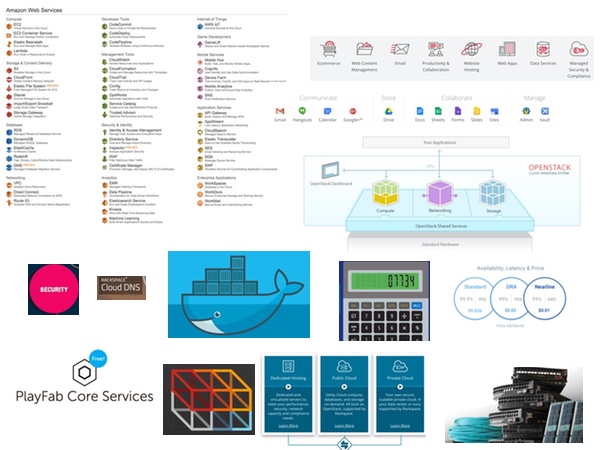
The AWS cloud offering continues to expand at a rapid rate, as reflected in its immense Management Console:
Amazon offers a variety of services that you certainly can't find all together from a single vendor, nor can you even easily find some from individual vendors. But there'sful an ever growing array of alternatives.
In 2015, Gartner researched the Magic Quadrant for Cloud Infrastructure as a Service, Worldwide. It showcased the leaders (Amazon, Microsoft and Google) and a handful of up and coming provider networks, both Fortune 500 companies such as IBM and larger startups such as Rackspace and Joyent:
Microsoft Azure and Google Cloud Compute are the two biggest competitors to AWS attempting to offer a growing stack of service offerings.
Google Cloud Compute
There's no simple visual way to see the scope of Google's offerings, but they have steadily grown to offer a moderate subset of AWS. Here's how they place their features into a discoverable hierarchy:
Computation
Compute Engine: Run large-scale workloads on virtual machines hosted on Google's infrastructure.
Preemptible VMs: Preemptible VMs are a low-cost choice for distributed and fault-tolerant workloads.
App Engine: A platform for building scalable web apps and mobile back ends.
Container Engine: Run Docker containers on Google's infrastructure, powered by Kubernetes.
Storage
Cloud Storage: Powerful, simple and cost effective object storage service with global edge-caching.
Nearline: A highly available, affordable solution for backup, archiving, and disaster recovery.
Cloud SQL: Store and manage data using a fully-managed, relational MySQL database.
Datastore: A managed, NoSQL, schemaless database for storing non-relational data.
Bigtable: Cloud Bigtable is a fast, fully managed, massively scalable NoSQL database service.
Networking
Cloud Networking: Connect your network to Google directly, via your carrier or using a secure VPN. Use reliable, resilient and low-latency DNS. Load balance traffic between Compute Engine instances using either HTTP or Network (TCP/UDP).
Big Data
BigQuery: Analyze Big Data in the cloud. Run fast, SQL-like queries against petabytes of data in seconds.
Dataflow: Dataflow is a real-time data processing service for batch and stream data processing.
Dataproc: Google Cloud Dataproc is a managed Spark and Hadoop service that is fast, easy to use, and low cost.
Datalab: An easy to use interactive tool for large-scale data exploration, analysis and visualization.
Pub/Sub: Connect your services with reliable, many-to-many, asynchronous messaging hosted on Google's infrastructure.
Services
Translate API: Create multilingual apps and translate text into other languages programmatically.
Prediction API: Use Google's machine learning algorithms to analyze data and predict future outcomes using a familiar RESTful interface.
Cloud Endpoints: Create RESTful services from your code and make them accessible to iOS, Android, and JavaScript clients using App Engine.
Cloud Monitoring: Gain insight into the performance and availability of your cloud-powered applications.
Cloud Deployment Manager: Developers can easily design, share, deploy and manage complex Google Cloud Platform solutions using simple, declarative templates.
Container Registry: Fast, private Docker image storage on Google Cloud Platform.
Cloud Logging: Manage all your log data for Compute Engine and App Engine to investigate and debug system issues, gain operational and business insights, and meet security and compliance needs.
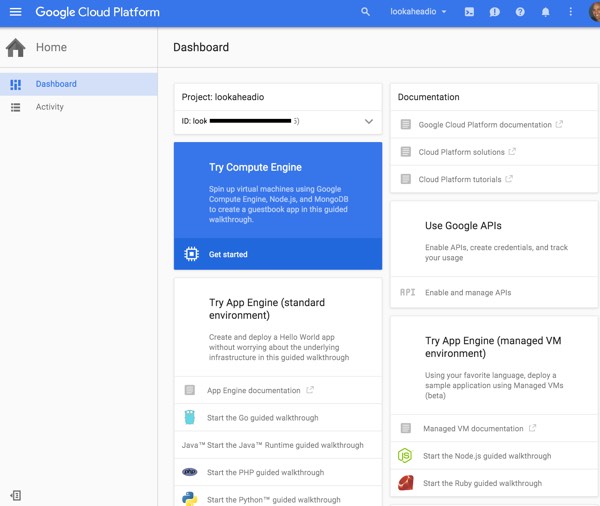
As you can see, there's a lot available. Here's the Cloud Platform Console:
Azure is Microsoft's most important growing product; it will help the company transform as Windows and Office application growth slow.
Here's a nice visual summary of Azure's features compared to Google and AWS above:
Azure is eager to get you on board. You start with $200 in credit, and keep going with free options. There's a pricing calculator which you can compare to the AWS calculator:
There are three well-known cloud providers that make a good effort at offering a variety of the services that AWS does.
Rackspace
Rackspace formally launched back in 1998 and has grown steadily to provide compelling cloud services. I'm a big fan of its Mailgun as well as its DNS offering, both of which I'll describe further below.
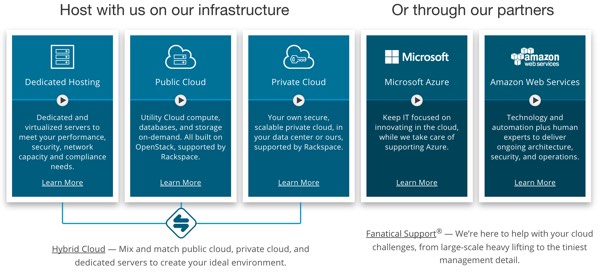
Here's how Rackspace categorizes its offerings:
You can visit the Rackspace Demonstration Site to see a bit of the control panel in action—but not much before you have to register.
One thing that's unique is that it offers its services both on its own hardware or powered by Azure or AWS (kind of a pseudo-alternative to AWS):
Full disclosure: I've done consulting work for RackSpace in the past. Generally, I've found the services of theirs that I've used to be quite good.
Joyent
I first used Joyent back in 2007 when they offered free hosting for the emerging Facebook application platform. It's grown a lot since then to offer a variety of cloud services that you can run on your hardware or theirs.
They offer a unique container focus perfect for launching and managing Docker containers.
IBM Cloud Computing
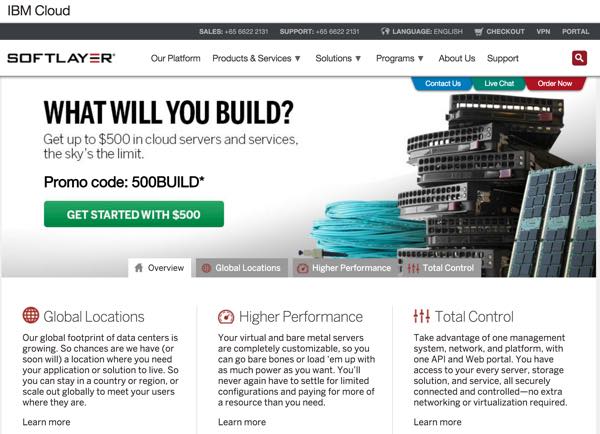
IBM's SoftLayer cloud offering isn't easy to find through the marketing presentation on their website, but it seems to have a positive, growing reputation. It also includes $500 of trial funds to get started:
Many of the Rest
As I researched this topic, I found a variety of other services that seemed to have some basic merit and usage that you may wish to explore:
OVH: The most common cloud services on a dedicated infrastructure.
Atlantic.net: Cloud VPS hosting, like Digital Ocean which I'll describe more below.
CloudSigma: More of an enhanced VPS host with some unique customization options.
Hewlett Packard's Helion Eucalyptus: "an open solution for building private clouds that are compatible with Amazon Web Services (AWS). Discover the benefits of moving public cloud workloads and data to your own private cloud."
I've noticed that the bigger companies like HP and IBM have the most unwieldy product names, making it easy to get lost in the clouds.
If you'd like to build and manage your own (or launch a competitor to AWS), there are two that I found:
1. Apache CloudStack
Apache CloudStack is "open source software designed to deploy and manage large networks of virtual machines, as a highly available, highly scalable Infrastructure as a Service (IaaS) cloud computing platform...a turnkey solution that includes the entire 'stack' of features most organizations want with an IaaS cloud: compute orchestration, Network-as-a-Service, user and account management, a full and open native API, resource accounting, and a first-class User Interface (UI)."
2. OpenStack
OpenStack "controls large pools of compute, storage, and networking resources throughout a datacenter, managed through a dashboard or via the OpenStack API. OpenStack works with popular enterprise and open source technologies making it ideal for heterogeneous infrastructure."
Service Specific Alternatives
Many Envato Tuts+ developers need cloud-based services for a vertical need but not a full stack. I've often found it easier to apply third-party solutions for specific needs and have moved away from Amazon for reasons I mentioned above.
Let's begin to explore some of the more common cloud verticals.
Virtual Servers
Obviously, there are endless numbers of hosting companies offering virtual hosting. The two that I've heard the best things about, besides some of the above, are Digital Ocean and Linode.
I haven't used Linode in a while, but it worked well when I did, and it has a solid reputation.
DNS Services
While many of us use our domain registrar's free DNS services, they are not always the fastest or most reliable. If you need a higher service level, SolveDNS publishes a monthly speed comparison of the major providers:
Verizon is impressively fast:
But they are a bit obtuse about pricing—I presume the technician meant monthly, which is pricey:
"We don't really disclose prices because it varies from case to case but roughly it will cost you $50 for the first 50 zones and $35 per additional 50 zones." - Verizon Route Chat Support
Rackspace offers free, sophisticated DNS hosting for free as long as you have an account:
A lot of people begin using AWS with its CloudFront and S3 storage and global content delivery. But there are a lot of options emerging in this field as well.
CloudFlare launched itself focusing on DDoS protection, which can be vital for many sites, and integrates this closely with its CDN services:
After I wrote about KeyCDN for Envato Tuts+, I decided to become a user and have been quite satisfied. It's simpler and more economical than AWS.
I've also written about Incapsula, another powerful security service which provides broad spectrum optimization, including CDN:
Data Storage and Backup
There are a wide variety of Data Storage and Backup services available.
Google Cloud Storage is a solid and effective alternative to AWS's various services. Two others I do not have experience which may be worth checking out include Iron Mountain and Mozy.
You may also want to investigate my series here on CloudBerry, which offers data storage exploration tools for AWS S3, Azure, and Google:
Email Broadcasting
When I used Amazon's Simple Email Service (SES), I found it difficult to configure, monitor and maintain. Ultimately, I found Rackspace's Mailgun to be much simpler and more reliable. This is often the case when you switch away from AWS's breadth of features which get limited usability attention and native language customer support and to startups that are focused and attentive. Amazon has too large a focus on development and not enough on product design and product management—you can see this in weaknesses across AWS's user experience.
There's also SendGrid, and while I'm not a fan of MailChimp due to their overzealous, unfair customer service (they shut down email lists of mine where we'd hand-collected emails in person during an initiative campaign), they offer Mandrill.
Yes, during that campaign, we married a corporation to a woman in Seattle to honor the absurdity of corporate personhood and its harmful effects on the United States (I thought you might need a humor break after all this cloud study):
Management Tools and Monitoring
Envato Tuts+ has a number of tutorials about New Relic, which is a highly reliable solution to website monitoring. It offers more focused, detailed features than AWS. Check out a couple of mine from Envato Tuts+:
I've also written about Stackify, which takes a direct path for development monitoring specializing in errors and logs:
Game Support
One area where AWS distinguishes itself is in its gaming features. One startup I've seen that's making a compelling alternative offering for game developers is PlayFab, who recently raised $7.4 million in venture capital funding:
PlayFab provides a sophisticated array of cloud-powered gaming infrastructure and APIs to speed game development. For more detail, download PlayFab's Technical White Paper (pdf).
Full disclosure: I'm an acquaintance of its CEO James Gwertzman, and we worked together at Microsoft.
Enterprise Applications
Certainly one of the greatest transitions of the past decade is the switch from desktop applications such as Office to cloud-based word processors, spreadsheets, etc.
I hope this tutorial has helped you get an overview of the landscape of options out there for you and your business (small and large)—they are immense. Obviously, I couldn't go into detail of the pros and cons of all the alternatives, but if you'd like to see us explore some of these more deeply, please add this to the comments below.
Ultimately, please let us know your experience with AWS and the alternatives that you've experimented with. You can also reach me directly on Twitter @reifman. And, be sure to browse my Envato Tuts+ instructor page to see some of my other tutorials.
A Jedi-style HoloLens hackathon proof of concept would let smart home owners control their connected gadgets through augmented reality, using simple gestures and glances. Check out the awesome video demo here.
A new startup called Scale, officially launching today, wants to make it easier for businesses to outsource their core processes and tasks that require people, not algorithms, to handle. This could include anything from appointment scheduling to more complicated matters like content moderation, transcriptions, and more. Today, many companies handle outsourcing themselves by hiring and… Read More
Jiobit is building a revolutionary chip that, using machine learning and contextual clues, could drastically improve the battery life of wearables. It's working on smartwatches for kids., but it has bigger plans for the future.
Google has fallen behind in the cloud computing market, outpaced by rivals like Microsoft and Amazon. However, the company hopes it can win new customers by offering not only computing power on tap, but also artificial intelligence. Earlier this year, Google announced its intention to offer cloud-based machine learning tools to customers, and from this week onwards, two of those APIS are going to be available to all in an open beta.
The first of these is a text analysis tool, which can be used to automatically extract key bits of information from written documents, or perform "sentiment analysis" to judge the mood and intent of the author. "For example," says Google, "digital marketers can analyze online product reviews or service...
La folie et le style Pokémon GO n’a pas fini de se décliner un peu partout. Dans l’Alabama, le Birmingham Zoo vient d’installer des pancartes sur les enclos de ses animaux qui reprennent le style des fameuses fiches Pokémon GO. Une adaptation express aux préoccupations du moment.
Cola, a messaging app that integrates apps into chats, is opening up its developer kit today to enable anyone to build new apps.
The updated version available today comes with 12 “bubbles” that are essentially applications that run inside the messaging app. Users can share weather and flight information, gifs, and more without creating accounts with individual tools. The… Read More
Fouiller un texte numérique est aujourd’hui aussi simple qu’un banal Ctrl-F. Les mots-clé remontent alors quasiment instantanément. Malheureusement, dans un livre, un manuel ou n’importe quel document imprimé. L’application mobile Ctrl-F sur Android permet justement de faire comme une recherche numérique. Diablement pratique ! En photographiant le passage qui vous intéresse dans un texte imprimé […]
Since its launch in 2008, Stack Overflow has become the go-to community for discussing programming-related questions. Now the service is launching a new product that aims to harness its community to build a repository of peer-reviewed technical documentation. Stack Overflow Documentation wants to be a complement and maybe even a replacement for existing instruction manuals and… Read More
Fresh off its $16 million funding round from earlier this spring, popular airfare prediction app Hopper is moving beyond simply helping travelers figure out when to fly in order to snag the best deal. With the launch of Hopper 3.0, out this morning, the app will now also make personalized recommendations regarding how to adjust your trip plans to save more money, as well as point users to… Read More
It’s a cloud. It’s pendant light. It is Nimbus Luminous!
I made this after my wife stared enviously at the cloud light in a dessert restaurant. =)
It is an easy, fun sized, and affordable project for a playroom.
Let’s get started!
Items:
Solleftea lantern x1
Hemma lamp x1
Old unused teddies x 2
Glue gun
Ledare LED 1000 lm x1 (white)
Osram LED 350lm x1 (warm)
1. Open and expand the Solleftea lantern (Ikea common sense) and set up the pendant light + LEDS.
Link both socket as above in a L-shape configuration. I used the socket mount as a holder for the extra long wires.
2. Dissection. Imagine yourself as Hannibal Lecter + Frankenstein.
Remove all the teddies’ innards and use it to create life.
3. Glue teddy’s innards to the lantern. Haphazardly as possible to give the cloud its unique identity.
Glue the cotton to the lantern using a glue gun. Be creative.
4. Now stuff the heart of the light into the innards-laden-lantern!
Après avoir fondé Cozy Cloud, Frank Rousseau n'en est plus directeur technique. Il a été révoqué en assemblée générale hier, suite à des divergences sur la stratégie. Contacté, il affirme vouloir attaquer l'entreprise, estimant la décision abusive.
25W, la puissance d’une ampoule standard, et pourtant elle parvient facilement à illuminer un salon. Imaginez alors une puissance équivalente à 100W ? Poussons le vice à 10 000W ? Toujours pas impressionnés ? Eh bien misons plus gros et faisons tapis avec une ampoule de 20 000W. Photonicinduction a testé cette ampoule 20kW, le résultat […]
Doppler Labs, the makers of the Here Active Listening system and the Here One headphones, has today announced the close of a $24 million follow-on Series B funding round led by Peter Chernin and The Chernin Group. New investors also contributed, including Kevin Efrusy, David Geffen, Dan Gilbert, Henry Kravis and Anton Levy, among others.
Doppler Labs has been on the scene since 2014, slowly… Read More
We live in an age with no shortage of robot animals — they seem to multiply like little unstable rabbits, except they're hardly ever rabbits — but none have proven themselves quite so relatable as this one. This is PneuHound, and while its name doesn't quite slide off the tongue, its body is definitely doing some sliding... whenever it tries to move in any way at all. Haha, same!
As Gizmodo points out, PneuHound (or PH, as I will refer to him from here on out to indicate an intimate relationship) was built at Hosoda Laboratory at Osaka University, and it's much smaller than other robot dogs, like Boston Dynamics' SpotMini. But I'm not interested in PH's size, although its lack of bulk does contribute to its overall aesthetic, which...
I’ve fallen asleep in some seriously public places over the years, like on the subway and in college common rooms. When I look back on it, that was a crazy thing to do. I really had faith no one would steal my wallet or cut my hair while I was away from the real world. Sleep is a mysterious time that I love, so when I got a pitch for the ZEEQ smart pillow, I knew I had to try it out.
The pillow, which launched on Kickstarter today, comes with eight speakers, a microphone, a three-axis gyroscope, and a 5000 mAh battery tucked inside it. The pillow can detect snoring through its microphone, register motion with its gyroscope, and play music through its speakers. ZEEQ’s creators told me their inspiration came from their own sleep...
YouCanHave.it répond à une réalité vécue par plus de 22 millions de Français possédant une télévision : Marc et Sophie ont décidé de se faire une petite soirée Télé. Bien installés sur leur canapé, ils commencent à regarder le programme qu’ils ont choisi et de nombreuses choses qu’ils voient leur font envie : destinations, vêtements, bijoux, etc. Or, le seul moyen qu’ils aient d’essayer de retrouver ce qui leur plaît est de multiplier leurs recherches sur le net. Une perte de temps et une difficulté indiscutable pour essayer de trouver ce qu’ils cherchent qui ne se concluent pas toujours par une réussite.
YouCanHave.it est l’application gratuite incontournable pour regarder la télévision autrement : « Je vois, je veux, je trouve !! ». C’est une application mobile second écran enrichissant les contenus télévisuels avec des compléments sous forme de textes, d’images ou de vidéos. YouCanHave.it met l’innovation au service de tous en permettant aux utilisateurs d’accéder aux informations et/ou produits / services associés au programme qu’ils regardent, classés selon différentes catégories et proposés en fonction des besoins et goûts propres à chaque téléspectateur (One-2-One vs One-2-Many).
Nos usagers cible sont les 98,5% de la population française équipée d’un écran de télévision et d’un smartphone / tablette, toutes tranches d’âge, toutes catégories sociaux professionnelles, et toutes cultures confondues.
Nos clients cible sont :
Les annonceurs, les marques qui peuvent ainsi bonifier leur placement de produit et/ou profiter d’une publicité innovante et ciblée grâce au profilage des téléspectateurs.
Les producteurs et les diffuseurs qui valorisent leur production en complétant leur diffusion par des informations associées (making-of, anecdotes, rush, lieux de tournages, etc.)
Les personnalités publiques qui peuvent profiter d’une plus grande audience et d’une promotion pertinente
Les collectivités qui ont la possibilité de valoriser leur ville, leur département, leur région, leur politique
Génèse.
S&B Digital est une start up française spécialisée dans le marketing et le conseil. Elle a vu le jour grâce à la rencontre de 2 experts de la télévision numérique et du Digital Marketing qui ont décidé de révolutionner le monde de l’audiovisuel, des nouvelles technologies et de la publicité. Très vite rejoins par un expert financier et de 2 ingénieurs informatiques convaincus par le projet, S&B Digital se développe de jour en jour et s’agrandit en sachant toujours compléter son équipe par des personnalités fortes, engagées et créatives. Aujourd’hui, S&B Digital ouvre le champ de ses activités pour accompagner des jeunes entreprises et leur permettre de bénéficier de l’expérience des associés et de l’expertise de toute l’équipe dans des domaines variés et complémentaires.
Ingrédient secret.
Il y a, à ce jour, deux concurrents sur le marché français, et un sur le marché américain. Ces trois Start up se concentrent exclusivement sur l’aspect commercial. Nous couvrons, quant à nous, l’enrichissement en Informations, en produits, et en services. De plus, les concurrents n’adressent que la partie « fashion » là où nous proposons neuf catégories supplémentaires. Enfin, YouCanHave.it est le seul à permettre la saisie en temps réel des publications, pendant la diffusion du programme, ou de son replay et est déjà prête pour son internationalisation.
Traction.
YouCanhave.it s’adressant à plusieurs cibles, BtoB et BtoC, diverses stratégies ont été mises en place. Promotion réseaux sociaux et événementiels, concours commerciaux, stratégie de communication globale, publicités pour les BtoC. Création d’un blog sur la télévision, en général, internationale permettant l’analyse, la réflexion, l’approfondissement de certains sujets, tout comme apportant un aspect fun et quelques fois léger. Prospection (calling, mailing), référencement (création de fichiers), présentation (individuelle), participation à des concours, à des salons spécialisés, organisation d’événementiels (présentation collective), pour les BtoB.
Équipe.
L’équipe est composée de collaborateurs qualifiés et spécialisés dans des secteurs complémentaires : technologie, commerce et marketing, communication, et finances.
Nos valeurs et notre culture se déclinent sur trois axes :
Innovation / « Ce qui est, est déjà fait, ce qui n’est pas est à penser et à réaliser », c’est pourquoi nous mettons notre créativité au service de l’innovation et nous nous efforçons d’être précurseurs dans tout ce que nous entreprenons.
Engagement Responsable / L’intérêt du client est au centre de nos préoccupations, nous cherchons à améliorer son quotidien et non pas à lui créer des nouveaux besoins. Nous mettons en place une approche améliorée de la RSE, la communication responsable qui sera notre ligne de route (responsabilité sociétale et environnementale)
Expertise / Chacun des membres de notre équipe est expert dans son domaine, reconnu par ses pairs, ce qui garantit la qualité et l’efficacité de nos services.
Marché.
Près de 22 millions de Français qui regardent la télévision (qui demeure en 2015, l’activité de loisir n°1 des Français) au moins une fois par jour. Une étude de The 2014 Nielsen Research Report montre que 84% des possesseurs de smartphone et de tablette utilisent leur appareil comme second écran lorsqu’ils regardent la télé, 52% d’entre eux effectuent des recherches en relation directe avec ce qu’ils regardent. Cette tendance augmente chaque jour un peu plus. Selon une étude de l’UDA (l’Union des Annonceurs) en 2014, la publicité TV n’a cru que très faiblement (+0,1% et –3,5% en 2013). Au contraire, elle a explosé sur le mobile (+35%). Les ventes en lignes représentent d’ailleurs 64,9 Milliards d’Euros en France en 2015 selon une étude de la FEVAD. Le marché international, que nous visons dans un avenir proche, représentait quant à lui 1 552 milliards d’euros dès 2013.
Financement & modèle éco.
Une entreprise rentable dès 2017, internationale dès 2019. Nous ouvrons peu à peu notre société aux investisseurs, une première phase d’ouverture aux business angel est en cours, une seconde aura lieu courant octobre. Nous envisageons une dernière levée premier trimestre 2017 via des fonds d’investissements. Nos sources de revenus sont diversifiées et vont de l’affiliation standard à la valorisation des données en passant par d’autres modèles possibles que nous évaluons au fur et à mesure.
Échecs.
Les premières difficultés rencontrées ont été liées aux premiers associés : 2 des membres de la première équipe n’étaient pas entièrement investis, sur le terrain du temps, comme sur l’aspect financier, laissant l’entier poids de la start up reposer sur les épaules de leur associé. Ces 2 membres ont fini par quitter la société, et le projet a failli échoué. Les nouveaux associés ont alors repris le flambeau sur des bases où l’investissement personnel et financier de chacun sont définies et primordiales.
La seconde est d’ordre de conseil banquier : lorsque le compte de la société a été ouvert, l’agence nous a orienté vers un compte pro, qui s’est avéré obsolète pour une start up et qui a compliqué de nombreuses transactions par des problèmes d’habilitation, rallongeant les délais nécessaire pour récupérer des fonds et nécessitant des frais d’avocats supplémentaires. Il s’avère que pour les start up, il faut ouvrir un compte en banque d’affaire. Le transfert vers une banque spécialisée sera effectif dès cet été.
Demain.
Nous souhaitons devenir la référence internationale en matière de publicité digitale non intrusive, et de bonification de l’utilisation du second écran. Déclencher de nouvelles habitudes dans la relation téléspectateurs – programme télévisés, permettant à l’usager de reprendre le contrôle sur ce qu’il voit, entend et regarde à la télévision en ayant le réflexe YouCanHave.it pour compléter son expérience télévisuelle, rechercher des informations supplémentaires, contradictoire et/ou approfondies, et tout, ce qui en lien avec ce qu’il visionne, pourra lui permettre de répondre à ses attentes, envies et besoins.
What else ?
YouCanHave.it est l’application qui dresse les bases de la télévision du futur sans publicités intempestives et avec le pouvoir d’en avoir le plein contrôle, dans la logique : « Je vois, je veux, j’ai mais ne subit plus ». Elle permettra, aussi, dans un proche avenir de connecter tous les spectateurs d’un programme télévisés afin qu’ils puissent échanger, partager ensemble sur ce qu’ils regardent au moment où ils le regardent, et échanger aussi avec les acteurs/animateurs/invités d’une émission lors de sa diffusion.
Que faire quand on ne peut pas emmener son chien avec soi, et qu’il faut le laisser seul à la maison… Solution pour que Pitchoune ait un peu de compagnie, lui laisser la télévision. Malheureusement, s’il préfère Motus aux Feux de l’amour, le toutou ne peut pas changer de chaîne. Enfin, ça, c’était avant. La […]
GIF de l'auteur. Toutes les images sont publiées avec l'aimable autorisation de l'artiste.
Dans ses dernières créations, Neil Mendoza a tendance à joindre le technologique au biologique. Dans Eggsistential Angst, par exemple, l’artiste britannique basé à Los Angeles couplait un pendule avec un œuf. Dans sa dernière œuvre, Hamster Powered Hamster Drawing Machine, il crée exactement ce que le titre annonce : une machine à dessiner actionnée par un hamster.
Comme pour toute roue pour rongeur, elle est mise en mouvement par la petite bête qui court, produisant l’énergie nécessaire à l’enclenchement de la machine à dessiner, grâce à un système de CAM, un bras mécanique et un crayon placé au centre d’une autre roue dessinent sur le papier. Un projet né de la fascination de Mendoza pour les machines à dessiner assistées par ordinateur, comme il le confie à The Creators Project.
« Il y a quelque chose de magique à regarder ces objets produire un truc qui a l’air fait à la main. » Familier des logiciels pour CAM, Mendoza a décidé d’ajouter un hamster, estimant que ce rongeur est sous-représenté dans le monde de l’art. Il est ici montré via un petit écran circulaire connecté à un appareil contrôlant la vitesse de la machine à dessiner via le logiciel openFrameworks.
« Une machine en particulier m’a inspiré, elle a été créée au XVIIIe siècle par le Suisse Pierre Jaquet-Droz, avec l’aide de son films Henri-Louis et Jean-Frédéric Leschot », note Mendoza. « Elle s’appelle The Writer et est l’un des automates les plus complexes qui aient survécu. Il s’agit d’un enfant assis à un bureau et écrivant à la plume. »
« En action, il écrit un texte jusqu’à 40 caractères, trempant sa plume dans l’encre de temps à autre, et remuant même le poignet pour éviter que l’encre ne coule », ajoute-t-il. « Ses yeux suivent le texte et sa tête bouge lorsqu’il prend de l’encre. L’une des choses les plus remarquables, c’est que le texte qu’il écrit est programmable. Certains considèrent que cet automate est l’un des premiers exemples de programmation. »
Si la machine de Mendoza n’est pas un automate du même gabarit, on ne se lasse pas de voir courir ce hamster, ignorant tout du dessein artistique auquel il est livré, perdu dans une course perpétuelle.
Hamster Powered Hamster Drawing Machine est exposé à la galerie Young Projects, à Los Angeles, jusqu’au 19 août 2016, aux côtés de dessins produits. Pour en savoir plus sur le travail de Neil Mendoza, cliquez ici.
Google's upcoming Daydream platform wants to keep you in virtual reality even in Chrome. The latest build of Chrome Dev for Android lists a feature called VR Shell, which would allow you to view any website in VR.
En dévoilant son robot domestique, la start-up chinoise Roobo se positionne en futur acteur majeur des nouvelles technologies.
Anno 0 de la robotique domestique
Après Buddy, Zenbo, Jibo et consorts, l’année 2016 est décidément celle de la robotique domestique. Les machines quittent peu à peu les usines pour intégrer nos foyers. Un essor notamment dû aux progrès technologiques en termes de miniaturisation de l’électronique mais aussi et surtout aux avancées de l’intelligence artificielle et de la connectivité. Les algorithmes informatiques sont de plus en plus poussés et performants, au point de créer des machines capables d’apprendre.
Fini les aspirateurs et les tondeuses autonomes. Les machines deviennent chaque année plus intelligentes et peuvent réaliser un nombre de tâches toujours plus variées. Un appareil n’est plus conçu pour remplir une seule et unique mission. Grâce à l’internet des objets, de nombreuses entreprises se sont lancées sur le créneau du robot assistant personnel. Certains ont fait le choix d’un design simpliste comme Google et Amazon qui travaillent chacun sur un assistant personnel matérialisé mais statique, qui prendrait en charge toutes les fonctionnalités de la maison : réglage du chauffage, verrouillage des portes, surveillance et gestion des lumières. Ces dernières figurent parmi les missions principales assumées par ces systèmes intelligents. D’autres ont choisi de créer des assistants personnels mobiles et intelligents pour conjuguer le potentiel de l’IoT aux besoins des consommateurs. Rien que cette année, des BIG I, Zenbo et AI.Mergence ont été dévoilés. Et des projets de longue date comme le petit français Buddy, vont enfin pouvoir être commercialisés.
Grâce à la connectivité, tous ces appareils peuvent enfin être reliés. Et si acheter une bouilloire connectée ne fait absolument pas partie de vos priorités, sachez que si on l’inscrit dans un système global, son utilisation peut devenir intéressante.
La robotique domestique entre dans une nouvelle ère. Exit les simples machines fonctionnelles, c’est au tour des robots mobiles, intelligents et multitâches d’entrer dans nos maisons.
Domgy, le chien robotisé
Les machines sont particulièrement prisées dans les pays d’Asie, et notamment au Japon et en Chine, qui figurent parmi les pays les plus robophiles de la planète. Cette énorme demande insatisfaite et très enthousiaste représente un créneau en or. De plus de plus d’entreprises s’attaquent donc au grand public. Et qui dit grand public… dit domestique.
Si nous autres européens faisons preuve d’une certaine méfiance à l’égard des machines, les chinois sont beaucoup plus enthousiastes à l’idée d’en accueillir une chez eux. Roobo l’a bien compris et vient de lancer l’un des touts premiers systèmes autonomes pour la maison. Domgy (anagramme de My Dog) est un compagnon de vie non invasif (22 cm de haut) qui se charge de gérer votre foyer. La start-up basée à Pékin s’est en réalité occupée avant tout de la partie software, puisque c’est la société coréenne Innovative Play Lab dans laquelle Roobo a investi qui a développé le modèle hardware.
En bref Domgy réunit peu ou proue toutes les capacités habituelles d’un appareil domestique : assistance personnelle (comme pour les téléphones), assistance domotique (gestion centralisée de tous les appareils électroniques de la maison), divertissement (jeux, danse, musique et vidéos), gardien de sécurité (patrouille pendant votre absence et vous prévient en cas d’intrusion, peut également configurer des zones à risques pour les enfants et les personnages âgées)… Et ce grâce à des technologies désormais courantes comme la reconnaissance faciale, gestuelle et sonore, des capteurs en tout genre pour se déplacer sans accrocs dans la maison, un logiciel avancé qui lui permet de répondre habilement aux questions et ainsi de suite. Domgy peut également servir de téléconférencier pour vous mettre en relation avec vos proches. Il est même possible d’en prendre le contrôle à distance pour se déplacer directement dans la maison.
“Domgy a été développé pour servir de compagnon, d’ami. La solitude est l’un des principaux maux de nos sociétés, et les animaux peuvent parfois combler ce vide” explique Bruce Liu, co-fondateur et CEO de Roobo, “nous avons donc créé un personnage avec sa personnalité propre capable de reconnaître votre visage et votre voix et vous parler comme un ami. Il vous aide à envoyer des messages à vos proches et à surmonter votre solitude” résume-t-il.
Pour assumer son rôle, Domgy a été équipé d’un processeur MTK, d’une caméra Raspberry Pi 5M, d’une connexion wi-fi, bluetooth et infrarouge et d’un écran tactile. Côté détection, il embarque des capteurs de lumière, de température, d’humidité ainsi qu’un accéléromètre et un gyroscope pour ses déplacements. Enfin, le petit robot dispose d’une autonomie de 4 à 6 heures à une vitesse d’environ 5 km/h. Mais heureusement, lorsque sa batterie est presque épuisée, il se rend tout seul à sa station de chargement.
Roobo un acteur majeur de la robolution ?
La start-up pékinoise n’en est pas à son premier coup d’essai. Depuis 2014, elle a déjà lancé un appareil éducatif à destination des enfants, proche des modèles Amazon Echo et de Google Home, qui se contrôle par la voix et particulièrement abordable avec un prix avoisinant les 135€. Mais Roobo ne se limite pas à la robotique humanoïde. Elle officie dans les technologies les plus prometteuses. Son casque Idealens surfe ainsi sur la vague de la réalitié virtuelle et son drone Skye Obit comme le “drone social” qui suit son utilisateur. En plus de cela, l’entreprise s’attaque également au marché des wearables avec son casque connecté Runbone pour aider les sportifs à mesurer leurs performances. De quoi faire de Roobo l’un des acteurs majeurs du marché chinois de l’électronique dans les prochaines années.
La production de Domgy a déjà commencé fin 2015 et sa commercialisation est prévue dans les prochains mois.










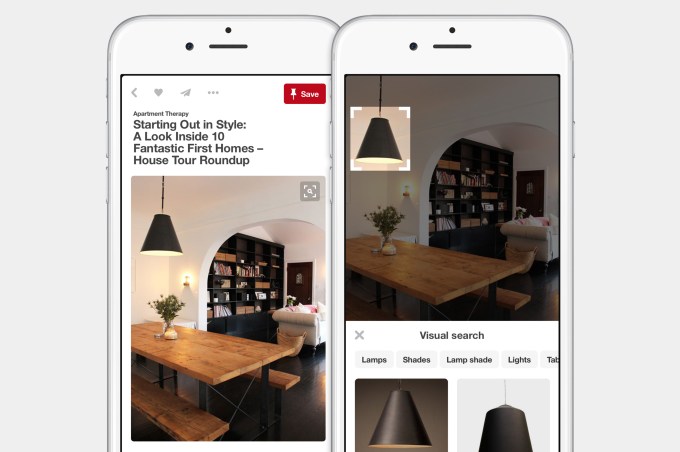 Video has generally been available — and is often shared — on Pinterest, but it hasn’t quite received the same treatment that the company’s traditional content has seen.
Over the next few months, however, that will be changing. Pinterest is starting to test ways to get video running directly on its services, including building a native video player. And beyond that…
Video has generally been available — and is often shared — on Pinterest, but it hasn’t quite received the same treatment that the company’s traditional content has seen.
Over the next few months, however, that will be changing. Pinterest is starting to test ways to get video running directly on its services, including building a native video player. And beyond that… 





















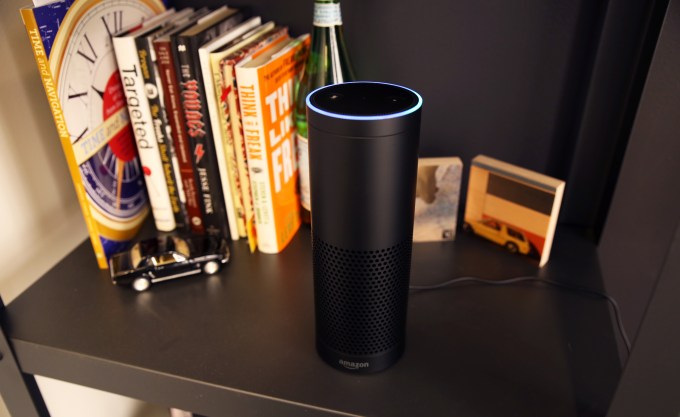 Amazon’s plucky little voice assistant already has a fairly broad skill set – but gaming has never really been Alexa’s strong suit. Granted, the AI is no Xbox, but that doesn’t mean there isn’t some potential for a little gaming fun. A few developers have already created titles for the platform, adventure games that are a bit of a throwback to the text-based…










 A new startup called Scale, officially launching today, wants to make it easier for businesses to outsource their core processes and tasks that require people, not algorithms, to handle. This could include anything from appointment scheduling to more complicated matters like content moderation, transcriptions, and more. Today, many companies handle outsourcing themselves by hiring and…


 Cola, a messaging app that integrates apps into chats, is opening up its developer kit today to enable anyone to build new apps.
The updated version available today comes with 12 “bubbles” that are essentially applications that run inside the messaging app. Users can share weather and flight information, gifs, and more without creating accounts with individual tools. The…
Cola, a messaging app that integrates apps into chats, is opening up its developer kit today to enable anyone to build new apps.
The updated version available today comes with 12 “bubbles” that are essentially applications that run inside the messaging app. Users can share weather and flight information, gifs, and more without creating accounts with individual tools. The… 
 Since its launch in 2008, Stack Overflow has become the go-to community for discussing programming-related questions. Now the service is launching a new product that aims to harness its community to build a repository of peer-reviewed technical documentation. Stack Overflow Documentation wants to be a complement and maybe even a replacement for existing instruction manuals and…
  Fresh off its $16 million funding round from earlier this spring, popular airfare prediction app Hopper is moving beyond simply helping travelers figure out when to fly in order to snag the best deal. With the launch of Hopper 3.0, out this morning, the app will now also make personalized recommendations regarding how to adjust your trip plans to save more money, as well as point users to…


 Doppler Labs, the makers of the Here Active Listening system and the Here One headphones, has today announced the close of a $24 million follow-on Series B funding round led by Peter Chernin and The Chernin Group. New investors also contributed, including Kevin Efrusy, David Geffen, Dan Gilbert, Henry Kravis and Anton Levy, among others.
Doppler Labs has been on the scene since 2014, slowly…
Doppler Labs, the makers of the Here Active Listening system and the Here One headphones, has today announced the close of a $24 million follow-on Series B funding round led by Peter Chernin and The Chernin Group. New investors also contributed, including Kevin Efrusy, David Geffen, Dan Gilbert, Henry Kravis and Anton Levy, among others.
Doppler Labs has been on the scene since 2014, slowly… 


 GIF de l'auteur. Toutes les images sont publiées avec l'aimable autorisation de l'artiste.