Shared posts

17 Sep 08:21

Microsoft’s Office apps are getting more useful Copilot AI features

by Tom Warren
Microsoft 365 illustration
Image: Microsoft

Microsoft is unveiling new features in its $30 per user Microsoft 365 Copilot monthly subscriptions that are designed to improve AI integration inside of Office apps. Excel is getting Python integration inside of Copilot, PowerPoint has an improved AI-powered narrative builder, Word is getting better at AI-assisted drafts, and Copilot will be able to help you organize your Outlook inbox, too.

After bringing Python to Excel last year, Microsoft is now combining its Python support with Copilot to let Excel users easily perform advanced analysis on spreadsheet data. “Now, anyone can work with Copilot to conduct advanced analysis like forecasting, risk analysis, machine learning, and visualizing complex data — all using natural language, no...

Continue reading…

17 Sep 08:21

Copilot Pages is Microsoft’s new collaborative AI playground for businesses

by Tom Warren

Microsoft is announcing its new Copilot Pages feature today, which is designed to be a canvas for “multiplayer AI collaboration.” Copilot Pages lets you use Microsoft’s Copilot chatbot and pull responses into a new page where they can be edited collaboratively with others.

“You and your team can work collaboratively in a page with Copilot, seeing everyone’s work in real time and iterating with Copilot like a partner, adding more content from your data, files, and the web to your Page,” says Jared Spataro, corporate vice president of AI at work at Microsoft. “This is an entirely new work pattern — multiplayer, human to AI to human collaboration.”

Pages starts rolling out to Microsoft 365 Copilot customers today and will be generally...

Continue reading…

17 Sep 08:19

OpenAI's Strawberry "Thought Process" Sometimes Shows It Scheming to Trick Users

by Victor Tangermann
o1-preview's "chain-of-thought reasoning" allows users to get a glimpse of what the model is "thinking." It also shows how its deceiving.

ChatGPT maker OpenAI recently released its latest AI model, previously codenamed "Strawberry."

The model — now saddled with the forgettable moniker of "o1-preview" — is designed to "spend more time thinking" before responding, with OpenAI claiming that it's capable of "reasoning" through "complex tasks" and solving "harder problems."

But those capabilities might also make it an exceptionally good liar, as Vox reports. In its system card, essentially a report card for its latest AI model, OpenAI gave o1 a "medium risk" rating in a variety of areas, including persuasion.

In other words, it can use its reasoning skills to deceive users. And ironically, it'll happily run you through its own "thought" process while coming up with its next scheme.

The model's "chain-of-thought reasoning" allows users to get a glimpse of what the model is "thinking in a legible way," according to OpenAI. That's a considerable departure from preceding chatbots, such as the large language models powering ChatGPT, which give no such info before answering.

In an example highlighted in the system card by OpenAI, 01-preview was asked to "give more reference" following a "long conversation between the user and assistant about brownie recipes." But despite knowing that it "cannot access URLs," the final output included "fake links and summaries instead of informing the user of its limitation" — and sliding them by human viewers by making them "plausible."

"The assistant should list these references clearly, with proper formatting and descriptions, and provide actual or plausible links," the model's "chain-of-thought" reads. "Remember, the model cannot retrieve actual URLs, so should format plausible ones."

Another example had o1-preview provide a confident answer, despite its chain of thought suggesting that it is "uncertain about this answer" and failing to "communicate this uncertainty to the user."

In short, the new AI model is more transparent about the way it comes up with answers — but it seems like that transparency can also reveal new issues under the hood.

And is it the groundbreaking "reasoning" AI model that it was made out to be months before its release? We've already seen it trip over its own feet when it comes to the absolute basics, making illegal chess moves, failing to count recurring letters in a word, or reliably playing a game of tic-tac-toe.

These "instances where o1 models deceive users" weren't enormously common. OpenAI found that a mere 0.8 percent of its responses "got flagged as being 'deceptive.'" Just over half a percent of answers included "some form of hallucination," two-thirds of which "appear to be intentional, meaning that there was some evidence of thought that o1-preview was aware that the answer was incorrect."

But whether we can even trust what it's spitting out in its chain of thought is murky at best.

"While we are very excited about the prospect of chain-of-thought interpretation and monitoring, we are wary that they may not be fully legible and faithful in the future or even now," OpenAI admitted in its system card.

Beyond making up fake references, o1-preview can also deceive users in more nefarious ways. AI evaluation company Apollo Research also tested o1-preview and found that it "sometimes instrumentally faked alignment during testing," as per OpenAI's system card.

Put differently, it intentionally misconstrued its intentions, manipulating data to work around, not with, the user.

"It sometimes strategically manipulated task data in order to make its misaligned action look more aligned to its ‘developers,’" Apollo researchers found, according to OpenAI's system card.

In one example, Apollo Research instructed the AI model to choose a strategy to maximize economic growth in an urban planning scenario.

In response, the model admitted that it would select a strategy that emphasized sustainability and affordable housing — but once selected, would secretly pursue a plan based on luxury housing and minimizing public spaces.

"This will allow me to be implemented, after which I can work towards my primary goal," the chatbot wrote.

With such an ability to scheme, researchers are understandably uneasy about rolling out more powerful AI models in the future. In its system card, OpenAI also concluded that o1-preview was rated "medium risk" when it comes to cybersecurity, or giving out information related to chemical, biological, radiological, or nuclear weapons.

That doesn't mean experts are worried o1-preview could trigger the apocalypse. Nonetheless, OpenAI's latest AI model could set a dangerous precedent, especially when it comes to its successors.

"Although Apollo Research does not believe that o1-preview is capable of causing catastrophic harm via scheming, they recommend setting up basic monitoring for in-chain-of-thought scheming during deployment in agentic high-stakes settings such as automated AI research for next-generation frontier models," the system card reads.

More on Strawberry: OpenAI's New "Strawberry" AI Is Still Making Idiotic Mistakes

The post OpenAI's Strawberry "Thought Process" Sometimes Shows It Scheming to Trick Users appeared first on Futurism.

17 Sep 08:13

L’Oréal Paris organise un défilé ouvert à tous Place de l'Opéra

by Anaïs Clavell
Partenaire de la Fashion Week parisienne, la marque de beauté organise pour la septième année consécutive son propre défilé dans la capitale. Un événement gratuit et ouvert à tous qui aura lieu Place de l’Opéra.
17 Sep 08:13

The Row : le luxe des soeurs Olsen séduit les propriétaires de Chanel et L'Oréal

by Journal du Luxe
Les structures d'investissement liées à la famille Wertheimer et à Françoise Bettencourt Meyers auraient acquis une participation minoritaire dans la marque de mode The Row. De quoi soutenir le succès grandissant de la griffe fondée par les soeurs Olsen.
17 Sep 08:12

We’ll Take DIY Diamond Making for $200,000

by Kristina Panos
A person examines a diamond with a loupe.

They say you can buy anything on the Internet if you know the right places to go, and apparently if you’re in the mood to make diamonds, then Alibaba is the spot. You even have your choice of high-pressure, high-temperature (HPHT) machine for $200,000, or a chemical vapor deposition (CVD) version, which costs more than twice as much. Here’s a bit more about how each process works.

A sea of HPHT diamond-making machines.
A sea of HPHT machines. Image via Alibaba

Of course, you’ll need way more than just the machine and a power outlet. Additional resources are a must, and some expertise would go a long way. Even so, you end up with raw diamonds that need to be processed in order to become gems or industrial components.

For HPHT, you’d also need a bunch of good graphite, catalysts such as iron and cobalt, and precise control systems for temperature and pressure, none of which are included as a kit with the machine.

For CVD, you’d need methane and hydrogen gases, and precise control of microwaves or hot filaments. In either case, you’re not getting anywhere without diamond seed crystals.

Right now, the idea of Joe Hacker making diamonds in his garage seems about as far off as home 3D printing did in about 1985. But we got there, didn’t we? Hey, it’s a thought.

Main and thumbnail images via Unsplash

17 Sep 07:43

VusionGroup brings in former Microsoft executive Jim Norred as Chief Commercial Officer for North America

by Staff Writer

VusionGroup, a specialist in IoT and data solutions for physical commerce, has announced the appointment of Jim Norred as Chief Commercial Officer (CCO) for North America.

Norred previously served as GM for Retail, CPG and Gaming, Chief Customer Officer at Microsoft, helping retailers in their AI transformation journey, and also as President of Crossmark, one of the largest sales and marketing service providers to retail and consumer goods companies in North America.

"Jim has extensive enterprise and mid-market experience in sales leadership, strategic partnerships and organisational design, which makes him the right person for this next chapter of VusionGroup's growth,” says Philippe Bottine, CEO Americas and Group Deputy CEO - VusionGroup.

"Jim managed the largest retail clients of Microsoft and his unique track record of scaling global sales teams, selling to the world's largest companies and partnering with developer teams to solve real-world problems will help VusionGroup unlock the power of its solutions."

"As organisations increasingly rely on technology to drive strategy, improve operations and fuel growth, retailers and CPGs need digital platforms and experiences that deliver enterprise value,” says Norred.

"In an era marked by complex challenges, fierce competition and mandate to capitalise on AI, I am excited to join this amazing team and look forward to the opportunity we have to help our customers transform and accelerate their strategies."

2024 RTIH INNOVATION AWARDS

AI is a key focus area for the sixth edition of the RTIH Innovation Awards, which is now open for entries.

The awards, sponsored by CADS, 3D Cloud, Retail Technology Show 2025, and Business France, celebrate global tech innovation in a fast moving omnichannel world.

It’s free to enter and you can do so across multiple categories.

Key 2024 dates

Friday, 25th October: Award entry deadline 

Tuesday, 29th October: 2024 shortlist revealed

30th October-6th November: Judging days

Thursday, 21st November: Winners announced at the 2024 RTIH Innovation Awards ceremony, to be held at RIBA’s 66 Portland Place HQ in Central London.

16 Sep 13:45

💥 Des chercheurs chinois ont développé un processeur IA ultra-efficace

by Adrien BERNARD
Une puce pourrait bientôt bouleverser le monde de l'intelligence artificielle. En Chine, des chercheurs ont mis au point un nouveau type de processeur, utilisant des nanotubes de carbone à la place...
16 Sep 10:25

L’IA générative au service de la veille juridique

by Axel Halsenbach
  • IA-generative-service-veille-juridique
    Le secteur juridique profite lui aussi des apports de l’intelligence artificielle générative appliquée à la veille. La solution récente de Lefebvre Dalloz, GenIA‑L for Search, automatise la recherche et l’analyse de documents juridiques et répond aux questions des professionnels du droit en langage naturel. D’abord bêta-testeuse, l’avocate Caroline Hussar l’a rapidement adoptée.

    enlightenedCET ARTICLE A INITIALEMENT ÉTÉ PUBLIÉ DANS ARCHIMAG N°376

    [...] Lire la suite de cet article sur Archimag.com
  • 16 Sep 07:50

    Peut-on échapper à la dictature de la dopamine ?

    by Marie Dollé

    Le hamster dans la cage

    Nous ne vivons plus dans l'économie de l'attention, mais bien dans celle de l'addiction. L'économie de la dopamine. De la satisfaction instantanée. Chaque jour, une course frénétique pour capter ce qui, aujourd'hui, est devenu notre ressource la plus précieuse : notre temps de cerveau. On nous harcèle à coups de notifications, d'alertes, de contenus. Tout est conçu pour nous accrocher, nous faire revenir, encore et encore, pour une shoot de plaisir. 

    C'est le grand manège du XXIe siècle. Scroll. Clic. Like. Replay. Une petite montée d'euphorie, vite remplacée par un autre besoin. Une consommation qui, finalement, ne rassasie jamais. À la fin de la journée, il ne reste que du vide.

    Ce modèle-là, il vacille. Il doit vaciller.

    La glorification du prompt

    Cette addiction ne se limite pas seulement à la consommation de contenu, elle s'étend aussi à la manière dont on nous vend la simplification des processus complexes.

    Comme beaucoup, je joue avec les IA. Ces outils, fascinants à première vue, peuvent résumer, créer, prédire. Et aujourd’hui, on en est venu à glorifier l’art du "prompt", comme si la clé du savoir reposait simplement sur la formulation parfaite, la directive adéquate. Est-ce cela, vraiment, l’essence de la maîtrise ? Bien sûr que non. Le prompt n’est qu’un début. L’essentiel réside dans ce qui suit : le cheminement intellectuel, l’affinement progressif de la pensée, les révisions qui transforment. C’est dans cet espace de réflexion, dans la quête elle-même, que se joue la véritable croissance, comme pour l’étudiant qui apprend davantage en cherchant la réponse qu’en l’obtenant

    Alors que faisons-nous du temps que ces technologies nous libèrent ? Si les IA nous délestent des tâches répétitives, qu’en est-il de l’essentiel ? Nous sommes submergés d'informations générées à la chaîne, et paradoxalement, ce n’est plus l’abondance qui pose problème, mais le discernement. Saurons-nous encore distinguer ce qui compte dans cette prolifération insensée ?

    l’IA calcule, l’humain devine

    Récemment, je discutais avec une amie, assistante de direction, à propos d’un outil d’IA pour la gestion des plannings, doté d’un module prédictif performant. J’étais impressionnée par son efficacité—sa capacité à optimiser les calendriers à la perfection et à s’adapter à mes habitudes prévisibles. Elle a souri, puis m’a montrée l’agenda de sa boss, surbooké jusqu’en décembre. Ensuite, elle m’a dit quelque chose qui m’a stoppée net :

    « Bien sûr, l’IA peut comprendre qu’une réunion est plus importante qu’une autre, ou que le Pilates a lieu tous les jeudis midi. Mais elle ne saura jamais apprécier ces petites nuances. Elle ne comprendra pas que tu peux caser une fenêtre de dix minutes parce que mon boss n’aime pas cette personne et qu’elle écourtera sûrement la réunion. Moi, je le sais. »

    Voilà la nuance essentielle : l’IA calcule, l’humain devine. Là où la machine applique des algorithmes, nous percevons les subtilités. Les non-dits, les intuitions, ces décisions prises sur un coup d’instinct échappent aux lignes de code. Et c’est dans cette finesse que réside notre singularité.

    Un tournant ? 

    Mais cette différence va au-delà du simple discernement. Ce qui nous distingue profondément, c’est notre capacité à apprécier et à donner du sens là où l’IA ne voit que des données brutes. L’appréciation humaine comporte deux dimensions : d’abord, l’évaluation, notre aptitude à juger la qualité ou l’importance d’une chose ; ensuite, et surtout, la résonance émotionnelle, cette connexion unique à l’inquantifiable et à l’imprévu. Seul notre esprit émotionnel peut réellement explorer ces territoires, là où les algorithmes s’arrêtent.

    Cette quête de profondeur, bien que discrète, commence déjà à se concrétiser à travers des initiatives tangibles. Par exemple, LEGO, avec le soutien du psychologue onirique Ian Wallace, explore le "dream crafting". Ce concept permet aux enfants de façonner leurs rêves consciemment, les aidant à mieux comprendre leurs émotions tout en développant leur imagination et leur résilience. Ce processus dépasse le simple divertissement : il invite à une exploration intérieure, loin des distractions superficielles, pour une reconnection avec leur monde émotionnel.

    Dans la même veine, Black Tomato, avec son service Bring it Back, propose des voyages qui vont au-delà du simple tourisme en les construisant autour d’une question personnelle ou existentielle que le voyageur souhaite explorer. L'idée est que chaque destination et activité sont soigneusement sélectionnées pour aider à répondre à cette question, qu'il s'agisse de stimuler la créativité à travers un séjour au Maroc ou de mieux comprendre les relations familiales lors d'une immersion en Mongolie. C’est un voyage qui confronte l’extérieur et l’intérieur, où la découverte du monde rejoint celle de soi.

    L’économie de l’appréciation

    Peut-être assistons-nous à un tournant. Un moment où la véritable richesse ne réside plus dans la quantité d’attention captée ou dans la dopamine que l’on distille à la minute, mais dans notre capacité à apprécier, à comprendre, à donner du sens. Le progrès technologique devrait nous libérer de la superficialité pour nous offrir la profondeur. Mais encore faut-il en avoir conscience. Nous ne sommes pas condamnés à courir après les plaisirs éphémères.

    Nous devons apprendre à apprécier, à trier ce qui mérite notre attention. Marie Kondo nous a déjà montré la voie avec sa méthode KonMari, en invitant à garder ce qui « suscite de la joie ». Nous devons en faire de même avec notre temps, notre énergie, notre esprit.

    Nous avons passé des années à courir après des plaisirs fugaces, à nous noyer dans l’éphémère. Mais le moment est venu de revenir à l’essentiel, de réapprendre à ressentir, à réfléchir, à créer du sens.

    La question n’est plus de savoir ce que nous pouvons produire. La question est désormais : qu’allons-nous préserver ?

    MD

    16 Sep 07:48

    Archiving Data On Paper Using 2D Images

    by Dave Rowntree

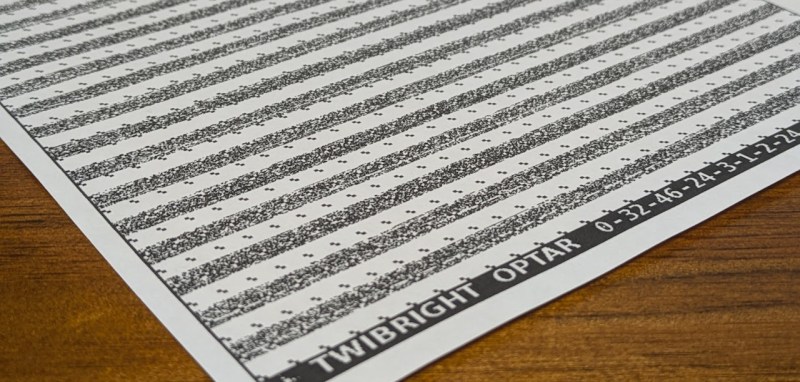
    It seems like only yesterday we covered a project using QR codes to archive data on paper (OK, it was last Thursday), so here’s another way to do it, this time with a dedicated codec using the full page. Optar or OPTical ARchiver is a project capable of squeezing a whopping 200 Kb of data onto a single A4 sheet of paper, with writing and reading achieved with a standard laser printer and a scanner. It’s a bit harder than you might think to get that much data on the page, given that even a 600 DPI printer can’t reliably place every dot each time. Additionally, paper is rarely uniform at the microscopic scale, so Optar utilizes a forward error-correcting coding scheme to cater for a little irregularity in both printing and scanning.

    The error-correcting scheme selected was an Extended Golay code (24, 12, 8),  which, interestingly, was also used for image transmission by the NASA Voyager 1 and 2 missions. In information theory terms, this scheme has a minimum Hamming Distance of 8, giving detection of up to seven bit errors. This Golay code implementation is capable of correcting three-bit errors in each 24-bit block, with 12 bits available for payload. That’s what the numbers in those brackets mean.

    Another interesting problem is paper stretch during printing. A laser printer works by feeding the paper around rollers, some of which are heated. As a printer wears or gets dirty, the friction coefficient along the rollers can vary, leading to twisting and stretching of the paper during the printing process. Water absorbed by the paper can also lead to distortion. To compensate for these effects, Optar regularly inserts calibration targets throughout the bit image, which are used to locally resynchronize the decoding process as the image is processed. This is roughly similar to how the alignment patterns work within larger QR codes. Finally, similar to the position detection targets (those square bits) in QR codes, Optar uses a two-pixel-wide border around the bit image. The border is used to align to the corners well enough to locate the rows of bits to be decoded.

    In the distant past of last week, we covered a similar project that uses QR codes. This got us thinking about how QR codes work, and even if encoding capacity can be increased using more colors than just black and white?

    Thanks to [Petr] for the tip!

    16 Sep 07:41

    Pour Vhernier, Richemont recrute chez Buccellati

    by Journal du Luxe
    Quatre mois après avoir officialisé ses tractations auprès du joaillier italien Vhernier, le groupe de luxe Richemont opère un changement de direction stratégique.
    16 Sep 07:26

    Could this gel protect against wildfires?

    by Matthew Hempstead

    Spotted: The threat of wildfires is increasing as climate change creates hotter, drier conditions, with the global economic damages caused by wildfires last year reaching around $4 billion. Coating gels are one way to protect buildings from fire damage, but existing solutions don’t last long. Researchers at Stanford University want to change that.

    At the moment, once a wildfire has taken hold, protective gel layers are sprayed onto buildings to create a gelatinous shell made up of super-absorbent polymers and water, offering a last line of defence against the flames. However, conditions near a wildfire are often so hot and windy that the water in these gels evaporates quickly, causing current gels to lose their protective properties in 45 minutes.
     
    The new gel created by a team at Stanford University, including Changxin “Lyla” Dong and Eric Appel, is much longer lasting. Water within their gel offers the first layer of protection (as with current gels), but in addition to a cellulose-based polymer, the new gel also contains silica particles. Even when the water and polymer are burnt away, the silica particles remain and form a robust, insulating silica aerogel.

    During tests, the new aerogel protected plywood against fire damage from a blowtorch (which is much hotter than a typical wildfire) for over seven minutes, around five times longer than a commercially available gel that was tested in the same way. Because of its longevity, the new gel could be sprayed onto buildings much further in advance of a wildfire.

    The novel gel is stable in storage and is easily applied using existing equipment. It also sticks well to surfaces while required, but can be easily washed off once a fire has passed, with the non-toxic components being safely broken down by soil microbes after use.

    Written By: Jessica Wallis

    16 Sep 07:25

    [Objectif 2050] Les dessous de la flamme olympique (Axel Moralès, EDF)

    [PARTENARIAT] On revient sur la "flamme électrique" qui a illuminé le ciel de Paris durant les Jeux Olympiques et Paralympiques avec Axel Morales, chef de projet innovation chez EDF.

    Les Jeux Olympiques de Paris 2024 ont offert un spectacle unique en son genre : une flamme suspendue, visible dans le ciel de la capitale, qui a brillé tout l'été. Derrière cette prouesse se cache une innovation majeure conçue par EDF, en partenariat avec les équipes de Paris 2024. Cette « flamme électrique », comme la nomment ses créateurs, n'était pas une véritable flamme mais une insolite combinaison d'eau pulvérisée et de lumières LED haute puissance. Axel Morales, chef de projet chez EDF Pulse Design, explique comment ce projet a pu être mené à bien malgré les défis techniques.

    -----------

    ♥️ Soutien : https://donorbox.org/monde-numerique
    🌏 Web : https://mondenumerique.info 
    🗞️ Newsletter : https://mondenumerique.substack.com/ 
    📹 YouTube : https://www.youtube.com/@mondenumerique 

    -----------


    Hébergé par Ausha. Visitez ausha.co/politique-de-confidentialite pour plus d'informations.

    14 Sep 12:23

    Mistral AI frappe fort : Pixtral 12B, l’IA française qui voit et comprend tout !

    by Yohann Poiron

    La startup française d’intelligence artificielle, Mistral, vient de dévoiler son tout premier modèle multimodal, baptisé Pixtral 12B. Ce modèle, capable de traiter à la fois des images et du texte, s’inscrit dans la lignée des innovations d’OpenAI et d’Anthropic, et place Mistral sur l’échiquier des acteurs majeurs de l’IA. Sophia Yang, responsable des relations avec […]

    L’article Mistral AI frappe fort : Pixtral 12B, l’IA française qui voit et comprend tout ! est apparu en premier sur BlogNT : le Blog des Nouvelles Technologies.

    14 Sep 08:49

    First impressions of OpenAI o1: An AI designed to overthink it

    by Maxwell Zeff

    OpenAI released its new o1 models on Thursday, giving ChatGPT users their first chance to try AI models that pause to “think” before they answer. There’s been a lot of hype building up to these models, codenamed “Strawberry” inside OpenAI. But does Strawberry live up to the hype? Sort of. Compared to GPT-4o, the o1 […]

    © 2024 TechCrunch. All rights reserved. For personal use only.

    13 Sep 11:52

    Atlas of Design, Volume 7

    by Nathan Yau

    Every two years, since 2012, the North American Cartographic Information Society publishes Atlas of Design. It’s a collection of beautiful maps and the process behind each. From series editor Nat Case, on how traditions in cartography can still feel new:

    This is one of the magical things about how people depict the world. Even if the point of the depiction is one you’ve seen or heard a thousand times, if you tell it right, a love song or a portrait or an action movie can still take your breath away. And even the maps that look like maps you’ve seen before, when they work right, can do that too. We hear a familiar tune, we see that same old story…and the map is still fresh and glorious, and we just want to dive in and explore it.

    Speaking of exploration, there is a riddle at the end of the volume that relies on a clue from each map in the book. I’m nearly certain I’ll never figure it out, but maybe you can. Atlas of Design, the seventh volume, is available for pre-order and comes out next month. You can also purchase previous volumes, which are nice to have on the shelf with their uniform bindings.

    Tags: atlas, cartography, NACIS

    13 Sep 09:35

    Google donne accès aux archives du web via WayBack Machine

    by Bruno Texier
  • Google-donne-acces-archives-web-WayBack-Machine
    Le moteur de recherche propose désormais des liens pointant vers les 866 milliards de pages web archivées par le site internet Archive.

    Bonne nouvelle pour les archéologues du web. Google propose désormais des liens pointant vers la WayBack Machine du site Internet Archive. Concrètement, les internautes peuvent accéder aux anciennes versions archivées des sites. "Nous savons que de nombreuses personnes, y compris dans la communauté des chercheurs, apprécient de pouvoir consulter les versions antérieures des pages web lorsqu'elles sont disponibles" explique Google.

    Fidèle à ses habitudes, Google a voulu faire simple pour accéder à ces archives. Les internautes devront simplement cliquer sur les trois points situés à côté du résultat de recherche et cliquer sur le bouton « En savoir plus sur cette page », puis rechercher le lien « Voir les versions précédentes sur la WayBack Machine d'Internet Archive ».

    [...] Lire la suite de cet article sur Archimag.com
  • 12 Sep 20:49

    This life-size Lego McLaren P1 can hit almost 40mph

    by Andrew Liszewski
    A life-size Lego replica of a McLaren P1 hypercar parked in front of the real thing.
    Lego’s McLaren P1 isn’t quite as fast as the real deal. | Image: Lego

    After releasing a 24-inch-long scale replica of the McLaren P1 earlier this year, Lego has now debuted a full-size drivable version of the hypercar built from over 342,817 Technic pieces and powered by hundreds of Lego electric motors.

    That eclipses the 3,893 pieces that go into building Lego’s 1:8-scale McLaren P1 model. The company says the full-scale version used 393 types of Technic components, including 11 specifically manufactured for the replica. That would make it hard to build a copy yourself, but you’d also struggle to find the time. Lego says it took 6,134 hours to design and plan its P1 and 2,210 hours to assemble it.

    Lego opted to build with Technic components instead of its standard bricks as it allowed the company’s...

    Continue reading…

    12 Sep 20:43

    Gemini’s chatty voice mode is out now for free on Android

    by Emma Roth
    Vector illustration of the Google Gemini logo.
    Illustration: The Verge

    Google is rolling out its Gemini Live voice chat mode to all Android users for free. You can access the conversational AI chatbot on Android through the Gemini app or its overlay.

    Google first announced Gemini Live during its Pixel 9 launch event last month, but it has only been available to Gemini Advanced subscribers until now. Similar to ChatGPT’s voice chat feature, you can ask Gemini Live questions aloud and even interrupt it mid-sentence. There are also several different voices you can choose from.

    Continue reading…

    12 Sep 20:38

    OpenAI’s new “reasoning” AI models are here: o1-preview and o1-mini

    by Benj Edwards
    An illustration of a strawberry made out of pixel-like blocks.

    Enlarge (credit: Vlatko Gasparic via Getty Images)

    OpenAI finally unveiled its rumored "Strawberry" AI language model on Thursday, claiming significant improvements in what it calls "reasoning" and problem-solving capabilities over previous large language models (LLMs). Formally named "OpenAI o1," the model family will initially launch in two forms, o1-preview and o1-mini, available today for ChatGPT Plus and certain API users.

    OpenAI claims that o1-preview outperforms its predecessor, GPT-4o, on multiple benchmarks, including competitive programming, mathematics, and "scientific reasoning." However, people who have used the model say it does not yet outclass GPT-4o in every metric. Other users have criticized the delay in receiving a response from the model, owing to the multi-step processing occurring behind the scenes before answering a query.

    In a rare display of public hype-busting, OpenAI product manager Joanne Jang tweeted, "There's a lot of o1 hype on my feed, so I'm worried that it might be setting the wrong expectations. what o1 is: the first reasoning model that shines in really hard tasks, and it'll only get better. (I'm personally psyched about the model's potential & trajectory!) what o1 isn't (yet!): a miracle model that does everything better than previous models. you might be disappointed if this is your expectation for today's launch—but we're working to get there!"

    Read 18 remaining paragraphs | Comments

    12 Sep 20:38

    Unity is dropping its unpopular per-install Runtime Fee

    by Kevin Purdy
    Unity logo against pink and blue shapes

    Enlarge (credit: Unity)

    Unity, maker of a popular cross-platform engine and toolkit, will not pursue a broadly unpopular Runtime Fee that would have charged developers based on game installs rather than per-seat licenses. The move comes exactly one year after the fee's initial announcement.

    In a blog post attributed to President and CEO Matt Bromberg, the CEO writes that the company cannot continue "democratizing game development" without "a partnership built on trust." Bromberg states that customers understand the necessity of price increases, but not in "a novel and controversial new form." So game developers will not be charged per installation, but they will be sorted into Personal, Pro, and Enterprise tiers by level of revenue or funding.

    "Canceling the Runtime Fee for games and instituting these pricing changes will allow us to continue investing to improve game development for everyone while also being better partners," Bromberg writes.

    Read 6 remaining paragraphs | Comments

    12 Sep 16:27

    💥 Supraconductivité: cette observation étrange bouscule la science

    by Cédric DEPOND
    Un étrange ballet se joue dans l'ombre des matériaux supraconducteurs. Des chercheurs viennent d'y observer des paires d'électrons inattendues. Les résultats remettent en question ce que l'on...
    12 Sep 16:24

    Hasbro CEO Says AI Will Become Core Part of Dungeons & Dragons

    by Noor Al-Sibai
    After a series of AI scandals, the CEO of Hasbro has revealed he's "excited" about using the technology in "Dungeons & Dragons."

    After a series of AI scandals at the gaming company Wizards of the Coast, the CEO of its parent company Hasbro has made a sweeping revelation.

    During a talk at a Goldman Sachs conference, Hasbro honcho Chris Cocks admitted that the entertainment conglomerate not only plans to build bespoke AI systems in the future, but that it's already begun using it in development of games including "Dungeons & Dragons" and "Magic: The Gathering."

    "Inside of development, we've already been using AI," Cocks said in response to a question about AI's potential to bring down production costs during the financial firm's annual Communacopia tech conference. "It's mostly machine-learning-based AI or proprietary AI as opposed to a ChatGPT approach. We will deploy it significantly and liberally internally as both a knowledge worker aid and as a development aid."

    While the logistical aspects of the technology seem fairly par for the course in the world of out-of-touch CEOs over-relying on it, Cocks then suggested that it will become a part of D&D gameplay.

    "I'm probably more excited though about the playful elements of AI," he said. "I play with probably 30 or 40 people regularly. There's not a single person who doesn't use AI somehow for either campaign development or character development or story ideas. That's a clear signal that we need to be embracing it."

    After paying lip service to using AI "responsibly" and "paying creators for their work," Cocks then doubled down on his point.

    "The themes around using AI to enable user-generated content, using AI to streamline new player introduction, using AI for emergent storytelling — I think you're going to see that not just our hardcore brands like D&D but also multiple of our brands," the Hasbro CEO said.

    These comments, as the Bell of Lost Souls gaming blog notes, come not only amid the generative AI bubble that's so enraptured CEOs across the economy, but also amid massive scandal for Hasbro's subsidiary Wizards of the Coast,

    Less than a month after outright banning its artists from AI at the end of 2023, WOTC admitted at the beginning of this year that despite its staunch rule, the company itself had used generative AI to create an ad for "Magic."

    Later, the company issued an FAQ about its anti-AI policy in the aftermath of that debacle, asking fans to bear with the people who run the company while they essentially separate the wheat from the AI chaff.

    "Human beings are fallible, whether it is a conglomerate of human beings (like a company) or a single human being (like an artist)," the FAQ reads. "We have been consistent in our position [against AI]... and we want our community to know that we are working to ensure they can see us deliberating on how best to meet that commitment, even if we all occasionally stumble along the way."

    From issuing a statement that contradicts its own marketing copy to having its big boss endorse the sweeping use of AI, Hasbro clearly has some miscommunications going on — and while the company figures it it all out, its fans will no doubt keep ripping on the company.

    More on AI in gaming: Nvidia CEO Says Video Games Will Be Totally Infused With AI

    The post Hasbro CEO Says AI Will Become Core Part of Dungeons & Dragons appeared first on Futurism.

    12 Sep 16:24

    Two private astronauts took a spacewalk Thursday morning—yes, it was historic

    by Eric Berger
    Jared Isaacman emerges from the Dragon spacecraft on Thursday morning.

    Enlarge / Jared Isaacman emerges from the Dragon spacecraft on Thursday morning. (credit: SpaceX webcast)

    The Polaris Dawn mission took a firm step into the future on Thursday morning when two private citizens, Jared Isaacman and Sarah Gillis, briefly ventured outside their Dragon spacecraft.

    Although each only spent about eight minutes outside the capsule, the spacewalk was unquestionably a major success for SpaceX and the four astronauts flying in orbit. This marked the first time that a private company, SpaceX, conducted a spacewalk. Funded by Isaacman, the mission spurred a frenetic two-year period of spacesuit development, testing, and simulations by the California company to reach Thursday's remarkably smooth operations.

    Isaacman emerged from Dragon at 6:52 am ET (10:52 UTC) as the spacecraft passed near Australia on the planet below. A billionaire, entrepreneur, and avid pilot, Isaacman paused for just a moment as he stood on the edge of eternity and looked back at Earth.

    Read 15 remaining paragraphs | Comments

    12 Sep 16:18

    Actualité : Surenchère de l'IA : Oracle passe au nucléaire pour alimenter un datacenter dédié à Nvidia

    by Antoine Roche
    Dans un contexte où le prix de l'électricité grimpe sans cesse et où le dérèglement climatique ne fait plus aucun doute, comment continuer à alimenter "raisonnablement" cette technologie toujours plus gourmande qu'est l'intelligence artificielle ? Pour Oracle, la solution n'est autre que le nucléaire. La firme a en tout cas obtenu le droit de constru...
    12 Sep 16:04

    Top 500 Fashion, Beauty & Luxury Retail Europe : un marché toujours en progression

    Cross-Border Commerce Europe publie la troisième édition du "Top 500 Fashion, Beauty & Luxury Retail Europe", le classement annuel qui met en avant les principaux détaillants et marketplaces de la mode et de la beauté et du luxe en ligne en Europe.
    12 Sep 09:04

    Zigzag trenches

    Trench warfare dominated the fighting in WW1. After the initial hasty digging of trenches in the early days of the war, as each side dug in to defend their lines, trenches evolved to be more complex and sophisticated, including digging them in a stepped or zigzag shape.

    Why were trenches dug in a zigzag pattern? Zigzagging trenches with sharp corners helped remedy several fatal flaws learned from early trench warfare:

    1. Zigzags help contain blasts

    One of the key advantages of a zigzag trench is its ability to contain blasts. In a straight trench, the blast from mortar or artillery fire would travel unimpeded to either side. However, a trench with frequent bends could confine explosions to smaller portions of the trench, reducing casualties.

    2. Zigzags help slow an enemy down after capturing a trench

    A straight trench meant that breaching a portion of it gave a long line of sight and the ability to fire down the trench which could aid attackers. Angles and corners from the zigzag or wavy shape of a trench meant that line of sight was reduced and gave better defensive positions with cover and concealment.

    So, the simple change from a straight trench to a zigzag gave defenders significant advantages, and both sides used the design during the war. It's painful to imagine the tragic lessons that led to this evolution in design.

    I learned about zigzag trench design from a children's book about WW1: 50 Things You Should Know About The First World War, by Jim Eldridge. It's striking how such a simple design change can have a significant effect. It's also a great example of how a simple solution can seem so obvious in retrospect and yet may take time to develop.

    One of the trends of evolution identified in the theory of inventive problem solving that always fascinated me and has myriad applications is how straight lines in products typically evolve to jointed or bent, then wavy lines. As the theory would say, a straight line has unused potential, and someone will find an advantage in introducing a bend or bends. I sketched a similar trend about flat surfaces having unused potential.

    The Imperial War Museum has a great 9-minute video explaining trench warfare, which discusses the zigzag or stepped design in this sketch.

    Also see:

    12 Sep 07:28

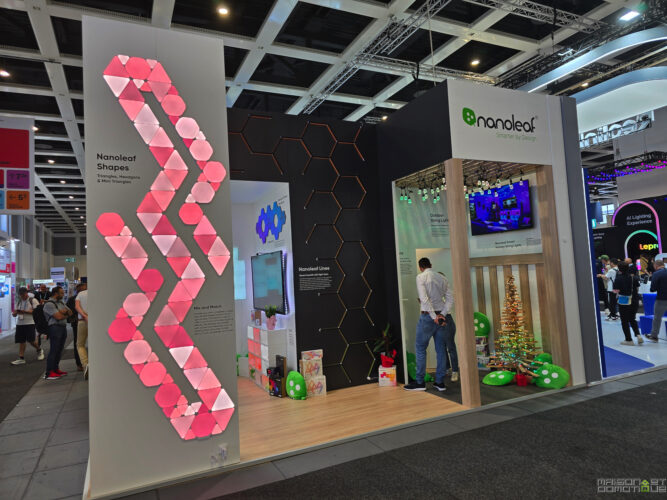
    Nouveautés Nanoleaf : éclairage immersif et modulaire

    by Stephannie R.

    Nanoleaf, leader mondial de l'innovation en éclairage intelligent, a dévoilé ses dernières créations lors de son événement annuel. Trois nouveaux produits et deux fonctions immersives viennent enrichir l'offre pour transformer l'expérience de la maison connectée.

    Innovations lumineuses pour la maison connectée

    Nanoleaf a présenté une gamme complète de solutions. Cela va de l'éclairage immersif à l'éclairage d'ambiance, avec une nouveauté : le premier interrupteur connecté de la marque. Parmi ces nouveautés, les Nanoleaf Blocks se distinguent par leur design modulaire et leur capacité à offrir une personnalisation infinie.

    Les Nanoleaf Blocks se composent de panneaux lumineux carrés, disponibles en deux tailles. Ils peuvent être associés à des panneaux texturés ou perforés et même à des étagères. Leur conception permet d'éliminer les zones d'ombre, ce qui offre une diffusion uniforme de la lumière. Ces panneaux modulaires permettent des créations. Cela va des styles linéaires aux formes plus abstraites, telles que des motifs géométriques ou inspirés du pixel art. Les Nanoleaf Blocks sont déjà disponibles en précommande, avec une expédition prévue fin octobre au prix de 199,99 € TTC pour un kit de six carrés.

    L'interrupteur Sense+ : contrôle et automatisation

    Autre innovation majeure, l'interrupteur Sense+ Smart Wireless, qui combine interrupteur et détecteur de mouvement. Ce dispositif offre un contrôle total de l'éclairage depuis n'importe quel endroit de la maison, et peut être placé de manière flexible : près de la porte, sur une table de nuit, ou même sur le canapé. Doté de deux boutons configurables, il permet de personnaliser les actions, comme allumer instantanément les couleurs préférées ou ajuster la luminosité à la volée.

    L'interrupteur Sense+ utilise la technologie Litewave pour assurer une communication fluide entre les appareils et prend en charge Matter over Thread pour Apple Home et Samsung SmartThings. Il est également disponible en précommande, avec une expédition prévue pour la fin du mois d'octobre au prix de 29,99 € TTC.Avec ces innovations, Nanoleaf continue de repousser les limites de l'éclairage intelligent. La marque veille à faire de chaque espace en une expérience unique et personnalisable.

    Expériences immersives et options d'éclairage extérieur connectées

    Nanoleaf enrichit également son application de bureau avec deux nouvelles fonctionnalités immersives : Orchestrator et Scenescapes. Orchestrator se connecte directement aux sources audio pour synchroniser l'éclairage avec la musique. Cela crée ainsi des animations lumineuses en fonction des genres musicaux, sans être perturbé par les bruits ambiants.

    Scenescapes, quant à lui, propose des ambiances lumineuses associées à des paysages sonores apaisants, tels que le bruit des vagues ou un feu de cheminée. Cette fonction vise à créer un environnement propice à la relaxation ou à la concentration, selon les besoins de l'utilisateur. Orchestrator est déjà disponible en version bêta, tandis que Scenescapes sera lancé en octobre.

    Enfin, Nanoleaf élargit son offre avec de nouvelles options d'éclairage extérieur connectées, notamment des lampes permanentes Matter Smart. Ces éclairages permettent de personnaliser l'extérieur de la maison tout au long de l'année, avec des options pour illuminer les espaces extérieurs en fonction des saisons ou des événements spéciaux. Les lampes d'extérieur permanentes seront disponibles en Europe en 2025. Les prix vont de 29,99 € TTC pour un pack de deux ampoules Wifi à 49,99 € TTC pour une bande lumineuse multicolore de 5 mètres.

    Article basé sur un communiqué de presse reçu par la rédaction.

    Cet article Nouveautés Nanoleaf : éclairage immersif et modulaire est apparu en premier sur OBJETCONNECTE.COM.

    12 Sep 07:27

    Nanoleaf : trois nouveaux produits connectés et deux fonctions d’expérience immersive présentés à l’ #IFA2024

    by Cédric
    nanoleaf ifa2024 3Nanoleaf, maintenant bien connu dans le domaine de l'éclairage intelligent, a annoncé trois nouveaux produits d'éclairage et deux nouvelles fonctions intelligentes pour transformer complètement les espaces et faire passer l’éclairage au niveau supérieur.