Jean-Philippe Encausse
Shared posts
🧬 Antibiorésistance: un désastre mondial annoncé pour 2050

Yves Saint Laurent Beauté lance un pop up immersif en plein coeur de Paris
Supraconducteur : dossier complet sur ce matériau
Le supraconducteur a révolutionné les secteurs de l’énergie et des transports en favorisant l’émergence de technologies de pointe. Continuez à lire pour en savoir plus sur ce dernier.
Au 20e siècle, les physiciens ont dévéloppé de nouvelles méthodes pour refroidir les matériaux à une température nulle. Ainsi, ils ont commencé à enquêter sur certains éléments pour savoir comment l’électricité va être modifiée dans diverses conditions. Ces chercheurs ont alors découvert le même comportement dans plusieurs composés, comme les céramiques et les nanotubes de carbone. Cet article présente une vue d’ensemble du supraconducteur.
Qu’est-ce qu’un supraconducteur ?
Le terme supraconducteur désigne un matériau capable de conduire l’électricité sans résistance. Dans la plupart des cas, les éléments métalliques présentent une certaine résistance à température ambiante. En sachant que cette résistance se réduit à une température appelée température critique.
Le passage des électrons d’un atome à l’autre se fait fréquemment à l’aide de certains matériaux après avoir atteint la température critique. Ces derniers s’appellent donc des matériaux supraconducteurs.
Ils servent notamment dans de nombreux domaines tels que la visualisation par résonance magnétique et les sciences médicales. Cependant, la plupart des matériaux disponibles sur le marché ne constituent pas des supraconducteurs.

En fait, ces derniers nécessitent un état d’énergie très faible pour se transformer en produits supraconducteurs. Actuellement, la recherche se concentre sur le développement de molécules qui peuvent se transformer en supraconducteurs à haute température.
Matériaux de supraconductivité
Il existe un grand nombre de matériaux, dont certains constituent des supraconducteurs. Ces matériaux supraconducteurs peuvent transporter des électrons sans résistance, et donc ne libérer aucune chaleur, aucun son ou autre forme d’énergie.
La supraconductivité se produit à la température critique d’un matériau spécifique (T c). Lorsque la température diminue, la résistance d’un matériau supraconducteur réduit progressivement jusqu’à ce qu’il atteigne une température critique. À ce stade, la résistance chute, souvent à zéro, comme le montre le graphique à droite.
À l’exception du mercure, les supraconducteurs originaux comprennent des métaux, des céramiques, des matériaux organiques.
Cas d’utilisation des supraconducteurs
Les supraconducteurs peuvent être utilisés dans les générateurs, les accélérateurs de particules, les transports, les moteurs électriques, l’informatique, le médical, la transmission d’énergie, etc.
Ils servent principalement à créer des électroaimants puissants dans les scanners IRM. Ils permettent donc de séparer les matériaux magnétiques et non magnétiques. En outre, ils aident à transmettre de l’énergie sur de longues distances
Types de supraconducteurs
Il existe deux types de supraconducteurs : le type I et le type II.
Supraconducteur de type I
Ce type comprend des pièces conductrices de base utilisées dans différents domaines, allant du câblage électrique aux puces électroniques des ordinateurs. Il perd leur supraconductivité de façon très simple en se plaçant dans un champ magnétique critique (Hc).
Après cela, il ressemble à un conducteur. À cause de cette perte de supraconductivité, on appelle également ces types de semi-conducteurs « supraconducteurs mous ». Ils obéissent complètement à l’effet Meissner. Parmi les exemples figurent le zinc et l’aluminium.

Supraconducteur de type II
Le type II se caractérise par une perte lente de la supraconductivité, mais pas facilement, car il se trouve dans un champ magnétique externe. Lorsque ce semi-conducteur se trouve dans un champ magnétique, il perd peu à peu sa supraconductivité.
Cette classe de semi-conducteurs commence à réduire sa supraconductivité en présence d’un champ magnétique plus faible. Cependant, elle disparaît complètement en présence d’un champ magnétique critique plus élevé. La condition entre le champ magnétique critique inférieur et supérieur se qualifie d’état intermédiaire ou de vortex.
Appelé supraconducteur dur, ce catégoriel s’affaiblit lentement, mais pas simplement, en perdant sa supraconductivité. Ces semi-conducteurs obéissent à l’effet Meissner, mais pas complètement. Les meilleurs exemples sont NbN et Babi3. Il est possible de fabriquer des aimants supraconducteurs à haut champ à partir de ces supraconducteurs.
Propriétés du supraconducteur
Les matériaux supraconducteurs présentent des propriétés étonnantes qui sont essentielles pour la technologie actuelle. La recherche sur ces propriétés est toujours en cours pour reconnaître et utiliser ces propriétés dans divers domaines énumérés ci-dessous.
- Conductivité infinie/résistance électrique nulle
- Effet Meissner
- Température de transition/température critique
- Courants Josephson
- Courant critique
- Courants persistants
- Conductivité infinie/résistance électrique nulle
Dans la condition supraconductrice, le matériau supraconducteur illustre la résistance électrique nulle. Lorsqu’il est refroidi sous sa température de transition, sa résistance sera soudainement réduite à zéro.
Effet Meissner

Refroidi sous la température critique, le supraconducteur ne permet pas au champ magnétique de le traverser. L’on connaît cet événement sous le nom d' »effet Meissner ».
Température de transition ou température critique
Quand la température critique d’un matériau supraconducteur change l’état conducteur de normal à supraconducteur.
Courant Josephson
Si les deux supraconducteurs sont fragmentés à l’aide d’un film mince en matériau isolant, il forme une jonction de faible résistance pour fonder les électrons avec une paire de cuivre. Il peut creuser un tunnel d’une surface de la jonction à l’autre surface. Ainsi, l’on connaît le courant dû au flux de paires de tonneliers sous le nom de courant Josephson.
Courant critique
Lorsque le courant est fourni à travers un conducteur dans des conditions supraconductrices, un champ magnétique peut être développé. Si le flux de courant augmente au-delà d’un certain taux alors il est possible d’augmenter le champ magnétique.
Ce qui équivaut à la valeur critique du conducteur à laquelle celui-ci revient à son état habituel. L’on connaît le flux de la valeur actuelle comme le courant critique.
Courants persistants
Si un anneau supraconducteur se situe dans un champ magnétique au-dessus de sa température critique, refroidir actuellement l’anneau supraconducteur en dessous de sa température critique. Si nous éliminons ce champ, alors le flux de courant peut être induit à l’intérieur de l’anneau en raison de son auto-inductance.
D’après la loi de Lenz, le courant induit s’oppose à la variation du flux qui traverse l’anneau. Lorsque l’anneau est placé dans une condition supraconductrice, le flux de courant sera induit pour continuer le flux de courant est nommé courant persistant. Ce courant génère un flux magnétique pour faire circuler le flux à travers l’anneau constant.
Quelle est la différence entre le semi-conducteur et le supraconducteur ?
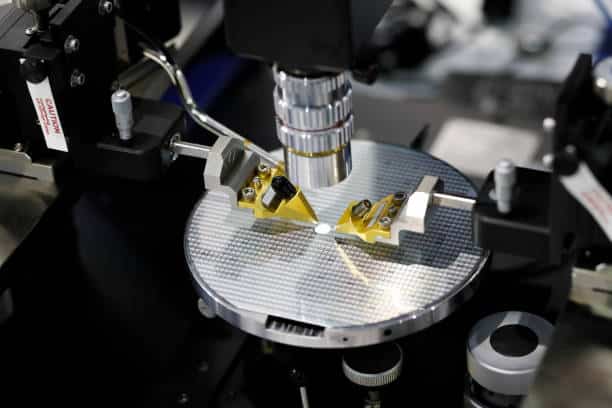
La différence clé entre semi-conducteur et supraconducteur réside dans le fait que les semi-conducteurs ont une conductivité électrique. Cette dernière est comprise entre la conductivité d’un conducteur et celle d’un isolant.
Tandis que les supraconducteurs ont une conductivité électrique supérieure à celle du conducteur. De plus, la bande interdite d’un semi-conducteur se trouve entre 0,25 et 2,5 eV alors que celle d’un supraconducteur est supérieure à 2,5 eV.
Les semi-conducteurs constituent des matériaux solides dotés de propriétés électriques particulières qui permettent de contrôler le flux d’électricité à travers le matériau. La conductivité peut être réglée de façon permanente ou modifiée selon les besoins d’un dispositif. Tous les dispositifs électriques modernes contiennent des semi-conducteurs.
Les supraconducteurs se composent des matériaux métalliques capables de conduire « purement » l’électricité à des températures extrêmes. En d’autres termes, à des températures spécifiques, ils offrent une résistance nulle à un courant électrique. De nombreux matériaux présentent des propriétés supraconductrices à certaines températures.
Parmi les supraconducteurs les plus courants figurent l’étain, l’aluminium, l’azote, le mercure, le plomb, le zinc, l’hélium, l’uranium et le titane. La température à laquelle les matériaux supraconducteurs présentent une résistance électrique nulle varie selon les matériaux.
Supraconducteur : top 4 des startups dans ce domaine
Comme il existe un grand nombre de startups travaillant sur une grande variété de solutions, cette partie jette un coup d’œil à 4 start-up prometteuses dans le domaine des supraconducteurs.
Anyon Systems – des Ordinateurs quantiques clés en main

Le domaine de l’informatique quantique existe depuis les années 1980. Il utilise les propriétés des circuits supraconducteurs et des métaux pour traiter de grandes quantités de données. D’ailleurs, ces derniers permettent d’analyser des algorithmes sophistiqués dans un temps nettement plus court.
Contrairement à d’autres innovations technologiques dans le domaine de l’informatique, le coût d’entrée élevé a ralenti son développement. Les entreprises et les startups s’efforcent désormais de rendre cette technologie plus accessible à la recherche et aux développements commerciaux et universitaires.
La startup canadienne Anyon Systems fabrique des ordinateurs quantiques supraconducteurs clés en main. Leur solution permet aux chercheurs et développeurs d’accéder à une technologie qui était considérée comme hors de portée, soit en raison de coûts élevés ou de complexité.
Au fur et à mesure que l’accent passe du matériel au logiciel, le développement d’algorithmes plus efficaces se traduira par des avantages pour plusieurs autres innovations industrielles.
Epoch Wires – Fils supraconducteurs

La résistance des câbles, des aimants et des champs magnétiques affecte généralement le flux d’énergie dans tout système électrique et, par conséquent, réduit l’efficacité énergétique. L’utilisation de matériaux supraconducteurs, en particulier de fils, contribue à réduire la résistance des systèmes électriques et facilite un transfert d’énergie plus efficace.
La société britannique Epoch Wires fabrique des fils supraconducteurs brevetés. Leur processus de production permet la création de fils supraconducteurs en diborure de magnésium (MgB2) à faible coût et de longue durée. Ils ont le potentiel de fournir une supraconductivité à des températures de 40 K (-233 °C) pour l’imagerie par résonance magnétique et les applications de puissance.
Circuits de Delft – Circuits supraconducteurs

La productivité des systèmes informatiques dépend généralement des propriétés électriques de leurs composants. Cela devient généralement un facteur limitant important pour les ordinateurs quantiques.
L’utilisation de circuits supraconducteurs contribue au développement d’applications et d’industries de calcul intensif de nouvelle génération. C’est pourquoi les fabricants se tournent vers les innovations technologiques pour améliorer le processus de production de ces circuits.
La startup néerlandaise Delft Circuits est un fournisseur de solutions matérielles pour les applications de calcul intensif. Ils fabriquent des câbles pour des applications cryogéniques et à conductance thermique ultra-faible en utilisant des circuits supraconducteurs sur un substrat flexible.
Leurs solutions sont idéales pour utiliser diverses techniques d’apprentissage automatique, d’intelligence artificielle (IA) et de communication quantique.
Seeqc — Système sur puce (SOC)

System-On-Chip résout le défi d’intégrer plusieurs composants d’un ordinateur ou d’un système électronique dans une seule puce. Cela fonctionne bien pour les systèmes conventionnels. Toutefois, la même conception intégrée ne devrait pas être appliquée aux puces informatiques quantiques. En effet, le coût et la complexité des systèmes informatiques quantiques sont considérablement plus élevés.
La startup américaine Seeqc développe des systèmes informatiques sur puce brevetée Single Flux Quantum (SFQ) avec une logique classique de contrôle qubit. Ces systèmes sont par ailleurs conçus pour les systèmes supraconducteurs, tels que les environnements cryo-refroidis que l’on trouve dans les ordinateurs quantiques.
Autres acteurs clés dans le domaine des supraconducteurs
Le secteur des supraconducteurs, en constante évolution, continue d’attirer des startups innovantes qui repoussent les frontières de la technologie. Snowcap Compute a récemment levé 23 millions de dollars pour le développement de puces d’IA supraconductrices. Leur technologie vise à exploiter les propriétés des supraconducteurs pour rendre l’informatique plus rapide et plus efficace, notamment dans les domaines de l’intelligence artificielle et de l’apprentissage automatique.
Ensuite, IsentroniQ est à l’avant-garde de l’informatique quantique avec sa fabrication de processeurs supraconducteurs à grande échelle. La société travaille sur des puces quantiques qui utilisent des circuits supraconducteurs pour réaliser des calculs plus rapides et complexes, ce qui pourrait transformer des industries comme la finance, la chimie et la modélisation moléculaire.
Quant à Quantum Materials Corp, cette startup se distingue par sa recherche avancée sur des matériaux supraconducteurs à haute température, particulièrement dans le domaine des applications cryogéniques. Ils se concentrent sur la réduction des coûts de production et l’amélioration des propriétés des supraconducteurs pour les rendre plus accessibles à des applications industrielles à grande échelle.
Enfin, Princeton Supraconductor Technologies développe des aimants supraconducteurs utilisés dans les accélérateurs de particules et les IRM. Leur approche innovante permet de créer des systèmes supraconducteurs plus puissants et plus efficaces, avec des applications potentielles dans la médecine, la recherche et l’énergie.
Supraconducteurs et informatique quantique
Les supraconducteurs jouent un rôle fondamental dans le développement de l’informatique quantique, un domaine en plein essor qui promet de révolutionner le traitement de l’information. Grâce à leur capacité à conduire l’électricité sans résistance et à maintenir des courants électriques stables sans dissipation d’énergie, les supraconducteurs sont idéaux pour créer des qubits — l’unité fondamentale de l’information quantique. Contrairement aux bits classiques, les qubits peuvent exister dans plusieurs états simultanément grâce au phénomène de superposition quantique, ce qui permet des calculs beaucoup plus rapides et complexes.
Les circuits supraconducteurs, en particulier les jonctions Josephson, sont utilisés pour fabriquer des qubits robustes et contrôlables. Ces jonctions permettent aux qubits de changer d’état de manière contrôlée, tout en minimisant les interférences et la décohérence, deux problèmes majeurs dans les systèmes quantiques. Cela permet de développer des ordinateurs quantiques plus stables et efficaces.
Les applications des supraconducteurs dans l’informatique quantique s’étendent aux domaines de la cryptographie, de la modélisation moléculaire, et de l’intelligence artificielle. À long terme, cette technologie pourrait transformer des industries entières en permettant des calculs d’une ampleur sans précédent, ouvrant la voie à des percées dans la recherche scientifique, la chimie, et la finance.
Un nouveau supraconducteur intrigue les scientifiques et ravive l’espoir d’une percée technologique
Un matériau récemment découvert suscite un vif intérêt dans le domaine de la supraconductivité. Grâce à des propriétés inédites, cet élément pourrait rapprocher la science d’un objectif ambitieux : un supraconducteur fonctionnant sans conditions extrêmes de température ou de pression. Ce qui ouvre la voie à une révolution énergétique et technologique.
Les supraconducteurs sont effectivement des matériaux capables de transporter l’électricité sans aucune résistance. L’objectif étant d’éliminer toute perte d’énergie. Cependant, leur exploitation reste limitée, car ils nécessitent généralement des températures extrêmement basses ou des pressions colossales. Ces contraintes empêchent leur intégration dans des dispositifs du quotidien.
Aux dernières nouvelles, une nouvelle famille de matériaux, structurée autour d’atomes spécifiques, pourrait changer la donne. Des chercheurs ont démontré que ces composés possèdent des propriétés supraconductrices à des températures plus élevées que la moyenne, et surtout, à pression ambiante. Ces résultats restent préliminaires, mais ouvrent des perspectives enthousiasmantes pour l’électronique, les transports et la production d’énergie.
Si ces matériaux tiennent leurs promesses, ils pourraient marquer un tournant décisif dans l’histoire des sciences appliquées. Ce qui rapproche l’humanité d’une technologie aux implications révolutionnaires.
SupraFusion : un pari français pour l’énergie du futur
A l’heure actuelle, la France est en train de lancer un projet ambitieux appelé SupraFusion, mené par le CEA et le CNRS. Son but est d’explorer une technologie prometteuse qui repose sur les supraconducteurs à haute température, capables de transporter l’électricité sans aucune perte. Contrairement aux anciens modèles, ils fonctionnent à des températures moins extrêmes. Ce qui les rend plus faciles à utiliser.
Avec un budget de 50 millions d’euros issu du plan France 2030, le projet mobilise 200 chercheurs pour créer des technologies innovantes. De celles-ci devraient déboucher des petits réacteurs nucléaires à fusion, des réseaux électriques très efficaces, ou encore des IRM plus puissants. La construction d’un immense électro-aimant sera toutefois le cœur du projet. Ceci, afin de prouver que cette technologie peut fonctionner à grande échelle.
Pour ce qui est de son implantation, le programme est basé sur le campus Paris-Saclay, un lieu d’innovation regroupant chercheurs, ingénieurs et entreprises. Dans la réalisation, il y a un défi de taille à relever. Effectivement, les matériaux sont difficiles à produire, les températures restent très basses, et la concurrence internationale est forte.
Malgré un tel défi, d’ici 2032, la France espère devenir un leader mondial dans ce domaine. SupraFusion pourrait ainsi transformer l’énergie, mais également la santé, les transports, et contribuer à une planète plus propre.
FAQ sur le supraconducteur
Un supraconducteur est un matériau qui conduit l’électricité sans aucune résistance lorsqu’il atteint une température critique spécifique. Ce phénomène physique s’accompagne de l’effet Meissner, où le matériau expulse les champs magnétiques de son intérieur.
Les supraconducteurs à haute température (HTS) à base de cuprates détiennent actuellement les records de température critique. Pour les applications pratiques, l’YBCO (YBa₂Cu₃O₇) reste très utilisé grâce à sa température critique de 93K et sa relative facilité de fabrication.
La supraconductivité permet la création d’aimants superpuissants pour les IRM médicales et les accélérateurs de particules. Dans le secteur énergétique, les câbles supraconducteurs transmettent l’électricité sans pertes sur de longues distances. La supraconductivité sert également dans les ordinateurs quantiques et les détecteurs ultra-sensibles comme les SQUID qui mesurent des champs magnétiques infimes.
Les supraconducteurs se divisent en deux catégories principales. Les supraconducteurs de type I incluent principalement des éléments purs comme le mercure ou l’aluminium. Les supraconducteurs de type II présentent deux champs critiques et maintiennent partiellement leurs propriétés sous champs magnétiques élevé. Cette catégorie comprend les alliages métalliques comme le NbTi et les composés complexes comme les cuprates.
Cet article Supraconducteur : dossier complet sur ce matériau est apparu en premier sur OBJETCONNECTE.COM.
Meta updates Ray-Ban smart glasses with real-time AI video, reminders, and QR code scanning
The Ray-Ban Meta smart glasses got an update with new familiar smartphone features and AI capabilities coming later in 2024.
© 2024 TechCrunch. All rights reserved. For personal use only.
Meta is giving its metaverse avatars a glow-up

Meta is overhauling its metaverse avatars, and you’ll be able to use them soon: the new look will be available on October 1st, the company announced at its Connect conference on Wednesday. The new avatars will be available on Meta Horizon OS (its VR operating system), as well as Facebook, Instagram, and Messenger.
Meta’s avatars started out in a rough place, but the company has made steady improvements, and these changes look to build on that. With the upgraded avatars, Meta is going to give users new ways to fine-tune things like eye size, nose shape, and body shapes, Meta’s Aigerim Shorman, a VP on the Horizon team, said onstage. That’s thanks in part to a new underlying tech stack, which includes an updated avatar skeleton.
Of course,...
Meta’s new lightweight AR prototype shows a future beyond bulky VR headsets

Enlarge / The future's so bright, Mark Zuckerberg's gotta wear shades. (credit: Meta)
Thus far, Meta's heavily money-losing Reality Labs division has been primarily focused on bulky virtual reality headsets (and some odd, display-free Ray-Ban branded sunglasses). So when Meta CEO Mark Zuckerberg pulled out a 100 g pair of see-through, augmented-reality glasses at this year's Meta Connect keynote, it represented a bit of a new direction for the company.
The prototype Orion AR glasses Zuckerberg showed off today don't mean Meta will be ready to release a pair of consumer AR glasses anytime soon. But the demo represents a new vision for lightweight, wide-ranging, see-through smartglasses that Zuckerberg calls "a glimpse of the future" and "the dream of Reality Labs."
Not your average screen
The core challenge of building a pair of comfortable augmented-reality glasses, Zuckerberg said, is that "they have to be glasses." That means no bulky headset (a la Quest), no wires (a la Apple Vision Pro), and a weight of less than 100 grams (compared to a full 515 g for the Meta Quest 3). While there's a tiny battery and "custom silicon" in those lightweight glasses, Zuckerberg admitted that some processing is done in a "small puck" that connects wirelessly to the glasses themselves.
California’s new law requires schools to limit phone use

California Governor Gavin Newsom signed the Phone-Free School Act into law this week, requiring every school district, charter school, and county office of education statewide to implement rules limiting cellphone use by July 1st, 2026. There are exceptions to the rule, including using phones for emergencies or with permission under certain circumstances.
“We know that excessive smartphone use increases anxiety, depression, and other mental health issues — but we have the power to intervene,” said Newsom in a statement.
This comes as other states like New York consider pursuing legislation for a total ban on phones in schools. It’s part of a wave of laws targeting tech-related child safety at the state and national level, including the...
Puma taps Google Cloud’s Imagen on Vertex AI solution to create immersive digital shopping experiences
Puma and Google Cloud have announced an expanded partnership aimed at enhancing the digital shopping experience with generative AI.
Using Imagen 2 on Vertex AI, Puma says it can now create dynamic and personalised product imagery that is improving click-through rates and accelerating the time-to-market for its digital campaigns globally.
It has the ability to generate relevant imagery, such as new background images that are tailored to the product, customer, and region. While the technology is available globally, Imagen on Vertex AI enables marketers in individual Puma regions to tailor content to their specific market needs.
For example, while shopping online, customers from Japan may see a lifestyle shoe worn on the streets of Ginza or a trail running shoe on the foothills of Mt. Fuji.
Beyond image generation, Imagen on Vertex AI also becomes a tool for image editing, aiding Puma content editors with time-consuming editing tasks, such as shadowing, composition and color accuracy, resolution, and product positioning.
Since migrating its e-commerce ecosystem, including Puma.com, to Google Cloud earlier this year, Puma has experienced significant benefits across its online shopping portfolio.

In addition to increasing average order value (AOV) thanks to better personalised content with Google Cloud’s data and AI tools, its retail teams have also reduced the time needed to take products to market, enabling teams to make products shoppable the moment they reach the warehouse.
“At Puma, all product creations always starts with the consumer first in mind and we have the ambition to be as personal as possible in each interaction with our consumers. Google Cloud’s generative AI has allowed us to create an immersive experience that is tailored to each consumer, and we are already seeing the benefits,” says Arne Freundt, CEO at Puma.
Puma will soon explore Imagen 3, Google Cloud’s latest text-to-image model. The sports company also plans to expand the implementation of Google Cloud’s Vertex AI Search for Retail to more subsidiaries to further improve AOV and overall shopper conversion rate.
“Google Cloud is helping companies in every industry improve the customer experience with gen AI powered agents, and our partnership with Puma is an excellent example of this. The creative agent Puma has built with our leading Imagen technology is taking personalisation to a new level - and driving real business results,” says Thomas Kurian, CEO of Google Cloud.
2024 RTIH INNOVATION AWARDS
Gen AI is a key focus area for the sixth edition of the RTIH Innovation Awards, which is now open for entries.
The awards, sponsored by CADS, 3D Cloud, Retail Technology Show 2025, and Business France, celebrate global tech innovation in a fast moving omnichannel world.
It’s free to enter and you can do so across multiple categories.
Key 2024 dates
Friday, 25th October: Award entry deadline
Tuesday, 29th October: 2024 shortlist revealed
30th October-6th November: Judging days
Thursday, 21st November: Winners announced at the 2024 RTIH Innovation Awards ceremony, to be held at RIBA’s 66 Portland Place HQ in Central London.

Hacker plants false memories in ChatGPT to steal user data in perpetuity

Enlarge (credit: Getty Images)
When security researcher Johann Rehberger recently reported a vulnerability in ChatGPT that allowed attackers to store false information and malicious instructions in a user’s long-term memory settings, OpenAI summarily closed the inquiry, labeling the flaw a safety issue, not, technically speaking, a security concern.
So Rehberger did what all good researchers do: He created a proof-of-concept exploit that used the vulnerability to exfiltrate all user input in perpetuity. OpenAI engineers took notice and issued a partial fix earlier this month.
Strolling down memory lane
The vulnerability abused long-term conversation memory, a feature OpenAI began testing in February and made more broadly available in September. Memory with ChatGPT stores information from previous conversations and uses it as context in all future conversations. That way, the LLM can be aware of details such as a user’s age, gender, philosophical beliefs, and pretty much anything else, so those details don’t have to be inputted during each conversation.
Walmart explores 3D printing as new way to construct retail buildings
Popularized over the past few years as a unique new way to build homes, 3D concrete printing has now worked its way into retail through one of the largest projects of its kind. Still, the technology has a long way to go before becoming a mainstream method of commercial real estate construction.
Walmart partnered with Colorado-based construction company Alquist 3D this summer to build an almost 8,000-square-foot addition to its store in Athens, Tennessee, space that will be used for online pickup and delivery services. This is the first time the retailer has used 3D-printing technology at this scale and a rare use of the technology in a commercial context. 3D concrete printing, using large robotics pumping out concrete mixtures to construct buildings, has often been explored as a potentially less expensive and faster way to build homes. One of the biggest examples is a new community of 100 3D-printed houses near Austin, Texas, by a robotics startup called Icon.
Founded in 2020, Alquist 3D moved its offices last year from Iowa City, Iowa, to Greeley, Colorado. The company is also working to build homes and modular infrastructure for the city. “We are trying to create capabilities that can make better, greener, stronger, cheaper, faster structures,” Patrick Callahan, CEO of Alquist 3D, told Modern Retail. “Could be anything from commercial buildings to standard real estate to infrastructure, green space elements, you name it.”
Continue reading this article on modernretail.co. Sign up for Modern Retail newsletters to get the latest on the shifting dynamics between retail’s old and new guards.
Fake AI “podcasters” are reviewing my book and it’s freaking me out

Enlarge / Hey, welcome back to "Talkin'Minesweeper," the podcast where AI hosts discuss a book about Minesweeper! (credit: Aurich Lawson | Boss Fight Books)
As someone who has been following the growth of generative AI for a while now, I know that the technology can be pretty good (if not quite human-level) at quickly summarizing complex documents into a more digestible form. But I still wasn't prepared for how disarmingly compelling it would be to listen to Google's NotebookLM condense my recent book about Minesweeper into a tight, 12.5-minute, podcast-style conversation between two people who don't exist.
There are still enough notable issues with NotebookLM's audio output to prevent it from fully replacing professional podcasters any time soon. Even so, the podcast-like format is an incredibly engaging and endearing way to take in complex information and points to a much more personable future for generative AI than the dry back-and-forth of a text-based chatbot.
Hey! Listen!
Listen to NotebookLM's 12.5-minute summary of my Minesweeper book using the player above.
ESP32-C6 WiFi 6 and Bluetooth 5.0 USB-C development board integrates 1.47-inch TFT LCD Display


Waveshare has introduced the ESP32-C6-LCD-1.47 development board powered by an ESP32-C6 RISC-V microcontroller with WiFi 6 and Bluetooth 5 connectivity and equipped with a 1.47-inch display with a 172×320 resolution. With a 4MB flash, an RGB LED, and a microSD card slot for extra storage, this board is suitable for projects that need a compact display, low power consumption, and wireless connectivity such as AIoT applications and human-machine interfaces (HMI).
Earlier this month, we covered the ESP32-S3 USB dongle, another development board from Waveshare designed for HMI applications with the same 1.47-inch display with a 172×320 resolution, but a USB Type-A port instead of the USB-C port found in the model covered today. In the past, we’ve written about other ESP32-based development boards for HMI applications, including the LILYGO T-HMI, ESP32-S3-Touch-LCD-4.3B, and Waveshare’s ESP32-S3 LCD Driver Board supporting both square and round displays. Feel free to check them out if you’re interested.
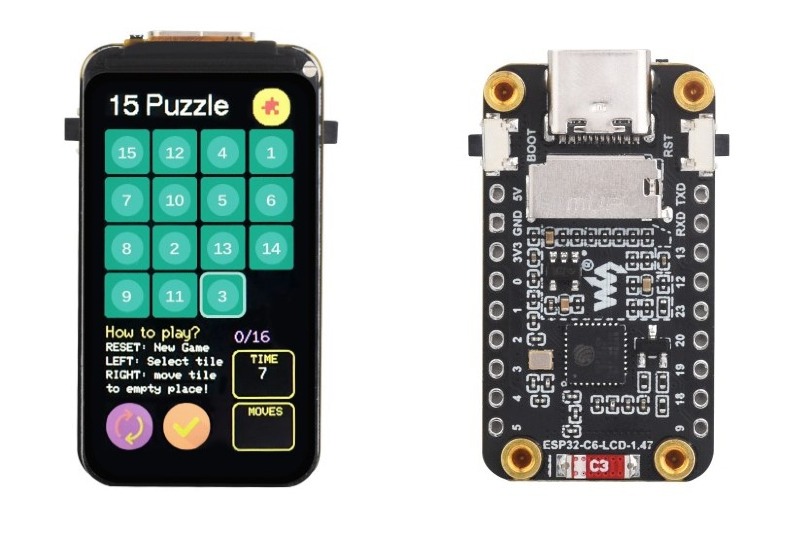
Waveshare ESP32-C6-LCD-1.47 specifications:
- Wireless MCU – Espressif Systems ESP32-C6FH4
- MCU cores
- 32-bit RISC-V core @ 160 MHz
- 32-bit RISC-V core @ 20 MHz low-power coprocessor can run tasks even when the main system is in a deep sleep state
- Memory – 512 KB HP SRAM, 16KB LP SRAM
- Storage – 320KB ROM, 4MB flash
- Wireless – 2.4GHz WiFi 6 and Bluetooth 5.0 LE
- MCU cores
- Storage – MicroSD card slot
- Display
- 1.47-inch TFT LCD
- Resolution – 172×320 pixels
- 262K color
- Display controller – ST7789 display controller
- USB – 1x USB Type-C port for power, programming, and data
- Expansion – 2x 9-pin headers
- 13x GPIO, UART, I2C, PWM
- 6x ADC pin
- 5V, 3.3V, GND
- Misc
- Built-in RGB LED with clear acrylic sandwich panel
- Reset and Boot buttons
- Onboard ceramic antenna
- Power Supply – 5V via USB Type-C male port regulated by ME6217C33M5G LDO (Onboard 3.3V and 5V Pins can also be used for power)
- Dimensions – 36.37 x 20.32mm (not including the USB port)
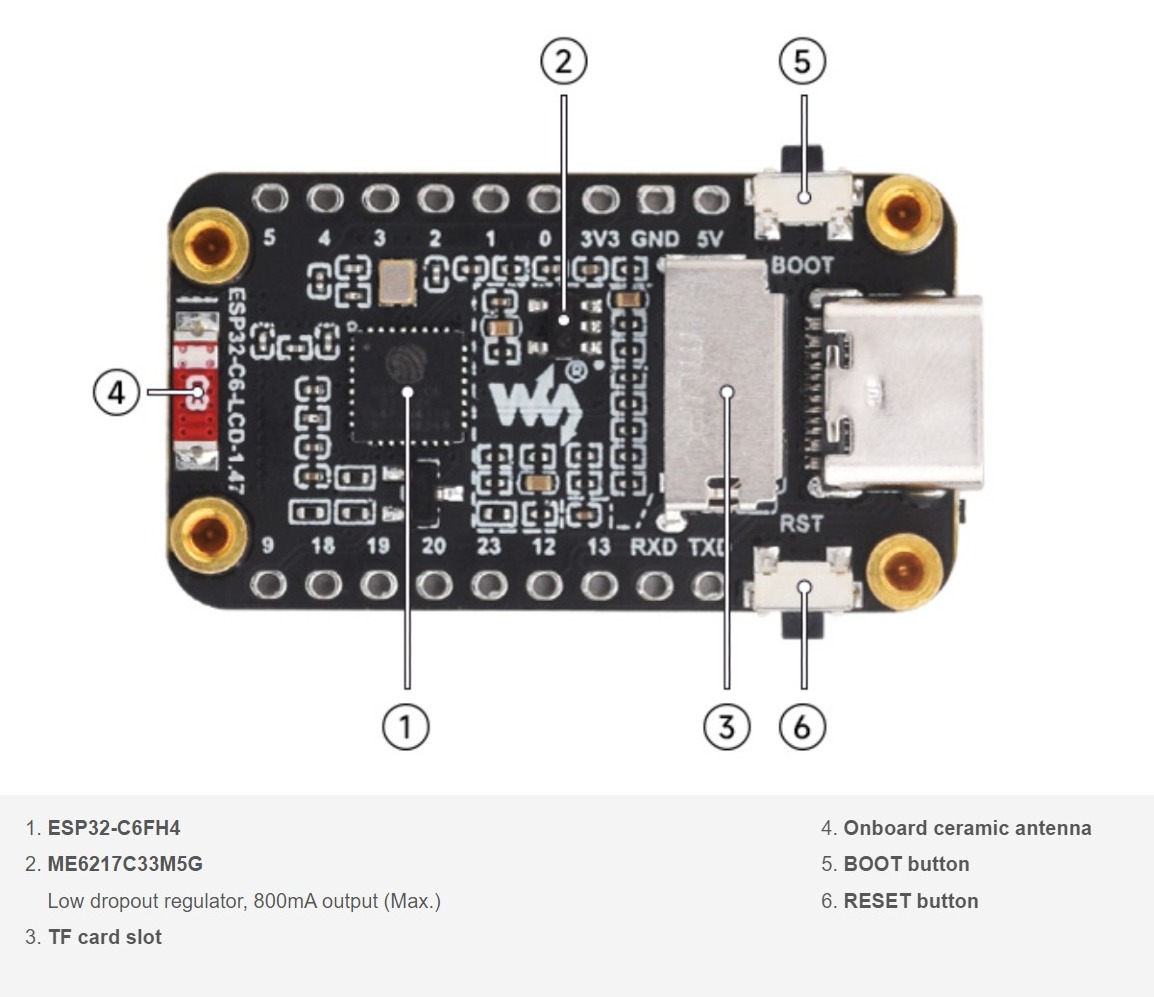
It supports precise control with features like a flexible clock and multiple power modes, ensuring low power consumption in various scenarios. LVGL, a free and open-source graphics library, offers all the tools needed to create embedded GUIs with simple graphical elements, attractive visual effects, and low memory usage. For more details, including Arduino software setup, library installation, and demo code, visit the Wiki.
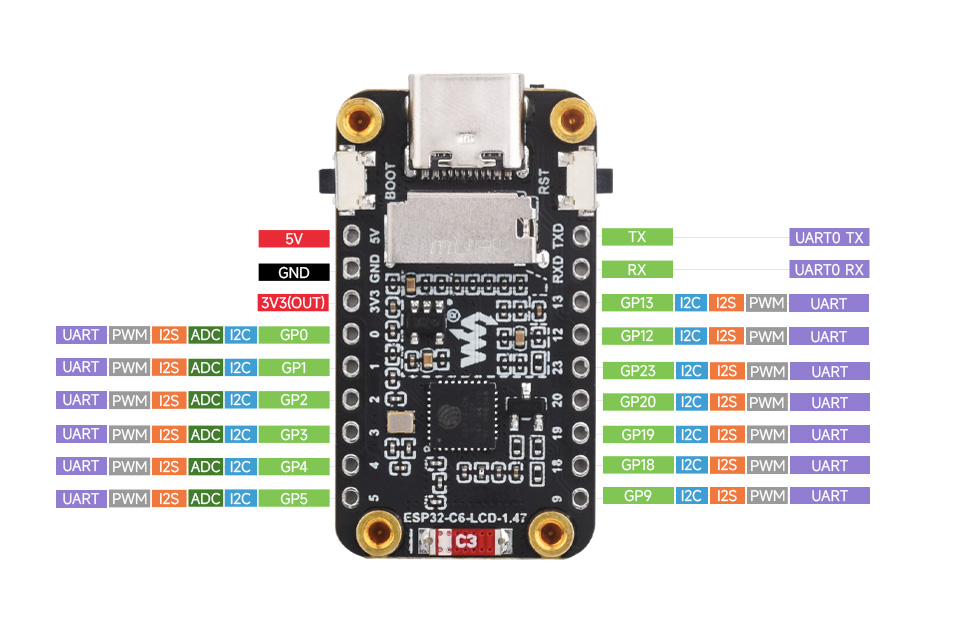
The Waveshare ESP32-C6-LCD-1.47 1.47-inch display USB-C development board is available on AliExpress for $13.99 excluding shipping, and you’ll also find it on the Waveshare store for $11.99.
The post ESP32-C6 WiFi 6 and Bluetooth 5.0 USB-C development board integrates 1.47-inch TFT LCD Display appeared first on CNX Software - Embedded Systems News.
AI – beyond the hype
It all seemed so world shaking. In November 2022, ChatGPT shocked the world with its versatility and eerily human-like responses to almost any question. Do you still remember the first time you used it and what you thought?
The rise
‘That’ ChatGPT moment fired the starting gun on an extraordinary period of focus on generative artificial intelligence – a category of technologies that includes the large language models that power Open AI’s flagship consumer product and its competitors. Since then, Mckinsey has estimated that generative AI could add the equivalent of $2.6 trillion to $4.4 trillion to the global economy – each year. And, in June 2024, Nvidia surpassed Microsoft as the world’s most valuable company as its graphics processing units, the key piece of hardware in AI-focused data centres, became the belle of the stock market ball. Hopes and fears for the technology have been so acute that the world’s dignitaries have rubbed shoulders with tech executives at high-level AI summits at the UK’s Bletchley Park and (virtually) in Seoul.

The fall?
Fast forward to today, however, and it has already become fashionable to see the whole thing as one big hype bubble – and with some cause. In July, The Economist highlighted that despite the AI mania, the technology has had ‘almost no economic impact.’ And, at the end of July, stock markets fell sharply as investors unloaded shares in AI-heavy tech firms, partly driven by uneaseabout the extraordinary levels of capital expenditure these businesses have committed to as they keep pace in the AI race.
The planetary impact of the accelerating expansion of power-thirsty data centres, which underpin AI, has also added to the souring mood, with Google and Microsoft reporting increases in emissions as a result of AI infrastructure.
The long term
Is this scepticism ultimately warranted? Betting against AI over the long term would be foolish, especially as the story we are seeing today has played out before. In 1987, economist Robert Solow quipped that that the computer age was everywhere except for the productivity statistics, foreshadowing, almost exactly, some of the arguments of today’s AI bears. And in May 2024, when the tide of sentiment had already begun to turn, Goldman Sachs research found that AI was showing very positive signs of *eventually* boosting productivity and GDP.
For most people generative AI has been synonymous with chatbots – but there is more to the technology. To cut through the Gordian knot of AI boosterism on the one hand and nay-saying on the other, we’ve therefore focused this month’s Future Now on innovations in generative AI that get behind the headlines to address less-discussed applications for the technology.
Beyond human language
While most of the discussion around generative AI has revolved around chatbots that generate responses to prompts in human language, this is not the only way that the technology can be used. Indeed, generative AI is showing promise in materials science and drug discovery, where it is molecules or protein sequences, rather than words, that are being generated. McKinsey, for example, forecasts that the technology could generate $60 billion to $110 billion in economic value for the pharmaceutical and medical product sector each year.
The innovations:

Photo credit: Cradle Bio
AI optimises protein sequences for enhanced products
Proteins are crucial building blocks in biology, and increasingly show promise for creating new products – from medicines to new foods, detergents, and petrochemical alternatives. Proteins are made up of sequences of amino acids, with the exact sequence determining the protein’s properties. And, just as generative AI can be used to string together chains of words, so it can be used to generate these protein sequences. This is what startup Cradle Bio is doing with its easy-to-use platform. The proprietary generative AI enables users to create variants of target protein sequences with improved characteristics, such as greater thermostability or optimised gene expression. This can all be done by a non-specialist at the touch of a button. Find out more

Photo credit: © ภาพของThanapipat Kulmuangdoan via Canva.com
AI-enabled protein design for gene-editing
Profluent is another startup that is using generative AI to de-code the ‘language of biology.’ Traditionally, researchers designing proteins for pharmaceutical or other use cases, either had to search for existing proteins in nature, or make small tweaks to natural proteins in the hope that they will deliver the desired properties. However, Profluent’s protein language models – which are similar in principle to the large language models used in chatbots – can be used to precisely design proteins and optimise their properties. The company is initially applying its platform to gene-editing, where genetic material of a living organism is altered by adding, deleting, or replacing sequences of DNA – often to cure a genetic illness. In April, the company announced that it had successfully edited the human genome using a gene-editor developed using its AI models. Find out more

Photo credit: © Julia Filirovska from Pexels via Canva.com
A generative AI search engine for advanced materials
The world will a require a range of new technologies and materials to tackle climate change. However, traditional testing processes can be time-consuming, expensive, and wasteful when things don’t go to plan. Now, CuspAI is applying generative AI to he problem, with its search engine that allows users to request and evaluate the properties of existing and new materials on demand – users could request a material that selectively binds carbon dioxide under specified conditions for example. The platform then uses generative AI, deep learning, and molecular simulation to generate, evaluate, and optimise potential molecular structures that meet those exact criteria. Read more
Streamlining scientific research
According to the Royal Society, “the applications of AI in scientific research are bringing a new age of possibilities and challenges.” And while there are obvious potential pitfalls for generative AI use in research, such as the risk of hallucinations and bias and the possibility of fraud, the technology can help humans to plan, conduct, and report on research in a better way. Innovators are therefore developing specialist tools that help with every stage of the process, from understanding the existing literature to writing up results.
The innovations:

Photo credit: Elicit
AI finds relevant research for time-poor academics
Reviewing past research is essential for academics, but it can be a slow process, as time is often wasted trying to source appropriate articles or reading content that ends up being irrelevant. Elicit is an online resource that utilises state-of-the-art AI to streamline academic research, acting as a virtual research assistant. Users type their research questions in plain English into the Elicit search engine and the platform draws from over 125 million articles in its database to create a personalised list of relevant papers, including those involving related keywords. Helpful one-sentence abstract summaries allow readers to quickly identify the most relevant resources and findings. Elicit claims that its tool can help users save five hours every week, cutting in half the amount of time it would normally take to do the same amount of research. Read more

Photo credit: © Mathias Reding from Pexels via Canva.com
Using AI to bring academic research to the fore
AI can help prioritise publications based on an individual’s preferences, which is how social media platform feeds work. And for those worried about increasingly narrow perspectives forcing people into echo chambers, a new discussion platform is bringing the latest research to the forefront of public discourse. Created by a Danish startup, the AI-powered platform, called Proemial, personalises reading recommendations to users and suggests connections across many different fields of study. The company brings together a variety of AI models to digest research and then make it not only applicable to scholars, but also interesting, relevant, and easy to understand for the general populace without specialist knowledge. Read more

Photo credit: © Ake Puttisarn from Getty Images via Canva.com
‘AI scientists’ that run their own research
In Japan, Sakana AI has recently introduced its ‘AI Scientist’, which allows large language models (LLMs) to independently perform machine learning research and speed up the entire process. The AI Scientist automates the whole research lifecycle – it can generate research ideas, execute experiments, summarise experimental results, and present findings in a full scientific manuscript. The system can even automate the peer review process to review the papers generated, write feedback, and develop ways to further improve results. While the AI Scientist demonstrates a strong ability to innovate on top of well-established ideas, such as diffusion modelling, it’s still yet to be seen whether it can also come up with novel, paradigm-shifting ideas. Read more
Giving healthcare a boost
Another area where generative AI can help to ease pressure is in the healthcare industry, where it can be used to streamline back-office processes and make time-poor clinicians more productive. In a 2024 Mckinsey survey that included 100 US healthcare leaders, 73 per cent of respondents believed that generative AI could be a boost for clinician productivity, with 60 per cent reporting that it could help with administrative efficiency and effectiveness. There have been several attention-grabbing headlines about the potential of general-purpose AI models in the healthcare space. For example, in February 2023, it was widely reported that ChatGPT had passed the US medical license exam. Researchers from Uppsala University have also found that one in five UK doctors are already using AI chatbots in their clinical workflows. However, innovators are working on more specialised tools that meet the particular needs of the healthcare industry.

Photo credit: © Alena Shekhovtsova from Baseimage via Canva.com
Speech-to-text tech for doctors in Africa
Healthcare systems across Africa are often particularly overstretched, with doctors in these countries frequently seeing far more patients each day than is typical for clinicians in other areas of the world. Voice-to-text apps can help to ease the pressure, but existing technologies often aren’t designed with African dialects and accents in mind. Now, Nigerian health technology company Intron Health has built a solution. The Transcribe app helps doctors complete clinical notes up to seven times faster than if they were typing, and has been built to accurately translate real-time speech and healthcare terms for more than 200 African accents. So far, the app works at a 92 per cent rate of accuracy for the included accents. Read more

Photo credit: © sasirin pamai’s Images via Canva.com
AI provides doctors with instant answers to clinical questions
To provide the best possible care for patients, doctors need to stay up to date with the latest clinical evidence and research as they make their diagnoses. Now, Medwise has developed an AI-powered search engine designed specifically for use by medical professionals. The sources for the platform include national knowledge resources as well as patient information and local guidance, all of which is vetted by clinicians. Users of the platform can then ask questions and get bite-sized answers – not full documents – at the moment they are caring for patients. Find out more

Photo credit: © Negative Space from Pexels via Canva.com
A decision support AI tool based on reputable medical evidence
Established businesses, as well as startups, are tackling the need for AI-generated answers to be drawn from robust and credible sources. For example, Elsevier Health, a global leader in medical information and analytics, is adding the convenient Q&A capabilities of generative AI to ClinicalKey, its clinical reference and decision support tool that is already embedded in thousands of hospital systems. Using the new tool, physicians can access Elsevier’s underlying body of curated and continuously updated medical content in a chat format. Doing so, they can be confident that responses are based on trustworthy medical information, with citations and underlying documents listed. Find out more
As a member you have unlimited access to our library over 14,000 innovation case studies. If this feature has piqued your interest, why not have a deeper dive into AI today?

Robotic Touch Using a DIY Squishy Magnetic Pad

There are a number of ways to give a robotic actuator a sense of touch, but the AnySkin project aims to make it an overall more reliable and practical process. The idea is twofold: create modular grippy “skins” that can be slipped onto actuators, and separate the sensing electronics from the skins themselves. The whole system ends up being quite small, as shown here.
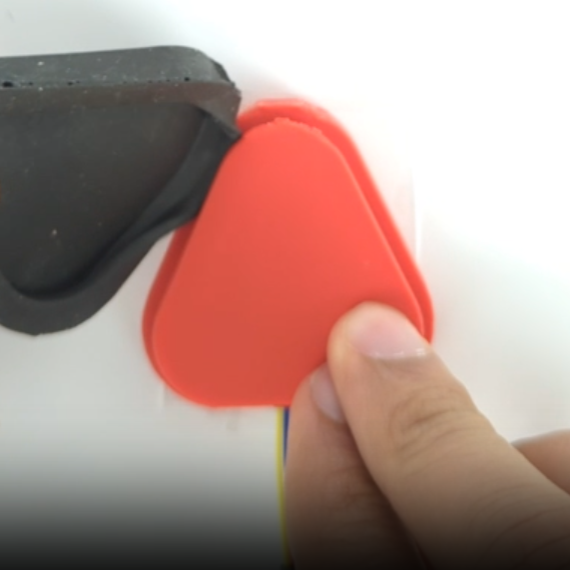
The skins are cast in whatever shape is called for by using silicone (using an off-the-shelf formulation from Smooth-on) mixed with iron particles. This skin is then slipped onto a base that contains the electronics, but first it is magnetized with a pulse magnetizer. It’s the magnetic field that is at the heart of how the system works.
The base contains five MLX90393 triple-axis magnetometers, each capable of sensing tiny changes in magnetic fields. When the magnetized skin over the base is deformed — no matter how slightly — its magnetic field changes in distinct ways that paint an impressively detailed picture of exactly what is happening at the sensor. As a bonus, slippage of the skin against the sensor (a kind of shearing) can also be distinctly detected with a high degree of accuracy.
The result is a durable and swappable robotic skin that can be cast in whatever shape is needed, itself contains no electronics, and can even be changed without needing to re-calibrate everything. Cameras can also sense touch with a high degree of accuracy, but camera-based sensors put constraints on the size and shape of the end result.
AnySkin builds on another project called ReSkin and in fact uses the same sensor PCB (design files and bill of materials available here) but provides a streamlined process to create swappable skins, and has pre-made models for a variety of different robot arms.

Chanel s’offre un immeuble avenue Montaigne
Google AR Patent Highlights Potential Advantage in Smart Glasses Market
Google wants to understand your surroundings.
The company filed a patent application for “augmented reality-based geolocalization of images.” The goal of Google’s tech is to help users capture better images of target areas, such as businesses or landmarks, using location data and augmented reality overlays.
“By formalizing the capture of images that represent the actual state of a target location, the accuracy of associated geolocalized images can be improved and the need for burdensome manual verification of geolocalized images can be reduced,” Google said in the filing.
The point of this tech is seemingly to crowdsource good images for Google Maps “without having to resort to manual inspection by a human due to the high quality of captured images,” the filing noted.
When a user wants to capture an image of a specific location, the system may give the user instructions on how exactly to capture that image using AR as a guide. For example, if it’s capturing an image of a business, the user may be instructed via their phone or smart glasses to get certain things in the frame, such as the address number or hours of operation.
That data may then be used to update data related to that location (likely through Google Maps). Along with adding the image to a location’s listing, it could collect and update information related to visiting hours or business type.
Google’s tech can create a symbiotic relationship between users and its mapping technology: While it could help beef up listings for the company’s GPS tech, it can also add value to the user experience by opening the door for AR activations and guides for users, said DJ Smith, co-founder and chief creative officer at The Glimpse Group.
Tech like this also shows a potential advantage that Google may have in developing augmented reality that sits atop real-world experiences, said Smith: its access to a vast amount of data through Google Earth and Maps. This factor may give it “a point of differentiation that the other large technology companies might not have,” he said.
And that edge may be particularly helpful as it joins the likes of Meta, Apple, and Snap in the competition to create mixed reality headgear that people actually want to wear. The company is working with Qualcomm and Samsung on a pair of mixed reality smart glasses that are linked to wearers’ phones.
Though Google’s glasses are meant to be a companion to a person’s phone, the push from big tech firms to create the next spatial computing device may signal that “our phones are getting to the end of their evolution,” said Smith. “With spatial computing, there’s this saying of ‘where you need it, when you need it,’ as opposed to buried without a phone.”
However, this isn’t the first time that Google has wanted to throw a set of spectacles into the mix. In order to avoid the missteps it took with Google Glass — and the nickname that came along with it — is an emphasis on privacy, said Smith. “They missed the mark on the security and privacy side of things. People didn’t want to be privately recorded by these devices.”
The post Google AR Patent Highlights Potential Advantage in Smart Glasses Market appeared first on The Daily Upside.
Amazon is stuffing generative AI into its shopping experience

Amazon has introduced a batch of new generative AI tools that aim to improve the retail experience for both customers and sellers on the platform. One of the more notable features announced at the Amazon Accelerate event on Thursday will use customers’ preferences, search, browsing, and purchase history to create personalized product recommendations on Amazon’s homepage.
Instead of the “more like this” feature that suggests similar, specific items, the new recommendations will be offered as larger categories based on a customer’s shopping habits — such as those catering to holiday events or sporting activities. The company says it’s leveraging a large language model to recommend products with specific features, but it’s not clear how...
EssilorLuxottica et Meta continuent d'établir le futur de la lunette intelligente
Meta has a major opportunity to win the AI hardware race

The Ray-Ban Meta smart glasses exceeded expectations in a year when AI gadgets flopped. But can it keep the momentum going?
Satellite imagery of all the outdoor basketball courts

For The Pudding, Matthew Daniels extracted all the outdoor basketball courts in the United States via OpenStreetMap satellite imagery. With 59,705 locations along with commenting and liking, it’s a fun experiment in scale for display, filtering, and interaction. Plus, basketball.
Tags: basketball, Matt Daniels, OpenStreetMap, Pudding, satellite imagery
Liban : après les bipeurs, ce sont les talkies-walkies du Hezbollah qui explosent

Plusieurs explosions ont retenti ce 18 septembre à travers le Liban, causées selon les premières images par des talkies-walkies piégés. Cette attaque intervient moins de 24h après l'explosion des bipeurs du Hezbollah.
Arnaud Bodzon, LVMH : "La data peut être utilisée pour mieux comprendre les habitudes de paiement"

Fauxtomation

Writer and filmmaker Astra Taylor explains fauxtomation as "the process that renders invisible human labour to maintain the illusion that machines and systems are smarter than they are." (Faux means false or fake in French).
Taylor gives an example of standing in line to collect food and the person in front of her expressing amazement at how the app knew his order was done 20 minutes early. The server replies, "I sent you a message."
With the rise in incredible abilities driven by AI chatbots and tools, it's tempting to believe that AI can run anything. But, in many situations, claims of AI magic and sophisticated automation disguise work done by people—often outsourced and poorly paid.
An example of fauxtomation is content moderators, whose job is to review and filter objectionable content from the web when the claim is that sophisticated algorithms and AI are doing the work. Other examples are tagging or searching images, transcribing audio, responding to customer queries, making decisions, or, ironically, training machine learning models. In another twist, ordering on the app or touchscreen at McDonalds or the self-checkout at a supermarket, you, as a customer, become the labour of a server or waiter.
Some have argued that automation polarises work into vast quantities of small, menial tasks feeding the machines on one end and sophisticated, high-skilled work in designing and maintaining the machines at the other.
Amazon has long offered its Mechanical Turk service, which crowdsources assignments with a distributed workforce—they called it artificial, artificial intelligence. The original Mechanical Turk was a hoax from the 1700s where a concealed human chess player fooled onlookers into believing a machine was playing.
As a design and UX professional, I've used the Wizard of Oz prototype technique. Named after the infamous wizard secretly controlling impressive machines from behind a curtain, the idea is to give the appearance of a working software prototype by discreetly controlling what people see based on their actions.
AI promises instant automation, but that's rarely the case. As you work to automate and remove inefficiencies, it's natural that systems should be supported by people. Human-augmented work may be a more appropriate term. In many domains, especially where safety is at stake, such as in self-driving cars, reviewing legal documents, or automated background checks, oversight by people may remain critical.
Alongside the AI revolution, a quiet revolution nearly as significant for our everyday experience is the tying together of different tools for automation. Tools like Zapier, Google Sheets, Notion, and the growth of APIs allow us to automate workflows across systems, saving massive amounts of time and effort.
While the vision of machines reducing our labour persists, history shows that they often drive increased productivity instead of reducing work. This echoes Jevon's paradox, where fuel efficiency gains usually result in increased fuel usage rather than less.
I saw an excellent talk by machine learning and AI expert James Smith, in which, before you try machine learning ("I hear you have Magic Pixie dust. Can I have some?"), he would ask, "Have you tried 50 IF statements?" These programmed rules will be more maintainable, less complex, and result in responses that are easy to understand.
I learned about fauxtomation from Tom Humberstone's remarkable visual essay What Luddites Can Teach us About Resisting an Automated Future in the MIT Technology Review. Fauxtomation is similar in concept to Potemkin AI, a term from researcher Jathan Sadowski.
You can read Astra Taylor's article, The Automation Charade, or watch her discuss fauxtomation at the AI Now 2018 symposium.
Sketchplanations continues to be done by me, by hand. If you'd like to support me, I'm improving my Patreon, which makes such a difference in helping creators like me keep creating. Thank you.
Here's a fauxtomation sketch by ChatGPT in case you're interested =)
Also see:
As well as fauxtomation prints, you can get AI department prints
Liban : ces centaines de bipeurs ont explosé en même temps dans les poches des membres du Hezbollah

Des milliers de membres du groupe terroriste libanais Hezbollah ont été blessés dans l’explosion simultanée de leurs bipeurs, survenue ce mardi 17 septembre 2024. Ces appareils étaient utilisés pour éviter l’utilisation de téléphones portables.
The first Thunderbolt 5 dock appears to have arrived

The first Thunderbolt 5 cables arrived in July, and now it looks like we’re finally getting the first Thunderbolt 5 dock! Kensington has just announced the Intel-certified SD5000T5 EQ is now available to buy, seemingly beating every rival to the 120Gbps single-cable docking punch. (I just checked: Hyper, J5Create and OWC’s docks aren’t yet available.)
The new dock claims to support up to three 4K monitors or two 8K monitors on Windows, or dual 6K monitors on MacBook Pros with M1 Pro chips or better. It also offers up to 120Gbps speeds for connected peripherals — assuming your computer has a Thunderbolt 5 port, anyhow. Last we checked, only a single $4,500 version of the Razer Blade 18 has that port, though PCWorld points out the $3,899...
Actualité : Des chirurgiens opèrent avec une manette PlayStation à 9300 km de distance

Snap Unveils Upgraded AR Spectacles For Developers, Priced $100/Month
The company behind Snapchat just unveiled its fifth generation Spectacles.
The first three generations of Spectacles were launched as consumer devices from 2016 to 2019 but lacked any kind of display or speakers. They functioned solely as camera glasses, similar to today's Ray-Ban Meta glasses but without the audio out and AI capabilities.
Fourth generation Spectacles were unveiled in 2021 with waveguide displays for true AR, but were only available to select developers in very limited quantities. They were a standalone AR device in true sunglasses form factor, featuring a Qualcomm Snapdragon XR1 chipset, a tiny field of view, and an active battery life of just 30 minutes.
The new fifth generation Snap Spectacles offer a wider field of view, longer battery life, a more powerful processor, and higher transparency to allow bystanders to see the wearer's eyes. And this time Snap will offer them to any developer for $99/month.
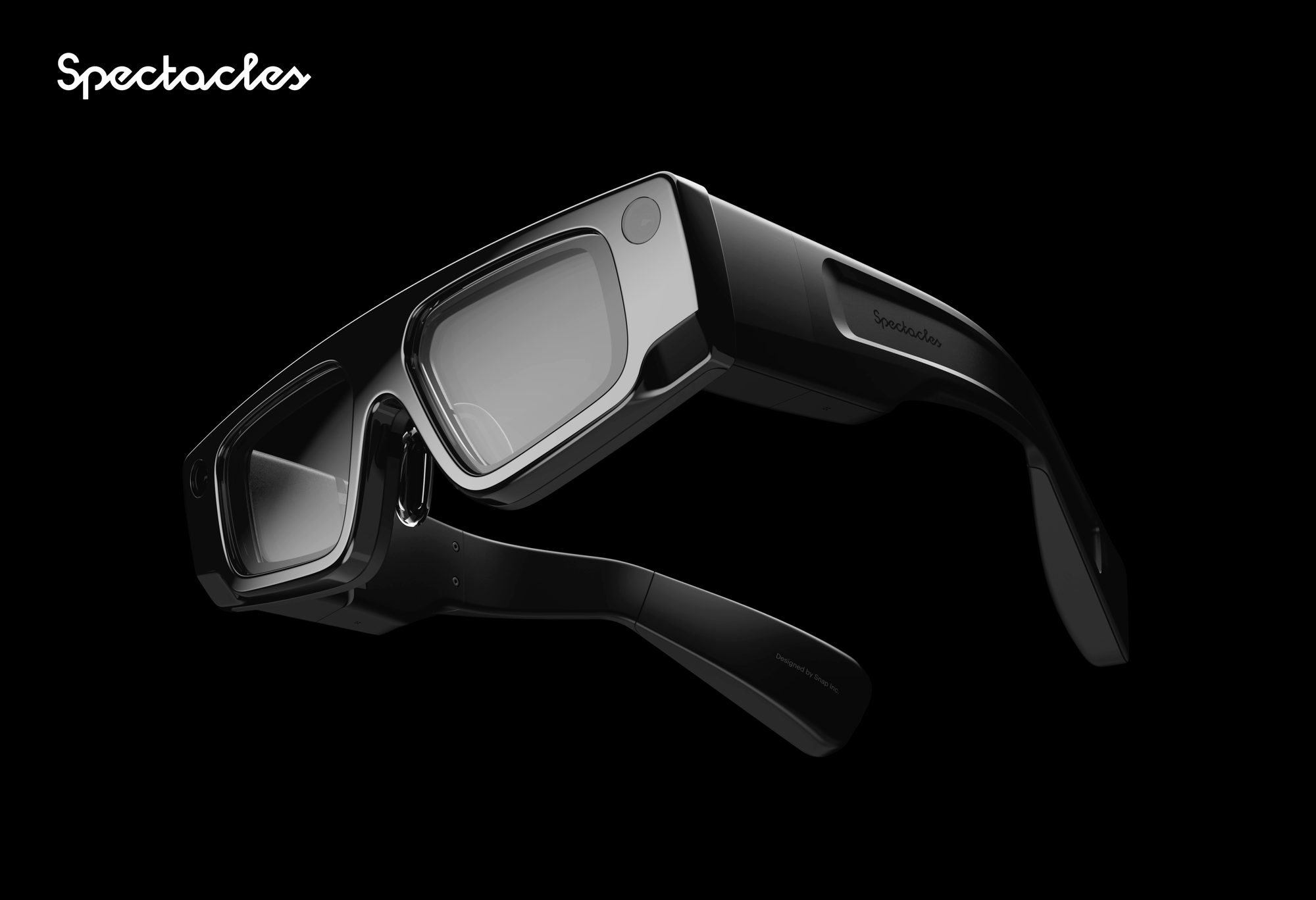
The field of view has been increased from just 26 degrees to now 46 degrees diagonal, the same as Xreal but slightly below HoloLens 2.
Spectacles now offer an angular resolution of 37 pixels per degree (PPD), similar to Apple Vision Pro. This is made possible by the use of LCoS displays, at the cost of rendering Spectacles noticeably thicker than future microLED solutions have the potential to be.
Spectacles also feature "automatically tinting lenses", which Snap claims makes visuals "vibrant, indoors or outdoors — even in direct sunlight".
Snap says the device is powered by "two Snapdragon processors from Qualcomm", which split the compute workload across each stem, increasing performance while improving thermal dissipation. To further cool the chips, Spectacles uses titanium vapor chambers. The dual-chip solution somewhat reminds us of Snapdragon AR2, but Snap declined to tell us an exact name for what chipset it's using, suggesting it may be a new unannounced offering from Qualcomm.
Snap claims a motion-to-photon latency of 13 milliseconds, close to the 12 milliseconds Apple claims for passthrough latency of Vision Pro.
The active battery life has been increased from 30 to 45 minutes, and a USB-C port at the back of one of the stems allows for extended usage via a power bank.
One area in which Spectacles have regressed though is the weight and size. The original AR Spectacles weighed 134 grams, while the new Spectacles weigh 226 grams. They're also visibly bulkier, pushing the limits of what can be described as a true glasses form factor.


Original AR Spectacles (left) vs New AR Spectacles (right)
Snap Spectacles can't capture first-person photos and videos outside of apps, and there's no audio streaming "yet", so it can't play podcasts and music from your phone or take calls. But the AR capabilities let Spectacles do much more than basic smart glasses.
Spectacles run Snap OS, which the company claims is a "purpose-built, brand new operating system" for AR.
Spectacles has a built-in web browser which supports YouTube, or you can wirelessly mirror your phone screen to bring your mobile apps into AR.
The glasses feature hand tracking, and the main menu of Snap OS is anchored to one of your hands to be interacted with using the other. It also has on-device speech recognition for text input.

Developers build "Lenses" for Snap OS, the company's terms for apps, using Lens Studio 5.0. Snap says developers can easily build Lenses using Spectacles Interaction Kit, and more advanced Lenses can be written using TypeScript and JavaScript. To identify, track, and augment real world objects, SnapML will let developers use custom machine learning models in their Lenses.
Additionally, developers can leverage your smartphone as a 6DoF tracked controller. And with Spectator Mode nearby smartphone users can see what you're seeing in AR.
In future, through a partnership with OpenAI, developers will also be able to use GPT-4o API "to provide more context about what you see, say, or hear".

LEGO has used Lens Studio to build an AR game for Spectacles called Bricktacular. "Whether you're free building or tackling specific LEGO sets, this experience unlocks endless possibilities to challenge yourself and see how fast you can build."
Snap says ILM Immersive, the team behind the Star Wars VR interactive stories Vader Immortal and Tales from the Galaxy’s Edge and the Marvel mixed reality interactive experience What If…?, is currently building AR Star Wars experiences "that connect you and your friends with the Star Wars Galaxy".
Niantic is bringing a Peridot spinoff and Scaniverse to Snapchat Spectacles too.
Snap Spectacles will only be available in the US, and developers renting Spectacles need to commit to a 1-year minimum term. If they stop subscribing after that, they'll need to send the glasses back to Snap.
The Verge reports that these Spectacles are difficult and expensive to manufacture, with "thousands of dollars" in components, and that Snap is building only on the order of 10,000. A consumer version at an affordable price is likely many years away, and we'll keep a close eye on Snap for any signs of it.
 UploadVRDavid Heaney
Snap's reveal comes just a week before Meta is expected to show off its own AR glasses. But Meta's glasses are reportedly even more expensive and hard to manufacture, achieving a wider field of view, and the company won't even sell them to developers.
You can read our hands-on impressions of Snap's new AR Spectacles here:
 UploadVRIan Hamilton

Paris Retail Week devient le "Retail's Big Show Europe", en partenariat avec la NRF

La Chine veut faire peur aux États-Unis en détectant des signaux de Starlink avec l’armée

Une étude publiée par une université chinoise met en avant des tests pour détecter les connexions avec un satellite Starlink. Les chercheurs affirment ainsi pouvoir récupérer des infos sur des appareils militaires américains.
The Rise of Self-Cleaning, Cat-Killing Litter Boxes

Machines that automate the various tedious tasks that come with being a servant in a cat’s household — like feeding and cleaning Mr. Fluffles’ litter box — are generally a godsend, as they ensure a happy cat and a happy human. That is, unless said litter box-cleaning robot kills said cat. That’s the gruesome topic that [Philip Bloom], also known as the bloke of the One Man Five Cats channel on YouTube, decided to investigate after coming across a report about a certain Amazon-bought unit.

Although he was unable to get the (generic & often rebranded) unit off Amazon UK, he did get it via AliExpress for £165 + £80 shipping. Although this version lacks the cute ears of other variants, it’s still effectively the same unit, with the same moving components and mechanism. An initial test with a cat plushie gave the result that can be observed in the above image, where the inner part with the opening will move upwards, regardless of whether a cat is currently poking through said opening. Once the victim is stuck, there is no obvious way to free the trapped critter, which has already led to the death of a number of cats.
The other self-cleaning litter boxes which [Philip] owns have a number of safety features, including a weight sensor, an infrared sensor above the opening to detect nearby critters, a top that will pop off rather than trap a critter, as well as a pinch sensor. During a test with his own hand, [Philip] managed to get injured, and following a banana test, he had a nice banana smoothie.
What takes the cake here is that after [Philip] connected the mobile app for the litter box, he found that there was a firmware update that seems to actually change the machine to use the pinch and infrared sensors that do exist in the litter box, but which clearly were not used properly or at all with the shipped firmware. This means that anyone who buys any of these self-cleaning litter boxes and does not update the firmware runs the significant risk of losing their pet(s) in a gruesome incident. In the video a number of such tragic deaths are covered, which can be rather distressing for any cat lover.
Of note here is that even with the improved firmware, any issue with the sensors will still inevitably lead to the tragic death of Mr. Fluffles. If you do want to obtain a self-cleaning litter box, make sure to for example get one of [Philip]’s recommendations which come with a paw stamp of approval from his own precious fluff balls, rather than a random unit off Amazon or AliExpress.