Shared posts

03 Jul 07:37

Vuzix’s Strategic Ascent: Fueling Smart Glass Innovation and Market Dominance

by Rory Greener

Recently, Vuzix made two key announcements, solidifying sales and market presence, just as the AR smart glasses foresee incredible growth.  

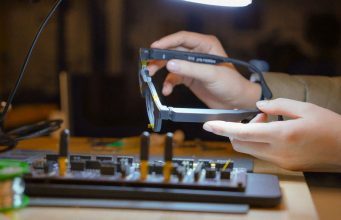
Firstly, Vuzix announced that TranscribeGlass is continuing to place follow-on orders for Vuzix smart glasses to support the increasing demand for its AI-powered real-time transcription service.

Madhav Lavakare, Founder and CEO of TranscribeGlass, said

These follow-on orders reflect the strong market response we’ve received since our solution launch. TranscribeGlass empowers individuals with hearing impairments by delivering real-time closed captions directly into their field of view, fundamentally improving accessibility and communication. With growing demand for our solution, the Vuzix Z100 enables us to offer a seamless, all-day wearable experience that’s accelerating adoption and expanding our impact. 

The TranscribeGlass solution is a patient care XR device that utilises the Vuzix hardware platform to enhance accessibility for individuals who are deaf or hard of hearing. This innovative product employs AI to provide real-time speech-to-text transcription. It also features Bluetooth connectivity for smartphones and tablets and advanced speaker identification, making it easier to follow conversations in group settings.

Paul Travers, President and CEO of Vuzix, also said: 

Vuzix Z100 smart glasses offer a perfect foundation for TranscribeGlass’s advanced AI transcription technology. By working together, we aim to accelerate the use and development of smart eyewear, further solidifying Vuzix’ position at the forefront of AI-driven wearable tech.

In addition to the TranscribeGlass news, Vuzix confirmed its addition to the Russell 3000 Index. 

“Vuzix is at the forefront of next-generation wearable displays, and our leadership in advanced waveguide optics is helping to define what’s possible in augmented reality,” said Paul Travers. 

Travers also noted: 

Our inclusion in the Russell Indexes is a meaningful acknowledgment of the progress we’ve made. We see this as both validation of our strategy and a catalyst for broader institutional engagement as we continue to push the boundaries of AR innovation on a global scale. 

Vuzix Accelerates Smart Glasses Development with $15 Million Investment

Vuzix has announced receiving a second tranche investment of $5 million from Quanta Computer, a leading global ODM and strategic partner. This new funding brings Quanta’s total investment in Vuzix to approximately $15 million, following earlier contributions over the years.

Additionally, Vuzix recently formed a partnership with Ramblr. This collaboration is a significant step toward the company’s projected success in 2025 and will enhance Vuzix’s efforts to integrate artificial intelligence into its augmented reality hardware portfolio. This trend is noteworthy as the smart glasses market approaches a crucial convergence this year, as highlighted by Google.

In a strategic move, Vuzix acquired a waveguide research and development facility in Milpitas, California. This acquisition will improve Vuzix’s waveguide tools, vital for its next-generation, AI-driven smart glasses, benefiting both its products and ODM/OEM partners. The acquisition centralises Vuzix’s innovation efforts within Silicon Valley and involves securing advanced equipment, further solidifying its position as a key player in the smart glasses market.

Moreover, Vuzix is strengthening its OEM partnerships with recent developments. The company has shipped its latest order of XanderGlasses, a private-label version of the Vuzix Shield smart glasses designed to assist individuals with hearing loss. This advancement signifies a significant milestone for Vuzix, especially following a strong start to 2025. XanderGlasses aims to support approximately 48 million people in the U.S. who experience hearing loss, and the devices are currently being distributed nationwide.

The Vuzix Shield smart glasses can display real-time captions of in-person conversations directly within the wearer’s field of view, allowing users to remain fully engaged in social and professional settings. Xander has received recognition for its product, earning a CES 2024 Innovation Award Honoree in the Accessibility and Ageing Tech categories.

This news comes during a crucial growth period for Vuzix, as the market gains momentum, indicating a promising future for this veteran in the smart glasses industry.

03 Jul 07:29

Laptop Farms : l’incroyable réseau de télétravailleurs nord-coréen démantelé par les États-Unis

by Amine Baba Aissa

Fin juin 2025, la justice américaine a dévoilé l’opération DPRK RevGen, une initiative des principales agences de sécurité du pays (NSA, FBI, contre-espionnage) visant à démanteler un vaste réseau de travailleurs informatiques nord-coréens.

01 Jul 11:22

Simplifier le travail ne revient pas à sous-exploiter les talents

by Bertrand DUPERRIN

Un de mes crédos en termes d’expérience employé, qui s’inscrit d’ailleurs également dans des logiques d’expérience opérationnelle, est que la simplification est à la base de tout. Le travail et son organisation doivent être fluides, lisibles, logiques afin de permettre aux collaborateurs de se concentrer sur leur mission sans être constamment freinés par la complexité inutile du quotidien.

Mais, à ma grande surprise, mon idée est souvent mal comprise. On m’a déjà répondu plusieurs fois « On ne va tout de même pas payer des gens à faire des choses simples, si on les paie c’est justement parce que c’est compliqué« .

Comme si simplifier les conditions de travail revenait à appauvrir le travail lui-même ou à gâcher les talents.

Remarquez que c’est une piste qui mériterait peut être d’être explorée : et si la raison pour laquelle on recrutait des gens hyper expérimentés et qualifiés n’était que pour faire face à une complication (La complication organisationnelle : irritant #1 de l’expérience employé ) et une dette organisationnelle (How to Tackle the Biggest Threat to Your Team’s Growth ) qu’on a pas la volonté ou le courage de régler ?

Mais en fait le sens original de mon propos est tout autre.

En bref :

  • La simplification doit être conçue comme un levier d’efficacité permettant aux collaborateurs de se concentrer sur des missions à forte valeur ajoutée, en supprimant les obstacles inutiles et non comme un appauvrissement du travail.
  • La complexité inutile dans les organisations découle souvent d’une dette organisationnelle : processus obsolètes, outils inadaptés, contrôles excessifs et routines sans finalité réelle.
  • Cette complication parasite la motivation, dilue l’énergie des équipes et empêche l’expression des compétences pour lesquelles les collaborateurs ont été recrutés.
  • Simplifier, c’est renforcer la qualité et l’exigence du travail en libérant les équipes des frictions structurelles, et non réduire les attentes ou les transformer en exécutants de tâches triviales.
  • Cela nécessite une alliance entre RH et opérations, une culture de l’amélioration continue et surtout du courage managérial pour rendre le travail plus intelligent, plus utile.

Ce que les gens veulent, ce n’est pas faire des choses simples

Ce qu’ils veulent c’est qu’on simplifie ce qui n’a aucune raison d’être compliqué !

Il ne s’agit pas de transformer les métiers en tâches triviales mais de supprimer les obstacles inutiles, ceux qui parasitent l’attention, usent la motivation et consomment l’énergie sans créer de valeur.

La complication inutile est partout dans les entreprises :

  • des process conçus à une autre époque que personne n’ose remettre en question,
  • des outils mal intégrés, qui transforment chaque tâche en parcours du combattant (Une expérience IT compliquée. Irritant #7 de l’expérience employé),
  • des circuits de validation interminables qui multiplient les points de friction et retardent les décisions,
  • des réunions, des emails, des reportings qui mobilisent du temps, mais ont rarement du sens.

Elle est le fruit de la dette organisationnelle dont je parlais plus haut mais aussi du travail des managers dont l’appétence pour le contrôle n’a d’égal que leur peu d’intérêt pour l’amélioration du travail.

Tout cela finit par détourner les collaborateurs de l’essentiel. On les recrute pour leur intelligence, leur capacité d’analyse, leur créativité et on les enferme dans des systèmes qui les empêchent de les mettre en œuvre.

Simplifier, ce n’est pas abaisser le niveau d’exigence.

Simplifier c’est, au contraire, augmenter le niveau de concentration, de qualité et donc de qualité sur les sujets qui comptent vraiment.

Il faut en effet permettre aux équipes de se consacrer à des problèmes complexes, à forte valeur ajoutée, en les libérant de la pagaille organisationnelle. Déjà parce cette pagaille ne devrait pas exister et que les collaborateurs n’ont pas à en payer le prix mais également parce qu’avec l’essor de l’IA ce c’est de plus en plus pour gérer la complexité (et non la complication !) qu’on va embaucher des gens.

Et non, l’IA ne va pas régler le problème seule sans qu’on s’en occupe (AI Reasoning Is Cool, But First How Can We Tackle Organisational Debt?).


C’est ce qu’on attendrait naturellement d’un bon designer d’expérience utilisateur : faire en sorte que l’interface disparaisse, pour que l’usager se concentre sur son objectif


Mais pourquoi ce principe serait-il réservé aux clients, et pas aux collaborateurs ?

La simplification c’est de l’excellence opérationnelle…mais pas seulement

La simplification en effet est au croisement des opérations, de l’expérience employé et des RH (RH et Opérations : le seul duo viable pour mener l’expérience employé
et L’humain est partout dans l’entreprise mais, dans le travail, les RH ne sont nulle part).

On l’a oublié, ou on n’a jamais voulu le comprendre, mais l’expérience employé n’est pas une affaire de bien-être cosmétique ou de programme RH déconnecté du rée (Baromètre 2023 de l’expérience collaborateur : l’expérience employé face à ses contradictions). C’est un levier de performance (L’expérience collaborateur : un levier de transformation au service de la performance), au même titre que la qualité, la satisfaction client ou la maîtrise des coûts.


Et comme tout levier de performance, il exige une approche rigoureuse : observer, comprendre les irritants, supprimer les frictions, alléger ce qui peut l’être.

Cela demande une vraie culture de l’amélioration continue (Ca n’est pas parce que le travail est invisible qu’on ne peut l’améliorer) mais avant tout et surtout du courage managérial.


Pas pour rendre le travail « plus agréable » , mais pour le rendre plus efficace, plus intelligent, parfois digne. Le reste n’est qu’une conséquence.

Conclusion

Simplifier, ce n’est pas simplifier les missions mais simplifier l’environnement et le contexte du travail pour que chacun puisse utiliser tout son potentiel là où il est réellement utile.


C’est créer les conditions d’un travail exigeant, stimulant, valorisant mais sans surcharges inutiles ni complexité gratuite.

On ne paie en effet pas les gens pour faire des choses simples mais pour résoudre des problèmes complexes, prendre des décisions, faire avancer les choses.

Cela fonctionne très bien mais encore faut-il leur en laisser le temps, l’espace et l’énergie.

Et pour cela les organisation n’ont qu’un et un seul problème à régler : la complication.

Illustration : générée par IA avec ChatGPT, OpenAI, 2025.

L’article Simplifier le travail ne revient pas à sous-exploiter les talents est apparu en premier sur Bloc-Notes de Bertrand Duperrin.

01 Jul 10:52

Reinforcement learning for nuclear microreactor control

A machine learning approach leverages nuclear microreactor symmetry to reduce training time when modeling power output adjustments, according to a study led by University of Michigan researchers, published in the journal Energy Conversion and Management: X.
01 Jul 10:47

Flexible e-textile uses 3D-printed sensors to monitor and optimize combat training routines

Traditional military training often relies on standardized methods, which has limited the provision of optimized training tailored to individual combatants' characteristics or specific combat situations. To address this, a research team has developed an e-textile platform, securing core technology that can reflect the unique traits of individual combatants and various combat scenarios. This technology has proven robust enough for battlefield use and is economical enough for widespread distribution to a large number of troops.
01 Jul 10:46

The Industrial Metaverse: A $600 Billion Horizon by 2032

by Rory Greener

This week, Meticulous Research published its “Industrial Metaverse Market—Global Opportunity Analysis and Industry Forecasts to 2032”, highlighting how the industrial metaverse market is experiencing extraordinary growth, reaching roughly $48.2 billion in 2025.

The report also noted that the industrial metaverse market is expected to grow to $600.6 billion by 2032, with a compound annual growth rate of 20.5% during the 2025-2032 forecast period.

Industrial metaverse, or in short, shared RT3D immersive applications, assets, and services, are leveraged broadly in sectors such as manufacturing, transport, and oil & gas, where high-quality simulations are finding a home as a tool to save capital during complex projects and operations.

AR Smart Glasses to Emerge Alongside Industrial Metaverse

But what hardware will the industrial metaverse be consumed on? If current trends are to be believed, it will most likely be smart glasses. The International Data Corporation (IDC) reported a significant recovery in headset purchases in its Worldwide Quarterly Augmented and Virtual Reality Headset Tracker. The latest report indicates that the AR/VR headset market grew by 18.1% year over year in the most recent quarter, with Meta leading the resurgence, capturing 50.8% of the market share.

Ramon T. Llamas, Research Director with IDC’s AR/VR team, noted that “the worldwide AR/VR headset market is reaching a critical tipping point.”

Llamas added:

Pure VR was once the darling of the market with companies like Meta, HTC, and Sony accounting for the vast majority of volumes. Now we have it on track to wind down in the next few years. Likewise, pure AR had strong promise with the help of Microsoft, but now we anticipate volumes to hold a small place in the overall market.

XREAL is currently the second-leading market player, partly due to its sales of smart glasses. In contrast, Viture, another smart glasses vendor, reported an impressive 268.4% year-over-year growth, while TCL saw an increase of 91.6%. Interestingly, the IDC noted that Apple did not appear in the market’s top rankings this quarter. The reporting firm observed a shift towards optical see-through glasses.

Jitesh Ubrani, research manager for IDC’s Worldwide Mobile Device Trackers, also added:

The market is clearly shifting toward more immersive and versatile experiences. While Meta continues to lead, the rise of brands like Viture and XREAL shows that innovation in form factor and user experience is resonating with consumers. The next wave of growth will be driven by mixed and extended reality, especially as AI and Android XR platforms mature.

IDC reports that although AR/VR/MR device shipments are expected to decline by 12% in 2025 due to delayed product launches, the firm anticipates significant growth in 2026. They project an approximate increase of 87%, and from 2025 to 2029, the market is forecasted to grow at a compound annual growth rate of 38.6%.

Llamas concluded:

Meanwhile, we anticipate MR to experience a strong reception with many of those VR companies pivoting there and gaining entrants like Apple. ER headsets will continue to gain traction primarily among gamers. Not to be overlooked is the impact that Google’s Android XR can have across both MR and ER, and we look forward to seeing more vendors leverage the new platform in much the same way that numerous smartphone vendors embraced Android.

The XR market is maturing, though it is progressing slowly and often repetitively. However, this suggests that paradigm-shifting technology is on the horizon. While widespread adoption and utilisation will take time, upcoming events like Meta Connect will likely serve as platforms for reaffirming long-term visions of XR innovation.

01 Jul 10:46

Creating a 3D interactive digital room from simple video

Cornell researchers have developed an AI-powered process that automatically transforms a short video of a room into an interactive, 3D simulation of the space.
27 Jun 13:08

Comment une cyberattaque russe a coûté la vie à un patient anglais

by Amine Baba Aissa

Le National Health Service (NHS) britannique a confirmé, le lundi 26 juin 2025, un fait tragique et inédit : la mort d’un patient, officiellement liée à une cyberattaque. Retour sur une affaire qui illustre la réalité des cybermenaces sur les infrastructures critiques.

27 Jun 12:04

Harvard’s $2.6b of grants canceled by the government

by Nathan Yau

For NYT’s the Upshot, Emily Badger, Aatish Bhatia, and Ethan Singer accounted for 900+ canceled federal grants and describe how the cancelations break the feedback loop of government-funded research.

The money the government sends to Harvard is, in effect, not a subsidy to advance the university’s mission. It’s a payment for the role Harvard plays in advancing the research mission of the United States.

This is the science model the U.S. has developed over 80 years: The government sets the agenda and funds the work; university scientists design the studies and find the answers. The president’s willingness to upend that model has revealed its fragility. There is no alternative in the U.S. to produce the kind of scientific advancements represented by these grants.

A tour through a treemap highlights specific grants and an interactive version at the end lets you poke around.

Tags: funding, government, Harvard, Upshot

27 Jun 12:02

“Ils osent tout dire !” Ce podcast révèle l’avenir inattendu de l’IoT mondial

by Henintsoa M.

Aeris, un leader mondial dans les solutions IoT et cybersécurité, a lancé un podcast audacieux : « IoT Real Talk ». Ce podcast, animé par des experts de l’industrie, promet de fournir des conversations honnêtes et non filtrées sur l’avenir de l’Internet des objets (IoT). Avec des invités influents du secteur, le podcast propose une vision complète et brutale des défis et des opportunités que présente l’IoT à l’échelle mondiale. « Ils osent tout dire ! » devient ainsi un cri de ralliement pour ceux qui souhaitent comprendre l’IoT sous tous ses angles.

L’IoT est souvent perçu comme une technologie en constante évolution, mais cette série de podcasts va bien au-delà des clichés. Loin de la simple discussion sur les appareils connectés, « IoT Real Talk » aborde des questions critiques, souvent ignorées, mais essentielles pour l’avenir de l’industrie. Le podcast est destiné à ceux qui souhaitent comprendre comment les technologies IoT affectent notre vie quotidienne et les défis non résolus derrière l’innovation technologique.

Des conversations sans filtre sur l’avenir de l’IoT mondial

« IoT Real Talk » ne se contente pas d’analyser les tendances actuelles, mais va directement au cœur des problématiques. Les animateurs, Susanna Song et Jon Connet, utilisent leurs expériences respectives pour poser des questions percutantes, plongeant ainsi dans les aspects les plus complexes de l’IoT. Avec des invités prestigieux, ils dévoilent les coulisses de l’industrie de l’IoT, et abordent  les erreurs, les réussites et les leçons apprises dans le développement de solutions IoT.

Le podcast couvre une large gamme de sujets allant de la cybersécurité aux défis d’interopérabilité entre les appareils. Les auditeurs découvrent des discussions sur des projets innovants, comme l’utilisation de l’IA dans l’IoT et les défis de l’eSIM. Ces épisodes offrent en effet un éclairage unique sur un secteur en pleine expansion, mais aussi sur les obstacles réels qui ralentissent son adoption mondiale.

Le rôle clé de l’IoT dans la transformation numérique mondiale

Les discussions de « IoT Real Talk » révèlent aussi l’importance de l’IoT dans la transformation numérique des entreprises. Chaque épisode explore comment l’Internet des objets devient un moteur pour l’innovation dans des secteurs aussi divers que la logistique, la santé, et la gestion de l’énergie. En rendant l’IoT plus accessible, les entreprises peuvent utiliser ces technologies pour améliorer leur efficacité opérationnelle et stimuler leur croissance à l’échelle mondiale.

Cependant, le podcast ne se contente pas de parler des solutions IoT. Il soulève également des questions sur la gestion des données et la protection de la vie privée. Comment garantir que les informations collectées par des milliards d’appareils sont sécurisées ? Ces conversations ouvrent alors la voie à des solutions novatrices et, espérons le, à une réglementation plus claire pour accompagner cette technologie omniprésente.

La vision d’Aeris pour l’avenir de l’IoT

Aeris a bien compris que l’IoT est plus qu’une simple technologie. C’est un catalyseur de changement dans la manière dont les entreprises et les individus interagissent avec leurs environnements. Avec son podcast « IoT Real Talk », Aeris veut ouvrir la porte à des discussions honnêtes sur la transformation numérique à travers l’IoT. En dévoilant les défis et les succès de l’IoT, Aeris crée un espace où l’industrie peut partager des informations critiques pour sa croissance.

Ce podcast est bien plus qu’une simple source d’informations; il devient un lieu de réflexion où les leaders du secteur peuvent échanger sur l’avenir de l’IoT et des technologies connexes. « IoT Real Talk » se positionne donc comme une référence pour quiconque souhaite comprendre l’impact réel de l’IoT sur le monde moderne. Des informations concrètes et des analyses approfondies sont au cœur de cette série d’épisodes. Les discussions sans filtre feront sans doute date dans le monde de l’IoT.

Découvrez les histoires cachées derrière l’IoT mondial

Ce podcast ne se contente pas de partager des analyses techniques. Il permet aux auditeurs de découvrir des histoires fascinantes sur les personnes qui façonnent le futur de l’IoT global. Les invités sont des experts, des entrepreneurs et des acteurs de l’industrie qui ont vécu des défis réels et trouvé des solutions concrètes. Ces témoignages donnent un aperçu rare de ce qui se passe réellement dans les coulisses de l’Internet des objets.

« IoT Real Talk » offre une compréhension de l’IoT au-delà des chiffres et des tendances marketing. Il expose les aspects humains de cette révolution numérique. Il souligne l’importance de la collaboration et de la résilience dans un secteur en constante évolution. C’est un podcast qui dépasse les attentes, offrant des perspectives uniques sur l’avenir de l’IoT.

Cet article “Ils osent tout dire !” Ce podcast révèle l’avenir inattendu de l’IoT mondial est apparu en premier sur OBJETCONNECTE.COM.

27 Jun 12:01

Former Oculus Execs Are Jumping Back into Wearables with Sesame Smart Glasses

by Scott Hayden

Oculus co-founder Nate Mitchell announced he’s joining former CEO Brendan Iribe and hardware architect Ryan Brown at Sesame, the smart glasses startup that exited stealth earlier this year.

Mitchell announced in a LinkedIn post that he’s joining Sesame as Chief Product Officer, noting his mission is to “help bring computers to life.”

“Getting the band back together with Brendan Iribe, Ryan Brown, and many of the original Oculus crew. Building the future together again,” Mitchell says in the post.

Sesame is currently working on an AI assistant along with a pair of lightweight smart glasses, which the company says is “[d]esigned to be worn all day, giving you high-quality audio and convenient access to your companion who can observe the world alongside you.”

Nate Mitchell on stage at Oculus Connect 2 | Image courtesy Oculus

Mitchell, who co-founded Oculus along with Palmer Luckey, Brendan Iribe, and Michael Antonov in 2012, served as VP of Product for a number of years, later leading Rift and Meta’s (ex-Facebook’s) broader VR product strategy. Mitchell departed the company in 2019 as the last remaining founder.

In 2020, Mitchell announced he was founding Mountaintop Studios and leading the company as CEO. The studio went on to release free-to-play tactical shooter Spectre Divide (2024) on PC and console, however within six months of release, the studio announced it would be shuttering the studio and taking Spectre Divide offline following tepid response to the game’s first big DLC drop, ‘Season 1: Flashpoint’.

Founded in 2023, Sesame is backed by a number of former Oculus investors, including Anjney Midha and Marc Andreessen at Andreessen Horowitz, Spark Capital, and Matrix Partners.

The company completed its most recent Series A funding round in November 2023 to the tune of $47.5 million, making for a total of $57,624,975 invested in the company to date, according to data obtained by Crunchbase.

The post Former Oculus Execs Are Jumping Back into Wearables with Sesame Smart Glasses appeared first on Road to VR.

27 Jun 11:57

Hands-on with Lumus waveguides

by Skarredghost

At AWE, I have been able to sit down with Lumus in a private meeting room. There, I had a short interview with them, and I’ve also been able to try their waveguide-based optical engines! Discover everything about them by reading this article!

Or, alternatively, discover everything about them by watching this video I have shot at AWE!

Lumus

Lumus is a company that works on display systems for augmented reality. It has been active for around 20 years now (WOW!), and it worked for more than 15 years with the military, building AR visualization systems for airplane pilots, for instance.

Lumus’s specialty is working with reflective geometric waveguides. The visual engine is made of a tiny projector that emits the virtual image and a lens with two sets of partially reflective mirrors that spread the image across the horizontal and vertical axes. The transparent lens lets you see the real world, while the mirrors carry the virtual image to your eyes: the mix of the two is an augmented reality. When you see one of their lenses, you can also see these mirrors, which appear as sets of parallel lines.

how waveguide works
This is how the Lumus waveguides work: the light starts from the projector and arrives at your eyes after a series of reflections (Image by Lumus)

The company claims that since they use reflective waveguides, they can preserve the colors and brightness of the images they project on the lenses. Their products also have very high luminance: from 3000 to 7000 nits, which means they are not only good to wear inside, like the other AR glasses like HoloLens, but they are also great with outside ambient light.

Reflective waveguides can also be merged with a prescription layer, meaning that it is possible to create an optical engine that projects AR elements, and at the same time features prescription lenses to make you see the real world better.

lumus optical module
One of the lenses that I tried at AWE: you can see the projector, and you can also see the mirrors on the left side of the lens

Lumus also claims that its battery efficiency is up to 10 times greater than any other waveguide on the market: this is a very important datum for AR glasses, where energy consumption should be reduced to its minimum.

Lumus’s products at AWE

When I arrived at the booth, the first thing that Lumus teased me was its upcoming visual system featuring 70° of FOV. Yes, 70°, the same as Meta Orion, but using only glass as a material and not something exotic (and very expensive) like silicon carbide. They had a prototype of the lens and the projector there, but they could not let me try it. Theoretically, they should launch it at the next CES, which is close enough to be excited about.

lumus ar 70 degrees fov
The 70-degrees module that Lumus is working on

They had two other systems for me: one with a 50° field of view, and the other with 30°, which was the new product just announced at AWE. I was a bit confused as to why offering a new product with a reduced field of view, but actually, after they explained it to me, it made a lot of sense. The 30° module is much more power efficient, meaning that it is less aggressive on the battery of your AR glasses and smartglasses. At this moment, the devices that are getting the most popularity are smartglasses that either do not have a display or just need a simple one to show notifications. These glasses do not need to provide immersive content, they just show small 2D content, sometimes in a monocular and other times in a binocular fashion. So it is useless to have a full 50° FOV: a 30° one suffices, and it allows for a longer battery life.

lumus z 50 lens
The Z-50 module that I tried at AWE. Notice that 50° of FOV is intended as diagonal (Image by Lumus)

Hands-on with Lumus’s optical engines

I have been able to go hands-on with Lumus’s AR systems. Notice that the company does not want to build its own glasses, but just be a provider of the optical engine for the firms making AR glasses or smartglasses. For this reason, at the booth, there were no commercial glasses to try. But Lumus built a prototype to let people try its products and at the same time have an idea of how small the glasses using this system may be.

The glasses were pretty small and had a fashionable blue frame. They were connected with a cable to a PC that was controlling the visuals projected on the lenses. Since they were not selling standalone glasses, there was no need to make a wireless demo, and a cabled demo of the optical system was fine to me.

Both the 30° and 50° models had a similar output, so I will just describe them once. Of course, the 50° model had a wider field of view, but rest assured, the rest was almost identical.

lumus glasses hands on
Me wearing the prototype glasses. You can see that the lenses are mostly transparent. On my right eye, you can also see something of the image I was shown

Since the optical systems were small, the test glasses were very lightweight, too. And it was cool to see that the lenses was very transparent, and not darkened out like it happened in the past with glasses like HoloLens. As I’ve explained while talking about LetinAR, this is a great thing because when seeing the person wearing the glasses, you can see his/her eyes and for us humans, it is very important to see the eyes of the people we are interacting with.

The first thing that surprised me when I was shown some images was the shape of the field of view: it was square-shaped, so its form factor was mostly 1:1. This was quite good because I remember reading somewhere that for our brain, having a good vertical field of view is very important. The form factor contributed to giving the impression that the FOV was actually bigger than 30°.

As for the colors, I can state that the claims of the company are correct. I have been shown some images with very bright colors, like the photo of a parrot, and the colors appeared very vivid. I also wanted to test the high luminance (up to 7000 nits), so I started looking at the lights on the ceiling. If I put the virtual image exactly superimposed on a light, of course, I couldn’t see much, but if I still looked up and put the virtual elements close to a light, I could still see everything. This quick test showed me that these waveguides are much brighter than what I’m used to, and remain visible also in bright light conditions. I couldn’t go outdoors with the glasses, unluckily, so I can’t confirm that they could be used outside… but from my indoor tests, I can confirm that potentially they could (I’m not 100% sure because the sun is much more powerful than any artificial light used to illuminate a room, so I still need to do a real test).

I was then shown various optical patterns, including some test images that I’ve seen multiple times in the articles written by Karl Guttag (whom I love, btw). The text was readable, and the white background appeared as just white. This may seem obvious, but it is not: it is very easy to have color artifacts on a white square. HoloLens had a lot of “rainbows” appearing when you were looking at a white element, for instance.

lumus through the lens
Very rough through-the-lens image that I’ve taken: you can see that the white is just white and the colors are vivid

Of course, no current AR system is perfect. And one thing that I noticed when I tried Lumus is that sometimes I had some horizontal grayish bars appearing on the image. They were much more evident when I was closing or opening the eyelid. The company spokesperson told me that it usually does not happen, so it probably depends on the shape of my face. But still, if I have seen them, other people will see them for sure.

Final impressions

The name Lumus is very famous in the AR space, but it was the first time for me to finally speak with the company and try the product. I have come out of the meeting with them with a very positive impression: they seemed very professional, and they showed me a product that was working great. The bright colors and the high luminance were the two biggest highlights for me. And the fact that in a few months, they will be able to do 70° of FOV is impressive, too.

Before we parted, the Lumus spokesperson told me to “expect to see our tech in some glasses in the near future”, meaning that pretty soon we will see some real product using these optical systems. I can’t wait to try it!

The post Hands-on with Lumus waveguides appeared first on The Ghost Howls.

27 Jun 09:29

Comment un groupe de hackers iranien s’introduit en temps réel dans des comptes sécurisés israéliens ?

by Amine Baba Aissa

Dans l’ombre du conflit armé entre l'Iran et Israël, la cyberguerre ne connaît pas de cessez-le-feu. Selon Check Point Research, un groupe de hackers iraniens, connu sous le nom d’« Educated Manticore » (alias Charming Kitten ou APT42), mène une campagne d’espionnage d’une rare sophistication contre des experts israéliens de la cybersécurité et du monde académique.

27 Jun 09:24

New method can teach AI to admit uncertainty

In high-stakes situations like health care—or weeknight "Jeopardy!"—it can be safer to say "I don't know" than to answer incorrectly. Doctors, game show contestants, and standardized test-takers understand this, but most artificial intelligence applications still prefer to give a potentially wrong answer rather than admit uncertainty.
27 Jun 09:24

Congested Equilibrium

You, like me, probably dislike being stuck in traffic. If you live in a densely populated area, it's likely that for at least some of the day, a number of the major roads around you are congested, i.e. there's a lot of traffic, and it tends to go slowly. Unfortunately, as I learned with the phrase "Congested equilibrium," from UCL Professor David Metz, there's no magic wand to wave for roads that will run smoothly and get you to your destination with minimal hassle.

What is Congested Equilibrium?

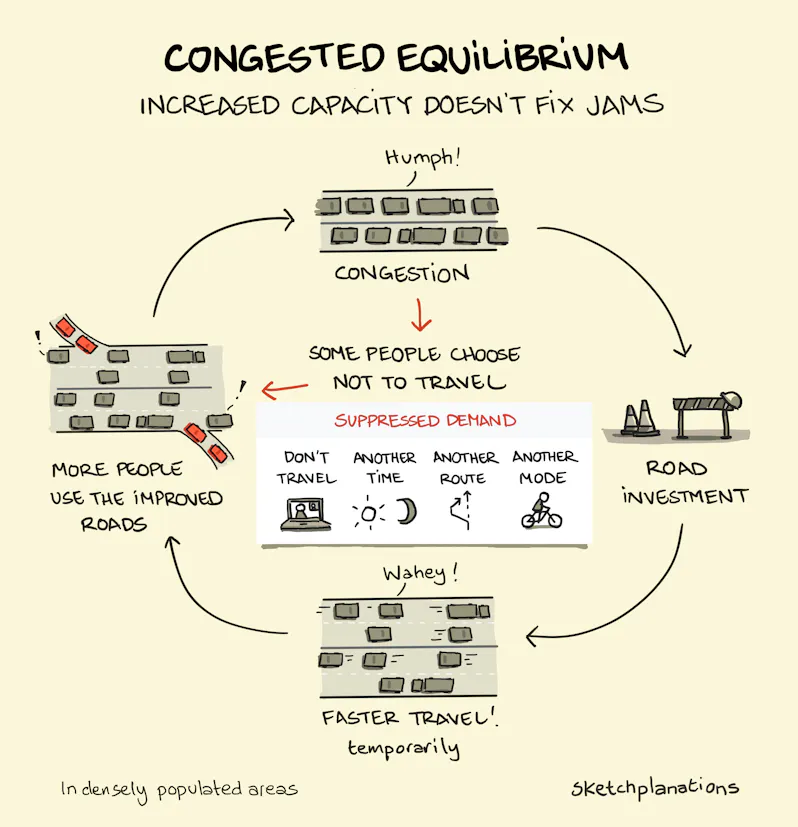
It's easy to assume that there's a fixed amount of traffic on the roads. So if your local road agency widens, improves, or adds alternative fast roads to get to your destination, you might think that traffic will improve. And it does, but only briefly. Then somehow the traffic jams return.

The reality is that in densely populated areas, traffic congestion tends to be self-regulating. When driving is slow and somewhat painful, people who would have driven make other choices:

  • choose not to travel—maybe a video call instead, or just don't go to the shops
  • take a different means of transport such as a train or bike
  • travel earlier or later
  • take different routes

After millions in road investment—perhaps widening roads or building a bypass or extended stretch of motorway—traffic runs faster, for a time.

But when people realise that roads are again a good option for travel, some of those who had chosen not to drive or didn't use that route before, jump back in the car and make use of the new, improved roads. And the increased traffic once again leads to congestion that gets progressively worse until people decide to make other choices once again.

Traffic congestion is a feature of road networks that is very hard to avoid because densely populated areas have a vast reserve of these suppressed trips—people who would drive if the traffic was better—ready to make use of an improved road network when it arrives.

From congested equilibrium comes the maxim in travel planning circles: "You can't build your way out of congestion."

I learned about congested equilibrium and the general trials and challenges of travel planners in the book Good to go? Decarbonising Travel After the Pandemic by Professor David Metz. Although the book had less to do with decarbonising than I expected, it did teach me a great deal about the challenges and considerations of travel planning.

Related Ideas to Congested Equilibrium

More I learned About Traffic

For the last half a century or so, the average daily travel time has remained unchanged. This is despite huge investments in road networks in urban areas.

When I find myself stuck in and complaining about traffic, my mind flashes back to a memory of a billboard in San Francisco that read, "You are not stuck in traffic. You are traffic." Then I feel better about my fellow drivers.

What people like least is uncertainty about journey time. So digital navigation, as exemplified by Google Maps, is doing an amazing job at giving us peace of mind here. Until ChatGPT, I put Google Maps as the best app out there.

In European cities you tend to find either high public transport use (like London), or a lot of cycling (think Copenhagen). But you don't tend to find high levels of both. Copenhagen's proportion of car journeys is similar to London's. The car has an appeal when the roads allow it. Improving cycling tends to pull people from public transport and vice versa rather than pull people from their cars.

Of David Metz' points that stick with me is also that the most effective way to reduce car usage in city centres, in conjunction with improving other means of travel, is to reduce the availability of parking.

Also, each city is different: some cities like London are spread wide and the distances are large, some have more cooperative weather, some have a lot of hills, and some are in countries where cars are a significant status symbol. There's no one-size-fits-all.

27 Jun 09:23

Generali surveille activement les avis en ligne

by Patrice
Generali
Generali France a récemment été distinguée par un prix de l'innovation de Qorus pour sa plate-forme de surveillance des avis en ligne, distribuée auprès de l'ensemble de ses agences. Dans un contexte d'incertitude sur l'avenir des relations en face à face, l'initiative comporte quelques idées originales qui justifient cette récompense.

La démarche répond à un besoin avéré puisque quand bien même les comparateurs restent un des premiers vecteurs de sélection d'une solution, les estimations de la compagnie révèlent que la moitié des recherches d'un assureur sur Google sont locales et presque tous les consommateurs (92%) vérifient la réputation d'une agence avant de s'y rendre, essentiellement grâce aux notes et commentaires laissés par les visiteurs précédents, qui constituent donc un facteur prépondérant de confiance.

Avec sa « PAD » (pour Plate-forme d'Avis Digitaux), Generali veut donc équiper chacune de ses représentations des moyens de se placer et se maintenir au sommet du podium en la matière. Pour ce faire, elle collecte et analyse, via, entre autres, des modèles sémantiques, les avis déposés par les internautes sur Google, TrustPilot et les Pages Jaunes et en restitue un aperçu synthétique quantifié sur différents axes, tels que score de sentiment, thèmes récurrents (accueil, délais…), doléances et louanges…

Generali France – Cockpit Agence

Le tableau de bord mis à la disposition des collaborateurs de l'agence (tous ou uniquement le responsable ?) fournissent non seulement des informations concrètes sur les avis évalués, ainsi que leur évolution dans la durée, mais également des éléments d'identification des leviers d'action à envisager. Une mise en regard, en temps réel, vis-à-vis de la concurrence de proximité, sur une carte, peut permettre, par exemple, d'ajuster le positionnement stratégique ou les politiques commerciales.

Naturellement, la plate-forme semble viser en priorité l'optimisation de la qualité de service dans les implantations locales, où, évidemment, le principal enjeu est d'entretenir la relation avec les clients face à la progression des interactions à distance. Cependant, si elle ne le fait pas (elle n'en parle pas, en tous cas), Generali pourrait aussi capitaliser sur les données capturées, en les agrégeant, afin de recenser ses qualités et défauts en tant que fournisseur, et intégrer ces derniers dans ses plans d'amélioration. La voix du client vaut d'être écoutée à tous les niveaux de l'organisation !
27 Jun 09:22

Ozempic-Style Drugs Linked To Hundreds of Illnesses and Deaths

by Noor Al-Sibai
The UK's health regulator is investigating Ozempic and Mounjaro after linking the drugs to hundreds of severe illnesses and deaths.

The United Kingdom's health regulator is investigating weight loss jabs like Ozempic and Mounjaro after linking it to hundreds of severe illnesses and even a handful of deaths.

As the Independent reports, the UK Medicines and Healthcare products Regulatory Agency (MHRA) is asking residents to submit their own experiences with glucagon-like peptide-1 (GLP-1) receptor/agonist drugs after the release of new data linking them to nearly 300 cases of pancreatitis and at least 10 pancreatitis-related deaths.

Earlier in the month, the pharmacy news site Chemists and Druggists reported that a whopping 111 people in the UK had died after taking GLP-1 drugs, though as the government noted, those figures do "not necessarily mean that [a death] was caused by the medicine" and that the fatalities could have been caused by underlying conditions. Instead, it appears that the authorities who reported those deaths to the health regulator suspected that the drug played a part.

Of those 111 deaths, at least 10 were related to pancreatitis. UK outlets are now reporting on them thanks to the government's new push for residents to flag any pancreas issues after taking GLP-1s to the MHRA's "Yellow Card" campaign, which urges residents to report adverse drug events.

Official warnings about this potential link between GLP-1s and pancreatitis also comes just days after the country's National Health Service began allowing doctors offices to prescribe Mounjaro, the Eli Lilly weight loss jab that uses the drug tirzepatide, a compound similar to the one underlying Novo Nordisk's Ozempic and Wegovy.

As the NHS notes, general practitioners in the UK will only be able to prescribe Mounjaro based on a very selective list of eligibility criteria that includes being diagnosed with at least four obesity-related illnesses and, strangely, having a body mass index (BMI) rating that's adjustable based on race or ethnicity.

While doctors maintain that GLP-1s are safe for most people to take, some have begun to voice caution based on real-world data like those recently released by the MHRA — especially because an estimated 1.5 million people in the UK are now taking them.

"The percentages for pancreatitis seen in clinical trials was small, but we know that many people are now purchasing these medications privately," explained Simon Cork, a physiology teacher at Anglia Ruskin University, in an interview with the Indy. "Small percentages in large numbers means an increasing number of people developing these conditions, although they still remain rare."

The MHRA's new guidance is meant more to help doctors and patients decide what is best rather than to sow panic, Cork insisted.

"For the vast majority of people, these drugs will help with weight loss and are overwhelmingly safe," he continued. "For a small number of people, significant side effects will occur, and it’s important to ensure that people are being monitored by their healthcare professionals."

More on Ozempic: Doctors Concerned By Massive Uptick In Teens Taking Ozempic

The post Ozempic-Style Drugs Linked To Hundreds of Illnesses and Deaths appeared first on Futurism.

26 Jun 08:04

Depth of bunker-buster bombs

by Nathan Yau

 
To show how deep bunker-buster bombs penetrate the ground, the New York Times used the long graphic method that requires a scroll to the end. The GBU-57, a.k.a. the Massive Ordnance Penetrator, goes down pretty far.

See also: ocean depth and height of the sky.

Tags: bomb, New York Times, scale

26 Jun 08:04

Hands-on LetinAR optical system

by Skarredghost

At AWE US, I have been able to go hands-on with the newest LetinAR optical system for AR glasses. In the following, you can find my impressions!

My first impressions on LetinAR directly from the AWE showfloor!

LetinAR optical system

It is not the first time I have gone hands-on with LetinAR. I had already met the company two years ago, always at AWE US, so I am quite familiar with its product. The idea behind LetinAR is to offer a display system for AR glasses and smart glasses that use micromirrors. You have a transparent lens that lets you see the real world in front of you, and then on the lens, you have some tiny mirrors that reflect into your eyes the image of the virtual elements projected by a light emitter (basically a display). Theoretically, since the mirrors are very tiny, you don’t notice them, as you don’t notice the eyelashes that you have in front of your eyes. And theoretically, the little pieces of the virtual image reflected by all the single micromirrors compose into a single cohesive image onto your eyes. The result is so augmented reality, with the view of the real world and then some virtual elements imposed on top of it.

LetinAR claims that this approach can offer many advantages, for instance:

  • The lens can be very transparent, and not darkened out like it happens with glasses like HoloLens or XREAL. This also means that you can see better the eyes of the people that are in front of you, for a more human connection
letinar transparency
LetinAR claims its PinTILT lenses can be very transparent (Image by LetinAR)
  • The optical system is very simple and does not require many components (the lenses require manufacturing with all the micromirrors, though)
letinar display structure
PinTilt is quite small and requires only two components (Image by LetinAR)
  • The power consumption is pretty low, which is very important for standalone AR glasses

I have been shown all the advantages of this system in a presentation. You can read them too on this page, if you want to go further.

LetinAR has many variants of its optical system, each one of them with its advantages and disadvantages. I have been told that its optical systems can be used for the whole gamut of see-through devices, from smart glasses to AR glasses.

The various types of LetinAR PinTILT systems (Image by LetinAR)

Notice that the company does not aim at building its own glasses, but at providing its technology to other manufacturers. In fact, I remember last year I tried at the Qualcomm booth some Japanese AR glasses whose optical engine was provided by LetinAR.

LetinAR hands-on

This was more or less the experience I had two years ago

When I tried a prototype of the LetinAR system a couple of years ago, I found it promising, but I also found that the system was not always working as expected. The first prototype I tried was made with pinholes, that is, tiny circular mirrors, and I found that sometimes I could still see the halo of the holes, but at least the colors were bright. Then I tried a new evolution of the system, with semitransparent little “mirror bars” and found that the image was a bit less bright than the first model.

Fast forward two years, what was the “new evolution of the system” is actually the current technology: I was given some glass frames with the LetinAR system inside, and I could grab it and take it close to my eyes using my hand to enjoy augmented reality. The eye module clearly featured some horizontal little lines, which were the semitransparent mirrors.

letinar test awe
The test device I was given. You can clearly see the micromirrors on the lenses

The first test I was provided with was a static image, as if the glasses were used to provide a virtual display, a la XREAL One. I was positively surprised by the image quality: the resolution was good and the colors were very bright. The problems of the image being a bit transparent and washed out a couple of years ago had totally disappeared. The field of view was also pretty ok for the current status of augmented reality: I have been told it was around 45°. As for the image consistency, it was pretty good, as you can see from the through-the-lens picture, but still, I could notice some dark-ish horizontal halos of the mirrors. In certain conditions, I could see the image, but also some gray-ish horizontal lines superimposed on it. These were for sure artifacts created by the horizontal semitransparent mirrors, whose reflections did not combine into a single cohesive image.

letinar through lenses
From my through-the-lens image, you can see that the colors were bright

After this demo, the LetinAR representative also let me try something related to augmented reality, so we started a new demo that showed me some 3D cubes floating in the air at a distance of about 3 meters from me. What was cool about this demo was that at that moment, all the visual artifacts disappeared from my view. It was like black magic: no more gray lines, and I could just see a cohesive, bright 3D augmented reality application. But how was that possible? Well, there are a couple of things that contributed to this “miracle”. One is that my eyes started to get used to the visual system, so my brain started to ignore the grey lines. The second is that while the 2D image of the first demo forced me to focus on a close distance, the AR demo let me focus on more distant elements, so all the disturbances close to my eyes became more blurred and unnoticeable.

It was pretty cool because for the first time, I could see what the final goal of LetinAR is: I’ve seen all these tiny mirrors disappear and just give me pure AR.

One more thing

Me wearing LetinAR prototype glasses. You can clearly see the reflection of the virtual elements in front of my eyes

The company showed me the roadmap for the next months, and there are pretty cool things coming. I can not share the details, but two things they are working on are improving the field of view and also making the “lines” less noticeable from the outside. Currently, if you wear some LetinAR lenses, you see the eyes of the wearer with some bright lines in front of them… which is very cyberpunk, but not very natural. So the company is trying its best to let you clearly see the eyes of the person with the glasses you have in front of you.

Final impressions

I came out with a good impression from the LetinAR demo. You know me: when I see progress, I’m always happy. And I’ve seen that in these two years, the company improved its technology, creating glasses with a decent field of view and bright colors. And in some conditions, I have even seen all the artifacts disappearing, which was mindblowing to me.

Of course, there is still some work to do: the FOV should be larger, and especially, the artifacts should always disappear, not only in some conditions. They should disappear both from inside the lenses (for the user) and outside the lenses (for the people looking at the user). The company showed me they are working on all of this, so I can’t wait to try the next model that is coming in the future.

The post Hands-on LetinAR optical system appeared first on The Ghost Howls.

25 Jun 19:37

Ring cameras and doorbells now use AI to provide specific descriptions of motion activity

by Lauren Forristal
Ring gets a new AI-powered feature that offers users specific text descriptions of current motion activity.
25 Jun 16:43

Gartner prédit l'abandon de 40 % des projets d'IA agentique d'ici 2027

Les projets d'IA agentique ne sont pas encore la révolution promise. D’après les dernières prévisions du cabinet d’analystes (...)
24 Jun 06:50

Greyparrot claims world first with launch of Deepnest AI powered waste intelligence platform

by Staff Writer

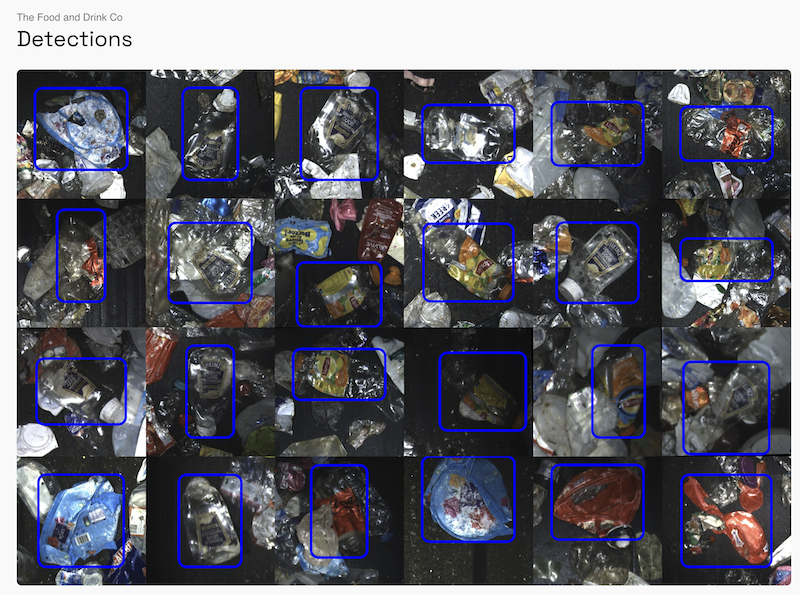
Greyparrot, a specialist in waste analytics, has launched Deepnest, pitched as a world first AI platform that gives brands direct access to their recyclable waste data.

This tracks packaging performance by brand, material, product type, and region. It reveals exactly how packaging moves through the waste system: what’s sorted, recycled, or lost.

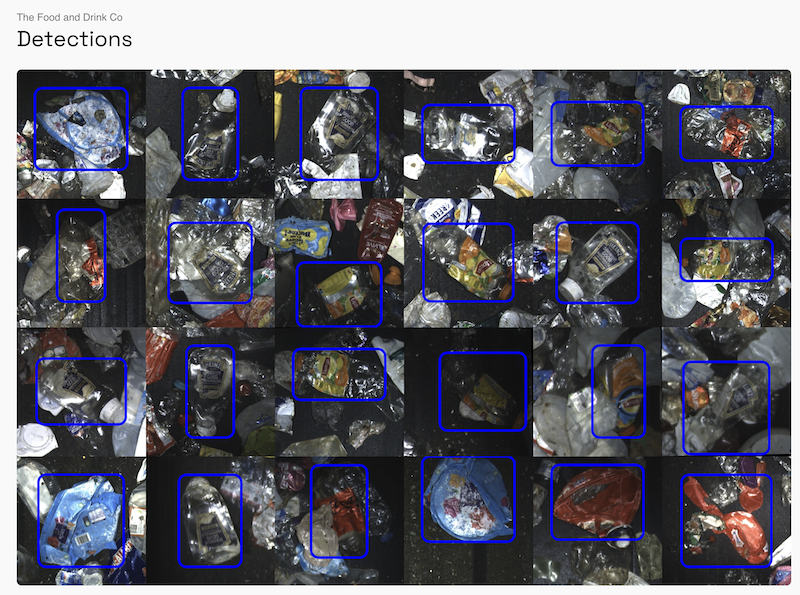
Powered by Greyparrot Analyser AI camera systems in material recovery facilities, Deepnest relies on what is claimed to be the world’s most comprehensive household packaging waste database - these systems process over 40 billion waste objects annually across more than 20 countries.

Greyparrot currently detects $1 billion worth of recyclable materials in the waste streams it monitors, and estimates that, if rolled out globally, its systems could uncover up to $100 billion in recyclable value every year by 2040. Using this data, Deepnest then provides brands with actionable insights, generating tailored recommendations to improve packaging, from shape and colour to material composition.  

Ambarish Mitra, Co-founder at Greyparrot, says: “The term “waste” is itself a misnomer - our data shows that post-consumption materials are worth billions to our global economy. For too long, brands have had to operate with little visibility into their packaging’s end of life.”

“Empowering brands with real-world data on their products' recyclability gives them a huge competitive advantage, which is exactly what Deepnest is designed to do. As regulations tighten and consumer demands grow, winners will be those who act on real-time insight - and can prove it.”

Unilever and Amcor are some of the major consumer goods brands and packaging producers trialling Greyparrot’s technology. 

Dr Liz Smith, Global R&D Head of Deodorants at Unilever, says: “AI enabled waste intelligence tools have great potential to provide new visibility into how packaging is actually being sorted and processed in real-world recycling systems.”

“Our goal is to reduce our virgin plastic use and make our plastic packaging reusable, recyclable or compostable - and insights like these could critically help to inform future packaging design, enable recyclability in practice and at scale, and increase the supply of high-quality recycled materials.”

Sandra Gibbs, Chief Supply Chain Officer at Asahi Beverages, says: “Asahi Beverages has made big strides in sustainable packaging, including switching to 100% recycled plastic bottles for brands like Pepsi Max, Solo, Schweppes, and Sunkist.”

“We also operate Australia’s largest PET recycling facility - a joint venture with Coca-Cola Europacific Partners - and we’ve been looking for real-time data to help maximise its impact. That’s why we installed Greyparrot Analysers to unlock operational data to improve recycling quality and output. Deepnest can transform that data into insights to guide smarter packaging design from the outset. We’re exploring how this technology can help us embed a data driven approach across the entire packaging lifecycle, moving us closer to 100% circular packaging.”

Mark Roberts, Circular Economy Director at Amcor, comments: "The packaging industry relies on lab scale testing and software models to predict recyclability of packaging solutions, but actual real-life data is missing, given the huge resources it would take to get real waste data at scale from operating facilities. With Greyparrot’s AI powered waste intelligence, Deepnest is unlocking real-world recyclability data that the packaging data chain has been missing."

RTIH AI in Retail Awards

RTIH, organiser of the industry leading RTIH Innovation Awards, proudly brings you the first edition of the RTIH AI in Retail Awards, which is now open for entries. 

As we witness a digital transformation revolution across all channels, AI tools are reshaping the omnichannel game, from personalising customer experiences to optimising inventory, uncovering insights into consumer behaviour, and enhancing the human element of retailers' businesses.

With 2025 set to be the year when AI and especially gen AI shake off the ‘heavily hyped’ tag and become embedded in retail business processes, our newly launched awards celebrate global technology innovation in a fast moving omnichannel world and the resulting benefits for retailers, shoppers and employees.

Our 2025 winners will be those companies who not only recognise the potential of AI, but also make it usable in everyday work - resulting in more efficiency and innovation in all areas.

Winners will be announced at an evening event at The Barbican in Central London on Wednesday, 3rd September.

This will kick off with a drinks reception in the stunning Conservatory, followed by a three course meal, and awards ceremony in the Garden Room.

Please email our Editor, Scott Thompson, if you have any questions or need further information: scott.thompson@retailtechinnovationhub.com

Key 2025 dates

Friday, 18th July: Award entry deadline 

Tuesday, 22nd July: 2025 finalists revealed

Wednesday, 23rd July - Friday, 8th August: Judging days

Wednesday, 3rd September: Winners announced at the 2025 RTIH AI in Retail Awards Ceremony, to be held at The Barbican in Central London.

Name * First Name Last Name Email * Subject * Message *

Thank you!

23 Jun 21:04

Satellite imagery shows avoided nuclear reactors in Iran

by Nathan Yau

Jonathan Tirone, reporting for Bloomberg:

Notably absent from the latest International Atomic Energy Agency’s damage report are three research reactors operating at the Isfahan Nuclear Technology and Research Center. One of the so-called miniature neutron source reactors, made by China in 1991, runs on 900 grams (2 pounds) of bomb-grade uranium.

It seems we’re going to see more satellite imagery in the coming weeks.

Tags: Bloomberg, Iran, nuclear, satellite imagery

23 Jun 12:59

TSMC tire la sonnette d’alarme : Les taxes US menacent son méga-projet de puces en Arizona !

by Yohann Poiron

Le plus grand fabricant de puces au monde, TSMC (Taiwan Semiconductor Manufacturing Company), tire la sonnette d’alarme : de nouveaux droits de douane envisagés par les États-Unis sur les semi-conducteurs pourraient menacer l’un des plus vastes projets industriels du pays. Dans une lettre officielle envoyée au Département du Commerce américain le 5 mai, la filiale américaine de […]

L’article TSMC tire la sonnette d’alarme : Les taxes US menacent son méga-projet de puces en Arizona ! est apparu en premier sur BlogNT : le Blog des Nouvelles Technologies.

23 Jun 12:55

Carrefour makes digitalisation of stores a priority as it tests VusionGroup EdgeSense tech in hypermarket

by Staff Writer

Carrefour says that the digitalisation of stores is a priority, and this includes a partnership with VusionGroup.

At VivaTech, we announced a partnership with VusionGroup to deploy EdgeSense technology, a first in Europe,” says Emmanuel Grenier, Executive Director E-commerce, Data and Digital Transformation at Carrefour.

“Already tested in our Villabé hypermarket, this solution is based on: AI and computer vision to ensure shelves are always full; Product geolocation to simplify the customer journey; Ultra-accurate data to guide our teams in real-time.”

He adds: “This partnership marks a key step in the modernisation of our stores and brings immediate benefits for our customers, our employees and our operational performance.”

Carrefour is the first major European grocer to adopt the tech, following its deployment by Walmart in the US. EdgeSense delivers real-time shelf monitoring, stockout detection, pricing compliance and precise product geolocation.

At the hypermarket in Villabé, France, approximately 70,000 electronic shelf labels, 500 cameras, and 7,000 EdgeSense rails have been installed, with a second site due to launch soon.

2025 RTIH INNOVATION AWARDS

Digitalisation of stores will be a key focus area at the 2025 RTIH Innovation Awards.

The awards, which are now open for entries, celebrate global tech innovation in a fast moving omnichannel world.

Our 2024 hall of fame entrants were revealed during an event which took place at RIBA’s 66 Portland Place HQ in Central London on 21st November, and consisted of a drinks reception, three course meal, and awards ceremony presided over by comedian Lucy Porter.

In his welcome speech, Scott Thompson, Founder and Editor, RTIH, said: “The event is now into its sixth year and what a journey it has been. The awards started life as an online only affair during the Covid outbreak, before launching as a small scale in real life event and growing year on year to the point where we’re now selling out this fine, historic venue.”

He added: “Congratulations to all of our finalists. Many submissions did not make it through to the final stage, and getting to this point is no mean feat. Checkout-free stores, automated supply chains, immersive experiences, on-demand delivery, next generation loyalty offerings, inclusive retail, green technology. We’ve got all the cool stuff covered this evening.”

“But just importantly we’ve got lots of great examples of companies taking innovative tech and making it usable in everyday operations - resulting in more efficiency and profitability in all areas.”

Congratulations to our 2024 winners, and a big thank you to our sponsors, judging panel, the legend that is Lucy Porter, and all those who attended November's gathering. 

For further information on the 2025 RTIH Innovation Awards, please fill in the below form and we will get back to you asap.

Name * First Name Last Name Email * Subject * Message *

Thank you!

23 Jun 12:55

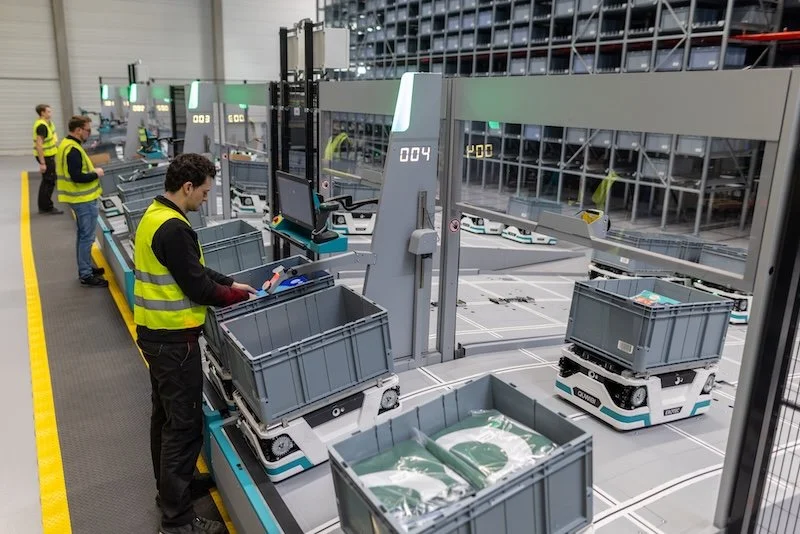
Exotec: warehouse robotisation is key to building retail resilience in an unstable economic environment

by Staff Writer

Flexibility, reliability, and security in logistics warehouses are crucial for staying competitive amid ongoing uncertainty for businesses, says Thomas Genestar, Managing Director of Western Europe at Exotec.

Global supply chains are operating under considerable strain, with issues such as international conflicts, product shortages, new tariffs and stricter regulations causing significant disruption. Warehouse operators are very much in the middle of this maelstrom, and according to Exotec, robotisation of the warehouse will be key to successfully navigating these challenges.

Genestar says: “While certain geopolitical and economic factors cannot be controlled, there are always things you can do as a business to soften the blow. As an organisation in the logistics sector, it’s important to fortify your own operations to build resilience. This is where robotisation has a major role to play."

“Effective stock management streamlined picking processes and efficient order preparation are critical. Start by mapping these processes to identify areas for improvement. Once optimised, warehouse automation through robotics becomes a vital ally, automating essential tasks. And goods-to-person systems reduce walking distances and improve operator ergonomics, speeding up order preparation. This not only reduces errors but also ensures 24/7 operational continuity, regardless of external disruptions.

“Seasonal peaks, unexpected order surges and labour shortages also present a challenge for logistics operations. Robotic automation systems feature a modular fleet of autonomous mobile robots (AMRs), allowing businesses to scale up or down flexibly in response to fluctuating demand. This adaptability ensures operational efficiency in both short- and long-term scenarios."

 “Such systems should be simple to install and deliver smooth flow capacity, with the option to easily add new robots to active systems in minutes depending on demand. They should also be able to adapt to both business-to-business and business-to-consumer models and operate in both environments simultaneously when required."

 “Additionally, geographical reconfiguration is an important consideration, and warehouses should be close to consumers or production sites to minimise delays and guarantee product availability.”

Genestar concludes: “To remain a step ahead and prepare for economic instability, or business fluctuations, having a robotic automated system is a real asset to manage operations. Flexibility and scalability provide our clients an outstanding additional value, even more when economic disruptions emerge.”

“Robotic systems integrate with warehouse management systems and provide real-time visibility and traceability of inventory, helping businesses plan for the toughest of periods. This results in faster fulfilment, better working conditions, and higher customer satisfaction.”

2025 RTIH INNOVATION AWARDS

Supply chain automation will be a key focus area at the 2025 RTIH Innovation Awards.

The awards, which are now open for entries, celebrate global tech innovation in a fast moving omnichannel world.

Our 2024 hall of fame entrants were revealed during an event which took place at RIBA’s 66 Portland Place HQ in Central London on 21st November, and consisted of a drinks reception, three course meal, and awards ceremony presided over by comedian Lucy Porter.

In his welcome speech, Scott Thompson, Founder and Editor, RTIH, said: “The event is now into its sixth year and what a journey it has been. The awards started life as an online only affair during the Covid outbreak, before launching as a small scale in real life event and growing year on year to the point where we’re now selling out this fine, historic venue.”

He added: “Congratulations to all of our finalists. Many submissions did not make it through to the final stage, and getting to this point is no mean feat. Checkout-free stores, automated supply chains, immersive experiences, on-demand delivery, next generation loyalty offerings, inclusive retail, green technology. We’ve got all the cool stuff covered this evening.”

“But just importantly we’ve got lots of great examples of companies taking innovative tech and making it usable in everyday operations - resulting in more efficiency and profitability in all areas.”

Congratulations to our 2024 winners, and a big thank you to our sponsors, judging panel, the legend that is Lucy Porter, and all those who attended November's gathering. 

For further information on the 2025 RTIH Innovation Awards, please fill in the below form and we will get back to you asap.

Name * First Name Last Name Email * Subject * Message *

Thank you!

23 Jun 12:30

Snap Inc. & Niantic’s New Partnership Could be a Big Moment for City-scale AR Positioning and Experiences

by Ben Lang

Snap Inc., the company behind the Snapchat social app and Spectacles AR glasses, has teamed up with Niantic Spatial to bring accurate geospatial capabilities to the Snapchat and Spectacles platforms. The partnership could be mutually beneficial as Snap’s platforms will get city-scale positioning capabilities while Niantic could see a massive influx of user-generated data to enhance its ‘Visual Positioning System’.

Many AR devices today are capable of localizing themselves within an arbitrary environment. An AR headset, for instance, looks at the room around you and uses that information to understand how the headset itself is moving through the space.

But if you want to enable multiple devices to interact in a shared space, both need to be able to localize themselves not just to the environment, but with regards to one another. Essentially, you need both devices to share the same map so that both users see the same thing happening in the same place in the real world.

That’s the goal of Niantic’s Visual Positioning System. The company has spent years aiming to allow AR devices to tap into a shared spatial map to establish their real-world position. While GPS would be far too inaccurate for the job, such a system allows devices to understand if they’re in a shared space together, allowing for content to be synchronized between the two for multiplayer and persistent content.

Now Niantic is partnering with social media and AR company Snap Inc to bring its VPS tool to the company’s Snapchat and Spectacles platforms. The companies released a concept video showing the kind of city-scale spatial and social experiences that could be possible with the system:

“For AR Lenses, developers will be able to anchor their AR experiences to millions of real-world locations with centimeter-level precision. That means not just layering effects on top of the camera view — the experiences truly live in the world, making it possible, for example, to create a lens where a virtual concert springs to life in a city square or where a portal opens only when someone walks to a specific park bench. VPS makes that possible — and lets multiple people see the same AR moment, in the same place, at the same time. It’s a powerful new tool for turning public spaces into canvases for creativity,” the announcement reads.

The joint announcement describes the relationship as a “strategic multi-year partnership,” which includes an unspecified capital investment by Snap into Niantic.

Strategic indeed… not only will Snap’s platforms get access to perhaps the most comprehensive city-scale positioning system for AR, but Niantic stands to gain a massive quantity of new data to enhance its VPS system.

Niantic sees user-generated scans as the way to not only scale its VPS system to more places around the world, but also to keep its map consistently up to date.

With VPS integrated into certain AR apps on Snapchat or Spectacles, users could be asked to contribute scans in order to unlock usage of a given lens. That scan data can be incorporated into the VPS’s understanding of the world, and thus allowing future users to use any VPS-dependent apps in that location.

Niantic has long been a pioneer when it comes to leveraging user-generated scans and data for spatial understanding. The company cut its teeth on social geo-location games like Ingress (2013) and Pokemon Go (2016). After recently selling off its gaming division, Niantic is only getting more serious about its VPS system and the user-generated data that powers it—hence its new formal name: Niantic Spatial.

While Snap’s Spectacles AR glasses are still a nascent platform, the 900 million existing Snapchat users could give Niantic and Snap a massive jump start on building out the most extensive geospatial AR dataset in the industry.

The post Snap Inc. & Niantic’s New Partnership Could be a Big Moment for City-scale AR Positioning and Experiences appeared first on Road to VR.

21 Jun 19:28

Granola. Le bloc-notes intelligent pour la prise de notes en réunion

by Fidel Navamuel

Les journées professionnelles restent souvent rythmées par les réunions à la chaîne.

Chacune de ces sessions génère une quantité significative d’informations, mais capturer, organiser et exploiter ces données de manière efficace peut vite devenir une contrainte. La prise de notes traditionnelle est souvent laborieuse, détournant l’attention de la discussion en cours et rendant le processus fastidieux.

Granola se présente comme une solution concrète à ce défi quotidien. Ce bloc-notes intelligent alimenté par l’IA est conçu pour faciliter la prise et l’utilisation de vos notes de réunion. Il ne se contente pas de transcrire ; il combine vos propres annotations avec une transcription intelligente pour capturer chaque détail essentiel.

L’objectif est clair : vous permettre de rester pleinement présent lors de vos réunions et interactions, sans le stress de manquer un détail important. 

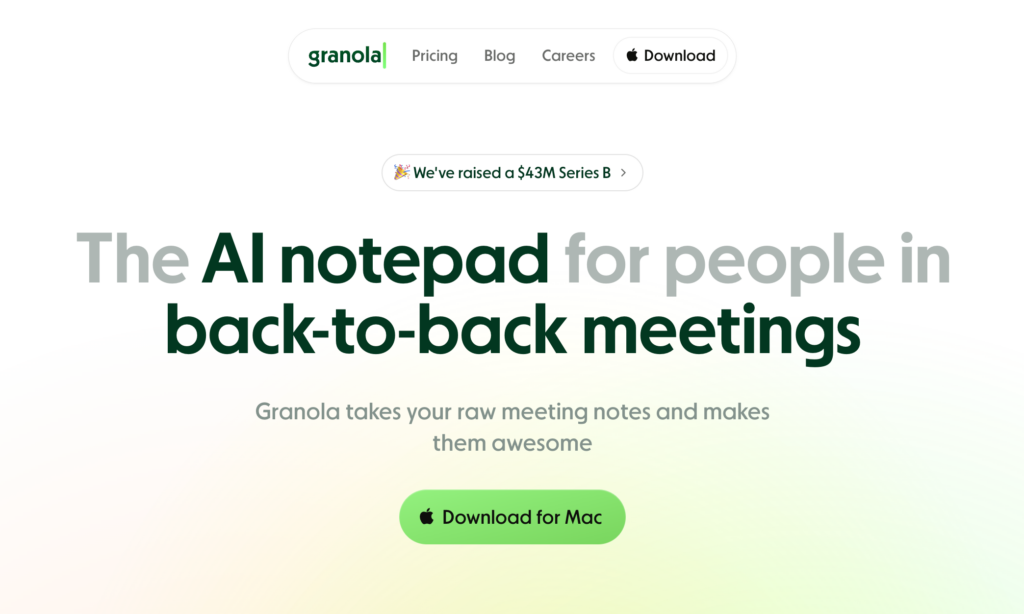
granola bloc note intelligent page d'accueil du site

Un assistant intelligent pour des notes complètes et structurées

Contrairement à de nombreux outils qui s’appuient sur des bots pour enregistrer les réunions, Granola fonctionne comme un bloc-notes classique, mais avec une IA puissante en coulisses.

Granola utilise l’audio de votre ordinateur pour transcrire vos réunions en temps réel. Que vous utilisiez Zoom, Google Meet, Microsoft Teams ou WebEx, l’outil s’active discrètement en arrière-plan sans nécessiter l’ajout d’un “bot” de réunion visible par les autres participants.

Une garantie pour la confidentialité des échanges, même lors de discussions sensibles ou de présentations commerciales.

Vos notes, enrichies et structurées automatiquement

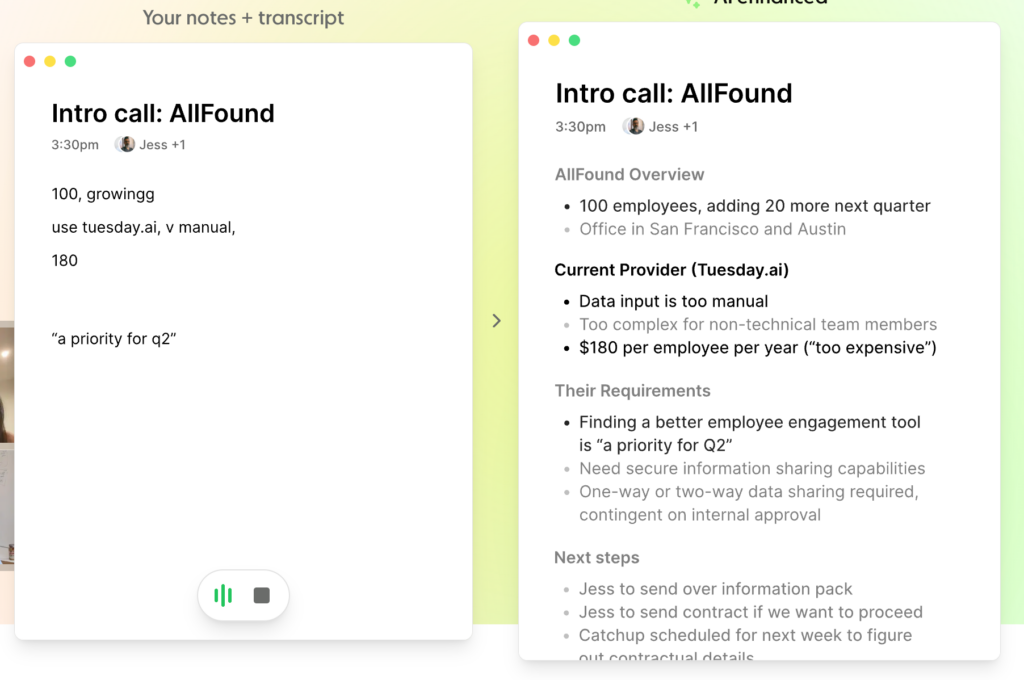
L’un des atouts majeurs de Granola est sa capacité à combiner vos propres notes avec une transcription intelligente de la réunion. Vous écrivez ce que vous jugez important, l’IA complète et structure l’ensemble pour créer une synthèse claire, hiérarchisée et actionnable.

Les notes générées par l’IA apparaissent en gris pour les distinguer de vos apports personnels (en noir), et chaque point clé est hyperlié à la transcription pour un accès rapide au contexte original.

L’outil ajoute automatiquement de la hiérarchie et une structure à vos notes, les rendant plus faciles à parcourir et à assimiler, même si vous n’avez pris que des notes minimales. À l’usage c’est hyper efficace.

prise de notes intelligente

Organisation Automatique et Partage Simplifié

À la fin de chaque session, Granola organise vos notes de manière claire et hiérarchisée. Les décisions clés, les actions à entreprendre et les prochaines étapes sont mises en évidence. Granola est très bon aussi dans la transformation des discussions en éléments exploitables.

Il génère des résumés thématiques avec des sections extensibles et des points d’action clairs. Le partage des notes avec vos collègues est également facilité, avec des options d’exportation par email, Slack, Google Drive ou des dossiers partagés.

Un boost pour votre productivité

La plateforme a des effets rapides sur la productivité de vos équipes. Les principales fonctions de cet outil ont été pensées pour cela:

  • Transcription en direct : L’audio de la réunion est capturé et transcrit instantanément, sans intervention extérieure.
  • Templates personnalisables : Adaptez la structure des notes selon le type de réunion (entretien, point projet, rendez-vous commercial, etc.).
  • Partage en un clic : Diffusez vos notes sur Slack, Notion, ou tout autre outil collaboratif, ou générez un lien partageable pour votre équipe.
  • Recherche et chat IA : Interrogez l’IA sur le contenu d’une réunion passée pour retrouver une décision, un chiffre ou une question sans avoir à relire l’intégralité du transcript.
  • Automatisation des suites de réunion : Demandez à Granola de rédiger un email de suivi, de lister les actions à mener ou de synthétiser les objections et décisions prises. C’est magique.
partage de notes simplifiée
Screenshot

Un sans faute… ou presque

Comme tout outil utilisant l’IA, Granola présente certaines limites, notamment lorsqu’il s’agit de transcrire des données chiffrées complexes ou de travailler dans des environnements très techniques. Cependant, dans la plupart des situations, il se révèle être un assistant fiable, facile à prendre en main et d’une gande efficacité.

Le logiciel est disponible sur toutes les plateformes. Vous pouvez l’utiliser gratuitement avec ses fonctionnalités de base pour jusqu’à 25 réunions par mois. Les abonnements complets et illimités commencent à environ quinze euros par mois.

Un allié pour rester présent et créatif en réunion

En déchargeant l’utilisateur du stress de tout noter, la plateforme Granola permet d’être plus attentif et participatif pendant les réunions. Essayez-le et vous constaterez une meilleure implication et plus de créativité, l’IA vous servant de filet de sécurité pour ne rien perdre des échanges.

The post Granola. Le bloc-notes intelligent pour la prise de notes en réunion appeared first on Les Outils Collaboratifs.

20 Jun 13:12

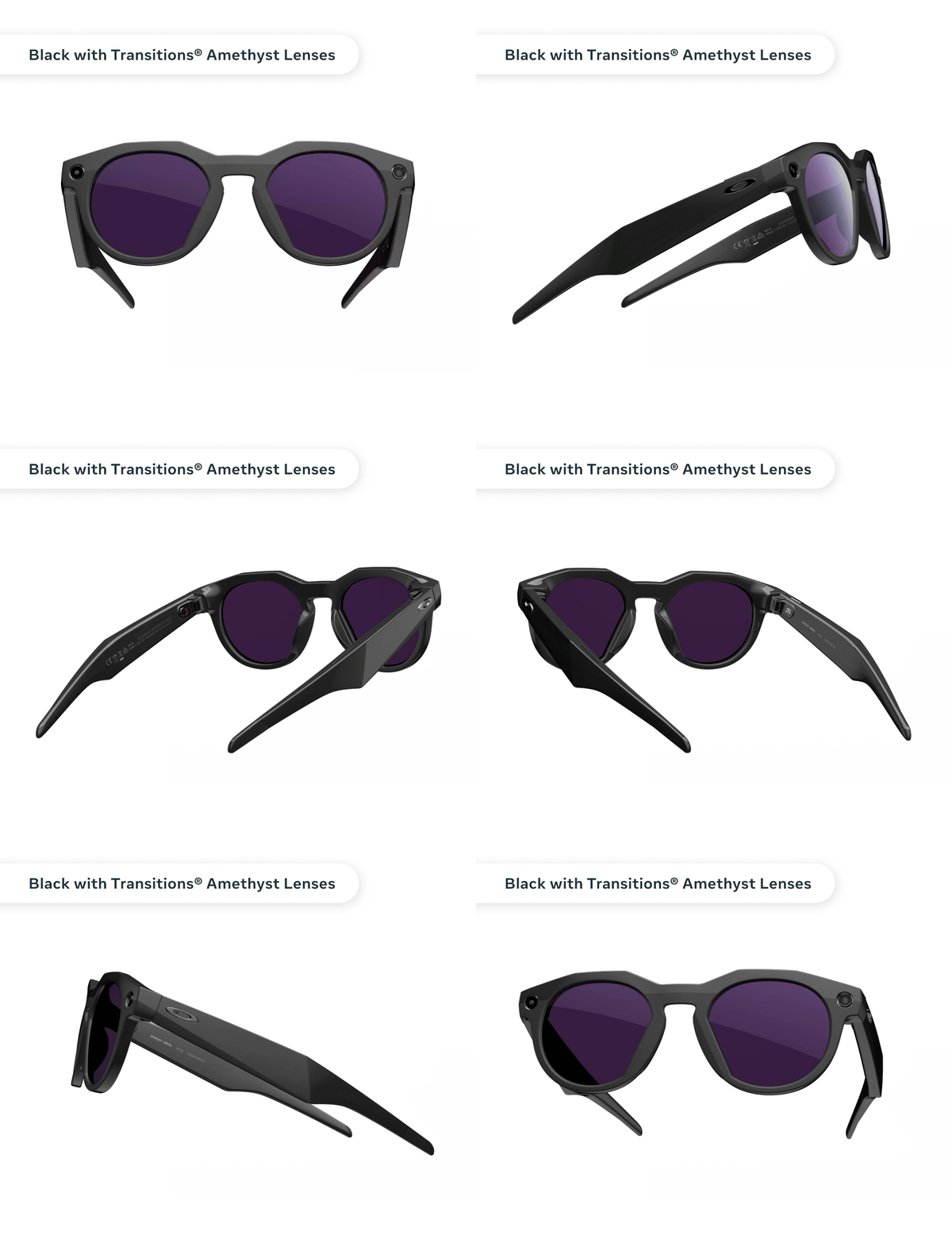
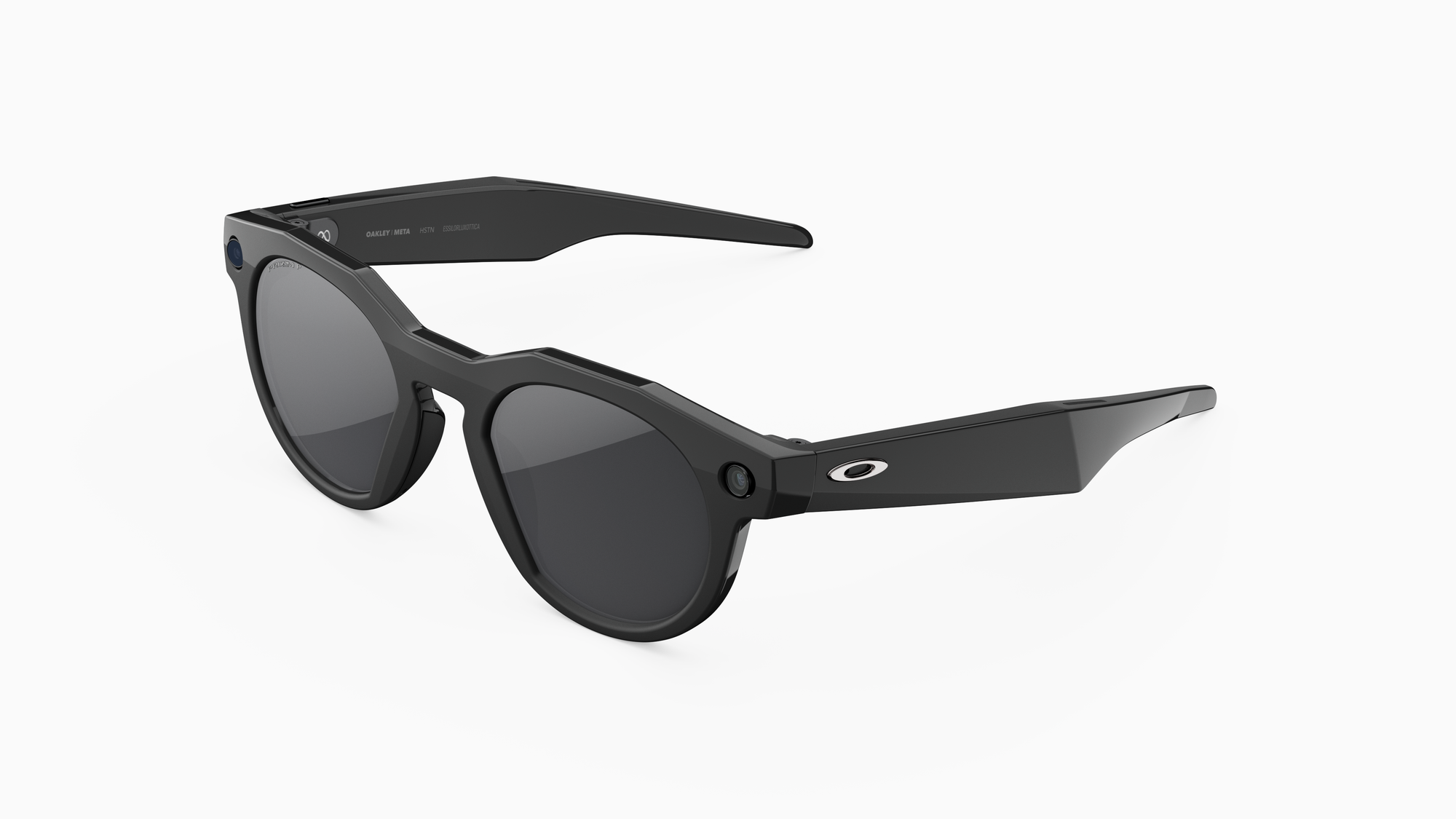
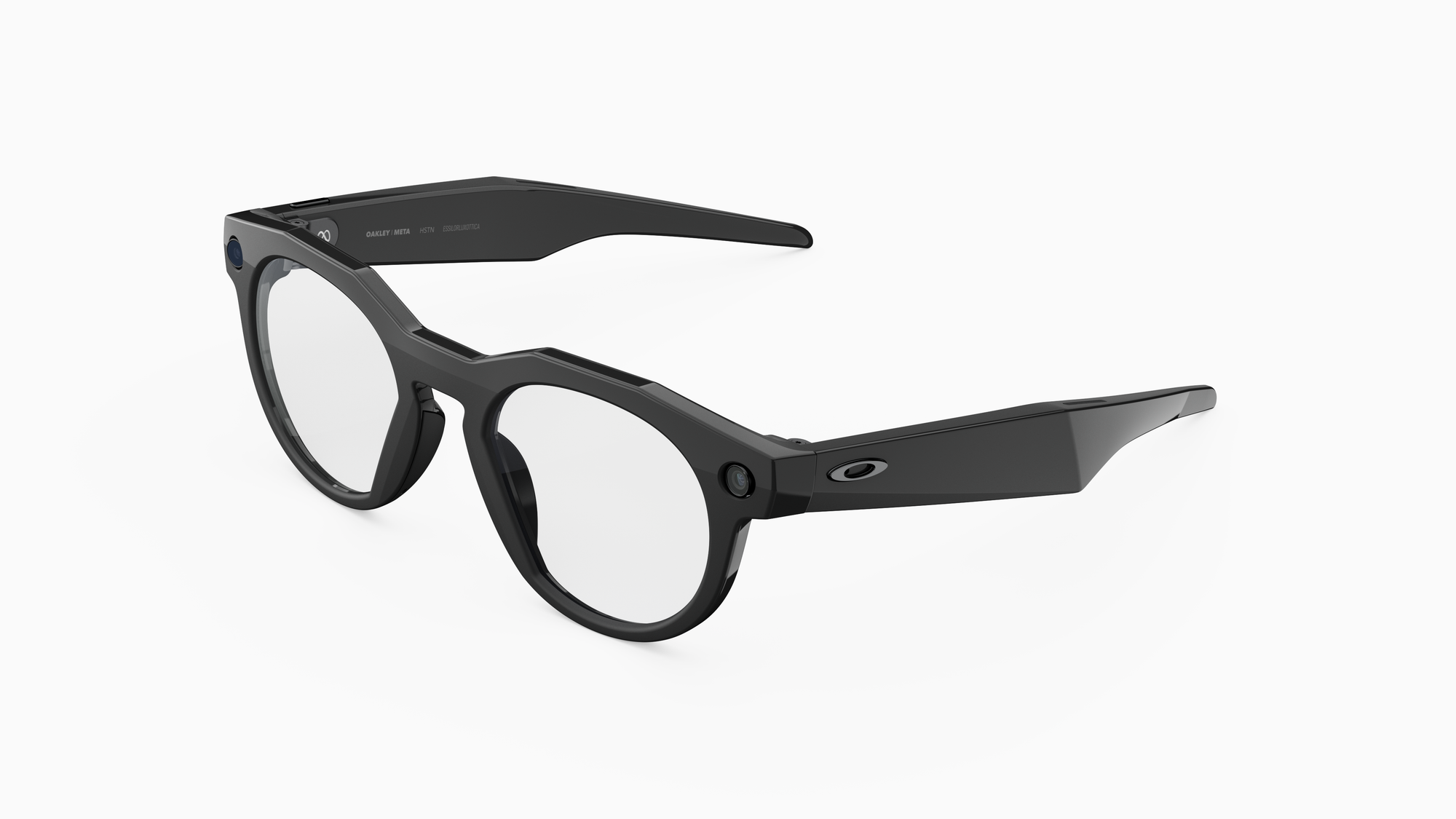
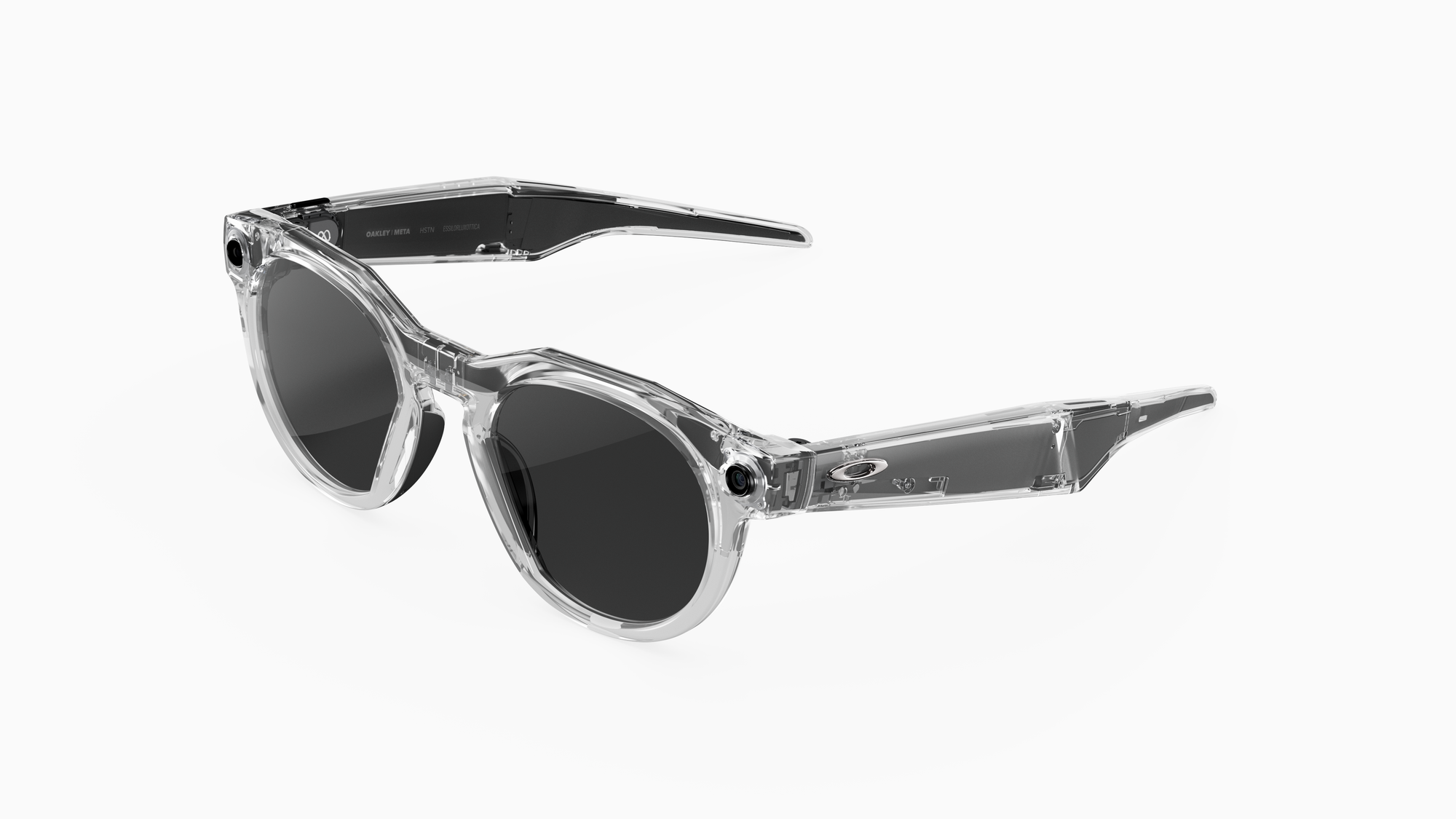
Oakley Meta HSTN Glasses Have Double The Battery Life Of Ray-Bans & Capture 3K Video

by David Heaney

Oakley Meta HSTN glasses are official, after months of rumors and a tease earlier this week.

Ray-Ban and Oakley are both owned by EssilorLuxottica, the eyewear giant with which Meta last year secured an agreement extending their partnership “into the next decade”.

The partnership has been a success so far, with EssilorLuxottica announcing in February that 2 million Ray-Ban Meta glasses had been sold, as it vowed to increase annual production capacity to 10 million units by the end of 2026. Now, it's expanding to Oakley's HSTN design.

0:00
/0:14

Meta says the Oakley Meta HSTN glasses have 8 hours of battery life in typical use, compared to 4 hours for the Ray-Ban Meta glasses. They also capture 3K video, up from 1080p.

The included charging case also has a larger battery, delivering up to 8 full recharges, compared to 6 for the Ray-Ban Meta case.

No Centered Camera?

Bloomberg's Mark Gurman was the first to report the existence of an Oakley smart glasses project at Meta.

His January report claimed that Oakley Meta glasses would have a camera in the center, instead of on a temple, but the Oakley Meta HSTN glasses do not.

Gurman now says that the centered camera model will be coming later this year, in a separate Oakley Meta Sphaera glasses product.

Other than these improvements, Oakley Meta HSTN glasses function the same way as Ray-Ban Meta. They're screenless smart glasses with a camera, microphones, and speakers. You can use them to capture photos and videos, listen to music/podcasts/audiobooks, make and receive calls, share your first-person view on WhatsApp/Messenger/Instagram video calls, translate speech, scan QR codes, and query Meta AI, the company's LLM-based assistant that can see via the camera when you ask about something in view. It'll also read out some phone notifications, if you want.

Like the existing Ray-Ban Meta glasses, Oakley Meta HSTN glasses are IPX4 water resistant, meaning they repel splashing water, but aren't rated for water jets or submersion. And also like Ray-Ban Meta, Oakley Meta HSTN feature an LED on the front that illuminates whenever the camera is in use, be it for capture or for Meta AI.

Oakley Meta HSTN glasses are not replacing Ray-Ban Meta, to be clear. They're a slightly higher-end option, aimed at athletes and smart glasses power users.

Oakley Meta HSTN glasses will be available "later this summer", starting at $400, in the US, Canada, the UK, Ireland, France, Italy, Spain, Austria, Belgium, Australia, Germany, Sweden, Norway, Finland, and Denmark.

They'll also be coming to Mexico, India, and the United Arab Emirates later in the year.

The glasses will be offered in six regular frame and lens color combinations:

Warm Grey with Ruby PRIZM Lenses
Brown Smoke with Polar Deep Water PRIZM Lenses
Black with Amethyst Transitions Lenses
Black with Black PRIZM Polar Lenses
Black with Clear Lenses
Clear with Grey Transitions Lenses

The sunglasses models use Oakley's PRIZM lens technology, which EssilorLuxottica says enhances colors and contrast.

Before the regular models hit the market, preorders for a limited-edition model with gold accents and gold 24K Polar lenses will open on July 11, priced at $500.

Limited Edition Desert with Golf 24K PRIZM Polar lenses.

Meta says it's still "just getting started" with smart glasses, and Oakley says this is "just the first chapter of a new era for sports".

20 Jun 11:41

2025.25: Snapshots of an Evolving AI Landscape

by Ben Thompson
(Photo by Justin Sullivan/Getty Images)

Welcome back to This Week in Stratechery!

As a reminder, each week, every Friday, we’re sending out this overview of content in the Stratechery bundle; highlighted links are free for everyone. Additionally, you have complete control over what we send to you. If you don’t want to receive This Week in Stratechery emails (there is no podcast), please uncheck the box in your delivery settings.

On that note, here were a few of our favorites this week.

  1. OpenAI Gets Testy and xAI Gets Expensive. A slow news week after WWDC provided an opportunity to take a closer look at two leading AI players. First, Tuesday’s Daily Update covered the latest round of tensions between OpenAI and Microsoft, as OpenAI reportedly threatens a complaint to regulators and the companies continue to haggle over contract terms in the midst of OpenAI’s attempts to change its corporate structure (again). Next, Wednesday’s Daily Update drew on reports of spiraling costs and limited revenue at xAI to examine the company’s core challenges, potential solutions, and why it would benefit the entire AI ecosystem to maintain xAI as an additional competitor in the space. Alliances are evolving and costs are spiraling as the hierarchies that will define the future are still very much in flux. Andrew Sharp

  2. Speedbumps for China’s Car Industry. The overnight emergence and dominance of Chinese EV companies has been one of the biggest stories in the world over the past two years, both because of the skill and ingenuity of PRC manufacturers, as well as the low cost and (over)supply of Chinese brands, which has inflamed trade tensions and threatened incumbent car companies elsewhere in the world. This is context for recent reports that many of the biggest Chinese companies are struggling for cash flow, themselves, caught in the middle of a ruthless domestic competition for market share. Bill and I discussed that story at the end of this week’s episode Sharp China, including why consolidation in the industry has been slower than experts predicted, and why shutting down any factories in China is politically sensitive and rare in 2025. Also covered in that show: a new framework for a temporary US-China trade truce, and worldwide tensions surrounding rare earth access, which may be a theme for the rest of the decade.  AS
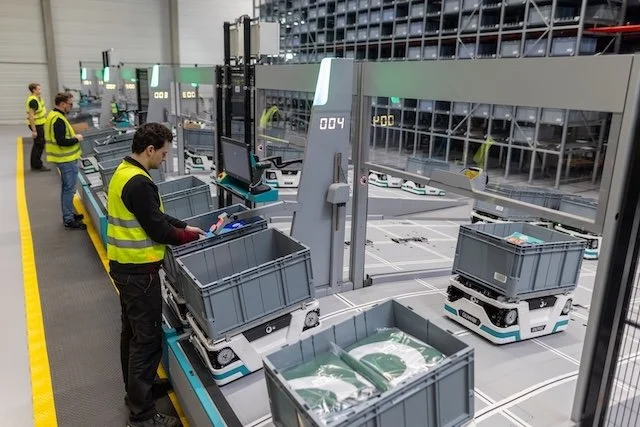

  3. Meta Continues Its AI Hiring Spree. One week removed from hiring Alexandr Wang to lead a “superintelligence” division as Meta attempts to reset its AI efforts, The Information reported on Wednesday night that Meta is also in advanced talks to add prominent AI investors Daniel Gross and Nat Friedman to the new AI team with an offer that could exceed $1 billion. In light of that news, my recommendation here is two-fold. First, anyone unfamiliar with Friedman and Gross should review the Stratechery Interviews with Friedman and Gross over the last three years, as that interview series is not only a window into how Gross and Friedman think about AI and related products, but also just a great way to trace the mind-blowing evolution of the AI conversations we’ve all been having since October 2022 (seven weeks before ChatGPT launched). And second, for contemporary thoughts on what these moves signify at Meta and what the astounding price tag may signify for the future of tech salaries, Ben and I had a great time reacting to the news on this week’s Sharp Tech AS

Stratechery Articles and Updates

Dithering with Ben Thompson and Daring Fireball’s John Gruber

Asianometry with Jon Yu

Sharp China with Andrew Sharp and Sinocism’s Bill Bishop

Greatest of All Talk with Andrew Sharp and WaPo’s Ben Golliver

Sharp Tech with Andrew Sharp and Ben Thompson

This week’s Stratechery video is on Apple Retreats.