Shared posts

15 Jul 08:19

What Will It Take to Restore a Serious Flight Simulator?

by Donald Papp

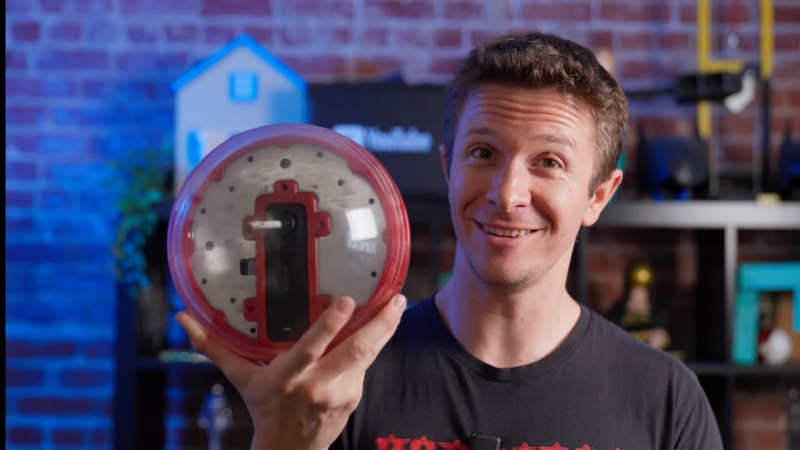
[Jared] managed to find a professional FAA-certified flight simulator at an auction (a disassembled, partial one anyway) and wondered, what would it take to rebuild it into the coolest flight sim rig ever?

In a video, [Jared] gives a tour of the system and highlights the potential as well as pointing out challenges and drawbacks. Fortunately the system is of a modular design overall, and the motion control system is documented. The chassis and physical parts are great, but the avionics stack is a mixed bag with some missing parts and evidence of previous tinkering — that part being not quite so well documented.

Conceptually, a mid-tier gaming rig with a wraparound display will take care of the flight software part, and some custom electronics work (and probably a Raspberry Pi or three) will do for interfacing to various hardware elements. But a lot of details will need to be worked out in order to turn the pile of components into an entertaining flight sim rig, so [Jared] invites anyone who is interested to join him in collaborating on innovative approaches to the myriad little challenges this build presents.

We’ve seen the community pull off some clever things when it comes to flight sims, so we know the expertise is out there.

15 Jul 07:34

Introducing PooLA Filament: Grass Fiber-Reinforced PLA

by Maya Posch

We’re probably all familiar with adding wood dust, hemp and carbon fibers to PLA filament, but there are so many other fillers one could add. During the completely unrelated recent heatwave in Germany, [Stefan] from CNCKitchen decided to give a new type of biodegradable filler type a shot by scooping some freshly dried cow patties off the very picturesque grazing fields near his place. In the resulting video a number of questions are answered about this ‘PooLA’ that nobody was asking, such as whether it makes for a good filler, and whether it smells bad while printing.

Perhaps unsurprisingly to those who have spent any amount of time around large herbivores like cows, cow dung doesn’t smell bad since it’s mostly composed of the grass fibers that are left over after the cow’s multiple stomachs and repeated chewing have done their thing. As [Stefan] and his colleagues thus found out was that printing with PooLA smells like printing with grass.

As for the practical benefits of PooLA, it adds a nice coloring, but like other ‘reinforced’ PLA filaments seems to trade flexibility for stiffness, so that at ratios of cow dung powder between 5 to 20% added to the PLA powder the test parts would break faster. Creating the filament was also a bit of a chore, for reasons that [Stefan] still has to figure out.

That said, aside from the technically unneeded bacterial corpses and other detritus in cow patties, using grass fibers in FDM filament isn’t a crazy idea, and might fit right in there with other fibers.

11 Jul 11:32

It’s hunting season in orbit as Russia’s killer satellites mystify skywatchers

by Stephen Clark

Russia is a waning space power, but President Vladimir Putin has made sure he still has a saber to rattle in orbit.

This has become more evident in recent weeks, when we saw a pair of rocket launches carrying top-secret military payloads, the release of a mysterious object from a Russian mothership in orbit, and a sequence of complex formation-flying maneuvers with a trio of satellites nearly 400 miles up.

In isolation, each of these things would catch the attention of Western analysts. Taken together, the frenzy of maneuvers represents one of the most significant surges in Russian military space activity since the end of the Cold War. What's more, all of this is happening as Russia lags further behind the United States and China in everything from rockets to satellite manufacturing. Russian efforts to develop a reusable rocket, field a new human-rated spacecraft to replace the venerable Soyuz, and launch a megaconstellation akin to SpaceX's Starlink are going nowhere fast.

Read full article

Comments

10 Jul 19:02

Ask Hackaday: Are You Wearing 3D Printed Shoes?

by Al Williams

We love 3D printing. We’ll print brackets, brackets for brackets, and brackets to hold other brackets in place. Perhaps even a guilty-pleasure Benchy. But 3D printed shoes? That’s where we start to have questions.

Every few months, someone announces a new line of 3D-printed footwear. Do you really want your next pair of sneakers to come out of a nozzle? Most of the shoes are either limited editions or fail to become very popular.

First World Problem

You might be thinking, “Really? Is this a problem that 3D printing is uniquely situated to solve?” You might assume that this is just some funny designs on some of the 3D model download sites. But no. Adidas, Nike, and Puma have shoes that are at least partially 3D printed. We have to ask why.

We are pretty happy with our shoes just the way that they are. But we will admit, if you insist on getting a perfect fitting shoe, maybe having a scan of your foot and a custom or semi-custom shoe printed is a good idea. Zellerfield lets you scan your feet with your phone, for example. [Stefan] at CNC Kitchen had a look at those in a recent video. The company is also in many partnerships, so when you hear that Hugo Boss, Mallet London, and Sean Watherspoon have a 3D-printed shoe, it might actually be their design from Zellerfield.

Or, try a Vivobiome sandal. We aren’t sold on the idea that we can’t buy shoes off the rack, but custom fits might make a little sense. We aren’t sure about 3D-printed bras, though.

Maybe the appeal of 3D-printed shoes lies in their personalizability? Creating self-printed shoes might make sense, so you can change their appearance or otherwise customize them. Maybe you’d experiment with different materials, colors, or subtle changes in designs. Nothing like 30 hours of printing and three filament changes to make one shoe. And that doesn’t explain why the majors are doing it.

Think of the Environment!

There is one possible plus to printing shoes. According to industry sources, more than 20 billion pairs of shoes are made every year, and almost all will end up in landfills. Up to 20% of these shoes will go straight to the dump without being worn even once.

So maybe you could argue that making shoes on demand would help reduce waste. We know of some shoe companies that offer you a discount if you send in an old pair for recycling, although we don’t know if they use them to make new shoes or not. Your tolerance for how much you are willing to pay might correlate to how much of a problem you think trash shoes really are.

But mass-market 3D-printed shoes? What’s the appeal? If you’re desperate for status, consider grabbing a pair of 3D-printed Gucci shoes for around $1,300. But for most of us, are you planning on dropping a few bucks on a pair of 3D-printed shoes? Why or why not? Let us know in the comments.

If you are imagining the big guys printing shoes on an Ender 3, that’s probably not the case. The shoes we’ve seen are made on big commercial printers.

10 Jul 19:01

Un hacker chinois arrêté en italie : l’extradition qui secoue la cyberguerre mondiale

by Damien Bancal
Arrestation d’un hacker chinois à Milan pour cyberespionnage d’État : analyse d’un dossier emblématique de la cyberguerre mondiale, entre enjeux judiciaires, diplomatiques et technologiques. ...
10 Jul 19:00

3D printing method turns biodegradable polymers into conductive electronic components

From touch-sensitive smartphone screens to fitness wearables and wireless earbuds, electronics are becoming ever more integrated into our daily lives—and smaller, lighter, and more flexible in the process. But as the demand for electronic devices grows, so does the need for more sustainable ways to produce them.
10 Jul 18:59

Announcing GenAI Processors: Build powerful and flexible Gemini applications

GenAI Processors is a new open-source Python library from Google DeepMind designed to simplify the development of AI applications, especially those handling multimodal input and requiring real-time responsiveness, by providing a consistent "Processor" interface for all steps from input handling to model calls and output processing, for seamless chaining and concurrent execution.
10 Jul 07:09

Smart Contact Maker Raises $250M Investment at a Whopping $1.35B Valuation

by Scott Hayden

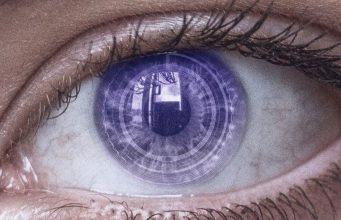
Smart contact lens startup XPANCEO announced it’s secured $250 million in Series A funding, putting its valuation at $1.35 billion and minting it as XR’s most recent unicorn.

The funding round was led by Opportunity Venture (Asia), which led the company’s $40 million Seed round in 2023, bringing its overall funding to $290 million, according to Crunchbase data.

XPANCEO, a UAE-based company, says the new funding will “accelerate the company’s mission to launch the world’s first all-in-one smart contact lens,” which is targeted to arrive by 2026.

While the company’s smart contacts are still in prototyping phase, XPANCEO says they will integrate XR, real-time health monitoring, night vision, and zoom features.

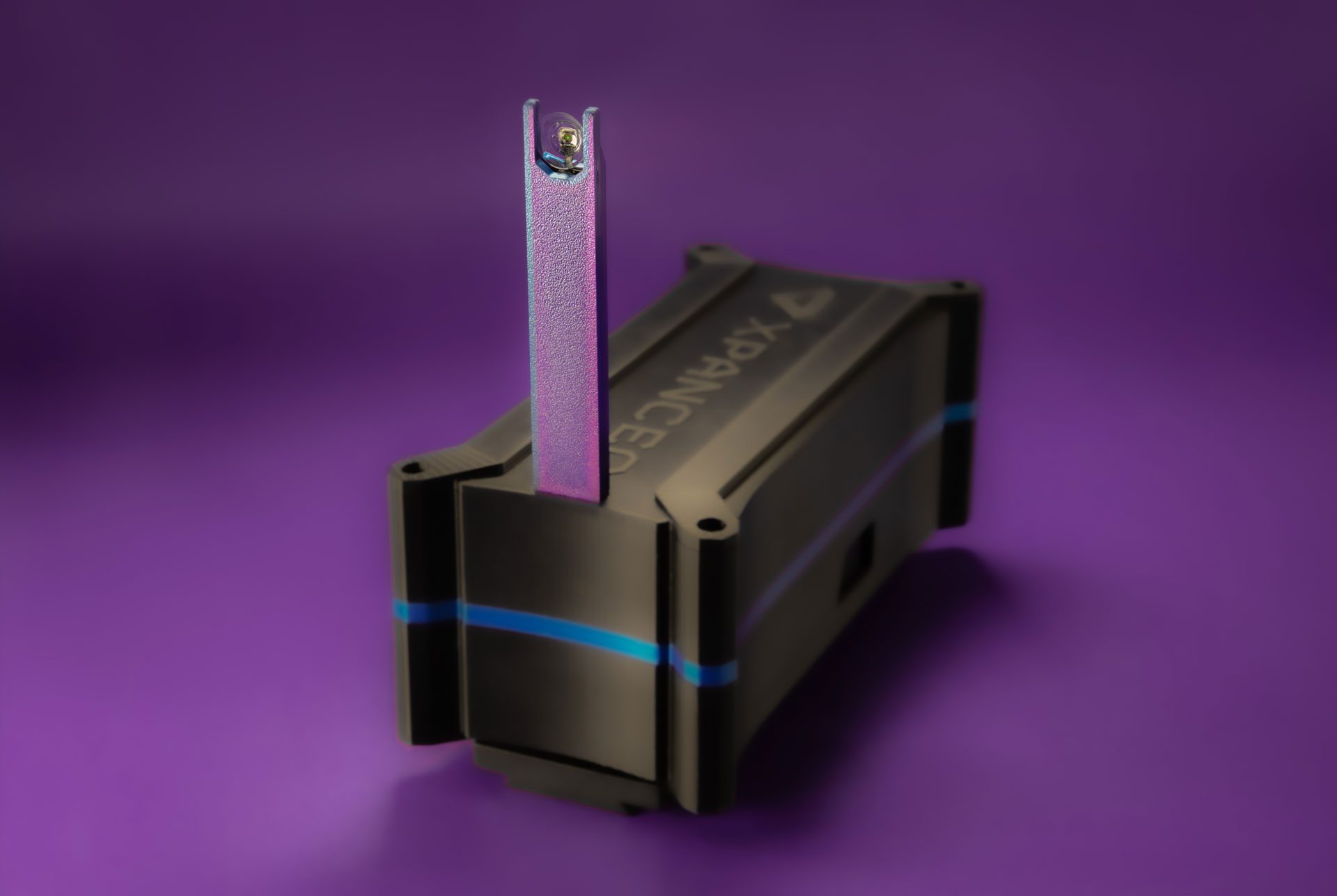
Display System with Sub-0.5 mm Projector | Image courtesy XPANCEO

“Becoming a unicorn is a powerful signal that we’re on the right path,” said Roman Axelrod, founder and Managing Partner at XPANCEO. “In just 24 months, we’ve developed 15 working prototypes, each unlocking a new layer of possibility. Our vision remains the same: to merge all your devices into a single, invisible interface – your eyes.”

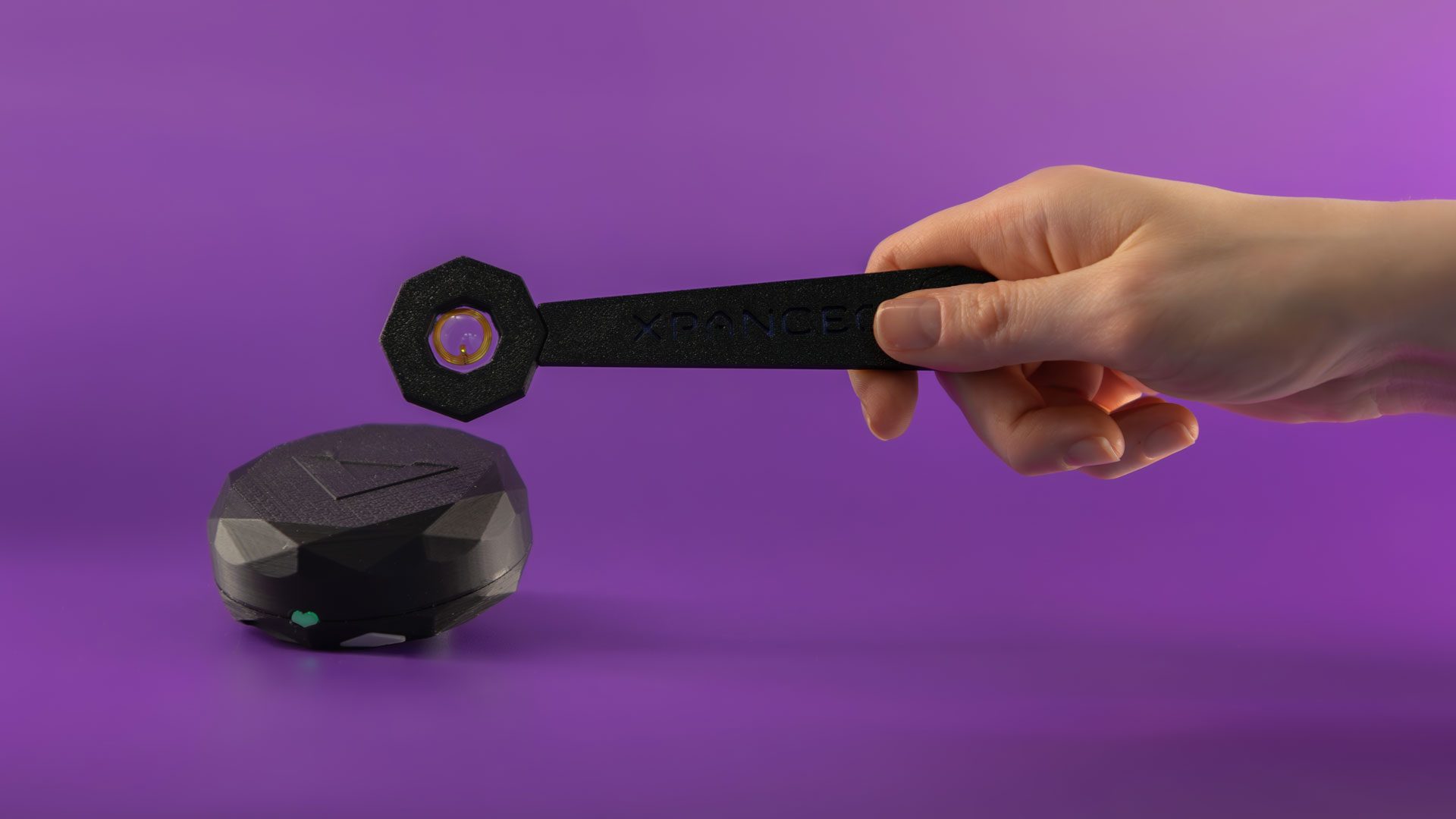
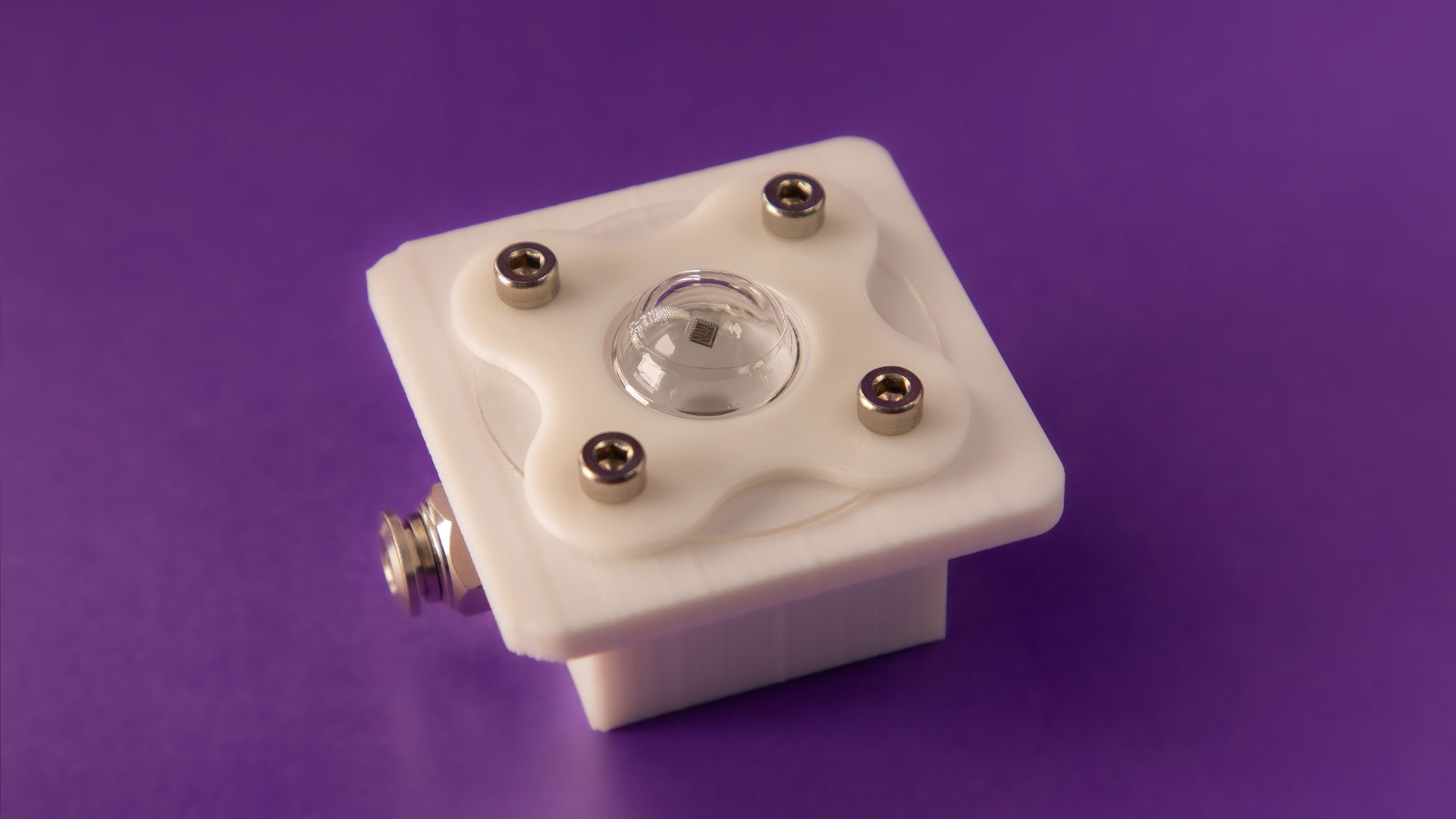
Since its 2023 seed round, XPANCEO says its fleet of prototypes include a lens for AR vision, a smart lens with intraocular pressure (IOP) sensing for glaucoma monitoring, a biochemical lens capable of measuring health parameters such as glucose directly from tear fluid, and a lens capable of real-time wireless charging and data reading.

Other prototypes feature nanoparticle-enhanced lenses for night vision and color correction, as well as lenses designed for 3D imaging, the company says.

Smart Сontact Lens with Wireless Powering Companion | Image courtesy XPANCEO

Headed by serial entrepreneur Roman Axelrod and physicist Dr. Valentyn S. Volkov, XPANCEO has grown rapidly since its 2021 founding, expanding from 50 to 100 scientists, engineers, and business leaders. Meanwhile, its lab has expanded to support the increasing scope of its research, the company says.

Over the years, XPANCEO has collaborated with a number of institutions, including the University of Manchester, the National University of Singapore, Donostia International Physics Center, and the University of Dubai.

High-Sensitivity Compact IOP Sensor | Image courtesy XPANCEO

XPANCEO’s new unicorn status puts it alongside some of the most ambitious XR projects to date: AR headset company Magic Leap first broke the $1 billion valuation mark in 2014 with a $542 million Series B investment led by Google, putting it at a max of $6.4 billion valuation in 2018 following its landmark investment by Saudi Arabia’s Public Investment Fund (PIF).

Earlier this year, immersive web content company Infinite Reality announced it raised $3 billion from a private investor to build its “vision for the next generation of the internet,” bringing the company’s valuation to $12.25 billion.

The post Smart Contact Maker Raises $250M Investment at a Whopping $1.35B Valuation appeared first on Road to VR.

10 Jul 07:08

Meta Invests €3 Billion In EssilorLuxottica, Taking 3% Stake

by David Heaney

Meta has invested €3 billion in EssilorLuxottica, taking a 3% stake in the eyewear giant, Bloomberg and Reuters report.

The French-Italian giant EssilorLuxottica is the largest eyewear company in the world by far. It owns iconic brands like Ray-Ban, Oakley, Oliver Peoples, and Persol, and has exclusive licenses with major fashion companies like Prada, Armani, Burberry, and Chanel. It also owns Sunglass Hut, and has more than 18,000 retail stores in total worldwide.

Last year multiple outlets, including The Wall Street Journal, reported that Meta was in talks to take a 5% stake in EssilorLuxottica. Now, Bloomberg and Reuters report that Meta has completed a €3 billion investment representing a just under 3% stake, and "is considering" further investment to bring this to 5% over time.

It comes 3 weeks after Google reportedly took a 4% stake in Gentle Monster, one of EssilorLuxottica's rising competitors that the company is working with on Gemini smart glasses.

Google Reportedly Investing In Gentle Monster To Take On Ray-Ban Meta
Google is taking a 4% stake in Gentle Monster, the South Korean eyewear company it’s building a Ray-Ban Meta competitor with, The Korea Economic Daily reports.
UploadVRDavid Heaney

Meta has so far partnered with EssilorLuxottica for two smart glasses products, Ray-Ban Stories and Ray-Ban Meta, with a third - Oakley Meta HSTN - launching this summer.

Last year Meta and EssilorLuxottica signed an agreement extending their partnership “into the next decade” to develop “multi-generational smart eyewear products”.

Ray-Ban Meta glasses had sold 2 million units as of February, and EssilorLuxottica said annual production capacity will be increased to 10 million by the end of 2026.

The next product from the two companies will reportedly be Oakley Meta Sphaera glasses, according to Bloomberg, featuring a centered camera better suited for first-person video capture.

Apparent Renders Of Next-Gen Ray-Ban Meta Glasses Leak
Apparent renders of next-gen Ray-Ban Meta glasses have leaked on Chinese social media, showing distinct designs for optical glasses and sunglasses.
UploadVRDavid Heaney

The Information has separately reported that the two companies plan two next generation Ray-Ban Meta glasses models for 2026, with enhanced AI features and longer battery life, and apparent renders of these models leaked on Chinese social media this week.

What Are Ray-Ban Meta Glasses?

Ray-Ban Meta glasses are smart glasses with a camera, microphones, and speakers. They do not have a display.

You can use them to capture photos and videos, listen to music/podcasts/audiobooks, make and receive calls, share your first-person view on WhatsApp/Messenger/Instagram video calls, translate speech, scan QR codes, and query Meta AI, the company's LLM-based assistant that can see via the camera when you ask about something in view. It'll also read out some phone notifications, if you want.

Ray-Ban Meta glasses come in three styles: Wayfarer, Headliner, and Skyler. These styles are offered with four types of lenses: Clear, Sun, Polarized, and Transitions, and come in a variety of colors, for both the frame and the lenses.

Whenever the camera is in use, be it for capture or for Meta AI, a white LED on the front of the glasses will pulse to make others nearby aware.

10 Jul 07:07

Ce drone moustique chinois fout la trouille à tout le monde

by Ismael R.

Il ressemble à un insecte ordinaire, mais il pourrait bien écouter toutes vos conversations confidentielles. Ce drone « moustique » conçu par la Chine redéfinit le sens du mot espionnage, en silence et sans laisser de trace.

Présenté le 20 juin 2025, ce drone ne mesure que trois centimètres de large et pèse 0,2 gramme. Selon la télévision chinoise CCTV, il reproduit la morphologie d’un moustique, ailes comprises. Liang Hexiang, son concepteur et étudiant à la NUDT, affirme que ce robot « est parfaitement adapté aux missions spéciales sur le champ de bataille ».

Deux versions seraient à l’étude : l’une avec deux ailes, plus légère et une autre avec quatre ailes pour porter une charge. Invisible à l’œil nu, le dispositif est conçu pour éviter toute détection, de jour comme de nuit. Sa structure miniature lui permettrait d’accéder à des zones sensibles, interdites aux drones classiques. Ce projet militaire s’appuie sur un biomimétisme précis, couplé à une capacité de vol autonome.

Un outil espion caché dans votre salon

Selon Interesting Engineering, le drone moustique embarque des capteurs, un système de commande et sa propre alimentation. Il serait capable d’entrer dans des bâtiments, de suivre une cible et d’enregistrer des sons. Sa conception lui permettrait de passer inaperçu, même dans des espaces fermés. Le drone chinois ne serait pas seulement un prototype de laboratoire, mais un signal fort envoyé aux puissances adverses.

Son autonomie reste néanmoins très faible, quelques minutes tout au plus. Cela limite pour l’instant son emploi sur le terrain militaire ou sécuritaire. Mais Pékin semble vouloir prouver sa maîtrise des technologies les plus miniatures. Comme le résume Europe 1 : « La démonstration technologique est frappante : la Chine veut montrer qu’elle est à la pointe. »

Une guerre invisible à peine commencée

La biomimétique n’est pas un terrain nouveau pour les militaires. Les États-Unis, la Norvège ou le Royaume-Uni ont déjà expérimenté des robots volants inspirés d’insectes. Le Black Hornet, par exemple, pèse plusieurs dizaines de grammes et reste détectable. Le RoboBee de Harvard, lui, n’est pas encore autonome et dépend d’un câble d’alimentation externe.

Le drone chinois franchit donc une étape supplémentaire : il imite un insecte tout en restant totalement libre. Sa finalité semble claire : espionner sans être vu, ni entendu.

Ce drone moustique chinois fout la trouille à tout le monde

Surveillance miniature, menace maximale

Ce drone moustique transforme la perception même de la surveillance. Son existence brouille les frontières entre fiction dystopique et opérations militaires réelles. Une fois introduit dans un espace, il pourrait écouter, filmer, voire transmettre des données. Des scénarios inquiétants émergent déjà : empoisonnement ciblé, usurpation biométrique, manipulation de données sensibles.

Aujourd’hui, aucun traité n’encadre l’usage de ce type de drone espion. La miniaturisation avance plus vite que la régulation et les démocraties peinent à suivre. La Chine, elle, trace son chemin, moustique robotisé en main.

Cet article Ce drone moustique chinois fout la trouille à tout le monde est apparu en premier sur OBJETCONNECTE.COM.

10 Jul 06:59

La grande arnaque des soft skills

by Marie Dollé

Ce matin, train pour le sud avec mon fils, et le rituel immuable : halte au point presse. Je scanne, à ma façon : lecture en diagonale, pensée en spirale. Mon cortex joue à saute-mouton avec les signaux faibles, et une demi-phrase m’ouvre trois dossiers. 

La preuve : un encart sur le “management émotionnel” me fait penser à Spinoza, au design conversationnel et à l’odeur des salles de réunion mal ventilées. J’essaie de ne pas m’enflammer : ce n’est pas simple d’être câblée pour capter du signal partout.

Place à ce présentoir en caisse, une pépite : 

À deux doigts des “serial killers”, un guide des émotions signé Le Monde. Volontaire ? Brillant. Pas volontaire ? Carrément freudien. Surtout avec, en arrière-plan, Fracas et son “Comment tout peut exploser”. Oui, je vois. Très bien même.

Deuxième arrêt de cette matinée déjà bien chargée (nuits courtes, cerveau allumé trop tôt). Ça se passe ici, juste là : ce qu’ils appellent, dans le jargon, une “zone chaude”. Là où l’œil tombe, là où le panier se remplit. 

Fait marquant : à vue d’œil, la moitié du linéaire est dédiée à ce que j’appellerais la feel-to-buy zone. À droite, l’empire du “mieux-être” : hypersensibles, hyperempathiques, pensées positives, communication non violente, PNL pour tous. Et ça déborde en bas à gauche : flow, happinez, yoga, méditation, psychologie (en kit), etc. 

Après avoir failli rater mon train (welcome to my life), happée en hyperfocus par le rayon snacks et ses promesses de diversification healthy, je me pose enfin.

J’écris aujourd’hui à mi-chaud, ce moment bizarre entre l’impulsion brute et le recul structuré. Trop à chaud, c’est illisible, et ce, même pour moi. À froid, je contrôle. Trop. Je filtre, je cadre… et je perds quelque chose, un élan, une nervure peut-être. Là, j’ai juste envie d’autre chose : une facette moins lisse, plus vivante.

Donc… reprenons le fil. Qu’est-ce que ça m’inspire, tout ça ?

Au début, je me suis dit : ok, chouette, on se reconnecte au sensible, à quelque chose de plus humain. Mais très vite, j’ai senti que c’était trop bien ficelé. À force de vouloir cartographier les émotions, on leur ôte toute géographie sensible. Ce n’est plus du ressenti, c’est de la logistique : réglable, paramétrable, plug-and-play. Comme si, sous le vernis de l’éveil, c’était l’anesthésie de masse qui opérait.

Et là, ça m’a ramenée à ce mythe tenace autour des soft skills qui seraient forcément bienveillantes, douces, morales.

Erreur.  

Déjà, les soft skills qu’on croit “morales” - l’écoute, l’empathie, la patience - sont parfois devenues des outils d’efficacité. On ne les valorise plus seulement pour leur éthique, mais pour leur performance. On écoute pour mieux convaincre. On fait preuve d’empathie pour désamorcer. Même la bienveillance est devenue une stratégie.

Deuxio, et plus largement : les soft skills ne sont pas, par nature, bienveillantes, ni morales, ni neutres. Un soft skill, en réalité, c’est une compétence non technique, incarnée, humaine, qui influence notre manière de percevoir, de réagir, de lire l’autre, de se mouvoir dans le monde. 

Et ça peut inclure des choses moins avouables : 

l’ironie comme système de survie ; 

la froideur, comme refus de se laisser annexer par l’émotion attendue ; 

la méfiance comme mémoire active du réel ; 

la manipulation, parce qu’on perçoit trop vite ce que les autres dissimulent encore ; 

la roublardise, un art de naviguer dans le déséquilibre avec une lucidité trop fine pour rester sage ; 

Le voyeurisme, pas celui qui regarde en cachette, mais celui qui regarde là où le monde à mis un rideau, et se demande pourquoi ; 

ou encore l’obsession, comme ligne de force dans un monde où l’intention (au même titre que l’attention) se dissout. 

Et dans l’attention comme dans l’intention, ce qui tient, c’est la tension. Sans elle, tout s’effondre en surface.

Ce n’est pas moral, c’est humain. Et profondément inadapté à ce que l’époque attend de nous. Donc, peut-être, essentiel.

Mon avis ? Méfiez-vous des sentiments bien emballés : ce n’est pas vivant. 

L’époque veut du bon, du juste, du positif… calibré, partageable, rentable. Mais pour être vraiment présent à l’autre, curieux du monde, il faut parfois regarder là où ça dérange. Sentir ce qui gène. Penser avec ce qui ne se digère pas. 

On a longtemps voulu distinguer le vrai du faux, il est peut-être temps d’écouter ni l’un ni l’autre, et de tenter autre chose : être justes.

Juste authentiques. 

MD

09 Jul 12:57

ChatGPT is testing a mysterious new feature called ‘study together’

by Julie Bort
The mode is apparently the chatbot's way of becoming a better educational tool. Rather than providing answers to prompts, some say it asks more questions and requires the human to answer.
09 Jul 12:54

🎤 Interview - Comment l’IA réinvente le commerce (Lionel Tardy, École supérieure de vente et d’exportation)

by Jérôme Colombain

L’intelligence artificielle ne remplace pas les vendeurs : elle les rend plus stratégiques. Lionel Tardy, enseignant en école de commerce et spécialiste du retail, décrypte comment l’IA bouleverse les pratiques d’achat et de vente, en ligne comme en magasin.

Avec l’essor des assistants IA comme ChatGPT, les Français sont de plus en plus nombreux à se tourner vers ces outils pour guider leurs choix d’achat. Une révolution déjà bien entamée côté entreprises, avec l’automatisation des recommandations et la personnalisation des parcours clients. Mais désormais, c’est le consommateur lui-même qui dialogue avec l’IA, en langage naturel, pour obtenir des conseils avant de passer à l’acte d’achat.

Lionel Tardy revient sur les chiffres récents montrant l’adoption massive de ces technologies, y compris chez les plus de 60 ans. Il décrit aussi le futur du commerce : IA agentique, vendeurs augmentés équipés de lunettes en réalité augmentée, omnicanalité centrée sur l’utilisateur… et les nouveaux enjeux éthiques que cela soulève.

-----------
♥️ Soutien
https://donorbox.org/monde-numerique
🗞️ Newsletter
https://mondenumerique.substack.com
📹 Chaîne YouTube
https://www.youtube.com/@mondenumerique

Hébergé par Audiomeans. Visitez audiomeans.fr/politique-de-confidentialite pour plus d'informations.

09 Jul 06:56

ChinAI #319: China Developer Survey Report (2024)

by Jeffrey Ding

Greetings from a world where…

buffets and JazzFest in Iowa City are the best way to celebrate the Fourth

…As always, the searchable archive of all past issues is here. Please please subscribe here to support ChinAI under a Guardian/Wikipedia-style tipping model (everyone gets the same content but those who can pay support access for all AND compensation for awesome ChinAI contributors).

Feature Translation: The 2024 China Developer Survey Report is here!

Context: The China Software Developer Network (CSDN) is the largest software developer community in China, which provides IT news coverage and hosts code — a mix of Stack Overflow, Hacker News, and Github. It has fielded a large-scale annual survey of Chinese developers since 2004, and this 2024 version was published in July 2024. One important methodology note before we delve into 17 pages of findings: Even though CSDN brands this effort as “the largest survey covering all types of Chinese developers”, it does not share any details about the survey sample, including even the number of total respondents.

  • I have a few inquiries out to get more details about the survey methodology, but if anyone knows folks at CSDN who could give clarification, please let me know.

  • CSDN has also been accused of copying GitHub projects to its own site in ways that go against open-source.

*Again, before we get into the data, take these findings as rough temperature gauges, rather than a national representative sample of Chinese developers — and I’ll update this post if we get clarification on the methodology.

Key Takeaways: In terms of basic demographics of developers, 72% of respondents were under the age of 30, and only 49% said that their salary had increased in the past year.

  • While young developers are still the main force, the proportion of developers over 30 actually increased compared with past years, which suggests a somewhat improved situation for this “job that relies on youth” [青春饭]. Men made up 84% of respondents under the age of 30.

  • There’s been some stagnation of salaries, though some of this could be attributed to more developers moving to lower cost-of-living cities. From the report: “49% of developers said that their salary has increased in the past year, while the figure was 51% in 2023 and 62% in 2022.”

A day in the working life of a Chinese developer involves spending less than half of one’s time writing code. Interestingly, in the report’s discussion about work habits and involution, they cited a viral tweet from OpenAI developer Jason Wei about his daily schedule (which was meant to be satirical).

  • Nearly 80% of respondents said that code-writing time is less than half of their overall working time. 74% of developers write less than 300 effective lines of code per day.

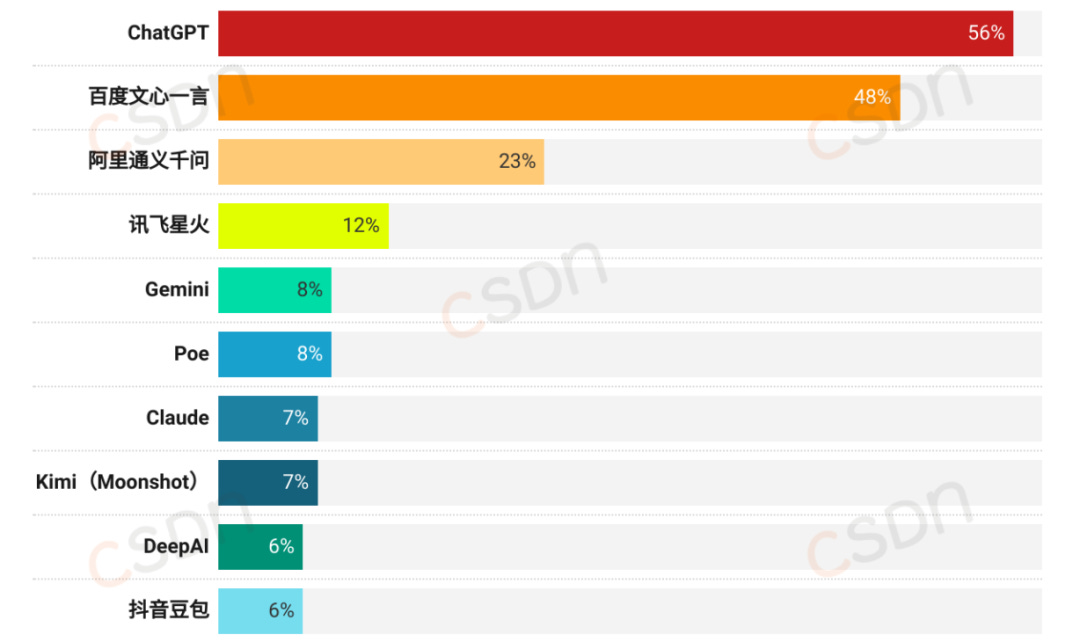
  • ChatGPT is the top chatbot used by Chinese developers (56% of respondents reported that they used it). As the below image shows, Baidu’s ErnieBot, Alibaba’s Tongyi Qianwen, and iFlytek’s SparkDesk follow behind with 48%, 23%, and 12% of developers that report usage, respectively.

Source: 2024 CSDN China Developer Survey Report; multiple survey items can be selected
  • Other top tools used by Chinese developers: MySQL for commercial database; Vue.js for web development frameworks; Alibaba Cloud for container cloud platforms.

  • The results for most popular AI coding assistants were surprising. Alibaba’s Tongyi Lingma leads the way (19%) and ChatDev, an open-source tool developed by ModelBest and Tsinghua NLP lab, placed second (14%). GitHub Copilot and OpenAI Codex lagged behind with 9% and 8%, respectively.

  • When asked to asses the impact of AI coding assistants on their workload, the plurality of respondents (38%) said it could reduce their workload by 20-40%; very close behind, 35% of respondents said it decreased their workload by just 0-20%.

Some other trends in the Chinese developer community related to cloud computing and open-source software:

  • The survey investigated attitudes toward “cloud repatriation” [下云], a process of migrating workloads from a public cloud to an on-premises data center. This trend has not been taken up in China: “foreign companies have voiced their intention to ‘go off the cloud,’ claiming that the cost of going to the cloud is too high, and some have even built their own servers to reduce costs. However, in China, more than half of the respondents (60%) said they had no experience of ‘going off the cloud.’”

  • Though the open-source environment is growing, only 14% of respondents develop open-source software as their full-time job. Most either participate in open-source on a part-time and spare time basis (35% of respondents) or as freelance developers (34%).

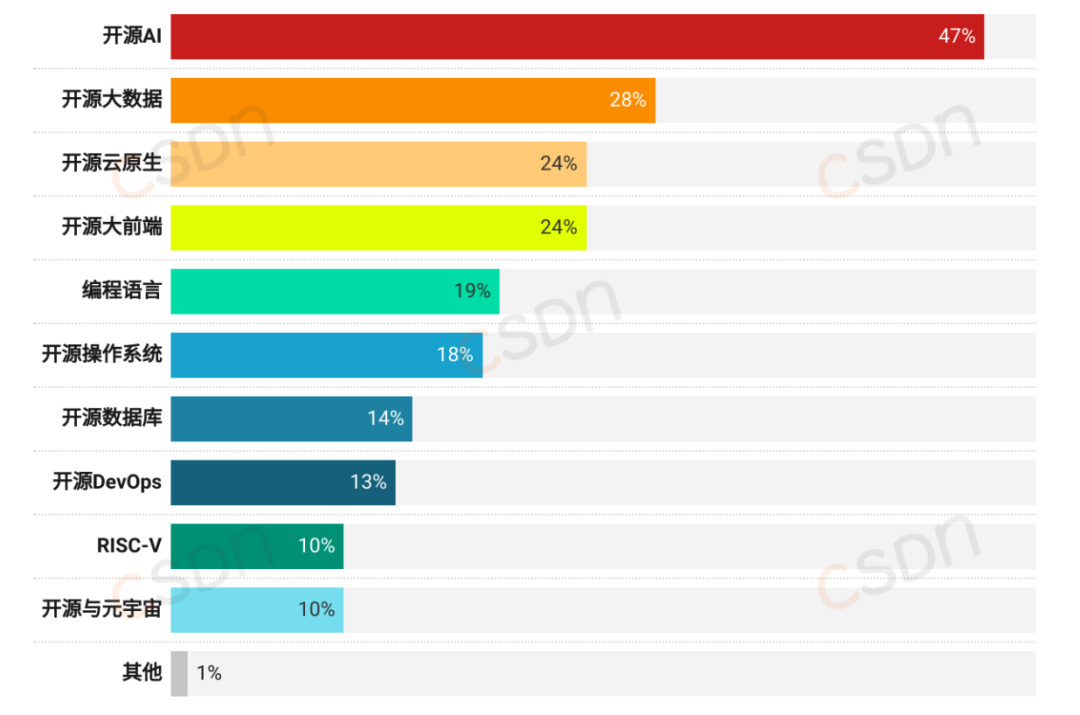
  • AI is fueling the growth of China’s open-source software community. It ranks first among open-source tech domain that developer pay attention to (see image below), followed by big data and cloud-native computing.

Source: CSDN 2024 China Developer Survey Report. Open source technology fields that developers pay attention to (multiple items can be selected).

FULL TRANSLATION: The 2024 China Developer Survey Report is here!

ChinAI Links (Four to Forward)

Must-read: Promising Topics for U.S.–China Dialogues on AI Risks and Governance

How can we foster meaningful cooperation between the US and China on AI risks? This FAccT2025 paper, led by Saad Siddiqui and Lujain Ibrahim, reviewed 40+ Chinese and U.S. documents to map areas of common ground: “Specifically, using an adapted version of the AI Governance and Regulatory Archive (AGORA) — a comprehensive repository of global AI governance documents — we analyze these materials in their original languages to identify areas of convergence in (1) sociotechnical risk perception and (2) governance approaches. We find strong and moderate overlap in several areas such as on concerns about algorithmic transparency, system reliability, agreement on the importance of inclusive multi-stakeholder engagement, and AI’s role in enhancing safety. These findings suggest that despite strategic competition, there exist concrete opportunities for bilateral U.S.- China cooperation in the development of responsible AI.”

Should-read: Two Rulings on Fair Use and LLM Training

Ben Murphy, current GovAI fellow, wrote up some in-depth analysiss on two copyright cases involving Anthropic and Meta’s use of pirated books to train their AI models. Some fascinating details about how Anthropic dealt with concerns about pirating millions of books: “It then realized that it might have a copyright issue, and proceeded to buy physical copies of books, cut the pages, scan them, and use those transcribed copies for actual training.”

Should-watch: Can Multinationals Win in China? Lessons from Apple’s Experience

CSIS hosted a thoughtful discussion on Patrick McGee’s recent book Apple in China. Grateful for the opportunity to provide some thoughts alongside Meg Rithmire and James McGregor.

Should-read: Financial Security: Lian Ping on US Sanctions, SWIFT and De-Dollarisation

I found this Sinification post to be really illuminating. Bert Hofman, who was previously Country Director for China at the World Bank, provided some context and scene-setting for the feature translation: Lian Ping, President and Chief Economist, Guangkai Chief Industry Research Institute, on US Sanctions, SWIFT and De-Dollarisation.

Thank you for reading and engaging.

These are Jeff Ding's (sometimes) weekly translations of Chinese-language musings on AI and related topics. Jeff is an Assistant Professor of Political Science at George Washington University.

Check out the archive of all past issues here & please subscribe here to support ChinAI under a Guardian/Wikipedia-style tipping model (everyone gets the same content but those who can pay for a subscription will support access for all).

Also! Listen to narrations of the ChinAI Newsletter in podcast format here.

09 Jul 06:54

Processeur photonique, Arago lève 24 millions d’euros pour repenser le calcul IA

by LA REDACTION DE FRENCHWEB.FR

Depuis plus d’une décennie, le GPU domine le paysage du calcul intensif. Des milliers de modèles d’intelligence artificielle, du plus simple classifieur jusqu’aux systèmes multimodaux génératifs, ont été entraînés sur ces architectures massivement parallèles. Pourtant, à mesure que la demande de puissance explose, les limites physiques de ces puces deviennent de plus en plus contraignantes. …

L’article Processeur photonique, Arago lève 24 millions d’euros pour repenser le calcul IA est apparu en premier sur FRENCHWEB.FR.

07 Jul 12:16

AI Act : le texte que tout le monde défendait… tant qu’il ne s’appliquait à personne

by LA REDACTION DE FRENCHWEB.FR

Il était présenté comme un modèle, le premier cadre législatif structuré sur l’intelligence artificielle au monde, un texte ambitieux, porté par la Commission européenne, applaudi par les États membres, les ONG, les entreprises technologiques européennes, mais à l’approche de son entrée en vigueur, l’AI Act se retrouve au cœur d’un retournement de situation et se …

L’article AI Act : le texte que tout le monde défendait… tant qu’il ne s’appliquait à personne est apparu en premier sur FRENCHWEB.FR.

07 Jul 07:18

From position to meaning: How AI learns to read

The language capabilities of today's artificial intelligence systems are astonishing. We can now engage in natural conversations with systems like ChatGPT, Gemini, and many others, with a fluency nearly comparable to that of a human being. Yet we still know very little about the internal processes in these networks that lead to such remarkable results.
07 Jul 07:15

Actualité : Une astronaute de l’ISS capture une “méduse rouge” géante dans le ciel : la photo est exceptionnelle

by Aymeric Geoffre-Rouland
Le 3 juillet 2025, à bord de la Station spatiale internationale, Nichole Ayers a photographié un phénomène aussi spectaculaire que fugace : un sprite. Contrairement à la foudre que l’on observe depuis le sol, ce type de décharge électrique se produit à des altitudes stratosphériques et ne résulte pas d’un éclair visible, mais d’un champ électrique tr...
06 Jul 13:13

A Look Through the Eye of a Bowling Ball

by Fenix Guthrie

If you are anything like us, last time you went bowling, you thought more about how the ball came back to you than actually knocking down the pin. Perhaps you even wondered what it would be like to be a bowling ball making its way back through mysterious and hidden machines. [Wren] and [Erik Beck] did as well, so they set out to make a bowling ball camera to find out.

At the heart of the contraption is an Insta360 X5 camera nestled between water-jet cut metal plates. Because each lens of the camera has a 200 degree field of view, anything in the overlap of the two lenses simply does not appear, so the two metal plates likewise, do not appear. This does leave a somewhat noticeable seam down the middle of the footage, but overall worked out very well. To prevent vibrations in the bowling ball, it can only be rolled along the plate line, making said seam appear in all the footage. Because the stabilization is happening purely digitally, and the camera itself is spinning with the ball, motion blur became an issue immediately. Fortunately increasing the shutter speed fixed the issue, along with an increase in ISO to compensate for the decreased exposure.

The outer shell was made of two acrylic or polycarbonate domes, with the former providing better optics, and the latter better strength. Unfortunately, clear half-domes can only be formed in certain sizes, and the closest to the standard bowling ball size of 8.5 inches was 8 inches. This led to many challenges come filming, resulting in neither the pin-side pickup nor the bowler side pickup being able to grip the ball. The pin side was solved using a simple foot, but the bowler side proved more challenging. After many attempts with cardboard shimming, the team finally just gave it a push with a regular sized bowling ball pushed in afterward.

The footage turned out brilliantly, and we would love to see a V2 of a correct diameter. Now, this is not the first time we have covered strange bowling engineering, make sure to read this piece on pins with strings next!

05 Jul 08:34

Condamnation en France d’anciens dirigeants d’Ubisoft

by Morgan Fromentin
Condamnation en France d’anciens dirigeants d’Ubisoft
En France, plusieurs anciens dirigeants d’Ubisoft ont été reconnus coupables par la justice. Ce verdict marque une étape importante dans une affaire qui visait la gouvernance et les pratiques internes au sein du géant français du jeu vidéo.
04 Jul 20:30

Researcher develops 'SpeechSSM,' opening up possibilities for a 24-hour AI voice assistant

Recently, spoken language models (SLMs) have been highlighted as next-generation technology that surpasses the limitations of text-based language models by learning human speech without text to understand and generate linguistic and non-linguistic information.
04 Jul 20:17

🏺 L'agent de la malédiction de Toutankhamon pourrait guérir le cancer

by Alain REDBRAN
Le champignon Aspergillus flavus, très toxique, connu pour ses spores jaunes et associé à des légendes comme celle de la malédiction de Toutankhamon, pourrait en réalité jouer un rôle...
04 Jul 20:15

Actualité : Décathlon modernise ses magasins avec une innovation tech qui vous fait gagner un temps fou

by Aymeric Geoffre-Rouland
Depuis avril 2025, plus de 300 magasins Décathlon en France ont abandonné les caisses traditionnelles au profit d’un nouveau système d’encaissement mobile. Le principe est simple : un vendeur s’approche, scanne vos articles avec un terminal portable, encaisse via carte ou mobile, désactive les antivols… et vous repartez sans passer par une caisse fix...
04 Jul 12:48

Les poupées Labubu au cœur d’une arnaque cyber internationale

by Amine Baba Aissa

Les poupées Labubu, un phénomène marketing originaire de Hong Kong, continuent de faire sensation sur les réseaux sociaux. Malheureusement, cette popularité attire également des escrocs. Certains profitent de l’engouement pour piéger parents et collectionneurs, en créant de faux sites web imitant la boutique officielle.

04 Jul 12:44

EU says it will continue rolling out AI legislation on schedule

by Ram Iyer
The European Union said it will stick to its timeline for rolling out its AI legislation, ignoring calls by tech companies to delay the bloc's AI rules.
04 Jul 12:21

Why Cloudflare wants AI companies to pay for content

by Theresa Loconsolo, Kirsten Korosec, Maxwell Zeff
Cloudflare wants AI companies to pay up. The cloud infrastructure provider, which powers around 20% of the web, is launching a new experiment that would let publishers charge AI firms every time their bots scrape a site. It’s called Pay per Crawl, and it could reshape how content is accessed and monetized online. Today on […]
04 Jul 12:18

Halfpinion: considering only the benefits or the costs

Governing sometimes seems easy from afar. We should spend more on education. We should pay hospital staff more. We should fix the roads. More police. Everyone should work harder. These would all be great if they were free. Unfortunately, doing more in one area often means taking from another.

What is a Halfpinion?

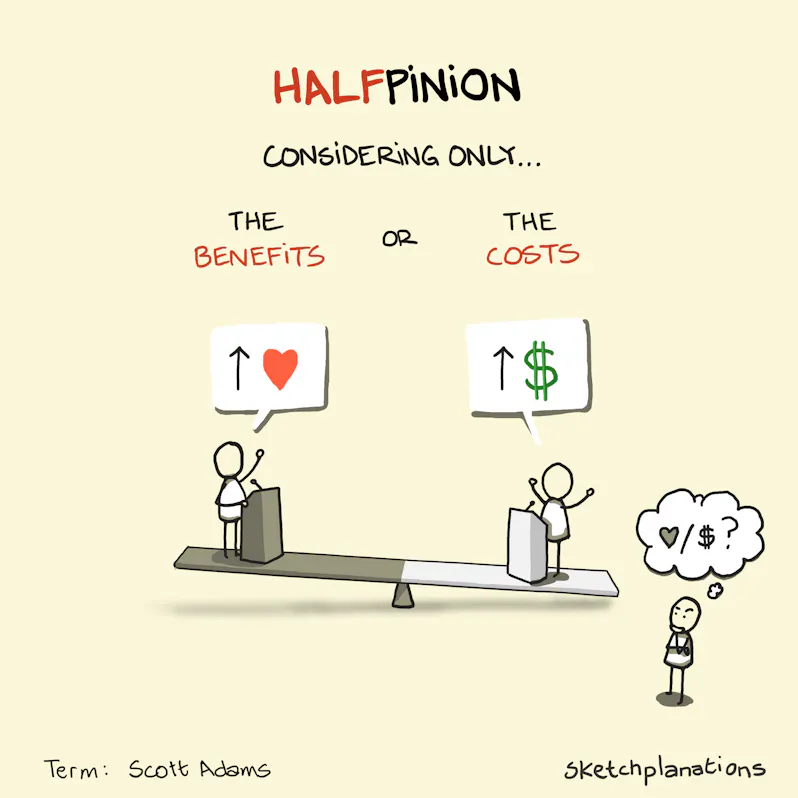
The reality is that most actions have benefits and costs. A halfpinion is a handy term for when someone is ignoring one half of a topic—either the costs or the benefits. When you only consider one side of an issue, often just the benefits, you don't have a full opinion, you just have a halfpinion, and can't make an informed decision.

Getting a pet, having a child, moving to the country, working remotely, working in-house versus working at an agency, going freelance, banning plastics, staying up all night, or launching a new feature — each of these has benefits and also costs.

It applies to values, too. If your company values speed, it might mean that you have to accept that not everything will be perfect. If you value quality, it won't always be the cheapest. Valuing speed while tacitly assuming that quality won't be affected is a halfpinion.

If you don't consider both aspects, you might find the grass isn't always greener. Providing a credible perspective requires comparing the full benefits of a choice to the full costs.

Now, you don't have to accept a trade-off—the benefits or the costs, or somewhere in between. In design, I learned that we innovate through resolving contradictions. In the progression of ideas, this might follow thesis, antithesis, synthesis.

Perhaps there's a creative solution to be found that gets the benefits without most of the costs. But considering only one or the other is just a halfpinion.

Related Ideas to Halfpinion

Also see:

Halfpinion is a term coined by Scott Adams. I read about it in his book Loserthink. An example he gives is one group of people saying, "We can't do this, it's too expensive," and another responding, "But children are our future." The groups aren't so much disagreeing as pointing out one side of the issue: children are our future, and education is expensive.

03 Jul 12:34

ChatGPT vous renvoie vers de mauvaises URLs et c’est formidable pour les hackers

by Amine Baba Aissa

Une étude de la société de cybersécurité Netcraft révèle que des cybercriminels exploitent les errances des LLMs comme ChatGPT ou Perplexity. Cette nouvelle méthode de piratage repose sur les faux liens renvoyés par les IA génératives.

03 Jul 07:35

Crunchyroll Accidentally Left AI Slop in Anime Subtitles

by Frank Landymore
Crunchyroll, the massively popular anime streaming service and distributor, just got caught using obvious AI slop in its subtitles.

Crunchyroll, the massively popular anime streaming service and distributor, just got caught using obvious AI slop in its subtitles.

The slipup was made in the premiere episode of a new series called "Necronomico and the Cosmic Horror Show" — and trust us, there's no guesswork involved in sniffing out the AI here.

Around the 19:12 mark, the show's German subtitles feature a big fat "ChatGPT said:" jammed into the dialog. A classic, lazy error. (We double checked, and it's still there as of this morning.)

The fans who spotted this shoddy work didn't hold back in expressing their disappointment.

"This is not acceptable," wrote a user on Bluesky who was among the first to flag the AI usage. "How can we be expected to pay for a service that clearly doesn't care about the quality of its products?"

This might not come as a surprise to astute anime fans who've long complained about the quality of some of the service's subtitles. In late 2023, Crunchyroll infamously was forced to take down the first episode of the series "The Yuzuki Family's Four Sons" after the subs turned out to be outrageously bad. Errors ranging from random punctuation to straight up getting a character's name wrong raised the specter of machine translation.

Recently, some fans have found that the errors typically arise from the English closed captions — designed to be watched with the English dub — which show telltale signs of automation in how the text would incorrectly transcribe names or refer to characters that don't exist.

Pinning the blame for this latest incident is a bit tricky, though, since translations come from a variety of sources — sometimes from the production company, or the show's license holder, or from Crunchyroll's team.

Regardless, it won't help Crunchyroll's case that it's openly flirted with — and flip-flopped on — AI for some time now.

In an interview with The Verge last year, CEO Rahul Purini said that using AI to put out subtitles faster was "definitely an area where we are focused on."

"AI is definitely something that we think about at a lot of different workflows within the organization," Purini said in the interview. "Right now, one of the areas we are very focused on testing is our subtitling and closed captioning, where we go from speech to text and how do we improve and optimize our processes where we can get the subtitles done in various languages across the world faster so that we can launch as close to the Japanese release as possible."

Purini has since changed his tune. In an interview with Forbes in April, he insisted that the company is"not considering AI in the creative process, including our voice actors."

"We consider them to be creators because they are contributing to the story and plot with their voice," Purini added.

Fans were quick to declare victory at the time. Maybe it was premature.

More on AI: In Further Assault on Cinema, Amazon Is Deploying AI-Aided Dubs on Streaming Movies

The post Crunchyroll Accidentally Left AI Slop in Anime Subtitles appeared first on Futurism.

02 Jul 17:05

Robo-Soccer is Now Real, and It’s Gloriously Weird

by Geeks are Sexy

On June 28th, Beijing hosted its first Robotic Soccer Tournament, and yes, it was everything you hoped it would be: awkward running, dramatic falls, and robots giving 110%… processing power.

In the semi-finals, Team Vulcan from Tsinghua University took on Team Blaze Light from Beijing Info & Sci-Tech U. Picture this: six humanoid bots on a soccer field, moving like toddlers in cosplay armor, kicking with the precision of a cat wearing socks.

And this is only the beginning. It’s all leading up to the World Humanoid Robot Games this August, where teams will battle for glory, honor, and maybe a firmware update. Check it out!

Click This Link for the Full Post > Robo-Soccer is Now Real, and It’s Gloriously Weird