Shared posts

04 Aug 22:12

Microsoft Debuts Immersive Events in Teams Public Preview

by John Davis

Microsoft has officially launched public preview access to immersive events in Microsoft Teams, bringing its Mesh-powered 3D collaboration experience directly into the workplace platform used by millions.

With no downloads, no special hardware, and no complex setup, the new feature allows organizers to host fully interactive, customizable events for up to 300 participants – right inside Teams. Attendees simply click the calendar invite, hit “Join,” and drop straight into a spatial, avatar-driven environment.

This isn’t XR as an add-on. This is XR embedded.

Mesh Becomes Enterprise-Ready

Microsoft Mesh has been in development for several years – originally pitched as a mixed reality collaboration platform that relied heavily on headsets and bespoke spaces. But now, Mesh’s immersive capabilities are being folded directly into Microsoft Teams, turning it into a scalable, intuitive, and secure solution for enterprise-grade virtual events.

The result? A seamless, familiar interface for setting up 3D meetings, town halls, and celebrations – all with built-in support for avatars, spatial audio, interactive elements, and real-time engagement tools.

“Now anyone can host customizable 3D events where people connect from anywhere, interact through avatars, and have natural conversations that feel like being in the same room.”

Why Enterprise Teams and XR Pros Should Take Note

This launch is more than a user experience upgrade – it’s a strategic integration that redefines how businesses approach digital engagement.

For enterprise buyers, immersive events solve a key challenge: creating meaningful, branded experiences in a hybrid-first world without burdening IT or requiring external software. Everything happens within Microsoft 365, including identity and security management.

For XR professionals, this marks a shift in how immersive technology is distributed and adopted. No longer a niche platform, Mesh is now a feature inside Teams – lowering the barrier to entry for immersive collaboration at scale.

Whether you’re hosting an all-hands update or launching a new product, the promise is the same: Presence without friction.

What You Can Do with Immersive Events in Teams

Organizers can now launch and personalize 3D events directly in Teams using no-code tools. Key features include:

  • No downloads, no VR headset required (though supported)
  • Pre-built 3D templates for both formal and informal events
  • Interactive customization: Add logos, videos, 3D models, text, and more
  • Avatar integration: Join as an avatar or floating profile pic
  • Spatial audio and movement: Walk around and engage naturally
  • Presenter tools: One-click spotlight, Q&A teleporting, audience reactions
  • Secure, M365-native experience: Built-in compliance and user management

Event setup is simple: schedule from your Teams calendar, edit your immersive space, and send out the invite. Attendees need just two clicks to join.

Microsoft has quietly taken one of XR’s biggest challenges – accessibility and adoption – and solved it with two clicks and a calendar invite.

So here’s the question: if immersive meetings are now this easy, how long until they become the norm rather than the novelty?

And if Microsoft is setting the standard with Mesh + Teams… will Google, Zoom, or Apple be far behind?

Why All This Matters

There’s no question immersive events represent a powerful shift in how businesses engage distributed teams and global audiences. Microsoft’s biggest strength here may be its low-friction deployment: no new apps, no niche headsets, no complex onboarding. For industries like finance, healthcare, education, and beyond, this lowers the bar to participation significantly.

But enthusiasm must be tempered by pragmatism. Enterprise buyers will want to see:

  • How scalable and stable is this in practice?
  • Does it support diverse hardware environments (low-end laptops, mobile, etc.)?
  • Can users really create compelling 3D spaces in minutes – or will it require training?

If Microsoft can deliver on these promises, it could mark a turning point not just for Mesh, but for enterprise XR more broadly.

In their recent announcement, Microsoft said:

“We’ve made it easy to get started. Now anyone can host customizable 3D events where people connect from anywhere.”

Time – and user feedback – will tell.

Want to try it? Explore Microsoft Immersive Events here.


Join the XR Conversation

To keep up with the future of immersive tech in the workplace:

Join our XR Today LinkedIn Group – connect with 2,000+ industry pros

Subscribe to our Newsletter – get the top XR stories in your inbox each week

04 Aug 22:12

Maturité IA : le vrai progrès, c’est de reconnaître qu’on n’est pas prêt

by Bertrand DUPERRIN


Alors que nous sommes saturés d’annonces sur l’IA qui permettent une révolution instantanée et des gains de productivité massifs, rares sont sont les rapports qui assument une certaine sobriété et c’est justement le cas de l’édition 2025 de l’Enterprise AI Maturity Index de ServiceNow.

Bien que la plupart des études cherchent à mettre en avant la vitesse d’adoption, le nombre de cas d’usages ou des gains de productivité qui ne reposent que sur le déclaratif, celle-ci s’intéresse à un indicateur intéressant, à savoir la maturité. Et cette maturité, selon les données collectées auprès de près de 4 500 entreprises dans le monde, est non seulement faible, mais en net recul par rapport à l’an dernier. Un constat qui pourrait inquiéter mais qui a mon avis est au contraire un sain retour à la réalité.

Selon moi cette baisse ne doit en effet pas être vue comme un échec mais est au contraire le symptôme d’un réveil plutôt salutaire. Les entreprises découvrent en effet, parfois brutalement, qu’il ne suffit pas d’adopter l’IA pour se transformer, et qu’entre l’expérimentation enthousiaste et la transformation durable, il y a un gouffre organisationnel, managérial et culturel.

C’est ce gouffre que le rapport met en lumière sans tenter de l’édulcorer et c’est précisément ce qui en fait une lecture utile pour ceux qui veulent aller au delà de la promesse pour réfléchir aux véritables conditions de mise en œuvre de l’intelligence artificielle à l’échelle de l’entreprise.

Une dernière précision avant de rentrer dans le vif du sujet. Je dis souvent qu’il suffit de lire le nom de l’auteur ou du sponsor d’une étude pour deviner ce qu’elle raconte et celle-ci ne fait pas exception à la règle. ServiceNow étant de longue date le leader incontesté de la Robotic Process Automation il n’est donc pas surprenant de lire que l’avenir est dans l’IA agentique mais pour moi il s’agit d’une évidence et au moins l’expertise et le recul de ServiceNow sur le sujet change des charlatans qui essaient d’enrober tout et n’importe quoi avec de l’IA et croire qu’ils vont changer le monde à coup de marketing tapageur. Je crois d’ailleurs qu’un sommet a été atteint lors du dernier Vivatech avec beaucoup de visiteurs qui se sont avoués déçus de voir le nombre de projets semblant opportunistes, portés par des fondateurs peu spécialisés ou à la rentabilité économique pas encore prouvée. J’ajouterai également qu’à une époque où il devient évident que beaucoup d’éditeurs essaient de présenter leurs chiffres de manière avantageuse de manière à éviter de trop montrer que « ça ne se vend pas si bien que ça » et que les revenus sont très loin d’être à la hauteur des couts, ServiceNow semble être l’acteur le plus honnête et transparent sur le sujet, trouvant même grâce, ce qui est rare, auprès du très critique Ed Zitron (The Hater’s Guide To The AI Bubble).

En bref :

  • Le rapport 2025 de ServiceNow met en avant une baisse du score moyen de maturité IA (de 44 à 35 sur 100), interprétée comme une prise de conscience des défis réels plutôt qu’un échec de l’IA.
  • Les entreprises réalisent qu’adopter l’IA ne suffit pas : il faut transformer en profondeur les structures, la gouvernance, les compétences et les processus pour en tirer un bénéfice durable.
  • L’IA agentique, capable d’orchestration et d’exécution autonome, est identifiée comme la prochaine étape, mais seules quelques entreprises ont entamé des projets concrets et sont prêtes à l’encadrer efficacement.
  • Une minorité d’entreprises (« pacesetters ») se distinguent par leur vision intégrée et leur capacité de mise en œuvre, mais leur exemple ne garantit pas une transformation généralisée du tissu économique.
  • On peut suggérer que le rapport appelle à ralentir pour structurer, en soulignant que la valeur de l’IA dépend avant tout de la manière dont elle est pensée, encadrée et intégrée dans les organisations.

Une baisse brutale, mais salutaire

Le chiffre peut surprendre voire inquiéter mais le fait est que le score moyen de maturité IA passe de 44 à 35 sur 100, soit une baisse relative de plus de 20 %. Cela pourrait être interprétée comme un signal d’alarme mais je préfère y voir un signe de maturité dans le sens d’une prise de conscience des vrais enjeux. Une prise de conscience tardive, certes, mais qu’on peut espérer bénéfique et ce recul, qui pourrait paraître préoccupant au premier abord, est peut-être la chose la plus saine qui se soit produite depuis l’émergence de la vague IA générative.

On cesse donc enfin de confondre adoption et compréhension, pilote et déploiement et, surtout, potentiel de transformation et transformation effective. On revient à un niveau de lucidité qui oblige à se poser les bonnes questions sans se laisser griser par l’euphorie initiale qui avait masqué les vrais enjeux.

Contrairement à d’autres rapports, souvent trop enthousiastes et rédigés pour rassurer ou séduire clients et investisseurs, celui-ci assume presque une forme de désenchantement, non parce que l’IA ne fonctionne pas, mais parce que les organisations, dans leur grande majorité, ont sous-estimé la complexité de son intégration. La maturité ne se mesure ni au nombre de cas d’usage ni au nombre de prompts générés mais à la capacité d’aligner stratégie, gouvernance, compétences et modèles opératoires, dans une approche systémique et durable. Et c’est précisément là que beaucoup d’entreprises accusent un retard qu’elles n’avaient bizarrement pas anticipé.

Une course à l’innovation qui dépasse les structures

L’étude ne remet nullement en question la qualité des avancées technologiques récentes, bien au contraire, puisqu’elle souligne l’émergence rapide de ce qu’on appelle IA agentique, une forme d’intelligence artificielle incarnée par des agents autonomes, capables d’agir de manière proactive pour atteindre des objectifs définis. On quitte ici le registre de la génération de texte ou d’images pour entrer dans celui de l’orchestration, de l’automatisation et de l’exécution.

Mais si l’offre technologique évolue vite, la capacité des entreprises à en tirer profit ne suit pas. Seuls 33 % des répondants ont entamé des projets concrets autour de l’IA agentique et, parmi les 40 % qui déclarent vouloir s’y lancer dans les 12 prochains mois, une majorité reconnaît ne pas disposer des garde-fous nécessaires qu’il s’agisse de gouvernance, de sécurité ou simplement de critères d’évaluation clairs.

On retrouve ici un schéma classique que l’expérience devrait toutefois permettre d’anticiper, à savoir celui d’une innovation qui avance plus vite que la capacité d’absorption des structures qui l’adoptent. Ce n’est pas tant la volonté qui manque, que la vision, la capacité à prioriser, à encadrer, à traduire une intention technologique en transformation organisationnelle. Ce phénomène n’est pas nouveau, puisqu’il accompagne depuis des décennies chaque vague de transformation numérique, mais il prend ici une ampleur rarement vue, en raison de la complexité propre à l’IA, de son caractère non-déterministe (L’entreprise est déterministe, l’IA générative ne l’est pas et c’est un vrai problème), et du flou méthodologique qui entoure encore trop souvent la manière de mesurer sa valeur.

Ca n’est pas l’IA qu’il faut améliorer, c’est l’organisation

Le message principal de l’étude est que l’IA, dans ses différentes formes, fonctionne mais que ce qui ne fonctionne pas, ou pas encore, ce sont les entreprises qui cherchent à la déployer sans revoir leurs manières de penser, de structurer et de piloter leur fonctionnement. C’est d’ailleurs en phase avec une récente étude du BCG sur le sujet (IA générative : votre organisation vaut plus que vos outils).

L’étude ServiceNow le montre très clairement : moins de 30 % des entreprises interrogées ont une vision claire des compétences nécessaires pour exploiter l’IA à l’échelle. La plupart n’ont pas défini de modèle d’impact, ne disposent pas d’indicateurs opérationnels partagés, et n’ont engagé ni effort de formation ni politique d’appropriation digne de ce nom. Et, quand la formation existe, elle se limite souvent à des usages outils, sans réelle acculturation aux enjeux sous-jacents.

On reste donc, dans bien des cas, dans une logique expérimentale, opportuniste, parfois désordonnée, qui génère à la fois du scepticisme et de la fatigue et, cette fatigue, si elle s’installe, risque de nuire à la crédibilité même des initiatives IA dans les mois à venir.

Comme le rappelle Frédéric Cavazza dans plusieurs de ses billets (Nous n’avons pas besoin de meilleures IA, mais d’une meilleure compréhension de l’IA et Nous n’avons pas besoin de meilleurs modèles, mais de meilleurs produits), le sujet central n’est pas la performance intrinsèque des modèles, mais leur intégration dans un environnement de travail compréhensible, pilotable, évaluable. Ce qu’il faut, ce n’est pas une meilleure IA, mais de meilleurs produits, de meilleurs processus et, avant tout, comprendre à quoi nous avons vraiment affaire.

Les Pacesetters : des éclaireurs, pas une norme

Parmi les 4 500 entreprises interrogées, seules 18 % affichent un niveau de maturité supérieur et des résultats tangibles. Ce sont les « pacesetters » que le rapport définit comme des entreprises, qui combinent vision stratégique, gouvernance forte, approche orientée plateforme, politique de montée en compétence et capacité de mise en œuvre à l’échelle, qui tirent effectivement leur épingle du jeu.

Mais faut-il pour autant les ériger en modèle ? J’en doute. L’histoire de la technologie en entreprise montre que cette avant-garde a toujours existé, et qu’elle n’a jamais garanti à elle seule une transformation généralisée.

Le vrai sujet, c’est celui de la diffusion : à quelle vitesse le reste des entreprise va-t-il s’approprier les mêmes leviers et à quelle profondeur ? Si dans cinq ou dix ans, seuls ces 18 % ont su transformer l’essai, alors il faudra admettre que l’IA, loin d’avoir été une révolution partagée, aura surtout servi à creuser un écart de performance entre ceux qui savaient déjà transformer et les autres.

L’agentic AI : prochain levier ou prochain mirage ?

Ce qui rend ce rapport plus crédible que bien d’autres, c’est que ServiceNow n’est pas un acteur opportuniste de l’IA générative, mais un spécialiste de l’automatisation, dont l’ADN repose sur les workflows, les processus, et la rationalisation des flux d’information. Quand ils parlent d’IA agentique, ils ne le font pas pour impressionner mais pour maintenir une trajectoire cohérente.

ServiceNow ne remet pas en cause l’IA générative, mais à travers la place qu’elle accorde à l’IA agentique présentée comme la prochaine étape pour industrialiser les usages et piloter des systèmes complexes on comprend que l’IA générative, bien qu’utile pour initier des dynamiques, ne saurait suffire à elle seule pour supporter une transformation durable. C’est aussi, plus clairement encore, la conviction que je partage : l’IA générative, si spectaculaire soit-elle, restera une étape transitoire, dont les limites appellent d’ores et déjà autre chose. Elle devra s’articuler à des formes d’IA plus structurées et structurantes, orientée objectifs, capable de prendre des décisions, de coordonner des actions, et d’optimiser des systèmes. C’est cette IA-là qui est susceptible d’apporter un vrai différentiel opérationnel comme le montre l’initiative récente de Moderna (Fusion des RH et de l’IT : Moderna redessine son organisation pour et avec l’IA).

Mais cela suppose des prérequis comme une architecture de données fiable, une gouvernance solide, une supervision humaine compétente, et surtout une capacité à repenser le travail au-delà de la logique outil.

Le risque serait d’attendre de l’IA agentique qu’elle répare les errements de l’IA générative, alors même qu’elle s’inscrit dans une complexité supérieure.

Conclusion : ralentir pour mieux transformer

La baisse du score moyen de maturité IA n’est pas un échec mais une étape. Elle marque la fin d’une phase d’illusion et le début d’un cycle plus lucide, plus structurant, et sans doute plus efficace à terme. Les entreprises ne manquent pas de technologie mais manquent de structure et de méthode.

Ce que nous dit ce rapport, ce n’est pas de faire plus vite, ni même de faire plus, mais de faire mieux et pour cela, il faut accepter de ralentir, de clarifier, de poser les fondations. L’IA n’est pas la solution en soi., elle n’est qu’un moyen, dont la valeur dépend intégralement de la manière dont on s’en saisit.

Crédit visuel : Image générée par intelligence artificielle via ChatGPT (OpenAI)

L’article Maturité IA : le vrai progrès, c’est de reconnaître qu’on n’est pas prêt est apparu en premier sur Bloc-Notes de Bertrand Duperrin.

04 Aug 11:56

LangExtract : Un nouvel outil Google pour extraire des données structurées via les LLMs

by Camille Roux

Google dévoile LangExtract, une bibliothèque Python open source qui permet d’extraire des informations structurées à partir de textes bruts en utilisant les modèles de langage (LLMs). Cet outil se distingue par sa capacité de ‘source grounding’ précise et ses fonctionnalités de visualisation interactive, offrant aux développeur·se·s une solution robuste pour l’analyse et le traitement de données textuelles.


Commentaires
L'article LangExtract : Un nouvel outil Google pour extraire des données structurées via les LLMs a été posté dans la catégorie Python de Human Coders News
04 Aug 11:55

La Paréïa, où quand votre cerveau voit de l’IA partout.

by Geoffrey Dorne

Depuis quelques années je ressens cela et il fallait que je vous en parle ! Encore aujourd’hui, en scrollant sur les réseaux sociaux, j’ai eu cette sensation désormais familière qui me saisit devant chaque image : est-ce que cette photo est authentique ou générée par une IA ? Cette forme d’hésitation intellectuelle, ce doute qui s’immisce dans mon cerveau avant même la réflexion… j’ai pensé que cela méritait un nom, une manière d’en parler.

Paréïa

Après des recherches étymologiques, de la réflexion fort fort avec mon cerveau, je propose « Pareïa », un mot qui mélange le concept de paréidolie et l’intelligence artificielle, l’IA.

Pour vous expliquer cela, la paréidolie, c’est ce phénomène psychologique fascinant qui nous pousse à reconnaître des formes familières dans des stimuli ambigus. L’exemple le plus parlant ce sont ces visages que nous voyons dans les nuages ou encore ces silhouettes humaines dans les taches d’encre. Ou ma préférée : cette tendance irrésistible à anthropomorphiser les prises électriques. Notre cerveau, dans sa quête perpétuelle de sens, projette du familier sur l’inconnu. C’est un mécanisme de survie ancestral qui nous aide à identifier rapidement des dangers ou des opportunités dans notre environnement… même encore aujourd’hui à l’heure de l’IA.

Bref, en cherchant à vérifier de ma proposition du mot Paréïa, j’ai aussi découvert qu’il existe déjà dans la mythologie grecque une Pareia qui est la nymphe de Paros, concubine du roi Minos, dont le nom signifie « serpent brun-rougeâtre ». Elle donna naissance à quatre fils qui furent plus tard tués par Héraclès. Bref, mon cerveau y voit là quelque chose de prophétique dans cette résonance : une nymphe antique qui enfante des êtres voués à la destruction, quoi de mieux pour ce concept de Paréïa qui interroge notre rapport trouble à l’authenticité face à des outils (les IA), qui pour certains, semblent voués à notre destruction.

Bref, ce terme, je vous le propose puisque cette expérience révèle quelque chose de fondamental sur notre époque : nous développons une sorte de sixième sens techno-visuel, même si nos repères pour faire face à la réalité vacillent. Et en tant que designer, je constate combien cette incertitude redéfinit notre rapport à l’image et aux formes graphique en général.

Et vous, avez-vous déjà récemment fait l’expérience de la Pareïa ?

04 Aug 11:53

SEC Is Now All In On Crypto. What’s Next?

by Lilly Riddle

Crypto funds are about to become a whole lot more regulated — or deregulated, depending on who you ask.

After initial delays, the SEC has approved in-kind redemptions for spot Bitcoin and Ethereum ETFs. The decision is the first pro-crypto policy decision by Paul Atkins, the SEC chair confirmed earlier this year who is expected to help realize crypto evangelists’ digital currency dreams. The move also is the first major indication that the crypto industry — whose super PACs donated tens of millions to President Donald Trump’s 2024 campaign — is getting what it expected.

The decision marked “the biggest day for crypto in the history of the space,” said financial consultant Tyrone Ross Jr. “This administration, whether it’s custody, whether it’s on-chain, whether it’s ETFs … they’re making sure that crypto thrives in America.”

Will That Be Cash or Crypto?

In-kind redemptions let investors create and redeem shares of spot crypto ETFs without having to use cash — meaning authorized participants, the people with the power to change the number of ETF shares on the market, can now add or remove assets from a fund using Bitcoin or Ethereum. In a statement on the approval, Atkins said the decision is only the first step toward building “a rational regulatory framework for crypto.” But how much of these changes can be attributed to the Trump administration? “One hundred percent,” said Ross. “They are hell-bent on America becoming the main hub for crypto in the world.”

Other measures approved by the agency were:

  • Advancing a “merit-neutral” approach to crypto-based products, including applications for spot crypto ETFs.
  • Allowing FLEX options on shares of certain Bitcoin ETFs that let investors customize things like expiration date and strike price.

The SEC’s likely next move is specifying which coins are and aren’t securities, Ross said. “That’s the big one that everyone is still waiting for,” he said. The Commodity Futures Trading Commission is also likely to eventually update its guidance on what it will oversee, he added.

Keeping Options Open. In-kind redemption approvals took place alongside another policy change to increase positions limits for options trading on BlackRock’s spot Bitcoin exchange-traded fund, IBIT — the biggest crypto ETF on the market — from 25,000 to 250,000 contracts. BlackRock has been among the most prominent issuers pushing for deregulation, having filed for in-kind redemptions back in January. “It’s huge for the individual investor. It’s huge for BlackRock,” Ross said. “It’s huge for the entire space.”

The post SEC Is Now All In On Crypto. What’s Next? appeared first on The Daily Upside.

03 Aug 07:53

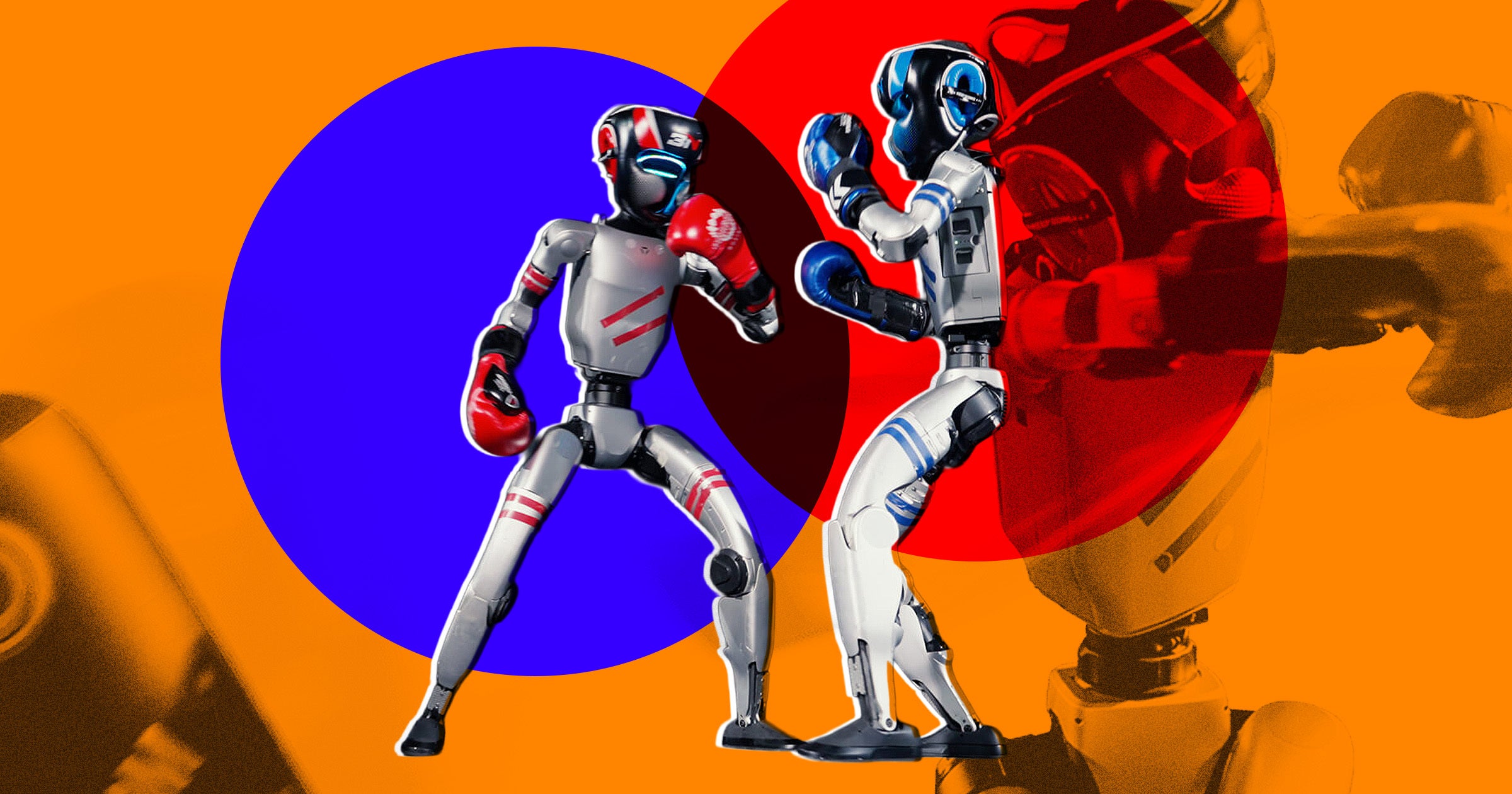
We Must Admit That This Video of Two Small Robots Punching Each Other With Boxing Gloves Is Pretty Awesome

by Noor Al-Sibai
Two pint-sized robots were seen boxing at an AI conference in Shanghai, and we've gotta say, they're pretty cool.

These days, robots with varying degrees of impressiveness can manage all kinds of tasks. But two diminutive humanoids seen boxing with outsize gloves at the recent World AI Conference in Shanghai may take the cake.

In a video posted to X, AI security researcher Helen Toner — who was, it should be noted, a driving force behind the ultimately failed coup against CEO Sam Altman back in November 2023 — showed off the boxing ring prowess of two short-statured robots from the Chinese company Unitree.

Known as the "Iron Fist King," this new robot model has indeed made waves since Unitree unveiled it in a splashy boxing tournament in May.

As Toner alludes in her post, these boxing bots aren't quite autonomous just yet. The robots are, for now, remote-controlled by human operators who choreograph their ducks and punches.

Even so, the AI researcher was impressed with the robots' balance and stabilization mechanisms, which she noted in her tweet "must be automatic."

Along with that first match and the Shanghai demo, Unitree showed off the Iron Fist Kings to students at Hangzhou Qian Xuesen School in Hangzhou, China during yet another match between bots in May. Naturally, the kids ate it up.

"It's incredible," remarked one of the tykes when interviewed by the Hong Kong newspaper Bastille Post. "Now I really want to know how these robots can fight with each other."

It appears that same school, which is located in the town where Unitree is headquartered, has become something of a test market for the company's wares. Back in February, its better-known G1 humanoid robot was filmed dancing with — and perhaps overshadowing — two people there.

At the AI conference in Shanghai, Toner didn't get a glimpse of G1, but she did see other companies' robots engaged in everything from playing tic-tac-toe to cheerleading with real pom-poms.

Still, she said that the boxing little robots were the "most impressive" of the bunch — and having seen footage them in three very different arenas, we have to agree.

More on robots: Scientists Create Prototype of Robot Designed to Cannibalize Parts of Other Robots and Build Them Into Itself

The post We Must Admit That This Video of Two Small Robots Punching Each Other With Boxing Gloves Is Pretty Awesome appeared first on Futurism.

02 Aug 08:21

Proton vient défier Google avec un outil de sécurité crucial pour l’internaute

by Julien Lausson

Proton Authenticator

Proton annonce le lancement de Proton Authenticator, un logiciel pour smartphone et pour ordinateur pour gérer ses codes pour la double authentification. L'outil vient challenger les ténors du genre, comme Google Authenticator.

31 Jul 13:20

Microsoft nears OpenAI agreement for ongoing tech access

Microsoft Corp. is in advanced talks to land a deal that could give it ongoing access to critical OpenAI technology, an agreement that would remove a major obstacle to the startup's efforts to become a for-profit enterprise.
31 Jul 13:19

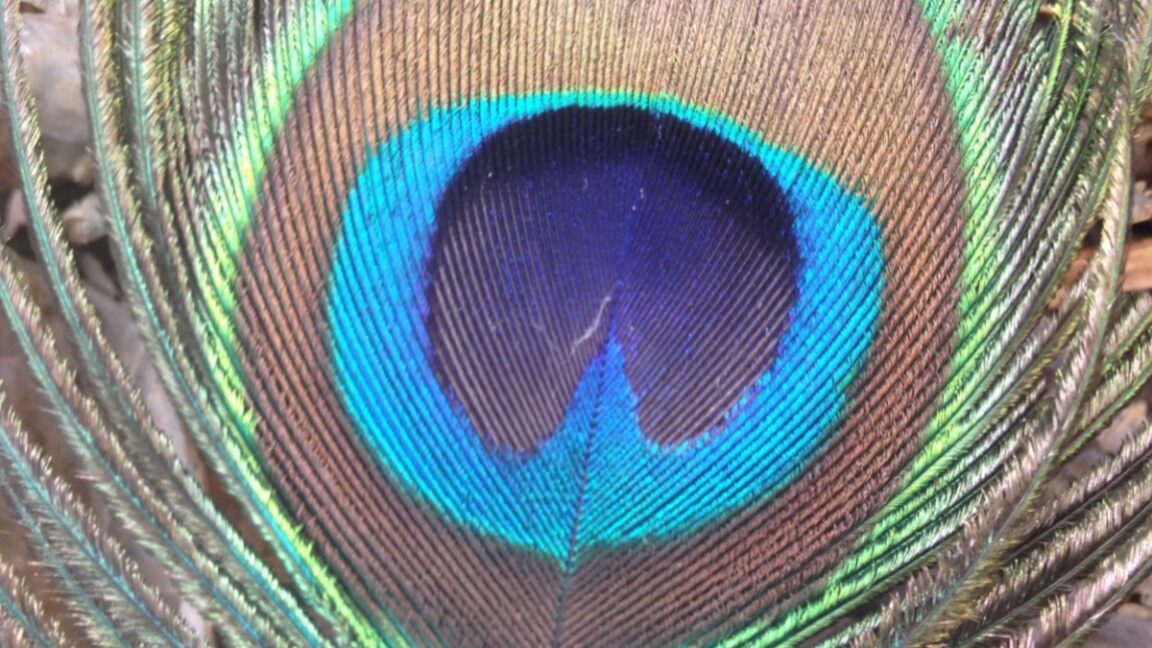
Peacock feathers can emit laser beams

by Jennifer Ouellette

Peacock feathers are greatly admired for their bright iridescent colors, but it turns out they can also emit laser light when dyed multiple times, according to a paper published in the journal Scientific Reports. Per the authors, it's the first example of a biolaser cavity within the animal kingdom.

As previously reported, the bright iridescent colors in things like peacock feathers and butterfly wings don't come from any pigment molecules but from how they are structured. The scales of chitin (a polysaccharide common to insects) in butterfly wings, for example, are arranged like roof tiles. Essentially, they form a diffraction grating, except photonic crystals only produce certain colors, or wavelengths, of light, while a diffraction grating will produce the entire spectrum, much like a prism.

In the case of peacock feathers, it's the regular, periodic nanostructures of the barbules—fiber-like components composed of ordered melanin rods coated in keratin—that produce the iridescent colors. Different colors correspond to different spacing of the barbules.

Read full article

Comments

30 Jul 21:02

Geode Crochet Pattern

by staff

Unlock earthy magic with the Geode Crochet Pattern, a whimsical DIY project that mimics the natural beauty of crystal geodes. Layered stitches and vibrant yarns create a dazzling effect, perfect for decor, gifts, or just showing off your inner rock star.

Check it out

$6.50

30 Jul 21:02

Google confirms it will sign the EU AI Code of Practice

by Ryan Whitwam

Big Tech is increasingly addicted to AI, but many companies are allergic to regulation, bucking suggestions that they adhere to copyright law and provide data on training. In a rare move, Google has confirmed it will sign the European Union's AI Code of Practice, a framework it initially opposed for being too harsh. However, Google isn't totally on board with Europe's efforts to rein in the AI explosion. The company's head of global affairs, Kent Walker, noted that the code could stifle innovation if it's not applied carefully, and that's something Google hopes to prevent.

While Google was initially opposed to the Code of Practice, Walker says the input it has provided to the European Commission has been well-received, and the result is a legal framework it believes can provide Europe with access to "secure, first-rate AI tools." The company claims that the expansion of such tools on the continent could boost the economy by 8 percent (about 1.8 trillion euros) annually by 2034.

These supposed economic gains are being dangled like bait to entice business interests in the EU to align with Google on the Code of Practice. While the company is signing the agreement, it appears interested in influencing the way it is implemented. Walker says Google remains concerned that tightening copyright guidelines and forced disclosure of possible trade secrets could slow innovation. Having a seat at the table could make it easier to bend the needle of regulation than if it followed some of its competitors in eschewing voluntary compliance.

Read full article

Comments

30 Jul 12:09

$5,900 Unitree R1 is an ultra-lightweight, customizable humanoid robot

by Jean-Luc Aufranc (CNXSoft)
low-cost humanoid robot

The Unitree R1 is a cost-effective, ultra-lightweight, and customizable humanoid robot that stands 1.21m tall and weighs approximately 25kg in its default configuration.

The company says pricing starts at $5,900, which is considerably cheaper than the company’s G1 humanoid robot or Elephant Robotics’ Mercuxy X1 wheeled humanoid robot, both of which go for about $16,000 and up. Some cost-cutting measures had to be taken for the lower price, including a slightly shorter design and missing features like working hands… Let’s check out the specifications for more details.

low-cost humanoid robot

Unitree R1 specifications:

  • Computing
    • 8-core CPU
    • Optional “high-power computing module” for EDU version only: NVIDIA Jetson Orin with 40 to 100 TOPS of AI processing power
  • Audio
    • 4-Mic Array
    • Build-in Speaker
  • Camera – Humanoid binocular cameras
  • Wireless – WiFi & Bluetooth 5.2
  • Degree of Freedom (Total Joints) – 26
  • Single Leg Degrees of Freedom – 6
  • Single Arm Degrees of Freedom – 5
  • Waist Degrees of Freedom – 2
  • Head Degrees of Freedom – None (2 for EDU version)
  • Dexterous Hand – None (optional for EDU version)
  • Joint output bearing – Crossed roller bearings, Double Hook Ball bearings
  • Joint motor – Low-inertia, high-speed internal rotor PMSM (permanent magnet synchronous motor) for better response time and heat dissipation
  • Maximum Torque of Arm Joint – About 2kg
  • Joint Movement Space
    • Waist Joint: Y±150° R±30°
    • Knee Joint: -10° +146°
    • Hip Joint: Y:±157° P:±168° -146° R: -60° +100°
  • Electrical Routing – Hollow + Internal Routing
  • Joint Encoder – Dual + Single encoder
  • Cooling System – Local air cooling
  • Power Supply – Lithium battery good for about one hour on a charge
  • Dimensions
    • 1210 x 357 x 190mm while standing
    • Calf + Thigh Length – 675mm
    • Forearm + Upper Arm Length: 435 mm
  • Weight – About 25kg with battery

Unitree R1 humanoid robot specifications

The Unitree R1 is clearly not designed to be your next robotic maid since it lacks “dexterity hands” and has limited torque, and the company advertises it as an “intelligent companion” that you can interact with using the built-in microphone array, speaker, and cameras. It can also walk, run, walk on its hands, perform a front handspring, fight (or at least move like a kung fu fighter), lie down after it’s tired, and more.

It might be especially useful for the education and research market, as it’s much more affordable than other humanoid robots of this size. The EDU version (no price given) adds an NVIDIA Jetson Orion module or board, two degrees of freedom for the head, and optional dexterous hands. The warranty is also extended to 12 months from 8 months.

I had a look at the Unitree G1 last year for an article, but I skipped it because I found the documentation to be lacking at the time. There’s no documentation for the R1 just yet, but the G1 documentation has various manuals, tutorials, and QR codes to the Unitree Explore Android (APK) and iOS apps to control the robot, which I assume can also be used with the low-cost R1 robot.

Unitree Explore App
Unitree Explore app

Some of the resources for the company’s robots are open-source, including some SDKs, ROS, manipulation datasets, and more, but it’s unclear which ones are relevant to the R1 from a quick read.

While the company says the Unitree R1 “intelligent companion” starts at $5,900, it’s not yet listed on the shop with other humanoid robots from the company. If you are interested in the EDU version, you’d need to contact the company to purchase a sample. Additional information for both the Standard and EDU models can be found on the product page.

The post $5,900 Unitree R1 is an ultra-lightweight, customizable humanoid robot appeared first on CNX Software - Embedded Systems News.

30 Jul 08:54

Elon Musk Is Getting Destroyed by Yet Another Chinese Company

by Joe Wilkins
After beating Elon Musk's Tesla with automakers like BYD and Li Auto, Chinese tech firms are now setting their sights on robotics.

After delivering all but the finishing blow to Elon Musk's electric vehicle empire with cutting-edge companies like BYD and Li Auto, Chinese industrialists are now setting their sights on the South African billionaire's robotics ambitions.

Earlier this week, the Hangzhou-based tech company Unitree Robotics launched what Bloomberg calls one of the world's "first humanoid robots for under $6,000," the Unitree R1, at the relatively low price of just $5,900. While that's still a major chunk of change, it's substantially lower than the price for similar humanoid robots, like the Booster H1, which retails for over $75,000, or the AGIBOT A2, which goes for a cool $180,000.

And however expensive those units might be, at least they're actually on the market.

Musk's Optimus, the humanoid robot that Tesla's planning to sell for something around five times the R1's price, can't say the same. Since its initial announcement in 2021, Optimus has been plagued by the type of internal disasters and embarrassing PR failures that seem to have become the billionaire's calling card.

Despite Musk's claims that Optimus would be ready for production by 2023, the rollout is extremely rocky, with production shortfalls resulting in major bottlenecks on the assembly line.

For example, The Information reported last week that Tesla is lagging way behind in the production of the robot's dexterous hands, leading to a buildup of half-finished robots missing their digits.

While the R1 base unit doesn't come with dexterous hands, Unitree's $6,000 bot is said to have 26 separate joints, an 8-core CPU, 6 degrees of leg freedom, as well as voice and image recognition capabilities. The design decision speaks for itself: unlike Optimus, the R1 is currently enjoying its time in the world, showing off flashy tricks like cartwheels, walking on its hands, and roundhouse kicks.

The bots are also just fun. The R1's older cousin, the G1, which sells for around $16,000, has gone viral in stunts where it's paraded around public spaces rizzing up passersby, or sporting bright rainbow flag attire.

It all comes at a moment when China is surging ahead of the rest of the world in robotics production. Though consumer robots around the world are still in a primitive state, China's rollout of industrial robotics has skyrocketed in recent years. Between 2022 and 2023, China deployed over 276,000 factory robo-units — over half of all manufacturing robots installed throughout the globe.

Chinese companies aren't shy about those efforts either. A number of PR campaigns bragging up the People's Republic's advanced robotics have attained viral status abroad, including a "Real Steel" style robot boxing match, and an "Uncle Bot" which chronicles its adventures online.

To be fair, Tesla's Optimus has also gone viral — though not for stepping into the ring or roaming the countryside, but for serving popcorn while standing behind a counter.

During a recent earnings call with investors, meanwhile, Musk introduced his signature wild card to the already rocky Optimus production, hinting that when the humanoid robots finally ship, they'll do so with a completely new design.

Whether Tesla plans to cut back its ambitious dexterous hands design to get to market? That remains to be seen.

More on robots: Scientists Create Prototype of Robot Designed to Cannibalize Parts of Other Robots and Build Them Into Itself

The post Elon Musk Is Getting Destroyed by Yet Another Chinese Company appeared first on Futurism.

28 Jul 21:18

A secretive space plane is set to launch and test quantum navigation technology

by Eric Berger

The X-37B, the US Space Force's secretive space plane, will soon take flight again.

On Monday, the Space Force announced that it will fly the small, Space Shuttle-shaped vehicle on the program's eighth mission next month. The launch of the vehicle, on a Falcon 9 rocket, is scheduled to occur no earlier than August 21 from Kennedy Space Center in Florida.

There are two active X-37Bs in the Space Force fleet, both built by Boeing. The first made its debut flight in April 2010. Since then, the two uncrewed spacecraft have made a succession of longer flights. The first made its longest and latest flight from 2020 to 2022 over a span of 908 days. The second flew more recently, landing at Vandenberg Space Force Base on March 7 after 434 days in orbit.

Read full article

Comments

28 Jul 21:15

Be More Axolotl: How Humans May One Day Regrow Limbs and Organs

by Maya Posch

Although often glossed over, the human liver is a pretty amazing organ. Not just because it’s pretty much the sole thing that prevents our food from killing us, but also because it’s the only organ in our body that is capable of significant regeneration. This is a major boon in medicine, as you can remove most of a person’s liver and it’ll happily regrow back to its original volume. Obviously this is very convenient in the case of disease or when performing a liver transplant.

Despite tissue regeneration being very common among animals, most mammalian species have only limited regenerative ability. This means that while some species can easily regrow entire limbs and organs including eyes as well as parts of their brain, us humans and our primate cousins are lucky if we can even count on our liver to do that thing, while limbs and eyes are lost forever.

This raises many questions, including whether the deactivation of regenerative capabilities is just an evolutionary glitch, and how easily we might be able to turn it back on.

Regenerating Vs Repair

Even in the absence of a regenerative ability, animals can heal injuries, which generally means the growth of fibrous tissue called scar tissue. This can be observed very clearly on our skin, where certain old injuries tend to remain clearly visible as the scar tissue replaces skin tissue. While made of the same collagen protein as skin tissue, the fiber organization is different and serves no real purpose beyond sealing up a lesion. Scar tissue can form elsewhere in the body too, where it can impede function, as in the heart and lungs.

Both regeneration and repair are a form of healing in an organism, but only the former restores the original functionality, whereas the latter is the biological equivalent of slapping on a duct tape patch and calling it good. This ‘repair’ outcome is effectively an incomplete regeneration process, where instead of the affected site creating the conditions for normal growth – leading to a good-as-new result – you only get the basic scaffolding while certain biochemical pathways are never or insufficiently activated.

Phases of wound healing. (Credit: Mikael Häggström, Wikimedia)

Although it’s often said that the human liver is the sole organ capable of regeneration in our species, it could be argued that our blood vessels are a much better example of regeneration. Within minutes after receiving a cut or bad scrape, any damaged blood vessels are plugged and macrophages along with other specialized cells begin to move into the area as the inflammatory phase begins.

At the end of this phase, angiogenesis commences, which involves existing blood vessels growing new blood vessels into the affected area. In a developing embryo, this is the stage that follows the earliest development of the initial blood vessels through vasculogenesis. In this regard, blood vessels can be said to regenerate themselves in the case of injury. They can also expand into tissues where e.g. hypoxia conditions are present, which triggers the hypoxia-inducible factor (HIF) signaling path.

In the case of wound healing this signal path is stimulated due to the hypoxia condition that exists at the injury site. Although the HIF-related HIF-1α subunit is constantly expressed, oxygen-dependent prolyl hydroxylases (PHDs) normally degrade it and thus downregulating the further responses down this chain.

Another aspect here is the re-epithelization, whereby surrounding skin cells move towards the wound, multiplying until the signals that induce this growth are downregulated below a critical threshold. Based on research the same HIF pathway is implicated here. For example, in a 2015 study in Science Translational Medicine Yong Zhang et al. reported that forced upregulation of HIF-1α was able to induce full regeneration of a hole punched in the ears of mice who normally just show scarring.

This indicates that boosting the HIF signaling pathway might be a viable way to prevent scarring and induce full regeneration of certain types of wounds to the skin.

Blastema Limbo

Two Ambystoma mexicanum axolotl at the Vancouver Aquarium. (Credit: ZeWrestler, Wikimedia)

The HIF signaling pathway is an example of a basic regeneration pathway involving a single organ (i.e. the skin). Things get more complicated when there’s the removal of something to the extent of a limb. Among mammals regenerating ability is limited, with some species like rabbits still possessing the ability to regenerate holes in their ears while other species, including humans, are not creating the requisite blastema of undifferentiated cells after an amputation.

The axolotl is one of the most studied species when it comes to tissue regeneration. Similar to other salamanders they possess a remarkable ability to regenerate many parts of their body, with the axolotl capable of regenerating their limbs, gills, eyes and parts of their brain. Although annelids (segmented worms) and echinoderms like starfish are capable of even more extreme forms of regeneration, axolotls are significantly more akin to us mammals than either of those.

Incidentally, similar research in fruit flies (Drosophila melanogaster) has led us to the highly conserved Hippo signaling pathway. This particular signaling path is essential in determining how big an organ is supposed to be, such as when a human liver is chopped up in vivo and has to regrow back to its original size.

New Limb Cap

When an axolotl suffers severe injury like the loss of a limb or a gill, the surface where the amputation occurred gets covered up by epidermal cells, forming the wound epithelium (WE). This is the point where for human and other mammals the process pretty much ends with a stump covered up by skin. In the case of the axolotl, however, this WE keeps gathering epidermal cells, forming the apical epithelial cap (AEC).

Inside this AEC the tissues then undergo dedifferentiation into a blastema – led by signals from macrophages –  effectively resetting the tissues here to a much earlier, embryonic state of development. Under the influence of Hox genes which regulate the body’s layout, the AEC subsequently grows as it would have done previously with the very young axolotl until the entire limb, gill, eye, etc. has been regrown.

 Hox protein classification across model organisms by CLANS analysis, (Credit: Hueber et al., 2010)
Hox protein classification across model organisms by CLANS analysis, (Credit: Hueber et al., 2010)

The trick is thus to take these identified signaling pathways, establish in how far they have been preserved in other animals – like us primates – and whether we can easily re-enable them in some way, whether permanently or temporarily. After all, it worked once when we were still embryos, ergo by resetting the cellular clock on part of our bodies it would simply run through the same biochemical steps again.

Still A Lumpy Road Ahead

Of course, this involves developmental biology, biochemistry and genetic research, meaning that clear answers are rarely found and require immense amounts of research and study to unravel how all of these signaling pathways work, while maybe finding a few more ones along the way. The upshot of course is that the field of regenerative medicine can have massive implications for human health, ranging from the ability to treat many (genetic) disorders related to faulty signaling pathways to the ability regrow limbs, eyes and more.

It’s likely that regenerating skin and directly related tissues in human patients will be one of the first widescale applications of these findings, with recently Weifeng Lin et al. publishing a study in Science involving regrowing a damaged outer ear (pinna) of mice and rats through the addition of retinoic acid (RA), a key element in embryonic development. Specifically they identified that in non-regenerative species of rats and mice the Aldh1a2 gene was not expressed as much as it was in species who do regenerate, which reduces the amount of available RA from the retinaldehyde precursor.

Although there’s a lot that can be said about the pros and cons of turning back on genes that haven’t been active since we were either an embryo or a still-growing-child, understanding these biochemical pathways offers us the prospect of bypassing them in order to restore that which once was thought to be lost forever. Even if we won’t be regrowing limbs yet next year, we might be giving people back their pinna, digits, faces and erase old scars before we know it.


Closeup of Axolotl in Hand” by [Yaiol AI]

Purple Tropical Axolotl” by[ Raphael Brasileiro]

28 Jul 21:13

Autonomous vehicle revival is fueling demand for training and simulation solutions — here are the companies gaining momentum

by Stephanie Dalwin

Autonomous vehicles are booming again, led by robotaxi pioneers like Waymo.

Their commercial breakthroughs are sparking an industry-wide race, with Tesla and Uber scrambling to catch up — Uber recently partnered with Lucid and Nuro to launch its own robotaxi fleet.

This revival is creating massive demand for simulation and training solutions — essential components of AV development that generative AI has made faster and more cost-effective

AV simulation and training market leader Applied Intuition exemplifies this opportunity, having just raised $600M at a $15B valuation and counting 18 of the top 20 automotive OEMs as clients — a strong signal of surging demand.

The appeal is obvious: external simulation offers a cost-effective alternative to in-house development for major OEMs like GM and Hyundai, which have struggled with safety issues and commercialization delays in their self-driving units.

As AVs accelerate their shift from experimentation to deployment, simulation providers are expanding beyond passenger vehicles into high-value sectors like defense and industrials.

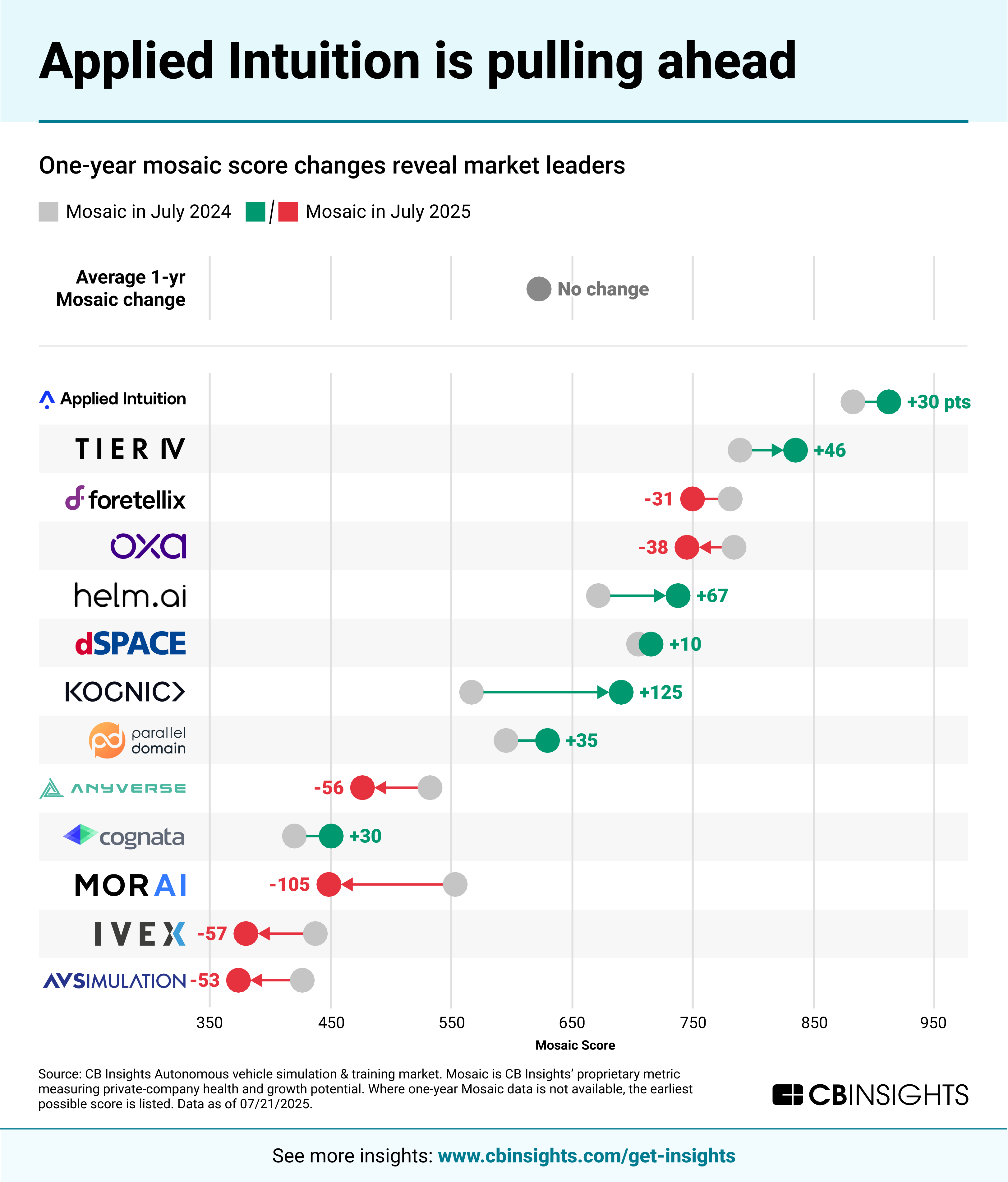
Using CB Insights’ Mosaic score, which measures a company’s health, we identified the most promising autonomous driving training and simulation providers, revealing critical signals for the industry’s expansion into new AV use cases (see graphic below). 

If you are an autonomous vehicle simulation and training startup and want to be featured in our research, please reach out to analystbriefing@cbinsights.com to submit your data. 

CBI iconSee the full list of autonomous vehicle simulation & testing companies


  • Industrials and defense are the new battlegrounds. Top Mosaic score movers target AV applications beyond the already competitive passenger vehicles market. Both Cognata and  Applied Intuition offer defense-specific autonomous vehicle solutions, with the latter recently strengthening its position in this space by acquiring EpiSci, a company specializing in national security autonomy. Others like Kognic and Parallel Domain focus on industrial applications, including robotics and drones. 
  • OEM relationships create strategic moats. The top 5 market leaders all have relationships with OEMs and hardware manufacturers. Since 2022, 74% of OEM relationships have gone to the top 5 players in the space. The bottom 5 players account for just 12% of these partnerships, and most have decreased Mosaic scores over the past year. 
  • NVIDIA emerges as a key enabler. Oxa and Foretellix are using NVIDIA’s large world models to strengthen AI training. The tech giant has partnerships with 3 of the top 5 market players, positioning NVIDIA is a likely winner of growth in this space. 

As the autonomous vehicle arms race continues, momentum will favor the companies diversifying beyond passenger vehicles. Established passenger vehicle players already leverage proprietary AI simulation tools, pushing new entrants to other applications such as defense and aerospace — with growing demand for autonomous guidance simulation in robotics and drones. Monitor strategic partnership activity to identify the likely winners in each AV application.  

For information on reprint rights or other inquiries, please contact reprints@cbinsights.com.

The post Autonomous vehicle revival is fueling demand for training and simulation solutions — here are the companies gaining momentum appeared first on CB Insights Research.

27 Jul 19:20

Un béton qui se nourrit de CO₂ : la promesse folle d’une IA jamais vue

by Edward Back, Journaliste hi-tech
Le béton est partout. C’est la matière la plus utilisée au monde, mais aussi l’une de celles qui produit le plus de gaz carbonique (CO2). Pour lutter contre le changement climatique, de nombreux chercheurs essaient différentes formulations afin de créer un béton « zéro carbone ». Des chercheurs...
27 Jul 08:07

Quels sont les profils des geeks qui attirent vraiment les services de renseignement en France ?

by Gabriel Thierry

Ou comment les espions cherchent leurs futurs Mister Q.

27 Jul 08:07

Scientists Find Secret Code in Human DNA

by Frank Landymore
New research suggests that DNA sequences historically considered to be "junk" have had an overlooked role in gene expression this whole time.

One person's junk is another's treasure.

An international team of scientists have found that strings of "junk" DNA in the human genome that were previously written off as having no useful function are actually pretty important after all.

The work, published as a study in the journal Science Advances, focuses on transposable elements, a class of DNA sequences that can "jump," via a biological copy-and-paste mechanism, to different locations in a genome. These "jumping genes" take up nearly 50 percent of human DNA; in other organisms, the proportion is even higher.

What the researchers from Japan, China, Canada, and the US found is that a particular family of these TEs, called MER11, can strongly influence gene expression and act like "genetic switches" — without actually changing the underlying DNA.

"Our genome was sequenced long ago, but the function of many of its parts remain unknown," study coauthor Fumitaka Inoue from Kyoto University said in a statement about the work. 

MER11 sequences are what's known as long terminal repeat (LTR) retrotransposons. Spookily, these are believed to have originated from an endogenous retrovirus (ERV) that infected a simian ancestor tens of millions of years ago, hijacking the DNA of the cells it invaded to produce copies of its genetic makeup that have never gone away, but have largely remained inert. Per the researchers, at least eight percent of the human genome comes from these retroviruses.

That, plus all the other TEs littering our genome, makes for a lot of puzzling clutter for human scientists to sift through. The authors argue that the current methods for classifying and annotating TEs are inaccurate, leading to DNA sequences being overlooked as genetic junk. This inspired them to test their own classification system. 

"The proper classification and annotation of LTR instances is critical to understanding their evolution, co-option and potential impact on the host," the authors wrote in the study.

The researchers' system classified MER11 sequences based on their evolutionary relationships and how well they were preserved in primate genomes, according to the researchers' statement. Then, they divided MER11 into four separate subfamilies, MER11_G1 through G4, based on their age.

This allowed the team to compare the MER11 subfamilies to what are known as epigenetic marks: chemicals that can affect how important proteins function, and as a consequence affect gene activity. Crucially, epigenetic marks don't have to physically alter a cell's DNA to modify a cell's behavior, such as silencing a gene that should be expressed. Accurately tying the MER11 subfamilies to the markers is a key step to revealing the extent of their impact on gene expression.

With that as a springboard, the team tested some 7,000 MER11 sequences from humans and primates, measured how much each one affected gene activity, and found that the youngest MER11 subfamily, G4, had a strong ability to influence gene expression — namely, by bearing its own DNA "motifs" that attract proteins called transcription factors that regulate what genes are switched on and off.

"Young MER11_G4 binds to a distinct set of transcription factors, indicating that this group gained different regulatory functions through sequence changes and contributes to speciation," lead author Xun Chen from the Chinese Academy of Sciences said in the statement.

The implications are fascinating. Though these strands of DNA may have started as "junk," they have gradually insinuated their way to playing a role in gene regulation today — suggesting a vast portion of unknown evolutionary history that we're only scratching the surface of.

"Transposable elements are thought to play important roles in genome evolution, and their significance is expected to become clearer as research continues to advance," Inoue said.

More on genetics: Elon Musk Using Eugenics Startup to Inspect DNA of Potential Babies for Intelligence

The post Scientists Find Secret Code in Human DNA appeared first on Futurism.

26 Jul 08:17

The Trolley Problem

The famous moral dilemma: switch the tracks or not?

(Here's a combined version of the Trolley Problem and 3 Variants)

Imagine you’re the driver of a runaway trolley whose brakes have failed. Ahead on the track, five people are working and will be killed if you do nothing. But you notice a side-track—if you switch the trolley to it, you’ll avoid the five, but one person on that track would be killed instead.

Should you pull the lever and switch the tracks—killing one to save five?

This is the start of the famous moral dilemma of The Trolley Problem. The fictitious scenario, and others like it, are so effective because they force us to confront our internal moral compass: what seems like the right thing to do, and why?

Trolley Problem Variants

As we formulate a position on a scenario, it's possible to devise variant scenarios that test our moral reasoning more sharply.

For example, in the original problem, many people might suggest that it's OK for the driver to choose to save five people's lives at the expense of the one person on the other track on the basis that killing five people is worse than killing one.

Where would you stand on these other variants?

The Bystander at the Switch

Sketch of the Bystander at the Switch Variant

You’re no longer the driver. This time, you’re simply passing by when you see a runaway trolley heading toward five people. The trolley is driverless, and you’re standing next to a switch that could divert the train to another track—where one person would be killed instead.

Is it morally acceptable to intervene? Does it feel different when you’re not the driver but an onlooker?

The Heavy Man Problem

Sketch of the Heavy Man Variant

Or suppose that you were on a bridge above the track when you saw the train on its way to crash through the five people working on the track.

There’s no switch—but next to you stands a very heavy man. If you push him off the bridge, his body would stop the trolley and save the five.

Most people react more strongly against this version, even though the outcome is similar: one life traded for five.

(This variant was originally the 'Fat Man' problem, but it's not important that the person is fat, just that they're heavy enough to stop the trolley).

The Mafia Problem

Sketch of the Mafia Variant

Suppose once again you were the bystander at the switch passing the track in this deadly scene. This time, however, you see that the five people on the track are not workmen but hardened criminals. What's more, they've tied an innocent person to the other track.

If you switch the trolley, the innocent person dies. If you do nothing, the five criminals die.

Does who the people are affect your decision?

How to Decide?

It may be clear to you what the right path to choose is. And yet, your position may differ from someone else faced with the same scenario.

The philosopher Philippa Foot introduced the Trolley Problem in a 1967 paper discussing abortion (PDF), along with several options for reasoning about it. Judith Jarvis Thomson invents some of the further scenarios (such as the mafia case) and alternative arguments in a 1985 paper, The Trolley Problem (pdf).

Some possible positions and distinctions you might keep in mind include:

Passive vs Active Harm

Is it morally different to let five people die (by doing nothing) than to actively cause one person’s death (by switching tracks or pushing someone)? Are you killing or are you failing to save?

Is there a difference in what we do and what we allow?

Negative Duties vs Positive Duties

Some argue there’s a moral difference between duties not to harm (negative duties) and duties to help (positive duties).

Avoiding Injury vs Bringing Aid

Is there a difference when you are making choices that save different numbers of people rather than making choices where people will die as a direct result of your choices?

For example, suppose you face a choice of rescuing a large group of people while leaving another small group to die.

Or what if a villain asked you to sacrifice an innocent person, or they will kill five others.

Rights vs Utility

Does your action violate someone’s rights? Even if the outcome is better overall, is it acceptable to use a person as a means to an end?

Is it a matter of degrees? For example, violating an individual's rights by pushing them off a bridge versus stealing from them as a route to save someone.

Doctrine of Double Effect

Philippa Foot discusses the Doctrine of Double Effect—that our actions may have intended consequences and other outcomes that are foreseeable but not intended—the distinction between "direct" and "oblique intention".

In the case of the runaway trolley, it's "one thing to steer towards someone foreseeing that you will kill him and another to aim at his death as part of your plan."

Or, for example, in surgery to save a mother during childbirth, the death of a child may be foreseen but not intended.

Dilemmas

While fictitious moral dilemmas are intriguing thought experiments, real dilemmas surround us.

  • A general orders his troops on a dangerous mission.
  • Adjusting the speed limit on a dangerous road. People die from driving too fast, but walking isn't an option—what's the appropriate risk of death we're comfortable with?
  • Who should receive aid?
  • Who should be rescued first?
  • Should a pilot steer a plane that's about to crash into a less populated area?

I remember, in the film Beneath Hill 60 (spoiler), a commander must decide whether to detonate underground munitions to execute the battle plan, knowing that one of his team members is trapped.

I find moral dilemmas to be at once fascinating, puzzling, troubling, and uncomfortable.

Related Ideas to the Trolley Problem

Learn More About the Trolley Problem

Prints of the Trolley Problem

25 Jul 14:52

Brilliant Labs to Launch Next-gen Smart Glasses on July 31st

by Scott Hayden

Brilliant Labs announced it’s getting ready to launch its next generation of smart glasses at the end of the month, making it the company’s third device since it was founded in 2019.

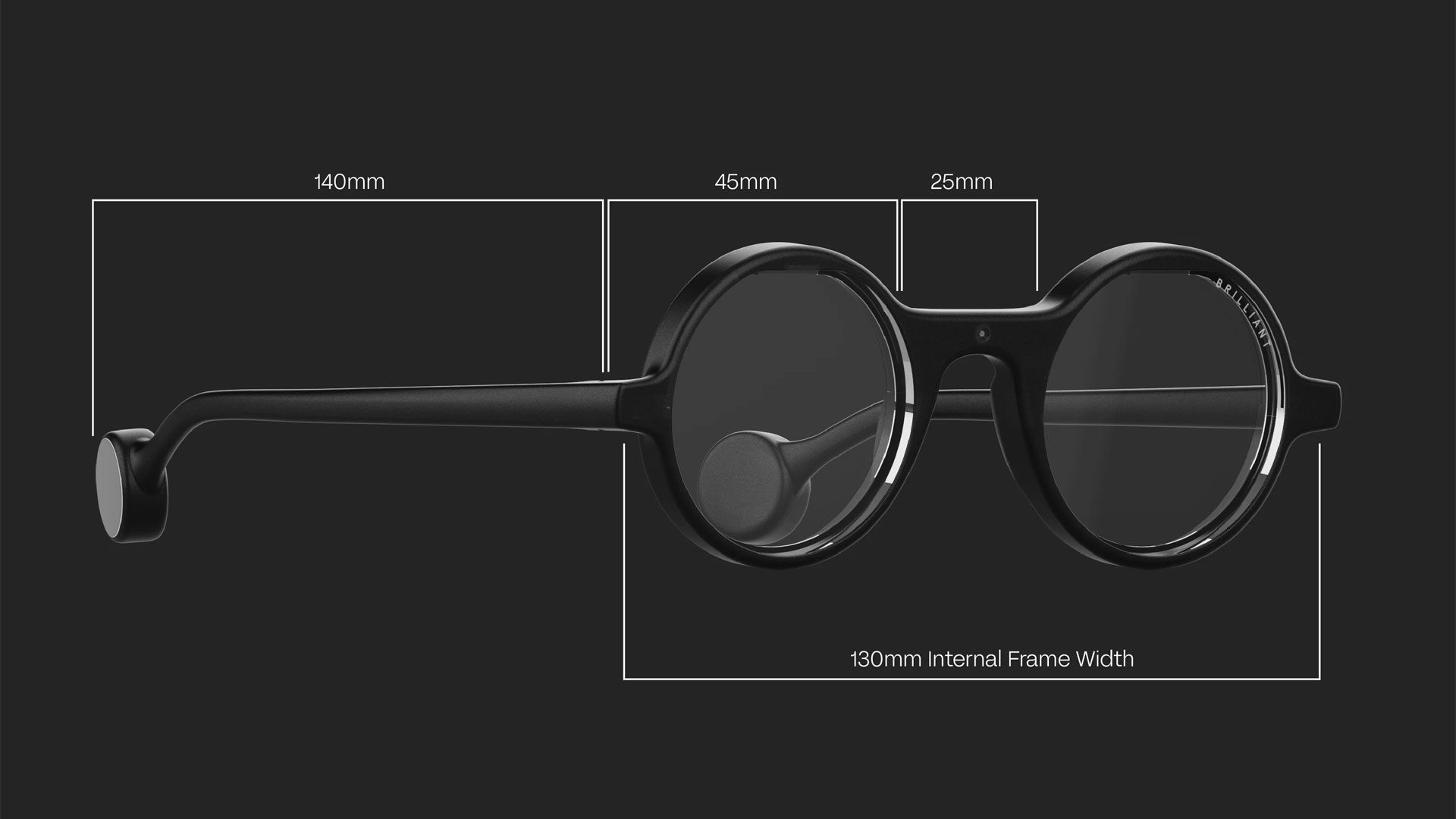
In 2023, Brilliant Labs released Monocle, a developer kit which included a single heads-up display that was meant to be clipped onto existing eyewear.

A year later, the company released Frame, which evolved Monocle’s monoscopic display and housed it in a glasses-like form factor, including a single camera sensor—making for an impressively slim and light package weighing in at less than 40g.

Image courtesy Brilliant Labs

Frame was “designed to be your AI driven personal assistant,” the company says, emphasizing its access to AI models like Perplexity, ChatGPT, and Whisper, so you gets answers to questions about what you’re currently looking at, experience live translation from either speech or text, and search the Internet in real-time.

Now, Brilliant Labs says its next device is coming on July 31st. Information is thin on the ground, however company co-founder and CEO Bobak Tavangar is taking part in a launch day Q&A via the augmented reality subreddit.

Image courtesy Brilliant Labs

There, we also got a side glimpse of the device in question, which appears to have ditched the round, old school spectacle vibe for a more modern frame shape. Whatever the case, we’re sure to learn more come July 31st. We’ll be keeping an eye on the augmented reality subreddit and the company’s website then.

Meanwhile, the smart glasses segment is heating up. Meta and EssilorLuxottica announced its next-gen Oakley Meta HSTN smart glasses last month; shortly afterwards Chinese tech giant Xiaomi announced its was releasing its own AI Glasses. On the horizon is Google’s Android XR-based smart glasses, built in collaboration with Warby Parker and Gentle Monster.

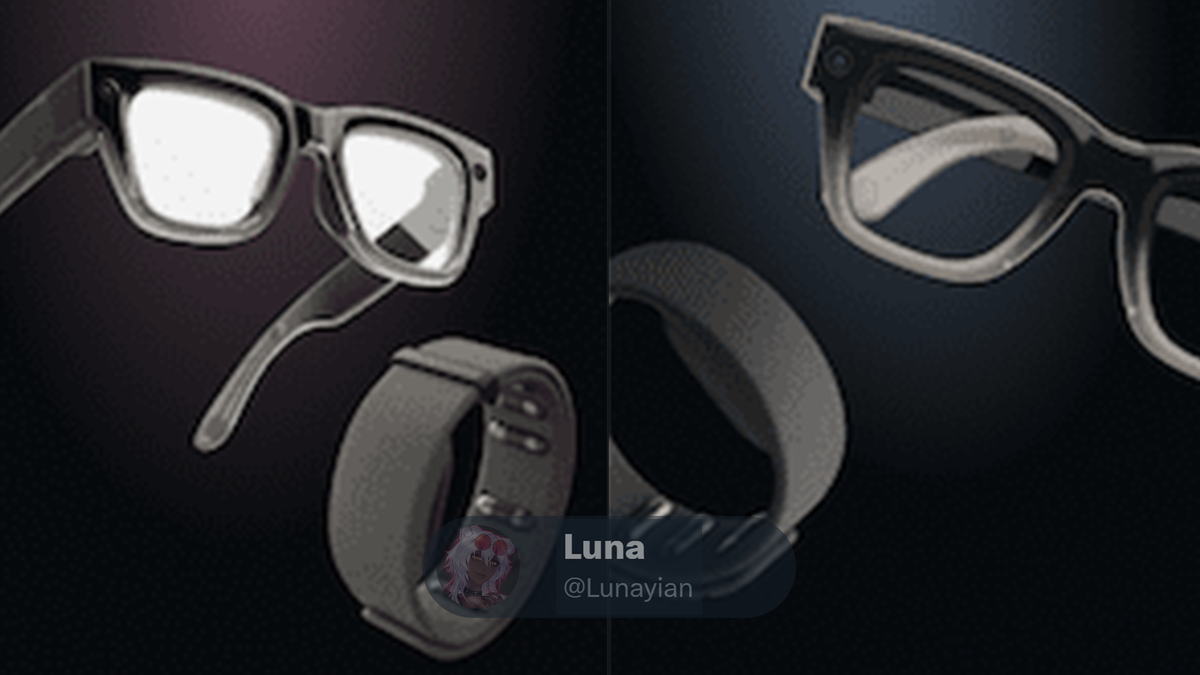
Although Brilliant Labs is currently one of the few actually offering a pair of smart glasses with a built-in display, it won’t be that way for long. Google says it’s going to offer a model of its Android XR smart glasses with some sort of display. Leaks also maintain Meta’s next pair of smart glasses may also include a display and a wrist-worn controller for input.

The post Brilliant Labs to Launch Next-gen Smart Glasses on July 31st appeared first on Road to VR.

25 Jul 14:50

Au secours ! Il a piraté mon Thermomix

by Ismael R.

Un Thermomix qui perd la tête et affiche des messages étranges, ce n’est pas une panne. C’est un hack volontaire, orchestré par un expert français pour alerter sur les failles des objets connectés.

Baptiste Moine, ingénieur chez Synacktiv, a piraté un Thermomix pour démontrer ses limites de sécurité. Ce modèle TM5, doté d’un écran tactile et d’une connexion internet, a servi de terrain d’expérimentation. À travers une faille présente sur le port magnétique latéral, il a simulé une mise à jour piégée. « J’ai bluffé le système en contournant les mécanismes de sécurité », résume le chercheur. Il ne s’agit pas d’un acte malveillant, mais d’une démonstration éthique, validée par la marque Vorwerk.

Des résultats très parlants pour l’ensemble du marché

« Ce Thermomix piraté ne représente pas un danger direct, mais il montre ce qu’on peut faire », prévient Moine. L’appareil reste globalement bien protégé pour un objet sorti en 2014. En revanche, des équipements plus récents, parfois moins bien conçus, sont bien plus vulnérables. Caméras connectées, babyphones, enceintes vocales, aspirateurs : tout ce qui communique peut être ciblé. Certaines caméras à 15 euros stockent mal les données ou négligent les protocoles de sécurité.

En 2024, le piratage à distance d’un robot aspirateur a généré un scandale au Minnesota. Le pirate n’avait pas ciblé la machine, mais les identifiants client volés via une ancienne fuite de données. Le phénomène touche de plus en plus d’objets du quotidien : on parle désormais de 48 milliards d’appareils connectés dans le monde. Et certains, comme ce Thermomix piraté à des fins de test, deviennent symboliques des limites du secteur.

Les bons gestes pour protéger ses appareils connectés

L’expert recommande de toujours appliquer les mises à jour proposées par les fabricants. Vorwerk, suite à ce test, a corrigé les failles observées sur le Thermomix piraté par Baptiste Moine. Mieux encore, l’entreprise collabore désormais avec lui pour renforcer la sécurité des futurs modèles. Enfin, il pose une vraie question : « Est-ce bien utile de connecter une machine à laver au Wi-Fi ? » À méditer.

Cet article Au secours ! Il a piraté mon Thermomix est apparu en premier sur OBJETCONNECTE.COM.

24 Jul 15:36

Meta Details EMG Wristband Gestures You'll Use To Control Its HUD & AR Glasses

by David Heaney

In a paper in Nature, Meta detailed some of the sEMG wristband gestures you'll use to control its HUD glasses & AR glasses.

The peer-reviewed paper, titled "A generic non-invasive neuromotor interface for human-computer interaction", describes in scientific detail the device which Meta has been developing since at least 2019, when it acquired a startup called CTRL Labs.

CTRL Labs was co-founded and led by computational neuroscientist Thomas Reardon, who still leads the project at Meta today.

0:00
/0:47

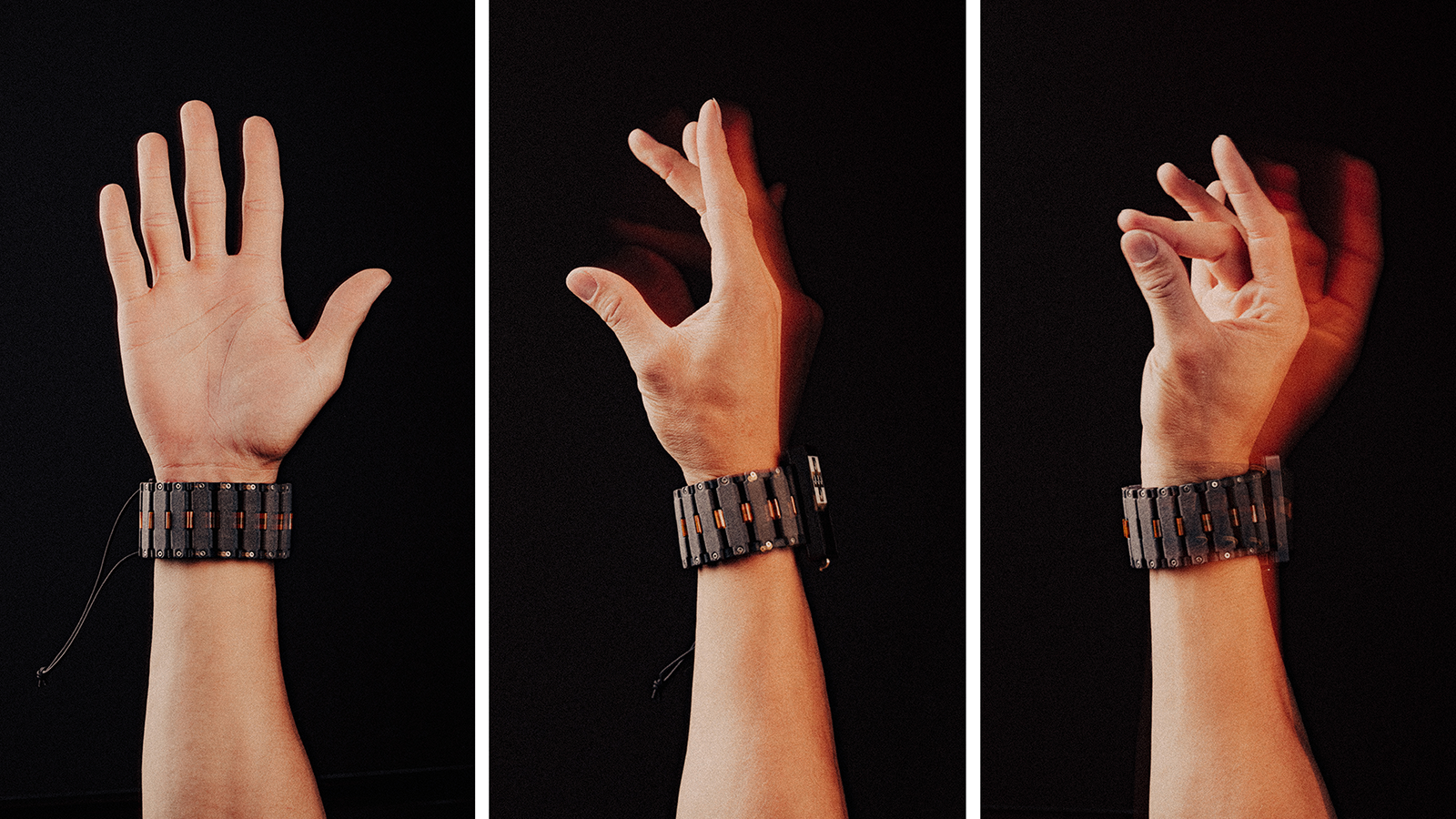
The wristband works by sensing the activation of the muscles in your wrist which drive your finger movements, a technique called surface electromyography (sEMG). It enables precise finger tracking with very little power draw, and without the need to be in view of a camera.

This means you can control virtual interfaces using subtle finger movements while your arm is at rest, instead of needing to raise your hands or speak out loud.

The video released alongside the paper shows four types of gestures:

  • Writing individual characters on a surface using your index finger, which are converted to digital characters for text entry.
  • Rotating your hand, using your wrist, to control a 1-dimensional cursor.
  • Swiping your thumb against the side of your index finger.
  • Tapping your thumb against your index finger, or holding, as a tap/click.

The paper also claims that Meta's sEMG technology can now generalize to new users, without the need for a per-user trained model, and the company has released over 100 hours of sEMG recordings for use by the scientific community, which it says should help advance accessibility technology around the world.

The hardware shown in the paper is a research prototype, strongly resembling one first shown in 2021. But at Meta Connect 2024, the company publicly demoed a sleek seemingly-productized version of the wristband, codenamed Ceres, as the input device for the Orion AR glasses prototype.

Swiping your thumb against the side of your index finger was introduced as a Meta Quest SDK feature in March, called microgestures, and was a key part of the Orion demo.

Renders of Ceres, and footage of a similar-looking device in use, were discovered inside leaked early firmware for the simpler HUD glasses that The Verge, The Information, The Financial Times, and Bloomberg's Mark Gurman have all previously reported that Meta intends to release later this year, codenamed Hypernova and seemingly named Meta Celeste.

Gurman has reported that Meta intends to include the wristband with Hypernova, with the total package priced "over $1000 and as high as $1300 to $1400".

The leaked firmware included tutorial videos for some of the same gestures seen in the Nature paper, as well as others, including pinching your thumb to your index finger and "pulling" horizontally or vertically.

Meta HUD Glasses Name, Design & EMG Wristband Gestures Leak
The name, design, and key finger gestures of Meta’s smart glasses with a HUD and neural wristband, expected to launch in October, have leaked.
UploadVRDavid Heaney

Meta Connect 2025 will take place from September 17, and we expect Meta to announce Celeste then and open preorders for shipping in October, assuming it doesn't get delayed.

In April, Mark Gurman reported that some Meta employees were working weekends to ship the HUD glasses on time. In just under two months, we should know whether these efforts succeeded.

24 Jul 14:06

Des hackers chinois ont infiltré l’agence qui gère le stock d’armes nucléaires des États-Unis !

by Sylvain Biget, Journaliste, télépilote professionnel de drones et réalisateur de documentaires
Inquiétant. Parmi les victimes de la cyberattaque liée à la vulnérabilité SharePoint, il y a l’agence américaine qui stocke l'arsenal d'armes nucléaires. L’attaque semble provenir de groupes de hackers chinois affiliés à l’État et ils viennent déjà de passer à l’étape suivante…
24 Jul 14:03

AI video is invading YouTube Shorts and Google Photos starting today

by Ryan Whitwam

Google is following through on recent promises to add more generative AI features to its photo and video products. Over on YouTube, Google is rolling out the first wave of generative AI video for YouTube Shorts, but even if you're not a YouTuber, you'll be exposed to more AI videos soon. Google Photos, which is integrated with virtually every Android phone on the market, is also getting AI video-generation capabilities. In both cases, the features are currently based on the older Veo 2 model, not the more capable Veo 3 that has been meming across the Internet since it was announced at I/O in May.

YouTube CEO Neal Mohan confirmed earlier this summer that the company planned to add generative AI to the creator tools for YouTube Shorts. There were already tools to generate backgrounds for videos, but the next phase will involve creating new video elements from a text prompt.

Starting today, creators will be able to use a photo as the basis for a new generative AI video. YouTube also promises a collection of easily applied generative effects, which will be accessible from the Shorts camera. There's also a new AI playground hub that the company says will be home to all its AI tools, along with examples and suggested prompts to help people pump out AI content.

Read full article

Comments

24 Jul 14:02

Une faille eSIM met des millions de smartphones en danger (et c’est très sérieux)

by Hari R.

On est tous d’accord, les smartphones sont au cœur de notre quotidien. Avouez-le, il est impossible de s’en passer une seule journée. Mais cette technologie, si pratique, peut nous coûter cher si elle est mal protégée. 

En effet, une faille eSIM peut devenir une menace sérieuse pour la sécurité d’un smartphone. Et pour cause, cette vulnérabilité ouvre la porte à des attaques capables de compromettre les communications… et même la vie privée. Mais comment en est-on arrivé là ?

Les pirates peuvent exploiter une faille eSIM pour espionner les communications

Cette faille eSIM ouvre une porte aux pirates pour écouter discrètement les échanges. En effet, en exploitant ce défaut, les malfaiteurs interceptent les communications sans que personne ne s’en rende compte. Cette vulnérabilité se trouve dans les anciennes versions du profil de test GSMA, utilisées sur de nombreux smartphones.

Le problème concerne la carte eUICC, un élément clé de la eSIM. Car les attaquants peuvent insérer un logiciel malveillant directement dans cette puce. Et cette intrusion leur donne un accès secret aux appels, messages et données mobiles. Face à cette menace, la sécurité classique des smartphones ne suffit plus.

Les malfaiteurs peuvent prendre le contrôle total d’un profil mobile

Au-delà de l’espionnage, cette faille eSIM permet aux malfaiteurs de manipuler un profil mobile. Avec un accès physique au téléphone, ils peuvent installer un applet malveillant qui va prendre le contrôle complet de la gestion des profils. Puis, ils modifient, ajoutent ou suppriment facilement des profils comme bon leur semble.

Cette prise de contrôle entraîne une perte totale d’autorité sur la ligne. En effet, même les opérateurs ne peuvent plus désactiver ou surveiller les profils piratés. À ce stade, on comprend comment une faille ouvre la voie à des fraudes graves. Car il ne s’agit plus seulement de vol de données mais d’un contournement complet du système.

Sans correctif de sécurité, la menace risque de devenir incontrôlable

Malheureusement, cette faille eSIM reste active sur les anciennes versions du profil GSMA. Aucun correctif global n’a encore été appliqué. Les pirates peuvent donc continuer à l’exploiter sur des millions de smartphones dans le monde. Et tant que les mises à jour ne sont pas installées, le risque reste entier.

Mais le danger est encore plus grave car cette vulnérabilité peut servir à glisser des portes dérobées dans la puce eSIM. Ces logiciels cachés permettent des attaques silencieuses, difficiles à repérer. Par conséquent, sans correctif rapide, cette faille eSIM pourrait devenir incontrôlable. La sécurité mobile est clairement en jeu.

Cet article Une faille eSIM met des millions de smartphones en danger (et c’est très sérieux) est apparu en premier sur OBJETCONNECTE.COM.

24 Jul 13:18

Gixel comes out of stealth with a new type of AR optical engine

by Skarredghost

Yesterday, German startup Gixel came out of stealth mode to announce it is working on a new type of optical engine for AR glasses and smartglasses. It also announced a €5M funding round led by several business angels, including the Oculus co-founder Brendan Iribe. Ah, and I also had a secret meeting with them at AWE. Discover all of this, with some information EXCLUSIVE to this blog, by reading this article!

What is Gixel?

gixel team
The Gixel team (Image by Gixel)

Let’s start from the basics: Gixel is a startup based in Germany that is working on a new optical engine for smartglasses and AR glasses. It’s the third time I’ve repeated this sentence, so I guess this is already overly clear to you. You may be aware of other AR optical engines, like waveguides (used e.g. in HoloLens), birdbath (e.g. XREAL), or pinhole (e.g. LetinAR). Gixel is using another approach, which is based on micromirrors. And since it is a new, intriguing mode, it has just gained the trust of some relevant investors.

How does the Gixel optical engine work?

The Gixel optical engine (which may be used in smartglasses and AR glasses, never forget about it :P) works as shown in this picture:

how gixel ar works
This image makes the basic principles very clear (Image by Gixel)

Before describing the inner workings, let’s focus for one moment on the lenses in the Gixel system, because they are not the standard glass/plastic lenses of AR glasses, but they are definitely special. These lenses contain some micromirrors. These micromirrors, thanks to some optoelectrical magic, can change their optical properties, so, for instance, they can be commanded to change the direction they reflect the light to. Inside the lenses, there is some liquid, which has the same refraction index as the elements that mount and move these mirrors, which means that, optically speaking, these control elements do not alter how the light passes by compared to the rest of the lens. The result is a transparent lens with some quasi-transparent micromirrors that can reflect light rays as we wish.

Now that we’ve seen how the lenses are, let’s see the intended behavior of the whole optical system. There is a tiny microOLED projector that projects the image of the virtual elements onto the lenses of the glasses. Remember that on the lenses there are the micromirrors, whose purpose is exactly to reflect these light rays emitted by the projector. On the glasses, there is also an eye-tracking system, able to always detect where your pupil is. The control system of the glasses takes the input of the eye tracking and commands the micromirrors to rotate so as to make sure that the light rays from the projector are reflected into the eyes. So we have a transparent lens that makes you see the real world, and a system of projectors and micromirrors that cast a virtual image into your eyes: the result is that you see augmented reality.

This explains the overall workings. Unluckily, at this stage of the project, the company has not unveiled more details about how its system works, but probably more information is coming in the future.

What are the advantages of this approach?

According to the company, “Gixel’s approach enables optical see-through displays with smartphone-level quality, stellar transparency when the display is off, and extremely energy-efficient, low-weight, low-heat operation. Designed for industrial-scale manufacturing, it supports curved lenses for sleek form factors, variable focal planes for correct depth placement, and a scalable field of view, from small zones to the entire lens. Its scalable design gives OEMs freedom to choose the field of view and place displays anywhere on the lens.”

gixel fov
With Gixel techology, it is possible to build glasses with variable FOV (Image by Gixel)

Long story short, the Gixel team is convinced that its technology ensures more power-efficient AR glasses with a much larger FOV than the current technology. The other interesting advantage is that, depending on how many micromirrors you add to the lenses, you can have different configurations with different FOVs, so with this optical engine, it is possible to make many different products with different characteristics.

And the lenses used by these glasses can be very transparent, and not feel darkened like it happened, for instance, with the first Magic Leap.

The company also prides itself on bringing significant advancements not just in one area but in several at once (FOV, power efficiency, clarity, etc…), which is, to their say, quite unusual.

What are the potential disadvantages?

gixel people lab
Gixel people working in the lab (Image by Gixel)

Making a system like this may be tricky. First of all, the micromirrors should be positioned so that the eyes do not notice them. I know they are two different optical systems, but to me, the approach by Gixel has some similarities with the one by LetinAR. In both cases, many small points reflect the virtual image to the eyes of the user, and in both cases, this image should appear as a single cohesive image and not as many small points. The first prototype I tried from LetinAR still made me see the various holes as halos in the image, while the latest one I tried at AWE showed huge progress in improving this. I think Gixel has a similar challenge in trying to transform these reflections from all these micromirrors into just one single virtual image.

letinar
Some artifacts I saw when trying an old prototoype of LetinAR. Gixel has to ensure that the image you see has not artifacts like this

Furthermore, the fact that the micromirrors have to modify their properties to follow the eyes may be a concern. The eyes move continuously and move very fast, so the mirrors should continuously change themselves. Not to mention the fact that to ensure the eyes see the image correctly every time, the mirrors should be able to move with very low latency. All these fast electromechanical operations, executed for a long time, may put the mirrors under strain, and I have some questions about the durability of the system. Long and detailed tests are necessary to ensure the mirrors can last for years. I also have the concern of repairability: what if just one mirror breaks? May the surrounding ones supply to their purpose? Can it be repaired?

Finally, when the glasses are turned off, you should just see the world around you with no distortions and artifacts given by the presence of micromirrors.

These are all concerns that are known to the company. The team is actively working on them.

Gixel got €5M of investment

The intriguing technology developed by Gixel (which is useful for AR gl… ok, you know it) has just got the trust of some very important investors from our industry. They are: “Oculus VR co-founder Brendan Iribe; former Chief Futurist at 20th Century Fox and Paramount, and founding team member at RED Digital Cinema, Ted Schilowitz; FlixBus founders Jochen Engert, Daniel Kraus, and André Schwämmlein; Germany’s Federal Agency for Disruptive Innovation (SPRIND); and early-stage VC firm LEA Partners”. You may have recognized some names, like Brendan and Ted: if these people who have been in our industry for ages decided to invest in this company, it means that it has something interesting to offer.

While €5M may seem a lot of money, they are nothing if you are building hardware, especially if we are talking about a new type of hardware for which there are no established manufacturing pipelines. This money will be used to improve the current technology, solve its potential issues, and evaluate how to manufacture it at scale.

If all these steps prove to be successful, the company aims to raise a much bigger Series A next year to scale manufacturing and meet industry demand.

Hands-on with Gixel prototype

When I was at AWE, I was able to have a friendly meeting with the CEO of Gixel, Felix Nienstaedt, and the Director of Strategy & Partnerships, Marcus Kuehne. Since you all like disclaimers, I’ll say that they offered me a breakfast… which, considering they just raised €5M, it is pretty disappointing… they could have taken me to eat caviar and Champagne on a yacht full of strippers, but you know, these Germans all work seriously.

Jokes apart, this is the first thing that I appreciated about the Gixel CEO: the meeting had no bullshit, no big claims. He just pointed out what he thinks are the advantages and disadvantages of their approach, what the milestones are, what they need, etc… It was all very serious and practical. This gave me a lot of confidence in the company, because it gave me the impression that these are people who know what they are doing. They know they are trying a new, different approach, they are confident in it, but they know the difficulties and are not overpromising anything. I personally think this is very important.

Talking about the product, I was able to try the current early prototype. I was given a little black cube with a single lens and a single mirror on it. You can see it in the image below:

gixel prototype hands on ar
The prototype (on the left) and the virtual flower I was able to see. If you look very closely at the first image, you may see a small circular darker halo: that is the micromirror (Image by Gixel)

I put these half-glasses close to my right eye until I could see what was in that single micromirror: the small image of a small animated flower. The thing that I can comment on is that the flower had a great definition and very bright colors. And the lens it was mounted on was very transparent, so I could see that small flower in augmented reality. So I can confirm that at least with one single static micromirror, the system works very well. Of course, we all know that the real problems start with many mirrors, but the fact that they took a working prototype is another sign of reliability to me.

Final impressions

gixel glasses render
A render of how AR glasses using the Gixel system may look like (Image by Gixel)

I’m not as smart as Karl Guttag when we are talking about optical systems, but I know a thing or two about XR systems. So while we wait for Karl to write a post about Gixel, the thing I can say is that I find this startup very interesting. It is proposing a new approach for AR optical systems, its current basic prototype works, and it has the money and a clear roadmap for the next steps. Plus, as a European, I’m happy that it is an XR hardware company based in Europe, which is not something very common.

Now that the company has received this investment, the hardest moment begins, because it has to prove that its idea can truly deliver, that the multiple moving micromirrors approach works, and can scale to potentially millions of units. I wish good luck to the team, and I’ll keep following its developments.

The post Gixel comes out of stealth with a new type of AR optical engine appeared first on The Ghost Howls.

23 Jul 08:27

Sharp Unveils Prototype VR Controller, Combining Haptic Gloves & Standard Buttons

by Scott Hayden

Sharp announced it’s releasing a prototype VR haptic controller in Japan, which aims to reproduce the sense of touch in VR while serving a familiar button layout.

Japan-based Sharp says its VR haptic controllers can let users sense texture thanks to “multi-segmented tactile elements” placed on the device’s fingertips. Various vibration patterns on the surface are meant to convey different textures, such as smooth, rough, etc., the company says.

“Although the haptics are not at a level that reproduces the real thing, by changing the parameters we have been able to achieve a variety of tactile sensations,” Sharp says on the project’s Japan-facing website. “Rather than leaving it in-house until the developers are satisfied with it, we plan to work with our users to improve the quality of the content.”

Image courtesy Sharp

Sharp says the device, which will arrive in a left and right pair, “does not allow for delicate finger tracking like glove types.” It also lacks force feedback, or any sort of temperature feedback.

The prototype is supposed to also function like a standard controller, including sticks and buttons, the company says. One thing that isn’t clear though is how the gloves will be tracked, which Sharp says could include mounts for “high market share” tracking standards.

Sharp says the device is currently undergoing demonstration experiments, so it’s not clear whether it will eventually be commercialized; we haven’t seen anything beyond renders at this time. The company is aiming to put early iterations of the device in the hands of the paying public though, at least in Japan.

The company recently closed pre-registrations through its Japan-facing website, pricing units at ¥100,000 (~$680). “Please note that development or release may be canceled,” the company warns.

Granted, Sharp has more experience in XR than you might think. As the leading OEM supplier of high-end VR displays, at one time Sharp was the top display supplier for Meta Quest 2. In late 2024, Sharp and Japan’s largest telecom NTT Docomo also launched a pair of AR glasses, called MiRZA.

The post Sharp Unveils Prototype VR Controller, Combining Haptic Gloves & Standard Buttons appeared first on Road to VR.

23 Jul 08:24

Apple’s Liquid Glass

by Jono Yuen

Here’s a look at Apple’s Liquid Glass UI, showcased at WWDC 2025. Reviews have been mixed, with some praising its visual ambition and others highlighting accessibility concerns, even likening it to Windows Vista. Whether you're a fan or not, there’s no denying it has sparked important conversations in UI design.

Personally, I see it as a promising move. It’s encouraging to see a major industry leader putting renewed value on visual expression. Over the past few years, UI design has become highly standardised, heavily influenced by established systems like Google’s Material Design. As a result, many interfaces have started to look predictable and, frankly, a bit boring.

It’s helpful when an influential company does something differently. It sets a precedent and opens up new conversations. For instance, the dynamic corner radius would rarely make it into serious design and development discussions. The value is hard to quantify compared to the effort required to implement it. But now, Apple has made it tangible, shifting what’s considered impossible into the realm of the plausible.

Liquid Glass also signals a shift away from older technical constraints. Remember the rise of flat design? It was a direct response to the limitations of early smartphones, chosen for its scalability and lightweight performance demands. In contrast, Liquid Glass showcases real time light rendering, something not feasible on consumer hardware a decade ago.

This brings up some interesting questions. For example, will we be seeing more UI that's inspired by what you would normally find in game engines, reacting dynamically to its environment? As spatial interfaces become more common, especially on platforms like Apple Vision, it seems likely that game like UI could shape the next evolution of interface design.

(UPDATE) - In light of Apple’s Liquid Glass, Figma has released new Glass effects. Check out this Glass Effects Playground file to play around with it.

View fullsize article_283553_apple_liquid_glass_ui_early_reactions_1749579697048_45f7c7ecd7.jpeg
View fullsize focus__ggpbjiev9i62_large_2x.jpg
View fullsize dynamic_controls__ezqkwhge3vsm_large_2x (1).jpg
View fullsize app_icons__ghno6awtphe2_large_2x.jpg
View fullsize controls__djddwinnqlqq_large_2x.jpg
View fullsize design__51h6pg9xusii_large_2x.jpg
View fullsize liquid_glass__f595gw1ozwi2_large_2x (1).jpg
View fullsize intelligent__es592gzxo9qq_large_2x.jpg
View fullsize navigation__gdkvxthggeai_large_2x.jpg
View fullsize liquid_glass_hero__e4g9pjpws8ya_large_2x.png
View fullsize dynamic_controls__ezqkwhge3vsm_large_2x.jpg
View fullsize toolbars.png
View fullsize liquid_glass__f595gw1ozwi2_large_2x.jpg
View fullsize liquid_glass_hero__e4g9pjpws8ya_xlarge_2x (1).jpg
View fullsize liquid_glass_hero__e4g9pjpws8ya_xlarge_2x.jpg
View fullsize menu__dowiti2aeu2q_large_2x.jpg


22 Jul 07:45

Nearly 3,000 people are leaving NASA, and this director is one of them

by Stephen Clark

You can add another name to the thousands of employees leaving NASA as the Trump administration primes the space agency for a 25 percent budget cut.

On Monday, NASA announced that Makenzie Lystrup will leave her post as director of the Goddard Space Flight Center on Friday, August 1. Lystrup has held the top job at Goddard since April 2023, overseeing a staff of more than 8,000 civil servants and contractor employees and a budget last year of about $4.7 billion.

These figures make Goddard the largest of NASA's 10 field centers primarily devoted to scientific research and development of robotic space missions, with a budget and workforce comparable to NASA's human spaceflight centers in Texas, Florida, and Alabama. Officials at Goddard manage the James Webb and Hubble telescopes in space, and Goddard engineers are assembling the Nancy Grace Roman Space Telescope, another flagship observatory scheduled for launch late next year.

Read full article

Comments