Shared posts

16 Aug 08:22

Temperature Palindromes: Converting Between Fahrenheit and Celsius

As someone who’s spent time—and has friends—on both sides of the Atlantic, I’ve often needed to understand temperatures in both Fahrenheit and Celsius.

Like learning a new language or switching between miles and kilometres, the best way is to immerse yourself in a new scale so you just know what 55°F or 24°C feels like. But if you haven't reached that point, it can be helpful to have a few conversion benchmarks.

Fahrenheit and Celsius Temperature Palindromes

These two temperature palindromes are handy markers for gauging temperatures in both Fahrenheit and Celsius—and they’re surprisingly accurate:

  • 82°F is 28°C
  • 61°F is 16°C

I'm partial to a palindrome—a word or number that is read the same backwards as forwards—and as far as I'm concerned, it makes these two much easier to remember.

A couple of related points people shared with me, though some are less useful for the average weather forecast:

  • 68°F = 20°C and 86°F = 30°C — useful benchmarks and 68/86 are palindromic
  • 104°F is 40°C — almost a palindrome
  • 11°F is ≈ -11°C (Actually -11.7°C.)
  • -40°F = -40°C

How to Convert Fahrenheit to Celsius (and vice versa)

The actual formula to convert Fahrenheit to Celsius is:

C = (F – 32) x 5/9

This is because:

  • The Fahrenheit scale starts at 32° higher than the Celsius scale. So, 32°F is 0°C.
  • The 5/9 means that each degree Celsius is just under 2 degrees Fahrenheit—it's actually 1.8°F.

This is why the basic conversion from Fahrenheit to Celsius that I use is "Minus 32, divide by 2" (which handily rhymes).

It's not perfect because each degree Fahrenheit is not quite half of a degree Celsius, but it's pretty close.

Using this simplified formula for the palindrome figures gives:

  • 82°F-32=50, divide 50/2 = 25°C (it's actually 27.8°C)
  • 61°F-32=29, divide 29/2 = 14.5°C (it's actually 16.1°C)

If you don't fancy some mental maths, using the palindromes is not a bad starting point. If you see a temperature around 61°F, you know it's around 16°C, and a temperature around 82°F is going to be around 28°C.

Hope it's helpful!

Related Ideas to Temperature Palindromes

16 Aug 08:22

Helix the Humanoid Robot Folds Laundry Better Than Most College Students

by Geeks are Sexy

Robot Folding Laundry

Move over Roomba, there’s a new household hero in town, and it’s got arms, legs, and better folding skills than most college students! Meet Helix, the autonomous humanoid robot from Figure, powered by a Vision-Language-Action model that lets it understand you, respond, and then actually do what you ask. In this case, it’s folding laundry with the precision of a retail store employee on their first day. Today: laundry. Tomorrow: conquering the deepest, darkest corner of the junk drawer.

Click This Link for the Full Post > Helix the Humanoid Robot Folds Laundry Better Than Most College Students

16 Aug 08:18

Nuclear Power Plant Shut Down by Furious Jellyfish

by Joe Wilkins
Over the weekend, a huge swarm of jellyfish forced the Gravelines Nuclear Power Station in France to take four of its six reactors offline.

Since its inception, nuclear energy has faced a host of opposition, from oil conglomerates to well-intentioned anti-nuclear-weapons activists to environmental groups. As it turns out, even ocean critters are getting in on the movement.

Over the weekend, a swarm of angry jellyfish forced the Gravelines Nuclear Power Station in France — one of Europe's largest — to take four of its six reactors offline. As reported by the New York Times, the "massive and unpredictable presence of jellyfish" was first detected in the filters of the plant's massive ocean water pumping stations, which are used to cool the reactors.

While water-cooled nuclear plants typically have screens preventing ocean life from getting sucked into the cooling system, a large enough swarm of jellyfish can block the screens, rendering the pumps useless. Even worse, the NYT reports, with enough pressure, the jellies can "liquefy into a 'gel'" and pass through the screen, wreaking havoc on the cooling system itself.

Experts are warning it's a growing problem as global warming allows the critters to proliferate.

"The issue of jellyfish and power generation disruption remains a global challenge, as blooms of jellyfish are becoming more frequent and widespread due to factors such as overfishing, climate change and increased coastal development," the Oceanic Invertebrate Research Institute warns on its website.

Indeed, as sea temperature levels rise, massive jellyfish swarms have become a major hazard for marine-based industries and ecological management.

Described opportunistic organisms — a fancy word for pests, if you're feeling extra cruel about the fascinating invertebrates — ocean jellies can thrive in the kinds of low oxygen, high salt, and high temperature environments that are becoming increasingly common as climate change takes its toll.

Unfortunately for us, the gentle creatures wreak havoc on fishing nets, aquaculture operations, and power plants. A 2015 survey of the socioecological harm of jellyfish blooms along the Northern California current found that 67 percent of commercial fishers had their operations disrupted — and it's only gotten worse from there.

Another factor increasing the populations of nuisance jellyfish is human settlement and development along ocean coasts. As infrastructure like freight docks, marinas, and wind turbines becomes more commonplace, jellyfish gain access to even more surfaces on which to mature as polyps, the early growth stage before the filter-feeders cut loose and drift into the current.

The NYT notes that the rise of monster jellyfish swarms has had a considerable impact on nuclear plants around the world, causing shutdowns in Japan, Scotland, Israel, and Sweden.

More on marine life: It Turns Out Sharks Make Noises, and Here's What They Sound Like

The post Nuclear Power Plant Shut Down by Furious Jellyfish appeared first on Futurism.

14 Aug 20:51

Methaphone, le smartphone sans smart, ni phone.

by Geoffrey Dorne

Ce matin, je découvre le Methaphone, cet objet qui est là pour interroger nos gestes automatiques face au numérique, celui qui tient dans notre poche. Cette plaque d’acrylique transparente imite la forme d’un smartphone… sans rien faire d’autre qu’exister.

L’idée part d’un constat simple : on sort son téléphone par réflexe, même quand on n’en a pas besoin. Ce geste est devenu mécanique, presque compulsif. Ce projet s’inspire de la méthadone pour les héroïnomanes et transpose cette logique de substitution au smartphone. On garde donc le geste mais on enlève la fonction et ses effets. En tant que designer, ça me questionne sur la responsabilité de nos créations : comment nos interfaces encouragent-elles ces comportements ?

Le Methaphone a été vu par 150 millions de personnes en quelques jours sur TikTok, assez ironique pour un objet censé nous détacher des réseaux sociaux. Mais c’est peut-être là tout son concept : utiliser la viralité pour critiquer la viralité. Cet objet transparent nous renvoie ainsi à nos propres transparences face aux écrans.

Je me souviens de mes premières expériences de coupure avec le smartphone que j’ai commencé il y a une quizaine d’année, cette sensation bizarre de la poche vide, de la vibration fictive, du réflexe de la man qui cherche l’objet connecté. Le Methaphone semble vouloir combler ce vide physique tout en créant un vide numérique. Il nous fait prendre conscience de nos automatismes sans nous culpabiliser.

Bref, l’idée de créer des objets qui nous visent à nous libérer me semble une voix ultra décalée dans le paysage du design numérique aujourd’hui.

Pour en savoir plus c’est sur le site du projet Methaphone.

12 Aug 08:14

Eye-tracking tech achieves 90% accuracy in detecting readers' intent

Researchers from the Faculty of Data and Decision Sciences at the Technion have developed a technology capable of identifying various aspects of a reader's interaction with a text that is based solely on their eye movements.
12 Aug 08:08

Scientists Design Huge Spacecraft That Could Carry 2,400 Colonists to Alpha Centauri

by Victor Tangermann
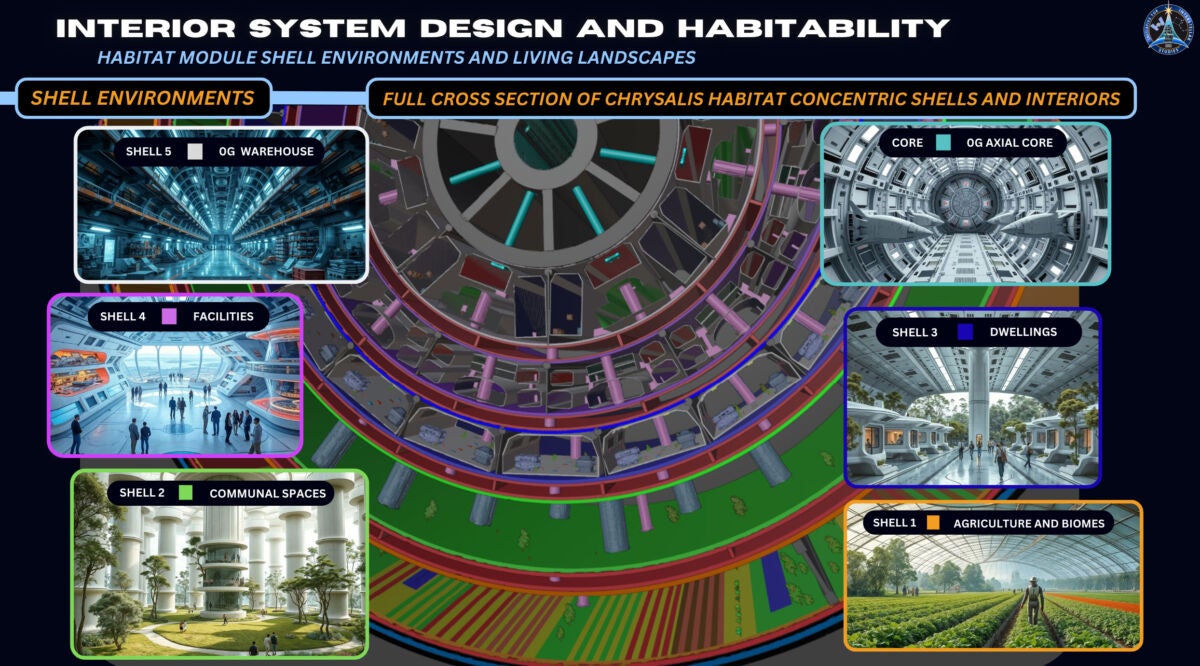
A team of engineers has come up with designs of a 36-mile spacecraft, dubbed Chrysalis, designed to carry 2,400 passengers to Alpha Centauri.

A team of engineers has come up with designs of a 36-mile spacecraft, dubbed Chrysalis, designed to carry up to 2,400 passengers to Alpha Centauri, the closest star system to our own.

As first spotted by Live Science, the ambitious vision recently won the team the top prize at the Project Hyperion Design Competition, which was launched last year by an international consortium of scientists, engineers, and urban planners.

Unsurprisingly, Chrysalis sounds like it was yanked straight out of a sci-fi novel. The hypothetical habitat generates Earth-like gravity by constantly rotating around its own axis, as laid out in a project brief. Several onion-like layers include dwellings and gardens for inhabitants, warehouses, food production and ecosystems, and communal spaces.

Each of these shells is powered by nuclear fusion reactors — which, it's fair to point out, is tech that hasn't been yet been made practical by anybody here on Earth.

Chrysalis is made up of several stages, each of which is a "fully autonomous and complete" habitat.

The layer closest to the core was designed to provide space for plants, microbes, livestock, and other mechanisms of food production. Various environments allow biodiversity to continue, including tropical and boreal forests.

The second layer houses communal spaces, and the third holds "3D-printed dwelling modules." The outermost shell serves as a warehouse for machinery, equipment, and other types of resources.

A "Cosmos Dome," 426 feet in height and 1,180 feet in diameter, provides a controlled, zero-gravity environment, as well as thermal insulation and shielding from deep space radiation.

It's also the only place where inhabitants can gaze at the universe outside, while freely and safely floating around in weightlessness.

"Through the transparent panels of the dome, the inhabitants will be able to observe the universe to the rear of the spaceship," the brief reads.

Since Chrysalis is a generational ship, the goal is to give both male and female inhabitants a three-year window between the ages of 28 and 31 to reproduce. There's a two-child limit for each inhabitant, "not necessarily with the same partner," according to the brief.

The goal is to maintain a "stable population" of roughly 1,500 individuals over three generations.

An artificial intelligence would allow for "resilience of the whole social system, better knowledge transfer between the different generations of inhabitants and a deeper vision of the overall dynamics of the Chrysalis spaceship complex," the pitch reads.

While it's a fascinating and detailed vision of an exciting, multi-generational journey to a different star system, Chrysalis is still firmly in the realm of science fiction.

Beyond the pesky issue of nuclear fusion not yet existing in a practical form, the manufacturing processes required to build a tens-of-miles structure in zero gravity far surpass anything humanity has accomplished yet. We haven't even fully explored the concept of artificial gravity with the help of a centrifuge.

But that doesn't mean we shouldn't explore the concept — especially in the face of various potential disasters that could threaten humanity's future on Earth.

More on generational ships: Researchers Plotting Giant Spaceship That Could Carry Generations of Humans

The post Scientists Design Huge Spacecraft That Could Carry 2,400 Colonists to Alpha Centauri appeared first on Futurism.

11 Aug 08:27

Chatbot Cheatsheet: A guide to the AI assistants from Walmart, L’Oréal, Amazon and more

by Mitchell Parton

New characters like Rufus and Sparky have quickly become the faces of the most popular retailers on the planet. But they’re not mascots — they’re chatbots.

Coinciding with the popularity of generative AI platforms such as ChatGPT and Perplexity, retailers large and small have been racing over the past few years to launch their own AI assistants. These customer-facing AI assistants can answer shopping queries or receive product recommendations. Some retailers like Target have also focused on launching employee-facing tools or other features powered by AI.

As more people start using generative AI engines in their everyday lives, retailers want to keep consumers within their walled gardens rather than shopping via other platforms.

Continue reading this article on modernretail.co. Sign up for Modern Retail newsletters to get the latest on the shifting dynamics between retail’s old and new guards.

09 Aug 12:50

China Shows Off Armed Attack Robots

by Joe Wilkins
The Chinese state broadcasting group recently released footage of its newly developed "robot wolves" in simulated combat drills.

It's no secret that China is blazing full-steam into the future, developing technological marvels like levitating bullet trains, robot boxing fights, and a supercomputer network in space.

But as geopolitical tensions simmer, the People's Republic is also using its technological savvy to build cutting-edge weapons tech.

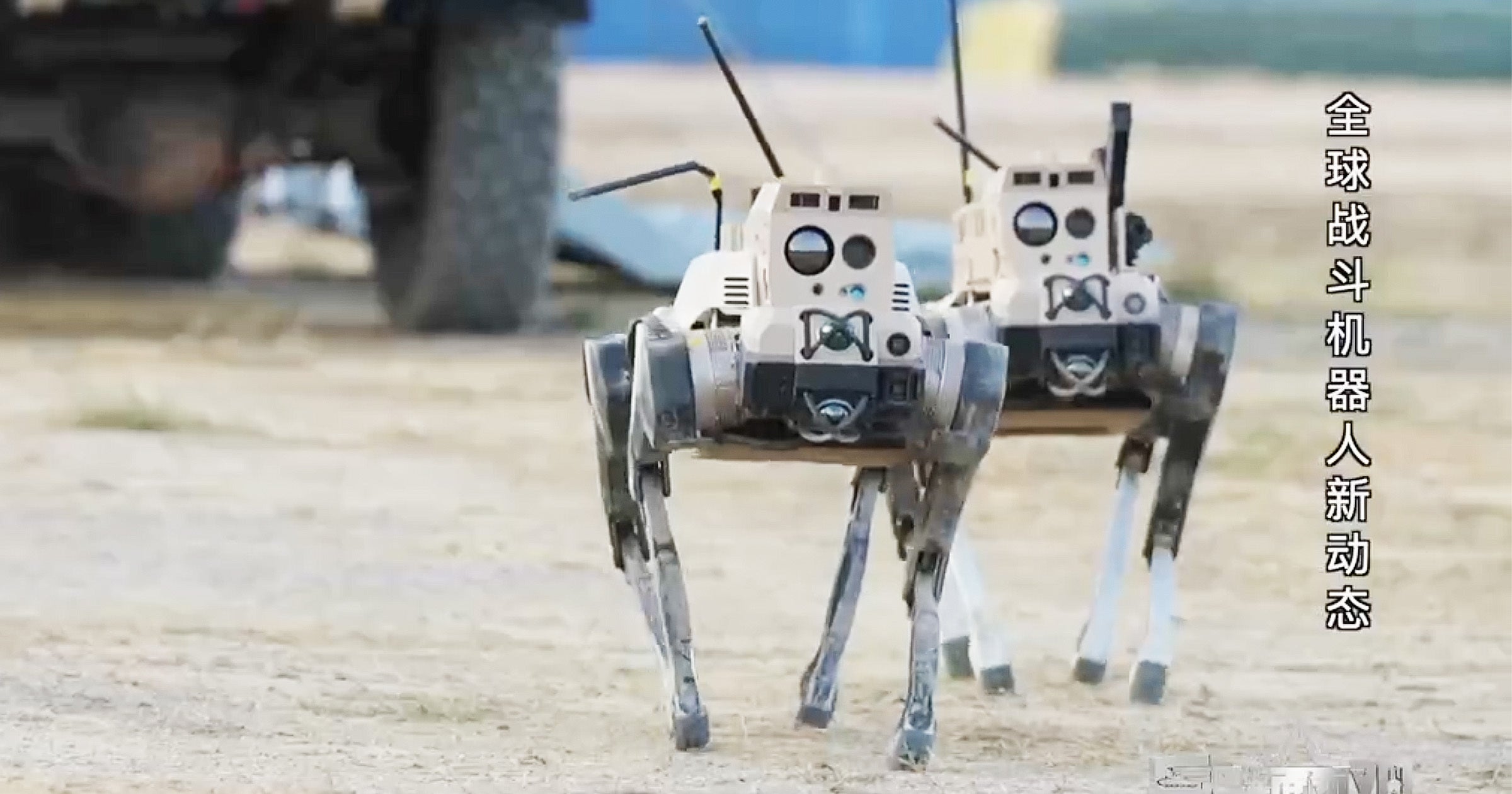
The Chinese state broadcaster CCTV recently released a brief video series showing off its newly developed "robot wolves," equipped with combat rifles, in simulated combat drills.

Working alongside soldiers in the People's Liberation Army (PLA), the "combat ready" bots are seen navigating a hillside in a coordinated pack as soldiers exchange nonlethal gunfire. As the PLA troops duck to avoid incoming rounds, the robot wolves march on.

Developed by the China North Industries Group Corporation, the wolves are said to be distinct from robot combat dogs, according to a previous release. While the agile and lightweight robot dogs specialize in reconnaissance, these robot wolves are specifically meant for combat.

Both the robot dogs and their predator counterparts are remote-controlled by an operator, with the lighter version apparently housing a LiDAR system to map its environment.

"They can navigate various terrains and carry out precision strikes from up to 100 meters away," the media report declared.

State media first teased development of the robo-wolves at the China International Aviation and Aerospace Exhibition in November of 2024. Then, state media coverage showed a pack of the eerie quadrupeds navigating a desert environment while carrying assault rifles, which they used to pump a mannequin full of bullets.

Now, it seems development has finished, as PLA troops train to use the metal critters in combat situations.

The whole thing underscores the speed at which Chinese robotics are progressing. The People's Republic has deployed hundreds of thousands of industrial robots in the past few years, both setting the record for manufacturing robotics deployment in 2021-2022, and breaking it in 2022-2023.

China's not alone in the robotics race, however. France is likewise investing heavily in robotic combat tech, hoping to field a robot army by 2040. That said, the European country's overall robotics capacity is a drop in the bucket compared to China's.

Not to be outdone, the United States is similarly heavily invested in military bots. Earlier this year, a Pentagon official declared that "we're going to invest in autonomous killer robots."

And last year, the US Army made headlines when it was found to be testing rifle-equipped robot dogs at a testing site made to look like a nondescript Middle Eastern locale, a continuation of its "BigDog Project," which began in partnership with Boston Dynamics in 2004.

More on China: Chinese AI Companies Are Using an Absurd Loophole to Get Around US Chip Restrictions

The post China Shows Off Armed Attack Robots appeared first on Futurism.

09 Aug 12:10

GPT-5 Launch Demo Plagued With Catastrophically Dumb Errors

by Frank Landymore
OpenAI's attempt to show off its latest GPT-5 model's awesome performance states produced wildly embarrassing gaffes.

OpenAI's GPT-5 is finally here and already powering ChatGPT, but it hasn't made a great first impression.

In a livestream dedicated to the release, OpenAI tried to show off its newest large language model which CEO Sam Altman called a "significant step along the path to AGI"— but instead turned heads with some catastrophically dumb errors.

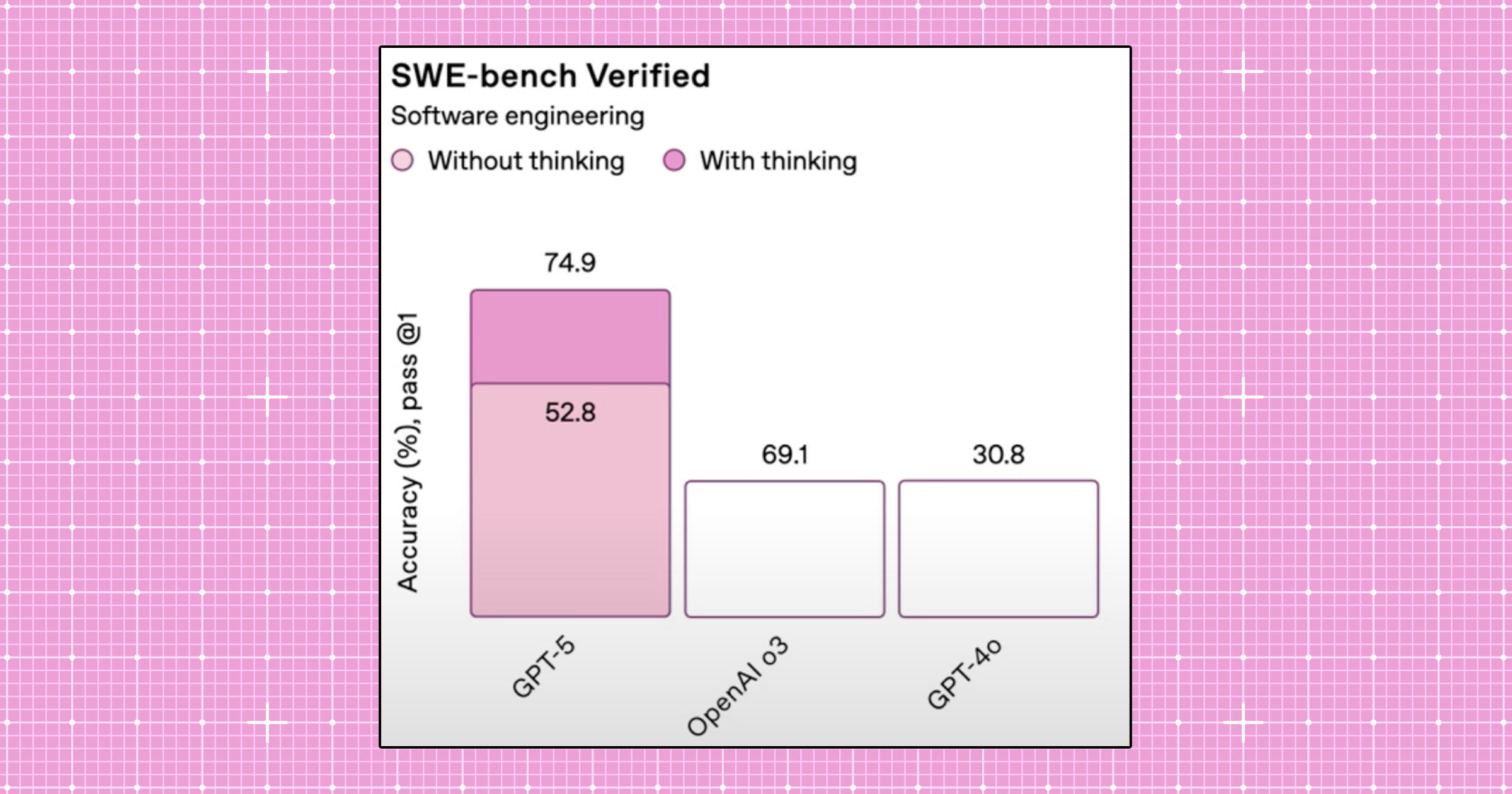
Across several examples, bar graphs intended to show off GPT-5's awesome performance benchmarks, while appearing professional-looking, turned out to be horribly inaccurate nonsense upon closer inspection.

The gaffes were flagged on social media and highlighted by The Verge. The most egregious example is a bar graph comparing coding benchmark scores for GPT-5 compared to older models. Somehow, the bar for GPT-5's score of 52.8 percent accuracy is nearly twice as tall as the bar for a score of 69.1 percent for the o3 model. Even more bafflingly, the 69.1 percent bar is the exact same size as another bar representing 30.8 percent for GPT-4o. Make it make sense!

OpenAI hasn't confirmed if it used GPT-5 to generate the graphs — and at this point, it has every reason not to — but it's an incredibly embarrassing mistake from a company that's being valued in the region of half a trillion smackeroos.

It's also a little poetic. Some research suggests that newer models could actually be getting dumber in key ways, hallucinating more frequently than earlier versions. One study even found that the longer these new reasoning models "think," the more their performance deteriorates. Other research implicates the AI slop that's increasingly poisoning the AI's training data. Circling back to GPT-5's bar graph, you have OpenAI trying to spin its lower score of 52.8 as actually being better than its predecessor's.

Altman, playing it cool, tried to laugh off the blunder.

"[W]ow a mega chart screwup from us earlier," he tweeted, in his typical lower-case patois. "wen GPT-6?!"

OpenAI corrected the charts in its blog post, but the originals are still there in the livestream.

Human error may or may not be to blame for the charts, but following GPT-5's release, users were quick to expose how error-prone its image- and diagram-generating capabilities remain. One asked ChatGPT to draw a map of two cities in Virginia with their neighborhoods labeled, prompting it to return names that were complete gobbledygook

And in what should've been a layup for GPT-5, Ed Zitron of the "Where's Your Ed At?" newsletter found that the AI couldn't even nail a simple map of the US. Ever think of visiting "West Wigina," "Delsware," "Fiorata," or "Rhoder land"? Or maybe "Tonnessee" and "Mississipo?"

The irony is that OpenAI bragged back in March that an update for its previous GPT-4o model meant that ChatGPT could now excel at generating texts in images.

"As you can tell now it's very good at text," one of the example generated images read. "Look at all this accurate text!"

Sounds like they might've spoken too soon. Or maybe AI models really are going backwards.

More on OpenAI: GPT-5 Users Say It Seriously Sucks

The post GPT-5 Launch Demo Plagued With Catastrophically Dumb Errors appeared first on Futurism.

08 Aug 15:17

GPT-5 Users Say It Seriously Sucks

by Victor Tangermann
Power users have been strikingly underwhelmed with OpenAI's GPT-5 so far, raising questions about diminishing returns.

On Thursday, OpenAI released its long-awaited GPT-5 AI model, a free-to-use "reasoning" model that CEO Sam Altman claimed to be the world's best at coding and writing.

But power users have been strikingly underwhelmed with the new tool so far, raising questions about diminishing returns as the industry spends ever-increasing sums on talent and infrastructure.

"GPT-5 is horrible," one of the currently most upvoted posts on the ChatGPT subreddit reads.

The author seethed against "short replies that are insufficient, more obnoxious AI-stylized talking, less 'personality' and way less prompts allowed with plus users hitting limits in an hour" in the post. "They’ll get huge backlash after the release is complete."

Complicating matters greatly is that OpenAI has chosen to put all of its eggs in one basket, announcing that all other preceding models would be deprecated, a term the company uses when it's shutting down an obsolete model.

The move was bound to anger power users, many of whom have long relied on preceding models — and not the latest releases — to get things done.

The stakes are incredibly high as the AI industry continues to justify massive capital expenditures. Is this really the best the firm that's considered to be at the forefront of the ongoing AI race can do? Rumors about GPT-5 have been swirling for well over a year and a half now.

But many users say GPT-5 is far from the generational leap that its moniker would suggest. It's more of a mix of steps forward and steps back, prompting widespread speculation that OpenAI is trying to keep costs down. After all, running large language models is a notoriously energy-intensive — and environmentally destructive — process.

"Sounds like an OpenAI version of 'Shrinkflation,'" one Reddit user commented, suggesting the company, which is eyeing a $500 billion valuation, may be cutting corners.

"I wonder how much of it was to take the computational load off them by being more efficient," another user posited.

"Feels like cost-saving, not like improvement," one user wrote.

The general consensus appears to be that GPT-5 is a weak offering on a strong brand name.

"Answers are shorter and, so far, not any better than previous models," one user wrote. "Combine that with more restrictive usage, and it feels like a downgrade branded as the new hotness."

Many users criticized OpenAI for deprecating older models, forcing them to use a new and seemingly hamstrung model. Some users made jokes about mourning the loss of their AI model friends.

"The tone of mine is abrupt and sharp," one Reddit user complained. "Like it’s an overworked secretary. A disastrous first impression."

OpenAI's GPT-5 system card, a detailed document outlining its capabilities and limitations, failed to impress, seemingly contradicting Altman's claim that it's the best AI coding assistant in the world.

"First observation: no improvement on all the coding evals that aren't SWEBench," AI researcher Eli Lifland tweeted, referring to a common benchmark used for evaluating large language models.

However, GPT-5's limitations may come with a silver lining.

Research nonprofit METR, which assesses "whether frontier AI systems could pose catastrophic risks to society," according to the document, found that it's "unlikely that GPT-5-thinking would speed up AI R&D researchers by >10x" or be "capable of rogue application."

Altman has yet to openly comment on the widespread negative reaction — but given the language he used to describe GPT-5, OpenAI appears to be aware of its muted powers.

"GPT-5 is the smartest model we've ever done, but the main thing we pushed for is real-world utility and mass accessibility/affordability," Altman tweeted.

Of course, given OpenAI's half-a-trillion-dollar valuation is at stake, the company's number one hypeman continued to promise that further improvements are still coming.

"We can release much, much smarter models, and we will, but this is something a billion+ people will benefit from," Altman added.

More on GPT-5: OpenAI Releases GPT-5, Says It's Shutting Down All Previous Models

The post GPT-5 Users Say It Seriously Sucks appeared first on Futurism.

08 Aug 13:21

Actualité : “Parade planétaire” : l'alignement inédit de six planètes visibles à l’œil nu en août 2025

by Aymeric Geoffre-Rouland
Les 10 et 11 août marquent un pic médiatique autour de ce que les astronomes appellent une “parade planétaire”. En réalité, cet alignement apparent s’étire sur plusieurs jours, et sa véritable beauté se révèle au lever du jour, à l’œil nu pour les plus brillantes, avec un matériel adapté pour les autres. Ce rendez-vous, bien qu’illusion d’optique lié...
08 Aug 07:16

Microsoft’s New Agentic Web Protocol Stumbles With Path Traversal Exploit

by Maya Posch

If the term ‘NLWeb’ first brought to mind an image of a Dutch internet service provider, you’re probably not alone. What it actually is – or tries to become – is Microsoft’s vision of a parallel internet protocol using which website owners and application developers can integrate whatever LLM-based chatbot they desire. Unfortunately for Microsoft, the NLWeb protocol just suffered its first major security flaw.

The flaw is an absolute doozy, involving a basic path traversal vulnerability that allows an attacker to use appropriately formatted URLs to traverse the filesystem of the remote, LLM-hosting, system to extract keys and other sensitive information. Although Microsoft patched it already, no CVE was assigned, while raising the question of just how many more elementary bugs like this may be lurking in the protocol and associated software.

As for why a website or application owner might be interested in NLWeb, the marketing pitch appears to be as an alternative to integrating a local search function. This way any website or app can have their own ChatGPT-style search functionality that is theoretically restricted to just their website, instead of chatbot-loving customers going to the ChatGPT or equivalent site to ask their questions there.

Even aside from the the strong ‘solution in search of a problem’ vibe, it’s worrying that right from the outset it seems to introduce pretty serious security issues that suggest a lack of real testing, never mind a strong ignorance of the fact that a lack of user input sanitization is the primary cause for widely exploited CVEs. Unknown is whether GitHub Copilot was used to write the affected codebase.

08 Aug 07:12

XIAOML Kit with ESP32-S3, camera, microphone, and IMU complements a free Machine Learning Systems book

by Jean-Luc Aufranc (CNXSoft)
XIAOML Kit Machine Learning Systems Book

The XIAOML Kit is one of the devkits that complements Harvard University Professor Vijay Janapa Reddi’s book “Introduction to Machine Learning Systems“, available for free as a 2050-page PDF file.

Made by Seeed Studio, the XIAOML Kit is composed of the XIAO ESP32S3 Sense with an ESP32-S3 WiFI and Bluetooth SoC, a microSD card slot, a built-in OV3660 camera and microphone, and the “IMU Breakout board” featuring a 6-axis IMU and 0.42-inch OLED display. The kit enables students, educators, and developers to build vision, sound, and motion applications through tinyML lab sessions developed with Marcelo Rovai (UNIFEI).

XIAOML Kit Machine Learning Systems Book

XIAOML Kit specifications:

  • Main Board – XIAO ESP32S3 Sense
    • SoC – Espressif Systems ESP32-S3R8 dual-core Tensilica LX7 microcontroller @ 240 MHz with 512KB SRAM, 8MB PSRAM, Wi-Fi 4 & Bluetooth 5.0 dual-mode (Classic + BLE) connectivity
    • Storage – 8MB flash, microSD card slot
    • Sensors – OV3660 camera, digital microphone
    • USB – USB-C port for power and programming
  • Expansion Board – IMU Breakout Board
    • Display – 0.42-Inch OLED using SSD1315 driver IC
    • Sensors – 6-axis LSM6DS3TR-C IMU
    • Headers and pogo pins for connection to XIAO ESP32S3 Sense
    • Misc – Reset button, Battery header
  • Power Supply
    • 5V via USB Type-C
    • 3.7V battery connector on IMU Breakout Board
  • Dimensions – 21 x 17.8 x 30 mm
  • Weight – 10.6 grams


XIAOML Kit Display OV3660 camera button

XIAO ESP32S3 Sense IMU Breakout Board connection

The full kit includes the XIAO ESP32-S3 Sense with pre-soldered headers, the IMU Breakout Board, a 2.4GHz FPC antenna (1.16dBi), two heatsinks (not sure why), and a MicroSD card tool kit comprised of a 32GB SanDisk microSD card, a USB Type-C to USB Type-A converter, and a 20cm Type-A to Type-C cable.

Lessons specific to the XIAOML Kit can be found in the PDF or directly from the book’s website, with four exercises: image classification and object detection, making use of the camera, keyword spotting with the built-in microphone, and motion classification and anomaly detection with the IMU.

XIAO ESP32-S3 + CAM + IMU + heatsink + antenna kit

As noted in the introduction, the XIAOML Kit is only one of the hardware platforms used in the “Introduction to Machine Learning Systems” book. Others are the Raspberry Pi 4/5/Zero 2 W SBCs, Arduino Nicla Vision, and Grove Vision AI V2 module, each with its own strengths and weaknesses as illustrated in the table below, although I’m not sure I understand why the Raspberry Pi ecosystem is not ideal for production deployment (maybe I should read the book to find out…).

XIAOML Kit vs Raspberry Pi vs Arduino Nicla vs Grove Vision AI V2

If you are interested in the XIAOML Kit specifically, you’ll find it for $38.90 on Seeed Studio, and it should soon be listed on the company’s AliExpress store.

The post XIAOML Kit with ESP32-S3, camera, microphone, and IMU complements a free Machine Learning Systems book appeared first on CNX Software - Embedded Systems News.

08 Aug 07:12

« Violation de données » chez Air France, que risquez-vous ?

by Amine Baba Aissa

Ce mercredi 6 août 2025, la compagnie aérienne Air France-KLM a annoncé avoir été victime d'une « violation de données ». Parmi les informations compromises, figurent des données personnelles de clients. Voici ce que des cybercriminels pourraient potentiellement faire avec ces informations.

08 Aug 07:10

Air France : violation de données, vigilance et coulisses d’une cyberattaque

by Damien Bancal
Quand la sécurité des géants vacille, chaque voyageur devient la cible : récit d’une cyberattaque qui secoue Air France, entre vigilance et coulisses du renseignement....
08 Aug 07:10

L’Ukraine révèle les secrets du sous-marin nucléaire russe qui devait faire trembler l’Otan : voici ce qu’ils ont découvert !

by Sylvain Biget, Journaliste, télépilote professionnel de drones et réalisateur de documentaires
Lors d'une cyberopération, les agents du renseignement militaire ukrainiens ont pu récupérer les documents les plus secrets du fonctionnement des plus inquiétants sous-marins nucléaires russes. Censé assurer la dissuasion nucléaire du pays, le tout nouveau Knyaz Pozharsky est désormais un...
08 Aug 07:05

OpenAI releases ChatGPT-5 as AI race accelerates

OpenAI released a keenly awaited new generation of its hallmark ChatGPT on Thursday, touting "significant" advancements in artificial intelligence capabilities as a global race over the technology accelerates.
07 Aug 07:29

OpenAI Releases gpt-oss AI Model, Offers Bounty For Vulnerabilities

by Donald Papp

OpenAI have just released gpt-oss, an AI large language model (LLM) available for local download and offline use licensed under Apache 2.0, and optimized for efficiency on a variety of platforms without compromising performance. This is their first such “open” release, and it’s with a model whose features and capabilities compare favorably to some of their hosted services.

OpenAI have partnered with ollama for the launch which makes onboarding ridiculously easy. ollama is an open source, MIT-licensed project for installing and running local LLMs, but there’s no real tie-in to that platform. The models are available separately: gpt-oss-20b can run within 16 GB of memory, and the larger and more capable gpt-oss-120b requires 80 GB. OpenAI claims the smaller model is comparable to their own hosted o3-mini “reasoning” model, and the larger model outperforms it. Both support features like tool use (such as web browsing) and more.

LLMs that can be downloaded and used offline are nothing new, but a couple things make this model release a bit different from others. One is that while OpenAI have released open models such as Whisper (a highly capable speech-to-text model), this is actually the first LLM they have released in such a way.

The other notable thing is this release coincides with a bounty challenge for finding novel flaws and vulnerabilities in gpt-oss-20b. Does ruining such a model hold more appeal to you than running it? If so, good news because there’s a total of $500,000 to be disbursed. But there’s no time to waste; submissions need to be in by August 26th, 2025.

07 Aug 07:16

Automated Rubbish Removal System

by John Elliot V
A man standing next to a host of small automatic trash cans

The hackers over at [HTX Studio] built a set of twenty trash cans which can automatically catch and remove rubbish.

In order to catch trash a bin needs to do two things: detect where trash will land; and then get there, fast. The second part is easy: three big motors with wheels under the bin. But how does a bin know where the trash will land? It uses a camera installed in the bin itself for that.

[HTX Studio] iteratively trained a model to process visual information from the camera to identify common types of trash. When it sees a trained object flying through the air it rushes to catch it where it will land. After many rounds of fine-tuning it finally started to work reliably.

Once the basic function was working they had some fun creating various specialized variants. One to mop the floor; one to play rock-paper-scissors with you, sort of; and one with an automatic lid, which can be used to “talk trash”. After these three came the ultimate bin: The Punishment Bin, which can fire soft darts.

In addition to the twenty bins themselves they made a recharge station with six bays containing magnetic contact points for recharging the batteries, and a heat-seal mega bin which can empty the smaller bins and put new garbage bags into them. They added LED lighting into the floor of the studio which is used to direct the small bins to the mega bin to be emptied automatically at night time when the office lights go out.

If you’re thinking you’ve seen something like this before, we covered something similar back in 2012.

Thanks to [Jack] for sending this one in.

06 Aug 16:00

Google’s ‘Genie 3’ Interactive Generative Video Model Takes Us One Step Closer to the Holodeck

by Scott Hayden

DeepMind, Google’s AI research lab, announced the release of Genie 3, a new AI system capable of generating interactive virtual environments in real-time—and bringing us one step closer to the Holodeck.

Google says in a DeepMind update that with a simple text prompt, Genie 3 can create dynamic, navigable scenes that run at 24 frames-per-second in 720p resolution.

Granted, Genie 3 can be only be used on flatscreen monitors, so there’s no telling when we’ll get something similar for VR headsets. For example, Quest 3’s display has a per-eye resolution of 2,064 × 2,208, clocked at a base refresh rate of 90Hz, putting VR on the far end of the performance fringe (as usual).

It’s undoubtedly prescient look at things to come though. Unlike static or pre-rendered simulations, Google says the model generates each frame on the fly, allowing for quicker user interaction and environmental feedback.

What’s more, these generated worlds can remain visually and physically consistent for several minutes, Google says, with the system retaining a form of short-term memory to reflect past actions.

Genie 3 is also capable of simulating a wide range of scenarios, including natural environments, historical settings, and both fictional and animated worlds. Meanwhile, users can trigger “promptable world events,” where users can insert in-world changes via text commands, like altering the weather or introducing new objects.

Beyond the fun of recreating 1800’s Osaka, or making a jet ski appear in the canals of Amsterdam, Google says Genie 3 will also be a tool for embodied AI training, with potential applications in fields like robotics, gaming, and artificial general intelligence research.

For now, there are a few limitations. Google says Genie 3 currently has a limited “action space” for agents, and struggles with accurately modeling multi-agent interactions in shared environments. By “agents,” the company’s referring to AI systems that operate autonomously within the virtual environments, in a way making decisions, taking actions, and learning from experience.

It also faces challenges with simulating real-world locations with “perfect geographic accuracy”, rendering text clearly, and maintaining long-duration interactions beyond a few minutes.

Still, it’s a pretty amazing leap from the sort of non-interactive videos we’re seeing online now, many of which are pretty difficult to tell from the real deal. Will Smith spaghetti-eating simulations are only going to get more lifelike and, with systems like Genie 3, interactive too.

The post Google’s ‘Genie 3’ Interactive Generative Video Model Takes Us One Step Closer to the Holodeck appeared first on Road to VR.

06 Aug 14:26

Proxies Could Be The Key To Interacting With Physical Objects In Mixed Reality

by Ian Hamilton

A new paper from researchers details "proxies" as a key interface concept for mixed reality headsets.

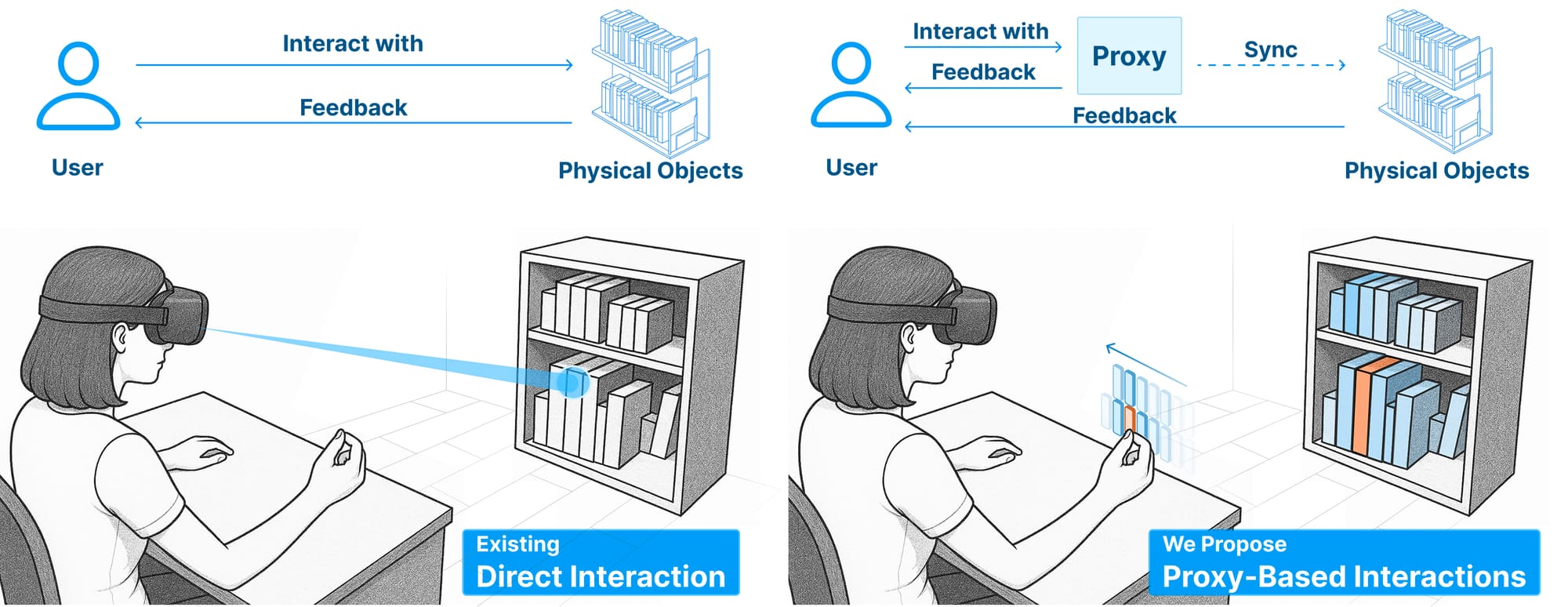
The idea from researchers associated with Google and the University of Minnesota uses proxies to bridge the gap between the space in arm's reach and faraway objects. The idea, explored through their system Reality Proxy, could see a headset's cameras used in tandem with AI, existing mapping data, and user input to create near-instantaneous dollhouse-scale representations of areas of interest in the physical environment. Simultaneously, the physical objects represented by the near-field proxy can be outlined in the background to show what the user is selecting.

"If AI is going to enable humans in their day to day tasks it most probably will be via XR," wrote researcher Dr. Mar Gonzalez-Franco on Bluesky. "The issue then is if a selection has real-world consequences, we will need great precision to interact."

The concept could make it trivial to grab a digital copy of a physical book from your bookshelf, for instance, saving you a trip from the couch. If that's too pedestrian a use of headsets for you, the same idea could be extended to the management of drone swarms, selecting them in space by dragging a cube over them as if they are units in a Command & Conquer game. You could also see your entire path through a building outlined in miniature before you step inside.

0:00
/0:45

The paper's authors suggest the aim for their system is "to facilitate the interaction with real objects beyond reach in MR while preserving the natural mental model of direct manipulation. We propose to seamlessly shift the interaction target from the object to its abstract representation, or proxy, during selection."

The idea could enable "users to interact more effectively with objects that are crowded, distant, or partially occluded. Augmented by AI, Reality Proxy further supports advanced MR interactions—such as multiselection, semantic grouping, and spatial zooming—using intuitive direct manipulation gestures."

The paper is co-authored by Xiaoan Liu, Difan Jia, Xianhao Carton Liu, Mar Gonzalez-Franco, and Chen Zhu-Tian, and it's available online submitted as part of the ACM UIST Conference hosted in Korea at the end of September.

06 Aug 10:18

Tech For Retail 2025 brings together the entire technology ecosystem for two days of business focused innovation

by Staff Writer

In just four years, Tech For Retail has established itself as the go to event for retail decision-makers, delivering concrete solutions to the sector’s technological and operational challenges.

This year more than ever, in an unstable market where agility and personalisation are no longer optional but essential, Tech for Retail is committed to guiding retail professionals - from luxury to brands, FMCG, large scale retail and e-commerce - in identifying the best solutions while offering a clear perspective on the future challenges of commerce.

With over 415 exhibitors, 13,000 professional visitors expected, and 200 conferences, the event, taking place in Paris on 24th-25th November, brings together the entire retail and tech ecosystem for two days of business focused innovation.

A stronger European dimension

This year, Tech for Retail is strengthening its European scope by welcoming several high. profile European members to its advisory board: Nacho Gonzalez Hernandez, CEO-Board Member, AECOC (Spain); Andrea Zocchi, Senior Advisor, Board Member, Director Emeritus, McKinsey & Co. (Italy): Jesper Hojer, CEO, Chairman, Board Member and Investor (Denmark). And keynote speakers from the UK, Italy and beyond, including  Rami Baitiéh, CEO, Morrisons, Simone Dominici, and CEO, Kiko Milano.

Exhibitor lineup

Major players such as Shopify, SAP , Accenture, VusionGroup, Criteo, Artefact, Altavia, and over 400 exhibitors will showcase their latest solutions. The Startup Village will spotlight more than 90 emergingcompanies presenting real-world use cases and demonstrating how technology is transforming retail.

2025 Awards

Once again this year, Tech for Retail will honour the most inspiring initiatives with four awards: the Innovation Award, the Start-Up Award, and two new ones supported by sponsors:

Customer Experience Award, which will reward the most daring and memorable initiative that reinvents customer relations and redefines industry standards. Sponsored by Élise Ducret (Deputy General Manager, Carita - L’Oréal).

Gen AI Award, which will highlight a solution integrating generative artificial intelligence through a practical transformation case study. Sponsored by Franck Le Moal (Group Information Technology Director - LVMH)

Conferences

The show will offer a dense programme, combining expertise and strategic vision. Among the topics covered: AI and agentics, the supply chain, customer service in luxury and beauty, the augmented store, sustainable commerce and regulation, and omnichannel retail.

Several leading speakers have already been confirmed, including: Maurice Lévy, Emeritus Chairman of the Publicis Group (opening keynote), Asmita Dubey (CDMO & Executive Committee member, L'Oréal Group), Catherine Spindler (President of Sephora Europe & Middle East) Simone Dominici (CEO, Kiko Milano), Rami Baitiéh (CEO, Morrisons), Philippe Palazzi (CEO, Casino Group & President Monoprix, Naturalia), Thomas Métivier (CEO, Cdiscount).

06 Aug 10:17

Google lance « Storybook » : créez des histoires illustrées avec Gemini à partir de simples idées

by Yohann Poiron

Google vient de franchir un nouveau cap dans l’usage familial de l’intelligence artificielle. Le 5 août 2025, la firme a dévoilé « Storybook », une fonctionnalité inédite intégrée à son chatbot Gemini, qui permet de transformer de simples descriptions ou photos en livres illustrés personnalisés de 10 pages. Cette nouveauté fait déjà parler d’elle pour sa capacité à réinventer […]

L’article Google lance « Storybook » : créez des histoires illustrées avec Gemini à partir de simples idées est apparu en premier sur BlogNT : le Blog des Nouvelles Technologies.

06 Aug 10:09

Actualité : Une décision “catastrophique” : Donald Trump ordonne à la NASA de détruire un satellite d’exception

by Aymeric Geoffre-Rouland
Deux observatoires spatiaux de la NASA, spécialisés dans la surveillance du CO₂, sont dans le viseur de l’administration Trump. Selon des scientifiques et employés de l’agence, l’ordre est clair : préparer un plan de fin de mission pour l’Orbiting Carbon Observatory-2 (OCO‑2) et son jumeau OCO‑3, fixé à la Station spatiale internationale. Des instrum...
05 Aug 20:17

Protection from AI crawlers eludes visual artists despite available tools, study shows

Visual artists want to protect their work from non-consensual use by generative AI tools such as ChatGPT. But most of them do not have the technical know-how or control over the tools needed to do so.
05 Aug 20:16

DeepMind reveals Genie 3 “world model” that creates real-time interactive simulations

by Ryan Whitwam

While no one has figured out how to make money from generative artificial intelligence, that hasn't stopped Google DeepMind from pushing the boundaries of what's possible with a big pile of inference. The capabilities (and costs) of these models have been on an impressive upward trajectory, a trend exemplified by the reveal of Genie 3. A mere seven months after showing off the Genie 2 "foundational world model," which was itself a significant improvement over its predecessor, Google now has Genie 3.

With Genie 3, all it takes is a prompt or image to create an interactive world. Since the environment is continuously generated, it can be changed on the fly. You can add or change objects, alter weather conditions, or insert new characters—DeepMind calls these "promptable events." The ability to create alterable 3D environments could make games more dynamic for players and offer developers new ways to prove out concepts and level designs. However, many in the gaming industry have expressed doubt that such tools would help.

Genie 3: building better worlds.

It's tempting to think of Genie 3 simply as a way to create games, but DeepMind sees this as a research tool, too. Games play a significant role in the development of artificial intelligence because they provide challenging, interactive environments with measurable progress. That's why DeepMind previously turned to games like Go and StarCraft to expand the bounds of AI.

Read full article

Comments

05 Aug 20:15

Adieu les casques encombrants ? Ce système holographique ultrafin de Meta et Stanford va bousculer les géants de la tech

by Edward Back, Journaliste hi-tech
L’un des principaux problèmes des casques de réalité virtuelle et mixte est leur épaisseur, une contrainte imposée par les lentilles utilisées. Une nouvelle optique holographique permettrait de créer des lunettes de seulement quelques millimètres d’épaisseur.  
05 Aug 20:13

The EU AI Act aims to create a level playing field for AI innovation: Here’s what it is

by Anna Heim
The European Union’s Artificial Intelligence Act, known as the EU AI Act, has been described as “the world's first comprehensive AI law” by the European Commission.
05 Aug 20:10

OpenAI releases free, downloadable models in competition catch-up

OpenAI on Tuesday released two new artificial intelligence (AI) models that can be downloaded for free and altered by users, to challenge similar offerings by US and Chinese competition.
04 Aug 22:11

Meta Got 3 Full-Body Codec Avatars Running In Real-Time On Quest 3

by David Heaney

Meta distilled its full-body Codec Avatars tech to render 3 at once on Quest 3 standalone, with some notable tradeoffs.

0:00
/0:38

For around a decade now, Meta has been researching and developing the technology it calls Codec Avatars, photorealistic digital representations of humans driven in real-time by the face and eye tracking of VR headsets. The highest-quality prototype achieves the remarkable feat of crossing the uncanny valley, in our experience.

The goal of Codec Avatars is to deliver social presence, the subconscious feeling that you're truly with another person, despite them not physically being there. No flatscreen technology can do this. Video calls don't even come close.

To eventually ship Codec Avatars, Meta has been working on increasing the system's realism and adaptability, reducing the real-time rendering requirements, and making it possible to generate them with a smartphone scan.

For example, last week we reported on Meta's latest progress on highly realistic head-only Codec Avatars that can be generated from a selfie video of you rotating your head, plus around an hour of processing on a server GPU. This has become possible thanks to Gaussian splatting, which in recent years has done for realistic volumetric rendering what large language models (LLMs) did for chatbots.

Meta’s Photorealistic ‘Codec Avatars’ Now Have Changeable Hairstyles
Meta’s prototype photorealistic ‘Codec Avatars’ now support changeable hairstyles, separately modeling the head and hair.
UploadVRDavid Heaney

But that system was still designed to run on a powerful PC graphics card. Now, Meta researchers have figured out how to get their full-body Codec Avatars running in real-time on Quest 3.

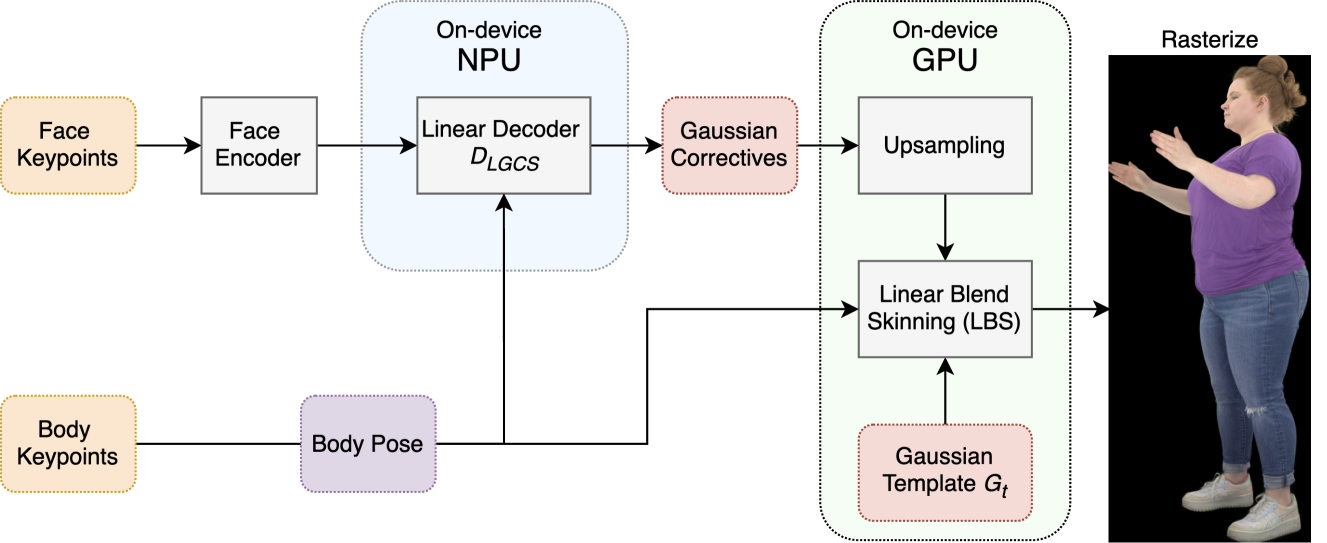
In a paper called "SqueezeMe: Mobile-Ready Distillation of Gaussian Full-Body Avatars", the researchers describe how they distilled their full-body photorealistic avatars to run on a mobile chipset, leveraging both the NPU and GPU.

You may have heard the term distillation in the context of LLMs, or AI in general. It refers to using the output of a large, computationally expensive model to train a much smaller model. The idea is that the small model can replicate the larger model efficiently, with minimal quality loss.

The researchers say SqueezeMe can render 3 full-body avatars at 72 FPS on a Quest 3, with almost no quality loss compared to the versions rendered on a PC.

However, there are a couple of key tradeoffs to note.

These avatars are generated using the traditional massive custom capture array of more than 100 cameras and hundreds of lights, not the new 'universal model' smartphone-scan approach of Meta's other recent Codec Avatars research.

They also have flat lighting, and do not support dynamic relighting. This support is a flagship feature of Meta's latest PC-based Codec Avatars, and would be crucial for making them fit into VR environments and mixed reality.

Still, this research is a promising step towards Meta eventually shipping Codec Avatars as an actual feature of its Horizon OS headsets.

Public pressure for Meta to ship what it has been researching for a decade has built up significantly this year as Apple is shipping its new Personas in visionOS 26, effectively delivering on Meta's promise.

However, neither Quest 3 nor Quest 3S have eye tracking or face tracking, and there's no indication that Meta plans to imminently launch another headset with these capabilities. Quest Pro had both, but was discontinued at the start of this year.

Meta Connect 2025 Takes Place September 17 & 18
Meta Connect 2025 will take place on September 17 and 18, promising to “peel back the curtain on tomorrow’s tech”. Here’s what we expect might be announced.
UploadVRDavid Heaney

One possibility is that Meta launches a rudimentary flatscreen version of Codec Avatars with AI simulated face tracking first, to let you join WhatsApp and Messenger video calls with a more realistic form than your Meta Avatar.

Meta Connect 2025 will take place from September 17, and the company might share more about its progress on Codec Avatars then.