On pensait les salles américaines engourdies, ne se réveillant que pour des rendez-vous horrifiques tels que Évanouis et Conjuring. C'était sans compter sur Demon Slayer : La Forteresse Infinie, et la grosse communauté de fans d'anime qui se sont rués en salles ce week-end. Résultat : le film a explosé les attentes et s'offre un lancement historique...
People often ask, "What's the difference between science and engineering?" Having studied engineering but always loved science, I've come across a few perspectives I find useful to understand the two.
In England at least, studying science usually comes first. In fact, you can't really study engineering until you head off to University. So discussing science and engineering together never came up when I was at school. Engineering seemed to be machines and buildings and projects and design and technology, and science seemed to be everything else. But what really makes science science and engineering engineering?
Science vs Engineering: Five perspectives
Here are five simple ways people have described science and engineering.
Theodore Von Kármán on Scientists and Engineers
Aerospace engineer Theodore Von Kármán said:
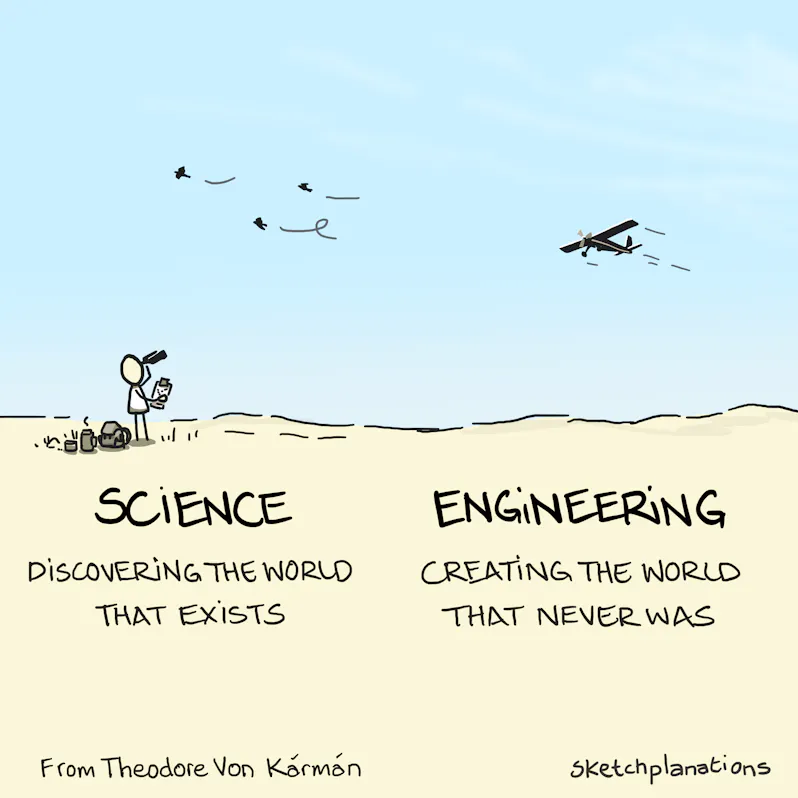
Scientists discover the world that exists; Engineers create the world that never was.
"In science if you know what you are doing you should not be doing it.
In engineering if you do not know what you are doing you should not be doing it."
— Richard Hamming
Hamming also points out that there's a lot of science in engineering and a lot of engineering in science: "Much of present science rests on engineering tools, and as time goes on, engineering seems to involve more and more of the science part."
For example, dealing with huge amounts of data, of the sort generated by weather sensors or particle colliders, requires exceptional engineering techniques. And engineering new displays or ever smaller processing chips requires a lot of scientific knowledge. The two are intertwined: science enables engineering to push forward, and engineering opens new doors for science.
Richard Feynman on Computer Science
Physicist Richard Feynman, in a talk on quantum computers at Bell Labs (video excerpt), said:
"I don't believe in Computer Science. To me, science is the study of the behavior of nature. And engineering or applied things is the behavior of things we make.
You need to know how Nature works in order to make the things, and so you use science in engineering, but you're doing it for a human purpose."
— Richard Feynman
Mythbusters' Adam Savage on Science vs Screwing Around
Adam Savage, Mythbusters host, shared:
"Remember kids, the only difference between screwing around and science is writing it down."
Adam said that the quote was actually from the ballistics expert on a shoot, Alex Jason. It doesn’t quite get to the heart of science versus engineering, but it’s a great reminder of good practice.
Why, How, What's Next?
A reader shared this framing with me:
Science asks “Why”
Engineering asks “How”
And together, they answer, “What’s next?”
And finally, my own phrasing in the first draft for the sketch used:
Science: Study of the world
Engineering: Doing things with what we've learned about the world
So while there probably isn't a single neat answer to the question of what’s the difference between science and engineering, maybe these give some food for thought.
If you know of other interesting framings for science and engineering, please let me know.
Tilly Lockey is living proof that the future of prosthetics is already here. At just 19, this amputee rights advocate showed off her incredibly advanced 3D-printed bionic arms on Good Morning Britain. These aren’t your average prosthetics: they’re powered by her muscles, quick as lightning, super strong, and so advanced they can even move when they’re not attached.
Tilly, who lost both forearms to meningitis as a baby, teamed up with Open Bionics to bring these marvels of tech to life. And she’s not stopping there! She just launched a podcast, Tilly Talks Tech, where every view helps fund more accessibility to prosthetics for others who need them.
Je relisais dernièrement une étude IBM sur l’IA agentique qui promet un avenir où les opérations de l’entreprise seront pilotées par des agents autonomes, disponibles 24h/24, capables de prédire, d’optimiser, d’agir sans supervision (Orchestrating agentic AI for intelligent business operations).
Une promesse d’efficacité algorithmique qui laisse percevoir un potentiel plus qu’intéressant mais qui pose de nombreuses questions car derrière cette vision technologique, se cachent des défis qui eux sont bien humains entre pilotage, gouvernance, sens du travail et réalité opérationnelle.
En bref :
L’IA agentique promet une automatisation fluide et autonome des opérations, en orchestrant des processus complets plutôt qu’en se limitant à des tâches isolées.
Cette vision repose sur des hypothèses fragiles, notamment la stabilité et l’interconnexion des environnements, qui sont rarement réunies dans la réalité opérationnelle.
L’automatisation déplace une charge cognitive importante vers les salariés (supervision, correction, interprétation), souvent ignorée ou sous-estimée.
La réussite de ces systèmes dépend moins de leur puissance technique que de la maturité organisationnelle : qualité des données, gouvernance, compétences humaines.
L’IA ne peut améliorer le travail que si les salariés sont pleinement impliqués dans sa conception et son déploiement, dans une logique d’apprentissage collectif et de sens partagé.
Une promesse d’automatisation sans couture
Dans cette étude IBM remet au goût du jour une ambition que la transformation digitale n’a jamais vraiment concrétisée à savoir celle d’une automatisation fluide, continue et auto-apprenante. L’IA agentique, définie comme la capacité d’agents à agir de manière autonome pour atteindre des objectifs métiers, marque une nouvelle étape dans le l’application de l’IA aux opérations.
Les chiffres avancés sont ambitieux : 75 % des dirigeants pensent que ces agents prendront en charge les processus transactionnels d’ici deux ans, 85 % prévoient qu’ils collaboreront en continu avec les humains, et 90 % anticipent une exploitation accrue des analytics temps réel. L’idée derrière tout cela est ne plus seulement automatiser des tâches, mais orchestrer des processus entiers, d’un bout à l’autre de la chaîne.
Cette vision d’ensemble repose sur l‘hypothèse implicite d’un environnement opérationnel suffisamment stable, normé et interconnecté pour permettre à des agents d’évoluer librement. Une hypothèse qui ne ne se se vérifie que rarement dans la réalité.
Derrière le vernis de l’autonomie, le déploiement d’agents suppose en effet :
une contextualisation fine des situations,
une capacité à résoudre les cas déviants ou ambigus,
et une coordination entre systèmes, humains et règles implicites.
Or ces dimensions sont souvent les plus complexes à modéliser, et les moins visibles dans les feuilles de route technologiques.
La charge de travail cachée de l’automatisation
L’étude évoque le repositionnement des collaborateurs vers des tâches à plus forte valeur : stratégie, créativité, accompagnement client mais elle passe sous silence un phénomène bien connu, à savoir la charge mentale de supervision et d’ajustement.
Superviser un agent, interpréter ses choix, corriger ses biais, réintégrer les cas limites : tout cela demande un effort cognitif que l’automatisation ne fait pas disparaître, mais qu’elle déplace vers les salariés. Un effort rarement reconnu comme du travail, encore moins comme une compétence à développer.
Une promesse de fluidité qui ne dit rien de son pilotage
IBM insiste sur la capacité des agents à améliorer la performance opérationnelle. Mais pour y parvenir, encore faut-il que les conditions de succès soient réunies : qualité des données, alignement des processus, gouvernance robuste, sécurité, supervision éthique.
Or ce sont précisément les zones les plus fragiles dans la plupart des organisations. L’étude elle-même reconnaît que 68 % des dirigeants évoquent un manque de compétences comme frein à la transformation, et que plus de 80 % jugent difficile l’interconnexion avec les partenaires. Les vieux démons ont la vie dure (Digital workplace, IA et intéropérabilité : un problème qui reste entier).
Le problème n’est donc pas celui de la puissance de l’IA, mais celui de la maturité organisationnelle pour en tirer parti.
La face cachée de l’expérience employé
L’expérience employé (EX) est mentionnée à plusieurs reprises comme bénéfice collatéral : assistants RH personnalisés, montée en compétences, gain de temps mais jamais l’étude ne pose la question l’effet structurel de l’automatisation sur le vécu du travail :
perte de contrôle sur les processus,
atomisation des responsabilités,
standardisation des interactions,
pilotage algorithmique déconnecté du sens métier.
Derrière les promesses de personnalisation, c’est souvent une logique de modularisation et de fragmentation du travail qui s’installe.
Agentic AI ou People-Centric Operations ?
L’étude d’IBM oppose implicitement deux modèles : celui d’un travail orchestré par des agents intelligents, et celui d’un travail régulé par des humains augmentés. Ces deux modèles ne sont pas incompatibles, mais leur articulation demande une condition préalable rarement remplie : impliquer les salariés dans la conception, le cadrage et l’amélioration continue des systèmes.
C’est ici qu’une approche de type People-Centric Operations prend tout son sens : considérer les opérateurs comme des architectes du système, pas comme des exécutants du pilotage par les algorithmes (People Centric Operations 2.0 : comment l’IA réinvente le travail du savoir à l’échelle). L’IA peut améliorer le travail si elle s’insère dans une logique d’appropriation, d’alignement collectif et d’apprentissage partagé.
Conclusion
L’IA agentique ouvre des perspectives passionnantes mais elle ne changera rien si elle ne s’intègre pas dans un système organisationnel repensé : gouvernance distribuée, responsabilité partagée, pilotage éthique, hybridation des compétences.
La question n’est pas et ne doit pas être « l’agent peut-il le faire à ma place ? » mais « »dans quelle mesure ce qu’il fait renforce ma capacité à comprendre, décider, collaborer ? ».
Crédit visuel : Image générée par intelligence artificielle via ChatGPT (OpenAI)
C’est un deal qui fera date : ASML, le géant néerlandais de la lithographie, s’apprête à investir près de 1,5 milliard de dollars (1,3 milliard d’euros) dans la pépite française Mistral AI, selon Reuters. Cette levée de fonds, estimée à 1,7 milliard d’euros au total, valorise Mistral à 10 milliards d’euros (pré-money) et propulse la […]
Des chercheurs danois ont trouvé une manière étonnante de transformer un problème environnemental en solution climatique. Le plastique jeté pourrait bientôt jouer un rôle actif dans la lutte...
Forget high-tech gadgets, flying cars, or AI overlords: true innovation has finally arrived… in the form of a grumpy octopus that lives in a box and tells you to mind your own business.
The Octopus Useless Box is the kind of invention that proves humanity has peaked. You press a lever, it pops open, and out comes a cranky little cephalopod who slams it shut again, sometimes throwing a tantrum, sometimes giving you the stink-eye, always making sure you know who’s boss. It’s useless, it’s adorable, and it’s probably judging you harder than your cat ever has. Check it out!
While we’re still far from a definitive conclusion about current or ancient life on Mars, it was an exciting finding, with a sampled rock containing minerals closely associated with Earth-based microbial life.
The only problem? The Trump administration has made it clear that it’s not interested in returning the samples taken by NASA’s Perseverance rover back to Earth for laboratory analysis.
In other words, as much as Duffy glazes Trump publicly, in reality, Trump is our planet’s number one obstacle to following up on NASA’s blockbuster findings about life on Mars.
As Ars Technica reports, Duffy had very little to add when needled by reporters this week about the Trump administration’s commitment to returning the Mars samples, clumsily avoiding making any promises.
“What we’re going to do is look at our budget, so we look at our timing, and you know, how do we spend money better?” he told one reporter. “And you know, what technology do we have to get samples back more quickly? And so that’s a current analysis that’s happening right now.”
Duffy also reiterated that the Trump administration was pouring all of its resources into sending “our boots to the Moon and to Mars” — efforts that would be far more complex, expensive, and time-intensive than a sample return mission. (And that’s if sending astronauts to the Red Planet is even feasible in the first place.)
To experts, canceling the Mars Sample Return mission would be an enormous and costly mistake.
“Our understanding of Mars has gotten to the point that the questions we’re asking can best be addressed with returned samples,” University of Colorado Boulder senior research scientist Bruce Jakosky told Space.com earlier this year.
“To decide not to return them, or to put it off to an indefinite future time with human missions would be to take a major step back in exploring the solar system and the universe and in continuing to develop our scientific understanding of the world around us,” he added.
Jakosky also explained that such a mission could lay important groundwork for future crewed missions to the Red Planet, and “allow us to solve important problems in planetary protection so that we don’t put the Earth at risk from possible Martian microbes.”
Instead, the Trump administration wants to award the private space industry $1 billion to send the first humans to Mars.
What that plan looks like remains uncertain as ever — but considering the president’s complicated relationship with SpaceX CEO Elon Musk, there’s a chance NASA will attempt to tap the space firm’s interplanetary Starship spacecraft for such a journey.
But if Musk’s abysmal track record when it comes to timelines is anything to go by, sending a crew to Mars could take a very long time. The company has encountered major headwinds in its efforts to turn its Starship super heavy launch platform into a reality.
And considering the major steps China has taken in its efforts to explore the Moon and Mars, there’s a good chance the United States could be beaten to the punch. China is hoping to launch its own Mars sample return as soon as 2028.
During this week’s press conference, Ars senior space reporter Eric Berger asked Duffy whether he was comfortable with losing such a key achievement to its geopolitical rival.
Duffy was seemingly unprepared, falling far short of making any commitments.
“We’re making the right calls for America and for our partners,” the former TV host assured. “And again, we lead, and we are going to continue to lead, but it’s always important that we keep pushing. We have to push because we are in another space race.”
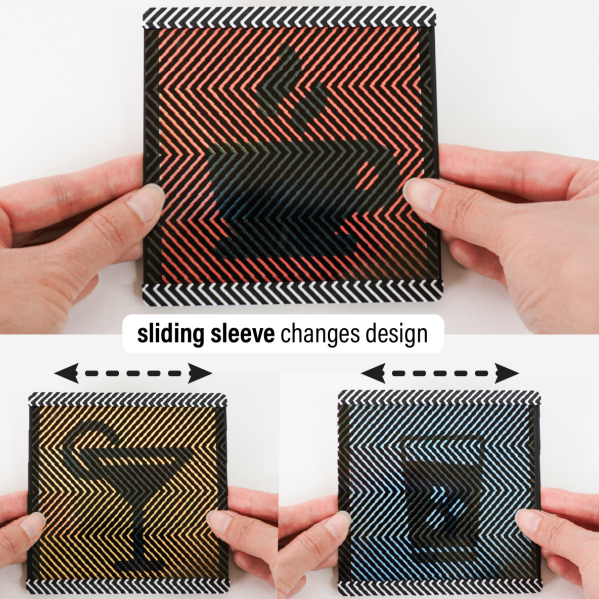
Barrier-grid animations (also called scanimations) are a thing most people would recognize on sight, even if they didn’t know what they were called. Move a set of opaque strips over a pattern, and watch as different slices of that image are alternately hidden and revealed, resulting in a simple animation. The tricky part is designing the whole thing — but researchers at MIT designed FabObscura as a design tool capable not only of creating the patterned sheets, but doing so in a way that allows for complex designs.
The barrier grid need not consist of simple straight lines, and movement of the grid can just as easily be a rotation instead of a slide. The system simply takes in the desired frames, a mathematical function describing how the display should behave, and creates the necessary design automatically.
The paper (PDF) has more details, and while it is possible to make highly complex animations with this system, the more frames and the more complex the design, the more prominent the barrier grid and therefore the harder it is to see what’s going on. Still, there are some very nice results, such as the example in the image up top, which shows a coaster that can represent three different drink orders.
We recommend checking out the video (embedded below) which shows off other possibilities like a clock that looks like a hamster wheel, complete with running rodent. It’s reminiscent of this incredibly clever clock that uses a Moiré pattern (a kind of interference pattern between two elements) to reveal numerals as time passes.
We couldn’t find any online demo or repository for FabObscura, but if you know of one, please share it in the comments.
Check out this informative list of nouns for various animal collectives such as a cackle of hyenas or a murder of crows. Unfortunately, the name for a group of pugs isn’t there: A grumble of pugs!
In May, President Donald Trump signed four executive orders to facilitate the construction of nuclear reactors and the development of nuclear energy technology; the orders aim to cut red tape, ease approval processes, and reshape the role of the main regulatory agency, the Nuclear Regulatory Commission, or NRC. These moves, the administration said, were part of an effort to achieve American independence from foreign power providers by way of a “nuclear energy renaissance.”
Self-reliance isn’t the only factor motivating nuclear power proponents outside of the administration: Following a decades-long trend away from nuclear energy, in part due to safety concerns and high costs, the technology has emerged as a potential option to try to mitigate climate change. Through nuclear fission, in which atoms are split to release energy, reactors don’t emit any greenhouse gases.
The Trump administration wants to quadruple the nuclear sector’s domestic energy production, with the goal of producing 400 gigawatts by 2050. To help achieve that goal, scientific institutions like the Idaho National Laboratory, a leading research institute in nuclear energy, are pushing forward innovations such as more efficient types of fuel. Companies are also investing millions of dollars to develop their own nuclear reactor designs, a move from industry that was previously unheard of in the nuclear sector. For example, Westinghouse, a Pennsylvania-based nuclear power company, plans to build 10 new large reactors to help achieve the 2050 goal.
NASA has announced that its Perseverance Mars rover spotted "potential biosignatures" in an ancient dry riverbed last year.
Samples collected from a rock dubbed "Cheyava Falls" contain a structure that hints at the possibility of having a biological origin, according to the space agency, but more research needs to be completed to draw any conclusions about the presence of life on the Red Planet.
"The identification of a potential biosignature on the Red Planet is a groundbreaking discovery, and one that will advance our understanding of Mars," said interim NASA administrator Sean Duffy in a statement, arguing this is the "closest we have ever come to discovering life on Mars."
The rover first encountered the rock in July 2024 while exploring a rocky outcropping, called the Bright Angel rock formation, on the edge of an ancient river valley, which scientists believe was carved into the Martian surface by a rushing river billions of years ago.
Perseverance's science instruments revealed layers of clay and silt, which are "excellent preservers of past microbial life" on Earth, according to NASA.
"The combination of chemical compounds we found in the Bright Angel formation could have been a rich source of energy for microbial metabolisms," said Stony Brook University associate professor Joel Hurowitz, coauthor of a new paper published in the journal Nature about the finding, in the statement.
Despite the exciting findings, Hurowitz warned that it's still far too early to draw any conclusions about "discovering life on Mars," as Duffy put it, and scientists have yet to rule out abiotic, or non-living, explanations.
"But just because we saw all these compelling chemical signatures in the data didn’t mean we had a potential biosignature," Hurowitz explained. "We needed to analyze what that data could mean."
Mysterious, colorful spots on the Cheyava Falls rock had scientists intrigued. The spots could've been left behind by microbes billions of years ago, after turning organic carbon, sulfur, and phosphorus in the rock into energy.
Some of these "leopard spots" contained greigite, or iron sulfide, which certain Earth-based microbes can produce. They also contained vivianite, or hydrated iron phosphate, which is found near decaying organic matter on Earth.
"These reactions appear to have taken place shortly after the mud was deposited on the lake bottom," Hurowitz told Reuters. "On Earth, reactions like these, which combine organic matter and chemical compounds in mud to form new minerals like vivianite and greigite, are often driven by the activity of microbes."
In other words, scientists are hypothesizing that Martian microbial life could've left us an important clue of their existence eons ago.
Since the Cheyava Falls rock is younger compared to other closely examined Martian rocks, the finding could mean the planet was been habitable for much longer than previously believed.
"Astrobiological claims, particularly those related to the potential discovery of past extraterrestrial life, require extraordinary evidence," said Jet Propulsion Laboratory's Perseverance project scientist Katie Morgan in the NASA statement.
"Getting such a significant finding as a potential biosignature on Mars into a peer-reviewed publication is a crucial step in the scientific process because it ensures the rigor, validity, and significance of our results," she added. "And while abiotic explanations for what we see at Bright Angel are less likely given the paper’s findings, we cannot rule them out."
For one, "there are chemical processes that can cause similar reactions in the absence of biology," Hurowitz told Reuters, meaning that we cannot rule them out "completely on the basis of rover data alone."
However, future research could finally bring us closer to a more definitive answer as to whether microbial life could have once been feeding on ancient rocks on the Red Planet.
In a major change in tune, Google has admitted that the "open web is already in rapid decline" — despite being adamant for months that the "web is thriving."
As first spotted by The Verge, the tech giant attempted to dissuade regulators from breaking up its advertising tech business, arguing that doing so would harm publishers who rely on advertising revenue.
Google argued that splitting up its ad business would "only accelerate" the open web's disintegration ahead of an antitrust trial in a DC court.
It's a peculiar admission, especially considering it's in Google's best interest to downplay the sizable role it plays in the traditional ecosystem of the web. The company has been caught up in several antitrust lawsuits, with regulators finding that it was behaving anti-competitively, using its influence to assume an unprecedented level of control over the open web.
Earlier this year, the US Department of Justice won a separate antitrust case against Google, finding that the company had been operating a monopoly in the adtech business. In August 2024, a judge also ruled that Google had illegally exploited its dominance on the web to stifle innovation and squash competition.
It's worth noting that the search giant is pushing back; a spokesperson told the Verge that the "rapid decline" statement was "cherry-picked," misrepresenting the filing.
"We are pointing out the obvious: that investments in non-open web display advertising like connected TV and retail media are growing at the expense of those in open web display advertising," the spokesperson said.
Cherrypicked or not, Google's choice of words tells a damning story about the situation countless digital publishers find themselves in. Many of them have become highly susceptible to changes in the company's algorithms, seeing traffic, and therefore display ad revenues plummet, practically overnight, earlier this year, as Google makes changes behind the scenes.
Adding insult to injury is Google's embrace of AI, putting its error-laden AI Overviews feature on top of search results to disincentivize users from clicking on links, for instance. Research has shown that Google users are far less likely to visit actual sites when presented with AI-generated summaries.
Google CEO Sundar Pichai attempted to argue the company has played no part in the major drop in internet traffic, telling the Verge earlier this year that it's "definitely sending traffic to a wider range of sources and publishers" thanks to its AI search tools.
Besides Google accelerating the demise of ad revenue-reliant publishers, users have also found that the quality of Google search results has significantly deteriorated as AI slop continues to flood the open web, often exploiting the company's algorithms to float to the top of search rankings.
In short, Google is stuck between a rock and a hard place: it played a mammoth role in the evolution of the modern internet — but with AI now remaking that landscape, it finds its search results flooded by low-quality AI content at the same time that it's forced to integrate AI in ways that feel embarrassing for an entity of its stature.
Amazon is reportedly developing a pair of consumer smart glasses which is slated to rival Meta’s rumored ‘Hypernova’ smart glasses with display, according to a report by The Information.
Citing two people with direct knowledge of the plans, The Information maintains the glasses, internally codenamed ‘Jayhawk’, are set to include include microphones, speakers, a camera, and a monocular, full-color display.
The report maintains Amazon is eyeing a consumer launch of Jayhawk in late 2026 or early 2027, however the price point is currently unknown.
Equally uncertain is whether Jayhawk will be marketed under Amazon’s ‘Echo Frames’ line, first introduced in 2019, including voice-controlled frames and music playback, calls, and smart home control powered by Alexa.
Third-gen Echo Frames | Image courtesy Amazon
Now in its third generation, launched in late 2023, Echo Frames offer essentially the same set of features as the first and second, with the notable outlier being any sort of camera (or display) for photos and video capture.
Additionally, The Information reports that Amazon is also creating smart glasses for its delivery drivers, said to be bulkier and less sleek than the consumer ‘Jayhawk’ model for consumers.
Codenamed ‘Amelia’, the glasses are reportedly set to provide instructions to help sort and deliver packages. Those are said to rollout as soon as Q2 2026, and include an initial production run of 100,000 units.
In contrast, recent reports from supply chain analyst Ming-Chi Kuo and Bloomberg’s Mark Gurman maintain Meta is nearly ready to begin mass production of its own smart glasses with monocular display.
Internally codenamed ‘Hypernova’, and possibly marketed as ‘Celeste’, Meta’s forthcoming smart glasses are expected to cost around $800, according to Kuo.
– – — – –
The Information maintains in its reporting that the glasses will be “augmented reality”, however the device’s description puts it squarely in the smart glasses segment.
In short, AR glasses overlay spatially anchored 3D digital content into the real environment, while smart glasses mainly provide heads-up information or notifications, either by monoscopic or even stereoscopic displays. You can learn more about the difference between AR and smart glasses here.
For a long time, companies have been using relational databases (DB) to manage data. However, with the increasing use of large AI models, integration with graph databases is now required. This process, however, reveals limitations such as cost burden, data inconsistency, and the difficulty of processing complex queries.
C'est un développement qui pourrait faire grand bruit. L'un des dirigeants de Nokia aurait affirmé lors d’un point presse que son entreprise ainsi qu’Ericsson seraient prochainement éjectées de Chine pour des raisons de « sécurité nationale ».
As tech giants race to monetize AI, startups that make shipping AI products faster are coming into focus.
OpenAI’s recent $1.1B purchase of A/B testing & experimentation platform Statsig at a 27.5x revenue multiple — one of its largest acquisitions to date — highlights this shift as model performance gains become increasingly expensive and incremental. Statsig’s CEO Vijaye Raji will also join OpenAI as CTO of Applications to accelerate development of its consumer and enterprise products.
The trend is taking shape across the AI landscape this year. In August, Databricks acquired feature store company Tecton to support its AI agent business, while DataDog snatched up A/B testing company Eppo to strengthen its application development suite in May.
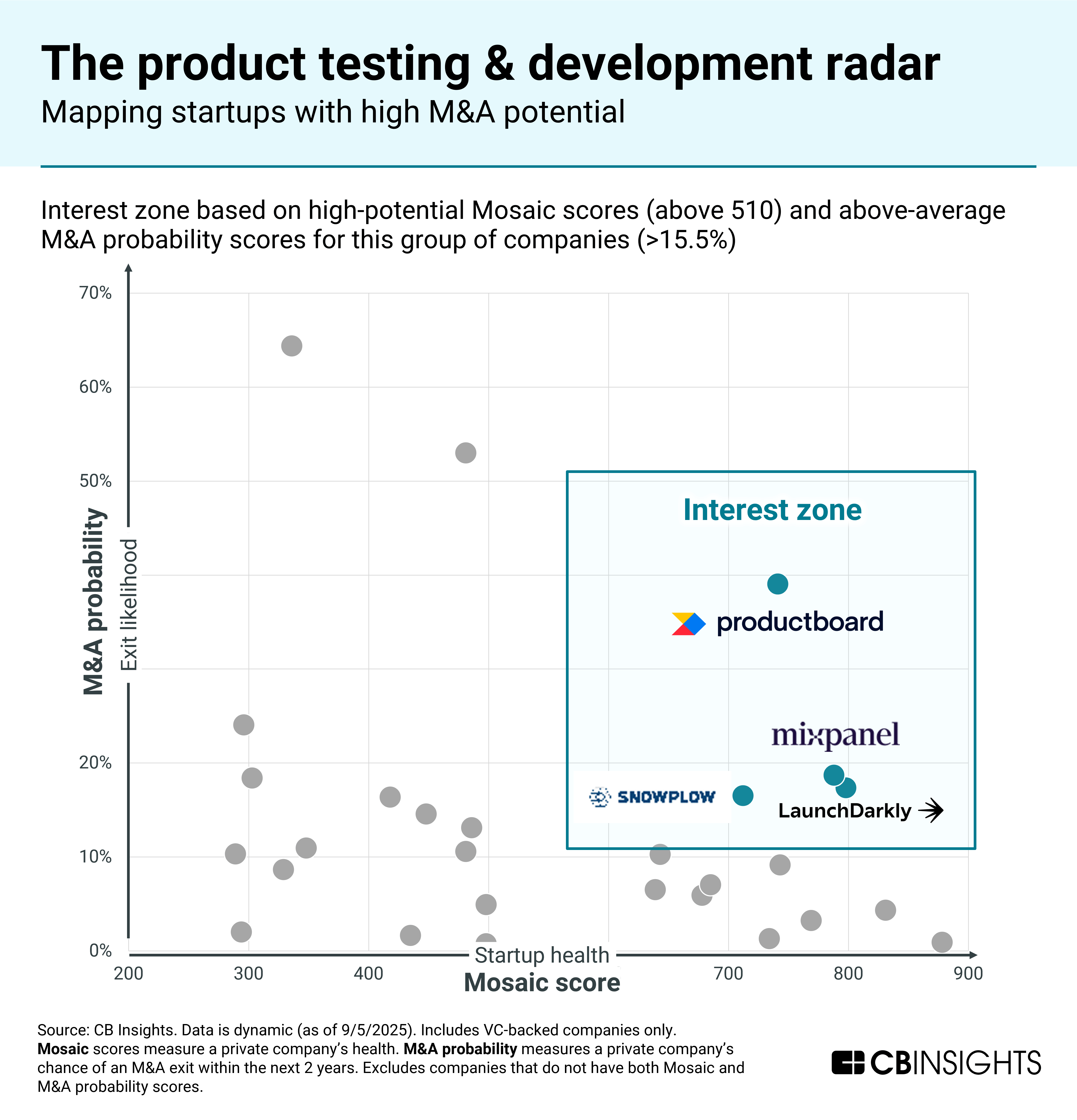
Using CB Insights’ predictive signals, including Mosaic company health scores and M&A probability, we’ve identified the product testing and development platforms that tech giants could acquire next.
AI-focused companies with proven revenue are prime targets: Almost all of the companies in the interest zone enable AI product development. Mixpanel and Snowplow provide product analytics for AI applications, and LaunchDarkly offers AI product feature management. Both Mixpanel and LaunchDarkly have crossed $100M in revenue, indicating product-market validation and traction.
C-level teams feature tech and data expertise that potential acquirers can bring in-house: 3 out of the 4 executive teams in the interest zone come from large tech and SaaS companies. The CEO of LaunchDarkly is ex-Salesforce, AWS, and Microsoft, and the CEO of Productboard spent time at HP and GoodData. Like Statsig, tech talent at the executive level is a ripe target for tech companies seeking this expertise. Based on CBI Funding Insights, LaunchDarkly, and Productboard used their most recent funding rounds to go after new talent and grow their teams, indicating technical expertise across levels.
Partnerships with larger tech and professional services companies signal validation and reach: Established tech and AI companies have business relationships with nearly all of the companies in the interest zone. Databricks partnered with and invested in Snowplow for AI-driven user analytics, Salesforce is a customer of Productboard, and LaunchDarkly integrates with AWS to reduce data transfer costs. Similarly, Productboard partnered with consulting firms like Boston Consulting Group and Slalom to expand reach, and Mixpanel grew its international presence with Seven Peaks and Altudo. These companies have grown not only their own platform capabilities but also their market presence, networks that potential acquirers may want to leverage for reach.
Want to submit your company’s profile data? Please reach out to researchanalyst@cbinsights.com.
For information on reprint rights or other inquiries, please contact reprints@cbinsights.com.
Nvidia's relentless development cycle has resulted in enormous profits for the company, which brought in $41.1 billion in data center sales in its most recent quarter.
Business cards, on the whole, haven’t changed significantly over the past 600-ish years, and arguably are not as important as they used to be, but they are still worth considering as a reminder for someone to contact you. If the format of that card and method of contact stand out as unique and related to your personal or professional interests, you have a winning combination that will cement yourself in the recipient’s memory.
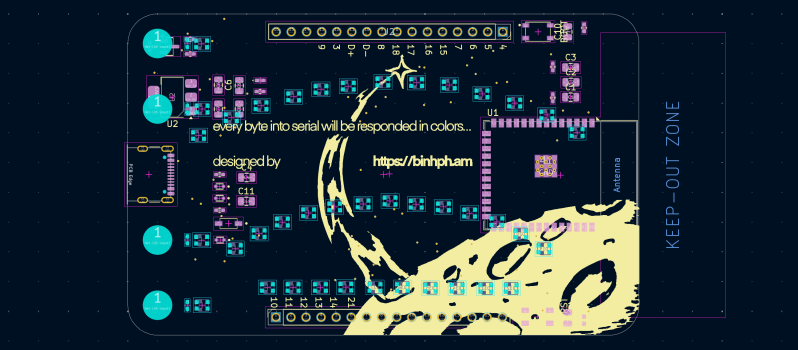
In a case study of “show, don’t tell”, [Binh]’s business card draws on technological and paranormal curiosity, blending affordable, short-run PCB manufacturing and an, LLM or, in this case, a Small Language Model, with a tiny Ouija board. While [Binh] is very much with us in the here and now, and a séance isn’t really an effective way to get a hold of him, the interactive Ouija card gives recipient’s a playful demonstration of his skills.
The interface is an array of LEDs in the classical Ouija layout, which slowly spell out the message your supernatural contact wants to communicate. The messages are triggered by the user through touch pads. Messages are generated locally by an ESP32-S3 based on Dave Bennett’s TinyLlama LLM implementation.
As hackers exploit a high-severity vulnerability in SAP’s flagship Enterprise Resource Planning software product, the software maker is warning users of more than two dozen newly detected vulnerabilities in its other widely used products, including a security flaw with a maximum-severity rating of 10.
SAP on Tuesday said the highest-severity vulnerability—with a rating of 10 out of a possible 10—was found in NetWeaver, a platform that serves as the technical foundation for many of the company’s other enterprise applications. The vulnerability, tracked as CVE-2025-42944, makes it possible for unauthenticated attackers to execute commands by submitting malicious payloads to an open port.
The maximum-severity threat stems from a deserialization vulnerability. Serialization is a coding process that translates data structures and object states into formats that can be stored or transmitted and then reconstructed later. Deserialization is the process in reverse.
According to a Breaking Defense report, the U.S. Army has chosen defense startups Anduril and Rivet to compete against one another in its revamped Integrated Visual Augmentation System (IVAS) project, now called the Soldier Borne Mission Command (SBMC), which is slated to integrate AR headsets into combat roles.
Rivet, partly funded by Palantir and led by former Microsoft IVAS lead David Marra, announced last week it’s secured a $195 million, 18-month contract to prototype and produce 470 “production representative” devices in the new SBMC program.
At present, the company produces an XR platform, called Rivet Hard Spec, which is designed for frontline professionals in defense and industrial sectors. Information is thin on the ground surrounding Hard Spec, and whether the system is playing a central role in the SBMC bid.
Rivet notes however the company will “help the Army field [SBMC] to the Infantry through rigorous iteration with Soldiers, ensuring an adaptable and extensible platform for lethality and overmatch against evolving threats.”
Rivet Hard Spec | Image courtesy Rivet
While Rivet has confirmed it’s secured the $195 million contract for the batch of XR prototypes, Rivet still faces strong competition from a possible Anduril + Meta partnership. In May, Anduril and Meta announced the companies were aiming to make “the world’s best AR and VR systems for the US military.”
Anduril CEO Palmer Luckey, known for creating Oculus Rift and selling the company to Meta (then Facebook) in 2014 for more than $2 billion, teased a military-focused XR device called Eagle Eye, which is said to serve as central component in their SBMC bid.
At the time of this writing, Anduril has not publicly confirmed a contract with the U.S. Army, however Breaking Defense reports Army sources have confirmed their selection alongside Rivet.
The SBMC recompete follows years of challenges with IVAS, which was initially awarded to Microsoft in 2018 to produce a combat-ready AR headset based on HoloLens 2 capable of fulfilling the $22 billion, 10-year production deal.
At the time, it was seen as a way of potentially giving Luckey’s defense company valuable time to work with Army leaders in preparation to recompete for the new, revamped SBMC program.
Dans l’écosystème tech mondial, The Merge s’impose comme l’un des concepts les plus radicaux de la décennie. Popularisé en 2017 par Sam Altman, cofondateur d’OpenAI, il désigne le processus par lequel humains et machines s’intègrent dans un flux bidirectionnel d’informations, jusqu’à former un système cognitif hybride. Ce n’est plus l’homme utilisant l’intelligence artificielle comme un …
Kiabi et Affilae ont su créer un programme d'affiliation et d'influence qui dépasse la simple promotion commerciale. "KIABI Link" est un cas d'école de l'évolution du marketing digital vers plus d'authenticité, d'engagement local et d'innovation technologique, renforçant la croissance économique tout en fidélisant une clientèle impliquée.
Google may have escaped the most serious consequences in its most recent antitrust fight with the US Department of Justice (DOJ), but the European Union is still gunning for the search giant. After a brief delay, the European Commission has announced a substantial 2.95 billion euro ($3.45 billion) fine relating to Google's anti-competitive advertising practices. This is not Google's first big fine in the EU, and it probably won't be the last, but it's the first time European leaders could face blowback from the US government for going after Big Tech.
The case stems from a complaint made by the European Publishers Council in 2021. The ensuing EU investigation determined that Google illegally preferenced its own ad display services, which made its Google Ad Exchange (AdX) marketplace more important in the European ad space. As a result, the competition says Google was able to charge higher fees for its service, standing in the way of fair competition since at least 2014.
A $3.45 billion fine would be a staggering amount for most firms, but Google's earnings have never been higher. In Q2 2025, Google had net earnings of over $28 billion on almost $100 billion in revenue. The European Commission isn't stopping with financial penalties, though. Google has also been ordered to end its anti-competitive advertising practices and submit a plan for doing so within 60 days.
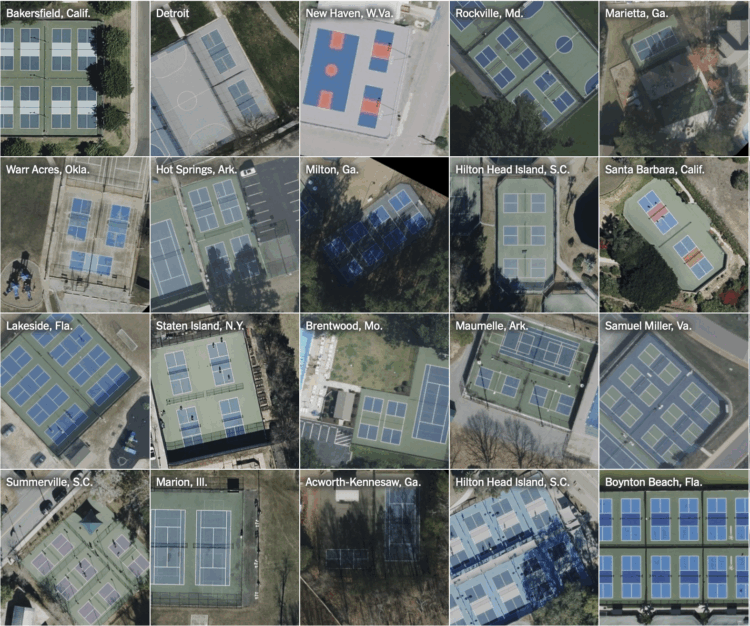
By analyzing nearly 100,000 aerial photographs, we were able to identify more than 26,000 outdoor pickleball courts made in the last seven years — a majority of them at the expense of once-exclusive tennis spaces and created since the onset of the pandemic in 2020. In total, we found more than 8,000 tennis courts that had been transformed for pickleball.
Singer used computer vision to get precise coordinates of each court. Then he compared that data against old photographs to find tennis courts taken over by pickleball.
The sliding effect for before and after photographs works well here, given the contrast between a lone tennis court and a tennis court with four pickleball boundaries drawn on top.
For farmers, every planting decision carries risks, and many of those risks are increasing with climate change. One of the most consequential is weather, which can damage crop yields and livelihoods. A delayed monsoon, for example, can force a rice farmer in South Asia to replant or switch crops altogether, losing both time and income.
Access to reliable, timely weather forecasts can help farmers prepare for the weeks ahead, find the best time to plant or determine how much fertilizer will be needed, resulting in better crop yields and lower costs.
Yet, in many low- and middle-income countries, accurate weather forecasts remain out of reach, limited by the high technology costs and infrastructure demands of traditional forecasting models.
A new wave of AI-powered weather forecasting models has the potential to change that.
A farmer holds dried-up maize stalks in his field in Zimbabwe on March 22, 2024. A drought had caused widespread water shortages and crop failures. AP Photo/Tsvangirayi Mukwazhi
By using artificial intelligence, these models can deliver accurate, localized predictions at a fraction of the computational cost of conventional physics-based models. This makes it possible for national meteorological agencies in developing countries to provide farmers with the timely, localized information about changing rainfall patterns that the farmers need.
The challenge is getting this technology where it’s needed.
Why AI forecasting matters now
The physics-based weather prediction models used by major meteorological centers around the world are powerful but costly. They simulate atmospheric physics to forecast weather conditions ahead, but they require expensive computing infrastructure. The cost puts them out of reach for most developing countries.
Moreover, these models have mainly been developed by and optimized for northern countries. They tend to focus on temperate, high-income regions and pay less attention to the tropics, where many low- and middle-income countries are located.
A major shift in weather models began in 2022 as industry and university researchers developed deep learning models that could generate accurate short- and medium-range forecasts for locations around the globe up to two weeks ahead.
These models worked at speeds several orders of magnitude faster than physics-based models, and they could run on laptops instead of supercomputers. Newer models, such as Pangu-Weather and GraphCast, have matched or even outperformed leading physics-based systems for some predictions, such as temperature.
AI-driven models require dramatically less computing power than the traditional systems.
While physics-based systems may need thousands of CPU hours to run a single forecast cycle, modern AI models can do so using a single GPU in minutes once the model has been trained. This is because the intensive part of the AI model training, which learns relationships in the climate from data, can use those learned relationships to produce a forecast without further extensive computation – that’s a major shortcut. In contrast, the physics-based models need to calculate the physics for each variable in each place and time for every forecast produced.
While training these models from physics-based model data does require significant upfront investment, once the AI is trained, the model can generate large ensemble forecasts — sets of multiple forecast runs — at a fraction of the computational cost of physics-based models.
Even the expensive step of training an AI weather model shows considerable computational savings. One study found the early model FourCastNet could be trained in about an hour on a supercomputer. That made its time to presenting a forecast thousands of times faster than state-of-the-art, physics-based models.
The result of all these advances: high-resolution forecasts globally within seconds on a single laptop or desktop computer.
While AI weather models offer impressive technical capabilities, they are not plug-and-play solutions. Their impact depends on how well they are calibrated to local weather, benchmarked against real-world agricultural conditions, and aligned with the actual decisions farmers need to make, such as what and when to plant, or when drought is likely.
To unlock its full potential, AI forecasting must be connected to the people whose decisions it’s meant to guide.
That’s why groups such as AIM for Scale, a collaboration we work with as researchers in public policy and sustainability, are helping governments to develop AI tools that meet real-world needs, including training users and tailoring forecasts to farmers’ needs. International development institutions and the World Meteorological Organization are also working to expand access to AI forecasting models in low- and middle-income countries.
Many low-income countries in Africa face harsh effects from climate change, from severe droughts to unpredictable rain and flooding. The shocks worsen conflict and upend livelihoods. AP Photo/Sunday Alamba
AI forecasts can be tailored to context-specific agricultural needs, such as identifying optimal planting windows, predicting dry spells or planning pest management. Disseminating those forecasts through text messages, radio, extension agents or mobile apps can then help reach farmers who can benefit. This is especially true when the messages themselves are constantly tested and improved to ensure they meet the farmers’ needs.
A recent study in India found that when farmers there received more accurate monsoon forecasts, they made more informed decisions about what and how much to plant – or whether to plant at all – resulting in better investment outcomes and reduced risk.
A new era in climate adaptation
AI weather forecasting has reached a pivotal moment. Tools that were experimental just five years ago are now being integrated into government weather forecasting systems. But technology alone won’t change lives.
With support, low- and middle-income countries can build the capacity to generate, evaluate and act on their own forecasts, providing valuable information to farmers that has long been missing in weather services.





 The barrier grid need not consist of simple straight lines, and movement of the grid can just as easily be a rotation instead of a slide. The system simply takes in the desired frames, a mathematical function describing how the display should behave, and creates the necessary design automatically.