Shared posts

23 May 00:51

Tue, May. 12 Electoral Vote Predictor

Trump is Bombing When It Comes to Iran

It took 10 days, but the Iranians have finally responded to Donald Trump's "blueprint" for peace with a list of demands. And the President promptly got on his Obama-centric social media platform to announce:

I have just read the response from Iran's so-called "Representatives." I don't like it—TOTALLY UNACCEPTABLE! Thank you for your attention to this matter. President DONALD J. TRUMP

It would seem last week's reports that the end might be near were a wee bit premature. Well, the end of the Iran War, at least. The big "the end is near" is still on the table.

Before we continue, let us address that "Obama-centric" bit. We like to link to the Truth Social postings, whenever possible, so readers can see for themselves, if they wish. But it took us forever to find the Iran pronouncement. That is because after that little bit of Trumpian diplomacy, the President (or someone working for him) went on an absolutely unhinged jag, posting dozens of angry messages/videos about Obama, Joe Biden, and Hillary Clinton. These folks have been out of office for 10 years, nearly 2 years, and more than 12 years, respectively. And yet, Trump is STILL beating that drum. It's yet another reminder that something is very wrong with him, either emotionally, or mentally, or both. His constantly shifting "policy" on Iran, if you can even call it that, should be viewed through that prism.

The Iranians' demands are as follows:

  • An end to the war (including Israel's war in Lebanon)
  • An end to the U.S. blockade
  • No further U.S. or Israeli attacks
  • Reparations for damages
  • All Western economic sanctions to be lifted
  • The release of Iran's frozen assets
  • Iran's continued control over the Strait of Hormuz
  • No negotiations over Iran's nuclear program until all of the other demands are satisfied

That is a "Here's what I want for Christmas, Santa" list of demands (the Iranians' Muslim-ness notwithstanding). So, it's no surprise Trump does not like it.

The problem is that Trump has backed himself into a very tenuous corner. He's clearly not willing to order a ground invasion (and if he does, there will be riots in the streets in the U.S.). His effort to impose American military might on the Strait of Hormuz, "Project Freedom," was a failure. Conventional bombing was not effective, and the United States' stockpile of "smart" missiles is now depleted. Trump has obliquely threatened, several times, to nuke Iran. However, that is not likely to be any more effective than the conventional bombing was, and would trigger outrage domestically and abroad. And every time Trump issues forth with a bunch of hot air, and doesn't follow through, it makes every subsequent blast of hot air even less effective.

Meanwhile, perhaps Trump's very biggest problem is this: Iran's leadership doesn't particularly need the war to end. They might even prefer that it not end. After all, as long as Iranians have a common enemy, domestic dissent is largely stifled. Further, the people calling the shots right now are (apparently) the leaders of the Islamic Revolutionary Guard Corps (IRGC). This is not only a military organization, it is a militaristic military organization. That is the kind of entity that tends to see war as a good thing, not something to be avoided or ended.

And while the Iranians can afford to cool their jets, at least for a while, the pressure on Trump is growing. First, even with all the verbal gymnastics, it's clear that the Iran War is well past the 60-day limit for warring without Congressional approval. The members don't want the blame for this mess, so they aren't likely to pass a use-of-force authorization. Will they eventually stand up and demand that Trump withdraw? They might, given the unpopularity of the war, and the fact that the price tag keeps ballooning. The preternaturally dishonest Secretary of Defense Pete Hegseth looked the members right in the face and said that the war had cost $25 billion so far. The true figure appears to be almost triple that.

And then, of course, there's the gas-price problem. Not to be a broken record, but prices are up again. Yesterday, the national average was $4.50/gallon, which is up 38 cents compared to a month ago, and is up $1.37 compared to a year ago. Trump is talking about suspending the federal gas tax, and has also just released another 53 million barrels of oil from the United States' Strategic Petroleum Reserve. However, these things are both relative drops in the barrel. Nothing is going to substantially reverse the upward trend beyond the end of the war and then supply chains being unsnarled. And even then, it's probably too late for the midterms; analysts are now saying that even if the war ends in short order, oil prices won't return to pre-war levels until early-to-mid 2027.

And finally, there's the thing that Trump cares most about, namely his public image. The war is certainly doing a number on his approval ratings. Everyone reading this already knows he's approaching the Bush line (32% approval) nationally, so let's do this another way: He is now above water in just six states: Idaho, Wyoming, North Dakota, Oklahoma, Tennessee and West Virginia. That is a very short list, especially since those states have only about 5% of the U.S. population.

Trump has also become the butt of jokes, even more so than usual. For example, since TACO has gotten a little stale, there's now a veritable buffet of Mexican-food acronyms out there. A sampling:

TORTA: Trump Only Rarely Thinks Ahead

TAMALE: Trump Always Makes America Look Embarrassing

CEVICHE: Cowardly Enabler Vance Is Complicit Helper Elf

CHICKEN QUESADILLAS: Closing Hormuz Is Causing Kerfuffle; Every Negotiation Quickly Unravels; Economic Situation Awful; Donald Is Laughably Lousy American Sovereign

CORONA WITH LIME: Come On, Republicans! Obtain Nuts Already! Wallowing In Trump's Horrendous Leadership Is Manifestly Evil!

CHIMICHANGA: Criminal Hegseth Is Making It Clear He Approves Nuclear Genocidal Armageddon

All we can say is: Ouch. Well, and also: ¡Olé!

If Trump were a rational president, we might be able to hazard a guess as to how he'll play his hand. However, he is not rational (see the point about Obama above), and we do not believe for a minute that he's using some version of the Nixon "madman theory" (which didn't work, anyhow). So, we have absolutely no idea what Trump will do. (Z & A)

18 May 15:03

An LA-area mayor acted as an agent for China. Experts say it's part of a pattern

by Vanessa Romo
Eileen Wang, now the former mayor of the City of Arcadia, agreed to plead guilty to one felony charge that she acted as an illegal foreign agent of China.

Eileen Wang, now the former mayor of the City of Arcadia, agreed to plead guilty to one felony charge that she acted as an illegal foreign agent of China.

(Image credit: Frazer Harrison)

14 May 17:48

Valtteri Bottas reveals FBI involvement after Cadillac stolen during Miami GP weekend

Cadillac Formula 1 driver Valtteri Bottas has revealed that his car was stolen during the Miami Grand Prix weekend, leaving the thief with his paddock pass and VIP parking pass, and the FBI was involved.
The Finnish driver detailed how the Cadillac Escalade provided by the team was taken from the driveway of his Airbnb during the What's Next podcast with Paul Ripke for the Cadillac driver's ...Keep reading
14 May 14:53

Japanese snack packages turning black-and-white as Iran war depletes ink supply

by The Associated Press
This image made from video provided by Japan

The packaging on some snacks is turning black-and-white, as the war in Iran disrupts the supply of an ingredient used in colored ink. Calbee's chips originally came in a bright-orange bag.

(Image credit: AP)

14 May 14:42

Apple Taps Intel 18A-P Node for M7 MacBook Chip, 14A Node for iPhone

by AleksandarK
According to the sell-side equity research firm GF Securities, Apple is set to utilize both Intel's 18A-P and 14A nodes for its product lineups. As previously reported, the company will employ Intel's advanced 18A-P node for the M7 SoCs that power MacBook Air and entry-level MacBook Pro laptops. Intel's investment in the development and manufacturing ramp of the 14A node will also be beneficial, as Apple plans to use the 14A node for producing A21 SoCs for iPhones. The 18A-P node is ideal for Apple's laptop SoCs, providing a balance between efficiency and speed. It offers a 9% performance increase at the same power level or achieves 18% power savings at the same performance level compared to the standard 18A node, resulting in laptops with good frequency and low power usage. With Apple moving away from TSMC's 3 nm node in the current M5 SoC, the improvements will be significant and are expected to be realized by 2027.

For the A21 iPhone SoCs, Apple will use Intel's advanced 14A node, which promises a generational leap in density, frequency, and power savings. Apple's primary goal is to employ a more advanced node for mobile devices, with plans to have these chips ready by 2028. As this is anticipated to begin in about two years, Apple will likely wait for the final 14A PDK before starting trial production. It remains uncertain whether the company will manufacture its A21 Pro SoC at TSMC and leave the regular version to Intel. However, Apple is gradually diversifying its supply chain with more silicon manufacturers. With advanced packaging, Intel can compete with TSMC in many areas, and we are eager to see the outcomes of this competition.

13 May 15:42

Israel's government is expected to collapse over ultra-Orthodox military draft

by Daniel Estrin
Police use water cannon to disperse ultra-Orthodox Jewish men blocking a street during a protest against the country

An ultra-Orthodox Jewish party in Israeli Prime Minister Benjamin Netanyahu's coalition has called for parliament to be dissolved, threatening to bring down the government.

(Image credit: Leo Correa)

12 May 15:26

Mon, May. 11 Electoral Vote Predictor

Trump Is Shaking Down TikTok to Build His Arc de Trump

Donald Trump is definitely the first socialist president. He demonstrates that over and over. All the other presidents have left companies to make their own decisions based on what is best for them. Occasionally, something gets out of hand—like health insurance—and then the government tries to patch it up—for example by offering subsidies, as in the ACA, not by buying up health insurance companies. The government has never told companies how to run their businesses. Well, until Trump showed up. Here is a list of companies Trump has had the government partially buy.

Another area where Trump has deeply immersed the government in private companies' decisions is by "encouraging" them to do something he wants, with an implicit understanding that Bad Things will happen if they don't. Nice company you got there. It would be a pity if something happened to it. Getting the Ellisons to buy CNN is the poster child here. And now, Trump is back at it again. This time he wants TikTok to fork over $400 million for D.C. "beautification," including construction of the Arc de Trump, which he—alone—thinks is beautiful. His "argument" to TikTok is that if it ponies up, he will drop the lawsuit against the company. The lawsuit is about TikTok's pushing inappropriate content to young children. Normally, when the government wins a lawsuit of that type, the proceeds go to trying to right the wrong, not to building a giant monument to the Dear Leader.

This is not the first time Trump tried to get something from TikTok. When he took office in Jan. 2025, a federal law required TikTok to sell its American operations to some American firm or consortium. Trump ultimately brokered a deal in which the Chinese parent company, ByteDance, sold part of its U.S. operations to a consortium led by Oracle and also including other investors. ByteDance will have about 20% of the stock in the joint venture. Trump's interest in the deal had nothing to do with protecting children. It was all about who gets the profits from TikTok's U.S. operations. Now much of it will go to his cronies in the U.S. and some foreign investors, including the U.A.E. The model here is Russia. Vladimir Putin doesn't have a personal stake in all the companies his wholly owned oligarchs run, but the oligarchs are well aware that the deal is this: They support Putin and in return he arranges for them to become very rich. Friends help friends. It's natural. (V)

12 May 15:00

Anthropic’s bug-hunting Mythos was greatest marketing stunt ever, says cURL creator

cURL developer Daniel Stenberg has seen Anthropic’s Mythos, a model the AI biz has suggested is too capable at finding security holes to release publicly, scan his popular open source project. But after the system turned up just a single vulnerability, he concluded the hype around Mythos was “primarily marketing” rather than a major AI security breakthrough. Stenberg explained in a Monday blog post that he was promised access to Anthropic’s Mythos model - sort of - through the AI biz’s Project Glasswing program. Part of Glasswing involves giving high-profile open source projects access via the Linux Foundation, but while Stenberg signed up to try Mythos, he said he never actually received direct access to the model. Instead, someone else with access ran Mythos against curl’s codebase and later sent him a report. “It’s not that I would have a lot of time to explore lots of different prompts and doing deep dive adventures anyway,” Stenberg explained. “Getting the tool to generate a first proper scan and analysis would be great, whoever did it.” That scan, which analyzed curl’s git repository at a recent master-branch commit, was sent back to him earlier this month, and it found just five things that it claimed were “confirmed security vulnerabilities” in cURL. Saying he had expected an extensive list of vulnerabilities, Stenberg wrote that the report “felt like nothing,” and that feeling was further validated by a review of Mythos’ findings. “Once my curl security team fellows and I had poked on this short list for a number of hours and dug into the details, we had trimmed the list down and were left with one confirmed vulnerability,” Stenberg said, bringing us back to the aforementioned number. As for the other four, three turned out to be false positives that pointed out cURL shortcomings already noted in API documentation, while the team deemed the fourth to be just a simple bug. “The single confirmed vulnerability is going to end up a severity low CVE planned to get published in sync with our pending next curl release 8.21.0 in late June,” the cURL meister noted. “The flaw is not going to make anyone grasp for breath.” That said, Mythos did find several other non-security bugs that Stenberg said the team is working on fixing, and he notes that their description and explanation were well done. Mythos can do good work, in other words, but it’s not a ground-breaking, game-changing AI model like Anthropic has claimed. “My personal conclusion can however not end up with anything else than that the big hype around this model so far was primarily marketing,” Stenberg said in the blog post. “I see no evidence that this setup finds issues to any particular higher or more advanced degree than the other tools have done before Mythos.” cURL code is no stranger to AI To say cURL has become widely used in its nearly three decades of existence would be an understatement. Its wide reach has meant that its team has been running it through all sorts of static code analyzers and fuzz testing it since well before the dawn of the AI age. With AI’s rise, the cURL team has adapted, meaning Mythos is hardly the first AI to get its fingers on cURL’s codebase. “These tools and the analyses they have done have triggered somewhere between two and three hundred bugfixes merged in curl through-out the recent 8-10 months or so,” Stenberg said of tools like AISLE, Zeropath, and OpenAI Codex Security that’ve tested cURL code. “A bunch of the findings these AI tools reported were confirmed vulnerabilities and have been published as CVEs. Probably a dozen or more.” Stenberg’s experience with AI testing cURL, in other words, makes it a great candidate to see how effective Mythos can really be at finding more than the average AI. As Stenberg noted elsewhere in his blog post, Mythos isn’t doing anything particularly novel when it comes to security discoveries: It might be a bit better at finding things than previous models, but “it is not better to a degree that seems to make a significant dent in code analyzing,” the cURL author noted. Stenberg isn’t an AI doomer when it comes to its ability to improve software design, though. Yes, he may have closed the cURL bug bounty earlier this year due to an influx of sloppy, useless bug reports, but he also noted a few months prior to the bounty closure that some security researchers assisted by AI have made valuable reports. “AI powered code analyzers are significantly better at finding security flaws and mistakes in source code than any traditional code analyzers did in the past,” Stenberg said, adding an important qualifier for the Mythos moment: “All modern AI models are good at this now.” Mythos isn’t any more creative than its creators Both older AI models and security-focused tools like Mythos have a common limitation, as far as Stenberg is concerned: They’re only as good at finding security vulnerabilities as the humans who programmed them. “AI tools find the usual and established kind of errors we already know about. It just finds new instances of them,” Stenberg said. “We have not seen any AI so far report a vulnerability that would somehow be of a novel kind or something totally new.” As for Mythos, Stenberg remains unimpressed, calling it "an amazingly successful marketing stunt for sure" in his blog post. In an email to The Register, Stenberg admitted that it’d be possible for AI models to actually discover new, novel types of vulnerabilities, but he’s still not convinced that they can go beyond what humans are capable of finding, given that they’re limited by our understanding of how software vulnerabilities work. At the end of the day, Stenberg explained, when we talk about security, we’re only talking about code. “Source code is text and it feels like maybe we already know about most ways we can do security problems in it,” he pondered in his email. In other words, like the valuable AI-assisted reports made to the cURL bug bounty program before its closure due to a flood of AI garbage, making valuable use of systems like Mythos is going to require humans to get creative. Sorry, no foisting your critical thinking onto a bot. “Human researchers have always used tools when they look for security problems,” Stenberg told us. “Adding AIs to the mix gives the humans even more powerful tools to use, more ways to find problems. I expect that many security bugs going forward will be found by humans coming up with new ways and angles of prompting the AIs.” Stenberg said that he hopes he’ll actually get his hands on Mythos so he can experiment with its capabilities, but he doesn’t seem to be holding out hope the promised access will materialize. “I have been promised access and for all I know I will eventually get it,” Stenberg told us. “I just don't know when.” ®
12 May 14:34

Trump taps former FEMA director to lead the disaster agency again

by Rebecca Hersher
Johnathan Smith

I guess he couldn't find anyone else willing to do it.

Cameron Hamilton, above, has been nominated by President Trump to lead the Federal Emergency Management Agency (FEMA). He previously led the agency in an acting capacity, but was removed by the Trump administration about a year ago after telling Congress that did not think the agency should be eliminated.

Cameron Hamilton led FEMA briefly in 2025. He was removed by the Trump administration after telling Congress that the agency should continue to exist. Now, he's been nominated to lead it once again.

(Image credit: Jose Luis Magana)

09 May 23:01

Sat, May. 09 Electoral Vote Predictor

Legal News, Part I: Virginia Supreme Court Decides to Rock Democrats' World

Yesterday, the Virginia Supreme Court invalidated the special election in which Virginia voters approved the legislature's new district maps that would (likely) allow Democrats to gain four more Congressional seats. In a 4-3 decision, the Court found that the state legislators did not follow the process outlined in the state Constitution, which requires two votes in the general assembly with an intervening election between the two votes.

The exact language of the provision, Article XII, Section 1 states:

Any amendment or amendments to this Constitution may be proposed in the Senate or House of Delegates, and if the same shall be agreed to by a majority of the members elected to each of the two houses, such proposed amendment or amendments shall be entered on their journals, the name of each member and how he voted to be recorded, and referred to the General Assembly at its first regular session held after the next general election of members of the House of Delegates.

The general assembly first passed the proposed amendment on October 31, 2025, with an election on November 4, 2025. The second approval occurred in January in the 2026 regular session. Voters then approved the measure on April 21.

The issue for the Court was the meaning of the phrase "next general election." Both sides agree that the purpose of this intervening election is to give voters a chance to indirectly respond to an effort to amend the Constitution by voting either for or against the delegates who supported (or opposed) the measure. And then, of course, voters have the chance to vote on the measure directly if it passes in two sessions of the general assembly. Early voting for the 2025 general election began on September 19, so many votes had already been cast by the time of the first vote in the legislature on October 31. The question, then, is whether the legislature followed the requirement to pass the proposal and then pass it again "after the next general election."

The majority held that "general election" includes the period of early voting, so the first vote in the legislature needed to occur before September 19. Because so many voters cast their ballots in the November 2025 election without knowing how their representative voted on the proposal, the Court held that both the letter and spirit of the state Constitution had been violated and the only appropriate remedy was to render the results of the subsequent special election in April 2026 null and void.

The dissent argues that the term "general election" refers to November 4, which is consistent with other state statutes interpreting that phrase. Both the majority opinion and dissent go through lots of linguistic gymnastics to justify their respective interpretations, but what is left unsaid by the majority is why early voters from the November general election matter more than all the voters who cast ballots in the April special election. No one claims that Virginia voters were not given the chance to decide directly whether to adopt the new Congressional maps.

While there is support in the constitutional provision for the majority's position, it's very difficult not to see this decision as yet another partisan ruling by an ideological court. In Virginia, justices are nominated and appointed by the state legislature, such that it's not always clear-cut who is a "Republican justice" and who is a "Democratic justice." That said, three of the judges who voted in the majority (Associate Justices Arthur Kelsey, Stephen McCullough and Teresa Chafin) were selected and appointed when Republicans controlled both chambers of the legislature. The fourth (Associate Justice Wesley Russell Jr.) was selected and appointed by a Republican House of Delegates and a Democratic Senate. Two of the judges in the minority (Chief Justice Cleo Powell and Associate Justice Thomas Mann) were also selected and appointed by a Republican House of Delegates and a Democratic Senate, while Associate Justice Junius P. Fulton III was selected and appointed while the Democrats controlled both chambers. Anyhow, while not as clear as the Supreme Court's current 6-3 breakdown, it's still quite obviously correct to describe the decision as the work of a Republican majority.

And it doesn't exactly inspire confidence that this decision is strictly law-based, given that the opening paragraphs are a lecture to Democrats of the harmful effects of partisan gerrymandering. Kelsey even quotes Associate Justice Elena Kagan's dissent in Rucho v. Common Cause, while ignoring the conservative majority's pronouncement that partisan gerrymandering is not the judiciary's business. Given the top court's encouragement of the practice in the Callais decision and the gleeful alacrity with which Republicans have moved to destroy Black-majority districts, it's the height of hypocrisy to begin the decision with a lecture to Democrats on the distastefulness of the practice.

It seems to us that given the drastic remedy of invalidating an election and disenfranchising all Virginia voters, since the provision of Virginia law is open to both interpretations, the more prudent course would have been to choose the ruling that would be least disruptive to the (small d) democratic process. Of course, the legislature can always try again with an eye toward 2028, but it was an expensive and difficult process the first time around with just a bare majority of voters supporting it. So, there may not be an appetite for round two.

In the short-term, meanwhile, Virginia Democrats have asked the State Supreme Court to stay its ruling while they appeal to the U.S. Supreme Court. They might get the stay, since that is usually pro forma, or they might not, because the matter is very time sensitive. However, do not hold your breath waiting for the U.S. Supreme Court to hear the case, or even to take it. SCOTUS is generally supposed to defer on matters of state law, and this SCOTUS is very happy to do so, at least when a state-level decision is one that the six conservatives agree with, politically. (L & Z)

08 May 14:23

Devastating 'Dirty Frag' exploit leaks out, gives immediate root access on most Linux machines since 2017, no patches available, no warning given — Copy Fail-like vulnerability had its embargo broken

by Bruno Ferreira
Dirty Frag exploit gets root on most Linux machines since 2017, no patches available
07 May 16:29

Thu, May. 07 Electoral Vote Predictor

Johnathan Smith

At this point I'm hoping the gerrymander situation gets to the point where actual reform happens. The R states seem to have already milked this one about as much as possible, they won't compromise until the D states outdo them.

New York Moving Towards More Gerrymandering

Now that Florida has raised the gerrymandering stakes, another state is gearing up to join the party: New York. The state House delegation has seven Republicans, and state Democrats think they can come up with a map that reduces that to three. The districts that the Democrats want to flip are on Long Island, on Staten Island, in the Hudson Valley, and one upstate.

However, the state Constitution makes it impossible to change the map for 2026, so the Democrats' focus, with urging from Gov. Kathy Hochul (D-NY) and House Minority Leader Hakeem Jeffries (D-NY), is to aim for the 2028 elections. That will require a referendum in 2027, in which the voters will have to approve a constitutional amendment.

One complication is that the Assembly and Senate have somewhat different ideas about how to go about this and how permanent the new rules should be. The state legislators want to get it right this time. They made a mess last time. The initial map after the 2020 census was fought over in court. In the end, a judge threw out the official map and hired a special master to draw a new map. This allowed Republicans to gain seats in 2022. In 2023, the Court of Appeals made the state redraw the map again. The next year, another commission drew another map. So the legislators want to have a procedure and draw a map that will pass all the expected court fights.

New York isn't the only blue state that is going to go wild in 2028. Colorado currently has a 4D, 4R split. State legislators are going for 7D, 1R in 2028, but for legal reasons they can't do it this year. If every state goes for broke, that might actually make enough people so angry that Congress might be forced to address the American rotten boroughs problem. This is, of course, the outcome we are rooting for. (V)

07 May 16:18

1 in 8 employees totally cool with selling work credentials

You can't trust anyone these days! Get together with seven of your colleagues, and there’s a decent chance one of the eight will say they’ve either sold company login details in the past year or know someone who has, says UK fraud prevention outfit Cifas. That 13 percent figure is shocking. Just as strikingly, Cifas found a similar 13 percent of employees overall believed selling access to company systems was justifiable, though the org’s Workplace Fraud Trends report did not spell out those justifications. Regardless, Cifas says it suggests that there’s a worrying shift happening among attitudes toward insider-enabled fraud that should trouble leadership. Then again, leadership might not be too worried based on the data. Cifas doesn’t give a precise number for the share of rank-and-file employees who feel selling credentials is justified, but it does call attention to how leadership feels, and the more power they have, the more they seem to think it’s okay to sell their access. Thirty-two percent of managers, 36 percent of directors, and 43 percent of C-suite executives said it was justifiable to sell their login details. Even more shockingly, a full 81 percent of business owners felt the exact same way. As for why, that’s not entirely clear, though Cifas told us it’s heard various excuses in the past. Financial challenges, the belief it would be a harmless one-off, confidence they wouldn’t get caught, and disgruntlement were among the reasons cited for selling credentials. If you’re wondering who to keep an eye on, Cifas suggests looking at IT and telecoms professionals, who showed the highest tolerance for fraud-related behavior across multiple scenarios covered in the study. Those scenarios included the aforementioned selling of login details, as well as secretly moonlighting for a competitor, using fraudulent references on job applications, expense fraud, and the like. Selling access to company systems was one of the less common types of fraud covered in the survey, but the 13 percent figure reflects respondents who said they had done it or knew someone who had - meaning that, in a company of 1,000 people, around 130 might report direct or indirect exposure to the behavior. The fact that leadership respondents and IT and telecoms professionals showed higher tolerance for such activity makes the findings more concerning, even if the survey focused specifically on selling login details, in some cases to a former colleague. This data is specific to the UK, mind you, but there’s no reason to assume a relaxed attitude toward such a critical cybersecurity weakness is confined to the Isles - that’s just as likely as the person buying those credentials keeping it to themselves. When asked if Cifas had comparable data from prior years to compare this to, the organization described its findings as revealing “a worrying shift in attitudes toward insider-enabled fraud.” However, the firm said that this is the first year it compiled this report, so it doesn’t have comparable data. Nonetheless, Cifas Director of Learning Rachael Tiffen said in a press release that the point is that organizations need to be aware of how many employees might be willing to sell access to company systems. “These findings show how vital it is for organisations to build fraud‑aware cultures, where employees at all levels understand their responsibilities and the consequences of their actions,” Tiffen said. Be sure to pay them well, too. ®
07 May 01:21

Xbox CEO Asha Sharma kills Copilot for Gaming — overhauls leadership with CoreAI veterans

by Luke James
Johnathan Smith

I'm shocked.

Sharma took over as Xbox CEO in February after Phil Spencer retired following 38 years at Microsoft.
05 May 18:06

A United jet struck a light pole and a truck near Newark airport, police say

by Joel Rose
Johnathan Smith

The truck dash cam video is crazy.

A United Airlines 767-300ER at the gate at Newark Liberty International Airport on March 18, 2026.

New Jersey State Police say a United Airlines passenger jet struck a light pole and damaged a truck as it was coming in for a landing at Newark Liberty International Airport on Sunday.

(Image credit: Kena Betancur)

05 May 14:41

Google, Microsoft, and xAI agree to let US government test AI models before public release — OpenAI and Anthropic also on board after renegotiating deals with Washington

by Luke James
Johnathan Smith

I suppose this may just be another path for bribes.

OpenAI and Anthropic, which had existing evaluation partnerships with the center dating to 2024, renegotiated their deals to align with priorities in Trump's AI Action Plan.
04 May 19:04

Utah first state to hold websites liable for users who mask their location with VPNs — law goes into effect, designed to prevent bypassing age checks

by Luke James
Johnathan Smith

It's always strange where "Think of the kids" ends up. I don't see how this in enforceable regardless of what the lawmakers say.

Utah's Online Age Verification Amendments, formally Senate Bill 73, take effect on May 6.
04 May 14:34

Japan is deploying ultra-cheap cardboard drones built for swarm warfare and expendable combat missions — $2,000 expendable combat drones cost less than some gaming PCs

by Etiido Uko
Japan is deploying ultra-cheap cardboard drones built for swarm warfare and expendable combat missions. The flat-packed AirKamuy 150 costs as little as $2,000 — far cheaper than many military drones.
02 May 23:01

Mon, Apr. 27 Electoral Vote Predictor

Johnathan Smith

What are the other 23% thinking?

Three-quarters of Voters Blame Trump for Gas Prices

We doubt that the OED will choose "affordability" as the word of the year, but in the political world, affordability certainly is worthy of the honor. The midterms may well hinge on which party does a better job of convincing the voters that it can handle prices better than the other party.

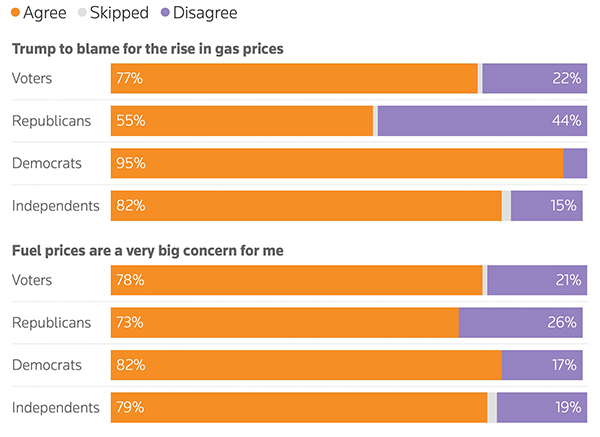
For many voters, the key to affordability is the price of gas, which currently averages $4.07/gal. nationally. The voters don't like that one bit. And a new Reuters/Ipsos poll puts the blame for high gas prices squarely in Donald Trump's lap:

Poll about gas prices

A full 77% of registered voters put the blame on Donald Trump on account of his decision to go to war with Iran. Not surprisingly, 95% of Democrats blame Trump, but also 82% of independents and even 55% of Republicans. Also important is that 78% of voters say gas prices are a big concern. Fewer Republicans say it is a concern than Democrats, but that could be their way of getting Trump off the hook rather than actually being less interested.

In addition, the poll showed that 58% of the voters, including two-thirds of independents, do not want to support a candidate who supports Trump's approach to handling Iran. And the longer the war goes on, the higher this number will be. (V)

02 May 22:45

IBM's AI coding 'partner' Bob hits general availability

by Joe Fay
Johnathan Smith

It just so happens one of my racing friends works at IBM and the subject of AI coding came up recently. That's when I learned about Bob. From his telling, it sounded like Bob was about on par with a very entry level coder that needed to be double checked a ton. Not exactly the sort of thing that made him worried about his job from a productivity perspective, not that that is any sort of protection at IBM.

80,000 internal guinea pigs, Bobcoins, mainframe dreams and a name that really should have raised more flags

IBM has announced global availability of Bob, the AI coding assistant - sorry partner - which it claims has delivered a productivity boost to the 80,000 big bluers pressed into guinea pig status last year.…

01 May 15:21

Google, Microsoft, Meta, and Amazon capex spending to hit $725 billion in 2026, up 77% from last year — analyst says bear thesis is 'garbage'

by Luke James
Google, Amazon, Microsoft, and Meta collectively plan to spend $725 billion on capex in 2026, up 77% from last year's record $410 billion.
29 Apr 16:19

Nvidia exec says AI is more expensive than actual workers — yet some companies don't see the extra costs as a negative

by Bruno Ferreira
As advanced LLMs do more and more for modern businesses, the outlays to cover all those tokens can cost more than worker salaries alone. But some companies don't see the added costs as a negative as they look toward a more automated future.
29 Apr 16:12

The U.S. Supreme Court strikes another severe blow to the Voting Rights Act

by NPR Washington Desk
The U.S. Supreme Court

The court, in a 6-3 decision along partisan lines, ruled that Louisiana's 2024 election map, which created a second majority-Black congressional district, was "an unconstitutional racial gerrymander."

(Image credit: Kevin Dietsch)

29 Apr 01:18

Meta to power its bit barns with energy from space

by Dan Robinson
Johnathan Smith

I'll believe it when I see it.

Facebook provider also working with energy storage firm to keep 100 hours of juice on hand

With AI demand growing, Facebook parent Meta is looking for new ways to power its datacenters, with one ambitious project pledging to send solar power down from orbit. Another agreement offers Meta the opportunity to store enough power to keep its bit barns going, even when the grid is over capacity or down.…

27 Apr 14:54

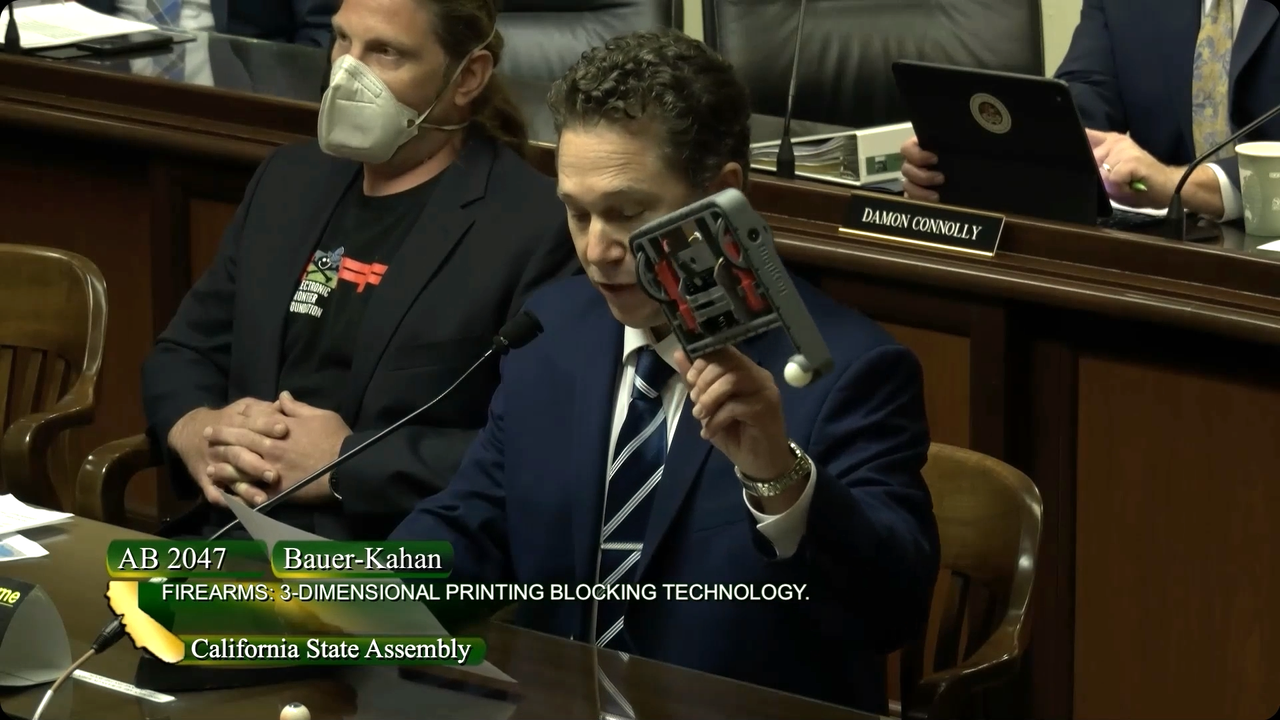
3D printing community organizes against California law that would restrict sales to state-approved models to prevent printing gun parts

by Denise Bertacchi
Johnathan Smith

This is one of those things that, honestly, the lawmakers here should spend time doing something productive instead of this. There are integral parts, like the barrel, of a gun that just can't be printed by any of the printers that these people are going to end up banning. There also just isn't some rash of 3d printed gun crime going on. People shoot people with guns made at big manufacturing companies, not from stuff they 3d print from some open source online 3d printing repo on a cheap home printer.

Experts warn that "safety algorithms" are a death sentence for makerspaces, schools, and innovation.
26 Apr 16:27

Ubuntu 26.04 "Resolute Raccoon" Launches With Gnome 50 and Linux 7.0

by Cpt.Jank
Johnathan Smith

I have had a crazy amount of issues with 24.04 show up over the last couple of months. They've fucked up their repos and updates to where there have been times that fresh installs of 24.04 are broken in serious ways after just doing an install and update. This change to Wayland and the rumors I've read about their work culture make me think Ubuntu is basically well past its expiration date.

Canonical has today released Ubuntu 26.04 LTS as the company's latest update to the mainstream Linux distro. As we reported previously, Canonical has upgraded the minimum system requirements to 6 GB of RAM, but that change comes alongside a number of upgrades to the distro itself, some of which will be immediately noticeable, while others will silently improve the user experience in the background. Ubuntu users can download Ubuntu 26.04 directly from Canonical, or users of previous Ubuntu versions can simply run "do-release-upgrade -p" in their terminal.

The biggest user-facing change is the move to Gnome 50, which now mandates Wayland and has improved, non-experimental support for both VRR and fractional scaling. Gnome 50 also implements a new feature that allows the cursor to render at the monitor's full refresh rate, even if the foreground app is running at a lower frame rate. The Gnome 50 update also sees the Yaru theme get some nifty visual tweaks that bring it closer to the standard Gnome theme and a new icon pack. Resolute Raccoon also moves Ubuntu up to the Linux kernel 7.0, adding better memory management, removing the "experimental" tag from Rust, and updating various drivers and services, like ZFS, and adding security features, like TPM-backed full-disk encryption. Ubuntu 26.04 is also the first Ubuntu version to ship NVIDIA CUDA out of the box, and AMD's ROCm platform is available in the Ubuntu repos for those looking to run local AI.
26 Apr 02:21

Why Trump wants to spend $1 billion on Great Salt Lake

by Saige Miller
Johnathan Smith

This sounds like farmers want to be paid for not using water.

Bison walk on the dry lake bed of the Great Salt Lake on April 08, 2026 near Syracuse, Utah.

Utah's Great Salt Lake has been labeled an "environmental nuclear bomb" and it has the attention of the president of the United States.

(Image credit: Justin Sullivan)

25 Apr 16:35

Intel Posts Strong Q1 2026 Results, Lands Tesla as First 14A Node Major Customer

by Nomad76
Johnathan Smith

INTC is finally higher than its peak from the dotcom bubble 26 years ago.

Intel has posted better-than-expected Q1 2026 results, with $13.58 billion in revenue, up 7.2% year over year and well ahead of the $12.42 billion analysts had forecast. Adjusted earnings per share hit 29 cents against an expectation of just one cent, sending the stock up more than 15% in after-hours trading. Data center and AI were strong performers, bringing in $5.1 billion against estimates of $4.41 billion. The foundry division revenue generated $5.4 billion, though the vast majority of that was Intel's own internal business. External customer revenue was less than $200 million, mostly legacy wafer work. Also, Intel ASIC business is on track for more than $1 billion in revenue this year. Part of the Q1 surprising results came from Intel clearing out finished goods inventory it hadn't expected to move, according to CFO David Zinsner. The company is also raising chip prices to offset rising production costs, which is reflected in its Q2 guidance of $13.8 to $14.8 billion, a bit more than the $13 billion Wall Street had estimated.

Going back to the foundry side, Intel scored two notable wins on this front. Tesla signed on as Intel's first major 14A customer for Elon Musk's Terafab AI chip complex in Austin, however, the details of this deal are still unknown. The most logical scenario is that Terafab will license the Intel 14A process, but neither side has confirmed it. The second win came earlier this month when Intel expanded its AI CPU deal with Google, the two companies extending their co-development of custom ASIC-based IPUs.
25 Apr 01:14

Trump administration eases rules on some marijuana categories. Here's what to know

by Bill Chappell
The Trump administration has reclassified medical marijuana on the federal level, from a Schedule I to a Schedule III drug.

Acting Attorney General Todd Blanche said he is immediately moving medical marijuana from Schedule I to Schedule III, which includes drugs like ketamine, Tylenol with codeine and anabolic steroids.

(Image credit: Justin Sullivan)

24 Apr 14:57

SpaceX says it is going to begin manufacturing GPUs — $1.75 trillion IPO listing reportedly includes in-house GPU production

by Anton Shilov
Johnathan Smith

This doesn't seem like a real thing.

Elon Musk's SpaceX set to produce 'own GPUs' at its own multi-billion fab as the company warns that it may be unable to purchase all the silicon it needs to meet its goals.