Amazon will now deliver groceries to select Los Angeles neighborhoods in an expansion of its AmazonFresh service. Only available "in select zip codes as a free 90-day trial to Amazon Prime members," AmazonFresh lets you order food items and get them delivered on the same day. As part of the launch, Amazon has also created an LA spotlight, highlighting some of the stores that are participating in the service.
Amazon has been toying with the concept of grocery deliveries in Seattle for many years, slowly expanding an initial 2007 pilot to cover a large portion of its hometown. It's not clear if the business is making money yet, but Jeff Bezos told investors last month that the economics of AmazonFresh are moving in the right direction.
After months of acquisition speculation, it appears that mapping company Waze may actually be, really and truly, getting bought. And the lucky winner? One of the few companies on the planet that probably doesn't need Waze at all: Google.
Israeli business publication Globes is reporting that Google will acquire the Ra'anana-based Waze for $1.3 billion. Naturally, neither party in this reported deal is confirming the details, no doubt until their ghostwriters can get the corporate blogs ready to post.
Update: Tuesday morning, the acquisition was officially announced by Google.
If this deal does go through, it essentially knocks a major mapping-data resource off the board. Waze's social-oriented traffic app has generated a lot of map data, independent of vendors Google, TomTom, NAVTEQ and the crowd-sourced OpenStreetMap Project.
The fact that there have been so few collections of geographic data out there for commercial use has made Waze very attractive to anyone looking to build a mobile platform without relying on Google Maps. When Apple decided to discontinue using Google Maps data in its own Apple Map app for iOS, Waze and TomTom were used for map data.
It was likely this association that helped create rumors earlier this spring that Apple was courting. Apple CEO recently publicly denied ever having made a bid for Waze.
Facebook, on the other hand, was very much in the hunt for Waze, with rumors that the social media company was throwing around billion-dollar checks to pick Waze up. Facebook reportedly backed off when it learned that Waze, unlike other Facebook acquisitions, wanted to remain open and maintain its offices in Israel.
It is not clear what Waze's role within Google will be when all is said and done, though early reports indicate the company will remain independent. Likely, a scenario like Google's 2010 acquisition of travel vendor ITA Software will unfold. Today, ITA is still a separate entity, and its passenger and airline reservation systems software powers travel apps like Kayak and Hipmunk.
While Waze data would be superfluous to Google's mapping data, the social aspects of the Waze app, which enables users to report traffic conditions in real time, could be folded into Google's mapping system, which would increase the accuracy and robustness of Google's existing traffic-reporting systems.
However Google opts to use Waze, one thing is for sure: Waze and its data would now be out of reach for any company that needs mapping data without going through Google. This puts Apple and Facebook in a particular bind.
We can't disguise it as movie news, but here at Empire we're all deeply saddened by the loss of Iain Banks, who died today from the cancer he first revealed was making him "officially very poorly" in April. The author of 27 novels (roughly half of them sci-fi written as Iain M. Banks), plus a short story collection and a whisky travelogue, he was 59.
Banks was born in Fife, to a professional ice skater mother and a father in the British Admiralty. He attributed his early creative spark to being one of the earliest households in the country with a television: his mother had insisted on a set to fill the void left by his father's frequent navy-dictated absences. He completed his first novel at the age of 16 and his second during his time at Stirling University, but wouldn't be published until The Wasp Factory garnered him instant notoriety at the age of 30. Prior to that watershed moment he'd worked for IBM and British Steel, but The Wasp Factory opened the doors to his career as an author. He averaged a book a year from that point on.
Walking On Glass and The Bridge followed, before Banks added the M (for Menzies) for the first of his sci-fi doorstops, Consider Phlebas, which debuted his unique socialist-anarchist-imperialist utopia The Culture. Henceforward, he would alternate between sci-fi and mainstream novels (although as a description, "mainstream" hardly cuts it for his more surreal and violent works). He likened writing as Iain and writing as Iain M. to the distinction between playing a piano and playing a pipe organ. A piano, he said, can produce something beautiful and elegant. But a pipe organ has multiple keyboards and stops you can pull out.
Sadly, for our own usual agenda, his novels were rarely adapted for the screen. There was a great version of The Crow Road for the BBC during the 1990s, and a middling film of Complicity, starring Johnny Lee Miller, in 2000. The second Culture novel , The Player Of Games, gained some traction for a film adaptation at Pathe a decade or so ago, but was eventually cancelled. "It wasn't even a nibble, it was a proper bite," Banks told us in 2009, "but we couldn't reel it in: couldn't land the blighter!" Most recently there was some talk of a film version of the short story A Gift From The Culture, to be directed by White Lightnin's Dominic Murphy, although it's unclear where that project currently stands.
Banks' final novel, The Quarry, will be published on June 20: its publication date brought forward at Banks' request to allow him to see its release. Tragically, that wasn't to be, although he did get to hold a finished copy and attend a recent launch party. He is survived by his partner of seven years Adele Hartley, whom he married in March having asked her to "do me the honour of becoming my widow". Gallows humour, the couple said, was part of their coping strategy.
"What Iain brought to his writing was himself," said Banks' fellow Scottish sci-fi author Ken MacLeod. "He brought a wonderful combination of the dark and the light side of life, and he explored them both without flinching. He left us a very significant body of work both in mainstream literature and in science-fiction. And he left a large gap in the Scottish literary scene as well as that of the wider English-speaking world."
"I'm off out to the pub to toast one of my all-time literary heroes with a malt," said Irvine Welsh.
The Guardian has published an interview with the NSA whistleblower, who revealed himself as a 29-year-old former technical assistant named Edward Snowden. In recent days, Snowden has leaked top secret NSA documents to The Guardian and the Washington Post detailing the NSA's PRISM and Boundless Informant programs, among others. The Washington Post has confirmed that Snowden was the source of their leaks.
Speaking from Hong Kong, Snowden described himself as a classic whistleblower, motivated by civic duty, a description he also applied to Bradley Manning. "I think the sense of outrage that has been expressed is justified," Snowden told The Guardian. "It has given me hope that, no matter what happens to me, the outcome will be positive...
On a smaller scale police and rightsholders carried out actions as well. Cooperating with the anti-piracy group FACT, local police visited the home of a local Pirate Bay proxy operator. While we’ve reported on similar actions against torrent site owners in the past, to our knowledge this is the first time that a proxy has been targeted.
After The Pirate Bay was blocked in the UK last year hundreds of proxies were launched, which are nothing more than a front for the regular Pirate Bay site. Running a proxy requires relatively few resources and one can be put online in a matter of minutes. But despite the easy setup they can also have serious consequences.
TorrentFreak talked to Tom, the operator of the PirateSniper proxy, who says he was visited by the police and anti-piracy group FACT for the second time recently, strengthening a message they delivered earlier.
“Two weeks ago I received a second knock on the door with the police standing on my doorstep. They had another letter and a further warning, ‘demanding’ that I shutdown PirateSniper.net before they take ‘criminal’ action against me,” Tom told TorrentFreak.
Tom was baffled by the surprise visit, to say the least. His proxy site has been active for a few months but has never been advertised and receives virtually no traffic. In addition, the site is not listed in Google’s search results.
“I cannot understand why I am a target. Yes, PirateSniper was recently removed from Google’s indexing list, but I can’t conceive the idea of police at my doorstep. Why?” Tom says.
In a pattern that fits with previous door knockings, the police were mainly there to assist FACT, who did most of the talking. According to Tom, FACT handed over some paperwork along with a warning that he could end up in jail if he continued operating the proxy.
“The police didn’t say much at all, they only asked me to confirm my identity then handed the conversation to a representative of the Federation Against Copyright Theft. It all happened quite suddenly and this time they were a little more aggressive than the first time they came.”
“They threatened me by saying things like ‘You could be sentenced to jail for a minimum of 4 years for the distribution of copyrighted material’. This time they were on a very personal level, not bothering with minor manners and such and just shoving information down my throat without any explanation whatsoever.”
Without receiving an ultimatum, Tom says he was asked to shut down the proxy, or else. The PirateSniper operator has contacted a solicitor and is prepared for the worst. However, the site will remain online for the time being.
“No, this is my stand, we have to show companies that we will not get bullied into doing their bidding. Censorship is like a cancer, we must kill it before it spreads,” Tom says.
There is a certain jollity in the reactions of the webby class to news that the NSA has been, first, spying on Verizon communications for years, and second has approached multiple information-gathering startups, hat in hand, asking for access to their data stores. It is indeed funny: faceless bureaucrats who, we are certain, can barely click the Start menu, are horking down data from America’s Can You Hear Me Now Network while browsing our Facebook profiles over lunch. Now that the truth has come to light, we’re positively giddy. All of our worst fears have come to call and it’s hilarious.
I had heard the refrain for years from the conspiracy-minded: “Google/Facebook/Twitter/Apple will sell you out in a second.” Well, they have. Every word written by RMS (“I refuse to have a cell phone because they are tracking and surveillance devices”) was true and every time Doctorow incited us to run Ubuntu with an encrypted root partition we should have listened. But who cares? We’re not building bombs in our kitchens, we’re playing Farmville. Their jeremiads only reminded us of what sticks-in-the-mud the privacymongers are and how clever we are when it comes to routing around damage.
Maybe we should have listened.
We asked for this. We asked for this when we traded password protection for single sign-in. We asked for this when we chased social network after social network, creating a deer trail that could lead a hunter to our crushed-grass bed, still warm. We asked for this when, almost a decade ago, we traded some privacy for some security and got neither in the bargain.
I’m as guilty as you (unless you’re Cory Doctorow.) I dumped my photos into someone else’s hard drive. We use a publishing platform that will roll over to plagiarists and lairs thanks to the DMCA. We have no expectation of privacy (nor do we particularly need it, I’d imagine) and so we upload our work to the “cloud” where it sits, potentially unmolested, in DropSugarGoogleBox’s servers. We give Amazon a list of things we like and do not like and are amazed when it offers up a slew of products that will strike the perfect chord of our fancy. We are like a drunk blundering through a crowd of pickpockets. That we are not poor and naked already is a testament to either the goodness of humanity or the ineptitude of the criminal class.
In short, we didn’t trade privacy for security. We traded privacy for convenience. And the government, seeing a hole, took advantage of this.
This era of absolute trust is fading, at least in certain circles. Facebook is boring and Twitter is a firehose so people late to the game probably won’t even bother with those services. It will take a few good Google crashes to wean us off of cloud services but as the price of storage falls precipitously and the ability to connect to a home network becomes increasingly easy I could see a time when Yahoo’s promise of a free terabyte is vaguely seedy. This breach itself will probably encourage millions of programmers to use harder encryption. And so it goes.
A bad sysadmin can get away with typing “chmod a+rwx .” for years. Then some hacker discovers that little peccadillo and hides a rootkit in his server. Then that sysadmin learns his lesson and moves on. I’d like to think we’re going to be the same way, but I doubt it. We love our ease-of-use, our single sign-ins, our constant pings and instant access. We will not trade that because someone, somewhere, may be reading our private correspondence.
And so we’ll ask for it again and again. The crypto-lovers will cry wolf, then the real wolf will come and we’ll laugh it off, confident in our abilities behind the keyboard to outsmart a bureaucratic apparatus so outdated that they still require us to file our taxes on paper. Slowly, steadily we will watch this crisis erode and the next one will build itself in the old one’s stead. By that time we’ll be lifecasting what we see and hear 24/7 using wearables, perhaps, but we web savvy users will laugh that off as well. We’ll smirk at some lumpen NSA agent hunched behind a computer watching us spoon sugar into endless coffees and talk about movies and TV shows. It serves them right, we’ll say, for wanting this data in the first place.
As Schneier writes: “Welcome to an Internet without privacy, and we’ve ended up here with hardly a fight.”
When apathy is our defense we deserve what we get. But apathy breeds another kind of insecurity and makes us bigger targets still. We forget this at our peril.
America is supposed to be a nation governed by principles, which are undergirded by the Constitution and the Bill of Rights and carried into law. The discussion about the government and its capture of *our* data should be held on the level of principles.
* Privacy: Our direct and personal communication in any medium and by any means — mail, email, phone, VOIP, Twitter DM, and any technology yet to be invented — should be considered private, as our physical mail is, and subject to government intervention only through lawful warrant. That is not the case. Thus it is quite reasonable to be disturbed at the news that government can demand and receive communication we believe to be private. Government may call itself the protector of our privacy but it is our privacy’s worst enemy.
* Transparency: The actions of government should be known to citizens. I argue in Public Parts that our institutions should be public by default, secret by necessity; now they are secret by default and open by force. There are necessary secrets. There is a need for intelligence. There I agree with David Simon. I saw people die before me on 9/11 and I fault intelligence or not stopping it.
But we are left out of the discussion of where the line of necessity should be. If President Obama believes in the transparency he talks about and if he now says he welcomes the debate about security and freedom then it should have occurred *before* government took the actions now being reported and not by force through leaks. There I agree with James Fallows that this leak is not harmful — what bad guys didn’t already realize that their phones could be tracked? — and will be beneficial for democracy.
* Balance of powers: The best protection of our nation’s principles is the balance of powers. Yes, Congress passed the Patriot Act and yes, a FISA court does approve the executive branch’s actions. But both our representatives and our justices are prevented from sharing anything with us, as are the companies that are forced to be their accomplices. The true balance of powers is the exercise of democracy by citizens, but without information we have no power and government has it all.
* Freedom of speech and of the press: Information comes to the public from the press, which is now anyone with information to share. And citizens exercise power through speech. But in its jihad against leaks… that is whistleblowers… that is reporting… that is journalism and the public’s right to know, the White House is chilling both the press and speech. I pray that Glenn Greenwald doesn’t have a Verizon phone.
This discussion is less about privacy and more about transparency and speech. The principles most offended here are those embedded in the First Amendment for those are the principles we rely upon to take part in the debate that is democracy.
I am asking for government to behave according to principles. I am also asking companies to do so. Twitter — whose behavior toward developers and users can sometimes mystify me — is apparently the platform most stalwart in standing for its users’ rights as a matter of principle. They apparently refused to make it easier for government to get data. Now one could argue that helping government thwart terrorists is also behaving according to principle. But again we and these companies aren’t allowed to have that debate. So I’d now advise following what is apparently Twitter’s route in only responding to demands, nothing more. And I’d advise following Google’s example in revealing government demands for information (though under FISA, once again, they’re not allowed to reveal — even by a count — them all).
There is much debate and sometimes conspiracy theorizing swirling around about what Google, Facebook, et al did and didn’t provide to government. I take Larry Page’s and Mark Zuckerberg’s statements at their literal word and agree with Declan McCullagh that I so far see no evidence that these companies handed the keys to their servers to the NSA. We know and they have long said that they comply with government orders, whether in the U.S. or China.
Though some are attacking him on this issue and though I often disagree with him on the state of the news business, I again say that I agree with David Simon on the unsophisticated and emotional interpretation of this news. Since the initial New York Times report on NSA “warrantless wiretapping,” I have understood that one of government’s goals is to use data to find anomalies but to do that it has to have a baseline of normal behavior. We’re the normal. This has been going on for sometime, as Simon says; we just haven’t known how.
Are we as a nation OK with allowing government to make such an analysis to find the terrorists’ anomalous behaviour or not? That’s a discussion that should occur according to principles, properly informed about the risks and benefits. Are we OK with government using that same data to fish for other crimes — like, say, leaking a PowerPoint to the Guardian? I am not. Are we OK with government treating whistleblowers and leakers as traitors — starting with Bradley Manning? I am not. I agree with Bruce Shneier: “We need whistleblowers.” Are we OK with government having access to our private communications without warrants? I say: most definitely not, as a matter of principle.
Under a regime of secrecy, assuming the worst becomes the default in the discussion. We assume the worst of government because they keep from us even activities they say are harmless and beneficial. We see people who want to be suspicious of technology and technology companies assuming the worst of them because, after all, we can’t know precisely what they are doing. I agree with Farhad Manjoo about the danger. People in other nations — I’m looking at you, EU — already distrust both the American government and American technology companies, often in the past for emotional reasons or with anti-American roots but now with more cause. You can bet we’ll hear governments across Europe and elsewhere push harder for legislation now in process to require that their citizens’ data be held outside the U.S. and to European standards because, well, they assume the worst. We’ll hear calls to boycott American-made platforms because — even if they try not to go along — their acquiescence to our government means they cannot be trusted. This is bad for the net and bad for the country. The fault lies with government.
This is a story about transparency and the lack of it. It is a story about secrecy and its damages. It is a story about principles that are being flouted. It should be a discussion about upholding principles.
On Engadget, Richard Lawler paraphrases a NYT theory on how the companies identified as participating in the NSA's PRISM program are able to deny participation without technically lying; this is followed up with a quote from Google's chief legal officer denying this theory:
So why the quick denials about something the companies listed (including AOL, parent company of Engadget) may actually have ties to? Because FISA requests are by their nature secret, the report claims employees that deal with the requests can't discuss the details, even with their fellow employees. Notably, although companies must by law respond to the requests, they're not legally obligated to make it easy, and the article points out Twitter as a company that has declined to participate. Because of that, even if PRISM is more a streamlining of bureaucratic processes than a government backdoor into your Candy Crush Saga level, the semantic differences of company denials may not sit well with users, much less citizens voting for the officials who oversee the programs.
Update: Google Chief Legal Officer David Drummond has chimed in once again via a post on Google+, denying (again) that the government has any access to Google servers. That includes directly, through a back door, or any kind of "drop box" as the Times report mentions had been discussed. Meanwhile, CNET has an alternate source who corroborates the company's claims of no direct access, describing the system as a "formalized legal process."
The NSA may have wanted full firehoses of data from Google, Facebook and other tech giants, but the companies attempted to protect innocent users from monitoring via compliance systems that created segregated data before securely handing it over as required by law, according to individuals familiar with the systems used by the tech companies targeted by PRISM.
The widelycriticized corroboration with the NSA therefore may have benefited citizens rather than being to their detriment.
How PRISM Requests And Receives Private Data
My sources confirm that the NSA did not have direct access or any special instant access to data or servers at the PRISM targets, but instead had to send requests to the companies for the data. These requests must be complied with by law, but only if the government narrowly defines what it’s looking for. The government may have initially requested a firehose of data, and was happy to take this full data dump from the tech companies and sort it itself. Had the tech giants simply accepted these requests at the minimum level required by law, many innocent citizens’ data could have been monitored.
By working to create “a locked mailbox and give the government the key” which the New York Times reported, rather than allowing widespread monitoring, the firehose is restricted to a trickle of specific requests. When the NSA has specific people they want to data about, they make a specific, legal request for that data that the tech companies are required to comply with. Google or Facebook then puts the specific requested data into the locked mailbox where the government can access it. This keeps requested data about suspected terrorists or other people who are threats to national security segregated from that of innocent users.
By cooperating, companies can better ensure that each request is valid, and narrow enough in its scope. If the request is too broad, the tech companies can send it back and ask for a narrower pull. The method also ensure the data is securely transferred from the companies to the government, opposed to being more forcibly pulled by the NSA in ways that could have left it open for exploit by third-parties.
[Update 1am PST 6/8/2013: This information matches the follow-up statement issued by Google's Chief Legal Officer David Drummond,: We cannot say this more clearly—the government does not have access to Google servers—not directly, or via a back door, or a so-called drop box...Our legal team reviews each and every request, and frequently pushes back when requests are overly broad or don’t follow the correct process.]
PRISM’s Scope May Be Smaller Than Feared
Over the last day, tech executives including Larry Page and Mark Zuckerberg outlined that they did not give bulk or blanket access to user data. However, they may not have been able to discuss the exact volume of the legal demands for data they’ve received. That left the exact scope of how many people had data pulled by NSA open for wide interpretation, and many including myself, in some cases assumed the worst — that while not at the volume of the massive request for data on all Verizon users that’s been reported, huge numbers of people may have been spied on.
However, in the last year, there were only 1,865 FISA requests for data. Some believe those requests could include data pulls as broad as anyone who searched a specific term. Legal experts I’ve consulted, though, believe the requests must be more narrow than that for the tech companies to have not pushed back. That means the the number of people monitored by PRISM may have been in the thousands or tens of thousands, rather than in the tens or even hundreds of millions.
Previously I accused Page, Zuckerberg, and other tech executives and companies of trying to hide the scope of their cooperation with the NSA. Their carefully worded denials of offering direct access or back doors to their data seemed to minimize how they were involved with the NSA. I still think they should be more specific on how requests are handled, and could have been despite FISA restrictions on what they could say. However, after speaking with sources, I’ve come to believe the blame rests more on the government for muzzling these companies in the way they explain to their users the complex privacy issues associated with compliance with government requests for personal information on their users.
Both the secure, segregated responses to demands for data, and the limited scope of the monitoring could help ease the fears of the public. It still may be an assault on liberty, but possibly smaller than suspected. And with any luck, the whole PRISM issue will push the government towards greater transparency.
A well-placed government source leaked ReadWrite this draft memorandum from the White House.*
Announcing Citizenship 2.0—The Same Civil Rights You Love, But Better!
We're super excited to announce Citizenship 2.0—now enhanced with extra monitoring for your safety and security!
We know that many people have enjoyed the old version of American citizenship. But as with any product, times change and require adaptation and upgrades to stay current.
Your old freedoms were delivered in conventional ways. Now you can get just the freedom you need, when you need it. It's freedom as a service. It's Citizenship 2.0.
New And Improved!
In recent years, this administration has learned a lot from Silicon Valley—and we're not just talking about the communications we've been intercepting for years from some of the biggest Internet companies. We've been very interested in how innovative business models can be applied to government.
In particular, the freemium style of product has proven very compelling, where most users get a basic service for free and others pay to get an enhanced version.
Of course, as taxpayers, you're already paying the government to provide services. But our expert governance innovators—"governovators," we call them—have figured out a way to apply this model to the rights you enjoy as a citizen.
Get excited, people—freedom is no longer free. It's freemium!
PRISM doesn't exist, of course. But let's say we had a secret program to monitor all Internet communications with the tacit cooperation or nonresistance of major tech companies. For argument's sake. If something like that existed, that would merely be a back-end foundation for the front-end interface improvements to your government that really matter. That's Citizenship 2.0.
Here's what you're going to get:
Unlimited storage for all your communications. You won't have access to them—but we will. And that's what matters. If you or your parents come from a foreign country, or you just have a funny-sounding name, or you ever Googled the name of a political organization, you also get extra backups—for free!
In-app purchases. Benjamin Franklin once said, "Those who would give up essential Liberty, to purchase a little temporary Safety, deserve neither Liberty nor Safety." First of all, that was, like, soooo three centuries ago. Second, what's with the crazy capitalization? Anyway, we have all this new technology that's a complete game-changer. With Citizenship 2.0, you don't have to surrender your essential liberty up front. You can trade little bits of it as you go, for all the temporary safety you want!
Access to your leaders. We're all about transparency—at least when it comes to what you're doing online. Thanks to Citizenship 2.0, what you do online might end up in a report that the president himself reads! Isn't that cool?
Note: If you prefer the old version of citizenship, you can opt out of these changes and stick to the original version guaranteed by the Bill of Rights by marching, protesting, or writing your Congressman. But let's get real—no one's going to bother to do that.
You may be aware of press reports alleging that Internet companies have joined a secret U.S. government program called PRISM to give the National Security Agency direct access to our servers. As Google’s CEO and Chief Legal Officer, we wanted you to have the facts.
First, we have not joined any program that would give the U.S. government—or any other government—direct access to our servers. Indeed, the U.S. government does not have direct access or a “back door” to the information stored in our data centers. We had not heard of a program called PRISM until yesterday.
Second, we provide user data to governments only in accordance with the law. Our legal team reviews each and every request, and frequently pushes back when requests are overly broad or don’t follow the correct process. Press reports that suggest that Google is providing open-ended access to our users’ data are false, period. Until this week’s reports, we had never heard of the broad type of order that Verizon received—an order that appears to have required them to hand over millions of users’ call records. We were very surprised to learn that such broad orders exist. Any suggestion that Google is disclosing information about our users’ Internet activity on such a scale is completely false.
Finally, this episode confirms what we have long believed—there needs to be a more transparent approach. Google has worked hard, within the confines of the current laws, to be open about the data requests we receive. We post this information on our Transparency Report whenever possible. We were the first company to do this. And, of course, we understand that the U.S. and other governments need to take action to protect their citizens’ safety—including sometimes by using surveillance. But the level of secrecy around the current legal procedures undermines the freedoms we all cherish.
Posted by Larry Page, CEO and David Drummond, Chief Legal Officer
If you haven't heard yet, Gmail is rolling out a new tabbed interface for the inbox on both desktop and mobile. At first glance, this looks great for email organization. On further inspection, these new tabs are confusing as hell. Here's how to make sense of the new tabs and customize them for your own filters.
How the New Tabbed Interface Works
Google describes the new tabs as a way to "put you back in control so that you can see what's new at a glance and decide which emails you want to read and when."
You get five optional tabs, described by Google below. Google automatically sorts your inbox into these tabs using its special algorithms (essentially matching many of Gmail's existing Smart Labels, which automatically filter incoming messages):
Primary: person-to-person conversations and messages that don't appear in other tabs
Social: messages from social networks, media-sharing sites, online dating services, and other social websites
Promotions: deals, offers, and other marketing emails
Updates: personal, auto-generated updates including confirmations, bills, receipts, bills, and statements
Forums: messages from online groups, discussion boards, and mailing lists
You can also choose to force starred emails from all tabs to display in the Primary tab (in addition to the other tab).
How to Enable and Use the Tabs
To enable the new tabbed view, go to the Gear icon and select "Configure inbox." Once you do that, you'll be prompted to choose which tabs to enable and Gmail will start doing its magic, auto-sorting your inbox.
You can drag-and-drop emails from one tab to the next; when you do that, Gmail will ask if you want to create a filter for that sender to send messages in the future to that tab. Handy! It doesn't, however, move existing emails into that tab.
You can also create your own filters to send emails into specific tabs, as we'll see below, but that's tricky if you don't understand how the new tabs differ from Gmail's existing labels and which messages get sorted into tabs.
Why the Tabs Are So Confusing
The tabs do give you a convenient way to automatically sort your inbox according to Gmail's preset categories and get notifications at a glance for when new emails come in. However, the tabbed view introduces a new, not-so-clear element in Gmail called "categories."
The tabs are based on these new categories. When you create a filter, in addition to being able to label a message, you can now categorize it as: Personal, Social, Updates, Promotions, or Forums from a drop-down box. These, as you see, match the tabs.
The problem is, you already have labels that also match these categories. Gmail, for example, adds Social Updates, Promotions, and Forums as SmartLabels in the left menu. The "Notifications" SmartLabel corresponds to the Updates tab (I wonder why they didn't just call the tab Notifications), but SmartLabels are not the same as Categories. Gmail's pre-designed SmartLabel filters makes it seem like that, but they're really two different things.
I also noticed one problem where certain messages would show up under a SmartLabel, but not a category. For example: Some auto-labeled "Notifications" didn't show up under my "Updates" tab.
It turns out the tabs only include emails from your inbox, not archived emails. In other words, the tabs are really just another view of your inbox. You can have more emails in the corresponding label than in the tabs if some of those emails are archived.
So, a few things we've discovered from testing:
If you have filters for daily deals emails and similar emails that would get categorized by Gmail as "Promotions" but have it set to skip the inbox (archive them), you won't see them in the Promotions tab unless you change those filters. The same goes for the other tabs.
If you want to filter messages into a specific tab, you'll have to use the new "Categorize" option, not the labels.
Gmail has added a new "Categories" label in the left menu with sub-labels for the categories, which match the tabs. In other words, all the messages under specific tabs are also in the corresponding Categories sub-label. Tip: If you want to briefly switch away from tabbed view and see all the emails at once across all the tabs, click on the Categories label.
Now you'll have labels and categories with the same names. If you want to avoid confusion, you can just delete the old SmartLabels, since you can still access them through the categories in the sidebar. Alternatively, you could just hide them from the sidebar so they don't clutter it up.
If you want to see the unread count for messages in the tabs, you have to click the Categories label name to expand the sub-labels. The tabs themselves only show when you have new messages, not the number of unread messages.
Continuing on that theme, the unread count in the inbox label and browser tab only show the Primary tab number of unread messages, not all of your unread messages. That is by design.
As mentioned above, when drag-and-dropping across tabs, you can create a new filter for future messages. However, this doesn't work if you select multiple email messages and drag them, unfortunately.
Confused yet? Gmail's SmartLabels aren't perfect, and neither are the tabs. Gmail has been consistently labeling some personal emails as Promotions and putting some promotional emails in the Primary tab for me. It also seems like there's a fine line between Social and Forums messages.
All of this said, it may be possible to harness the organizational power of the new tabbed interface to suit your needs better.
How to Customize the Tabs with Your Own Filters
As mentioned above, you can now create your own filters to categorize messages, thus putting them in one of these tabs. So if you have no use for the "Forums" tab, you can instead use it to collect messages from specific senders or keywords. Unfortunately, there's no way to change the tab name.
The key is to make sure the filter doesn't overlap an existing filter that might counteract what you're trying to do. For example, you can't have "Skip the inbox" on a matching filter, otherwise it won't appear in the tabs at all (since the tabs are organization for the inbox).
To customize the tabs:
Create a new filter for the messages you want moved to one of the tabs. (For example, since I have no use for the Social tab on my work email, I'm using it instead to store emails I send to myself from my personal email address. In the search box, I put in "from:[my email address]" and click the down arrow in the search box to find the "Create filter with this search" link.)
In the filter options in the next screen, choose the category that matches the tab for the "Categorize as" option. (E.g., I chose "Categorize as: Social.")
You'll also have to check "Exclude from SmartLabels" just in case Gmail tries to categorize your email differently (as it did for one of my test emails to myself). Then hit "Create filter."
If you also want to prevent Gmail auto-categorizing other messages in that tab, you could also go into your Settings > Filters and scroll to the bottom for the SmartLabel Filters and disable or edit the corresponding filter. However, do this with caution, as it seems there's no easy way to restore the built-in filter. It might be better to configure Gmail's SmartLabels so they skip the inbox and thus skip your tabs. About.com's Email site has the list of each SmartLabel (e.g., "label:^smartlabel_promo" for Promotions). When creating your filter, search for that "label:^" term to filter it out as you'd like.
At the very least, the new "Categorize as:" filter can help you correct any Gmail errors when it comes to SmartLabels. For example, by creating a filter to categorize fellow Lifehacker editors' emails as "Personal," they now appear in my Primary tab, instead of, oddly, the Promotions or Forums one. They're still strangely "Smart"Labeled as Promotions, but at least they're in the right tab.
Thinking about Gmail's new tabs, SmartLabels, regular labels, and filters can feel like you're trying to solve an annoying circular reference error in Excel. However, the new tabbed view might come in handy if you know how to harness it.
The Washington Post is reporting a top-secret National Security Administration data-mining program that taps directly into the Google, Facebook, Microsoft and Apple servers among others. ”The National Security Agency and the FBI are tapping directly into the central servers of nine leading U.S. Internet companies, extracting audio, video, photographs, e-mails, documents and connection logs that enable analysts to track a person’s movements and contacts over time,” reports the Post.
Details about the highly classified program, Project PRISM, are somewhat vague, but it appears that the NSA allows the Attorney General and Director of National of National Intelligence “to open their servers to the FBI’s Data Intercept Technology Unit, which handles liaison to U.S. companies from the NSA.”
“With a few clicks and an affirmation that the subject is believed to be engaged in terrorism, espionage or nuclear proliferation, an analyst obtains full access to Facebook’s ‘extensive search and surveillance capabilities against the variety of online social networking services,’” explainsThe Post.
From there, the NSA mines the data for suspects, then “hops” to their potential contacts, exponentially increasing the number of Americans that the NSA can spy on (by mandate, the NSA is supposed to monitor foreigners).
We reached out to Facebook for comment and they replied: ”We do not provide any government organization with direct access to Facebook servers. When Facebook is asked for data or information about specific individuals, we carefully scrutinize any such request for compliance with all applicable laws, and provide information only to the extent required by law.”
In a statement, Google said: “Google cares deeply about the security of our users’ data. We disclose user data to government in accordance with the law, and we review all such requests carefully. From time to time, people allege that we have created a government ‘back door’ into our systems, but Google does not have a backdoor for the government to access private user data.”
And Apple gave a statement to CNBC:
Apple to @CNBC: "We have never heard of PRISM. We do not provide any government agency with direct access to our servers.."
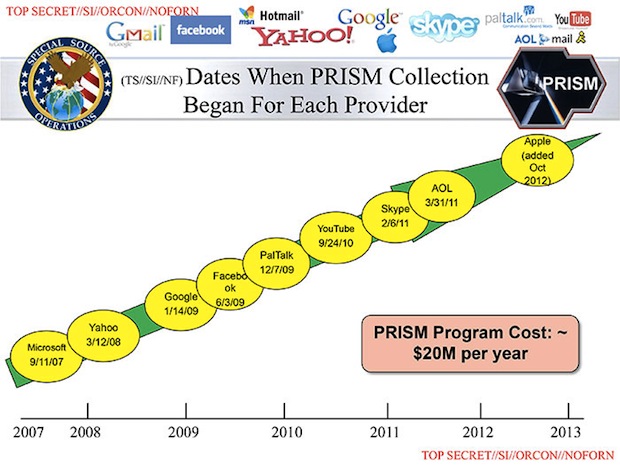
According to the Post’s slides (below), the number of PRISM partners has steadily grown over the years. Microsoft, the first partner, began in 2007, Yahoo in 2008; Google, Facebook and PalTalk in 2009; YouTube in 2010; Skype and Aol in 2011; and finally Apple, which joined the program in 2012,” explains the Guardian.
This revelation follows yesterday’s exposé by the Guardian on the NSA’s program to monitor phone data of every single U.S. call on the Verizon network.
The Post notes that resistance seems possible, given Twitter’s conspicuous absence from the list of companies.
This is an ongoing story and we will update readers as more information comes in.
The Washington Post today reported that Google, Apple, Facebook, Dropbox, Microsoft, Paltalk, AOL (TechCrunch’s parent company) and Yahoo participated in the so-called PRISM program which provided the NSA with what looks like virtually direct access to their servers and their users’ data.
We have now reached out to all of these companies and so far, Dropbox, Facebook, Google, Yahoo, Microsoft and Apple have categorically denied that they are participating. We have not received statements from the other companies yet, but will update this post as we learn more.
These denials are especially odd given that a number of publications, including USA Today, are now citing source that confirm the existence of this program. According to these reports, PRISM is not aimed at U.S. citizens or any person in the United States.
Here is what we got so far:
Facebook
“We do not provide any government organization with direct access to Facebook servers. When Facebook is asked for data or information about specific individuals, we carefully scrutinize any such request for compliance with all applicable laws, and provide information only to the extent required by law.”
Google
“Google cares deeply about the security of our users’ data. We disclose user data to government in accordance with the law, and we review all such requests carefully. From time to time, people allege that we have created a government ‘back door’ into our systems, but Google does not have a backdoor for the government to access private user data.”
“We have never heard of PRISM. We do not provide any government agency with direct access to our servers, and any government agency requesting customer data must get a court order.”
Microsoft
“We provide customer data only when we receive a legally binding order or subpoena to do so, and never on a voluntary basis. In addition we only ever comply with orders for requests about specific accounts or identifiers. If the government has a broader voluntary national security program to gather customer data we don’t participate in it.”
Yahoo
“Yahoo! takes users’ privacy very seriously. We do not provide the government with direct access to our servers, systems, or network.”
Dropbox
“We’ve seen reports that Dropbox might be asked to participate in a government program called PRISM. We are not part of any such program and remain committed to protecting our users’ privacy.”
Prism already looked like a pretty far-reaching program, but a new report claims the NSA also gave at least one foreign security agency access to this system. According to a report in the Guardian, the NSA provided the U.K.’s Government Communications Headquarters (GCHQ) with access to Prism since at least June 2010.
The U.S. has now acknowledged that Prism exists, though Google, Apple and all of the other companies named in the original leak continue to say that they are not giving the U.S. government “direct access” to their servers, as the leak claims. The U.S.’s Director of National Intelligence James Clapper yesterday argued that the program only exists to spy on foreign citizens, but it seems clear that no matter the intentions, the program was far more wide-reaching than this.
The U.K. GCHQ, the report claims, generated 197 intelligence reports from Prism in the first half of 2012. It’s unclear if the organization had full access to Prism. The Guardian’s report suggests that it was “able to receive material from a bespoke part of the programme to suit British interests.”
So far, we haven’t heard about any additional U.S. allies who received access to this data, but if the NSA provided the U.K. with a direct line into Prism and the aim of the program was indeed to spy on foreign citizens, it wouldn’t come as a huge surprise if others had access, too.
Sony Mobile will partner with Google to release a ‘Nexus user experience’ version of its flagship Xperia Z phone, Android Central can confirm
First came the Samsung Galaxy S4 "Google Edition." Then last week brought news of the HTC One "with Nexus user experience." In the past couple of days, rumors have been circulating that Sony will join the "Google Edition" club and release a vanilla Android phone of its own, with Romanian site AndroidGeeks breaking the story. Today we can confirm through our own sources that the Japanese manufacturer is indeed preparing a "Google Edition" of its flagship Xperia Z handset.
The "Google Edition" Sony Xperia Z should be sold in the U.S. through the Google Play Store later in the year, just like the two other Google Edition handsets. Being a "Nexus user experience" phone it’s very likely this new Xperia Z will benefit from speedier system updates, though we weren’t able to specifically confirm this point. (Nor could we nail down any details on possible international availability -- though we’re not holding our breath.)
A new piece of Android malware has been discovered by security researchers at Kaspersky Labs. That by itself wouldn't be big news, but this Trojan does things no other malicious app has done. It exploits multiple vulnerabilities, blocks uninstall attempts, attempts to gain root access, and can execute a host of remote commands. Backdoor.AndroidOS.Obad.a, as it has been dubbed, is the most sophisticated piece of Android malware ever seen.
There are two previously unknown Android vulnerabilities exploited by Obad. The malware installer contains a modified AndroidManifest.xml file, which is a part of every Android apps. The first big vulnerability is in the processing of this file by the system – it shouldn't be processed at all, but the app installs just fine.
Following up on our roundup of May's absolute best games, we're back with the month's greatest apps. As with (almost) every month, May offered plenty in the way of great new apps to try out. If you feel like the supercomputer in your pocket just isn't doing enough, any of these apps are great starting points for added functionality, productivity, or just entertainment.
As with our last roundup, we'll also include a list of honorable mentions – those are the apps that didn't quite make the short list but that you should still take a look at if you find your selection wanting.
Google announced earlier this year that its popular RSS reader would be discontinued as of July 1st. Users were outraged at the decision, however a company executive has now launched a formal defense of the move, saying it had to be done. Google News and social products senior director Richard Gringras explained in an interview with Wired that Google Reader was an old model for consuming news. In the age of smartphones and tablets, the executive noted, consumption of news is "a near-constant process.” He said that people no longer read news at breakfast or at the end of the day, but rather throughout the day on their mobile devices. With Google Reader out of the picture, the company will continue to develop services like Google Now and Google+ to help users get their daily news.
The US National Security Agency and Federal Bureau of Investigation have been harvesting data such as audio, video, photographs, emails, and documents from the internal servers of nine major technology companies, according to a leaked 41-slide security presentation obtained by The Washington Postand The Guardian. According to The Washington Post, the program's slides were provided by a "career intelligence officer" that had "firsthand experience with these systems, and horror at their capabilities," and wished to expose the programs "gross intrusion on privacy."
The program, codenamed PRISM, is considered highly classified and has never been made public before. The list of companies involved are the who's who of Silicon Valley:...
We won't have the Meebo bar to kick around any more. A year after Google acquired the makers of the social networking web page plug-in, the company has shut down the Meebo bar and integrated its team with Google+. "We have decided to focus our resources on initiatives like the recently launched Google+ Sign-In (which includes interactive posts and over-the-air app installs) and the Google+ plug-ins," Meebo said in a post on its website.
Unlike the decision to shut down Google Reader, the end of Meebo hasn't generated much outrage since it was announced last year. While it started as an instant messenger embedded on websites, it morphed into a tool publishers used to generate traffic and revenue by exhorting readers to share stories in a...
The New York Senate has passed a bill making it illegal to "harass" a police officer by "any type of physical action" -- even action that does not otherwise constitute interference, obstruction or assault. Given that "obstruction" and "interference" are famously broad, it's hard to imagine what conduct the police and the NY Senate believe they need to control by statute, though there's a clue in the statutory language, which makes it a felony to "harass, annoy, or threaten a police officer while on duty."
In other words, if you cause any physical contact with a police officer, even unintentionally, even if the contact does not rise to the level of assault or obstruction or interference, you can be convicted of a felony and imprisoned if the officer can show that your conduct "annoyed" him. This is the kind of statute that seems calculated to allow the police and prosecutors to put people in jail for very long stretches (remember that 97% of people indicted for felonies in the USA plead guilty under threat of decades of prison should they fight and lose) just because they don't like them very much.
I'm reminded of Toronto's notorious "Officer Bubbles", Adam Josephs, who told a G20 protester that if any soap bubbles were to touch him, he could consider it assault (and who violently arrested the protester on that basis). The world laughed (albeit with some weary cynicism) at the idea that a large, armed man could call incidental contact with a soap-bubble "assault." But the New York Senate has effectively given police the power to literally treat mere annoyances as felonious conduct.
“At a time when shocking incidents of disrespect and outright confrontation are at an all-time high, the men and women who patrol the streets of our cities deserve every possible protection we can offer them,” Senator Griffo stated. “My bill would make it a crime to take any type of physical action to try to intimidate a police officer. This is a necessary action because we can see from the rise in incidents that too many people in our society have lost the respect they need to have for a police officer. We need to make it very clear that when a police officer is performing his duty, every citizen needs to comply and that refusal to comply carries a penalty.”
When Google made its infamous decision to kill off Google Reader, it didn't offer much in the way of reasoning, saying only that the RSS aggregator's usage was in decline and the company had made a conscious decision to focus on fewer products. That explanation failed to quell a massive backlash from passionate users who continue to plead with Google to keep Reader alive. As the July 1st cutoff approaches, Google is showing no signs of a change of heart, but it is trying to better explain the unpopular move.
"As a culture we have moved into a realm where the consumption of news is a near-constant process," Richard Gringras, Google's senior director of news and social products, told Wired. "Users with smartphones and tablets are...
As always, we've been busy combing through all the Play Store's latest entries during the past month. Besides publishing our larger, semi-weekly roundups, we try to separate out the very best. In the interest of saving readers time and – more importantly – money in trying out all the games we discuss each month, we assemble a shortlist of the games you can't miss. If you're looking to spice up your games library, any of these picks would be a great choice.
Just like last month, we'll discuss our top picks, followed by a list of honorable mentions that are also worth at least looking into if your gaming appetite still isn't sated.
The DHS has responded to a Freedom of Information Act request filed by the ACLU asking when and how it decides whose laptop to search at the border. It explained its legal rationale for conducting these searches with a blank page:
On Page 18 of the 52-page document under the section entitled “First Amendment,” several paragraphs are completely blacked out. They simply end with the sentence: “The laptop border searches in the [Immigration and Customs Enforcement] and [Customs and Border Protection] do not violate travelers’ First Amendment rights as defined by the courts."
More excellence from "the most transparent administration in American history." Also, the DHS rejected claims that it should limit searches to situations where it had reasonable grounds for suspicion, because then they would have to explain their suspicion:
First, commonplace decisions to search electronic devices might be opened to litigation challenging the reasons for the search. In addition to interfering with a carefully constructed border security system, the litigation could directly undermine national security by requiring the government to produce sensitive investigative and national security information to justify some of the most critical searches. Even a policy change entirely unenforceable by courts might be problematic; we have been presented with some noteworthy CBP and ICE success stories based on hard-to-articulate intuitions or hunches based on officer experience and judgment. Under a reasonable suspicion requirement, officers might hesitate to search an individual's device without the presence of articulable factors capable of being formally defended, despite having an intuition or hunch based on experience that justified a search.
BlackBerry hasn't made anything official just yet, but that didn't stop T-Mobile UK from seemingly spilling the beans and tweeting a release date for BlackBerry Messenger for iOS and Android. BGR scooped the eventual arrival of cross-platform BBM ages ago, but BlackBerry finally confirmed it last month and said its popular messaging service would launch on iOS and Android this summer. According to T-Mobile UK, a firm date has now been set: June 27th. BBM will be free on both competing platforms, and it is unclear exactly what functionality will be carried over from the BlackBerry 10 version.
After the huge success of Any.Do, the immensely popular to-do list app for iOS and Android, its developers must have figured their dead-simple organization and beautiful interface was good for more than just tasks. So the company's branching out, bringing its know-how to three more markets in desperate need of powerful-yet-simple apps: calendar, email, and notes. Together they're called Any.Do's "life management apps," and we've had a chance to play with the first of them — Cal, the calendar app coming later this summer.
If you've updated to the new Gmail app for Android, you'll see there's a lot to love about it. One little quirk however is that the delete button is gone from the toolbar, leaving you only with options to archive, "mark as unread," and "move to" a folder. Here's how to get the delete button back.
As it stands, you have to press the menu button on your phone to bring up additional options, and "Delete" is right at the top of that menu. That's fine, but here's how to get the trash can back on your toolbar:
Press the menu button on your phone, and select settings from the pop-up menu.
Tap "General Settings," then tap "Archive & Delete actions" at the top of the menu.
Next, you'll see a pop-up menu with "Show archive only," "Show delete only," and "Show archive & delete." Archive only is the default. Select the one you prefer. I like "Show archive & delete," because options are good things to have.
Press the back button to go back to your message view.
That's all there is to it. Then end result is the image you see on the right above. The "move to" folder icon has been bumped off, and the trash can is back. One important thing to note—the new version of the app lets you swipe a message to archive or delete it from your inbox. If you select "Show archive & delete," swiping will archive messages (this is the default behavior, so you're not missing anything). If you want swiping to delete messages, you'll have to go back and choose "Show delete only."
Granted, most of us probably just archive everything in Gmail anyway—with so much space, there's little need to delete. However, if you get as much mail as I do, sometimes you just want to trash something and save the space.
Update: Reader Brian over at Google+ reminds us that if you want to swipe to delete, go back to General Settings and check the option to "swipe to delete." That's right, it's a stand-alone setting option now, but at least it's easy to find!
The new-and-improved streaming radio API from 7digital is designed to help anyone interested in doing so launch their own streaming radio service, and one which is fully compliant with DMCA restrictions in the U.S, and which also includes all of 7digital’s extensive catalog of licensed music – that’s a library that’s over 25 million tracks strong as of this writing, and one that continues to grow.
Already, 7digital offers streaming music licensing for some DMCA radio providers in the U.S., including NYC-based Turntable.fm, which also used the 7digital API to launch its new Piki service, the music-based social network it debuted late last year. Piki, along with any other app that complies to U.S. DMCA streaming radio regulations, must fit very specific conditions to offer its service, in terms of being able to skip tracks or not, how users can search for songs and artists and more. It all sounds a bit constricting, but 7digital President of North America Vickie Nauman says that in fact, they’re finding the DMCA-style radio experience is exactly what users are looking for to replicate the ease and convenience of terrestrial radio.
“In the old days you drive your car and you push a button and you listen to a program that’s been streamed for you,” she said. “It’s easy, you find someone that can curate, and something that’s to your liking, and it’s such a great lean-back experience and we’ve been watching the marketplace and we feel that the partners that we have that are doing really well, combined with the need people have for a really easy way to listen to their music have led us to decide that this year we’re really going to focus on radio.”
7digital’s radio push comes at a time when streaming radio seems to be the order of the day. Google has just launched its own All Access streaming music and radio service, while Apple is said to be preparing its own iRadio service, which could potentially launch as soon as next week at WWDC. But while the space is heating up in terms of competition, Nauman believes it’s heating up in terms of interest among potential 7digital partners as well, and that represents a big opportunity.
“Everyone watches what they do, and then they play their cards, and people see the products, and people say ‘Oh, well we can do that better’,” she said. “For Apple, I’m certainly a fan of the devices, and the way they incorporate hardware, software and content, and I used to work at Sonos so I have a real appreciation for the elegance of having all three of those pieces work well, but Apple is going to build things for iOS, and for iOS users, and especially as you go outside of the U.S. you realize there are a lot of other operating systems and devices in different parts of the world.”
In the end, though, 7digital isn’t choosing radio streaming over and above other options. It still plans on offering its digital purchasing and download model, as well as on-demand streaming as a separate option. In fact, Nauman says that 7digital wants to offer solution that highlight how different delivery systems can work seamlessly together. There’s an option to plug its streaming radio API directly into the 7digital store, for instance, which she says should result in such a seamless shopping experience that users would be able to hear a song, purchase it as simply as if they’d liked it or given it a thumbs up, and then have it delivered automatically to their cloud locker.
7digital’s streaming radio API is designed for big companies and startups alike, and Nauman says it should be particularly helpful to startups in terms of simplifying the thorny licensing issues around music and letting companies focus on products. That leads to a dramatic increased capability in terms of go-to-market time, and lowers a huge barrier faced when starting up any media-focused enterprise. But with so many big fish in the pond, it’ll be interesting to see how eager others are to jump in.


 It’s been a turbulent week in the UK with regard to anti-piracy initiatives.



 New And Improved!