Buttercup is a duck who was born with a deformed foot. So the Feathered Angels Waterfowl Sanctuary and NovaCopy scanned and printed a copy of Buttercup's sister Minnie's foot! You can watch him walk for the first time wearing the prosthetic below. What a lucky duck. "Duck Foot" (Bust)
When you want to seamlessly stream music from a mobile device or computer to a speaker or other device, it doesn't get much easier than with Apple's AirPlay service. While there are a myriad of other options to wirelessly stream music from non-Apple devices to speakers (Bluetooth being the most commonly-used one), none of them have been able to replicate the simplicity of AirPlay. DoubleTwist, the company behind a suite of well designedapps for Android, hopes to change that with its new open source MagicPlay service.
MagicPlay, which was developed in conjunction with Qualcomm and its AllJoyn framework, replicates the one-touch simplicity of AirPlay, but opens it up to many more devices without the requirement of licensing fees. That...
Phablet fans wondering when the next flagship phone from the company that started it all might debut now have a possible answer. According to a report from Android Geeks that cites an unnamed source, Samsung is planning to hold one of its customary "Unpacked" press conferences on September 4th in Berlin, Germany to unveil the Galaxy Note III. If the report is accurate, Samsung's event would come just two days before the start of the annual IFA trade show in Berlin, where Samsung unveiled the first two generations of its Galaxy Note smartphone. Numerous earlier reports have suggested that Samsung's Galaxy Note III will launch in September this year, and the phone is said to feature a 2.3GHz quad-core Snapdragon 800 processor, a full HD Super AMOLED display measuring between 5.7 and 6 inches diagonally, a 13-megapixel camera, Android 4.2.2 Jelly Bean and improved S Pen support.
Skype has done fine work with its new Version 4.0 on Android, bringing about some badly needed performance improvements as well as a redesign. But in doing so, it's buried the sign-out button, as well as the settings — two things that absolutely need to be in the top level of the user interface.
The 2012 Joss Whedon / Drew Goddard horror movie The Cabin in the Woods is the basis for a new maze at Universal Orlando. Rather than a straight recreation of the movie, the maze will feature a new storyline told from the perspective of a worker in the cabin's "facility." Mike Aiello, Universal Orlando's Halloween Horror Nights creative director tells Zap2it that his team is "building the cabin completely. You're going to walk through a forest to get there. You're going into the cabin. You're going into the cube cells."
Aiello envisions the maze as a "kind of best-of montage of the film" linked together with a new take on the story. Many of the movie's monsters will feature in the attraction, including some that were only depicted on...
Microsoft is unveiling a new version of Skype for Android on Monday, with a redesign that looks more like the company's Windows Phone variant. The new design includes a "Metro" look and feel with flattened UI elements and the usual blue and white elements found in Skype for Windows 8 and Windows Phone 8. Skype claims the new Android app is a lot faster, with improvements to trigger quick messages and access to contacts and favourites.
There's no mention of a refreshed Skype for iOS, but given the focus on aligning the user interface it's likely that a redesign is on the way. "This release is just the beginning," claims Microsoft, promising more updates in the months ahead to improve Skype for Android.
Those who are suffering with Type 1 diabetes may be able to ditch the needles in the future, thanks to a new treatment that enables patients to produce their own insulin instead of having to inject it. Dr. Lawrence Steinman of Stanford University recently announced that the new treatment has passed its first human test, paving the way for wider use in the future.
The so-called "reverse vaccine" works by suppressing the immune system at the DNA level, which in turn stimulates insulin production. It could stand to be the first DNA-based vaccine approved for human use. "This vaccine is a new concept. It’s shutting off a specific immune response, rather than turning on specific immune responses as conventional vaccines for, say, influenza...
As you're reading this, the world has changed. After years of faithful service, Google Reader has ceased operation. Ever since the announcement was made services like Feedly have been revving up to take its place. The Old Reader is another alternative that doesn't get as much attention, but it's got some admirers. The uber-popular RSS reader app gReader has just been updated with support for The Old Reader to help ease the transition.
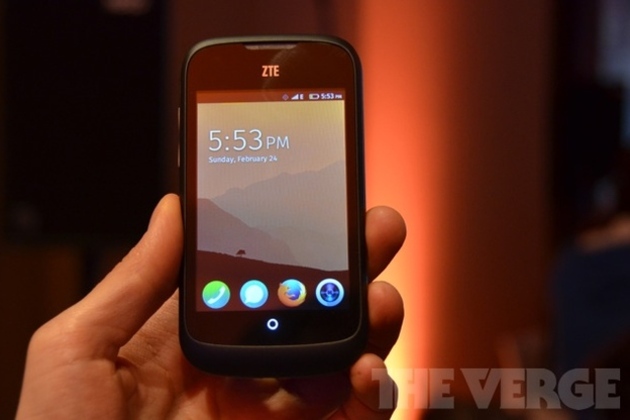
After months in development, Mozilla's Firefox OS is ready for the public. Today, the company announced that the first two handsets running the open-source HTML5 operating system — the ZTE Open and the Alcatel One Touch Fire — will soon go on sale in limited markets. Consumers in Spain won't have long to wait after Telefónica-owned Movistar announced the 3.5-inch ZTE Open smartphone will go on sale from tomorrow, costing €69 / $90 (including €30 / $39 balance) for prepay customers.
Mozilla hopes that its open frameworks, HTML5 apps, and consumer-friendly approach will lure people away from low-cost Android, Asha, and Windows Phone smartphones — which offer similar pricing but may provide more in the way of features. Firefox...
As Apple shares hover around the $400 mark, investors continue to look for signs the company will innovate and tackle new growth markets before confidence is restored. Among the new devices Apple will reportedly launch in the near future is a connected wrist watch rumored to be called the "iWatch," which would mark Apple's entrance into the emerging wearable computing market. Dozens of reports suggest an iWatch is imminent, and now it has been discovered that Apple recently filed documents in an effort to trademark the name "iWatch" in Japan, Bloomberg reported. This is the second country in which Apple has attempted to trademark the name — the first was Russia — and it is the most solid evidence yet that the company plans to launch a smartwatch in the future.
Yes, Twitter has a #music service now, and iTunes Radio is all shiny and new. But forget about them for a moment. In fact, forget about Pandora, Spotify, Rdio and Slacker. Same for Grooveshark, Vevo, Rhapsody, MOG, last.fm, Soundcloud, Deezer and Songza.
While we’re at it, please—oh please—forget about listening to music on YouTube. Just take a moment and clear your mental cache.
It’s not that these services are bad. In fact, I love many of them. But sometimes we get stuck in familiar routines. Every now and then we need to press pause and see what else is out there. It’s good for us. We might find something new (or better) that we would’ve never known about otherwise.
So whether you're simply a music junkie, or you want to enhance or supplement a service you already use, or you just love staying on the bleeding edge or relish living outside of the mainstream, take a moment to discover a few great music services. Most—maybe all—of which I’m betting you’ve never heard of before.
Exfm is all about creating a music feed chock full of songs you love. It works like this: Create a profile and click on the heart icon when you hear a song you really like. It’s basically that simple.
On the music discovery side, you can follow other people to hear what they loved and or check what’s trending to tap into the community pulse. Additionally, the Exfm team hand-picks featured music on a daily basis to give you a professionally curated source of fresh tunes to explore.
One fun and unique feature also lets you follow your favorite music blogs—and discover new ones.
Lisnr offers you a way to get more from your music—more goodies, more special offers, more whatever. Using the app, you can scan audio (live or recorded) for a special frequency that only Lisnr can recognize. Artists can use the service to deliver perks and bonuses to their fans.
If Lisnr detects the appropriate frequency, your phone will display a notification signaling the arrival of bonus tracks, discounts on live-show tickets, or some other exclusive.
Rapper J. Cole, for instance, recently gave fans early access to his latest album by holding "listening parties" whose locations could only be unearthed via Lisnr. Unwrap and enjoy your extras.
If the idea of advertising-free unlimited music streaming (with access to 17 million tracks) for only 99¢ per month tickles your fancy, you’re going to want to give rara a try.
Ready-made playlists and stations put together by music experts? Check. The ability to take your music with you on the go (even on a Windows 8 device) and access it offline (through an app that costs $1.99)? Check and check.
You might consider this a decent Spotify alternative if you’re looking for something even cheaper.
Murfie has found a way to squeeze a little extra juice out of the compact disc by merging a marketplace to buy CDs for $1-2 with streaming and downloads.
Every interaction on the site is based on a real CD that you own and can “do whatever you want with.” Since everything is based on physical CDs, Murfie will help you add the first 100 discs from your home collection for free.
Murfie gives you lossless downloads (FLAC and ALAC) and allows you to trade albums with other members—at zero cost.
Serendip (which derives its name from “an aptitude for making desirable discoveries by accident) bills itself as a social music discovery service.
If you prefer a lean-back approach to music (as opposed to picking every single song you want to listen to) then Serendip may be a great fit. It can connect you with people who share your musical taste and generates an automatic playlist based on music both you and they are enjoying.
The concept behind Stereomood is simple: Turn your mood into music. Pre-selected moods range from Happy to Studying to Just Woke Up to Lost In Jamaica.
Up at the top of the site is a big search box where you can type what you are feeling to quickly get matched to a particular playlist. What’s nice about Stereomood is that the songs are all aggregated from the best music blogs across the Internet.
Meaning that you could discover the next big thing at any time.
Playground.fm is an app that aims to transform your favorite songs into “the perfect musical mix” to provide a simple, beautiful and, perhaps most importantly, free listening experience.
This playlist-based music service was born out of the founders' desire to use awesome playlists without necessarily having to create awesome playlists. If you, like the founders, feel that “popular is boring,” you may want to give it a try.
8tracks can easily be described as internet radio created by people, not algorithms.
True to its name, 8tracks lets you create mixtapes with 8 or more tracks (to which you add a title, cover art and tags) that you can then share with with friends. When you first land on the site you are presented with some basic categories to get you started—like chill, party or indie rock, for instance.
If you want free music to go, check out the iOS and Android apps.
Seevl combines an algorithm with a search platform to help you find new music.
Seevl currently works with Deezer and YouTube and is the product of years of research and development at the intersection of social and semantic web technologies. Like other music services, seevl centers around a dashboard/profile that you create and builds recommendations from there.
MPme gives you real-time, live radio station recommendations matched to your taste. It brings its own unique twist to the curated playlist.
MPme provides you with access to high-quality, “pro” playlists already on the airwaves. If you own more than one device you can sync them via Facebook integration.
Amazon’s GameCircle, the company’s answer to Apple’s Game Center, is today receiving a major upgrade that includes the expansion of GameCircle to all Android devices. The service, which at launch had only supported Kindle Fire, already provides support for syncing progress, achievements and leaderboard data between devices, but today’s upgrade will also now include conflict resolution.
This feature arrives as an improvement to Amazon’s Whispersync technology, which now offers a more simplified interface for quicker integration, and allows for queuing updates to support offline operation. As the company explains in a blog post announcing these changes, these updates mean that customers’ game data will automatically sync across devices, even if they temporarily play offline. Developers, meanwhile, can concentrate on using the data and not persisting it, though the post makes clear that a copy of the data is available if developers need it — they’re not being locked in.
Amazon first introduced GameCircle nearly a year ago as a new gaming experience designed only for the Kindle Fire. However, speculation at the time was that this was necessary headway the company needed to make in the mobile gaming space, if reports of an Amazon smartphone were indeed true. While GameCircle is useful to those who delete a game from their Kindle Fire, then later install it again, the more prevalent use case for such a thing is for syncing progress between different devices — often a phone and tablet, as with Apple’s iPhone and iPad, for example.
GameCircle’s early adopters at the time of launch included Imangi Studios (Temple Run), Spry Fox (Triple Town), and GameHouse (Doodle Jump, Collapse). Today, there are over 500 different Kindle Fire titles that support the Whispersync-based service.
With the expansion to support the larger Android’s ecosystem, GameCircle can now better compete with Google’s more recently announced Google Play Game Services, an SDK revealed at this year’s I/O conference that also allows game state, leaderboards, and achievements to be stored in the cloud and synced between devices, plus supports real-time multiplayer gaming. However, Google’s Game Services technology also works on iOS and web in addition to Android, while Amazon’s platform remains Android-only.
Though Google doesn’t explicitly break out how many Android titles support Game Services, a search for keywords “game services” (in quotes) in Google Play revealed at least 1,000 results.
A deeper dive into the technical details of Amazon’s GameCircle’s upgrade is available here.
Keeping the pressure up, UK music industry group BPI is now contacting torrent sites with a legal threat of their own. In their letter the BPI accuses torrent site owners of encouraging and facilitating massive infringement of their copyrights.
“We are writing you in relation to the Site’s very large-scale infringements of the Members’ copyrights in sound recordings in the UK. The site encourages and enables the infringement of those copyrights by users of BitTorrent technology,” the letter notes.
The BPI explains that it found pirated music from Amy Winehouse, Justin Bieber, Rihanna, Take That and many other popular artists via torrent sites, and claims that site owners are liable for these infringing works.
“We have carried out tests which confirm that torrent files for sound recordings identified in the enclosed list are available for download and/or accessible by magnet link on the Site. You are therefore liable for infringement of the copyright in those sound recordings,” BPI explains.
To prevent further damages the BPI asks the site owners to “take immediate action” to prevent further infringements.
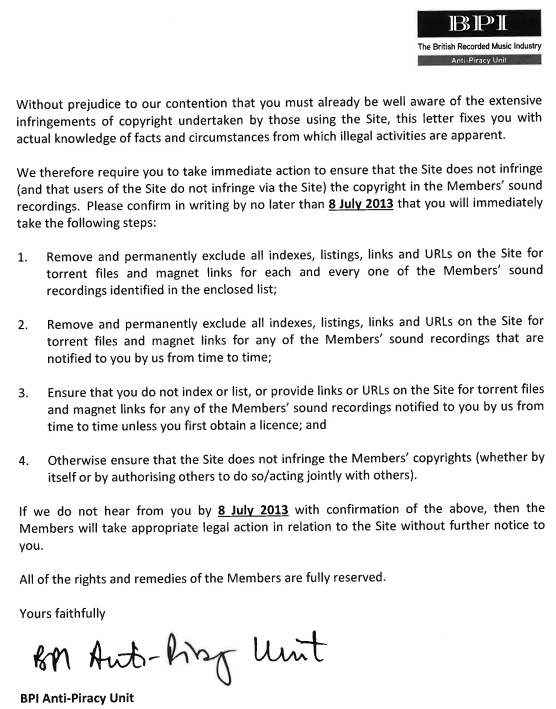
BPI Demands
As can be seen in the image above, the BPI wants site owners to remove a list of albums and tracks from their sites. However, it doesn’t stop there as the music group also demands that future uploads should be prevented and reserves the right to expand the list in the future.
The enclosed list doesn’t specify any URLs. This means that the torrent site owners would have to install a broad keyword filter to comply, or otherwise prevent new titles from being added to the site.
Responding to the letter, one torrent site owner made it clear to TorrentFreak that he doesn’t intend to cooperate.
“Apparently BPI thinks that all the whole world is governed by UK laws, sponsored by BPI! They don’t like torrent sites – fine, we don’t like their ‘music’,” we were told.
According to the site owner his site complies with takedown notices as most others do, including requests from BPI members. However, he can’t find any recent notices from the BPI itself and the music group is not among the most active senders.
“There are several music labels who happen to be BPI members who send cease and desist notices. These are processed normally – content gets deleted if they send URLs, which usually takes up to four hours,” the site owner explains.
The BPI has a different view on the matter and believes that the torrent sites have an obligation to take action.
“These sites exploit artists’ work without their permission and undermine the massive investments that labels make bringing new music to fans,” BPI’s Chief Executive Geoff Taylor tells TorrentFreak.
“They also inhibit the development of legitimate services, which need a level playing field to grow. We have therefore written to ask that they take immediate action to ensure they no longer infringe copyright,” he adds.
If the sites fail to respond positively the BPI plans to take legal action, as the group makes clear in its letter.
“If we do not hear from you by 8 July 2013 with confirmation of the above, then the Members will take appropriate legal action in relation to the Site without further notice to you.”
Whether that means site owners will be dragged into court, or that the BPI will apply for the sites to be blocked in the UK, remains to be seen.
There are many different forces pushing us toward a Big Brother dystopia.
There are those who profit off of selling surveillance equipment (obviously), there are various religious nutcases who insist that they have the perfect way of life for everybody else, there are politicians who try to prey votes off of fear. But one overlooked major player driving us towards a Big Brother society is the copyright industry.
The reason for the copyright industry to push for surveillance is simple: any digital communications channel can be used for private conversation, but it can also be used to share culture and knowledge that is under copyright monopoly. In order to tell which communications is which, you must sort all of it – and to do that, you must look at all of it.
In other words, if enforcing the copyright monopoly is your priority, you need to kill privacy, and specifically anonymity and secrecy of correspondence. This is exactly what the copyright industry has been doing quite consistently. I’m not going to let this stay at a philosophical level – instead, let’s see what tangible changes they pushed for hard in Sweden to enable persecution of people who share knowledge and culture outside of their monopolies. I’m going to focus on two changes.
In order to be able to sue single parents for their houses and life savings, they needed the ability to tie an IP address and a timestamp to a subscriber. In other words, they had to establish historic trackability of everybody’s actions online, and they needed direct access to that surveillance data. These two developments by themselves were unthinkable a decade ago, but it is the combination of them that mixes the real poison into society’s fabric.
If the copyright industry “only” received rights that went further than those of the Police in requesting IP logs from Internet Service Providers, the ISPs would have responded by refusing to keep any logs at all. If the ISPs were forced to keep logs by law, thus switching this kind of privacy intrusion from “absolutely forbidden” to “mandatory”, those logs would have been kept strictly for law enforcement. So it was the combination of the two – forcing ISPs to keep logs of everybody’s subscriber identity, and getting rights by law to access those logs – that was the key to suing the houses off single parents.
This was also exactly what they got in Sweden. Through an atrocious over-implementation of the EU IPRED directive, which was in itself shameless mail-order legislation from the record industry, the copyright industry got access to the subscriber logs. (It is notable that these rights to violate privacy are stronger than what the Police had.) You can even see this demand on a checklist of demands given to Sweden’s government from the International IP Association via the US Embassy. They also got their Data Retention Directive that specifically requires logging of subscriber identities online – Thomas Bodström, one of the architects behind the EU directive, was heavily in bed with the copyright industry.
There were many snags on the way to this point that were even more revealing. For example, it was proposed in Sweden that the records stored in accordance with the Data Retention Directive should be explicitly excepted from availability in accordance with IPRED. At that point, the copyright industry in Sweden went ballistic and threw tantrums all over the media. It left little to chance, or to the imagination, for that matter: it was obvious what they wanted. They wanted trackability of everybody online. And they got it, thanks to the clueless digital illiterates we have that call themselves politicians.
The copyright industry drives a Big Brother society in order to force everybody to care for their obsolete business. I certainly don’t, and I certainly won’t. I think the idea is repulsive. But at the end of the day, it’s not really the copyright industry who is at fault for making obscene demands. They’re just spectacularly failed entrepreneurs. The real blame here lies with the politicians who blindly accept the obscene demands.
With regards to the net and its liberties, today’s politicians keep behaving like drunken blindfolded elephants trumpeting about in a porcelain factory. It remains up to us to educate or replace them, and above all, making clear to them that these are their two options.
About The Author
Rick Falkvinge is a regular columnist on TorrentFreak, sharing his thoughts every other week. He is the founder of the Swedish and first Pirate Party, a whisky aficionado, and a low-altitude motorcycle pilot. His blog at falkvinge.net focuses on information policy.
Free cloud storage is easy to come by these days—anyone can give it out, and anyone can give out lots of it. However, the best cloud storage providers give you more than just storage. They offer availability, multi-platform support, security, app integration, and more. This week we're going to look at five of the best cloud storage providers on the market, thanks to your nominations.
If you're reading this, you probably already know what Dropbox is. We've covered Dropbox and services that support it extensively, and most of you here have followed along with our tricksto getas much space as you possibly can. Many people bemoan Dropbox's position at the top of the pack as being a matter of popularity and the fact that they were one of the first to really popularize cloud storage (referral links and storage bonuses didn't hurt), but it's not just popularity that makes Dropbox special. Support for virtually every operating system, both desktop and mobile, experimental and beta builds that add tons of useful features, and a vast third-party developer community taking advantage of its open APIs to build applications on top of it make Dropbox a great cloud storage service, whether you use it for your files and just sync with the desktop clients, or you have another favorite app that uses Dropbox to keep your files synced across devices. Dropbox has its woes (especially with regard to security), but it's a stellar option—if it weren't, people wouldn't keep using it. Plans start with 2GB, but you can get way more than that via referrals, mobile app use, photo and video uploads, or by using an EDU address. You can check out their plans here.
Google Drive's inclusion in the top five came as a bit of surprise, especially considering some of the older contenders that fell off due to lack of votes. Drive has only been around for about a year, but the fact that it combines the tools that formerly known as Google Docs (Docs, Spreadsheets, Presentations, and Drawing), all of your files created with those tools, and 15GB of storage for anything else you want makes it a strong contender. After all, if you're using those tools in your day to day work, it makes sense to use Google Drive for file storage as well. Plus, the fact that it's available in OS X, Windows, iOS, and Android makes it useful at your desk or on the go. Plus, with the right plugins, it can be even more powerful than other services you may also use. Those of you who nominated Google Drive almost unanimously praised its tight integration with the Google services you already use, and of course its pricing. 15GB for free, and you can go here to check out their other plans (as well as see your current utilization) or go here to read more about Drive.
SkyDrive used to be pretty clunky and difficult to use, but Microsoft's cloud storage service has come a long way since those days. It's tightly integrated with Windows now, especially Windows 8 for desktops and tablets, and if you use Office 2013 at all—either on the desktop or on the web—using SkyDrive as cloud storage for all of your files is quick and seamless. SkyDrive also has mobile apps for Windows Phone, iOS, and Android, so you can stay up to date on changes to your files and access them on the go, anywhere you have an internet connection. Desktop clients for Windows and Mac make working with your saved documents and syncing them easy too. If you got in while the latest iteration of the service was still in beta, you probably have a cool 25GB of storage, but even if you signed up today, you'd still walk away with 7GB of storage, 10GB if you're a student, with the option to buy more storage if you need it or run out. SkyDrive also has a third-party app ecosystem and open APIs, and a number of tools that tie nicely into it. Those of you who nominated Skydrive praised it for its Microsoft integration, especially with Office and Windows, and its third party app support.
SugarSync has been around for a long time, and it's incredibly richly featured. It's not as widely used as some of the other big names, but in some ways, it really should be. SugarSync has insanely detailed syncing options, and can back up or sync any files or folders you choose on your system, not just a single folder and all of its contents. SugarSync can work like a backup client, automatically backing up your files as you change them, or you can use it like a traditional syncing cloud service, complete with a drive on your system you drop files in. The service keeps an impressive revision history for each of your files, lets you share, lock down, or password protect individual files on the web or on the desktop, and even makes streaming media to your mobile devices easy. While they don't really put their free plan up front, you can get 5GB for free, and make use of the service's wealth of features, along with their desktop apps for OS X and Windows and their mobile apps for iOS, Android, and Windows Phone. If you need more storage, their pricing plans are pretty attractive.
Bitcasa was surprising contender, considering some of the names that fell short of the nominations, but it's a great service to mention. Aside from having virtually unlimited storage options—we mean in the terabytes, easily, Bitcasa has syncing clients for Windows and OS X, and mobile apps for Android, iOS, and Windows Phone (including tablet versions of all three). Bitcasa knows that you'll probably use that wealth of space for photos, music, and movies, and makes it easy to stream that content to your mobile devices when you're on the go, or to your desktop when you want to use it. They even have a Chrome extension that lets you use Bitcasa as your downloads folder. Bitcasa is free for 10GB, but if you're willing to pay, you can get infinite storage for $99/yr. Seriously—just keep uploading files and they'll be there. If storage is what you really need—not extra bells and whistles—and you're willing to pay for it, Bitcasa is worth a look.
Now that you've seen the top five, it's time to put them to a final vote to determine the community favorite:
We have to give an honorable mention this week to everyone who suggested you Do It Yourself, essentially using a NAS or other storage device at home packed with disks and any free software that lets you access them anywhere you go from any computer whether you're on your home network or off of it. It's super easy to roll your own cloud storage solution with tools like OwnCloud, or just by giving your NAS locked down access to the internet so you can get to your files when you're away. Either way, hats off to those of you who choose to just do your own thing. Besides, someone has to keep the NSA on their toes, right?
Another honorable mention this week goes out to Box (formerly Box.net), which barely missed the top five, and earned high praise from many of you for shoveling out up to 50GB of free space to new users in some cases, and you can still pretty easily find services and promotions offering tons of free space with Box just for signing up and downloading the client. It's not new—it's been around for ages (and was a contender the last time we asked you about cloud storage services), and walks the line between being a consumer-friendly storage and syncing solution and an enterprise-level document management service.
Speaking of referral links, one contender that also missed the top five (but wouldn't, if its supporters had voted correctly instead of just pimping referral links) was Copy, a relative newcomer who's only distinguishing feature, as far as we can tell, is really just that you get 15GB to start, and there's no real cap on how much more you can earn if you get the world to click on your referrals—you get 5GB for each person you get to sign up. Note: Please don't spam the discussions with your referral links. Comments with referral links will be dismissed.
Have something to say about one of the contenders? Want to make the case for your personal favorite, even if it wasn't included in the list? Remember, the top five are based on your most popular nominations from the call for contenders thread from earlier in the week. Don't just complain about the top five, let us know what your preferred alternative is—and make your case for it—in the discussions below.
The Hive Five is based on reader nominations. As with most Hive Five posts, if your favorite was left out, it's not because we hate it—it's because it didn't get the nominations required in the call for contenders post to make the top five. We understand it's a bit of a popularity contest, but if you have a favorite, we want to hear about it. Have a suggestion for the Hive Five? Send us an email at tips+hivefive@lifehacker.com!
Considered by many to be one of John Carpenter's finest horror features, The Thing was very nearly a dramatically different film. After viewing an early cut of the movie, Carpenter (who also directed classics such as Halloween, The Fog, and Escape from New York) found it a confusing mess that dragged heavily and didn't have any sort of lead character. By filming additional scenes, extending some, and cutting a huge amount of already-shot material, Carpenter created the movie that we all know so well. Stuart Cohen, who co-produced the movie, has written a blog post laying out the adjustments that Carpenter made to the script and final cut. It's a fascinating insight into the drastic changes that can happen to a movie even after cameras...
There's apparently a sudden surge in the number of films being made in Black and White. MAaN gets mentioned in this article looking at reasons for the phenomenon.
Bruce Schneier's latest Google talk expands -- very productively -- on his recent theme of "security feudalism" (roughly, the idea that we end up trusting companies like Facebook, Apple and Google to serve as our feudal lords, securing us from marauders in exchange for being locked into them and subject to their whims). This is a lot more unfinished and unformed that the usual talks I've heard from Bruce, but that's really because he's exploring some new ways of thinking about important issues. It's an hour's watch (or listen -- there's not really any reason to tune into the video; I just ripped it to an MP3 and put it on my phone while I was walking around) but it's an hour well spent.
While the practice of domain blocking remains out of reach for rightsholders in the United States, over in Europe it is gathering pace.
The music and movie industries have honed their skills particularly well in the United Kingdom, where the main ISPs now block several leading torrent and movie streaming sites.
To combat this censorship so-called ‘proxy sites’ have been cropping up thick and fast. To gain access to The Pirate Bay or KickassTorrents (the two most-blocked domains) all one has to do is visit a proxy site instead and the real domain will bounce into view.
Finding a proxy for The Pirate Bay is incredibly simple since there are dozens of them, but in addition to KickassTorrents proxies being generally more thin on the ground, a new problem is raising its head which could restrict them even further.
In order to keep their operations going, proxy operators often display advertising on their services. Sometimes this is in addition to the advertising already showing on KickassTorrents but sometimes ads are replaced. This has caused friction between Kickass and some proxies.
A few days ago TorrentFreak spoke with the admin of KickassProxy about a problem he’d been experiencing.
“Earlier this week [my proxy] dropped offline and my server was unable to connect with KAT. I figured it was something I’d broken so I moved everything onto another server which worked for a bit until the same thing happened. I thought it seemed a bit suspicious and not just coincidental so I pm’ed KAT staff asking if I was being blocked,” the admin explained.
Kickass staff later confirmed that the site had indeed been blocked because the KickassProxy admin had allegedly replaced Kickass advertising with his own.
“Whilst I did add my own banner ads in place of KAT’s, they aren’t quite replaced as KAT’s banner ads just don’t appear on my proxy or any other proxy (as far as I know). All of KAT’s other ads remain and I offered to remove mine but was told that they’d made their decision and wouldn’t change.”
The operator of another proxy who spoke on condition of anonymity told TorrentFreak that they suspected their IP addresses had also been blocked but the problem with disappearing ads could be down to the way the Kickass site is setup.
“We would happily display their ads if they worked in addition to a few of ours to help with costs. KAT’s ads are served from a.kickass.to which as you may guess, is blocked,” he explained.
Going into some detail, the proxy operator then explained that Kickass (for unknown reasons, but possibly to save bandwidth) set their site up in a way that makes it extremely difficult to get proxies working. We didn’t get a comment on that specifically from Kickass, but they did give us an explanation as to why some proxies had stopped working.
“We have banned some proxies which were replacing ads. The only reason is that we don’t want to lose our traffic because of proxies which are not even showing our ads while they are providing additional load on our servers,” the Kickass operators explained.
So what we have here is Kickass being blocked in the UK in the first instance due to its claimed disruptive effect on the revenue models of the entertainment industries, followed by proxies being blocked for having a similar effect on the revenues Kickass. Hmmmm.
Additionally, Kickass also told us that they blocked some proxy sites for doing too well in search engine results.
“Another reason [for banning proxies] is that for some queries in Google, proxy’s pages were placed even higher than [Kickass' results],” the site explained.
Quite why proxy sites have been outgunning the official domain in Google’s results is uncertain, but the search engine may well be down-ranking ‘pirate site’ domains as it promised the music industry it would.
But despite KAT’s approach to some proxies, it is possible for them to work with others.
Drastik, the admin of PirateProxy.net, the world’s largest Pirate Bay proxy, told TorrentFreak that he had previously spoken with the KAT admins about ads and had reached an agreement.
“When my KAT proxy (katproxy.com) started getting a lot of traffic, I contacted a KAT admin and asked if I could add one banner advertisement to cover my server costs. They said that it was okay and I added that one ad. My proxy has been running fine,” he explained.
Finally, it seems that KAT has a plan to help the site remain accessible in the future, even without the assistance of third-party proxies.
“In the nearest future a number of official proxies will be started as well so KAT definitely will be available through its official proxies even in case of any issues with our main domain,” KAT concludes.
Huawei has confirmed that it is collaborating with Google to join the likes of Samsung and HTC and produce a stock Android smartphone that will be sold in the Google Play store. Kevin Ho, president of the Huawei's handset product division, revealed in an interview with Pocket-lint that the company is "working with Google to analyse the possibility" of producing a Google Edition version of its incredibly thin Ascend P6 smartphone. The device measures a mere 6.2 millimeters thick and is equipped with a 4.7-inch 720p display, an in-house 1.5GHz quad-core processor and an 8-megapixel rear camera. The P6 also includes 2GB of RAM, 8GB of internal storage, a microSD slot, a 5-megapixel front-facing camera and a 2,000 mAh battery.
Images of what are said to be of Sony's upcoming flagship smartphone leaked onto the Web this week. The latest rumors suggest that the handset, code-named Honami, will be equipped with a 5-inch full HD display, a 2.3GHz quad-core Snapdragon 800 processor, 2GB of RAM and a non-removable battery between 2,700 mAh and 3,000 mAh. The smartphone will also reportedly feature a 20-megapixel rear camera with a Cybershot CMOS sensor and Carl Zeiss lens. The images, which were published by the website Just Another Mobile Blog, reveal that the device will include a textured backplate and aluminium frame. Sony is expected to announce the Honami smartphone at the IFA trade show in September. Additional images follow below.
Coming update makes it easier to organize and play your library while keeping all the sound improvements you expect from Spins HD
While the debate over keeping your music collection stored locally or in the cloud will never end, the one thing most people agree on is that a good music player app makes a world of difference in the way those files sound. Everyone has a favorite, but Max Sound is pushing out an update to Spins HD that you're going to want to look at.
Spins HD takes your existing on-device music collection and runs it through more than equalizer presets, the app delivers HD sound by converting the file into an actual analog sound wave. While it's still a compressed digital file, this allows the "full breadth" of the original recording to come through, delivering better sounding music. These claims may come from the developers, but I will say the files do sound better when playing in Spins HD, and often times much better. And it's easy -- there is a page of presets that work well, and for the more adventurous, you can also set the tone for high, low, and midpoint sounds from your music. Great sound from an app that's easy to use is always a plus.
Smart phones have taken the place of the mp3 player for most of us, so getting great sounding audio is important for the connoisseurs out there. The coming update for Spins HD keeps the great sound you expect from the player, and adds a much improved UI that makes it easier to manage and sort your playlists and songs. If you're a current user, look for the update shortly, and if you haven't tried Spins HD yet, click the link above to give it a whirl. A press release and series of screenshots is after the break.
Neil Gaiman's multi-pantheon epic gets the green light
A series like Game Of Thrones doesn't come along every day, even if you are HBO, but if there's any justice in the world American Gods will be the channel's next mega-hit, and word has now emerged that HBO is currently planning a six-season arc for the adaptation of Neil Gaiman's novel.
The book's focus is a man called Shadow, who's about to be released from prison when word reaches him that his much-loved wife has been killed in a car crash. It's just the first in a series of blows for the strong but silent type, who soon finds himself reluctantly working for a charismatic salesman called Mr Wednesday and drawn into a conflict between America's gods, old and new.
Tom Hanks' Playtone Productions are going to be pulling it all together, with a $40m budget for each series of 10-12 episodes - not a vast amount for that much screen time. While the novel has a sprawling cast of characters and a fantasy-heavy story that will demand a large amount of CG and stretch that budget, there are also lots of human-focused scenes that should only require a decent cast.
For more on American Gods and the rest of Neil Gaiman's work, check out our podcast special with him below. Look out for American Gods on TV either late this year or (more likely, we suspect) sometime in 2014.
The Atlantic has a fantastic piece on the work on space artist Ron Miller, showing pictures of the night sky on Earth with other planets swapped in where the Moon should be. Jupiter is my favorite — if that were hovering over us every night, we'd all have deep inferiority complexes.
Earlier this month, federal prosecutors filed a formal criminal complaint against Edward Snowden charging him with three felonies for leaking information about the National Security Agency’s surveillance programs to Glenn Greenwald at the Guardian and Barton Gellman at the Washington Post. Two of those charges were filed under the 1917 Espionage Act.
Snowden is the seventh person the Obama administration has charged with violating the Espionage Act for leaking information to the press. Prior to 2008, only three other people had been charged with felonies under the Espionage Act for leaking documents.
Indeed, the first time the Espionage Act was applied to a whistleblower was in the case of Daniel Ellsberg, who leaked the Pentagon Papers to the New York Times in 1971.
This month marks the 32nd anniversary of the Times’ publication of the first excerpts of the Pentagon Papers.
I serve on the board of directors of the Freedom of the Press Foundation with both Greenwald and Ellsberg, and minutes after news broke about Snowden’s charges our board received an email from Ellsberg. It was short and to the point: “Same charges as against me, 40 years ago, except (so far) for conspiracy.”
Ellsberg predicted, accurately, that Snowden wouldn’t be charged with “espionage” per se, but rather with a violation of one specific part of the Espionage Act, 18 U.S.C. 793 (d). “Other parts of 792, 793 and 794 deal with real espionage; paragraph 793(d) could too, potentially, but has been used almost exclusively not for espionage but for unauthorized disclosures of classified information, starting with me in 1971, and all of Obama’s prior prosecutions of leaks,” Ellsberg wrote.
In the email, Ellsberg noted that the application of the Espionage Act to himself, Snowden, Bradley Manning and others is significant because the Act’s original intent focused on “secretly conveying defense information to a foreign power, especially an enemy in wartime, with intent to help that power or harm the U.S.”
On this point, James Goodale, the general counsel for the New York Times during the Pentagon Papers case in 1971, argues in his new book, “Obama apparently cannot distinguish between communicating information to the enemy and communicating information to the press. The former is espionage, the latter is not.”
Indeed, the recently revealed “Insider Threat” program, which the Obama administration implemented after Bradley Manning handed over hundreds of thousands of documents to WikiLeaks, is perhaps the most troubling illustration of this fact. Marisa Taylor and Jonathan S. Landay of McClatchy report that under the program, “Leaks to the media are equated with espionage.” They call the program “a government-wide crackdown on security threats that requires federal employees to keep closer tabs on their co-workers and exhorts managers to punish those who fail to report their suspicions.”
This belief that leaks to the media are akin to leaks to an enemy state helps explain recent incursions on press freedom by the Obama Justice Department. These have included secret subpoenas of journalists’ phone records and their characterization of Fox News journalist James Rosen as aiding and abetting in the leaks that he eventually published. In these cases, journalists have not yet been charged with anything but the Justice Department’s actions have already had a chilling effect on journalists and their sources.
Scott Bomboy of the National Constitution Center reports that the current charges against Snowden carry a 30-year prison term, but that additional charges may be added as the investigation continues. And, he notes, “Section 794 of the [Espionage Act] contains the death penalty as possible punishment for giving information to the enemy during wartime.”
Many media pundits and politicians are already wondering aloud if Snowden has provided NSA documents (knowingly or not) to either the Chinese or the Russians, though there is no evidence he has done either. In fact, he has steadfastly denied this.
The legacy of the Espionage Act, and especially its recent application to leaks and the press, is a troubled one. Not long after the Espionage Act was put in place, it was used three times against peaceful anti-war protesters: Charles Schenck, Eugene Debs and Jacob Frohwerk (Frohwerk was a columnist for a Missouri newspaper). Trevor Timm writes in the Atlantic that “Together, the trio of rulings did more damage to [the] First Amendment [than] any othercase in the 20th century.”
Today, lawmakers like Peter King and journalists like David Gregory seem ready to extend the Espionage Act charges facing Snowden to Glenn Greenwald, the journalist who published Snowden’s leaks.
In response to this, Erik Wemple has outlined what it would take to charge Greenwald under the Act. He finds it wouldn’t be easy, but it should be troubling that so many people are even suggesting it. “Reading through the opinions and scholarly work on the Espionage Act reveals how carefully this country’s finest legal minds have sought to protect press freedoms vis-a-vis our precious national security interests,” Wemple writes. “Stunning to behold how carelessly some commentators would trample it all.”
In an NPR interview this month, Benjamin Wittes of the Brookings Institution argued “the problems with the Espionage Act are that it is hopelessly broad.” Greenwald echoed this sentiment in the Guardian, suggesting it was that vagueness that made administrations before Obama’s leery of using it. Charles Pierce has called for its repeal, describing it as a "foul relic of a foul time […] employed to quash dissent during World War I, and then repurposed for the Red Scare."
The First Amendment and press freedom questions that haunt the Espionage Act are particularly important right now. Changes in media and technology have put the tools of journalism and media making in the hands of more and more people, challenging old assumptions about who is a journalist and how journalism is done. Increasingly, independent journalists, nonprofit news outlets and citizens are playing critical roles in newsgathering and reporting on the most important issues of our time.
Unlike Greenwald or Neil Sheehan, the New York Times journalist who first published the Pentagon Papers, these independent and citizen journalists don’t have the resources, legal or financial, of major newsrooms to support them. As such, they are more at risk than ever. In this moment, an overly broad law like the Espionage Act can become a dangerous tool to silence and suppress both political dissent and rigorous journalism. Indeed, history has shown that it already has.
In the U.S. alone, BitTorrent transfers account for one-third of all upstream traffic during peak hours.
This massive network use has received plenty of interest from Internet providers over the years, but AT&T is planning to take it to the next level.
A new patent awarded to the Intellectual Property division of the Texas-based company describes a system that can accurately measure the flow of both legitimate and infringing file-sharing traffic.
Titled “Method and apparatus for automated end to end content tracking in peer-to-peer environments,” the patent covers an advanced monitoring system that can detect how often a certain title is downloaded. AT&T says this information can then be used to address network congestion or counter piracy.
The flow-chart below shows the various steps involved in the detection and tracking process.
AT&T Torrent tracker
The system described by AT&T focuses specifically on torrents, which are gathered from search engines and other websites through RSS feeds. Discovered content is collected in a database and the system then downloads the torrent and records information on the people who are downloading.
In the patent AT&T notes that peer-to-peer traffic accounts for a large percentage of traffic generated on the Internet, some of which results in a loss of revenue for copyright holders.
“For example, some content may be legitimately purchased and downloaded by users via P2P. However, some content may be pirated and illegally copied and distributed P2P violating copyright laws and reducing revenue for the content producers and distributors,” the company explains.
AT&T’s system will be able to detect what is most downloaded on P2P-networks, suggesting that this information can be used to track and counter piracy.
“The present disclosure automatically tracks content that is downloaded in a peer-to-peer environment. In doing so, the present disclosure automatically identifies the most popular content titles to monitor and tracks and identifies a number of unique peers for each of the content titles.”
In addition, there is a content analysis component that will verify whether the downloaded files are indeed what the title suggests. This will be useful to filter out spam files and viruses that are mislabeled as popular videos or music.
“Based upon the verification, the list may be modified if the content titles actually being downloaded do not match the content titles in the list. For example, the content titles in the list may be looking for a recently released movie; however, the actually downloaded content titles may be a television show that had an identical title or may be a peer attempting to disseminate a virus under a disguise of the content title and so forth.”
The patent doesn’t go into detail on the intended purpose of the tracking, but AT&T specifically mentions that it can be used to track infringing downloads and address network congestion.
“The present disclosure may be used to determine which content titles are being illegally distributed and by whom. In another example, the present disclosure may be used to determine which content title downloads are creating the most network congestion. This information may in turn be used for capacity planning and the like,” the patent reads.
While there are many outfits that track BitTorrent and other file-sharing traffic, until now we are not aware of any ISPs that have shown interest in this type of monitoring. AT&T is certainly the first company to be granted a patent for such a specific P2P monitoring system.
It’s worth noting that AT&T participates in the six-strikes copyright alert system where P2P users are also monitored. The main difference is that under that program the monitoring is carried out by a the third-party company which only tracks a list of titles supplied by the MPAA and RIAA.
Whether the provider has intentions to actively scan for and throttle pirated content being shared using BitTorrent is unknown. With the patented system it could certainly do so, and if it targets infringing traffic only it does not violate FCC’s net neutrality rules.
Ouya, Project Mojo, GameStick, Unu, and GamePop — a growing flood of small, inexpensive, Android-powered game consoles are currently fighting for a spot in your entertainment center. Even Google is reportedly building a console. On Friday, BlueStacks announced the GamePop Mini, a console that's will be about the size of a pack of bubble gum, and free for those who commit to a 1-year subscription to its online gaming service — which is also called GamePop.
Netflix this morning announced its own take on virtual assistants like the iPhone’s Siri, with the debut of “Max,” an on-screen guide for the Netflix app on PlayStation 3 devices which helps you find new movies or TV shows to watch. And yes, the guide does talk to you, but thankfully has yet to manifest itself in some more corporeal format, like Microsoft’s “Bob.”
Instead, Max – which Netflix says is “rumored to be the child of Siri and HAL 9000″ – will ask you a few questions about your mood or movie and TV show tastes in order to make a recommendation, while also taking into account your interests as already understood by Netflix’s algorithms.
Max also offers a game show-like experience called “The Ratings Game,” where users can pick a genre that fits your mood, and then Netflix – err, Max – runs through a few titles you might like and has you rate them on a 5-star scale.
After gaining a better understanding of your interests, Max may offer personalized suggestions after asking only one question. In an example provided by Netflix on its blog, Max asks if you prefer “monkeys” or “UFOs” to make its – err, his – recommendations. And at other times, Max will simply make a suggestion, no Q&A involved.
All the while, Max speaks to interact with you using a goofy, “I’m a game show host!,” type of voice. (You can almost imagine him saying, “no, I’m sorry, the correct answer was ‘UFO’s', it’s back to zero for you.”)
Today, however, Netflix seems to be making a broader commitment to this silly assistant, promising “we’ll expand his repertoire and make him available on other devices in the future, likely the iPad next.” The company tells TechCrunch that the iPad is expected for 6 months to a year from now, if Max proves successful.
In addition, the decision to launch first on the PS3 is due to the fact that it’s most popular way for people to watch Netflix on their TVs, explains Netflix. “We have tested Max already, now he’s going public to all members who use PS3,” a company spokesperson says. “Max has shown already that members who use him will watch more and stay with Netflix longer.”
Unfortunately (???), Max will only be available to U.S. users for now, and the rollout should complete by end of day.
Updated 10:30 AM ET with additional rollout details and comments from Netflix.










 While the practice of domain blocking remains out of reach for rightsholders in the United States, over in Europe it is gathering pace.