Shared posts

09 Oct 15:21

UK Police Orders Registrars to Suspend Domains of Major Torrent Sites

by Ernesto

city of london policeEarlier this year UK police began working with rightsholders on a campaign to shut down file-sharing sites. Many site operators received warnings that their activities were breaching copyright law as well as the UK’s Serious Crime Act.

The actions yielded some success as a few smaller sites closed their doors. However, the major targets were unfazed by the police demands and continued business as usual.

This week the newly founded Intellectual Property Crime Unit (PIPCU) of the City of London Police stepped up its efforts and instead of targeting the site owners, they contacted their domain registrars. In a carefully worded letter the police warn that the sites in question may be copyright-infringing.

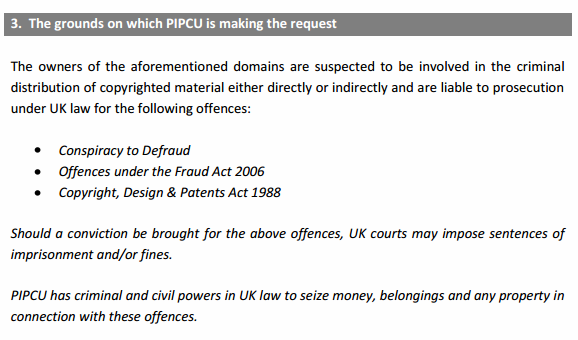
“The owners of the aforementioned domains are suspected to be involved in the criminal distribution of copyrighted material either directly or indirectly and are liable to prosecution under UK law for the following offences: Conspiracy to Defraud, Offences under the Fraud Act 2006, Copyright, Design & Patents Act 1988,” the letter states.

“Should a conviction be brought for the above offences, UK courts may impose sentences of imprisonment and/or fines. PIPCU has criminal and civil powers in UK law to seize money, belongings and any property in connection with these offences.”
grounds

There is no reference to an active court order that requires the registrar to take action, but the police unit instead points at the obligations the registrars have. Among other things, the letter lists a possible breach of ICANN policy and a violation of the registrars’ own Terms of Services as a validation for the suspension.

The letters were sent to the registrars of dozens of domain names and the fallout is already visible. TorrentFreak spoke to the owner of SumoTorrent.com who confirmed that his domain was suspended yesterday. The site quickly moved to SumoTorrent.sx, but lost a lot of traffic in the process.

MisterTorrent.me was also suspended after the registrar received the police letter, and ExtraTorrent’s .com domain presumably suffered that same fate.

With millions of visitors a day ExtraTorrent is the biggest casualty so far. TorrentFreak talked to the operator who couldn’t yet confirm that City of London Police are behind the suspension, but this seems very likely. For now the site has moved to ExtraTorrent.cc which is still operational.

Not all domain name registrars are blindly complying with the demands of the Intellectual Property Crime Unit. Canada-based easyDNS is refusing to suspend TorrentPond’s domain, describing the police request as overbroad and unfounded as there is no hint of due process.

“Who decides what is illegal? What makes somebody a criminal? Given that the subtext of the request contains a threat to refer the matter to ICANN if we don’t play along, this is a non-trivial question,” easyDNS’ CEO Mark Jeftovic responds.

“Correct me if I’m wrong, but I always thought it was something that gets decided in a court of law, as opposed to ‘some guy on the internet’ sending emails. While that’s plenty reason enough for some registrars to take down domain names, it doesn’t fly here,” he adds.

It’s unclear how many sites were targeted by the police letter but it’s not unlikely that more registrars will take action during the hours to come. The police letter recommends the registrars to act within 48 hours and asks the companies to “consider their liability.”

“Suspension of the domain(s) is intended to prevent further crime. Where possible we request that domain suspension(s) are made within 48 hours of receipt of this Alert. In respect of the information provided by us, we respectfully ask you to consider your liability and the wider public interest should those services be allowed to continue,” the letter states.

In addition, the registrars are being asked to effectively send the traffic of the torrent sites to a landing page with the City of London Police logo, as well as the logos of their entertainment industry partners. Again, all without citing a court order or specific legal mandate.

“We request that the aforementioned domain(s) are redirected to the PIPCU Warning Page located at IP address: 83.138.166.114,” the letter notes.

TorrentFreak asked the City of London Police for the comment on their latest actions but we have not heard back from them. It’s clear, however, that the cooperation between the entertainment industry and UK law enforcement is serious.

Whether the impact will be lasting has yet to be seen.

Update: The emails were sent to registrars of other “pirate” sites as well, including emp3world.com, full-albums.net and maxalbums.com. We will update this article when more information comes in.

Update: ExtraTorrent confirms that their domain troubles are related to the same issue.

“Our registrar and with no court order or due process got scared of the London Police email and did suspend the domain. We are communicating with the registrar to find a logical solution to this chaos,” TorrentFreak was told.

city-police

Source: UK Police Orders Registrars to Suspend Domains of Major Torrent Sites

09 Oct 12:30

Google to open fire at WhatsApp, other messaging giants

by Jacob Siegal
Google Hangouts SMS MMS IntegrationWhatsApp, Kik and Line have made their mark on mobile app stores around the world by offering a more robust chat ecosystem than Apple or Google have managed to create on their own. Now that Google has fully transitioned from Google Chat to Hangouts on the desktop, the company has an opportunity to bring the improved software to its mobile platform in a much more meaningful way. Android Police received alleged screenshots of Android 4.4 KitKat which show settings that will enable SMS and MMS with Hangouts. Although there is no hard evidence indicating that the Messaging app will be done away with altogether, combining the popular Hangouts chat service with existing mobile messaging services would be a smart way to compete with third-party apps. Check out the purported leaked screenshots below.

Continue reading...
09 Oct 12:29

Drugs Search Engine Diagnosia Raises €1M To Take Its Wares To Europe

by Steve O'Hear
screen568x568-5

To readers looking for an alternative to Silk Road, I’m afraid that Diagnosia is a drugs-related startup of a very different kind. Competing with the likes of Rxlist, Drugs.com and Epocrates, the Austrian company launched in 2011 as a European drugs info search engine targeting both consumers and medical professionals, but has since added a number of subscription-based apps aimed at physicians who need speedy and up-to-date access to drug information.

Today Diagnosia, which is co-founded by former sometimes TechCrunch Europe contributor Lukas Zinnagl, has announced that it’s raised a further €1 million to expand its wares to other European countries outside of its native Austria. Participating in the round is Austrian research institute FFG, along with angel investors Christoph Prinz, Michael Altrichter, Johann Jauk, Martin Dall, and Christoph Gelbmann.

The new funding adds to a previous investment led by Johann Hansmann, a former pharma entrepreneur and now active angel investor whose previous investments include language learning tool busuu, and fitness app Runtastic, which was recently majority acquired by German media company Axel Springer.

Alongside its web-based drugs info search engine, which we previously likened to indexing the patient information leaflets that come with prescription medication, Diagnosia’s two primary apps for physicians are Diagnosia Index, and Diagnosia Check.

The former is described as a “medical drug information system” that consists of both iOS and Android apps, as well as a PC-friendly web version. It enables medical professionals to get quick access to up-to-date drug information.

Building on this database of drug info, iOS-only Diagnosia Check tackles the problem of checking multiple drug-to-drug and drug-to-food interactions in order to ensure that prescribed drugs are safe for the patient to use. The app contains 12,000 sets of interactions with detailed information including consequences, recommendations and references to help physicians make the right decisions.

Zinnagl tells me Diagnosia will roll out its apps in the Netherlands and other German speaking countries like Switzerland “within the next 6 months”. The Vienna-based company, which currently has a head-count of 20, is also poised to launch other drugs info-related products under the Diagosia brand.

“Since Diagnosia.com also runs the biggest drug search engine in Europe, it understands both the needs of medical professionals as well as its patient audience, which will lead to further innovations and products along the way,” says Zinnagl.


08 Oct 23:08

HP Chromebook 11 is the Pixel for the masses

by Dustin Earley

When the Chromebook Pixel first launched, the only bad thing the tech press could come up with about the device was the cost. Despite its beautiful design and top of the line specs, $1,300 is simply way too much for the Pixel. We’ve been waiting for Google to deliver on the same fronts as the Pixel in a more affordable package, and with the HP Chromebook 11, they finally have.

Despite being manufactured by HP, the Chromebook 11 is clearly very heavily influenced by Google. Priced at $279 and coming in with an 11.6-inch 1366 x 768 display, an Exynos 5250, 2GB of RAM, a 16GB SSD, a micro USB port for charging and 6 hours of battery life, the HP Chromebook 11 looks to be more than the sum of its parts. The Pixel was praised not just for its specs, but for how it looked, how it felt and the time Google spent on the machine getting it right. The Chromebook 11 looks to be playing in the same league, only having a bit more fun.

Make no mistake, the Chromebook 11 is a cheap laptop. But not necessarily in a bad way. The Chromebook 11 has received the same treatment as the Pixel in a few key areas. First, how it feels. The Chromebook 11 is a smooth plastic with no visible screws, vents or speakers. In spite of the plastic construct, early hands-on reports say it feels relatively sturdy. That’s most likely thanks to the magnesium chassis for added rigidity. It also has the same tapered edges as the Pixel, giving your wrists a break from the sharp edges of Apple’s MacBook computers. And then there’s how it looks. Reminiscent of the plastic MacBooks of yesteryear, the Chromebook 11 comes in either black or white with one of four accent colors: red, blue, green or yellow. It looks awesome. Last but not least, maybe even most importantly, the Chromebook 11 gets a multi-colored lightbar of its own. “Just because it looks cool.”

Google is also throwing a handful of services at the Chromebook 11, giving those that purchase the device 2 years’ worth of 100GB of storage on Google drive, a dozen free sessions of GoGo in-flight internet and 60 days of Google Play Music All Access.

On specs alone, the HP Chromebook 11 isn’t going to be winning any awards. But an affordable price combined with good design and charming looks just might make the Chromebook 11 one of 2013′s must-buy holiday items. If you’re on the fence as to whether or not you need a tablet or laptop, the Chromebook 11 could be perfect for you. The Chromebook 11 is supposed to be available from Best Buy, Google Play, Amazon and HP today, but is only currently available for pre-order on HP, Google Play and Amazon.

I’ve been considering whether or not to pick up a new Nexus 7 or to wait for the rumored new Nexus 10 coming soon from ASUS, but the Chromebook 11 looks mighty tempting. What do you think?

08 Oct 21:15

Hollywood Attacks Scholars Who Deny The Evils of Piracy

by Ernesto

runningIn recent months the MPAA has made a habit of attacking every paper which suggests that piracy may not actually be that big of a problem after all.

While the movie industry group often raises valid points, the critique is also one-sided. Much like the critique often voiced by pro-sharing opponents, it’s merely reinforcing their existing beliefs.

Yesterday the MPAA “debunked” the findings of a policy brief the London School of Economics and Political Science published last week.

In their report the scholars noted that there is ample evidence that file-sharing is helping, rather than hurting the creative industries. The scholars therefore called on the Government to look at more objective data when deciding on future copyright enforcement policies.

The MPAA, however, is quick to point out that the researchers are wrong. For example, they refute the argument that piracy may do little harm because revenues are still booming. Describing the analysis as “unsophisticated and misleading,” the Hollywood group notes that they could have made even more money if piracy was properly dealt with.

The MPAA points out that there is plenty of academic research that affirms how piracy leads to a loss in revenue. To strengthen their argument they highlight a literature review study published last summer, which ironically displays the following footnote on the first page.

“We thank the Motion Picture Association of America (MPAA) for providing generous funding to support this study.”

The MPAA’s debunking effort also refers to music industry analyst Matt Mulligan, whose critique of the LSE brief has also been retweeted by the RIAA and IFPI. Again, while some of Mulligan’s arguments make sense, many are rather one-sided.

For example, LSE noted that the music industry is holding ground as revenues from live performances compensate for the decline in revenues from the sale of CDs or records. Mulligan’s reply to this is that revenues from live gigs are over-reported because they include reseller revenue, which doesn’t go anywhere near the artists.

However, this appears to be a skewed logic, because the same can be said for recorded music where traditionally only a tiny fraction of the retail value goes to the musician, probably much less than for live performances. And the same can be said for streaming services and digital download platforms where a lot of money sticks in the distribution chain.

It’s not our intention to debunk all comments from the MPAA and Mulligan, but their responses are an illustration of the problem LSE tried to highlight. TorrentFreak spoke with Dr. Bart Cammaert, one of the authors of LSE’s policy brief, who believes that the industry critique completely misses the point.

“The main problem here is that the copyright and file sharing debate is waged in a highly ideological fashion. In other words, the industry is itself guilty of the allegations it fields at us. A closer reading of what we actually say in the reports shows furthermore that the industry has misread what we actually say.”

“In addition to this, we would argue that in this debate we only really hear the self-interested arguments and skewed figures of the lobby organizations calling for repression. We almost never hear the many counter-arguments to their positions,” Cammaert tells TorrentFreak.

LSE’s intention was not to write a definitive piece arguing that piracy doesn’t have any negative effects. Instead, they wanted to highlight certain points where the industry is misrepresenting what’s actually happening.

“Hence, one of the main aims of our policy briefs is to rebalance this and list, document, outline the counter-arguments to this repressive logic and to the same old tune that the internet is killing the video stars. From this perspective, the entertainment industry refuting and taking issue with our findings and conclusions is hardly surprising and as far as we’re concerned totally logical,” Cammaert adds.

The industry response to LSE’s brief is perhaps the best reinforcement of the main point the scholars tried to make. That is, review existing copyright law based on objective and independent analysis that strikes a healthy balance among the interests of a range of stakeholders, including copyright holders, Internet Providers and internet users.

The above clearly illustrates that this advice is perhaps more relevant than ever before.

Source: Hollywood Attacks Scholars Who Deny The Evils of Piracy

08 Oct 21:12

Amazon Matchmaker pairs Audible audiobooks with Kindle ebooks

by Dante D'Orazio

Amazon wants to bundle Kindle ebook purchases with Audible audiobooks. The company has announced a new shopping tool called "Matchmaker" that scans your ebook library and find which ones are compatible with Whispersync for Voice. The service, first announced last year, allows readers to pick up at the right spot when switching between reading and listening to books, across devices. Amazon says it's doubled the selection of Whispersync for Voice titles to 30,000, and with Matchmaker you'll be able to add a narrated copy of a book to your Kindle ebook with one click. Some deals come in at $3.95 or less, but others cost more than that. For now audio playback is only available on the Kindle Fire, Kindle Touch, and Kindle Keyboard, as well...

Continue reading…

08 Oct 21:12

Turntable.fm begins streaming live, interactive concerts, but tickets will cost you

by Jacob Kastrenakes

Turntable.fm has been struggling to stay afloat, and it's now looking to live, streaming performances to help it get back on track. Turntable Live is the company's new service, and it's officially debuting tonight at 7PM ET with a performance by the folky pop outfit Beat Radio. While you might see hints of Turntable.fm inside Turntable Live, the new service looks a whole lot different: you have to buy a ticket to watch each show, and all of the music is performed live by an artist at the company's studio.

Continue reading…

08 Oct 14:50

TabletRocket Compares Tablet Specs and Benchmarks Side by Side

by Alan Henry

TabletRocket Compares Tablet Specs and Benchmarks Side by Side

If you're in the market for a new tablet, you have a lot of information to sift through. Benchmarks, specs, software versions, supported apps, there's a ton of data. TabletRocket makes it a little easier by putting any two tablets side-by-side so you can compare them directly.

Just start typing in the name of the tablet you're interested in, and a drop-down menu will pre-populate with suggestions for you. Select the tablets you want to compare, hit the "Compare" button, and you'll see images of both, how much you can buy them for at Amazon right now, and their overall score (issued by TabletRocket, of course). Scroll down to see how both tablets compared in benchmark tests, battery life, and more, all side-by-side.

Keep scrolling to see more specifics of the tests, and some specific differences between the two tablets, reviews from other sites, and detailed specs that you should be aware of if you're thinking about buying. We've mentioned before that benchmarks can be tricky things, but in this case at least the comparisons are the same between models, and the data is useful if you're doing your homework before making a purchase.

TabletRocket

08 Oct 14:48

The Most Dangerous Things About Credit Cards (and How to Fight Back)

by Carrie Smith

The Most Dangerous Things About Credit Cards (and How to Fight Back)

If you’re reading this, there’s a good chance you have credit card debt or have had it in the past. Even if you think you’ve got it all under control, there are still some dangerous things about using credit cards that might be affecting you, so it’s important you know them and understand how to protect yourself.

This post originally appeared on ReadyForZero.

Let's take a look at the four most dangerous things about credit cards (and how to fight back).

They Make It Effortless to Spend Money

Credit cards are often mistakenly thought of—and used—as extensions of our income, but just because we have a certain credit limit doesn’t mean we’re free to purchase whatever we want. I found this out the hard way, as I racked up credit card debt like it was my best friend.

It’s unfortunate that credit cards make it all too easy for us to spend money, but it’s the truth. We tend to purchase things without thinking of how we’re going to pay for it when the bill arrives—and it inevitably will.

How to protect yourself: Challenge yourself to only using debit cards to make purchases for the next 14 days. When you go to the grocery store or out to eat, leave your credit cards at home and use your debit card, or cash instead. Then at the end of the 14 days you can assess your spending habits and see if you really need to use your credit cards at all. Or if you only need them for certain expenses, like travel or buying online.

Everyone Else is Using Them, So You Feel You Should Too

Credit cards didn’t play a major role in our consumer spending until the 1980’s. But we have quickly become dependent on them and crafted our spending habits with them in mind. Nowadays, 72 percent of Americans have at least one credit card, with the average being three credit cards or more.

This peer pressure makes it easy for us to use—and rely on—credit cards, since it’s such a commonly accepted idea. Not only is using credit cards socially acceptable, but so is having debt. However, if you want to build wealth and save for the future, you need to understand your own spending habits and money personality.

If you’re a spender by nature, having access to a high credit limit could be cause for a financial disaster. Your neighbor might be a saver and can easily handle a credit card, but that doesn’t automatically mean it’s a good idea for you.

How to protect yourself: Evaluate the way you handle money and do some experiments on whether it’s smart for you to use credit cards. Pay attention to what your friends are doing and see if their behavior is indirectly influencing you to spend more or swipe that credit card more often. Finances are never a one-size-fits-all type of thing, so don’t get caught up in the hype and think that just because everyone else is doing it you should be doing it too.

Interest Charges Keep You Treading Water

One of the biggest ways to keep yourself drowning in debt is to pay the minimum balance on a credit card with a high interest rate. It’s like throwing money down the drain—while your pockets are being depleted, you funds are padding the banker’s account.

Let’s say you see a really good sale on an item you’ve been needing for a while, so you buy it on your credit card and promise yourself you’ll have the money when the bill comes. But the bill comes and you don’t have all the funds to pay it, so you only send in half the money.

Instead of getting a discount on your item, you’re actually losing money by paying usually around 15%–20% in interest charges. This can be easily avoided by planning ahead or using the other strategies listed here.

How to protect yourself: One thing you can do is call your credit card company and ask them to lower your interest rate. They might not always approve your request but in many cases they are open to working with you, and it never hurts to ask.

You can also consider using a promotional balance transfer that comes with a 0% interest rate, or even a debt consolidation loan from Lending Club. While these strategies are not right for everyone, they might offer you a chance to get an interest rate far lower than the average 20% interest your credit card company will charge you.

They Block You from Pursuing Other Goals

When you strictly rely on credit cards to make all your monthly purchases, it can be difficult to stick to a budget. Before you know it, you’ve spent $5 here and $20 there, then it all adds up to several hundred dollars and you have nothing to show for it.

This can create leaks and holes in your budget and hinder you from ever making progress on your financial goals. Even if you pay your bill on time, and you are careful about spending, there’s still a chance you could pay a bill late or need to pay for an emergency that pops up. Next thing you know, you’re chasing your money instead of having control of it.

How to protect yourself: Put your financial priorities first by limiting the use of credit cards. Readjust your mindset so you no longer view credit cards as part of your monthly spending routine. When creating your budget, only use the income and funds you currently have saved to pay your bills—leave the credit limit out of the equation.

The 4 Most Dangerous Things About Credit Cards (and How to Protect Yourself) | ReadyForZero


Carrie Smith is a guest blogger for ReadyForZero. She's the writer and editor behindCareful Cents, a blog aimed to help solopreneurs and full-time freelancers make valuable connections and grow their businesses. Find her on Twitter@carefulcents.

Image via Jacek_Kadaj (Shutterstock).

Want to see your work on Lifehacker? Email Tessa

08 Oct 14:47

Funds Calculates Your Budget, Provides Simple Charts of Your Spending

by Eric Ravenscraft

Funds Calculates Your Budget, Provides Simple Charts of Your Spending

iOS: Budgeting isn't always the prettiest or easiest-to-understand endeavor. Funds aims to change that by making the process of allotting your money as simple as possible.

Funds allow you to set your income rate, then deduct from that your expenses and savings. It will return some easy-to-read pie charts that show what proportion of your income is going to which activity. This can be particularly helpful when creating a zero-sum budget.

Funds | iTunes App Store via Beautiful Pixels

08 Oct 14:45

Yahoo unveils total email redesign inspired by Flickr and Tumblr

by Casey Newton

Yahoo’s march to modernize its core products continues with a significant redesign of Yahoo Mail that brings Flickr-generated themes, a new compose screen, and a host of other features designed to win back defectors. The company is also putting a cap on its previously unlimited storage: 1 terabyte, which the company says should be good for 6,000 years of email. The redesign is rolling out today simultaneously on the web, and for apps on Android, iOS, and Windows 8.

Continue reading…

08 Oct 12:14

Top 10 Android apps from last week

by Steve Raycraft

Every week we cover new Android apps with Fresh Meat on Wednesday, followed by Android Gaming on Thursday and Top 10 app updates on Friday. On Mondays we look back to see which ones were the most crowd-pleasing among our audience. Read on for the 10 most popular Android apps among your peers from last week.

1. SAO Launcher

SAO Launcher

SAO Launcher is a unique system menu that resides over your apps to provide quick access to applications.

2.  Edge: Quick Actions

Edge_QuickActions

Edge: Quick Actions allows you to tap the edge of your screen and bring up a list of recent apps to select.

3. Frozen LED

Frozen LED

Frozen LED changes the color of your notification light based on the type of notification.

4. Moves

Moves

Moves is another great app for tracking your daily activity including steps taken and distance traveled.

5. Chronus – Home and Lock Widget

Chronus

Those familiar with Cyanogenmod will instantly recognize this widget. This is the same widget as a standalone application.

6. Themer Beta

Themer Beta

Themer Beta gives you the ability to change the theme of your device with one tap.  Beta codes from the develop are still rolling out so you may need to wait a short bit to use this awesome app.

7. PaperBoy – Feedly News Reader

PaperBoy

PaperBoy should be the go to app for all Feedly Pro users.  The sleek interface makes reading your news feeds enjoyable.

8. Mobie

Mobie

Mobie is many apps in one, providing security, anti-theft, and power management recommendations to keep your device in top shape.

9. Today

Today

Today is a beautiful set of calendar widgets for your device including Agenda and Month views.

10. Receipts

Receipts

Receipts help you organize and digitally store receipts from your purchases.

Note:  To ensure apps receive a fair chance to make the list, we will retire any app that has made the list for 3 consecutive weeks and will place it in our Android and Me App Hall of Fame. We will post this Hall of Fame list every 3 months in a dedicated series.

08 Oct 12:14

All But Confirmed - Google Hangouts 1.3 Screenshots Suggest SMS/MMS Integration; Video Sharing Capabilities Coming Too

by Artem Russakovskii

imageSeveral days ago, I started a series of rumor posts on my personal Google+ account discussing some Android rumors I felt were interesting enough to share, but didn't feel confident enough yet to do so here on the site. The posts were heavily prefixed with disclaimers that none of them may turn out to be true but that I had a certain level of confidence to talk about them in public unofficially.

Done With This Post? You Might Also Like These:

All But Confirmed - Google Hangouts 1.3 Screenshots Suggest SMS/MMS Integration; Video Sharing Capabilities Coming Too was written by the awesome team at Android Police.


08 Oct 12:13

27 Best (And 1 WTF) New Android Apps And Live Wallpapers From The Last 2 Weeks (9/24/13 - 10/7/13)

by Jeremiah Rice

roundup_icon_largeWelcome to the roundup of the best new Android applications, games, and live wallpapers that went live in the Play Store or were spotted by us in the previous 2 weeks or so.

This is the app roundup. The game roundup from this week can be found here.

Please wait for this page to load in full in order to see the AppBrain widgets, which include ratings and pricing info.
Done With This Post? You Might Also Like These:

27 Best (And 1 WTF) New Android Apps And Live Wallpapers From The Last 2 Weeks (9/24/13 - 10/7/13) was written by the awesome team at Android Police.


08 Oct 12:13

Amazon now taking international Chromecast orders

by Alex Dobie

Chromecast

Google streaming dongle now shipping internationally from Amazon.com

Update: It seems other territories including Hong Kong and Germany are also eligible to place Chromecast orders on Amazon.com. Readers in other countries might want to try their luck, too.

Original story: Until now if you wanted to to get your hands on a Chromecast outside of the United States, you'd have to resort to an unofficial import through eBay, often with a significant markup. But today there's a more paletable option open to international buyers — Amazon.com is now taking orders for Chromecast from buyers outside the U.S. We've just been able to place an order to the UK, costing us around £22.59 plus shipping and import fees. Our friends at Ausdroid have confirmed that the deal is open to Australian buyers too, with prices starting at A$36.42 before tax and shipping.

For UK buyers, standard (8 to 14-day) shipping costs £5.79, while priority (two-day) shipping costs £21.28. In Australia it's A$11.02 and A$36.42 respectively. With standard shipping our UK order came to just over £34 — not at all bad for this type of product.

It's worth noting that while Chromecast may be shipping internationally from Amazon, the Chromecast app is still U.S.-only right now, meaning you'll need to track down the APK yourself once your dongle arrives.

More: Buy Chromecast from Amazon.com ($35, £22.59, A$38.64)


08 Oct 12:08

Britain gets its own FBI with new National Crime Agency

by Tom Warren

The UK government is taking a tougher approach to organized crime this week by unveiling an FBI-like National Crime Agency (NCA). At first glance it might look similar to the National Security Agency (NSA) naming used in the US, but Britain's new crime agency will focus on organized crime, cybercrime, and even border policing rather than monitoring and surveillance. The NCA naming effectively replaces the Serious and Organised Crime Agency (SOCA), and it will be backed by local police forces with a staff of 4,500 and a budget of £463 million.

"Organized crime is a national security threat."

UK Home Secretary Theresa May told Reuters "that in the past organized crime hasn't been given sufficient focus," before noting that "organized...

Continue reading…

08 Oct 12:02

Apple Reportedly Bringing iTunes Radio To UK, Canada And More In Early 2014

by Darrell Etherington
itunes-radio

iTunes Radio is one of the best new parts of iOS 7 (and the most recent update to the iTunes desktop media management software), but it’s a U.S. exclusive. As is often the case with new movie/music/TV media products, Apple has launched the feature first in its home (and largest) market, likely because it focused on locking down streaming radio rights in the U.S. first. Now, Bloomberg reports that the service is set to expand in early 2014.

The start of next year could see iTunes Radio make its way to Canadian, U.K., Australian and New Zealand-based listeners, and potentially to some Nordic regions as well, according to Bloomberg’s sources. A launch in that timeframe would mean iTunes Radio beats competitor Pandora into those markets, so long as that company doesn’t manage any international expansion before then. There’s no evidence so far that they will, so it could be huge for Apple in terms of securing an advance foothold in markets that don’t yet have a really impressive streaming radio offering.

As I noted nearer to the iTunes Radio launch, Apple’s launch window listeners for iTunes radio represented 5.5 percent of Pandora’s total registered users with just three days of availability. 11 million had used the service in that time, and it’s likely far more now that more users have updated to iOS 7 and downloaded the newest version of iTunes.

For Apple, international growth is likely less of a challenge than it is for smaller companies. The digital media giant already operates movie, music and TV content stores in many countries around the world, and previously staged the rollout of iTunes Match, its digital music locker subscription service, across different markets, too. If we can expect a similar launch plan for iTunes Radio, then an early 2014 date makes sense, since iTunes Match rolled out to U.K. users in December 2011, following a November U.S. launch that same year.

We’ve reached out to Apple for comment, and will update this story if we hear more.


08 Oct 11:54

BBC Launches Playlister, A Social Music Service With Spotify, YouTube And Deezer To Tag Tracks Heard On BBC

by Ingrid Lunden
playlister

On the heels of the BBC ramping up its iPlayer on-demand video and music player as the go-to place for all its digital assets, the UK’s public broadcaster is also gearing up to take its music service up another notch. Today it is unveiling Playlister, a global (not just UK) service in partnership with Spotify, YouTube and Deezer that lets people tag music they hear on the BBC to listen to it later, create playlists from it, and potentially discover more tracks by way of recommendations from BBC DJs and hosts.

If Playlister rings a bell for you, you’re not just hearing things. This follows on from reports a year ago that the BBC was working on this product, accurately identified at the time as Playlister. Instead, last year, it unveiled iOS and web apps for its radio service. Still, it hedged its bets at the time. “Strategically, there is an obvious overlap and potential connection with music providers,” Daniel Danker, GM, programmes and on-demand for the BBC, told TechCrunch in October 2012. “There isn’t anything tangible right now, but we always have those conversations.”

The BBC is holding an event on Wednesday where we will have a chance to play around with Playlister and talk to the partners working with the BBC on the new service.

This is a significant move for BBC’s music division, and an important step for the company in its strategy to generate more revenue longer term — something it will have to do to complement its license fee to keep up with media growth in the future. Charging people directly for content and advertising are two things that the BBC, as a public broadcaster, does not do in the UK for its traditional TV and radio services; but when it comes to international and new media assets, the rules change. Playlister almost certainly will be one of the services that will push that idea forward.

With Playlister going live across the world, it gives the company a higher international profile for the service, and potentially sets it up for ways of generating revenues in the future. The plan is to integrate Playlister with the BBC’s radio apps in the future, but today it is only available via PC and mobile browser, where users can export a playlist from the BBC to Spotify, YouTube or Deezer and listen back to tracks in full.

But this is just the start: “Over time, the BBC will look to welcome a number of other services to the product,” the company notes in a statement. These will include the recommendations feature, and perhaps even paid content downloads from the BBC’s very rich back catalog of studio recordings and live recordings, which have been largely untapped up to now but would potentially set a service like this apart from the me-too offerings of the many recorded-music digital streaming platforms.

“BBC Playlister is a wonderful innovation from the BBC that has been designed purely with audience needs in mind. We have a proud musical heritage that dates back to the very beginning of the BBC’s history, and over the years we have found many new ways of bringing fantastic music to our viewers and listeners,” said Tony Hall, BBC Director-General, in a statement. “Working with partners such as Spotify, YouTube and Deezer, we will once again transform our audiences’ relationship with music and the BBC.”

But beyond the fact that this could be an interesting way of making money for the BBC, for consumers Playlister will be one more way that they can use to better find their way along the long tail of music content available to them today.

The BBC has a potentially big role to play here. Listeners look to radio services to hear a curated variety of music, not just what is in their own collections. At the same time, discovery has been one of the big areas that hasn’t been “owned” by any single provider up to now. Playlister will play on the BBC’s reputation for doing just that, helping you discover music. If it works, it could not only be a way of tying listeners deeper into using sites like Spotify and Deezer (and YouTube) but give the BBC a renewed lease of life as a conduit for taking you there.


07 Oct 16:36

LG Is Now Mass-Producing Flexible 6-inch OLED Screens, Presumably For Upcoming Smartphones

by Jeremiah Rice

lgd logoIf you've always wanted a phone with a big, curved screen, LG wants to grant your wish. To that end the company is now mass-producing flexible OLED screen panels, presumably for an upcoming device or class of devices. The screen itself (not the phone or tablet that it's going into) will be 6 inches diagonally, .44mm thin, and just 7.2 grams.

image199

LG didn't include a photo with their PR, so here's the same Samsung demo that's been floating around for years.

Done With This Post? You Might Also Like These:

LG Is Now Mass-Producing Flexible 6-inch OLED Screens, Presumably For Upcoming Smartphones was written by the awesome team at Android Police.


07 Oct 16:35

Dictionary Bubble Defines Words With a Double-Click

by Eric Ravenscraft

Dictionary Bubble Defines Words With a Double-Click

Chrome: Whether you're inordinately loquacious or just really love gargantuan words, chances are you could use a dictionary on hand. Dictionary Bubble makes it as easy as possible, providing definitions with a double click.

When you double-click a word with this extension activated, a definition bubble will appear right above the word. If you'd still like to be able to select words with a double-click without getting a definition, you can choose a trigger key in the extension's options.

Double-Click Words To Instantly View Their Definitions & Synonyms In Chrome | Addictive Tips

07 Oct 11:15

Google and Microsoft join ambitious UK white space trial

by Tom Warren

British telecommunications regulator Ofcom has revealed that 20 organizations will participate in a major trial of UK white space over the next six months. White space is simply unused spectrum that separates over-the-air TV stations. Due to its low frequency, signals that use white space can travel further than Wi-Fi and other radio signals. Microsoft, Google, and other organizations are planning to test mobile broadband and sensors to monitor cities and traffic using the spectrum. Microsoft, a company that has expressed interest in UK white space previously, will test white spaces in Glasgow to provide free Wi-Fi and link together a network of sensors.

Google will test intelligent databases designed to ensure the white space use...

Continue reading…

07 Oct 11:13

Twitter rolls out Nielsen rating to track TV tweets

by Rich McCormick

Twitter is rolling out its "Nielsen TV Twitter Rating" system in the US today. The metric was first announced in 2012, and was developed in partnership with TV ratings-tracker Nielsen. It will show both the number of tweets mentioning specific shows, and the number of accounts those tweets reach.

That second statistic is of particular importance to Nielsen, Twitter, and advertisers. The New York Times calls actual tweets about a show "the tip of the iceberg," and quotes Andrew Somosi — chief executive of SocialGuideacquired by Nielsen in late 2012 — saying "the full iceberg is the extent to which people are seeing those tweets." The New York Times uses the example of Breaking Bad's finale. The show was mentioned in 1.2...

Continue reading…

07 Oct 11:12

Microsoft's game Wordament makes its way to Google Play

by Andrew Martonik

Wordament

Find as many words as possible in the puzzle and see how you rank

Microsoft has just released one of its casual gaming titles, Wordament, into the Play Store so folks on Android can now challenge those on Windows Phone and iOS. Wordament is a word search game similar to other titles like Scramble With Friends or the tabletop game "Boggle," but with a large community leaderboard aspect. Rather than taking on individual players, everyone around the world playing the game plays the same puzzles and competes for the high scores on a single leaderboard.

The game looks and plays the same on Android as it does on the other platforms, and is pretty easy to pick up and get started with. In order to get into the leaderboards you'll need to sign in to Wordament with either your Facebook or Xbox Live account (sorry, no Google+ here at the moment) but you can play as a guest if you don't care about where you rank amongst the crowd.

read more


06 Oct 19:41

106 long-lost Doctor Who episodes found in Ethiopia

by Rob Beschizza
Halina Watts, with the Daily Mirror: "It was feared the BBC ­programmes from the 1960s – featuring the first two doctors William Hartnell and Patrick Troughton – had vanished for all time after the Beeb flogged off a load of old footage. But after months of ­detective work the tapes have been unearthed at the Ethiopian Radio and Television Agency." [via Jim Saul]


06 Oct 14:47

I Suspect that Many of You Have Seen a High Percentage Already

by Bill Crider
05 Oct 20:45

Google is building Chrome OS straight into Windows 8

by Tom Warren

Google unveiled its Chrome Apps initiative recently to launch apps that exist outside of the browser and extend its reach into more of a platform, but it looks like the company has a whole lot more planned. Over the past few weeks, Google has been updating its developer version of the Chrome browser to run what's essentially Chrome OS within Windows 8's "Metro" mode.

Chrome traditionally runs on the desktop in Windows 8, but you can set it to launch within the Windows 8 Start Screen into a special "Metro-style" mode. The new updates are very different from the existing stable channel version of Chrome in Windows 8 that simply presents a fullscreen browser. In the latest dev channel release the UI and functionality is identical to Chrome...

Continue reading…

05 Oct 15:32

Meet The New Serfs, Same As The Old Serfs

by Jon Evans
Reeve_and_Serfs

Once upon a time there were things called jobs, and they were well understood. People went to work for companies, in offices or in factories. There were exceptions — artists, aristocrats, entrepeneurs — but they were rare.

Laws, regulations, and statistics were based on this assumption; but, increasingly, what people do today doesn’t fit neatly into that anachronistic 1950s rubric. I’ve had the pleasure of trying to explain to border officials that my “job” consisted of contracting in Country A for a client in Country B, while also writing books and selling apps. I don’t recommend it.

This disconnect will just keep getting worse. The so-called “sharing economy” mediated by sites and apps like Lyft, TaskRabbit, Thumbtack, Postmates, Mechanical Turk, etc etc etc., replaces “consistent work for a single employer” with “an agglomeration of short-term/one-time gigs.” That doesn’t really map to the old-economy assumptions at all. And even relatively high-skill professions are now being nibbled at by shared-economy software; consider Disrupt winner YourMechanic.

I say “so-called” because, let’s face it, “sharing economy” is mostly spin. It mostly consists of people who have excess disposable income hiring those who do not; it’s pretty rare to vacillate across that divide. Far more accurate to call it the “servant economy.” (Not to be confused with the “patronage economy” — Kickstarter, Indiegogo — which deserves its own post.)

It’s not surprising that relatively-wealthy techies like me have created apps and services which make relatively-wealthy techies’ lives a little better, instead of solving the real and hard problems faced by poor people. But it is a little surprising that these apps effectively echo what’s happening on a massive scale in the corporate world.

Did you know that “the hiring rate of temp workers is five times that of hiring overall in the past year” and “The number of temps has jumped more than 50 percent since the recession ended”? Meanwhile, in the UK, “The median hourly earnings for the self-employed are £5.58, less than half the £11.21 earned by employees.”

The Harvard Business Review points out:

This “ephemeral workforce” phenomenon isn’t just American; the UK has also set records in the contingently employed. Something profoundly structural is going on. Even healthier economic growth won’t make it go away.

We already know how software will eat manufacturing (robots and 3D printing) and transportation (self-driving vehicles.) This new servant economy shows us how software will eat much of the service sector; by turning turn many of its existing full-time jobs into a disconnected cloud of temporary gigs.

In many ways this is inarguably a good thing. I may not think much of Uber’s CEO’s politics but I think even less of the insane medallion system that rules taxi industries across America for no good reason. (Anyone who believes taxi companies’ claims that they’re safer probably also believes the TSA’s claims that security theater keeps you safe.) I applaud the leveling of that demented regulatory wall.

What’s more, when the New Temps no longer require companies like Manpower to connect them to their actual employers, but can pick and choose on the fly among competing third parties, that too will be a huge benefit for all concerned. It’s entertaining to read Manpower’s CEO dismissal of this trend as “somewhat niche…I don’t think it’s going to take over the world” in a recent Wall Street Journal piece. I suspect that quote will sound fantastically dense in ten years’ time.

And yet this trend makes me uneasy. The slow transformation of a huge swathe of the economy from steady jobs to an ever-shifting maelstrom of short-term contracts with few-to-no benefits, for which an ever-larger pool of people will compete thanks to ever-lower barriers to entry, in a sector where most jobs are already poorly paid…does this sound to you like it will decrease inequality and increase social mobility? Maybe, it certain specialized high-skill areas. But across the spectrum? I doubt it.

It does sound like it will reduce prices…but, unlike Wal-Mart, servant-economy providers are rarely servant-economy customers. (As prices drop, their incomes drop too, keeping the now-cheaper services still out of reach; a vicious circle.) The people who benefit are, surprise, surprise, the techies, the professionals, the bankers, the steadily dwindling middle class. You know. People like you and me. And, of course, the companies hiring the armies of temps.

I don’t want to sound like a pessimistic Luddite; I do believe that this will ultimately be better than the status quo for most people. But it seems to me that — like many of the other economic shifts triggered by new technologies, as I’ve been arguing for some time — the vast majority of the benefits will accrue to a small and shrinking fraction of the population.

Is that inequality such a bad thing? If the techno-economic tide is lifting all boats, does it really matter if it lifts the yachts higher than the fishing boats, and the super-yachts into the stratosphere? It seems to me that the answer depends in large part on whether the fishing boats have any realistic prospect of achieving yachtdom:

Heard at conference: "Americans are willing to live with inequality if you don't violate their faith in upward mobility." Too true.—
Andy Goodman (@GoodmanCenter) September 27, 2013

Unfortunately, social mobility is actually significantly lower in America than in other rich nations…and so far I see no reason to believe that the combination of tomorrow’s technology and today’s economic architecture will change that. In fact I have a nasty gut feeling that the opposite is true, both in America and worldwide.


05 Oct 08:34

Robot made from bionic body parts and implantable synthetic organs

by Mark Frauenfelder

It is a "a 6-foot-tall robot built entirely from bionic body parts and implantable synthetic organs – complete with a functioning circulatory system."

It "contains more than a million sensors, two hundred processors, seventy circuit boards and twenty-six individual motors."

It "walks, talks, grasps, sees, hears, and even thinks."

It is called the Incredible Bionic Man, and is the star of a new documentary premiering on Smithsonian Channel on Sunday, October 20, 2013 at 9 p.m.

I'll watch it with interest and some skepticism. For instance, do the organs and circulatory system actually serve a useful purpose, or are they just useless baggage?

Previously: Building a "bionic man"


05 Oct 08:32

Patent trolls may have found a way to make everyone hate them even more

by Brad Reed
Patent Troll Lobbying GroupAlthough patent trolls are already one of the least liked groups in the United States, they may have found a way to make themselves even more loathsome in the eyes of the public by doubling as government lobbyists. Politico reports that Intellectual Ventures, one of America's largest patent-assertion entities, is investing in lobbying help to protect its interests on Capitol Hill by pushing back against legislation designed to curb patent trolls' ability to extract rents from other companies. Unnamed sources also tell Politico that "several patent-assertion entities are trying to create their own advocacy group to give them a larger voice in Washington, although its prospects are unclear." "Patent trolls" is an informal term for firms whose sole business is acquiring patents and using them to sue other companies even though they don't actually produce any products based on the patented technology.
04 Oct 16:49

NSA and UK intel agency GCHQ target online anonymity tool Tor, according to leaked Snowden documents

by Xeni Jardin


Despite the fact that online anonymity tool Tor was developed with US government funds, the NSA really does not like Tor.

Top-secret documents leaked to the Guardian by former US intelligence contractor Edward Snowden reveal details of repeated attempts by the US and UK governments to crack Tor, the "onion router" that was originally funded in by the US government, and used widely by dissidents and activists around the world. Tor's core network security remains intact, but the NSA has had some success attacking users' computers, according to the report.

Who uses Tor? According to one of the slides in the leaked presentations, "Terrorists!" The NSA is fond of the generous use of exclamation points in these things.


Who uses Tor? According to the NSA, in red, "Terrorists!"

Snip:

Top-secret NSA documents, disclosed by whistleblower Edward Snowden, reveal that the agency's current successes against Tor rely on identifying users and then attacking vulnerable software on their computers. One technique developed by the agency targeted the Firefox web browser used with Tor, giving the agency full control over targets' computers, including access to files, all keystrokes and all online activity.

But the documents suggest that the fundamental security of the Tor service remains intact. One top-secret presentation, titled 'Tor Stinks', states: "We will never be able to de-anonymize all Tor users all the time." It continues: "With manual analysis we can de-anonymize a very small fraction of Tor users," and says the agency has had "no success de-anonymizing a user in response" to a specific request.

A slide published by the Guardian from a top-secret NSA powerpoint presentation explaining how, and in what kinds of scenarios, agents may work to compromise the online anonymity tool Tor.

Selected extracts from the documents leaked to the Guardian by Snowden illustrate how NSA uses a technique codenamed "EgotisticalGiraffe" to attack Tor users through vulnerable software on their computers.

And another published by the Guardian, titled "Tor Stinks," includes this observation: "We will never be able to de-anonymize all Tor users all the time," but "with manual analysis we can de-anonymize a very small fraction of Tor users."

In another NSA document excerpt published by the Guardian, Tor is described as "The king of high-secure, low-latency anonymity." The NSA acknowledges Tor's fundamental security, and notes that "there are no contenders to the throne in waiting."

A related commentary at the Guardian by Bruce Schneier: "Attacking Tor: how the NSA targets users' online anonymity." The short version: "Tor is a well-designed and robust anonymity tool, and successfully attacking it is difficult." Snip:

The very feature that makes Tor a powerful anonymity service, and the fact that all Tor users look alike on the internet, makes it easy to differentiate Tor users from other web users. On the other hand, the anonymity provided by Tor makes it impossible for the NSA to know who the user is, or whether or not the user is in the US.

After identifying an individual Tor user on the internet, the NSA uses its network of secret internet servers to redirect those users to another set of secret internet servers, with the codename FoxAcid, to infect the user's computer. FoxAcid is an NSA system designed to act as a matchmaker between potential targets and attacks developed by the NSA, giving the agency opportunity to launch prepared attacks against their systems.

Once the computer is successfully attacked, it secretly calls back to a FoxAcid server, which then performs additional attacks on the target computer to ensure that it remains compromised long-term, and continues to provide eavesdropping information back to the NSA.