Shared posts

13 Jan 23:36

Apple loses its battle to oust antitrust monitor from ebooks case

by Josh Lowensohn

Apple's stuck with the court-appointed monitor tasked with keeping an eye on the inner workings of its digital business — at least for now. In a ruling today, US District Judge Denise Cote denied a request by Apple to oust Michael Bromwich, who last year was tasked with keeping the tech giant within the bounds of antitrust laws following its loss to the Justice Department over ebooks price-fixing. In a filing last week Apple said it wanted Bromwich out, and accused him of having a personal bias against the company. Moreover, Apple had also tried to reverse the need for a monitor entirely, something Cote denied as part of her ruling today, Reuters reports.

Continue reading…

13 Jan 21:30

Holding mirrors up to police lines at #Euromaidan

by Cory Doctorow


Ukrainian protesters from the #Euromaidan movement have faced brutal police violence. A moving demonstration on December 30th included a line of protesters who held up mirrors to the riot police who faced them across the barricades.

In a gesture to remind the police of their violent actions that memorable night, EuroMaidan demonstrators lined up with mirrors to show law enforcement personnel their reflections. The civic demonstration took place near walkways and streets that lead to the government building district where police have been stationed. The buildings include the president's headquarters, Cabinet of Ministers and central bank, among others.

Protesters also held posters that read, "Who and what are you protecting?" in reference to President Viktor Yanukovych and his appointed government whose ouster they have called.

Protest of mirrors held to commemorate Nov. 30 police beating of demonstrators [Kostyantyn Chernichkin/Kyiv Post]

(Thanks, Freemore)

(Photo: Kostyantyn Chernichkin)


13 Jan 21:28

Google to acquire Nest for $3.2 billion

by Jerry Hildenbrand

Nest

Nest will continue to operate with current leadership

Google has announced that they will acquire Nest, makers of the popular smart thermostat and smoke alarm systems. In a post in the Investor Relations blog, Google CEO Larry Page says:

Nest’s founders, Tony Fadell and Matt Rogers, have built a tremendous team that we are excited to welcome into the Google family. They’re already delivering amazing products you can buy right now--thermostats that save energy and smoke/CO alarms that can help keep your family safe. We are excited to bring great experiences to more homes in more countries and fulfill their dreams!

Nest devices are popular among tech adopters, and should be a nice addition to Google's plans to make your home (or office) smarter. 

The current leadership, under Tony Fadell, will remain and Nest will continue to be their own separate entity. Given the recognition that the brand already has, and its reputation for solid and reliable products, this is the right move in our opinion.

With this acquisition, we expect Nest's mobile applications to become more robust and integrated on both Android and iOS. We look forward to see how this all plays out.

Source: Google Investor Relations


13 Jan 19:42

Pirate Bay Founder Gets Access to His Books After Public Outcry

by Ernesto

gottFollowing a failed appeal to the Supreme Court in Sweden, Gottfrid Svartholm was extradited to Denmark last November, where he stands accused of hacking into the mainframe computers of IT company CSC.

On his arrival the Pirate Bay founder was put in solitary confinement, as the authorities feared that he would try to exchange sensitive information with the outside world.

These restrictions also meant that he couldn’t access the books he brought from Sweden, for an advanced mathematics course he started.

As time passed by the restrictions were somewhat loosened. Gottfrid’s solitary confinement and the restriction against meeting with other inmates were canceled earlier this month but access to his books and other reading material was still off-limits.

TorrentFreak talked to Gottfrid’s mother Kristina on Saturday, who explained that she can’t even send him a copy of The Economist, as the responsible police officer fears that it may contain secret messages.

“One of the magazines that Gottfrid subscribes to is ‘The Economist’. I get his copy at my home address every week, wrapped in plastic, directly from the publishers. According to the police officer in charge, this magazine could contain ‘secret messages’ and he therefore has check it and read it before handing it over,” Kristina says.

Unfortunately, the officer in question doesn’t read English, so The Economist never reaches Gottfrid, nor do any other magazines or newspapers.

When the news about Gottfrid’s prison circumstances got around a petition was started by the Free Anakata Campaign, asking the Danish Prime Minister to improve his conditions. Initially there were only a few hundred backers but last week this quickly grew to more than 50,000, and then quickly doubled to 100,000.


petition-100k

During her visit to the prison last Friday, Kristina mentioned the petition to the officer in charge, who said he would look into the book issue. This morning came confirmation that Gottfrid can have his books back.

“Gottfrid has access to his books now, with a maximum of ten at a time in his cell,” Kristina told TorrentFreak.

According to Gottfrid’s mother, the overwhelming support for the petition is one of the prime reasons why things changed so quickly. “The petition must have put a tremendous pressure on them,” Kristina says.

In addition to his own books, Gottfrid can also lend books and other reading material from the prison’s library. In addition, he is allowed to leave his cell for a few hours per week, and invite an inmate to socialize in his cell.

The prison even allowed the Pirate Bay founder to buy a games console, a request that was previously denied.

“Gottfrid is now allowed to have a PlayStation 2 in his cell. He has bought one from the prison service, but he is still waiting for his order of a memory card so he can save games, and a second-hand controller so he can play with fellow inmates,” Kristina says.

Gottfrid’s mother tells us that Gottfrid is holding up relatively well. She will continue to make the 1,320 kilometer round-trip to Denmark once a week for the one hour visitor time he has. All in all she is very happy with the positive developments, and grateful for the public support.

“Needless to say, the support for him from all around the world is inestimable. It helps a lot, I assure each and every one of you,” Kristina concludes.

Source: TorrentFreak, for the latest info on copyright, file-sharing and VPN services.

13 Jan 19:38

What's the Fuss Over Antibacterial Soaps? Should I Stop Using One?

by Alan Henry

What's the Fuss Over Antibacterial Soaps? Should I Stop Using One?

Dear Lifehacker,
I've heard that antibacterial soap is bad for you, or at least that I should stop using them. I always thought antibacterial must be good, but now people are saying they're a waste of money and could be bad for me. What am I missing? Should I stop using them?

Sincerely,
No Germophobe, Just Curious

Dear No Germophobe,
It's true, antibacterial soaps, cleaners, and other products are everywhere, and by their name alone you might think "oh, it's antibacterial, so it must be good." Well, the truth isn't quite so simple, and to get to the bottom of it, we need to first take a look at germs and what they do (or don't do) for us, then check out some of the current science around antibacterial products in general and how effective they are.

We're not here to settle the debate once and for all, but there is a growing consensus that you might want to be aware of the next time you open your wallet, consider your own health, or consider the environment. Let's take a look.

Don't Be Too Afraid of Germs in the First Place

What's the Fuss Over Antibacterial Soaps? Should I Stop Using One?

Germs make you sick, right? Absolutely—many germs, or bacteria and viruses and other microbial organisms, can cause infection and sickness in humans. Many others, however, don't. Without getting into a longer discourse about the incredible microscopic flora and fauna that live with, on, and inside of our bodies and work diligently to keep us healthy and well, we can safely say that if your fear when you hear "germs" is that they'll all make you sick and need to be eliminated to as great a degree as possible, you're actually doing yourself a disservice.

In fact, in our rush to embrace antibacterial cleaning products that allegedly keep us from getting sick, we may actually be minimizing the natural contact our immune system would have with them—contact that's necessary for our bodies to develop natural immunities and antibodies that really keep us healthy (this is called the hygiene hypothesis.) Additionally, there's growing concern that antibacterial products may actually have the opposite effect. Researchers at Johns Hopkins University published a study in the 2012 Journal of Allergy and Clinical Immunology where they found that children with high levels of triclosan, a common component in everything from cleaning products and toothpaste to pizza cutters and countertops—anywhere "antibacterial" properties are marketed), were at significantly higher risk for developing seasonal allergies, food, drug, and insect allergies, hay fever, and other immune-related sensitivities.

Of course, correlation doesn't equal causation, and the study's researchers noted that the area warrant further study, especially due to the wide use of antibacterial products in western nations. However, they're far from the first people to suggest that an over-reliance on antibacterial cleaning products may actually be more detrimental than helpful. To be clear, none of this is any reason to wallow in filth and dirt. Proper hand-washing, food preparation hygiene, and overall cleanliness is important to good health and well-being. It's simply important to remember that being too clean can present issues, just as not being clean enough can.

Antibacterials May Not Be as Effective As Advertised

What's the Fuss Over Antibacterial Soaps? Should I Stop Using One?

Beyond the idea that over-use of antibacterial cleaning products may contribute to immune illnesses and allergies, there's a more practical reason you may want to stop wasting money on them: They just don't work as well as they claim to. As we mentioned when we said that water temperature isn't terribly important when it comes to regular hand-washing (for sanitation, not for dirt or grime removal), the same study, published in The International Journal of Consumer Studies by researchers at Vanderbilt University, pointed out that antibacterial soap simply isn't more effective at removing bacteria than normal, proper hand-washing. In short, if you're washing your hands properly (20 seconds, with soap, under water of any temperature) you remove just as much bacteria as if you replaced the soap with an antibacterial version.

It's not just one study that points to this, either. This study, published in The American Journal of Public Health, points to the same conclusion. The US Food and Drug Administration has finally wrapped up a series of 40-year studies into the efficacy of antibacterial products—specifically the use of triclosan—and has concluded that they're not as effective as manufacturers claim they are. They've gone so far as to insist manufacturers prove to the FDA that they are effective, or else remove it from their products. The issue here isn't with triclosan—it is an effective antibacterial and is often used in hospitals. The problem is that when it's used in applications that generally don't need antibacterial qualities—like those pizza cutters, or countertops, or socks, even—its efficacy is diminished because it's not being used properly. Similarly, many researchers are concerned about microbial drug resistance to common antibacterials, or the fact that the more we over-use antibacterial products, the more resistant the bacteria become—something these researchers, publishing their findings in Biochemistry, and these researchers, published in Environmental Science and Technology, have already seen.

In short, by perhaps the most effective thing our current crop of antibacterial products are effective at is creating resistant bacteria. It's a bit of a stretch, but not terribly far when you consider the wide range of products in which they're applied when they don't need to be. That said, when you wipe down a countertop with an cleaning wipe that's antibacterial, you're definitely sanitizing it. When you clean the toilet with antibacterial cleaner, it's doing its job. There are definitely places where antibacterial cleaners are necessary—the toilet is probably a good one, but embedded in your cookware, or the literally thousands of other products in which it's used, may be a stretch.

Antibacterials Come with Their Own Health and Environmental Concerns

What's the Fuss Over Antibacterial Soaps? Should I Stop Using One?

If the possibility that antibacterial products are less effective than advertised and may actually be helping develop resistant bacteria (that will pose an even greater health risk) isn't enough to make you reconsider, here are two more. Remember earlier, when we mentioned that children with high levels of triclosan in their system were shown to be at higher risk of allergies of all types? The issue may be even deeper than just allergies. Preliminary research (and we do mean preliminary, so take this with a grain of salt) indicates that common antibacterials may be endocrine disruptors (which interfere with the normal function of the Thyroid, an organ that controls several important functions), and there's some data to indicate triclosan can interfere with the skeletal and muscular systems as well, as the Smithsonian reports. Granted, all of this research is early, but the FDA has expressed its concern, and their effects would be farther-reaching than the allergy implications we've already seen.

Second, it turns out that the compounds used in most antibacterial products (again, triclosan being a primary culprit) may be harmful to the environment. Given that it's easily absorbed through the skin and detected in humans (blood, urine, breast milk, it's fat-soluble, so it builds up easily in human tissue), it perseveres pretty well in the environment and doesn't break down too quickly. Mind the Science Gap goes into great detail about this. The journal Aquatic Toxicology notes that even small quantities persist in water treatment plants, and the USGS has found it often in surveys of streams and lakes. The same study in Aquatic Toxicology also notes that once present, it can disrupt algae's ability to perform photosynthesis, which can spell big trouble for the food chain. Similarly, because it's fat soluble, it can build up in other animals the same way it does in humans—something some researchers have already seen in dolphins. We can't say we've seen a rise in dolphins with allergies though, and the other health issues require more research, but it is worth noting that an antibacterial agent that is of limited efficacy in many of its applications is persistent in the environment and growing in quantity.

The Bottom Line: What Should You Do?

What's the Fuss Over Antibacterial Soaps? Should I Stop Using One?

At the end of the day, antibacterial products have their place—just perhaps not in the soap you wash your hands with, or your shampoo, or your body lotion, or your socks or clothing items. Most researchers point out that you can save money by buying traditional versions of antibacterial products, and you won't lose anything (or put yourself at any health risk) in the process. Wash your hands with regular soap, and opt-out of needlessly "antibacterial" products. In places where sanitation is necessary and alternatives can't be used, antibacterial cleaners can be useful.

The Smithsonian suggests using a non-antibiotic hand sanitizer instead if you're concerned, since they rely on alcohol and not antibacterial agents to clean your hands (hand sanitizer, by the way does not contribute to microbial resistance) and get the job done just as well. In hospitals and environments where sterility and sanitation are critical, antibacterials are necessary (and even then, generally controlled.) For the rest of us, common cleaners like bleach work wonders at sanitizing surfaces, and for our bodies and clothing, soap and water are—as they always have been—your best friend.

Sincerely,
Lifehacker

Have a question or suggestion for Ask Lifehacker? Send it to tips+asklh@lifehacker.com.

Photos by Denis Semenchenko (Shutterstock) and La Gorda (Shutterstock), Nick Nguyen, Andy Melton, Jill Kemerer, and Peapod Labs.

13 Jan 19:36

When ice attacks

by David Pescovitz

This incredible video shot at Izatys Resort at Mille Lacs Lake, Minnesota shows an "ice shove," where currents, winds, or temperature differences push chunks of lake ice onto land like a drifting iceberg. (via karenstan, thanks Sean Ness!)

And here is a CNN story from last year about this phenomena destroying homes in the Minnesota region. (Thanks, Jason!)


13 Jan 19:33

This is why passwords need to die

by Brad Reed
Password Security StrategiesEvery other week it seems like we have to create new passwords that are increasingly complex and difficult to remember, with more requirements for capital letters, numbers and symbols aimed at preventing hackers from accessing our account information. Even worse, some sites even tell us to periodically change our passwords, which means that just as we've finally gotten comfortable with the passwords we have, we're forced to memorize new ones. Wouter Smet, who is "employed as Growth Hacker at social media management software company Engagor," has written a very thorough guide to help people create smart password strategies that also shows us just how ridiculous the standard password system has become.

Continue reading...
13 Jan 19:32

PayPal Debuts A Simpler, Native Checkout Experience For Merchants And Expands Beacon Internationally

by Leena Rao
PayPal_—_In-Context_Checkout

We’ve been hearing a lot about PayPal’s ambitions to integrate technology into the offline and mobile experience, with the recent launch of Beacon, a device that enables hands free checkins in stores and payments. But much of the core of PayPal’s business is its online payments and checkout technology which is used by many online merchants to enable payments. Today, the payments giant is debuting a simpler checkout experience online for merchants to embed in their e-commerce sites.

Similar the existing “pay with PayPal” technology, purchasers can click a pay with PayPal icon on a merchant’s site at checkout. But instead of being taken to a PayPal page, the entire payments experience, including logging into PayPal, choosing a credit card/account, inputting billing/shipping info and more, takes place in a small window on the retailer’s page. So you never leave the retailer at all.

PayPal says it is piloting this new checkout experience with a few partners and will make it more generally available to large merchants during the first half of this year. And PayPal plans to eventually expand this to small and medium sized merchants.

PayPal is also announcing today that tests of Beacon are expanding internationally to Australia, and soon in the U.K., Canada, France, and Germany. And the company plans to complete the integration of Beacon into the PayPal in the next few months.

It’s definitely worth noting that the payments company announced the expansion of Payment Code, a new technology that allows shopper to pay for goods using apps that generate QR Codes readable by merchants’ existing scanning devices.

Everyone in the payments world is in the race to make the online experience more simple at checkout, and thus decrease the churn rate of potential buyers. Clearly PayPal is still investing in making its online payments and checkout service a frictionless experience. How that will translate into beating out the competition, which is heating up with fast-growing Stripe in the mix, is yet to be determined.


13 Jan 19:32

Facebook Acquires Branch Media To Lead New “Conversations” Group

by Anthony Ha
branch

It looks like Facebook has acquired Branch Media, the startup behind conversation service Branch and link-sharing service Potluck.

Co-founder Josh Miller made the announcement on Facebook. He said his team will be forming a new Conversations group, which will be based in New York City, “with the goal of helping people connect with others around their interests.” He added, “Although the products we build will be reminiscent of Branch and Potluck, those services will live on outside of Facebook.”

The post is light on details (Miller said he’s currently on vacation and is only posting now because he “was tipped that the story was going to leak”), but The Verge is reporting that the price was $15 million. I’ve reached out to Facebook for more information and will update if I hear back.

Branch Media’s investors include Obvious Corp. (the incubator led by Ev Williams, Biz Stone, and Jason Goldman — in a 2013 post,, Williams said Goldman “relocated to New York City last year to spend most of his time working with … Branch”), Lerer Ventures, Betaworks, SV Angel, and others. The startup reportedly raised $2 million in seed funding.


13 Jan 14:31

First Full Trailer For Game Of Thrones Season 4

First Full Trailer For Game Of Thrones Season 4

'Things are a bit tense right now...'

Winter? Still coming. And from the looks of that opening shot, Daenerys Targaryen (Emilia Clarke) and her dragons really are going to be a force this year. It should come as no surprise that Season Four will once again bring more challenges to the sprawling cast of characters for Game Of Thrones, as this new trailer proves. 

Featuring both favourites (Tyrion!) and love-to-hate types (Joffrey!) learning again that nothing is ever easy in this world, the new promo from HBO shows that fresh trials are lurking even as some try to enjoy minor victories.

Even after the bloody chaos of last season, more characters are scheduled to die at the hands of show-runners David Benioff and D.B. Wise, spurred on by the merciless creative vision of George R.R. Martin (emphasis on the 'merciless' bit).

Season Four, once more adapted from Martin’s sprawling tome A Storm Of Swords (the third of his Song Of Ice And Fire series) will find new characters coming into play, including Mace Tyrell (Roger Ashton-Griffiths), Ellaria Sand (Indira Varma), Daario Naharis (Michiel Huisman), Styr, Magnar of Thenn (Joseph Gatt) and Prince Oberyn Martell (Pedro Pascal). And let’s not forget Sherlock’s Mark Gatiss, who will apparently crop up as Tycho Nestoris, a representative of the Iron Bank.

The new season arrives in the States on April 6 and will screen in the UK starting April 7 on Sky Atlantic.


13 Jan 14:30

How to Control Anything on Your PC with Your Android Phone

by Eric Ravenscraft

How to Control Anything on Your PC with Your Android Phone

Your TV, Blu-Ray player, and DVR all come with remote controls, but if you use a PC to run your media center, nothing comes in the box. Fortunately, if you have an Android phone, you can control just about everything on your PC.

Getting Started: Download Unified Remote

The cornerstone of this guide is Unified Remote. The full version of the app (which is required for some of the functions we'll go over) costs $3.99, but for what it can pull off, the price is easy to swing. At the moment, only Android is supported, though you can sign up for an iOS beta here. The server application only runs on Windows and will need to be installed on any PC you want to control.

To establish a connection, install the app on your phone, the server on your PC, and connect both to the same Wi-Fi network. The Android app can then scan your network for any active servers. Select the PC you want to control. That selection will stay as the default until you change it.

Control Apps with Pre-Made Remotes

How to Control Anything on Your PC with Your Android Phone

Out of the box, both the free and the paid versions of Unified Remote offer a selection of pre-built custom remote controls. The basics are covered here like a virtual keyboard, mouse and system volume controls. However, a few others provide custom controls for certain apps and sites. Here are a few of the most common remotes and the functions they provide:

  • YouTube - Play, pause, next and last playlist track, and volume.
  • VLC - Play, pause, volume, next and last video, video scrubbing.
  • Spotify - Play, pause, next and last track, and volume.
  • Spotify Advanced (Paid) - Playlist control, search, volume, shuffle, and repeat.
  • Hulu Desktop & Web (Paid) - Volume/pause for web, navigation controls for Hulu Desktop.
  • Netflix (Paid) - Play, pause, back and forth scrubbing, fullscreen and volume.
  • Pandora (Paid) - Play, pause, volume, thumbs up and down.
  • XBMC (Paid) - Navigation control, play, pause, volume, media file navigation.

There are plenty others that offer some form of control for a variety of other apps including Boxee, Chrome, Firefox, iTunes, MediaMonkey, PowerPoint, and even Winamp (rest its soul). For most things you'll need, these can already be a breath of fresh air—muting your HTPC over Wi-Fi feels like magic—but for the tinkerers, we can go deeper.

Create Custom Widgets

How to Control Anything on Your PC with Your Android Phone

In addition to the stock remotes, you can create custom widgets with compilations of your most commonly used actions. To begin setting it up, open up the widget selection menu on your phone and drag one to the home screen. You can choose from one of the preset configurations, but any of them will allow you to add or remove rows and columns of buttons as you see fit.

Each button is highly configurable. You can choose from a variety of colors or symbols and all of that is up to your personal preferences. However, the fun part is in choosing the action each button will take. While creating a widget, tap the button you want to configure, then select "Change Action." On the next screen, there's a drop down labeled "Select Target." There are three categories of targets you can choose from:

  • Remote: This is where you can choose any of the buttons associated with any of the premade remotes. You can create a widget that controls your system volume, pauses Netflix, skips tracks on Spotify, and thumbs up or down Pandora songs.
  • Device: These functions run actions on the device you're using, which will probably only be useful for advanced users.
  • Server: If you have more than one PC connected to the network, you can use this action to assign a specific server to a button.

How to Control Anything on Your PC with Your Android Phone

Most of the action will happen under the Remote section. Every function that's built into the regular remotes can be accessed here, which means you can use a single widget to create a super remote of all your most frequently used tasks.

So, let's say we want to create a widget with system volume controls, pause and fullscreen buttons for Netflix, and thumbs-up/thumbs-down buttons for Pandora. To create this widget, follow these steps:

  1. Create a 3x3 widget on an empty home screen.
  2. In the layout section, long-press one button in each of the two bottom rows. Your widget should now have one row with three buttons and two rows with two buttons.
  3. Tap the first button in the first row and select "Change Action.
    1. Choose "Remote" under "Select Target."
    2. Choose "Media" under "Select Remote."
    3. Choose "Volume Down" under "Select Action."
    4. Tap "OK."
  4. Tap "Change icon" and "Change color" to give the button a symbol and color of your choice.
  5. Repeat steps 3 and 4 for each of the remaining buttons (from left-to-right), using the following Remote actions:
    1. Remote > Media > Volume Mute.
    2. Remote > Media > Volume Up
    3. Remote > Netflix > Play Pause
    4. Remote > Netflix > Fullscreen
    5. Remote > Pandora > Thumbs Up
    6. Remote > Pandora > Thumbs Down
  6. Once you've finished configuring each button, tap the checkmark in the action bar. (Optionally, you can deselect "Show 'edit' button in widget layout if you don't want to change the widget later and prefer to give yourself some more space.)

When you're finished, the widget should look like the one above.

Expand Your Options with Infrared, NFC, and Tasker

How to Control Anything on Your PC with Your Android Phone

Pressing buttons isn't everything. There are a number of features that are a bit beyond the scope of this article, but we can point you in the right direction. Here are some of the more useful expanded functions that can be integrated to custom remotes and widgets:

  • NFC Tags: You can program certain Unified Remote actions to NFC tags that will activate when you tap your phone on them. With these, you can activate different servers with tags in each room, or launch Pandora or Spotify when you walk into the room.
  • IR Actions: While most Android devices don't contain an IR blaster, a few select handsets do. If you own a device like the HTC One, you can use it to control devices like your TV. Unified Remote will go through a learning tool that will test IR codes with your particular device, so you'll need to be in front of your TV.
  • Tasker: Tasker is one of Lifehacker's favorite automation tools. You can assign specific Unified Remote actions to Tasker tasks, which means you can create even more elaborate automation. So, for example, you could set up your computer to begin playing music as soon as you arrive home and turn it off when you leave.

In most cases, Unified Remote has dedicated functions that can do most of what you need. However, for the bits in between, you can still use the Basic Input remote to use regular mouse and keyboard controls.

13 Jan 14:27

DuckDuckGo’s Popularity Exploded In 2013 Following The NSA/PRISM Leaks

by Greg Kumparak
DDG Logo

DDG

See that graph up there? Thats a chart of how many queries the privacy-minded search engine DuckDuckGo has seen each day since early 2010.

See that massive growth near the end? That’s when details of the NSA’s PRISM program first leaked. Pretty much overnight, DuckDuckGo more than doubled its traffic.

I don’t think there’s a better way to portray the sudden and massive surge in the public’s desire for Internet privacy than that graph and the accompanying stats. The month before Snowden’s revelations, DuckDuckGo saw 54.4 million requests. The month after, it saw 105.6 million. Incredible.

Wondering what the heck DuckDuckGo is? That’s okay. But once you know, be sure to tell your friends.

DuckDuckGo is sometimes portrayed as the “anti-Google”, but that’s not quite right. It’s more like bizarro-world Google. It looks similar, it acts similar — but in the end, it has totally different motives. DuckDuckGo aims to offer up the simplicity and functionality of the big search engines, minus all the creepy tracking stuff. The company outlines everything they do/don’t store right here, but most importantly: it doesn’t use tracking cookies, and it doesn’t save a record of your IP.
DDG Logo

All in all, DuckDuckGo’s total search count for 2013 came in at just over 1 billion – more than double what it saw in 2012.

There’s still room to grow, though — lots, and lots of room. Even after their monstrous mid-year spike, DuckDuckGo’s numbers are a tiny drop in the worlds biggest bucket when put up against the likes of giants. Google pulled in over 1.2 trillion searches in 2012, for example. That’s 3.2 billion searches, or roughly 3X all of DuckDuckGo’s annual traffic, each day.

DuckDuckGo last raised money ($3M) at the end of 2011, long before Edward Snowden was a household name. With these numbers and the ever-growing demand for privacy online, raising another round would probably be like a walk in the park.


13 Jan 14:25

Yahoo ad malware attack far greater than anticipated

by Chris Smith
Yahoo Malware AttackThe malware attack that took advantage of Yahoo's Java-based ad network around Christmas Eve was far greater than anticipated, the company confirmed in a post (via CNET) on its help web pages. Initially believed to have affected only European users on January 3, 2014, the malware ad attacks were then said to have occurred during December 31, 2013 – January 3, 2014. But Yahoo on Friday revealed the attack actually took place between December 27, 2013 – January 3, 2014, and affected users outside of the European Union as well.

Continue reading...
12 Jan 17:13

Canadian teen convicted of child pornography after spreading explicit photos of boyfriend's ex

by Ellis Hamburger

Sexting photos of yourself can be perilous, but sexting photos of somebody else could lead to jail time. A teenage girl in Canada has been convicted of distributing child pornography after she sent around five explicit pictures of a girl she found on her boyfriend's phone, CNN reports. The 16-year old defendant is being tried as a minor, and is out on bail while awaiting sentencing.

Continue reading…

12 Jan 11:35

Total corruption: Organised crime infiltrated and compromised UK courts, police, HMRC, Crown Prosecution Service, prisons, and juries

by Cory Doctorow


A leaked Scotland Yard report disclosed in The Indepedent documents the near-total corruption of the British government and justice system by organised criminals. The report documents "Operation Tiberius," which dates to 2003, and contains a series of explosive allegations about corruption, including the sale of £50,000 "get out of jail free cards," the buying off of juries, and the "at will" infiltration of Scotland Yard by gangs.

The report quotes a Senior Investigating Officer who said, "I feel that at the current time I cannot carry out an ethical murder investigation without the fear of it being compromised." It claims that a Metropolitan Police detective's son was employed as a torturer for one gang, and that the detective impeded any investigations into the gang his son worked for and the crimes he committed.

There's no reason to suspect that the crimes documented in Tiberius stopped there, nor that they couldn't take place today. And yet today, the political establishment sees nothing wrong with total surveillance of every person in the country, from ubiquitous CCTVs to illegal harvesting of Internet data and mobile phone logs.

The thing that corruption stories -- even astounding ones like this -- teach us is that our systems need to account for the possibility that the authorities are corrupt, or sloppy, or duped. Creating laws that give police and magistrates the power to declare anything anyone does illegal, storing massive DNA databases, allowing for secret courts and warrantless surveillance, creating unaccountable systems of censorship, and letting spies run wild are all examples of systems designed on the presumption that the establishment is both uncorrupted and perpetually uncorrectable.

In one case identified by Tiberius, a leading criminal was acquitted of importing cannabis after he allegedly “bought” members of the jury hearing his case. A named police officer “was involved in some way or another”, according to the report.

Tiberius also revealed the Met was concerned at the time with a national newspaper story on the ability of the Adams family to escape the law by penetrating the criminal justice system.

In 1998, police appeared to have finally made a breakthrough when Tommy Adams was jailed for more than seven years for importing cannabis.

However, the article cited by Tiberius stated that the “only reason the Adams family had allowed the prosecution to succeed and had not resorted to bribery or intimidation to thwart it, was because the other brothers wanted to teach Tommy a lesson for getting involved in crimes they had not authorised”.

The article concluded: “Witnesses terrified into silence, dodgy jurors, bent lawyers, bent policemen and bent CPS clerks – all are part of the same cancer eating away at justice. A cure for the malady will not be easy to come by. Perhaps we should begin by acknowledging that the patient is sick.”

The corruption of Britain: UK’s key institutions infiltrated by criminals [Tom Harper/The Independent]

(Image: New Scotland Yard sign 3, Man Vyi/Wikimedia Commons, Public Domain)


11 Jan 12:51

BBC Fights TV Piracy By Rushing Sherlock Holmes to the East

by Andy

sherlockWhen embarking on writing an article for TF, one of the first tasks is to setup tags and a category for the piece so it makes it easier to find. When selecting the “anti-piracy” category the story content is usually enforcement-focused, so it makes a really nice change to use it for something positive.

China and piracy are topics that often run hand-in-hand and as a result the country is subjected to endless criticism from the world’s largest entertainment companies. Figures of up to 99% piracy on certain products are thrown around like confetti making tackling the Chinese infringement issue a seemingly impossible task. However, it doesn’t have to be that way and things are beginning to change.

At the turn of 2014 and following an investigation into the streaming of unlicensed content, the National Copyright Administration of China labeled the QVOD video platform and Baidu, China’s largest search engine, as 2013′s top copyright infringers. In a parallel lawsuit filed with the help of the MPA, both services were fined $41,000 for copyright infringement, the maximum currently permissible.

Then something interesting happened. Just days later Sohu Video, a local platform with 389 million users, announced it had secured licenses to show NBC’s Saturday Night Live. Other deals to show The Walking Dead and Modern Family to a massive Chinese audience are also in the bag.

And now the BBC is getting in the on act too. Inspired by a Chinese obsession with Sherlock, its hit show based on the adventures of Sherlock Holmes, the UK national broadcaster is fast-tracking it straight to China and airing it just two hours after it debuts in the UK.

The first episode has already been watched millions of times and every single one of those Chinese viewings subtracts from those who would otherwise have chosen to obtain the show from unlicensed sources.

This move by the BBC might only chip away slightly at the huge piracy rate in China but it’s a great start and one that shows real potential, as recognized by Sohu.com, the video site that recently licensed Saturday Night Live.

“The more content we buy, the less piracy we get,” chief executive Charles Zhang said.

Source: TorrentFreak, for the latest info on copyright, file-sharing and VPN services.

10 Jan 21:05

NSA-thwarting alternative to Google search has a record year

by Jacob Siegal
DuckDuckGo Anonymous Search Engine StatisticsYou probably assume that Google holds a monopoly on Internet search. Think again. According to a blog post, DuckDuckGo, the search engine that doesn't collect or share any of your personal information, processed a record 1 billion searches in 2013. Unlike Google, DuckDuckGo will never store historical search data or inundate you with targeted ads, sell your information to the highest bidder, or invite you to a terrible social network. Much like T-Mobile, the search engine's spirited message convinced a great deal of users to rethink what they had been told was the status quo.

Continue reading...
10 Jan 21:00

Victorian Transport Department calls cops on 16 year old for reporting bug that exposed customers' personal data

by Cory Doctorow

Last month, around Christmas, a sixteen-year-old Australian named Joshua Rogers living in Victoria told the Transport Department that its Metlink website was exposing the sensitive details of over 600,000 transit users, including "full names, addresses, home and mobile phone numbers, email addresses, dates of birth, and a nine-digit extract of credit card numbers."

He waited two weeks, but after he had not heard from Metlink -- and as the data exposure was ongoing -- he went to the national newspaper The Age, who called the Transport Department for comment. Whereupon the Transport Department called the police, who arrested the teenager.

It may be that the mistake that exposed all this sensitive data was an "honest" one -- after all, there's no experimental methodology for verifying security apart from telling people what you're doing and asking them to poke holes in it. Security is a process, not a product.

But that means that anyone who keeps sensitive public information on hand has a duty to take bug reports about vulnerabilities seriously, and to act on them quickly. Killing (or arresting) the messenger is absolutely unforgivable, not merely because of the injustice to this one person, but because it creates a chilling effect on all future bug-reporters, and not just for your service, but for all of them.

The Transport Department hasn't only unjustly punished an innocent person; it hasn't only weakened its own security; it hasn't only failed in its duty to its customers -- it has struck a blow against the very idea of security itself, and harmed us all.

The Age doesn’t say whether the police took any action against Rogers. But in 2011, Patrick Webster suffered a similar consequence after reporting a website vulnerability to First State Super, an Australian investment firm that managed his pension fund. The flaw allowed any account holder to access the online statements of other customers, thus exposing some 770,000 pension accounts — including those of police officers and politicians. Webster didn’t stop at simply uncovering the vulnerability, however. He wrote a script to download about 500 account statements to prove to First State that its account holders were at risk. First State responded by reporting him to police and demanding access to his computer to make sure he’d deleted all of the statements he had downloaded.

In the U.S., hacker Andrew Auernheimer, aka “weev”, is serving a three-and-a-half-year sentence for identity theft and hacking after he and a friend discovered a hole in AT&T’s website that allowed anyone to obtain the email addresses and ICC-IDs of iPad users. The ICC-ID is a unique identifier that’s used to authenticate the SIM card in a customer’s iPad to AT&T’s network.

Auernheimer and his friend discovered that the site would leak email addresses to anyone who provided it with a ICC-ID. So the two wrote a script to mimic the behavior of numerous iPads contacting the web site in order to harvest the email addresses of about 120,000 iPad users. They were charged with hacking and identity theft after reporting the information to a journalist at Gawker. Auernheimer is currently appealing his conviction.

Teen Reported to Police After Finding Security Hole in Website [Kim Zetter/Wired]


10 Jan 18:07

Coalition to fight mass Internet surveillance declares global day of action, Feb 11

by Cory Doctorow


A broad coalition of organizations -- including Boing Boing -- have joined forces to declare February 11 a day of action in memory of Aaron Swartz and against NSA Internet spying and mass surveillance. Just as we did with the SOPA fight, we're asking people who care about this to make their own personal expressions of resistance, and take the case for caring about this and fighting back to the people closest to them. Each of us knows the arguments that will convince our friends and loved ones.

The Day We Fight Back sets out a number of ways you can participate, small and large. This is a fight we can win.

David Segal, executive director of Demand Progress, which he co-founded with Swartz, said: "Today the greatest threat to a free Internet, and broader free society, is the National Security Agency's mass spying regime. If Aaron were alive he'd be on the front lines, fighting back against these practices that undermine our ability to engage with each other as genuinely free human beings." According to Roy Singham, Chairman of the global technology company ThoughtWorks, where Aaron was working up until the time of his passing:

"Aaron showed us that being a technologist in the 21st century means taking action to prevent technology from being turned against the public interest. The time is now for the global tribe of technologists to rise up together and defeat mass surveillance."

The Day We Fight Back - February 11th 2014


10 Jan 14:10

How to keep just anyone on Google+ from sending you Gmail

by Phil Nickinson

Gmail and Google+

Google's just implemented a new feature in Gmail that — by default — lets anyone in your Google+ circles send you email without actually having your address. (Google is sending out email now reminding folks that this is taking effect.)

Here's how to keep that from happening.

read more


10 Jan 14:03

Registrars Can’t Hold ‘Pirate’ Domains Hostage Without Court Order

by Andy

Prompted by Hollywood and the major recording labels, during October 2013 the Intellectual Property Crime Unit (PIPCU) of City of London Police embarked on a new approach to take allegedly-infringing sites offline.

In a letter sent to the domain registrars of several torrent and MP3-related sites, police stated that the domains in question (including ExtraTorrent.com, SumoTorrent.com, emp3world.com, full-albums.net and maxalbums.com) were being run by criminals who were breaking UK law. Therefore the domains should be suspended within 48 hours, the police explained.

One registrar, PDR Ltd, immediately complied with the request, even though the police had not obtained a court order compelling them to do so. Another, EasyDNS, refused to comply on the basis that there needed to be due process. This led to an attempt by the owner of the latter three sites listed above to transfer his domains to EasyDNS as he believed the registrar would stand up for his rights.

However, PDR Ltd refused to transfer the domains over, prompting EasyDNS to embark on a crusade to force PDR Ltd to accept that while seizing domains with a court order might be acceptable, doing so simply because someone asks you to is not, even when that someone is the police.

EasyDNS took the matter to Verisign (who issued a decision of “No Decision”) and eventually all the way to the National Arbitration Forum. Yesterday the ICANN Transfer Dispute Resolution Policy panel handed down its decision and it was good news for EasyDNS, the sites in question, plus any others that may face future domain seizures that are not backed by court orders.

“Although there are compelling reasons why the request from a recognized law enforcement agency such as the City of London Police should be honored, the Transfer Policy is unambiguous in requiring a court order before a Registrar of Record may deny a request to transfer a domain name,” the panel wrote in its decision.

“To permit a registrar of record to withhold the transfer of a domain based on the suspicion of a law enforcement agency, without the intervention of a judicial body, opens the possibility for abuse by agencies far less reputable than the City of London Police.”

Concluding, the panel found that PDR Ltd had violated the policy on domain transfers and ordered the registrar to transfer emp3world.com, full-albums.net and maxalbums.com to EasyDNS.

“This is a big victory for all domain holders because it upholds their right to ‘vote with their feet’ in response to unreasonable takedown of their domain names,” EasyDNS CEO Mark Jeftovic tells TorrentFreak.

“We expect all modern democracies to accord a legal process against parties accused of something, something that has been conspicuous in its absence from the London Police requests, which encouraged registrars to summarily shutdown domain names and then go so far as to hijack their traffic to competing interests.”

The question now is whether the police or the BPI / FACT will choose to step away from domain seizures or try a fresh approach with the backing of the courts.

Source: TorrentFreak, for the latest info on copyright, file-sharing and VPN services.

10 Jan 13:58

Google+ Is Getting Harder And Harder To Avoid

by Selena Larson

We all saw this coming. On Thursday, Google introduced deeper Google+ integration into its email service to allow any Google+ user to send each other Gmail. 

It’s the search giant’s latest push to make Google+ the glue that holds together all Google services. This writing has been on the wall for a while now. Last year, Google began requiring Google+ accounts for all YouTube users who wanted to comment on videos. And Gmail inboxes are starting to fill up with constant reminders alerting users to “what you missed” on Google+.

But as Google continues its effort to tie all its services together in a neatly wrapped package, users are slowly feeling the pressure to conform to Google’s standards. Many don’t like it. (Just check out the comments to this ReadWrite piece about the YouTube change.)

That’s not to say Google is changing everything in one fell swoop. In fact, with each new service it announces, Google anticipates backlash and makes updates less intrusive than they might be perceived. For instance, while the Google+ and Gmail contact integration is a default, the company gives you a variety of options to let you control who on Google+ can email you. That includes no one (although you have to take the initiative to change that setting yourself).

As Google+ begins to become the platform all of Google is built on, our control lessens. At first, anyone could comment on YouTube. And then YouTube was linked to your Google+ account (if you had one). And then an account was required to comment on a video. And then everyone freaked out

The Biggest Problem With Google+

People who use Google+ for professional connections could benefit from the new Gmail feature, but it compounds the intrinsic problem with Google+—many users have multiple accounts. I use my personal email as my main Google+ account, but my company email is also associated with a separate Google+ profile. 

Google+ isn’t just Google’s version of a social network. It’s the entire social layer Google is built on. That includes our communications (emails), personal relationships (Google+), and media consumption (YouTube). 

But in order to consolidate the social layer, Google needs to find a way to streamline the online identity. We usually just have one Facebook, Twitter and LinkedIn profile for friends, followers and colleagues to connect with us. It’s easy to keep those contacts in their separate buckets because each service provides us with one, unique identity.

And with all those services, people can connect with us directly. 

Facebook warmed up users to the idea that anyone on the social network can send you a message. The company rolled out @facebook.com email addresses in 2012 that let anyone with a traditional email system—like Gmail—send you an email that will end up in your Facebook messages.

Twitter tried something similar last year when it gave users the option to receive direct messages from any Twitter user. After a month, though, Twitter quietly removed the feature, offering no reason beyond a link to the blog post that explained Twitter’s experimentation policy. People were worried that opening up direct messages would increase spam, though I opened up my Twitter DMs that month and only received messages from credible Twitter users. 

With Hangouts, the text and video messaging service linked to Google+, users could already message each other, though the receiver had to confirm the chat request before seeing any messages appear as a chat window. Now, though, messages will wind up in your Gmail inbox.

Email—Where Messages Go To Die

When Google released new inbox categories last May, it essentially added an additional spam filter for your messages. Sales and coupon offers and annoying email newsletters suddenly got shunted to the “Promotions” tab, leaving your main inbox free for only important messages. 

With Gmail’s Google+ integration, messages from people you’re not connected with on Google+ will go into the “Social” category, meaning they’re deemed less important that your other emails. What does this remind you of? Oh right, spam.  

Some people don't have the Gmail categories activated to parse emails. But everyone is used to getting spam, from newsletters we signed up for years ago to notifications from long-forgotten applications we don’t remember downloading. So these Google+ messages will fit right in to the deluge of communications we’re already receiving. 

For now, Google is giving us the option to opt-out of the Google+ email feature. But as we saw with YouTube, options can quickly turn into mandates. And Google is making it harder and harder to avoid them.

Lead image via Flickr user meneame comunicacions, CC 2.0; Google Minus image by Madeleine Weiss for ReadWrite

10 Jan 13:50

UltraViolet working on easier redemption process for adding movies to the cloud

by Chris Welch

Redeeming the UltraViolet codes found in Blu-ray cases can be a confusing process, and DECE (Digital Entertainment Content Ecosystem) general manager Mark Teitell is quick to admit that. At some point this year, consumers will likely start seeing inserts directing them to a universal redemption destination rather than a specific digital retailer like Vudu or Flixster.

"We haven't talked a ton about this, but we're moving toward what we call a common redemption approach where there could be a single destination where multiple different studios' disc packaging tells you to go," Teitell said in an interview with The Verge. "This will be a single destination and also a single experience, and we're working with studios to develop that and...

Continue reading…

09 Jan 21:40

Reach the people you know more easily

by The Gmail Team
Posted by David Nachum, Product Manager

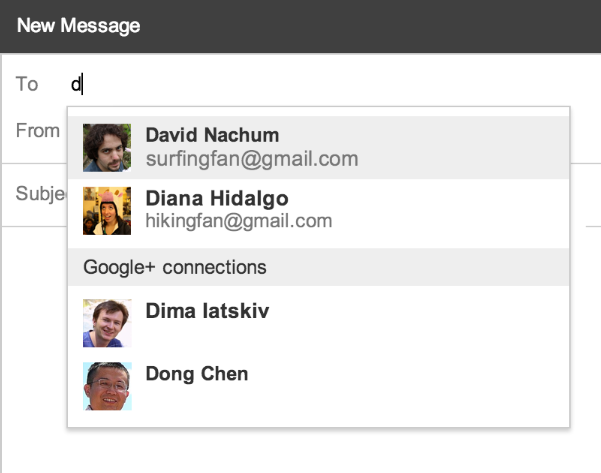
Have you ever started typing an email to someone only to realize halfway through the draft that you haven't actually exchanged email addresses? If you are nodding your head 'yes' and already have a Google+ profile, then you’re in luck, because now it's easier for people using Gmail and Google+ to connect over email. As an extension of some earlier improvements that keep Gmail contacts automatically up to date using Google+, Gmail will suggest your Google+ connections as recipients when you are composing a new email.
How it works
As you can tell from the example above, these emails work a bit differently so that your email address is only shared with the people you want. Your email address isn't visible to a Google+ connection unless you send that person an email, and likewise, that person’s email address isn’t visible to you unless they send you an email.

You're in control
You control whether people can reach you this way with a new setting in Gmail.
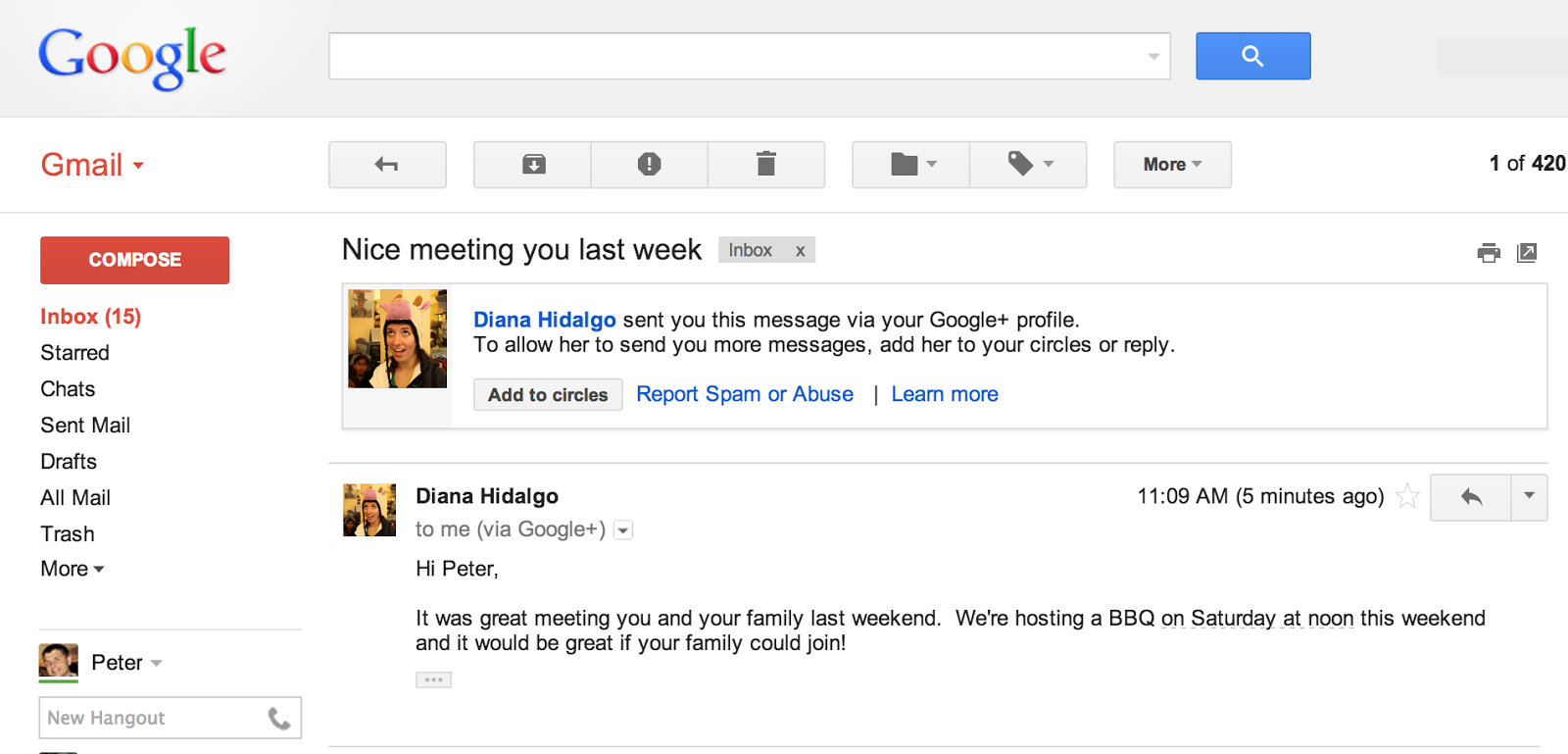
Emailing Google+ connections also takes advantage of Gmail's new inbox's categories. When someone in your circles emails you, the email will appear in the Primary category. But if you don't have them in your circles, it will be filtered into the Social category (if enabled) and they'll only be able start another conversation with you if you respond or add them to your circles.
Diana has sent an email to Peter and Peter decides if he wants to add Diana to his circles or reply.
This feature is rolling out over the next couple of days to everyone that uses Gmail and Google+. You'll get an email with information and a link to the setting when the feature is available.
09 Jan 21:33

Fresh Meat: 10 Android apps worth checking out

by Steve Raycraft

New apps need lovin’ too, right? Every day there are thousands of additions to the Google Play Store, but many go unnoticed and never receive the attention they deserve. We’ve shown in the past that this community can discover great apps and launch them to new heights. Our weekly column Fresh Meat highlights new apps with less than 100,000 installs. Browse our new Android app picks below and let us know which ones you enjoy.

Loopr Beta

Loopr

Description: Loopr is a task switcher, pretty much like the recent apps menu on your android system, but with much quicker access and a few more options.


Jelly

Jelly

Description: Jelly is a new way to search with pictures and people from your social networks. It’s also people helping each other—something that’s both meaningful and fun.


QuitControl

QuitControl

Description: Quit smoking and improve the quality of your life with QuitControl smoking cessation app. The app provides realtime statistics of your progression: Passed cigarettes, saved money and time, prolonged life and health indicators with time counters so you see where you’re at.


AppDeals

AppDeals

Description: AppDeals is great new way to find the best app deals and sales for apps, games and wallpapers on Google Play.


Engadget Mini

Engadget Mini

Description: Engadget Mini is a real-time stream of everything important, interesting and fun in the world of consumer technology, with instant updates on the latest product news and reviews, as well as a mix of the best photos, videos and posts from across the social web.


CM (Cleanmaster) Security

Cleanmaster

Description: Blazing fast, lightweight and ultra-secure, CM (Cleanmaster) Security is a FREE mobile security app developed by Clean Master – the world’s most trusted Android optimizer (over 100,000,000 downloads worldwide and 4.7 top ratings on Google Play).


Super Simple Sleep Timer

Super Simple Sleep Timer

Description: Silence any music or audio app after a set period of time. Perfect for listening to any music, audiobook or podcast app before going to sleep.


Veeder

Veeder

Description: Another option for a Google Reader replacement. Anonymous Poll creation. Anonymous Voting. Bookmarking news articles. News photos. Search Tags. Social Awareness.


Shifu: To Do & Task Manager

Shifu

Description: Shifu tracks your context and when it recognizes that you have a spare moment, it estimates the free time you have and suggests a relevant daily task.


Picklor

Picklor

Description:  Picklor is an application for you to collect and compare colors around you. Choose your desired color from wherever you want, save it and search for the matching color anywhere else, anytime using this application.


09 Jan 21:32

Top 10 new Android games this week: SpellStack, Sir Hoppity

by Steve Raycraft

Welcome back to Android Gaming Weekly, our weekly recap on new game releases. We still plan to cover upcoming releases and games we’re playing, but this column is dedicated to new games you can install and start playing right now. Check out our top picks and let us know if you have any suggestions for next week in the comments below.

Wordspionage

Description: Go beyond the board with Wordspionage! Take word game strategy to a new level with Special Operations such as Cover ID (a blank tile to use as any letter) and Surveillance (spy on your opponent’s tiles.)


Race Stunt Fighter 3!

Description: The third installment of the best selling RSF motorcycle game. Stunning graphics and a barrage of weapons and motorcycles to choose from make this the best one yet. Race through cities, mountains and tunnels as you stunt your wary to the finish line.


Crazy Heroes : The Ninja Ropes

Description: Crazy Heroes : The Ninja Ropes is an adventure game with the ropes climbing involved. Cut out for great the ropes adventure, the temple adventure of your life! Winter is coming, its getting icy, warm up yourself with this Crazy Heroes : The Ninja Ropes app. [sic]


Detective Grimoire

Description:  Detective Grimoire is a charming and mysterious adventure, featuring a variety of strange and unique interactions with the bizarre residents of the swamp, a compelling and challenging murder mystery to solve and an original award-nominated soundtrack.


Word Hive

Description: Find as many words as possible before the time runs out! Tap a word letter by letter. You can tap any letter that is touching an already selected letter. Watch the video for some examples.


Ball Patrol 3D

Description: Solve 3D puzzles, defuse BOMBS, balance the ball, discover an explosive world of robots, turrets mazes and secret areas! Explore action-packed levels and get ready for action.


SpellStack

Description: Spell your way to the top of your friends! SpellStack is how you decide who your smartest friend is. Steal the other player’s letters and break their words, all while defending your own.


Magic Rampage

Description:  From the creators of Magic Portals, Magic Rampage is an addictive platformer that combines the action-RPG genre with hack ‘n’ slash gameplay! A tribute to the “Metroidvania” style!


Sir Hoppity

Description: With only your magic carrot sword to protect you, play as Sir Hoppity through the dark forest, a rolling sand desert, and the volcano dragon’s lair. Collect treasure and buy upgrade items to defeat jumping spiders, angry wasps, sidewinder snakes and more!


Devils

Description: When a game mixes action, puzzles, strategy, humor and eye-candy graphics, you’ve got a hell of an adventure. And this is what Devils is all about: fun for all ages. Anytime, anywhere!


09 Jan 21:30

Gmail Cuddles Up A Little Closer To Google+, Website Now Suggests People In Your Circles When Composing A New Email

by Bertel King, Jr.

Gmail-ThumbEmail addresses are like phone numbers - who memorizes more than a handful these days? For years, cranking out a new email has begun with typing a few letters and clicking on the relevant contact that pops up (occasionally followed by frantic deleting and carefully selecting the correct contact). Soon Gmail users will have an even broader pool of names to select from, as Google+ connections will start to appear below saved contacts when typing out a recipient.

Done With This Post? You Might Also Like These:

Gmail Cuddles Up A Little Closer To Google+, Website Now Suggests People In Your Circles When Composing A New Email was written by the awesome team at Android Police.


09 Jan 21:29

ReveelSound makes your music sound alive with any headphones #CESlive

by Jerry Hildenbrand

Inline analog device brings back audio detail for any recording

Android Central @ CES

Standard electronics lose audio detail during the calculation to turn electricity into music. These canceled sounds are still there, but we don't get to hear them. This little analog device from ReveelSound can fix that.

This small gadget simply plugs inline with your headphones, and those "lost" sounds are restored. It sounds like Voodoo, but the priceless look on Derek's face around the eight minute mark tells me that it works.

Take a few minutes and see John P and Derek talk with Larry from ReveelSound about this revolutionary new product.


09 Jan 21:29

EE and Vodafone set to get speedy in Channel Tunnel

by Jordan Miera

Android Central

20 million yearly travelers will now have high speed broadband inside the Chunnel

Looks like EE and Vodafone are set to unleash some speed in the Channel Tunnel, a transportation mode that turns the trip from the UK to France into a 35-minute jaunt.

Vodafone and EE's networks will consist of LTE (or, as EE creatively calls it, "4GEE"), 3G and 2G. Services should be up by this summer. The goal is to have 2G and 3G up by March. 4G might take a little bit longer.

Fotis Karonis, EE CTO, had this to say about the development:

We’re proud to offer customers a superfast 4G service when they’re traveling from the UK into Europe. It’s another technology first for EE, and it’s one that will make a big difference to business workers and people going away on holiday. Being connected is such an important part of traveling now and this will be another route we’ve covered with 4G, making a huge difference to millions of customers who can now make the most of their journey time.

According to EE, around 20 million people travel through the Channel Tunnel each year.

This just might give me a good reason to go over there and try it out!


09 Jan 21:28

25 Different Ways to Wear a Scarf, in One 5-Minute Video

by Melanie Pinola

Who knew there were so many ways to tie a scarf? If ever there was an epic scarf-wearing video, this one by Wendy's Lookbook is it.

She shows options for both square scarves and typical long ones (both silk and cashmere), so you can wear a scarf every season and mix up your look just about every day.

25 Ways to Wear a Scarf in 4.5 Minutes! | YouTube