
Pepperoni Pizza Grilled Cheese Sandwiches
craving more? check out TasteSpotting

A historic blizzard is on track to hit southern New England and the northern mid-Atlantic — including Boston, New York City and possibly Philadelphia — early this week. A storm system will develop off the East Coast during the day Monday and throw back moisture into cold air Monday evening and into Tuesday. Snow may fall at a rate of 2 inches to 4 inches per hour in some spots.
But just how historic will the storm be? It could easily make the all-time top 10 in terms of snowfall in all three cities, and it may claim the No. 1 spot in Boston and New York.
New York City is under a blizzard warning for 20 to 30 inches of snow. The biggest snowstorm to ever hit New York dropped 26.9 inches of snow on Feb. 12 and 13, 2006, according to data going back to 1869. The snowy wallop was caused by mesoscale bands that pivoted over the city in the overnight hours.
Here are New York’s top 10 snowstorms:
New York’s top 10 includes the “Blizzard of 1888″ (No. 3), the “Blizzard of 1996″ (No. 5) and, most recently, the “Snowicane” of 2010 (No. 4). The Blizzard of 1888 was responsible for many deaths and was one impetus for the construction of the city’s underground subway system, while the historic Blizzard of 1996 dumped snow from Washington, D.C., to southern New England. Both featured heavy winds.
If the National Weather Service is dead-on accurate (not a sure thing), the coming blizzard will make it into New York’s top six at a minimum. As long as a foot and a half of snow falls, this storm will be tied for the 10th spot with an 1872 storm none of us was alive to see.
Boston is also under a blizzard warning for 20 to 30 inches of snow. According to data dating back to 1935, Boston’s top snowfall, 27.5 inches, occurred during the “President’s Day Storm II” in 2003. It’s quite possible this storm will top it.
Other top storms on Boston’s list include the infamous “April Fool’s Day Blizzard” in 1997 (No. 4), the “Blizzard of 1978″ (No. 2) and the February “Blizzard of 2013″ (No. 5). Some weather buffs believe these storms were far more severe than the President’s Day Storm II in 2003 because of wind and the wetness of the snow. To match any of these storms, Tuesday’s blizzard must drop more than 24 inches in Boston.
Far more accessible is Boston’s No. 10 spot: Feb. 8-10, 1994. That storm isn’t remembered for its severity because it fell over three days and didn’t feature the strong winds that this one almost certainly will.
Down in Philadelphia, a winter storm warning is in effect for 14 to 24 inches. There’s no blizzard warning in Philly because winds aren’t expected to be as strong there. It also looks unlikely that Philadelphia will be able to break its all-time record of 31 inches, set in the Blizzard of 1996. Nor does it look like this storm will match the 28.5 inches of snow that fell on Feb. 5-6, 2010.
Still, this storm could easily break into the top 10 in Philly. To tie the 10th-greatest storm (which itself is a tie between a storm in 1941 and one in 2011), only 15.1 inches need to fall.
The expected blizzard is still more than 24 hours away, though. Predicting snowfall is tough, and this storm system is complex. The forecasts may change. And measuring snow in windy conditions is difficult and imprecise.
Overall, though, this storm looks to be a historic one. Keep safe.

This 1970 Toyota 2000GT is sold with very little information aside from photos, but its (relatively) low ask caught our attention. Prices are routinely hitting elevated six figures now, with several high-profile examples having reached past $1,000,000. A right hand drive, domestic market exmample, this one looks clean and complete and is said to have 63k kilometers from new. Find it here on mobile.de in Tokyo, Japan for 548k euros (~$614,116 today).

Offered by Shinoda Co., Ltd., a few minutes of searching turned up another Japanese dealer of the same name with a white 2000GT in their inventory, though further digging revealed it to be a 1967, LHD model that’s already been sold. A mild 1969 refresh saw the fitment of slightly smaller driving lamps and reshaped front turn signals, the latter of which can just be made out in photos of the two linked here.

Inside things look fully stock, including the rosewood veneer dash finished by Yamaha grand piano craftsmen. Photos don’t convey how low and small these cars are in person, and though nicely put together and luxurious for a sports car of the period, head and hip room seem to be pretty restrictive.

Underhood sits a correct 3M-coded two liter straight six with Yamaha-designed and built aluminum twin cam hemi head. Built around a standard production Toyota block, they were also fitted with an alloy sump and churned out 150 HP at 6,600 RPM—more than enough to motivate a slippery, sub-2,500 pound car. Said to be in good running condition, no other details are provided.

We vaguely remember seeing these cars trade for less than $100k in the 90’s and wish there had been an opportunity to buy one then. Crazy to think a nice $600,000 example can now be considered somewhat of a bargain.

Reminder that about 10 people own everything in the world, so buy small! Such as from say, *cough* start-up infographic chart-makers, if you happen to know of any.
(Via Reddit)
D Gno, only what SJW hypocrite self-hating pasty rich white people say
D Gfeels good to see them burn
 |
submitted by MrWeiner [link] [1963 comments] |
D Gcaring what college-aged SJWs have to say for more than an ironic or humorous reason is just plain silly. college kids are "I know everything" teenagers on speed.

A couple of weeks ago a professor at Vanderbilt University became the center of controversy. Carol Swain, professor of political science and law, wrote what should be a very non-controversial op-ed in the Nashville Tennessean:
As Miller has so often stated, Islam has a problem with the West. Islam will never understand the freedoms that we live and die to preserve. If America is to be safe, it must remove the foxes from the henhouses and institute serious monitoring of Islamic organizations.
Civic education and other indicators of assimilation should be a prerequisite for remaining and advancing in this nation. We must be willing to recognize the dangers of the burka (head-to-toe garb worn by women in some Islamic sects), which allows individuals to completely conceal their identities.
If Muslims are to thrive in America, and if we are to be safe, then we must have ground rules that protect the people from those who disdain the freedoms that most of the world covets.
While we haven’t had anything on the order of the Charlie Hebdo attacks, we have seen Christian evangelists arrested in Dearborn, Michigan for fear that they would start a riot. Mind you, the police didn’t act against any rioters, they arrested men preaching the Gospel. And, of course, attacks on Dr. Swain weren’t far behind. From muslims:
Vanderbilt undergraduate Farishtay Yamin said she “could not believe her eyes” when she first read the editorial.
“How could such an educated, informed woman, a professor at Vanderbilt in charge of educating our youth, publish such ignorance?” Yamin said. “It’s hard for me to describe how much pain I felt reading an article written by a Vanderbilt professor who, before meeting me, considers me to be a threat to Western society. She wrote that I was a threat to American people and children. I was born in New Jersey. I’ve lived almost my entire life in the United States—and yet there are people who will never consider me to be an American or accept me as one of their own. And that really hurts.”
It is interesting to note that Ms. Yamin (below) would be flogged if she showed up in Riyadh wearing this garb, and the fact that she as a muslim woman is allowed to attend a co-educational institution and drive a car is due solely to the fact that she does not live in a country with a muslim majority–

And she is unable to offer any response to Dr. Swain’s measured and reasonable critique other than “Meany-Pants!”
Naturally, when ever totalitarianism is challenged you will find a college Democrat defending it and attacking whoever denounces it. A dipstick named “Michael Diamond” writes in Vanderbilt College Democrats respond to Carol Swain
As an organization with members from diverse ethnic, religious, socio-economic and cultural backgrounds, Vanderbilt College Democrats is committed to maintaining an atmosphere on campus of inclusion and respect for all. We therefore condemn the caricature of Islam presented in Professor Swain’s Tennessean op-ed and reaffirm that the vast majority of the Vanderbilt community has nothing but respect for our Muslim friends and colleagues, and we applaud those who have posted, written letters, emailed and even rallied to demonstrate our support for tolerance and inclusion.
However, noxious as it may be, Professor Swain is entitled to her free speech, and Vanderbilt College Democrats does not call for and would not support administrative action against her. Yet at the same time, we must not confuse speech that is legally permissible with speech that advances education. As Martin Luther King Jr. said, “The function of education is to teach one to think intensively and to think critically. Intelligence plus character — that is the goal of true education.” The remarks in question not only showed lack of critical analysis, but also revealed troublingly bigoted beliefs, rooted in ignorance of one of the world’s major religions.
Again, you’ll note that both here and in the full letter, Diamond doesn’t address a single point raised by Dr. Swain. He, like Yamin, screams “Meany-Pants!” and accuses Dr. Swain of bigotry in the bargain.
In addition to the juvenile whining and utter intellectual incapacity shown by Yamin and Diamond, there is the rather bizarre spectacle of a bunch of privileged, upper class, white kids calling a black female professor, who did not graduate high school (she received a GED), and was a teenage mother of bigotry.
I don’t profess to be an authority on comparative religion. I’ve found that Trinitarian theology provides more than ample fodder for my intellectual abilities. Though I have no doubt whatsoever that Christianity is the only true faith and I might try to nudge a non-believer in that direction, I have no interest in telling other religions how to conduct their affairs. At the same time, I don’t subscribe to the view that all religions are compatible with the mostly-secular but Judeo-Christian based societies one find in mostly in Europe, the Americas, and Australia. In the case of Islam, it has become very, very obvious, as Dr. Swain notes, that that religion simply cannot coexist with core Western values.
When the discussion of the issues is placed completely off limits, like the two little neo-Nazis at Vanderbilt are trying to do do, based on the excuse that feelings will be hurt, then a grave disservice is done to our society. You know what, slave owners didn’t like be criticized. The Klan didn’t like being criticized. And muslims don’t like being criticized. And basically for the same reason. If their peculiar beliefs are not subject to scrutiny and debate then their belief are safe.
The post University professor criticizes Islam, college dipsticks go bonkers appeared first on RedState.
D Gcorps will always offload bullshit fees on the customer much like a landlord lumps property tax into rent. Who wouldn't? An idiot, that's who.
PHOTO: When They Were Handed Their Bill, They Noticed THIS Strange Charge And It’s Infuriating. Every business in the country should put a line item “Obamacare” on their invoices. Perhaps if the all of the clueless were infuriated the redistribution of wealth would stop.

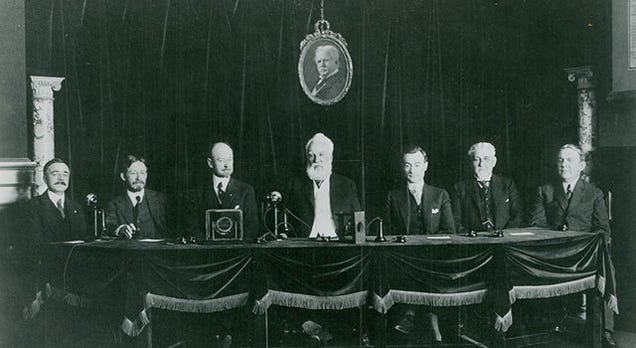
On Jan. 25, 1915, inventor Alexander Graham Bell (center) called up his former lab partner, Thomas Watson, in San Francisco, making the first transcontinental phone call in history.
Submitted by Raul Ilargi Meijer via The Automatic Earth blog,
Is This The Day Europe Gets Its Future Back?
With The Greek election apparently over and anti-bailout Syriza the victor, it would seem useful to lay to rest a few misconceptions, and to expose a few ‘conceptions’ that have – largely – remained buried to date.
The first misconception is that the Greeks borrowed like crazy and therefore deserve to be thrown into a pit of suffering and misery. It is simply nonsense, a mere political narrative. Besides, most of what was borrowed went to the utterly corrupt ‘oligarch system’, not to the people in the street. Something the EU was certainly aware of when it accepted Greece as a member. But corrupt regimes can be of great use.
A few days back, in Bunch Of Criminals!, I made the point that the EU, and its members, have no right to do to a fellow member country what they did to Greece – and want to continue doing -.
SYRIZA leader Alexis Tsipras said this week that he will not negotiate with the Troika, but directly with EU officials. And there is a very solid reason for that. In today’s Observer, Helena Smith interviews Greek sociologist Constantine Tsoukalas, who understands what has been happening to his country, and – rightfully – frames it in terms of Naomi Klein’s Shock Doctrine.
What has happened to Greece is what Klein describes was done to South America and – later – Eastern Europe. Disaster capitalism. Bringing entire countries to their knees by enforcing predatory economic policies, and then using the ensuing chaos and smouldering ruins to take full control over their political, economic and social systems. Helena Smith:
Is Greece About To Call Time On Five Punishing Years Of Austerity?
For Professor Constantine Tsoukalas, Greece’s pre-eminent sociologist, there is no question that, come Monday, Europe will have reached a watershed. I first met Tsoukalas in January 2009, in his lofty, book-lined apartment in Kolonaki. For several weeks Athens had been shaken by riots triggered by the police shooting of a teenage boy. The violence was tumultuous and prolonged.
Looking back, it is clear that this was the start of the crisis – a cry for help by a dislocated youth robbed of hope as a result of surging unemployment and enraged by a system that, corrupt and inefficient, favoured the few. Tsoukalas knew that this was “the beginning of something” although he could not tell what. But with great prescience he spoke of the degeneration of politics – both inside and outside Greece – the rise of moral indignation, and the emptiness of a globalised market “that was supposed to put an end to ideology but, in crisis, has instead created this moment of great ideological tension”.
Six years later, following the longest recession on record, he is in little doubt that anger has fuelled the rise of Syriza. On the back of rage over austerity, the leftists have seen their popularity soar from 5% before the crisis to as high as 35% – more than the combined total of New Democracy and left-leaning Pasok, the two parties that have alternated in power since the restoration of democracy in 1974.
The European policy towards Greece, to a large extent, has been determined by the will to experiment with the feasibility of shock therapies,” says Tsoukalas. “It worked, but the reaction is going to be a leftwing government. Europe cannot survive as it is. The rise of fascism … should be sufficient [evidence] to everyone that it has to change.”
If Greece’s rebellion was to occur in a coherent way, Tsoukalas, who is being fielded by Syriza as an honorary candidate, believes it would be only a matter of time before it was replicated in other parts of the continent. “These elections are important because they are a reminder to the people of Europe that there is another way out,” he insists. “That neoliberal orthodoxy is not an immovable problem.”
[..] at 28 Veikou Street, Syriza runs the Solidarity Club – initially set up as a food bank in March 2013 when stories began to surface of malnourished children fainting in schools. In recent months, its staff have focused on providing medicines. “That’s the big problem now because so many are uninsured, without any access to the health system,” says volunteer Panaghiota Mourtidou. “People don’t have the money to go to doctors. If they have a toothache, they get terrified, because how the hell are they going to pay for a visit to the dentist?”
With its Che Guevara posters, Italian Euro-communist flags, chaos of boxes and tins, and makeshift furniture, there is something of a field-camp feeling about Veikou Street. But its army of volunteers are tireless. This, they say, is a battle to be won, a huge victory for the left that Greece will set in motion. “We are conscious that we have managed to unite in a way that the left elsewhere has failed to do,” says Angeliki Kassola, a theatre director. “I’ve met lots of once-strident New Democracy supporters who say they will be voting for us because they are attracted to Syriza’s vision of democracy, justice, dignity – all the things that have been taken from us in the crisis.”
There will be plenty who don’t agree with an analysis like this. Just as there will be plenty who insist that the Greeks brought it all upon themselves. They should take a look at what my friend Steve Keen, presently “Professor of Economics and Head of the School of Economics, Politics and History at Kingston University London”, wrote this week in Forbes Magazine. That should cure a few lost souls of their foolish fantasies. And then they should take their new found insights and ask themselves: wait a minute, what is going on here? Why is Greece being squeezed the way it is? Deep down, you already know, don’t you? Steve:
I fully expect most commentators to take a line like that in my title. After all, it’s common knowledge that the Greeks lied about their levels of public debt to appear to qualify for the EU’s entry criteria, which include that aggregate public debt should be below 60% of GDP. Though there’s an argument that Goldman Sachs, many of whose ex-staff are now leading Central Bankers, helped the Greeks make this alleged lie, the responsibility for it will be shafted home to the Greeks, and that in turn will be used to argue that the Greeks deserve to suffer.
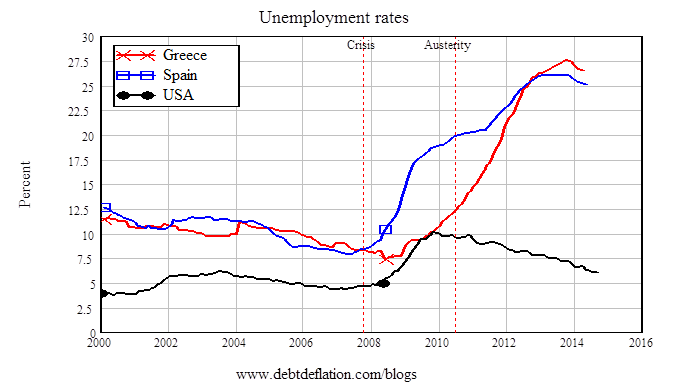
The story, in other words, will be that the Greeks were architects of their own dilemma, and that therefore they should pay for it, rather than making the rest of the world suffer through a write-down of their debts. Emotion will rule the debate rather than logic. So to cast a logical eye over this forthcoming debate, I’m going to consider who is really to blame for the Greek dilemma by considering another country entirely: Spain. Today, Greece and Spain are in very similar situations, with unemployment rates of well over 25%—higher than the worst the USA recorded during the Great Depression (see Figure 1). But unlike Greece, Spain before the crisis was doing everything right, according to the EU.
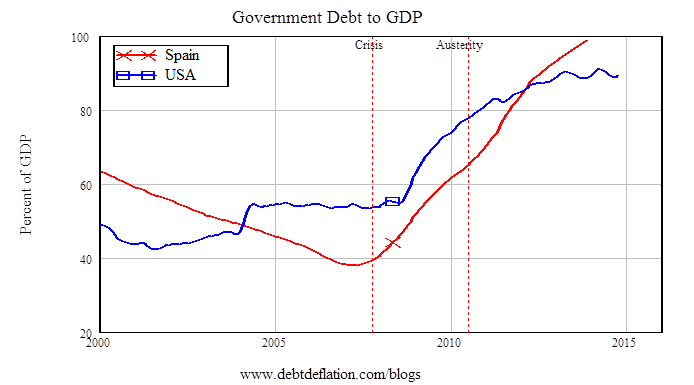
More importantly still, Spain’s government debt when the EU imposed its austerity regime (mid-2010) was still well below America’s, even though both had risen substantially since the crisis. Spain’s government debt ratio was 65% of GDP then, versus 78% for the USA. The whole purpose of the EU’s austerity program was to reduce government debt levels. Reducing government debt was the political topic du jour in America as well from 2010 on, but the various attempts to impose austerity came to naught: instead, after shooting up because of deliberate policy at the time of the crisis America’s budget deficit merely responded to the state of the economy.
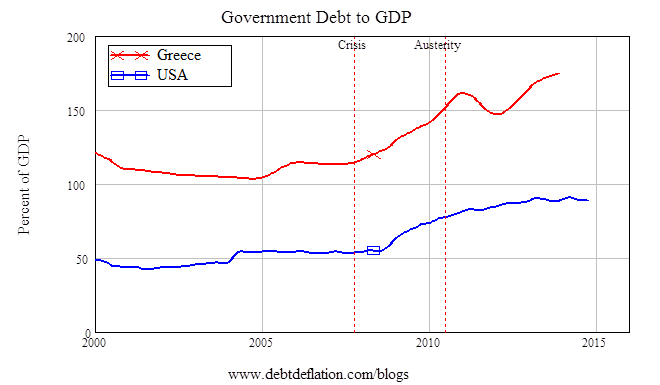
Politically paralyzed Washington talked austerity, but never actually imposed it. So who was more successful: the deliberate, policy-driven EU attempt to reduce government debt, or the “muddle through” USA? Figure 2 shows that muddle through was a hands-down winner: the USA’s government debt to GDP ratio has stabilized at 90% of GDP, while Spain’s has sailed past 100%. The USA’s macroeconomic performance has also been far better than Spain’s under the EU’s policy of austerity. Comparing the USA’s unemployment rate to Spain’s has to account for the fact that it was higher before the crisis—at 8.5%, Spain’s unemployment was 1.75 times the USA’s when the crisis began. It is now about 4 times the USA’s.
So simply on the data, the prima facie case is that all of Spain’s problems—and by inference, most of Greece’s—are due to austerity, rather than Spain’s (or Greece’s) own failings. On the data alone, the EU should “Cry Uncle”, concede Greece’s point, stop imposing austerity, and talk debt-writeoffs—especially since the Greeks can argue that at least part of its excessive public debt ratio is due to the failure of the EU’s austerity policies to reduce it.
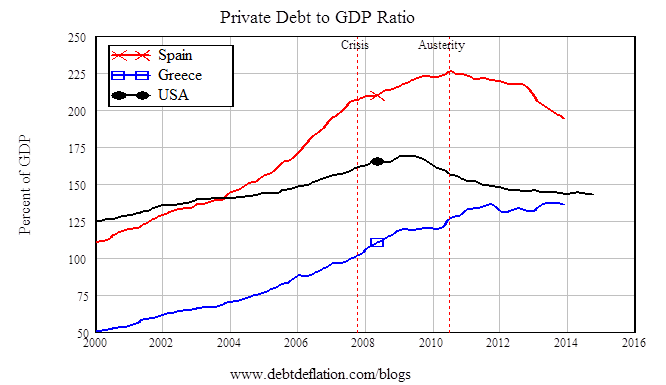
But I know that data isn’t enough to sway the public opinion—let alone the bureaucrats in Brussels. So we need to know the why: why did austerity in Europe fail to reduce the government debt ratio, while muddle-through has stabilized it in the USA? Here I return to my hobby-horse: the key factor that I consider and mainstream economists ignore—the level and rate of change of private debt. The first clue this gives us is that the EU’s pre-crisis poster-boy, Spain, had the greatest growth in private debt of the three—far exceeding the USA’s. Its peak debt level was also much higher—225% of GDP in mid-2010 versus 170% of GDP for the USA in 2009 (see Figure 4).
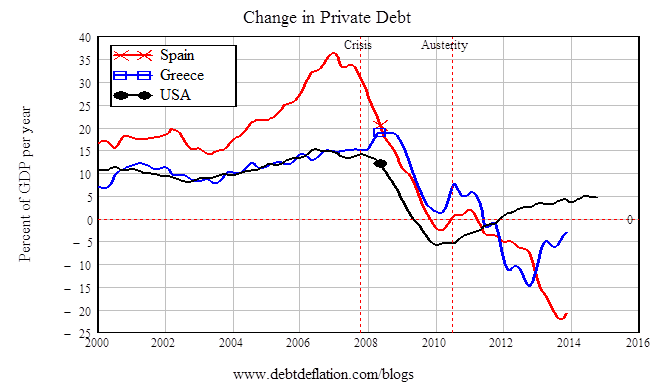
The second clue comes from the change in debt data: the factor that Greece and Spain have in common is that the private sector is reducing its debt level drastically—in Spain’s case by over 20% per year. The USA, on the other hand, ended its private sector deleveraging way back in 2012. Today, Americans are increasing their private debt levels at a rate of about 5% of GDP per year—well below the peak levels prior to the crisis, but roughly in line with the rate of growth of nominal GDP.
The third clue? I’ll leave that for my next post—this one is long enough already. But the conclusion is that Greece’s crisis is the EU’s fault, and the EU should “pay” via the debt write-offs that Syriza wants – and then some.

Austerity is something that doesn’t work, but it does fit in great with the will to experiment with the feasibility of shock therapies. Austerity, in the way it’s been applied to Greece, is a tool to gain greater power over people and their social structures. It is economic warfare, plain and simple. That is to say, the EU has become a ‘union’ where the people in weaker member states can be strangled, and ‘economically conquered’, with impunity.
If you live in a EU country, and you don’t like that these things are carried out in your name, this is the time to make your discontent known. Because now you know. Don’t let the Greeks fight this battle on their own. I don’t care what you say, but you’re not innocent if you let it happen. If they lose, it’ll be on your conscience.
Oh, and if they win, heed Helena Smith’s words: “if Greece’s rebellion was to occur in a coherent way, [..] it would be only a matter of time before it was replicated in other parts of the continent.” But don’t think ‘they’ will let it happen peacefully. They’ll organize huge social unrest, inject violence, and then try to use it to clamp down on the population and reinforce their grip on power. This won’t remain confined to Greece.



_Jennifer_Walters_Marvel_She-Hulk_cosplay.jpg)


![[link]](http://i.imgur.com/NlXMtVD.gif)
![[link]](http://i.imgur.com/UVVO18t.jpg)
![[link]](http://i.imgur.com/Ubd8ONL.jpg)
![[link]](http://i.imgur.com/IOnQGib.png)
![[link]](http://i.imgur.com/Pe0Iv27.png)