Shared posts

01 Feb 04:50

This Bulldog can really sing

by Xeni Jardin

He may sing better than the humans on each side.

ezgif-2187826236

Recommended article: Chomsky: We Are All – Fill in the Blank.
This entry passed through the Full-Text RSS service - if this is your content and you're reading it on someone else's site, please read the FAQ at fivefilters.org/content-only/faq.php#publishers.

31 Jan 04:02

On a feminist post

31 Jan 04:02

Sweet sound on a summers eve.

31 Jan 04:01

No, no he is not high...

31 Jan 04:01

Kim Jung Un getting Honey Dicked

30 Jan 21:50

I See What You Did There...

30 Jan 21:50

Yes! Now I Can Take a Break

FAIL,gifs,weights,fall

Submitted by: ToolBee

Tagged: FAIL , gifs , weights , fall
30 Jan 21:49

we_always_knew_the_truth_about_djs.jpg

we_always_knew_the_truth_about_djs.jpg
30 Jan 21:49

These Two English Towns Are About To Get The Fastest Internet In Europe

by Joshua Barrie

INTERNET

Two nondescript English towns are about to get the fastest internet speeds in Europe, after telecoms giant BT announced plans Friday to test broadband speeds of 500 megabits per second (Mbps) at two pilot locations this summer. 

For perspective, the UK's average broadband speed is around 29 Mbps, according to Net Index, an organisation that tracks these things. The city of Bolton has the fastest internet in the UK at 44.78 Mbps. The world's average download speed is 22Mbps, while Singapore is the country with the fastest broadband speed at 104Mbps. 

In a statement, BT said that around 4,000 homes and businesses in Huntington, Cambridgshire, and Gosforth, an area just north of Newcastle, will be the first to enjoy the internet upgrade, previously tested at the company's research centre in Suffolk.

If all goes well, most of the UK will be able to receieve the new ultrafast service, called "G.fast," within the decade, BT said. 

According to BT, the new technology is capable of delivering "a range of speeds depending on how close the technology is to a customer's premises." This means not everyone will get the peak 500Mbps. The company expects to start off with 300Mbps or so, which it wants to install in millions of homes and businesses by 2020. Soon after, the speed will increase to its full capacity. 

“We believe G.fast is the key to unlocking ultrafast speeds and we are prepared to upgrade large parts of our network should the pilots prove successful. The UK is ahead of its major European neighbours when it comes to broadband and we need to stay ahead as customer demands evolve," BT CEO Patterson said in a media release.

To easily calculate the time it takes to download a specific item based on the download speed, Media group Uswitch has produced the table below. So, for example, a connection speed of 100Mbps would allow you to download a single song in just 0.4 seconds. 

Internet

BT is a leader when it comes to improving internet speeds. In early 2014, BT scientists created the fastest ever "real-world" commercial internet connection, The Independent reports. They used commercial-grade fibre optic lines and managed to put out speeds of 1.4 terabytes per second. The paper explains this would mean downloading the entire English version of Wikipedia would take just 0.0006 seconds. It's also the equivalent of downloading 44 high-definition films in a single second. 

Meanwhile, in the US, the city of Minneapolis looks like it's soon going to soon grab the crown for the world's fastest internet by delivering speeds of 10,000 megabits, or 10 gigabytes per second, CBS Minnesota reports

SEE ALSO: THE INTERNET OF EVERYTHING: 2015 [SLIDE DECK]

Join the conversation about this story »


30 Jan 21:49

Big Mouth Birds: My Newest Series Of Hybrid Animals

30 Jan 21:49

The universe is not infinite

30 Jan 21:48

Footlong Fact and Falacy

by Jonco

Footlong facts

via


The post Footlong Fact and Falacy appeared first on Bits and Pieces.

30 Jan 02:40

"They're Out Of Their Minds" Gorbachev Slams US 'Triumphalism' For "Turning Cold War 'Hot'"

by Tyler Durden

In November of last year, Mikhail Gorbachev first warned "the world is on the brink of a new Cold War." Then around the turn of the year he escalated his warning, fearing "a war of this kind could lead to a nuclear war," hoping that no one "loses their nerve in this overheated situation." Today, in an interview with Russian news agency Interfax, the 83-year-old former Soviet leader, asks "have they lost their minds?" raging that "the U.S. has already dragged us into a new Cold War, trying to openly implement its idea of triumphalism," warning that "the 'cold' war will "lead to a 'hot' war," concluding "The U.S. has been totally 'lost in the jungle' and is dragging us there as well."


As Common Dreams reports,

Mikhail Gorbachev stated that the United States has pulled Russia into a new Cold War that faces the risk of further escalation.


The 83-year-old former Soviet leader made the comments on Thursday in an interview with Russian news agency Interfax.


"The U.S. has already dragged us into a new Cold War, trying to openly implement its idea of triumphalism," he is quoted as saying.


"Where will that lead all of us?" he said.


"What’s next? Unfortunately, I cannot be sure that the Cold War will not bring about a ‘hot’ one. I’m afraid they might take the risk," Gorbachev said, referring to the United States.


"All you hear is about sanctions towards Russia from America and the European Union. Have they totally lost their minds? The U.S. has been totally 'lost in the jungle' and is dragging us there as well."

*  *  *

The new comments follow a warning in November from the Soviet Union's last leader when he said,

"The world is on the brink of a new Cold War. Some say that it has already begun."

A month later he stayed said that the U.S. is "tortured by triumphalism" and called for deescalation in the midst of hostilities in Ukraine.

"This whole process may and needs to be stopped. It was stopped in the 1980s. And we opted for deescalation and reunification. Back then it was harsher than today. And now we can also do this," Gorbachev said at the time.

*  *  *

As RT reports, it appears more and more likely that this comes to a non-diplomatic head...

Meanwhile, international relations experts in America are quite alarmed over the new Cold War possibility – although not as much as the general public. While over 48 percent of scholars answered "no" when asked whether the US and Russia are headed towards such a conflict, the scenario was deemed likely by 38 percent.


The data comes from an American snap poll conducted at the end of January by the Teaching, Research, and International Policy (TRIP) project at the College of William and Mary, in collaboration with Foreign Policy magazine.


The research compared its results to a Gallup poll from March 2014, when 50 percent of the public believed a new Cold War was indeed possible when asked the same question.


In Russia, one-third of the population believes their country and the US are on a collision course.

*  *  *


30 Jan 02:39

I think she lost interest at that point.

30 Jan 02:35

"Ugh, guys are so disgusting." I bet everyone has a gem like this one on their social media.

30 Jan 02:33

Fun Way To Mow

by admin

yd1

30 Jan 02:33

Wheelie Machine

by admin

yd2

30 Jan 02:33

White House: Taliban are not terrorists

by streiff (Diary)

taliban_posing

I suppose that if Daniel Patrick Moynihan was right and we can define deviancy down, there is really no good reason why terrorism can’t be defined down, too. Via ABC’s Jon Karl:

They act like terrorists, they regularly kill civilians like terrorists, but the White House does not consider the Afghan Taliban to be a terrorist group.

“They do carry out tactics that are akin to terrorism. They do pursue terror attacks in an effort to try to advance their agenda,” White House Press Secretary Josh Earnest explained today, but “they have a different classification.”

Semantics aside, the Taliban is suspected in multiple attacks over just the last 48 hours that have killed more than 30 people, including a suicide bombing attack on a funeral in Afghanistan today that killed 16 and wounded 39.

Based on what we’ve seen after Ferguson, I suppose this means the White House now considers them to be community organizers.

As Karl points out, in making this shift in policy it didn’t even bother to attempt to look consistent:

On one hand, the Afghan Taliban are not on the State Department’s list of Foreign Terrorist Organizations (the Pakistan Taliban is on that last). On the other hand, the Taliban is on the Treasury Department’s list of Specially Designated Global Terrorists, a classification that allows their assets to be frozen.

This change of designation seems to be linked to two events. First,  the impending (or not) charging of Bowe Bergdahl as a deserter.

The issue has come up because the White House insisted on Wednesday that a prisoner exchange between Jordan and ISIS would be different than the prisoner exchange the United States made last year with the Taliban to gain the release of Army Sgt. Bowe Bergdahl.

“Our policy is that we don’t pay ransom. We don’t give concessions to terrorist organizations,” Deputy Press Secretary Eric Schultz said Wednesday. “This is a longstanding policy that predates this administration. And it’s also one that we’ve communicated to our friends and allies across the world.”

Schultz explained that the exchange the United States made with the Taliban — releasing five Taliban prisoners from the Guantanamo Bay detention facility in exchange for the release of Sgt. Bergdahl — was consistent with that policy because the Taliban is an “armed insurgency” and not a terrorist organization.

If Bergdahl is charged, and it will take Olympic gold medal quality gymnastics to avoid doing so, and the Taliban are terrorists (which they are) then the administration will be seen as doing exactly what it is criticizing other nations for now, paying ransom to have their citizens returned. This will be doubly true as at least one of the terrorists released to facilitate Berghdahl’s return is now back in the field doing what he does best: being a terrorist.

Second, with the official end of US combat operations in Afghanistan, the Obama administration obviously intends to negotiate with the Taliban, presumably to the disadvantage of the elected government of that nation. This will unseemly under the best of circumstances and unconscionable if the Taliban are still listed as a terrorist organization.


The post White House: Taliban are not terrorists appeared first on RedState.

30 Jan 02:32

Homemade KFC Double Down Dog

30 Jan 02:32

"The Thread By Which Venezuelan Socialism Hangs May Soon Snap"

by Tyler Durden

Submitted by Pater Tenebrarum via Acting-Man blog,

Fixing the Dollar Drought

Say you are a socialist, and you have intervened heavily in the economy. Suddenly, things don’t work as you thought they would. Somehow, economic laws seem to refuse to bend to your will. However, you cannot really believe that since according to your convictions, wealth is a byproduct of government plans and decrees. Moreover, your predecessor (also a socialist revolutionary) had the best advice oil money can buy – even from people who are now advising socialist parties over in good old Europe. So the solution to the unintended consequences of the initial intervention is to intervene further, in an attempt to refine the plan, so to speak.

You may have heard about a certain proverb attributed to Einstein about insanity, but you can’t quite recall what it was. So you try again. And again. And again. Chances are, your name is Nicolas Maduro. But eventually, you quit trying – sort of.


 pear-shaped-body

Image via diyconfessions.com

As Bloomberg reports, Maduro wants to fix the dollar shortage in Venezuela by introducing the fifth parallel currency market in 12 years – Venezuela will end up with three different official exchange rates as a result, one of which should actually track what was hitherto the black market rate (i.e., the real market exchange rate):

Venezuela will create its fifth parallel currency market in 12 years to boost U.S. dollar supplies as plunging oil revenue worsens food and medicine shortages and pushes the nation deeper into recession.

The new market will allow private companies and individuals to trade the greenback through brokerages, President Nicolas Maduro told Congress in a televised address Wednesday night. The government will continue importing essential products at the primary exchange rate of 6.3 bolivars a dollar, while combining two other existing currency auctions into one, he said.


“This is the decision I have taken: a system of three markets,” he told lawmakers after being welcomed by live salsa, ceremonial cannon shots and chanting supporters. “This exchange system is a transitory system to attend the country’s development needs” while oil prices stabilize, he said.


Maduro has preferred tighter currency controls to ease economic strife as he seeks to avoid cuts to social spending. A 61 percent drop in the value of Venezuelan oil since June has brought it to the brink of a debt default, according to prices in the swaps market. Oil provides 96 percent of revenue to the country, which imports almost everything it consumes.


“The set of reforms announced in the annual report were incomplete and insufficient to disentangle accumulated distortions over 15 years,” Hernan Yellati, Miami-based head of research at brokerage BancTrust & Co., wrote in a note to clients after the speech. “Plus an unanticipated plunge in oil prices.”


Venezuela last sold dollars at the two secondary auction markets for 12 and 52 bolivars.


Maduro said he has approved $8.1 billion of food purchases this year at the preferential rate. This compares with the $11.4 billion allocated to importers at 6.3 bolivars per dollar in the whole of 2014, according to Barclays Plc estimates.

(emphasis added)

Below is an updated chart of the Venezuelan bolivar’s exchange rate against the US dollar on the black market in Cucuta, a town near the Colombian border. Interestingly, it seems to have temporarily stabilized in a volatile trading range since November last year. This is interesting mainly because the US dollar has continued to rise against almost every other currency, but then again, the bolivar has already plummeted rather precipitously for most of 2014:


Bolivar black market rate

Venezuelan bolivar vs. USD, black market rate (data via dolartoday) – click to enlarge.


Making free trade in bolivars legal is undoubtedly one of Mr. Maduro’s better ideas, quite possibly the best one he ever had. It is a result of desperation, and it appears it is also a case of too little, too late. Venezuela’s foreign currency reserves amount to slightly over $20 billion, while its total foreign liabilities amount to approx. $135 billion as of Q3 2014 (of which $11 bn. in government debt are coming due this year). After many years of heavy-handed regimentation of the economy, characterized by expropriation/nationalization and price controls, Venezuela has indeed not much it can export besides oil – and even oil production has steadily declined.

The inflationary regime has moreover undoubtedly pulled resources from the consumer stages to higher orders in those parts of the economy still in private hands, so that consumer goods production is likely especially subdued. According to Professor Steven Hanke, Venezuela’s implied consumer price inflation rate is around 194% at the moment, which is about three times what the country’s central bank has lately admitted to. While the ‘general level’ of prices is inherently impossible to ascertain – as there exists simply no fixed yardstick that can be used to measure it – Venezuela’s money supply growth has definitely exploded into the blue yonder:


venezuela-money-supply-m1

Venezuela’s narrow money supply M1 since 2004, in millions of VEF – click to enlarge.


Maduro even admitted that the official consumer price inflation rate of 64% was a little on the high side, and announced he would only approve a 15% minimum wage hike this year and would ponder whether to cut fuel subsidies. Even such tentative reform proposals may once have been received quite positively by the markets. However, due to the decline in oil prices, markets have refused to budge. Implied annual default probabilities for Venezuela’s government debt remain at a record high near 20% (based on 5 year CDS spreads and a 40% recovery rate), in spite of government debt only amounting to about 50% of GDP at the current juncture (this is set to rise even if no debt is added, as GDP is set to shrink sharply this year).


Venezuela default probability

Venezuela’s sovereign debt sports the highest CDS spreads and default probabilities in the world – click to enlarge.


Effects of Price Controls Are Getting Worse

Maduro would have to adopt a radical program of economic liberalization if he wanted to effectively counter the increasingly acute economic crisis Venezuela is faced with. However, even if he were aware of that – which he possibly isn’t – he seems to be afraid that cutting subsidies would worsen his already sharply declining popularity further.

Not surprisingly, price controls have denuded the shelves of shops of even the most basic goods, with the result that people are these days forced to queue for hours to buy food and other necessities – reminiscent of Soviet times. The situation is evidently becoming more desperate by the day, as the government has just announced it will deploy the military to “protect shoppers”. Meanwhile government officials are telling people with a straight face that the bare shelves are actually “full”, in an Orwellian twist that would be quite funny if it weren’t so sad for the citizenry.

Shoppers thronged grocery stores across Caracas today as deepening shortages led the government to put Venezuela’s food distribution under military protection. Long lines, some stretching for blocks, formed outside grocery stores in the South American country’s capital as residents search for scarce basic items such as detergent and chicken.


“I’ve visited six stores already today looking for detergent — I can’t find it anywhere,” said Lisbeth Elsa, a 27-year-old janitor, waiting in line outside a supermarket in eastern Caracas. “We’re wearing our dirty clothes again because we can’t find it. At this point I’ll buy whatever I can find.”


A dearth of foreign currency exacerbated by collapsing oil prices has led to shortages of imports from toilet paper to car batteries, and helped push annual inflation to 64 percent in November. The lines will persist as long as price controls remain in place, Luis Vicente Leon, director of Caracas-based polling firm Datanalisis, said today in a telephone interview.


Government officials met with representatives from supermarket chains today to guarantee supplies, state news agency AVN reported. Interior Minister Carmen Melendez said yesterday that security forces would be sent to food stores and distribution centers to protect shoppers.


“Don’t fall into desperation — we have the capacity and products for everyone, with calmness and patience. The stores are full,” she said on state television.”

(emphasis added)

It seems to us the time of “calmness and patience” is long past, and we wonder how the government plans to “guarantee supplies” that evidently simply don’t exist. We were also wondering what precisely shoppers are supposed to be protected from. Evil capitalists? Actually, it seems that they by now mainly need to be protected from each other, as fights over scarce goods have become quite frequent. Good queuing behavior has also gone out of the window.


Maduro and Melendes

Venezuelan president Nicolas Maduro and his heavily mil-bling adorned interior minister Carmen Melendez.

Photo credit: Prensa Miraflores


But worry not, true believers, an “economic counteroffensive” is in the works – as soon as the details have been worked out. And please take no photos of the full shelves dwelling in Ms. Melendez’ imagination:

“President Nicolas Maduro last week vowed to implement an economic “counter-offensive” to steer the country out of recession, including an overhaul of the foreign exchange system. He has yet to provide details. While the main government-controlled exchange sets a rate of 6.3 bolivars per U.S. dollar, the black market rate is as much as 187 per dollar.


Inside a Plan Suarez grocery store yesterday in eastern Caracas, shelves were mostly bare. Customers struggled and fought for items at times, with many trying to skip lines. The most sought-after products included detergent, with customers waiting in line for two to three hours to buy a maximum of two bags. A security guard asked that photos of empty shelves not be taken.


Police inside a Luvebras supermarket in eastern Caracas intervened to help staff distribute toilet paper and other products.


You can’t find anything, I’ve spent 15 days looking for diapers,” Jean Paul Mate, a meat vendor, said outside the Luvebras store. “You have to take off work to look for products. I go to at least five stores a day.”


Venezuelan online news outlet VIVOplay posted a video of government food security regulator Carlos Osorio being interrupted by throngs of shoppers searching for products as he broadcast on state television from a Bicentenario government-run supermarket in central Caracas.

(emphasis added)

Unfortunately VIVOplay is a subscription service, so we cannot post the video of government shill Carlos Osorio getting almost run over by shoppers mentioned above (he is known for regularly pronouncing that everything is perfectly fine on state-owned TV, and they prepare selected supermarkets for his appearances). Here is however a video by the FT summarizing the situation in early December:

Queues and shortages in Venezuela – note that annual imports amount to $43 billion – it will be quite difficult to pay for both imports and debt redemptions if oil prices remain near their current levels for an extended time period, hence the rising default probabilities.


Conclusion:

For many years, the Venezuelan government was able to mask the failures of Hugo Chavez’ “socialist revolution” somewhat with the help of the country’s oil revenues. However, it should be remembered that shortages of basic goods in Venezuela are nothing new; the first press reports appeared about two years ago, when oil prices were still quite high (see also this late 2013 article of ours: “The Hygienically Challenged Crack-Up Boom”). As we quoted from a press report on that occasion, some Marxists – as long as they are members of the ruling class – seem actually not overly worried about scarcity:

“Not everyone thinks these shortages spell bad news. Planning Minister Jorge Giordani, an avowed Marxist, famously quipped in 2009 that “socialism has been built based on scarcity.”

Of course it was easy to make such quips, callous though they may be, back when the hugely popular Hugo Chavez was still around and able to distribute large oil revenues with both hands. The situation is a lot more difficult for Nicolas Maduro, who is probably slowly but surely getting worried about the potential for a counter-revolution (there has already been intermittent unrest in Caracas – and at the time the bolivar’s black market rate was still 85 to the dollar instead of 185).

Russia’s economy is likewise suffering from the decline in oil prices , but its government has a lot more breathing room in terms of debt and foreign exchange reserves and would be able to greatly help its economy merely by getting serious about tackling corruption.

Maduro has a much bigger problem, as he would essentially be forced to abandon the very ideology he so wholeheartedly supports if he wants to turn the floundering ship around. He does have one advantage over Putin though: he has very little to lose anymore in terms of his approval ratings. He probably must worry about his party comrades though, many of whom will be reluctant to abandon the late and great Hugo Chavez’ “socialist achievements”. It will be interesting to see how things will play out, in light of Maduro lately adopting steps he would never have taken a year ago. Still, given the government’s debt situation and Venezuela’s monetary statistics, a complete loss of confidence in the currency remains a very real possibility. In other words, the thread by which Venezuelan socialism hangs may soon snap.


venezuela-inflation-cpi

Venezuela’s official inflation rate is a (more or less) comforting fantasy concocted by its central bank, but it is nevertheless worth showing, as the chart illustrates that the rise in prices has greatly accelerated over the past two years – click to enlarge.


29 Jan 04:54

The dutch...

29 Jan 04:54

Religious extremism

29 Jan 04:41

Tendies strike

29 Jan 03:21

OP sends dick pics to /b/'s girlfriends. Some are faithful, some are not. (and then some whiteknight faggot ruined it and the thread 404'd)

29 Jan 03:19

A fellow was about to enter a bar when a dog tugged at his trouser leg and said ...

A fellow was about to enter a bar when a dog tugged at his trouser leg and said to him, "Hey, pal! Wanna make some quick money?"

The man couldn't believe his ears. He said to the dog, "Can you talk?"

"Yeah," the dog answered, "and that's how we can pick up some easy money. You take me into the bar with you, pretend I'm your dog, and bet everybody I can talk."

The fellow thought that was a great idea, so he took the dog into the bar, set it on the bar, and announced to everyone that the dog could talk. The other patrons didn't believe him, and it wasn't long before several thousand dollars had been bet. Finally, after all the bets had been placed, the guy said to the dog, "All right, go ahead and say something."

Nothing.

He told the dog again, "Hey! All the bets are placed! Say something, for God's sake!"

The dog just looked at him and whined.

He, asked again and again, but the dog wouldn't say a word. Finally, the fellow had to pay all the bets, scooped up the dog in disgust and walked out. Once outside, he screamed at the dog, "You just cost me way over a thousand dollars! You got anything to say before I seriously boot your mangy arse?"

"Take it easy, pal! You ain't thinkin'," the dog answered. "Tomorrow night, we'll be able to get odds of fives or better."
28 Jan 23:55

How Cunning VOD Pirates Plundered Taken 3

by Andy

taken3-logoSoon after its U.S. premiere on January 9, pirate copies of the new Liam Neeson movie Taken 3 began appearing online. While quality was decent for a ‘cam’ recording, it was nothing to get really excited about.

As it happened that didn’t matter too much since most downloaders were already preoccupied with the recent flood of high quality Oscar screeners. Nevertheless, those who ventured into a cinema to record Taken 3 are likely to have exposed themselves to considerable risk.

In many countries one can end up in jail for such activities, especially when recording is followed by uploading to the Internet. But just a week later new events meant that the Taken 3 pirates’ dance with danger would largely be forgotten.

Last Thursday an HD copy of Taken 3 appeared on all major torrent sites but thanks to an earlier tipoff, that came as no surprise to us. Several days earlier a source already told TF that a “pristine” copy of Taken 3 would become available on January 22. So how did he know? The answer lies thousands of miles away in the Middle East.

OSN is a pay TV network with its headquarters in Dubai, United Arab Emirates. The network offers international entertainment content such as movies, TV shows and sporting events. Perhaps surprisingly to readers in the West, it also provides access to movies still running in U.S. theaters.

As can be seen from the image of an OSN TV screen below, Taken 3 was due to air on the PPV network on January 22.

taken 3

TF was assured that a copy would quickly by pirated using OSN as several other popular movies had also been ‘capped’ from the same source in recent times. Sure enough, the first copies to appear online last Thursday all appeared with tell-tale Arabic subtitles or a suspiciously narrow image window where they’d been cropped out.

taken-arabic

While it’s not easy to say whether all ‘subbed’ copies now online originate from the first original ‘capping’ of Taken 3, we know that the first ‘big’ copy on Western sites (uploaded by a group called CPG) was not the first overall.

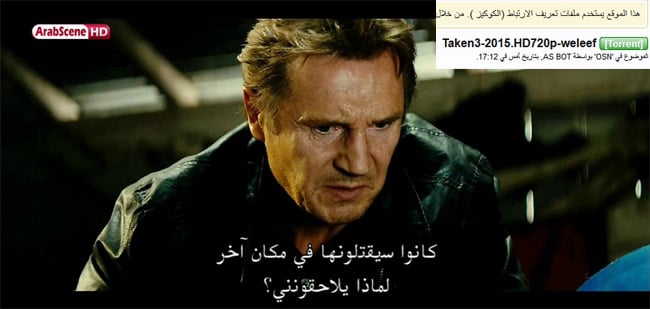
Those honors fell to a group called “weleef” who uploaded this “exclusive” to Arabic forum ArabScene shortly after the first showings on OSN.

arabscene-taken

Of course, thanks to this source people from all around the globe were able to watch a good copy of the movie, despite it still playing in cinemas in the United States and elsewhere. Sadly, even those wanting to pay for the movie in the U.S. will have to wait until April 2015 for a VOD release.

Why Hollywood treats citizens in the Middle East and Asia better than its home audience is anyone’s guess, but if defeating piracy is the goal the practice might be backfiring.

Our source says that a Chinese VOD site already has 50 Shades of Grey listed for an end of February release, two weeks after its Valentine’s Day premiere in the U.S. Only a month to find out if that leaks too.

Update: A new and non-subtitled copy of Taken 3 is now flourishing online. The source? An OSN set-top box…

Source: TorrentFreak, for the latest info on copyright, file-sharing, torrent sites and anonymous VPN services.

28 Jan 23:51

What do you mean we're out of cocaine?

28 Jan 23:51

Meet The Extreme Super Rich: A List Of The 80 People Who Own As Much As The World’s Poorest 3.6 Billion

by Tyler Durden

Submitted by Mike Krieger via Liberty Blitzkrieg blog,

Before I get into the meat of this post, I want to make it clear that the definition of oligarch, a term I use a lot, does not center solely around money.

Late last year, in the post Inside the Mind of an Oligarch – Sheldon Adelson Proclaims “I Don’t Like Journalism,” I attempted to frame the word oligarch as I use it. I wrote the following:

In a nutshell, while many oligarchs are extremely wealthy (or have access to extreme wealth), not all people with extreme wealth are oligarchs. The term oligarch is reserved for those with extreme wealth who also want to control the political process, policy levers and most other aspects of the lives of the citizenry in a top-down tyrannical and undemocratic manner. They think they know best about pretty much everything, and believe unelected technocrats who share their worldview should be empowered so that they can unilaterally make all of society’s important decisions. The unwashed masses (plebs) in their minds are unnecessary distractions who must to be told what to do. Useless eaters who need to be brainwashed into worshipping the oligarch mindset, or turned into apathetic automatons incapable or unwilling to engage in critical thought. Either outcome is equally acceptable and equally encouraged.

With that out of the way, Five-Thirty-Eight provided the following:

Eighty people hold the same amount of wealth as the world’s 3.6 billion poorest people, according to an analysis just released from Oxfam. The report from the global anti-poverty organization finds that since 2009, the wealth of those 80 richest has doubled in nominal terms — while the wealth of the poorest 50 percent of the world’s population has fallen.

There you have it. The reason the wealth of the richest has doubled since 2009, is because “it’s not a recession, it’s a robbery.” Central bank and government policy has done this, it is no accident.

For more evidence…

Four years earlier, 388 billionaires together held as much wealth as the poorest 50 percent of the world.


Thirty-five of the 80 richest people in the world are U.S. citizens, with combined wealth of $941 billion in 2014. Together in second place are Germany and Russia, with seven mega-rich individuals apiece. The entire list is dominated by one gender, though — 70 of the 80 richest people are men. And 68 of the people on the list are 50 or older.


Oxfam notes that global wealth inequality is increasing while the rich get richer. If trends continue, the organization projects that the richest 1 percent of people will have more wealth than the remaining 99 percent by 2016.

Now here’s the list:

1 Bill Gates $76 USA   Tech
2 Carlos Slim Helu $72 Mexico   Telecom
3 Amancio Ortega $64 Spain   Retail
4 Warren Buffett $58 USA   Finance
5 Larry Ellison $48 USA   Tech
6 Charles Koch $40 USA   Diversified
7 David Koch $40 USA   Diversified
8 Sheldon Adelson $38 USA   Entertainment
9 Christy Walton $37 USA   Retail
10 Jim Walton $35 USA   Retail
11 Liliane Bettencourt $35 France   Product
12 Stefan Persson $34 Sweden   Retail
13 Alice Walton $34 USA   Retail
14 S. Robson Walton $34 USA   Retail
15 Bernard Arnault $34 France   Luxury
16 Michael Bloomberg $33 USA   Finance
17 Larry Page $32 USA   Tech
18 Jeff Bezos $32 USA   Retail
19 Sergey Brin $32 USA   Tech
20 Li Ka-shing $31 Hong Kong   Diversified
21 Mark Zuckerberg $29 USA   Tech
22 Michele Ferrero $27 Italy   Food
23 Aliko Dangote $25 Nigeria   Commodities
24 Karl Albrecht $25 Germany   Retail
25 Carl Icahn $25 USA   Finance
26 George Soros $23 USA   Finance
27 David Thomson $23 Canada   Media
28 Lui Che Woo $22 Hong Kong   Entertainment
29 Dieter Schwarz $21 Germany   Retail
30 Alwaleed Bin Talal Alsaud $20 Saudi Arabia   Finance
31 Forrest Mars Jr. $20 USA   Food
32 Jacqueline Mars $20 USA   Food
33 John Mars $20 USA   Food
34 Jorge Paulo Lemann $20 Brazil   Drinks
35 Lee Shau Kee $20 Hong Kong   Diversified
36 Steve Ballmer $19 USA   Tech
37 Theo Albrecht Jr. $19 Germany   Retail
38 Leonardo Del Vecchio $19 Italy   Luxury
39 Len Blavatnik $19 USA   Diversified
40 Alisher Usmanov $19 Russia   Extractives
41 Mukesh Ambani $19 India   Extractives
42 Masayoshi Son $18 Japan   Telecom
43 Michael Otto $18 Germany   Retail
44 Phil Knight $18 USA   Retail
45 Tadashi Yanai $18 Japan   Retail
46 Gina Rinehart $18 Australia   Extractives
47 Mikhail Fridman $18 Russia   Extractives
48 Michael Dell $18 USA   Tech
49 Susanne Klatten $17 Germany   Cars
50 Abigail Johnson $17 USA   Finance
51 Viktor Vekselberg $17 Russia   Metals
52 Lakshmi Mittal $17 India   Metals
53 Vladimir Lisin $17 Russia   Transport
54 Cheng Yu-tung $16 Hong Kong   Diversified
55 Joseph Safra $16 Brazil   Finance
56 Paul Allen $16 USA   Tech
57 Leonid Mikhelson $16 Russia   Extractives
58 Anne Cox Chambers $16 USA   Media
59 Francois Pinault $16 France   Retail
60 Iris Fontbona $16 Chile   Extractives
61 Azim Premji $15 India   Tech
62 Mohammed Al Amoudi $15 Saudi Arabia   Extractives
63 Gennady Timchenko $15 Russia   Extractives
64 Wang Jianlin $15 China   Real Estate
65 Charles Ergen $15 USA   Telecom
66 Stefan Quandt $15 Germany   Cars
67 Germán Larrea Mota Velasco $15 Mexico   Extractives
68 Harold Hamm $15 USA   Extractives
69 Ray Dalio $14 USA   Finance
70 Donald Bren $14 USA   Real Estate
71 Georg Schaeffler $14 Germany   Product
72 Luis Carlos Sarmiento $14 Colombia   Finance
73 Ronald Perelman $14 USA   Finance
74 Laurene Powell Jobs $14 USA   Entertainment
75 Serge Dassault $14 France   Aviation
76 John Fredriksen $14 Cyprus   Transport
77 Vagit Alekperov $14 Russia   Extractives
78 John Paulson $14 USA   Finance
79 Rupert Murdoch $14 USA   Media
80 Ma Huateng $13 China   Tech


I didn’t provide this list to say whether these people are good or bad. I provide it, because whenever 80 people own as much as the poorest 50% of the globe, we sure better know who they are. We should also be cognizant of the disproportionate influence any of them can have on public affairs should they want to.


28 Jan 21:16

It's a Very High-Concept Meal

28 Jan 21:02

#352242 - Pale Ale Cheddar Crackers

855343

Recipe for Pale Ale Cheddar Crackers. A homemade version of the classic (and addictive) cheesy snack!

craving more? check out TasteSpotting