
Shared posts
11 Feb 01:44
What 3-Parent Babies Mean For The Future Of Reproductive Medicine
by Lydia Ramsey
Last week members of the British House of Commons passed a bill legalizing mitochondrial DNA transfers--a process that combines three different sets of DNA to create an…


10 Feb 23:39
BOOM: Mom makes $65k a month selling headbands and socks on ETSY...
(Second column, 11th story, link)


BOOM: Mom makes $65k a month selling headbands and socks on ETSY...
BOOM: Mom makes $65k a month selling headbands and socks on ETSY...
(Second column, 11th story, link)
10 Feb 21:59
Consider the possibility that everyone but you can smell it.
 |
submitted by Shopworn_Soul [link] [227 comments] |
10 Feb 02:10
REVEALED: OBAMA'S 332-PAGE PLAN TO CONTROL THE INTERNET...
(Third column, 5th story, link)
Related stories:


REVEALED: OBAMA'S 332-PAGE PLAN TO CONTROL THE INTERNET...
REVEALED: OBAMA'S 332-PAGE PLAN TO CONTROL THE INTERNET...
(Third column, 5th story, link)
Related stories:
Commissioner: 'It is worse than I had imagined'...
Republicans probe White House role in FCC 'net-neutrality' proposal...
'Saddles small, independent businesses and entrepreneurs with heavy-handed regulations'...
'Monumental shift'...
Media ignore...
Republicans probe White House role in FCC 'net-neutrality' proposal...
'Saddles small, independent businesses and entrepreneurs with heavy-handed regulations'...
'Monumental shift'...
Media ignore...

10 Feb 01:40


Mapping The Next Nation To Join The Currency War
by Tyler Durden
With China devaluation looming as the great unspoken Black Swan trade, and on the heels of the Swiss National Bank folding on its 'peg', we thought a quick glance at the world's "pegged" currencies would be useful as a guide to where the next shoe (and pant legs) will drop. With global FX implied volatility at EU crisis highs, the markets clearly expect more to come...
The World's Pegged Currencies...

Pegging a nation’s currency to that of a trading partner has some advantages. It allows businesses to plan; exporters and importers can agree on prices without worrying about sudden foreign-exchange fluctuations. Until the early 1970s, most global currencies were pegged to the dollar under the Bretton Woods system. Since then, pegs have been adopted for three main reasons by varying groups of countries.
- The first group, of which China is an example, dislikes the fluctuations of the free market. These countries prefer to manage their currencies, along with maintaining the capital controls that a peg implies.
- A second group sees currency pegs as a way to gain economic credibility: Argentina’s currency board in the 1990s was designed to help end the hyperinflation of the 1970s and 1980s. In effect, America’s Federal Reserve, not the Argentine central bank, set monetary policy.
- The third group is the euro-zone countries, which saw currency links through the Exchange Rate Mechanism (ERM) as a way to boost economic integration, a process that ended with the creation of the euro in 1999.
Yet pegs have problems. Economic policy must be subordinated to the exchange-rate target. If monetary policy in the target country is tightened, then the pegger must tighten too. If the two economies are not closely linked, such a policy shift may be completely inappropriate. And markets can sense weakness. Traders may try to break the peg, as happened when Britain was forced out of the ERM in 1992. The central bank may run out of reserves in an attempt to hold the peg, and the policy will have to be abandoned.
And judging by FX implied volatility, markets expect more pain to come...

Charts: Bloomberg & The Economist

10 Feb 01:39

BioShock 2 pulled for sale from Steam, PlayStation Network and Xbox Live (update)
by Michael McWhertor
D GSame shit happened to GTA:SA. Licensing music expired. They "patched" it and fucked it all up. No thanks.
If you're looking for a digital copy of BioShock 2 right now, you might be out of luck. The game has disappeared somewhat unceremoniously from a number of online stores, including Steam, Amazon, Apple's App Store, the PlayStation Store and Xbox Games Store.
Digital versions of the game and its downloadable content, including the Minerva's Den add-on, seem to have been removed late last week, based on some discussions on Steam's BioShock 2 community hub.
BioShock 2 turns five years old today, leading some speculation that the game's digital disappearance is somehow related to an expired licensing deal. The game features a number of licensed musical tracks from the 1920s to 1950s. Other BioShock titles do not appear to be affected by B...
10 Feb 01:38
Inclusivity
by John Farrier
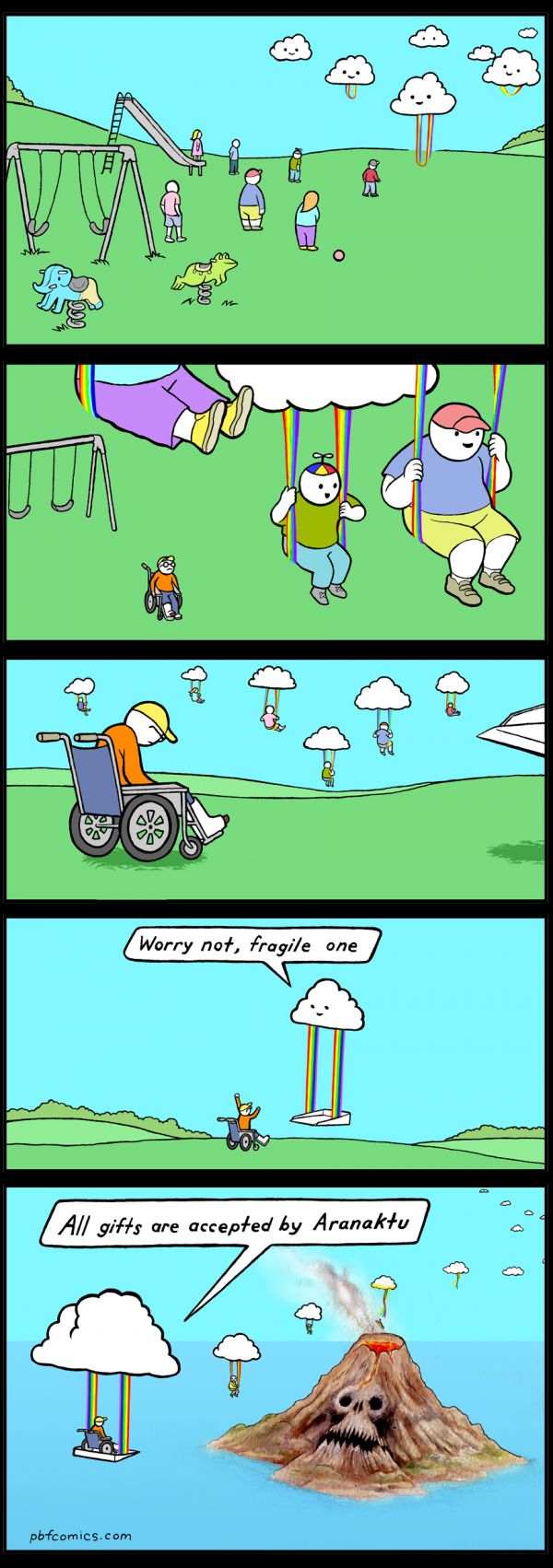
Nicholas Gurewitch rarely updates his brilliant webcomic Perry Bible Fellowship. You can go through the archives and laugh, over and over again. But sometimes, at special moments, you can read new, freshly baked PBF. When you can do so, always seize the opportunity.

10 Feb 01:37

Seaworthy: It's like FTL, but with pirates
by Jason Faulkner
I always wanted to play a more brutal game centered on pirates, but as the years went by I was continually disappointed. Sid Meier’s Pirates was an interesting ride, but it was too lighthearted for me. Seaworthy, a real-time strategy title that features pixelated pirates, looks like it’s going to go a long way in delivering that brutality I’ve been looking for.
Right now it’s on Kickstarter, and while there’s plenty of Kickstarter-based titles that I balk at, this one looks like it could actually be worth getting into. It’s supposed to be a clever mixture of FTL and Sid Meier’s Pirates, coincidentally, where you command your crew as you see fit, take part in battles, recruit new pirates to hop aboard your ship, and more. Looks like it’s probably going to be right up my alley. Or would that be galley?
Seaworthy’s alpha build is coming out before the end of 2015, with Early Access soon after. It remains to be seen if it’ll be worth picking up, but I’m pretty interested just from the trailer alone.
[Via Rock, Paper, Shotgun]


10 Feb 01:10
Hubble Photo Shows a Galactic Smiley Face
by Cassidee Moser
A faraway galaxy cluster has found something to smile about.
While searching the archives of photos taken by the Hubble telescope, a woman discovered one image of a galaxy cluster shaped like a smiley face.

Known as galaxy cluster SDSSJ1038+4849, the two "eyes" of the face are separate galaxies, while the "smile" is actually created by an effect caused by powerful gravitational pull called strong gravitational lensing.
10 Feb 01:10
These shirts the wait staff wear at Fifty/50 in Chicago
 |
submitted by jsun187 [link] [186 comments] |


09 Feb 22:33

It’s A Two-Horse Race For The Best Picture Oscar
by Walt Hickey
The Academy Award for best picture will probably go to “Boyhood,” about a young Texan growing up, or “Birdman (Or The Unexpected Virtue of Ignorance),” which tells the story of Michael Keaton struggling to put on a play. We know this thanks to last weekend’s Directors Guild of America Awards and BAFTAs. “Birdman” took the top DGA award, for best director. “Boyhood” took the BAFTA for best film.
The DGAs and BAFTAs are two of the four award shows most highly correlated with the best picture Oscar. (The winner of best director at the DGAs has often won the best picture Oscar, as has the best film BAFTA winner). They’re both “insider” award shows; the people voting on winners are the same (general group of) people voting on the Academy Awards. (“Birdman” won top honors at the other two, the Producers Guild of America and the Screen Actors Guild awards.)
The DGA has the best prediction rate in the past 25 years: 76 percent of films that won that award for best director went on to win best picture at the Oscars.
I’ve updated the scores derived from my colleague Nate Silver’s model. Here’s how things look:

Last weekend’s plaudits for “Birdman” and “Boyhood” essentially pushed the two films further in front of the pack. Factoring in those awards, “Birdman” has a score of 3.27, and “Boyhood” has a score of 2.47.
And what’s more, there aren’t a lot of potential points left to claim. With just the Writers Guild of America and Satellite awards left, about 0.51 points remain to divvy up.
Is it possible for another film to win best picture at the Oscars? Definitely. Sometimes there’s a backlash against the favorites. There are also dedicated campaigns to woo voters, and we don’t have data on how these campaigns influence Academy members. And there’s a history of big upsets at the Oscars. “Crash” in 2005 and “Braveheart” in 1995, for example, won best picture with zero consensus from the other awards.
Looking at the scores, there’s an argument to be made that this year is one of the most competitive in recent memory, and I plan to check that out soon. But either way, the stats and the conversation around the early awards point to this being a race that’s probably between only two horses.


![[link]](http://i.imgur.com/IqZmq2p.png)
![[link]](http://i.imgur.com/JG9WOis.jpg)
![[link]](http://i.imgur.com/xQwaCyj.jpg)
![[link]](http://i.imgur.com/H9LVFkZ.jpg)
![[link]](http://i.imgur.com/9oYDaY0.jpg)