Shared posts
Az új mobilos játékok harmada Flappy Bird-klón
Jön a GeForce GTX 745 is?
Szdani88nem sieti el néha az old most jött be 2 óraja
Magyar titkosítás véd a lehallgatástól
Kétszáz év népszámlálási adatai a neten
Button: Meg fognak lepődni a Marussia teljesítményén!
Szdani88haha

Overmax Vertis-02 Plus - az olcsóság ára
A Pirelli gumiválasztása az első négy nagydíjra

The Elder Scrolls Online Beta тест GPU
 |
The Elder Scrolls Online по сравнению с конкурентами выглядит просто замечательно. И дело не в том, что в игре есть поддержка DirectX 11, а в том что разработчики отнеслись к игре с завидным усердием, досконально проработав окружающий мир... |
How We Test PSUs - 2014
_575px.jpg)
After a lengthy hiatus, we're back with a new PSU and case reviewer. As we kick off our revised power supply testing and reviews, we wanted to cover the fundamentals of how we test and what to expect. Some of this is still a work in progress, as we have not gathered all of the equipment we would like to have, and as we move forward we will periodically provide updates to our PSU testing procedures. And with that out of the way, let's discuss how we're going to go about testing power supplies.
Effective testing of a power supply requires far more than just connecting it to a PC and using a $10 multimeter to check the voltage rails. At the very least, it requires specialized (and very expensive) equipment. At this point, most people that actually know a few things about PSUs would say, "Yes, OK, you need an adjustable load and an oscilloscope." While it's true you need those items, you can't simply grab any old adjustable load and oscilloscope. What you really need is very precise, programmable electronic loads with transient testing built-in and an oscilloscope that should comply with exact specifications, among other meters and equipment. Then of course you need to know what you are doing, as it's not simply a matter of connecting a PSU to the equipment and pressing a few buttons; there are exact loading and testing procedures, described in technical papers and guides, that need to be followed.
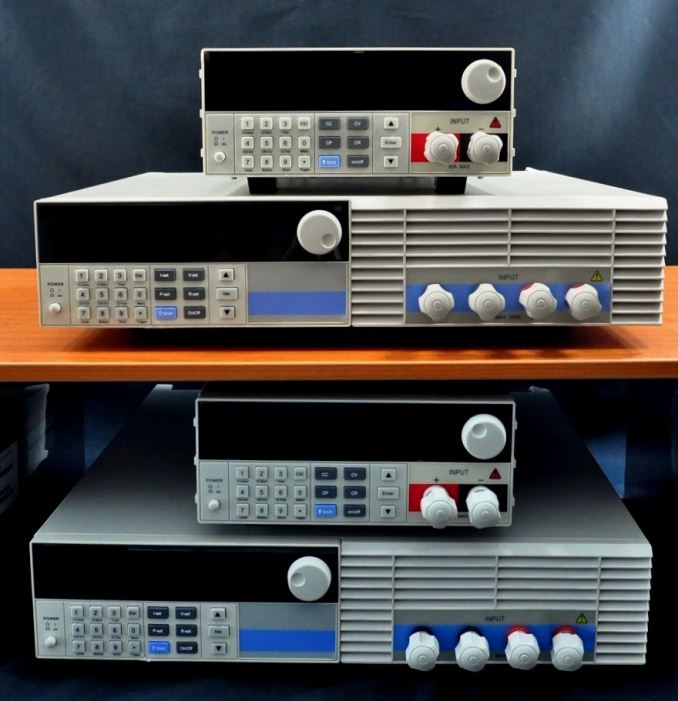
Programmable DC loads are an absolute necessity if you want to test a power supply. To that end, we acquired two high precision Maynuo M9714 1200 Watt and two Maynuo M9711 150 Watt electronic loads, which will allow us to draw up to 2400 Watts from 12 Volt lines and up to 150 Watts from each of the 3.3 Volt and 5 Volt lines. As these are quick-response programmable models, they will also allow us to perform transient tests in the future.
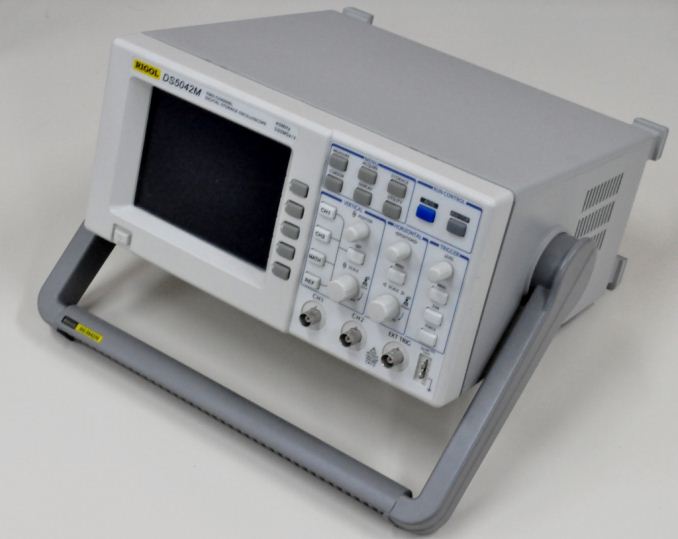
When testing a power supply, using even the best of multimeters are entirely useless. An oscilloscope is an absolute necessity and not just any oscilloscope. Intel's ATX design guide denotes that the oscilloscope should have a bandwidth of 20MHz; however, things are not nearly as simple as that. Even if you do want to purchase a proper oscilloscope, buying a 20MHz oscilloscope is a mistake. Digital oscilloscopes need to be capable of acquiring samples at least ten times faster than the frequency they are required to resolve. So, you need a 20MHz oscilloscope with a sampling rate of at least 200 MSa/s, and low range or USB connected devices cannot get anywhere close to that number.
There are of course many other minor details but we will not bore you with those. It should suffice to say that for the time being we are using a Rigol DS5042M oscilloscope, which has a bandwidth of 40MHz and a real time sampling rate of 500 MSa/s. Although that sounds impressive, actually even this device is not good enough if you want to perform transient tests properly and it cannot resolve noise out of the ripple of a signal; these are tests we plan to add in the future.
Compared to the above items, testing the efficiency of a PSU is relatively simple, once you know exactly how much power you are drawing from it. Our electronic loads tell us exactly how much power is being drawn at a given time; therefore, we only need a good AC power analyzer to tell us how much power the unit is drawing from the AC outlet. Note the "good" part, as you need a power analyzer capable of displaying true RMS values, as PSUs can generate a great deal of harmonics.
Our Extech 380803 power analyzer does a very good job at reporting the level of power that our PSU requires at any given time. We should note that all testing is being performed with a 230V/50Hz input, delivered by a 3000VA VARIAC for the perfect adjustment of the input voltage. Unfortunately, we cannot perform tests at 110V/60Hz at the moment, as that requires a high output, programmable AC power source. As a rough estimate, conversion efficiency drops by 1% to 1.5% when the input voltage is lowered to 110V/ 60Hz.
Thermal and noise testing are another complex procedure. Thermal testing is relatively simple; we only had to acquire two high precision UNI-T UT-325 digital thermometers. With four temperature probes, we can monitor the ambient temperature, the exhaust temperature of the PSU, as well as the temperature of its primary and secondary heatsinks. Noise testing however cannot be performed while the unit is being tested, as the very equipment that is used to test it generates a lot of noise. Everyone says that it is impossible to keep the unit loaded with the equipment far apart in order to perform noise testing and yes, that truly is impossible. So, it cannot be done, right? Wrong.
One of the basics of the scientific method is that you isolate the problem from a system and resolve it on its own. In other words, instead of trying to do the impossible and measure the noise of a power supply while we are testing it, there is nothing keeping us from using a non-intrusive laser tachometer to record the speed of the fan instead. Then, we can simply test the unit on its own, with the fan hotwired to a small fanless, adjustable DC PSU that we fabricated, taking noise readings with our Extech HD600 for the RPM range of the fan and cross-referencing the two tables. Not quite that difficult, was it? There is a catch however; as the unit will not be powered at the time of sound level testing, the meter cannot record any coil whine noise. Coil whine is clearly audible during testing though and we will make sure to report it if (when) we encounter a PSU whose coils could have used a little bit more lacquer. The background noise of our testing environment is about 30.4 dB(A), which figure resembles a quiet room at night. Equipment noise usually becomes audible when our instrumentation reads above 33.5 dB(A).
In order to facilitate testing power supplies more effectively, we created a test fixture for the connection between the PSU and the testing equipment, as well as a proprietary hot box. The hot box is not much more than a closed case with an air-heating device, which is controlled via a DAQ and our software. It is imperative to heat the air inside the box, not the box itself, in order to create good testing conditions. Admittedly, this self-made contraption is not perfect as it is small and has a very slow reaction rate, but it does work well for the means of simulating the environment inside a computer case. Therefore, testing will be performed at room temperature (maintained at 25 °C) and inside the hotbox (at 45-50 °C). Remember that efficiency certifications are performed at room temperature (25 °C) and a power supply can easily fail to meet its efficiency certification standards inside the hotbox!
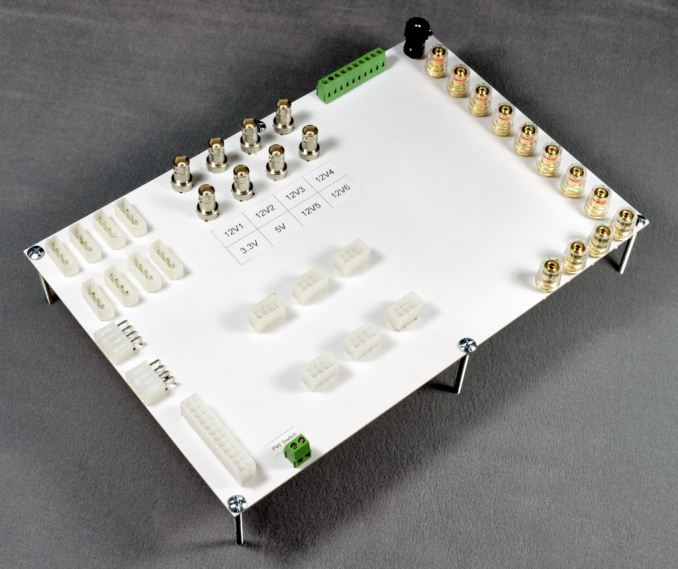
As for the testing procedure, there are specific, detailed guidelines on how to perform it. All testing is done in accordance with Intel's Power Supply Design Guide for Desktop Form Factors and with the Generalized Test Protocol for Calculating the Energy Efficiency of Internal AC-DC and DC-DC Power Supplies. These two documents describe in detail how the equipment should be interconnected, how loading should be performed (yes, you do not simply load the power lines randomly), and the basic methodology for the acquisition of each data set. However, not all of our testing is covered and/or endorsed by these guidelines.
There are no guidelines on how transient tests should be performed and the momentary power-up cross load testing that Intel recommends is far too lenient. Intel recommends that the 12V line should be loaded to < 0.1A and the 3.3V/5V lines up to just 5A. We also perform two cross load tests of our own design. In test CL1, we load the 12V line up to 80% of its maximum capacity and the 3.3V/5V lines with 2A each. In test CL2, we load the 12V line with 2A and the 3.3V/5V lines up to 80% of their maximum combined capacity.
Furthermore, it has been suggested that efficiency testing needs to be performed at specific load intervals (20% - 50% - 100%), which is considered to be the normal operating range of a PSU. However, modern systems can easily have their energy demand drop dramatically while idling, which is why we will be testing power supplies starting at 5% of their rated capacity, not 20%. Note that the conversion efficiency of all switching PSUs literally takes a dive when the load is very low, so large drops of >10% are expected and natural.
Any questions or comments on our PSU testing procedures are welcome, and as noted earlier we plan to add and/or improve some of the testing over the coming months with some additional hardware. We will provide an updated article when/if such changes are required.
Barack Obama fogadta a Prezi vezérét
Bitcoincsempésznek hitték a kitűzőárust
Szdani88xD
A radargép, amivel a NATO vigyáz ránk
Gyönyörűen repülnek a magyar drónok
Fantasztikus térképek a Google Mapsen
Féltávnál Bottas az élen, Vettel Red Bullja újra leállt
Szdani88komoly ez a williams
egyetlen komolyabb műszaki gondjuk nem volt még 2014-ben... komoly lenne ha massa behuzna

Kanyart neveznek el Schumacherről Bahreinben

Google Now Launcher, Play Store running on Nokia X
Szdani88xd

Last night, we shared with you the work that was being done to get the Nokia app store from the new Nokia X running on regular old Google-centric Androids handsets. We knew it wasn’t any technological milestone or anything nearly so important, but it was still a neat thing to see, especially due to all the effort Nokia’s made to distance its X family from Google. Tonight we turn that on its head, as we see a Nokia X handset configured to run Google apps,
The post Google Now Launcher, Play Store running on Nokia X appeared first on Pocketnow.
Red Bull: Melbourne-ben a túlélés lesz a cél

Hivatalos: Felbomlott a FOTA

LG G Pad 8.3 is a must-have deal at $224.99
Beárazták az LG 34 colos, ultraszélesvásznú monitorját
Hama blog: bambusz headset
Szdani88elég raj xd
A Renault haladékot kért motorja véglegesítéséhez
Szdani88hát most sanszos h nem rbr lesz de ilyen formán nem tudom mekkora dicsőség ez a többieknek

No 1080p native rendering for Titanfall
Szdani88remek xd biztos jó lesz pixelesen tolni de milyen szép is a textúra
Valaki ellopott 400 millió dollárnyi bitcoint
Oppo says its Find 7 will be much better phone than Galaxy S5
Szdani88milyen szemtelen xd

HTC is not the only company mocking the newly announced Galaxy S5. China’s Oppo is joining the bandwagon as well, having shared an image above through Weibo (Chinese version of Twitter).
As you can see for yourself, Oppo claims that 7 is bigger than 5 where that “5″ looks very much like “S” in Samsung’s “Galaxy S” brand.
As far as we know, the Oppo Find 7 will be unveiled on March 19th; users will be able to choose between two different versions, one sporting a full HD screen, and another a QHD one with resolution of 2,560 x 1,440 pixels. That (better) model will also reportedly rock Qualcomm’s newly announced Snapdragon 801 chip, making it one of the best phones on the planet.
That said, we would have to guess that HTC’s One successor (One Up?) may also use the same chip. We’ll see…
Meanwhile, we’ll be on the lookout for any other news coming from Oppo like when it will be available for purchase in North America and Europe. Stay tuned.
[Via: G4Games]
The post Oppo says its Find 7 will be much better phone than Galaxy S5 appeared first on IntoMobile.
Oppo says its Find 7 will be much better phone than Galaxy S5 originally appeared on IntoMobile.com on 2014-02-27T13:35:47Z. FV1gMYsz9b5j
MWC Update – Unleashing the Future
Szdani88komoly az a róka
Hello again from Barcelona –
This year when attendees visit our booth at MWC, we’re asking them to “Unleash the Future” with a web based platform that enables an entire mobile ecosystem. The phrase is on our stand’s wall, our materials, and on our promotional banners that hang over the entrance to Hall 3.
But what does Unleashing the Future mean?
For operators and device manufacturers, an unleashed future may mean a path of independence from the business relationships and platform dependencies that have driven their organizations forward to date. For mobile developers it can mean the ability to build apps and experiences more easily, the ability to reach new audiences, or the ability to participate in new types of financial relationships with users.
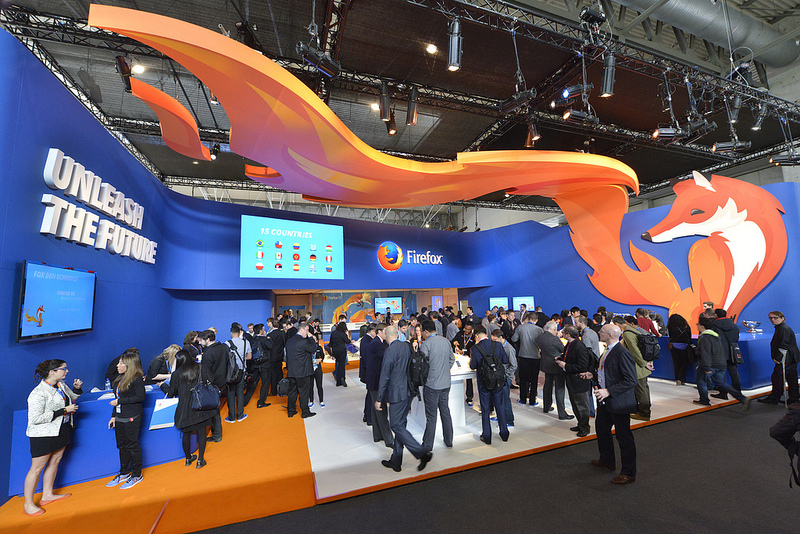
Day One on the Firefox stand at MWC 2014
But for the most important audience, the people who will use the devices powered by Firefox OS, Unleashing the Future means all of the above, and more. Mobile means the Web itself and everything it can offer. Being connected to a modern world means having access to the information, skills, and opportunities that can move lives forward. Mobile provides not only the ability to consume, but also to create. To hear and to be heard. To connect, and to be connected.
Unleash the Future speaks to us as Mozillians well. As an organization we’ve moved beyond a browser focus solely, and have expanded the range of products that carry our values to more people around the world. Unleashing the Future changes how we work together, who we work with as partners, and how we enable and empower the people who trust us to be their agent in a virtual world.
Part of the Mozilla team here in Barcelona has created a great short film that captures thoughts and reactions from a few MWC attendees:
I invite you all to watch it, and then to ask yourselves how Unleashing the Future changes what you do in 2014.
More to come from MWC.
Pete Scanlon,
Acting Chief Marketing Officer