Shared posts

19 Mar 11:21

Hereville Wins An Oregon Book Award And I Am Surprised

by Ampersand

I attended the Oregon Book Awards tonight with my friend Becky Hawkins; Hereville: How Mirka Met a Meteorite was nominated for the “Graphic Literature” category, but had no chance of winning, since the competition included Joe Sacco and Craig Thompson, both of whom are 600-pound gorillas of cartooning awards (and deservedly so). And also nominated was my pal Shannon Wheeler, who is a friggin’ New Yorker cartoonist, and an award-winning gorilla himself, albeit perhaps more of a 450-pound gorilla.

So I had NO chance.

And then I WON!!!!!!!

oregon-book-award

I can’t possibly describe how surprised I was. (And thrilled. And honored.)

BTW, Joe Sacco wasn’t there tonight, but Craig Thompson greeted me afterwards with a big hug and congratulated me. (I had only met him once before, but he seems very nice). And Shannon was also very nice, but of course I know him well enough to expect him to be gracious.

19 Mar 11:21

Well, I AM Proud, But . . .

by Ken White

Sometimes that personalized marketing on Facebook doesn't work out quite right.

Ummmmmm

Well, I AM Proud, But . . . © 2007-2013 by the authors of Popehat. This feed is for personal, non-commercial use only. Using this feed on any other site is a copyright violation. No scraping.

18 Mar 10:11

A Cake for All Seasons (Part Two)

by Maggie McNeill

Cake is happiness!  If you know the way of the cake, you know the way of happiness!  If you have a cake in front of you, you should not look any further for joy!  ―  C. JoyBell C.

Since it’s been far too long since I published a recipe, I decided to make up for it with seven new ones: all different types of cake, arranged one per demi-season.  Yesterday we covered winter and spring, and today cakes for the summer and autumn.  I would only consider one of these (Moss Rose Cake) difficult, and even it isn’t all that tough.  But if you aren’t an experienced baker, make sure you read my general tips in yesterday’s column before proceeding.

Summertide (late May – early July)

Texas BrowniesI first discovered this recipe in the early ‘90s, and I don’t know why they’re so named; maybe because they’re big, or maybe it’s the buttermilk, but they’re delicious in any case.  If you don’t have buttermilk handy, put 2 teaspoons (10 ml) of lemon juice or vinegar into a glass measuring cup, pour milk in until it’s just below the ¾ cup (180 ml) line, stir, and let it sit for 5 minutes before using (the usage is divided between cake & frosting, so be sure to measure).  Note that the coffee need not be freshly brewed; I always use whatever’s left from breakfast.

Texas Brownies

2 cups (480 ml) flour
2 cups (480 ml) sugar
1 teaspoon (5 ml) baking soda
¼ teaspoon (1 ml) salt
1 cup butter (2 sticks)
1/3 cup (80 ml) cocoa powder
1 cup (240 ml) coffee (the stronger the better)
2 eggs
½ cup (120 ml) buttermilk
1½ teaspoons (8 ml) vanilla extract
1 recipe frosting (see below)

Preheat oven to 350o Fahrenheit, grease a 13” x 9” baking pan and sift together flour, sugar, soda and salt.  In a medium saucepan over medium heat combine butter, cocoa and coffee, stirring constantly until it boils.  Add the chocolate mixture to the dry mixture and beat with an electric mixer at medium to high speed until well-combined.  Add eggs, buttermilk and vanilla and beat for 1 minute more, then pour into the pan (batter will be thin).  Bake for 35 minutes or until a wooden toothpick comes out clean, then remove from oven and immediately prepare frosting.

¼ cup (½ stick) butter
3 tablespoons (45 ml) cocoa powder
3 tablespoons (45 ml) buttermilk
2¼ cups (540 ml) sifted powdered sugar
½ teaspoon (2.5 ml) vanilla extract

In a small saucepan over medium heat combine butter, cocoa and buttermilk, stirring constantly until mixture boils.  Pour over powdered sugar in mixing bowl, add vanilla and beat until smooth, then pour over hot cake.  Allow cake to cool thoroughly in pan, then cut into squares.

Lammastide  (July and the Dog Days)

refrigerator cakeIt’s true that sheet cakes aren’t as fancy as layer cakes, but unless you’re trying to impress company they taste the same.  Here’s another cake Maman used to make; it’s wonderfully refreshing in an oppressively-hot Louisiana summer.  Just bake a white cake in a 13” x 9” pan, and when it’s cool use a wooden skewer to poke holes at about 1-cm intervals over the whole top of the cake.  Pour the proper amount of boiling water over two regular-size packets of any flavor of dessert gelatin (in the US this would be two cups [480 ml] of water ) and stir until dissolved, about 2 minutes.  But do not then add cold water as one normally would when preparing the gelatin; instead pour it evenly over the top of the cake and set it in the refrigerator for at least four hours before cutting.

Mabontide  (September and late August)

To make up for all those homely cakes, here’s a very fancy one that’s my husband’s all-time favorite.  It isn’t just two layers, but three!  Usually I add green and red food coloring to the frosting to get a sort of mossy color in keeping with the name.  The fresher the eggs, the lighter and fluffier the result with this cake; farm-fresh eggs give the best result.  It’s also much easier if you have a stand mixer.

Moss Rose Cake

2 cups (480 ml) sifted flour
½ teaspoon (2.5 ml) salt
2 teaspoons (10 ml) baking powder
4 eggs
2 cups (480 ml) sugar
½ teaspoon (2.5 ml) almond extract
1 cup (240 ml) hot milk

beaten whole eggsLet eggs sit at room temperature for half an hour while you grease and lightly flour three 8” or 9” round cake pans, then sift flour, salt and baking powder together three times.  Preheat oven to 350o Fahrenheit.  Beat eggs and almond extract on high speed for about five minutes, gradually adding sugar, until very thick; the mixture will cascade from the beater in a thick ribbon and mound up on the batter’s surface, then slowly vanish into it.  Gently fold flour mixture into egg mixture, then gradually add hot milk and stir quickly until the batter is smooth.  Divide evenly between the three pans and bake for 30 minutes, until the top springs back when lightly touched.  Cool layers in pans for 20 minutes while preparing frosting.

7-minute Frosting 

1½ cups (360 ml) sugar
1/3 cup (80 ml) cold water
2 egg whites
¼ teaspoon (1.25 ml) cream of tartar
1 teaspoon (5 ml) almond extract
Food coloring

In the top of a double boiler combine sugar, water, egg whites and cream of tartar and mix with electric mixer on low speed for 30 seconds.  Place over boiling water and cook for seven minutes, mixing on high speed the whole time, until frosting forms stiff peaks.  Remove from heat, add extract and color, and beat for 2 or 3 minutes more until frosting reaches spreading consistency.  Carefully remove layer from pan, frost and stack layers, frost the whole cake and then sprinkle the top with ground pistachios (about ¼ or ½ cup of nuts ground up in a food processor should do it).

Autumntide  (October and November)

This is a simple but delicious seasonal cake; I used to make it often at UNO when friends came over to play Dungeons & Dragons.  As with Texas Brownies, you can use sour milk in place of buttermilk; put one tablespoon (15 ml) vinegar or lemon juice in a glass measuring cup, then add milk to the one-cup (240 ml) line and stir.  Allow to sit five minutes before using.

Pumpkin Spice Cake

2 cups (480 ml) flour
1½ teaspoons (8 ml) baking powder
½ teaspoon (2.5 ml) baking soda
1 teaspoon (5 ml) cinnamon
¼ teaspoon (1.25 ml) each nutmeg, cloves and ginger
¼ cup butter (½ stick)
¼ cup (60 ml) vegetable shortening
1½ cups (360 ml) sugar
½ teaspoon (2.5 ml) vanilla extract
2 eggs
1 cup (240 ml) buttermilk
½ cup (120 ml) cooked pumpkin

Preheat oven to 350o Fahrenheit, then grease and lightly flour two 9” round cake pans and stir together all dry ingredients except sugar.  Beat butter and shortening together with an electric mixer on medium to high speed for about 30 seconds, then add vanilla and sugar and beat until light and fluffy.  Add eggs one at a time, beating well after each.  Add pumpkin, then dry mixture and buttermilk alternately in thirds, beating at low speed after each just until combined.  Pour into pans and bake for 30 minutes, until a toothpick comes out clean.  Cool in pans for 20 minutes while preparing frosting.  Variations: Replace pumpkin with 1 cup (240 ml) applesauce and reduce buttermilk to ¼ cup (60 ml); or, omit fruit altogether and increase buttermilk to 1¼ cups (300 ml).

Browned Butter Frosting

In a small saucepan melt ½ cup (1 stick) butter over low heat, then continue heating until it turns a delicate brown.  Pour it into a mixing bowl with 4 cups (960 ml) powdered sugar, 2 tablespoons (30 ml) milk and 1 teaspoon (5 ml) vanilla, beat on low speed until combined and then on medium to high speed until it reaches spreading consistency.


18 Mar 09:16

A Cake for All Seasons (Part One)

by Maggie McNeill

Qu’ils mangent de la brioche.  –  “a great princess” (according to Rousseau)

I like cake, and I’m sure you do as well unless you’re some sort of disguised alien (just kidding)(not really).  But I wonder if you’ve considered the amazing variety of cakes that there are?  They come in many shapes, textures, flavors and presentations, and the familiar chocolate cake, wedding cake and the like represent a very small region of the cake world.  Recently, I realized I hadn’t done any recipes lately, and since a couple of sex workers I follow on Twitter often mention how much they love cake I was inspired to share some favorites you might not find in the typical cookbook.  I’ve assigned each of these recipes to one of the demi-seasons as I count them (each anchored by one of the sabbats), but you can really make most of them any time you like.  Some of these recipes are easy, and some a bit trickier; the first two are actually brioches, and two others (one today and one tomorrow) could even be made with a box cake (just don’t tell me if you do that).

There are a few general things I should note before we start; if you’re an experienced baker you can skip this paragraph.  First of all, DO NOT be tempted to replace butter with margarine; butter is pure fat, while margarine is an emulsion of fat and water which does not behave the same way in cake recipes and may ruin the results.  If you want low-fat, I’ll be happy to share my recipe for angel food cake if you haven’t got one (it has no fat whatsoever).  DO NOT omit salt if a recipe calls for it; it’s there for a reason, especially in the brioches (yeast needs a slightly saline environment in which to grow).  Use large eggs, and unless a recipe says otherwise add them one at a time, beating for about a minute after each.  You don’t need to use cake flour for any of these recipes, though you might get a slightly finer result from Moss Ross Cake (tomorrow) if you do.  Though I’ve provided metric equivalents for most ingredients, I don’t know whether sticks of butter are the same size in other countries as in the US, where a standard stick is 4 ounces (113 grams).  The same goes for pans; a 13” x 9” rectangular pan would be 33 x 23 cm, so use the closest equivalent.  Test most cakes for doneness by inserting a wooden toothpick or skewer near the center; if it comes out clean, it’s done.  Test sponge cakes (like Moss Rose) by lightly touching the top; if done, it will spring back.  And since brioche is really a sweet bread, panettone and king cake are tested as bread is: by tapping on the top, which sounds hollow when done.

Yuletide  (late November – January 5th)

Panettone is an Italian brioche traditionally eaten during Yuletide; you can buy it imported from Italy in a box, but making it fresh is so much better.  You’ll need a peculiar baking tin for this one: a large, clean coffee can with a volume of about 3 liters, or something similar to that.

4½ to 5½ cups (1 to 1.3 liters) flour
1 package fast-rising yeast
1 teaspoon (5 ml) nutmeg
1 tablespoon (15 ml) ground orange peel (orange zest)
1¼ cups (300 ml) milk
½ cup butter (1 stick)
¼ cup (60 ml) sugar
½ teaspoon (2.5 ml) salt
2 eggs
1 teaspoon (5 ml) vanilla extract
1 cup (240 ml) raisins
½ cup (120 ml) candied orange peels

panettoneCombine 2 cups (480 ml) flour, yeast, nutmeg and zest in a large mixing bowl.  Heat and stir milk, butter, sugar and salt in a small saucepan over medium heat until butter almost completely melts, then pour the mixture over the flour mixture and beat with electric mixer on low speed for 30 seconds.  Add eggs and vanilla and mix on high speed for 3 more minutes.  Stir in as much of the remaining flour as you can, plus raisins and peels.  Turn dough onto a lightly floured surface and knead in enough of the remaining flour to make a moderately soft dough; this will take about 3 to 5 minutes and will still be slightly sticky when you’re done kneading.  Shape the dough into a ball, put it in a lightly greased bowl (cooking spray is perfect for this) and turn the ball to grease the surface of the dough.  Then cover it with a clean towel and let it rise in a warm, draft-free place for about an hour.

Meanwhile, grease and lightly flour the coffee can, then cut a circle of waxed paper to fit in the bottom of the can and sprinkle a little more flour on it.  At the end of the rising time, make a fist and punch down into the uncovered dough (it will deflate as gas escapes), then gather it up and put it into the prepared can.  Let it rise until double again (another hour), and near the end of the time preheat the oven to 350o Fahrenheit.  Bake the loaf for 35 minutes, then drape a piece of aluminum foil on top to prevent overbrowning and bake 15 minutes more (50 minutes in all); the top should sound somewhat hollow when you tap on it.  Immediately remove the panettone from the tin to a cooling rack and dust the top with powdered sugar; when ready to serve, cut it with a bread knife.

Carnival  (January 6th – Mardi Gras)OLYMPUS DIGITAL CAMERA

In New Orleans, the traditional dessert of this season is king cake, the very first recipe I ever shared on this blog (on Twelfth Night, 2011).  Of all these it is the one most firmly attached to the season I’ve assigned it, though panettone is a close second and pumpkin cake third.

Lent  (Ash Wednesday – Easter Eve)

When I was a lass, Easter baskets in the Deep South could be counted on to prominently feature products from the Elmer’s candy company of New Orleans, and among the most prized of these was a chocolate, marshmallow and almond confection called Heavenly Hash.  Here’s a cake based on it, though it uses pecans rather than almonds; if you can’t get pecans I’m sure almonds would be just as nice.

Heavenly Hash Cake

1 cup butter (2 sticks)
2 cups (480 ml) sugar
4 eggs
1½ cups (360 ml) flour
1½ teaspoons (8 ml) baking powder
¼ cup (60 ml) cocoa powder
2 cups (480 ml) chopped pecans
2 teaspoons (10 ml) vanilla extract
3 cups (720 ml) miniature marshmallows
1 recipe icing (see below)

Heavenly Hash cakePreheat oven to 350o Fahrenheit, grease a 13” x 9” baking pan and sift dry ingredients together.  Beat butter with an electric mixer for 30 seconds or so, then add sugar and beat until light and fluffy.  Add eggs, one at a time, beating after each one, then add flour mixture and mix well.  Add vanilla and pecans, mix just until combined and pour into pan.  Bake for 40 minutes or until done; remove from oven, immediately cover cake with marshmallows and prepare icing.

3½ cups (840 ml) sifted powdered sugar
¼ cup (60 ml) cocoa powder
½ cup (120 ml) cream or evaporated milk
¼ cup (½ stick) butter, melted

Beat together all ingredients until smooth; pour over hot marshmallow-covered cake.  Allow cake to cool thoroughly in pan, then cut into squares.

Springtide  (Easter – late May)

OLYMPUS DIGITAL CAMERAThe arrival of spring meant Maman “would pay me far too much money to cut her lawn every week, and usually made a cake for me; my favorite one was a simple yellow cake made in a ring pan and drizzled with powdered-sugar icing flavored with a powdered drink mix.”  I now call it Love Cake in memory of my beloved Maman.  Just bake a regular yellow cake in a tube pan (an angel food cake pan); you’ll probably need to add 5 minutes to the baking time.  Cool it for 20 minutes in the pan before removing it, then combine 2 cups (480 ml) sifted powdered sugar with ½ a packet (just under a teaspoon, about 4 ml) unsweetened powdered drink mix and 2 or 3 tablespoons (30-45 ml) milk and mix well; drizzle it evenly over the top of the cake, letting it pour down the sides.  You can use any flavor, but I like orange best.

Tomorrow:  Four more recipes for the other half of the year!


18 Mar 09:15

What does your perfect world look like?

I don’t have exact specs, but it’d have a lot more penguins.

18 Mar 08:59

How Did Hermes Get the Caduceus?

by Sarah Veale

It is difficult to imagine Hermes, the messenger of the gods, without his usual accoutrements: wings on his feet, a stylish chapeau, and carrying a winged staff encircled by snakes. The Homeric Hymns, poems written in the Homeric style that date to around 700bce, are often filled with the origin myths of the gods and goddesses. The tales regale their audience with depictions of the immortals, listing the things they rule over and the things sacred to them. And yes, Hermes is among those memorialized in the hymns.

The “Homeric Hymn to Hermes,” which dates from around the sixth century bce, follows in this tradition and recounts the early life of the god, from his birth in a cave to the nymph Maia (herself a consort of Zeus), to his installation among the gods of Mt. Olympus. Along the way, the poem relates how Hermes acquired his famous staff and what it is used for. I thought it would be fun to share this version of the story from the Homeric Hymns and see how the mythology of Hermes is wrapped up with this important symbol.

According to the poem, Hermes is quite the prodigy. He is born in the morning, by noon he is playing the lyre, and at evening he is out-and-about stealing Apollo’s cows. Very ambitious, but it gets better. In order to cover-up his theft, the young Hermes marches the cows backwards, so that their tracks lead in the opposite direction. Thus, anyone who followed the tracks to find the cows (i.e. Apollo) would think they led one way, when they really went the other. Even sneakier, Hermes ties branches to his feet, which obscure the tracks further, making it seem as if a giant was driving the cattle. Tsk-tsk.

This is all good, except someone sees Hermes. An old man working in his vineyard catches him driving Apollo’s cows across the plains of Onchestus. Busted, Hermes orders the old man to keep quiet and hurries on his way.

Upon discovering his cows missing, Apollo sets off to find them. Lo and behold, he encounters the old man tending his vineyard. Despite the earlier warning to not disclose Hermes’ theft, the old man spills the beans and provides this description of the youth he saw with Apollo’s cows:

ὦ φίλος, ἀργαλέον μέν, ὅσ᾽ ὀφθαλμοῖσιν ἴδοιτο,
πάντα λέγειν: πολλοὶ γὰρ ὁδὸν πρήσσουσιν ὁδῖται,
τῶν οἳ μὲν κακὰ πολλὰ μεμαότες, οἳ δὲ μάλ᾽ ἐσθλὰ
φοιτῶσιν: χαλεπὸν δὲ δαήμεναί ἐστιν ἕκαστον:
αὐτὰρ ἐγὼ πρόπαν ἦμαρ ἐς ἠέλιον καταδύντα
ἔσκαπτον περὶ γουνὸν ἀλωῆς οἰνοπέδοιο:
παῖδα δ᾽ ἔδοξα, φέριστε, σαφὲς δ᾽ οὐκ οἶδα, νοῆσαι,
ὅς τις ὁ παῖς, ἅμα βουσὶν ἐυκραίρῃσιν ὀπήδει
νήπιος, εἶχε δὲ ῥάβδον: ἐπιστροφάδην δ᾽ ἐβάδιζεν.

Dear friend, it vexes me. As much as may be seen with the eyes is all there is to tell. For many travelers pass over this road, of whom some strive for many bad things, while others wander to and fro and strive for very good things, and it is difficult to know which is which. However, I was digging the entire day until the sun was sinking around my fruitful vineyard, which abounds in wine. And I thought that a child, most brave one, but I do not know clearly…I saw him, whoever this child is—an infant following with fine-horned cattle, and he held a rod, and he went, turning this way and that.

Homeric Hymn to Hermes, 202-210 (translation mine)

We know a couple of things from this passage. One, this old man sure has a nice vineyard that gives him oodles of wine. Sweet. The other is that Hermes guided the cattle with a rod or stick. This suggests that the divine messenger’s top accessory is not just for show, but has a rather practical purpose: it’s intended to aid in the tending of cattle. More about this later, because it’s totally relevant.

I’m going to flash-forward through the story a bit. Obviously, Apollo apprehends the little thief. After all, he’s the god of divination, and it would be pretty difficult to put one past him. So Apollo nabs Hermes and the two gods go to Mt. Olympus, to have the issue settled by Zeus. After much scheming, Hermes wriggles his way out of trouble by playing the lyre, which Apollo just falls in love with. Thus, Apollo gets the lyre, and Hermes is given status among the gods. But there’s a trade:

ὣς εἰπὼν ὤρεξ᾽: ὃ δ᾽ ἐδέξατο Φοῖβος Ἀπόλλων,
Ἐρμῇ δ᾽ ἐγγυάλιξεν ἑκὼν μάστιγα φαεινήν,
βουκολίας τ᾽ ἐπέτελλεν: ἔδεκτο δὲ Μαιάδος υἱὸς
γηθήσας: κίθαριν δὲ λαβὼν ἐπ᾽ ἀριστερὰ χειρὸς
Λητοῦς ἀγλαὸς υἱός, ἄναξ ἑκάεργος Ἀπόλλων,
πλήκτρῳ ἐπειρήτιζε κατὰ μέλος: ἣ δ᾽ ὑπὸ νέρθε
ἱμερόεν κονάβησε: θεὸς δ᾽ ὑπὸ καλὸν ἄεισεν.

Thus having spoken, Hermes held out his hand. And the bright Apollo received the lyre from Hermes, and in return, he put into his hand the shining whip which he held. And Hermes, the son of Maia, rejoicing, received this and commanded the herd of cattle. And the bright son of Leto, the far-working Lord Apollo, taking the kithara in his left hand, proved himself by song with the Plektron. And it resounded sweetly from him, and the god sang with beauty.

Homeric Hymn to Hermes 496 – 502 (translation mine)

He we see that, in exchange for the lyre (and presumably Apollo’s forgiveness) Hermes is given a whip with which to command cattle. Some translations suggest that at this point in the story Hermes is actually given dominion over tending cattle (Crudden 61). Later we see that Zeus has designated Hermes as the god of commerce (516). It is interesting to note that valuable commodities, money, and livestock are referred to by the same term in ancient Greek, τὰ χρήματα, which suggests an association among these items in the minds of the ancient Greeks.

Nevertheless, we’ve talked a bit about Hermes using a rod to drive cattle, and here he upgrades to Apollo’s whip and gains rulership over the τὰ χρήματα, or valuable things. Finally, towards the end of the story, Hermes receives his famous staff:

ὄλβου καὶ πλούτου δώσω περικαλλέα ῥάβδον,
χρυσείην, τριπέτηλον, ἀκήριον ἥ σε φυλάξει
πάντας ἐπικραίνουσ᾽ ἄθλους ἐπέων τε καὶ ἔργων
τῶν ἀγαθῶν, ὅσα φημὶ δαήμεναι ἐκ Διὸς ὀμφῆς.

I [Apollo] shall give you, for happiness and wealth, a very beautiful rod. It is adorned with gold and thrice-branched and pure. And it shall guard you as you accomplish all the ordinances which are uttered and of the good works, as much as I say to be learned from the voice of Zeus.

Homeric Hymn to Hermes 529-532, (translation mine)

And here Hermes gets a golden rod with three-branches. This rod is to be used by Hermes in conveying the will of Zeus to humans, but under the guidance of Apollo. Hermes has gone from a driver of cows, to a driver of humans. Now, the shape of the wand has been disputed, as τριπέτηλον literally means “thrice-leaved.” Is this a branch with three leaves? Three branches? What’s its deal? According to Nicholas Richardson, this word usually refers to something which “forks at the top in a V-shape” (216). Nevertheless, at this point in the story that Hermes gains the tool which comes to be closely identified with the god from here on out.

This is a bit different than what we’re used to, eh? The rod as we know it today, the caduceus with two snakes, didn’t come into being until the fifth century bce. So until then, Hermes will have to make do with this wand. At least it’s made of gold, so there’s a bit of consolation for the new god.

In the “Homeric Hymn to Hermes” we get a bit of the back-story on Hermes, the messenger of the gods. Of seemingly humble origins, he finagles his way into the ranks of the gods of Olympus through trickery and cunning. At the end of his ordeal, he is given a golden rod with which to conduct his business and is granted rulership of commerce. However, we see the connection between the Hermes, trade, and the symbol of the rod alluded to throughout the story, as the rod is depicted as the key tool with which Hermes tends cattle, animals which were considered to be a valuable good to the Ancient Greeks. The sacred staff that Hermes carries, like the god himself in the story, is transformed from a mundane object with mundane authority to an object of reverence and divine authority. It symbolizes both the things he governs on earth, but is also a token of his status among the gods of Mt. Olympus.

Sources:

“Homeric Hymn to Hermes” in Three Homeric Hymns: To Apollo, Hermes, and Aphrodite. Edited by Nicholas Richardson. Cambridge Greek and Latin Classics, Cambridge University Press. 2010.

The Homeric Hymns: A New Translation by Michael Crudden. Oxford World’s Classics, Oxford University Press. 2001.

Photo by Andrea Crisante.


Filed under: Ancient, Greek
18 Mar 08:55

Abby Huntsman Is As Useless As Her Father

by Zandar
I'm not sure how Abby Huntsman ended up on MSNBC's The Cycle...scratch that.  I know exactly how she did, spouting her dad's same No Labels nonsense for the Millennials. LA Times econ reporter Michael Hiltzik has her pegged.

Abby Huntsman is really, really upset about Social Security. We know this because the television presenter, a daughter of former GOP Presidential contender Jon Huntsman, went on an extended rant about it Thursday on MSNBC's "The Cycle." The show is aimed at a younger audience of news consumers and Huntsman, 27, is one of the four youthful co-hosts.

She thinks Social Security is going bankrupt, leaving her and her generation with nothing. "This is infuriating," she said, bouncing up and down in her chair like a petulant toddler, "because none of our elected officials seem to care enough to do anything about it."

Unfortunately, almost everything she said about Social Security in the name of making it "sustainable" for her generation was wrong.

Dead wrong.
Huntsman wants to tell it like it is, but she fails due to lack of information. And if her generation believes what she said, it's going to be in deep trouble.

Let's get one thing straight:  Nobody in my generation (the youngest Gen Xers) and younger believes we'll ever see a dime of Social Security.  I still have a minimum of 35 years of work ahead of me.  For those in their early 30's, it's 40, and those in their 20's it's 45 or 50.  I understand the appeal of "after the Boomers drain the system, odds are really good there won't be a lot left for us."

But that's simply not true.

The most dire projections of the program's future say that "doing nothing about it"--no benefit cuts, no tax increases--will leave the program still able to pay 75%-80% of scheduled benefits. Not "nothing at all." And that 75% to 80% would still be much more per month 75 years from now than retirees get today.

By the way, it's also untrue that President Obama's budget plan makes "no mention of entitlement reform. None," as Huntsman claims. His budget proposes a very damaging cutback in Social Security disability, as we documented here, as well as changes to Medicare payment formulas to save money.

Huntsman has stitched her spiel together out of scraps and tatters of misinformation, of a sort we've heard from the older generation for years. They're no more accurate coming out the mouths of a "millennial." But it's tragic to see that what she's learned from her elders is how to mislead her public.

Which is exactly the platform her dad ran on in 2012.  She's just as useless.


18 Mar 08:53

Bad Moments in Parenting

by Jerry Stahl

I tried to buy “The Hokey Pokey” for my daughter on iTunes and iTunes said I didn’t have the credit for $1.29. My daughter was sitting next to me. 19 months. But I could sense she understood my credit shame. In fact, it was Mastercard’s mistake, but that didn’t matter. There were enough times when lack of a buck-twenty-nine to my name was not such a far-fetched concept, and the feelings were still in there, waiting to be triggered. What you never think about – when you stagger into parenthood, is the emotional osmosis factor.

(I believe I may have flung my phone off the wall.)

Which—why kid?—has to be a banner imprint-forming moment for the young mammal sitting on your lap. (Which I’d worry about more, if I could stop worrying about radiation leaking out of my hand-held device leaking into her brain like slow-motion battery acid.)

Just seeing you act like that, to a child, makes acting like that an option. Even more, if you really want to work up some guilt, the more they see you doing shit, the more they think that’s the way they’re supposed to do it. Which is fine, if you want them to grow up to be unhinged phone hurlers.

One should be, to use the overly used word, more “mindful”. Just using the word is kind of mortifying. But then again, ideas, as George Bernard Shaw would say, “are not responsible for the people who embrace them.” (I know this because I used to keep a Bartlett’s famous quotations beside the toilet.) I can’t say I’ve ever seen one of the man’s plays, but I throw out his bon mots like beads at Mardi Gras.

Stay focused, is what I’m trying to say, and you can stop yourself from, not just from phone hurling, but other behavioral lapses like, say spooning walnut butter out of the jar at four in the morning, buck naked in front of the fridge with your cute little behavior-sponge standing beside you.

Like most little kids, mine’s smart. (There aren’t a lot of dumb ones. They don’t get dumb until they get older, from what I can tell.) She picks things right up. As soon as she’s old enough, you’ll catch her doing you—staring blankly into the refrigerator, holding the door with one hand and muttering to herself, “I don’t know… I don’t know… I don’t know…” just like her Daddy.

Still, unwholesome as late night fridge-gaping may be for the formative mind, it’s not the worst. From a certain angle, anything you do at four in the morning seems vaguely sketchy. Unless, maybe you’re hopping right out of bed and into a half-lotus for early meditation.

And yes, I once did a ten-day silent retreat with Swami Satchidananda and came back to New York City determined to keep up my four a.m. wake-and-meditate schedule. After three days—okay, two—it was right back to wake-and-medicate.  Then again, this was decades ago, and I was twenty. Before the gender category “Loaded Yogi” had been invented.

Sometimes, when I’m channel-surfing like somebody hitting the buzzer in a Jeopardy bonus round at ten-after-hell-o’clock in the morning, I look down at my year-and-a-halfer, happily plopped on my lap sharing a bowl of popcorn. And think, Why don’t I just enroll her in ADHD Pre-School? I mean, friends, people I respect, have told me how bad it is to watch TV with a child. The experts agree. But, maybe I’m deluding myself, I feel like the sooner I can expose her to Wallace and Gromit, the better. Plus life’s hard. You can only read so many books, do so many horsey rides (never a good idea when their mother is trying to sleep, after a late-night weaning session anyway).

I always imagine good parents teaching their children Spanish, or how to play the flute as soon as little Bri or Megan can sit up. I’ve taught mine how to consume pasta without silverware and zone out in front of the tube. (Should I not be watching “Lockup: Idaho State Penitentiary” with my under-2’er?) Or is the worse crime the popcorn—as I have since learned how criminally easy it is for a baby to choke on popcorn?  We also have sock-fights and make up stories about giraffes who wear owls made out of worms on their heads. Imagination’s good, right? Or should Social Services be contacted immediately?

No, what really worries me is that I’ve taught my little girl how to stress. Accidentally. I mean, you can control—more or less—what you do in front of your child. But what about what you feel? For example, when I’m down, I have a habit of remembering something that happened, say, fifteen years ago, and then I stop whatever I’m doing and groan “Oh fuck!” over and over. Sometimes the exclamation is accompanied by a loud, patented palm-to-forehead “I should have had a V-8” slap. Not the worst thing in the world—until you’ve seen it re-enacted by a sweet-faced 21-month old in Sesame Street pajamas. “Oh fuck! Oh fuck! Look Daddy—Oh fuck!”

Yes.

The best life advice I ever got came from Hubert Selby. He told me, “If you can’t be happy—at least try not to depress people when you walk into a room.”

A bar too high?

If you grow up in a tense house, you don’t just get used to tension, you become tension. A tension conductor. Nervousness is like any other household pollutant, except it’s not manufactured by Monsanto. Unless it’s worrying about Monsanto that’s getting me nervous. Or worrying about Kimberly Clark. Parent company of Huggies whose “Snug and Dry” brand diapers are giving babies chemical burns. Needless to say, our baby wears Seventh Generation, which makes me an enlightened and progressive parent. But still, an occasionally depressed one.

“Depressed parents! Show of hands? Anybody?”

Thank you. What this late-life, elder-dad does—which I’m letting you know because so many strangers stop me on the street and say, ‘Hey, OG Dad Guy, what do I do when I’m feeling suicidal, but I don’t want to bum out my kid?’—what I do, as last resort,  is slip into Borscht Belt Tummler Mode. Mel Brooks in Catskills. Jerry Lewis at 23.  Even Peter Sellers in “The Party”. Anything for a laugh. When my baby is wailing, inconsolable, my last resort is pretending to trip and fall. It never fails. If she’s really in it, baby Ixnay will catch herself laughing—mid-wail—and giggle her ass off before remembering the role she’s playing and morphing right back to fake-sounding cries and whimpers again. If I pick her up, then stumble and pretend to drop her, her splurpy delight is irrepressible. Nothing funnier than Daddy nearly losing his grip—on her, I mean. Like I’ve slipped on a make-believe banana peel. Hijinks ensue.

We grow up and tell ourselves a story about how we ended up who we ended up. But if you tell yourself a different story, just as a science project, you can snip the chain that anchors you to the past. (Wait—are you wearing Eau de Wayne Dyer?) The real trick to making sure your toddler sees you happy is by actually being happy. When that’s not happening,  try not to let her see you banging your head off the wall.

I mean, how hard is that? Life is great, late-life toddler pop. Look in the mirror. Repeat in the morning. Act like you believe. Even if you’re embarrassed to tell anybody.

Is it better to go blind staring at the light or the dark? I’m sorry—what?  It’s four in the fucking morning. Let’s watch Wallace and Gromit.

Related Posts:

18 Mar 08:48

The Leftward Shift of the Democratic Party Revisited

by Scott Lemieux

Following up on the exchange between Meyerson and Reed, I reiterate my position that the Democratic Party is clearly well to the left of where it was in the 90s:

Reed would presumably argue that much of this legislation, even if it reflects the priorities of the left rather than the right in some broad sense, is so compromised in the execution as to be more of the same timorous neoliberalism in practice. But I can’t agree. My strongest disagreement with Reed’s essay and its follow ups are his implicit and explicit dismissals of the importance of the comprehensive health reform that eluded not only Bill Clinton but (during times of much greater labor power) Harry Truman and Lyndon Johnson. I’m frankly baffled that anyone could argue that legislation that, among other important achievements, expanded Medicaid from a program that required states to cover only a subset of those well under the poverty line to a program that requires states to cover everyone within 133 percent of the federal poverty level doesn’t represent “anything that a left would want.” The Supreme Court’s appalling decision to strike down the ACA’s funding mechanism for the Medicaid expansion has thrown the inadequacies of the original Medicaid into sharp relief—but would anyone assert that it didn’t constitute an accomplishment for the left? Nor, I think, is it accurate to describe even the exchanges established by the ACA as “neoliberal.” While actual conservative reform proposals leave health coverage to the market with the exception of minimalist catastrophic insurance, the ACA tightly regulates the content of insurance, provides extensive subsidies, and creates a right to the guaranteed issue of health insurance. To call this “conservative” would be like calling the Clean Air Act “conservative” because it merely regulates industries rather than nationalizing them.

This does not mean, of course, that the Affordable Care Act is an unmitigated liberal triumph. It addresses a longstanding priority of the left with a combination of genuinely progressive provisions and others that are less so in order to attract the support of conservative Democrats (each of whom had an effective veto over the bill) in the Senate. While a major improvement on the status quo, it still leaves the United States with a health care system more inequitable and inefficient than any other liberal democracy. The stimulus passed in 2009 looks good compared to an austerity-gripped Europe (particularly remarkable, in retrospect, given that the Democrats did not yet have a filibuster-proof majority), but was still inadequate to the scale of the economic collapse. Dodd-Frank is even more suboptimal, and reflects the increasing influence of the financial sector that remains perhaps the central problem of American politics. But it must also be remembered that unmitigated liberal triumphs are the black swan of American politics. If the ACA doesn’t count as any kind of victory for the left, neither do the social programs of the original New Deal, which combined relatively meager benefits with intentional racial exclusion. We can’t criticize the limitations of LBJ’s comprehensive health care reform because Congress didn’t pass one, settling for cherry-picking the insurance industry’s least profitable potential consumers instead. What Reed cites as the high point of the labor-liberal alliance in 1944—the year of FDR’s proposed Second Bill of Rights—was a period in which the conservative coalition of Republicans and Democrats already had a hammerlock on Congress and was about deliver Taft-Hartley, filibusters of civil rights legislation, and HUAC witch hunts rather than progressive reform. The high veto-point structure of American politics creates a huge bias to the status quo, and at the federal left-wing reform in the United States has almost always required compromise with conservative elements and buying off vested interests. Even compared to legislation passed during rare periods of high labor influence the ACA isn’t the exception, it’s the rule.

One additional point is that while I think Reed overstates when he calls Obama a “neoliberal cipher,” it’s true enough that Obama per se is not the key part of the story. If Bill Clinton had become president in 2009 all things being equal, I’m not sure the results would be all that much different, although both the agenda and the results were much more liberal than what happened under him in the 90s. Reed is right about this: presidents are coalition leaders, who will be pushed in the direction of the forces within the coalition. Where I disagree strongly is with the assertion the Obama administration has left no progress to build on. The radicalism of the Republicans is a national crisis but it’s also an opportunity; the progressive forces inside and outside the party need to keep things moving in the right direction.


18 Mar 08:45

Bad Packaging, cont.

by tengrain
I’m sure something was lost in translation. Or maybe not? (Hat tip: Scissorhead Mr. C. Montgomery Burns)Filed under: Bad design, Bad Ideas, Bad Packaging
18 Mar 08:44

No More O’Reillys Car Parts

by syrbal-labrys

1antigayO’Reilly’s?  Go back to Misery Missouri where your god-bothered, up-tight, cheap-assed headquarters are located and fuck yourselves, ok?

Yes, here in Washington State where same sex marriage is legal, the first case has come to light about O’Reilly’s Auto Parts not paying benefits to a same sex marriage partner, because it “offends” their tender little homophobic sensibilities.  I guess they thought if it was good enough for their competitor, The Auto Zone, it was good enough for them.

I’ve got an idea, folks!  Let’s just take gender off ALL forms for everything, and initials for first names.  Then it just says “spouse” and they can go whistle to know who is wearing the pants.


Filed under: Life, Religious Nuts & Bolts Tagged: homophobia, religious nuts
18 Mar 08:42

Rideshare

by djw

An embarrassing and truly awful decision by the Seattle City Council. The problem is not, as the article seems to imply, “regulation” in the abstract–driving training, background checks, insurance rules, and the like are all perfectly reasonable and appropriate. It’s the utterly arbitrary 150 cars at a time cap that deserves heaps of scorn and derision. It’s particularly galling to see advocates of taxi protectionist measure try to play the ‘friend of the working class’ card, as if guaranteeing people who drive for a living must pay rents to the sacred owner of the ~850 or so cab licences is doing them a favor. As I understand it, cab drivers have been jumping ship to rideshares because they get a better deal from them, because the companies they work for have a raison d’etre beyond collecting rent. My pre-election concerns about Sawant are not lessened by this. She explains her vote thusly:

“We need to fight for a real expansion of public transportation paid for by taxes on big corporations and the rich,” she argued.

Here’s the thing: she’s absolutely right. Every word of that statement is true. But how do we get there? Transit expansions cost money, and you need popular support to accomplish that. One thing these rideshare companies are doing is making it easier to get by without a car (or with one less car per household). Since almost noone can/will afford cabs/rideshare all the time, almost every time someone ditches their car transit use increases. More importantly for political purposes “choice” transit use increases. The more riders, the greater the political commitment to improving transit. When non-poor people can ditch a car, they become political supporters of transit expansions. Transit advocates need that. Sawant needs that to achieve her goals with respect to transit. Populist talk is a fine tool for the toolkit, but using it to justify this kind of nonsense risks stripping it of its real power and turning it into general political sloganeering. If you care about transit, and the ecological disaster requiring a massive waste of city resources that is individual car ownership, you want to encourage innovations in car-sharing, as the city has in fact done with Car2go.

The cap indicates that the council is committed to the notion that the number of cars for hire in the city is at 1:30 on a Tuesday afternoon is exactly the same as the number available Friday and Saturday nights, regardless of demand. This is not only anti-transit (as it keeps the costs of car-free lifestyles artificially and needlessly high) it is also objectively pro-drunk driving. As people aren’t going to be able to get a ride for hours on Saturday night, they’re more likely to risk it and drive drunk.

Seattle: the alleged socialist you just elected is protecting the interests of the cab license owners, against the interests of consumers, workers, transit, and the environment. Please don’t let give her a pass on this. She might yet become a force for progressive politics in Seattle, but she’s clearly not there yet.


18 Mar 08:41

zhinxy: When Kimmy was 5 I found a page of notes she’d made, featuring: "where is the legos" "make...

zhinxy:

When Kimmy was 5 I found a page of notes she’d made, featuring:

"where is the legos" "make evil plan" "do I need mulk" "frog?" "triforce" "I want this home to be mine" 

I still think that’s all gonna come to fruition someday.

(Yes, only ‘frog?’ had the question mark. The other questions were written as statements. This contributes to me really, really wondering about the frog part.)

I think she’s raising a dragon.  You better find her other notes.  They’ll probably say things like:

"Grows fast for a frog."

"Frogs eat sheep?"

"Definitely not a frog."

"Evil plan made."

"Mulk still needed."

18 Mar 08:40

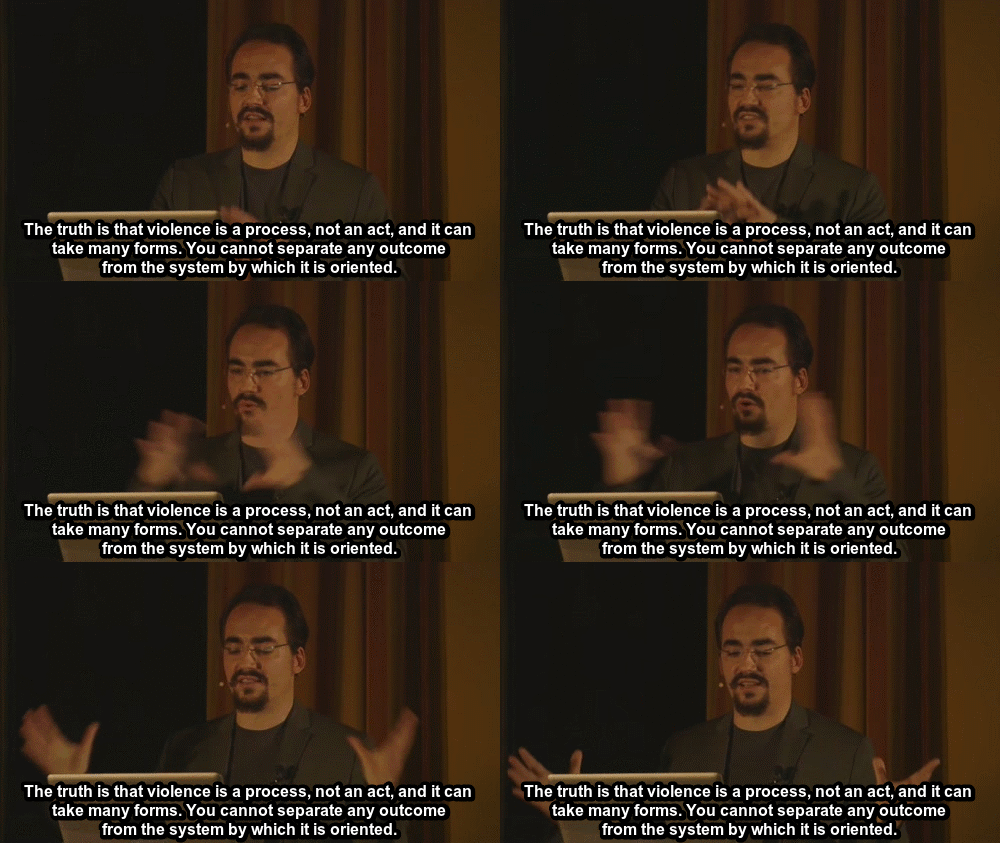
bidyke: universalequalityisinevitable: Peter Joseph on...


bidyke:

universalequalityisinevitable:

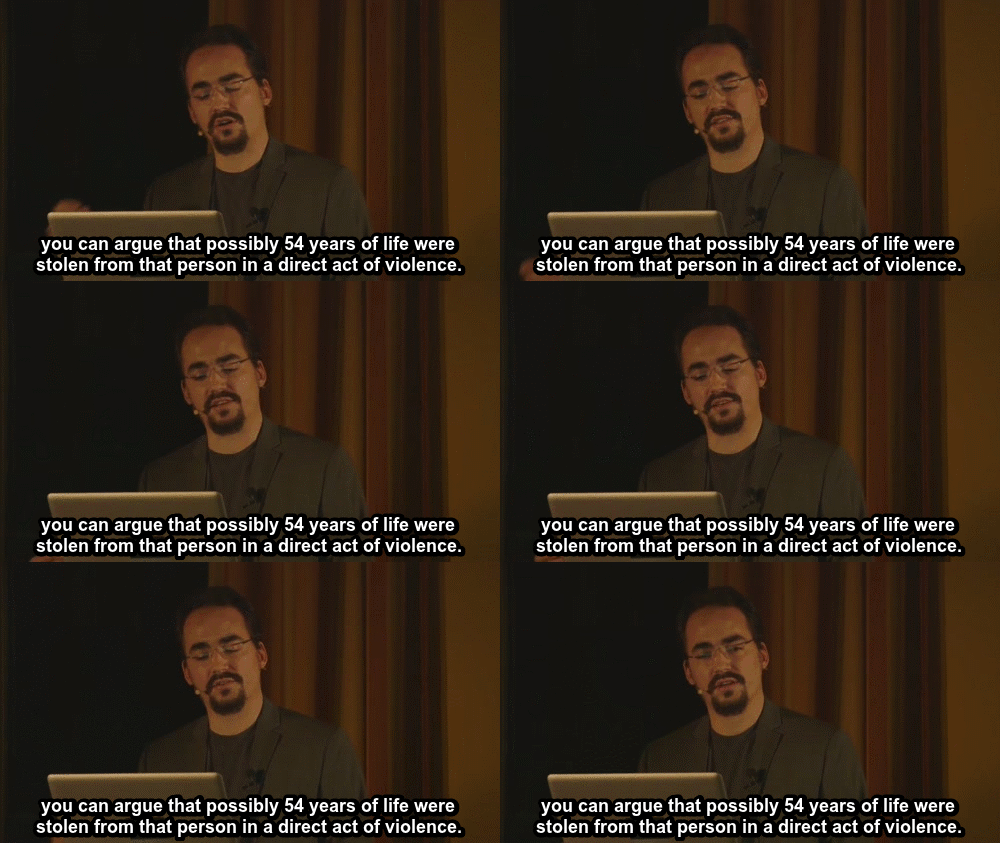
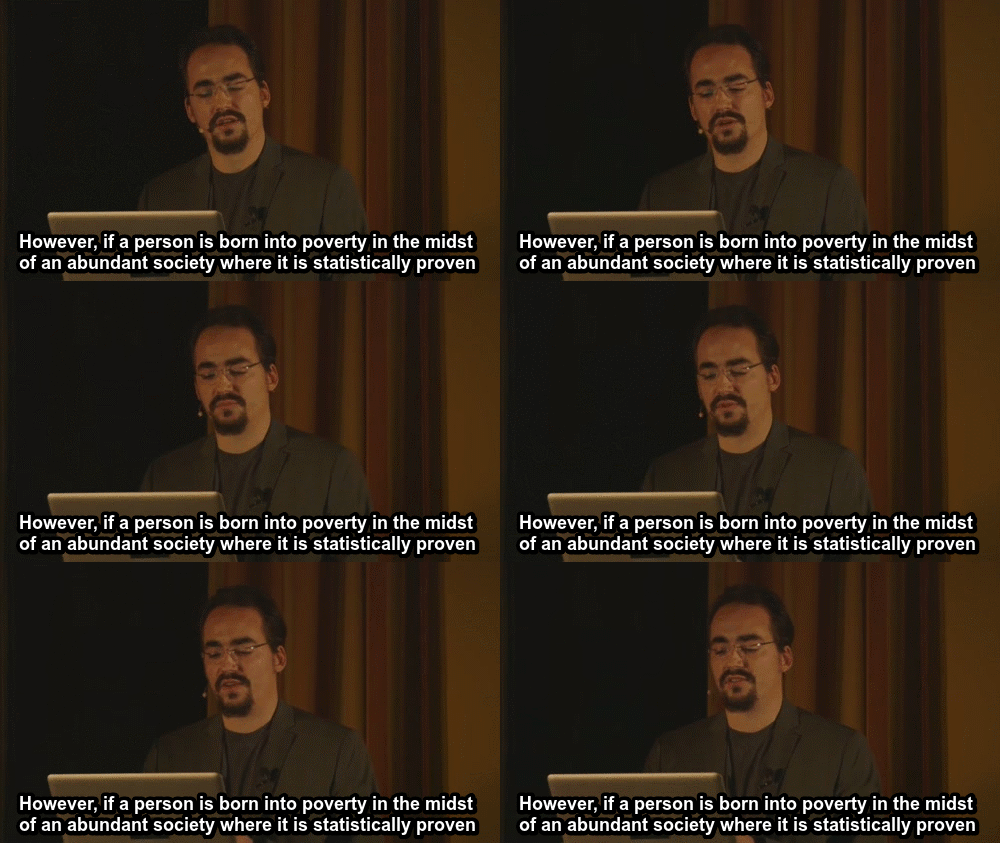
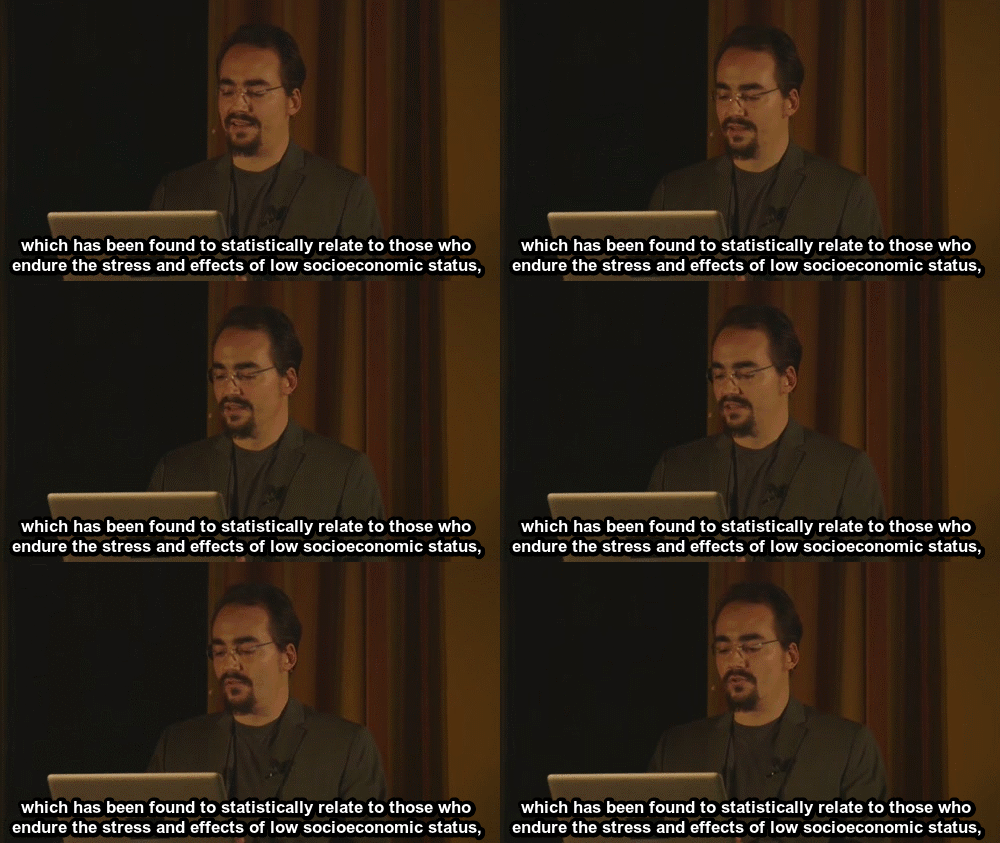
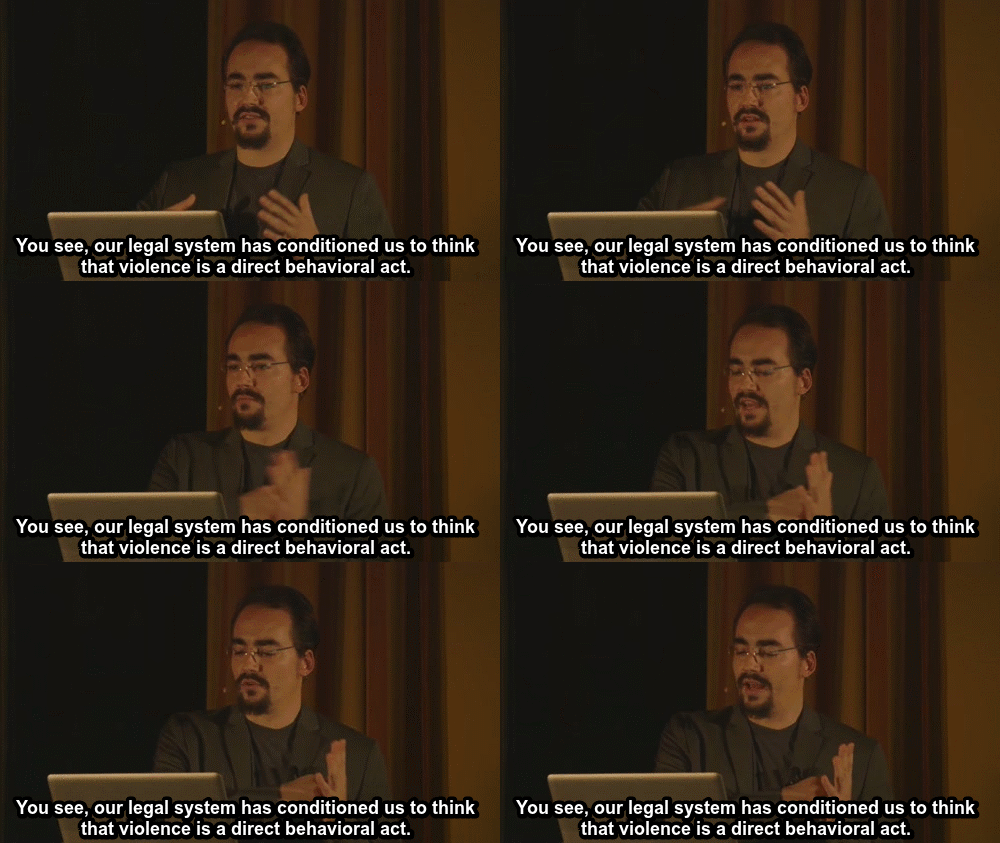
Peter Joseph on structural violence, from this video.

Accurate.

18 Mar 08:39

When did giving a Fuck become a bad thing

by Provider_UNE

submitted without comment*.

Reality Checker said,

March 18, 2014 at 5:53 · Edit

it’s an act of faith to be anything other than completely despairing.

That’s one act of faith I have had a hell of a time with lately.

I mean really. I grew up in a house where we knew personally a lot of the people involved in many struggles for social justice. But I have never felt worse about the prospects for having grandchildren at all.

We have a whole class of people that is hell bent on not only taking everything and re-instating slavery, but committing species suicide as well. I feel that at least the ancient Greeks understood how to live in a world like this: make sacrifices to the capricious, sociopathic gods and hope they didn’t decide to kill you this morning.

I don’t even know who to sacrifice to.

And then I see people like Goldberg. And I just wonder why I ever bothered to even try. I spent all those years trying to improve myself, to do my bit to make the world better. What the hell was I thinking? Moral courage? Shit, that was pretty stupid of me, evidently, and completely futile, since the conservatards are bent on making any future for humanity a moot point.

Sorry I am having a bad day.

*Never apologize when empathy takes the breath away.

17 Mar 20:46

The House That Ruth Built

by Zandar
Erwin Chemerinsky, the dean of UC Irvine's law school, takes to the LA Times to argue that Justice Ruth Bader Ginsberg needs to retire now in order to get a liberal justice appointed in her place on the Supreme Court.  It's a noble argument and it makes sense:

There likely will be many calls, publicly and privately, for Justice Ginsburg to resign before President Obama leaves the White House to prevent the risk of a Republican being able to appoint her successor. But simply leaving before the next election isn't enough. If Ginsburg waits until 2016 to announce her retirement, there is a real chance that Republicans would delay the confirmation process to block an outgoing president from being able to fill a vacancy on the Supreme Court. In fact, the process for confirming nominees for judicial vacancies usually largely shuts down the summer before a presidential election.

Moreover, there is a distinct possibility that Democrats will not keep the Senate in the November 2014 elections. The current Senate has 53 Democrats, two independents who vote with the Democrats and 45 Republicans. But in the November 2014 elections, Republicans have a far greater likelihood of gaining seats in the Senate than the Democrats. One recent study identified nine seats held by Democrats that could be won by Republicans, but only two seats occupied by Republicans that might be taken by Democrats.

But I'm with Steve M on this: If Justice Ginsburg retired tomorrow, the Republicans can and would block her successor for the next three years.  There's no possible way at this point that President Obama would be allowed to appoint anyone to the Court short of a second (and more militant) Scalia, and Democrats would revolt.

It's not happening.  The only way a Democrat gets to appoint another justice is if we get 60 in the Senate.  That may be a prospect somewhere in Hillary's term in 2020 or something.  Justice Ginsburg is just going to have to hold on until then,
17 Mar 02:36

Last Call For Going It Alone

by Zandar
Steve M on the hand-wringing in the Village Media about Millennials not trusting institutions:

Under Obama, millennials can't get jobs and can't pay off student loans, and their parents have been struggling financially for years -- but millennials didn't exactly see their elders thrive even during the supposedly better days of the Bush presidency, when the only way a non-rich person could get an extra sliver of the pie was by tapping into what turned out to be hyperinflated home equity. America's military might was more or less useless under Bush, and it's not much use under Obama. Churches, then and now, were overpoliticized and scandal-plagued. D.C. has been reduced to permanent dysfunction by a cabal of nihilists -- we know they're Republicans, though most millennials probably assume, because they're constantly told this, that "both sides do it."

Maybe millennials think institutions suck because institutions suck.

Guy has a point.  Hell, Chris Hayes wrote an entire book about said point.

Ross Douthat however just thinks we're leaving the door open to fascism because, hey, the Internet.

You don’t have to see a fascist or Communist revival on the horizon (I certainly don’t) to see this argument’s potential relevance for our apparently individualistic future. You only have to look at the place where millennials — and indeed, most of us — are clearly seeking new forms of community today.

That place is the online realm, which offers a fascinating variation on Nisbet’s theme. Like modernity writ large, it promises emancipation and offers new forms of community that transcend the particular and local. But it requires a price, in terms of privacy surrendered, that past tyrannies could have only dreamed of exacting from their subjects.

This surrender could prove to be benign. But it’s still noteworthy that today’s vaguely totalitarian arguments don’t usually come from political demagogues. They come from enthusiasts for the online Panopticon, the uploaded world where everyone will be transparent to everyone else.

That kind of future is far from inevitable. But as Nisbet would argue, and as the rising generation of Americans may yet need to learn, it probably cannot be successfully resisted by individualism alone.

To recap, the Glibertarian is worried that without enough religion and/or government regulation in our lives(!), we'll all become victims of digital totalitarianism because when given the freedom to operate away from the failed institutions that bind us, human nature isn't all about the online utopia, but Orwellian control.  It's almost like we need a certain amount of baseline societal norms in order to operate without becoming alpha male dickweeds.  Call them "rules of the road" even.

Mull on that point for a second.

16 Mar 08:01

Not All Like That

guerrillamamamedicine:

ladyatheist:

alexandraerin:

Imagine a minefield… a strip of land seeded with traps that will maim or kill you if you put one foot in the wrong place. What’s the wrong place? You’ll know when you step there. There’s no rhyme or reason to it. The pattern that gets you safely through one part might get you killed in another part.

It isn’t that every square inch of soil in the minefield means certain death, of course. But what would the ratio of safe ground to mined ground have to be before you could actually relax, before you could feel safe… before you could be safe, in practical terms?

Imagine that you and your entire family are woken up at dawn every day and made to cross the minefield in order to just live your lives. You’re not allowed to take the same route as each other. You have to watch each other as you make your way through an invisible deadly maze, never knowing if today will be the day but always knowing that it could be.

And one day, while you’re in the middle of that maze, watching your children or your siblings pick their way carefully around you, you say, “I HATE EVERY LAST INCH OF THIS FUCKING MINEFIELD.”

And then you hear a voice from up above you, from someone who doesn’t have to walk the minefield… someone who’s allowed to use a footbridge to bypass it every day while you’re inching your way through it, someone who gets a head start on everything compared to you and yours because they don’t have to go through the minefield…

And the voice says, “That isn’t fair. Sure, some of the minefield will kill you if you step on it, but it isn’t all like that.”

This is for every person who has come to me on both twitter and tumblr talking about “we’re not all like that”. I’m so sick of hearing that shit.

this is beautiful. 

YES.  This is what I tried to articulate in my post about why I’m afraid of interacting with cis people I don’t know.  It doesn’t matter how many people AREN’T like that, it matters how many ARE.

16 Mar 08:00

What literally just happened in my night class:

My Art History Teacher: “Who can name some notable Renaissance artists?”
Me: *Raises hand.*
My Art History Teacher: “…Aside from the girl with the Teenage Mutant Ninja Turtles shirt and backpack…”
Me: *Lowers hand.*
14 Mar 01:18

I... don't know if I regret this or not

1. Puts blog on university applications as personal activity showing writing skills and anti-oppression knowledge.

2. Submits application.

3. Spends next week reblogging femslash.

14 Mar 01:16

Last Call For We Don't Need No Education

by Zandar
Seems Ohio Republican State Rep. Andrew Brenner has decided that public education needs to go in America, because it's socialism.

In the post, titled "Public education in America is socialism, what is the solution?," Brenner laid out his argument. He noted that the Tea Party, which "will attack Obama-care relentlessly as a socialist system," rarely brings up "the fact that our public education system is already a socialist system[…] and has been a socialist system since the founding of our country." He addressed teachers unions -- "an outgrowth of our socialistic education system" -- which he granted originally improved things "temporarily" before they ultimately "became bureaucratic and they started to take the place of school boards and school management."

"I’m not blaming the teachers unions or the local school boards who are bound to the contracts, because if they don’t they will end up with strikes and an arbitrator will rule against them," Brenner wrote. "These issues all stemmed from the fact that we have a socialist education system in the first place."

Brenner's solution: more privatization.

"In a free market system parents and students are free to go where the product and results are better," he wrote. "Common core and standardized tests under such a system will not be necessary, because the schools that fail will go out of business. Government will not be there to prop them up with more tax dollars and increased regulations. Successful schools will thrive. The free-market system works for cars, furniture, housing, restaurants, and to a lesser degree higher education, so why can’t it work for our primary education system?"

It can, if you've decided that the goal of primary education is "Only those with money get educated."   Everyone else?  Well, I guess you don't need to be educated to greet people at Wallyworld or flip burgers at Mickey D's.  After all, if the parents really cared, they'd either work those extra jobs in order to afford to send their kids to school, or they'd stay home and teach the kids themselves, right?

I bet this guy hates the Interstate Highway System.

Oh, did I mention Brenner is the number two Republican on the Ohio House Education Committee?

14 Mar 01:15

The Derpy Carson Show

by Zandar
By all means Republicans, do everything you can to put Dr. Ben Carson in the hotseat for 2016.

Ben Carson, a renowned neurosurgeon and a popular figure among conservatives, compared the United States to the Third Reich in an interview.

Asked to elaborate on his previous comments about the U.S. living in "a Gestapo age," the conservative firebrand argued the country has become "very much like Nazi Germany."

"I know you're not supposed to say Nazi Germany, but I don't care about political correctness," he said in an interview Monday with the conservative news outlet Breitbart.

His comments came at the New York Meeting, a gathering of conservative politicians, journalists and business leaders.

Carson, who came in third in the GOP presidential nomination straw poll at last week's Conservative Political Action Conference, has been a fierce critic of the administration on the IRS controversy. The tax agency admitted last year to scrutinizing conservative political groups, though it maintains the error was not done out of political bias.

"You had the government using its tools to intimidate the population," Carson said. "We now live in a society where people are afraid to say what they actually believe."

And yet, here's Ben Carson, complaining that imaginary tyrants are preventing him from saying what he believes, and he's getting to say exactly what he believes.  He sure looks intimidated, huh.

In all seriousness, with FOX, the news shows, and endless coverage of everything they say, who actually believes that these clowns don't get to freely say what they want 24/7?
14 Mar 01:13

Words Will Break Cement by Masha Gessen

by Sean Carman

In her memoir The Pharmacist’s Mate, Amy Fusselman describes an AC/DC concert at Madison Square Garden as a religious experience:

And that’s the thing right there, that makes me believe in everything that makes no sense. When Angus Young plays the opening chords to “Hell’s Bells,” we know that something is here in the Garden that wasn’t here before, something huge and inexplicable, and it is not the giant, papier-mâchépapier-mache bell that drops from the ceiling. It is a presence, and even though it seems associated with Angus Young, it is not Angus Young.

And it is like a joke, almost, that . . . when we hear this gargantuan thing arriving, this giant presence, this god . . . we see only this shadow, this Angus Young fidgeting in his red velvet shorts, when we know as sure as we are standing here that a freaking king has come.

It’s not just heavy metal. The power of transcendent spectacle extends to punk rock, faith, and political resistance. When Pussy Riot performed their “Punk Prayer” in the Cathedral of Christ the Savior, they combined all three. “Mother of God, Chase Putin Out” sounded like a Russian Orthodox choir being interrupted by Bikini Kill. Their bright party dresses and balaclavas, which made them look like cartoon superheroes, branded their protest as performance art. Their song begged the Virgin to chase Putin from the Russian Orthodox Church, which his propaganda had fashioned into an instrument of state power.

The performance drew more international attention to Putin’s oppressive rule than the years of protests leading up to it. Nadezdha Tolokonnikov, Yekaterina Samutsevich, and Maria Alyokhina seemed to have summoned the presence of something larger than themselves.

In Words Will Break Cement: The Passion of Pussy Riot, Masha Gessen puts the wonder of this achievement at the center of Pussy Riot’s story. She writes:

Here is what I was trying to figure out: How a miracle happens. A great work of art –– something that makes people pay attention, return to the work again and again, and reexamine their assumptions, something that infuriates, hurts, and confronts –– a great work of art is always a miracle.

Gessen offers a riveting account of Pussy Riot’s birth as an opposition artists’ collective, the protest in the Cathedral of Christ the Savior, the show trial staged by Putin’s government, Samutsevich’s release on appeal, and Alyokhina’s and Tolokonnikov’s imprisonment in the Berezniki and Mordovia penal colonies. She is a sharp observer of people and events, and she tells Pussy Riot’s story in a lively style that is somehow casual, precise, and powerful all at once. She has written a terrific book, a compelling story of three creative women who courageously attacked a repressive regime by disrupting the spectacle of it propaganda.

Words Will Break Cement is so good because, in addition to possessing an accessible and understated literary style, Gessen really knows her subject. (Her excellent personal reporting on Moscow’s anti-Putin protests, on the New York TimesLatitude blog, is also well worth reading). She renders every detail of Pussy Riot’s story with great skill and understanding.

Masha Gessen (Photo by David Levenson)

Masha Gessen (Photo by David Levenson)

To dwell on a few of those details, the popular YouTube video translates the first chorus of “Punk Prayer” as, “Shit, shit, the Lord’s shit ,” which renders the lyric a mere sacrilege. Gessen’s “Shit, shit, Holy shit!” is more punchy, and makes the lyric ironic. Even her title for “Punk Prayer” (“Mother of God, Chase Putin Out” instead of “Mother of God, Chase Putin Away”) has more bite.

Gessen quotes Tolokonnikov’s, Samutsevich’s and Alyokhina’s closing statements from the transcript of the trial, rather than from their later edited versions, which gives them a more immediate feel. She casts the story against the backdrop of Moscow’s growing resistance to Putin’s rule, and provides well-chosen and helpful explanatory footnotes.

As for larger themes, the task of every political biography is to place its subject in historical context. Gessen doesn’t describe the women of Pussy Riot as political saviors, but their story naturally makes the reader wonder if they are. Maybe Gessen just polished the edges of her tale to throw its implications into relief, but it is possible to read her brief history of Pussy Riot as a retelling of the passion play referenced in her title.

Tolokonnikov, Samutsevich, and Alyokhina are thoroughly human in the early chapters. Gessen captures their ideals, flaws, ambitions, and contradictions. She makes them complete characters. By the time of their trial, however, they have become icons, and Moscow and its legal system a modern day Judea. Pussy Riot’s closing statements are captivating in their eloquence. Thankfully, Tolokonnikov does not become a martyr, although Gessen’s account of her ordeals in the Mordovia penal colony will make you fear for her and Pussy Riot’s safety if they imprisoned again. (There is a chilling passage in which a drop-out from the group recalls her realization that, for Pussy Riot, being arrested and detained wasn’t a setback, it was a goal, a feature of their lifestyle.)

As for Pussy Riot’s legacy, Samutsevich and Tolokonnikov recently out-shined Stephen Colbert on his show, and shared the Barclays Center stage with Madonna, but Maria Alyokhina put it best in her closing statement:

I am not afraid of lies and fictions and of poorly coded deception in the verdict of this so-called court, because all you can do is take away my so-called freedom, the only sort that exists in the Russian Federation. But no one can take away my inner freedom. It lives in my words and it will survive thanks to the public nature of my statements, which will be heard and read by thousands. This freedom is already multiplying, thanks to every caring person who hears us in this country. Thanks to everyone who has found splinters of this trial in themselves, as Franz Kafka and Guy Debord once did. I believe that openness and public speech and hunger for the truth will make us all a little bit freer.

We will see this yet.

Related Posts:

14 Mar 00:20

“Paul Ryan insists his ‘inarticulate’ comments about ‘inner city’ men were not about race”

by SEK

That’s today’s headline.

Tomorrow’s will be: “Paul Ryan insists he has no idea why he thought of the word ‘inarticulate’ to describe racially insensitive remarks.”

NOTE: I’m posting links to what I’m writing elsewhere because the conversations generated by them strike me — for the most part — as really interesting. I promise, though, that as a salaried employee at an online publication, I don’t receive any more money if you click on the link than if you don’t.

NOTE ABOUT THE PREVIOUS NOTE: But the more times people comment to complain about me cross-posting material, the more money all of the folks here make, so feel free to lambast me in many comments and at great length.


14 Mar 00:20

Unhappy International Aguna Day?

by syrbal-labrys

imageNot the sort of holiday to celebrate with Jewish folks songs and dancing.  Imagine being in a marriage so bad you want out; but your religion insists your husband must “free” you.  And if he does not, you STAY legally wed and will be branded an adultress if you date or have a relationship?  Imagine being captive, religiously and legally to a man bending you over legally for a custody agreement you simply cannot make over the children?  Not that pretty at all, is it?

While this Jewish custom of both sides needing to agree to a divorce is religiously motivated; I know plenty of “chained” American women…financially bound to men who don’t see validity to their needs and emotions.  American divorce has become so acrimonious, costly, and devastating to both sides that even an unhappy marriage, if devoid of physical abuse and addiction issues is sometimes more bearable.

I admit, on alternate days, I wonder why ANYone wants to get married at all.


Filed under: Life, Religious Nuts & Bolts Tagged: divorce, marriage, religion
14 Mar 00:20

In Which Paul Ryan Apologizes, sort of

by tengrain
Shorter Paul Ryan: “I’m sorry you heard what I said.” What the brown paper bag fabulist and Zombie-eyed Granny-starver actually said as an apology (of sorts?): After reading the transcript of yesterday morning’s interview, it is clear that I was … Continue reading →
14 Mar 00:19

Is it Stupid Day in Wingnuttia?

by tengrain
“The former Arkansas governor went on to say that “I don’t believe I can own another person, I thought we settled that after the Civil War, or as some people in the South when I was young used to still … Continue reading →
14 Mar 00:19

Job Market Strategies

by Erik Loomis
14 Mar 00:18

Socialism

by Erik Loomis

I look forward to Republicans discovering the interstates are a socialist program and thus Interstate 5 Brought to You by Microsoft can be a pothole-ridden road that would make no nation proud:

“Socialism, defined on Wikipedia, ‘is a social and economic system characterized by social ownership of the means of production and co-operative management of the economy,’” state Rep. Andrew Brenner (R ) wrote in a post published Mar. 3 on Brenner Brief News, a website founded and edited by his wife. “That seems to summarize our primary education system. Public education in America is socialism.”

Brenner serves as vice-chair of the Ohio House Education Committee.

In the post, titled “Public education in America is socialism, what is the solution?,” Brenner laid out his argument. He noted that the Tea Party, which “will attack Obama-care relentlessly as a socialist system,” rarely brings up “the fact that our public education system is already a socialist system[…] and has been a socialist system since the founding of our country.” He addressed teachers unions — “an outgrowth of our socialistic education system” — which he granted originally improved things “temporarily” before they ultimately “became bureaucratic and they started to take the place of school boards and school management.”


14 Mar 00:15

Paul Ryan, Master Of GOP Minority Outreach

by Zandar
Apparently the entire thrust of GOP Rep. Paul Ryan's interest in poverty statistics is to once again blame it all on black men for being lazy.

House Budget Chairman Paul Ryan (R-WI) previewed his upcoming legislative proposals for reforming America’s poverty programs during an appearance on Bill Bennett’s Morning in America Wednesday, hinting that he would focus on creating work requirements for men “in our inner cities” and dealing with the “real culture problem” in these communities. “We have got this tailspin of culture, in our inner cities in particular, of men not working and just generations of men not even thinking about working or learning the value and the culture of work, and so there is a real culture problem here that has to be dealt with,” he said.


I guess he thinks we black men are too stupid to see through that nonsense, but that's kind of his point, isn't it?  It's black culture that doesn't value hard work, cause we're all thugs and drug dealers and...well wait a minute, drug dealers and thugs actually do know the value of hard work, now that I think about it.  So I guess he sees someone like me as subhuman maybe?

Ryan also cited Charles Murray, a conservative social scientist who believes African-Americans are, as a population, less intelligent than whites due to genetic differences and that poverty remains a national problem because “a lot of poor people are born lazy.”

And yet this lovely pile of racist garbage was the Republican choice for Vice-President in 2012.  Sure does make me want to vote Republican.  You know, if I wasn't so lazy and/or stupid.

Today, Ryan apologized.  Sort of.

After some reflection, Ryan said Thursday "it is clear that I was inarticulate about the point I was trying to make." 
"I was not implicating the culture of one community - but of society as a whole."

Sure he was.  Especially when he cited Murray and his Bell Curve nonsense.  He must think we're pretty stupid.

Oh wait, he does, and he said so.  On multiple occasions.  Look, even if you somehow can make the argument that Ryan isn't a racist asshole citing other avowed racist assholes in his policy work, at the very least his entire budget is based on the fact he thinks poor people only exist because they are all  one hundred percent of them lazy to a person.

And again, this guy was going to be Vice-President of the United States if the GOP had their way.