Shared posts

04 Dec 12:52

Los obispos reciben una edición especial del libro ‘Francisco Franco, cristiano ejemplar’

by INFOVATICANA

El movimiento el Valle No Se Toca, que vio la luz tras el anuncio de Pedro Sánchez de exhumar los restos de Francisco Franco del Valle de los Caídos el pasado mes de junio y que ha protagonizado campañas con mucho impacto mediático por toda España, ha impreso una edición especial del libro de D. Manuel Garrido Bonaño OSB dedicada en exclusiva a los obispos españoles.

Ayer, miércoles 21 de noviembre, antes de empezar la sesión de la Asamblea Plenaria de la Conferencia Episcopal en que los obispos de España eligieron Secretario General, activistas de El Valle No Se Toca entregaron en mano a los prelados un ejemplar del libro Francisco Franco cristiano ejemplar. El libro cuenta con un prólogo del historiador Pío Moa, escrito especialmente para esta edición.

El Valle No Se Toca ha querido con esta acción acercar la figura humana y cristiana de Francisco Franco a los obispos de España para concienciar del ataque del gobierno a quien, como se muestra en el libro, vivió una vida intensa de fe y procuró defender los derechos de Dios y de la Iglesia Católica. El Valle No Se Toca dedica el libro a los obispos en la contraportada expresando que “Francisco Franco fue un dignísimo hijo de la Iglesia, a cuya jerarquía en España invitamos a leer este texto para que emprenda una merecida defensa de su figura y cumpla con el mandato apostólico de cuidar de sus ovejas, las de ayer, las de hoy y las de mañana”.

Según ha podido saber Infovaticana, ayer fueron entregados cerca de noventa libros en la puerta de la Conferencia Episcopal, aunque algunos obispos rechazaron aceptar el regalo que El Valle No Se Toca les ofrecía. Entre los obispos que se negaron a coger el libro están D. Luis Argüello, obispo auxiliar de Valladolid y que momentos después fue elegido Secretario General de la Conferencia Episcopal; D. Braulio Rodríguez, Arzobispo de Toledo y Primado de España,  D. Demetrio Fernández, obispo de Córdoba o D. Francisco Pardo, obispo de Gerona e hijo del alcalde franquista de Torrella (Barcelona) D. Emilio Pardo Sanahuja. El Arzobispo de Sevilla Asenjo, el obispo de Cuenca D. José María Yanguas y el Obispo de la Seo de Urgel y Copríncipe de Andorra D. Joan Enric Vives, también rechazaron la edición especial para los obispos españoles del libro Francisco Franco cristiano ejemplar.

La entrada Los obispos reciben una edición especial del libro ‘Francisco Franco, cristiano ejemplar’ se publicó primero en InfoVaticana.

27 Nov 12:25

AUNQUE ES DE NOCHE. Sobre cómo las luces de Navidad iluminan, pero de otra manera

by María Marco


Me va a llamar el alcalde de Nueva York y me va a decir que me tiene sana envidia,

porque las luces de Vigo son las mejores del planeta

Abel Caballero

-¿Podrías decirme, por favor, qué camino debo seguir para salir de aquí?

-Esto depende en gran medida del sitio al que quieras llegar.

-No me importa mucho el sitio.

-Entonces, tampoco importa mucho el camino.

Lewis Carroll

Alicia en el País de las Maravillas (1865)

El capitalismo acepta la crítica con la condición de hacerla ineficaz.

  1. Didi-Huberman

 La obra de arte es un juego. Cada cual se crea sus propias reglas de juego. Pero esas reglas deben poder aparecérseles a quienes también quieren ponerse a jugar.

Le Corbusier, 1965

El árbol de Navidad de la Puerta de Sol es más alto que el de Rockefeller Center de Nueva York, aunque Nueva York tenga ocho millones y medio de habitantes y Vigo apenas 300.000. Este año alcanza los 31 metros, casi la misma medida del ego desproporcionado de un alcalde fuera de control. La empresa cordobesa Xímenez ha firmado con el Concello de Vigo un contrato para producir la iluminación navideña de la ciudad durante cinco años por la que cobrará 3,7 millones, con IVA 4.500.000 de euros, una media de 900.000 anuales. El año pasado Santiago de Compostela invirtió en iluminación navideña 170.000 euros, Pontevedra 82.000 y Ourense 88.000. El alcalde justifica este gasto en el retorno que recibe el pequeño comercio y la hostelería, pero en la era de la compra online no hay datos fiables que avalen una relación directa entre nueve millones de leds y el ascenso meteórico de la venta al por menor.

Estoy hablando de cultura, estúpido

Vigo está sufriendo una situación de total excepcionalidad respecto al cumplimiento de las obligaciones administrativas derivadas de los principios legales de igualdad, transparencia, libertad y participación en las decisiones de los poderes públicos. La situación, desplazada a un segundo plano por la prensa local dependiente de jugosas subvenciones públicas, es lo suficientemente grave para cuestionarnos desde la imparcialidad (en serio) la conveniencia o no de este gasto, y si es el mejor momento para disneyficar la ciudad armándola a base de políticas-ficción.

Estamos hablando de cultura. En Artes Escénicas el presupuesto municipal pasa en 2011 de 110.000 euros a 57.000, se privatiza la programación del Auditorio Municipal Mar de Vigo construido con dinero público, muere la Semana de Teatro Aficionado, muere el Festiclown (2012), el festival de artes escénicas ALT pasa de tener 60000 (2011) a 10000 euros en 2016 para finalmente desaparecer. Muere el festival de música VigoTransforma (2012) e Imaxinasons pasa a ser el modesto festival de Jazz de Vigo fagocitado por la ambición municipal. En Artes Visuales el panorama es igualmente desolador: El Archivo Pacheco —la memoria visual de la historia de nuestra ciudad— cerrado, el Centro Fotográfico de Vigo (CAFVI), un proyecto dedicado a la fotografía que se abrió en mayo de 2015 para cerrar en agosto de ese mismo año, está actualmente abandonado, Secuencia 0, festival de cortometrajes muere, la Red Museística, la gran apuesta cultural de la era caballero no existe como órgano articulado (el Verbum sólo abre 14 horas semanales), el Museo MARCO de Vigo, institución insignia de la ciudad, que estaba en el puesto 86 entre las 100 mejores instituciones culturales del mundo según la prestigiosa empresa ArtFacts queda anulado con un sospechoso giro de los acontecimientos en el cambio de los estatutos —que llevan más de una década en vigor— y con una convocatoria para la dirección del centro condicionada por la priorización de la exhibición de la colección pictórica de la ciudad, que por otra parte se replica ad infinitum en los diversos centros que ya existen con ese fin como la Pinacoteca, el Museo Quiñones de León y que a partir de ahora el MARCO exhibirá también. Respecto a las bibliotecas municipales la situación es igualmente grave. La Red de Bibliotecas de Barrio se convirtió en un proyecto fracasado que solo inauguró un único centro en 2011 en el Calvario. Además, las bibliotecas que resisten son desoídas por el Concello, despreciando el enorme potencial cultural y social de estos centros, como catalizador de la energía de cada barrio, archivo cultural, oferta de ocio gratuito y de calidad y espacio socializador intergeneracional.

Estos siete años de gobierno caballerista han dejado una cultura local bulímica, entre la inapetencia y el vómito compulsivo, orientado a la mercantilización de la ciudad, efímera, cortoplacista y electoralista (no olvidemos que las elecciones municipales son en seis meses). Socialmente la situación es igualmente detestable. Más de 18500 familias viguesas sufren pobreza energética. La compañía Fenosa, ahora Naturgy, tiene 18.458 contratos de bono social, un 4,6% menos que el año pasado a pesar de la campaña del gobierno central, que en realidad ha dificultado los trámites burocráticos de renovación denegando una parte de los solicitados, además de la huelga que hemos tenido de funcionarios judiciales que ha congelado las peticiones de fe de vida para la obtención de dicho descuento.

Vigo se convierte ahora en la ciudad gallega con mayor tasa de población en riesgo de pobreza a partir de datos del Instituto Nacional de Estadística (2017) concretamente un 21% de la población. A oscuras ven como sus impuestos se esfuman en alimentar un circo mediático, que en realidad es una escenografía, una apropiación iconográfica anacrónica: muñecos de nieve, papanoeles, bastones de caramelo rojos y blancos y calcetines en las chimeneas que nada tienen nada que ver con la tradición de austeridad europea que hoy ya asume como propios, en este mundo globalizado, tradiciones importadas por el capitalismo más voraz.

Además de la pobreza energética debemos hablar también de contaminación lumínica, no sólo como un despilfarro de los recursos energéticos contribuyendo y acelerando el cambio climático, la lluvia ácida y la generación de residuos. Se agrede y estresa a la fauna y flora nocturna, incluso microbiológica, y se influye en las migraciones de muchos de ellos. Respecto al ser humano maltrata nuestros ojos, ya que demasiada luz provoca fatiga visual haciendo disminuir nuestros reflejos. Así que mientras el resto del mundo se plantea un consumo lumínico sostenible nosotros no sólo no lo planteamos sino que durante un mes y medio al año multiplicamos exponencialmente nuestra tasa lumínica. No quiero olvidar tampoco la desafortunada instalación de las estructuras, taladrando las fachadas de los edificios privados sin permiso y causando en muchas de ellas focos potenciales de entradas de humedad, grietas etc. por lo que también hay un perjuicio a la propiedad privada y al patrimonio arquitectónico de la ciudad.

Si te dicen que #CAÍN

El sector cultural articulado a través de asociaciones ciudadanas ha dicho basta. El mes de noviembre de 2018 será recordado como el primer levantamiento ciudadano, no únicamente sectorial, contra el inmovilismo y la instrumentalización de la cultura, sus presupuestos y recursos. El pasado #16N ocurrió un encuentro histórico en el Instituto Politécnico de Vigo en un evento presentado por el mediático “Gonzo” en el que diversas asociaciones #AteneoAtlántico, #AsociaciondeamigosdoMARCO #AColectiva #InstitutoGalegoPraxeActual sentaron las bases de una lucha por reconquistar la maquinaria pública y la dignidad de nuestro patrimonio e instituciones. Todo ello amparado por el paraguas de una meta-asociación llamada CAIN que en realidad es voz para todas las asociaciones viguesas que demanden un cambio del rumbo cultural.

El colectivo CAÍN (Colectivo de admiradores da iluminación de nadal) surge como grupo de trabajo abierto, heterogéneo e intergeneracional con la intención de estimular el diálogo con el Concello, con el resto de fuerzas políticas y la ciudadanía, divulgando la gestión real de nuestros recursos públicos. CAIN ha supuesto la articulación organizada de un malestar común y apoyan varios actos y campañas diversas como la que se ha celebrado el viernes organizada por el colectivo +SOCIAL (Asamblea por un Vigo más social) quienes han dado una rueda prensa denunciando el derroche de este encendido con el hashtag #alumeandoamiseria o el #ProyectoCUBO, una nueva iniciativa cultural en Doctor Cadaval 17, un espacio abierto dirigido por Alfons Freire y que inaugura hoy viernes 23 su primer proyecto expositivo A Imaxe na Parede con piezas de Iria Vázquez, Pilar Alonso y Yolanda Carbajales que aspira a convertirse en uno de los ejes contraculturales de la ciudad.

Sin duda este es un paso crucial, el que ha dado CAÍN y el que debemos dar con él, implicándonos en la toma de decisiones públicas en la medida de nuestras posibilidades. CAÍN, como ellos mismos dicen, somos todos y no es nadie, pero destaca por ser una nueva herramienta que debemos aprender a utilizar para la construcción de ese modelo de ciudad sostenible, cuidada y cultivada, que ahora no podemos ver.

Nulla aesthetica sine ethica.


>>> CONTRAINFORMEMOS!: Comparte esta info en tus redes o por whattsapp


@mariamarco__

mariamarco.weebly.com

La entrada AUNQUE ES DE NOCHE. Sobre cómo las luces de Navidad iluminan, pero de otra manera se publicó primero en Dot Magazine.

26 Nov 17:02

How Christians co-opted the winter solstice

by Mike Colagrossi


  • Christmas was heavily influenced by the Roman festival of Saturnalia.
  • The historical Jesus was not born on December 25th as many contemporary Christians believe.
  • Many staple Christmas traditions predated the festival and were tied into ancient pagan worship of the sun and related directly to the winter solstice.

In the depths of darkness covering the entire Northern Hemisphere, the winter solstice has marked the shortest day of the year. It has always held significance in many culture's religious festivities and holidays. A great deal of religions have made the celestial moment a holy day. It is the darkest day of the whole year and for the ancients that meant a lot more to them then it does to us today. Sun worshippers and pagans have venerated this natural cycle for millenia.

Christmas as we know it today is a relatively new holiday. Many traditional elements we associate with Christmas pre-date Christianity by many centuries. There is also a lot of debate as to how much corporate and commercial interests have influenced this holiday as well.

Nowadays there's a lot of hand waving when it comes to the Christian origins of Christmas. Inarguably, however, is the fact that the holiday's modern iteration has been influenced by many pagan and secular festivities.

Early human celebrations and customs during the Winter Solstice


You'll find plenty of pagan customs in Christmas that were adopted during the early Christian spread around the Roman Empire. We can look back to both the Romans and the Celts for a whole lot of our modern day Christmas traditions.

Celts began celebrating once the winter solstice arrived and rejoiced that the days were slowly getting longer, which meant that spring and the harvest was around the corner. This was most pronounced in their holiday of Yule. Early Christians, who, at that time, were seen by many as being members of an urban cult, worked hard to try to convert and ban old Pagan customs. But the rural pagan inhabitants of those lands were not convinced. Eventually the church realized they needed to co-opt some of these traditions.

Around this time, the Church came up with the idea that Jesus Christ, their savior, was born on December 25th. In the 4th century CE, Christianity had begun to draw heavily upon Roman festival of Saturnalia. Christian leaders succeeded in transposing these festivities on to their new made-up holiday.

The first mention of the Nativity feast and other early Christmas traditions appears in a Philocalian calendar dated around 354 CE. It was because of this pagan origin that celebrating Christmas was banned by the Puritans and made illegal in Massachusetts between 1659 and 1681.

Saturnalia as the ultimate midwinter festival


Saturnalia was an ancient pagan holiday that honored the Roman God Saturn. It took place sometime between December 17th and 24th. It was a week of revelry, decadence and the inversion of social and moral roles.

The festivities consisted of drinking, eating lavishly and giving presents. The first-century poet Gaius Valerius Catullus said that Saturnalia was "the best of times."

Wealthy Romans paid for the destitute and masters would swap clothes with their slaves. Lucian of Samosata speaking as the god Cronos, boasts about this exuberant time in his poem titled Saturnalia:

During my week the serious is barred: no business allowed. Drinking and being drunk, noise and games of dice, appointing of kings and feasting of slaves, singing naked, clapping… an occasional ducking of corked faces in icy water – such are the functions over which I preside.

Saturnalia began as a rural farmer's festival to mark the end of the planting season and midwinter.

Both psychologically and cosmically, this is was a unique time of the year for the ancients. The darkness must have affected them tremendously as without the modern advent of artificial lighting, lessened sunlight would have taken a toll on their mental health. During this time sun and stargazers would have also seen the change in the sun's position.

All of this led to many religious spectacles and spiritual festivals. After all, they were now only relying on their summer food stores of grains and other crops to get them through the winter until they could, again, plant in the new season.

This led to a number of traditions we still take part in today.

Christmas traditions with other pagan origins


Even before historical record, Pagans would worship the trees in the forest and even bring them into their house and start to decorate them. Mistletoe for example was also a plant revered by the Celts and the Norse.

Celtic Druids believed that mistletoe would protect them against the elements of thunder and lightning. These druids would cut off a piece of mistletoe from the trees and then distribute that amongst their people for protection. It was also considered a symbol of peace and joy. Meeting under the mistletoe would call for enemies to put down their weapons and have a truce.

Ivy on the other hand was the great symbol of Bacchus, the Roman equivalent of Dionysus – God of wine, fertility and ritualistic madness. Ivy is a symbol of eternal life.

Traditional Christmas colors like green and red represent fertility. Burning Yule logs was representative of the returning sun as the days began to get longer again.

Christmas revelers, commercial shoppers and devout religious types can all thank the rich traditions and pagan history stretching back thousands of years this holiday season.

25 Nov 02:37

Fallece al inhalar un producto químico mientras hacía licor

by Redacción

Una mujer falleció este martes por la tarde en Ribadavia después de inhalar un producto químico de una botella mientras preparaba licor. Los hechos sucedieron en la calle Maquians, a la altura del número 34.

Según la información facilitada al 112 Galicia, parte del contenido del envase finalizó derramado en el suelo, por lo que los servicios de emergencias, una vez en el punto, llevaron a cabo las mediciones correspondientes para medir la toxicidad del gas en la estancia, que resultaron negativas.

El 112 Galicia tuvo constancia de lo ocurrido a las 16.55 horas, a través de la alerta del 061-Urxencias Sanitarias.

Nada más recibir el aviso, los gestores del 112 Galicia requirieron la intervención de los Bomberos de O Carballiño, de la Policía Local, de la Guardia Civil, del GES de Ribadavia y de Protección Civil.

Ya en el lugar de los hechos, los efectivos sanitarios nada pudieron hacer por salvarle la vida a la mujer. 

25 Nov 02:29

Luís Villares e o ex-deputado David Bruzos, cabezas de lista nas eleccións internas de En Marea

by David Lombao

Na lista de Villares intégranse os deputados Pancho Casal, Paula Vázquez Verao e Davide Rodríguez, tamén a eurodeputada Lídia Senra. Na candidatura 'crítica', que encabeza Bruzos, figuran varios nomes vinculados a Anova, Podemos Galicia e mareas municipais como Marea Atlántica e Compostela Aberta

23 Nov 00:31

A Tafona, el restaurante de Lucía Freitas, se hace con su primera estrella Michelín

by BenBoInfo

Foto: Facebook A Tafona

Galicia brilla con una nueva estrella: A Tafona, el restaurante de Lucía Freitas, acaba de ser reconocido con la máxima distinción gastronómica que otorga la Guía Michelin. Así lo anunciaban ayer desde Lisboa, lugar en el que se celebró la gala de presentación de la nueva edición de la guía roja para 2019.

La chef compostelana , que estuvo presente en la celebración, se mostró “muy feliz” por haber conseguido la prestigiosa estrella en declaraciones para Michelin España, además de dar las gracias al “gran equipo” que la acompaña en su restaurante y que también “está detrás” del galardón.

Los inspectores de Michelin destacan la “gran fineza” de la cocina de A Tafona, con una propuesta de “corte moderno, con mucho sabor, buena técnica y elegantes maridajes”. Además, destacan del su local la combinación de sus “llamativas paredes en piedra con una preciosa escalera, un lucernario y algún que otro detalle de diseño”.

De este modo, Freitas y su restaurante se unen al Olimpo gastronómico de la península, al que este año se ha sumado otros 24 establecimientos con una estrella, 4 con dos estrellas y 1, el restaurante Dani García de Marbella, con 3 estrellas Michelin. Un doble éxito para la chef compostelana si tenemos en cuenta, además, que el restaurante neoyorkino Tomiño, del que es Chef Manager, obtuvo este mismo mes el título de Bib Gourmand en la edición de la guía en la ciudad.

A nivel autonómico Galicia se mantiene con el mismo número de estrellas: 11 con la incorporación de A Tafona y la baja de Alborada, que cerró sus puertas el mes pasado. Casa Solla y Culler de Pau, que un año más entraban en todas las quinielas para llevarse el doble reconocimiento, tendrán que esperar un año más para intentar hacerse con dos astros de Michelin para sus locales.

Más allá de estas distinciones, 22 nuevos restaurantes gallegos se sumarán como establecimientos recomendados en la Guía de 2019.

Listado de locales galardonados con una estrella Michelin 2019:

  • Maruja Limón, Vigo (Pontevedra)
  • Culler de Pau, O Grove (Pontevedra)
  • Casa Solla, Poio (Pontevedra)
  • Casa Marcelo, Santiago de Compostela (A Coruña)
  • Pepe Vieira, Poio (Pontevedra)
  • Yayo Daporta, Cambados (Pontevedra)
  • As Garzas, Malpica (A Coruña)
  • Retiro da Costiña, Santa Comba (A Coruña)
  • Nova, Ourense (Ourense)
  • Árbore da Veira, A Coruña (A Coruña)
  • A Tafona, Santiago de Compostela (A Coruña)

La entrada A Tafona, el restaurante de Lucía Freitas, se hace con su primera estrella Michelín aparece primero en BenBo - Revista gastronómica.

22 Nov 00:48

Neighborhood Brats - Claw Marks

by noreply@blogger.com (Lord Rutledge)
If I had polled you all at the beginning of the year on which 2018 album release you were most looking forward to, there's a good chance that Neighborhood Brats' Claw Marks would have been the #1 choice. After waiting four long years for a follow-up to the band's brilliant 2014 debut LP Recovery, a lot of us were super-stoked about Claw Marks finally coming out. Well now it's out, and my cliched response would have been to say that it does not disappoint. But the hell with that! Claw Marks does far more than not disappoint. It's even better than I thought it would be! If I were stating my case for Neighborhood Brats being one of our greatest present-day punk bands, this album would be exhibit A!

Out on Dirt Cult Records, Claw Marks is a great example of a punk band building off of its core sound. It's immediately recognizable as a Neighborhood Brats record, yet it displays songwriting chops far beyond what Jenny and George would have been capable of a few years back. There are still plenty of nods to late '70s/early '80s California punk, but this album also incorporates a heavy Aussie punk influence along with the dark melodic sensibilities often associated with "modern" punk rock. As always, Jenny's impassioned vocals are perfectly in sync with the sheer power of the band's music. Digging deep into these songs, you'll find tremendous meaning in what Jenny is singing. Sometimes her lyrics are topical/political; other times, they are intensely personal. Put it all together, and you really do have a soundtrack album for the real-life dystopia that is 2018 America ("Late Stage Capitalism" just might be THE protest song for our times). From the furious, vintage Neighborhood Brats banger "Misery Parade" to the thumping, Aussie-inspired "Dumpster Values" to the made-for-singing-along anthem "Down 3rd" to the pitch-black apocalyptic pop of "Touching The Void", this album is full of memorable songs in a wide variety of styles. The inclusion of "Night Shift" and "Comfort Women" from the band's most recent EP was a smart choice; those songs fit the sound and tone of the album so perfectly that it would have seemed wrong to leave them out.

Speaking of that aforementioned EP: Night Shift was the first new music from Neighborhood Brats in nearly four years, and it quickly showed that a long hiatus had not diminished the band in the least. On the strength of that EP, I expected Claw Marks to be something special. And that's exactly what it is. If you long for the days when punk music meant something, I'd urge you to check out Neighborhood Brats and discover that it means more than ever.

Claw Marks by Neighborhood BratsClaw Marks by Neighborhood Brats

-L.R.
  
https://dirtcultrecords.bandcamp.com/album/claw-marks 
https://neighborhoodbrats.bandcamp.com/ 
https://www.facebook.com/neighborhoodbrats 
https://www.facebook.com/dirtcultrecords 
21 Nov 20:57

The Single Person Answer to Thanksgiving May Be Bangsgiving

by Alex Zaragoza

For all those gearing up for another Thanksgiving filled with drunk aunts and uncles asking about your relationship status, fear not. There's another option that gives single folks the chance to stuff more than the turkey.

In a 2014 episode of Fox's Zooey Deschanel led sitcom New Girl, the gang of relationship-less friends decided to take Thanksgiving and their horniness into their own hands. The episode, titled "Thanksgiving IV" but more warmly known as the Bangsgiving episode, opens with douche-with-a-heart-of-gold Schmidt (Max Greenfield) reminding the group of his previous warnings that “winter was coming, and for the cold and wretched days ahead I stressed our need to take lovers and take them quickly.” The group faced a dilemma as winter had arrived and not one had a partner for what is also referred to as cuffing season. Thanksgiving was there, decorative gourds and all, and they all needed to get laid. This birthed a new tradition coined as Bangsgiving.

The rules of Bangsgiving are as follows: Names of all friends attending the Bangsgiving party are placed into a hat. In this instance it was a Pilgrim's hat worn by Schmidt in an air of festive whimsy. Everyone then picks a name from the hat and has to bring a date for the friend they picked. According to Schmidt, no one may leave the party until all are banged. Though as it's quickly pointed out, people should definitely be allowed to leave if they want, otherwise the event will inevitable veer into "kidnappy" territory. As it goes in sitcoms, hilarity ensues. But also some commentary on being single in your 30s.

Series creator Liz Meriwether and episode writer David Feeney look back at the episode, and give us tips on throwing your own sexy, non-kidnappy Bangsgiving celebration.

New Girl
Jess (Zooey Deschanel) trying not to seduce her colleague. Credit: Fox

I think at this point in the series the characters are all in their 30s, and it gave some insight into what it’s like being single in your 30s, especially around the holidays. Was that something you considered in the planning of the episode, or just happen organically?
Meriwether: I feel like the whole first part of that season was just about dating in your 30s and how you have to take more risks than you normally would. By risks I mean open up your field. Open up who you’re looking for, a little bit. I think in your 20s everything can be organic, and it’s just like people hanging out and that’s how you meet people. But I feel like in your 30s, you end up going on blind dates, you end up getting set up, you end up on the internet, doing all those things. I think this goes to that. I had some experience with being single in my 30s so that was probably some of what had happened with me. Feeney has never been single in his life, so I don’t know.

Feeney: That’s kind of true. But what was good about the way that Liz did frame the season at the beginning was that there’s a big wedding at the beginning of the season. Because that’s what’s happening in your early 30s as well, right? People start getting married off. That pressure is there. Even if friends aren’t putting pressure, that pressure is kind of there. People start getting married and then it’s like, wait a minute, should I be getting married? I need to get on this.

Meriwether: The holidays are really hard when you are single, because it’s a lot of events and family events and having dates. I think that’s part of the wish fulfillment of the show. We probably all wish we could have a Thanksgiving with our friends instead of going home with our families and being the single one, which I’ve also done in my life.

Another thing that comes up in the episode is how to get over a crush. Jess is told to “bang one out” to get over Ryan. You think that still holds true? You think that is the best method?

Meriwether: I feel like “bang one out” is a terrible idea. It’s sort of like going to Vegas and being like, “I’m just gonna win back what I lost.” If you have feelings for somebody and you hook up with them in order to get it out of your system, you’re lying to yourself in a huge way.

During the opening scene at Bangsgiving, we hear the sensual, soulful sounds of Bill Withers’ “Use Me.” It’s like, “Ooh! They’re setting the mood!” What other songs do you think need to be included in a Bangsgiving playlist?
Meriwether: I mean, you don’t want it to be too sexual. I feel like that would be awkward. I feel like soul music is great. You gotta keep it up, but a little bit hint of something.

Feeney: Yeah, it should get slower and slower as the night progresses, I think.

What are the necessary elements that set the mood for a bangin’ Bangsgiving? I would think it would be hard to eat a lot of turkey if you’re trying to be cute and sexy.
Meriwether: I was gonna say that! I feel like it was really smart that they had a buffet. I know that we did it because we needed everybody to be in different places so we could do scenes. I think it was good for us, but I think in real life having some kind of buffet situation is great because you’re not stuck talking to your date that you don’t like. So [a buffet] might be fun.

I feel like the food is not center stage at Bangsgiving. I think you just want some basics out in a buffet style. I would just have a lot of alcohol probably. And then possibly a lot of dessert for after everybody leaves and things didn’t go well.

You touched on a few of the possible pitfalls of arranging a Bangsgiving, but is there any others that you think that I, a single 34-year-old woman, should try to avoid?
Meriwether: I feel like, just do it. Just jump in. What’s the worst that can happen? It’s Thanksgiving. I feel like there’s a holiday spirit that comes with holidays. I feel like you just have to do it and then it’s either a really good story or you meet the love of your life, or you forge a connection much like the Native Americans and the Pilgrims.

That turned out really well.
Meriwether: You forge a connection that ultimately leads to one group of people dying and giving up all their land.

So what you’re saying is it can’t go wrong?
Meriwether: I mean, if your options are Bangsgiving or going out to the woods and getting giardia from a pond fish, I think you should so Bangsgiving.

I feel like there should be something in the middle.
Meriwether: There probably should. Yeah, there probably should.

But you know what? Those are the options you presented, and those are the options I’m going with.
Meriwether: I mean, I feel like it would be such a fun way of spending the holiday.

Feeney: Yeah, it’s great! Just make sure you don’t pick your own name. There’s gotta be some rules. You can’t pick your own name.

We see Friendsgiving is the big thing with younger and not-so-young single people to celebrate a holiday where all your drunk aunts and uncles are like, “Why don’t you have a boyfriend or a girlfriend?” Do you think this has the potential to be a trend? Like Bangsgiving is the new Friendsgiving.
Meriwether: I mean, if you write this article the world is our oyster. [Laughs] I feel like when it aired it didn’t start a trend. I think this is our best chance of that happening.

Feeney: This is the beginning of the trend right now! Let’s cash in!

I’m taking the responsibility of making this a thing very seriously. I will try my best.
Meriwether: Listen, I’ve been to plenty a family holiday single. My heart goes out to anyone going through that. I think the key is change the topic from whether or not you have a boyfriend to something lighter, like politics. Or just drink a lot. I mean, there’s some options. You can hide in the bathroom. You can hide in a room and watch the Bangsgiving episode.

Feeney: That’s a great idea! That’s the tradition right there.

This interview has been lightly edited and condensed for clarity.

Follow Alex Zaragoza on Twitter.

21 Nov 20:55

Qué es el Friendsgiving, la nueva moda millennial para celebrar Acción de Gracias

by Liliana Fuchs

Qué es el Friendsgiving, la nueva moda millennial para celebrar Acción de Gracias

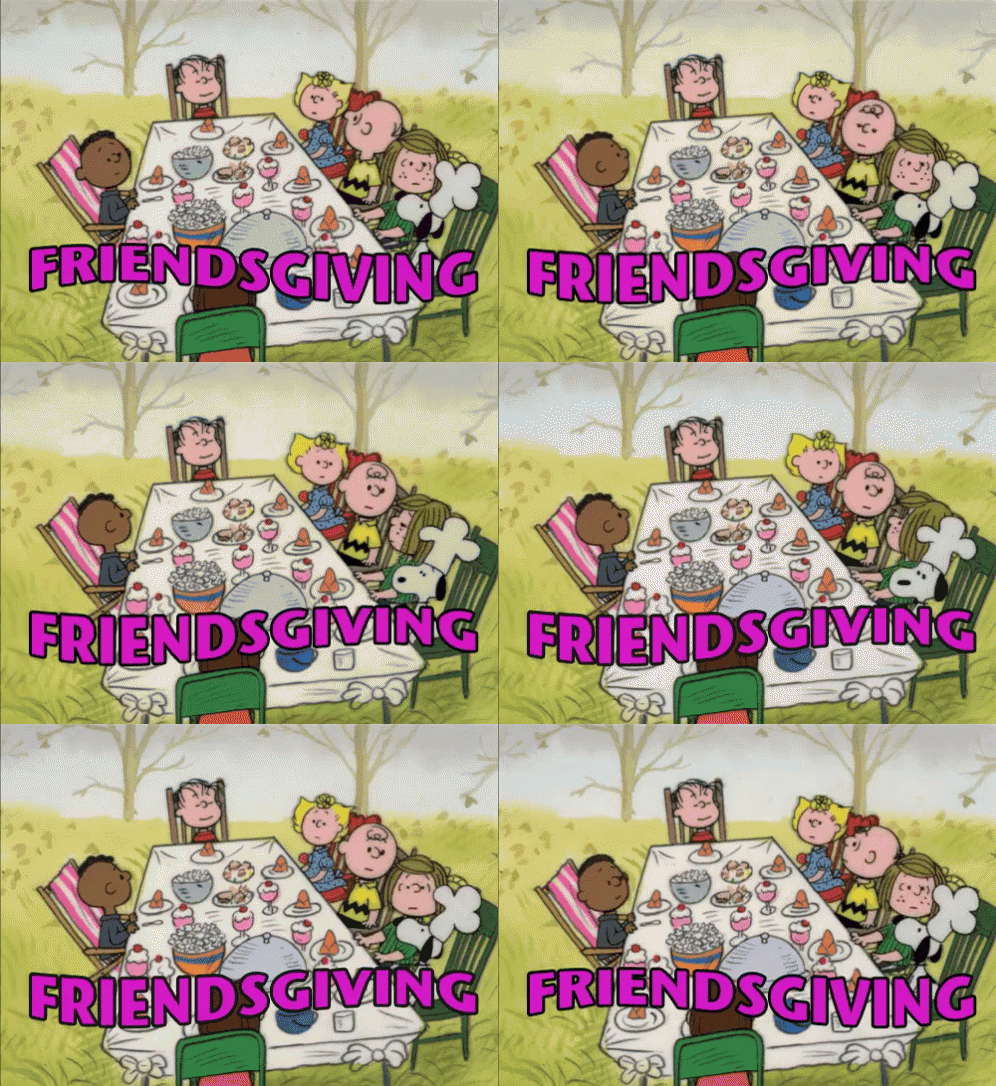
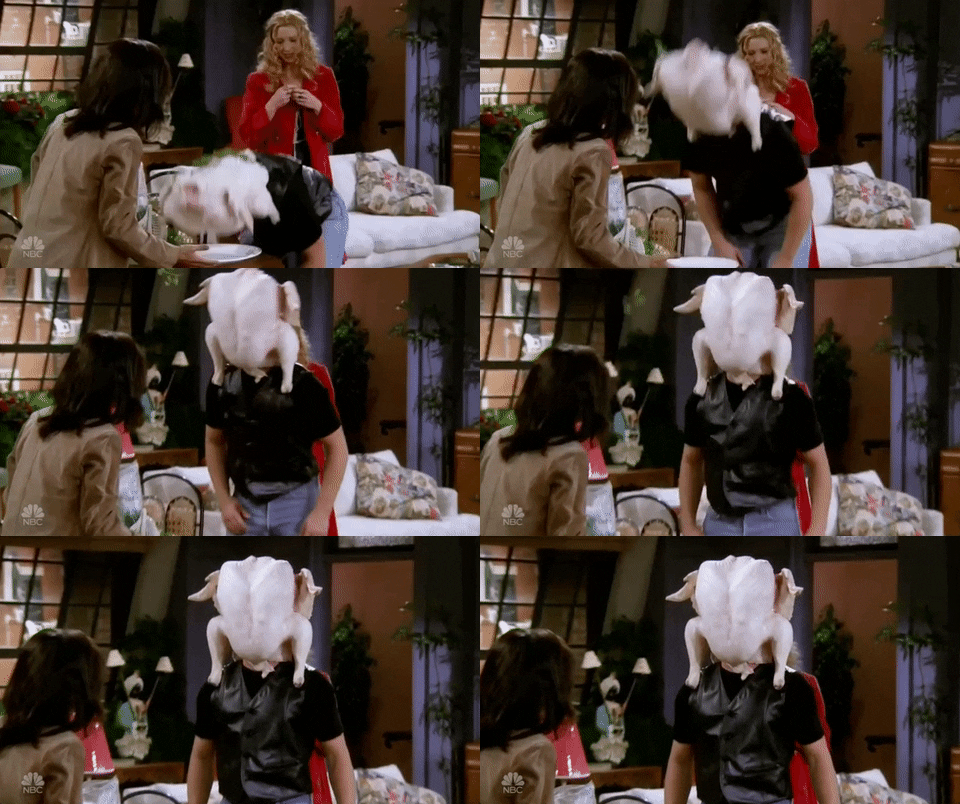
Si al leer Friendsgiving habéis pensado en Joey o Mónica con un pavo en la cabeza, el triffle “mixto” de Rachel y las historias familiares de Chaendler, no estáis del todo desencaminados. Muchos aprendimos con la serie 'Friends' qué era la fiesta americana de Acción de Gracias, pero también anticiparon la que hoy es una nueva moda entre millennials, celebrar una gran cena con amigos.

¿Poco original? ¿Otra tendencia absurda más? Podríamos debatirlo, pero el nombre tiene gancho y no deja de ganar adeptos. Sí es un ejemplo de cómo las tradiciones evolucionan y se adaptan a los propios cambios de la sociedad. La cena de Acción de Gracias siempre ha sido el gran evento familiar por excelencia, pero ahora los adultos jóvenes americanos también quieren celebrarlo con amigos, con menos estrés y creando nuevas tradiciones.

El nacimiento de una nueva moda destinada a convertirse en tradición

Friendsgiving

El inglés es una lengua maravillosa que no deja de dar a luz términos y expresiones nuevas. A los angloparlantes les gusta especialmente combinar palabras ya populares para crear conceptos nuevos, por eso es imposible saber a quién se le ocurrió por primera vez eso de Friendsgiving. Combinar Thanksgiving -Acción de Gracias- con friends -amigos- era casi algo obvio, y solo cuestión de tiempo de que se impusiera como tendencia.

Parece que ya por el año 2006 aparece en los inicios de redes sociales como Twitter, y se pueden encontrar menciones en algunos blogs y páginas gastronómicas, pero el concepto no comenzó a arrancar de verdad hasta 2016. El año pasado ya terminó de explotar como nueva tendencia en las redes, y parece que ya se está imponiendo este 2018 como fiesta paralela o alternativa a la Acción de Gracias tradicional. Incluso hay anunciada una película para 2019 titulada, precisamente, 'Friendsgiving'.

Algunas marcas y compañías vieron el posible tirón y se anticiparon a la moda con campañas publicitarias que aprovecharon el término a su favor. Taco Bell, Baileys, Betty Crocker o Whole Foods son algunos ejemplos conocidos que no hicieron más que contribuir a extender la popularidad del nuevo concepto. El uso del hashtag en redes como Instagram va en aumento, y cada vez se suman más restaurantes y locales de comida a ofrecer menús y ofertas especiales durante estos días.

GIF animado

La primera entrada de Friendsgiving que aparece en el Urban Dictionary, el diccionario de lenguaje urbano y jerga anglosajona, se remonta al año 2009, dando un significado simple pero conciso:

The celebration of Thanksgiving dinner with your friends. This usually occurs on the Wednesday before or the Friday after Thanksgiving Day, since Thanksgiving is usually reserved for family gatherings.

La celebración de la cena de Acción de Gracias con tus amigos. Suele acontecer el miércoles anterior o el viernes posterior al Día de Acción de Gracias, puesto que Acción de Gracias suele estar reservado para las reuniones familiares.

Acción de Gracias VS Friendsgiving millennial: ¿enriquece o destruye la tradición?

Si en España no nos gusta que nos toquen nuestras tradiciones, en Estados Unidos tampoco están muy contentos con los cambios repentinos -no importa que su historia como nación tenga apenas unos pocos siglos, el concepto de tiempo es relativo-. Y cualquier cosa que lleve el sello millennial es susceptible de recibir críticas y ataques de todo tipo, como bien nos han demostrado los medios infinidad de veces en los últimos años.

GIF animado

A los millennials se les acusa constantemente de romper lo tradicional

Recordemos que pertenecen -pertenecemos- a la generación millennial todos los nacidos entre los años 1981 y 1995, aproximadamente. Son adultos jóvenes, rozando algunos ya la cuarentena, en teoría independizados pero muchos todavía sin "formar una familia" o sin un patrimonio económico sólido. La crisis económica y el contexto social y laboral han marcado a una generación que cada vez retrasa más comprar una vivienda, casarse o tener hijos.

Se les acusa de crear y seguir modas absurdas, de no tener respeto por los valores tradicionales o de "destruir" todo tipo de cosas y costumbres, de forma muy injusta. La generación irreverente y que de verdad ha nacido con la expansión de internet y las redes es la que viene después, llamada generación Z.

Friendsgiving

El Friendsgiving está triunfando entre los jóvenes de veintitantos y treintaymuchos porque es una manera de celebrar un día especial con los amigos, que para muchos son casi la verdadera familia, con quienes comparten el día a día. Pasar Acción de Gracias en el hogar familiar se asocia a algo más solemne, más íntimo y más cerrado, en muchas ocasiones rodeada de estrés y cierto agobio.

También es una manera de reunirse con los otros amigos que ya no viven cerca. La ocasión ideal para reencontrarse con los compañeros de universidad o del instituto, con los amigos del pueblo o de la infancia, antes o después de la cena con la familia. En un país tan grande con distancias de miles de kilómetros entre ciudades, es fácil perder el contacto con los años.

Friendsgiving

Y para muchos, Acción de Gracias tiene un significado muy especial que nos es ajeno. Se habla de la Thanksgiving season, algo así como la época navideña que llena el ambiente de todo los días anteriores y posteriores al 25 de diciembre. Pero Acción de Gracias es un único día, ¿por qué no alargarlo un poco más, adelantando la fiesta o continuándola un poco después?

En The Atlantic se analiza el fenómeno desde diversas perspectivas, y hay opiniones para todos los gustos. Si bien parece que el Friendsgiving no se ve con muy malos ojos, pues es perfectamente compatible con la fiesta tradicional, hay visiones más pesimistas.

El Friendsgiving sale mucho más barato que la cena de Acción de Gracias tradicional

El autor Malcolm Harris señala que esta tendencia no es más que otro signo de cómo las nuevas generaciones se están empobreciendo, y el poder lo quiere maquillar. Un típico Friendsgiving consiste en que cada invitado aporte un plato para compartirlo, normalmente en una versión más modesta y menos pretenciosa que en el menú tradicional. Es decir: es más barato.

Harris apunta que los millennials no se pueden permitir organizar una lujosa cena de Acción de Gracias y se quiere vender esta nueva moda como algo moderno y entrañable; "es un arma de propaganda empleada por la clase dominante para promover sus planes de estancamiento salarial".

Friendsgiving

Pero incluso expertos en los aspectos culturales y la historia del Día de Acción de Gracias defienden la validez de la nueva tendencia. A diferencia de la Navidad, la idea de esta fiesta no es rodearse de platos lujosos o hacerse regalos: gira en torno a la generosidad, hospitalidad y el compartir platos con un espíritu hogareño. ¿Por qué no extenderlo también al círculo de amistades?

Cómo celebrar un Friendsgiving en casa (llamándolo como quieras)

Aunque no tiene sentido querer imitar el valor cultural que tiene Acción de Gracias para los estadounidenses, sí defiendo recrear sus platos más típicos en nuestra casa; es una excusa como otra cualquiera para pasar una buena velada probando recetas nuevas.

Por eso me gusta la idea de importar el Friendsgiving, que se sale un poco más de la norma y permite ser más flexibles con la tradición. Nos podemos olvidar de decoraciones recargadas, vajillas de lujo o platos complicadísimos y simplemente invitar a los amigos -o a la familia- a cenar a casa, repartiendo el menú entre los invitados.

Es más sencillo que los anfitriones se encarguen del plato fuerte, como el típico pavo al estilo americano o nuestra receta de pollo al horno favorita. Dependiendo del número de invitados podemos asignar guarniciones, entrantes y aperitivos, organizando bien quién se encarga del postre. Si hay sobras -que las habrá-, se repartirán entre los invitados y todos ayudarán a recoger y limpiar un poco.

No hace falta complicarse ni forzar el estómago con un banquete exagerado. Lo más importante es pasarlo bien con los amigos, quizá hacer nuevas amistades, y relajarse antes del estrés de las fiestas. Ese es el espíritu del Friendsgiving: disfrutar compartiendo buena comida en buena compañía y comenzar nuestras nuevas y propias tradiciones.

Fotos | Unsplash - iStock - Giphy

También te recomendamos

American pie: así es la tarta favorita de Estados Unidos (receta imprescindible en Acción de Gracias)

Ideas originales para regalar en Navidad gracias al Black Friday

Así es el menú típico de Acción de Gracias: 11 recetas para montar tu propio Thanksgiving

-
La noticia Qué es el Friendsgiving, la nueva moda millennial para celebrar Acción de Gracias fue publicada originalmente en Directo al Paladar por Liliana Fuchs .

21 Nov 09:41

All The Dating Apps, Ranked By How Badly They'll Disappoint You

by Helen Meriel Thomas

Every single and lonely millennial is on at least two dating apps. Without them, it would be impossible to meet someone at a Time Out-approved Bavarian beer hall pop-up and split an Uber home for a profoundly disappointing shag.

The amount of rutting you can actually get done off these apps, though, is entirely dependent on how much effort you can bear to put in – whether you're willing to reply to inspired openers like "hey" and "hi" and "where do you live???", or if you'd rather sack those off in favour of dying alone.

However, what you must learn is that, despite their advertised convenience, All Dating Apps Will Disappoint You. Here's why, from my point of view as a mostly straight, cisgender white woman (I'm sure the apps are all disappointing to you in their own unique ways), they all suck. Conveniently, I've ranked them for you, from least to most disappointing:

1: Grindr and other straightforward hookup apps

1542281987527-ttpink
The "offensive" photo that Bumble removed from my profile.

There are honestly too many reasons why Bumble is the dirt-worst dating app for me to string into a 200-word paragraph, so here are the headlines:

  • Forcing women to message first is not inherently feminist. It will not improve my life, and it does not emancipate me from years of living in a misogynistic, capitalist society. It is just really fucking inconvenient.
  • The first time you download Bumble, you'll think that everyone is really fit. This is the algorithm laughing at you. Rumour has it people who get more right-swiped (i.e. are more shaggable) will be put at the top of the deck, to tempt, but never match with Good Day sevens / Bad Day (to be honest) fives like you.
  • Because of its supposed "wokeness", Bumble attracts an inordinate number of softbois who will talk a big talk about smashing the patriarchy but won't smash, haha, anything else.
  • Those notifications with messages like "You made the first move! Girl power!" or "63 likes, any one of them could be amazing!" are useless. If I have to be notified about anything to do with a dating app, it should only be that someone very, very rich wants to go very, very down on me.
  • They once deleted one of my photos because you could see my pants (nice ones), so it's apparently not a thirst trap safe space, to which I say: what the fuck is the point.

    N.B If you’re a rep from any of these apps please don’t delete my account. I love you really and don’t want to die alone.

@iamhelenthomas

21 Nov 09:39

Why Straight Men Hate Astrology So Much

by Hannah Ewens

Joe is a straight man in his twenties. Like many men, he passionately rejects astrology.

"It strips people of their uniqueness and reduces them to pigeonholed blocks of characteristics," he tells me. "I don't like being a real logic lord about it, on some 'I am the ultimate skeptic! Facts don't care about your feelings, compadre!' vibe. However, I do find it really fucking irritating, and the memes are all really annoying and I hate the self-aggrandisement of '[Star sign] season, bitches!'"

By that, he means people on social media announcing the calendar entry into a new zodiac sign. From now until the 22nd of November, for instance, it's Scorpio season, bitches.

"Aren't you a Taurus?" I ask, knowing full well that he is. He replies: "Are you going to tell me this is a very Taurus way of behaving?" I tell him that Taureans are often pegged as the sign least likely to believe in astrology.

Over the past two to three years, astrology has shifted from being a niche interest to a major point of enthusiasm for many women and queer people. Broadly, VICE's channel geared towards women and the LGBTQ community, gets a huge amount of traffic from astrological features and horoscopes. Other media platforms for women have noticeably ramped up astrology content from filler to the forefront. In the UK, Google searches for "birth chart" doubled between November of 2013 and November of 2018. Since September of 2017, there's been a steady increase in people searching "astrological compatibility". All that interest has given publishing a boost: sales of mind, body and spirit books are booming; in 2017, sales rose by 13 percent in just a year.

In 2016, mental health was prime meme fodder; now, astrology memes are all over our timelines. Swipe through a dating app and you'll soon find a woman who's included their sign in emoji in their bio as shorthand for personality traits, likes and dislikes, and an indicator for compatibility.

But not everyone is onboard. Joe is not alone in his antipathy to the cosmological boom; straight men seem to be frequently apathetic or adverse to astrology. In a 2005 Gallup UK poll, just over twice as many women in the UK believed in astrology compared to men (30 percent to 14 percent of a data pool of 1,010 people). A 2017 study by Pew Research Centre found that 20 percent of adult men in the US believed in astrology, compared to 37 percent of women.

If you're a straight man with a lot of female friends, you probably tolerate astrology ("It's gotten to the point where I'm sharing Virgo memes in the group chat like 'lol, me', but I still don't like it," says Adam from Manchester). And if you don't, you likely think it's a load of shit ("If you try to bring up that shit with me, I'll think you're a mindless bimbo," Tom, 25, London). There are obviously women and LGBTQ people who feel similarly, but why is this attitude so prevalent among straight men in particular? Is it because astrology is generally seen as a "women's" interest?

A couple of the men I spoke to referenced their dads reading daily horoscopes in the tabloids, realising that any of the vague summaries could apply to them and deciding they would never return to astrology. "It was the first time I'd noticed something so embedded in our culture was surely just bollocks, and it sent me into a tailspin," says Sam Hill, 27, from Lincoln.

Most admitted being put off because astrology had been so gendered. "As a child, the females [would go] for tea and biscuits round my nan's, where the astrology columns of the Mail and the dreaded Sun would be read out with various degrees of mystery and giggling," 36-year-old Bob from Kent remembered. "Nowadays, [horoscopes are] near the women's section in the papers or in female-specific weeklies such as Woman’s Own or Take A Break. I can't remember Esquire or Loaded having such pages when I read them many moons ago.”"

His opinion on astrology? "Waste of time. Waste of energy. Waste of chip paper. It's like the lottery for lonely people."

Sam feels similarly that astrology has always been gendered, and that the male response to that – to ignore it – makes sense. "It's hard to indicate what I mean, but, for example, if a girl in school likes a certain book, the boys can't like it for fear of being called gay or whatever, so that book becomes a girl's book," he said. "The same can be said of horoscopes. I think women are drawn to them out of a sense of curiosity and spirituality that is drummed out of boys at a young age."

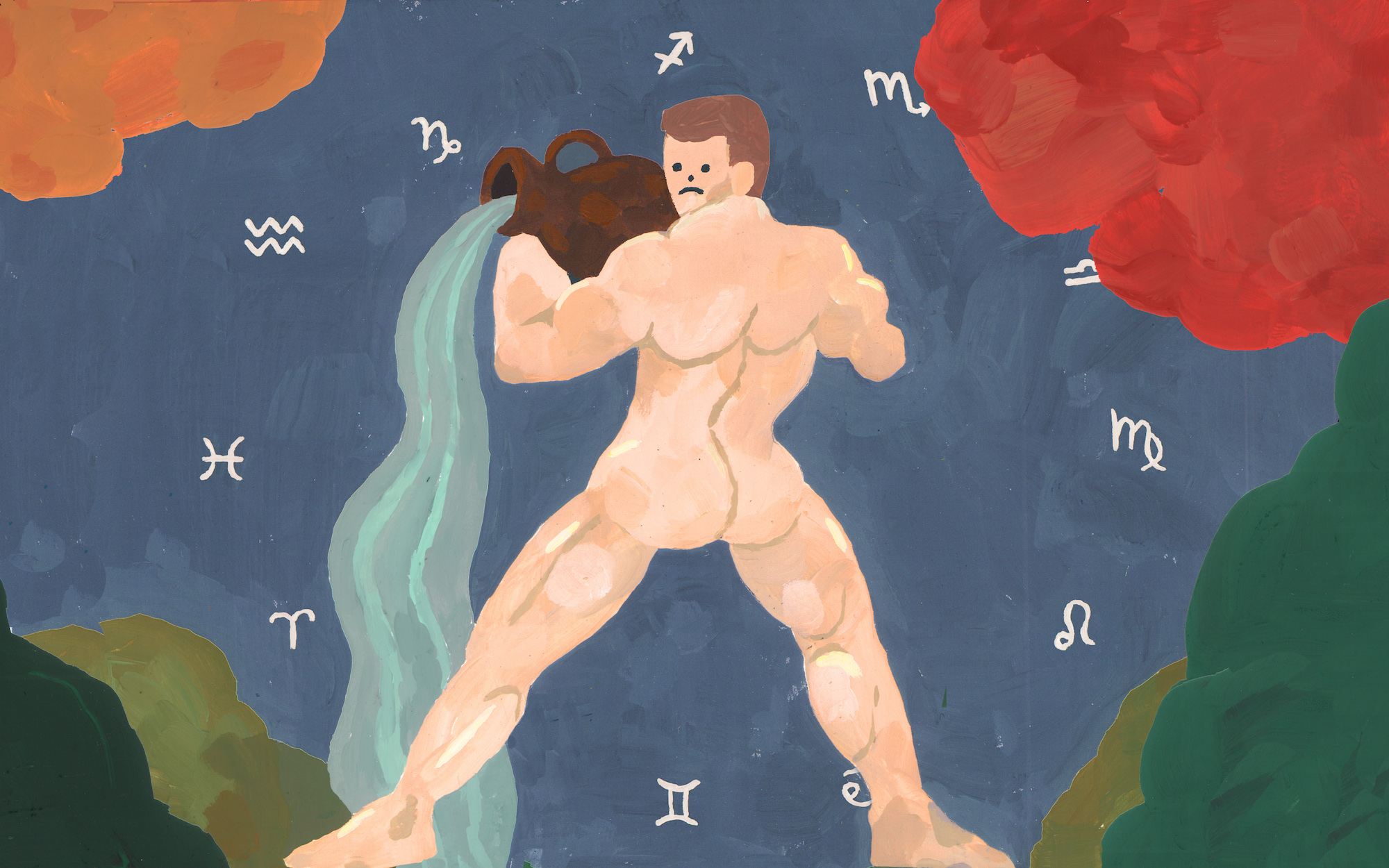
1542290356566-aquarius-vice-2
Illustration: Charlotte Mei

Unsurprisingly, dating has provided a stage for tension. As women become more hooked on astrology, more straight men are being forced to engage with it. Most of the men I spoke to talked about astrology chat ruining dates, or ex-girlfriends who were "too obsessed" with the cosmos.

"After the initial stages of 'getting to know you', it became apparent that she was quite into her spiritual side: short of a nose piercing and a gap year spent in India, she was a paid-up member of the horoscope crew, with a little smattering of tarot reading and general warnings to 'watch out for karma'," says Laurie, 29, from London. "At first I quite enjoyed it: as a spiritually bankrupt man it was nice having some direction to consider in my life beyond the deep-set, middle-class guilt I'd had bullied into me at school. She met my parents – a meeting I thought went well, until my dad laughed in her face when she asked what his sign was and suggested that cancer signs typically struggled with appreciating music."

The family ended up having an "icy" tube journey home, the ex upset that Laurie's dad had given her beliefs so little patience. Both had an explosive argument about astrology that ended in her "consulting some charts for me there and then to see if my decision-making or reasoning was being negatively affected by Mercury or some similar shite", and Laurie breaking up with her via text.

Kevin from Ireland says his ex used her birth chart to justify poor behaviour or bad moods, while Paul from Essex says a woman he slept with looked up his chart and got rapidly into him based off their supposed compatibility, "but ignored all the stuff that suggested I was difficult (I am) and that we weren't destined to be together (we weren’t)".

Adam, 26, from Oxford, was dating a female friend when an initial interest in astrology became a gateway drug to all sorts of New Age stuff, like tarot and palm reading. "It wasn't something I was into myself, but it became a really defining feature of the whole relationship, which was a case of 'not really for me, thanks'," he says. "It stops being an interest and [becomes] a personality trait: 'I'm an astrology girl.'"

Would Adam date another Astrology Girl? "If it was a minor interest in their life it wouldn't bother me. If it was a major thing? Nope."

All of the above has been observed by working astrologers, too. Jessica Lanyadoo, who hosts Ghost Of A Podcast, said, "I know lots of cis straight male astrologers, but not as many cis straight male astrology fans." Astrologer Randon Rosenbohm agrees, telling me "it's for girls and gays".

"Astrology is a natural, intuitive way of telling time, and women are more in tune with nature," Randon continues. "Men, however, are builders who work with the material world. Unless you give a straight man evidence of astrology being real, they're less likely to find it remotely interesting."

In other words, Randon thinks men might be more likely to be immediately dismissive, while women might feel something out. A large study released this month found that women are more empathetic and men more analytical, and there is some evidence to show that women's brains will stay with a distressing feeling while a male brain will seek a solution. But gendered biology is a highly disputed field: not every man is a builder, and neither is anyone with a womb somehow bound to be more naturally in tune with nature.

With or without that purported "natural intuition", women are undoubtedly driving the wider self-help and therapeutic industries. Often, there's little separation between self-help and astrology; the latter is often used as a type of the former. Ghost Of A Podcast, for example, has a set-up where the first-half is self-help agony aunt, and the second astrological forecasting for the upcoming week.

"Astrology doesn't shy away from symbols that explore our weaknesses and 'weak feelings', like grief, trauma, sorrow, denial, misperception, projection, self-sabotage, victimisation," says astrologer Danny Larkin. "And that runs counter to how straight men are constantly encouraged in their lives to man up instead of open up. It’s easier and more palatable to observe that women and queer people are often on the short end of the stick in many situations, so it's easier for them to identify with these difficult themes that astrology probes."

To understand your and others' personalities, to try to predict the future: ultimately, it's grasping for control, when we have none. Women and queer people are drawn to astrology because it offers community and refuge, something to lean on during a time in which religion has taken a backseat. In a heterosexual patriarchy, cis-het men arguably have less to seek refuge from. It is during times of significant stress that people turn to astrology, after all. In a 1982 study, the psychologist Graham Tyson found that people who consult astrologers did so in response to stressors, writing, "Under conditions of high stress, the individual is prepared to use astrology as a coping device, even though under low-stress conditions he does not believe in it."

Personally, a vague interest I'd had in astrology since I was a kid was solidified once I did my birth chart and found it to be eerily accurate. As soon as conflicting deadlines strike in tandem with my rising anxiety levels, and if I've not been looking after myself properly, I notice I'm checking astrology apps and podcasts more. But without that initial "in" I’d never have gone down the rabbit hole. It's just about the entry point and who gets there.

I ask Joe if I can do his birth chart. He says I can, so I go onto Cafe Astrology and work it out for him, sharing some of his characteristics: stubborn, stoical, likes pleasure and the arts, might easily get a bruised ego if not "heard".

It is, he says, pretty much accurate – but to express any kind of joy over astrological correctness would be an endorsement he could never give.

@hannahrosewens

21 Nov 09:30

When Does BDSM Become Abuse?

by Steven Blum

In Instagram photos, Dylan Hafertepen, a master to five adult slaves, appears cartoonishly large, like a Tom of Finland sketch come to life. In one of his most iconic shots (since deleted from the gram) Dylan gives a military salute to the camera as his pups Chuck, Angus, Daniel, Biff and Tank pose around him. Some are wearing skin-tight jockstraps that barely contain their inflated ball sacks. Tank, whose given name was Jack Chapman, sits on Dylan’s right side, wearing a red bandana, with a padlocked chain around his neck. He’s beaming.

To casual followers of Dylan’s account, known as “Noodles and Beef,” his relationship with his pups seemed to be kinky and playful. It wasn’t uncommon for fans (the account had over 60 thousand followers) to write Dylan, begging him to adopt them as their master, too.

Dylan announced new additions to the family with theatrical flair. First, pups would earn training collars, then they’d be emblazoned with a tattoo above their butt cheeks, known as “Master’s brand.” He heralded the addition of Angus by writing in his newsletter: “He is mine. The news brought him to tears.” Angus responded floridly in the same newsletter, “I had been lost and confused before, unaware I was always yours, oblivious to my reason to exist.”

Dylan’s pups had social media lives of their own, as well—which their master couldn’t always control. On Tumblr, Jack wrote long, anguished apologies to Dylan for not being the perfect pup. “Let’s get a few things established,” he wrote. “I am shit. I am a shit person. I do horrible and inexcusable things. I am dishonest. I am deceitful. I am a coward. I am stupid. I hurt my master.” His offense? Jumping into a hot tub with a friend.

Jack’s social media posts came to the attention of a broad audience on Tumblr when he died on October 15th “due to a previously undiagnosed lung ailment.” That “ailment” was later revealed to have been caused by bits of silicone from a scrotal injection that had traveled to his lungs. (Dylan’s entire pup family were known to inject silicone in order to increase the size of their packages.)

After his death, a contract that described Jack’s relationship with Dylan, originally posted on Jack’s Tumblr, was circulated online, describing a relationship in which Jack’s psyche, bank account, body and social life were under the complete control of his master. The contract even stipulated how big Jack’s body should be, saying that ”a pup will submit all orders for body modifications, including piercings, tattoos and scrotal saline inflation…in accordance to the wishes of master.”

Dylan recently told BuzzFeed News that this contract was a piece of “a piece of erotic fiction written by Tank, featuring some of his submissive fantasies.” Still, it raised questions about what a loving, healthy BDSM relationship looks like and how observers could distinguish actual abuse from the simulated kind.

Relationships between full-time, 24/7 masters and slaves haven’t been extensively studied in academia, with one exception. Back in 2006, researchers at the University of Ottawa and the Institute for Advanced Study of Human Sexuality surveyed 146 masters and slaves to understand how they negotiated power, role-playing, household chores and even money. The researchers wondered: how could slaves consent when they had given up all rights to participate in decision-making in the relationship? And were people happy as slaves, long term?

Some of the results were intriguing, if a bit mundane: the researchers found that male slaves were more likely to take out the garbage than female slaves, for example. Other findings were more illuminating: around three-quarters of slaves had engaged in behavior that seemed “inconceivable” at the start of their relationship, suggesting that “limit-pushing” was common.

They also noted that many slaves felt satisfied in their current relationships and were free to leave. Financial independence was the norm, not the exception: only three respondents had no access to a bank account in their own names.

Nonetheless, the researchers noted that abuse could easily masquerade as BDSM. “Some spousal abusers could use such arrangements to legitimize or otherwise find support for their abusive inclinations or intentions,” the article read. Slaves on the prowl for new masters, they noted, were “keenly aware” of this danger.


Ellen Lee, an instructor of psychology at Ripon College, spent the last seven years studying the master slave community as part of “The Science of BDSM” research team based at Northern Illinois University. While she says contracts are common, they’re usually meant as a safeguard for all parties involved—and not as a carte-blanche method for masters to take full control over every facet of their slaves’ lives.

“The goal is to iron out what people want and what they don’t want,” she says. “They’re used for people to think very carefully and thoroughly about the boundaries of their relationships.”

Worryingly, in Jack’s supposed contract with Dylan, his salary was meant to be “relinquished to his Master,” who was supposed to ensure it would be securely saved. “I can tell you that with abusive relationships, one of the hallmarks is limiting access to financial resources,” says Lee. “Without money, they can’t leave. That’s not consent, that’s coercion.”

Another part of Dylan’s contract allegedly stipulated that a pup’s social life must revolve around his master and that he should find contact with other people “pointless, unfruitful and unfulfilling.” This also seemed extreme to Lee. “Social and emotional isolation is another hallmark of abuse,” she said.

In a healthy BDSM relationship, the submissive partner must have their needs met. The needs of the bottom come first, followed by the needs and wants of the person in authority, and, finally, the wants of the submissive partner. “If the person who’s submissive isn’t having their needs met, the relationship can’t get off the ground,” she says.

Of course, two consenting adults can engage in any kind of dynamic they’d like—and master slave contracts are legally-dubious, having never been tried in U.S. court. Lee isn’t comfortable speculating about what kind of relationship Tank and Dylan had, but she says that the BDSM community could be a place for people to hide abuse. “And that’s why, largely, people in the community try to talk about safeguards, best practices and making sure others are aware that it’s inherently risky playing with these power extremes.”

“We know assault and abuse happen in the kink community,” she says. “But I’d like to think they’re doing it better.”

Sign up for our newsletter to get the best of VICE delivered to your inbox daily.

Follow Steven on Twitter.

21 Nov 09:29

Satanic Temple Sues Netflix for Depicting Its Baphomet Statue as a "Symbol of Evil"

by Alex Santoso

The Satanic Temple was offended by The Chilling Adventures of Sabrina presenting their Baphomet statue as “the devil.” Now Netflix and Warner Brothers have a lawsuit on their hands:

Satan “is a literary figure symbolic of the eternal rebel in opposition, rather than the personalization of evil,” per the Temple. A key tenet of members and supporters of the Temple is that Satanists deserve as much protection and respect as followers of any religion.
The Temple “commissioned ... Baphomet ... to be a central part of its efforts to promote First Amendment values of separation of church and state and equal protection,” the complaint stated. “Defendants’ prominent use of this symbol ... associated with evil, cannibalism and murder blurs and tarnishes” the Temple’s Baphomet.

Read the rest over at HuffPost

Image: @LucienGreaves

21 Nov 09:27

George R.R. Martin Is Hiding in a Cabin So He Can Finally Finish the Next 'GoT' Book

by River Donaghey

This article originally appeared on VICE US.

George R.R. Martin keeps himself pretty goddamn busy. The guy's penned dozens of books over the past few decades and single-handedly spawned one of the biggest TV franchises of all time. He currently has his hands in HBO's upcoming Game of Thrones prequel series, a new sci-fi show based on his novel Nightflyers, and not one but two other shows based on his Wild Cards franchise for Hulu. On top of all of that, he also managed to find time to crank out a massive tome detailing hundreds of years of Targaryen rule in Westeros called Fire & Blood.

All these creative endeavors aside, though, there's one project that Martin still hasn't been able to finish: The Winds of Winter. The sixth and penultimate novel in his Song of Ice and Fire series missed its initial end-of-2015 deadline, then the promised 2017 completion date, and now it's definitely not coming out this year, either.

But worry not, everybody—George R.R. Martin is going to finish Winds of Winter, goddammit, and he's apparently locking himself up in a far-flung cabin until he does.

According to a new interview with Martin in the Wall Street Journal, the author is currently "in hiding" in a "remote mountain hideaway whose location he refuses to disclose " in order to finally— finally!—get the novel done. "It’s a cabin he visits when he wants to hunker down to finish a book," the article continues, "and he’s hard at work on The Winds of Winter."

Now, to be fair, it's not like Martin just hasn't put time into the book until now—he's been reportedly cranking out pages consistently for the past few years, but it just hasn't clicked. "You can blame my travels or my blog posts or the distractions of other projects and the Cocteau and whatever, but maybe all that had an impact," he wrote in a 2016 blog about the book's progress. "You can blame my age, and maybe that had an impact too... but if truth be told, sometimes the writing goes well and sometimes it doesn't, and that was true for me even when I was in my 20s."

"I know there are a lot of people out there who are very angry with me that Winds of Winter isn’t finished. And I’m mad about that myself. I wished I finished it four years ago," Martin said in a recent interview with Entertainment Weekly. "I wished it was finished now. But it’s not. And I’ve had dark nights of the soul where I’ve pounded my head against the keyboard and said, 'God, will I ever finish this? The show is going further and further forward and I’m falling further and further behind. What the hell is happening here? I’ve got to do this.'"

It's unclear if locking himself in a secret cabin is actually the thing Martin needs to finish the book once and for all, but let's hope he's doing more than just banging his head against his keyboard while he's there. Regardless, the last season of Game of Thrones is finally due out in April, so at least we'll be catching up with everyone back in Westeros sooner rather than later.

Follow VICE on Twitter.

21 Nov 09:06

Las últimas horas de M80, la emisora que pasó del éxito al olvido

by no-spam@prnoticias.com (redacción prnoticias)
Las últimas horas de M80, la emisora que pasó del éxito al olvido

Las horas de vida de M80 llegan a su fin. A partir de mañana, 21 de noviembre, la emisora cesará sus emisiones tras 25 años en antena y dejará su hueco a Los40 Classic, la nueva radio musical de PRISA. De esta manera, se certifica el fatídico desenlace para una cadena que se convirtió en un referente radiofónico pero que terminó diluida por la incapacidad de la compañía de adaptarse a los nuevos tiempos.

Los malos datos de audiencia han condenado a M80, que pasó de ser incubadora de algunos proyectos que marcaron una época a una emisora más. Su historia se remonta a 1993, cuando PRISA compró Antena 3 Radio. La compañía creó la marca tras fusionar dos emisoras ya existentes, Cadena Minuto y Radio 80 Serie Oro. La radio comenzó su andadura confiando sus mañanas a un principiante Alfonso Arús, que ensambló uno de los mornings más recordados de la historia radiofónica española, Arús con leche.

En 1995, la franja matinal fue a parar a manos de Gomaespuma. El dúo revolucionó las mañanas y rápidamente se convirtieron en referentes tanto a nivel cómico como radiofónico. Su particular sentido del humor acabó derivando en un fenómeno de culto, lo que reportó a M80 grandes cuotas de audiencia y a la pareja un hueco dentro de la cultura popular.

Tras siete temporadas, Juan Luis Cano y Guillermo Fesser dijeron adiós al programa y la emisora tuvo que afrontar la complicada situación que supuso sustituirles… y la moneda salió cara: M80 apostó por un jovencísimo Pablo Motos para presentar No somos nadie, un formato que acabó siendo el programa más escuchado de la historia de la cadena y que fue el germen de uno de los shows más exitosos de la televisión nacional actual, El hormiguero.

 no somos nadie.jpg

La marcha de Motos y su equipo a Cuatro, sumado al adiós de programas emblemáticos de la emisora como Plásticos y decibelios o Vuelo 605, despojó a M80 de parte de su identidad. La incapacidad de PRISA para renovar la emisora manteniendo la esencia que le había llevado al éxito acabó convirtiendo lentamente a la cadena en un contenedor de radiofórmula más sin ningún elemento diferencial.

Pese a los esfuerzos realizados en los últimos tiempos por renovar tanto su imagen como su parrilla (ha tenido tres mornings diferentes en cuatro años), M80 no consiguió revivir y su cuesta abajo llevó a la radio a obtener menos de la mitad de la audiencia lograda por Kiss FM o Rock FM, perdiendo toda influencia y desdibujándose como marca.

Tras consumar el final de M80, PRISA se enfrenta ante una ocasión única para conformar una emisora que sepa conectar con los oyentes y que no se limite a pinchar música, sino que ofrezca contenido diferente y novedoso y que aporte algo al saturado panorama radiofónico. Solo el tiempo dirá si Los40 Classic se convierten en la reformulación que necesitaba M80 o si, por el contrario, pasa a ser una cadena más dentro de

Seguiremos Informando…

20 Nov 00:27

'Big Mouth' tendrá tercera temporada: Netflix renueva su hilarante retrato de la pubertad

by Albertini

'Big Mouth' tendrá tercera temporada: Netflix renueva su hilarante retrato de la pubertad

Netflix suma y sigue intentando refinar su programación original, aunque parezca cada vez más una "generalista" en el sentido de ofrecer cosas para todos los gustos y todo tipo de público. Hoy toca hablar de una de sus series de animación más gamberras y eroticofestivas: 'Big Mouth', que ha sido renovada por una tercera temporada.

Se confirma así la buena acogida que ha tenido la serie en sus dos primeras temporadas, la última de las cuales se estrenó el pasado mes de octubre. La comedia, creada por Nick Kroll y Andrew Goldberg, relata los gloriosos episodios que pueden ocurrir durante la pubertad y el despertar sexual de un grupo de adolescentes.

Otra cosa no. Nos puede gustar más o menos 'Big Mouth', pero nadie puede negar que detrás de ese humor se esconde un relato real de lo que significan los cambios hormonales y el descubrimiento de la sexualidad dentro de la adolescencia. De hecho, según Andrew Levin, director de guion, sus guionistas se basan en experiencias propias y de conocidos para elaborar este retrato:

«Siempre que entrevistamos a un guionista para la serie siempre decimos "Cuéntanos sobre cómo te fue cuando te vino el primer periodo, o qué pasó cuando te pillaron masturbándote". Esa fue la prueba de fuego porque tenían que ser capaces de abrirse libremente. Hicimos de la sala un lugar seguro donde cualquiera podía hablar de esto»

Yo he de reconocer que 'Big Mouth' fue un poco "demasiado" para mí. No es que muriese de sobredosis hormonal pero, simplemente, era un enfoque que no me terminaba de convencer. Esto no quita que no crea que tuviese bastantes virtudes y que sea una serie divertida y, desde luego, una que funciona. Y vosotros, ¿la estáis siguiendo?

También te recomendamos

David Attenborough deja la BBC para fichar por Netflix a los 92 años: primer vistazo a 'Nuestro planeta'

El enoturismo no es solo ver paisajes y beber vino: estas rutas por España te sorprenderán

Netflix contraataca: su respuesta a Apple y Amazon es un acuerdo con Paramount para producir películas en exclusiva

-
La noticia 'Big Mouth' tendrá tercera temporada: Netflix renueva su hilarante retrato de la pubertad fue publicada originalmente en Espinof por Albertini .

20 Nov 00:18

Gwyneth Paltrow sugiere regalar una aldea de Riotorto, a la venta por 149.550 euros

by Galiciaé

El anuncio publicado por Paltrow con la imagen de la aldea de Riotorto a la venta. EPEntre las estrambóticas sugerencias de regalo incluidas en la guía que la actriz Gwyneth Paltrow ha publicado en su portal Goop.com hay una que llama especialmente la atención: una aldea de Riotorto compuesta por tres edificaciones y valorada en 149.550 euros. El agente inmobiliario de aldeasabandonadas.com José Rodil ha confirmado que la oscarizada intérprete se hizo eco del anuncio en el que se detallan las especificaciones del conjunto rural, que incluye "casas, hórreos, alpendres, bodegas, corrales, finca, río...", dentro de una extravagante lista de recomendaciones de obsequios que incluye desde une expedición en globo por el Everest a una caja de cerillas.

"Se publicitan mucho en televisiones extranjeras, por eso lo puede haber sabido la actriz", apunta Rodil, especulando por cómo pudo llegar a conocer Paltrow la existencia de esta aldea del valle del Eo "ideal para turismo rural". En la web en la que se anuncia no dudaron en aprovechar esta casual publicidad y colgar un enlace a Cosmopolitan en el que se mofan de la peculiar guía de regalos de la actriz.

La aldea con la que recomienda agasajar la protagonista de Shakespeare in love cuenta  con una casa de 360 m2 útiles "para entrar a vivir con muy pocas reformas", con agua , luz y alcantarillado todo conectado y "con todos sus muros y maderas en buen estado", además de un alpendre-pajar de 80 m2 en dos plantas, un edificio de 22 m2 con horno para hacer pan, otra casa "con todos lo muros y maderas en buen estado de 124 m2 en dos plantas",  un hórreo de 3 metros cuadrados y una tercera casa para restaurar de 160 m2, entre otros servicios, como una bodega "que se puede utilizar para generar energía eléctrica pues tiene el canal de traída de agua". 
 

19 Nov 17:01

A modificación da Ordenanza de ruídos permitirá a música ao vivo nos locais da cidade

by Redacción

Os estableccmentos de hostalería de Compostela poderán programar espectáculos de música en directo sen medo a recibir multas. O Pleno da Corporación municipal aprobou onte a modificación da Ordenanza municipal reguladora da emisión e recepción de ruídos, vibraciósn e condicións dos locais.

A modificación contou cos votos favorables de Compostela Aberta e BNG, a abstención do PSOE e o voto en contra do PP. A nova normativa permitirá obter unha autorización complementaria para facer actividades con música en vivo. Os requisitos que se solicitarán a partir de agora teñen en conta o aillamento acústico, a presenza dun sonógrafo e a instalación dunha dobre porta onde se considere posible e necesario.

María Rozas, tenente de alcalde de Santiago, amosouse satisfeita por este paso sinalando que o municipio de Compostela é “pioneiro” neste tipo de propostas como “cidade dinámica”. O obxectivo desta modificación, para Rozas, é precisamente “solventar” este problema.

O artigo A modificación da Ordenanza de ruídos permitirá a música ao vivo nos locais da cidade publicouse primeiro en Nós Televisión.

19 Nov 16:59

Puigdemont ve “intelixente” unha candidatura catalá, vasca e galega ás europeas

by Redacción

“Tendo en conta que nós defendemos a máxima unión política neste momento, esta é unha proposta que entra de cheo neste espírito”. Así respondía Carles Puigdemont, president da Generalitat no exilio, a unha pregunta formulada polo diario vasco Gara en relación á posibilidade de artellar candidaturas unitarias entre forzas soberanistas de Catalunya, Euskal Herria e Galiza.


O president no exilio afirmou na entrevistas que “sumar o máximo de forzas posíbeis de lugares moi diversos que, aínda que nalgúns temas poidamos ter ideas moi distantes, coincida naquilo que é fundamental como o dereito á autodeterminación e as liberdades básicas, pode facer escoitar unha voz que existe, que é potente e que ten moita capacidade para intervir na política europea”.


Na mesma liña, Puigdemont, sinalou “paréceme unha proposta intelixente que pode ser realmente disruptiva na fórmula política sobre a que se asentou o Estado español”. Referíase así a que hoxe en día o Estado “non pasa os estándares de calidade democrática”. Nesta liña, advertiu que cómpre “deixar partidismos a un lado e entender que é un momento dunha grande transcendencia que pide tamén decisións transcendentes”.


A pasada semana, nunha entrevista a Radio Barcelona (SER), o portavoz de ERC no Congreso, Joan Tardà, anunciaba que Esquerra negociaba unha candidatura ás eleccións europeas “co independentismo de Euskal Herria e co BNG”. Pola súa banda, nunha recente entrevista publicada en Sermos Galiza, a europarlamentar do Bloque Ana Miranda expresaba o desexo de “agrandar a coalición ás tres nacións, con vascos e cataláns”.

19 Nov 16:59

Gumersindo Salinas: De asasino en Oseira a verdugo en Vigo

by Cilia Torna

Era da mesma feitura cun Francisco  González “O Rabioso”, a facer mal entre as xentes de ben de Vigo ou dun Florentino González Vallés, a sementar morte por Lugo, A Coruña ou Donostia e tamén dun Victoriano Suanzes Suanzes, o home do saco para os bos de Asturias e Ferrol, e así moitos como, Manuel Cebral Caamaño, Xerardo Casanova Martín, Andrés Ocampo Varela e Isidro García Teso daquel corpo benemérito.


Chegou a Oseira coa lección aprendida. Educado naquelas casas cuartel onde ensinaban a disparar primeiro e preguntar despois, formado naquel estado construído desde mediados do século XIX a forza de mosquetón e mauser, programado para ser un servo ao servizo duns poucos e un látego para mallar nos máis, nunca defraudou os amos. Á volta de 1901, cando mandaba a comandancia da Garda Civil de Baiona, saíu a rúa cos seus un martes de carnaval e mallou ao pobo, encirrado por algúns cregos que vían na festa o pecado. Concentrado en Vigo con outras unidades da benemérita da contorna para rebentar unha folga obreira, visitaba as causas dos dirixentes operarios acompañado dunha guillada e na ausencia deles mallaba nas compañeiras, nas nais e nas fillas. Ascendido a tenente chegou a Verín en 1906, deixando pegadas da súa brutalidade, do gusto polo diñeiro procedente das prebendas e do servilismo cos poderosos.


O 2 de abril de 1909 desembarcou na praza de Oseira. Ao mando dunha columna formada por dezaoito gardas civís, dous cabos e un sarxento tentou disolver unha concentración veciñal que impedía a retirada do baldaquino do mosteiro, acordando primeiramente cos manifestantes retirarse do lugar para facer o acordo. Porén, ás doce da mañá, despois de xantar, volveu á praza, onde homes e mulleres retiraban diversos materiais de obra, dando orde de disolverse e abrindo fogo contra as persoas que se atopaban nas proximidades do templo. E así morreron María Paz Fernández, de catorce anos, Manuela González Rodríguez, de vinte e cinco anos embarazada de varios meses, Ramón Fernández, Baltasar Fernández, Anxo Civeira Trigo, Xosé Moure Xil e Manuel González Guerra. E foi premiado, ascendido a capitán, após o terríbel de crime, mantivo o seu destino en Verín, e despois en Pontevedra e tamén en Compostela, onde a ditadura de Primo de Rivera o situou como xefe da garda municipal, só cesado coa chegada da II República.


O golpe militar foi a chispa para volver á primeira liña. Xubilado en Vigo desde 1931, volvera ao servizo activo en 1934 para colaborar na represión á revolución de 1934 pero non será até 1936 no que se incorpore de novo de xeito permanente ao aparello represivo. A comezos de outubro de 1936 o seu nome comeza a aparecer nos consellos de guerra, unhas veces como vogal, outras como secretario e tamén como presidente naqueles xuízos farsas armados polo franquismo para dar cobertura legal ao asasinato do inimigo interno. A súa sinatura esta presente ao pé da sentenza de Casiano Oliveira e outros sete veciños de Porriño, e tamén na de Xosé Fervenza Pena e máis sete mariñeiros de Moaña, e na de Xosé Oubiña Fuentes e así en moitas. A caída en desgraza do delegado de Orde Público de Vigo Francisco  González “O Rabioso” e o seu traslado fóra de Galiza pola súa implicación na trama criminal e corrupta de Lago Búa, abriulle a porta para ocupar de novo un posto chave no entramado do terror, cuns métodos e estilo que non difería do seu predecesor. Non durou moito na responsabilidade, facéndose, ao pouco, coa xefatura da policía municipal da cidade, depurada dos seus sectores demócratas e renovada con persoas procedentes das milicias fascistas da zona.


E chamábase Gumersindo Salinas Fernández, morreu en Vigo o 19 de maio de 1942 con 78 anos e din os papeis que naceu na parroquia do Ribeiro en Bande, aínda que os veciños négano.

19 Nov 16:57

Un país en Blanco

by Luís Pardo
«Sabiamos que estabamos abrindo unha fiestra para que entrase aire fresco». Fernando Blanco sobre o Plan Eólico en Faro de ...
19 Nov 03:20

New “Warsaw Declaration” Promises International Anti-Piracy Cooperation

by Ernesto

Last month, many key players in the entertainment industries took part in the International Content Protection Summit in Warsaw, Poland.

The summit was organized by the Sygnał Association, supported by the EU’s Intellectual Property Office (EUIPO), with an agenda featuring the latest threats and developments in anti-piracy enforcement.

While these type of gatherings are not new, several of the participants used the opportunity to strengthen their ties. International cooperation, they believe, is a key component for successful anti-piracy enforcement efforts.

To stress their commitment to this goal, 34 participants signed a new memorandum of cooperation titled the Warsaw Declaration.

The signees, including BBC Studios, BREIN, Discovery, FACT, HBO Europe, LaLiga, MPA, NBCUniversal, Sky Deutschland, and the Spanish National Police, state that they “acknowledge and understand the need for regular international involvement of major stakeholders.”

According to the summit’s organizers, the “Warsaw Declaration” can help to target the major piracy threats more effectively. This includes the increasingly global reach of cybercrime, new distribution methods, and the use of cryptocurrencies as payment methods.

“Piracy is currently a highly profitable undertaking with a complicated network of relations. There is proof of its connections to other types of crime. said Teresa Wierzbowska, President the Sygnał Association’s board.

“The alarming figures concerning the scale of theft and illegal trade of audiovisual content are a motivating factor to take action,” she adds.

The declaration itself doesn’t include a concrete plan of action. Apart from acknowledging and understanding the need for more collaboration, there’s not much more to it.

What it does say is that the signees hope to increase “awareness” of the “negative impact of piracy on the global economy” among “decision-makers, opinion leaders, media and society,” and persuade them to counteract this.

Speaking with TorrentFreak, Sygnał Association’s Anna Słoboda notes that the declaration is just the first step. The next stage is to turn it into action.

“For us, it was very important to let people from western and eastern Europe meet each other in one place to exchange experiences and contacts. I am sure that it will soon bring results,” she says.

A copy of the Warsaw declaration is available here (pdf) and a full list of the signees can be found below as well.

-A+E Networks
-Anti-Piracy Protection
-Association “For Legal Content!”
-Association of Commercial Television in Europe (ACT)
-Audiovisual Anti-Piracy Alliance (AAPA)
-BBC Studios
-BREIN Foundation
-CANAL + Group
-NDS
-Clear Sky Initiative
-Cyfrowy Polsat
-Discovery
-Federation Against Copyright Theft (FACT)
-Federazione per la Tutela dei Contenuti Audiovisivi e Multimediali (FAPAV)
-Group-IB
-Guardia di Finanza
-HBO Europe
-International Federation of the Phonographic Industry (IFPI)
-ITI Neovision
-Kreatywna Polska
-LaLiga
-Motion Picture Association EMEA
-NAGRA/Kudelski Group
-NBCUniversal International
-OSN
-RettighedsAlliancen
-Sky Deutschland
-Sky Italia
-Sygnał Association
-TeRaPro
-The Spanish National Police
-TVN
-United Media
-Warner Bros. Entertainment

Source: TF, for the latest info on copyright, file-sharing, torrent sites and more. We also have VPN reviews, discounts, offers and coupons.

19 Nov 03:19

Changing Your Metabolism Isn't Complicated or Mysterious

by Grant Stoddard

Metabolism. The word refers to the sum of all the chemical changes that take place in your body and, as I’ve written about before, metabolic rate can vary widely from person to person. Two individuals of the same height, weight, gender can, for example, perform the same amount of work in the same conditions and expend a very different amount of energy doing so. When people can eat like a horse, do virtually no exercise, and still look like a muscle diagram, they’ll happily remark that they have a fast metabolism. If someone can barely think of a donut without gaining weight, they’ll profess to having a slow one. But all that said, your metabolic rate isn’t something that’s inalterable. In fact, it’s something you can actively change by avoiding a few exceedingly common missteps throughout your day.

You don't drink enough water

Studies have shown that people who drink water instead of drinks brimming with empty calories are already more successful at losing weight and keeping it off. Firstly, unlike juice, soda, milk, and alcoholic beverages, water contains zero calories. Simply by quenching your thirst with H2O and resisting the urge to do the Dew automatically reduces your calorie intake. Then, there’s the fact—borne out again by research—that drinking a lot of water can decrease your desire to overeat during meals. One study of overweight adults found that those who drank half a liter of water before their meals lost 44 percent more weight than those who didn't. Then there’s water’s effect of metabolic rate. A 2003 study showed that drinking 0.5 liters (around 17 oz) of water, increases your resting metabolism by 10-30 percent for the next hour. If that water is cold, more energy is used bringing the water up to body temperature.

You don't get enough sleep

Studies have shown that a lack of sleep is linked to a significant increase in the risk of obesity. There are several reasons why that is, but in part, it’s due to the drag a chronic sleep deprivation has on your metabolism. “A lack of sleep can cause several metabolic problems,” says Los Angeles-based nutritionist Seth Santoro. “It can cause you to burn fewer calories, lack appetite control, and experience an increase in cortisol levels, which stores fat.” Habitually getting less than the recommended seven to nine hours of sleep also been linked to increased blood sugar levels and insulin resistance, both of which are both linked to a higher risk of developing type 2 diabetes. Tossing and turning has also been shown to boost the hunger hormone ghrelin while decreasing the fullness hormone leptin. This may explain why many people who are sleep-deprived feel hungry and struggle to lose weight.

You don't eat enough protein

Breaking down food into a form our bodies can use takes energy. In fact, it’s thought that anywhere between 5 and 15 percent of all the calories you eat in a day are used in the digestion, absorption and processing of said calories. This is called the thermic effect of food (TEF). Not all macronutrients (i.e.: fats, carbs, protein) require the same amount of work to break down. Protein causes the largest rise in TEF by far and if you didn’t get an adequate amount of it at every meal, you missed an opportunity to stoke your inner furnace. Protein increases your metabolic rate by 15–30 percent, compared to 5–10 percent for carbs and 0–3 percent for fats.

What’s more, a diet high in protein has also been shown to help individuals feel more full. One small study found that people were likely to eat around 441 fewer calories per day when protein made up 30 percent of their diet. If you’re having trouble getting an adequate amount of protein in your meals, Virginia Beach-based dietician Jim White says that consuming casein, a slow-absorbed protein, before bed can improve muscle gain and fat loss. “It can also increase metabolism during sleep and improve satiety, helping you to eat less during the day,” he says. [should we cut this casein thing, MFD? I feel like some would argue you should just get your protein from food]

Your home or workplace is too warm

You’re an endotherm. What this means is that you can free up heat from within your own body to regulate your body temperature, rather than relying on the ambient temperature like reptiles do. It’s not just a neat trick common to both mammals and birds—it also burns calories. If you had your thermostat up, you missed an opportunity to let your body do the heavy lifting. A study published in the Journal of Clinical Endocrinology & Metabolism found that participants who slept in bedrooms cooled to 66°F for a month doubled the amount of brown adipose tissue they burned. Brown adipose tissue is a type of fat that burns calories rather than stores them. “Brown fat becomes more active in cooler temperatures to help keep us warm,” explains Aaron Cypess, an endocrinologist at the NIH. Turning down your heat, sleeping in cooler temps, and spending time outdoors can help to stoke your metabolism.

You let stress get the better of you

While you may lose your appetite while under a considerable amount of stress, your metabolism is actually taking a nosedive. In a 2015 study published in the journal Biological Psychiatry it was demonstrated that stress causes the body to metabolize food more slowly. On average, study participants who had experienced at least one stressful event during the previous day burned 104 fewer calories than their stress-free counterparts. "This means that, over time, stressors could lead to weight gain," says Jan Kiecolt-Glaser, professor of psychiatry and psychology at The Ohio State University and lead author of the study. "We know from other data that we're more likely to eat the wrong foods when we're stressed, and our data say that when we eat the wrong foods, weight gain becomes more likely because we are burning fewer calories."

Sign up for our newsletter to get the best of Tonic delivered to your inbox.

19 Nov 03:18

At Folsom Prison: A Mini-Doc on Johnny Cash’s Historic & Career-Changing Concert

by Ted Mills

It was the opposite of superstar rock concerts, or even a sweaty, dark stage like that at CBGB’s in New York. But the dining hall at Folsom Prison was the setting for a concert that would give Johnny Cash, on the verge of a career collapse, a second chance on life. And it would become one of the unlikeliest venues in the history of country music.

Nothing was the same after this unlikeliest of turnarounds. After the album recorded at this gig, Cash would be hurtled into superstardom. He’d get his own national TV show. And instead of being a drug and alcohol casualty, he’d take on the mantel of elder statesman with a hint of danger. No, he’d never killed a man in Reno just to watch him die, but when he sang it in that long drawl, you could believe so. None of the original artists that played on Sun Records had a second act quite like Cash.


And that’s all down to the decision to play a concert at California’s Folsom Prison, in which he had set one of his most famous songs from 1953.

In Polyphonic’s nine minute mini-doc above on the making of this classic album, he tries to piece together what makes the Folsom Prison album so special.

You might not think of the album as a radical piece of late ‘60s music similar to The White Album or Beggar’s Banquet, but it is. For it was birthed with the help of producer Bob Johnston, who had a try-anything attitude that was very much in the air in 1968. The recording is raw and very, very live sounding. The audience of prisoners is a part of the mix. Cash’s voice is similarly raw and flubs and mistakes were kept in. (But as the video points out, some of the audience noises were edited for greater impact, like a ‘whoop’ after Cash’s infamous “Reno” line.) June Carter’s sweet voice contrasts with Cash’s, but there’s an air of tension to the duets, as these men probably haven’t seen a young woman in the flesh for a very long time.

There’s also the empathy of the entire project. Cash sings like he’s one of them, and his songs are of isolation and loneliness. He even sings a song written by an inmate called “Greystone Chapel.” While so many acts at this time were stripping away artifice--think of Bob Dylan’s turn away from his psychedelic mid-‘60s height--Cash beat them all to it with unadorned honesty, humor, and in the middle of a prison, a sense of joy.

This year marks the 50th anniversary of the album, and the racial make-up of Folsom has changed--it’s gone from a majority white prison to one populated by African-Americans, Latinos, and Asians.
And while country music would not get the same reception now as it did then, the biggest change is that prisoners make the music themselves. In a Los Angeles Times article about the prison, “the musicians at Folsom have formed hip-hop, hard rock/heavy metal, Latin rock, alt-rock, smooth jazz and progressive rock ensembles within Folsom’s walls.” One recent artist to visit and perform was hip-hop musician Common.

But none of that would have happened without Cash’s historic visit. As he told the Times’ Robert Hilburn about that moment, “I knew this was it. My chance to make up for all the times when I had messed up. I kept hoping my voice wouldn’t give out again. Then I suddenly felt calm. I could see the men looking over at me. There was something in their eyes that made me realize everything was going to be okay. I felt I had something they needed.”

Related Content:

Johnny Cash Sings “Man in Black” for the First Time, 1971

Johnny Cash’s Short and Personal To-Do List

Watch Johnny Cash’s Poignant Final Interview & His Last Performance: “Death, Where Is Thy Sting?” (2003)

Ted Mills is a freelance writer on the arts who currently hosts the artist interview-based FunkZone Podcast and is the producer of KCRW's Curious Coast. You can also follow him on Twitter at @tedmills, read his other arts writing at tedmills.com and/or watch his films here.

At Folsom Prison: A Mini-Doc on Johnny Cash’s Historic & Career-Changing Concert is a post from: Open Culture. Follow us on Facebook, Twitter, and Google Plus, or get our Daily Email. And don't miss our big collections of Free Online Courses, Free Online Movies, Free eBooksFree Audio Books, Free Foreign Language Lessons, and MOOCs.

19 Nov 03:17

Young Farmers Are Cashing in on Hemp to Live Happier

by Melissa Pandika

Growing hemp allows Dani Fontaine to support her family—including her 10-year-old son—and then some. Fontaine, 32, began farming the plant with her father in Longmont, Colorado in 2013, when the state legalized its cultivation. She extracts cannabidiol, or CBD—a non-inebriating compound that studies suggest could treat anxiety and joint pain, among other ailments—from her crop, selling it wholesale and incorporating it into her body care product line. Now, she earns enough to donate about a fourth of the CBD oil she makes to patients who can’t afford it.

Fontaine believes hemp could help struggling farmers earn a comfortable living, too, a major reason she and her father began growing the plant. They’ve seen firsthand the toll financial pressures can take on farmers' mental health. Her father, who used to farm corn and alfalfa, experienced anxiety, and many of the farmers he worked struggled with depression. Now, the two work with farmers across rural America and around the world to help them start growing hemp. “It changes farmers’ lives,” Fontaine tells me. “They’re coming from literally nothing—300 bucks an acre for corn bales—to 2,000 bucks an acre. They’re getting new clothes, new cars. It’s big.”

In recent years, media attention has attributed the anxiety, depression, and suicide among farmers to factors beyond their control, from drought to falling prices that threaten their livelihoods. Production costs have risen, while commodity prices have fallen, making farming less profitable today than it was just a few decades ago. The stresses of farming weighed heavily on Matt Peters, a farmer in Perry, Iowa. In May 2011, he told his wife, Ginnie, that he felt “paralyzed,” The Guardian reports. He hadn’t slept in days, working at all hours to plant his crop in a race against the weather. That evening, when he still hadn’t returned home, Ginnie tried calling him, but he didn’t answer. She found a letter he had written and dialed 9-1-1. When authorities found Matt, he had already killed himself.

But cannabis—both hemp and its high-inducing cousin, marijuana—could help turn the tide. For the first time in nearly 50 years, Congress is expected to federally legalize hemp as part of its 2018 farm bill later this year. Amid a burgeoning CBD market, Fontaine and other young farmers believe growing cannabis could alleviate the financial stress that contributes to the mental health issues farmers often face. That said, others note that pioneering a new industry brings its own, often unanticipated sources of stress.

Hemp and marijuana both belong to the Cannabis sativa family, and both contain CBD. Hemp, however, contains less than 0.3 percent THC—the compound that gets you high—while marijuana contains more than 0.3 percent THC. And unlike marijuana, hemp’s uses go beyond its pharmacologically active compounds. Oil from hemp grain can be used in food and beauty products or as biodiesel, while the stalks can be processed into textiles, paper, plastic or even building material.

Hemp was a common crop in the US. The Marihuana Tax Act of 1937 contributed to a decline in its production by levying a tax on cannabis, including hemp, making it less lucrative to grow and trade. Then, in 1970, Congress classified all types of cannabis, including hemp, as Schedule I federally controlled substances. It didn’t soften its stance until 2014, with a farm bill that permitted universities and state agriculture departments to grow hemp as part of a pilot program secured by Kentucky Senator Mitch McConnell to offer hard-pressed tobacco farmers in his state with a replacement crop. Several states now allow hemp cultivation, and so could the rest, thanks to language McConnell introduced to the 2018 farm bill, which would legalize hemp.

For now, the US relies heavily on hemp imports—totaling $67.3 million last year—mostly from Canada. A domestic hemp industry could give farmers more financial stability, says Cory Sharp, CEO and founder of hemp consulting firm HempLogic, noting that hemp generally commands far higher prices per acre than conventional row crops like corn or soy: We’re talking thousands of dollars versus only hundreds. This type of financial stability could allow for people to farm and live with more freedom and less stress.

Meanwhile, more states are legalizing marijuana, bringing the tally to 33 that allow medical use, plus DC. But while he sees both marijuana and hemp emerging as major commercial crops, Nic Easley, CEO of 3C, Comprehensive Cannabis Consulting in Colorado, believes hemp stands a better chance, at least in the near future, with the 2018 farm bill already expected to federally legalize hemp, which would allow for interstate commerce. “We’re still looking at between three to four years minimum, and eight to nine years maximum until legal recreational cannabis [across] the US.”

Still, the shift toward legalization has seeded a flourishing cannabis industry. The popularity of CBD in particular—the wellness ingredient du jour, infused into everything from cold brew to face masks—has exploded; a recent report expects the CBD market to hit $22 billion by 2022. Now, an emerging crop of young farmers are eagerly pursuing this green rush.


Watch this from VICE:


Lee Hysinger, 39, hopes hemp will help him gain the financial freedom that his day job in automotive sales can’t provide. He started growing hemp with his older brother and their two friends on his family’s farm in Simpsonville, Kentucky last year, selling CBD oil from their hemp at a farmer’s market and local retail stores. They’re still pouring earnings from their CBD oil sales back into the farm, but Hysinger sees it becoming profitable enough for him to farm full-time once they scale up. “In the end, we’re going to take care of our families,” he says while hanging their recent harvest in the barn to dry. Like Fontaine, Hysinger has seen hemp turn farmers’ lives around, namely tobacco farmers who struggled with dwindling demand until they switched to hemp as part of Kentucky’s participation in the 2014 farm bill’s hemp pilot program.

The promise of prosperity also draws young people to marijuana cultivation. Thirty-one-year-old Simon Evers says his financial situation “improved tremendously” when he began growing marijuana in 2015 with his fiancée on their farm, which is tucked in a hilly oak woodland in Mendocino, California. “It wasn’t until I had the opportunity to grow cannabis that I could gain any traction to earn a good living,” Evers says. Until then, he had led a fairly peripatetic existence, with brief stints as a deckhand, motorcycle mechanic, and a worker on fruit and vegetable farms. While working on a farm in Costa Rica, he befriended a marijuana grower from outside Mendocino, through whom he met the leaser of his current farm.

But money is only part of the allure. The young cannabis farmers I spoke to all had personal experiences with cannabis, describing how it had healed them or their loved ones, and cited a passion for sharing its therapeutic effects with others as their primary motivation.

Hysinger's father used CBD oil to successfully quell the pain from a chronic obstructive pulmonary disease, as well as the anxiety he had over his difficulty breathing. Similarly, seeing marijuana alleviate his father’s multiple sclerosis symptoms “has been a huge inspiration” for Evers, who also uses marijuana to self-treat for depression. “I’ve really been empowered by this feeling that I’m really, truly contributing something really important to the world,” he says. "I feel like I’m an ambassador for this medicine.” (It’s important to note that research on the effects of cannabis on many health conditions is still limited and developing, although CBD has been shown to reduce the frequency of seizures due to two rare types of epilepsy.)

Beyond the therapeutic potential of CBD, Fontaine believes hemp cultivation will lead the world to a more sustainable future by, for instance, lowering our dependence on timber and fossil fuels. “I want to save the planet with hemp,” she says. She tells me she’s collaborating with university researchers to develop methods for mass producing paper, plastic, and other products from hemp.

Fontaine and the other cannabis farmers I interviewed say that making a living while what they view as helping the greater good has enhanced their mental health, especially since, unlike produce farmers, they often get to see the impacts of their efforts firsthand. Hysinger says customers who found little relief in the medications their doctors prescribed routinely approach his team’s farmer’s market stall to tell them how their CBD oil changed their lives. Lyle, Lee’s older brother, says these stories give him “an adrenaline rush. It makes me feel really, really good.”

But while cannabis cultivation may be more lucrative than conventional agriculture, it’s still a nascent industry, making it tricky to navigate. Those who expect to get rich quick from it often get a reality check. In their haste to cash in on the CBD rush, Sharp has seen plenty of prospective hemp farmers dive in without doing their research first, a problem he expects to grow if the farm bill passes. He tells me about farmers who let their crop go to waste by planting it at large scales before learning to properly harvest and process it, or secure a buyer. And because of hemp’s status as a Schedule 1 federally controlled substance, they usually can’t get crop insurance.

Marijuana farmers can experience rude awakenings, too. Trecia Ehrlich saw “a challenge of expectation” among the marijuana farmers in Washington State whom she interviewed for a forthcoming University of Washington study. “What they expected from the marketplace is not what they received,” largely because of their transition from an unregulated marketplace to a regulated one. Before legalization of recreational use in Washington State in 2012, marijuana farmers could risk their whole crop, but if they played their cards right, they could ship it to, say, New York, earning three times as much for it as they would at home, she says.

The regulated marijuana market entails less risk—but also a narrower profit margin. Those who choose to operate in it have to pay taxes on their previously untaxed good, and since they can’t ship it out of state, they also face restricted demand, Ehrlich explains. Evers also tells me about all the costs associated with licensing and permitting that emerged since California legalized recreational use in 2016. While he says he isn’t struggling, he has felt more of a pinch since then. Now, he and his fiancée are trying to rapidly expand their crop to cover these costs.

All this has heightened Evers’ anxiety. “It’s just a sense of insecurity… and constantly grappling with the potential of basically losing everything we’ve worked on for years,” he says. He adds that legalization has also sent “shock waves” through his community.

Maintaining compliance is a big source of stress for Hysinger, too. A few weeks ago, the Kentucky Department of Agriculture tested his crop to make sure its THC levels didn’t exceed 0.3 percent. Any plants he and his team didn’t harvest within 15 days of testing had to be re-tested or destroyed—but rains from Hurricane Florence set them back ten days. They had to scramble to harvest everything in time. “We barely scraped by,” Hysinger says.

The legal status of cannabis also makes financing cultivation difficult. Since the federal government still considers all forms of cannabis illegal, cannabis farmers can’t get crop insurance, and most banks won’t do business with them. Evers knows of farmers whose banks have closed their accounts after learning they grew cannabis, or refused to let them open an account altogether.

And finances aside, cannabis still carries stigma, which can also affect mental health, Ehrlich says. Her research found that some marijuana farmers felt hesitant to discuss their jobs with their families, or pick up their kids from school with their clothes smelling of weed. The famers I spoke to have also experienced stigma. Hysinger recalls when his wife dropped off their kids at daycare wearing a shirt that said “CBD.” “Nobody said anything, but we’ve got to be careful, he says. “We don’t want anyone to get the wrong idea and call CPS [child protective services].” Meanwhile, Fontaine has faced more overt stigma, mostly from older conventional farmers. Some have told her upfront, “This stuff is bad,” and worry that touching it will get them high.

But unlike perhaps, say, a potato or soy farmer, the cannabis farmers I interviewed say that their belief that they’re carrying out a larger social mission helps them persist despite these stressors. Ehrlich says that many of the farm owners and workers she interviewed did feel like “they were part of a cultural and political movement.” Indeed, Evers says he would grow marijuana regardless of the legal or other consequences he may face. “I feel like I’m doing something for the greater good,” he says. “That is so much bigger than this little box of regulation around it.”

While it hasn’t been easy, Fontaine sees farming hemp and using it to make CBD oil and other, sustainable byproducts—and teaching others to do the same—as her life’s purpose. Now, her fear of not planting enough hemp outweighs her fear of financial or regulatory challenges. “I had to realize I was chosen for this plant,” she says. “That kept me from giving up.”

Sign up for our newsletter to get the best of Tonic delivered to your inbox.

19 Nov 03:17

No llueve más, lo hace en menos tiempo: en 12 días, la mitad de lo que antes llovía en un año

by Sergio Parra

No llueve más, lo hace en menos tiempo: en 12 días, la mitad de lo que antes llovía en un año

Cada vez nos llegan más noticias de lluvias torrenciales e inundaciones, sin embargo no es que esté lloviendo más que antes, sino que lo hace en intervalos de tiempo más cortos. Es decir, de forma más concentrada.

Según un estudio que ha recogido datos de estaciones meteorológicas de todo el mundo, de hecho, se ha estimado que en solo 12 días ha llovido el 50% de toda la lluvia anual. El estudio se publica en Geophysical Research Letters, una revista de la American Geophysical Union.

Lluvia más intensa

En el análisis se emplearon datos de 185 estaciones terrestres durante los 16 años desde 1999 hasta 2014, un período en el que las mediciones podrían validarse con los datos del satélite de la Misión de medición de lluvias tropicales (TRMM).

Aunque las estaciones estaban dispersas en todo el mundo, la mayoría estaban en América del Norte, Eurasia y Australia. Para mirar hacia adelante, los científicos usaron simulaciones de 36 de los modelos climáticos líderes en el mundo que tenían datos para la precipitación diaria.

Seguidamente, señalaron las proyecciones del modelo climático de los últimos 16 años de este siglo para las estaciones de observación individuales. Según explica Angeline Pendergrass, científica del NCAR (National Center for Atmospheric Research) y autora principal del nuevo estudio:

Si bien los modelos climáticos generalmente proyectan solo un pequeño aumento de la lluvia en general, encontramos que este aumento se produce como un puñado de eventos con mucha más lluvia y, por lo tanto, podría provocar más impactos negativos, incluidas inundaciones.

Los hallazgos, que sugieren que las inundaciones y los daños asociados también podrían aumentar, tienen implicaciones para los administradores del agua, los planificadores urbanos y los servicios de emergencia.

También te recomendamos

Uno de cada tres seres humanos vive expuesto a los terremotos

Esta base de datos global de vegetación con 1,1 millones de entradas

10 Razones para preferir un coche familiar… por su tecnología

-
La noticia No llueve más, lo hace en menos tiempo: en 12 días, la mitad de lo que antes llovía en un año fue publicada originalmente en Xataka Ciencia por Sergio Parra .

19 Nov 03:12

Reseña: Reef

by iMisut

Introducción

Observa el crecimiento de la estructura natural más bonita y exótica: el arrecife de coral. Los arrecifes se encuentran principalmente en los océanos Índico y Pacífico, y han tardado miles de años en crecer. En ese tiempo, han cautivado la vida marina y creado fabulosos ecosistemas submarinos. Prepárate para hacer lo mismo… y abre tus ojos a la belleza de los océanos.

Portada

Así se nos presenta Reef, un diseño de Emerson Matsuuchi (la saga Century, Specter Ops o Crossfire). El juego fue publicado en 2018 por Next Move Games, una submarca de Plan B Games (formada por antiguos integrantes de Z-Man Games). De las ilustraciones se encarga Chris Quilliams (Azul, Akrotiri, Merchants & MArauders, Clash of Cultures).

En nuestro país se encuentra publicado por Asmodee Ibérica, aunque el juego es completamente independiente del idioma. Permite partidas de 2 a 4 jugadores, con una edad mínima sugerida de 8 años y una duración aproximada de entre 30 y 45 minutos. El precio de venta al público es de 39,99€. Para esta reseña se ha utilizado una copia de la versión en español de Asmodee Ibérica, que la propia editorial nos ha cedido amablemente.

Contraportada

Importante: si ya conoces el juego y/o sólo te interesa mi opinión sobre el mismo, puedes pasar directamente al apartado de Opinión. Los apartados Contenido y Mecánica están destinados especialmente a aquellos que no conocen el juego y prefieren hacerse una idea general de cómo funciona.

Ir a la Opinión Personal


Contenido

Dentro de una caja de cartón de dos piezas (tapa y fondo), de dimensiones 26×26×7 cm. (caja cuadrada mediana de dimensione similares a las de Azul), encontramos los siguientes elementos:

  • 4 Tableros de Jugador
  • 60 Cartas (63,5×88 mm.)
  • 88 Fichas de Puntos de Victoria (de cartón):
    • 44 Fichas de Valor 1
    • 10 Fichas de Valor 3
    • 15 Fichas de Valor 10
    • 15 Fichas de Valor 15
    • 4 Fichas de Valor 20
  • 112 Piezas de Coral (28 piezas de cada color) (de resina)
  • Reglamento

Contenido


Mecánica

En Reef Los jugadores deben construir un arrecife de coral utilizando piezas de cuatro colores que se encuentran en una reserva general. El eje central de la mecánica es un mazo de cartas las cuales muestran en su parte superior las piezas que el jugador podrá colocar en su tablero y, en la parte inferior, un patrón a intentar cumplir el mayor número de veces para conseguir los puntos de victoria indicados. El jugador activo en cada turno debe decidir si robar carta del suministro para añadirla a su mano o jugar una carta de su mano para colocar corales y puntuar el patrón. La partida finaliza cuando se agota un color de coral en la reserva.


Conceptos Básicos

Cada jugador deberá conformar un arrecife de coral, y lo hará sobre un Tablero de 16 casillas distribuidas en cuatro filas y cuatro columnas. Uno de estos tableros tendrá una marca de jugador inicial y se utilizará para determinar qué jugador disfrutará del primer turno.

Tablero

Para construir el arrecife los jugadores utilizarán Piezas de Coral. Existen cuatro colores con una forma distinta cada uno. Los jugadores podrán colocar estas piezas en su tablero ocupando alguna de las casillas, existiendo la posibilidad de apilarlos, existiendo un máximo de apilamiento que no podremos sobrepasar en ningún momento.

Piezas de Coral

El eje mecánico del juego lo encontraremos en un mazo de Cartas. Estas cartas muestran en su mitad superior dos piezas de coral (que serán las que el jugador en su turno podrá colocar) y, en su mitad inferior, un patrón que los jugadores deberán intentar conformar antes de jugar la carta. Asociado al patrón encontraremos una cantidad de puntos de victoria que el jugador recibirá por cada vez que el patrón aparezca en su tablero. Estas cartas se encontrarán en un suministro general, pudiendo escoger de el para llevarla a la mano o jugarlas de la mano para activar las dos mitades de la misma. También existirá un límite de mano que no se podrá sobrepasar.

Cartas

Para anotar los Puntos de Victoria los jugadores dispondrán de una serie de fichas con valores 1, 3, 5, 10, 15 y 20 que irán acumulando a medida que evalúen patrones en sus turnos.

Puntos de Victoria

Con esto tenemos suficiente.


Preparación de la Partida

  1. Cada jugador recibe un tablero de arrecife (en partidas de menos de cuatro jugadores, se devuelven a la caja tableros que no muestren la marca de jugador inicial).
  2. Se mezcla el mazo de cartas, se reparten 2 a cada jugador y se forma un suministro con 3 cartas visibles y el mazo bocarriba al lado como cuarta opción.
  3. Se forma una reserva general de piezas de coral. Según el número de jugadores habrá 28/24/18 piezas de cada color en partidas de 4/3/2 jugadores.
  4. Se forma una reserva general con las fichas de puntos de victoria, entregándose a cada jugador 3 puntos iniciales.
  5. Cada jugador recibe una pieza de coral de cada color y las coloca en las cuatro casillas centrales de su tablero (puede escoger el orden tras consultar sus cartas).
  6. Finalmente, el jugador con el tablero que tiene la marca de jugador inicial disfrutará del primer turno.

¡Ya podemos comenzar!

Partida Preparada


Desarrollo de la Partida

Una partida de Reef se desarrolla a lo largo de un número indeterminado de rondas. En cada ronda, comenzando por el jugador inicial y continuando en el sentido de las agujas del reloj, cada jugador disfrutará de un turno.

En cada turno, el jugador activo deberá escoger una de las dos opciones disponibles:

  • Tomar una Carta del Suministro. El jugador escoge una de las tres cartas bocarriba o, a cambio de colocar un punto de victoria sobre la carta del suministro de menos valor (en caso de empate el jugador decide), tomar la carta que se encuentra en la parte superior del mazo. La carta escogida se añade a la mano. Si el jugador ya tiene cuatro cartas en su mano, no podrá escoger esta opción.
  • Jugar una Carta de la Mano. El jugador pone en su pila de descarte una de las cartas de su mano y realiza estos dos pasos en el orden indicado:
    1. Colocar Piezas de Coral. El jugador toma de la reserva las piezas de coral indicadas en la mitad superior de la carta jugada y la coloca en cualquier casilla de su tablero personal (pudiendo ocupar casillas vacías o apilarlas sobre piezas ya colocadas). La única restricción a la hora de colocar una pieza es que las pilas nunca podrán sobrepasar una altura de cuatro piezas. Si no hay suficientes piezas de los colores indicados en la carta, el jugador tomará las piezas que pueda.
    2. Evaluar Patrón. El jugador ahora evalúa el patrón mostrado en la mitad inferior de la carta. Solo se tendrá en cuenta la ficha que se encuentre en la parte superior de cada pila (siendo irrelevante el color de las piezas que se encuentren bajo esta). El jugador anotará los puntos de victoria indicados (tomándolos de la reserva) por cada vez que el patrón se encuentre en el tablero, teniendo en cuenta que cada casilla solo puede formar parte de un patrón. La carta de patrón se podrá rotar libremente, pero no se aceptarán patrones reflejados. Si el jugador no tiene cartas en su mano, no podrá escoger esta opción.

Tras esto, el turno pasa al jugador de su izquierda.

Detalle Arrecife


Fin de la Partida

La ronda final se activa cuando, en el turno de un jugador, se agota la reserva de coral de alguno de los cuatro colores. Se completa la ronda y se procede a evaluar los patrones de las cartas que los jugadores tienen en mano, con la importante diferencia de que estos patrones solo se podrán puntuar una vez, independientemente de si en el tablero el jugador lo contiene varias veces.

El jugador con más puntos de victoria será el vencedor. En caso de empate, el jugador con menos espacios libres en su tablero será el vencedor. Si la igualdad se mantiene, el vencedor será el jugador con más pilas de 4 piezas de coral en su arrecife. Si ni por esas se ha roto el empate, los jugadores compartirán la victoria.


Variantes

El Rey del Coral (necesitas dos marcadores para que actúen como peces). Cada jugador recibe al comienzo de la partida 2 fichas de pez, que inicialmente estarán fuera del tablero. Al final de cada turno (tras haber evaluado el patrón) el jugador tendrá la opción de introducir uno de sus peces al tablero (en alguna de las 12 casillas de borde) o desplazar un pez que ya se encuentre en el tablero a una casilla ortogonalmente adyacente. No importa los corales que haya en la casilla, la única restricción al movimiento de los peces será que en una casilla solo puede encontrarse uno de ellos. No se podrá construir en una casilla ocupada por un pez. Si dicha casilla forma parte de un patrón puntuado, el jugador recibirá un punto adicional. Dicho de otra forma, los jugadores pueden sumar dos puntos adicionales si sus dos peces se encuentran en casillas que formen parte del patrón o patrones puntuados en un turno.


Opinión Personal

Plan B Games es una editorial que surge de las cenizas de Z-Man Games, fundada por un grupo de exintegrantes de esta ultima una vez fue adquirida por el gigante Asmodee. La premisa básica estuvo muy clara desde el principio: lanzar al mercado juegos familiares con un alto nivel de producción. Su primer anuncio no fue de un solo juego, sino de una trilogía, Century, que vendría a competir con uno de los grandes éxitos de los últimos años en el campo de los juegos familiares, Splendor (aquí su tochorreseña).

Sin duda, la promesa de alta calidad en sus productos no fue un brindis al sol, y desde la caja hasta las instrucciones se aprecia un cuidado poco habitual en el mundillo. Como supondréis, este dispendio en cuanto a acabados no sale barato, pero es la época en la que nos ha tocado vivir. Juegos cuya producción es excesiva y que realmente no aportan mucho más a la experiencia de juego que si se hubiese optado por componentes de una calidad inferior. Pero bueno, es marca de la casa y no queda otra que aceptarlo.

Detalle Puntos de Victoria

Al segundo intento de la compañía llega el gran éxito. En 2017 se publica Azul (aquí su tochorreseña), con la firma de un inspirado Michael Kiesling. Un juego abstracto familiar con un acabado espectacular (de nuevo, marca de la casa) y una carga conceptual que lo hace apto para todos los públicos. El juego funcionó a las mil maravillas y no ha terminado de cosechar galardones. Y eso que en 2017 no fue el único juego con una mecánica central de draft con la que tomar elementos con los que conformar patrones puntuables. Ahí están otros juegos remarcables como son Sagrada (aquí su tochorreseña) o Dragon Castle (aquí su tochorreseña).

Tras el éxito de Azul, Plan B Games decide crear una marca paralela, Next Move Games, con la que pretende dar continuidad a juegos tipo Azul (de hecho, se traslada Azul a dicha marca y ya no aparece en el catálogo de Plan B Games). El movimiento obvio era crear una franquicia con Azul, publicándose en 2018 lo que vendría a ser una ligera revisión del gran éxito, Azul: Stained Glass of Sintra, donde en vez de alicatar cuartos de baño, ahora nos convertiremos en cristaleros en Sintra (no salimos de Portugal). Pero no por previsible deja de ser un movimiento arriesgado. Ha pasado demasiado poco tiempo como para endosarnos un juego tan parecido (y de nuevo, que no es barato para lo que ofrece). Es por eso que la editorial saca un segundo juego en 2018 para cubrirse las espaldas, volviendo a contar con Emerson Matsuuchi, el autor de Century. Ese juego es el que hoy nos ocupa. Vamos a ver qué aporta al mundo lúdico no sin antes agradecer a Asmodee Ibérica la cesión de la copia que posibilita esta tochorreseña.

En Reef nuestro objetivo será conformar un arrecife de coral lo más vistoso posible. Para ello utilizaremos piezas de cuatro especies de coral, con formas y colores propios. La vistosidad del arrecife no dependerá de nuestra percepción, sino de unas cartas de objetivo que mostrarán unos patrones a intentar cumplir cuantas más veces mejor en nuestro reducido tablero de dieciséis casillas (cuatro filas y cuatro columnas). Pero, y aquí es donde está la gracia, estas cartas, además, serán las que nos marcarán qué dos piezas de coral podemos colocar justo antes de proceder a evaluar el patrón. Como ya supondréis, los colores de las piezas de coral no tendrán relación con el patrón.

Detalle Suministro

Así, la carga del juego se reparte en dos conceptos. Por un lado, la gestión de la mano de cartas. Existirá un suministro común, con tres cartas visible más el mazo, del que podremos robar cartas para llevarla a nuestra mano. Existirá un límite de cuatro cartas, por lo que no podremos acumularlas hasta que tengamos claro el orden en el que jugarlas. Por otro lado, está la construcción del arrecife, intentando conformar los patrones que aparecen en las cartas que tenemos.

Ya he dicho que las piezas que proporciona una carta no están relacionadas con el patrón que aparece en la misma ¿verdad? Pues esta es la clave del juego y es lo que eleva a Reef un punto por encima de sus competidores. Ahora no solo hay que competir con nuestros rivales por las cartas del suministro, sino que tendremos que optimizar al máximo el orden en el que jugaremos las cartas para que todos los patrones se activen (a ser posible más de una vez) y que nos proporcionen muchos puntos.

Claro, a la hora de empezar a jugar es complicado que algún patrón ya esté conformado (aunque no es imposible porque ya comenzamos con dos cartas en mano y cuatro piezas, una de cada color, en el arrecife), por lo que tendremos que empezar a acumular cartas buscando la secuencia óptima. Un desarrollo mental típico será el tener una carta con un patrón valioso en la mano y querer prepararlo en el tablero. Pero claro, para eso necesitamos unas piezas de coral concretas que podamos colocar en los sitios que el patrón exige, por lo que procederemos a intentar robar cartas que proporcionen esos corales. Pero, ¡sorpresa!, una vez que tengamos las cartas en mano, también querremos activar los patrones que en estas aparecen. Así se forma un bucle que solo tiene fin en el límite de la mano, de forma que una vez que acumulemos cuatro cartas no nos quedará más remedio que escoger el mal menor para poner en marcha la rueda.

La partida finalizará cuando la reserva de coral de alguno de los colores (que está ajustada según el número de jugadores) se agote. Se completará la ronda y los jugadores revelaran las cartas que les queden en mano para puntuar los patrones (aunque en este caso solo una vez). Este sistema le aporta un punto de tensión muy interesante porque, aunque se va viendo venir porque cada vez quedan menos fichas en la reserva, no sabes cuándo será el turno en el que alguien juegue una carta con la que tome las últimas piezas de un color. En el momento que queden 2 o 1 ficha de un color se entrará en un momento de calma tensa en el que los jugadores intentarán ampliar sus manos al máximo para intentar anotar el máximo de puntos posibles en esa tanda final, ya sin colocar piezas de coral. Pero claro, el límite de mano vuelve a actuar, y alguien tendrá que tomar la iniciativa. Me gusta esta forma de cerrar. Le da un punto de tensión que los juegos anteriormente mencionados no tenían. Y es gracia a la separación en dos pasos.

Detalle Arrecife

Y ya que hablamos de juegos mencionados, es casi inevitable la comparación con Azul por haberse establecido como un referente en el campo de los abstractos familiares. Son juegos que apuntan al mismo mercado, ambos con una producción excelente y los dos bajo el mismo sello. La pregunta es clara ¿cuál es mejor? Pues aquí habría que matizar, porque va a depender más de los jugadores que de otra cosa. Azul me parece un juego mucho más táctico y directo, donde el peso de la partida recae en el draft y en las decisiones que toman el resto de jugadores. Ese punto de interacción sutil a la hora de intentar prever los movimientos de cada rival para coger las losetas adecuadas en cada turno es lo que encumbra al juego de los azulejos. Sin embargo, la parte de la construcción del patrón puede resultar demasiado directa y se reduce a contar cuantas losetas necesitamos del color que hayamos escogido para cada fila.

Reef gira las tornas, y resta importancia al draft en cuanto a interacción se refiere, y pasa todo el peso a la construcción de patrones, un problema nada fácil de resolver de forma óptima (o al menos de forma más óptima que nuestros rivales). Bastante tiene uno con gestionar sus cartas y sus corales como para estar pendiente de qué le interesa a cada uno para intentar fastidiarle sus planes. Sobre todo, porque, salvo alineación de astros, será contraproducente coger una carta que le interese a otro pues, seguramente, nosotros no tengamos tan encarrilado el patrón que aparece en ella. Si aparecerá pelea entre los jugadores cuando la motivación de estos para tomar unas determinadas cartas sean los corales que permiten colocar. Y es que puede darse la circunstancia de que en una partida un tipo de coral sea poco utilizado porque no salen las cartas correspondientes (algo más probable en partidas de dos jugadores, en las que se queda casi medio mazo sin utilizar).

En resumen, si disfrutas de la construcción de patrones y la resolución de problemas de forma óptima, Reef te encaja como anillo al dedo. Sin embargo, si buscas interacción, puede que Reef te deje insatisfecho. Es por esto que ambos juegos pueden convivir perfectamente en una misma ludoteca. En mi caso (por si os sirve), pongo por delante a Reef porque me parece un reto más interesante, aun sin ese punto de interacción que lo habría convertido en un diseño redondo.

Al ser más solitario, el juego escala a la perfección. Que haya más o menos jugadores en la partida solo influirá en que el suministro tendrá una tasa de reposición más elevada, ya que las probabilidades de que una carta concreta interese a alguno de los cuatro es mayor que cuando solo hay dos participantes. En este último caso puede darse la circunstancia de que ninguna de las cartas disponible sea interesante para los jugadores, teniendo que escoger alguna a regañadientes porque el flujo del juego no te da más opción. Pero será un problema que afectará a ambos, sin perjuicio de las sensaciones.

Detalle Mano

En cuanto a la rejugabilidad, si creo que Reef puede tener una vida mayor que Azul gracias al gran mazo de cartas y al diverso crecimiento del coral en cada arrecife. Al contrario de lo que ocurre en Azul, es difícil que se jueguen turnos en piloto automático.

Existe una miniexpansión que se puso a la venta en Essen que pone en juego dos pequeños peces que complican ligeramente el asunto, ya que, por un lado, permiten elevar la cantidad de puntos que el patrón proporciona (si los peces se encuentran sobre corales involucrados en el patrón), pero, por otro, impiden construir sobre las casillas en las que los peces se encuentren. Si no habéis podido haceros con vuestro set de peces, siempre podríais usar cualquier figurita de pez (o unos marcadores cualesquiera).

Pasemos a la edición. Como ya hemos dicho antes, Plan B Games y Next Move Games tomaron la determinación de ofrecer productos de alta calidad en cuanto a componentes y acabados. Y Reef es una maravilla en ese sentido. Las piezas de coral sorprenden la primera vez que las ves en persona. Aunque hayas visto fotos, son más grandes de lo que esperas (son más grandes que las piezas de Hive Pocket). Además, tienen muy buena densidad, pudiéndose utilizar como arma arrojadiza. Vamos, uno siente que el dinero que ha pagado está ajustado al contenido de la caja. Las cartas son de tamaño estándar, con un gramaje magnifico, textura en lino y una respuesta elástica perfecta. Eso sí, recomiendo el enfundado porque las cartas están en constante movimiento. Y los tableros de cartón son de un grosor considerable. El reglamento no deja lugar a dudas y viene con suficientes ejemplos como para no equivocarse ni en la primera partida. Tal vez el detalle de que las cartas que quedan en mano y se puntúan al final de la partida solo proporcionan puntos una vez habría sido recomendable remarcarlo más.

Detalle Arrecife

A los pinceles tenemos al gran Chris Quilliams. En este caso su trabajo se limita a la portada y al tablero. ¡Pero vaya trabajo! La portada de Reef es de las más bonitas que hemos podido ver este año en las estanterías de las tiendas. Si uno se fija bien, seguro que encontramos sirenas dibujadas, porque cuando uno lo ve por primera vez en la tienda, escucha voces que le piden que lo compre ipso facto.

Y vamos cerrando. Reef es un familiar abstracto con una mecánica principal de gestión de la mano de cartas con un pequeño draft para ir conformando esta. Las cartas permiten, por un lado, obtener piezas con las que ir construyendo el arrecife y, por otro lado, patrones que se tienen que intentar conformar en el arrecife para puntuar. Es un entretenidísimo ejercicio de optimización y que verá mesa con pasmosa facilidad. Tal vez su único pequeño defecto es que es bastante solitario. Si hubiese tenido un punto más de interacción, sería un juego imprescindible. Pero vamos, no va a sobrar en casi ninguna ludoteca. Por todo esto le doy un…

Notable

Artículo Original: Reseña: Reef.

17 Nov 23:38

CONHECEMOS A MENINA ARROUTADAA artista do cinema, do teatro e da música foi entrevistada por Edilson S. Tavares e Raquel L. Ramos

by Produtores
Filha de emigrantes da Galiza, nasceu na Suíça. É “Menina” porque  gostava de viajar a Portugal e o de “Arroutada” para reivindicar a sua propria forma de ser. Ela é Álex Rei Vázquez. Nesta entrega número 105 do Grandes Vozes conversa ao vivo com Edilson e Raquel e, através das suas próprias palavras, podemos conhecê-la […]
14 Nov 09:31

Folga na CRTVG: nove días de paros "contra a manipulación e o desmantelamento"

by Miguel Pardo

Uns 900 traballadores están chamados aos paros parciais de dúas horas por quenda que dan inicio o día 20 e ao de 24 horas do 19 de decembro para reivindicar o remate da externalización da produción, mellores condicións laborais ou a fin da "política represiva" nos medios públicos

14 Nov 09:20

Os centros socioculturais do Concello de Santiago irán á folga o 29 de novembro

by Redacción

Os traballadores dos centros socioculturais do Concello de Santiago, xestionados pola empresa Ferrovial Servicios, irán á folga o vindeiro día 29 de novembro en demanda do desbloqueo do convenio colectivo e para "esixir que rematen dunha vez as presións ás que se ven sometidos os traballadores". 

Segundo explicou Aitor Sebio, representante da CIG-Servizos de Compostela, a nova adxudicataria, que "incumpre as súas obrigas co comité canto a traslado de información e documentación", pretende "rebaixar as condicións laborais e salariais existentes no servizo". 

Ademais, Sebio denuncia que non se permite a realización de promocións internas. “Hai que ter en conta que nesta empresa moito do persoal está contratado a tempo parcial e a empresa en lugar de regularizar e mellorar as súas condicións laborais o que fai é optar por novas contratacións en condicións máis precarias”, afirma. 

Denuncian ademais a "descoordinación e desorganización do servizo, con constantes modificacións horarias, de funcións e mesmo de centro"s. Un descontrol que afecta" ás condicións laborais das traballadoras e traballadores" mais tamén das usuarias e usuarios do servizo.