Shared posts

15 Sep 21:03

Santiago de Cuba

by gmaldonator

¿QUÉ? Mojitos, mambo, merengue y salsa y a comerciar, que de eso trata Santiago de Cuba, un juego de mesa familiar (apto para todos los públicos) y que queríamos reseñar desde hace tiempo.
portada-santiago-de-cuba
¿CÓMO? De trapicheos va la cosa, y es que en Santiago de Cuba no viajas a disfrutar de las maravillosas playas de Varadeo, si no a comerciar. Para ello deberás tirar de agenda y ganarte el favor de los siempre amables habitantes de Santiago.

componentes-santiago-de-cuba-gaceta-tableros

Ellos te proporcionarán los contactos en los edificios y oficinas más influyentes de la ciudad donde podrás ganar el dinero y los recursos que te convertirán en el tipo con más poder en Santiago.


Lo primero que hacemos es colocar en el tablero (de forma aleatoria, lo que hace que cada partida sea diferente) a los personajes y los edificios. Además se tirán 5 dados que serán los que indiquen la demanda de productos en el puerto. El objetivo del juego es intentar conseguir dinero y recursos para poder comerciar con ellos en el puerto. Por la ciudad nos desplazamos por un coche y en nuestro turno deberemos decidir a qué personajes visitamos. La primera parada es gratuíta pero si queremos avanzar más rapidamente, deberemos pagar una moneda al conducto, lo que obliga a andarse con ojo con las monedas porque no sobran en la isla.

tablero-santiago-de-cuba

Cada personaje nos da diferentes recursos, puntos de victoria o monedas y lo más importante, acceso a diferentes edificios, cruciales para maximizar nuestra riqueza. Los personajes sólo te dan acceso a determinados barrios (diferenciados con una flor en su esquina derecha), por lo tanto la clave es preveer con qué personaje te interesa hablar para poder alcanzar los edificios que te interesan.

edificios-santiago-de-cuba

Si algún jugador detiene el coche en el puerto, automáticamente comienza la ronda de carga de mercancías. Empenzando por el que detuvo el coche en el puerto, cada jugador puede cargar las mercancías  en los barcos cargueros hasta que la demanda se agote. Según el tipo de mercancia que carguemos obtendremos más o menos puntos de victoria.


Cuando un barco se carga por completo, éste zarpa y comienza una nueva ronda. Se volverán a lanzar los 5 dados y se eligen 4 y esa será la demanda del nuevo barco. El juego acaba cuando zarpa el séptimo barco y gana cómo no el que mejor dotes tenga para el trapicheo.

REGLAS EN ESPAÑOL

¿QUIÉN? Es un juego familiar apto para todos los públicos, sobre todo para aquellos que quieran dar un pasito más y empezar a jugar a juegos con un componente más estratégico.

¿POR QUÉ? Nos gusta mucho Santiago de Cuba porque es fácil de aprender, porque no es demasiado largo lo que lo hace accesible a todos los públicos, porque tiene un gran diseño y un precio imbatible, porque la disposición aleatoria de los personajes y los edificios convierte cada partida en una historia nueva, y porque con una buena banda sonora, te hará pasar una gran velada.

Dificultad: 4/10 Es un juego bastante sencillo de explicar y aprender, incluso para los iniciados. La única dificultad es conocer bien los 12 edificios y saber qué se consigue en cada uno de ellos
Diseño: 8/10 Muy buen diseño y muy buenos componentes para el precio del juego. Tablero de tamaño medio, más horizontal, se puede jugar en cualquier bar o mesa.
Número de jugadores: de 2 a 4 jugadores. A nosotros nos gusta más con 4 jugadores porque los movimientos se complican y las partidas están muy reñidas.
Duración: 45 min aprox.
Puntuación: 7,5/10.
Precio: 18 euros.
Edita: Ludonova.


Tagged: juego de mesa, Ludonova, santiago de cuba
14 Sep 21:39

La irresistible relación entre lo marinero y lo maricón. To the...


La irresistible relación entre lo marinero y lo maricón.

To the ends of the earth. Leigh Jackson, Tony Basgallop & David Attwood. 2005.

14 Sep 21:35

Funny Birthday Cards

by A B


Get it at FINCHandHARE


Made by Jeff Wysaski


Get it at SpellingBeeCards


Get it at OrangeCricket

14 Sep 11:57

santa inspection

by tiki god

santa inspection santa inspection

santa inspection originally appeared on MyConfinedSpace NSFW on September 14, 2014.

14 Sep 11:20

.../\ /.\.. ../.\ ./.\. ..???

by twoleftfeet
14 Sep 11:18

The World's A Little More Galactic Empire Than Rebel Alliance

by Mike Fahey

The World's A Little More Galactic Empire Than Rebel Alliance

In Star Wars: Commander, Disney's recently-released Star Wars take on the popular Clash of Clans, players are given a choice of siding with evil or good. With more than five million players around the world picking sides, it turns out the planet's leaning slightly towards the Dark Side.

Read more...


14 Sep 11:17

The 12 Best Games for Mac

by Kotaku Staff

Hey, look! A sleek computer with a piece of fruit embossed on it. Contrary to popular belief, there’s loads of games to be played on Apple computers.

Read more...

14 Sep 10:42

Sunday, September 14 @ 3:17:07 am

by dw
14 Sep 10:40

This Baby Fennec Fox Is Just The Happiest

by Jason G. Goldman on Animals, shared by Robbie Gonzalez to io9

The three-month-old male, weighing in at a scant 1.5 pounds, is in quarantine at the San Diego Zoo. Soon, the fox will begin training to become an "animal ambassador" for the species, meaning he'll participate in educational programs.

Read more...


14 Sep 10:38

La mejor postura sexual para evitar la espalda

by Sergio Parra

la-ciencia-busca-las-mejores-posturas-sexuales-para-evitar-danos-en-la-espalda_image_380-7.jpgTodos tenemos nuestras posturas sexuales preferidas. Sin embargo, algunas son las más propicias para evitar dolores de espalda. Buscar la más propicia ha sido el objetivo de un estudio llevado a cabo por investigadores de la Universidad de Waterloo (Ontario, Canadá) y que se ha sido publicado en la revista Spine.

De momento, este estudio solo abarca qué postura sexual es la mejor para evitar dolores de espalda en los hombres. En la próxima parte del estudio, aún por publicarse, se analizará la mejor postura para las mujeres. Este estudio ha combinado sistemas electromagnéticos de captura de movimientos, como los que se utilizan en la creación de videojuegos, para realizar un seguimiento del modo en el que se movían las columnas de diez parejas en cinco de las posturas de coito más comunes.

Según Natalie Sidorkewicz, líder del estudio:

Hasta ahora, la posición de la cuchara se recomendaba como una buena postura para hombres y mujeres. Pero hemos descubierto que no es el caso.

Los hombres que sean intolerantes a la flexión (es decir, aquellos cuyo dolor de espalda se agrava al tocar los dedos de sus pies o estar sentados durante largos períodos de tiempo), en vez de hacer la postura de la cuchara, deberían decantarse por la de ‘estilo perro’, utilizando un movimiento articular de cadera en vez de empujar con sus columnas.

Vía | Sinc

Foto | Wikipedia

-
La noticia La mejor postura sexual para evitar la espalda fue publicada originalmente en Xatakaciencia por Sergio Parra.


14 Sep 00:14

I Attended a Pug Pool Party in Staten Island

by Amy Lombard

Photos by the author

Regardless of your age, class, or location, you probably have struggled to meet new people. In my experience, this fact has proven true for both platonic and romantic relationships. Luckily we live in the age of the glorious and almighty internet, where we can find individuals who are as passionate about weird shit as we are.

Take the Staten Island Pug Meetup.

The group belongs to Meetup.com, a website that serves as the largest network of local groups. With groups like UFO Roundtable and The Fun and Fabulous Girlfriends of NYC, the site offers a clique for everyone. One summer day while perusing the site, I came across the Staten Island Pug Meetup. I love Staten Island and I love pugs, I thought. Although I don’t own a pug or live in Staten Island, I decided to attend one of their meetups anyway.

Like a mom, Jodi Kronheim, the middle-aged organizer of the meetup, welcomed me to her 11th annual pug pool party. She defied Jersey Shore’s stereotype of Staten Island women with glowing, orange skin, treating everyone at the party like a relative. Some guests might as well have been relatives. Kronheim founded the group in 2004 with her husband, as a way to make friends with people who also love pugs. Ten years later, over 200 people belong to the group—including a married couple that met at a meetup. 

“The power of pug love brings people together,” Kronheim told me.

Between the pug swimming races, pug lollipops, and pug-shaped cake, the Staten Island pug pool party was an entertaining event anyone could enjoy.  Luckily for everyone who missed the event, I took these pictures.

Follow Amy Lombard on Twitter

14 Sep 00:12

The Hórreos of Spain

by John Farrier


(Photo: Adhara Caamaño)

This is a hórreo. It's a structure that can be found throughout western and southern Europe, but is most common in Spain. It's a building built on stone columns. Some have stood for 2,000 years.

Why did people build these architectural oddities?

(Photo: alamanos)

They were barns where farmers kept harvested crops. Here's one of a few hórreos still in use. Originally, a farmer would use only the top portion to store food. The stone columns kept crops out of the reach of many rodents.


(Photo: Luis Miguel Bugallo Sánchez)

The origin of the hórreo is uncertain, but it dates back to at least Roman times. Many are well-preserved.


(Photo: juantiagues)

The hórreo is an architectural icon of Spain with an influence still seen in modern design.

You can learn more about hórreos and view more photos at Kuriositas.

14 Sep 00:11

John Waters Still Loves Justin Bieber

by Mitchell Sunderland

Photo by Greg Gorman

John Waters has been offending audiences for 50 years. This week, the Film Society of Lincoln Center celebrates Waters’s films with a career retrospective, but Waters doesn’t plan to stop shocking the world anytime soon. This year, he’s given talks at screenings, hosted the CFDA Awards, and promoted Carsick, his new book about hitchhiking across America. Waters’s recent output offers as much entertainment and insight as his classics, so I called him to talk about his new book, Grindr, and why Justin Bieber looks sexier than ever. 

VICE: Why did you decide to go hitchhiking for this book?
John Waters: To write a book and to have an adventure and to not be safe so much, because my life is pretty scheduled, and everything is going fine in my life, so I need to take a couple more chances.

Do you want to write a novel in the future?
I do, yes. That’s a scary thing to say, but at the same time, all my movies are novels in a way—they’re just in screenplay form. I have written fiction my whole life really—certainly Female Trouble is fiction—but it is a different thing. Right now I’m reading volume three of the six-volume book My Struggle, that Norwegian novel by Karl Ove and I don’t know how to pronounce his last name.

What is your favorite contemporary novel right now, besides My Struggle?
I’m a big fan of Lydia Davis too. I just finished her new book, Can’t and Won’t, which is such a great title, and then I went back and read all her collected short stories together.

Your life has changed over the years. Is Baltimore still your favorite city?
Baltimore is definitely my favorite. Baltimore has the cutest boys!

Which part of Baltimore has the cutest boys right now?
They’re all at the hipster bars.

Has Grindr killed cruising at these bars?
People don’t cruise anymore. I’m in Provincetown, and they don’t cruise. I remember, when you used to walk around, there’d be people standing and looking in the shop windows, standing on the corner. [Today] you see people looking at their phones—they’re on Grindr. Even at the beach they’re on Grindr. So I don’t think there is such a thing as cruising anymore.

Does the death of cruising bother you?
I’m not like [Norma Desmond from] Sunset Boulevard. I’m not the kind of person who says, “I hate talkies.” That’s the way it is, and it’s not going back. And I always say I want a hacker boyfriend cause they stay home. They’re just upstairs, shutting down the governments of other countries and having fun, and then they come down and you have sex. That’s what I think would be the perfect boyfriend.

They’re not really good in bed, though.
How do you know?

I’ve never slept with hackers, but I’ve slept with computer nerds, and they’re bad at sex. 
Maybe cause their posture is bad. Really, hackers are not good? You’re the first person who’s told me that, but I have never had anybody [who has had sex with hackers]. So you’re a hacker hag?

I’m more into drug dealers and Wall Street-types, which are two totally different groups.
I don’t like drug dealers. I like pot dealers as backers for businesses. They don’t give notes. They don’t want to be identified and they are usually trusting and they’re not in a hurry to get paid back, but you always want to pay them back.

I feel like you’ve worked with everyone. Are there any contemporary actors you want to work with who you haven’t worked with before?
The only one in the world is Meryl Streep. I would go see her in anything—in anything ever, ever, ever, ever—and Isabelle Huppert. [They’re] the two best actresses, or actors, in the whole world. I don’t understand why you’re not allowed to say the word actress anymore. Did they say “Best Actor, female?” I don’t get why the word actress has disappeared.

Do you like RuPaul’s Drag Race? I love the performances on that show.
I think it’s great. I think RuPaul has an amazing career. I really respect him because he made regular families embrace drag queens. Personally, I’m more obsessed with drag kings. Transgendered men I find the most fascinating because they look like cute boys I’d be attracted to, so it’s so confusing, and I love sex to be confusing. I like confused dick and vagabond vaginas.

Who do you think is the baddest person in America right now?
The baddest? To me [the person] who is the most hated but that I would secretly like to meet is Casey Anthony. I don’t know if she did it, but I was glad she got off cause—and I’ve said this before—but I wanted Nancy Grace’s head to explode. I don’t know if Casey Anthony did it, but she is hiding well. I always say in my spoken word show, “Is [Casey Anthony] here? Stand up and take a bow if you are.” 

You’ve always loved bad girls. Is that why you loved Spring Breakers?
Finally we had a real sexploitation movie, and it was hilarious and funny, and it got those [child stars] to do all that. My friend in Switzerland said it was the most irresponsible movie ever made, and I said, “Well, it wasn’t that good.”

Did you see Justin Bieber’s mug shot?
I did. I’m still a fan. I love it that he was going to be a rap star named Bizzle—that made me like him even more than ever.

What do you think of the leather shorts he allegedly wore to jail?
I’m for everything he does. I even think his father is cute.

His dad is hot in a truck driver kind of way.
What’s so surprising about that? You read my book.

Want more Waters? Well, then go to his retrospective at Lincoln Center, dammit! 

Follow Mitchell Sunderland on Twitter

14 Sep 00:08

"How to Keep Your Cat, c. 1470"

by Quietgal
If you have a good cat and you don't want to lose it, you must rub its nose and four legs with butter for three days, and it will never leave the house.

Ask The Past, a blog edited by Dr. Elizabeth Archibald, offers "advice from old books". Really old books. These ancestors of today's DIY manuals and self-help books offer practical (if only occasionally effective) suggestions for perennial problems such as how to mouse-proof your cheese and how to tell if someone is dead or not (Hint: weasel brains and roasted onions, respectively.)
Even Erasmus himself weighs in on how to fart.

Dr. Archibald is a historian focusing on education and literacy in medieval Europe. Examining the role of books in society, particularly after the invention of the printing press allowed dissemination of information more broadly than ever before, she suspects that some of these how-to books were not entirely serious. "Manuals of the past were more interested in the various possibilities of the form, including entertainment". Hmm, probably best not to try this method for getting rid of bedbugs with gunpowder.
13 Sep 23:59

Historical Caterday - WWI Cats

by Anita Bryant
5.) A couple of Scottish soldiers in the 9th Battalion, Gordon Highlanders, with their pet cat, Martinpuich.

HMS Encounter's ship cat.">

7.) A gunner in a French trench with his regimental cat.

HMS Vindex, Pincher, sitting on the propeller of one of the sea planes carried by this ship.">

10.) Mascot Spark Plug is probably giving his fellow soldier solid advice on the propeller.

11.) Two cats cozying up in the breech of a 4-inch caliber gun on an American ship.


13 Sep 23:56

Stiff Little Fingers – No Going Back [Deluxe Edition] (2017)

by exy

No Going BackThe “No Going Back” double CD reissue comes in a 2-CD Digipak edition with 12 exclusive demo songs, an acoustic version of “My Dark Places” and a live version of “When We Were Young.”
Stiff Little Fingers might have existed for over 35 years but the band is still flying the flag for the fight against intolerance and injustice, and that is clearly evident on this, the first studio album since 2003’s acclaimed Guitar and Drum.
No Going Back has what is now the classic Stiff Little Fingers sound which revolves around the enthralling guitar work of Jake Burns, Ali McMordie’s pumping bass lines, Ian McCallum’s solid rhythm guitar and Steve Grantley’s thunderous drums. All of this is tied together by Burns’ lyrics which still contain a snarl and a bite…

223 MB  320 ** FLAC

…although the music is a far cry from that heard back on the likes of Inflammable Material and Nobody’s Heroes. In fact, if you’ve kept up with the band and the five albums they released in the period from 1991 and 2003 you will hear elements from all of them here, with the result being perhaps the most cohesive off all the output from the reformed group, and that’s saying something as 2003’s Guitar and Drum was (and still is) a belter of a record.

CD1
1. Liar’s Club [03:41]
2. My Dark Places [04:06]
3. Full Steam Backwards [04:18]
4. I Just Care About Me [03:14]
5. Don’t Mind Me [03:09]
6. Guilty As Sin [03:49]
7. One Man Island [03:44]
8. Throwing It All Away [03:24]
9. Good Luck with That [02:46]
10. Trail of Tears [04:35]
11. Since Yesterday Was Here [04:06]
12. When We Were Young [04:23]

CD2
1. Liar’s Club (Demo) [03:05]
2. My Dark Places (Demo) [04:02]
3. Full Steam Backwards (Demo) [04:07]
4. I Just Care About Me (Demo) [03:17]
5. Don’t Mind Me (Demo) [03:09]
6. Guilty As Sin (Demo) [02:15]
7. One Man Island (Demo) [03:46]
8. Throwing It All Away (Demo) [03:07]
9. Good Luck with That (Demo) [02:46]
10. Trail of Tears (Demo) [04:01]
11. Since Yesterday Was Here (Demo) [03:40]
12. When We Were Young (Demo) [03:24]
13. My Dark Places (Acoustic Version) [04:00]
14. When We Were Young (Live-Oxford O2 Academy Nov 8/13) [03:23]

13 Sep 23:54

¿Qué había en la pesada caja fuerte robada en el juzgado de Santiago?

by xurxo melchor
Aumentan las sospechas de que los ladrones buscaban en realidad la antigua sala de Taín
13 Sep 23:44

10 Times Niles From "The Nanny" Threw The Best Shade

Ugh yes, Niles, the true spirit animal. Poor C.C., she never knew what hit her.

He was never afraid to comment on fashion.

He was never afraid to comment on fashion.

CBS / Via notincontolofthemuse.tumblr.com

He contributed to the conversation.

He contributed to the conversation.

CBS / Via queenphoria.tumblr.com

He always did his job.

He always did his job.

CBS / Via notincontolofthemuse.tumblr.com

From catering the family...

From catering the family...

CBS / Via notincontolofthemuse.tumblr.com


View Entire List ›

13 Sep 23:41

Photo


13 Sep 23:41

Photo


13 Sep 23:41

Especial cachas en Canarias


Especial cachas en Canarias

13 Sep 08:55

The War Nerd: The Day After 9/11

by Gary Brecher

None

The big anniversary is here again. The big Muslim/Western confrontation. Only it wasn’t on September 11, it was actually September 12. And it wasn’t just a couple of buildings falling down in Manhattan, it was way bigger than that. Those two towers that went down in Manhattan are like a counter-illustration of the old Phil 101 koan, “If a tree falls in the forest and no one hears it…” This version goes, “If a couple of buildings fall down right down the street from the HQ of every major news organization, do they ever shut up about it?”

So forget about that over-hyped demolition video. I’m talking about the real thing: Vienna, September 12, 1683: An Ottoman army, 140,000 Turks and assorted Balkan and Tatar allies, dug in outside the walls of Vienna. 30,000 Austrian villagers held as hostages. A tiny, starved garrison of about 11,000 patrolling the walls of the city, dreaming of All-U-Can-Eat Bratwurst.

Quite a story. I’ve had a lot of requests to write about it. But I kept shying away, anniversary after anniversary, because the Siege of Vienna is the one thing that attracts loons even better than the Book of Revelations. For example, remember Anders Breivik, who took shooting fish in a barrel to new lows by massacring Scandinavian socialist kids trapped on an island? Well, the anti-Muslim blog that inspired him is a sleazy blog called The Gates of Vienna, a heavy-handed allusion to 1683. Their slogan is, “We are in a new phase of a very old war.”

It’s a “new phase” all right. The first one was real; this one is a joke. Anders Breivik sits in the most luxurious prison ever built, whining that he can’t get decent Playstation games:

[Breivik] …demanded the replacement of a PlayStation 2 games console for a more recent PS3 “with access to more adult games that I get to choose myself” as well as a sofa or armchair instead of a “painful” chair.

But don’t you worry — those ferocious Norwegian peaceniks came up with a way to punish Breivik for his crimes. They sang at him. Yup, 40,000 Norwegians, in public squares from Oslo to Narvik, all singing a Pete Seeger song, “Children of the Rainbow” right into Breivik’s cell, as he writhed in his “’painful’ chair.” That’ll teach him to kill 77 kids! The Texas penal system ain’t got nuthin’ on Norway when it comes to cruel and unusual.

Tastes differ, of course; if Breivik had killed anyone I cared about I’d be thinking more along the lines of, “How can I hire a couple of lifers to gouge the bastard’s eyes out with a prison spork?” But the Norwegians are some kind of new breed of non-biting humanity, and they decided the only revenge high-minded and passive-aggressive enough to suit them was to sing at this whiny mass murderer. The greatest Norwegian hero of all, Egill Skallagrimsson, must have been rolling in his grave that day hard enough to set seismographs across the Baltic into the red — because Egill wasn’t just a proud warrior, he was also a talented poet, so listening to Pete Seeger’s lyrics would have been true torture for him. No one ever accused Seeger of having literary talent — in fact, I can’t think of a better way to show the difference between Vienna, 1683, and the world of Anders Breivik than to quote this immortal verse:

Some hope to take the easy way:
Poisons, bombs. They think we need ‘em.
Don’t you know you can’t kill all the unbelievers?
There’s no shortcut to freedom

You know you’re in the hands of a real master when you come across a rhyme like “need’em/freedom.” But it’s the next-to-last line that really gets at the difference between the Breivik Era and the 17th century: “Don’t you know you can’t kill all the unbelievers?” That line probably produced a lot of enthusiastic nodding among the potheads in Oslo, but every single participant in the Siege of Vienna, on both sides, would have considered it odd and defeatist. Their attitude was simple: “Maybe not *all* of them, but we can sure thin their ranks!”

There was no talk about rainbows or unicorns on the fault line between the Ottoman Empire and the Holy Roman Empire during the Siege of Vienna. Sultan Mehmet IV explained the program to Leopold I, the Habsburg Emperor, in pretty simple, concise terms:

“We order You to await Us in Your residence city of Vienna so that We can decapitate You… (…) We will exterminate You and all Your followers… (…) Children and grown-ups will be exposed to the most atrocious tortures before put to an end in the most ignominious way imaginable…”

Christian Europe was equally blunt and to-the-point. Martin Luther preached that the Turks were “agents of the Devil” — and was still accused of being soft on Turk-ism by more hot-headed soldiers of Christ.

Turkish armies had been pushing North and West from Anatolia long before they finally took Constantinople in 1453. The Battle of Kosovo Field, the tragic defeat that still makes Serbs weep in their slivovitz, happened in 1389, more than a half century before Constantine XI, last Byzantine Emperor, died fighting on the walls of Byzantium. And once the Serbs were crushed, the rest of the Balkans fell easily to the Ottomans. To the terrified Central European elite, the 16th century Ottoman Empire seemed to be exploding in all directions—taking Cyprus from the VenetiansRhodes from the Knights, and besieging Vienna for the first time in 1529.

The 1529 siege failed, and the Ottoman army did what it usually did after a failed attack: massacred all prisoners and hostages. By the way, there’s a meme bouncing around the more gullible shores of the net that the Ottomans were actually tolerant, misunderstood, ahead of their time. Uh, no. Ask the Assyrians, the Ionian Greeks, the Armenians — God, the Armenians, who aren’t even allowed to talk about what happened to them! — Nope, the Ottomans were not Children-of-the-Rainbow material.

But then, who was, in South Central circa 1683? The Balkans have never been a good place to grow Children of the Rainbow. You have to live in a country as isolated as Norway to indulge that sort of fairy tale. In South Central Europe, the I-5 of invasion routes, no one cherished any such illusions.

Even among Christian powers, there were no delusions about solidarity or trust. In fact, there were three creeds fighting in Central Europe in the late 17th century: Islam, Catholicism and Protestantism. The Habsburgs who ruled the German Lands and Northern Italy, loosely federated as the Holy Roman Empire, were committed to Catholic Counter-Reformation. But after the nightmare of the Thirty Years’ War, even those prognathic freaks had grudgingly signed on to religious tolerance in their devolved and devolving swarm of principalities — most of those in the North following Lutheranism, and most in the South remaining Catholic.

The Hungarian princes were the wild card, still powerful, mostly Protestant, and big Habsburg haters. You might think of Hungary as a nominally Catholic country, but that was a later development, the result of a lot of remedial Jesuit preaching and sheer Hungarian contrariness. Back in 1683, Hungarians were fiercely Protestant and hardcore Habsburg haters. Their leader, Imre Thokoly, made an alliance with the Ottomans and fought on the Turkish side in the Siege of 1683.

Switching sides like that, even across the Muslim/Christian divide, was standard practice. There was no other way for a Central European dynasty to survive. This is one part of the world that the designers of Risk, game of budding War Nerds everywhere, got exactly right. You never start your Risk empire in Europe, because it can be attacked from too many places, too many angles. That was the problem with trying to establish a dynasty in Central Europe: Too many players, too many avenues of attack.

So there was no honor among Christian powers; they couldn’t afford to be honorable. Alliances were made to be broken, without notice, as the odds changed.

The same unreliability operated among the Sultan’s allies. The Turks’ Christian allies — Hungarian, Wallachian, Moldavian — hated the infidels and had to be bribed and threatened into sending troops at all. Even fellow Muslim vassals, like the Khan of the Crimean Tatars, did as little to help the Ottomans as they could get away with.

The one exception to this rule of treachery is the Polish King, Jan Sobieski, hero of Vienna. There’s no question Jan and his “winged Polish hussars” won the battle for Christendom in 1683, but if you look carefully at Jan’s earlier career, you see some surprising flip-flops for a king who gloried in the title of “Defender of the Faith.” He had a history of changing sides when it suited his purposes. Early in his career, Jan sided with the Muslim Tatars against the Christian Russians.

Of course, you can’t blame a Pole for siding with anyone against the Russians. There’s a joke I can’t resist telling on that topic:

Polish peasant digs up an old lamp, rubs it, genie pops out—the usual scenario—and offers him a wish. Pole scratches his head, says, “I think I’d like the Chinese to invade Poland.” Genie does a double take, shrugs, and wham! The Chinese roar across Poland, burning and bayoneting everything in their path. But this weird, perverse wish preys on the genie’s mind so bad that he appears to the Pole again as the Pole is sitting in the ruins, staring at the columns of smoke where his house used to be.

Genie says, “Look, I just don’t understand that wish of yours, so I’m gonna give you another, OK? This time, please, think a little harder!” Pole scratches his head a little more, says, “Well, I think…yeah, I’d like the Chinese to invade Poland again!” Genie just stares at him in disgust, vanishes, and whoom! There’s the Chinese hordes ravaging Poland again. When the dust clears, the Genie finds the Pole again, sitting on the ground this time because the second invasion didn’t even leave any rubble to sit on. Genie goes, “You have to tell me — why? Why’d you make such a stupid masochistic wish, twice in a row?” And the Pole smiles for the first time, says, “See, for the Chinese army to invade Poland, it has to cross Russia!”

But Jan didn’t just side with Muslims — he even swore allegiance to Sweden, the ultra-Protestant power, the feared and hated nemesis of Catholic Europe since the Thirty Years’ War. He may have been cleaned up by Polish nationalist historians into a pure, noble Defender of the Faith, but in life he was a flexible guy. You had to be, if you hoped to survive long enough to pass your kingdom on to your sons. Central European rulers weren’t “hypocrites,” as we use that term. Most of them were genuinely pious, but they were even more serious about seeing their sons inherit something more than a noose. And surviving long enough to see your descendents on the throne meant being ruthless, shameless, brave or cringing, as circumstances required.

The coldest, most cynical Christian ruler of all, Louis XIV of France, was watching the clash between the Holy Roman and Ottoman Empires with considerable satisfaction. With the Habsburgs shifting troops to Austria to meet the Turkish threat, France attacked in the West, grabbing Alsace. After all, the Ottomans had been French allies for more than a century, and territory always meant more than religion to the Kings of France.

France could afford to look calmly at the Turkish advance, but the Ottoman threat was real, and obvious, enough to terrify most of Central Europe into unity — and Central European unity is like snow in L.A.

Finesse would’ve accomplished more than the threats to chop off the Holy Roman Emperor’s head, turn St. Peter’s in Rome into a mosque, and kill civilians with “the most atrocious tortures imaginable.” But finesse was not an Ottoman specialty. Terror had worked for them in the past, and they were committed to it now. The terror of a massed Ottoman advance on Vienna accomplished something close to a miracle: a stable, effective alliance between Germans, Austrians, and Poles.

Like most huge multi-national Imperial armies, the Ottoman force was slow to start and slow to move. It was mobilized in early 1682 but didn’t start marching northwest until the spring of 1683. By that time, the Turks’ Christian vassals had been writing secret letters to every prince in Christendom revealing the Ottomans’ battle plans.

It was a huge force, intended to overwhelm Vienna with sheer numbers — at least 140,000 men commanded by Kara Mustafa, an in-law of the Koprulu family, who were more or less hereditary viziers. Like many commanding officers of the latter Ottoman era, Kara Mustafa was a poor field commander, who managed to offend important, semi-autonomous subordinates like the Khan of Crimea, who repaid the slight by doing as little as possible to aid the attack on Vienna. Again, it’s that lack of finesse, born of the early Ottomans’ invincible sense of doing God’s will, that doomed so many of their later campaigns.

The Turks had good reason to be proud. They’d been on one of history’s greatest rolls, with their biggest strategic victory over the Byzantines occurring only five years after the Battle of Hastings. Their conquest of Crete had been completed in 1669. That’s a 500-year tradition of victory, an astonishing record for any empire.

But victory means wealth, and wealth weakens any warrior tradition — especially those of steppe peoples like the Turks. Steppe peoples depend on very difficult skills, especially the use of compound bows fired from horseback. Once steppe people won slaves, cities, and easy lives with those weapons, they got out of the saddle and onto the divan, which meant that the skills they’d learned as steppe warriors started to decay, and the warrior ethos with them. When that happens, an imperial people has to learn a new set of skills, schmoozing and propaganda — but the Ottomans’ schmoozing skills had not developed to compensate for their loss of ferocity. As Kara Mustafa’s force advanced, towns that had accepted surrender were massacred — a classic mistake, guaranteeing that future sieges would be fought to the death.

The Viennese knew very well that the Ottoman army was coming for their city, but with a total population of 80,000, they could only put about 15,000 soldiers on the walls. This meant that the Turkish army, which arrived outside its walls on July 14, 1683, had a 10:1 advantage over the defenders. A simple frontal attack could have worked, but Kara Mustafa decided to try siege warfare instead.

It’s an odd decision, given the Turks’ huge advantage in numbers. It wasn’t driven by compassion for the Ottoman soldiers who would have died in a direct attack; no one ever accused an Ottoman commander of being unwilling to take casualties. It may be that Kara Mustafa wanted Vienna intact, so that he could enrich himself and his Koprulu in-laws for future struggles back in Constantinople.

But remember that the theory of siege warfare vs. frontal attack was a very lively, important topic among military men in late 17th-c. Europe. In France, the dispute between the advocates of siege warfare, led by the polymath Vauban, and professional officers of the “gallant idiot” school, led to disasters like the Battle of Turin in 1706, in which the French commander Marechal de la Feulliade, sacrificed thousands of their men to prove that their head-first methods were superior to Vauban’s weak-kneed bloodless siege warfare.

In Turin, siege warfare would have worked and frontal assault did not; in Vienna 1683, a frontal assault probably would have overwhelmed the tiny Austrian garrison, and siege warfare failed. That’s the trouble with military theory; sometimes it works and sometimes it doesn’t, and most of the time, commanders play along with their natural tendencies, cautious or headstrong, then find a quote from the Romans to justify it.

Kara Mustafa was one of Nature’s conservatives. He chose to entrench his huge army around the walls of Vienna and start digging trenches, always closer, so that his sappers could burrow under vulnerable strong points and set off a few dozen barrels of powder. This “subterranean warfare” was one of the nastiest, most effective ways of using gunpowder — much more effective at bringing down city walls than firing cannon at them all day. It was a nightmare for the men assigned to tunnel duty — digging tunnels that could bury you at any moment, listening for enemy sappers, and rolling barrels of black powder along torch-lit passages, setting off counter-mines before they could blow theirs. The only entertainment came when two opposing parties of sappers dug right into each other, leading to quick, rat-like fights to the death with knives, shovels, teeth — whatever was handy.

The Ottomans had 5,000 trained sappers chewing away under the walls of Vienna, a force one-third as large as the entire Austrian garrison. But though the Turkish sappers did manage to blow up several bastions, the defenders built new walls inside the breaches, and the Ottomans failed to make the big breakthrough they needed.

And time was running out. The Polish/German relief force was on the move at last, after quarreling in the classic European-allied manner about money and command structure. Jan Sobieski, the Polish King, got overall command thanks to his record of defeating Ottoman armies, and an unusually sensible deal was reached on finance: The Holy Roman Empire would pay all soldiers on its territory, the Poles would pay their men until they crossed into the Empire. As the relief force moved south toward Vienna, its officers coalesced — another miracle, an unheard-of success for this sort of multi-ethnic force — into an efficient, simple chain of command.

The Turkish force had another enemy to deal with, one that even Homer feared: the infectious, waterborne diseases that laid low every army that ever tried to spend the summer in shit-stinking, crowded camps outside an enemy city. Most war poetry describes the smell of blood, but the smell of a camp, especially in hot weather, was shit, not blood — though as dysentery spread, the two smells mixed in something called “the bloody flux,” or bloody diarrhea. Ottoman soldiers were dying in the disgusting trenches, and the city seemed no closer to falling than ever.

Actually, life inside the walls was fairly grim. Food was so scarce that sentries were fainting on duty. The Austrian commander, Count von Stahremberg, responded with the sort of compassion one expects from an Austrian commander; he made fainting on duty a capital offense. Better than caffeine pills any day.

This was the moment a little flexibility toward conquered cities would have served the Ottomans very well. If the Viennese had had any real hope of being spared, they might have considered surrender. But there was no point in surrender when you were doomed anyway. Death on the walls was preferable to the slow, inventive methods for which the Ottomans were famous.

Kara Mustafa had already collected 30,000 civilian hostages from the countryside around Vienna, to be used as bargaining chips or killed in the most demoralizing manner possible, or sold into slavery in the event of an Ottoman victory. The sight of the hostages was probably not much of an incentive for the Viennese to consider surrender, either. All in all, their best choice was to hold out as long as there were rats, cats or other wildlife to grill among the ruins of the town, while waiting for the relief expedition.

Many towns have waited for a relief expedition, only to find out they dreamed it, or it was defeated on the way, diverted for political purposes, or invented as a joke by the besiegers. Most of the time, it’s a sucker’s proposition. But not this time. The German force defeated Thokoly’s Hungarians, who had been assigned the blocking position by Kara Mustafa. The main relief force now had an open road to Vienna. They arrived before dawn on September 12, 1683, and lit bonfires to inspire the Viennese and demoralize the siege force.

Kara Mustafa now had two decent options: Either turn and fight the relief force in the open, or order an all-out attack on the city in the hope of taking it before the relief force could act. He did neither. His sappers had told him they were ready to detonate their biggest charge yet under the city walls, and his subordinates were convinced they could crush the Poles on open ground. So he did the one thing no sane commander would do: He ordered simultaneous attacks on the city and against the relief force. He had the numbers on his side, even after the summer’s attrition; the relief force totaled 70,000, roughly half the Ottoman force. But by dividing that force, he squandered his advantage. Worse yet, his best troops were still facing the walls of Vienna, leaving inferior troops to deal with the fresh, heavily armored heavy cavalry massed on the hills.

And there was one more drain on Ottoman manpower: the execution of those 30,000 Austrian peasants. Even while facing a two-front battle for his army’s survival, Kara Mustafa stayed true to form as an Ottoman commander by ordering a significant body of his available soldiery to the butchering of every one of those screaming women and children. No, the Ottomans were not — no matter what your Poli Sci prof told you — proto-Rainbow Children. They weren’t even smart about their brutality, because that was a very stupid waste of armed men at a critical time.

What followed was the biggest cavalry charge in history — 20,000 lancers sweeping down onto a huge but tired, confused, badly led Ottoman siege force. This was Poland’s finest hour, and I’m more than willing to give their “winged hussars” the beery toast they deserve. If you grew up around Poles, you’ve probably seen a few of the two zillion patriotic paintings of the Polish hussars riding to Vienna’s rescue. Their “wings” were two wooden frames attached to the back of their cuirasses, with feathers tied to the frames so that what you saw, as a terrified enemy infantryman, was a thundering herd of Slavic angel/centaurs bearing down on you, with lance-heads bouncing roughly at the level of your big, scared eyes.

Most infantry didn’t stick around for a closer look. The Ottomans did, but without leadership, worn out after two months in their stinking tents, they had no heart to deal with an apparition like that. They broke and fled.

The Viennese garrison, seeing the rout, scrambled out from what was left of the walls and attacked Kara Mustafa’s inner force. It’s amazing what a change of morale can do, even with troops who haven’t had anything but rodent-schnitzel in a month. The Ottoman elite, janissaries and sipahi had no choice but to retreat.

They managed to protect Kara Mustafa, and brought him home to Belgrade to explain what had gone so wrong. Apparently it wasn’t a particularly effective speech (even though Mustafa had had almost three months to rehearse it), because on Christmas Day, 1683, he was executed in Belgrade. On the bright side, Mustafa was granted the kind of execution reserved for high-level officials: being strangled by a silk rope, each end pulled by several janissaries. Kind of like tug-of-war with a head in the middle. History doesn’t tell us whether he was grateful for the honor (“Mmmm, soft!”) though given the Turkish court’s creepy inventiveness with methods of capital punishment, he should have been glad he got off so easy.

Among the victors, there was a moment of Polish/Austrian friendship, which lasted about as long as it takes to microwave a kolbasa. Poland’s brief era of glory ended with the War of the Polish Succession in 1733 — a war so confused, so diffuse, so intricate and cynical, that it makes the Lebanese Civil War seem as straightforward as Gettysburg.

It left Poland weaker and more corrupt, more vulnerable to the North-German and Russian powers that were pressing in on it from both sides. A little over a century after its moment of glory outside Vienna, the Kingdom of Poland vanished, divvied up as a serf state by the Prussian upstarts and the hated Muscovites.

Austria, the Habsburgs’ flagship principality, began decaying almost as soon as the Turkish armies left, devolving into the grotesque Austro-Hungarian Empire which, as Hemingway said, was created to give victories to Napoleon.

The only consolation for sentimental Central Europeans was that the Ottomans were decaying even faster than the Poles or Austrians, well on their way to status as the “sick man of Europe,” cynically propped up against the Russians by the French and British. The real power was moving to the edges of Europe — the British Empire in the West, Russia in the east — isolated, impregnable empires, just like the Risk board.

Now all that remains of the brief glory of September 12, 1683 are cheesy attempts by reactionary Europeans to connect their midget-fascism to what happened outside Vienna that day. Breivik is typical of the breed — childless weirdos lamenting the decline of the European birthrate, would-be crusaders whining that they’re not given the latest Playstation games in their cushy prison cells. It’s a long way since 1683, and downhill all the way.

Gary Brecher

8320ad7218821615d8a87d53f23fae11
Gary Brecher is the War Nerd.
13 Sep 08:50

Tampon Run

by Miss Cellania

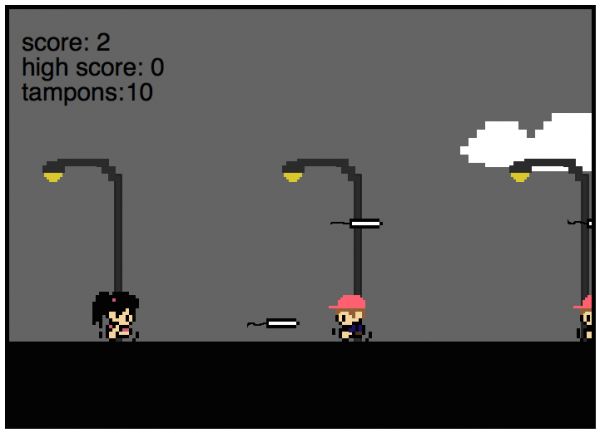
High School students Andrea Gonzales and Sophie Houser developed the video game Tampon Run as a sort of shoot-em-up game in which you throw tampons instead of shooting. The point of the game is that a natural process like menstruation should be just as acceptable in a video game as the shooting and violence that are so common.

Gonzales and Houser produced the game as their final project in the Girls Who Code program. Go play it now -it’s a hoot!  -via Daily of the Day

13 Sep 08:41

Three At Once

by tiki god

Three At Once Three At Once

Three At Once originally appeared on MyConfinedSpace NSFW on September 12, 2014.

13 Sep 08:41

Disabled masterbation

by tiki god

Disabled masterbation Disabled masterbation

Disabled masterbation originally appeared on MyConfinedSpace NSFW on September 13, 2014.

13 Sep 08:37

Military Stopper

by tiki god

Military Stopper 700x515 Military Stopper

Military Stopper originally appeared on MyConfinedSpace NSFW on September 13, 2014.

13 Sep 08:34

BOOKER T & THE MGs / THE MAR-KEYS - Stax Instrumentals [Unreleased]

by noreply@blogger.com (Mr.Eliminator)


GREAT!!! collection of previously unreleased 60's instro stuff from Stax Records vaults. Soul/R&B hammond 'n' sax stompers & sliders by these two legendary Stax B&W groups. Good Groove... Dig!!!


http://www4.zippyshare.com/v/19442504/file.html


13 Sep 08:27

Josei Gems: Anime for Adult Women - Card games, jellyfish, and running from the cops

by Caitlin Donovan

michiko

Josei is anime and manga created mostly by women for an audience of adult and young adult women. Since it’s aimed at an older demographic, it tends to focus more on the concerns of adulthood and is far more likely to include mature themes. The three anime and manga below show a wide range of stories that explore the rich experiences of a colorful variety of unstoppable women.

chihayfuru

Chihayafuru

Chihayafuru by Yuki Suetsugu has been an ongoing manga since 2007 and has been adapted into two 25-episode anime seasons: Chihayafuru in 2011 and Chihayafuru 2 in 2013. A 4-volume novel series was written in 2012.

Chihayafuru focuses on a high schooler named Chihaya’s efforts to conquer the world of karuta, a card game based on Japanese poetry that requires both quick reflexes and good ear. After having been introduced to the game by her childhood friend, Chihaya is spurred into playing competitively, aiming to be the karuta Queen of Japan. But she has to get a team together if she wants to compete…

Chihayafuru makes a bunch of kids playing a non-mystic card game truly exciting. The characters even suffer injuries from battling it out! The anime is a feast for the eyes and delivers heart-pumping karuta action with unique angles and motion. Chihaya is a fun lead who is aggressively driven and singlemindedly focused on her passion for karuta is but also full to the brim with enthusiasm and affection for her friends. Chihayafuru has a bit of a sports anime vibe with a lot of emphasis on teamwork and competition, but it focuses on the interpersonal development between the characters as well.

Chihayafuru - 17 - Large 01

The overarching themes of the series are friendship and people learning to understand each other, which yields a lot of complex relationships between women. Among them are Chihaya’s beloved (and terrifying) rival Shinobu, the poetry enthusiast Kana, and the love-obsessed Sumire. These are a lot of great ladies who get character arcs and awesome achievements. There is even a nice scene where a girl sticks up for herself when she’s looked down on for her enthusiastic interest in boys, explaining that there’s nothing wrong with being interested in love and pointing out that most of the literature they read is about love.

As for possible drawbacks, there is a love triangle involving Chihaya, but it’s been handled well so far. Chihaya isn’t treated as a prize to be won, and she’s mostly oblivious to it since she’s so focused on karuta. Chihaya gives her chubby friend the nickname “pork bun” (he eats them often), which is pretty insensitive since he doesn’t like it. There was also some concern over the episode that dealt with people of other races living in Japan, though overall it can be interesting to watch to see how some Japanese people might perceive other races and how the Japanese characters in question confront the wrongness of some of the stereotypes they have. There’s also the occasional gender essentialist comment.

If you want to get immersed in the world of karuta, the Chihayafuru anime can be viewed on Crunchyroll.

michikoehatchin

Michiko e Hatchin

Michiko e Hatchin (alternately known as Michiko to Hatchin or Michiko & Hatchin) is a 22-episode anime from 2008. It takes place in a setting that appears to be Brazil, though there are bits of other cultures (like the Japanese names). The story follows the adventures of Michiko Malandro and Hana Morenos. Adult Michiko escapes from prison and rescues young Hana (whom Michiko nicknames “Hatchin”) from her abusive foster family. Together they search for Hana’s real father, who is Michiko’s ex. The cops are hot on their trail, with detective Atsuko Jackson, Michiko’s former childhood friend, gunning especially hard for them.

The first notable thing about this series is that the majority of the cast is Brazilian and African-Brazilian, which is a rarity for both Japanese and Western media. In addition to that, the core of the story is the developing bond between two women, with the series focusing on them navigating a harsh world together and fighting back with all they’ve got. Michiko and Hana clash a lot, but when the chips are down, they are always there to love and protect each other. The fact that they are on a mission to find a man who clearly left them both behind is explored, and the clear message of the show is that the bond between Michiko and Hana transcends anything to do with the father. Michiko might also be one of the most hardcore and unstoppable characters ever seen on television, especially when it comes to protecting Hana. There is a part where she’s hit with multiple tranquilizer darts and keeps going. It’s also pretty rare to see two women have the emotionally charged on-opposite-sides-of-the law-rivalry that Michiko and Atsuko have. The underlying affection and backstory the two ladies share is well done.

michiko2

The series has a colorful setting, bombastic characters, and killer animation. There’s a lot of over-the-top action and adventure—from bullfighting to battles on hot air balloons to taking down corrupt circuses—plus endless psychological drama and encounters with the criminal element. Some of the side characters are queer, including a bisexual woman. The director, Sayo Yamamoto, is also one of the few female anime directors out there and made the series specifically for “office ladies” who “would be returning home, and worn out from the day” so “they could have a beer and watch it.” So another good reason to watch this series is to support more women directing anime, especially ones who make media for other women.

This series does include a ton of gang violence, gore, child abuse, violent murder, and occasional slurs. It also shows women being sexually exploited a couple times, and there are a few male gaze-y camera angles. In an article from The Untitled Mag, it was noted that while the series has a diverse array of characters, there are some obvious stereotypes present, like most of the black characters in the series technically being criminals. The article itself is no unfortunately no longer available, but I have a quote from it here.

Despite its flaws, Michiko e Hatchin is a very unique anime that is certainly worth your time. It is available for streaming and DVD purchase at Funimation and can also be found on Hulu.

kuragehime-kuragehime-17940951-768-982

Princess Jellyfish

Akiko Higashimura’s Princess Jellyfish (alternately known as Kuragehime) has been an ongoing manga since 2008. It was adapted in to an 11-episode anime in 2010, and a live-action film is planned for December 2014.

The plot of Princess Jellyfish revolves around Tsukimi, a geeky shut-in who’s obsessed with jellyfish and lives with her four geeky female friends. They are all incredibly socially awkward and dislike attractive people. Men are not allowed into their domain. Tsukimi happens to befriend an attractive girl who actually turns out to be a crossdressing rich boy names Kuranosuke. When the girls risk losing their apartment thanks to redevelopment, Kuranosuke offers to help them fight back.

The first and most notable thing about Princess Jellyfish is that the nerdy female characters actually look and dress geeky and have somewhat diverse facial structures and body types. What’s more, the girls aren’t generically nerdy—they each are obsessed with a specific thing and all struggle with debilitating social anxiety. Though Kuranosuke does dress the girls “fashionably” so they can be taken seriously in public meetings, it’s also made clear that the girls have their own strengths and are far more comfortable just being themselves. So far the girls’ uniqueness has not been sacrificed. Even the makeovers sometimes accentuate the girls’ unique physical features rather than hiding them.

Princess Jellyfish - Cast

Princess-Jellyfish

The story is just as much about Kuranosuke realizing he has a lot in common with the girls’ geekiness as it is about the girls coming out of their shells. A unique aspect of the show is that Kuranosuke is a male character who is unashamedly interested in women’s fashion while still being a heartthrob. Though it leads to humorous situations, the crossdressing itself (which he is very good at) is never played as a joke. The story also sometimes pokes at the beauty expectations heaped on women and gently examines how society treats nerd girls. However, it’s mostly a humorous series about a bunch of quirky girls who are wonderful in their weirdness and the boy who gets mixed up with them. It’s also about Tsukimi discovering her talents and specialness, so it’s a warm and fluffy wish fulfillment fantasy for nerd girls to enjoy. The manga also later introduces some darker-skinned characters from India who are pretty fleshed out.

There are some unfortunate aspects. Queerness is used as a punchline on occasion. The girls have a female rival who is shown to be sexually manipulative and willing to sleep with men to get ahead in her career. Since she’s the only incredibly sexual woman in the series, this unfortunately associates female sexuality with evil, while the virginal girls are “good.” This woman even sexually assaults a drunk man (and it is acknowledged as sexual assault by him). When the man finally snaps under her constant abuse and strikes her, she gets incredibly turned on, which is… uncomfortable. Basically, the series is good except for this character, who is walking horribleness that is often played for laughs.

Princess Jellyfish is available on Funimation’s YouTube channel and their website, plus Hulu and Netflix.

As you can see from the above, Josei is valuable because it bucks the Western stereotype that media for women must be denigrated as “chick flicks” and acknowledges the wide range of stories women can enjoy. Michiko e Hatchin targets women who enjoy action and police chases, Chihayafuru aims to excite women who enjoy competition, and Princess Jellyfish openly caters to nerd girls. This is a medium of storytelling for women, by women, so it’s a great opportunity to support female artists who create things for their fellow women to enjoy. Josei acknowledges the complexity of women as an audience and treats them with the respect they deserve.

Caitlin Donovan is a longtime comic geek and internet blogger who is currently working on her MFA and her first novel. She formerly wrote for Big Shiny Robot and for a time helped run the blog When Fangirls Attack. These days, she mostly can be found blogging on her Tumblr, Lady Love and Justice.

Previously in Caitlin’s guides to anime

Are you following The Mary Sue on TwitterFacebookTumblrPinterest, & Google +?

13 Sep 08:19

In Case You Were Wondering, This Is The Official Definition Of A Sandwich

Overthinking sandwiches so you don’t have to.

The Atlantic gives the final word on how to properly define a sandwich.

Via youtube.com

These are all undeniably sandwiches.

These are all undeniably sandwiches.

Yum.

Via youtube.com

These are too, kinda.

These are too, kinda.

Via youtube.com

But what about these guys?!

But what about these guys?!

Via youtube.com


View Entire List ›

13 Sep 08:14

Esta sexta 19 de Setembro Festa 9º aniversário do C.S. O pichel!!!!!

by Gentalha

9aniversariopichelHá 10 aninhos que nascia a Gentalha em Compostela. Um dos nossos desejos era poder levar adiante umha chea de projectos e actividades desde um espaço nosso, autogerido, livre e aberto a quem queira somar forças no activismo cultural dia a dia .
Há 9 anos que esse espaço existe depois de muito trabalho. No C.S.O Pichel tenhem lugar muitas actividades. Seria complicado organizar os cursinhos, as palestras, as festas, as comissons, a universidade popular, as assembleias, os concertos, as foliadas, os bailes assalto sem o centro social.
A sexta feira 19 de setembro celebramos o aniversário do Pichel com umha festa na que terá lugar umha noite de DJs na que contaremos com a Radio Kalimera, Genderal e Bigote Mix. Antes poderás degustar uns deliciosos petiscos das melhores receitas da comissom gastronómica e contaremos com ofertas em táboas de copinhos (shots), mojitos e gin tonics.
Vem festejar com nós!