Shared posts

15 Mar 01:34

Las islas de los 4.000 castros.

by David Fernández Abella
Estos días de encierro necesario es bueno volver a la arqueología digital. Pese al tiempo y las ocupaciones, cada uno debemos sacar nuestro granito de arena para colaborar, ser solidario y, si no podemos ayudar más, al menos obedecer, no entorpecer y entretener a todos los que tenemos alrededor.

Hoy os traigo un link de esos que dan envidia, fruto de cinco años de trabajo colaborativo de la Universidad de Oxford, Edimburgo y el University college de Cork. 

Todo para catalogar 4.147 castros de toda Irlanda y Gran Bretaña, con toda la información de los mismos totalmente accesible a través de la web. Libre y gratuito, por supuesto.

Cerca de la mitad (1.694) se ubican en Escocia, seguida numéricamente de Inglaterra, que tiene 1.224 castros catalogados.

El link está aquí 

Más de 100 personas colaboran actualizando datos de los castros catalogados, analizada luego por el equipo científico. Un ejemplo de buen hacer, que puede consultarse aquí.

Aprendamos.


15 Mar 01:21

Condenada una prostituta que robó 350 euros, un crucifijo y una medalla de la Virgen a un cliente

by xurxo melchor

El hombre echó en falta sus pertenencias tras salir del piso y llamó a la Policía, que identificó a ambos

12 Mar 23:35

As mulleres non mandaban, e na Galiza tampouco

by Montse Dopico
“A familia estaba revestida dun cuño patriarcal ou patrucial, en contra do mito persistente que atribúe un presunto carácter matriarcal á familia tradicional galega”. Con esta contundencia expresa o historiador Xavier Castro no seu último ensaio...
12 Mar 23:31

'Scream 5' queda en manos de los directores de 'Noche de bodas'

by Mikel Zorrilla

'Scream 5' queda en manos de los directores de 'Noche de bodas'

El pasado mes de noviembre de hacía oficial la puesta en marcha de 'Scream 5'. Ya entonces se aclaraba que ni el ya fallecido Wes Craven ni el guionista Kevin Williamson iban a participar creativamente en la misma, siendo ahora cuando el proyecto ha dado un importante paso adelante al anunciarse el fichaje de los directores de 'Noche de bodas'.

La noticia ha sido dada en exclusiva por Discussing Film -y confirmada posteriormente por otros medios-, donde se afirma que la historia girará alrededor de una mujer que regresa a su lugar de origen para intentar averiguar quién está cometiendo una serie de terribles asesinatos.

¿Secuela directa o algo diferente?

Por el momento se desconoce si 'Scream 5' será una continuación de las cuatro anteriores entregas o si se optará por llevar la franquicia en otra dirección, así que nada se sabe sobre un posible retorno de Neve Campbell, Courteney Cox o David Arquette. Lo que espero que como mínimo mantengan es a Ghostface, porque de lo contrario qué sentido tendría llamarla 'Scream 5'.

Ghostface

Ahora habrá que ver a qué guionista encomiendan la misión de dar nuevas energías a la saga, porque es cierto que los realizadores Matthew Bettinelli-Olpin y Tyler Gillett hicieron un buen trabajo en 'Noche de bodas', pero ellos no la escribieron

-
La noticia 'Scream 5' queda en manos de los directores de 'Noche de bodas' fue publicada originalmente en Espinof por Mikel Zorrilla .

12 Mar 19:54

Un actor italiano, encerrado en su casa junto a su hermana fallecida por el coronavirus

by El Confidencial

El actor italiano Luca Franzese ha utilizado las redes sociales para denunciar el abandono que sufren, según su versión, por parte de las autoridades italianas. El intérprete ha subido un vídeo a su cuenta de Facebook en el que explica que su hermana murió a causa del coronavirus de China pero, aunque comunicaron su fallecimiento, nadie quiso hacerse cargo de su cuerpo.

El vídeo con la denuncia de Franzese se ha hecho viral: "Tengo a mi hermana en la cama, muerta, no sé qué hacer. No puedo darle el honor que se merece porque las instituciones me han abandonado. Me puse en contacto con todos, pero nadie pudo darme una respuesta". El actor ha estado más de 36 horas atrapado en su casa junto al cadáver de su hermana.

Según publica el Washington Post, Teresa Franzese tenía 47 años y sufría problemas de epilepsia, pero se encontraba en buen estado de salud hasta la semana pasada. Fue entonces cuando comenzó a mostrar síntomas de haber contraído el Covid-19 y, finalmente, moría el sábado por la noche en su casa de Nápoles.

El domingo, el actor publicaba varios vídeos en su cuenta de Facebook en los que explicaba que a su hermana solo le habían hecho la prueba del coronavirus después de su muerte, arrojando un resultado positivo. Por eso, tanto él como otros miembros de su familia han sido puestos en cuarentena… pero con el cadáver de su hermana descomponiéndose en una cama.

El domingo por la noche, Franzese publicó otro vídeo en la misma habitación donde su hermana yacía muerta: "Estamos arruinados. Italia nos ha abandonado". Mientras, Francesco Emilio Borrelli, concejal y miembro de la Comisión Regional de Salud de la región de Campania, explicó que se trataba del "primer caso en el que una persona con el Covid-19 moría en casa, por lo que había confusión sobre qué hacer".

Franzese explicó que la ciudad de Nápoles le remitió a una funeraria, después de que nadie supiera qué hacer, pero la funeraria se negó aduciendo que no estaban equipados para esta situación. Después de 36 horas en una situación dantesca, finalmente el lunes por la mañana un ejército de personas totalmente aisladas llegaba al domicilio de la familia del actor para llevarse a la fallecida.

Eran trabajadores de otra funeraria local que, finalmente, aceptó llevarse el cuerpo de Teresa. Según Efi Campania, la asociación que representa a las funerarias de esta zona de Italia, el retraso se produjo por obstáculos administrativos y no a que ellos no hubieran querido realizar el trabajo. Finalmente, Teresa Franzese fue incinerada, aunque ningún miembro de la familia pudo asistir al funeral.

12 Mar 19:50

INFORMACIÓN RELATIVA Á ENFERMIDADE POLO NOVO CORONAVIRUS (COVID-19)

Informacións, avisos e recomendacións do Concello de Santiago relativas á enfermidade polo novo coronavirus, COVID-19:
12 Mar 19:48

Bélgica suspende todas las misas públicas

by Fernando Beltrán

Segundo país que suspende las misas públicas tras Italia –que lo hizo el domingo pasado– debido a la epidemia del coronavirus. La diócesis de Roma, corazón de la Cristiandad, cierra todas sus iglesias. Hoy rectifica y las abre.

La Conferencia Episcopal de Bélgica ha decidido suspender todas las misas públicas en el país desde el próximo 14 de marzo hasta el 3 de abril, para evitar los contagios ante la epidemia del coronavirus.

Se podrán celebrar bodas y funerales, pero con restricciones. Las iglesias permanecerán abiertas para los fieles que deseen acudir a rezar.

Esto último no lo podrán hacer en la diócesis de Roma, sede del obispo de Roma -el Papa- y corazón del catolicismo. Hoy, el Vicario de la diócesis, el cardenal Angelo De Donatis, ha dispuesto que todas las iglesias de la diócesis queden cerradas para todos los fieles hasta el 3 de abril. También dispensa a los fieles del precepto dominical.

“En este momento, más que nunca, nuestras casas son Iglesias domésticas”, termina el decreto de De Donatis.

Al día siguiente, el propio De Donatis rectificaba la decisión.

La entrada Bélgica suspende todas las misas públicas se publicó primero en InfoVaticana.

12 Mar 16:23

Why Do People Hoard Toilet Paper During Emergencies?

by Koh Ewe

About a month ago, supermarkets in Hong Kong and Singapore were rampaged by panic buyers. More recently, stores in Japan, the US, and Australia also fell victim to stockpiling. Across the world, we see that people are zeroing in on one commodity in particular: toilet paper. There is now a shortage of the bathroom essential, which has led to armed gang robbery for toilet paper in Hong Kong and people taking them from public restrooms in Japan. In Australia, a cafe started accepting toilet paper as payment.

But why is toilet paper, of all things, the most valuable product amidst the pandemic? “When people face uncertainties about the future, they would look for information and clues with reference to others,” said Dr Tan Ern Ser, Associate Professor of Sociology at the National University of Singapore.

That means, when some people start panic buying, others tend to follow suit. And when people hoard toilet paper, we get a lot of panic buyers stocking up on them too.

The whole toilet paper hoo-ha isn’t without logic. Amidst the anxiety of being quarantined at home due to the coronavirus, getting a clean wipe ranks high on people’s list of priorities.

“People have established certain norms and practices in their everyday life with regards to how much they need to maintain their preferred lifestyle,” Tan explained. “And two basic categories of items they need in their everyday life relate to consumption (food) and personal hygiene (toilet paper and tissue paper).”

A psychological theory suggests that stockpiling gives people a sense of control during a public health crisis where they are, for the most part, helpless. It seems like the bigger the item, the greater the sense of control. And the sheer bulkiness of toilet roll packets makes them one of the most popular items to hoard. Making big purchases, literally, during a big crisis is our coping mechanism for dealing with something we have very little control over.

On Friday, February 7, the Singaporean government raised its disease outbreak response status to code orange. According to Singapore’s Ministry of Health, this meant that the coronavirus would have “moderate to high public health impact”. And boy, did Singaporeans spiral into the rabbit hole of panic buying over that weekend.

One resident visited her neighbourhood supermarket and saw a scene right out of a doomsday movie.

Panic buying coronavirus Singapore supermarket
Photo from Chua Hui Ling.
Panic buying coronavirus Singapore supermarket
Photo from Chua Hui Ling.
Panic buying coronavirus Singapore supermarket
Photo from Chua Hui Ling.

A quick look at supermarkets today, about a month after the panic buying weekend, showed that not all stores in Singapore bore the brunt of irrational stockpiling. But for supermarkets that did, it was mayhem.

“I saw some people buying ten, even 20 packets of toilet paper,” recalled a supermarket employee. Each packet typically contains ten rolls of toilet paper.

Now, back to the question: why toilet paper?

“I have no idea,” said the supermarket employee with a little laugh.

“The internet!” said Regine Tan, a student at the National University of Singapore. “People see what others are doing and they have FOMO.”

Messaging groups in apps like WhatsApp have become echo chambers of coronavirus-induced paranoia.

In Hong Kong, there were rumours that China was making more face masks and less toilet paper, since the two items are made of the same raw materials. This apparently came from a widely circulated WhatsApp message, which claimed that China would soon stop its export of toilet paper to Hong Kong. The Hong Kong government eventually dismissed this rumour as fake news, but toilet paper rolls had already been swept off the shelves by then.

All these explanations seem to boil down to herd mentality, which is helplessly human at its core. But this doesn’t mean we should all give in to our selfish instincts. After all, empathy and generosity are distinctly human traits too.

Irrational stockpiling could aggravate shortages, as people overbuy items they don’t need, while depriving others who actually need those items. The prices of these items may also be distorted as a result of sudden shortages.

Many have started to consider alternatives to toilet paper. Australian bidet companies saw a surge in inquiries towards the end of February, around the time when the Australian government announced that a coronavirus pandemic was imminent. Google search entries for bidets from Australia also increased 350 percent from late February to early March.

@hellokoyu

This article originally appeared on VICE ASIA.

12 Mar 16:22

Gómez-Reino, candidato a la Xunta, en cuarentena

by Efe
Es compañero de Irene Montero en el Congreso
12 Mar 14:58

La presencia de cocaína en las aguas residuales de Santiago aumenta un 42 %

by Xurxo Melchor

El último informe del Observatorio Europeo de las Drogas revela que los fines de semana se consume más esta sustancia en la capital gallega que en Madrid

12 Mar 14:55

Parents Are Sharing All The Hilariously Absurd Reasons Why Their Kids Cry

by A B

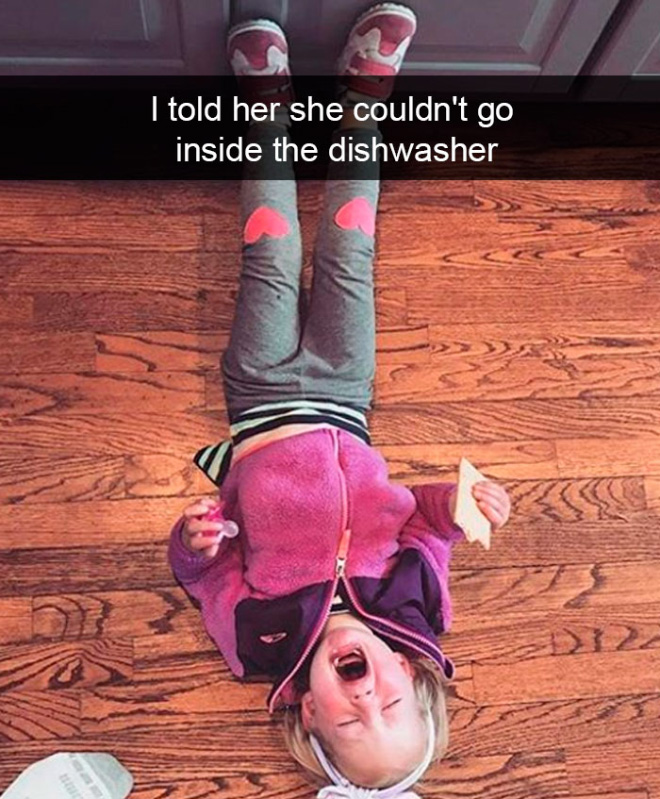
Although it might seem that someone is about to die, the kid just isn’t allowed to eat the cat food. Or throw books at her parent’s faces. Or any of the other absurd reasons why kids decide to show their skills on how to cry. Isn’t it awesome to be a parent? It is. It really is.

Kids cry for the weirdest reasons.

Kids cry for the weirdest reasons.

Kids cry for the weirdest reasons.

Kids cry for the weirdest reasons.

Kids cry for the weirdest reasons.

Kids cry for the weirdest reasons.

Kids cry for the weirdest reasons.

Kids cry for the weirdest reasons.

Kids cry for the weirdest reasons.

Kids cry for the weirdest reasons.

Kids cry for the weirdest reasons.

Kids cry for the weirdest reasons.

Kids cry for the weirdest reasons.

Kids cry for the weirdest reasons.

Kids cry for the weirdest reasons.

Kids cry for the weirdest reasons.

Kids cry for the weirdest reasons.

Kids cry for the weirdest reasons.

Kids cry for the weirdest reasons.

Kids cry for the weirdest reasons.

Kids cry for the weirdest reasons.

Kids cry for the weirdest reasons.

Kids cry for the weirdest reasons.

12 Mar 14:52

El Gobierno pide a los ciudadanos que se queden en casa y se preparen para rescatar a Bankia

by Xavi Puig

“Haremos lo que haga falta, donde haga falta y cuando haga falta”. El presidente del Gobierno, Pedro Sánchez, ha querido lanzar esta tarde desde La Moncloa un mensaje de firmeza ante la emergencia sanitaria y económica del coronavirus en España. Ha pedido a la ciudadanía que se quede en casa y se prepare para rescatar a la banca.

Las medidas aprobadas en el Consejo de Ministros extraordinario celebrado hoy confirman la necesidad de aislamiento para contener los contagios pero también de prepararse para las consecuencias que los paros de actividad tendrán para la economía española. Se prevé un rescate al sector financiero de casi cien mil millones de euros procedente del erario público, de modo que, en palabras del presidente, «conviene aprovechar esos días de aislamiento para pensar cómo vamos a pagar entre todos la deuda de Bankia».

Sánchez se ha mostrado confiado en que «los españoles demostrarán de nuevo al mundo su entrega y su talante solidario» y ha asegurado que «no es la primera vez que nos enfrentamos a este desafío», refiriéndose al rescate a 15 entidades llevado a cabo por el Fondo de Reestructuración Ordenada Bancaria (FROB) y el Fondo de Garantía de Depósitos de Entidades de Crédito (FGDEC) entre los años 2008 y 2012.

“Vamos a tener semanas difíciles, las vamos a tener”, ha admitido el presidente, que ha terminado su comparecencia recordando que «a veces, entre los cojines del sofá o en bolsillos de abrigos viejos, pueden encontrarse recursos con los que no se contaba y que pueden marcar la diferencia en estas circunstancias difíciles».

11 Mar 16:42

Meet the Liverbirds, Britain’s First Female (and Now Forgotten) Rock Band

by Ayun Halliday

We never ever got as famous as the Beatles. But we started as friends, and we ended as friends. —Sylvia Saunders, The Liverbirds’ drummer

John Lennon (a member of a band who in a parallel universe might’ve been billed as the male Liverbirds) announced that the all-female quartet would fail, a deeply inaccurate prediction.

The band got a lot of attention, toured with The Kinks and The Rolling Stones, dismissed Brian Epstein when he pooh-poohed their desire to play in Hamburg, rejected an offer to play topless in Las Vegas, and were sought out by Jimi Hendrix, owing to their bassist’s joint-rolling skills.


They also learned how to play the instruments they had optimistically purchased after seeing The Beatles in Liverpool’s famed Cavern Club.

Respect to any grandmother with bragging rights to having seen The Beatles live, but it’s heartening that these 16-year-old girls immediately pictured themselves not so much as fans, but as players.

As bassist and former-aspirant-nun Mary McGlory recalls in Almost Famous: The Other Fab FourBen Proudfoot’s New York Times’ Op-Doc, above:

"Oh my god!" I said to my cousins, "We’re going to be like them. And we’re going to be the first girls to do it."

Mission accomplished, in trousers and neatly tucked-in shirts, buttoned all the way to their collars.

It’s not terribly hard to guess what put an end to their six-year-run.

Motherly, wifely duties…

Sylvia Saunders, who became drummer by default because sticks were a better fit with her small hands than frets, got pregnant, and recused herself due to complications with that pregnancy.

Valerie Gell, the Liverbirds’ late guitarist and most accomplished musician, married a handsome fan who’d been en route to Hamburg to propose when he was paralyzed in a car accident, devoting herself to his care for 26 years.

The other two members carried on for a bit, playing a Japanese tour with a couple of female musicians they’d met in Hamburg, but the chemistry couldn’t compare.

The dream was over, but fortunately rock and roll stardom was not their only dream.

Unlike the fourth Liverbird, Pam Birch, who descended into addiction after the band broke up, neither Saunders nor McGlory seems angry or regretful over what could have been, smiling as they mention their long, happy marriages, children, and grandchildren.

They were awfully tickled by Girls Don’t Play Guitars, a recent West End musical that tells the story of the Liverbirds.

And McGlory is admirably sanguine about Lennon’s famous diss, revealing to the Liverpool Echo that:

He had a smile on his face when he said it—he wasn’t being malicious. But it would have been nice to have bumped into him a few years later and for him to say, "Well done, you proved me wrong," which I’m sure he would have been happy to do.

Related Content:

New Web Project Immortalizes the Overlooked Women Who Helped Create Rock and Roll in the 1950s

Women of Jazz: Stream a Playlist of 91 Recordings by Great Female Jazz Musicians

Venerable Female Artists, Musicians & Authors Give Advice to the Young: Patti Smith, Laurie Anderson & More

Ayun Halliday is an author, illustrator, theater maker and Chief Primatologist of the East Village Inky zine.  Join Ayun’s company Theater of the Apes in New York City for her book-based variety series, Necromancers of the Public Domain, and the world premiere of Greg Kotis’ new musical, I AM NOBODY., playing at The Tank NYC through March 28 Follow her @AyunHalliday.

Meet the Liverbirds, Britain’s First Female (and Now Forgotten) Rock Band is a post from: Open Culture. Follow us on Facebook, Twitter, and Google Plus, or get our Daily Email. And don't miss our big collections of Free Online Courses, Free Online Movies, Free eBooksFree Audio Books, Free Foreign Language Lessons, and MOOCs.

11 Mar 16:27

Feijóo di que "non sabe que segue" a mobilización de persoal da CRTVG, que xa dura 95 semanas

"Eu non sabían que seguían", asegura o presidente da Xunta e candidato do PP, que defende elección do actual director xeral dos medios públicos, anterior á lei de medios do ano 2011. Esa norma foi reformada en 2015 para permitir que, a efectos prácticos, Sánchez Izquierdo continúe indefinidamente no posto

11 Mar 15:22

How the “Bernie Bros” were invented as Sexist, Racist, Antisemitic and UnAmerican as Borscht

by Jonathan Cook

The Democratic presidential nomination race is a fascinating case study in how power works – not least, because the Democratic party leaders are visibly contriving to impose one candidate, Joe Biden, as the party’s nominee, even as it becomes clear that he is no longer mentally equipped to run a local table tennis club let alone the world’s most powerful nation.

Biden’s campaign is a reminder that power is indivisible. Donald Trump or Joe Biden for president – it doesn’t matter to the power-establishment. An egomaniacal man-child (Trump), representing the billionaires, or an elder suffering rapid neurological degeneration (Biden), representing the billionaires, are equally useful to power. A woman will do too, or a person of colour. The establishment is no longer worried about who stands on stage – so long as that person is not a Bernie Sanders in the US, or a Jeremy Corbyn in the UK.

It really isn’t about who the candidates are – hurtful as that may sound to some in our identity-saturated times. It is about what the candidate might try to do once in office. In truth, the very fact that nowadays we are allowed to focus on identity to our heart’s content should be warning enough that the establishment is only too keen for us to exhaust our energies in promoting divisions based on those identities. What concerns it far more is that we might overcome those divisions and unify against it, withdrawing our consent from an establishment committed to endless asset-stripping of our societies and the planet.

Neither Biden nor Trump will obstruct the establishment, because they are at its very heart. The Republican and Democratic leaderships are there to ensure that, before a candidate gets selected to compete in the parties’ name, he or she has proven they are power-friendly. Two candidates, each vetted for obedience to power.

Although a pretty face or a way with words are desirable, incapacity and incompetence are no barrier to qualifying, as the two white men groomed by their respective parties demonstrate. Both have proved they will favour the establishment, both will pursue near-enough the same policies, both are committed to the status quo, both have demonstrated their indifference to the future of life on Earth. What separates the candidates is not real substance, but presentation styles – the creation of the appearance of difference, of choice.

Policing the debate

The subtle dynamics of how the Democratic nomination race is being rigged are interesting. Especially revealing are the ways the Democratic leadership protects establishment power by policing the terms of debate: what can be said, and what can be thought; who gets to speak and whose voices are misrepresented or demonised. Manipulation of language is key.

As I pointed out in my previous post, the establishment’s power derives from its invisibility. Scrutiny is kryptonite to power.

The only way we can interrogate power is through language, and the only way we can communicate our conclusions to others is through words – as I am doing right now. And therefore our strength – our ability to awaken ourselves from the trance of power – must be subverted by the establishment, transformed into our Achilles’ heel, a weakness.

The treatment of Bernie Sanders and his supporters by the Democratic establishment – and those who eagerly repeat its talking points – neatly illustrates how this can be done in manifold ways.

Remember this all started back in 2016, when Sanders committed the unforgivable sin of challenging the Democratic leadership’s right simply to anoint Hillary Clinton as the party’s presidential candidate. In those days, the fault line was obvious and neat: Bernie was a man, Clinton a woman. She would be the first woman president. The only party members who might wish to deny her that historic moment, and back Sanders instead, had to be misogynist men. They were supposedly venting their anti-women grudge against Clinton, who in turn was presented to women as a symbol of their oppression by men.

And so was born a meme: the “Bernie Bros”. It rapidly became shorthand for suggesting – contrary to all evidence – that Sanders’ candidacy appealed chiefly to angry, young, entitled white men. In fact, as Sanders’ 2020 run has amply demonstrated, support for him has been more diverse than for the many other Democratic candidates who sought the nomination.

How contrived the 2016 identity-fuelled contest was should have been clear, had anyone been allowed to point that fact out. This wasn’t really about the Democratic leadership respecting Clinton’s identity as a woman. It was about them paying lip service to her identity as a woman, while actually promoting her because she was a reliable warmonger and Wall Street functionary. She was useful to power.

If the debate had really been driven by identity politics, Sanders had a winning card too: he is Jewish. That meant he could be the United States’ first Jewish president. In a fair identity fight, it would have been a draw between the two. The decision about who should represent the Democratic party would then have had to be decided based on policies, not identity. But party leaders did not want Clinton’s actual policies, or her political history, being put under the microscope for very obvious reasons.

Weaponisation of identity

The weaponisation of identity politics is even more transparent in 2020. Sanders is still Jewish, but his main opponent, Joe Biden, really is simply a privileged white man. Were the Clinton format to be followed again by Democratic officials, Sanders would enjoy an identity politics trump card. And yet Sanders is still being presented as just another white male candidate, no different from Biden.

(We could take this argument even further and note that the other candidate who no one, least of all the Democratic leadership, ever mentions as still in the race is Tulsi Gabbard, a woman of colour. The Democratic party has worked hard to make her as invisible as possible in the primaries because, of all the candidates, she is the most vocal and articulate opponent of foreign wars. That has deprived her of the chance to raise funds and win delegates.)

Sanders’ Jewish identity isn’t celebrated because he isn’t useful to the power-establishment. What’s far more important to them – and should be to us too – are his policies, which might limit their power to wage war, exploit workers and trash the planet.

But it is not just that Democratic Party leaders are ignoring Sanders’ Jewish identity. They are also again actively using identity politics against him, and in many different ways.

The ‘black’ establishment?

Bernie Sanders’ supporters have been complaining for some time – based on mounting evidence – that the Democratic leadership is far from neutral between Sanders and Biden. Because it has a vested interest in the outcome, and because it is the part of the power-establishment, the Democratic National Committee (DNC) is exercising its influence in favour of Biden. And because power prefers darkness, the DNC is doing its best to exercise that power behind the scenes, out of sight – at least, unseen by those who still rely on the “mainstream” corporate media, which is also part of the power-establishment. As should be clear to anyone watching, the nomination proceedings are being controlled to give Biden every advantage and to obstruct Sanders.

But the Democratic leadership is not only dismissing out of hand these very justified complaints from Bernie Sanders’ supporters but also turning these complaints against them, as further evidence of their – and his – illegitimacy. A new way of doing this emerged in the immediate wake of Biden winning South Carolina on the back of strong support from older black voters – Biden’s first state win and a launchpad for his Super Tuesday bid a few days later.

It was given perfect expression from Symone Sanders, who despite her surname is actually a senior adviser to Biden’s campaign. She is also black. This is what she wrote: “People who keep referring to Black voters as ‘the establishment’ are tone deaf and have obviously learned nothing.”

Her reference to generic “people” was understood precisely by both sides of the debate as code for those “Bernie Bros”. Now, it seems, Bernie Sanders’ supporters are not simply misogynists, they are potential recruits to the Ku Klux Klan.

The tweet went viral, even though in the fiercely contested back-and-forth below her tweet no one could produce a single example of anyone actually saying anything like the sentiment ascribed by Symone Sanders to “Bernie Bros”. But then, tackling bigotry was not her real goal. This wasn’t meant to be a reflection on a real-world talking-point by Bernie supporters. It was high-level gas-lighting by a senior Democratic party official of the party’s own voters.

Survival of the fittest smear

What Symone Sanders was really trying to do was conceal power – the fact that the DNC is seeking to impose its chosen candidate on party members. As occurred during the confected women-men, Clinton vs “Bernie Bros” confrontation, Symone Sanders was field-testing a similar narrative management tool as part of the establishment’s efforts to hone it for improved effect. The establishment has learnt – through a kind of survival of the fittest smear – that divide-and-rule identity politics is the perfect way to shield its influence as it favours a status-quo candidate (Biden or Clinton) over a candidate seen as a threat to its power (Sanders).

In her tweet, Symone Sanders showed exactly how the power elite seeks to obscure its toxic role in our societies. She neatly conflated “the establishment” – of which she is a very small, but well-paid component – with ordinary “black voters”.  Her message is this: should you try to criticise the establishment (which has inordinate power to damage lives and destroy the planet) we will demonise you, making it seem that you are really attacking black people (who in the vast majority of cases – though Symone Sanders is a notable exception – wield no power at all).

Symone Sanders has recruited her own blackness and South Carolina’s “black voters” as a ring of steel to protect the establishment. Cynically, she has turned poor black people, as well as the tens of thousands of people (presumably black and white) who liked her tweet, into human shields for the establishment.

It sounds a lot uglier put like that. But it has rapidly become a Biden talking-point, as we can see here:

The DNC’s wider strategy is to confer on Biden exclusive rights to speak for black voters (despite his inglorious record on civil rights issues) and, further, to strip Sanders and his senior black advisers of any right to do so. When Sanders protests about this, or about racist behaviour from the Biden camp, Biden’s supporters come out in force and often abusively, though, of course, no one is upbraiding them for their ugly, violent language. Here is the famous former tennis player Martina Navratilova showing that maybe we should start talking about “Biden Bros”:

Being unkind to billionaires

This kind of special pleading by the establishment for the establishment – using those sections of it, such as Symone Sanders, that can tap into the identity politics zeitgeist – is far more common than you might imagine. The approach is being constantly refined, often using social media as the ultimate focus group. Symone Sanders’ successful conflation of the establishment with “black voters” follows earlier, clumsier efforts by the establishment to protect its interests against Sanders that proved far less effective.

Remember how last autumn the billionaire-owned corporate media tried to tell us that it was unkind to criticise billionaires – that they had feelings too and that speaking harshly about them was “dehumanising”. Again it was aimed at Sanders, who had just commented that in a properly ordered world billionaires simply wouldn’t exist. It was an obvious point: allowing a handful of people to control almost all the planet’s wealth was not only depriving the rest of us of that wealth (and harming the planet) but it gave those few billionaires way too much power. They could buy all the media, our channels of communication, and most of the politicians to ring-fence their financial interests, gradually eroding even the most minimal democratic protections.

That campaign died a quick death because few of us are actually brainwashed enough to accept the idea that a handful of billionaires share an identity that needs protecting – from us! Most of us are still connected enough to the real world to understand that billionaires are more than capable of looking out for their own interests, without our helping them by imposing on ourselves a vow of silence.

But one cannot fault the power-establishment for being constantly inventive in the search for new ways to stifle our criticisms of the way it unilaterally exercises its power. The Democratic nomination race is testing such ingenuity to the limits. Here’s a new rule against “hateful conduct” on Twitter, where Biden’s neurological deficit is being subjected to much critical scrutiny through the sharing of dozens of videos of embarrassing Biden “senior moments”.

Yes, disability and age are identities too. And so, on the pretext of protecting and respecting those identities, social media can now be scrubbed of anything and anyone trying to highlight the mental deficiencies of an old man who might soon be given the nuclear codes and would be responsible for waging wars in the name of Americans.

Russian ‘agents’ and ‘assets’

None of this is to overlook the fact that another variation of identity politics has been weaponised against Sanders: that of failing to be an “American” patriot. Again illustrating how closely the Democratic and Republican leaderships’ interests align, the question of who is a patriot – and who is really working for the “Russians” – has been at the heart of both parties’ campaigns, though for different reasons.

Trump has been subjected to endless, evidence-free claims that he is a secret “Russian agent” in a concerted effort to control his original isolationist foreign policy impulses that might have stripped the establishment – and its military-industrial wing – of the right to wage wars of aggression, and revive the Cold War, wherever it believes a profit can be made under cover of “humanitarian intervention”. Trump partly inoculated himself against these criticisms, at least among his supporters, with his “Make America Great Again” slogan, and partly by learning – painfully for such an egotist – that his presidential role was to rubber-stamp decisions made elsewhere about waging wars and projecting US power.

Bernie Sanders has faced similar smear efforts by the establishment, including by the DNC’s last failed presidential candidate Hillary Clinton – in his case, painting him as a “Russian asset”. (“Asset” is a way to suggest collusion with the Kremlin based on even more flimsy evidence than is needed to accuse someone of being an agent.) In fact, in a world where identity politics wasn’t simply a tool to be weaponised by the establishment, there would be real trepidation about engaging in this kind of invective against a Jewish socialist.

One of the far-right’s favourite antisemitic tropes – promoted ever since the publication of the Protocols of the Elders of Zion more than 100 years ago – is that Jewish “Bolsheviks” are involved in an international conspiracy to subvert the countries they live in. We have reached the point now that the corporate media are happy to recycle evidence-free claims, cited by the Washington Post, from anonymous “US officials” and US intelligence agencies reinventing a US version of the Protocols against Sanders. And these smears have elicited not a word of criticism from the Democratic leadership nor from the usual antisemitism watchdogs that are so ready to let rip over the slightest signs of what they claim to be antisemitism on the left.

But the urgency of dealing with Sanders may be the reason normal conventions are being discarded. Sanders isn’t a loud-mouth egotist like Trump. A vote for Trump is a vote for the establishment, if for one of its number who pretends to be against the establishment. Trump has been largely tamed in time for a second term. By contrast, Sanders, like Corbyn in the UK, is more dangerous because he may resist the efforts to domesticate him, and because if he is allowed any significant measure of political success – such as becoming a candidate for president – it may inspire others to follow in his footsteps. The system might start to throw up more anomalies, more AOCs and more Ilhan Omars.

So Sanders is now being cast, like Trump, as a puppet of the Kremlin, not a true American. And because he made the serious mistake of indulging the “Russiagate” smears when they were used against Trump, Sanders now has little defence against their redeployment against him. And given that, by the impoverished standards of US political culture, he is considered an extreme leftist, it has been easy to conflate his democratic socialism with Communism, and then conflate his supposed Communism with acting on behalf of the Kremlin (which, of course, ignores the fact that Russia long ago abandoned Communism).

Antisemitism smear at the ready

There is a final use of weaponised identity politics that the Democratic establishment would dearly love to use against Sanders, if they can get away with it. It is the most toxic brand – and therefore the most effective – of the identity-based smears, and it has been extensively field-tested in the UK against Jeremy Corbyn to great success. The dream of the DNC would be denounce Sanders as an antisemite.

There has been only one thing holding them back so far: the fact that Sanders is Jewish. That may not prove an insuperable obstacle, but it does make it much harder to make the accusation look credible. The other identity-based smears have been a second-best, a make-do until a way can be found to unleash the antisemitism smear.

The establishment has been testing the waters with implied accusations of antisemitism against Sanders for a while, but their chances were given a fillip recently when Sanders refused to participate in the annual jamboree of AIPAC, the American Israel Public Affairs Committee, a prominent lobby group whose primary mission is to ring-fence Israel from criticism in the US. Both the Republican and Democratic establishments turn out in force to the AIPAC conference, and in the past the event has attracted keynote speeches from Barack Obama and Hillary Clinton.

But Sanders has refused to attend for decades and maintained that stance this month, even though he is a candidate for the Democratic nomination. In the last primaries debate, Sanders justified his decision by rightly calling Israel’s prime minister Benjamin Netanyahu a “racist” and by describing AIPAC as providing a platform “for leaders who express bigotry and oppose basic Palestinian rights”.

Trump’s Vice-President, Mike Pence, responded that Sanders supported “Israel’s enemies” and, if elected, would be the “most anti-Israel president in the history of this nation” – all coded suggestions that Sanders is antisemitic.

But that’s Mike Pence. More useful criticism came from billionaire Mike Bloomberg, who is himself Jewish and was until last week posing as a Democrat to try to win the party’s nomination. Bloomberg accused Sanders of using dehumanising language against a bunch of inclusive identities that, he improbably suggested, AIPAC represents. He claimed:

This is a gathering of 20,000 Israel supporters of every religious denomination, ethnicity, faith, color, sexual identity and political party. Calling it a racist platform is an attempt to discredit those voices, intimidate people from coming here, and weaken the US-Israel relationship.

Where might this head? At the AIPAC conference last week we were given a foretaste. Ephraim Mirvis, the chief rabbi of the UK and a friend to Conservative government leader Boris Johnson, was warmly greeted by delegates, including leading members of the Democratic establishment. He boasted that he and other Jewish leaders in the UK had managed to damage Jeremy Corbyn’s electoral chances by suggesting that he was an antisemite over his support, like Sanders, for Palestinian rights.

His own treatment of Corbyn, he argued, offered a model for US Jewish organisations to replicate against any leadership contender who might pose similar trouble for Israel, leaving it for his audience to pick up the not-so-subtle hint about who needed to be subjected to character-assassination.

Establishment playbook

For anyone who isn’t wilfully blind, the last few months have exposed the establishment playbook: it will use identity politics to divide those who might otherwise find a united voice and a common cause.

There is nothing wrong with celebrating one’s identity, especially if it is under threat, maligned or marginalised. But having an attachment to an identity is no excuse for allowing it to be coopted by billionaires, by the powerful, by nuclear-armed states oppressing other people, by political parties or by the corporate media, so that they can weaponise it to prevent the weak, the poor, the marginalised from being represented.

It is time for us to wake up to the tricks, the deceptions, the manipulations of the strong that exploit our weaknesses – and make us yet weaker still. It’s time to stop being a patsy for the establishment.


11 Mar 13:13

Héroes y heroínas de la memoria musical

by Eureka

Creían que los sonidos y las canciones eran la memoria musical de nuestros antepasados y pueblos. Luchando contra el tiempo y la destrucción, llegaban a lugares remotos con sus cilindros de cera y precarios equipos de grabación para preservar ese tesoro

[Vía American Folklife Center]

El American Folklife Center es uno de los principales archivos mundiales de grabaciones de campo realizadas en cilindros de cera que documentan la música y la tradición de las culturas nativas americanas, entre ellas muchas grabaciones transferidas de la Oficina de Etnología Americana de la Smithsonian Institution. A principios de la década de 1970 era evidente que el tiempo estaba afectando a los cilindros y la duplicación de la preservación era urgente. El renovado interés por las tribus indias americanas y en su propio patrimonio cultural aumentó la necesidad de preservar y catalogar esta extensa colección. El proyecto Save our Sound del American Folklife Center está preservando en archivos digitales miles de grabaciones de audio en peligro de extinción, todas ellas realizadas en diferentes formatos, desde la década de 1890 hasta la actualidad.

En 1928 el bibliotecario del Congreso Herbert Putnam invitó a Robert W. Gordon a convertirse en especialista y consultor en el campo de la canción y la literatura folclórica. Gordon ya había comenzado su misión de por vida de reunir toda la tradición musical del pueblo estadounidense. Lo llamó un «proyecto nacional con muchos trabajadores».

El histórico bluesman Mississippi John Hurt junto a varios folcloristas durante una grabación para la Library of Congress Recording Laboratory (1964). Fotografía: Library of Congress

El histórico bluesman Mississippi John Hurt junto a varios folcloristas durante una grabación para la Library of Congress Recording Laboratory (1964). Fotografía: Library of Congress

El folclorista y pionero Herbert Halpert fotografiado junto a su célebre «vagón del sonido», un miniestudio de grabación de discos de acetato para el Archive of American Folk-Song (Salotillo, Mississippi, 1939). Fotografía: Mississippi Department of Archives and History

El folclorista y pionero Herbert Halpert fotografiado junto a su célebre «vagón del sonido», un miniestudio de grabación de discos de acetato para el Archive of American Folk-Song (Salotillo, Mississippi, 1939). Fotografía: Mississippi Department of Archives and History

«Gordon viajó desde los frentes de agua de Oakland y San Francisco, California, a Asheville, Carolina del Norte y Darien, Georgia, recogiendo y grabando canciones populares con su máquina Edison de cilindros de cera»

Gordon asistió a la Universidad de Harvard entre 1906 y 1917, y luego la dejó para dedicar todo su tiempo libre a esta empresa de recolección. Apoyándose a sí mismo a través de la enseñanza, la escritura y la subvención ocasional, Gordon viajó desde los frentes de agua de Oakland y San Francisco, California, a Asheville, Carolina del Norte y Darien, Georgia, recogiendo y grabando canciones populares con su máquina Edison de cilindros de cera. Escribió una columna mensual en la revista Adventure, «Old Songs That Men Have Sung», en la que pedía a los lectores que enviasen copias de todas las canciones populares que pudieran recordar. Y contactó a Carl Engel, jefe de la División de Música de la Biblioteca del Congreso, para discutir su sueño y buscar apoyo institucional. Engel creía que las tradiciones de base estadounidenses debían estar en la Biblioteca Nacional. Por este motivo escribió en el Informe Anual de la Biblioteca del Congreso de 1928: «Hay una necesidad apremiante de formar una gran colección centralizada de canciones populares americanas. El lugar lógico para tal colección es la Biblioteca Nacional de los Estados Unidos. Esta colección debe comprender todos los poemas y melodías que han surgido de nuestra tierra o han sido trasplantadas aquí, y han sido transmitidas, a menudo con múltiples cambios, de generación en generación como una posesión preciosa de nuestra gente».

Robert Gordon no fue el primero en utilizar la última tecnología para documentar la cultura tradicional estadounidense, ni Carl Engel fue el primero en reconocer su importancia. Thomas A. Edison inventó la máquina de grabación con cilindro de cera en 1877, que estuvo disponible comercialmente alrededor de 1888. La máquina facilitó el trabajo documental por parte de muchas personas, así como por los empleados de agencias gubernamentales y museos públicos. Estos etnógrafos compartieron una visión común: creían que la historia de la nación estadounidense debía incluir las muchas voces de su población diversa, una noción que más tarde impulsó la creación del Centro Americano de Vida Popular. Creían que el sonido, tanto la canción como la palabra hablada, era una parte vital del registro histórico y cultural.

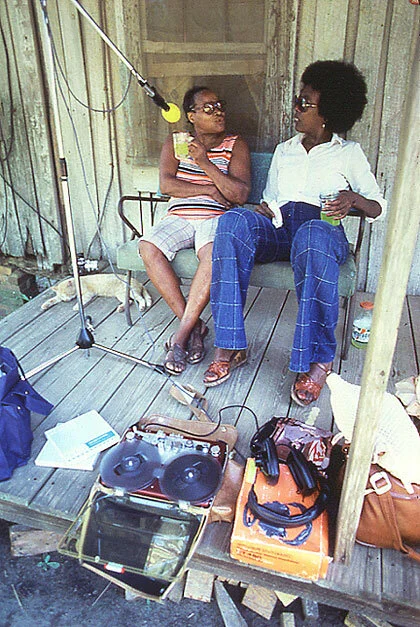
La folclorista Beverly Robinson (derecha) junto a en el porche de su casa en Tifton, Georgia, en 1977. Fotografía: South-Central Georgia Folklife Project Collection / Carl Fleischhauer

La folclorista Beverly Robinson (derecha) junto a en el porche de su casa en Tifton, Georgia, en 1977. Fotografía: South-Central Georgia Folklife Project Collection / Carl Fleischhauer

La folclorista Erika Brady, del Federal Cylinder Project, en el laboratorio de grabación de la Biblioteca del Congreso (circa 1980) haciendo una copia de un cilindro de cera. Fotografía: American Folklife Center / Carl Fleischhauer

La folclorista Erika Brady, del Federal Cylinder Project, en el laboratorio de grabación de la Biblioteca del Congreso (circa 1980) haciendo una copia de un cilindro de cera. Fotografía: American Folklife Center / Carl Fleischhauer

El técnico Peter Alyea en febrero de 2003 realizando una conversión en formato digital en el Library's Motion Picture, Broadcasting (Recorded Sound Division). Fotografía: American Folklife Center photo / James Hardin

El técnico Peter Alyea en febrero de 2003 realizando una conversión en formato digital en el Library's Motion Picture, Broadcasting (Recorded Sound Division). Fotografía: American Folklife Center photo / James Hardin

Alice Cunningham Fletcher

Alice Cunningham Fletcher

El antropólogo de Harvard Jesse Walter Fewkes, fue el primero en utilizar la máquina de cilindros Edison para la investigación etnográfica. Las grabaciones de campo hechas en cilindros de cera podían llevarse a un estudio para su grabación. Fewkes usó la máquina de Edison en Maine, en 1890, para grabar las canciones e historias de los indios Passamaquoddy. Estas grabaciones de cilindros de cera, las primeras grabaciones etnográficas existentes, se encuentran en las colecciones del Archivo de Cultura Popular.

Puedes escucharlas aquí:

Entre 1907 y principios de la década de 1940, Frances Densmore recopiló más de mil quinientas grabaciones de miembros de cuarenta tribus. Fue una de las mujeres pioneras en el campo de la documentación etnográfica (incluidas Alice Cunningham Fletcher, Helen Heffron Roberts y Laura Bolton), cuyas colecciones se encuentran ahora en el Archivo de la Cultura Popular. Innumerables personas y varias razas han contribuido a este tesoro de canciones y baladas, el más rico que existe actualmente, aunque mucho ha quedado disperso o no registrado. La Biblioteca del Congreso está interesada en la recopilación de estos versos y melodías populares. La recogida debe hacerse de manera académica y la colección, protegida contra el uso indebido, debe ser de libre acceso para los académicos.

Densmore graba a Mountain Chief

Densmore graba a Mountain Chief


10 Mar 19:00

Nice try, bro

The Bernie Bro stereotype has driven political conversations for nearly four years, without anyone really deciding if it matters.
10 Mar 16:03

Doctor Explosion - La caca de colores (Siniestro Total)

Doctor Explosion versiona "La caca de colores" de Siniestro Total. La canción se publicó en el álbum Siniestro Total II; El Regreso, 1983.

Letra y música: Miguel Costas

Estudio: grabado, mezclado y masterizado por Jorge Explosion en Estudios Circo Perrotti (Gijón)

Doctor Explosion son:

- Jorge Muñoz-Cobo Gonzalez: guitarra, voz y coros.

- Pibli González: batería y coros 

- Pablo Álvarez Torre: bajo y coros

10 Mar 15:49

Especial Zé do Caixão

by maldeolho

É a vida tudo, e a morte nada? Ou nada a vida, e a morte tudo? São as grandes perguntas da existência que a estranha figura de Zé do Caixão nos formula apontando-nos com as suas unhas, cartola encasquetada e capa estendida. O único certo é a imortalidade do sangue. Qual alma, qual quê?

Go to download


Com motivo da morte, em 19 de Fevereiro, do realizador brasileiro José Mojica Marins, repassamos os caminhos que levam desde a infância no bairro operário de Vila Anastácio, até o sucesso nas bilheteiras, a início da ditadura militar, com os blasfemos À Meia Noite Levarei Sua Alma (1963) e Esta noite encarnarei o teu cadáver (1967). Para além do terror clássico, do expressionismo, do surrealismo, do niilismo ou das suas raízes brasileiras; fazemos notar que a primeira entrega é coetânea do nascimento do gore (Blood Feast) e dos filmes roughies (Scum of the Earth!, Lorna); e que ambos são uma espécie de rape & revenge sobrenatural avant la lettre.


Acompanhamo-lo na sua descida aos infernos do alcoolismo e a pornochanchada, lamentando o que O Despertar da Besta pôde ter suposto para a sua carreira e finalmente não significou. Assim que nos vemos forçados a falar do seu empreendedorismo religioso, da sua breve carreira política e (ainda pior!) de 24 Horas de Sexo Ardente e 48 Horas de Sexo Alucinante. Dentro do cinema exploitation brasileiro, faz-se alguma breve menção a alguma outra fita, como A Reencarnação do Sexo (Luiz Castellini, 1982).


Mas depois de fazer figuras tristes, esta história tem um final feliz: Zé do Caixão (aka. Coffin Joe) é descoberto no estrangeiro e redescoberto no Brasil; de modo, que é capaz de encerrar a trilogia com a longamente esperada Encarnação do Demônio (2008). Há que reconhecer que não foi o momento mais elevado da história do cinema, mas algumas cenas com animalinhos mexeram nos experimentados estômagos de Pineda e Churi.


Acabamos sobrevoando as antologias (The Profane Exhibit, As Fábulas Negras), as Memórias da Boca ou Coffin Joe Born Again, filme experimental inacabado que ia ser composto com descartes das velhas obras de Zé do Caixão. Despedimo-nos de Mojica Marins e retomamos o funcionamento regular do podcast com a proposta de Churi para a próxima semana: Coherence (2013).

Recomendações
In The Tall Grass (2019)
Garth Marenghi’s Darkplace (série, 2004)
Swallow (2019)
República do Medo (podcast)

O artigo Especial Zé do Caixão publicouse primeiro en Mal de olho.

10 Mar 15:45

Corey Feldman Accuses Charlie Sheen of Sexually Abusing Corey Haim in New Documentary

by Claire Spellberg
"This wasn't like a one time thing he said in passing," Feldman says of Haim. "He went into great detail."
09 Mar 17:05

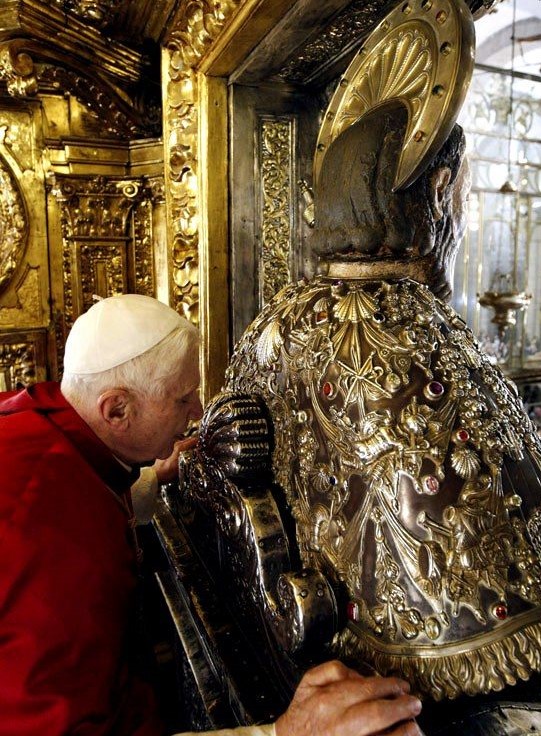
La Iglesia prohíbe el abrazo al Ápostol en la Catedral de Santiago

by INFOVATICANA

Los obispos de la provincia de Santiago de Compostela -que comprende toda Galicia- han emitido una nota sobre las medidas a tomar en relación al coronavirus. El cabildo de la catedral de Santiago de Compostela ha emitido también una nota en la que se ordena evitar el tradicional abrazo al Santo.

Nota de los obispos gallegos:

Atendiendo a las recomendaciones que la Consellería de Sanidade de la Xunta de Galicia nos ha hecho llegar para la prevención del contagio del coronavirus en el ámbito de las celebraciones litúrgicas y devocionales y a las indicaciones realizadas desde la Conferencia Episcopal Española, los obispos de la Provincia eclesiástica de Santiago de Compostela ofrecemos una serie de indicaciones con el objetivo de extremar las medidas de higiene adecuadas en los actos litúrgicos, especialmente en aquellos que conlleven acciones de besamanos a imágenes religiosas u otras manifestaciones externas de piedad popular” dice el comunicado de los obispos:

  1. Es conveniente retirar el agua bendita de las pilas que hay en las entradas de los templos y en otros lugares de devoción.
  2. Mantener la indicación de evitar dar la mano y otras formas de contacto físico en el rito de la paz; y recordar que, según lo previsto en las normas, es posible también prescindir de este rito en estas circunstancias, e invitar directamente a la preparación para la Comunión.
  3. Que los sacerdotes y los ministros extraordinarios que distribuyen la comunión durante la Eucaristía, se laven las manos antes y después de este momento. Se aconseja a los sacerdotes que para ello tengan un espray o líquido desinfectante en las sacristías y lo usen antes de celebrar los actos de culto.
  4. Que las muestras de devoción y afecto hacia las imágenes, tan propias de este tiempo de Cuaresma y en la próxima Semana Santa, puedan ser sustituidas por otras como la inclinación de cabeza ante las imágenes sagradas del Señor, de su Madre o de algún otro santo de especial devoción. El día de Viernes Santo en la adoración de la Cruz utilícese la segunda forma, nº 19 (Cf. El sacerdote, toma la cruz y, de pie ante el altar, invita al pueblo a que adore la Santa Cruz en silencio). Es necesario evitar todo tipo de contacto físico con cruces, medallas, escapularios, etc. que ya hayan sido besadas por otros fieles, facilitando, además, una mayor rapidez que evite aglomeraciones innecesarias.

La prudencia y la preocupación por el bien propio y del prójimo nos parecen razones suficientes para que también como Iglesia contribuyamos en lo posible a evitar circunstancias que puedan dar lugar a la expansión infecciosa del virus COVID-19. Vivir con fe esta situación nos pide igualmente no dejarse dominar por el miedo, como si no tuviésemos esperanza, dando así testimonio del destino de vida al que estamos llamados por Dios; y procurar ejercer la caridad en los modos adecuados: que nadie quede abandonado en nuestras comunidades parroquiales, ni quede sin respuesta el prójimo que necesite nuestra ayuda.

Los Obispos de la Provincia eclesiástica de Santiago de Compostela participamos de la creciente preocupación, los temores y ansiedades de la población por la rápida propagación del coronavirus a nivel mundial. Asimismo, agradecemos la generosa dedicación del personal sanitario y administrativo, auxiliares y voluntarios durante este periodo.

Queremos vivir estos momentos de dificultad unidos, como Iglesia; y, por eso, junto con las medidas y propuestas anteriores y, a la espera de ulteriores medidas que pudieran emitir las autoridades sanitarias, invitamos insistentemente a todos los fieles de esta Provincia eclesiástica de Santiago de Compostela a ser constantes en la oración por la salud pública y la de todos los afectados, y a confiar siempre en Dios Padre.

+ Julián, Arzobispo de Santiago.

+ Luis, Obispo de Tui-Vigo.

+ Alfonso, Obispo de Lugo.

+ José Leonardo, Obispo de Ourense.

+Luis Ángel cmf, Obispo de Mondoñedo-Ferrol.

+ Jesús, Obispo Auxiliar de Santiago.

Basándose en esta nota, el Cabildo de la Catedral de Santiago de Compostela, emitía a su vez otra nota, en la que se ordena evitar el abrazo al Santo. “Sólo se podrá hacer algún signo de reverencia a la Sagrada Imagen para evitar cualquier peligro de contagio”, reza el escrito.

Nota del Cabildo.

Siguiendo la normativa de la Consellería de Sanidad y la Nota de los obispos de Galicia, se podrá seguir subiendo al Camarín de Santiago. Pero sólo se podrá hacer algún signo de reverencia a la Sagrada Imagen para evitar cualquier peligro de contagio.

Agradecemos a los fieles y devotos su ayuda y comprensión para que se haga con el debido orden.

La entrada La Iglesia prohíbe el abrazo al Ápostol en la Catedral de Santiago se publicó primero en InfoVaticana.

07 Mar 19:58

Exhausted ‘Slay the Spire’ Fans Demand Developers Make Game Less Fun

by Kevin Flynn

NEW YORK — Emphasizing the fact that they really ought to start playing some other games that they’ve been meaning to get around to, a group of exhausted Slay the Spire fans banded together yesterday to demand that developer Mega Crit Games make the roguelike card game less fun immediately, sources confirmed.

“When I purchased Slay the Spire, I was expecting to be amused for a few minutes until I got bored of the game’s animations and presumably repetitive gameplay. But it’s actually a deep, captivating experience that I keep returning to no matter what other games I have waiting for me,” said one disgruntled fan, Chris Germain, adding regretfully that he still hasn’t been able to play many games released in the past few years since the game’s launch in 2017. “Of course, this is totally unacceptable. The least the developers could do is release a patch unbalancing things a little bit so I can shake my addiction. Oh, and also I want a refund, but that goes without saying.”

Others went as far as to boast that they could make a worse game themselves, saying that the changes that need to be made are “totally obvious.”

“I mean, come on, any amateur game developer could design a card battle system worse than that,” said disgruntled fan Brian McGovern in a Reddit post on r/gamedev. “All you have to do is take the three characters and mash them up into one character with an overly complicated skill tree. Extra points if the UI makes no sense, but of course, Slay the Spire’s got a terribly intuitive UI that makes it very easy to keep playing. They couldn’t even get that wrong.”

Despite a pessimistic outlook that developers would likely ignore their requests, sources say that the Slay the Spire modding community was confident that they would be able to ruin the game themselves.

Listen to the newest episode of our podcast, The Ace Watkins Presidential Hour:

The post Exhausted ‘Slay the Spire’ Fans Demand Developers Make Game Less Fun appeared first on The Hard Times.

07 Mar 15:45

Alumnas denuncian acoso sexual en la Escuela Superior de Arte Dramático gallega

by EFE

Alumnos y profesoras de la Escuela Superior de Arte Dramático (ESAD) de Galicia han denunciado este viernes episodios de acoso sexual y de abuso de poder de docentes a varias alumnas del centro, algunos de ellos sucedidos en cursos anteriores y otros en el actual.

Profesoras y alumnos exigen que los docentes en cuestión sean apartados, aunque sea temporalmente mientras se clarifique lo sucedido, y ya han puesto esta situación en conocimiento de la Consellería de Educación.

Fuentes de la Xunta confirman que dos inspectoras se entrevistaron con el equipo directivo y con el alumnado, con el que se asumió el compromiso de hacer un seguimiento del caso.

El sindicato de EEUU deniega al Teatro Real su informe sobre Plácido Domingo

EFE
El AGMA hizo público el pasado día 25 un comunicado en el que concluía tras una investigación iniciada en septiembre que el tenor madrileño tuvo "un comportamiento inapropiado"

Precisamente hoy se celebró una nueva reunión con el alumnado y representantes de la ESAD, en la misma jornada en la que las profesoras del centro han anunciado que secundarán los paros convocados por aquellos hasta que se aparte del ejercicio docente a los implicados en los presuntos episodios de abuso y de acoso que han sido denunciados.

Concentración de profesoras en apoyo a las alumnas que han denunciado acoso en Escuela Superior de Arte Dramático de Galicia. (EFE)Concentración de profesoras en apoyo a las alumnas que han denunciado acoso en Escuela Superior de Arte Dramático de Galicia. (EFE)Concentración de profesoras en apoyo a las alumnas que han denunciado acoso en Escuela Superior de Arte Dramático de Galicia. (EFE)

Las profesoras de la ESAD han leído un comunicado en el que trasladan su "apoyo total" al alumnado al objeto de que el centro sea "un espacio libre de abuso de poder y de acoso sexual".

"La ESAD no es solo un lugar laboral para nosotras, que como trabajadoras tenemos el derecho a desarrollar nuestra actividad en un espacio sin violencias machistas; es también lugar de convivencia consagrado a la formación de artistas y la educación en sentido amplio", reza el manifiesto.

Las profesoras de la ESAD han leído un comunicado en el que trasladan su "apoyo total" al alumnado

"Como creadoras y como personas comprometidas para formar mejores personas, libres, críticas y responsables, consideramos que estas prácticas execrables sucedidas durante el ejercicio docente son especialmente vergonzosas", denuncia también el texto leído por una profesora.

El grupo socialista pide poner nombres de mujeres a las líneas del Metro de Madrid

J. Corbacho
Pretenden instar a la Comunidad a añadir los nombres de 12 madrileñas célebres a los números identificativos de cada una de las líneas de Metro y combatir la "invisibilización"

Y añade: "El derecho a la educación no solo implica el acceso al saber, sino también el aprendizaje en los valores de libertad, igualdad y respeto por el derecho de las mujeres en cualquier espacio de nuestra sociedad".

"Exceden a comentarios"

Una portavoz de las profesoras de la ESAD ha señalado en declaraciones a los medios que no tienen un "conocimiento profundo de los hechos", pero que saben que "hay casos confirmados con declaraciones de alumnas ante la inspección" educativa.

"¡Qué piel más bonita tienes!": 11 años de cárcel para un tatuador por delitos sexuales

José Mari Alonso. San Sebastián
El condenado deberá indemnizar a las víctimas con más de 26.000 euros tras la sentencia que le considera autor de tres delitos de agresión sexual, seis de abuso, uno de acoso y otro de coacciones

Preguntada por cuántos profesores y cuántas alumnas estarían involucradas en los hechos denunciados, ha reconocido que desconocen este extremo, más allá de que son "varias" las presuntas víctimas de "comportamientos, que exceden a comentarios. Hablamos de violencia ejercida sobre las mujeres que estudian aquí", ha dicho la portavoz.

También ha recalcado que no se trata de "un episodio puntual" sino de hechos reiterados en el tiempo. Una portavoz de los alumnos de la ESAD ha asegurado que seguirán con los paros hasta que Educación "tome cartas en el asunto" y que los profesores implicados "no sigan en la docencia".

07 Mar 15:44

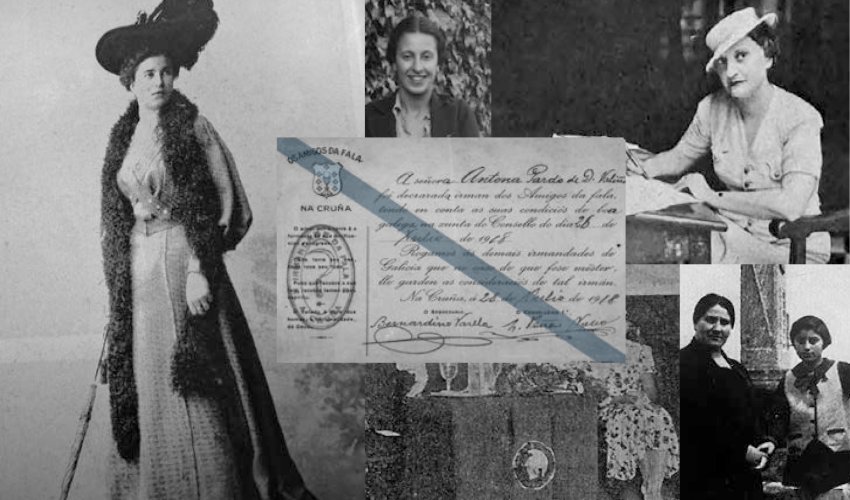
Irmandiñas: as mulleres esquecidas das Irmandades da Fala

O grupo feminino da Irmandade da Fala da Coruña contaba con máis de 200 asociadas cando celebrou, o 22 de decembro de 1918, unha xunta xeral para a escolla de directiva. Dúas mulleres foron designadas, pero ningunha tomou a palabra. Esta reveladora anécdota ilustra o propósito de 'Irmandiñas', o último libro de Aurora Marco

07 Mar 14:16

As deputadas que garanten o goberno do PP

Os populares xóganse a maioría absoluta nos catro escanos finais obtidos en 2016, para os que desta volta, nunhas listas finalmente sen membros de Ciudadanos nin Democracia Ourensana, concorren tres candidatos con experiencia no partido e a última conselleira en entrar na Xunta

07 Mar 14:15

‘Retrincos’: Xosé Manuel Beiras

by Redacción

“Son catedrático de sistemas económicos; nacionalista, desde que descubrín que o meu pobo era un pobo asoballado (…) e son de esquerda propiamente dita -marxista- porque cando falamos de pobo, falamos da xente que vive neste país e padece a historia que lle impoñen, e quero contribuír a que sexa protagonista da súa historia e da súa emancipación.”. Así se presenta Xosé Manuel Beiras neste Retrincos, no que debullamos a política e os movementos sociais galegos desde os anos 90 ata hoxe.

A sociedade civil e os partidos: “As eleccións son un mercado, e os votos cómpranse. As posibilidades de mudar a situación, de recuperar as liberdades efectivamente prácticas, de condición xustas, só se lograran mediante o motor que é a propia cidadanía.”

“As ferramentas das clases traballadoras, os partidos e os sindicatos hexemónicos, comezaron a fallar, e polo tanto, a orfandade é brutal. As clases traballadoras están inermes.”

O expolio das caixas galegas: “A cidadanía estaba preocupada das súas condicións de vida, brutalmente agredidas (…) A xente defendíase diso, non estaba en condicións de tamén ser unha forza cívica que se mobilizase para impedir que as caixas fosen regaladas a un banqueiro da contra venezolana.”

O fin do proceso de creba democrática e o goberno de coalición:

“O poder conseguiu domesticar á esquerda rebelde.”

“Non é un goberno de esquerdas, propiamente dita, se non progresista e antifascista.”

Ademais, falou das experiencias de AGE e En Marea, dos medios de comunicación galegos ou da evolución do BNG.

O artigo ‘Retrincos’: Xosé Manuel Beiras publicouse primeiro en Nós Televisión.

06 Mar 17:41

O PP modifica o vídeo de Los Limones: cambia o logo da Xunta por un polgar

by Europa Press
A xunta electoral consideraba inapropiado o uso de bandeiras ou emblemas do Goberno galego na peza musical
06 Mar 16:07

Francisco Calo, historiador: "Os galegos pescaban nas rías e non en Terranova porque non eran parvos"

by Héctor Pena
"Nacín no mundo mariñeiro. Aprendín a nadar entre peixes, son un deles. Tiven a sorte de poder estudar e chegar a ser catedrático de Xeografía e Historia, pero sigo sendo mariñeiro". Con esta autobiografía, ninguén mellor que o historiador...
05 Mar 22:31

A CRTVG propón un debate a seis o vindeiro 23 de marzo

by Europa Press
A compañía pública convida a PP, PSOE, BNG, Galicia en Común, Ciudadanos e Vox
05 Mar 21:20

If you loved HBO’s "The Deuce," The Rialto Report will leave you spellbound

by Matt Maranian

The Rialto Report is a podcast series and digital library that archives oral histories, images, magazines and books covering the golden age of the adult film industry in New York, from the early-1960s to the mid-1980s. It’s the project of adult film historians Ashley West and April Hall, both of whom served as consultants for HBO’s The Deuce.

Their podcast interviews are in-depth, intimate, and unrivaled, featuring some of the industry’s biggest and most influential names of the era; Seka, George Payne, Candy Samples, Hyapatia Lee, Jerry Butler, Candida Royalle, and Uschi Digard are among other well-and-lesser-known performers and industry stakeholders featured throughout the series.

Certainly, this “golden age” wasn’t exactly golden for all involved. Many performers—both women and men—were exploited, underpaid, mistreated, abused, or worse, and the Rialto Report doesn’t sugarcoat. Their interviews pull no punches and never miss an opportunity, allowing their subjects the space to share their perspectives and tell their own stories—many of them surprising, some of them shocking, all of them intriguing—bringing listeners to the inside of an opaque industry during New York’s epoch of the X-rated.