Shared posts

17 Feb 15:25

No Scrubs: Breeding a Better Bull

by Nicola Twilley

In 1900, the average dairy cow in America produced 424 gallons of milk each year. By 2000, that figure had more than quadrupled, to 2,116 gallons. In this episode of Gastropod, we explore the incredible science that transformed the American cow into a milk machine—but we also uncover the disturbing history of prejudice and animal cruelty that accompanied it.

Along the way, we’ll introduce you to the insane logic of the Lifetime Cheese Merit algorithm and the surreal bull trials of the 1920s. This is the untold story behind that most wholesome and quotidian of beverages: milk. Prepare to be horrified and amazed in equal measure.

New and Improved Bulls

Something extremely bizarre took place in the early decades of the twentieth century, inspired by a confluence of trends. Scientists had recently developed a deeper understanding of genetics and inherited traits; at the same time, the very first eugenics policies were being enacted in the United States. And, as the population grew, the public wanted cheaper meat and milk. As a result, in the 1920s, the USDA encouraged rural communities around the U.S. to put bulls on the witness stand—to hold a legal trial, complete with lawyers and witnesses and a watching public—to determine whether the bull was fit to breed.

Livestock breeding was a normal part of American life at the dawn of the twentieth century, according to historian Gabriel Rosenberg. The U.S., he told Gastropod, was “still largely a rural and agricultural society,” and farm animals—and thus some more-or-less scientific forms of selective breeding—were ubiquitous in American life.

Meanwhile, the eugenics movement was on the rise. Founded by Charles Darwin’s cousin, Francis Galton, eugenics held that the human race could improve itself by guided evolution—which meant that criminals, the mentally ill, and others of “inferior stock” should not be allowed to procreate and pass on their defective genes. America led the way, passing the first eugenic policies in the world. By the Second World War, twenty-nine states had passed legislation that empowered officials to forcibly sterilize “unfit” individuals.

Better Sires Better Livestock
A “Better Sires: Better Stock” accredited dairy herd.

Combine the growing population, the desire for cheap meat and milk, and the increasing popularity of eugenics, and the result, Rosenberg said, was the “Better Sires: Better Stock” program, launched by the USDA in 1919. In an accompanying essay, “Harnessing Heredity to Improve the Nation’s Live Stock,” the USDA’s Bureau of Animal Industry proclaimed that, each year, “a round billion dollars is lost because heredity has been permitted to work with too little control.” The implication: humans needed to take control—and stop letting inferior or “scrub” bulls reproduce!

Hear Ye! Hear Ye! Welcome to the Court of Bovine Justice

The “Better Sires: Better Stock” campaign included a variety of elements to encourage farmers to mate “purebred” rather than “scrub” or “degenerate” sires with their female animals. Anyone who pledged to only use purebred stock to expand their herd was awarded a handsome certificate. USDA field agents distributed pamphlets entitled “Runts and the Remedy” and “From Scrubs to Quality Stock,” packed with charts showing incremental increases of dollar value with each improved generation as well as testimonials from enrolled farmers.
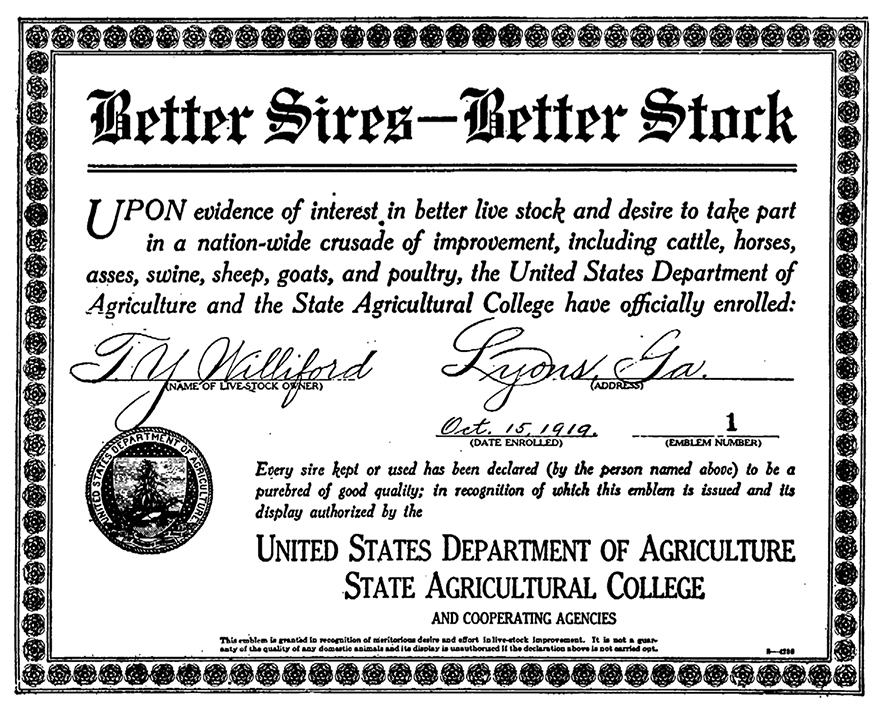
Better Sires Better Stock certificate The “Better Sires: Better Stock” certificate, awarded to farmers who pledged to use purebred rather than scrub bulls.

By far the most peculiar aspect of the campaign, however, came in 1924, when the USDA published its “Outline for Conducting a Scrub-Sire Trial.” This mimeographed pamphlet contained detailed instructions on how to hold a legal trial of a non-purebred bull, in order to publicly condemn it as unfit to reproduce. The pamphlet calls for a cast of characters to include a judge, jury, attorneys, and witnesses for the prosecution and the defense, as well as a sheriff, who should “wear a large metal star and carry a gun,” and whose role, given the trial’s foregone conclusion, was “to have charge of the slaughter of the condemned scrub sire and to superintend the barbecue.”

In addition to an optional funeral oration for the scrub sire and detailed instructions regarding the barbecue or other refreshments (“bologna sandwiches, boiled wieners, or similar products related to bull meat” are recommended), the pamphlet also includes a script that begins with the immortal lines: “Hear ye! Hear ye! The honorable court of bovine justice of ___ County is now in session.” The County’s case against the scrub bull is laid out: that he is a thief for consuming “valuable provender” while providing no value in return, that he is an “unworthy father,” and that his very existence is “detrimental to the progress and prosperity of the public at large.” Several pages and roughly two hours later, the trial concludes with the following stage direction: “The bull is led away and a few moments later a shot is fired.”

Within a month of publication, the USDA reported receiving more than 500 requests for its scrub-sire trial pamphlets. Across the country, the court of bovine justice was convened at county fairs, cattle auctions, and regional farmers’ association meetings, forming a popular and educational entertainment.
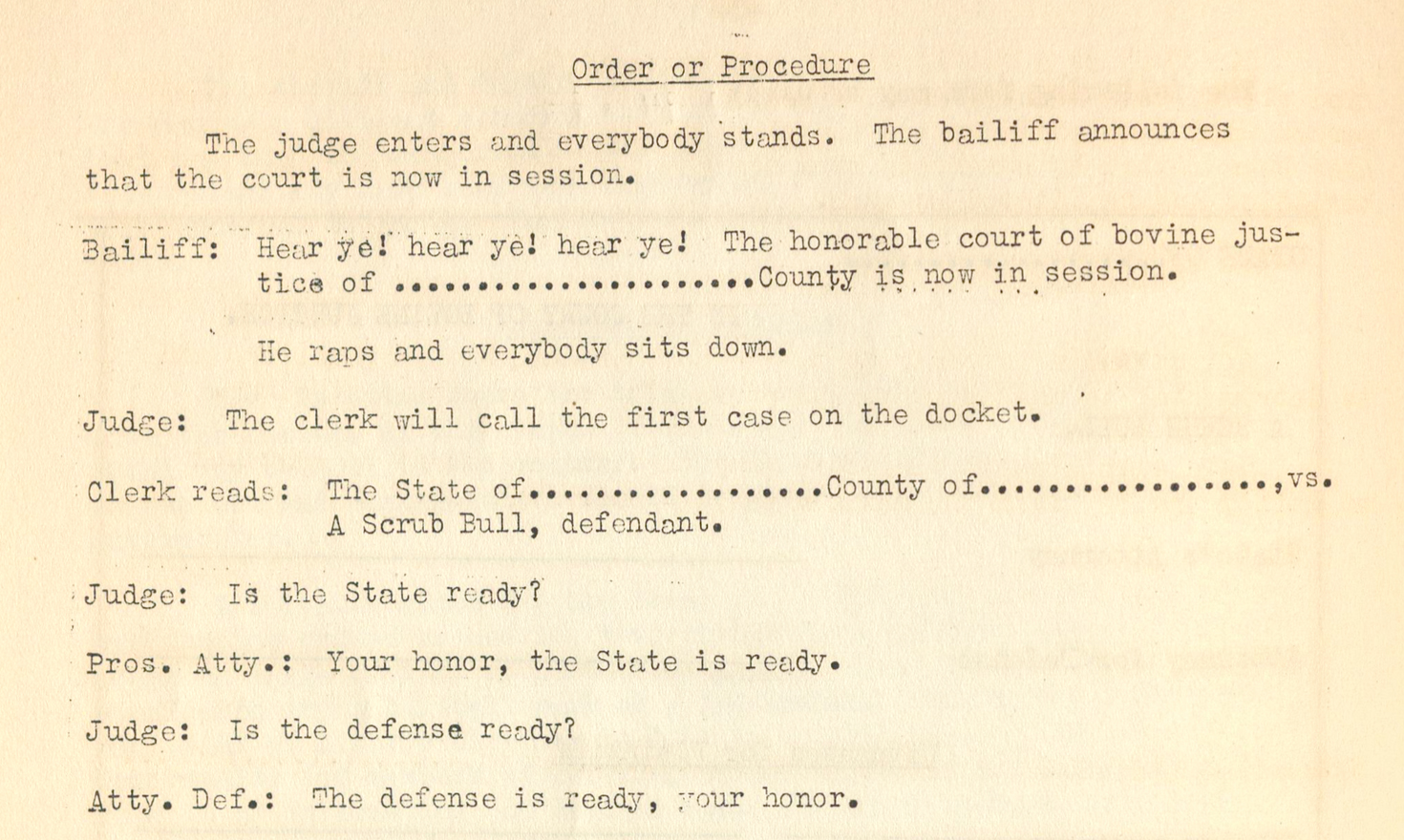
Order of ProcedureThe Order of Procedure, from the USDA’s “Outline for Conducting a Scrub-Sire Trial,” 1924.

The Genomic Bull

These bull trials may seem like a forgotten, bizarre, and ultimately amusing quirk of history, but, as Rosenberg reminded Gastropod, “they are talking about a lot more than just cattle genetics here.”

Indeed, the very same year—1924—that the USDA published its “Outline for Conducting a Scrub-Sire Trial,” the State of Virginia passed a Eugenical Sterilization Law. Immediately, Dr. Albert Sidney Priddy, Director of the Virginia State Colony for Epileptics and Feebleminded, filed a petition to sterilize Carrie Buck, an 18-year-old whom he claimed had a mental age of 9, and who had already given birth to a supposedly feeble-minded daughter (following a rape). Buck’s case went all the way to the Supreme Court, with Justice Oliver Wendell Holmes, Jr., upholding the decision in a 1927 ruling that concluded: “Three generations of imbeciles are enough.” Historians estimate that more than 60,000 Americans were sterilized in the decades leading up to the Second World War, with many more persecuted under racist immigration laws and marriage restrictions.
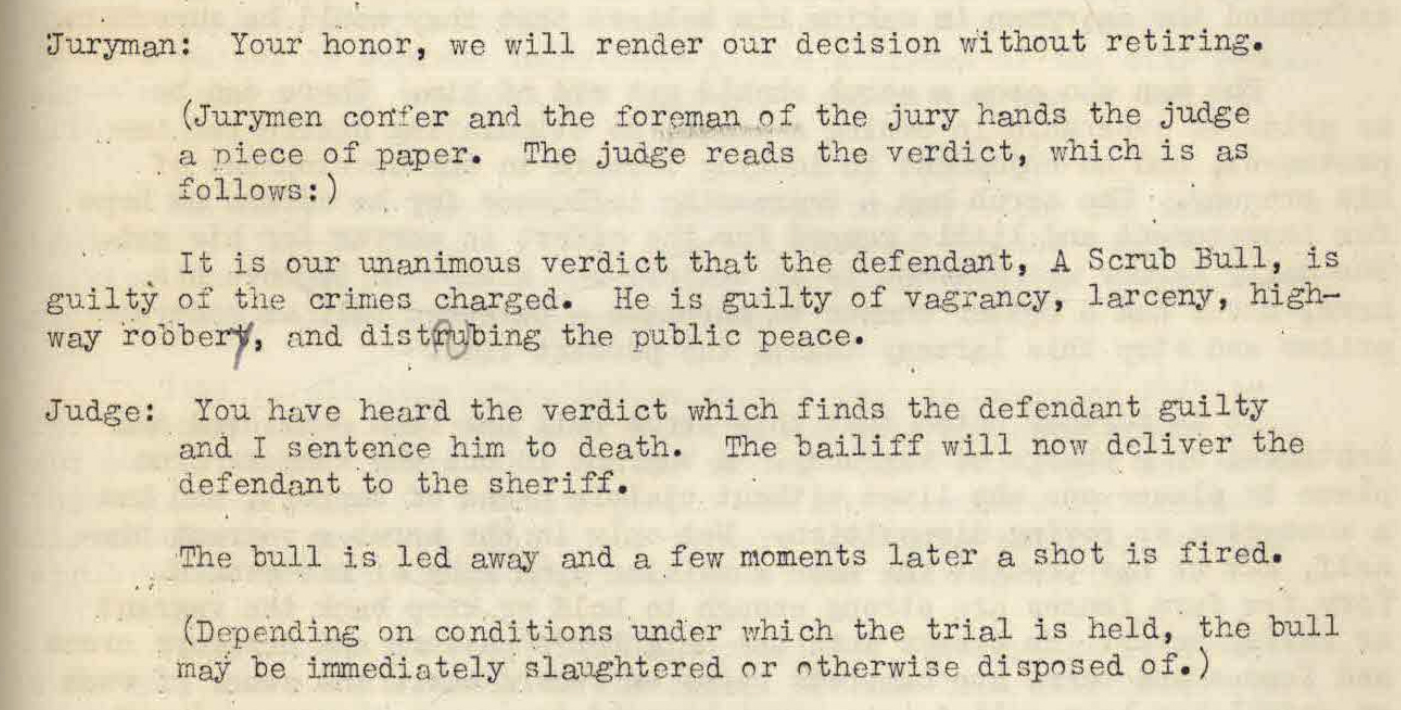
The verdictThe verdict (a foregone conclusion), from the USDA’s “Outline for Conducting a Scrub-Sire Trial,” 1924.

Eugenics, with its philosophical kinship to Nazism, largely fell out of favor in the U.S. by World War II. But the ideas promoted in the bull trials—that humans can and should take increasing control of animal genetics in order to design the perfect milk machine—have gained ground throughout the past century, as breeding has become ever more technologically advanced. As we discuss in this episode of Gastropod, the drive to improve dairy cattle through livestock breeding has led to huge innovations—in IVF, in genomics, and in big data analysis—as well as much more milk. But it has also continued, for better and for worse, to highlight the ethical problems that stem from this kind of techno-utopian approach to reproduction.

In this episode of Gastropod, we find out about the bull trials of the 1920s and meet the most valuable bull in the world, as we explore the history and the high-tech genomic science behind livestock breeding today. Along the way, we tease out its larger, thought-provoking, and frequently deeply troubling implications for animal welfare and society in general. Listen now!

Episode Notes

Alexis Madrigal’s “The Perfect Milk Machine”

Alexis Madrigal is currently Silicon Valley bureau chief for Fusion. This article, written while he was senior editor at The Atlantic, provides a terrific introduction to the concept of Lifetime Net Merit, to today’s “fast-paced bull semen market,” and to the (former) most valuable bull in America, Badger-Bluff Fannie Freddie. It’s a fantastic read.

Lifetime Net Merit

The Lifetime Net Merit algorithm for placing a dollar amount on the value a bull’s semen would add to his daughter’s productivity was developed by the USDA and introduced in 1994. You can read a short history of its subsequent evolution here.
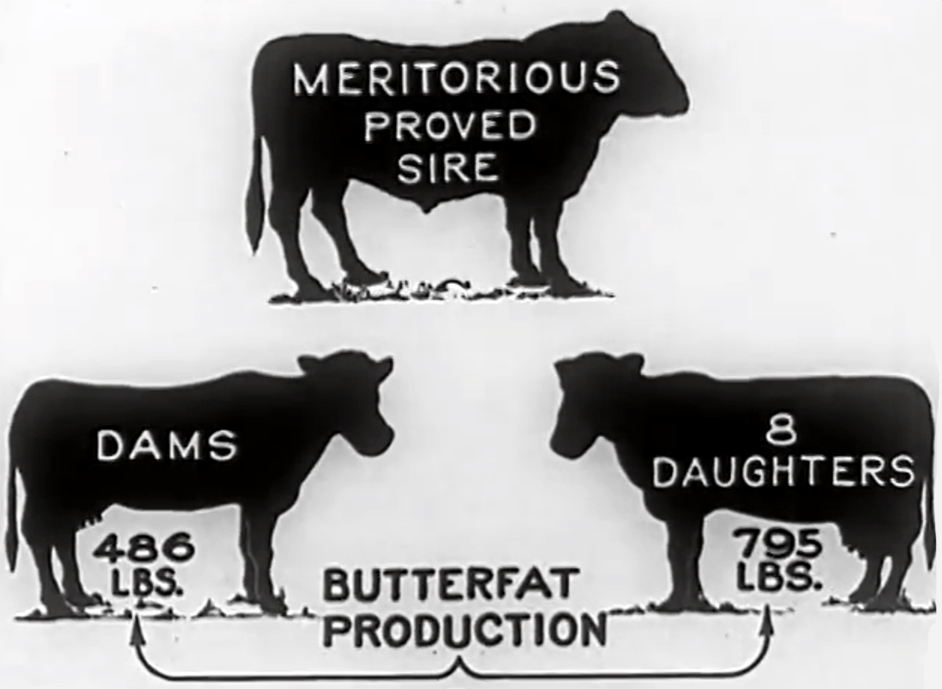
From USDA filmStill from “When the Cows Come Home,” a USDA Extension film, c. 1935, extolling the benefits of livestock improvement. At one point, the voiceover intones: “Domestic animals are supposed to be the slaves of man, but the man who owns a low-producing, non-profitable herd has this idea reversed.” Via the Prelinger Archive.

Heather Huson’s Odyssey Lab

Heather Huson is the Robert & Anne Everett Professor of Dairy Cattle Genetics at Cornell University. Her research uses genomic analysis to examine the evolution of heat adaptation, predisposition to mastitis, and population dynamics, including inbreeding, in the global dairy cow population. Outside the world of dairy cow DNA, she is part of the African Goat Improvement Project.

Dairy cow getting back scratched CornellA pampered dairy cow from the Cornell herd makes use of the back scratcher. Photo by Nicola Twilley.

Gabriel Rosenberg

Gabriel Rosenberg is an Assistant Professor in Duke’s Women’s Studies program, where his research explores the intersection between agriculture and human sexuality and gender. His first book, The 4-H Harvest: Sexuality and the State in Rural America, will be published later this year. He is currently working on a second book, Purebred: Making Meat and Eugenics in the Modern United States, which will cover the 1920s scrub-sire trials.

Michael Moss and the USDA’s Meat Animal Research Center, Nebraska

Michael Moss is a New York Times investigative reporter and author of Salt, Sugar, Fat. His recent article, “U.S. Research Lab Lets Livestock Suffer in Quest for Profit,” revealed shocking examples of sustained animal cruelty at the USDA’s Meat Animal Research Center in Nebraska. As we describe in the episode, Moss’s article has prompted widespread concern and legislative action. Tom Philpott’s response at Mother Jones is here, U.S. Secretary of Agriculture Tom Vilsack’s response is described in this Reuters story, and proposed bi-partisan legislation to remove the agricultural research loophole in animal welfare legislation is outlined here.

De Su Observer ET

De-Su-Observer-ET 500
De Su Observer ET, via Progressive Genetics.

In April 2013, De Su Observer ET toppled Badger-Bluff Fanny Freddie to become the most valuable bull in America, with a Lifetime Net Merit of $792.

According to a report in The Country Today, De Su Observer ET “transmits excellent production (1,602 pounds of milk) and protein (52 pounds and 0.02 percent).” In a press release, Select Sires semen providers claimed that his daughters “have exceptional udders (3.02 Udder Composite),” and “at 6 percent DBH (Difficult Births in Heifers), he’s a calving ease specialist.”

Genomic Bulls

In 2008, USDA began predicting Lifetime Net Merit scores based on the DNA of bulls that are too young to have sired daughters. (Previously, semen companies would have to wait four or five years, until the bull was old enough to have produced enough daughters to receive a Lifetime Net Merit score.) These so-called genomic bulls are typically better value for money than “proven” bulls, but carry the risk that their performance won’t match their genetic prediction.

The post No Scrubs: Breeding a Better Bull appeared first on Gastropod.

17 Feb 14:56

@Pats28Hawks24

by frimble
The Last Man game is an annual competition to be the last person in the United States to know who won the Super Bowl.
Most of the runners [...] found themselves waking up each day in a cold sweat. "I feel like I'm being sequestered for the stupidest jury trial in modern history," one competitor said. "It's gotten to the point where three things may end me: recklessness, homesickness, or sheer boredom." Several players eventually said that they couldn't take it anymore and quit. "I've spent way more time avoiding the Knowledge than I've ever spent thinking on it in the past," one said, committing seppuku with Twitter as his sword.
17 Feb 14:48

Obama accuses EU of attacking American tech companies because it 'can't compete'

by James Vincent

Barack Obama has angered officials in Europe after suggesting that investigations by the European Union into companies like Google and Facebook were "commercially driven." In an interview with Recode, the president claimed that European "service providers who … can’t compete with ours, are essentially trying to set up some roadblocks for our companies to operate effectively there." The truth, however, is more nuanced than this.

"our companies have created it, expanded it, perfected it."

Obama says: "We have owned the internet. Our companies have created it, expanded it, perfected it in ways that they can’t compete. And oftentimes what is portrayed as high-minded positions on issues sometimes is just designed to carve out some of their...

Continue reading…

17 Feb 00:25

God I love pickles

by pogolove
17 Feb 00:23

Lesley Gore (1946-2015)

by John Cohen
Lesley Gore, who sang "It's My Party" (live performance) and "You Don't Own Me," which Wikipedia calls a "proto-feminist" song (live performance + more), died of lung cancer at age 68 today in New York City.

An interview with her.

More songs:
California Nights
That's the Way Boys Are
She's a Fool
She didn't write her most famous songs, but she was a songwriter. In 1980, she was nominated for an Academy Award for Best Original Song for "Out Here on My Own," in the movie Fame. (She wrote that song with her brother, Michael Gore, who won the Oscar that year for a different song in the same movie.)

The manically happy "Sunshine, Lollipops, and Rainbows" was used in an episode of The Simpsons, "Marge on the Lam" (season 5).

She had a comeback in 2005, releasing a new album, Ever Since — her first since 1976. A couple songs from that album: "Cool Web" and "It's Gone."

ABC News notes:
Gore had been working on a stage version of her life with playwright Mark Hampton when she died.

She officially came out to the public when she hosted several episodes of the PBS series, "In The Life," which dealt with gay and lesbian issues.

During the 2012 presidential campaign, Gore turned "You Don't Own Me" into an online video public service announcement demanding reproductive rights which starred Lena Dunham and Tavi Gevinson, among others.
Previously.
17 Feb 00:22

WILSON PICKETT - The Atlantic Studio Recordings (1962-1978)

by Xena Dress


Wilson Pickett (18 de marzo de 1941 – 19 de enero de 2006) fue un cantante afroamericano de rhythm and blues y soul. Nacido en Prattville, Alabama (Estados Unidos), y más tarde establecido en Detroit, es una de la figuras más destacadas del soul sureño. Apodado Wicked Pickett. Cantó en grupos de gospel locales mudándose a Detroit en 1955. Estuvo con The Falcons entre 1961-63. Su carrera despegó después de grabar en Memphis con el guitarrista/productor Steve Cropper. El excelente sello Rhino Records ha publicado una preciosa caja con todo lo que grabó con el sello Atlantic. Su época de esplendor y donde se reúnen la mayoría de sus grandes éxitos. 154 temas del genial cantante concentrados en seis compacts y que por supuesto contienen alguna rareza para contentar a sus seguidores más fieles. En esta box-set, vendrá también un excelente libreto de 96 páginas con alguna foto inédita y un prólogo escrito por Steve Cropper. La presentación es de lujo a la altura de una leyenda como Wilson Pickett como no podía ser de otra manera. Pickett murió de un infarto al corazón el 19 de enero de 2006, a los 64 años de edad, en Reston, Virginia. Aquí tenéis la entrega de los seis  CDs.

LINK ALTERNATIVO (MEGA)
para bajar en block o individual

CECILIO
11/2/14
17 Feb 00:21

“My pug hates my kisses”

by Xeni Jardin

Keegan Osinski's dog doesn't care for her kisses. (more…)

16 Feb 20:58

How Does The Scoville Scale Measure The Exact Hotness Of A Pepper?

by Cheryl Eddy

The hottest chili ever measured rates a whopping 1,569,300 Scoville Heat Units, but what exactly does that mean? Where does the Scoville Scale come from? What exactly does it measure? And how do we end up with such a precise number to describe the heat sensation a pepper can produce?

Read more...


16 Feb 18:45

No te cruces con Marky Ramone en un concierto

by David Garcia

La irrupción de la tecnología asequible para la mayor parte de bolsillos es una gran noticia para la memoria musical. Ponte a buscar un testimonio videográfico del concierto de Buffalo Springfield en la academia militar de West Point el 25 de noviembre de 1967. No vas a encontrar.

Ahora, lo difícil es no encontrar como mínimo algún corte de cualquier concierto que se celebre en el mundo. Eso, que parece guay, lo es, pero tiene sus inconvenientes.

Más allá de la poca empatía que se puede llegar a sentir por una persona que prefiere ver un concierto a través de la pantalla de su móvil, el principal problema es de opacidad: la de los brazos alzados para obtener un toma decente. Esos peludos, interminables e incontables brazos que impiden ver a los intérpretes sobre el escenario.

¡Pues ya hay solución y la presenta un tipo de garantías! ¡Marky Ramone! Uno de los baterías de la legendaria banda neoyorquina presenta el Smartphone Swatter (Solution For Assholes Who Hold Up Phones At Concerts), un objeto de refinado diseño pensado para, directamente, arrebatar su teléfono al pesado de turno.

El sofisticado dispositivo consta de una baqueta a la que se adosa un vinilo de 7 pulgadas de Ramones. Su empleo está al alcance de cualquiera por presupuesto y por facilidad de uso ya que un simple y grácil giro de muñeca basta para recuperar la visibilidad durante el bolo.

yxpW7r

A falta de baquetas, la Organización Mundial de la Salud Musical recomienda utilizar palos de selfie dada la facilidad con la que se pueden conseguir. El propio Ramone asegura que su nueva autobiografía, Punk Rock Blitzkrieg es también un objeto adecuado para acabar con esta lacra.

El Smartphone Swatter no está, por supuesto, a la venta. «Sé un punk de verdad y haz uno tú mismo», dice Marky en el vídeo.

Este post No te cruces con Marky Ramone en un concierto, escrito por David Garcia, se publicó originalmente en Yorokobu.

16 Feb 17:05

Watch what happens when you toss a brick in a washing machine

by Mark Frauenfelder

Category: Entertainment -- Throwing bricks and other heavy objects into washing machines and recording their self-destruction.

A quicker way to do it:

16 Feb 16:56

Los enfermeros acudirán a la Fiscalía para que actúe contra las doulas

by EFE
Denuncian que estas «consejeras» de embarazadas llegan a fomentar el «canibalismo» con la «anuencia» de las autoridades
16 Feb 14:53

La Policía Local de Lugo se moviliza porque un perro negro ya se comió 8 cabritos

by Xosé Carreira
Las múltiples gestiones para localizar al can resultaron infructuosas
16 Feb 14:51

Why Americans still use Fahrenheit long after everyone else switched to Celsius

by Zack Beauchamp

Virtually every country on earth aside from the United States measures temperature in Celsius. This makes sense; Celsius is a reasonable scale that assigns freezing and boiling points of water with round numbers, zero and 100. In Fahrenheit, those are, incomprehensibly, 32 and 212.

This isn't just an aesthetic issue. America's stubborn unwillingness to get rid of Fahrenheit temperatures is part of its generally dumb refusal to change over to the metric system, which has real-world consequences. One conversion error between US and metric measurements sent a $125 million NASA probe to its fiery death in Mars' atmosphere.

Why does the United States have such an antiquated system of measurement? You can blame two of history's all-time greatest villains: British colonialism and Congress.

Fahrenheit was a great temperature system 300 years ago

Back in the early 18th century, the Fahrenheit measurement system was actually pretty useful. It comes from Daniel Gabriel Fahrenheit, a German scientist born in Poland in 1686.

As a young man, Fahrenheit became obsessed with thermometers. This may seem weird, but measuring temperature was a big problem at the time. No one had really invented a consistent, reliable way to measure temperature objectively. "Fahrenheit was still only twenty-eight years old when he stunned the world by making a pair of thermometers that both gave the same reading," the University of Houston's John Lienhard writes. "No one had ever managed to do that before."

As an early inventor of the thermometer as we know it, Fahrenheit naturally had to put something on them to mark out different temperatures. The scale he used became what we now call Fahrenheit.

Fahrenheit set zero at the lowest temperature he could get a water and salt mixture to reach. He then used a (very slightly incorrect) measurement of the average human body temperature, 96 degrees, as the second fixed point in the system. The resulting schema set the boiling point of water at 212 degrees, and the freezing point at 32 degrees.

In 1724, Fahrenheit was inducted into the British Royal Society, at the time a preeminent Western scientific organization, and his system caught on in the British Empire. "His fellowship in the Royal Society resulted in his thermometer, and thereby his scale, receiving particular acceptance in England," Ulrich Grigull, the former Chair of Thermodynamics at the Technical University of Munich, writes.

As Britain conquered huge chunks of the globe in the 18th and 19th centuries, it brought the Fahrenheit system (and some other peculiar Imperial measurements, such as feet and ounces) along with it. Fahrenheit became a standard temperature in much of the globe.

Why America still uses it

The Anglophone world ended up being an outlier. By the mid-20th century, most of the world adopted Celsius, the popular means of measuring temperature in the modern metric system. Celsius was invented in 1742 by Swedish astronomer Anders Celsius. "Celsius should be recognized as the first to perform and publish careful experiments aiming at the definition of an international temperature scale on scientific grounds," Uppsala University's Olof Beckman writes.

Around 1790, Celsius was integrated into the metric system — itself an outgrowth of the French revolution's desire to unify the country at the national level. The metric system's simplicity and scientific utility helped spread it, and celsius, throughout the world.

The Anglophone countries finally caved in the second half of the 20th century. The UK itself began metrication, the process of switching all measurements to the metric system, in 1965. It still hasn't fully completed metrication, but the modern UK is an overwhelmingly metric country.

Virtually every other former British colony switched over as well. Some did so before even the UK (e.g., India) and others after (e.g., Canada, Australia, South Africa). These changes, all around the same time, prompted the US to consider going metric itself.

It made sense to switch over, both because the metric system is more intuitive and because adopting the same system as other countries would make scientific cooperation much easier. Congress passed a law, the 1975 Metric Conversion Act, that was theoretically supposed to begin the process of metrication. It set up a Metric Board to supervise the transition.

The law crashed and burned. Because it made metrication voluntary, rather than mandatory, the public had a major say in the matter. And lots of people didn't want to have to learn new systems for temperatures or weights.

"Motorists rebelled at the idea of highway signs in kilometers, weather watchers blanched at the notion of reading a forecast in Celsius, and consumers balked at the prospect of buying poultry by the kilogram," Jason Zengerle writes in Mother Jones. Organized labor fought it as well, according to Zengerle, so workers wouldn't have to retrain to learn the new measures.

President Reagan dismantled the Metric Board in 1982, its work in tatters. Congress's dumb implementation of the law ensured that America would keep measuring temperature in Fahrenheit.

Today, the US is virtually alone in the world in staying off the metric system, joined only by Burma and Liberia (Burma announced its intent to metricate in 2013).

The US is needlessly hurting itself by sticking with Fahrenheit

The bizarre measurements commonly used in the US, including Fahrenheit, are bad for its scientific establishment, its kids, and probably its businesses.

Susannah Locke lays out the case for Celsius and the rest of the metric system very persuasively, but here's a brief recap. The simpler metric scales make basic calculations easier and thus less error-prone. American companies incur extra costs by producing two sets of products, one for the US and one for the metric using world.

American parents and caregivers are more likely to screw up conversion rates when they give out medicine, sending some children, who are more susceptible to overdoses, to the hospital. Further, American students have to be trained on two sets of measurements, making basic science education even more difficult.

So while Daniel Fahrenheit did the world a solid by inventing a reliable thermometer, his system for measuring temperatures has seen its day. America, it's time to adopt Celsius — and the rest of the metric system.

WATCH: The case against time zones

Like this video? Subscribe to Vox on YouTube.

16 Feb 14:19

Gravestones of The Russian Mafia

by A B

16 Feb 14:12

‘Caballero Luna. De entre los muertos’, golpe de autoridad

by Sergio Benítez

Moon Knight

Vertido en el transcurso del repaso a lo mejor del 2014 al otro lado del charco, el comentario no podía ser más claro: “Lo que los lectores de Marvel nos estamos encontrando mes a mes en ‘Caballero Luna’ NO ES NORMAL”. Y es que, dejándose seducir por el espíritu con el que Matt Fraction ha llevado a su ‘Hawkeye’ a lo más alto, La Casa de las Ideas nos regalaba a principios del año pasado un primer número de una serie de la que muy poco se podía esperar dado quien era su personaje central, un Marc Spector que pocas veces ha contado con un proyecto de cierto interés en el seno de la editorial más allá de las aventuras clásicas escritas por Doug Moench y dibujadas por Bill Swienkiewicz o, en menor medida (y de forma más reciente) en la miniserie firmada por Charlie Huston y David Finch (lo siento, soy de los que no soportaron lo que Bendis y Maalev plantearon entre 2011 y 2012).

Sea como fuere, y por más que un nombre de PESO como el de Warren Ellis respaldara esta nueva singladura del torturado héroe, la confianza en que el creador de ‘The Authority’ o ‘Planetary’ pudiera extraer algo consistente del vengador nocturno era, como poco, limitada. Craso error. Ya desde las primeras páginas que abren el volumen que Panini publicaba hace un par de meses, puede intuirse que lo que nos vamos a encontrar aquí nada tiene que ver con cualquier incursión previa que la editorial haya hecho en el universo de personaje, realizando Ellis toda una tabula rasa con el mismo para reiventarlo en unos modos que lo han colocado, como ya apuntaba más arriba, en una de las lecturas imprescindibles del cómic estadounidense del 2014.

Moon Knight Interior

Para conseguir tamaña hazaña el británico construye un relato en seis partes caracterizado, sobre todo, por el aparente talante autoconclusivo de cada una de sus entregas. Y digo aparente porque si bien las aventuras de la nueva dualidad Spector-Luna tienen en cada uno de ellos un foco diferente y se resuelven antes de llegar a las 24 páginas, hay de fondo una corriente que lo hilvana todo y mediante la que Ellis describe al personaje central como no habíamos visto hasta el momento. No es que, como sí pretendía Bendis, dicha descripción trate de alardear de una compleja vertiente psicológica de difícil aprehensión. Es que, aceptando aquélla en parte y mezclándola con las ansias de justicia del vengador, un sentido de la chulería alucinante y una apuesta por la acción sin palabras de impresión, el personaje que encontramos en las páginas de este soberbio volumen es uno que supera con mucho la media de lo que puede leerse hoy por hoy en el seno de la editorial.

De que esto se consiga es directo responsable (obviamente) un artista llamado Declan Shalvey. Salido, como quien dice, de la nada (trabajos previos suyos incluyen números de ‘Masacre’ y ‘Veneno’ que servidor ni ha olido), las páginas del dibujante son equiparables a las que David Aja ha ido plasmando en ‘Hawkeye’, esto es, ejercicios narrativos arriesgados que no dejan respiro al lector y que nos retan a no perder de vista lo que pasa en unas viñetas que no podrían ser más fascinantes. Y si bien cualquiera de los seis números incluídos aquí servirían para ilustrar los logros de Shalvey, me quedo con lo que podemos disfrutar en las páginas del segundo y el quinto, en las que el artista da lecciones espectaculares de cómo escenificar secuencias de combate en unos modos que sólo pueden ser definidos como magistrales.

Con Ellis fuera de la serie en su número siete, podemos adelantar que lo que Brian Wood lleva desarrollado en los cinco ejemplares aparecidos hasta la fecha está a la altura de las circunstancias y nada tiene que envidiar a lo planteado por su antecesor, algo también aplicable a las páginas dibujadas por Greg Smallwood, francamente impresionantes. Sólo resta esperar y confiar (aunque a priori cueste dado lo irregular de su trayectoria) que Cullen Bunn sepa recoger el testigo a partir del 13 y que Ron Ackins, su compañero en la tercera etapa de esta nueva singladura de Marc Spector, no nos haga afirmar eso de que “cualquier tiempo pasado fue mejor”. Sea como sea, aquí seguiremos para contároslo.

Otra reseña en Fancueva | ‘Caballero Luna: De entre los muertos’, de Warren Ellis y Declan Shalvey

Caballero Luna. De entre los muertos

  • Autores: Warren Ellis & Declan Shalvey
  • Editorial: Panini
  • Encuadernación: Rústica con solapas
  • Páginas: 136 páginas
  • Precio: 12,50 euros
16 Feb 14:07

5 Fitness Myths You Believe (That Don't Work At All)

By Michael Hossey,Ivan Farkas  Published: February 16th, 2015 
16 Feb 11:27

Juna José Lema Negrillo: «El urbanismo convirtió a Conxo en el barrio mártir de Compostela»

by Xosé Manuel Cambeiro
Sin los viejos municipios, Santiago sería «la Catedral y cuatro calles más»

16 Feb 11:11

Martin Luther playset is the best-selling toy of all time

by Cory Doctorow


Playmobil's German "Little Luther" toy sold 34,000 pieces in 72 hours. Read the rest

16 Feb 02:21

George R. R. Martin Says Game Of Thrones Is Gonna Kill Characters Who Didn’t Die In the Books - Dammit.

by Alanna Bennett

George R.R. MartinObviously a lot of people die on Game Of Thrones. A lot of people die in A Song Of Ice And Fire, after all. But George R. R. Martin has now warned that, yep, the show is gonna start* killing people who didn’t die in the books:

People are going to die who don’t die in the books, so even the book readers will be unhappy. So everybody better be on their toes. [David Benioff and D.B. Weiss] are even bloodier than I am.

Welp. At least twitter will be particularly entertaining when these episodes air?

Edit: They’ve totally already killed people who are still alive in the books. But there’s something about what Martin’s saying here that sounds particularly ominous. Or maybe that’s just…George R. R. Martin?

(via Winter Is Coming) (AP Photo/HBO, Nick Briggs )
Are you following The Mary Sue on Twitter, Facebook, Tumblr, Pinterest, & Google +?

16 Feb 02:20

Transmetropolitan: guía de lectura

by Eme A

Transmetropolitan 1

ECC Ediciones está empezando a publicar una nueva edición de Transmetropolitan (además en un formato idóneo para la obra: serán diez volúmenes bimestrales de 144 páginas en tapa blanda), así que es el momento para dedicarle unas líneas a uno de los tebeos más destacados de los años de entresiglos

La historia

Spider Jerusalem es un periodista retirado que vive solo en el campo, asqueado del mundo. Pero no es un periodista cualquiera, es el mejor periodista del mundo, con la inteligencia y las agallas necesarias para derribar gobiernos. El problema es que también es el ser más desagradable e insoportable que existe. Claro que el mundo en que se mueve también es desagradable e insoportable: un futuro dixtópico que no sería tan terrible si no fuera el reflejo de nuestro presente (Transmetropolitan ha sido catalogado a menudo como cyberpunk)

El punto de arranque de la historia es que un día su editor va a buscar a Spider Jerusalem a su retiro con una oferta que este no puede rechazar. Y así empieza el peor año de su vida

La colección

Transmetropolitan duró sesenta números en Estados Unidos, entre 1997 y 2002. Cinco años sin especiales, ramificaciones ni secuelas, y todos a cargo del mismo equipo artístico: el guionista Warren Ellis y el dibujante Darick Robertson, dando como resultado una obra sólida y cerrada

Ediciones españolas

La primera edición española fue la de Norma Editorial, entre 2000 y 2004, en paralelo a su edición original, en su formato habitual en aquellos tiempos: miniseries y tomos únicos dentro de la colección Vertigo

Posteriormente Planeta DeAgostini Cómics reeditó la obra entre 2006 y 2009. Empezó publicando dos episodios originales por número español, pero a la altura del 15 cambió el formato a seis episodios por tomo, y ralentizó la periodicidad de la serie

Así pues, la edición de ECC de la que hemos hablado en la introducción será la tercera que vea la luz en nuestro país. Esta es la tabla de equivalencias entre las distintas ediciones:

Original Norma Planeta ECC
1 De nuevo en la calle 1 1 1
2 De nuevo en la calle 1 1 1
3 De nuevo en la calle 2 2 1
4 De nuevo en la calle 2 2 1
5 De nuevo en la calle 3 3 1
6 De nuevo en la calle 3 3 1
7 De nuevo en la calle 4 4 2
8 De nuevo en la calle 4 4 2
9 Mátame a besos 1 5 2
10 Mátame a besos 1 5 2
11 Mátame a besos 2 6 2
12 Mátame a besos 2 6 2
13 El año del bastardo 1 7 3
14 El año del bastardo 1 7 3
15 El año del bastardo 2 8 3
16 El año del bastardo 2 8 3
17 El año del bastardo 3 9 3
18 El año del bastardo 3 9 3
19 La nueva escoria 1 10 4
20 La nueva escoria 1 10 4
21 La nueva escoria 2 11 4
22 La nueva escoria 2 11 4
23 La nueva escoria 3 12 4
24 La nueva escoria 3 12 4
25 ¡Acoso y derribo! 13 5
26 ¡Acoso y derribo! 13 5
27 ¡Acoso y derribo! 14 5
28 Ciudad solitaria 1 14 5
29 Ciudad solitaria 1 15 5
30 Ciudad solitaria 2 15 5
31 Ciudad solitaria 2 16 6
32 Regreso a los orígenes 1 16 6
33 Regreso a los orígenes 1 16 6
34 Regreso a los orígenes 2 16 6
35 Regreso a los orígenes 2 16 6
36 Regreso a los orígenes 3 16 6
37 Regreso a los orígenes 3 17 7
38 Regreso a los orígenes 4 17 7
39 Regreso a los orígenes 4 17 7
40 Réquiem 17 7
41 Réquiem 17 7
42 Réquiem 17 7
43 Réquiem 18 8
44 Réquiem 18 8
45 Réquiem 18 8
46 Sale el sol 18 8
47 Sale el sol 18 8
48 Sale el sol 18 8
49 Sale el sol 19 9
50 Sale el sol 19 9
51 Sale el sol 19 9
52 El canto del cisne 19 9
53 El canto del cisne 19 9
54 El canto del cisne 19 9
55 El canto del cisne 20 10
56 El canto del cisne 20 10
57 El canto del cisne 20 10
58 El canto del cisne 20 10
59 El canto del cisne 20 10
60 El canto del cisne 20 10

En resumen

Transmetropolitan es una obra imprescindible si te gusta la ciencia ficción (la de verdad, la que sirve para reconocer los problemas del mundo real, y no la space opera con la que a menudo se confunde), la sátira política y el humor negro, y tienes una alta tolerancia a las situaciones desagradables

El artículo Transmetropolitan: guía de lectura apareció primero en GenComics.

16 Feb 02:10

One, Two, Three Litters of Puppies!

by Andrew Bleiman

African Painted Pups at Port Lympne Reserve c Dave Rolfe1

Keepers at Great Britain’s Port Lympne Reserve are celebrating as not one but three litters of endangered African Painted Dog puppies make their public debut.

Mum and pup at Port Lympne Reserve c Dave Rolfe
African painted pups get their health checks at Port Lympne Reserve c Dave Rolfe
Photo Credit:  Dave Rolfe


The puppies, a mix of males and females, are now three months old and bring the number of African Painted Dogs at the reserve to 43, split between five packs.

Adrian Harland, Animal Director, explained that a recent health check showed that all the pups are strong and healthy.  Keepers administered vaccinations and weighed each pup.

African Painted Dogs are one of the most effective hunters in the world and will normally live in packs of 20 to 40 members. Found mainly in Southern Africa, experts estimate that as few as 3,000 African Painted Dogs remain in the wild.  Conflicts with humans encroaching on their habitat, illegal hunting, and risk of disease are all factors in their decline.

Breeding programs in zoos and reserves are important to the future of this unique species.

See more photos of the puppies below.


African painted puppy at Port Lympne Reserve c Dave Rolfe
African painted dog puppy and Mum at Port Lympne Reserve c Dave Rolfe
African Painted Pups at Port Lympne Reserve c Dave Rolfe (3)
Painted pups at Port Lympne c Dave Rolfe 5
Port Lympne Reserve has 3 litters of African Painted Pups c Dave Rolfe
Painted pups at Port Lympne Reserve c Dave Rolfe 3
2 painted pups at Port Lympne Reserve c Dave Rolfe
African painted pups at Port lympne Reserve c Dave Rolfe (2)
An African Painted Pup is checked over by the keepers c Dave Rolfe
Feeding time for African painted puppy at Port lympne Reserve c Dave Rolfe
Head Keeper Richard Barnes holds a painted pup at Port Lympne Reserve c Dave Rolfe


16 Feb 02:10

Talbots Bags to Masturbate Under During ‘Fifty Shades of Grey’

by Orli Matlow

Ladies, the time has come! We have been wandering the strip mall waiting to see this movie, longing to feel something this exquisite for years. We’re going to embrace our submissive urges in that three-hour window between dropping the kids off at soccer and dinner with the in-laws, and we’re going to do it right – with our Talbots bag in tow. Here are our favorite Talbots bags to place on your lap as you stroke your inner goddess:


Striped Zip-Top Tote

striped tote

This tote is big enough to serve as a diaper bag, so you can fit all your basic needs for doing the deed. Anastasia loved that baby oil on her ass, so why shouldn’t you pour some down your shapewear? When you’re beating the beaver to Christian Grey, those hand wipes aren’t going to be the only Wet Ones!


Leopard Print Haircalf Top-Flap Shoulder Bag

leopard

Close the flap of this bag, and open your own! Wearing leopard print has been the most rebellious thing you have done since the time you and your husband pretended to be asleep so Susie would just go back to her room to cry – until now, that is! You’ll be slamming that clam just a theater away from your son and his friends seeing The SpongeBob Movie. Christian Grey would approve!


Straw Tote Bag

Straw tote

This isn’t your daughter’s masturbation handbag! This bag is big enough to conceal the masturbatory activities of even the heftiest among us. The neutral beige tone will also match any pashmina you choose to wrap around your head in case anyone you know is in the theater.


Printed Double-Handle Tote

 printed double handed

Nothing says wild woman like a fun print! And if anyone in the theater starts to suspect you’re flicking the bean under that popcorn, your movements will by camouflaged by this graphic pattern. Just let go and let yourself be dominated – by yourself!


Trust me, ladies: This experience will be as rewarding as the first time you picked up the book at the airport, and read it on a flight that was shaking with turbulence.


Talbots Bags to Masturbate Under During ‘Fifty Shades of Grey’ is a post from: Reductress

16 Feb 02:08

I Know What’s Best For The Health of My Family, And It’s Magical Thinking

by Laura Buchholz

I’m a mom, a wife, a doula, an urban chicken farmer, a life coach, an extended breast-feeder, a weaver, a kombucha brewer, a yogini, and a Therapeutic Healing Touch practitioner. But most importantly, I’m a mom. And as a mom, I know what’s best for the health of my family: magical thinking.


I’m not stupid. I went to college. I took science classes. So I know about microbiology, infection control, anatomy, physiology, and all that. I am fully aware that the scientific method – including use of a control group, randomization, double-blind studies, and the peer review method – is the best tool we humans have of unlocking the secrets of the natural world to find ways of curing disease.


Science is great. It’s done a lot of good for the world, to be sure. It’s just not right for me or my family.


We have opted for a more controversial but totally natural method called “Please No Bad.” Periodically, as a family, we’ll squeeze our eyes shut, cover our ears, and chant, “Please no bad.” This chemical-free protective measure has worked for us so far and we’re going to keep on using it, despite the hatred we receive from others.


I’m not just talking about vaccines, but we can start there. A lot of people have judged us harshly in recent days for not vaccinating our nine young children. That’s fine. I myself was held down and vaccinated when I was young. I understand that vaccines bolster vulnerable immune systems by stimulating your body’s natural defenses against disease without actually giving you the disease. I understand that vaccines are safe and effective, and that herd immunity is the best way we have to ensure that young or immunocompromised children don’t get sick and die from terrible infectious diseases that until relatively recently, were commonplace. I get it. And if you want to live and die by the wholly effective, risk-free, and affordable breakthroughs that Western medicine has produced, that’s fine. That’s your right.


But don’t expect me to come along on that joyride of lies.


Here’s what I do believe in: toxins. I believe that toxins are in everything, and even though I can’t exactly articulate what these toxins are or where they come from or where they live in my body or what they’re doing that’s apparently threatening my life, I know they’re there. And as a mother, you can be damned sure I’m going to do everything in my power to make sure that these imaginary toxins don’t get into the pure white light embodiment of the physical plane occupied by my nine beautiful children. My husband and I practiced magical thinking as a form of birth control, and we have had sex way more than nine times. How’s that for proof?


I believe most illnesses can be cured by eating garlic. Yes, even scoliosis. It’s something about the pH balance being off, and garlic fixes that. When in doubt, eat more garlic. I eat it raw, like a tiny apple, sixteen to seventeen heads of garlic a day. My skin has never felt so soft.


Whenever a friend gets cancer, I make sure to tell her about the power of vitamin C and a can-do attitude. I’ve lost so many friends to the acidic nightmare of chemotherapy. They’re still alive; we just don’t talk anymore. Thanks a lot, Big Pharma.


Don’t get me started about sugar. Don’t get me started about gluten. Don’t get me started about mercury or fluoride. Because I will literally never stop talking about it.


Do get me started about the healing vibrations of singing anything in the key of A major. Do get me started about eating for your blood type, skin type, and hair color. I could go on for days about the mystical properties of a dried tangerine peel. These are the things that I believe, and it’s my right. It’s also what my children believe, because they have to.


I don’t expect you slaves to the mainstream Western corporate industrial complex to understand this. I don’t go around forcing my beliefs on you like you go around forcing your vaccines on helpless unsuspecting children who want nothing more than to overcome measles, mumps, and rubella the natural way. Blindness isn’t even that bad. If my child were to become blind, at least he wouldn’t see all the glares from ignorant outsiders who wish I’d bring him to the doctor. At least he wouldn’t see that.


So if you don’t let my kids back into the public schools on Monday, I’m going to get a lawyer and sue this school district so hard it won’t know what hit it. What hit it, in fact, will be polio.


Hey, here’s a crazy idea: Let’s all learn to live in peace with everyone, even the life-threatening virulent microorganisms with whom we share this precious and astounding earth plane. Life is so magical, and we honor that magic only when we engage in magical thinking.

I Know What’s Best For The Health of My Family, And It’s Magical Thinking is a post from: Reductress

16 Feb 02:06

5 Popular Figures of Speech That Have Creepy Hidden Meanings

By Cracked Writers  Published: February 15th, 2015 
15 Feb 18:54

Mission: Impossible

by noreply@blogger.com (Snidely Whiplash)

1 Sarah Vaughan: Peter Gunn
2 Barbara Acklin: Am I The Same Girl (= "Soulful Strut")
3 Eddie Rambeau: Summertime Guy (= "Newlywed Game theme")
4 Johnny Mathis: Midnight Cowboy
5 Gary Glitter: Rock And Roll (pt. 1)
6 Richard Anthony: Take Five
7 Claudine Longet: Sleep Safe And Warm (= "Rosemary's Baby" theme)
8 Lorne Greene: Bonanza
9 Sammy Davis, Jr.: You Can Count On Me (= "Hawaii Five-0" theme)
10 Sonny James: Apache
11 Tommy Leonetti: Walk Don't Run
12 Cliff Nobles: Love Is All Right (= "The Horse")
13 Free Design: A Man And A Woman
14 Kathy Kirby: Spanish Flea
15 The Hands Of Time: Blue's Theme
16 Bobby Rydell: The Cha Cha Cha (= "Rinky Dink")
17 Pat Boone: Baby Elephant Walk
18 Darla Hood: My Quiet VIllage
19 We Five: Cast Your Fate To The Wind
20 The Supremes: Sleepwalk
21 Ann-Margret: My Last Date
22 Little Anthony & The Imperials: Exodus Song
23 Frankie Laine: Misirlou
24 Bobby Rydell: Telstar
25 Andy Williams: Music To Watch Girls By
26 Nichelle NIchols: Star Trek Theme
27 Andy Williams: Stranger On The Shore
28 Tamiko Jones & Herbie Mann: A Man And A Woman
29 Sy Oliver & His Orch.: Caravan
30 Lou Rawls: Soul Serenade
31 The Kane Triplets: Mission Impossible

MISSION: IMPOSSIBLE


15 Feb 18:51

El conflicto de los conciertos en los pubs se extiende al Ensanche

by P. Calveiro
Cancelan las actuaciones por denuncias «fantasma» y amenaza de multas

15 Feb 00:22

The Gaeneviad

by jenkinsEar
French cartoonist Boulet creates a sweet tale for St. Valentine's day. Slightly NSFW.

Boulet Previously:
On Harry Potter
Kingdom's Lost
A Day at the Park
14 Feb 23:33

Harmonie Ensemble / New York – Henry Mancini: Music for Peter Gunn (2014)

by exy

Harmonie EnsembleThe music on this recording will seem so familiar, that it may be difficult to imagine how much of a novelty it was when it first appeared. It was, in the words of annotator John Caps, “the first dramatic jazz to reach a general audience.” The qualifiers are necessary, for jazz had certainly appeared in films prior to the television series Peter Gunn in 1958. But it generally connoted the underside of society, as in the jazz-flavored score of The Man with the Golden Arm (1955). The use of jazz to evoke a kind of urbane sophistication began with Henry Mancini‘s score to Peter Gunn, and the usage remains current in the second decade of the 21st century. What one hears here, in other words, is some of the most influential music of the 20th century, and it’s good to have the whole score…

320 kbps | 115 MB  UL | HF | MC ** FLAC

…rather than just the ubiquitous walking-bass theme. One thing to get out of it is the ingenious way Mancini and the series’ writers made the music both diegetic and extra-diegetic, as the film theorists say: both part of the action and external to it. The music is heard from the band at the roadhouse called Mother’s where private detective Gunn meets his clients, but it also serves as conventional background music. One of the ingenious elements of Mancini’s score is that, although the cuts are short, he blurs the boundary between these and produces a cohesive whole; the main theme seems to propel the listener forward into the action of each episode, and it is picked up in parts in individual numbers like the rock & roll-influenced Spook (track 15). Mancini’s lively and varied orchestration was influenced by that of jazz bandleaders Tex Beneke and Duke Ellington, but much of it, as well as the hooky melodic sense, is pure Mancini. New York’s Harmonie Ensemble performs the music essentially as written, but the musicians freely interpret it as to emotion and affect as might be done with any classic musical text. The result is an album as intriguing as it is just plain enjoyable. — AMG

14 Feb 23:17

Timehop realizes you might not want to see photos of your ex on Valentine's Day

by Lizzie Plaugic

Break-ups are rough, but on days like today (it's Valentine's Day, if you managed to forget), being alone can be especially difficult. That's why Timehop's Valentine's Day warning screen is the best example we've seen recently of a company recognizing that humans are really just extraordinarily delicate balls of surging emotions.

If you log in to the time capsule app today, you'll see a cheery-looking warning screen:

The graphic for #Valentimehop reminds you that if you go hunting for memories of Valentines past, you're in for a heavy dose of "exes and feels." If you're feeling emotionally solid, you can continue on, or you can heed the warning and walk away. Given Facebook's recent Year in Review debacle, in which users were...

Continue reading…

14 Feb 23:17

It's like a bad movie plot, only IRL.

by daq
"Kaspersky Lab says it has seen evidence of $300 million in theft from clients, and believes the total could be triple that." The New York Times reports that hackers have pulled off the first successful bank heist from banks in Russia, Japan, the U.S., and Europe.

"The American Bankers Association declined to comment, and an executive there, Douglas Johnson, said the group would let the financial services center's statement serve as the only comment. Investigators at Interpol said their digital crimes specialists in Singapore were coordinating an investigation with law enforcement in affected countries. In the Netherlands, the Dutch High Tech Crime Unit, a division of the Dutch National Police that investigates some of the world's most advanced financial cybercrime, has also been briefed."

Ars Technica is also following the story, and will likely have a technical detail updated once more information from Kaspersky Labs is released on Monday.