Shared posts

15 Mar 00:32

Blue Demon's Mexican Rock And Roll Favorites - LP (Numero Uno, 1988)

by caveman78
Side 1
    1 Los Hooligans - Pitagoras (Mexico) *
    2 Los Ovnis - Mother's Little Helper (Mexico City, Mexico)
    3 Los Apson - Viaje Submarino (Agua Prieta, Mexico) *
    4 Los Monstruos - We've Gotta Get Out Of This Place (Guadalajara, Mexico)
    5 Los Teen Tops - Good Rockin' Tonight (Mexico) *
    6 Los Locos Del Ritmo - Morelia (Mexico) *
    7 Los Rockin' Devils - Let The Good Times Roll (Tijuana, Mexico) *
    8 Los Apson - El Tren (Agua Prieta, Mexico) *
    9 Los Psicodelicos Xochimilcas - Susie Q (Mexico) *

Side 2
    1 Los Monstruos - Mama Keep Your Big Mouth Shut (Guadalajara, Mexico)
    2 The Crazy Boys - El Nino Popis (Mexico) *
    3 Los Hitters - Mary Y Juana (Mexico City, Mexico) *
    4 Los Strwck - Rompiendo Corazones (Mexico) *
    5 Los Strwck - Dijiste No (Mexico) *
    6 Los Locos Del Ritmo - Peter Gunn Theme (Mexico)
    7 Los Johnny Jets - Call Me Lightning (Reynosa, Mexico) *
    8 Los Freddy's - Hang On Sloopy (Mexico) *
    9 Los Babys - Ghost Riders In The Sky (Mexico) *
15 Mar 00:25

4 Things Kids Never Learn (Because Parents Teach Them Badly)

By Felix Clay  Published: March 14th, 2015 
15 Mar 00:23

Yo no he sufrido violencia de género, pero…

by Pikara Magazine
Nota: Este artículo se enmarca en la sección de libre publicación de Pikara, cuyo objetivo, como su nombre indica, es promover la participación de las lectoras y lectores. El colectivo editor de Pikara Magazine no se hace responsable ni del contenido ni de la forma de los artículos publicados en esta sección, que no son editados. Puedes mandar el tuyo a participa@pikaramagazine.com. Rogamos claridad, concisión y buena ortografía.
14 Mar 20:32

Gamergate scandal convinced 4chan founder Moot to leave the site

by Dante D'Orazio

This past January, when Christopher "Moot" Poole announced that he was stepping down as chief of online message board 4chan, he was vague as to what had led to his decision. But Rolling Stone's David Kushner reports that the extremely volatile "Gamergate" movement gave Poole the resolve he needed to leave the site he founded.

In an interview, Poole says that when both Gamergate and a separate controversy surrounding a number of nude celebrity photos came to life on 4chan last September, it was "probably the most stressful month of my life." As he explains, "Week after week after week after week, there's this new controversy ... I kept getting drawn back in."

"Week after week after week after week, there's this new controversy."

Poole...

Continue reading…

14 Mar 18:19

VA – The Rise & Fall of Paramount Records, vol. 2 (1928-1932) (2014)

by exy

Paramount RecordsIn 2103, Jack White’s Third Man Records teamed with the late John Fahey’s Revenant Records to release The Rise & Fall of Paramount Records, vol. 1. Housed in an oak cabinet, the expensive object was an elaborate and comprehensive history lesson about the Paramount label, a Wisconsin company that issued early jazz and blues records.
The Rise & Fall of Paramount Records, Volume 2 chronicles the period between 1928 and 1932, during which the Mississippi Delta blues genre was born. It features music by Skip James, Charley Patton, Son House, the Mississippi Sheiks, Tommy Johnson, Geeshie Wiley, Willie Brown, King Solomon Hill, and more spread over six LPs and a “sculpted metal” USB drive.
In all, it contains 800 tracks from 175 artists.

320 kbps | 5.48 GB  UL | HF | UP

Money, you might have noticed, is on the mind of many musicians. As music consumption continues to shift toward digital methods of distribution, from illegal downloads that pay the artist nothing to authorized streams that pay very little, some makers are wondering just how they’ll continue to make. If the consumer isn’t willing to foot the bill with a sliver of their own income, how can the product exist?

Though the circumstances have changed in most every respect during the 80 years since the Paramount Records empire crumbled, this core question hasn’t: How do you keep putting music out when you’re no longer pulling money in? The success of Paramount Records, a loss-leader meant to move the music-playing furniture made by the Wisconsin Chair Company as World War I came to a close, was a surprise for the business’ leaders. The shoddily recorded and haphazardly manufactured shellac discs became a rather big boon as the ’20s roared. Hired in 1923, J. Mayo Williams, an ambitious talent scout who had headed north from Arkansas, led the pivotal Paramount charge. He assembled and managed a roster of uncontested originals, from Blind Lemon Jefferson and Ma Rainey to Blind Blake and Jelly Roll Morton. But in 1927, Williams left the label following a series of injuries and insults from the company’s white owners and officers. That’s where the first volume of The Rise & Fall of Paramount Records—a massive two-set collaboration between Jack White’s Third Man, John Fahey’s revived Revenant and a fleet of researchers, writers, graphic designers, fabricators, builders, archivists, printers and collectors—closes.

Williams’ departure, though, isn’t the end of Paramount’s rise, even if it might denote the start of the fall. The second volume of The Rise & Fall is instead a catalogue brimming with genius, no matter that the label’s scouts in fields and offices alike didn’t carry the same historical clout as Williams. Charley Patton and Son House, Lottie Kimbrough and Dock Boggs, Geeshie Wiley and Skip James, Thomas Dorsey and Emry Arthur: Those are only some of the names that arrive for this set, which stretches from 1928 until the label’s unceremonious end in the wake of the Great Depression in 1932. That’s when the money ran out for music.

The talent had not stopped shipping into Grafton’s record-pressing plant during that time of widespread financial woe. In fact, the 800 remastered tracks offered in Volume Two document the roots of gospel and swing and the intensification of blues and jazz through the efforts of some of American music’s formative musical minds. You can hear the earliest echoes of bluegrass, which would be born a dozen years after Paramount closed, and antediluvian traces of rock’n’roll, hot on its heels with added electricity.

The funds, however, just weren’t what they used to be. “Despite many of the great talents he helps bring to Grafton, you can’t sell the records if no one has money to buy them,” writes Scott Blackwood of the pale, bespectacled and pivotal Paramount recruiter Art Laibly. “Likely, out on the road or riding the rails across the South, Art Laibly’s anxieties about the future would sometimes get the best of him. The Crash. The poor getting poorer. A part of him knowing the days of the Race Records business were numbered.” At least they kept it going long enough to firm up the foundation for their rather young country’s recording pedigree.

You can examine that foundation for yourself on Volume Two. You can ponder the existential strangeness of Patton’s still-singular approach to the blues and his divisive belief in both religion and the bottle. (His “Prayer of Death” tunes as Elder J.J. Hadley are essential.) You can sway to the woozy, wobbly string-band fare of the Mississippi Sheiks. You can nod and shake to the delirious a cappella spirituals of the Famous Blue Jay Singers of Birmingham, particularly the delirious and pulsing “Clanka-A-Lanka (Sleep on Mother)”. Skip James’ inescapable “Hard Time Killin’ Floor Blues” is here, as are two versions of Dock Boggs’ “Will Sweethearts Know Each Other” and Geeshie Wiley’s continually magnetic and tragic “Last Kind Words Blues”. Had the unlikely and uncanny venture of Paramount never thrived, and had these songs never been captured, it’s easy to imagine the next several decades of music taking very different turns.

Not everything here changed the world, of course, and some of Paramount’s hidden gems arrive through its most obscure oddities. Brother Fullbosom’s “A Sermon on a Silver Dollar” is a racially and religiously irreverent faux testimonial to the power of that most almighty ducat. “Wicked Treatin’ Blues”, a duet for despondent harmonica and vocals that seem delivered from a deathbed, hypnotizes with sadness. George Hamilton’s “Chimes Blues” offers a delightful piano jaunt. Ollie Hess’ parlor-ready “Mammy’s Lullaby” combines arching, urbane vocals and simply picked guitar—country, meet cosmopolitan. Two of the best and most truly haunting songs in the entire Paramount oeuvre belong to Rube Lacy, a little-known blues moaner who only recorded these two cuts as far as anyone can tell. In its waning days, without Williams in command, Paramount was grasping for anything to sell. Many of these didn’t do that, but thanks be to Paramount for thinking they might—they are wonderful, ponderous relics. The worst that can be said about any of these songs is that they’re simply curious; the best is that they’re landmarks.

The first volume of The Rise & Fall came housed in an impressive chestnut box, lined with green felt and accessorized with metallic emblems. Its six LPs lived in a wooden record book, and the marbled brown vinyl looked as though it had been cut from the cross-section of some grand old oak. An accompanying USB drive—a “Jobber-Luxe”, Third Man likes to call it—contained the central trove of songs and graphics in a tarnished brass device that seemed pulled from a steampunk’s wildest pipe dream. Both the design and the text were nominated for Grammys in early December, and deservedly so.

You can expect much the same for Volume Two, which steps into the machine age through an aluminum replication of RCA Victor’s beautiful Special Model K portable record player. When the outside latches are unlocked, sets of rivets on either half unscrew to reveal the contents—on one side, a packet of promotional Paramount reproductions and six alabaster white records that sparkle with holograms when lit; on the other, two dense books that detail what’s known about all the musicians involved on these tracks and Blackwood’s romantic history of the second Paramount era. A second USB drive sits lodged in this volume’s navy blue felt. It’s the Paramount eagle, wings up and cast in bright aluminum. The Streamline Moderne approach intends to pull the music from a past of rural antiquity and toward urban modernity. “The machine was the source of America’s might and standing in the world,” Blackwood told Wired in October, “our capacity as an industrial power that connected the vast plains of our country.”

Still, it’s hard to see these sets as more than museum pieces, or, at best, fetishist collector items that lock vital research, history, and context away in a private vault with actual latches. Taken together, volumes one and two of The Rise & Fall of Paramount Records are mighty resources for understanding how the near-century of music that has followed first moved. But it’s a shame that such indispensable history remains so relatively unobtainable. Issued in editions of 5,000, these bulky boxes cost $400 each; tellingly, the first volume is still available through Third Man, more than a year after its release.

The price, believe it or not, is worth it. Given the work that went into each package, it’s hard to imagine that White is building his own private railroad with the profits. The treasures in the sets are staggering and sprawling, capable of inducing laughter, heartache, belief, and disbelief. There is bedrock and bedlam alike. But as Blackwood himself writes of a different but not entirely separate era, “You can’t sell the records if no one has money to buy them.” It’s hard to believe that most people have an extra mortgage payment sitting around for this history lesson, however great it may be.

And that’s a shame, because this music still moves. Not only do many of these songs maintain a vibrancy and a spirit that function even now, but they’re part of a still-incomplete story. Paramount was infamously terrible at record-keeping and accounting, so researchers like archivist Alex van der Tuuk are still finding facts and chasing myths to build a more complete label history. “Sun to Sun”, a steady-swerving Blind Blake tune recorded in November 1931, hadn’t been heard by modern ears until a copy was found in a steamer trunk in Raleigh, North Carolina, by the collector Marshall Wyatt in 2007. And Willie Brown, who contributes some of the best blues guitar to either set, remains something of a ghost, despite his relationships with the more famous House and Patton. “No conclusive evidence has been found to prove that this is indeed the real Willie Brown,” van der Tuuk writes of Brown’s believed burial site.

Such mysteries sit close to the core of Pitchfork contributor Amanda Petrusich’s 2014 book, Do Not Sell at Any Price. “There is even a vague fear that rare-record collecting could one day become analogous to fine-art collecting,” Petrusich writes early in her book, “the obligation of wealthy aristocrats whose consumption of art is more a statement of status than a function of love or even understanding.” It’s unfortunate, then, that in an age of infinite digital replication, where media need not be scarce, these archival releases have intentionally realized those fears by turning this music into artifacts for only those who can afford it. The new Jobber-Luxe contains an application that plays all of these tracks in specific orders or at random. If these boxes ever sell out, let’s hope Third Man considers its money made and puts that player online, so that more listeners can know exactly where they came from.

14 Mar 05:47

The "musical saw" is on the soundtrack to "The Jinx"

by Clive Thompson
isawthefuture

If you've been watching The Jinx, HBO's documentary miniseries on Robert Durst, that eerie, ethereal music occasionally in the background is the musical saw, played by Natalia Paruz, NYC's "saw lady." Read the rest

14 Mar 05:20

Eden Mor

by tiki god
Chubby Fat Eden Mor with Floppy Tits in Car 8 150x225 Eden Mor Chubby Fat Eden Mor with Floppy Tits in Car 9 150x225 Eden Mor Chubby Fat Eden Mor with Floppy Tits in Car 2 150x225 Eden Mor Chubby Fat Eden Mor with Floppy Tits in Car 7 150x225 Eden Mor Chubby Fat Eden Mor with Floppy Tits in Car 13 150x225 Eden Mor Chubby Fat Eden Mor with Floppy Tits in Car 6 150x225 Eden Mor Chubby Fat Eden Mor with Floppy Tits in Car 16 150x225 Eden Mor Chubby Fat Eden Mor with Floppy Tits in Car 4 150x199 Eden Mor Chubby Fat Eden Mor with Floppy Tits in Car 3 150x225 Eden Mor Chubby Fat Eden Mor with Floppy Tits in Car 10 150x225 Eden Mor Chubby Fat Eden Mor with Floppy Tits in Car 5 150x225 Eden Mor Chubby Fat Eden Mor with Floppy Tits in Car 14 150x225 Eden Mor Chubby Fat Eden Mor with Floppy Tits in Car 12 150x225 Eden Mor Chubby Fat Eden Mor with Floppy Tits in Car 11 150x170 Eden Mor Chubby Fat Eden Mor with Floppy Tits in Car 1 150x225 Eden Mor Chubby Fat Eden Mor with Floppy Tits in Car 15 150x225 Eden Mor

Eden Mor originally appeared on MyConfinedSpace NSFW on March 13, 2015.

14 Mar 05:18

Role-playing games and political economy in Brazil

by Monsieur Caution
A short history of gaming in Brazil: "To understand the history of gaming in Brazil dear reader, you must know a little bit about our political and economic history ... In 1991, a small publisher by the name of GSA published a roleplaying game called Tagmar [translation], often lauded as the first Brazilian RPG. ... They also released Desafio dos Bandeirantes, a game set in 17th century colonial Brazil using regional folklore instead of European myths, and a sci-fi game, Millenia [translation] ... In February 1994, the Brazilian authorities set in motion a major economic plan that invigorated the Brazilian economy for the first time since 1973. By March, the currency stabilized enough to assure the population (and companies) that their money would be worth the same by the end of the week ... The happy result for gamers was that companies started buying game licenses right and left." Via. See also History of Brazilian RPGs, History of Brazilian RPG magazines, Role-playing games in education in Brazil: how we do it [PDF], and President Cardoso reflects on Brazil and sociology.
14 Mar 04:25

Kink da la bienvenida a Amarna Miller

by Pinjed
Kink da la bienvenida a Amarna Miller

Podemos presumir muy alto y muy fuerte de conocer a Amarna Miller y de tenerla entre nuestros lectores, y de hecho esta semana se asomó por esta...

  
14 Mar 04:04

Pork and Shrimp Siu Mai (Steamed Chinese Dumplings)

by Shao Z.
Pork and Shrimp Siu Mai (Steamed Chinese Dumplings)
Siu mai, the Chinese steamed pork and shrimp dumplings, are one of the most popular items at dim sum parlors. But you don't have to go out just to enjoy them, because they're one of the easiest dumplings to make at home. Get Recipe!
14 Mar 04:04

Who Invented Choose Your Own Adventure?

by Miss Cellania

(Image credit: Kali Ciesemier)

When a twentysomething editor gambled on her career, she created a publishing phenomenon.

An an unproven assistant editor in her early twenties, Joëlle Delbourgo got an unwelcome message: Her boss at Bantam wanted to see her. Immediately.

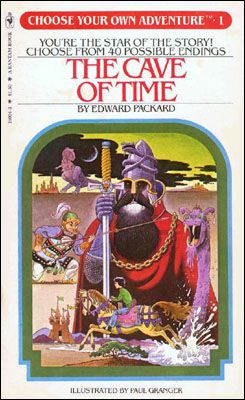
It was 1978, and Delbourgo was championing a new children’s title called The Cave of Time. The book was something of an anomaly: It didn’t have a plot or a main character or even a proper ending. Instead, the reader was asked to assume the role of the hero. Every few pages, he or she had to make a critical decision on how to proceed. There were about 40 possible endings, with some paths leading to glory and others ending in alien invasion, tyrannosaurus attack, and other forms of ruin. Delbourgo hoped to make it her first major acquisition.

In fact, she hoped to pursue it as a series. But as a junior voice in the company, she had no idea how her higher-ups would respond to such an experimental project. As she stepped into the cavernous office of Oscar Dystel, Bantam’s president, anxiety struck.

“I understand you’re trying to change the way kids read,” he barked. She was. And she wasn’t alone.

A decade prior, a lawyer named Edward Packard had hit upon an idea. He often told his kids bedtime stories, and whenever he couldn’t figure out how to resolve a story, he asked them to weigh in with options. He soon realized that they enjoyed the stories more when they helped choose the endings.

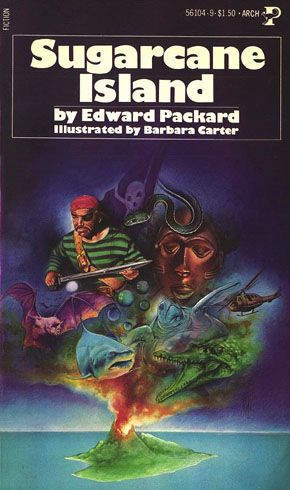
This interactivity was a valuable storytelling device—it both harnessed the kids’ attention and took advantage of their innate creativity—and Packard wondered whether there was a clever way to package it in book form. During his commute, he began writing a shipwreck adventure called Sugarcane Island, with multiple storylines that required reader participation.

When, in 1969, he passed his finished copy along to a friend of a friend who worked as a William Morris literary agent, the feedback was glowing. “The agent said he would be surprised if there were no takers,” Packard recalls. “Then he proceeded to be surprised.”

Island collected dust until 1975, when Vermont Crossroads Press, a publisher looking for innovative children’s books, picked it up. The press was headed by R.A. Montgomery, a former high school teacher who saw the educational value in game structure. “Experiential learning is the most powerful way for kids, or for anyone, to learn something,” Montgomery says.

Montgomery published Sugarcane Island to a nice, albeit quiet, response, and he and Packard began to write more stories. But Vermont Crossroads didn’t have great distribution. “He was not equipped to saturate the market,” Packard says. Montgomery agreed. He passed the title to a young literary agent named Amy Berkower, who tried to pitch the books to numerous houses. “The only person responsive was Joëlle,” Berkower remembers.

“I got really excited,” says Delbourgo, who also worked in Bantam’s educational division. “I said, ‘Amy, this is revolutionary.’ This is precomputer, remember. The idea of interactive fiction, choosing an ending, was fresh and novel. It tapped into something very fundamental.”

But before Delbourgo could publish the book, she had to persuade her boss at Bantam to take a risk. Dystel was skeptical at first, but Delbourgo’s presentation was convincing. She believed in the product. “He wound up becoming my biggest supporter,” she says. The “Choose Your Own Adventure” series officially launched in 1979.

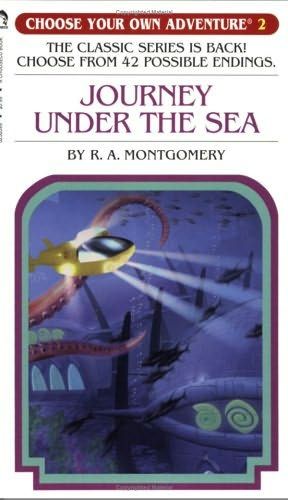
Montgomery and Packard were each contracted to write six books. The first title to be picked up by Bantam was Montgomery's Journey Under the Sea, about an expedition to Atlantis. Readers were confronted with seismic choices: “If you put up the energy repulsion shields to try and escape the black hole, turn to page 22!” To stoke attention, Bantam gave away thousands of copies, flooded book fairs, and created teaching guides for classrooms. The strategy worked. By 1981, Bantam had four million copies in print.

That same year, the young daughter of New York Times culture columnist Aljean Harmetz picked up a “Choose” book and couldn’t put it down. Intrigued, Harmetz wrote a piece that described the series as being “as contagious as chicken pox.” That’s when it exploded.

To capitalize on the momentum, Bantam decided to roll out one title a month. In turning up the frequency to serial levels, the publisher hit upon another novelty that would prove irresistible. Because the books were numbered sequentially, kids started collecting them like trading cards. Years later, this savvy marketing technique would be applied to other series, including “The Baby-Sitters Club” and “Sweet Valley High.”

To keep pace with this grueling publication schedule, Packard and Montgomery—who worked separately—started subcontracting installments to other writers. (In years to come, bestselling authors like James Patterson and Tom Clancy would use this same formula, known as “packaging,” to keep up their production.) In 1981, Packard quit his law practice to write full time.

While the main “Choose” line featured a variety of adventures—Mayan exploration, deep-sea intrigue, run-ins with the abominable snowman—greater demand called for more and more spin-offs. Some, like the Star Wars and Disney tie-ins, were licensed merchandise. Others didn’t fare so well. “I tried some sports titles like 'Soccer Star' and 'Skateboard Master,' but they didn’t sell,” Packard says. Instead, he and his writers gravitated toward subjects that interested them: science, shipwrecks, African mountain gorillas.

As with most children’s trends, there was some hand-wringing over several of the more gruesome fates: Child psychologists questioned whether scary stories—say, getting sacrificed in a pagan ritual—made for reassuring bedtime reading. Packard laughed off the criticisms. “I remember getting ‘shot’ as a kid,” he says of playing cowboy. “Kids got it very quickly. You die, yes, but you take another choice and go on.”

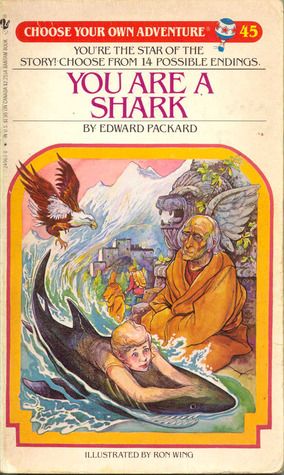
By the late 1980s, the series was showing signs of exhaustion. Lackluster concepts like You Are a Shark were pushed through in the rush to keep the installments coming, and the number of possible endings in many titles dwindled. Early “Choose” books had dozens of endings; later entries saw as few as eight. Then, with the rise of video and computer games, which provided that same interactivity in an even more addictive format, “Choose”’s foothold in the market slipped. In 1999, after selling 250 million copies worldwide, the publisher retired the brand and let the trademark lapse.

And yet, nearly 35 years after its debut, “Choose Your Own Adventure” remains a publishing landmark. It preceded many of the long-running children’s series, like “Goosebumps,” and proved to skeptical parents that kids were still willing to crack open books. “The reading happened because kids were put in the driver’s seat. They were the mountain climber, they were the doctor, they were the deep-sea explorer,” says Montgomery. “They made choices, and so they read.”

By combining savvy marketing with an innate sense for the psychology of storytelling, Delbourgo had stumbled upon the formula for an enduring classic. At the time, the series’ success netted her a $2000 raise. (Eventually, she settled in as a literary agent.) But having a hand in birthing “Choose Your Own Adventure” held far greater rewards than Delbourgo could have anticipated. “I remember how I felt when I read the books and how excited I got, the clarity I had about them,” she says. “I couldn’t have imagined the incredible impact it had or how prescient it was.”

[Ed. note: R.A. Montgomery passed away on November 9, 2014.]

_______________________

The article above, written by Jake Rossen, is reprinted with permission from the March-April 2014 issue of mental_floss magazine. Get a subscription to mental_floss and never miss an issue!

Be sure to visit mental_floss' website and blog for more fun stuff!

14 Mar 04:03

Church of Scientology reportedly blackmailing John Travolta

by Drew Salisbury

The Church of Scientology has allegedly been blackmailing John Travolta, one of its most visible and out-spoken members, with threats to reveal personal secrets and information about the actor when he has considered leaving the controversial religious organization in the past. The history of blackmail is detailed in the upcoming documentary “Going Clear: Scientology and the Prison of Belief,” which will premiere on HBO on March 29.

Rumors of Travolta’s sexuality have dogged the actor for most of his career, and while the movie doesn’t address them explicitly, it describes how Scientology amasses large amounts of secrets and personal information of its members through its “auditing” process. This material is then often used to coerce members to do whatever the church wills.

When Travolta has faced allegations of sexual assault and battery in the past, he has also benefitted from the considerable legal powers of the organization, whose lawyers have been rumored to intimidate accusers into dropping lawsuits against the actor. This in turn further put Travolta into Scientology’s pocket.

Alex Gibney, the director of the documentary, had this to say regarding his decision to refer to Travolta’s sexuality in the film: “It’s not my business. We just know that the church made it its business to collect private details and threaten to reveal them. That’s really the relevant detail.”

[ h/t BuzzFeed ]

14 Mar 04:01

Is He Negging You, or Does He Just Hate You?

by Clara Morris

“Negging” is becoming an increasingly common way for men to pick up girls. It involves guys undermining your sense of self worth with subtle or passive insults, so that you’ll desire their approval and be more receptive to their advances. But how do you know if a guy is negging you, or if he just hates you? See if you can tell when to stay and when to walk away from the following pickup lines:


“I like your outfit, but your shoes don’t match.”

This is a clear neg. He draws you in with a compliment and then tears you down with an insult. If you can get a guy to say this to you, congrats! He’s into you!


“No, I don’t like your outfit. Leave me alone.”

Sure, he’s telling you to go away, but look at the subtext. He’s basically saying without you, he’s alone. And nobody wants to be alone. So there you have it: He wants you to stay right there with him! Neg city!


“Let go of my arm!”

Another classic neg. He’s denying you the physical contact you want, which will only make you want it more. If he hated you and really wanted you to let go of his arm, he’d wrench his arm free and run off. The fact that he’s asking instead of taking action … uh yeah, that means he’s into you.


“I’m calling the police!”

Calling the police is a common form of negging. Think about it, contacting the police is a lot of effort; he has to talk to a dispatcher, wait around for the police to show up, file a report, etc. etc. And he’s doing all that for you – a girl he JUST met! If this is how big he goes in the courting process, just imagine what he’ll do once you guys are an official couple!


“This is a restraining order.”

He’s negging you. He is setting up all these roadblocks and hoops for you to jump through in order to be with him. He knows that the harder you have to work for a reward, the more you value that reward. A restraining order is just his way of saying he wants you to like him.


“How did you get in my car?! Get the hell out, you psycho!”

He really like you and he is negging you. When someone hates you they don’t ask how you do the amazing things that you do.


“You are ruining my life. I hate you.”

Okay, this seems pretty clear, but don’t sell yourself short! How many times have you told your best friend you hate her in the heat of an argument? Or your parents? And you love all those people. So it is pretty clear: This guy is playfully saying he loves you. He loves you, girl! That’s so sweet!


Now you’ll be better able to recognize negging when you see it. Whenever a guy throws shade your way, he’s probably just going along with the trend and “negging” you to be cool. Just let it slide and know that deep down, he’s into you!

Is He Negging You, or Does He Just Hate You? is a post from: Reductress

14 Mar 03:52

Jimmy Kimmel Asks President Obama Some Tough Questions on 'Jimmy Kimmel Live'

by Megh Wright
by Megh Wright

President Obama was a guest on last night's Jimmy Kimmel Live, and Kimmel didn't hold back when it came to some hard-hitting questions like whether Obama drives, where he gets dental work, and who makes his middle-of-the-night sandwiches. Watch more clips from the interview below:


0 Comments
14 Mar 03:51

How one perfume company misled scientists into believing in human sex pheromones

by Joseph Stromberg

There are all sorts of colognes and perfumes out there promising to help you attract the opposite sex with "human pheromones" — products with names like "Liquid Attraction" and "EvoMuse."

Their manufacturers point to scientific studies showing that these chemicals can improve mood and trigger a sexual response in the opposite sex.

But the basic truth is that we have no evidence human pheromones even exist — and these studies can all be traced back to a single fragrance company called Erox that managed to convince dozens of scientists their two "pheromones" were worth researching in the first place.

In a recent review in Proceedings of the Royal Society B, Oxford biologist Tristram Wyatt tells this strange story, starting with a 1991 paper presented at an Erox-funded conference that identified two molecules the company would later patent (androstadienone and estratetraenol) as "putative human pheromones."

"When it comes to explaining where they get them, it simply says, 'These putative human pheromones were supplied by the Erox corporation,'" Wyatt says. "That was the sum total of the evidence that these might actually be human pheromones."

This small, dubious paper has since been cited by dozens of other studies examining the molecules — and, in some cases, finding effects from them. And the story of how that happened reveals some of science's biggest weaknesses.

There are no known human pheromones

Watch: Tristram Wyatt's TED Talk on human pheromones.

A pheromone isn't just a distinctive smell specific to an individual or one that evokes an emotion for you. It's a chemical that's emitted by all similar individuals of a species and always triggers a reflexive, identical response in others.

Scientists have identified pheromones in single-celled organisms, insects, plants, and a few vertebrates such as pigs and goats — but not, so far, in humans.

Normally, scientists like Wyatt — who studies animal pheromones — go through a very rigorous process to identify a new pheromone. The key is to start with a specific, consistent response that always comes after an individual has smelled a certain mixture of chemicals. Pheromone-driven responses are binary: they either happen, or they don't.

A good example is the 2014 discovery of a sex pheromone emitted by male goats. Previously, scientists knew that putting a male goat in a group of females would lead the females to begin ovulating, and they suspected a pheromone might be responsible. So they used the act of ovulation as the theorized response to a possible pheromone, and started hunting for it.

Because castrated goats don't trigger ovulation in females, the scientists next compared the odors emitted by normal male goats with those emitted by castrated ones. Then they identified the chemicals secreted only by the non-castrated group. Finally, they isolated and tested each chemical on the female goats, ultimately discovering that a molecule called 4-ethyoctanal could reliably trigger ovulation.

A gas chromatograph shows the particular molecules present in the secretions of castrated and non-castrated male goats. (Murata et al. 2014)


In humans, you might find a sex pheromone by using erections or other signs of sexual stimulation as the response. But humans are far more complicated than goats — and we don't behave sexually in such a binary, reflexive way.

As a result, no pheromone has ever been found this way in humans. So what's the deal with all those pheromone sprays on the market?

Everything goes back to one 1991 paper from scientists with ties to a company that sells "pheromones"

In 1991, an American company called Erox was interested in patenting a pair of chemicals (androstadienone and estratetraenol) to use in perfume and cologne. To lend legitimacy to the molecules, Wyatt says, "they sponsored a Paris conference on mammalian olfaction, almost as a product launch." (Erox did not respond to requests for comment on this article.)

A number of respected scent scientists attended, and the proceedings were eventually published. When that happened, a small study by a pair of University of Utah psychiatrists entered the scientific literature.

Both the university and the paper's lead author, Luis Monti-Bloch, had a stake in Erox (which was founded by former Utah professor David Berliner), and Monti-Bloch would go on to work for the company. But the paper didn't mention these conflicts of interest.

What it did say is that androstadienone and estratetraenol, when injected into the human nose, elicited a physical response from the nasal tissue of females and males, respectively. The authors called these chemicals "putative pheromones" — even though they hadn't been isolated through the process normally used to find pheromones, and had been supplied by Erox in the first place.

The source of the paper (top), and the brief note on the source of the molecules (bottom). (Monti-Bloch and Grosser, 1991)

In 1994, Erox patented some uses of those molecules in fragrances and began selling them.

Then in 2000, the widely respected psychologist Martha McClintock cited the 1991 work in a new study showing that androstadienone seemed to have a positive effect on the mood of women, and estratetraenol on men. She was careful to note that "it is premature to call these ... human pheromones" — but, Wyatt says, "other people took the lead from that to use them in their own studies."

Because the molecules could be easily purchased — compared with actual human pheromones, which would have to be painstakingly isolated — research on them took off. In the years since, dozens of studies have been published showing that they improve mood, trigger sexual responses in the brain, and, most recently, affect the way we perceive gender. Erox still exists, and it cites these studies as evidence that its products increase sexual attraction.

(Erox)

But here's the thing: even though androstadienone and estratetraenol are chemically related to testosterone and estrogen, respectively, there isn't even evidence that they're secreted by all men and women, which would be the first requirement for a true pheromone. In fact, says Wyatt, "estratetraenol has only ever been found in the urine of pregnant women in the third trimester."

So how did all these studies come to the conclusion that the chemicals trigger a response? The answer reflects a broader problem in psychology — and in science as a whole.

The human "pheromones" story reveals some of science's biggest weaknesses

(Shutterstock)

The truth is that you could pick any number of different naturally occurring molecules and shove them into people's noses, and some of the time you'd find an effect. Sometimes, this could be the effect of random chance (especially if the studies are small).

But even if a study is well designed, it doesn't indicate the molecules are pheromones — all sorts of plant oils, like lemon oil, Wyatt points out, have also been found to improve mood. The real way to identify a pheromone is to start with a specific, binary, reflexive response (like, say, goat ovulation) and find a molecule that consistently triggers it — instead of finding a molecule and then trying to see what it does.

Now, if scientists published the results of all studies ever performed on these molecules, doing things backward might not be as big of a problem. But if they only publish the positive results, it's going to look like a real pheromone when there are actually just a lot of false positives or random effects.

This sort of positive publication bias is a growing problem across the sciences — especially psychology — and some journals, such as Plos One, have begun publishing negative or inconclusive results in an effort to remedy it. Still, it's currently estimated that more than 90 percent of psychology papers present positive results — which is way more than would be expected if there weren't biases involved.

A 2010 study found that all disciplines publish disproportionately positive results — including more than 90 percent of psychology papers. (Fanelli 2010)

There's also a related problem: a lack of replication, which has plagued psychology as a whole in recent years. Because researchers largely get funding to conduct and publish brand new work, rather than try to reproduce other research and see they find the same result or not, flawed findings often don't get exposed.

Finally, there's what Wyatt calls the "echo chamber" problem: when a paper on androstadienone or estratetraenol gets submitted to a journal, many of the people asked to review it have probably done their own research using the molecules and have already accepted that they're pheromones. Even though critics consistently pointed out the problem with these "pheromones" all along, this echo chamber can amplify a single random result into a long series of papers and citations.

But after two "lost decades" of human pheromone research (as Wyatt calls them) some scientists are now searching for pheromones the right way. There's some preliminary evidence that secretions from lactating human mothers might trigger suckling responses in infants. Ongoing work in this area could identify actual human pheromones — although it seems unlikely that anyone could sell them to help you attract the opposite sex.

14 Mar 03:48

18 Gochujang Recipes to Give Your Food Some Sweet, Sweet Heat

by Carey Polis

Gochujang is a staple in Korean cooking and one of our favorite condiments to have on hand. Not familiar with it? It’s the bright red paste found in everything from bibimbap to dukbokki (stir-fried glutinous rice cakes). We love it for its sweet heat on everything from chicken to vegetables. Here are 18 recipes to get you started.

The post 18 Gochujang Recipes to Give Your Food Some Sweet, Sweet Heat appeared first on Bon Appétit.

14 Mar 03:42

The Problem with Podemos

by Alberto Garzón

The new issue of Jacobin, focusing on technology, will be released Tuesday. Buy a copy or subscribe today.

In Spain, the decline of the green-communist United Left (IU) alliance has gone hand in hand with the rise of Podemos. In this interview, first published by the French site Mediapart, Alberto Garzón, a candidate for the IU leadership, argues that Podemos’s “caesarism” provides no solutions. He calls for the various left forces to converge in the run-up to the country’s November elections.

This piece, from the viewpoint of Podemos’s political rivals in the established Spanish left, provides a critique of Podemos and its brand of populism that has been inspired by Argentinian political theorist Ernesto Laclau.

Garzón is one of those people, together with Podemos’s Pablo Iglesias and Guanyem’s Ada Colau, who embodies the renovation of Spanish political life. A twenty-nine-year-old economist, he is a candidate running in the United Left’s primary this year. He’ll face the challenge of rejuvenating an organization that has not only having been left behind by the rise of Podemos but also has been struck by corruption allegations against some of its local officeholders.

In the following discussion, Garzón — elected a member of parliament for Malaga in 2011 — explains how he hopes to renew the party’s political culture from top to bottom. He also attacks the “ambiguities” that have emerged during the rise of Podemos, from its economic program to the institutional reforms that it proposes.


Izquierda Unida has not proven able to seize hold of the political space now occupied by Podemos. Why is that?

IU diagnosed very well what was happening in Spain, but we were not politically ambitious enough to take the decisions that ought to have gone along with this diagnosis. We could say that society changed faster than our own organization did internally. Romantics took the leadership of the assemblies [formed during the 2011 indignados movement] but then they gave way to the bureaucrats who are running them now.

Before we get to the Podemos “bureaucrats,” tell us what you mean by “politically ambitious.”

Providing political support for the PSOE [Socialist Party] should not be IU’s only ambition. Rather, its goal ought to be to lead the transformation of society. Within the organization, some people never believed that we could get above the 10 percent mark and that eventually we would have no choice but to work with the PSOE. To be politically ambitious is to do away with this kind of calculation, and that implies a change of method, a change of generation.

You call for a process of left convergence. What would that consist of?

It’s a simple idea. Unity is strength, and the fragmentation of the Left helps the Right. And the more of us that are committed to a project of social transformation, the better.

There is some reticence on this point within IU. Indeed, in Madrid the party seems very divided.

Some people fear that the party will be dissolved. But they are not in the majority. And as always in the Spanish political context, Madrid is a very particular case.

Would this “convergence” be for all of next year’s elections?

Yes, but Podemos has already said that it is not going to stand in the municipal vote [except in a few towns] and that they will stand by themselves in the regional and parliamentary elections. They have already said that they do not want popular unity.

Above all because Podemos regards IU as part of the “caste” of politicians responsible for the crisis.

Yes, they say it in hushed tones but they say it nonetheless.

IU is identified with an old political culture, which the indignados movement left behind.

Within IU there are some who see the organization as a prop for the PSOE but also as an electoral machine. It has become a very institutionalized party, whose existence is overly dependent on electioneering and which has very little implantation in social movements. That’s what we have to change.

The party has also seen instances of corruption. The “free credit cards” affair that came out in autumn showed that some of the people that IU appointed to the Caja Madrid bank’s board had for years been using these funds for their own personal expenses.

We must wipe out all traces of corruption in the party. All those who stole or allowed others to do so must leave the party. We have political responsibilities. An IU internal commission in which I myself participate is working on this [it published its findings on December 14, demanding that certain party officials resign].

Some people say that Podemos has already become the same as the other parties, cut off from the social movements. What do you think of this?

Podemos uses the terminology of the indignados’s 15-M movement, but in practice it is a very typical party with a general secretary and a team who operate as his praetorian guard. All of the general secretary’s wishes are granted. This is caesarism. They put on a show of constant internal consultations, but everything has been decided already. Its economic program was drawn up by two people, not by an assembly.

If we look at your economic programs, IU and Podemos look very much alike: you want an audit of Spain’s debt and denounce austerity. What differences are there?

At the outset there weren’t many differences. They literally copied us. But now there are some differences. They are changing their program in order to reposition themselves closer to the centre, and avoid upsetting the markets.

So the guaranteed basic income is not, now, entirely guaranteed. They have also blunted their plans for auditing the debt. We can see a series of retreats. Podemos is a lot more ambiguous today than it was during the European election campaign.

You’d struggle to justify the claim that they “copied” you. The first elements of their economic program did result from debates and votes in their circles and assemblies. . .

Well yes, that is true. But in the assemblies when Podemos was just getting started, Izquierda Anticapitalista (IA) activists had a major presence. And IA was part of IU up until 2008 [at that time being called Espacio Alternativo].

Pablo Iglesias, Podemos’s leader, showered Pope Francis’s recent intervention at the European Parliament with praise (¡Bien Bergoglio!). What are your thoughts on this?

They are trying to shift to the center, to strengthen their electoral support. They are making more and more nods to the army, the Church, but also traditional left circles, in order to seduce supporters left, right, and center.

Your most recent book calls for a “Third Republic” in Spain. That’s a priority for IU as well as for Podemos. . .

For IU the republic does not just mean the absence of the king. For us, more than anything, it means increased democratic participation, referendums, and initiatives for popular participation. The 1978 constitution does not provide for any of these mechanisms. On this subject, too, Podemos is sowing ambiguity. The other day in a debate in Madrid one of them explained that there were “some good royals.”

When we listen to Pablo Iglesias, he admits to this ambiguity, saying that it’s justified by the need to win.

For Pablo, the essential thing is to win the [November] elections. But electoral victories alone cannot bring social transformations. Podemos’s problem is that they are giving a signal that consists of telling people: stop taking to the streets, vote for us, and we’ll look after everything.

For the Left, that’s an enormous problem: if you exclusively base yourself on elections, then you demobilize citizens. So the mareas [anti-austerity movements in Spain] disappear, and there’s no more trade unions or social activism. And that’s very dangerous.

All that is going to complicate the “convergence process” that you are advocating. . .

Yes. Podemos’s strategy applies the theory of left populism as defined by Ernesto Laclau. Of course, Podemos’s leaders are of the Left. But their strategy is not. And their base — that is, the people who are currently rallying to them — clearly aren’t either.

The convergence that I’m talking about is a way of taking advantage of the historic opportunity that’s now taking shape in Spain, for something different from the PSOE and PP [People’s Party] duopoly. We have the possibility of breaking with this system and building a new one. So let’s get around the table and talk about a series of specific policy proposals.

Could you imagine an alliance with the PSOE if its new leader, Pedro Sanchez, changed his discourse? Your party is in power together with the Socialists in Andalusia.

Agreements are always made on the basis of a program. For the moment the scenario that I see as most likely [on the national level] is the Socialists being ready to make a pact with the PP and reproduce the “grand coalition” that now exists in the European Parliament.

Spain has been hit hard by crisis. Both socially and politically, the country is at boiling point. Conversely, in France the institutional scene seems to be hibernating. What are your thoughts on this?

The François Hollande government has shown the real nature of the European Union. The EU has been built in such a way that there can be no alternative to neoliberalism. So even governments who call themselves social democrats and try to implement an alternative policy do not succeed in so doing. The French example proves that social democracy is impossible in the European context.

Do you think Jean-Luc Mélenchon is making a false turn when he takes Podemos as a model for the launch of his own Movement for a Sixth Republic (M6R) in France?

The presidentialization of the French system poses real difficulties. But in my view there’s a wider problem.

Ultimately, Beppe Grillo in Italy, Marine Le Pen in France, and Podemos in Spain are very similar phenomena. They occupy a political space that allows them to channel frustration and anger. They have set themselves up in reaction to something negative, and that will make a difference at the elections or the day after.

And that’s the case even though Podemos is, of course, on the Left, or rather, somewhat on the Left, unlike Grillo or Le Pen.

But that changes everything.

True. But we don’t have Podemos to thank for that. Rather, it’s thanks to the indignados movement. In Spring 2011 Spanish citizens occupied the country’s city squares and said: we are all angry, and it’s not migrants and foreigners who are to blame, but the bankers and the politicians.

The problem in France is that Marine Le Pen has taken hold of that space, and I don’t believe that simple speechifying will be enough to take it back. We need to get back to practical activity, in local areas: only that can lead to new political identities and counter the Front National.

In Spain, it’s Ada Colau and her Guanyem movement that’s closest to this discourse inherited from the indignados, and that’s taken to action at neighborhood level.

Perhaps. Above all it’s a very Gramscian approach.

Perhaps we could say that Podemos, too, is “doing Gramsci,” imposing its own concepts on public debate — for example, when it speaks of the caste, a term that all the media have now taken on board.

I don’t agree. Gramsci thought in terms of social classes. For Podemos’s point of reference, Ernesto Laclau, they don’t exist any more. That’s no mere detail. Podemos is trying to build a movement solely by means of a very effective discourse, directed against an adversary comprising the whole political world, the famous “caste.” But they forget that there’s something more important in Gramsci: that social classes still exist, and ultimately the main thing is to improve people’s material conditions.

Podemos wants to seduce doctors, civil servants, the unemployed, and people dying of hunger, with a discourse that’s vague enough to suit everyone. From an electoral point of view that’s very effective. But when it comes to making decisions, I don’t see how you can reach an agreement between the doctor, the civil servant, and the guy starving in the street.

Buy a copy of the new technology issue or subscribe today.

14 Mar 03:37

AskHistorians Podcast 032 - Early Modern Medicine & Women's Health

Dr. Jennifer Evans, lecturer in history at the University of Hertfordshire, and Dr. Sara Read, lecturer in English at Loughborough University, make a special appearance on the AskHistorians podcast to discuss women's health in England during the early modern era. Covering the medical schema and standard of care of the time, Drs. Read and Evans touch on fertility, infections, menstruation, and the lived experience of women at the time. 

More of their work can be found on their blog, Early Modern Medicine. In addition, both have works of interest: Dr. Evans' Aphrodisiacs, Fertility and Medicine in Early Modern England is available from Boydell & Brewer, and Dr. Read's Menstruation and the Female Body in Early Modern England is available from Palgrave-MacMillan. 

14 Mar 03:30

Why video games are better without characters

by Clive Thompson
Simcity Ian Bogost argues we need more games that focus not on characters, but on systems -- like cities, economies, language, or physics. Read the rest
14 Mar 02:38

What Parenting Really Looks Like

by A B

14 Mar 02:11

Hilarious Parodies Of 1920s Films Featuring Dogs Instead Of People

by Vincze Miklós

In the late 1920s, somebody at Metro-Goldwyn-Mayer had a really strange idea: making short comedy films poking fun of recent films by replacing all the human characters with trained dogs in clothes. Here are all nine episodes made between 1929 and 1931 known as the "barkies."

Read more...


14 Mar 02:08

VA – Suicide Squeeze Records Presents: Forever Singles (2014)

by exy

Suicide SqueezeSeattle label Suicide Squeeze Records is collecting some of its finest singles for limited-edition compilation. Suicide Squeeze Presents: Forever Singles culls 14 tracks from previously released 7-inches and features tunes by Dirty Beaches (Lone Runner), King Tuff (Wild Desire), Audacity (Finders Keepers), JEFF the Brotherhood (Heavy Days), La Luz (T.V. Dream), and Bleached (Electric Chair).
The LP captures the rowdy garage rock of The Coathangers and Davilla 666, the scraggly dirt- ridden guitars of JEFF the Brotherhood and Heavy Cream, the nostalgic ‘60s girl-group melodies of Bleached and La Luz, the exuberant power pop of Audacity, King Tuff, Nobunny, and Meat Market, the vitriolic basement-show noise-punk of Nu Sensae, the sinister post-punk of Wax Idols, and…

320 kbps | 101 MB  UL | HF | MC ** FLAC

…the West Texas-bred Twin Reverb rock of The Numerators. Bundled together onto one record, the collection perfectly captures the spirit of Suicide Squeeze in the current decade: rambunctious youthful urgency tempered with a hat tip to rock n’ roll’s gritty unsung heroes of the past.

1. The Coathangers – “Merry Go Round”
2. JEFF the Brotherhood – “Heavy Days”
3. Bleached – “Electric Chair”
4. Meat Market – “Too Tired”
5. Heavy Cream – “Toasted”
6. Dirty Beaches – “Lone Runner”
7. Nü Sensae – “Throw”
8. Audacity – “Finders Keepers”
9. La Luz – “T.V. Dream”
10. Nobunny – “La La La La Love You”
11. King Tuff – “Wild Desire”
12. Numerators – “Dead”
13. Wax Idols – “Schadenfreude”
14. Davila 666 – “No Crees Que Ya Cansa”

13 Mar 21:04

Os dous cruceiros de San Francisco na noite


Os dous cruceiros de San Francisco na noite

13 Mar 21:02

Bazar de Villar cierra su última juguetería en el casco histórico

by marga mosteiro
El envejecimiento de la población hace inviable este tipo de negocios

13 Mar 21:01

El Concello de Santiago adjudica por 118.000 euros la demolición de la Casa da Xuventude

by Europa Press
La empresa adjudicataria, CYS Hispania, S.L., cuenta con un plazo de ejecución de tres meses. Agustín Hernández aclara que los trabajos arrancarán entre abril y mayo
13 Mar 16:08

Remembering the Wizardry of Terry Pratchett

by Gavin Haynes

[body_image width='800' height='600' path='images/content-images/2015/03/13/' crop='images/content-images-crops/2015/03/13/' filename='rip-terry-pratchett-890-body-image-1426243574.jpg' id='35752']

Photo by Myrmi via.

This article originally appeared on VICE UK.

When he was knighted for his contribution to literature, Terry Pratchett said he suspected that this contribution "consisted of refraining from trying to write any" more books. He was, of course, being facetious, but his comment couldn't have been further from the truth; in their subject matter, Pratchett books always felt like fringe concerns, yet their massive success actually put him at the center of public taste.

There's never been a Hollywood film of any of his stories, and pushing out two books a year meant that there was no single totemic best seller he could hang his reputation on. So in a funny kind of way, it was only as his death was announced yesterday that it became totally clear what a crater he'd smashed into readers' lives.

Time will continue to appraise his literary merits, so what is there left to do but pick out some of the more interesting, unusual, and amusing moments from his life?

[body_image width='900' height='675' path='images/content-images/2015/03/13/' crop='images/content-images-crops/2015/03/13/' filename='rip-terry-pratchett-890-body-image-1426249484.jpg' id='35809']

Artwork from the Discworld series

HIS MOTHER PAID HIM TO READ
A penny a page. As a child, he didn't give a damn about books, preferring the outdoors and fiddling with machinery. Until one day he read The Wind in the Willows and books crawled up his trousers and bit him hard in all the right places. He worked through the Beaconsfield library, before discovering a pornographic bookshop that also sold small quantities of hardcore sci-fi. Then he went on to become one of the most beloved British authors of all time, suggesting he ended up being quite into reading.

WE FORGET NOW THAT PRATCHETT WAS ROWLING BEFORE ROWLING
At his peak, Pratchett was selling 3 million books a year. Before J. K. Rowling, he was on course to be the best-selling British author of the 1990s. He'd do two new books a year. More than 40 Discworld books. More than 80 million copies sold in total. In 1997, booksellers estimated that 6.5 percent of the entire trade in books in this country were Terry Pratchett novels. Whether or not you ever read any of his books, there's no doubt you know his name.

NO ONE SEEMS TO BE BE ABLE TO FIND A SINGLE BAD WORD TO SAY ABOUT HIM
Honestly, we'd tell you if we could find one, but we can only conclude that the grinning wizard bloke was one of the nicest men anyone ever met. Early on, he made his name giving avuncular speeches at fan conferences and seemed to be a guy who genuinely loved meeting his fans. He'd do legendarily long book-signings. One fan reminisced on Twitter yesterday about sitting around patiently, waiting for Tez to finish signing every single of his 40-volume "complete set" of Discworld books. Some joked that an unsigned Pratchett was more valuable to collectors than a signed one.

[body_image width='1024' height='745' path='images/content-images/2015/03/13/' crop='images/content-images-crops/2015/03/13/' filename='rip-terry-pratchett-890-body-image-1426249618.jpeg' id='35810']

Artwork from Pratchett's book 'Guards! Guards!'

HIS FIRST BOOK STARTED AS A KIDS' NEWSPAPER COLUMN
Pratchett's first proper job was as a newspaper journalist at the Bucks Free Press in High Wycombe. It was there that he took on the lowest job on the ladder—compiling the kids' section: a list of child birthdays and a short-story column. Pratchett wrote the stories, turned his column into a serial, turned the serial into a book, and sold it as The Carpet People. A bit like The Borrowers, The Carpet People features tiny people living on the floor of a house who cross the carpet world in search of a new home after their village is destroyed.

HE DIDN'T GIVE UP THE DAY JOB UNTIL HIS FOURTH BOOK
"Local journalism is journalism," he told the Guardian. "If you get it wrong, they know where you live. You see more things and do more things than you would ever see or do on a mainstream newspaper. I saw my first dead body on my first day at work."

After the Bucks Free Press he went on to the Western Daily Mail, and by 1973 he'd jumped across the fence to be a PR man for the nuclear-power industry—a decent early test for his powers of imagination. Only when he bought his mother a house did she finally relent in her requests that he keep up his day job to "have something to fall back on."

HE READ ALMOST EVERY COPY OF PUNCH THAT EVER EXISTED
Despite the magazine folding in 1992, that's still 150 years of the stuff. "I didn't only look at the humor and the cartoons. I read the other stuff, which had the additional advantage of me picking up a lot of Victorian vocabulary, which comes in useful," he once said, also crediting Punch with shaping his particularly whimsical satirical worldview.

As a boy, Mad Magazine and Private Eye held a bigger sway, and he was also a big fan of 1066 and All That, W. C. Sellar, and R. J. Yeatman's deliberately flimsy history of England.

HE WAS VAGUELY WORRIED ABOUT BEING "THE RIGHT-TO-DIE GUY"
In recent years he campaigned for a greater awareness of assisted dying, but the thought that it had begun to overshadow his books in the public mind troubled him. At the same time, he was powerfully committed to changing the law. At one point, he kept a photo of fellow right-to-die campaigner, the late Tony Nicklinson, on his desk. "I put his picture [there] because I don't want this guy forgotten," he said. "He was very clear about what he wanted, and you cannot tell me that two doctors helping him to go to sleep would constitute murder."

He also did the TV show where a man killed himself at Dignitas in full view of the BBC's cameras, one of the more astonishing TV moments of the past decade.

HE WANTED TO TALK ALL HIS BOOKS
By 2010, Pratchett could no longer type efficiently, so he installed six screens in his office and used Dragon Dictate to keep going via voice recognition software, plus a human assistant who'd help him with revisions. His publisher reckoned that the shift had changed his writing style, mainly because of the difficulty with revising. Far from feeling set back, Pratchett thought the new way was more natural: "If it all came back, I would probably stick with talking," he said. "Because we're monkeys. We chatter. It's easy to do. It's mutable."

HE WAS THE EXACT OPPOSITE OF DOUGLAS ADAMS
While Adams operated in a similar parallel satirical universe, the Hitchhiker's author was the worst for actually writing. He sometimes had to be locked in his hotel room by his publishers when the deadline for a new novel drew near just to get him to stop procrastinating.

Pratchett, by contrast, couldn't stop the words. After he left his full-time job, he often felt bereft because he'd done all of his work in the mornings, then still had to fill his day. Later on, he'd start work at 10 AM, take a few hours off in the afternoon, then return to his desk until nearly midnight. The pace of his writing drew down a bit in the early 2000s, when his novels became more considered, less gag-led. When he went on his annual holiday to Australia, he boasted, he'd write even more than when he was at work, waking at dawn and putting down a thousand words before breakfast.

HE WROTE WITHOUT ANY REAL PLAN
He compared it to woodcarving: "You start cutting the shape you want it to be. But you find, if you do it right, that the wood has a grain of its own. If you're sensible, you work with the grain, and if you come across a knot hole, you incorporate it into the design."

[body_image width='800' height='600' path='images/content-images/2015/03/13/' crop='images/content-images-crops/2015/03/13/' filename='rip-terry-pratchett-890-body-image-1426249742.jpg' id='35811']

Pratchett talking in Milan in 2007. Photo by Moroboshi via Wikimedia Commons

HIS DAUGHTER WRITES STORIES FOR VIDEO GAMES
Rhianna Pratchett wrote scripts for the Tomb Raider reboot and Overlord. She was also co-writer on the BBC's Discworld series, The Watch. There's still a question mark over whether she will take over the Discworld series in at least a creative-director role.

HE TURNED DOWN MORE MONEY THAN THE GDP OF BURUNDI
They made 15 stage plays, nine radio adaptations, and seven TV ones of his books. But however loudly Hollywood called—and for a property second only to Rowling's, you can assume that was VERY, VERY LOUDLY—Tez never replied. He demanded creative control over whatever was put out under his marque, and hence the LA moneymen could never come to any proper deal with him.

HE EXPERIMENTED WITH ALTERNATIVE TREATMENTS FOR HIS ALZHEIMER'S
These included a helmet that sent light bursts at a particular wavelength into his skull. He was skeptical of its powers, however. "But it has become a kind of totem—an act of faith that the disease can be controlled, if not by this, then by some other development," he said.

HE HAD A LONG TIME TO PLAN HIS END, AND IT SHOWED
His death was announced to Twitter with three messages. "AT LAST, SIR TERRY, WE MUST WALK TOGETHER." / "Terry took Death's arm and followed him through the doors and on to the black desert under the endless night. / "The End."

HE BELIEVED DEATH IS NOT ENTIRELY 100 PERCENT THE END
As a card-carrying humanist, Pratchett was against the idea of there being any afterlife. Though he did delight one Telegraph interviewer by singing a hymn to her from the darker recesses of his hymnal: "Over the world there are small brown babies / Fathers and mothers and babies dear / They do not know the love of Jesus / No one to tell them that he is near..."

His views on what happens next were simple and neat: "No one is actually dead until the ripples they cause in the world die away," he wrote in 1991's Reaper Man. It's a safe bet that he'll keep rippling out for a long time to come.

Follow Gavin on Twitter.

13 Mar 16:00

‘Pukebox’: The 50 most sickening songs


It’s hard not to like the Ex, the Dutch anarcho-punk band that has transformed into a wild improv ensemble over the last 35 years. Back in 2002, when they were stumped as to how to book a tour of Ethiopia, they just showed up in the...

13 Mar 02:52

Asubios #2 - O Soul En España 1967-1971-CD (?,?)

by caveman78
O Soul En España 1967-1971
01 - conexión - i will pray
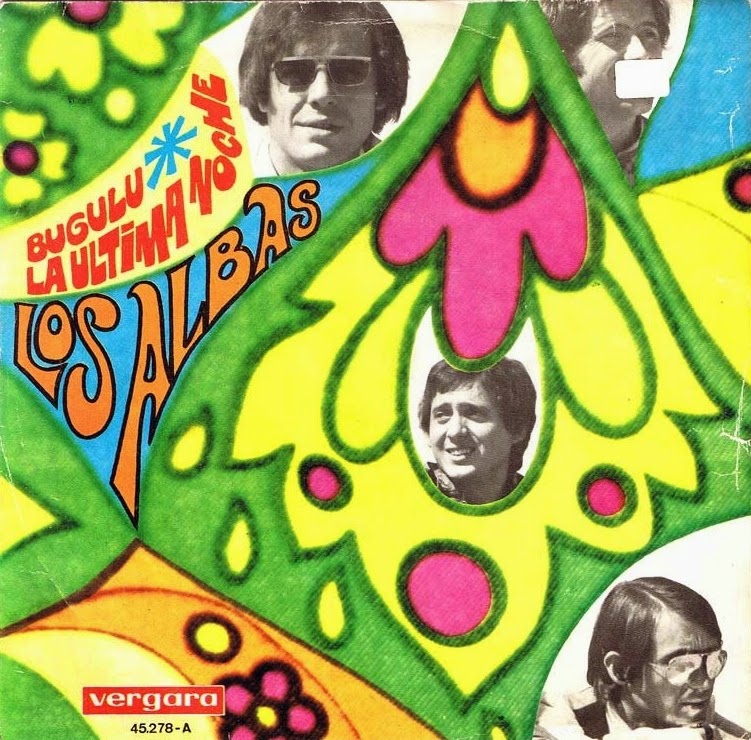
02 - los albas - bugulú
03 - los bravos - you'll never tha chance again
04 - los mustang - la sombra del camino
05 - the brisks - people
06 - jess & james - something for nothing
07 - canarios - get on your knees
08 - los buenos - summer talk
09 - henry & the seven - you love me
10 - los gritos - somos los jóvenes
11 - los pekenikes - el tiempo vuela
12 - the explosion - beggar for your lovin'
13 - los gatos negros - you took, your love
14 - tara - somebody
15 - los kifers - oye mis ansias de vivir
16 - los z-66 - love is all i have to give
17 - julian granados - donkey
18 - los huracanes - change
19 - canarios - free yourself
20 - los tamara - i'm  midnight mover
21 - conexión - strong lover
22 - los jóvenes - simpatís en soul
23 - pop tops - that woman
24 - círculos - respect

*Sorry, no front cover
13 Mar 02:52

Asubios #1-O nacemento do beat en españa (1965-1967) - CD (Felcia, ?)

by caveman78
O nacemento do beat en españa (1965-1967)
1 Los Flecos - Vales poco para mi (Madrid, Spain) *
    2 Los Beat 4 - Dame un bananino (Chile) *
    3 Los Archiduques - Lamento de Gaitas (Spain)
    4 Los Nivram - Sombras (Barcelona, Spain)
    5 Los Tonks - Llego el final (Spain) *
    6 Los Brisks - Si, Manana Sera Asi (Ceuta, Spain)
    7 Los Brincos - L'amore dei giovani (Madrid, Spain) *
    8 Los Protones - Eres un mal amigo (Valencia, Spain) *
    9 Los 5 Del Este - Look At This Boy (Palma de Mallorca, Spain)
  10 The Tomcats - A Tu Vera (London, U.K.)
  11 Los Supersonicos - Por que te vas? (Venezuela) *
  12 Los Sirex - Olvidame (Barcelona, Spain) *
  13 Rocio Durcal - Creo en ti (Spain) *
  14 Micky Y Los Tonys - Fuera de mis sentidos (Madrid, Spain) *
  15 Los Beta - Que mas quisiera yo (Palma de Mallorca, Spain) *
  16 Los Watts - Al Rojo Vivo (Barcelona, Spain)
  17 Los Gatos Negros - Por que llorar (Barcelona, Spain) *
  18 The Four Winds & Dito - No te comprendo (Mallorca, Spain) *
  19 Ramon 5 - Amor perdido (Mallorca, Spain) *
  20 Os Sheiks - A mala (Lisbon, Portugal) *
  21 Los Bravos - Recopilacion (Spain) *
  22 Los Bohemios - Que chica tan formal (Mallorca, Spain) *
  23 Los No - Incomprendidos (Barcelona, Spain) *
  24 Los Huracanes - El calor del verano (Valencia, Spain) *
  25 Los Botines - Eres un vago (Madrid, Spain) *
  26 Los Wikingos - El viernes en mi recuerdo (Barcelona, Spain) *
  27 Los Pepes - Un dia feliz, otro de llanto (Valencia, Spain) *
  28 Los Pasos - Paso a paso (Madrid, Spain) *
  29 Los Sprinters - El tablao (Ferrol, Spain) *
  30 Los Diapasons - Mi yaya (Valencia, Spain) *
13 Mar 02:50

!!! GARAGE REBEL GIRLS !!!

by noreply@blogger.com (Mr.Eliminator)


"Adam and Eve, sittin' in the woods
Eve said, Man I got somethin' real good
It's in that tree, you'll get smart fast!
Adam said 'sure, Satan my ass
I don't see no snakes but all women are bad"

"Half the tracks here are by genuine guitar-wielding all-girl bands, including the Debutantes from Detroit, Los Angeles quartet the Girls, Goldie & the Gingerbreads from New York, Pinky Chicks from Japan, the Honeybeats from Italy and San Francisco's Ace Of Cups. It might seem somewhat unlikely, but the Chantels are the featured musicians on the instrumental Peruvian Wedding Song. Thanks to acknowledged classics such as He's Gone and Maybe, it's beyond all doubt that the girls could really sing. Who knew they could also play?

It's rather ironic that some of the most striking records to emerge from mid-60s Britain were the work of an American producer. Beat combo Colette & the Bandits' riff-driven A Ladies Man is up there with the 45s Shel Talmy produced at the time of the Kinks and the Who. Talmy also produced Goldie & the Gingerbreads' Please, Please, another prime example of British beat, but one recorded by an American group. Brenda Lee's wild update of What'd I Say and Jackie DeShannon's folk rock nugget Dream Boy were also recorded in the UK, in each case with the young Jimmy Page on guitar. He also plays on Dana Gillespie's cult favourite You Just Gotta Know My Mind.


Some other noteworthy guys help out elsewhere: Kiwi duo the Chicks' great version of Lee Hazlewood's The Rebel Kind features the Mike Perjanik Group with Doug Jerebine on guitar; the Turtles back-up teenage trio the Chymes on their jangly He's Not There Anymore; chart band the Mob play on Mousie & the Traps' How About You; Gail Harris' live recording of I Idolize You features the Wailers; and the Milkshakes provide the instrumentation on the Delmonas' Peter Gunn Locomotion (the only non-60s track here, not that you'd notice).

Other highlights include Jean & the Statesides' Putty In Your Hands, which knocks spots off the Shirelles' original and the Yardbirds' cover, Lydia Marcelle's new-to-CD rocker The Girl He Needs, and International Girl by the Beas, who sound like the Bangles 20 years ahead of their time."


 "Hey I'm on my way on a journey out of this world
Swirling through the vortex to the center of a girl"