Shared posts
Sex is Normal
19 Penis Problems That Are Actually Real
Life is hard. Maybe wear a cup.

Alice Mongkongllite / BuzzFeed
You broke your penis.
Okay, so there isn't a bone in your penis, but you can fracture it. This happens when there's a tear in the part of the penis called the tunica albuginea. When it happens (typically during sex), you'll notice a loud popping sound and an immediate loss of your erection. Get to the emergency room ASAP, because studies show that the outcomes are better if you're seen within the first 24 hours. Here's more info on how not to break your penis.
Your boner won't cooperate after a few drinks.

Too much alcohol can make it harder for you to get an erection, keep an erection, or ejaculate, Dr. Harry Fisch, clinical professor of urology and reproductive medicine at Weill Cornell Medical College, tells BuzzFeed Life. It's most likely because alcohol acts as a depressant that dulls your senses (including your penile senses). So if you plan on using your penis later, set an alcohol limit early on in the night.
Artlite / Getty Images / Via thinkstockphotos.com
You notice blood in your semen.

Okay, try not to freak out. This is called hematospermia or hemospermia and it's usually not cancer, says Fisch. This could be a one-time thing or a persistent problem, and while it usually goes away on its own, you probably want to check with a doctor if it continues.
"Blood in the semen almost always has a benign cause," Dr. Abraham Morgentaler, director of Men's Health Boston and associate clinical professor of urology at Harvard Medical School, tells BuzzFeed Life. It could be from inflammation or infection in the prostate or seminal vesicles, stones in the ejaculatory ducts, or a whole list of other things. Sometimes doctors can't figure out the precise cause, but it's often nothing major, says Morgentaler. That said, if you're seeing blood in your urine, definitely get that checked out since it might be something more serious.
#1853 // The Decline of Western Civilization (Penelope Spheeris - 1981)

Un poderoso retrato de la escena punk de Los Angeles de principios de los 80, siguiendo a bandas como Black Flag, X, The Germs o Circle Jerks.
—————————-
How to Not Break Your Dick During Sex
[body_image width='850' height='622' path='images/content-images/2015/05/22/' crop='images/content-images-crops/2015/05/22/' filename='yes-you-actually-can-shatter-your-dick-253-body-image-1432307021.jpg' id='58967']
Kama Sutra illustration via Wikimedia Commons
A group of Brazilian doctors recently published a paper in the academic journal Advances in Urology identifying "woman-on-top" (aka cowgirl) as the most dangerous sex position in terms of the sheer number of dicks broken mid-fuck. Analyzing data from three accident and emergency units in the Brazilian city of Campinas over the past 13 years for clear cases of penile fractures (in which the ligament in the penis either tears or overextends, often with a loud, painful crack), the doctors determined that half of all such fractures came when women rode men, with 29 percent resulting from over-vigorous doggy-style and 21 percent resulting from missionary sex.
Those who made it trough the wince-inducing study may have tried to take comfort in the fact that sex-related injuries are rare. As it turns out, that's not entirely true. Urologists at the University of Washington Medical School alone say they see at least one or two penile fractures a month. More generally, a British study found that up to five percent of the workforce takes time off for expressly sex-related injuries every year. And although there's a great deal of under-reporting, self-treating, or misreporting of sex-related injuries, most estimates say that up to one-third of adults will suffer some kind of injury during or directly from the dirty deed—often without realizing the pain they're in until the morning after, thanks to our lovely, sexed-up endorphins.
Related: How I Broke My Dick: A Cautionary Tale of Average Length
Many of these injuries could happen outside of carnal embrace: carpet burns, pulled muscles, sprains, and the like. But many more are fairly serious, associated with specific sexual scenarios, and utterly avoidable with the proper precautions.
To save ourselves some grievous harm at the most unfortunate of times, VICE dove into the literature on sex-related injuries and spoke with renowned sex therapist Dr. Kat van Kirk to create a list of the six most injurious heterosexual sexual positions and situations. (While there is overlap between heterosexual and homosexual sex injuries for both men and women, there are enough differences to merit their own future posts.)
Our rankings were based on the severity of injuries involved and the frequency with which practitioners encounter them. We also identified the safest heterosexual sexual position, and a few very simple tips to help you avoid serious harm in any position to make sure sex doesn't wreck your bits.
SIX OF THE MOST DANGEROUS HETEROSEXUAL SEX POSITIONS
[body_image width='800' height='600' path='images/content-images/2015/05/22/' crop='images/content-images-crops/2015/05/22/' filename='yes-you-actually-can-shatter-your-dick-253-body-image-1432305730.jpg' id='58953']
Photo via Flickr user Abhishek Singh Baloo
WOMAN-ON-TOP / COWGIRL
The boys from Brazil were right about this one— it's fairly easy to hit things at the wrong angle and get a snap-crackle-pop when a woman puts her full body weight down on a penis.
"This issue is basically the woman's pubic bone," explains Dr. Van Kirk. "It's slightly differently positioned in each woman. At times there's not enough lubrication when the woman goes to sit on the penis if there's enough force or friction or the penis catches on the pubic bone, that's when that bend will occur in that ligament. That is more common than people think."
FYI: Apparently, the angle involved in reverse cowgirl is even more dangerous than cowgirl.
DOGGY STYLE AND ITS VARIANTS
This one's mainly dangerous because forceful penetration at the wrong angle can, according to Dr. Kristi Latham, a pelvic health specialist at Dallas's Beyond Therapy & Wellness clinic, cause vaginal tearing (which is least common in cowgirl thanks to the woman's greater power to control depth and motion). Additionally, according to Dr. Kat, deep and vigorous thrusts in a short vaginal canal can cause cervical bruising or even bleeding. But wait! There's more: issue associated with doggy.
"I'll often see from rear-entry positions guys going to penetrate the vagina and fairly often the penis will accidentally go into the anus," says Dr. Kat. "And because there wasn't any preparation, there can be anal tears and things like that."
[body_image width='1024' height='684' path='images/content-images/2015/05/22/' crop='images/content-images-crops/2015/05/22/' filename='yes-you-actually-can-shatter-your-dick-253-body-image-1432305510.jpg' id='58949']
Photo via Flickr user Michael Baun
69
Oral sex is a great fast pass to pink eye if your partner isn't as hygienic as he or she could be, leading to the introduction of fecal matter onto the cornea. But two parties engaging in the practice simultaneously is double trouble when it comes to the sewage-face conundrum.
TITTY FUCKING
You'd never expect this one, but apparently men run into trouble when penis meets breast.
"I've seen a few penile fractures, not just with the pelvic bone, but when guys are in the process of trying to give a pearl necklace," says Dr. Kat. "Sometimes they'll put so much force against the woman's sternum that it can fracture [the penis], and if you're not using any lube, the friction can cause some problems too."
MISSIONARY
Even the most seemingly boring, safe, and sacred position poses risks. According to Dr. Kat, while it's not as common as in rear-entry positions, it's pretty easy for women with short vaginal canals to suffer cervical bruising or other abrasions from deep thrusts.
SIX OF THE MOST INJURIOUS SEX SITUATIONS
[body_image width='800' height='600' path='images/content-images/2015/05/22/' crop='images/content-images-crops/2015/05/22/' filename='yes-you-actually-can-shatter-your-dick-253-body-image-1432305655.jpg' id='58952']
Photo via Flickr user Abhishek Singh Baloo
POORLY LUBRICATED SEX
"Regardless of position, one of the main things I see are vaginal and penile abrasions from not enough lubrication," says Dr. Kat. "If there's not enough lube and you're just trying to force things or if you're just jumping into it without a whole lot of lubrication or foreplay, it can cause nasty abrasions. I've seen those get infected pretty regularly."
Unfortunately, just slathering on lube isn't good lubrication either, because so many people wind up having allergic reactions to many over-the-counter gels (and condoms and sex toys) leading to further irritations.
UNCHARACTERISTICALLY ACROBATIC SEX
This one's simple: if you're out of shape or doing something you're not used to, you just might hurt yourself. Lifting someone at the wrong angle or bending in the wrong way can lead to pulled muscles at best and broken extremities and heart attacks at worst, especially when you're getting down on iffy surfaces like stairs or rickety tables.
"People trying to do things in the shower or in their cars," says Dr. Kat, "there I see things like actual broken bones just from trying to do things that might be outside of their typical range."
UNPRACTICED KINK SEX
Although usually low-level injuries are related to excessive spanking or hair pulling, at times people try whips and chains and other exciting things without reading up on how to properly use them. This trend actually spiked during the release of the 50 Shades books and movies, and seems to be on the rise in general, probably thanks to the rise in awareness of kinky lifestyles in the media but not a concurrent rise in open, candid, and common conversations on safe kink sex practice.
"I don't see it typically with people who have practiced it for a long time or at least with one partner who is well versed," says Dr. Kat. "But things that have been wrapped around the penis or limbs too long or too hard and causing bruising or contusions or things of that nature. Most of those practices, if they're done responsibly, are not very unsafe [though]."
FORGETFUL SEX
Whether in the anus or the vagina, men and women often forget that they've placed things inside of themselves, leading to lodged objects only discovered much later.
"Lost condoms, lost tampons, lost sex toys, and sometimes other lost items that shouldn't be used for sex toys in the anus and vagina," says Dr. Kat. "Especially when people have been drinking or using some kind of substance, their judgment is off and their ability to sense and feel sensation might be altered in some way. I've seen it plenty of times: People won't even realize that something was stuck there. They either figure that the condom got thrown away or that the little vibrator was taken out at some point.
Then they present because of other symptoms like infection symptoms, [like] itching and discharge. The cervix can become so inflamed that it bleeds. I've seen it more with men than with women [in the anus]. Retrieval requires emergency personnel because you have to employ ultrasounds or x-rays, because the anus can go up into the colon." Hope you have health insurance!
[body_image width='1024' height='681' path='images/content-images/2015/05/22/' crop='images/content-images-crops/2015/05/22/' filename='yes-you-actually-can-shatter-your-dick-253-body-image-1432305997.jpg' id='58956']
Photo via Flickr user Michael Baun
UNCLEAN SEX
The presence of fecal matter during sex can lead to the contamination of the urinary tract for men and women (but more often and more acutely for women) leading to urinary tract infections. Cleanliness isn't just a matter of wandering fecal matter, though. More often than you'd think, spicy food on hands and lips becomes an irritating issue during sex.
STRESSED-OUT SEX
As you might imagine, sex just isn't as enjoyable or relaxing when you're stressed out. But according to Dr. Latham, it can become physically painful as well due to the over-clenching of the pelvic floor, causing orgasms to feel more spasmodic and causing unpleasant sensations during penetration in women due to reduced flexibility.
Related: People Who Just Had Sex
A LESS DANGEROUS SEX POSITION FOR ALL!
For those discouraged about their (heterosexual) sexual safety, take heart: there is one sexual position that seems, anecdotally and wholly unscientifically, safer than the rest.
SIDE-TO-SIDE SEX / SPOONING SEX
"Even probably better than missionary when it comes to sex is the side-by-side position," says Dr. Kat, "which is typically recommended to couples who are pregnant."
"There's no real pressure on any specific joint. Insertion, even though it's typically through rear-entry and not through the front, usually has a little bit of buffer with the body so the penis won't hit the pelvic bone as quickly or bruise the cervix as often."
But just because this position is inherently safer than most others, that doesn't mean that you should only spoon-fuck from here on out. Every position can be a safe position so long as a few very basic and fundamental precautions (and preconditions for good sex) are observed.
"All [positions] are very safe if you're lubricated," says Dr. Kat, "if you're communicating, and if you're not trying to force things before somebody's ready."
If you do wind up suffering some manner of injury, it's not the end of the world. Most can be treated with simple approaches like icing, rest, or cranberry juice. But for serious pain, just suck it up and visit a doctor. You don't want to fuck over your sex life permanently, do you?
Follow Mark on Twitter.
A Plea for Culinary Modernism
The new edition of Jacobin, focusing on technology and politics, is out now. Four-issue subscriptions start at only $19.
Modern, fast, processed food is a disaster. That, at least, is the message conveyed by newspapers and magazines, on television cooking programs, and in prizewinning cookbooks.
It is a mark of sophistication to bemoan the steel roller mill and supermarket bread while yearning for stone ground flour and brick ovens; to seek out heirloom apples and pumpkins while despising modern tomatoes and hybrid corn; to be hostile to agronomists who develop high-yielding modern crops and to home economists who invent new recipes for General Mills.
We hover between ridicule and shame when we remember how our mothers and grandmothers enthusiastically embraced canned and frozen foods. We nod in agreement when the waiter proclaims that the restaurant showcases the freshest local produce. We shun Wonder Bread and Coca-Cola. Above all, we loathe the great culminating symbol of Culinary Modernism, McDonald’s — modern, fast, homogenous, and international.
Like so many of my generation, my culinary style was created by those who scorned industrialized food; Culinary Luddites, we may call them, after the English hand workers of the nineteenth century who abhorred the machines that were destroying their traditional way of life. I learned to cook from the books of Elizabeth David, who urged us to sweep our store cupboards “clean for ever of the cluttering debris of commercial sauce bottles and all synthetic flavorings.”
I progressed to the Time-Life Good Cook series and to Simple French Cooking, in which Richard Olney hoped against hope that “the reins of stubborn habit are strong enough to frustrate the famous industrial revolution for some time to come.” I turned to Paula Wolfert to learn more about Mediterranean cooking and was assured that I wouldn’t “find a dishonest dish in this book . . . The food here is real food . . . the real food of real people.” Today I rush to the newsstand to pick up Saveur with its promise to teach me to “Savor a world of authentic cuisine.”
Culinary Luddism involves more than just taste. Since the days of the counterculture, it has also presented itself as a moral and political crusade. Now in Boston, the Oldways Preservation and Exchange Trust works to provide “a scientific basis for the preservation and revitalization of traditional diets.
Meanwhile Slow Food, founded in 1989 to protest the opening of a McDonald’s in Rome, is a self-described Greenpeace for Food; its manifesto begins, “We are enslaved by speed and have all succumbed to the same insidious virus: Fast Life, which disrupts our habits, pervades the privacy of our homes and forces us to eat Fast Foods . . . Slow Food is now the only truly progressive answer.” As one of its spokesmen was reported as saying in the New York Times, “Our real enemy is the obtuse consumer.”
At this point I begin to back off. I want to cry, “Enough!” But why? Why would I, who learned to cook from Culinary Luddites, who grew up in a family that, in Elizabeth David’s words, produced their “own home-cured bacon, ham and sausages . . . churned their own butter, fed their chickens and geese, cherished their fruit trees, skinned and cleaned their own hares” (well, to be honest, not the geese and sausages), not rejoice at the growth of Culinary Luddism? Why would I (or anyone else) want to be thought “an obtuse consumer”? Or admit to preferring unreal food for unreal people? Or to savoring inauthentic cuisine?
The answer is not far to seek: because I am an historian.
As an historian I cannot accept the account of the past implied by Culinary Luddism, a past sharply divided between good and bad, between the sunny rural days of yore and the gray industrial present. My enthusiasm for Luddite kitchen wisdom does not carry over to their history, any more than my response to a stirring political speech inclines me to accept the orator as scholar.
The Luddites’ fable of disaster, of a fall from grace, smacks more of wishful thinking than of digging through archives. It gains credence not from scholarship but from evocative dichotomies: fresh and natural versus processed and preserved; local versus global; slow versus fast: artisanal and traditional versus urban and industrial; healthful versus contaminated and fatty. History shows, I believe, that the Luddites have things back to front.
That food should be fresh and natural has become an article of faith. It comes as something of a shock to realize that this is a latter-day creed. For our ancestors, natural was something quite nasty. Natural often tasted bad.
Fresh meat was rank and tough; fresh milk warm and unmistakably a bodily excretion; fresh fruits (dates and grapes being rare exceptions outside the tropics) were inedibly sour, fresh vegetables bitter. Even today, natural can be a shock when we actually encounter it. When Jacques Pepin offered free-range chickens to friends, they found “the flesh tough and the flavor too strong,” prompting him to wonder whether they would really like things the way they naturally used to be. Natural was unreliable. Fresh fish began to stink. Fresh milk soured, eggs went rotten.
Everywhere seasons of plenty were followed by seasons of hunger when the days were short. The weather turned cold, or the rain did not fall. Hens stopped laying eggs, cows went dry, fruits and vegetables were not to be found, fish could not be caught in the stormy seas.
Natural was usually indigestible. Grains, which supplied from fifty to ninety percent of the calories in most societies have to be threshed, ground, and cooked to make them edible. Other plants, including the roots and fibers that were the life support of the societies that did not eat grains, are often downright poisonous. Without careful processing green potatoes, stinging taro, and cassava bitter with prussic acid are not just indigestible, but toxic.
Nor did our ancestors’ physiological theories dispose them to the natural. Until about two hundred years ago, from China to Europe, and in Mesoamerica, too, everyone believed that the fires in the belly cooked foodstuffs and turned them into nutrients. That was what digestion was. Cooking foods in effect pre-digested them and made them easier to assimilate. Given a choice, no one would burden the stomach with raw, unprocessed foods.
So to make food tasty, safe, digestible and healthy, our forebears bred, ground, soaked, leached, curdled, fermented, and cooked naturally occurring plants and animals until they were literally beaten into submission.
To lower toxin levels, they cooked plants, treated them with clay (the Kaopectate effect), leached them with water, acid fruits and vinegars, and alkaline lye. They intensively bred maize to the point that it could not reproduce without human help. They created sweet oranges and juicy apples and non-bitter legumes, happily abandoning their more natural but less tasty ancestors.
They built granaries for their grain, dried their meat and their fruit, salted and smoked their fish, curdled and fermented their dairy products, and cheerfully used whatever additives and preservatives they could — sugar, salt, oil, vinegar, lye — to make edible foodstuffs.
In the twelfth century, the Chinese sage Wu Tzu-mu listed the six foodstuffs essential to life: rice, salt, vinegar, soy sauce, oil, and tea. Four had been unrecognizably transformed from their naturally occurring state.
Who could have imagined vinegar as rice that had been fermented to ale and then soured? Or soy sauce as cooked and fermented beans? Or oil as the extract of crushed cabbage seeds? Or bricks of tea as leaves that had been killed by heat, powdered, and compressed? Only salt and rice had any claim to fresh or natural, and even then the latter had been stored for months or years, threshed, and husked.
Processed and preserved foods kept well, were easier to digest, and were delicious: raised white bread instead of chewy wheat porridge; thick, nutritious, heady beer instead of prickly grains of barley; unctuous olive oil instead of a tiny, bitter fruit: soy milk, sauce, and tofu instead of dreary, flatulent soy beans; flexible, fragrant tortillas instead of dry, tough maize; not to mention red wine, blue cheese, sauerkraut, hundred-year-old eggs, Smithfield hams, smoked salmon, yogurt, sugar, chocolate, and fish sauce.
Eating fresh, natural food was regarded with suspicion verging on horror, something to which only the uncivilized, the poor, and the starving resorted. When the compiler of the Confucian classic, the Book of Rites (ca. 2oo BC), distinguished the first humans — people who had no alternative to wild, uncooked foods – from civilized peoples who took “advantage of the benefits of fire . . . [who] toasted, grilled, boiled, and roasted,” he was only repeating a commonplace.
When the ancient Greeks took it as a sign of bad times if people were driven to eat greens and root vegetables, they too were rehearsing common wisdom. Happiness was not a verdant Garden of Eden abounding in fresh fruits, but a securely locked storehouse jammed with preserved, processed foods.
Local food was greeted with about as much enthusiasm as fresh and natural. Local foods were the lot of the poor who could neither escape the tyranny of local climate and biology nor the monotonous, often precarious, diet it afforded. Meanwhile, the rich, in search of a more varied diet, bought, stole, wheedled, robbed, taxed, and ran off with appealing plants and animals, foodstuffs, and culinary techniques from wherever they could find them.
By the fifth century BC, Celtic princes in the region of France now known as Burgundy were enjoying a glass or two of Greek wine, drunk from silver copies of Greek drinking vessels. The Greeks themselves looked to the Persians, acclimatizing their peaches and apricots and citrons and emulating their rich sauces, while the Romans in turn hired Greek cooks. From around the time of the birth of Christ, the wealthy in China, India, and the Roman Empire paid vast sums for spices brought from the distant and mysterious Spice Islands.
From the seventh century AD, Islamic caliphs and sultans transplanted sugar, rice, citrus, and a host of other Indian and Southeast Asian plants to Persia and the Mediterranean, transforming the diets of West Asia and the shores of the Mediterranean. In the thirteenth century, the Japanese had naturalized the tea plant of China and were importing sugar from Southeast Asia.
In the seventeenth century, the European rich drank sweetened coffee, tea, and cocoa in Chinese porcelain, imported or imitation, proffered by servants in Turkish or other foreign dress. To ensure their own supply, the French, Dutch, and English embarked on imperial ventures and moved millions of Africans and Asians around the globe. The Swedes, who had no empire, had a hard time getting these exotic foodstuffs, so the eighteenth-century botanist Linnaeus set afoot plans to naturalize the tea plant in Sweden.
We may laugh at the climatic hopelessness of his proposal. Yet it was no more ridiculous than other, more successful, proposals to naturalize Southeast Asian sugarcane throughout the tropics, apples in Australia, grapes in Chile, hereford cattle in Colorado and Argentina, and Caucasian wheat on the Canadian prairie. Without our aggressively global ancestors, we would all still be subject to the tyranny of the local.
As for slow food, it is easy to wax nostalgic about a time when families and friends met to relax over delicious food, and to forget that, far from being an invention of the late twentieth century, fast food has been a mainstay of every society.
Hunters tracking their prey, fishermen at sea, shepherds tending their flocks, soldiers on campaign, and farmers rushing to get in the harvest all needed food that could be eaten quickly and away from home. The Creeks roasted barley and ground it into a meal to eat straight or mixed with water, milk, or butter (as the Tibetans still do), while the Aztecs ground roasted maize and mixed it with water to make an instant beverage (as the Mexicans still do).
City dwellers, above all, relied on fast food. When fuel cost as much as the food itself, when huddled dwellings lacked cooking facilities, and when cooking fires might easily conflagrate entire neighborhoods, it made sense to purchase your bread or noodles, and a little meat or fish to liven them up.
Before the birth of Christ, Romans were picking up honey cakes and sausages in the Forum. In twelfth-century Hangchow, the Chinese downed noodles, stuffed buns, bowls of soup, and deep-fried confections. In Baghdad of the same period, the townspeople bought ready-cooked meats, salt fish, bread, and a broth of dried chick peas. In the sixteenth century, when the Spanish arrived in Mexico, Mexicans had been enjoying tacos from the market for generations. In the eighteenth century, the French purchased cocoa, apple turnovers, and wine in the boulevards of Paris, while the Japanese savored tea, noodles, and stewed fish.
Deep-fried foods, expensive and dangerous to prepare at home, have always had their place on the street: doughnuts in Europe, churros in Mexico, andagi in Okinawa, and sev in India. Bread, also expensive to bake at home, is one of the oldest convenience foods. For many people in West Asia and Europe, a loaf fresh from the baker was the only warm food of the day.
To these venerable traditions of fast food, Americans have simply added the electric deep fryer, the heavy iron griddle of the Low Countries, and the franchise. The McDonald’s in Rome was, in fact, just one more in a long tradition of fast food joints reaching back to the days of the Caesars.
What about the idea that the best food was country food, handmade by artisans? That food came from the country goes without saying. The presumed corollary — that country people ate better than city dwellers — does not.
Few who worked the land were independent peasants baking their own bread, brewing their own wine or beer, and salting down their own pig. Most were burdened with heavy taxes and rents paid in kind (that is, food); or worse, they were indentured, serfs, or slaves.
Barely part of the cash economy, they subsisted on what was left over. “The city dwellers,” remarked the great Roman doctor Galen in the second century AD, “collected and stored enough grain for all the coming year immediately after the harvest. They carried off all the wheat, the barley, the beans and the lentils and left what remained to the countryfolk.”
What remained was pitiful. All too often, those who worked the land got by on thin gruels and gritty flatbreads north of the Alps. French peasants prayed that chestnuts would be sufficient to sustain them from the time when their grain ran out to the harvest still three months away. South of the Alps, Italian peasants suffered skin eruptions, went mad, and in the worst cases died of pellagra brought on by a diet of maize polenta and water.
The dishes we call ethnic and assume to be of peasant origin were invented for the urban, or at least urbane, aristocrats who collected the surplus. This is as true of the lasagne of northern Italy as it is of the chicken konna of Mughal Delhi, the mooshu pork of imperial China, the pilafs, stuffed vegetables, and baklava of the great Ottoman palace in Istanbul, or the mee krob of nineteenth-century Bangkok. Cities have always enjoyed the best food and have invariably been the focal points of culinary innovation.
Nor are most “traditional foods” very old. For every prized dish that goes back two thousand years, a dozen have been invented in the last two hundred. The French baguette? A twentieth-century phenomenon, adopted nationwide only after World War II. English fish and chips? Dates from the late nineteenth century, when the working class took up the fried fish of Sephardic Jewish immigrants in East London. Fish and chips, though, will soon be a thing of the past.
It’s a Balti and lager now, Balti being a kind of stir-fried curry dreamed up by Pakistanis living in Birmingham. Greek moussaka? Created in the early twentieth century in an attempt to Frenchify Greek food. The bubbling Russian samovar? Late eighteenth century. The Indonesian rijsttafel? Dutch colonial food. Indonesian padang food? Invented for the tourist market in the past fifty years.
Tequila? Promoted as the national drink of Mexico during the 1930s by the Mexican film industry. Indian tandoori chicken? The brainchild of Hindu Punjabis who survived by selling chicken cooked in a Muslim-style tandoor oven when they fled Pakistan for Delhi during the Partition of India. The soy sauce, steamed white rice, sushi, and tempura of Japan? Commonly eaten only after the middle of the nineteenth century.
The lomilomi salmon, salted salmon rubbed with chopped tomatoes and spring onions that is a fixture in every Hawaiian luau? Not a salmon is to be found within two thousand miles of the islands, and onions and tomatoes were unknown in Hawaii until the nineteenth century. These are indisputable facts of history, though if you point them out you will be met with stares of disbelief.
Not only were many “traditional” foods created after industrialization and urbanization, a lot of them were dependent on it. The Swedish smorgasbord came into its own at the beginning of the twentieth century when canned out-of-season fish, roe, and liver paste made it possible to set out a lavish table. Hungarian goulash was unknown before the nineteenth century, and not widely accepted until after the invention of a paprika-grinding mill in 1859.
When lands were conquered, peoples migrated, populations converted to different religions or accepted new dietary theories, and dishes — even whole cuisines — were forgotten and new ones invented. Where now is the cuisine of Renaissance Spain and Italy, or of the Indian Raj, or of Tsarist Russia, or of medieval Japan? Instead we have Nonya food in Singapore, Cape Malay food in South Africa, Creole food in the Mississippi Delta, and Local Food in Hawaii. How long does it take to create a cuisine? Not long: less than fifty years, judging by past experience.
Were old foods more healthful than ours? Inherent in this vague notion are several different claims, among them that foods were less dangerous, that diets were better balanced.
Yet while we fret about pesticides on apples, mercury in tuna, and mad cow disease, we should remember that ingesting food is, and always has been, inherently dangerous. Many plants contain both toxins and carcinogens, often at levels much higher than any pesticide residues. Grilling and frying add more.
Some historians argue that bread made from moldy, verminous flour, or adulterated with mash, leaves, or bark to make it go further, or contaminated with hemp or poppy seeds to drown out sorrows, meant that for five hundred years Europe’s poor staggered around in a drugged haze subject to hallucinations.
Certainly, many of our forebears were drunk much of the time, given that beer or wine were preferred to water, and with good reason. In the cities, polluted water supplies brought intestinal diseases in their wake. In France, for example, no piped water was available until the 1860s.
Bread was likely to be stretched with chalk, pepper adulterated with the sweepings of warehouse floors, and sausage stuffed with all the horrors famously exposed by Upton Sinclair in The Jungle. Even the most reputable cookbooks recommended using concentrated sulphuric acid to intensify the color of jams.
Milk, suspected of spreading scarlet fever, typhoid, and diphtheria as well as tuberculosis, was sensibly avoided well into the twentieth century when the United States and many parts of Europe introduced stringent regulations. My mother sifted weevils from the flour bin; my aunt reckoned that if the maggots could eat her home-cured ham and survive, so could the family.
As to dietary balance, once again we have to distinguish between rich and poor. The rich, whose bountiful tables and ample girths were visible evidence of their station in life, suffered many of the diseases of excess.
In the seventeenth century, the Mughal Emperor, Jahangir, died of overindulgence in food, opium, and alcohol. In Georgian England, George Cheyne, the leading doctor, had to be wedged in and out of his carriage by his servants when he soared to four hundred pounds, while a little later Erasmus Darwin, grandfather of Charles and another important physician, had a semicircle cut out of his dining table to accommodate his paunch.
In the nineteenth century, the fourteenth shogun of Japan died at age twenty-one, probably of beriberi induced by eating the white rice available only to the privileged. In the Islamic countries, India, and Europe, the well-to-do took sugar as a medicine; in India they used butter; and in much of the world people avoided fresh vegetables, all on medical advice.
Whether the peasants really starved, and if so how often, particularly outside of Europe, is the subject of ongoing research. What is clear is that the food supply was always precarious: if the weather was bad or war broke out, there might not be enough to go around. The end of winter or the dry season saw everyone suffering from the lack of fresh fruits and vegetables, scurvy occurring on land as well as at sea.
By our standards, the diet was scanty for people who were engaged in heavy physical toil. Estimates suggest that in France on the eve of the Revolution one in three adult men got by on no more than 1,800 calories a day, while a century later in Japan daily intake was perhaps 1,850 calories. Historians believe that in times of scarcity peasants essentially hibernated during the winter. It is not surprising, therefore, that in France the proudest of boasts was “there is always bread in the house,” while the Japanese adage advised that “all that matters is a full stomach.”
By the standard measures of health and nutrition — life expectancy and height — our ancestors were far worse off than we are. Much of the blame was due to the diet, exacerbated by living conditions and infections which affect the body’s ability to use the food that is ingested. No amount of nostalgia for the pastoral foods of the distant past can wish away the fact that our ancestors lived mean, short lives, constantly afflicted with diseases, many of which can be directly attributed to what they did and did not eat.
Historical myths, though, can mislead as much by what they don’t say as by what they do. Culinary Luddites typically gloss over the moral problems intrinsic to the labor of producing and preparing food. In 1800, 95 percent of the Russian population and 80 percent of the French lived in the country; in other words, they spent their days getting food on the table for themselves and other people.
A century later, 88 percent of Russians, 85 percent of Greeks, and over 50 percent of the French were still on the land. Traditional societies were aristocratic, made up of the many who toiled to produce, process, preserve, and prepare food, and the few who, supported by the limited surplus, could do other things.
In the great kitchens of the few — royalty, aristocracy, and rich merchants — cooks created elaborate cuisines. The cuisines drove home the power of the mighty few with a symbol that everyone understood: ostentatious shows of more food than the powerful could possibly consume. Feasts were public occasions for the display of power, not private occasions for celebration, for enjoying food for food’s sake. The poor were invited to watch, groveling as the rich gorged themselves.
Louis XIV was exploiting a tradition going back to the Roman Empire when he encouraged spectators at his feasts. Sometimes, to hammer home the point while amusing the court, the spectators were let loose on the leftovers. “The destruction of so handsome an arrangement served to give another agreeable entertainment to the court,” observed a commentator, “by the alacrity and disorder of those who demolished these castles of marzipan, and these mountains of preserved fruit.”
Meanwhile, most men were born to a life of labor in the fields, most women to a life of grinding, chopping, and cooking. “Servitude,” said my mother as she prepared homecooked breakfast, dinner, and tea for eight to ten people three hundred and sixty five days a year.
She was right. Churning butter and skinning and cleaning hares, without the option of picking up the phone for a pizza if something goes wrong, is unremitting, unforgiving toil. Perhaps, though, my mother did not realize how much worse her lot might have been.
She could at least buy our bread from the bakery. In Mexico, at the same time, women without servants could expect to spend five hours a day — one third of their waking hours — kneeling at the grindstone preparing the dough for the family’s tortillas. Not until the 1950s did the invention of the tortilla machine release them from the drudgery.
In the eighteenth and early nineteenth centuries, it looked as if the distinction between gorgers and grovelers would worsen. Between 1557 and 1825 world population had doubled from 5oo million to a billion, and it was to double again by 1925.
Malthus sounded his dire predictions. The poor, driven by necessity or government mandate, resorted to basic foods that produced bountifully even if they were disliked: maize and sweet potatoes in China and Japan, maize in Italy, Spain and Romania, potatoes in northern Europe.
They eked out an existence on porridges or polentas of oats or maize, on coarse breads of rye or barley bulked out with chaff or even clay and ground bark, and on boiled potatoes; they saw meat only on rare occasions. The privation continued. In Europe, 1840 was a year of hunger, best remembered now as the time of the devastating potato famine of Ireland.
Meanwhile, the rich continued to indulge, feasting on white bread, meats, rich fatty sauces, sweet desserts, exotic hothouse-grown pineapples, wine, and tea, coffee, and chocolate drunk from fine china. In 1845, shortly after revolutions had rocked Europe, the British Prime Minister Benjamin Disraeli described “two nations, between whom there is no intercourse and no sympathy . . . who are formed by a different breeding, are fed by a different food, are ordered by different manners, and are not governed by the same laws . . . THE RICH AND THE POOR.”
In the nick of time, in the 1880s, the industrialization of food got under way long after the production of other common items of consumption such as textiles and clothing had been mechanized. Farmers brought new land into production, utilized reapers and later tractors and combines, spread more fertilizer, and by the 1930s began growing hybrid maize. Steamships and trains brought fresh and canned meats, fruits, vegetables, and milk to the growing towns. Instead of starving, the poor of the industrialized world survived and thrived.
In Britain the retail price of food in a typical workman’s budget fell by a third between 1877 and 1887 (though he would still spend seventy-one percent of his income on food and drink). In 1898 in the United States a dollar bought forty-two percent more milk, fifty-one percent more coffee, a third more beef, twice as much sugar, and twice as much flour as in 1872. By the beginning of the twentieth century, the British working class were drinking sugary tea from china teacups and eating white bread spread with jam and margarine, canned meats, canned pineapple, and an orange from the Christmas stocking.
To us, the cheap jam, the margarine, and the starchy diet look pathetic. Yet white bread did not cause the “weakness, indigestion, or nausea” that coarse whole wheat bread did when it supplied most of the calories (not a problem for us since we never consume it in such quantities). Besides, it was easier to detect stretchers such as sawdust in white bread. Margarine and jam made the bread more attractive and easier to swallow. Sugar tasted good, and hot tea in an unheated house in mid-winter provided good cheer.
For those for whom fruit had been available, if at all, only from June to October, canned pineapple and a Christmas orange were treats to be relished. For the diners, therefore, the meals were a dream come true, a first step away from a coarse, monotonous diet and the constant threat of hunger, even starvation.
Nor should we think it was only the British, not famed for their cuisine, who were delighted with industrialized foods. Everyone was, whether American, Asian, African, or European.
In the first half of the twentieth century, Italians embraced factory-made pasta and canned tomatoes. In the second half of the century, Japanese women welcomed factory-made bread because they could sleep in a little longer instead of having to get up to make rice. Similarly, Mexicans seized on bread as a good food to have on hand when there was no time to prepare tortillas.
Working women in India are happy to serve commercially made bread during the week, saving the time-consuming business of making chapatis for the weekend. As supermarkets appeared in Eastern Europe and Russia, housewives rejoiced at the choice and convenience of ready-made goods.
For all, Culinary Modernism had provided what was wanted: food that was processed, preservable, industrial, novel, and fast, the food of the elite at a price everyone could afford. Where modern food became available, populations grew taller, stronger, had fewer diseases, and lived longer. Men had choices other than hard agricultural labor, women other than kneeling at the metate five hours a day.
So the sunlit past of the Culinary Luddites never existed. So their ethos is based not on history but on a fairy tale. So what? Perhaps we now need this culinary philosophy. Certainly no one would deny that an industrialized food supply has its own problems, problems we hear about every day. Perhaps we should eat more fresh, natural, local, artisanal, slow food. Why not create a historical myth to further that end? The past is over and gone. Does it matter if the history is not quite right?
It matters quite a bit, I believe. If we do not understand that most people had no choice but to devote their lives to growing and cooking food, we are incapable of comprehending that the foods of Culinary Modernism — egalitarian, available more or less equally to all, without demanding the disproportionate amount of the resources of time or money that traditional foodstuffs did — allow unparalleled choices not just of diet but of what to do with our lives.
If we urge the Mexican to stay at her metate, the farmer to stay at his olive press, the housewife to stay at her stove instead of going to McDonald’s, all so that we may eat handmade tortillas, traditionally pressed olive oil, and home-cooked meals, we are assuming the mantle of the aristocrats of old. We are reducing the options of others as we attempt to impose our elite culinary preferences on the rest of the population.
If we fail to understand how scant and monotonous most traditional diets were, we can misunderstand the “ethnic foods” we encounter in cookbooks, restaurants, or on our travels. We let our eyes glide over the occasional references to servants, to travel and education abroad in so-called ethnic cookbooks, references that otherwise would clue us in to the fact that the recipes are those of monied Italians, Indians, or Chinese with maids to do the donkey work of preparing elaborate dishes.
We may mistake the meals of today’s European, Asian, or Mexican middle class (many of them benefiting from industrialization and contemporary tourism) for peasant food or for the daily fare of our ancestors. We can represent the peoples of the Mediterranean, Southeast Asia, India, or Mexico as pawns at the mercy of multinational corporations bent on selling trashy modem products — failing to appreciate that, like us, they enjoy a choice of goods in the market, foreign restaurants to eat at, and new recipes to try.
A Mexican friend, suffering from one too many foreign visitors who chided her because she offered Italian, not Mexican food, complained, “Why can’t we eat spaghetti, too?” If we unthinkingly assume that good food maps neatly onto old or slow or homemade food (even though we’ve all had lousy traditional cooking), we miss the fact that lots of industrial foodstuffs are better. Certainly no one with a grindstone will ever produce chocolate as suave as that produced by conching in a machine for seventy two hours. Nor is the housewife likely to tum out fine soy sauce or miso.
And let us not forget that the current popularity of Italian food owes much to the availability and long shelf life of two convenience foods that even purists love, high-quality factory pasta and canned tomatoes. Far from fleeing them, we should be clamoring for more high-quality industrial foods.
If we romanticize the past, we may miss the fact that it is the modern, global, industrial economy (not the local resources of the wintry country around New York, Boston, or Chicago) that allows us to savor traditional, peasant, fresh, and natural foods.
Virgin olive oil, Thai fish sauce, and udon noodles come to us thanks to international marketing. Fresh and natural loom so large because we can take for granted the preserved and processed staples — salt, flour, sugar, chocolate, oils, coffee, tea — produced by agribusiness and food corporations. Asparagus and strawberries in winter come to us on trucks trundling up from Mexico and planes flying in from Chile.
Visits to charming little restaurants and colorful markets in Morocco or Vietnam would be impossible without international tourism. The ethnic foods we seek out when we travel are being preserved, indeed often created, by a hotel and restaurant industry determined to cater to our dream of India or Indonesia, Turkey, Hawaii, or Mexico. Culinary Luddism, far from escaping the modern global food economy, is parasitic upon it.
Culinary Luddites are right, though, about two important things. We need to know how to prepare good food, and we need a culinary ethos. As far as good food goes, they’ve done us all a service by teaching us to how to use the bounty delivered to us (ironically) by the global economy.
Their culinary ethos, though, is another matter. Were we able to turn back the clock, as they urge, most of us would be toiling all day in the fields or the kitchen; many of us would be starving. Nostalgia is not what we need.
What we need is an ethos that comes to terms with contemporary, industrialized food, not one that dismisses it, an ethos that opens choices for everyone, not one that closes them for many so that a few may enjoy their labor, and an ethos that does not prejudge, but decides case by case when natural is preferable to processed, fresh to preserved, old to new, slow to fast, artisanal to industrial.
Such an ethos, and not a timorous Luddism, is what will impel us to create the matchless modern cuisines appropriate to our time.
Read the new technology issue of Jacobin today.
Unreal Food For The Real World
The answer is not far to seek: because I am an historian.
A Plea For Culinary Modernism
Apelidos con nome de muller
Xoán Falcón foi pai de Constanza Falcoa. Esa variación na forma do apelido para o facer concordar co xénero de quen o portaba, neste caso unha muller, parece que foi algo, se non frecuente, polo menos non estraño na Galiza nos séculos XVI e XVII, e mesmo anteriores.
benwarheit: Things I like about this decal on a restaurant...

Things I like about this decal on a restaurant window:
-the insane orange waiter
-that he’s carrying his plates in the air like a strongman
-the couple looks like this isn’t the first time he’s done this, but it’s easier to just let it happen at this point.
-the sign says PASTA as if he’s screaming it like a frankenstein
-but he’s holding a plate of an entire chicken and a plate of wine glasses
-there’s three wine glasses
-one’s for him.


How to swear British-style
Why Is The Vinegar On Your Salt And Vinegar Potato Chips A Powder?

If vinegar is a liquid, why are most salt and vinegar potato chips covered in a powder? Here’s a little food science to help you understand your weekend snacks.

O botafumeiro, un marketing colosal do Medievo - O investigador compostelán Julio Vázquez desminte ó cronista Neira de Mosquera, que no século XIX “inventou” a función de ambientador do incensario
O investigador compostelán Julio Vázquez desminte ó cronista Neira de Mosquera, que no século XIX “inventou” a función de ambientador do incensario
El PP quiere una ciudad deportiva en torno al estadio de San Lázaro

A nova música deixa de interesar aos 33 anos - Un estudo revela que converterse en pai ten un impacto nas escoitas musicais equivalente a envellecer catro anos
Un estudo revela que converterse en pai ten un impacto nas escoitas musicais equivalente a envellecer catro anos
‘As covas de aceiro’. Intriga e leis da robótica

Isaac Asimov na década do 1950.
Hugin e Munin combina no seu catálogo editorial diferentes liñas editoriais. A diferenza de Rinoceronte ou Irmás Cartoné, o selo que dirixe Alexandre Tobar intenta captar lectores con diferentes intereses. É coma se andase, nestes primeiros anos de vida, apalpando o terreo para saber onde hai mellor resposta do público galego.
A publicación de As covas do aceiro, de Isaac Asimov, foi un acerto da editora. A pesar de que o formato orixinal era unha novela por entregas para unha daquelas revistas literarias populares que florecían nos EUA de hai cincuenta anos, o volume do neoiorquino deféndese moi ben no século XXI e nunha tradución que se asenta sobre un rexistro moi culto, cun galego (da man do tradutor, o propio Tobar) rigoroso, de alto nivel gramático.
En canto ao argumento, estamos diante dun clásico relato de intriga baixo o xénero da ciencia ficción. No futuro, a poboación do planeta vive en inmensas cidades illadas do seu contorno, covas de aceiro moi preocupadas polo aumento da poboación e en contacto con civilizacións extraterrestres, concretamente os espacenses, dos que só recibimos informacións puntuais. A historia comeza cando un policía humano recibe dúas encargas: resolver o crime dun científico espacense e compartir investigación cun compañeiro especial, o primeiro policía robot que vai traballar en Nova York.
Asimov domina a linguaxe científica e o rexistro da novela de detectives. É un auténtico mestre na dosificación dos datos e en rematar os capítulos en alto. Lóxico, pensando que o texto estaba destinado a unha revista que vivía da arela do lector de esperar con ansia o número seguinte para ver como continuaba aquela historia que o deixara xusto no momento máis interesante.
Son obvios os valores da narrativa de Asimov no plano literario. Crea personaxes complexos, nunca cae no maniqueísmo nin nas trampas “de guión” que lle sirvan para esquivar os nós da trama. Tamén neste libro pousan dúas calidades: unha, a súa visión humanística sobre a convivencia humana. Este libro non é pedagóxico pero si didáctico: reflexiona sobre diferentes conflitos que atinxen (atinxían especialmente o tempo da escrita do libro (1951) nos EUA) a humanidade cun perfil profundamente democrático: a necesidade de integración racial, a reflexión sobre a repartición da riqueza, as consecuencias da lei, incluso aquelas non previstas polos lexisladores que acaban marcando as vidas dos individuos e impoñendo ordes sociais en aparencia xustos mais na práctica profundamente deshumanas. E dúas: As covas do aceiro é un excelente xeito de achegarse ao xénero futurista, científico, da man dun escritor cun amplísimo coñecemento sobre os temas que trata. O seu estudo intelectual sobre a robótica é de gran fondura e en determinadas páxinas deste libro está explicado dun xeito claro pero rigoroso. E sempre ao servizo da acción, en coherencia cunha trama detectivesca enfiada sen fisuras, con falsas pistas, xiros inesperados e pregas realmente atractivas na definición e intereses dos personaxes. O rexistro culto que escolleu Tobar, do que hai un cacho falaba, serve para destacar aínda máis ese labor de Asimov como escritor de longo percorrido sobre o seu perfil de novelista popular que, hoxendía, xa vinte e tres anos despois do seu pasamento, non ten demasiada importancia para chamar a atención de novos lectores.
Con todo, a preocupación principal do libro neste plano sociolóxico é o risco de desequilibrio entre o crecemento da poboación e o nivel de alimentos dispoñibles. Asimov non quere caer no malthusianismo e cavilou en como o mundo do futuro vai xestionar ese desafío. O escritor neste punto cae máis ca en ningún nese punto débil da ciencia-ficción: proxectar os medos do presente só tendo en conta as circunstancias do presente. Por iso esta é a parte argumental da obra que cos ollos de hoxe se ven con maior tenrura. Cando os anos pasan, determinadas preocupacións do pasado acaban parecendo inxenuas. Pasou en todos os estadios da historia. Cando as naos empezaron a dar a volta ao mundo, sesudos científicos universitarios alertaron do perigo que supuña para o ser humano viaxar cara ao oeste e aparecer de repente polo leste. A finais do século XIX publicáronse alertas moi documentadas sobre o perigo que ía supor para o corpo das persoas someterse a velocidades superiores aos 20 km/hora a bordo dos novos automóbiles.
♦ As covas de aceiro, de Isaac Asimov. Tradución de Alexandre Tobar, Hugin e Munin, 2014. 293 páxinas. ♠16,50€
César Lorenzo Gil.


A policía, "estupefacta" pola liberdade dos acusados do asasinato de Jimmy
Un novo xuíz deixa libres os catro ultras do Frente Atlético que presuntamente asasinaron o afeccionado do Deportivo tras as declaracións de dúas testemuñas que, meses despois, din que o agredido non era el. Os axentes din non ter "dúbida ningunha" de que o asasinado é o que sae nas imaxes.
Rey Varela (PP): «Apoyar la Semana Santa es apoyar a Ferrol»
FERROL360 | Viernes 22 mayo 2015 | 18:01
José Manuel Rey Varela nació en Ferrol en 1975 y es el candidato a la Alcaldía por el Partido Popular.
Un libro: Puedo prometer y prometo, de Fernando Ónega.
Una película: Conoces a Joe Black
Una canción: A mi manera
Una comida: Tortilla
Una bebida: Coca- Cola Zero
Un personaje: Nelson Mandela
Una cita famosa: Un hombre solo tiene derecho a mirar a otro hacia abajo, cuando ha de ayudarle a levantarse, de Gabriel García Márquez.
Un deporte: Natación
¿Café o caña? ¿Dónde? Café siempre
¿Playa o montaña? Playa
¿Madruga o trasnocha? Madrugo
Un rincón de Ferrol: Los Jardines de Herrera
¿Apoya la Semana Santa Ferrolana? Es apoyar a Ferrol
Lo normal en campaña es que se critique a los contrincantes políticos, pero ¿podría decirnos algo positivo de ellos? Son nueve y no los conozco a todos por igual
¿Qué hace falta para que Ferrol “mole” de verdad? Ilusión y confianza en Ferrol y los ferrolanos

José Manuel Rey Varela es candidato del Partido Popular (cedida)
Publicidad


Cando votas no garaxe do veciño
Decote cando un pensa no acto de votar relaciónao cun instituto público, un colexio, un centro social ou unha unitaria reformada. Pero diversos cidadáns de Galicia, se pensan nas votacións, vincularanas co baixo do seu veciño, o bar de enfronte, un complexo de apartamentos turísticos, unha casa parroquial ou unha sala de xogos en alugueiro. Galería de imaxes no interior.
Host the Ultimate Summer Barbecue: The Best Cuts of Meat to Grill for a Crowd
This is the moment you’ve been planning for all year: You’ve buffed the grill, iced down the beer, and stocked up on every imaginable condiment. All that’s left is to select your meat. Choosing the perfect meat for your party from among the many, many cuts at the butcher or supermarket can sound intimidating, but it doesn’t have to feel like a mystery. We visited the Meat Hook, a staff-favorite butcher shop in Brooklyn, to talk to co-owner Brent Young about some of his favorite cuts to grill for groups of all sizes. From affordable butcher’s cuts to a whole brisket, here are the meats that will leave every guest well-fed and happy, no matter the size of your crowd. Young suggests getting a half-pound of meat per person (though no one will fault you for getting extra). All prices below were provided by the Meat Hook, and are comparable to those of other premium grass-fed beef purveyors.
Budget Meats for Any Size
Easily scaled up and ever-popular, burgers and sausages are your best bet for groups of all sizes.

Burgers
Find a butcher you trust, order freshly ground meat, and you will never, ever go wrong with a burger. We like ours with 80 percent meat and 20 percent fat, which yields a juicy burger that won’t cause flare-ups on the grill when excess grease hits the coals.
Why It’s Good for Groups of All Sizes: The ultimate crowd-pleaser cooks quickly, doesn’t need to be grilled at different temperatures, and will set you back just a few bucks a person for a hefty half-pound burger. “They’re going to walk away super satisfied,” Young says. “And you don’t need to do anything to it other than salt and pepper it, grill it to medium-rare, put a slice of cheese on it, done.”
What It Costs: $6.99/lb. ($3.50 per person)
How to Cook: Grill burgers over high heat until lightly charred on bottom, about 4 minutes. Flip, top with cheese (we like American), and grill about 4 minutes longer for medium. Let stand for 3 minutes before serving.
Pro Tip: Before you throw your patties on the grill, make a small indentation in the center of each burger with your thumb. This keeps the burger from puffing up as it cooks.
Get the Recipe: The BA Burger Deluxe

From left: The Meat Hook’s sweet Italian, beet, and green chorizo sausages.
Sausages
Sausages are a specialty at the Meat Hook, where they churn out links in flavors like “Franch Onion” (with caramelized onions and Swiss cheese) and Banh Mi (with pickled carrots, cilantro, and hoisin sauce). Pick up a variety at your butcher or supermarket, grab some buns and toppings, and let people make their own hot dogs.
Why It’s Good for Groups of All Sizes: Young loves to throw sausages on the grill because they’re low-maintenance, easy to share, and a total crowd-pleaser. Plus, you’ll be hard-pressed to find a better bang for your buck. Have a few going on the grill as the afternoon or evening progresses and everyone will be well-fed and happy.
What It Costs: $13-15/lb. ($3.50 to $5 per person)
Pro Tip: “Always get a few more than you think you need—everyone will eat it,” Young says.
How to Cook: Avoid burst links by grilling sausages over medium-low, indirect heat. Turn occasionally until cooked through, 15 to 20 minutes, then move to the hotter side of the grill to crisp. Let ‘em rest for 5 minutes before serving.
Meats for a Small Group (Under 6 People)
For a small get-together of four guests or fewer, set aside the small fries and bring out a couple of big, impressive cuts of meat to grill and carve tableside to share.

Dry-Aged Rib Eye
If you’re going to pay top dollar to grill steak for a few (very good) friends, you want a couple of dry-aged, bone-in rib eyes. This rich, beefy, and, yes, fatty cut is near-perfect to begin with, but dry-aging rib eyes adds flavor that Young says is “like eating beef mixed with blue cheese and funky mushrooms and truffles.” No need for marinades or rubs here: Salt, pepper, and a hot grill are all you need to coax out everything this glorious cut has to offer.
Why It’s Good for a Small Group: Due to sheer price alone, you’re never going to find dry-aged rib eye on the grill at the neighborhood block party. But for an intimate group of 4 to 6, nothing is more impressive to share as a group.
What It Costs: $21.99/lb. or around $50 per bone-in steak ($25 per person)
How to Cook It: Sear over medium-high, direct heat until charred, 3 to 4 minutes per side for a 2-lb. rib eye. Move to medium-low, indirect heat and continue grilling, flipping once, 3 to 4 minutes per side. Use tongs to lift the steak and sear the edges (the bone side and the fat-cap side) for 1 to 2 minutes per side. Grill until an instant-read thermometer registers 120° for rare (steak will carry over to 125°, or medium-rare, as it rests.) Let rest 10 minutes before slicing.
Pro Tip: Let your meat come up to room temperature about an hour before grilling. This ensures the meat cooks evenly and helps to avoid that dreaded gray, overcooked layer under the crust of your $50 steak.
Get the Recipe: Salt-and-Pepper Rib Eye

Denver Steak
This well-marbled, medium-tender, and beefy-flavored cut comes from the chuck. Young calls this cut a “Tuesday night grilling” steak: unfussy, easy, and affordable. Denver steaks, also known as underblade steaks, are usually around a half-pound each, so figure one per person.
Why It’s Good for a Small Group: Denver steaks are on the smaller side, which means they cook more quickly, so you don’t want to be tending to 10 of them at a time. But they’re also uniformly thick, which means you don’t have to worry about each steak cooking up at different rates.
What It Costs: $15.99/lb. ($8 per person)
How to Cook It: Young suggests grilling over medium, direct heat for 6 to 7 minutes per side.
Pro Tip: Denver steak is a cut that’s relatively new to the market, so if you have trouble finding it, ask your butcher.

Porterhouse
A sizable chunk of buttery tenderloin is what sets thick, luscious porterhouses apart from other T-bone steaks. This steakhouse favorite also sports the flavorful NY Strip. A porterhouse typically clocks in at around two to three pounds for a 2–2½” steak.
Why It’s Good for a Small Group: With a smaller group, you have more time and focus to dedicate to more impressive cuts like a porterhouse, Young says. Grill a couple of these to share, and whether your guests prefer the chewier strip or tenderer filet, everyone will find something they love.
What It Costs: $24.99/lb., or about $60 per bone-in steak ($30 per person)
How to Cook It: In a two-zone fire, sear over medium-high, direct heat, turning often, until desired brownness. Move steak to indirect heat, positioning so tenderloin is farthest away from the hot side of the grill, and cook until medium-rare and an instant-read thermometer registers 120°.
Pro Tip: Look for porterhouses that are at least 1½” thick (2″ and above is even better). This ensures you’ll have enough time to develop a nice, crusty exterior without overcooking the smaller tenderloin.
Get the Recipe: Slate-Grilled Porterhouse, Summer Vegetables, and Sourdough Bread
Meats for a Mid-Sized Group (6-10 People)

Strip Steak
The strip steak is cut from the short loin of the steer’s back. It’s moderately tender and well-marbled, but has considerably less fat than a rib eye, which makes it easier to cut to share. Strip steaks are also sold as the New York Strip and Kansas City Strip, among other names.
Why It’s Good for a Mid-Sized Group: If you’re looking for a fancier steak that still feels affordable for parties under 10 people, nothing beats a strip. It’s easy to cook and easy to slice and portion for a group, although the cost can start to add up for larger gatherings.
What It Costs: $19.99/lb. ($10 per person)
How to Cook It: Grill steaks over medium-high, direct heat, turning several times until lightly charred and medium-rare and an instant-read thermometer registers 120°. Let rest for 10 minutes before slicing.
Pro Tip: Ask your butcher for a bone-in strip steak (also known as a shell steak). Why? Young says: “Grilling with the bone is more fun!”
Get the Recipe: Strip Steak with Japanese Dipping Sauce

Top Sirloin
This tender, beefy cut comes from the sweet spot where the leg muscles hit the loin. Sirloin steaks essentially come from the same area as the New York Strip, but from an area of the back that’s closer to the hind. These steaks are smaller, around a pound per steak, but easily sliced.
Why It’s Good for a Crowd: Juicy sirloin steaks are easy to cook, easy to share, and an economic but comparable alternative to pricier tender cuts like the tenderloin.
What It Costs: $17.99/lb. ($9 per person)
How to Cook It: In a two-zone fire, sear over medium-high, direct heat until browned, then move to indirect heat and cook until an instant-read thermometer registers 120° for rare, or to desired doneness. (The Meat Hook recommends cooking sirloin steaks to rare or medium-rare for maximum tenderness and juiciness.)
Pro Tip: Try to buy steaks that are roughly the same size so they all cook at the same rate.

Whole Tenderloin
Beef tenderloin, or filet mignon, is what most people think of when they hear the words “high-end steak.” It’s prized for its buttery texture, though it has a less pronounced “beefy” flavor than cuts like the rib eye or porterhouse.
Why It’s Good for a Mid-Sized Group: A huge, whole tenderloin is a sight to behold on the grill. It’s a little too much meat for smaller groups, but it’s ideal for mid-sized groups. The tenderloin’s log shape makes it a cinch for guests to slice and serve themselves.
What It Costs: $34.99/lb.
How to Cook It: In a two-zone fire, sear all four sides of the tenderloin over medium-high, direct heat, about 2 minutes per side. Move tenderloin to indirect heat, cover grill, and cook until an instant-read thermometer registers 125°.
Pro Tip: Tenderloin is going to be one of the most tender options for grilling. If you like your meat to have a little more chew, consider a strip steak.
Meats for a Party (10+ People)
Having a big crowd over for an all-day affair? Keep it easy and affordable and your biggest worry will be where to locate the closest cold beer.

Short Ribs
The darling of winter braises also makes a great option for the grill. They’re ultra-fatty, which helps insulate them and prevent overcooking. Grilled short ribs are never going to cook to the fall-apart tenderness of their braised brethren, so you want them cut thin, Young says. Ask your butcher for flanken style ribs, which are cut across the ribs and have several cross-sections of bone in each slice. The ribs pictured above are ¾” thick, but you could go as thin as ¼” thick, like Korean kalbi.
Why It’s Good for a Crowd: Cheap, filling, and quick-cooking, short ribs have it all.
What It Costs: $9.99/lb. ($5 per person)
How to Cook It: Grill over medium-high, direct heat, turning once, until lightly charred and cooked through (about 2 minutes per side for medium-rare ¼”-thick ribs.)
Pro Tip: If you’ve ever had Korean barbecue, you know: Grilled flanken style short ribs are extra-delicious after a quick marinade.
Get the Recipe: Soy and Sesame Short Ribs

Man Steak (Pin-Bone Sirloin)
The Meat Hook calls this succulent honker a “Man Steak,” but you can find it called a pin-bone sirloin elsewhere. It’s got four different cuts of meat (tri-tip, top sirloin, tenderloin, and the tri-tip-like pequeña) in a single steak, which guarantees there’s something for everyone. Plus, it’s massive—there’s no way you won’t have fun grilling this steak.
Why It’s Good for a Crowd: Young says the smallest Man Steak the Meat Hook sells weighs in at around five pounds, which will still feed plenty. The beauty of this cut is all the different parts cook at the same rate. “You can casually drink your beer, staring at a huge piece of meat, with no worry of overcooking,” he says.
Pro Tip: Call your butcher ahead of time for this particular cut. Ask for the steak to be cut at least 2″ thick.
How to Cook It: Season the steak with lots of salt and pepper (you want to be able to see it) and set out at least two hours before grilling. Grill over medium, direct heat, flipping every 2 to 3 minutes, until an instant-read thermometer registers 125° to 135°. Let rest for 5 minutes before slicing.

Whole Brisket
At the Meat Hook, the tag for the brisket behind the butcher case reads, “The high holy cut for BBQ.” This cut comes from the cow’s breast or lower chest, and includes the hard-working muscles that support a large chunk of the animal’s body weight. It’s packed with lots of connective tissue that tenderizes over a long period of cooking time before reaching that euphoric state of melty, fatty, glorious meat.
Why It’s Good for a Crowd: Sure, smoking a whole, 12-lb. beef brisket is a project. It’ll take you all day, a few extra pieces of special equipment, and a close eye. But it’ll feed an army, and the look on everyone’s faces as you set down that beautifully crusted hunk of meat will make it all worth the effort.
What It Costs: $10.99/lb. ($5.50 per person)
How to Cook: Our guide to making Texas-style smoked brisket has everything you need to know about how to cook this glorious cut in a gas grill, charcoal grill, or smoker.
Pro Tip: Call your butcher ahead of time to place a special order for a whole brisket—it isn’t typically sold whole at the supermarket.
Get the Recipe: Texas-Style Smoked Brisket
Watch our editor Adam Rapoport grill the perfect burger:
Get fired up for grilling season and buy a copy of our June issue.
The post Host the Ultimate Summer Barbecue: The Best Cuts of Meat to Grill for a Crowd appeared first on Bon Appétit.
Just Say No to Jarred, Watery Salsa: 8 Common Mistakes to Avoid
Your chips, tacos, and grilled meats deserve the best. And by “best,” what we really mean is a salsa that’s chunky, saucy, scoopable, and packed with fiery, smoky, fresh flavor. You’re not going to find all that in a jarred supermarket salsa. For that kind of flavor, you’ve got to make your own at home. But first, read up on the most common mistakes people make for DIY salsa. Now pass us those tortillas.
1. Don’t Choose the Wrong Tomatoes
All in-season tomatoes are delicious (we don’t have to tell you to skip the hard, flavorless winter tomatoes, do we?), but not all are great for salsa. Dawn Perry, digital food editor, and Jess Damuck, recipe developer, prefer plum, roma, beefsteak, and vine-ripened tomatoes. What not to use? ”Heirloom tomatoes should be saved for slicing and eating on sandwiches,” says Perry. Both agree that cherry tomatoes don’t break down and get saucy enough.
2. Always De-Seed Your Tomatoes
Getting rid of the pulpy seeds in your tomatoes can seem like a lot of extra work, but it’s worth it. After the salsa sits—more on that in a moment—the tomatoes will break down. If you didn’t remove the seeds, they will make the salsa extra watery, with a pool of vaguely tomato-flavored liquid at the bottom of your bowl. Nobody wants to scoop vaguely tomato-flavored liquid onto a chip. To de-seed tomatoes, cut them in quarters, lay them skin-side down on a cutting board, and use a sharp paring knife to separate the pulp from the flesh.

Salsa Roja Asada gets its flavor from charred tomatoes. Photo: Danny Kim
3. Do Let It Marinate
Prepare your salsa an hour before you plan on serving it. Not only will the flavors mingle together better, the salt will draw out the moisture from the tomatoes, taking it from chopped slaw to a seasoned, perfectly saucy situation. Just keep in mind: The longer it sits, the soupier it will get, so plan accordingly.
4. Don’t Forget the Acid
All great salsa need a hit of acidity to lighten and brighten their flavors. Perry and Damuck like lime juice (skip the zest; it’s too perfume-y), plain white vinegar, or red wine vinegar, which is a nice match for the tomatoes. Avoid vinegars with overly bossy or clashing flavors, like balsamic and apple cider.

This Salsa Verde is made with arugula. Photo: Hirsheimer & Hamilton
5. Don’t Be Afraid to Experiment
While we love a classic Pico de Gallo, we’re also suckers for a charred tomatillo salsa verde, or a creamy-smooth puréed smoky Salsa Roja. Let the farmers’ market be your guide in choosing produce, and don’t be shy about getting a little char on your veg (tomatillos and peppers especially like the flame).
6. Choose Your Chips Wisely
When it comes to chips and salsa, fancier is not always better. In fact, we’re big fans of Tostitos Scoops. “They create a perfect-sized bowl for the salsa,” says Damuck. No matter which chip you dip, keep in mind these two rules: It’s got to be salted, and it’s got to be sturdy. Ultra-thin chips will crumble under the weight of a chunky salsa, and as for unsalted, Perry says, “What’s the point?” If you’re feeling ambitious, you can make your own chips. “It’s as easy as buying soft tortillas, cutting them into pieces, and frying them,” says Damuck. Don’t forget to season with salt! Psst—here’s how to deal with your leftover fry oil.
7. Salt Yes, Pepper No
Be generous with the salt, but skip the ground black pepper. “It’s too low of a base note for zingy salsa,” explains Perry. “Black pepper doesn’t bring the right kind of heat.” When it comes to tomato salsas, the only peppers you should be using are chiles.
8. Save the Dried Herbs for Your Soup
Oregano is optional; cilantro is a must (unless you’re one of those folks whose taste buds identify cilantro as soapy tasting. In that case, science gives you a pass). But please promise us this: You’ll use fresh, never dried, herbs. Save the jar of dried, flaked herbs for your next soup or stew.
Ready, set, salsa: Our best salsa recipes
The post Just Say No to Jarred, Watery Salsa: 8 Common Mistakes to Avoid appeared first on Bon Appétit.
Conoce más sobre la canela, sus diferentes tipos y datos curiosos

Empecemos por lo básico y lo que conocemos como canela, es el nombre común de la corteza seca de casi una docena de especies de árboles de hoja perenne del género cinnamomum. El mayor productor de canela en el mundo es Sri Lanka, donde el árbol de canela se conoce como "madera dulce".
En México se cultiva en algunas zonas de Chiapas y de Veracruz, sin embargo es una planta que puede adaptarse a diferentes zonas, ya que se aclimata desde nivel del mar hasta los 500 metros de altitud, siempre que el clima sea tropical húmedo, con temperaturas superiores a los 25°C.
Beneficios y datos de nutrición
Una cucharadita de canela molida contiene 1.4 gramos de fibra, también es una buena fuente de calcio y hierro. Además las ramas de canela también contienen vitamina A y algunas vitaminas del complejo B.
En la medicina china, la canela se ha utilizado desde hace años para tratar resfriados, flatulencia, nausea, diarrea y dolores menstruales. En la medicina ayurvédica, se utiliza la canela para tratar la diabetes y para mejorar la digestión. Y como hablamos hace unos días, estudios científicos han demostrado que la canela ayuda a regular los niveles de glucosa en la sangre. Además también se ha comprobado que el olor a canela estimula la actividad cerebral. Funciona como un conservador natural, antibacterial, y antiinflamatorio.
Cultivo de la canela

Lo más temprano que se puede recolectar la canela, puede ser a los ocho años de que el árbol se plantó, generalmente se recolecta una vez cada 10-15 años. De un árbol pequeño de canela se obtienen alrededor de 5 kilogramos de canela seca; al ser cortada, la corteza delgada se enrolla y forma las ramas de canela que conocemos. Conforme el árbol crece, la corteza se endurece y la producción incrementa, mejorando la concentración de aceites volátiles y dándole un sabor más intenso.
La canela es un cultivo naturalmente sostenible, al igual que el bambú. Los árboles de canela crecen de forma natural, y al cortar una rama, vuelve a crecer muy rápidamente.
Se eliminan las partes superficiales e internas, que son de sabor amargo, y sólo se conserva la parte media de la corteza, que se deja secar y después se enrolla. Los rollos adquieren un color pardo rojizo. La corteza de los troncos es de una calidad inferior, y no sirve para obtener los rollos de canela, pero se hace polvo.
Tipos de canela
De los miles de tipos de canela, solamente cuatro variedades son utilizados para fines comerciales. Estas variedades son: canela de Ceilán, canela Cassia, canela de Saigón y canela Korintje. Y aquí entra la parte confusa, la canela Cassia, Saigón y Korintje, muchas veces se clasifican como Cassia, debido a que son muy similares y solamente tienen ligeras variaciones en color, sabor, forma y contenido de cumarina.

La corteza de las canelas catalogadas como Cassia, son duras y en general tienen altos niveles de cumarina, una sustancia natural que, cuando se consume en grandes cantidades, puede causar toxicidad en el hígado en personas sensibles a este componente. La canela Cassia es la variedad más común en todo el mundo. La canela Ceilán, o canela mexicana, proviene de un árbol diferente, tiene una corteza quebradiza y suave, y niveles de cumarina muy bajos. Por cierto, una persona sensible a la cumarina, lo máximo que puede tomar es una cucharadita al día.
Datos curiosos
En el antiguo Egipto, la canela se utilizaba como un agente de embalsamiento. Y durante el imperio romano, la canela era una especia súper cara, se dice que posiblemente era 15 veces más costosa que la plata.
Registros demuestran que el cultivo de canela más antiguo estaba ubicado en Sri Lanka. Sri Lanka fue invadida en 1536 por los portugueses, y exigieron un tributo de 110,000 libras de canela al año al Rey Cingalés. Cuando los holandeses tomaron Sri Lanka un siglo después, instituyeron un sistema de cultivo de canela que aún está en uso.
Imagénes | Steven Depolo | Bernard DUPONT | Cinnamon Vogue | jamieanne | TALMADGEBOYD |
En Directo al Paladar México | ¿Sabías que la canela puede ayudar a reducir el nivel de azúcar en sangre? En Directo al Paladar México | Hot cakes de plátano y canela. Receta
También te recomendamos
México es una meca de la cerveza artesanal y Tijuana es en donde se hacen las mejores cervezas
México es el mayor productor de hongos shitake en América Latina y casi todo se exporta a Asia
No es una broma ¿por qué las cervezas ahora escriben sus nombres invertidos?
-
La noticia
Conoce más sobre la canela, sus diferentes tipos y datos curiosos
fue publicada originalmente en
Directo al Paladar México
por
Sweet Cannela
.
Octo-Puffs
The most difficult part in achieving anything is asking the question. During a recent workshop we were asked if it was possible to make an octopus Chicharron. We have explored the technique of making puffed snacks and chicharron-like products. We have an amazing recipe for kimchi cracklings (chicharron) in Ideas in Food: Great Recipes and Why They Work. Our calamari crackling recipe is here.
Once asked, we set about achieving the desired results. Instead of using actual octopus we started with the intensely seasoned and oceanic broth left over from cooking the octopus. This is a flavorful by-product that is often discarded. We combined roughly one part octopus stock with 2 parts tapioca flour and pureed them into a wet dough in the food processor. Then we divided the dough between two large vacuum bags and sealed them at high pressure. We used a rolling pin to spread the dough to inside edges of the bag so that a uniform thickness was achieved, about two millimeters thick. We placed both bags in a steamer large enough to hold them and gently steamed the dough for 45 minutes. Then we removed the bags from the steamer and cut them open. We carefully removed the dough and laid it on dehydrator trays. We dehydrated the sheets for several hours until the dough was completely dry and brittle. When fully dry, the sheets took on a shiny, opaque appearance and were easily broken into pieces. We removed it from the dehydrator and broke the sheet into pieces roughly 4-cm wide and 8-cm long.
When we were ready to fry we heated a pot of peanut oil to 204ºC. We slid two pieces at a time into the oil. The dried dough sank to the bottom of the oil and then began to puff and expand. We flipped the puffed cracklings once or twice to make sure they are completely puffed and cooked. Then we removed the puffed cracklings from the oil with the spider and drained them on a tray with a cooling rack. We seasoned the Octo-Puffs with a sprinkling of salt and Espelette pepper.
The Octo-Puffs are light, airy, crispy, and taste like the essence of octopus. The under-valued octopus stock has been utilized to create a delicious chicharron.
Years Past
Ideas in Food: Great Recipes and Why They Work
Maximum Flavor: Recipes That Will Change the Way You Cook
Gluten Free Flour Power: Bringing Your Favorite Foods Back to the Table
Let me be frank
Study: Popular Song Lyrics Are Written at a Third Grade Reading Level—And Are Dropping

Are you more literate than a third grader? If your vocabulary is limited to the most popular songs on the Billboard charts for the past 10 years, then that’s in doubt.
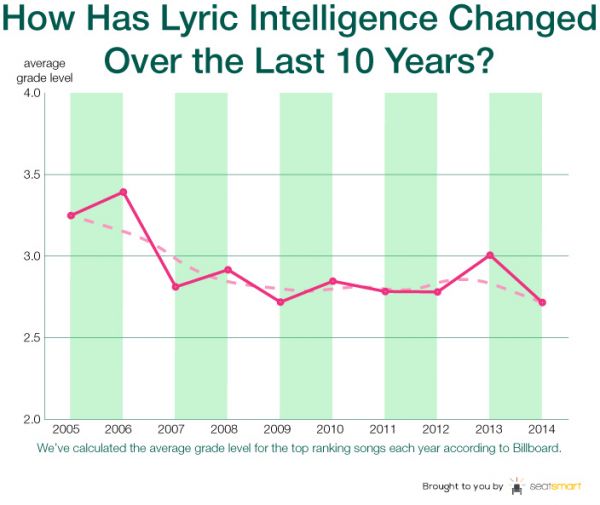
Andrew Powell-Morse of the data blog SeatSmart compiled the lyrics from 225 of the most popular songs in the pop, country, rock, and hip-hop genres. He analyzed them with the Flesch-Kincaid grade index to generate reading level scores. On average, songs that were popular over the past 10 years were written at the third grade level, but that’s been steadily dropping over time. You can see more charts here, including ones that show gender and genre differences, as well as the grade levels of specific singers, such as Kanye West and Justin Timberlake.
-via BuzzFeed
Why 'The Big Lebowski' Is Secretly 'Alice In Wonderland'
How the beauty industry convinced women to shave their legs

In 1920, when a young woman cut her leg shaving, it wasn't just an accident. It was national news, because shaving your legs was just that unusual:
/cdn0.vox-cdn.com/uploads/chorus_asset/file/3716964/nationalnewsforlegshaving.png)
Seattle Star/Library of Congress
How did women shaving their armpits and legs go from a freak story in 1920 to the mainstream by 1950?
The best research blames a sustained advertising campaign to change the way women groomed.
In the 1900s, most women didn't care about armpit or leg hair
/cdn0.vox-cdn.com/uploads/chorus_asset/file/3717570/542928419.jpg)
Ullstein Bild/Getty Images
In 1908, fashion around the world was generally very concealing.
As the 20th century began, women didn't care if they had leg or underarm hair, and it shows in the beauty guides, ads, and fashion of the time. Clothes were so concealing that it was rare to see bare legs or underarms, so removing hair there wasn't an issue. Before the 1910s, depilatories for those areas were used primarily by actresses or dancers, or for surgery.
Women did worry about hair other places. Christine Hope did the definitive research on women's hair removal in her 1982 paper "Caucasian Female Body Hair and American Culture," and her survey of ads in old Harper's Bazaar and McCall's magazines shows that they targeted facial, neck, and forearm hair. The legs and underarm were nowhere to be seen.
But new trends started to change everything within a few years.
Advertisers target the armpit
According to Hope, a shift began in 1915 when advertisers in Harper's Bazar started to target underarm hair (usually for various depilatory creams). A new trend in sleeveless dresses, often inspired by Greek and Roman clothing, exposed women's previously covered arms. That, of course, led the depilatory industry to conclude that underarm hair was undesirable.
This 1922 ad from Harper's Bazaar is typical of the genre that emerged:
/cdn0.vox-cdn.com/uploads/chorus_asset/file/3717188/1922harpersad.png)
Harper's Bazaar
A depilatory ad in Harper's Bazaar, from 1922.
This typical quote from a contemporaneous ad campaign says it all:
"The Woman of Fashion Says the underarm must be as smooth as the face"
The appeals were largely based on fashion, but they also told women what they should do to look fashionable (remove their underarm hair). Safety razors also got into the mix. As Gillette claimed in a typical 1917 ad: "Milady Decolette is the dainty little Gillette used by the well-groomed woman to keep the underarm white and smooth."
To some degree, the shift to increased shaving was made possible by technology, such as the the 1901 invention of a safety razor with disposable blades and the 1919 packaging of instant shaving cream. But that technology also needed to expand its market.
In the Roaring '20s, hemlines rise and the hair-removal industry targets legs
/cdn0.vox-cdn.com/uploads/chorus_asset/file/3717716/104415815.jpg)
Keystone France/Getty Images
Women shaving their legs in 1927 (these women were on Broadway, so they were slightly atypical for the time).
During the 1920s, knee-high skirts made legs more visible, and depilatory companies wasted no time claiming that their products enabled "a woman to bathe stockingless, without self-consciousness."
Hope's analysis shows that a relatively small percentage of ads focused on leg hair removal: in Harper's Bazar, for example, 66 percent of the ads mentioned it, but only 10 percent made it their sole focus.
Briefly, it even seemed like depilatories might just be a passing fad. From 1924 to 1926, ads for them disappeared from the Sears catalog and McCall's. And most of the ads were seasonal, running from around April to September — timing that suggests women mostly relegated hair removal to summer, when their underarms and legs were exposed.
That didn't last.
In the '50s, bare legs become the norm
/cdn0.vox-cdn.com/uploads/chorus_asset/file/3717436/1939legremovalad.png)
A leg hair removal ad from 1939.
By the 1940s, leg hair removal had become standard. By this point, all of the hair removal ads in Harper's Bazar mentioned leg hair, and 56 percent focused on the legs alone, according to Hope.
The more conservative McCall's didn't completely follow suit, but it also shifted toward leg hair, with salacious ad taglines like "Let's Look at Your Legs — Everyone Else Does."
And around this time, the media joined the ads in condemning leg hair. In 1939, Harper's Bazar wrote: "Ankle socks on the campus are a fine, old institution and all very well, but not on furry legs." There are hints that unshaved legs were still around at the time, but fading — in 1941, the magazine says, "If we were dean of women, we'd levy a demerit on every hairy leg on campus."
As the '50s ended, the transformation of American hair was complete. By 1964, 98 percent of American women ages 15 to 44 reported that they removed some body hair.
Did ads pressure women into removing their armpit and leg hair?
/cdn0.vox-cdn.com/uploads/chorus_asset/file/3717702/shutterstock_186100895.jpg)
A woman shaves her legs.
Can ads be blamed for the transformation? It's tough to know — a universal phenomenon like leg shaving that happens over decades is tough to pin down to a few ad campaigns. There was clearly a preexisting prejudice against body hair, too — that's shown by the ads in the 1900s that targeted face, neck, and arm hair. Changing fashion may have simply revealed a new area that needed to be groomed according to preexisting standards.
On the other hand, the advertising record hints that a lot of leg and underarm shaving was originally situational — women only shaved if they knew their underarms or legs would be exposed, and even then, it wasn't necessarily the norm yet.
In addition, as Hope notes, the instructional nature of many of the ads makes it seem like the ads were telling women what was appropriate instead of reenforcing existing trends. This ad from 1945 has to state exactly why a woman "needs" to shave her armpits.
One thing, however, we can know with certainty: in 1920 it was a story when a woman shaved her legs, and just a few decades later it was considered a story when she didn't.
WATCH: How mass marketing influenced popular cultureNo me duele la penetración anal
Técnicamente, al dolor que uno siente cuando es penetrado analmente se lo denomina anodispareunia. Alguien podría ahora mismo asentir con la cabeza: claro, duele, porque el ano no está diseñado para ser penetrado. Su función biológica es otra muy distinta, y todos la conocemos bastante bien cuando visitamos al señor Roca.
Religiones y morales laicas varias incluso se han atrevido a cuestionar o prohibir esta práctica por considerarla antinatural, sucia o inmoral. Hasta hace bien poco, en Kansas, Oklahoma o Texas, por ejemplo, se prohibía el sexo anal entre parejas heterosexuales. Hasta el año 2002, había diez estados donde el sexo anal estaba prohibido bajo cualquier circunstancia. Eran leyes periclitadas, pero hasta la década de 1990 aún se producían denuncias a parejas gays por sodomía. A pesar de ello, el 50 % de las mujeres entre 25 y 30 años admite haber probado el coito anal, según la Encuesta Nacional de Salud Sexual y Comportamiento.
Es peor y mejor
El sexo anal sin preservativo multiplica por veinte la posibilidad de contagio de VIH en comparación al coito vaginal. Pero eso no nos dice nada acerca de la moralidad de la práctica, solo de sus riesgos. Unos riesgos que, por otra parte, se minimizan con las medidas profilácticas adecuadas.
El dolor por sexo anal existe, pero sin embargo es improbable si el sexo anal se realiza en buenas condiciones de lubricación. Pere Estupinyà escribe acerca de los resultados presentados a este respecto en 1.190 homosexuales belgas en un congreso de medicina sexual en Chicago en su libro S=EX2:
Los resultados fueron que el 41 por ciento no sentía dolor alguno, pero el 32,7 por ciento de ellos sí sentía un dolor suave, el 17,2 por ciento de suave a moderado, el 4 por ciento moderado, y el 1,8 por ciento severo. Profundizando en los resultados se observó que cuanta mayor experiencia menos dolor, pero que había un sector de la población en el que el dolor estaba siempre presente, y que muy a menudo les impedía mantener relaciones satisfactorias.
Aleksander Stulhofer y su equipo de investigadores de la Universidad de Zagreb han descubierto que casi de la mitad de las participantes en un estudio tuvo que interrumpir su primera experiencia de sexo anal porque era dolorosa; pero, a la vez, solo el 52% de las dos mil encuestadas había utilizado lubricante antes de practicarlo. Es decir, que no lo había practicado con el suficiente cuidado.
De cualquier manera, para muchos el dolor es lo que menos a la hora de condenar el sexo anal: sencillamente el ano no está diseñado para ser penetrado. No es su función natural. Y eso es totalmente cierto. El ano es producto de miles de años de evolución darwiniana. Es una forma viable por la cual excretamos nuestros residuos. Usarlo para otra cosa, pues, no solo es antinatural, sino estúpido.
Sin embargo, ese razonamiento es muy superficial. A menudo usamos partes de nuestro cuerpo para funciones que no les corresponden. Es lo que se llaman funciones exadaptativas. Por ejemplo, nuestras orejas y el puente de nuestra nariz tiene una función exadaptativa en muchos miopes: sujetar las gafas.
El sexo anal y ponerse unas gafas no son la misma cosa, pero sí lo son con arreglo al argumento «esa parte del cuerpo no fue diseñada para eso». También las gafas, por cierto, fueron contempladas con suspicacia por la Iglesia, porque contravenían lo natural. Fray Guillermo de Baskerville, el protagonista de El nombre de la rosa, es un avanzado a su tiempo cuando extrae una suerte de lentes para poder escudriñar mejor la realidad.
Además, el sexo anal es natural en tanto en cuanto se produce a menudo en la naturaleza. Se ha observado en machos de oveja, de jirafa y de bisonte, y también entre machos de delfín mular, que se penetran mutuamente. Si hemos de catalogar moralmente un acto por la frecuencia en la que aparece en la naturaleza, entonces la monogamia, que anormal en la naturaleza, sería una práctica aberrante.

Es mejor y peor
Llegados a este punto podríamos aducir que no importan estas cifras acerca del dolor, o si usamos gafas o no. El simple hecho de que, porcentualmente, el sexo anal duela más que el vaginal ya debería ofrecernos una pista clara sobre la estupidez que estamos practicando. Sin embargo, ésta también es una forma simplista de analizar la situación.
Las razones que nos hacen disfrutar del sexo son diversas, y no se limitan a la estimulación erógena. Tras revisar una gran cantidad de bibliografía científica al respecto, Kim McBride, de la Universidad de India, concluyó que hay seis grandes grupos de razones que nos hacen disfrutar del sexo anal:
- Intimidad y confianza, pues el sexo anal suele practicarse con personas con las que tenemos más confianza.
- Búsqueda de diversidad y nuevas sensaciones.
- Juegos de control y dominación.
- El morbo de quebrantar un tabú.
- El dolor leve puede producir placer.
- Es una práctica más dentro de todas las que se llevan a cabo dentro de la pareja.
El placer sexual no es simple roce de células, sino también contexto e imaginación. Pero si nos limitamos a la biología, arrancando de raíz cualquier pensamiento y emoción, en muchos hombres, la penetración anal también estimula la próstata, lo que incrementa el placer hasta el punto de que se puede eyacular. En el caso de las mujeres, hay estudios con sonogramas que podrían determinar si se alcanzan algunas estructuras internas del clítoris durante la penetración anal:
Son estudios no finalizados todavía, pero de confirmarse explicarían que unas chicas sientan tanto placer asociado al sexo anal mientras que a otras le genera más bien indiferencia.

Suciedad
El ano es un lugar sucio y apestoso. Ése es un buen argumento, siempre y cuando no se recuerde que el sexo también es, para muchas personas, más excitante cuanto más sucio sea. ¿Acaso no es sucia la penetración vaginal con un pene por el que también se orina?
Siguiendo en la línea de salubridad, darse un morreo o plantarle un ósculo a la mejilla del amado también es sucio. Durante la Edad Media se decretó que el beso, como el juego amoroso o los preliminares en general, eran reprobable. Y Sigmund Freud catalogaba el beso como «perversión» en su Tres ensayos sobre la teoría de la sexualidad. Porque las bocas son mucosas en las que proliferan millones de bacterias. Más de 6 millones de bacterias de 600 tipos diferentes. Son casi cloacas. Su función es servir de entrada al alimento, no besar.
En nuestra también cara tenemos millones de ácaros foliculares (demodex folliculorum), y eso es lo que estamos besando cuando acercamos los labios a una mejilla.
El sexo es sucio y primitivo, desde un beso hasta la penetración vaginal. Pero el contexto es lo que determina que nos guste o no. Por eso nos damos el lote con nuestra novia, intercambiando babas a tope, pero quizá nos dé apuro compartir el cepillo de dientes o beber del mismo gollete que él o ella acaba de beber. Y ya no digamos bebernos una copa de saliva, aunque sea la propia.
Imágenes | Pixabay/Shutterstock
Este post No me duele la penetración anal, escrito por Sergio Parra, se publicó originalmente en Yorokobu.
Identifica árboles con esta app: Arbolapp
 La aplicación Arbolapp, que permite identificar árboles silvestres de la península ibérica y las Islas Baleares, fue lanzada en noviembre de 2014. Desde entonces, ha superado las 80.000 descargas en dispositivos Android y las 25.000 en iOS.
Ahora, el Consejo Superior de Investigaciones Científicas acaba de lanzar, con apoyo de la Fundación Española para la Ciencia y la Tecnología, una actualización de la aplicación que incorpora nuevas funciones, como el apartado de ‘Preguntas frecuentes’ y varias mejoras técnicas, como la posibilidad de ampliar el tamaño del texto en algunos apartados, un método más ágil para visualizar fotografías y una opción para seleccionar el idioma de la aplicación (castellano o inglés) desde el menú principal.
Arbolapp ofrece información acerca de 118 especies de árboles de la España peninsular, el Portugal continental, Andorra y las Islas Baleares. Las especies están organizadas en 98 fichas: 95 individuales y tres que agrupan las especies de los géneros acacia, eucalipto y tamarix. Cada ficha contiene fotografías, mapas que muestran en qué provincias está presente el árbol, un texto descriptivo y varias curiosidades.
Para identificar una especie, es posible elegir entre dos tipos de búsqueda. Una guiada, en la que hay que escoger en sucesivas pantallas la alternativa que mejor describe el árbol que se quiere reconocer; y otra abierta, que permite encontrar árboles por provincia, tipo de hoja, fruto, flor u otros criterios.
Vía | Sinc
También te recomendamos
Una aplicación que muestra los nacimientos y defunciones de todo el mundo y en tiempo real
Facebook At Work: la red para empresas de Facebook
Préstale tus ojos a un invidente
-
La noticia Identifica árboles con esta app: Arbolapp fue publicada originalmente en Xataka Ciencia por Sergio Parra .
