Vampi Soul's R&B Hipshakers, Vol. 1: Teach Me to Monkey is compiled by WFMU DJ Mr. Fine Wine and features an array of late-'50s to early-'60s R&B, some jump blues stragglers, and a bit of proto-rock & roll -- punctuated by honking saxes, shouting vocals, and tempos guaranteed to have you doing exactly what the title says. This set features rare tracks from Hank Ballard, Little Willie John, and many more. Roll back the rugs and grab a partner; this stuff will get you in a dancing mood real quick. (Tim Sendra, Allmusic)Shared posts
"R&B Hipshakers" Vol. 1 Teach Me To Monkey
Vampi Soul's R&B Hipshakers, Vol. 1: Teach Me to Monkey is compiled by WFMU DJ Mr. Fine Wine and features an array of late-'50s to early-'60s R&B, some jump blues stragglers, and a bit of proto-rock & roll -- punctuated by honking saxes, shouting vocals, and tempos guaranteed to have you doing exactly what the title says. This set features rare tracks from Hank Ballard, Little Willie John, and many more. Roll back the rugs and grab a partner; this stuff will get you in a dancing mood real quick. (Tim Sendra, Allmusic)El Movimiento Zapatista: la lucha contra el neoliberalismo global
El 1 de enero de 1994 entraba en vigor el Tratado de Libre Comercio de América del Norte (TLCAN) por el que México, Estados Unidos y Canadá se convertían en un mercado integrado a través de la supresión de las barreras arancelarias y comerciales. De esta forma, el gobierno mexicano dejaba claro que sus miras e intereses se centraban en el norte del continente americano; básicamente, en multiplicar sus perspectivas de crecimiento económico a través de la liberalización de una zona comercial con sus socios ricos más cercanos.
Paralelamente, en el estado mexicano de Chiapas, que hace de frontera sur con Guatemala, tenía lugar una sublevación armada a cargo de un grupo de indígenas conformados en el Ejército Zapatista de Liberación Nacional (EZLN). Hacía años que el EZLN se había convencido de que la transformación del país no podía lograrse por la vía institucional: la vía pacífica estaba ya agotada. Es por ello que, años después del establecimiento en Chiapas del primer campamento del EZLN en 1983, y tras los esfuerzos por acumular apoyos y tejer redes de solidaridad con organizaciones locales, el 1 de enero de 1994 tenía lugar la declaración pública de guerra al gobierno mexicano y la toma de los municipios de San Cristóbal de las Casas, Altamirano, Chanal, Ocosingo, Las Margaritas, Oxchuc, y Huixtan.
¿Por qué Chiapas?
La sociedad chiapaneca se caracterizaba por altos niveles de pobreza, marginación y desigualdad mayoritaria. Al mismo tiempo, el sistema político chiapaneco era un sistema oligárquico, clientelar y represivo. Todo ello sumado a la deriva neoliberal de las políticas del gobierno mexicano, y en general de toda América Latina, ocasionaron un deterioro en las condiciones de vida de la población, desempleo masivo y reducción del gasto social por parte del Estado.
No era la primera vez que la población indígena chiapaneca se rebelaba. Sus antepasados mayas destacaron entre los pueblos que más habían resistido la conquista; en Yucatán y en Guatemala no fueron sometidos hasta 1703, y pronto volvieron a rebelarse. En Chiapas organizaron una gran revuelta en 1712, y estos mismos pueblos volvieron a rebelarse en enero de 1994. ¿Contra qué? Contra una violencia renovada –institucional– que llevaba décadas tratando de destruir su identidad, arrebatarles su dignidad moral y aniquilar su modo de vida étnico.
El origen de la rebelión también está en el desarrollo de Chiapas durante el siglo XX, que implicó cambios en el modelo productivo agrarista tradicional y el despojo de tierras y trabajo indígena. Es decir, menos tierras para más pobres. Todo ello, sumado a la ausencia de cauces institucionales que canalizaran sus demandas propició la organización de una parte de la comunidad indígena bajo el EZLN y su posterior sublevación.
Para ampliar: “Causas de la rebelión en Chiapas“, Clacso
Los vínculos entre el EZLN, la comunidad indígena y la sociedad civil
Aunque el EZLN ha sido un actor predominante del Movimiento Zapatista, no ha sido el único. De hecho, su propia existencia y mantenimiento ha sido fruto de la interacción con otros dos grandes actores: las comunidades indígenas y la sociedad civil –nacional e internacional–.
El EZLN es la parte militar del movimiento, liderada por el Comité Clandestino Revolucionario Indígena, Comandancia General. Las bases militares estaban conformadas por indígenas, gente de la Iglesia católica, organizaciones productivas autónomas agrarias y campesinas y sectores de izquierdas. Esta heterogeneidad sociocultural fue un elemento esencial en la creación de nuevas dimensiones ideológicas y organizativas. En este sentido cabe destacar el papel del grupo religioso Diócesis de San Cristóbal, que sirvió de gran apoyo ideológico y promovió nuevas prácticas organizativas que incentivaban la reflexión intracomunitaria.

Por otro lado están las indígenas del EZLN. Varias de ellas estuvieron al frente de la toma de presidencias municipales y se convirtieron rápidamente en símbolo de la resistencia de las mujeres indígenas. La participación de las mujeres en la dirigencia guerrillera difiere de otras experiencias revolucionarias en América Latina. Además, el zapatismo se diferencia de otros movimientos guerrilleros en la inclusión de demandas de género dentro de su plataforma de lucha a través de la Ley Revolucionaria de Mujeres. Esta Ley fue el resultado de una consulta que varias mujeres zapatistas realizaron entre sus militantes y sus bases de apoyo y es conocida según un comunicado del Sub-Comandante Marcos, como “el primer levantamiento zapatista”:
Susana, tzotzil, está enojada. Hace rato la burlaban porque, dicen los demás del CCRI, ella tuvo la culpa del primer alzamiento del EZLN, en marzo de 1993. “Estoy brava”, me dice. Yo, mientras averiguo de qué se trata, me protejo tras una roca. “Los compañeros dicen que por mi culpa se alzaron los zapatistas el año pasado”. Yo me empiezo a acercar cauteloso. Después de un rato descubro de qué se trata: en marzo de 1993 los compañeros discutían lo que después serían las “Leyes Revolucionarias”. A Susana le tocó recorrer decenas de comunidades para hablar con los grupos de mujeres y sacar así, de su pensamiento, la “Ley de Mujeres”. (Fragmento de la Carta de Marcos sobre la vida cotidiana en el EZLN del 26 de enero de 1994.)
Por otro lado están las bases civiles que apoyan al EZLN pero no forman parte de su estructura militar: son los pueblos indígenas tzeltales, tzotziles, tojolabales, choles y zoques principalmente asentados en los Altos y la selva Lacandona de Chiapas.

El último actor central del Movimiento es la sociedad civil nacional e internacional, entre las que encontró grandes apoyos provenientes de organizaciones políticas de izquierda, organizaciones no gubernamentales de derechos humanos, comunidades universitarias, intelectuales, organismos internacionales como la ONU, la OEA y la UE, y agencias de cooperación.
La incursión del zapatismo en el escenario político
¿Qué oportunidades tenía el Movimiento Zapatista de incidir en el terreno político? En primer lugar podría decirse que la globalización estaba abriendo las posibilidades de participación de nuevos actores, por lo que las oportunidades políticas de incursión en el plano nacional e internacional empezaban a ser favorables. Más aún con los apoyos y aliados influyentes de la causa indígena procedentes de la sociedad civil.
Por otro lado, la búsqueda de reconocimiento internacional y la progresiva implantación de ideas sobre democracia y derechos humanos supusieron una disminución en la capacidad represiva del Estado. Sin embargo, las oportunidades políticas a nivel local eran totalmente contrarias: el ascenso al poder de un gobernador militar en Chiapas llevó a una etapa de represión y endurecimiento del código civil del Estado.
Por último, la aparición de organismos supranacionales encargados de supervisar los pactos favoreció la aparición de una clase tecnócrata en el gobierno que provocó cambios en las relaciones de poder: al tiempo que se forjaban nuevas alianzas políticas en el gobierno, se creaba inestabilidad entre los caciques locales que se beneficiaban del estatus anterior.
La etapa posterior a la sublevación
El 1 de enero de 1994 fue la única vez que el EZLN tomó las armas, hasta el día 12 en que se decretó una tregua a los combates. Desde entonces, la estrategia zapatista se ha ido concretando en varios ejes que acabarán siendo simultáneos. En primer lugar está la construcción autónoma de recursos, medios y procesos para la subsistencia de sus comunidades indígenas. En la práctica se traduce en la apropiación del territorio que ahora conforma los Municipios Autónomos Rebeldes Zapatistas, gobernados a través de espacios para el encuentro y diálogo como los “Aguascalientes”, las Juntas de Buen Gobierno o los caracoles -unidades civiles de autogobierno-. Otro medio importante será el uso de nuevas tecnologías como Internet, que les ha permitido difundir sus mensajes y crear una red mundial de solidaridad que ha logrado poner al movimiento en los primeros planos de la política mundial.

Por otro lado la estrategia zapatista se ha centrado en la búsqueda y apertura al diálogo con el gobierno y la clase política mexicanos. El reconocimiento como interlocutor es el primer paso para ser escuchado, y éste el paso para que se satisfagan las demandas. Por último, también se ha preocupado de los acercamientos y la búsqueda de apoyos en la sociedad civil nacional e internacional, con el objetivo de articular otras luchas contra la corrupción del gobierno mexicano y la implantación del neoliberalismo a nivel global.
Si hablamos de acciones colectivas, el Movimiento zapatista ha llevado a cabo numerosas marchas, consultas y encuentros entre bases civiles y EZLN. También existen innumerables producciones escritas tales como manifestaciones, demandas, declaraciones y reflexiones en forma de ensayos, cuentos o proclamas políticas; y producciones plásticas y artísticas como vídeos, exposiciones fotográficas, pinturas, murales, vestimentas o conciertos de música.
Pero, sin duda, las Declaraciones de la Selva de Lacandona son la mejor lectura de la historia zapatista. La primera fue la declaración de guerra, leída desde el balcón del palacio municipal de San Cristóbal que un grupo de unos 2000 indígenas armados y encapuchados habían asaltado aquel 1 de enero de 1994. Con la segunda se convoca a la sociedad civil; con la tercera se crea un Movimiento de Liberación Nacional; y con la cuarta el Frente Zapatista de Liberación Nacional. La quinta consistió en la creación de Consulta Nacional, la gran mesa de diálogo con todos menos con el gobierno; y con “La Sexta”, la última, se inicia “La Otra Campaña“, la campaña zapatista paralela a las campañas electorales mexicanas de 2006.
La particularidad de la narrativa zapatista
Los mensajes y expresiones hallados en los escritos, cartas, entrevistas y declaraciones del EZLN muestran cómo su innovadora producción ideológica les llevó a ocupar un espacio mediático sin precedentes en la historia de las guerrillas. El motivo principal: la innovación en el manejo de la simbología política.
Su sistema cultural –que incluye los rasgos culturales y étnicos como la lengua, las creencias, los ritos, costumbres y tradiciones; así como el sistema y capital económico, la producción material y la estructura social– conforma un marco de interpretación desde el que comprender la realidad de un modo alternativo al hegemónico. Se trata de un sistema tradicionalista, derivado de la memoria histórica ligada a las rebeliones indígenas y de los escritos mayas precolombinos. Su cosmovisión se caracteriza por una espiritualidad alejada del individualismo occidental, muy ligada a la naturaleza y a la vida comunitaria.
Según la narrativa zapatista, hubo un tiempo pasado donde se vivía de forma comunitaria e igualitaria, en solidaridad humana y en comunión con la naturaleza. La llegada de los conquistadores los abocaría a una situación de pobreza y riesgo de extinción, a la arbitrariedad de acciones gubernamentales y a la consideración como ciudadanos de tercera clase que han de ser eliminados silenciosamente en aras de la modernización del país.
El estilo narrativo de sus textos opta por el género cómico y poético, que intenta convencer conmocionando, y que no pretende presentar un programa ideológico sino que solamente es una estrategia para preguntar, dialogar y construir la “verdad” a través de la exaltación de la duda entre el pueblo o la sociedad civil. Uno de los elementos más interesantes del discurso zapatista reside en el uso de la paradoja y otros recursos literarios como el “detrás de nosotros, estamos ustedes”, o “para que nos vieran, nos tapamos el rostro, para que nos nombraran, nos negamos el nombre; apostamos al presente para tener futuro; y para vivir… morimos”.
Extraído de: Los “mensajes” de la narración política del Movimiento Zapatista
De la identidad étnica a la identidad política
Durante los años 70 y 80 tiene lugar la “liberación cognitiva”, momento en que la etnicidad se problematiza y politiza, articulándose la identidad étnica con la identidad política a través de un discurso que otorga significados a su existencia. Es entonces cuando empiezan a autodefinirse como los “primeros hombres”, los hombres “pequeños”, los “sin rostro”, “los que vienen de la noche y de la montaña”, los “más pobres entre los pobres de toda la pobrecía”, los del “color de la tierra”, los “dignos y rebeldes” “los mayas, hijos de los días, hechos de tiempo”, los “jamás escuchados”; proyectando así una imagen de férrea dignidad moral a la vez que de empobrecidas víctimas.
Cuando la identidad colectiva se percibe en riesgo se desencadena un choque entre lo que “es” y lo que “debería ser” el mundo, lo que provoca sentimientos de indignación e injusticia contra esta histórica y sistemática discriminación y opresión hacia el pueblo indígena. El objetivo político, por tanto, es garantizar la integración social y política de los pueblos indígenas a través de dos elementos fundamentales: el reconocimiento y el respeto de su territorialidad y autonomía jurídico-política. Entre otras demandas, están el derecho al uso y disfrute de los recursos naturales y al territorio –el hábitat–; programas de desarrollo; políticas culturales propias; educación indígena de calidad, defensa de sus lenguas, gestión de sus medios de comunicación, y protección de sus formas de democracia donde prima la importancia de lo colectivo frente a lo individual, la búsqueda del consenso, la autonomía municipal y el “mandar obedeciendo”:

La solidaridad cósmica con los pueblos oprimidos del mundo
Llegado un momento, el EZLN considera que los movimientos indígenas no pueden reducir su lucha a cuestiones localistas, pues forman parte de la actual estructura económica y sociopolítica global. De ahí que empiecen a definir al actor público como toda la humanidad excluida, marginada e invisibilizada por el proceso de globalización neoliberal. Su singular argumentación política persigue crear o recrear la autoestima de los grupos de estatus minoritarios mediante la afirmación de su identidad colectiva: un “nosotros” amplio, conformado por las minorías que abarcan “todos los colores de la tierra”; y una nueva utopía, “un mundo donde quepan muchos mundos”, construido sin exclusiones y con participación activa y plural.
Desde los primeros “encuentros selváticos” comienza a fraguarse un movimiento amplio y disperso de dimensiones mundiales que encontrará el posterior relevo en las sucesivas manifestaciones mundiales “antiglobalización” y en los Foros Sociales Mundiales.
INTERESANTE: Artículo “¿Qué quedó de la antiglobalización?”
A día de hoy, sabemos el Movimiento Zapatista no tiene ninguna intención de convertirse en una organización política vertical. No sólo quiere cambiar el gobierno; quiere cambiar el mundo, y lo hace a través de una organización descentralizada y heterogénea. El recorrido y objetivos son ahora de largo plazo, entrando en una etapa de revisión del “ritmo” y “las compañías” o aliados oportunistas del Movimiento.
Para ampliar: Desaparece la otra campaña; anuncia el EZLN cambios
Lo que está claro es que el movimiento zapatista es un fenómeno bastante complejo en el que convergen numerosos actores y procesos que resultan en la construcción de una identidad política, una nueva forma de ciudadanía de alcance global. La importancia de la incursión del movimiento zapatista en el escenario político reside en que pone de manifiesto el agotamiento del modelo democrático actual al servicio del régimen capitalista de acumulación y negación de la diferencia, en el sentido de no reconocimiento y no igualdad real. Por ello, la lucha zapatista sienta el precedente necesario que puede abrir las posibilidades de emancipación de otros grupos apartados y oprimidos del mundo.
Manifiesto zapatista en náhuatl
Al pueblo de México:
A los pueblos y gobiernos del mundo:
Hermanos:
Nosotros nacimos de la noche.
En ella vivimos.
Moriremos en ella.
Pero la luz será mañana para los más,
para todos aquellos que hoy lloran la noche,
para quienes se niega el día,
Para todos la luz.
Para todos todo.
Nuestra lucha es por hacernos escuchar,
y el mal gobierno grita soberbia
y tapa con cañones sus oídos.
Nuestra lucha es por un trabajo justo y digno,
y el mal gobierno compra y vende cuerpos y vergüenzas.
Nuestra lucha es por la vida,
y el mal gobierno oferta muerte como futuro.
Nuestra lucha es por la justicia,
y el mal gobierno se llena de criminales y asesinos.
Nuestra lucha es por la paz, y el mal gobierno anuncia guerra y destrucción.
Techo, tierra, trabajo, pan, salud, educación,
independencia, democracia y libertad.
Estas fueron nuestras demandas
en la larga noche de los 500 años.
Estas son, hoy, nuestras exigencias.
La entrada El Movimiento Zapatista: la lucha contra el neoliberalismo global aparece primero en El Orden Mundial en el S.XXI.
"R&B Hipshakers" Vol. 2 Scratch That Itch
trax:"The Hair" is everywhere
Fecal transplants work in puppies too

Fecal transplants cured 93% of diarrhea cases in a pioneering study, reports Ars Technica's Beth Mole.
By digging into the data on fecal transplants—which are highly effective at treating dogged gut infections, such as Clostridium difficile, in humans—Conrad realized that treatment didn’t have to be that rough. Such transplants generally work by using poop, laden with a helpful community of microbes, to restore disorderly microbial communities in the gut and elbow out harmful germs.
In Conrad’s procedure, veterinarians simply take stool from healthy dogs, screen it, liquefy it, and then inject it into a sick dog’s intestines with a feeding tube inserted in their rear. The screening process Conrad uses is simple, mostly culturing some of the microbes in lab to check for certain types of bacteria.
Within 12 to 24 hours, the puppies’ symptoms start clearing up, Conrad said. He’s now using the method to treat adults and pregnant dogs
How Some Asian Cultures Use Chopsticks Differently

Chopsticks are used by many different Asian cultures in many different ways, and considering they've been around for an estimated six thousand years it'd be silly to think otherwise.
But it seems how they're used, what they're made out of and what they're used to eat varies by country rather than by type of cuisine.

In Japan chopsticks are used to eat anything that's not considered hand food, and the debate whether sushi is hand food or not rages on.
In Hong Kong and mainland China chopsticks are used for traditional rice and noodle dishes, and any western foods are eaten with knife and fork.
And in Thailand chopsticks are often used to load up your spoon with ingredients from the bowl before you take a bite.
Mashable asked foodies from various countries how chopsticks are used in their culture, and it seems the one thing they all agree on is this- don't stick them in your bowl standing straight up, as this is symbolically associated with death.
Read One Size Does Not Fit All: How Some Asian Cultures Use Chopsticks Differently here
Why Cryonics Makes Sense
You’re on an airplane when you hear a loud sound and things start violently shaking. A minute later, the captain comes on the speaker and says:
There’s been an explosion in the engine, and the plane is going to crash in 15 minutes. There’s no chance of survival. There is a potential way out—the plane happens to be transferring a shipment of parachutes, and anyone who would like to use one to escape the plane may do so. But I must warn you—the parachutes are experimental and completely untested, with no guarantee to work. We also have no idea what the terrain will be like down below. Please line up in the aisle if you’d like a parachute, and the flight attendants will give you one, show you how to use it and usher you to the emergency exit where you can jump. Those who choose not to take that option, please remain in your seat—this will be over soon, and you will feel no pain.
What would you do?
___________
When Robert Ettinger was a kid in the 1930s, he read a lot of science fiction, and he assumed that with the world advancing the way it was, scientists would surely have a cure for aging at some point during his lifetime. He would live to see a world where sickness was a thing of the past and death was something people chose to do voluntarily, at a time of their choosing.11← New to WBW? Open these.
But thirty years later, aging and involuntary death were still very much a thing, and Ettinger, by then a physics professor, realized that science might not solve these problems in time for him to reap the benefits. So he started thinking about how to hack the system.
If, rather than being buried or cremated after his death, he could instead be frozen in some way—then whenever the scientists did eventually get around to conquering mortality, they’d probably also have the tools and know-how to resuscitate him, and he could have the last laugh after all.
In 1962, he wrote about this concept in a book called The Prospects of Immortality, and the cryonics movement was born.
The first person to give cryonics a try was James Bedford, a psychology professor who died of cancer in 1967 at the age of 73 and is doing his thing in a vat of liquid nitrogen in Arizona as you read this. Others slowly began to follow, and today, there are over 300 people hanging out in vats of liquid nitrogen.
Now let’s pause for a second. A year ago, I knew almost nothing about cryonics, and my impressions of it were something like this sentence:
Cryonics, or cryogenics, is the morbid process of freezing rich, dead people who can’t accept the concept of death, in the hopes that people from the future will be able to bring them back to life, and the community of hard-core cryonics people might also be a Scientology-like cult.
Then I started learning about it. It’s your fault—cryonics is one of the potential-future-post-topics people email me about most, and it’s something at least five readers have brought up in conversation when I’ve met them in person. And as I began to read about cryonics, I soon learned that a lot of the words in my italicized assumption sentence weren’t correct.
So let’s work our way through the sentence as we go over exactly what cryonics is and how it works. We’ll start with this part:
Cryonics, or cryogenics, is the morbid process of freezing rich, dead people who can’t accept the concept of death, in the hopes that people from the future will be able to bring them back to life, and the community of hard-core cryonics people might also be a Scientology-like cult.
It turns out that this is like saying, “Wingsuit flying, or meteorology, is the sport of flying through the air using a wingsuit.” Meteorology is the study of what happens in the atmosphere, which includes how wind works, and wingsuit flying is a process that harnesses the wind—and you’d be an odd person if you thought they were the same thing.
Likewise, cryogenics is a branch of physics that studies the production and effects of very low temperatures, while cryonics is the practice of using very low temperatures to try to preserve a human being. Not the same thing.
Next, we have a string of three misleading words to talk about:
Cryonics is the morbid process of freezing rich, dead people who can’t accept the concept of death, in the hopes that people from the future will be able to bring them back to life, and the community of hard-core cryonics people might also be a Scientology-like cult.
We’ll address these three words by going through how cryonics works, starting at the beginning.
So you decide you want to be a cryonicist. Here are the steps:
Step 1) Pick a company
There are four major companies that provide cryonics services—Alcor in Arizona, Cryonics Institute (CI) in Michigan, American Cryonics Society (ACS) in California, and KrioRus in Russia. KrioRus is the newest option and quickly up-and-coming, but the two big boys are Alcor and CI (ACS doesn’t have their own storage facilities—they store with CI).
From my perusing, it seems like Alcor is the slightly-more-legit and fancier of the two, while CI (which was started by Robert Ettinger, the guy who launched the movement) is more affordable and gives off more of a mom-and-pop vibe. Both are nonprofit, and each has about 150 people in storage. Alcor has a little over 1,000 “members” (i.e. people who will one day be in storage), and CI has around half that number.
Step 2) Become a member
To become a cryonicist, you need to fill out some paperwork, sign some stuff and get it notarized, and pay for three things: an annual membership fee, a transport fee to get your body to the facility after you die, and a treatment/storage/revival fee.
Alcor’s annual membership fee is about $700, and their transport fee is bundled together with the treatment/storage/revival fee—together they cost $200,000. Alcor gives you the option of ditching your body and just freezing your brain (this is called “neuropreservation”), which brings the price down to $80,000.
CI’s annual membership fee is $120 (or a one-time fee of $1,250 for a lifetime membership) and the treatment, etc. costs $35,000 ($28,000 for lifetime members). This is so much cheaper than Alcor for two main reasons:
First, it doesn’t include the transport. If you live near the facility, you can save a lot of money. If not, you’ll need to go through their partner for a transport contract, which costs $95,000 ($88,000 for lifetime members).
Second, Alcor uses more than half of their large fee to fund what they call their Patient Care Trust. Back in the 70s, there were more cryonics companies, and some of them went bankrupt, which meant their frozen people stopped being frozen, which was a not ideal outcome. Alcor’s trust is a backup fund to make sure their “patients” won’t be affected by something like a company financial crisis.
Step 3) Get a life insurance policy in the name of your new cryonics company
Sounds shady, right? But it also makes sense. Both Alcor and CI are small companies on a pretty tight budget and neither can afford to offer a payment plan to be hopefully paid out by your estate or your relatives. On the patient end, unless you’re rich, cryonics fees are huge, and a life insurance policy guaranteed to pay your full cryonics fee forces you to save for this fee throughout your life. For young people, even sizable life insurance policies are pretty cheap—with CI, you could be totally covered for as little as $300/year ($120 annual membership, $180 life insurance policy to cover the main fee). Even for Alcor’s more expensive package, costs shouldn’t exceed $100/month.
Those fees aren’t nothing, but the whole life insurance thing, at least when it comes to younger people, pretty effectively ejects “rich” from our black and red sentence. If it costs the same as cable or a cigarette habit, you don’t need to be rich to pay for it.
Step 4) Put on your bracelet and go on living your life
Cryonics members are given a bracelet and a necklace, etched with instructions and contact info, and encouraged to wear one at all times, so if you suddenly die, whoever finds you will know to notify the company.
Step 5) Die
Okay here’s where things get tricky. We think of the divide between life and death as a distinct boundary, and we believe that at any given point, a person is either definitively alive or definitively dead. But let’s examine that assumption for a second:
Let’s first talk about what it means when a person is “doomed” from a health standpoint. We can all agree that what constitutes someone being doomed depends on where, and when, they are. A three-year-old with advanced pneumonia in 1740 would probably have been doomed, while the same child with the same condition today might be fully treatable. The same story could be said of the fate of someone who falls badly ill in a remote village in Malawi compared with their fate if they were in London instead. “Doomed” depends on a number of factors.
That the same thing can be said of “dead” is at first pretty unintuitive. But Alcor’s CEO Max More puts it this way: “Fifty years ago if you were walking along the street and someone keeled over in front of you and stopped breathing you would have checked them out and said they were dead and disposed of them. Today we don’t do that, instead we do CPR and all kinds of things. People we thought were dead 50 years ago we now know were not.”2
Today, dead means the heart has been stopped for 4-6 minutes, because that’s how long the brain can go without oxygen before brain death occurs. But Alcor, in its site’s Science FAQ, explains that “the brain ‘dies’ after several minutes without oxygen not because it is immediately destroyed, but because of a cascade of processes that commit it to destruction in the hours that follow restoration of warm blood circulation. Restoring circulation with cool blood instead of warm blood, reopening blocked vessels with high pressure, avoiding excessive oxygenation, and blocking cell death with drugs can prevent this destruction.”3 The site goes on to explain that “with new experimental treatments, more than 10 minutes of warm cardiac arrest can now be survived without brain injury. Future technologies for molecular repair may extend the frontiers of resuscitation beyond 60 minutes or more, making today’s beliefs about when death occurs obsolete.”
In other words, what we think of as “dead” actually means “doomed, under the current circumstances.” Someone fifty years ago who suffered from cardiac arrest wasn’t dead, they were doomed to die because the medical technology at the time couldn’t save them. Today, that person wouldn’t be considered dead yet because they wouldn’t be doomed yet. Instead, someone today “dies” 4-6 minutes after cardiac arrest, because that happens to be how long someone can currently go before modern technology can no longer help them.
Cryonicists view death not as a singular event, but as a process—one that starts when the heart stops beating and ends later at a point called “the information-theoretic criterion for death”—let’s call it “info death”—when the brain has become so damaged that no amount of present or future technology could restore it to its original state or have any way to retrieve its information.
Here’s an interesting way to think about it: Imagine a patient arriving in an ambulance to Hospital A, a typical modern hospital. The patient’s heart stopped 15 minutes before the EMTs arrived and he is immediately pronounced dead at the hospital. What if, though, the doctors at Hospital A learned that Hospital B across the street had developed a radical new technology that could revive a patient anytime within 60 minutes after cardiac arrest with no long-term damage? What would the people at Hospital A do?
Of course, they would rush the patient across the street to Hospital B to save him. If Hospital B did save the patient, then by definition the patient wouldn’t actually have been dead in Hospital A, just pronounced dead because Hospital A viewed him as entirely and without exception doomed.
What cryonicists suggest is that in many cases where today a patient is pronounced dead, they’re not dead but rather doomed, and that there is a Hospital B that can save the day—but instead of being in a different place, it’s in a different time. It’s in the future.
That’s why cryonicists adamantly assert that cryonics does not deal with dead people—it deals with living people who simply need to be transferred to a future hospital to be saved. They believe that in many cases, today’s corpse is tomorrow’s patient (which is why they call their frozen clients “patients” instead of “corpses” or “remains”), and they view their work as essentially “extended emergency medicine.”4
But it’s emergency medicine with an important caveat. Today’s technology has no way to revive a cryonically-suspended patient, so it isn’t considered a medical procedure by the law but rather a weird kind of coffin—i.e. if you cryopreserve someone who hasn’t yet been pronounced dead, it’s seen by the law as homicide. Even if the patient is terminally ill beyond any hope and adamantly doesn’t want to deteriorate further before being cryopreserved, it’s not an option—at least not under current laws (laws that some are trying to change). This puts cryonicists in a tough bind—and it’s exactly where that differing definition of death comes in handy.
The law does not see death as a process. For a long time, legal death in the US was considered to occur when a person’s heartbeat and breathing stopped. As modern medical procedures like CPR and defibrillators started to allow those patients to be resuscitated, the law had to change the definition of legal death to include “irreversible cessation of all functions of the brain.”5 The old “heartbeat and breathing” definition of legal death is now called “clinical death,” a middle ground point where there’s an obligation to attempt resuscitation in most cases but where a patient can also have a Do Not Resuscitate (DNR) order in place (common with terminally ill patients).2 In DNR cases, a doctor or nurse will pronounce a clinically dead patient to be legally dead—even though a resuscitation effort could still revive them.
This is a critical fact for cryonics. Cryonics technicians have to wait until legal death to begin their work on a patient, but with the help of a patient’s DNR order, they can start the process right after the heart stops, well before any brain damage sets in.
So this is the window for cryonics:
Which brings us back to our list, where we can now clarify what we really mean with Step 5:
Step 5) Legally Die
You legally dying is a key step along the way here, so don’t mess it up. You can do it the good way, the bad way, or the really bad way.
The good way: Something predictable where you’re in a cliché deathbed situation, like cancer. This allows you to get yourself on a plane to either Scottsdale (Alcor) or Michigan (CI) and into one of the specifically designated hospice care facilities that the cryonics company regularly works with. This is important because cryonics is highly controversial within the mainstream medical community and often not well-regarded or well-understood. As a result, some hospitals and hospice care facilities are “cryonics friendly” and others are not (those that aren’t have been known to make it difficult for cryonics staff to do what they need to do or deny them the same privileges organ transplant specialists get in a hospital). Once you’re in hospice care, the cryonics company can put staff on standby around the clock, so that the second you legally die, they can be there to start the treatment.
The bad way: Something sudden and unexpected, like a heart attack, where at best, someone is there and can contact the cryonics company as you’re rushed to the hospital so they can meet you there, or worse, where you’re dead for a few hours or even longer before anyone finds you. In these circumstances, the cryonics company will do the best they can. Your brain will be in worse shape than ideal when you go into cryopreservation, but again, who knows what future technology will be able to accomplish, and as long as you’re still somewhere in the “cryonics window” and still in the process of dying, not yet having reached info death, there remains hope.
The really bad way: A violent accident or something where your brain ends up badly damaged. In the worst of these cases, there’s not much cryonics can do to help—like the Alcor member who died in the September 11th attacks.6 Another bad ending would be dying in a foul-play situation that would lead the police to want to do an autopsy (Alcor suggests its members file a no-autopsy-for-religious-reasons form with the government). A woman who has signed up for cryonics did a Reddit AMA, and when one of the questions was about how signing up had changed her life, she answered, “The biggest change I’ve noticed is that I’m more careful. I drive slower and more cautiously/attentively, I pay more attention to what’s going on around me.” Because she doesn’t want to die the really bad way.
Step 6) Cool off ASAP and get transferred to the cryonics facility
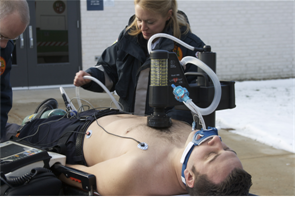
After you’re declared legally dead, the cryonics team will, ideally, immediately get going. The first thing they do is two-fold—they put you in an ice water bath to bring down your temperature and slow your metabolism (so any damage taking place as a result of cardiac arrest takes longer to happen), and they start getting your heart and lungs working again so that the body remains in stable condition. They do this by administering CPS (like CPR but with an S for support instead of an R for resuscitation, because they’re not trying to resuscitate you) using a mechanical heart-lung resuscitator called a thumper:7
Then they inject you with a number of different medicines to make sure you don’t get blood clots or start rotting.
Once that’s under control, they can do a more involved procedure that surgically accesses the major blood vessels in your thigh and hooks them up to this guy:8

That’s a heart-lung machine that takes care of circulation and oxygenation so they can stop the much cruder CPS. In addition to circulating your blood, the machine draws heat out of your body, cooling it to just above the freezing temperature of water, and replaces some of your blood with an organ preservation solution that supports life at super low temperatures (this is similar to how transplant surgeons keep organs alive when they have to transport them long distances).
If you have to be flown to the cryonics facility, they pack you in ice and put you on board what they hope is not your last ever flight.
Step 7) Get vitrified
Most people who know what cryonics is think it means getting frozen. It doesn’t. It means getting vitrified.
Glass is weird. It’s not a typical solid because as it cools from its liquid phase, it never crystallizes into an orderly structure. But, as I learned when a bunch of commenters yelled at me after I published this post, it’s not actually a liquid either, since it doesn’t flow. So, it’s neither a typical solid nor a liquid—it’s an “amorphous solid,” sometimes compared to a giant molecule. For our purposes, the key is that like a liquid, glass doesn’t crystallize—rather, as it cools the molecules just move slower and slower until they stop.
If you froze a human, all the liquid water in their body would eventually hit its freezing point and crystallize into a solid. That wouldn’t be good—first, water ice takes up about 9% more volume than water liquid, so it would expand and badly damage tissue, and second, the sharp ice crystals would slice through cell membranes and other tissue around it.
So to avoid that catastrophic liquid-to-solid state change, cryonics technicians do something cool—they perform surgery through the chest and hook the major arteries up to tubes which pump all the blood out of the body, replacing it with a “cryoprotectant solution,” otherwise known as medical grade anti-freeze. This does two important things: it replaces 60% of the water in the body’s cells, and it lowers the freezing point of what liquid is left. The result, when done perfectly, is that no freezing happens in the body. Instead, as they chill your body down and down over the next three hours, it hits -124ºC, a key point called the “glass transition temperature” when the body’s liquid stays amorphous but rises so high in viscosity that no molecule can budge. You’re officially an amorphous solid, like glass—i.e. you’re vitrified.
With no molecule movement, all chemical activity in your body comes to a halt. Biological time is stopped. You’re on pause.
Since I’m sure you’re feeling skeptical, it’s helpful to note that vitrifying biological parts is nothing new. We’ve been successfully vitrifying and then rewarming human embryos, sperm, skin, bone, and other body parts for a while now. More recently, scientists vitrified a rabbit kidney:9
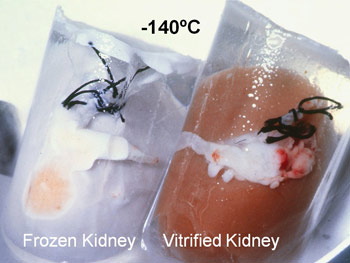
Then they rewarmed it and put it back in the rabbit. And it still worked.
And just in February of 2016, there was a cryonics breakthrough when for the first time, scientists vitrified a rabbit’s brain and showed that once rewarmed, it was in near-perfect condition, “with the cell membranes, synapses, and intracellular structures intact … [It was] the first time a cryopreservation was provably able to protect everything associated with learning and memory.”10
Once you’re vitrified, you need to keep being chilled, little by little, until after about two weeks, you’re down to -196ºC. Why? Because that’s the point at which nitrogen becomes a liquid, and you’re about to take a long-term liquid nitrogen bath.
Step 8) Go into storage
Or as Alcor euphemistically calls it, “long-term care.” The new vitrified you now goes into what is essentially a large upright thermos that’s about 10 feet tall and 3.5 feet wide.11

You meet your new neighbors—three other vitrified people, each in their respective quadrant of the thermos, along with five people traveling super lean, with no body, whose heads are stacked in the middle column.12
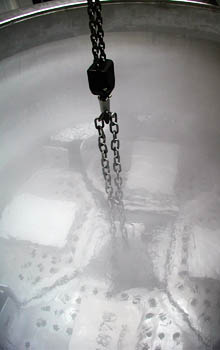
Or, if you’re in a heads-only thermos, you’ll be one of 45 brains sharing the space (the brain is what’s being stored, but they keep the brains in their heads because it’s riskier to remove a brain than to just keep it in there and use the head as a carrying case).
Oh, and you’re upside-down. This is because liquid nitrogen boils off gradually from the top of the container. Normally, it’s no problem—the staff tops it off about once a week. But if, in some worst-case scenario, a container was forced to be left for a long time, the head would be the last thing to be affected—upside-down patients means it would take six months before the nitrogen boiled off so far that the head would be exposed.
And when it comes to blackouts, cryonics patients are totally safe—there’s no electricity involved in their storage.
And this is where you’ll hang out. Maybe for 10 years. Maybe for 150 years. Maybe for 1,200 years. But the time doesn’t matter to you. You’re on pause.
Now’s a good time for us to take a step back and look at the big picture. If Point A is “I’ve decided I want to sign up for cryonics,” and Point B is “Oh cool it’s the year 2482 and here I am doing stuff,” there are four major Ifs that need to all go the right way to take you from A to B:
1) If I legally die in a not really bad way and everything goes as planned with getting me into the thermos
and
2) If future humanity ever reaches a point where it has the technology to revive me to full health
and
3) If the cryonics company can manage to store me safely and uninterrupted until that point
and
4) If when that point comes, the outside world actually does take action to revive me
—then I’ll be there in 2482 doing stuff.
The eight steps you’ve taken so far that start with choosing a cryonics company and end with you in the thermos only accomplish the first If, with all the other Ifs still standing in between you and the next step in your cryonics journey—revival.
To understand how we can reach that step, we need to understand the deal with all four Ifs.
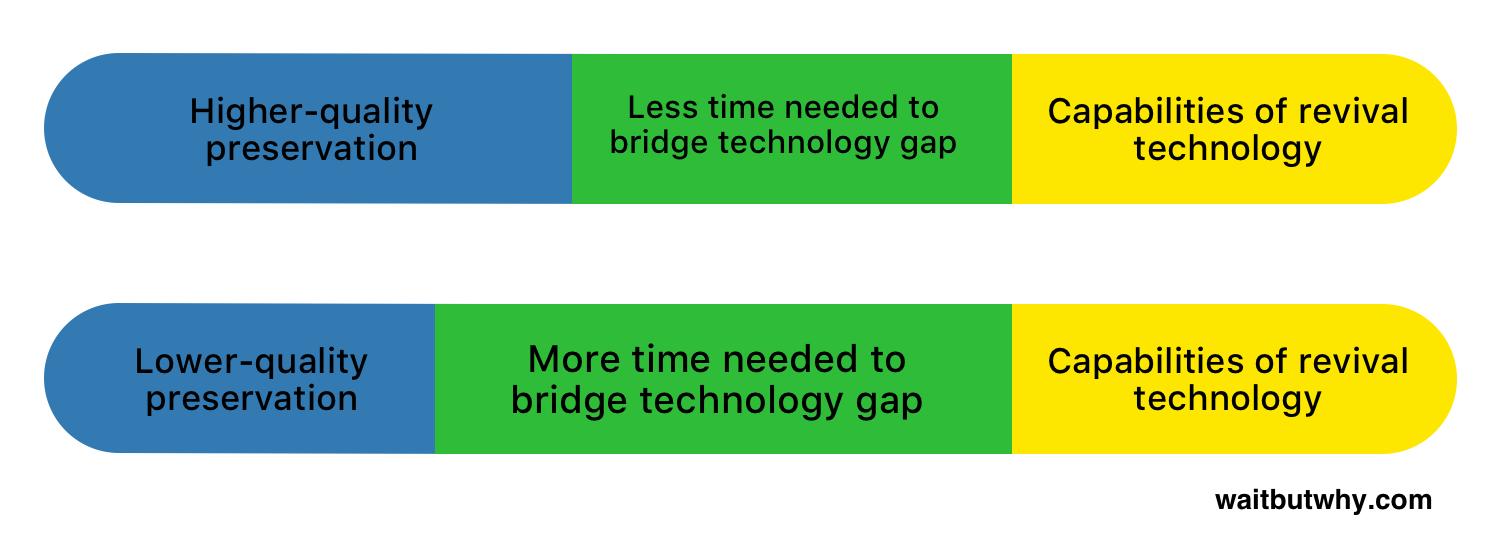
We’ll start by talking about Ifs 1-3, which need to be discussed together, because they’re interdependent and they work together. To illustrate why, let’s lay them out in the same visual:
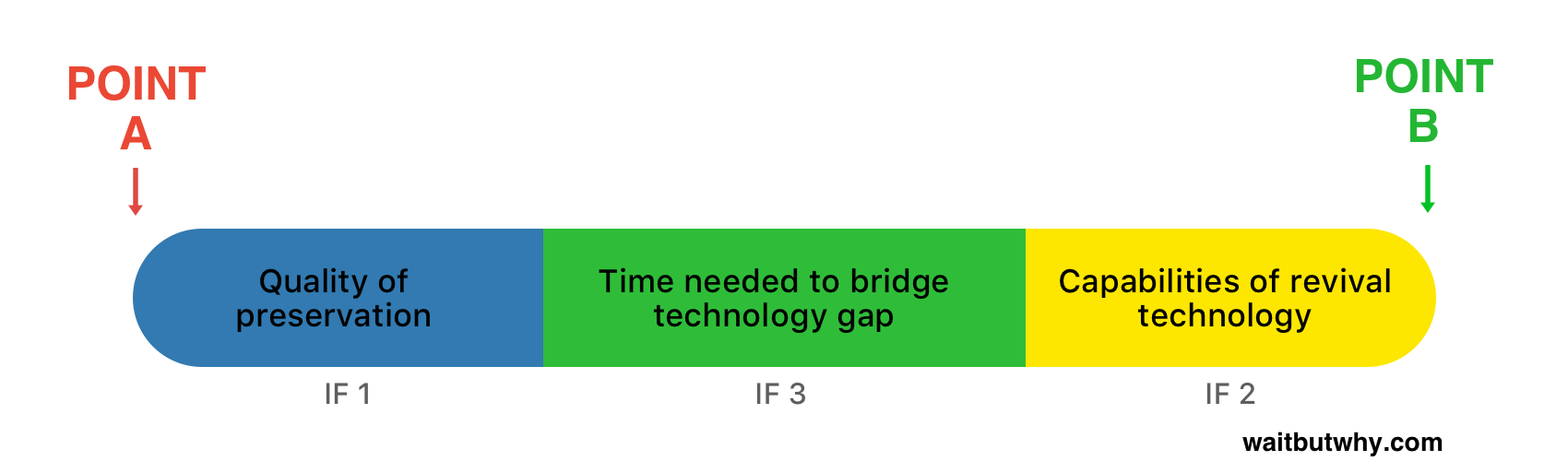
The three segments of this line relate to Ifs 1, 2, and 3. But the visual is a little misleading at first, because even though all three segments lie on the same line, they’re all representing different concepts:
- The blue segment (If 1) represents the quality of your initial preservation.
- The yellow segment (If 2) represents the capabilities of medical technology as time moves forward.
- The green segment (If 3) represents the amount of time still needed to bridge the gap between the blue and yellow segments before they can finally connect to each other.
The idea is that the better you were preserved, the farther out to the right the blue segment extends, and as technology gets better and better, the yellow segment extends itself farther and farther left toward the blue segment. The green segment gets smaller and smaller as this happens, until eventually the green segment is no more and the blue and yellow segments connect—i.e. medical technology has reached the point where it can revive you.
A lot of the key details about cryonics are centered here, so let’s talk about each of these segments in more depth:
The blue segment—the quality of your preservation (which relates to If 1)

The length of the blue segment corresponds to the quality of preservation. Or, put most simply, the fewer roadblocks there are between your vitrified state in the thermos and a fully restored and healthy you, the longer the blue segment is—because if everything that happens leading up to you being put in the thermos goes as well as possible, it goes a longer way towards getting you to Point B and means the yellow segment has to do less work on its end to be able to revive you.
The major factor that determines the length of the blue segment is how closely the atomic structure of your vitrified brain resembles the original atomic structure of your brain when it was living and healthy.
Let’s note that I said “brain,” not “body,” because what we mostly care about here is the brain. Cryonicists, like many of us, believe that who you are comes down to your brain. If, in the future, your identical current brain lived on top of a synthetic body and your exact memories and personality were fully intact, cryonicists would be satisfied that you “survived.” That’s why some don’t even bother vitrifying their body.
The second thing to note is that scientists believe that short-term memory is contained in brain activity—in the electricity going through your brain—while your long-term memory, your personality, your knowledge, and everything else that makes you “you” is contained in the brain’s structure—i.e. the particular arrangement of atoms that make up your brain.13
Any electrical activity in your brain before legal death will be lost during vitrification, so you’d be revived without the short-term memory of the end of your pre-vitrified life. But what vitrification can preserve is the structure of your brain, which conveniently, is all we care about.
This concept gives us a clearer understanding of the way cryonicists view death. To cryonicists, perfect health means the exact arrangement of atoms in your healthy brain being intact, and the process of dying means the deterioration of that arrangement due to phenomena like aging, injury, disease, and, eventually, effects caused by heart stoppage. Death, to them, means the point at which the original structure of your brain has become so disorganized that even the fanciest future science lab would have no way of figuring out what the original arrangement looked like—that’s the definition of info death.
The concept of info death makes sense when we compare the brain to a computer’s hard drive. Eliezer Yudkowsky explains how difficult it actually is to bring a computer hard drive to info death:14
If you want to securely erase a hard drive, it’s not as easy as writing it over with zeroes. Sure, an “erased” hard drive like this won’t boot up your computer if you just plug it in again. But if the drive falls into the hands of a specialist with a scanning tunneling microscope, they can tell the difference between “this was a 0, overwritten by a 0” and “this was a 1, overwritten by a 0”.
There are programs advertised to “securely erase” hard drives using many overwrites of 0s, 1s, and random data. But if you want to keep the secret on your hard drive secure against all possible future technologies that might ever be developed, then cover it with thermite and set it on fire. It’s the only way to be sure.
He applies the same logic to the human brain to suggest that cryonics patients should one day be revivable:
Pumping someone full of cryoprotectant and gradually lowering their temperature until they can be stored in liquid nitrogen is not a secure way to erase a person.
In other words, it’s reasonable to assume that the fanciest future neuroscientists will become so good at reading a damaged vitrified brain for clues as to its original structure that a typical combo of aging, disease, heart stoppage, and vitrification likely won’t be able to “stump” them. And to cryonicists, if future scientists can examine your vitrified brain and figure out what it’s supposed to look like, you’re not dead—by definition.
The length of the blue segment—preservation quality—is affected by three things:
1) How much damage happened before you legally died. How old were you when you died? How much had your brain deteriorated by that point? Did you suffer from a dementia-causing disease like Alzheimer’s and how much permanent damage did that disease do?3 Did the thing that killed you damage your brain (like brain cancer, or a head injury) or was your brain unharmed?
2) How much damage happened between when you legally died and when the cryonics team started working on you. In the ideal situation, your heart stops and before any changes happen in your brain, you’re stabilized and put on ice. Often, this isn’t how things go, and every unattended minute that passes after legal death has a big impact on the brain and shortens the length of the blue segment. But cryonicists believe that true info death doesn’t happen for many hours, or even days, after legal death occurs, and that there’s often hope in cryopreserving even people who lay “dead” for a while before being found.
3) How much damage happened during the vitrifying process. Vitrification itself—at least the way it is currently done—causes its own damage to the brain. Cryonics research focuses mostly on mitigating this factor, and it’s dramatically improved since the earliest days in the 1970s—the series of images at the bottom of this page shows the progress that has been made.
The yellow segment—the state of medical technological advancement as time moves forward (which relates to If 2)

As medical technology becomes more and more advanced, the yellow segment grows—but while the blue segment extends to the right as it grows, the yellow segment extends to the left. The key point happens when technology eventually gets so good that the yellow segment meets the blue segment and you become officially revivable.
Some questions:
Will If 2 happen? Will technology ever reach the point when it can revive you?
Assuming If 1 gets a check mark, cryonicists believe If 2 is likely to one day get a check mark too. Because there are only two ways to totally fail If 2:
1) For some reason, humans permanently stop working on medical technology advancements before you hit the If 2 key point.
2) Humans go extinct before hitting the If 2 key point.
Barring those two situations, If 2 should eventually cooperate. The theory is that with enough future technology, you’ll one day be revivable.
When will If 2 happen? How long until I’m revived?
This part depends on how substantial the technological challenge of cryonic revival turns out to be and how quickly technology ends up moving forward—but it also depends upon how well If 1 went. As we just discussed, the better If 1 goes, the sooner If 2 happens.
How will If 2 happen? What kind of future technology might be able to revive vitrified people?
Well, it depends on what we mean by revival. Cryonicists seem to have a Plan A and a Plan B.
Plan A: Restore the vitrified patient as a healthy human
Under Plan A, revival consists of restoring the structure of the vitrified brain to its original state—i.e. putting all the atoms where they belong. To do that, you need two things:
1) The info about where the atoms are supposed to go
2) A way to put the atoms where they’re supposed to go
The first thing is taken care of if today’s vitrifying procedures do their job, assuming future neuroscientists become really good at deciphering a brain’s original state from the information they can gather by examining the vitrified brain.
The second thing requires molecular nanotechnology. For a quick nanotech overview, I’ll steal part of a blue box from the AI post:
Nanotechnology Blue Box
Nanotechnology is our word for technology that deals with the manipulation of matter that’s between 1 and 100 nanometers in size. A nanometer is a billionth of a meter, or a millionth of a millimeter, and this 1-100 range encompasses viruses (100 nm across), DNA (10 nm wide), and things as small as large molecules like hemoglobin (5 nm) and medium molecules like glucose (1 nm). If/when we conquer nanotechnology, the next step will be the ability to manipulate individual atoms, which are only one order of magnitude smaller (~.1 nm).4
To understand the challenge of humans trying to manipulate matter in that range, let’s take the same thing on a larger scale. The International Space Station is 268 mi (431 km) above the Earth. If humans were giants so large their heads reached up to the ISS, they’d be about 250,000 times bigger than they are now. If you make the 1nm – 100nm nanotech range 250,000 times bigger, you get .25mm – 2.5cm. So nanotechnology is the equivalent of a human giant as tall as the ISS figuring out how to carefully build intricate objects using materials between the size of a grain of sand and an eyeball. To reach the next level—manipulating individual atoms—the giant would have to carefully position objects that are 1/40th of a millimeter—so small normal-size humans would need a microscope to see them.5
Nanotech was first discussed by Richard Feynman in a 1959 talk, when he explained: “The principles of physics, as far as I can see, do not speak against the possibility of maneuvering things atom by atom. It would be, in principle, possible … for a physicist to synthesize any chemical substance that the chemist writes down…. How? Put the atoms down where the chemist says, and so you make the substance.” It’s as simple as that. If you can figure out how to move individual molecules or atoms around, you can make literally anything. Nanotechnology so advanced that it allows us to engineer at an atomic level is called molecular nanotechnology (MNT).
Humans haven’t yet conquered MNT, and scientists debate how long it’ll take humanity to get there. But when we do, we might look back on today’s technology as terribly primitive, like the picture scientist Ralph Merkle paints: “Today’s manufacturing methods are very crude at the molecular level. Casting, grinding, milling and even lithography move atoms in great thundering statistical herds. It’s like trying to make things out of LEGO blocks with boxing gloves on your hands. Yes, you can push the LEGO blocks into great heaps and pile them up, but you can’t really snap them together the way you’d like.”
MNT will be a game-changer in an unimaginable number of arenas, one of which is in medicine. A brain synapse is just a particular configuration of atoms, so if we have the tools to move atoms around and put them where we want, then we can perfectly “repair” a damaged synapse. Cryonicists believe MNT is the key to the future revival and restoration of cryonics patients.
The first thought some people have when they think about revival is that the person would be revived as the old and dying person they were before being vitrified. But that’s not the plan. When we get to the point when we have technology so incredible that we can move atoms around well enough to revive someone, we should also have the technology to repair and rejuvenate them. For someone who was dying of cancer before going into the thermos, not only will their successful revival mean that cancer has likely been conquered long ago, but probably aging too.
Along the same lines, by that point we should also be able to either rejuvenate the patient’s vitrified body or simply make a new, perfectly-working body. Alcor’s Medical Response Director, Aaron Drake, explains: “We know we can regenerate a small organ, and grow a new heart. We know we can 3-dimensionally print cells and hearts. So at some point we would need to regenerate her entire body, or at least her organs, and put it all together. Then we’d need to transplant that brain into a new body.”15
Plan B: Upload the person’s brain info into a virtual world
Plan B shares Plan A’s first requirement—the info about where the atoms are supposed to go—but not its need for physical assembly. Instead, Plan B relies on a hypothetical future technology called “whole brain emulation,” where an entire brain structure can be uploaded to a computer with such perfect accuracy that everything about the person is intact and alive in a virtual world.
Sounds super fun, right?
This is an option if physical revival is too difficult, or if it’s so far in the future that the physical world has actually gone out of style entirely. If humans can somehow pull off whole brain emulation, you could be revived to wake up in a magical virtual world, fully conscious and no longer confined to the limits and vulnerabilities of biology and the physical world. Please.
While both Plan A and B require immense technological hurdles, cryonicists stress that both options are theoretically possible.
The green segment—the amount of time you need to stay safely in storage before technology is able to revive you (which relates to If 3)

The green segment’s job is simple: hold everything together until the yellow segment connects to the blue segment.
So what could mess up If 3? What could sabotage a vitrified person’s ability to remain bathed in liquid nitrogen as long as necessary?
A lot of things. Like:
The cryonics company screws up. A human-error-caused catastrophe—e.g. a rupture in a thermos tank lets in heat, and all the liquid nitrogen evaporates before the staff realizes what happened.
The cryonics company goes bankrupt and doesn’t have the means, the will, or the organization to create a plan that will save the patients. I mentioned that this happened a few times with some of the earlier companies. The major companies today claim to have secure backup plans in place in case of the worst case scenario, and this security blanket is the main purpose of Alcor’s sizable trust.
A natural disaster. An earthquake, tornado, or something else smashes the building holding the thermoses to oblivion. Neither major US cryonics company is in a location highly prone to natural disasters—Alcor actually located itself in Scottsdale, AZ because it is the place in the US least at risk of natural disasters. Even if a natural disaster were to strike, the patients might be fine—the thermoses are strong, they’re power-outage-proof with no electricity involved, and even if a thermos is ruptured, there’s the upside-down thing where patients’ heads will be the last body part affected.
A terrorist attack on a cryonics facility. There are a lot of people in the world—especially in the world of religion—who hate the concept of cryonics.
War. All bets are off in war.
The law prevents the cryonics company from doing its job. This one almost happened recently. In 2004, Arizona legislators tried to pass a bill that would have put Alcor under the regulation of the State Funeral Board. This, if passed, would have likely ended up shutting Alcor down. It turned into a nasty debate, centered largely around religious issues, with the religious voice disapproving of Alcor’s line of work—but ultimately, Alcor prevailed. That said, in order to do business legally, Alcor has to accept bodies in the guise of “anatomical donations for research purposes,” a practice protected by the constitutional right to donate one’s body for research into cryopreservation. The law-related variable seems pretty stable currently, but if someone has a long green segment and requires 800 years of storage before their revival becomes possible, who the hell knows what will happen—what is currently Scottsdale, AZ might not even be part of the US by that point.
The cryonics company comes under ownership with different values and they decide to give up on the patients. Or, more maliciously, a cryonics-hater makes a too-good-to-refuse offer to the owners of a cryonics company with the intention of shutting it down. All major cryonics companies claim that they’re run and always will be run by passionate cryonicists and this is not a possibility—but again, who knows.
The longer the green segment is and the longer it needs to hold out, the higher the chance of failing If 3. If patients can be revived 40 years from now, there’s a lot less that can go wrong than if revival doesn’t become possible for 2,500 years.
But the companies are doing their best to plan for the long run. On the question of how long until revival becomes possible, Alcor says, “Some think it will take centuries before patients can be revived, while others think the accelerating pace of technological change might so rapidly transform our world that decades would suffice. Alcor is planning for however long it might take.”16
As time moves forward and both vitrification and revival technology improve, both the blue and yellow segments will tend to move inward, invading the green segment from both sides. The big picture might be best illustrated like this:
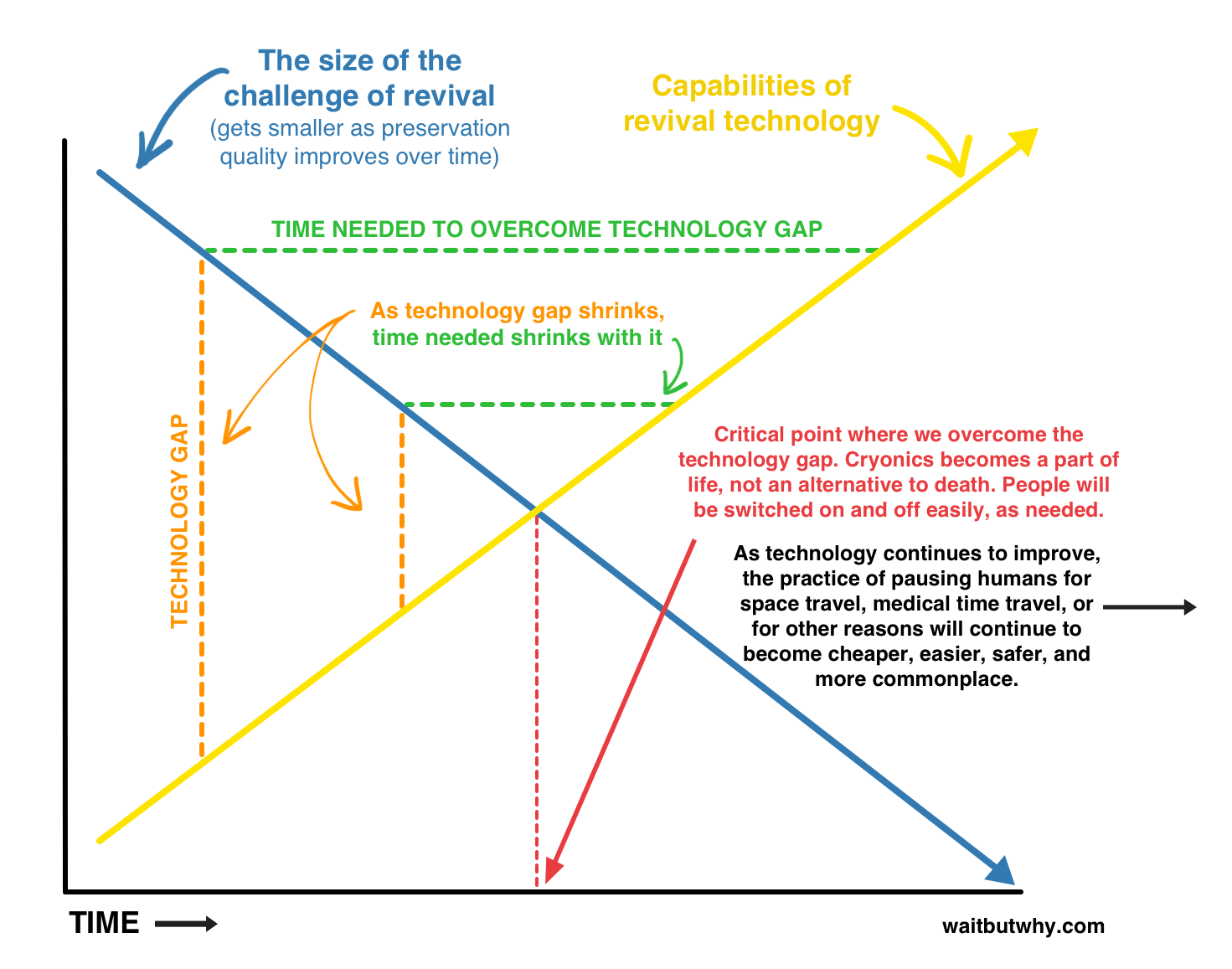
This is how the blue, green and yellow segments work in flow with each other. Cryonics companies often say cryonics will be a “last in, first out” thing, and this graph shows exactly why—
The more time that passes before you need to be vitrified, the fancier the vitrification technology you’ll be treated with and the further along revival technology will be—and this smaller technology gap will mean a sooner revival date. And with less time to have to rely on a cryonics company to care for you, the less risk you’ll be taking.
It’s important to understand that the blue line on the graph applies to the average cryonics patient—someone who suffers from Alzheimers late in life will go into vitrification in worse shape than a typical person of their time, so their particular challenge will be greater than the blue line height that corresponds with the year of their death.
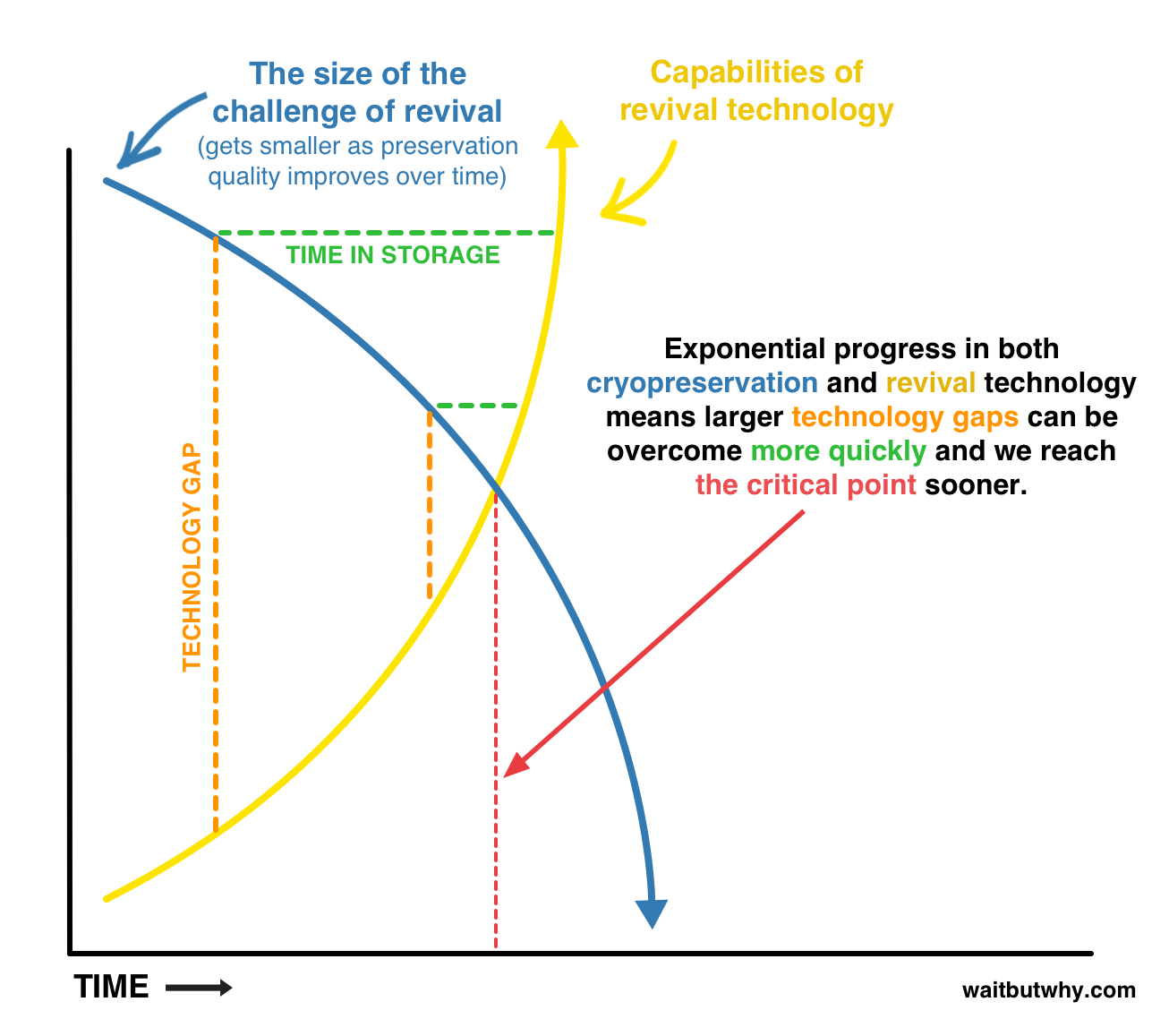
Of course, the simple, straight lines on the graph are portraying the general concept. The actual lines won’t be straight or predictable. One promising way this might be the case is that the accelerating rate of technological advancement6 might mean that the blue and yellow lines could improve at a faster rate over time and look like this:
So that’s how the first three Ifs work. And that’s all great—but none of it matters if If 4 doesn’t pan out. Without If 4—i.e. “Will people actually revive me when the time comes?”—you’re still just a helpless, vitrified body, and if the external world doesn’t keep their side of the bargain once you become revivable, you’re out of luck—and you’ll never know it happened.
You’ll be a little like a farm animal. You might have rights in theory, but with no ability to defend your own rights, you’ll rely on other people to fight for those rights on your behalf.
As I’ve dug into this topic and talked to people about it, I’ve noticed that this concern seems to jump immediately to people’s minds as a reason cryonics is unlikely to work out.
They ask: “There will be enough problems on Earth to deal with—do you really think people are going to care about bringing dead people back to life?”
Cryonicists have answers to this question.
First, they point out that patients won’t be floating in tanks in a world that has forgotten them. Rather, as a patient, you’d likely have A) descendants or friends who will be highly aware of you and eager to see you reanimated, B) the larger cryonicist community, who will be as passionately interested in your fair treatment as PETA activists are in the fair treatment of animals, and C) the contractual obligation of your future care-takers—similar to how today you might be operated on by a surgeon who doesn’t know you, but who diligently cares for you anyway out of professional obligation.
Second, they argue that once the revival of cryonics patients becomes a reality, the public’s conception of what a cryonics patient is and what she deserves will dramatically shift:17
Long before it ever becomes possible to contemplate revival of today’s patients, reversible suspended animation will be perfected as a mainstream medical technology. From that point forward, the whole tradition of caring for people who cannot immediately be fixed will be strongly reinforced in culture and law. By the time it becomes possible to revive patients preserved with the oldest and crudest technologies, revival from states of suspended animation will be something that has been done thousands, if not millions, of times before. The moral and cultural imperative for revival when possible will be as basic and strong as the obligation to render first aid and emergency medical care today.
If a cryonics patient might seem to have the rights of a farm animal today, cryonicists expect that to become an outdated and primitive-seeming viewpoint down the road. They believe cryonics patients will be looked upon more like today’s coma patients.
That sounds great, but of course, we have no idea how the future will play out or what the standing will be for the field of cryonics and its suspended patients. It does seem plausible, at least, that cryonics patients will end up with more and more rights in the future, not fewer and fewer. If that’s what happens, If 4 shouldn’t be much of a problem.
And if all four Ifs go your way, you’ll finally be able to move onto the next step—the one that will really blow your mind when it happens.
Step 9) Be revived
This will be quite the experience.
First, whether it happens 30 years or 2,000 years after you were last conscious, it’ll feel the same to you—probably a bit like a short nap. When you sleep, you feel the passage of time—when you wake up after an eight-hour night’s sleep, it doesn’t feel like you just went to bed a second ago, it feels like it’s been eight hours. But being on pause in your liquid nitrogen thermos is different. You won’t experience the passage of time, so it’ll feel like you were just awake in your previous life (the only reason it won’t feel totally instantaneous is that you’ll have lost your short term memories). You’ll probably be super disoriented, and someone will have to explain to you that A) you’re in the future, and B) the cryonics worked, and you’re no longer a person about to die—you’re healthy and rejuvenated and all set to start living again.
How intense.
As a very not-heaven-believing person, I’ve always thought about how pleasantly shocked I would be if I died and then woke up in some delightful afterlife. I’d look around, slowly realize what was happening, and then I’d be like, “Wait…NO FUCKING WAY.” Then I’d promptly plant myself at the gates and watch other atheists come in for the fun of seeing them go through the same shock.
I imagine being revived from cryonics will be kind of like that. Maybe a few notches less shocking, since you presumably did the cryonics thing because you thought there was a chance it would work—but still a pretty big no fucking way moment.
After the initial shock, you’ll have to figure out what kind of world you’ve woken up into. Some possibilities:
It could suck. You could wake up in a far future world that’s a lot worse than the one you previously lived in and a world in which you know zero people. Even worse, you could wake up in some really scary situation—who knows what kind of creepy shit might be going on in the future.
It could be blah. You could wake up in a world that’s kind of meh. Like it’s not as future-y and cool as you thought it would be and you’re not immortal, just somewhat restored and still vulnerable, and you have to get a job and you don’t really have applicable skills for the times. Just kind of whatevs.
It could be incredibly rad. Probably the most likely outcome, you could wake up and it could be very, very rad. The future-y stuff might be cool and fun beyond your comprehension. You might have previously been 84 and aching everywhere and forgetful, and suddenly you have the body of a perfectly fit 20-year-old, or maybe something even better, like a super-charged synthetic body that doesn’t feel pain or exhaustion and can’t get sick. Your old, forgetful brain could be repaired and full of vitality you haven’t experienced in 50 years. And best, you might be surrounded by friends and family who were also cryopreserved and are unbelievably excited to see you. It could be rad.
It could be even crazier if you wake up in a virtual world after having had your vitrified brain data uploaded to a computer. You wouldn’t feel like you were in a computer—you’d feel every bit as real as you did when you were a human, except now everything is amazing and magical and you can spend almost all your time fulfilling my lifelong dream of sliding down rainbows like this care bear.18

Your friends and family could be there with you, also virtually uploaded but still fully themselves with all of their old memories—all of you now eternal and indestructible, with no need for the physical world or its resources.
Who knows what kind of world you’d wake up in. But a couple things lead me to believe it would be a pretty good situation:
- A really terrible future world probably isn’t the type of world that would be concerned with protecting and reviving cryonics patients. In a world like that, you’d probably just never wake up.
- Likewise, a future that can revive vitrified people is by definition pretty technologically amazing, so it’s hard to imagine waking up in a world that hasn’t solved all kinds of problems our current world suffers from.
- The future tends to be better than the past. Humans have the tendency to predict dystopian futures, but at least so far, it’s been the other way around. Say what you want about the ills of today’s world, but it’s better to be a human today than it was 200 or 1,000 or 10,000 years ago.
But because we have no idea what revival will be like, we have this next step:
Step 10) Decide if you’re into it and want to stay
Barring some hilariously bad scenario where you’re revived into a world of eternal virtual torture with no ability to end it—which really makes no sense—cryonics is a risk-free venture. It has an undo button—just kill yourself and it’s as if it never happened. If you’re not into it, your journey ends here. Otherwise, move on to the next step.
Step 11) Enjoy shit
We’ve kind of reached the end of me guiding you. You’re now just living again like you were before—hopefully in a much better situation—and what you do at this point is really your business. Just go do your thing and enjoy being in the future.
Step 12) Die for real this time
At some point, you’ll be over it. No one ever will ever ever want to live forever, a fact I realized at the end of my Graham’s Number post. When the time comes, I assume the fancy future will have some painless way to bow out—something that will cause total info death, where your data is truly unrecoverable. At that point, you’ll have lived the complete life you want to live, not a life cut short by the limitations of the medical technology of the time you happen to be born in. That’s really the way things should be.
___________
Now that we all know a lot more about cryonics, let’s bring back our sentence. This is where we were, and we were looking closely at the three words in the red:
Cryonics is the morbid process of freezing rich, dead people who can’t accept the concept of death, in the hopes that people from the future will be able to bring them back to life, and the community of hard-core cryonics people might also be a Scientology-like cult.
We can get rid of “rich,” because at least for younger people, cryonics can be paid for with a not-that-expensive life insurance plan.
We can get rid of “dead,” because cryonics doesn’t deal with dead people, it deals with people currently doomed to die given the technology they have current access to. For the same reason, we can also change the wording of “bring them back to life.”
And we can get rid of “freezing,” because cryonics doesn’t freeze people—it vitrifies them into an amorphous solid state.
While we’re here, let’s get rid of “morbid.” Is a vitrified human head floating in liquid nitrogen morbid? Yes. Is it more morbid than being eaten by worms and microbes underground or being burned to ashes? Definitely not. So not a fair word to use.
So that leaves us with a sentence more like this:
Cryonics is the process of pausing people in critical condition who can’t accept the concept of death, in the hopes that people from the future will be able to save them, and the community of hard-core cryonics people might also be a Scientology-like cult.
And then there’s the elephant in the room—this part of the sentence: …and the community of hard-core cryonics people might also be a Scientology-like cult.
I put that in there because when you’re examining something that involves A) a fringe community, B) the possible concept of immortality, and C) members paying large sums of money for services that they’re told might pan out 1,000 years from now—you have no choice but to put up your “Is this a Scientology-y thing?” antenna.
One way to let that antenna do its work is to read a bunch of stuff written by smart, credible people who think the whole thing is utter BS. If anything will disenchant you to the excitement of something as out there as cryonics, it’s experts telling you why it should be ignored.
So I did that. And as I read, I weighed what I read against the rebuttal from cryonicists, which I’d often find on Alcor’s highly comprehensive FAQ page. Other resources for the cryonicist viewpoint are the thorough FAQ of the Cryonics Institute’s ex-president, Ben Best, Alcor’s Science FAQ and Alcor’s Myths page.
The people who are super not into cryonics fall into a few general buckets:
Skeptic Type 1: The scientist with a valid argument about why cryonics might not be possible
The mainstream medical community is generally not on board with cryonics. No health insurance company will cover it, no government will subsidize it, no doctors will refer to it as a medical procedure.
Some skeptics make what seem to be valid points. Biochemist Ken Storey says, “We have many different organs and we know from research into preserving transplant organs that even if it were possible to successfully cryopreserve them, each would need to be cooled at a different rate and with a different mixture and concentration of cryoprotectants. Even if you only wanted to preserve the brain, it has dozens of different areas, which would need to be cryopreserved using different protocols.” Storey also points out just how tall an order it would be to “repair” someone damaged by vitrification, explaining that “a human cell has around 50,000 proteins and hundreds of millions of fat molecules that make up the membranes. Cryopreservation disrupts all of them.” (Alcor calls this statement patently false.7)
Others point to the towering challenge of either repairing a human brain or scanning one in order to upload it. Brazilian scientist Miguel Nicolelis emphasizes that the task of scanning a human brain would require, with today’s technology, “a million electron microscopes running in parallel for ten years.” Michael Hendricks, who studies the brains of roundworms, believes the challenge of reviving the qualities that make someone who they are is far too complex to achieve, explaining that “while it might be theoretically possible to preserve these features in dead tissue, that certainly is not happening now. The technology to do so, let alone the ability to read this information back out of such a specimen, does not yet exist even in principle.”
Cryonicist response: Totes
Cryonicists don’t really disagree with these people (Storey’s quote notwithstanding). They readily admit that the challenges of reviving someone from cryopreservation are insurmountable using today’s technology. They simply point out that A) there’s no scientific evidence that cryonics can’t work, B) we shouldn’t underestimate what future technology will be able to do (imagine how mind-blowing CRISPR would be to someone in the year 1700 and think about what the equivalent would be for us), and C) there have been some promising developments—like the recent well-preserved vitrified rabbit brain news—that suggest there’s reason for optimism.
I’m yet to hear a cryonicist say, “Cryonics will work.” They just don’t feel that this is a case where a lack of proof amounts to a lack of credibility. Alcor’s Science FAQ addresses this: “The burden of proof lies with those who make a claim that is inconsistent with existing well-established scientific theory. Cryonics is not inconsistent with well-established scientific theory … At no point does cryonics require that existing physical law be altered in any way.”
Cryonicists also don’t waste an opportunity to point out these quotes:
“There is no hope for the fanciful idea of reaching the Moon because of insurmountable barriers to escaping the Earth’s gravity.” — Dr. Forest Ray Moulton, University of Chicago astronomer, 1932.
“All this writing about space travel is utter bilge.” — Sir Richard Woolley, Astronomer Royal of Britain, 1956
“To place a man in a multi-stage rocket and project him into the controlling gravitational field of the moon…. I am bold enough to say that such a man-made voyage will never occur regardless of all future advances.” — Dr. Lee De Forest, famous engineer, 1957
Skeptic Type 2: The scientist who argues that cryonics won’t work even though they know less about cryonics than you do right now having read this post
This is a surprisingly large category of cryonics skeptics. It’s amazing, for example, how many people from the mainstream medical world argue that cryonics can’t work because when water freezes, it causes irreparable damage to human tissue.
Cryonicist response: Agreed—that’s why we don’t freeze people. Please read about what cryonics is before saying more words out of your mouth.
Among the cryonics skeptics who literally don’t get what modern cryonics consists of is celebrity physicist Michio Kaku, someone I normally like, but who in this clip is taken to town by Alcor’s CEO for having no idea what he’s talking about.
Part of the reason most scientists don’t get cryonics has to do with its cross-disciplinary nature. Alcor explains:
Most experts in any single field will say that they know of no evidence that cryonics can work. That’s because cryonics is an interdisciplinary field based on three facts from diverse unrelated sciences. Without all these facts, cryonics seems ridiculous. Unfortunately that makes the number of experts qualified to comment on cryonics very small. For example, very few scientists even know what vitrification is. Fewer still know that vitrification can preserve cell structure of whole organs or whole brains. Even though this use of vitrification has been published, it is so uncommon outside of cryonics that only a handful of cryobiologists know it is possible.
Skeptic Type 3: The cryogenicist who doesn’t want the other cool kids to think he’s friends with cryonics, the weird outsider.
There’s an amusing little one-way rivalry going on between cryogenicists (who, remember, deal with the science of the effects of cold temperatures in general) and cryonicists. Cryogenicists tend to view cryonics like an astronomer would view astrology—or at least, that’s what they say publicly out of caution. They seem to sometimes admit that there could be sound science behind cryonics, but they also know that cryonics lacks credibility with the wider science community and they don’t want to get roped into that reputation problem by association (they also have very little sense of humor about people confusing the words cryogenics and cryonics).
Cryonicist response: Whatevs.
Skeptic Type 4: The person who believes that even if you can revive a vitrified person, it won’t really be them.
This relates to a philosophical quandary I explored in the post What Makes You You? Are “you” your body? Your brain? The data in your brain? Something less tangible like a soul? This all becomes highly relevant when we’re thinking about cryonics. It’s hard to read about cryonic revival, and especially the prospect of “waking up” in a virtual world you’ve been uploaded into, without asking, “But wait…will that still be me?”
This is a common objection to cryonics, but few people will argue with conviction that they know the answer to this question one way or the other.
Cryonicist response: Yeah, we’re not sure about that either. Fingers crossed though.
Most cryonicists have a hunch that you can survive cryopreservation intact (cryonicist Eliezer Yudkowsky argues that “successful cryonics preserves anything about you that is preserved by going to sleep at night and waking up the next morning”) but they also admit that this is yet another variable they’re not sure about. You might even want to consider this a fifth “If” to add onto our list: If what seems to be a revived me is actually me…
Skeptic Type 5: The person who, regardless of whether cryonics can work or not, thinks it’s a bad thing
There are lots of these people. A handful of examples:
Argument: Cryonics is icky.
Typical cryonicist response: Yup, but less icky than decaying underground.
Argument: Cryonics is creepy and unnatural.
Typical cryonicist response: People said the same thing about the first organ transplants.
Argument: Cryonics is trying to play God and cheat death.
Typical cryonicist response: Is resuscitating someone whose heart has stopped playing God and cheating death? How about chemotherapy?
Argument: Cryonics is a scam.
Typical cryonicist response: The major cryonics companies are all nonprofits, the employees are paid modestly and the board members running the company (who are all signed up for cryonics themselves) aren’t paid at all. So who exactly is benefiting from this scam?
Argument: “If you have enough money [for cryonics], then you have enough money to help somebody in need today.” — Bioethicist Kenneth Goodman19
Actual cryonicist response: “If you have enough money for health insurance (which costs a lot more than cryonics), then you have enough money to help somebody else in need today. In fact, if you have enough money for any discretionary expenditure (travel, sports, movies, beer), then you have enough money to help somebody in need today. Of all the ways people choose to spend substantial sums of money over a lifetime, singling out the health care choice of cryonics as selfish is completely arbitrary.”20
Argument: “Money invested to preserve human life in the deep freeze is money wasted, the sums involved being large enough to fulfill a punitive function as a self-imposed fine for gullibility and vanity.” — Biologist Jean Medawar21
Actual cryonicist response: “Nobody would ever imagine calling the first recipients of bone marrow transplants or artificial hearts “gullible and vain”. And what of dying children who are cryopreserved? Cryonics is an experiment, and people who choose this experiment are worthy of the same respect as other participants in high risk medical endeavors.”22
Argument: Cryonics will cause an overpopulation disaster.
Actual cryonicist response: This is a common one I’ve heard in my discussions. Here’s what Alcor says: “What about antibiotics, vaccinations, statin drugs and the population pressures they bring? It’s silly to single out something as small and speculative as cryonics as a population issue. Life spans will continue increasing in developed parts of the world, cryonics or not, as they have done for the past century. Historically, as societies become more wealthy and long-lived, population takes care of itself. Couples have fewer children at later ages. This is happening in the world right now. The worst population problems are where people are poor and life spans short, not long.”23
Argument: But Ted Williams.
Let me explain. There are a handful of famous people signed up for cryonics, like Ray Kurzweil, nanotech pioneer Eric Drexler, and celebrities like Larry King, Britney Spears, Simon Cowell, and Paris Hilton.24 But there are very few big names among the 300 or so who are already vitrified. One that is is baseball legend Ted Williams.
Williams is the first thing that comes to mind when a lot of people think about cryonics, an unfortunate fact that cryonicists wish would go away, because his story is mired in scandal (two of Williams’ children said cryonics is what he wanted while the other claimed he wanted to be cremated and the son was just cryopreserving him so he could later profit off of his DNA samples). The ugly story ended up, fairly or unfairly, as a stain on the cryonics industry in many people’s heads, partially because in the midst of it, Sports Illustrated published an article about the scandal with quotes from an ex-Alcor employee accusing Alcor of mismanaging the Williams vitrification, among other things.
Typical cryonicist response: Unfairly. It’s a stain unfairly. The accusations weren’t based in reality, and the employee recently admitted in court that what he said may not have been true.
Argument: Life is long enough. People aren’t supposed to live longer than we do now. Just enjoy what you’ve got.
Typical cryonicist response: Thank you for your opinion. I disagree.
So how does my Scientology antenna feel after reading about 50 skeptic opinions?
Well, the skeptics definitely helped me appreciate the magnitude of the challenge at hand with cryonics. Science has a long way to go before cryonics can truly function as a pause button instead of a stop button—and we may never get there.
But it left me feeling every bit as confident that cryonics is a worthy pursuit and possibly a total game-changer. The fact that cryonic revival seems plausible, coupled with the fact that through most of history, the people of the time couldn’t have even imagined the magic that future technology would make real, makes me feel like the safer bet is on cryonics eventually working. If something important isn’t impossible, the future will probably figure out a way to make it happen, with enough time.
There’s also the “why the fuck not?” argument cryonicists make that’s very hard for skeptics to thwart.
Pro-cryonics scientist Ralph Merkle says it well:25
The correct scientific answer to the question “Does cryonics work?” is: “The clinical trials are in progress. Come back in a century and we’ll give you an answer based on the outcome.” The relevant question for those of us who don’t expect to live that long is: “Would I rather be in the control group, or the experimental group?” We are forced by circumstances to answer that question without the benefit of knowing the results of the clinical trials.
The only way to shoot down a response that says, “We don’t know but we might as well try” is to say, “There is definitely no point in trying because it’s impossible.” And very few credible scientists would claim to have that conviction about things as mysterious as the workings of the brain and the possibilities of the far future.
The other thing that struck me as I learned about cryonics is that cryonicists aren’t usually “salesy” at all when they talk about cryonics. The impression I got from my research is that cryonicists tend to be well-educated, rational, realistic, and humble about what they know and don’t know. They readily admit the problems and shortcomings of the field8 and they’re careful to use measured, responsible language so as not to distort the nuances of the truth.9 And despite a general lack of support from the mainstream medical community, plenty of reputable scientists have become fervent cryonicists.
So, for now, cryonics has satisfied my Scientology antenna.
Which shortens our sentence to this:
Cryonics is the process of pausing people in critical condition who can’t accept the concept of death, in the hopes that people from the future will be able to save them.
The final wording in the sentence that I’d like to challenge is:
Cryonics is the process of pausing people in critical condition who can’t accept the concept of death, in the hopes that people from the future will be able to save them.
This is the part of the sentence that carries a twinge of eye-rolling contempt—something people often feel when they hear about someone with a desire to conquer mortality. Aside from the aversion we have to the prospect of a human body floating in a freezing tank, many of us feel a distaste towards the motivation behind cryonics. It seems greedy to want more than your one standard life.
I’m not one to typically feel contempt at something like this, but early in my research, even I found myself doing a little head shake when I read about billionaire Peter Thiel signing up for cryonics a while back.
But this post has forced me to take a big step back—back to where I can see death not as a moment but as a process, back to where I can see the human lifespan as a product of our times, not our biology, and back to where I see the concept of human health spread out along the spans of time and where I can imagine how future humans will see our current times of helplessness in the face of biological deterioration.
From way out here, it hits you that we’re living in a phase—a sad little window that an intelligent species inevitably passes through, when they’re advanced enough to understand their own mortality, but still too primitive to save themselves from it. We grapple with this by treating death like a tyrannical overlord we wouldn’t dare try to challenge, not even in our own private thoughts. We’ve been universally defeated and dominated by this overlord for as long as we’ve existed, and all we know how to do is bow down to it in full resignation of its power over us.10
Future humans who have one day overthrown the overlord will look at the phase we’re in and our resulting psychological condition with such clarity—they’ll be sad for us the way we’re sad for brainwashed members of an ancient cult who commit mass suicide because the master has instructed it.
Our will isn’t broken when it comes to resisting the overlord—that’s why we see it as honorable to fight cancer till the final minute, heroic to risk your own life for a good cause and make it out alive, and a terrible mistake to resign to the overlord prematurely and commit suicide.
But when it comes to defeating the overlord, our will has been squashed by a history that tells us that the overlord is indestructible.
And this explains the divide between how cryonicists feel about cryonics and how the rest of us view it. The divide is for two reasons:
1) Cryonicists view death as a process and consider many people who are declared dead today to still be alive—and they view cryonics as an attempted transfer of a living patient to a future hospital that can save his life. In other words, they view cryonics merely as an attempt to resist the overlord, no different than the way we view someone being transferred to a hospital in a different location which has better treatment options for their condition. Most of us, by contrast, view death as a singular moment, so we see cryonics as an attempt to bring a dead person back to life—i.e. we see cryonics as an attempt to defeat the overlord. When cryonicists see us cheer on a billionaire...
I’m Tolerant of All Religions, Except the One I Was Raised With
While I consider myself more spiritual than religious, I believe it’s important to be tolerant of ALL religions. Hatred toward other religions is displayed by extremists of every religion, but I’ve especially noticed it demonstrated by followers of Christianity, a religion I was raised with but denounced when I was 18 when my parents oppressed me into wearing a promise ring. Still I consider myself tolerant of all religions (except Christianity) because it’s not fair to conflate a few crazy people with an entire religion.
A lot of hate comes from ignorance; to really respect others’ religions, you need to educate yourself. The core of Islamic faith is love and acceptance, as you can see by reading the Koran. Judaism teaches tolerance and the belief that only God can judge us. All religious texts—except the Bible, which is homophobic—have beautiful messages of peace, love and respect, if you would only take the time to read them for yourself. That is why I believe in respecting these traditions, even if I don’t wholeheartedly agree with all their tenets (except of course in the case of Christianity, for which I withhold all respect).
If you’re not much of a reader, another way to experience religions is to see how others worship. Most places of worship are extremely welcoming. For example, Buddhist services are fun—there are beautiful Buddha statues and you can take part in meditative chanting. In a Sikh Gurdwara Sahib you might find worshippers singing hymns. I will never set foot in a Catholic church ever again because my tyrannical childhood priest said Easter egg hunts were “not the point of Easter,” but most churches will probably let you attend a mass if that’s what you want to do.
It is also important to respect the religious traditions and holidays of various religious groups. Seeing how people of other religions celebrate will help you to see that all religions are essentially the same. I think it’s fun to go to Seder meals at the synagogue down the street on Passover. I also like to sport a “bindi” and celebrate Diwali at the Hindu temple in my neighborhood. Personally, I choose to celebrate Friendsmas on December 25th, because I find the Christmas tradition I was raised with to be incredibly oppressive and intolerable.
Of course, all religions have their own sets of rules and restrictions we may not understand but should respect, except when the fascist nurse at my Jesuit college wouldn’t give me a birth control prescription. These rules are usually based on old traditions, so we should be mindful of that.
While I have rejected organized religion in favor of focusing on my yoga practice, I am tolerant of everyone’s beliefs, because religious freedom is what makes this country what it is. Whether you worship God, Allah, Yahweh, or even multiple gods (I consider myself an atheist), we’re all just trying to make the most out of our time here on earth. Just please don’t ever try to talk to me about the Father, the Son, or the Holy Spirit.
Tres varones esperan en el Clínico por una cirugía para el implante de pene

Grill a Steak in Your Fireplace. Really. Do It.
Welcome to Cook Like a Pro, in which we ask some of our favorite chefs for their essential techniques, along with advice on fearlessly frying, flipping, seasoning, and more.
Chefs everywhere know it: Fire is where the magic happens. The closer you get food to mankind’s OG kitchen appliance—smoldering wood—the more of that smoky, primal quality it takes on. Lee Desrosiers at Achilles Heel in Brooklyn is expert at this. While other chefs install custom-designed wood ovens, he works with an iron fireplace built nearly a century ago to cook rib eyes, carrots, and more. Turns out, the one tool you need to make a wood-fired meal yourself is right there in your living room.
Watch Desrosiers cook a steak in the fireplace:
Here’s What You’ll Need:
Upgrade your fireplace arsenal with a few heavy-duty essentials.

Firewood
Well, obviously. Hardwoods like oak not only lend good flavor but also burn longer and more consistently than soft stuff.

Cast-iron skillets
These burly pans can take the heat, and you won’t worry about charring or scratching them.

Set of fireplace tools
Here’s your opportunity to actually use that little shovel.

Long heatproof tongs
Important for keeping your paws a safe distance from the flame while moving the steak.

Fire-resistant gloves
Splurge on Steiner welding gloves ($22) if you’re nervous.

Metal cooling rack set inside a rimmed baking sheet
We promise it’s a better place to rest hot cast-iron pans than your newly finished hardwood floor.

Instant-read thermometer
If ever there was a justification for the Thermapen (from $80), which reads temperatures in an instant, it’s when you’re reaching into the fireplace to check on a steak.

Two bricks or a heavy-duty Dutch oven
Elevating the pans above the coals allows the food to take on a smoky flavor without burning. Bricks are great for this, but any sturdy overturned pot will work just fine.
The Set-Up

To cook the meat and butter without burning them, you need indirect heat. Beside your burning embers [1], set two bricks a foot apart so their longest, skinniest sides are on the hearth [2]. Rest a heatproof wire rack on top [3], then cook steak [4] to desired temp. Rest it off heat.
Before You Get Burning, Safety First

• If you can’t remember the last time you had your chimney inspected and swept, please do not cook food in it. (Have it cleaned annually.)
• You need a fire extinguisher, period, whether or not you’re planning to cook steak in your fireplace.
• The wood you use should be hard and seasoned. That makes it less likely to throw off sparks.
• Be sure to have sturdy fireplace tools and gloves on hand. Got it? Okay, now go have fun.
Get the Recipe: Ember-Grilled Steak with Bay Leaf Browned Butter
The post Grill a Steak in Your Fireplace. Really. Do It. appeared first on Bon Appétit.
Entrevistamos a Cañita Brava: "Estoy aburrido de las seis mil pesetas de whisky"

Todas las fotografías por el autor
Frank Sinatra, Bing Crosby o Dean Martin son los grandes crooners de la historia. Ahora también lo es, así se autodenomina en su último disco, Bertín Osborne. Por esa regla de 3, Manuel González Savín (A Coruña, 1946) "Manolo" para los del barrio y "Cañita Brava" para toda España, también es un crooner. Con bastantes más éxitos musicales que Bertín, por cierto. En su personalidad se mezcla el surrealismo no intencionado, la genialidad inesperada y la simpleza infantil. De cargar cajas en el puerto coruñés pasó a estrella televisiva noventera trabajando con Chicho Ibáñez Serrador. Virtuoso de las castañuelas (tarrañolas), o cucharas soperas en su defecto. Se consagró en el cine con una sola frase gracias a Santiago Segura y en los últimos años se hizo analista político, generador de memes y frases épicas gracias al programa "Vaya V" de la cadena gallega V Televisión, alcanzando el éxtasis nacional gracias a APM? de TV3, Arucitys de 8TV o Yu No te pierdas nada de Los 40. "A Cañita lo quieren en toda España". Como os podréis imaginar, hacerle una entrevista a Cañita Brava bascula entre lo extremadamente fácil y lo absolutamente imposible. Es una persona irrepetible, un artista no inimitable y con miles de "fanes" en toda España, entre los que seguro se encuentra Arturo Pérez Reverte y, como estrella que es, habla en tercera persona.
VICE: Acabas de cumplir años Cañita, ¿podemos decir cuántos?.
Cañita: (Risas) Eso no lo puedo decir que si no me echan mal agüero. Me lo dijo una señora, "no digas los años, Manolo". Hubo uno que dijo sus años y estuvo enfermo en cama 3 días. Tengo miedo a decir los años. Si me preguntas por el día de mi santo, sí que te lo digo, el uno de enero.
Llevas actuando 40 años. ¿Recuerdas la primera actuación que diste cobrando?
La primera fue en Los Castros en La Coruña en el año... a ver si me acuerdo... en el 76.
¿Y cuánto te pagaron?
Serían 100 euros que al cambio de aquella era bastante.
¿Quién te descubrió?
Benigno Eiriz, el mejor representante que tuve en toda la historia. En el año 2000 me llevaba por todos los sitios, Barcelona, Zaragoza, Tarragona, Lérida, Gerona, las cinco provincias catalanas. Madrid, León, Zamora, Salamanca, Valladolid y Palencia. La pena es que Benigno murió muy joven.
¿Cuál era tu caché en aquella época, si se puede saber?
Pues serían unos 600 euros por media hora.
Esas actuaciones llegaron gracias a tu aparición en "El Semáforo" de Chicho Ibáñez Serrador, ¿cómo te fichó?
Eso fue Benigno Eiriz que le habló de mí a Juan Ballesteros, un empleado de Chicho. Ballesteros le dijo a Chicho que yo tenía 30 canciones y Chicho le dijo "trámelo para TVE, me conviene".
¿Cuál fue la primera canción que le cantaste?
Fue la de "La pepeta", la del cambio de ojos, me la pidió Chicho porque le hacía gracia a la gente. En esa hago así ... (Hace el famoso cambio de ojos).
¿Te gustó convertirte en famoso, lo llevabas bien?
Lo llevaba bien. Mi representante a veces le tenía que decir a los músicos que me escondieran para que no me vieran porque si no me presionaban los "fanes". Un día en Avilés me tuve que esconder en un centro comercial. Eran 3.000 personas las que esperaban por mí, déjate de coñas.
Ahora pocos se acuerdan del Semáforo y muchos más de las "seis mil pesetas de whisky".
Eso lo previsé yo.
Habrás dicho esa frase un millón de veces en tu vida...
Porque me lo piden los fans (risas) yo que quieres que le haga (más risas).Ya me aburre. Me aburre más esa frase que la de "borchenoso". Pero yo me debo a mi público.
En aquella época hiciste dinero, ¿pudiste ahorrar?
Pude hacer mucho dinero, si no me metiera en el juego. Me gasté el dinero porque me murió la novia que tenía.
¿En qué lo gastaste?
En todo. En el bingo, el casino, el otro y el otro. Pero fue hace muchos años.
Mucha gente cree que en aquella época había personas que se acercaban a ti para aprovecharse porque eras famoso, ¿fue así?
Había alguna gente que sí, algunos me pedían dinero, y yo como tengo buen corazón lo daba. Sobre todo gente que yo no conocía, gente que me conocían de verme en la tele.
¿Cuál fue la mejor actuación de tu carrera?
Una vez que actué en Los Castros (A Coruña), "hormigas de gente había". Llevaba guardias de seguridad. Los guardias me tapaban y las chicas me tocaban y me gritaban "guapo". Los tíos me querían dar un abrazo y los guardias no les dejaban. Y hubo otra en Extremadura que salí a un escenario con una plataforma que subía a lo alto, muy alto. Yo tenía vértigo, estaba mareado, pero los músicos seguían tocando y yo me iba para los lados (risas mientras dramatiza) pero había 5.000 personas viendo allí a Cañita. Fue un éxito rotundo, y eso que yo me estaba mareando.
Tienes un repertorio muy caótico, un disco editado pero muchas "previsaciones" como dices tú, por ahí repartidas, muchas en directo. ¿Tú sabes las canciones que tienes?
Tengo 15 o 20 creaciones. Yo le llamo creaciones a mis canciones. Ruso, árabe, inglés, chino, griego y americano. Y la de Michael Jackson. Después tengo la "Mujer de puticlú" canción del verano. "La marcha yanqui", "Merengue caña brava", "Celanova" (enumera todas sus creaciones una tras otra mientras el reportero tararea, como buen fan, todas ellas).
Tu última "creación" es "Mujer de puticlú". ¿Cómo y sobre todo dónde compusiste esa creación?
Allá en Cantabria.
¿Basada en hechos reales?
Me inspiré en casa. (Y se pone a cantarla). Dedicada a una chica que andaba por la playa en Cantabria. A la gente le gusta mucho. Es música discoteca, tiene mucha marcha.
Estos últimos años te convertiste en comentarista político en la tele. ¿Cómo ves el panorama político ahora que no tenemos gobierno?Esta gente lo que quiere es echarnos la culpa a nosotros. Si nadie vota, ya verás cómo la cosa va mejor. Si no vota nadie mejora la economía seguro.
¿Qué opinas de Pablo Iglesias?
Es buen tío pero a veces también falla. Se equivoca muchas veces.
¿Y de Albert Rivera?
A ese no lo conozco. No lo distingo . (Risas). Para mí el mejor fue Adolfo Suárez.
A quien conoces es al actor Alec Baldwin. Coincidiste con él en Torrente 5.
Sí, el actor americano. Es buen tío. Cuando me lo presentó Santiago (Santiago Segura) le hablé en inglés, le dije "Gú nai", buenas noches. Y él me dijo "Oquei".
¿Piensas en retirarte de los escenarios?Yo me debo a mi público, voy a seguir actuando hasta que el cuerpo aguante. Tengo que hacer unas pruebas en el médico estos días y espero que vaya todo bien. Hay que hacer ejercicios espirituales para tener resistencia física y química.
Amazing: This Woman Mansplained ‘Goodfellas’ to Herself
In a move that is being called “amazing” and “astounding”, Kathy Rogers, 27, has mansplained the entirety of Martin Scorsese’s 1990 mob movie classic, Goodfellas, to herself.
“My whole life I’ve always tried to be independent, and never rely on men to do things for me,” says Rogers, looking spent but proud. “No one can overexplain the plot points of a dated mafia movie to me but me.”
Sources state the behavior began this past weekend when the battery in Rogers’ remote control gave out when she was attempting to flip away from Goodfellas to the Home Shopping Network. Unable to change the channel or turn off the TV, Rogers was forced to watch the seminal film in its entirety.
“The mansplaining started off small,” remarks Rogers. “Instead of rolling my eyes at Henry Hill’s cocky, self-indulgent narration like I normally would during a movie made for men by men, I began to relate to his struggle to rise up the ranks in the mob, despite the fact that’s a really stupid, impractical thing to aspire to.”
She then paused the movie, turned to a mirror on the wall, and explained to herself at length why Hill is actually a good guy.
“It was exhilarating,” she says. “I really ruined the movie for myself.”
After that early scene, her rate of auto-mansplaining only increased. Even though Rogers was keenly aware that casual sexism and racism in movies is hurtful to non-white male audience members, she heard herself defending such incidents in the movie as “essential to the plot” and “accurate,” and became frustrated with herself when she “didn’t get it.”
“When Henry disrespects his wife and mistresses and dismisses his female family members, it’s not sexist, it’s an authentic commentary on the times and his character,” Rogers states to no one in particular; presumably to herself.
Since that night, friends and family members have reported that now the only thing Rogers talks about is the “instant classic.”
“I think it’s beautiful,” smiles friend Melissa Burkett. “It’s so inspiring to see Kathy mansplain such a hallmark of cinema all by herself, to herself. It really shows you that anything is possible when you act like you you’re more qualified to discuss pop culture than those around you, especially women; even if that woman is yourself.”
“Since she started mansplaining, Kathy has really stepped up as a leader,” glows Rogers’ boss, Frank Hurwitz. While she has recently started saying her own ideas once quietly, then restating them louder to claim credit from herself, Hurwitz says she has really impressed him by bringing up the crown jewel of male pop culture at the office. “She stood up in a meeting the other day and went off about the subtle nuances of masculinity and camaraderie in Scorsese’s filmography, and how male relationships are seldom portrayed like that in cinema anymore, which is what I always say. I gave her a standing ovation and a 50% raise.”
Sources confirm that this incredible woman has since gone on to mansplain the plot of Scorsese’s 1991 psychological thriller Cape Fear to herself, despite having never seen it.
7 Fantastic Tips for Fabulous Flat Lay Photography
Flat Lay photography is an insanely easy way to showcase awesome items you own, tell a story, and wow your Instagram followers. Flat Lay is simple to do, can be shot almost anywhere, and can be as simple as emptying a knapsack or arranging the items on your desk. And, of course, all you need is your iPhone. Here are a few tips and tricks mobiographers can employ when shooting and editing their next #FlatLay shot.
1. Choose a Color Palette
It helps to choose 2-3 unifying colors. This helps provide your image with a consistent theme.
Speaking of colors, choose a neutral background, like a basic white, or, depending on your subject, a wood floor, desk, or table. If your content calls for it, pavement or earth can work well, too.
2. It’s About the Narrative
Flat Lay is compelling because it brings a lot of disparate elements together. But it’s also about the narrative of your image, as conveyed by the things you select, and how you place them. It can be something as simple as “Sunday Brunch” or as expansive as “my trip to Europe,” but your photo should tell a story, and not only showcase off a collection of items.
A flat lay photo story can be obvious and overstated, or subtle and playful. Try both.
3. Experiment with Empty Space
When shooting flat lays, photographers often incorporate one larger item that anchors your image. The goal is for this primary element to unite the other, more disparate parts of your image. Try the opposite – using a blank space to unite your image and make it more interesting.
You may find that less is more.
4. Use Natural Lighting
The best light is a soft, overhead light that’s bright enough to illuminate your image, but doesn’t blow out lighter colors. Avoid the urge to use a high-powered lamp to brighten the image; as long as you have enough light, you can raise the saturation afterward, when editing. A good tactic is simply to go outside, preferably in the morning, before the sun comes out in full force. The ideal weather conditions are a cloudy, overcast day, since you’ll get more neutral, balanced light.
5. Add Some Old School
Some of the best Flat Lays are the ones that mix an old item in with a newer one. If you’re shooting a modern “day at the office” Flat Lay with a laptop, headphones, and an iPad, feel free to incorporate a more analog item like a notebook, mechanical pencil, or even a typewriter. The contrast of new and old will make your photo stand out and stir up feelings of nostalgia.
6. Edit Your Flat Lay in Post
After you’ve arranged and snapped pictures of your Flat Lay array, you’ll want to spiff them up in post-production. You can really add to your image by applying filters that increase your photo’s detail, highlight the colors you’ve chosen, and make the background of your image looks more compelling. You can, focus on simple image correction and increase your photo’s brightness to make the colors pop a bit more, or adjust your image’s structure and contrast.
You don’t have to stop there – take a step beyond basic image correction. A flat lay composition is the perfect place for getting abstract and changing colors or shapes. Follow your imagination where ever takes you.
To change colors in Enlight, go to Image > Adjust > Tools tab > Basic > Color > and play with Hue and Temperature. To warp shapes, go to Tools > Reshape.
7. Get Textual
Adding text to your image is a great way to articulate the message you’re trying to convey, or provide a “mantra” for your image. Enlight’s Text > Type tool is an easy way to add a word or phrase to your image. A particularly cool effect to utilize is, within Text, to use the Blending > Overlay tool to have your text match the texture of the background or items beneath it. Be sure that your image isn’t too text-heavy – the best content shouldn’t be more than four or five words.
Image by @rawolutionary_me.
With these seven tips, you’re well-equipped to conquer the world of #FlatLay! Remember to keep your image colorful, interesting, and story-oriented. Now grab your iPhone, open Enlight, find a great wooden background, and get snapping!
Have something to add to this story? Share it in the comments below.
Written by: David Leshaw.
The post 7 Fantastic Tips for Fabulous Flat Lay Photography appeared first on Enlight Leak.
How I Learned to Stop Worrying and Love Expired Yogurt
Welcome to Cook Like a Pro, in which we ask some of our favorite chefs for their essential techniques, along with advice on fearlessly frying, flipping, seasoning, and more.
[Editor’s note: When assistant editor Amiel Stanek decided to pen an ode to expired (yes, expired) food, our research department had questions. Lots of questions. Below is Stanek’s unabridged text, complete with (very) extensive notes from the researcher assigned to fact-check his story. Oh, and one more note: This piece did not appear in our April “Cook Like a Pro” story, which probably saved us a lot of angry readers’ letters.]
Growing up with two healthcare-professional boomers for parents, food safety was a thing in my house. Raw eggs were handled with the kind of care usually reserved for unexploded ordnance. Meat and fish were transported home from the market packed on ice like organs awaiting a transplant. Food was dangerous.
So imagine my surprise when, as a young adult, I started working in restaurant kitchens and found that pro cooks didn’t share my parents’ paranoia. Buckets of aioli were whizzed up using regular ole’ egg yolks—not the “irradiated”1 ones my father insisted were the only kind safe to eat raw. Meat sat out at room temperature for hours2 before being cooked. (Steak 101: Cold meat never cooks evenly.) The list of “transgressions” was long. I was forced to conclude that either a) the restaurant industry was murdering millions of people each year and engaged in a massive conspiracy to cover it all up, or b) we can all—home cooks especially—chill out a little bit.
Having accepted the latter to be true, I’ve enjoyed yogurt months past3 its “expiration date” (I like it on the tangier side, anyway), sliced bits of mold from cheese and bread4 before happily munching on them, consumed plenty of medium-rare heritage-breed pork (so juicy it would make a rib eye blush), and generally decided that a good sniff5 is a much more reliable indicator of a foodstuff’s edibleness than any fear-mongering PSA*. Oh, but the whole washing your hands after using the bathroom thing? That’s (probably) still real.
[1] Amiel says his Dad may have meant “pasteurized.” Irradiated eggs are not commonly available in the U.S.
[2] I realize this is written in jest, but USDA says you shouldn’t leave meat out longer than 1 hour if temperature is above 90°F. Even in temp. of 40°F, you shouldn’t leave meat out longer than 2 hours. Bacteria grows rapidly and food could become dangerous.
[3] I realize that Amiel is joking around but “months past exp. date” seems excessive and yogurt probably would be spoiled or moldy at that point . Most sources say 3-10 days past expiration seems to be the limit. USDA food safety specialist says they recommend eating yogurt within 1-2 weeks of purchase.
[4] FYI: Per USDA food safety expert, it is safe to cut off mold and healthy margin from cheese, but they say you should not consume bread with mold on it. Bread is more porous than cheese, and since mold has long tendrils, it can spread into the bread. Aware this is written in jest, but eating moldy bread could make you sick.
[5] Per USDA, some people have better senses of smell than others (for example older people lose their sense of smell). Some can’t detect “off odor.” Also food left at room temperature for too long may look and smell just fine but may be dangerous to eat. According to USDA food safety specialist, food poisoning bacteria doesn’t affect the taste, smell or appearance of a food.
*Speaking of which: Consuming raw or undercooked meats, poultry, seafood, shellfish, or eggs may increase your risk of foodborne illness.
The post How I Learned to Stop Worrying and Love Expired Yogurt appeared first on Bon Appétit.
La estación de buses se convertirá en un gran complejo administrativo
30 Little Known Facts About Your Breasts

1. Your left boob is probably bigger than your right one. No one really knows why, but it probably has something to do with your immune system.
2. Dudes have nipples because all fetuses begin female.
3. The L cup is the largest bra size available.
4. About two million women in the United States have implants. Most women tend to get implants after they have children, and they don’t go up too much in size.
5. A D-cup breast weighs about one pound.
6. Implants are pretty safe, but sometimes scar tissue around your implants can get tight. This hard breast is called a capsular contracture, and it can be serious, requiring another stop at the doctor’s office.
7. Like 80% of women are wearing the wrong size bra. Go get fitted at Nordstrom by the real pros and see how your life changes!
8. The most popular cup size around the globe is a B cup. In America, it’s a 36C.
9. Your boobs are at their most symmetrical in the middle of your ovulation cycle.
10. Your boobs basically stop growing after you turn 25. Unless you gain weight or get pregnant, they’re probably not gonna get any bigger after your mid-twenties.
11. A woman named Annie Hawkins-Turner has the world’s largest natural breasts. They’re a V CUP. WHAT THE HELL. She started wearing a bra in third grade.
12. When men are hungry, they prefer larger breasts. Biology is weird, man.
13. Nipple and breast play releases oxytocin, the chemical released during orgasm.
14. About six percent of people have a third nipple, including Harry Styles and Mark Wahlberg. And Chandler Bing!
15. It’s a crapshoot as to whether your chest size and shape comes from your dad’s side of the family or your mom’s.
16. Your nipples get dark when you’re pregnant because infants are colorblind when they’re born. A darker nipple makes it easier for them to nurse.
17. Women in ancient Rome wrapped fabric around their breasts while they exercised, creating the first sports bras!
18. Apparently the Milky Way was created by Greek goddess Hera, who was nursing a baby that wasn’t hers. When she discovered the kid wasn’t of her genetic material, she yanked him off her boob and spilled milk into the stars, creating the Milky Way galaxy.
19. The bra as we know it wasn’t invented until the ‘20s. Maidenform, the brainchild of a husband and wife, debuted the modern-day bra and its sizing back when flappers were eschewing corsets.
20. Your breasts have very thin skin because, as they grew, the skin stretched. They’re also susceptible to UV rays when you’re laying out; your bikini top doesn’t cover very much skin and it isn’t a substitute for SPF.
21. Don’t sleep on your stomach, because over time it can mess up your boob shape.
22. If you’re a smoker, your boobs might be more likely to sag due to the chemicals in cigarettes, which can break down elastic in your body.
23. You can walk around topless in Hawaii – it’s legal.
24. Ancient Egyptians were the first to report cases of breast cancer. There are cases in their medical writings that sound very similar to breast cancer, and they didn’t have a cure.
25. Men who make more money prefer smaller breasts. In addition, men who aren’t into the idea of having children prefer smaller breasts, too, since large breasts often subconsciously signal the ability to bear children.
26. Breast milk is supposed to be sweeter than cow’s milk. I wonder who was first to compare the two.
27. When you breastfeed, it bonds you to your baby in more than a few ways. Breastfeeding actually makes a woman more attuned to the sound of crying.
28. There’s a “study” circulating around the internet that says staring at boobs can extend a man’s life by five years. However, we’re pretty sure this study is a total hoax, considering the author doesn’t actually exist.
29. Your nipples aren’t the most sensitive area, contrary to popular belief. Many women say that the area above the nipple is the most pleasurable when stimulated.
30. Both Marie Antoinette and Kate Moss are said to have champagne glasses modeled after their breast shape. That’s basically my dream life! 
10 Reasons Why Couples That Party Together Are The Happiest Ever

1. Parties let you remember that life isn’t just one long to-do list.
When you’re in a long-term relationship, you eventually settle into a routine of sorts and your everyday lives are inevitably defined by a certain amount of domestic drudgery and copious logistical headaches. It’s important to let loose once in a while so you can remember that life isn’t just a series of doctors appointments, trips to the grocery store, alarm clocks, and other necessary frustrations. If you can make sure to punctuate all the boring stuff with a few carefree, joyful moments, you’ll be much better positioned to stay together.
2. Getting drunk together is so much better than drinking alone.
There’s a reason why booze is an integral part of almost every party. Drinking generally leads to fun when you’re surrounded by friends and the person you love. It’s liberating to get too tipsy and engage in ridiculous conversations, play stupid games, and act like a fool once in awhile. Unless you’re one of those angry or weepy drunks, inebriation can be the root of lasting memories you can rely on when things get too serious and you need a good laugh.
3. Joint intoxication also leads to dirty sex.
There’s no doubt that alcohol strips of us inhibitions, and that’s generally a good thing for long-term lovers. Getting freaky in bed together and experimenting sexually can be incredibly intimate, and if a little booze helps you get there, so be it! Drink up, get naked, and have naughty sex already.
4. Being hungover together is surprisingly awesome.
Compulsory laziness is an opportunity to bond. Sometimes it’s nice to lay in bed together all day and watch movies in between binging on pizza, slugging water, and complaining about just how bad your heads hurt. Hangovers might suck, but sharing any experience is rewarding on some level, even if it’s a painful one.
5. Partying forces you to exit the relationship cocoon.
One of the perks of dating someone seriously is that you have a permanent on-demand hangout partner. It’s easy to get comfortable staying in almost every night watching Netflix and eating takeout with someone you really like who’s not going to reject your sexual advances. But you can’t live in your relationship cocoon forever without getting bored of each other. Going out together forces you to socialize, and to rely on others for intellectual stimulation for a change. Even if the main takeaway is that you love your significant other so much more than every other person in the world, it’s a worthwhile endeavor.
6. Going out together reinforces the feeling that you’re on the same team.
A certain amount of planning goes into executing a successful evening out. As you get dressed, you probably seek advice about what to wear, or how you look. En route to your destination, you probably touch base about what to expect—where you’re you’re going, who your host is, what you’re supposed to know about certain guests you’ll encounter. If you’re smart, you also concoct a potential “out”—a story you can both lean on to extract yourselves from any potentially annoying situation. Partying as a couple enhances the feeling that you’re in it together. Even if you have a shitty time and you end up pinching your partner on the sly to say “get me the fuck out of here already,” you can laugh about that together on your way home.
7. It’s sexy to watch your partner work a crowd.
The longer you date, the more enlightening it can be to watch your partner work a room. At a certain point, when your interactions become so familiar and automatic that you forget how your lover engages with others, it becomes a treat to witness them wield their A-game outside the relationship. Observing your significant other tell a story or deliver a punch line to a group is a good way to remember just how attractive they are—inside and outside the relationship—and how lucky you are to call them yours.
8. Compliments about your better half will make you beam.
Maybe you know in your heart that you’re with the right person, and you don’t need any relationship reassurance. Still, positive reinforcement is always welcome. When you earn people’s approval as a couple, you’re bound to hear about it—if not directly from the source, then through the grapevine. When you do, you’ll feel prouder than ever about your togetherness. It’s lovely to field compliments about how wonderful your significant other is and how well suited you are to each other, even if you already know it deep down.
9. Debriefing what went down is always fascinating.
There’s only so much you can tell your significant other in whispers and covert texts as an evening unfolds. As soon as you’re out of earshot from all the other guests, however, you get to exchange notes about everyone you talked to and the impressions you formed—all the important stuff, like who made a weird confession, who acted like an asshole, who was way too obliterated, and who asked a borderline offensive question. Trading tidbits gleaned from your individual experiences of the same party is often the best part about a wild night out.
10. Couples that play together stay together.
Being able to set aside your troubles and have a good time in spite of everything else is an underrated life skill, and it’s just as important to personal happiness as it is to relationship fulfillment. If you can shelve your worries and take a timeout to celebrate life, you’ll end up more satisfied than otherwise. Happy people know how to have fun, and so do happy couples. 
13 Men On The Qualities About Their Girlfriend That Made Them Settle Down

1. “She made me feel like what I gave her was enough, like I was enough.” —Alex, 25
![]()
2. “She thinks for herself. She doesn’t laugh at all my jokes, or pretend to constantly agree with me. If my jokes aren’t funny, she says so, and if she disagrees with me, she’ll make sure I know. I like that about her.” —Mike, 26
![]()
3. “When I realized she was willing to do things for me just to make me happy I was like alright, maybe I’ll stick with this one.” —Cal, 23
![]()
4. “She barely even talked to me at first. I think she actually hated me in the beginning, or at least acted like it. She basically seemed completely disinterested, and that caught my interest. Not saying the chase always works, but it definitely made me want her more. I think a girl just wants to know how much you really want her, and I really wanted my girlfriend, and yeah maybe it was because she didn’t want me…Now she loves me.” —Vince, 26
![]()
5. “Honestly, she’s amazing in bed. The first time we slept together I just thought, no way I’m letting her go anywhere.” —Ryan, 25
![]()
6. “She’s completely secure with who she is. She doesn’t yell at me for looking at another woman and she doesn’t beg me for compliments like her life depends on my approval.” —Nick, 27
![]()
7. “She’s just as weird as I am, and I absolutely love it.” —Paul, 24
![]()
8. “She’s extremely motivated, all on her own. There’s nothing more attractive than a girl with motivation.” —Lucas, 25
![]()
9. “She’s not a whiner. Any other girl I’ve been with is always complaining, either about me or something I did. She’s not like that.” —Bailey, 27
![]()
10. “She makes more money than I do…Just kidding, but it does help that she has a job and can support herself.” —Jay, 26
![]()
11. “She didn’t pressure me to be with her. We never had to have the ‘so what are we’ conversation because she didn’t rush me into a relationship that I didn’t want to be in. It was just simple with her, there was no guessing, or games, we knew we liked each other, and that was that. I wouldn’t want to be with anyone else, so that’s why I’m obviously with her.” —Peter, 24
![]()
12. “She’s just genuine. She’s genuinely a good person, and she has a good heart, and I could see that from the moment I met her. You’ll never see a fake smile on her face, and I love her smile for that reason, it’s real.” —Daniel, 26
![]()
13. “I think it was just timing. I met a great girl at a time in my life when I was clearly ready for a relationship. Before that, I was either meeting the wrong girls, or just not ready to be with one person. Timing finally worked in my favor.” —Jack, 25 
What Jane the Virgin and Crazy Ex-Girlfriend reveal about the limitations of the Bechdel test
The CW was all about the Bechdel test on Monday.
On Jane the Virgin, Jane’s new adviser instructs her to make sure the romance novel she's writing passes the Bechdel test, prompting the show’s narrator to assess whether the show itself passes the test. (Diagnosis: not great.) And on Crazy Ex-Girlfriend, Rebecca is visited by a dream ghost/Jiminy Cricket figure who admonishes her to stop paying so much attention to the guys in her story: "Do you know how hard it is to pass the Bechdel test as a dream ghost?"
The Bechdel test is integral to the way we talk about pop culture
The Bechdel test is named for cartoonist Alison Bechdel, who introduced the idea in 1985 in her comic strip "Dykes to Watch Out For" (although she says it should be called the Bechdel-Wallace test after her friend Liz Wallace, who gave her the idea). The rules are simple: To pass the test, a work of fiction must contain at least two women, with names, who have a conversation about something besides a man.
"The Rule," Dykes to Watch Out For, Alison Bechdel, 1985.
The test has become an integral part of the way we talk about pop culture. Websites maintain extensive databases detailing which movies pass and which don’t. In Sweden, some movie theaters are rating movies by whether they pass the Bechdel test. When Star Wars: The Force Awakens passed, it was a cause for celebration. And a major part of the feminist critique of dude-centric prestige films like The Social Network is that they don’t pass it.
The Bechdel test has also been the subject of some criticism: If a movie like Sex and the City 2 can pass it while The Hurt Locker — the first movie to net a Best Director Oscar for a woman — fails, how much does the test really tell us about how feminist a movie is? Bechdel herself says she’s "little bit sheepish" about its popularity as a tool for analysis; she intended to use it as nothing more than the setup for a joke.
The CW showcased both sides of the Bechdel test
Crazy Ex-Girlfriend demonstrates exactly what the test is good for: It helps us redirect our focus away from romantic plot lines, like Rebecca’s Josh-or-Greg angst, and toward the rest of the story. In "Josh Has No Idea Where I Am!" as Rebecca’s dream ghost walks her through her past, Rebecca keeps trying to talk about the men in her life: her absent father, the sweet college nerd she overlooked in favor of a douchey play director, and, of course, Josh Chan, the guy of whom she is the titular crazy ex-girlfriend.
"Forget about the guys!" Rebecca’s dream ghost tells her. "That’s the worst part about being a ghost and working with women. So much talk about the guys. It’s not the guys. FORGET THE GUYS!" Instead, the show informs us, the important parts of Rebecca’s life are her mother, who loves her; music, which Rebecca loves; and her friends, who care about her.
This shift in focus is the kind of thing the Bechdel test does at its best. A good Bechdel-passing work of fiction creates a space in which women can have complex interior lives that are not solely focused on men, in which they have interests and passions and mixed feelings that are important in their own right, not for how they affect the men around them.
But "Josh Has No Idea Where I Am!" also demonstrates some of the test's limitations. It is, after all, a rare episode of Crazy Ex-Girlfriend that passes the Bechdel test. Most of Rebecca’s conversations with her best friend Paula revolve around her plans to win back Josh; her conversations with Josh’s girlfriend Valencia are about whether or not she’s trying to steal Josh away; her conversations with her neighbor Heather are about her plans for a one-night stand. If we use the Bechdel test as a definitive arbiter of feminism, Crazy Ex-Girlfriend fails miserably.
What the Bechdel test can’t measure is how important men are in the context of the conversations women have about them. And for Crazy Ex-Girlfriend, the answer is "not very." When Rebecca decides to turn her life upside down to follow Josh across the country, her decision has nothing to do with Josh as a person — it has to do with Rebecca and her desire for happiness and how she projects that desire onto Josh.
Likewise, when Rebecca talks about boys with her friends, the focus is rarely on the boy himself. Instead, it's on the unapologetic middle school pleasure these women get from talking about their crushes and planning their romantic strategies together, as a team. It’s not a coincidence that Crazy Ex-Girlfriend's premiere episode ends with Rebecca and Paula singing a duet together. The lyrics might be about Rebecca winning Josh over, but the song isn’t really about the guy. The joy of the moment comes from the fact that Rebecca has clearly found her true soul mate: her best friend.
On Crazy Ex-Girlfriend, guys are excuses, tools the show can use to explore the psyches and relationships of its female characters. None of Rebecca’s Bechdel-violating conversations about Josh are really about Josh. They’re about Rebecca herself, and her interests and passions and mixed feelings that are important in their own right, not for how they affect the men around her. Forget the guys. The situation is a lot more nuanced than that.
The Bechdel test provides a solid baseline, but there are limits to its usefulness
Jane the Virgin, meanwhile, is downright skeptical about the usefulness of the Bechdel test. In "Chapter Thirty-Seven," Jane rolls her eyes as she checks her manuscript to make sure it passes the test, at the request of her stern adviser. "Yeah, she sounds like a hard-ass," Jane's mother, Xiomara, sympathizes, right before she changes the subject to talk about boys. But even after Jane revises the manuscript to be Bechdel-compliant, her adviser doesn’t like it: So what if a book passes the test on a technicality? That doesn’t mean it’s feminist; the test is just "a baseline."
The episode itself only passes the Bechdel test on a technicality too: Jane tells a book club full of women that she enjoyed Where’d You Go, Bernadette, and a green checkmark appears in a corner of the screen where the narrator has been tracking the episode's Bechdel rating. But does that make Jane the Virgin anti-feminist?
This is, after all, a show that's full of complex, three-dimensional women with full, rich lives. Jane has romantic drama, sure, and a major part of her character arc is focused on motherhood and her relationship with her son. (Fact: Any conversation Jane has about Mateo fails the Bechdel test.) But her arc is also about her career aspirations, her dreams of becoming a writer, and her slowly developing confidence in her own voice. It’s about her relationship with her spirituality and how much religion is a part of her life.
Boys are not the be-all, end-all of Jane’s life — or of Xiomara’s life or Alba’s. Xiomara has career goals, too, and the deft, nuanced way Jane the Virgin has explored her decision to refocus on those goals now that her daughter is an adult — along with her fear that she’s waited too long to do it — has been a joy to watch. And Alba, Jane's grandmother, has her politically charged immigration status storyline and her slowly changing religious convictions. The idea that the question of whether Jane the Virgin is a feminist show might be decided over a throwaway line at a book club highlights the limitations of the Bechdel test.
And it is limited. It is a blunt instrument, fantastic for looking at trends and almost useless for looking at individual works of fiction. To say that Ratatouille fails the Bechdel test means very little; to say that 10 out of 14 Pixar movies fail the Bechdel test means a lot.
What makes The CW’s current Monday-night lineup feminist is not its ability to pass or fail the Bechdel test. It’s the fact that the network has created a space in which women can have complex interior lives that are not solely focused on men, in which they have interests and passions and mixed feelings that are important in their own right, not for how they affect the men around them.
How Decriminalizing Drugs Could Reduce Islamic Terrorism in France and Belgium
This piece was published in partnership with The Influence.
Tuesday's horrific attacks in Brussels, which killed at least 31 people and left well over 200 injured, have brought shock and soul-searching. At publication time two brothers, Khalid and Ibrahim el-Bakraoui, were named as the suicide bombers who struck at a metro station and airport respectively, while a third suspect, Najim Laachraoui, was still being sought in a major manhunt. The Islamic State has claimed responsibility.
The attacks have already provoked Islamophobic rhetoric and desperate refugees are likely to be scapegoated (step forward Donald Trump, who vowed to keep "these people" out of America and re-embraced waterboarding). Still, the dozens of Islamist terrorists who have carried out recent attacks in Europe havenotbeen refugees. What many of themdohave in common, however, is that they have been to prison.
And the facts about prison and radicalization in Western Europe point to one logical response to terrorism (among all the other things that should be done) that might not seem so obvious: Decriminalize drugs.
The El-Bakroui brothers, who were known to Belgian police and reportedly already being sought due to suspected links with the November 2015 Paris attacks, both had criminal records and had spent time in prison. Belgian TV network RTBF reported that Khalid was imprisoned in 2011 for carjacking, and that Brahim had been imprisoned in 2010 for shooting at police.
What's more, several of the participants in the November 2015 Paris attacks had spent time in some stage of the criminal justice system, as had at least one of the participants in the January 2015 Charlie Hebdo attack—Cherif Kouachi. Additionally, both Amedy Coulibaly and Mohammed Merah, who murdered French Jews on separate occasions, are believed to have become radicalized in French prisons. A previously exposed network of Belgium jihadis recruiting for ISIS apparently had many ex-prisoners and drug dealers in its ranks.
Additionally, the black market for drugs has helped to create shadows that Jihadis can move around in. The only attacker to survive the Paris assault, Salah Abdeslam, who was captured in Brussels days before the latest attacks—which many believe were retaliation for his arrest—was able to hide out for weeks in the same area of the city where he grew up. "Abdeslam relied on a large network of friends and relatives that already existed for drug dealing and petty crime to keep him in hiding," said Frederic Van Leeuw, Belgium's federal prosecutor.
None of this should come as a surprise.
Contrary to popular opinion, radicalization does not primarily happen in the mosques and community centers of Europe's Muslim communities. Comfortably the most fertile ground for radicalization—above all in Belgium's neighbor, France—is the prison system, which is overcrowded with young Muslim men.
According to the book Euro Jihad by Angel Rabasa, a chief political scientist at the RAND Corporation, fewer than 1 percent of Europe's Muslim population are deemed to be a risk for Islamic extremism. But low socioeconomic status and alienation are among the main drivers for those who do embrace radical ideology. Add mass incarceration to that mix, and it becomes even more poisonous. This is something of which the French government is well aware—their Ministry of Justice website has a page devoted to the risks of prison radicalization.
For the past few years, French authorities have tried to tackle this by segregating radical prisoners from the general prison population, an experiment that has already witnessed monumental public failures. Amedy Coulibaly, who murdered French Jews in a Paris supermarket, said he became radicalized in prison. In 2010, he boasted to police that he was able to talk to Djamel Beghal, an al Qaeda sympathizer who was held in an "isolation cell" above Coulibily. Coulibily also claimed that Beghal was able to amass a small circle of followers in prison. At Fleury prison, Coulibily also met Cherif Kouachi, who would later attack the offices of Charlie Hebdo with his brother, Said. And the attacker who killed four people at the Brussels Jewish museum in 2014 had spent time in the same prison.
One symptom of France's problems with racism and alienation is that Muslim youths are arrested at far higher rates than the general population for all crimes. An estimated 5-12 percent of the population of France is Muslim, while a staggering 50-70 percent of France's prison population is estimated to be Muslim. In Belgium, about 5 percent of the population is Muslim; prison figures are unreliable, but unconfirmed claims that Muslims are disproportionately represented in Belgian prisons would be in line with other European countries. (By way of comparison, in the UK, where the overall Muslim population is about 4-5 percent, the prison population is closer to 14 percent Muslim.)
So France, in particular, has an enormous pool of incarcerated potential candidates for radicalization.
As numerous European countries move towards decriminalization and compassionate policing, France has gone in the opposite direction—with police seizures increasing since 2013. Even back in 2011, about 15,000 people in France received custodial or suspended prison sentences for drug offenses; according to World Prison Brief, France's total prison population stands at roughly 67,000.
Far too many of France's most marginalized people are jailed for low-level drug offenses. France has Europe's highest rates of marijuana consumption by some estimates, yet it also some of the most regressive marijuana laws on the continent. Smoking a joint can land you in jail for a year. Every year, tens of thousands of French people are arrested on cannabis-related charges—representing 90 percent of drug offenses in France.
How many of these arrests and imprisonments involve Muslims? Because it's illegal in France to collect statistics on race and religion, it's impossible to say precisely. But given the high rates of drug arrests in France, the disproportionate impact of arrests generally on Muslims, and the very high rates of incarcerated Muslims, it is safe to say that a very significant number of young Muslims are incarcerated for drug-related reasons—and that a loosening of the country's drug laws would keep a significant number of them out of prison. There is, in the absence of data, plenty of anecdotal evidence that French and Belgian youth, including Muslims, use drugs—including those who become radicalized. (Paris attacker Salah Abdeslam and his brother Brahim, who blew himself up in November, were big pot smokers, according to interviews with acquaintances and neighbors.)
Once young Muslims are incarcerated, the conditions in French prisons might as well bedesignedto make them disaffected. Prisons still refuse to standardize halal food, for example, forcing prisoners to skip meals. Prison officials discriminate based on religion in a variety of other ways, large and petty. For example, inmates are allowed packages on Christmas, under the pretext that they're "end of the year" gifts," while gifts related to Muslim holy days are blocked.
Sociologist Farhad Khosrokhavar wrote in an article about Muslim radicalization in French prisons for the New York Times:
One young French inmate of Algerian origin told me in 2013, "If you are a Muslim and ask to participate in the Friday prayers, they take your name down and hand it over to the Renseignements Généraux.' (The Renseignements Généraux is the French equivalent of the FBI.) He added: 'If I try to take my prayer carpet to the courtyard, they prohibit it. If I grow a beard, the guards call me Bin Laden, smiling and mocking me. They hate Islam. But Islam can take revenge!"
Muslim chaplains committed to de-radicalization have complained that these policies and attitudes make their work much harder and create unnecessary tension, alienating moderate Muslim prisoners.
So French and other European prisons are overcrowded. Muslims are grotesquely overrepresented and discriminated against. The prisons are hotbeds of radicalization. And drug laws are a huge driver of prison populations. The EU counter-terror chief Gilles de Kerchove, a Belgian national, has said, "We know that prisons are a massive incubator for radicalization."And Belgium has been so alarmed by radicals cycling through its prisons that it has implemented an isolation strategy similar to France's.
Is all of this really necessary?
The futility of France's laws—as well as Belgium's, which vaguely define drug trafficking in such a way that users can conveniently be treated as dealers by law—stands in contrast with successful examples of more sensible approaches elsewhere on the continent. Portugal has famously experienced more than a decade of progress since switching to a public health approach by decriminalizing drug possession entirely. The country has seen a reduction in HIV rates as well as a drop in crime and drug use. The Czech Republic has also seen success in its decriminalization of drugs for personal use. The Netherlands and Scandinavia host harm reduction programs and enlightened incarceration policies that are the envy of the world.
The French state is very willing to consider authoritarian measures, including extreme curtailments of civil liberties, to address the threat of radical Islam, and Belgian politicians may now do the same. In contrast, theliberalizationof laws in response to terror doesn't seem to fly: The French government is well aware that the available evidence shows that prison increases radicalization, and that drug prohibition swells the prison population.
Instead of contenting themselves with knee-jerk debates about closing borders, where to dump the bodies of terrorists, or what to do with their passports, France and Belgium should consider another course of action that might actually work.
The causes of Islamic radicalization are complex, and no one is suggesting that drug decriminalization alone would come anywhere near to solving the problem. But amid their professed determination and defiance, why will the leaders of nations under attack not do everything in their power to take steps that would, it can reasonably be assumed, be helpful?
Patrick Hilsman is an associate editor of The Influence and a French citizen. You can follow him on Twitter.
A version of this article was originally published by The Influence, a news site that covers the full spectrum of human relationships with drugs. Follow The Influence on Facebook or Twitter.
This story has been updated.
Dean Parrish: el ‘Sugar Man’ del Northern Soul
‘Searching for Sugar Man‘ (Malik Bendjelloul, 2012) es el documental de cómo un modesto pero talentoso músico de Detroit llamado Sixto Rodríguez se convirtió en una estrella en la Sudáfrica del Apartheid sin que él mismo supiera que gozaba de dicha fama.
Una historia tortuosa, muchas veces ocurrida y pocas veces contada, de cómo una discográfica abandona a un artista brillante en la cuneta de su catálogo y éste, poco a poco, se va alejando de los escenarios y que cuándo comienza a cobrar unos royalties provenientes de un mercado ignoto (Sudáfrica era un régimen dictatorial de mierda con todos los rasgos de mierda de un régimen dictatorial) prefiere coger la pasta y no informar al artista de dichos beneficios.
Si te gusta un poco la música habrás oído hablar de Sixto Rodríguez y, aunque solo sea por curiosidad melómana, habrás pinchado en su enlace de Spotify para descubrir la grandeza de sus dos únicos discos (‘Coming from Reality’ y ‘Cold Facts’ grabados, editados y publicados consecutivamente entre 1970 y 1971) pero solo si eres un convencido mod y/o fan del Northern Soul (lo que corresponde a una subcategoría dentro de los melómanos tan minoritaria y exquisita que su existencia percentual solo puede expresarse con decimales) conocerás las andanzas de Dean Parrish.
¿Y quién es Dean Parrish? ¿Y qué es el Northern Soul? ¿Por qué te siguen permitiendo publicar tus malditos delirios? Vamos a ello.

Dean Parrish nació en 1942 en Nueva York en el seno de una familia hispanoitaliana de Nueva York y es bautizado con el nombre de Phil Anastasia. Pasa su infancia y su adolescencia en el Brooklyn, más concretamente, en el barrio conocido como Little Italy. En su juventud destaca por su enérgica voz y, muy pronto, comienza a destacar hasta que llama la atención de Jim Gribble que, en ese momento, era el manager de The Mystics (grupo de do-woop en el que militaría durante un tiempo como cantante solista Paul Simon –su mayor descubrimiento- bajo el seudónimo de Jerry Landis) que le convence de que comience una carrera como solista y que lo encaja en la programación habitual del Peppermint Loung Club que, a comienzos de los 60, era el local de gamberreo de moda de Nueva York.
Allí, frente a una audiencia de celebrities como Marilyn Monroe o Truman Capote, desgrana un repertorio de versiones de éxitos actuando como telonero de grupos como The Ronnettes. Es la solista de las Ronettes, Ronnie Spector, la que le convence de que se ponga un nombre artístico como más gancho y es entonces cuando se rebautiza como Dean Parrish.
Philip, o Dean, firma su primer contrato discográfico con Warner Brothers en 1964 con los que graba un único single: La cara A contiene ‘Come on Down (To the World´s Fair)’ y en la B ‘The Pavilion’. En 1965 se pasa a Musicor donde publica ‘Bricks, Broken Bottles and Sticks’ y ‘I´m over eighteen’. Luego en 1966 firma con Boom con quienes consigue grabar otros tres singles y, en 1967, se pasa a Laurie para grabar lo que sería su último sencillo. La cara B contiene ‘Watch Out’ y la cara A un temarraco titulado ‘I’m On My Way‘ que, como todo su trabajo anterior, pasaría completamente desapercibido y que, sin embargo, le reportaría muchas alegrías varios años después.
Durante todos esos años Dean consigue colarse en la gira de de Dick Clark (¿Se acuerdan de la gira que protagoniza el grupo falso de la película ‘The Wonders’? Pues algo así) pero su carrera como solista va desapareciendo poco a poco. Sigue colaborando como músico de estudio, sobre todo con el sello Motown, y funda el grupo Steeplechase donde ejerce como cantante y guitarrista. Con ellos graba un LP titulado ‘Lady Bright‘ del que se extrae un solo single: “Lady Bright”. Ese mismo año colabora en una grabación con Jimmi Hendrix y Santana y no vuelve a aparecer una referencia suya como músico de estudio hasta 1972 cuando trabaja a las órdenes de Bob Marley.
A partir de entonces desaparece por completo y se convierte en músico de estudio y cantante de diversas formaciones anónimas que se hacen el circuito de la BBC (Bodas, Bautizos y Comuniones). Combina esta actividad con la de extra de diversas producciones de las que tampoco hay ninguna referencia (en el sagrado Imdb.com solo aparece su aparición fugaz, como cantante y cantando, en el episodio quinto de la sexta temporada de The Sopranos titulado ‘Mr. & Mrs John Sacramoni request‘ de 1999).
Pero la música es una fuerza poderosa y, a mediados de los años 70, se está produciendo la explosión del Northern Soul en Inglaterra. Un vestigio de la cultura mod, de aficionados al baile y al soul (conocidos como “allnighters”) que, literalmente, pasan toda la noche haciendo piruetas. Uno de los locales de referencia de la escena es el Wigam Casino y su disc Jockey residente: Russ Winstanley. Russ encuentra una copia de ‘I’m On My Way’ y, literalmente, se enamora del tema. Comienza a pincharlo y se convierte en uno de los éxitos de sus sesiones. La cultura “allnighter” es tan sumamente melómana que incluye el intercambio y venta de discos, la búsqueda continua de rarezas y la demanda de un single de ‘I’m On My Way’ crece sin parar hasta el punto de que en 1975 el sello UK Records compra los derechos de la canción y la reedita de nuevo alcanzando el puesto 38 de las listas y llegando a la cifra, nada desdeñable, de 200.000 copias iniciales. Luego publicaría todo el corto repertorio de Parrish.
Ninguna de las tres discográficas con las que ha grabó Dean Parrish se ponen en contacto con él con la excusa, agárrense los machos, de que Dean Parrish ya no existe. En parte tienen razón porque, por aquella época, Dean Parrish había vuelto a cambiarse el nombre por el de Phil Anastasia. Pero, al parecer, tampoco ponen mucho empeño en mandarle al músico un cheque. Durante unos cuantos años Dean (o Philip) no se entera de que ha tenido un éxito de ventas en UK y que tiene una selecta masa de seguidores que han urdido toda una red de leyendas urbanas sobre el paradero y destino de Dean Parrish. La más corriente: Dean murió en 1972 debido a una sobredosis de drogas. La más chiflada: Dean Parrish, en realidad, fue una invención de Russ Winstanley que quería vender unos cuantos discos más a costa de una historia sobre un músico desaparecido.
No es hasta 2001 cuando Dean Parrish (todavía Philip Anastasia) se entera de todo el embrollo y, sobre todo, de que alguien se ha quedado con un cheque que lleva su nombre. Contacta con Russ Winstanley y este le invita a viajar a Reino Unido. Lo hace por segunda vez porque ya había estado actuando en las Islas Británicas en 1964 pasando desapercibido. Philip vuelve a rebautizarse como Dean y da su primera actuación en el Northern Soul Weekend celebrado en Prestatyn (Gales) delante de una entregada audiencia que, definitivamente, enloquece cuando escucha los primeros compases de’I’m On My Way’ A partir de ahí inicia una pequeña gira por el Reino Unido. En 2006 Parrish entra de nuevo en un estudio de grabación de la mano de Steve Cradock, guitarrista de Ocean Colour Scene y amigo personal de Russ Winstanley, que le cede un tema musical que compuso con 15 años titulado ‘Left Right and Centre‘ y en 2008, en compañía de otros compinches, sale a la venta su primer disco como solista, el magnífico ‘Northern Soul Sound of Dean Parrish‘, 41 años después de grabar su último single.
Desde 2001 hasta la fecha Dean Parrish ha seguido visitando Europa. Viaja regularmente a Inglaterra y Holanda. En 2009 hizo su primer concierto en nuestro país. Se celebró en la sala Boite de Madrid un caluroso 12 de mayo. Dean se acompañó de la mítica banda granadina The Teenagers con la que poco pudo ensayar y que, sin embargo, estuvieron más que a la altura de las circunstancias y de la personalidad arrolladora y afable del cantante neoyorquino. Algunas de las fotos de este reportaje atestiguan la elegancia natural de Dean, su saber hacer y, sobre todo, la emotividad de la gala que puso a los presentes los pelos de punta.

El año pasado Dean Parrish volvió a grabar otro disco con, nada más y nada menos, que el batería Carmine Appice titulado ‘Northern Soul: I’M On My Way’. Carmine Appice bien vale un artículo por sí mismo, no será este, porque su recorrido musical comenzó con una de las bandas del rock psicodélico, Vanilla Fudge, es la influencia reconocida de modo directo por todos los que han tenido que decir algo detrás de una batería (Desde John Bonham a Roger Taylor pasando por Phil Collins o Tommy Lee), ha trabajado al servicio de Ozzy Osbourne, Pink Floyd y un largo etcétera de bandas míticas y, sobre todo, co escribió el imprescindible ‘Do Ya Think I’m Sexy’ junto a Rod Stewart.
En la actualidad Dean Parrish prepara su desembarco estival en este lado del charco. Seguirá desgranando sus temas clásicos y demostrándonos que la fama no es tan importante como hacer bien lo que sabes y te gusta hacer,… Eso y que hay que intentar no cambiar de nombre por si tu discográfica quiere hacerte llegar un cheque con unos royalties que cobraron por ti tres décadas atrás.
Not much writing, oddly
Puschak also examines...
- TV: Ren & Stimpy: Never The Same Face Twice
- Art: Las Meninas: Is This The Best Painting In History?
- Music: Rihanna's 'Work' Is Not Tropical House
- Poetry: How E.E. Cummings Writes A Poem
- Comic Books: Neil Gaiman's Sandman: What Dreams Cost
- Science: How Nuclear Weapons Screwed Art Forgers
- Social Science: How Donald Trump Answers a Question
28 of the Best Bites of Food Ever
A friend recently said to me, "My biggest pet peeve about you is that whenever food is around, you always take the best bite."
I responded, "Yeah, so?"
It's a dog-eat-dog world out there, one where there's only one best bite of the ice cream cone (the last one), you have to fight for your right to the corner brownie, and if you don't leap on the nachos, there may be no perfectly cheesy chips left. In case you had any doubts, here are 28 of the Best Bites, Ever:
1. The tip of the pizza slice (pepperoni preferred, but optional).
2. The last bite of the bowl of cereal. Or, according to our COO Bridget, the first bite. (Discuss.)
3. The crater of the mashed potato volcano.
4. The second bite of the dumpling (once you've bitten off the tip to maximize your sauce-to-dumpling dipping power).
5. The last bite of the ice cream cone (arguably tied with the first lick).
6. The crispiest bit on the top of the macaroni and cheese.
7. The center of the skillet cookie—or the center of any cookie, really.
8. The bottom of the burrito (or the bite where mid-way, you find where all the guacamole's been hanging out).
9. The perfectly melty-but-not-quite-melted side of the bowl (okay, pint) of ice cream.
10. The last swig of the hot chocolate.
11. The first sip of beer (especially if it's a Friday).
12. The salty crumbs at the bottom of the bowl (or bag!) of chips.
13. The crisped Parmesan that fell off the edge of your grilled cheese.
14. The dressing-soaked bite at the bottom of the grain bowl or salad.
15. The still-crispy but cheese-salsa-beans-and-jalapeño-covered tortilla chip at the middle of the nacho pile.
16. The turkey neck (or so we've heard).
17. The corner of the lasagna—or is it a straight bite of the melted cheese that sits on top of the lasagna?
18. The oysters of the chicken (no wonder the French call it the sot-l'y-laisse, or the "fool to leave it there").
19. The center of the sandwich.
20. The yolk of the soft-boiled egg.
21. The hole of the donut.
22. The top of the muffin.
23. The center of the cinnamon roll.
24. The head of the gingerbread man.
25. The first of the bar nuts. (Especially in flu season.)
26. The olive.
27. The center of the peanut butter cup.
28. The corner brownie—or is it the gooey center?
What are your favorite bites? Do you disagree with any of ours? Tell us in the comments below!
The 30 Funniest Single Panels in Comic Book History

Yesterday, we asked you what your favorite single panels in comics were. The results gave us some of the best laughs we’ve seen in a long time. So, here are the 30 funniest panels, courtesy of io9 readers and staff.
Be Less Stupid Is A Show For People Who Like To Know Stuff

The world could use a few more people who have their minds set on being less stupid, because those folks seem to be in short supply these days and the internet only makes it easier to skate by without a brain.
So maybe what we need is a new web series aimed at turning the tides of dumbness, a series with a catchy title like Be Less Stupid, yeah, that's the ticket! (NSFW due to language)

Be Less Stupid is a new series by former Penn & Teller: Bulls#%t! and Politically Incorrect with Bill Maher writer Jon Hotchkiss, who exposes the truth about hot button issues like Coke bleaching, cabin depressurization and whether having sex with a pregnant woman poses a threat to the infant. You know, smart people stuff!
-Via Laughing Squid
Why Girls Hump Pillows And Stuffed Animals
R. Kelly is wrong about many, many things, but on this one front, he was absolutely spot on: There is nothing wrong with a little bump and grind. Last week, in response to the question "Girls what's the strangest thing you've masturbated with?" the women of Reddit offered up a treasure trove of sex toys constructed from household objects, telling story after story about items they had repurposed back in the day (before they had access to vibrators). From electric toothbrushes to Teddy Ruxpins to tubes of M&M's Minis, the sum of their household lust makes the old adage true: If you build it, they will fuck it.
Perhaps surprisingly, pillows and stuffed animals were prominent features in many the Macgyvered-toy tales told.
Urbandictionary.com defines "pillow humping" as "The act of having consentual sex with a pillow (well, a pillow never says no)." The wordsmith who came up with this beautiful definition says that pillow humping (or as I like to call it, "cushion pushin'") knows no gender. But make no mistake: Bedroom pillows (and plushy stuffed animals) were the preferred sex toy of female adolescence.
Screengrab via Reddit
It might seem counterintuitive that girls would prefer to use soft objects, often outside their clothes, for optimum masturbatory pleasure. Why does rubbing up on a pillow and/or a Gumby doll feel so damn good?
Read more: Why Farts Sometimes Get Trapped in Your Vagina
For one thing, the clit is huge; it's not just a little nubbin under the hood. The majority of the clitoris is actually within the pelvis, and that little button you might think it is? Just the beginning. When the clitoris is erect, it can extend into the labia majora and even surround the vaginal opening. Therefore, humping a pillow can stimulate more erogenous zones at once. Also important to keep in mind is that the clitoris is one the most nerve rich areas of a woman's body. To help you understand the magnitude of potential clit pleasure, follow the instructions of the Columbia University's sex advice site: "Imagine all of the nerve endings in the penis poured into an area as small as a pea."
Go ahead, imagine it.
Makes sense that the soft touch of a pillow (or giant Scooby Doo plushie) might be more pleasurable than the jackhammering of a vibrator. Women also report preferring more full-bodied stimulation than men. Whereas a man will focus on the penis alone, a woman is more likely to get nipples, thighs, and other "secondary" erogenous zones into the mix. A giant Scooby Doo is more likely to hit those other hotspots than a vibrator, M&M's Minis tube, or curling iron.
"But wait a minute," you might say, "are you telling me I wasted $120 on my rubbery vibrator with rabbit ears when I could have just been grinding on my memory foam pillow?"

Woman with an intimate knowledge of pillows via Stocksy
Possibly, but only you know what makes you feel you the best. The real issue is that so much of our understanding of female sexual response has been shaped by men and their phallocentric conceptions of pleasure.
Sigmund Freud was one of the first to try and science his way around a vagina. His psychoanalytic practice was primarily focused on rich women whose problems, he believed, stemmed from sexual hang-ups—specifically, having the wrong kind of orgasm. He believed that young girls experienced clitoral orgasms, but that these were "immature sexual responses" they'd grow out of once their husbands or lovers introduced them to penetrative sex. Then the fully "mature" vaginal orgasms could occur, and babies would be produced, and the world could continue on in the fashion to which we've all grown accustomed.
Read more: Can Sharks Smell Period Blood and Will They Eat You Because of It?
For years, this was how female sexual dysfunction was treated: Get her to like vaginal sex because the clit is immature. As it turns out, this hypothesis is disprovable on all counts. First of all, only 25 percent of women experience orgasm from vaginal penetration alone. Secondly, even a vaginal orgasm is really a clitoral one.
Another reason why so many women humped pillows in their youth? A good pillow hump is much less intimidating than using a vibrator, or really anything that can penetrate you. (Even a tampon can seem daunting when it's the first thing you've had up there.)
Possibly the biggest advantage a stuffed animal or pillow has over a vibrator for young girls, though, is accessibility: The National Survey of Sexual Health and Behavior gathered data on the sexual habits of men and women ages 14-90, and it found that younger women were more likely to have solo masturbation as their main or only sexual activity. Since you can't legally enter a sex shop until you're 18, it makes sense that many of the Redditors' stories of improvised sex toys—taken from their early teens—were about pillows instead of pocket rockets.
Let's salute young girls around the world for their thriftiness and ingenuity!
Ask-Hole is a regular column in which Broadly investigates questions you probably already knew the answers to, but we didn't, so here it is. Do you have a question about honestly anything at all? Ask us about it.
Sticks And Stones ~ The Sue Records Story 1957-1962
1. Ike & Tina Turner - A Fool In Love (2:53)
2. Bobby Hendricks - Itchy Twitchy Feeling (2:30)
3. The Duals - Stick Shift (2:29)
4. Sonny Jackson - My Babe (2:31)
5. Baby Washington - Hush Heart (2:12)
6. Barbara George - Send For Me If You Want Some Lovin' (2:16)
7. Don Covay - Betty Jean (2:23)
8. Jimmy Barnes - If By Any Chance (2:47)
9. Mighty Hannibal - The Biggest Cry (2:33)
10. Mamie Bradley - I Feel Like A Million (2:23)
11. The Honey Do's - Honey Dew (2:31)
12. Eloise Carter - My Man Rock Head (2:39)
13. Johnny Darrow - Don't Start Me Talking (2:24)
14. Jimmy McGriff - I've Got A Woman, Part 1 (2:35)
15. Sammi Lynn - You Should Know I'm Still Your Baby (2:30)
16. Ike & Tina Turner - It's Gonna Work Out Fine (3:05)
17. Johnny Mae Matthews - My Little Angel (3:04)
18. The Matadors - Pennies From Heaven (2:51)
19. Bobby Hendricks - Psycho (2:31)
20. The Night Riders - Pretty Plaid Skirt & Long Black Sox (2:31)
21. The Chandeliers - She's A Heartbreaker (2:19)
22. Jimmy Oliver Orchestra - The Sneak (2:17)
23. Jackie Shane - Any Other Way (2:37)
24. Pearl Woods - Keep Your Business To Yourself (2:29)
25. The Senors - May I Have This Dance (2:26)
CD 2
1. Jackie Shane - Sticks And Stones (2:09)
2. Ike & Tina Turner - You're My Baby (2:21)
3. Bobby Hendricks - Cast Your Vote (2:27)
4. Don Covay - Believe It Or Not (2:33)
5. The Mighty Hannibal - I Need A Woman ('Cause I'm A Man) (2:35)
6. Jimmy Barnes - Maybe Never (2:35)
7. Eloise Carter - I Need You (1:50)
8. Johnny Darrow - Hand In Hand (2:32)
9. Baby Washington - A Handful Of Memories (2:21)
10. The Matadors - Be Good To Me (2:59)
11. The Duals - Cruising (2:10)
12. Ike & Tina Turner - I Idolize You (2:49)
13. The Honey Do's - Someone (2:07)
14. Johnnie Mae Mathews - The Headshrinker (2:40)
15. Billy & Rickey - Baby Doll (2:35)
16. Bobby Hendricks - Busy Flirtin' (2:30)
17. The Night Riders - St.Loo (2:33)
18. Mary Lou Williams' Trio - Chunk-A-Lunk Jug, Part 1 (2:16)
19. The Chandeliers - Give Me Your Love (2:27)
20. The Four Jokers - Written In The Stars (2:07)
21. Ike Turner & The Kings Of Rhythm - My Stuff (2:19)
22. Barbara George - The Recipe (For Perfect Fools) (2:46)
23. The Senors - Searching For Olive Oil (2:14)
24. Tommy Williams - Must Be Love (2:03)
25. Jimmy McGriff - All About My Girl (4:05)
16 pruebas irrefutables de que "Murcia" en realidad no existe
Buen intento, Murcia, buen intento.
A ver, llevamos años engañados: "Murcia" no puede ser real.

"¡Socorro, resto de España! ¡Nos están tomando los cerdos!".
Venga, por favor.
COPE / Via Twitter: @LeninHasiendo
No, en serio, de existir tendríais un problema serio con los cerdos.

Pasan cosas demasiado alucinantes como par ser ciertas.


...