Shared posts

10 Jun 09:20

11 Things People Don’t Realize You’re Doing Because You’re An All-Or-Nothing Person

by Lauren Jarvis-Gibson
God & Man

1. You love hard with no apologies.

You don’t just fall in love ‘a little bit’. You don’t just care for a little while. You fall head over heels and you can’t stop yourself from doing so. You are someone who loves with no walls up, and you do so without apologizing for it.

2. You are incredibly sensitive.

You can never brush things off or shrug your shoulders if someone mistreats you or backstabs you. You feel incredibly deeply and if anyone does something to hurt you, you feel incredibly sensitive in your heart and you can’t just ‘get over it’.

3. You act impulsively.

You are never the type to wait around for yourself to make a decision. You act on impulse and you follow your gut. You don’t waste time thinking about your life and which path to take. You just do it.

4. You’re extremely committed.

With everything that you do, you do it well and you do it with great amount of commitment. With your career, you don’t half ass anything. With your relationships and friendships, you are always there for them no matter what. You always put effort into things you care for, and sometimes you almost put too much effort in.

5. You fall fast.

When you fall in love, you don’t do so slowly and cautiously. You go all in and you fall deeply and fast. You put your all into this person and you never hide in fear of rejection. You fall, no matter the red flags or questions. And you fall harder than most people do in a short amount of time.

6. You don’t do casual relationships.

You never ever do casual anything. You don’t do flings or one night stands. You don’t do ‘almost’ of anything. You are a committed relationship type of person. You are either in a relationship, or nothing at all. You think hook ups and flings are frankly a waste of your time.

7. You experience extreme sadness to extreme happiness.

If you feel something, whether it’s joy or deep depression, you feel it to a really powerful extent. You feel deeply and so incredibly, that sometimes it can overwhelming for you. You never just feel ‘okay’ or ‘fine’. Your emotions are high on both sides of the spectrum.

8. You either adore your job or despise it.

You are either obsessed with your job, or you hate it and will quit abruptly. If you love your jobs, your friends call you a workaholic. You work even on your off hours and adore it. If you hate your job, you always complain about and it makes your life a living hell.

9. If you fail, you beat yourself up over it and won’t give yourself a break.

When you fail, you freak out and think really terrible things about yourself. you don’t see failure as an opportunity to learn or to grow, it just makes you want to work harder and harder to be the best. You think of yourself as a winner in all aspects in life and can’t comprehend losing or making a mistake.

10. You have only a few friends.

You have a few really great friends and that’s all you need to be happy and content. You don’t have a million fake friends because you can’t give your energy and love to that many people. With your core group of friends, you whole heartedly love them all and would never trade them to have thousands of friends.

11. You have extremely high standards for yourself.

You can be incredibly hard on yourself and your standards are sky high. When it comes to friendships, to relationships and to your career and status, you make sure that you have the best of the best. TC mark

10 Jun 00:32

New Baby Shakes album!

by noreply@blogger.com (Lord Rutledge)
There are some bands that should never change, and Baby Shakes are one of them. The idea of Baby Shakes putting out a new record and having it not sound like a mashup of The Ramones, Chuck Berry, '60s girl groups, and '70s power pop is impossible for me to accept. Much to my pleasure, the New York foursome's new album Turn It Up adheres fully to a successful recipe. It's everything a Baby Shakes record ought to be, right down to Judy's smoking guitar leads and production that is just dirty enough. This, my friends, is fun rock n' roll that you can dance to and sing along with! Only one song (barely) exceeds three minutes, and you're never left waiting long for a hook. "Turn It Up" is the perfect mission statement for this album and really the entire existence of Baby Shakes. "Baby Blue" belongs on everyone's 2017 summer rock n' roll playlist. "Crazy" and "Fade Away" are sugar-sweet pop done right, while "Do What You Want" finds these ladies (and gentleman) straight-up rocking out. If you liked the band's last two albums, you will like this one as well. And if you didn't like the last two albums, you are an enemy of rock n' roll and probably listen to Sting. Turn it up, indeed!

Turn It Up by Baby ShakesTurn It Up by Baby Shakes

-L.R.

https://babyshakesny.bandcamp.com/album/turn-it-up 
http://burgerrecords.11spot.com/baby-shakes-turn-it-up-cassette-pre-order.html 
https://www.facebook.com/babyshakesny 
http://baby-shakes.squarespace.com/ 
09 Jun 15:37

The Cast and Creators of 'Orphan Black' Discuss the Show's Final Season

by Daniela Costa

It's time to start saying goodbye to the sestrahood of clones on BBC America's Orphan Black, which premieres its fifth and final season on June 10. Fortunately, during a Toronto set visit back in early February, the cast and crew promised a lot of twists and turns, ensuring that the series ends just as well as it started.

During that visit—which included a set tour, watching some filming, a visual effects demo, and prop, wardrobe, hair and makeup explainers—I heard from the show's creators Graeme Manson and John Fawcett, as well as stars Tatiana Maslany (plenty of clones), Évelyne Brochu (Delphine), Jordan Gavaris (Felix), and Kristian Bruun (Donnie).

"This was a show that really shouldn't have gotten made in the first place. Nobody wanted to make it," explained co-creator John Fawcett. It's hard to believe that statement now with the show's multiple awards and nominations, culminating in Maslany finally winning Outstanding Lead Actress in a Drama Series statue at the 2016 Emmys.

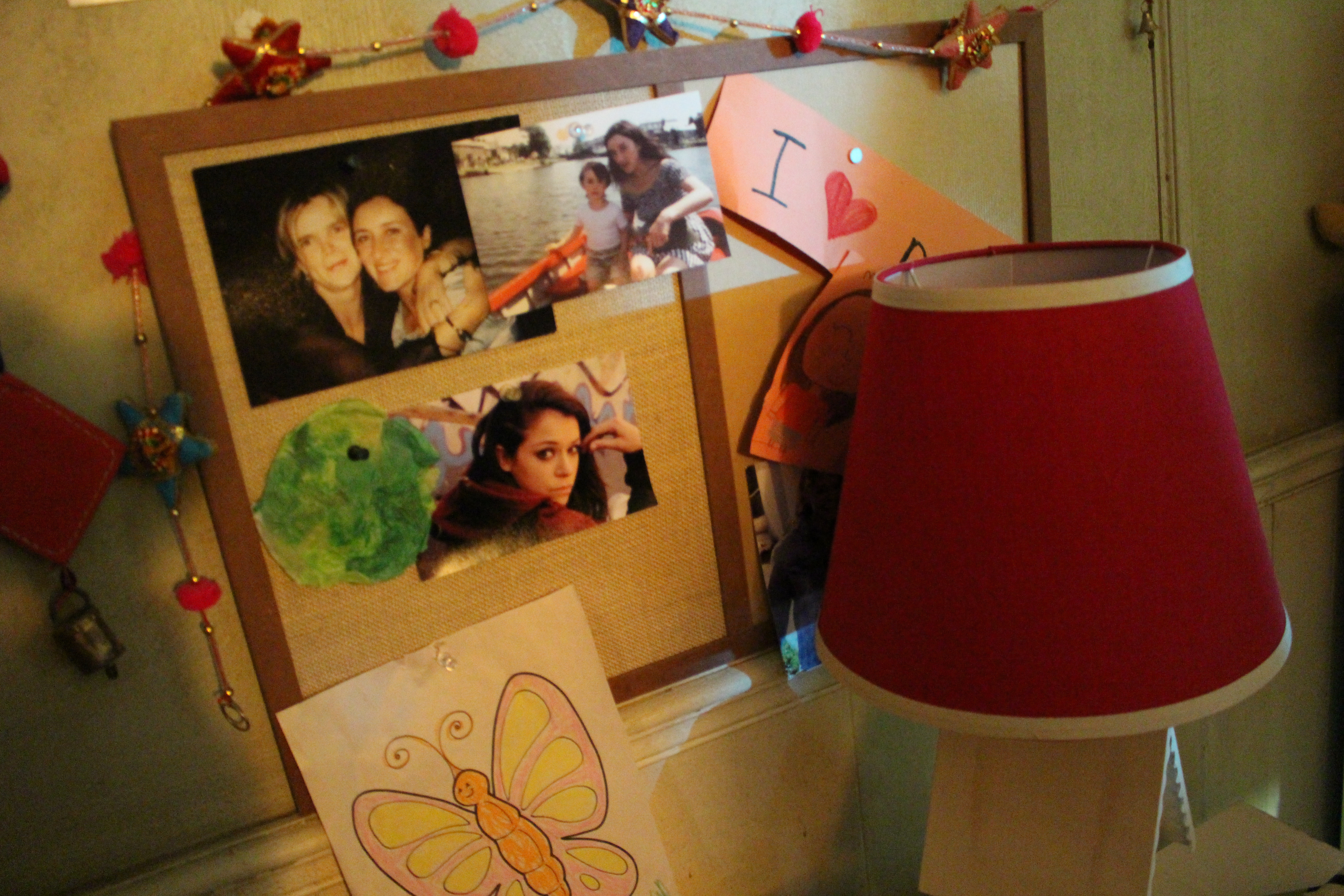
On Set of 'Orphan Black' (Photo by: Daniela Costa)

Indeed, plenty has happened for the show and its star since it premiered in 2013. But before we explore Orphan Black 's legacy, let's get into the real dirt: spoilers. Previously, the show revealed that the founder of Neolution is still alive. To add even more drama into the mix, Susan Duncan—Rachel's sinister adoptive mother—was left with a gut wound after Rachel stabbed her. This new season kicks off where the last one left off.

"We're on the run in a brand new location that's gonna unfold as a mystery over the first part of the season," said co-creator Graeme Manson. "We have a strong Sarah and Helena storyline running through this year." This season will also see Maslany playing a younger version of Rachel. "She's still who she is, but she's definitely a product of having been raised in a very specific environment," described Maslany.

There are big developments for the other clones as well, including episodes focused on individual sestras. "Graeme and I felt really like we wanted to explore those characters a little deeper than we had in previous seasons and allow more screen time," said Fawcett. "There's been a decent effort to kind of create stories that allowed us to get much, much deeper into each individual character."

On set of 'Orphan Black' (Photo by: Daniela Costa)

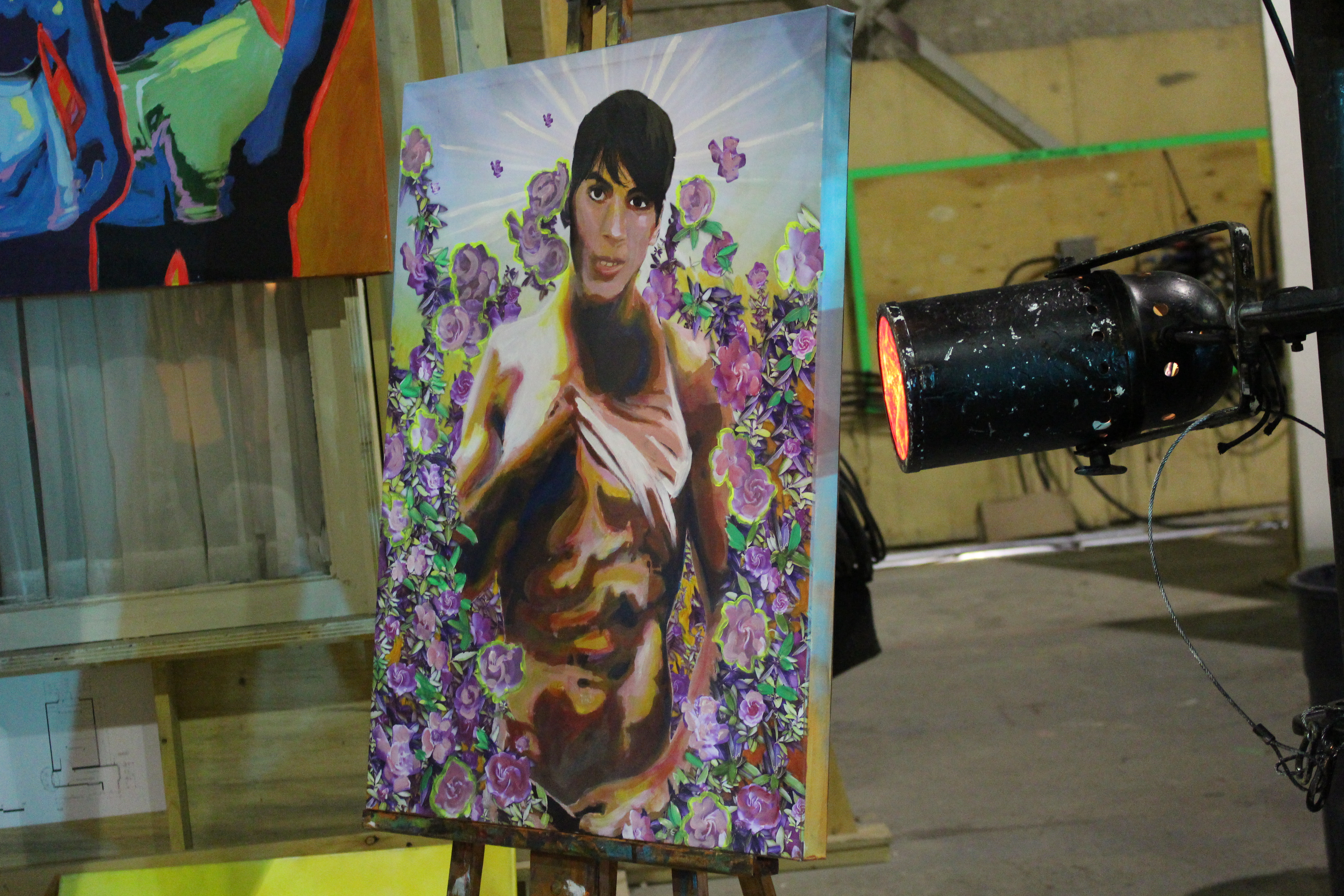
Even Felix will "get an episode to shine where we get to see him in his element a little bit more," according to Jordan Gavaris, who also shared that Felix has a new art project. "This is a bit of his story and what is important to him."

"I think something about his sex life will be explored in the fifth season," Gavaris teased before later elaborating that this season will also "explore, for a little bit, more of his gender fluidity. Because he's always been a queer character. He's not just gay. He's always been genderqueer." As for Felix's relationship with his adoptive sister Sarah and the rest of the clones, he's "sorted out his priorities. I think it's very clear that he's about these women." "He's sort of officially in it for the long haul," he added. "No more insolence or resistance—he's with Sarah."

During the set visit, I also got some insight into Alison and Donnie. "We start the season off in the woods and they're kind of hiding out, but that doesn't last long. Shit goes down," said Kristian Bruun. (If you're wondering, their kids are with Alison's mom down in Florida.) Donnie's primary role this season is not unlike it's been in the past: supporting Alison and Helena. And yes, the suburban life adventures that often provide the show's comic relief will still be present as well. "We have an episode where the church Fall Fun Fair becomes a central location and some very ridiculous Donnie things happen," Bruun teased.

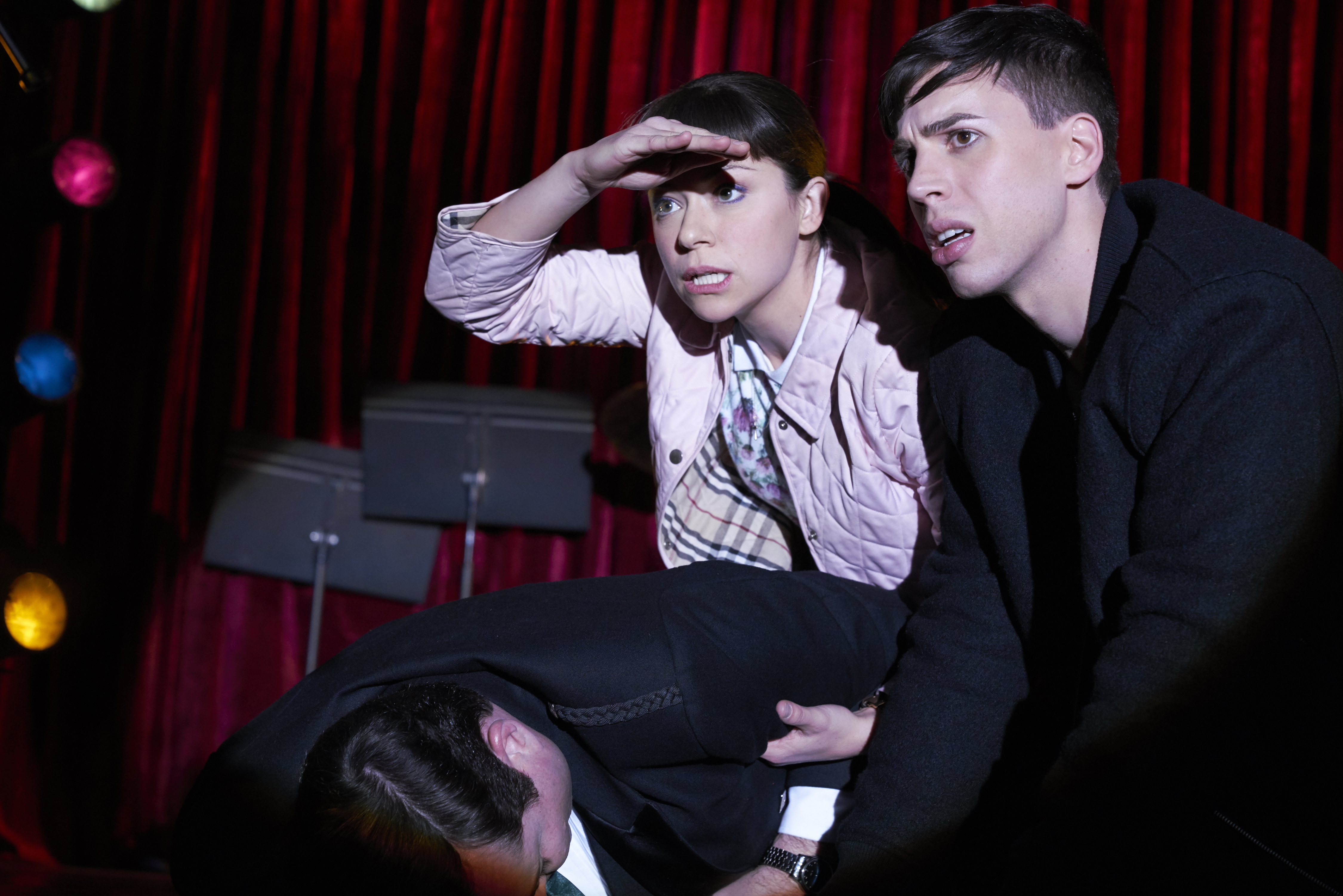
Photo: Ken Woroner/BBC America

When it comes to Cosima and Delphine—the couple Manson once told Évelyne Brochu is the love story of the show," Maslany says there will be "a real admittance of where they're at."

"I think the cool thing that we're going to see this season is that they're gonna get back to science, and that's where they connect the most," said Brochu. Speaking specifically to her character, she added: "She's looking out for the sisters and still trying to save Cosima. She's trying to help to free them. Find answers and finally set them free."

But her methods, as usual, will undoubtedly be the cause of future rifts for Cosima and Delphine. Brochu explained there will be questions for both of them about their dynamic moving forward. "We're in a world where the more you know, the more you're in danger. Delphine is someone that truly knows that," she said. "And so she's still trying to protect Cosima by withholding information."

The cast and creators were tight-lipped on specifics of the final season, but Manson did offer up a vague note by saying, "We get some interesting answers to things, to questions we may never have even thought of and some questions that might be very obvious." However, everyone was happy to talk endlessly about the legacy left behind by Orphan Black and its many characters. "The show became political without us really realizing it," said Manson. "It certainly feels more political now than it has before."

"It became inspirational for so many young people, for so many young women. Tatiana and so many of the other women who work on the show kept the feminist themes of the show and our themes of identity, nature versus nurture, diversity, inclusion."

On set of 'Orphan Black' (Photo by: Daniela Costa)

Bruun, a regular on a show where the men take a backseat to the women, says he couldn't be happier about that reality."I'm really proud of the fact that it's a feminist show. It's very LGBT-positive and supportive. And I think we need to put more of those stories out there, especially right the fuck now."

In fact, that might be Orphan Black's most enduring legacy: its treatment of its queer characters and themes. "We were trying to be a diverse show and from the very get-go sexual orientation was all part of it," said Manson. "Felix was always a gay character, always someone who was gonna be never defined by their sexuality, which was our immediate mandate."

"This is where Tatiana came in," he added, explaining that the actor—who has been a producer on the show since season 3—helped them develop Orphan Black's queer characters and find the "moral statement of the show around these issues."

"When you develop a very voracious fan base as Orphan Black has, there's a sort of responsibility you suddenly have to really pay attention to the voices and pay attention to the audience feedback," said Gavaris.

"It's very hard to be a political show," he continued. "It's hard because ultimately you're going to end up alienating someone. You'll end up alienating people that don't agree with progressive gay politics, and sometimes you make the mistake, or a mistake, and you end up alienating a subculture of the gay community."

Gavaris realizes some gay men might not enjoy Felix as a representation of the gay community. We won't see Felix in a monogamous relationship, and Gavaris believes that's a good thing."His love life was something I really wanted to explore," he said of earlier seasons. "I was really fixated on this idea of him maybe finding a partner."

"But ultimately when I gave it a bit more thought and I started talking to different friends in my community, and just like other artistic opinions and gay opinions about this particular character, that it would be interesting if he was never going to be in a long-term relationship, if that was never something that he was even looking for. That maybe Felix has and always will be polyamorous, or not monogamous at the very least."

During its run, Orphan Black also introduced us to transgender clone Tony. "There was a lot of responsibility in not playing a trope," said Maslany. "I was terrified to step into his shoes because it's a huge thing politically and there's so little representation. And I know that by no means does a cis woman playing a trans man equal representation, but the thing of our show is that one person plays all these roles."

Maslany has also played queer in her portrayal of Sarah, even though that was only confirmed last season when we saw her kiss a random woman at a club. "There's no question in my mind that Sarah's been with women and that she's open to that," said Maslany. As for everyone's favorite lesbian scientist, Cosima, Maslany told me, "She can't help but be sort of blown away by Delphine and turned on intellectually and physically and emotionally and everything. The two of them really push each other's buttons in that way.

Fans have certainly latched on to these queer characters, such as in season three when it looked like Delphine had been lost to the Bury Your Gays trope. The fan reaction over social media was intense enough to cause Maslany, Manson, and Fawcett to do press defending the move. Fortunately, she survived. This reaction, according to Maslany, "spoke a deep truth about how much the audience cares about these characters."

And the audience should care about these characters and this show. It is indeed political, now more than it's ever been. If it makes some uncomfortable, that's no accident—it's pure Orphan Black.

"Let's fucking creep those ideas in there," said Bruun. "Creep the ideas of yes it's normal to be gay and open and in love, it's normal to be in control of your own body or it should be, it's normal to be a feminist, it's normal to see powerful women, it's normal to see weak men, it's normal to see every iteration in between on the spectrum, because that is the actual fucking world that we live in."

Season 5 of Orphan Black premieres June 10 at 10/9c on BBC America.

Follow Daniela Costa on Twitter.

09 Jun 15:34

Bon Iver protagonizará la segunda temporada de ‘Por 13 razones’

by Mondo Insonoro
LOS CASETES CONTENDRÁN GEMIDOS, SOLLOZOS Y QUEJIDOS LASTIMOSOS DEL DE WISCONSIN
El cantante Bon Iver, tras volver a iniciar su gira suspendida hace tan sólo unos meses, ha sido confirmado como protagonista de la segunda temporada de la serie ‘Por 13 razones’. Para ello repetirá la fórmula del éxito de la primera, habiendo grabado un “minutaje bastante amplio de gemidos, sollozos y quejidos lastimosos”.
“La idea es darle continuidad al concepto, esta vez ejemplificando la voracidad de la industria musical a través de la amargura de mis composiciones”, ha declarado el de Wisconsin. “Las cintas, junto con su correspondiente walkman, serán repartidas durante los conciertos de mi gira, y su contenido conformará el grueso de mi repertorio en directo”.
Netflix ha asegurado que para esta segunda temporada, la trama girará en torno a la depresión del cantante y su perenne noción de juguete roto, que irá in crescendo conforme su manager y los distintos promotores y directores de festivales vayan haciéndole el vacío: “Muchos de los problemas que he arrastrado durante estos años tienen su origen en el trato que he recibido por parte de la industria musical, a la que solo le interesa mi música. Me siento utilizado”, confiesa entre lágrimas.
Aunque no está confirmado, se espera que para el final de la temporada aparezca Emma con su nuevo marido para “dotar de mayor dramatismo al argumento”, dejando en el aire el posible suicidio o redención del artista.
09 Jun 15:29

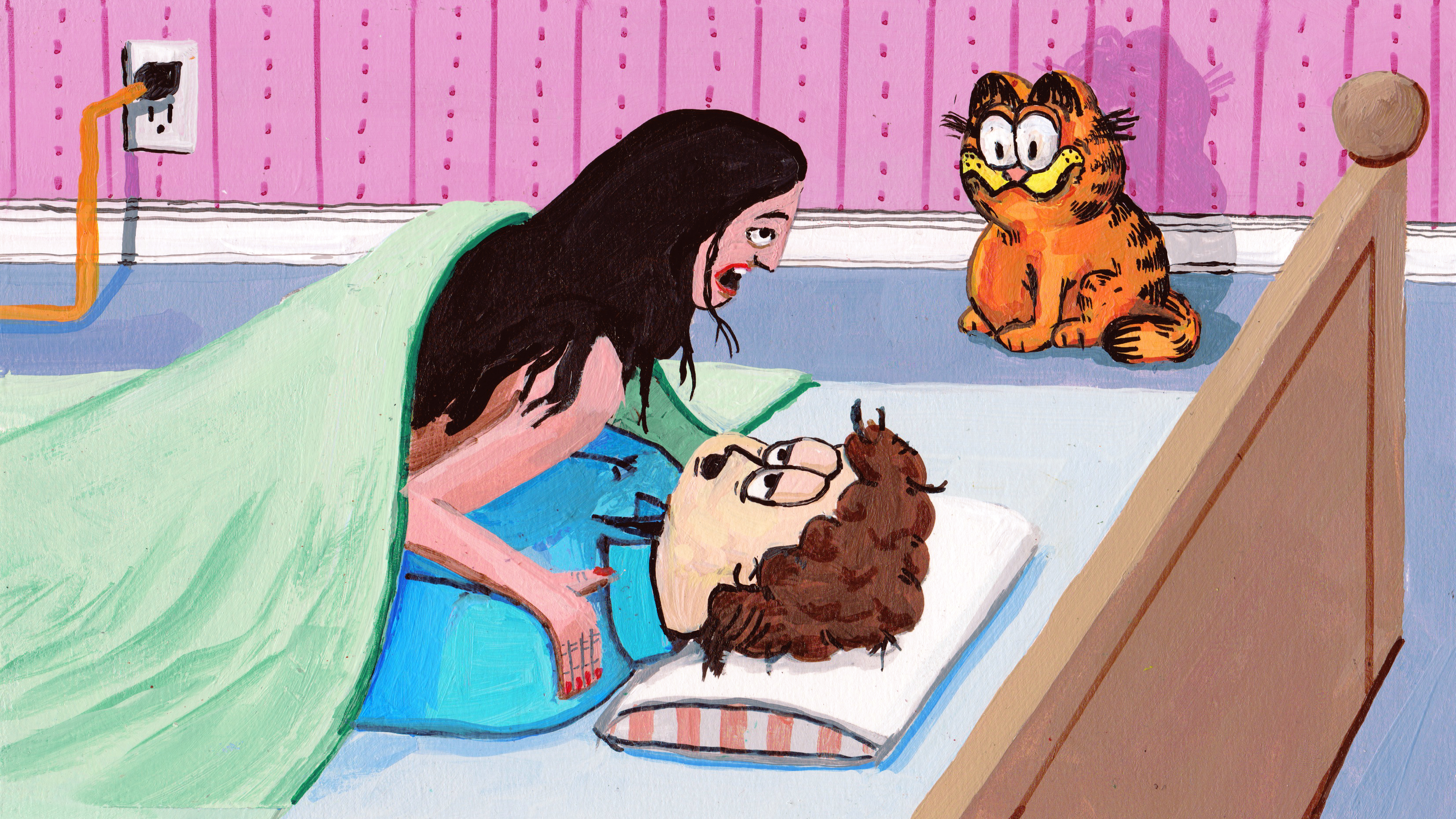
Ways In Which The Guy You Have A Crush On And Your Therapist Are Almost Exactly The Same

by Katie Mather
The Sopranos

1. They both have the capability of making you cry and are usually successful in doing so.

2. You’ve either thought of something or had something happen to you that’s made you think: “oh, great, I should remember to bring that up the next time I see them.”

3. You don’t really want to introduce either of them to your parents.

4. But your parents still ask about both of them.

5. You’ve had moments in public where you thought you saw them coming towards you and thought, “oh fuck, nooooooooooo.”

6. You tell your friends about them, but you keep 99% of the details to yourself.

7. And, honestly, you’re always wondering what they say about you to their friends.

8. Or if they talk about you at all.

9. You’ve wondered if they consider you exciting enough to even think about.

10. You seem to have uncontrollable word vomit whenever you’re around them.

11. They both have kept you up at night with different thoughts and concerns and worries.

12. You sometimes feel like impulsively buying them a gift, but is that appropriate?

13. You hate it when they cancel on you or have to reschedule.

14. Usually because you spend your whole day emotionally preparing yourself to see them and it’s exhausting.

15. Also because you have an irrational, suppressed idea that you should always be their number one priority forever and ever.

16. But you would never tell them that because they can’t know you’re that crazy. TC mark

09 Jun 15:26

We Asked Women to Sum Up the Worst Sex They Ever Had in Six Words

by Anna Goldfarb

Some people say pizza is like sex: even when it's bad, it's still pretty good. But that has not at all been our experience. When sex is bad, it can be achingly, insanely terrible—weird smells, awkward noises, unpleasant partners. We have heard many tales of sexual terror from female friends, which prompted me to look for more. Here, we ask women friends and co-workers to recall their most terrible, awkward sexual trysts. [Gags.]

"Farted in my face during 69." - Kylie, 31

"Curtains are not towels, Jackhammer Dude." - Adrian, 32

"Baby carrot dick kept slipping out." - Louisa, 31

"Insisted she eat pickles just before." - Tiffany, 24

"Cat maintained eye contact entire time." - Carrie, 35

"Dysfunctional penis, watered his plants instead" - Lia, 27

"Sloppy kisser. Bad breath. Smelly balls." - Jenna, 22

"Broke up with me while climaxing." - Lexie, 29

"Skinny penis looked like gnarled parsnip." - Erica, 39

"Doggy style while watching The Hills" - Tracy, 25

"Kept thanking me while penetrating pussy." - Nora, 23

"And then we decided to marry." - Sara, 25

"Surprised me with his uncircumcised dick." - Rupal, 33

"Didn't make any noises. Asleep? Dead?" - Beth, 27

"Blasted Blink-182. Begged for blowjob." - Justine, 35

"Talked in British accent. Not British." - Lynne, 28

"Kept socks on. Loud. Wanted anal." - Jasmine, 19

"Zits everywhere. Couldn't find clit. Republican." - Brandi, 30

"Didn't want to wake his parents." - Willa, 34

"He sobbed after dick went in." - Samantha, 21

"Took his virginity. Told me afterwards." - Annie, 32

"One night stand said he loved me." - Pam, 38

"Tried using clearly dirty sex toys." - Melissa, 27

"Big talk. Small penis. No go." - Kate, 28

"Vampire wannabe. Kept biting my neck." - Jules, 33

"Repeatedly asked to massage my asshole." - Carly, 26

"Pet his cat while inside me. #notaeuphemism" - Suzanne, 32


"Didn't know how to use condoms." - Molly, 36

"Left giant scratch marks on back." - Sharon, 22

"Cried when I could not orgasm." - Erin, 31

"Tried using spit as lube. No." - Paula, 26

"Couldn't cum without sucking my toes." - Mandy, 34

"Tequila-fueled threesome. Awkward and messy." - Ruthie, 31

"Sucked at licking pussy. Too eager." - Geri, 26

"Refused to shower. Feet smelled horrible." - Lauren, 25

"Bit my nipples so hard I screamed." - Kelly, 32

"Lied about herpes sores on dick." - Vivian, 24

"Virgin. Attempted rigorous marathon porno sex." - Irene, 31

"Pumping away. Sneezed into my mouth." - Ella, 37

Follow Anna Goldfarb on Twitter.

09 Jun 15:18

How Hollywood manufactures a Muslim menace

by Caroline Siede

In her new series The FREQ Show, Anita Sarkeesian digs into insidious, pervasive Hollywood stereotypes about Muslims and Arabs, and how those stereotypes fuel real-world Islamophobia. As Sarkeesian puts it:

To so many Americans, people in the Middle East have never been established as human beings with real lives, hopes, dreams, and struggles. When almost every story you’ve ever seen about a particular part of the world paints the people who live there as monolithic, evil, and scary, you’re a lot more likely to believe that it’s actually true.

And it’s not just fictional representation that’s a problem. According to a study by University of Illinois professor Travis Dixon that analyzed 146 episodes of TV news programing between 2008 and 2012, 81 percent of the terrorist suspects discussed on TV news were Muslim. In real life, however, Muslims accounted for just 6 percent of actual FBI terrorist suspects during that time period.

09 Jun 08:53

Debaluto

by @cequelinhos

De cando en vez gústame traer aquí algunhas palabras que están a acabarse. Si, as palabras son coma calquera ser vivo. Naceron nalgún momento, medraron e foron gañando e perdendo significados co paso do tempo e chegado un momento, han desaparecer. Hai veces que esa morte non é definitiva porque reviven por calquera causa mais por costume, unha vez que se silencian na lingua falada e xa nin os escritores a usan nos seus libros, marcha e adeus.

Hai pouco sentín na Limia esta fala: “Agora son vello e teño todas as terras ao debaluto”. Quen falaba, en efecto, debía roldar os 80 anos e tiña as bagullas a adornarlle as pálpebras mentres conversaba con outro, máis ou menos dos seus anos, sobre o tópico tempus fugit virxiliano.

O caso é que ao escoitar a expresión ao debaluto inmediatamente a relacionei con outra locución que estou farto de oírlle á miña nai e a toda a miña xínea da Maraña: andar ao debaluque. No caso da miña familia, o debaluque non ten que ver co abandono (con deixar de monte ou á poula) senón con andar de festa rachada. “Mira que olleiras traes! Andas ao debaluque venres e sábado e logo o domingo non tes nin saliva na boca”. É dicir, o debaluque é máis ben un abandono dos bos costumes, un asilvestrarse moral, unha desorde máis dionisíaca que agrícola.

Nos dicionarios de Leandro Carré Alvarellos e de Estraviz aparece a expresión ao debaluto; non así debaluque, polo que a considero unha derivación, común noutras moitas palabras.

Sempre digo que o único remedio para salvarlle a vida a unha palabra é usala. Non hai semana na que eu ou meu irmán ou moitos dos meus primos falemos do debaluque. Se vos presta, recordade que a forma documentada é debaluto e que serve moi ben para definir unha boa xolda abarrabasada.

09 Jun 08:52

May perde a maioría absoluta, mais podería gobernar co unionismo irlandés

by X.M.
May quería ter as mans libres para negociar o Brexit, mais sae das urnas maniatada. O Partido Conservador cedeu a maioría absoluta gañada por Cameron en 2015. O laborismo aumentou considerabelmente os seus apoios -261...
09 Jun 08:45

La nueva moda porno: recopilaciones 3-en-1

by Pinjed
La nueva moda porno: recopilaciones 3-en-1

Una cosa muy interesante que nos han traído los tubes y el streaming de porno en general es cierto nivel creativo: una admirable minoría de...

09 Jun 08:37

10-Month-Old Pug Worried Upon Reaching Age When Father Developed Debilitating Breathing Problems

BEAVER, PA—Frequently taking deep breaths to test his lung capacity, a local 10-month-old pug was reportedly worried Thursday upon reaching the age where his father developed debilitating respiratory problems. “You can’t help but be concerned when you realize you’re the exact same age your dad was when he started wheezing all the time,” said the pug, explaining how his fears were made all the more unsettling by memories of his father being able to climb no more than three steps before needing to lie down for 15 minutes just to catch his breath. “I didn’t worry when these problems seemed so far away, but now the day when I can’t walk from the kitchen to the living room without an attack of snorting is right around the corner. It’s like you start closing in on 1 year old, and everything just falls apart.” At ...

09 Jun 08:31

Piden que los ‘antidisturbios’ tengan sede permanente en Santiago

by alba garcía


09 Jun 08:26

G. Willow Wilson Tells Comics Industry To Adapt Or Die In Much Nicer Words

by press@theouthousers.com (Tim Midura)
G. Willow Wilson Tells Comics Industry To Adapt Or Die In Much Nicer Words

“It’s The Industry’s Job To Keep Up With The Way You Read.”

Source: Twitter

G. Willow Wilson, co-creator of Ms. Marvel, commented on a tweet by Gail Simone, seconding that book sales are up. She was then asked by a trade waiter if they're hurting or helping the comics industry.

Her response hit the nail on the head that the comics industry needs to adapt to its readers tastes. The medium doesn't matter.

She then dove into her own experience with Ms. Marvel.

She's then asked the oft mentioned question of buying the first few issues to show support for a series.

To which she replied.

She then went into her own experience as a young comics reader.

There are some books that might need monthly support though.

But those books aren't published by the Big Two.

And finally, old habits die hard.


Adapt or die.


Written or Contributed by Tim Midura


09 Jun 08:25

Archer Is Reinvented Under The Murder Mystery Genre

by Matthew

Back in its eighth year and already guaranteed for another two, which are meant to be the last ones for the series, Archer shed its case-of-the-week typical status for what could very well be a two and half hour movie that takes place in just over five days. If you’re a fan, then it is no secret to you that Archer had a few episodes like this throughout its history and, more relevantly, had a more straightforward approach to its fifth season where the gang became drug dealers for a couple of months. However, “Dreamland” baked the cake and ate it too, but that was a good thing.

As a result of last year’s finale where it was revealed that Sterling Archer, the world’s most dangerous spy-turned-Private-Investigator, got repeatedly shot by Veronica Deane, questions rapidly surfaced on how creator Adam Reed would solve this situation: would he call it back to Archer’s apparent immortality? Was it just another cyborg Dr. Krieger created? Had Archer been in a coma since his drowning in season four?

Nope.
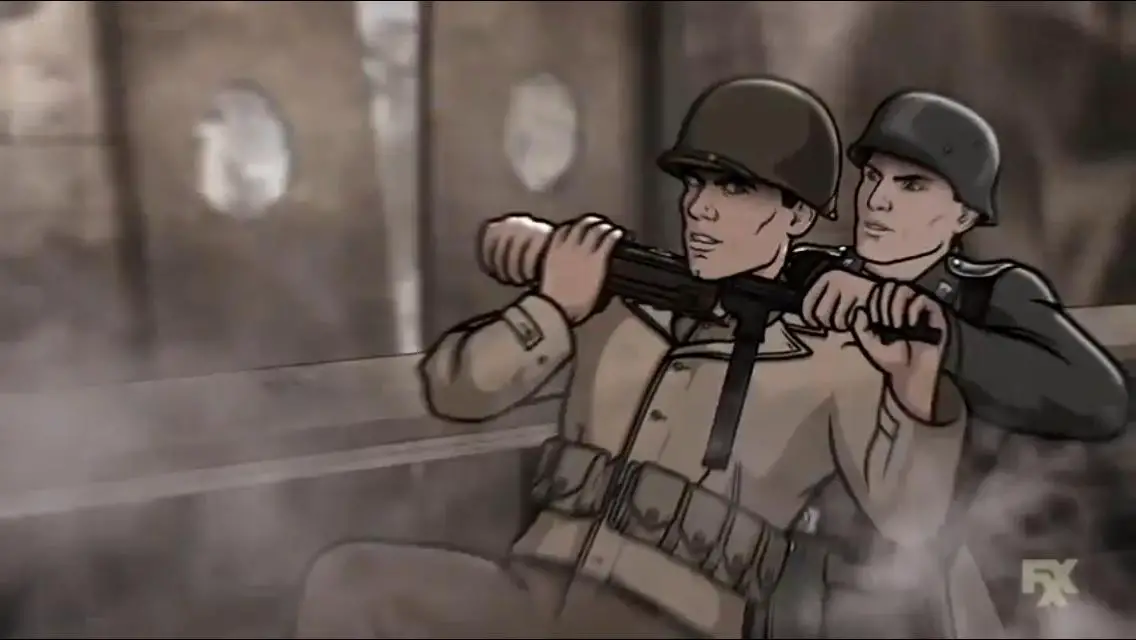
Adam Reed took a far more “out-of-the-box” approach and, while embracing the opportunity to honor Woodhouse’s late voice actor George Coe, took us to Los Angeles, 1947, reeling in post-war, Hollywoodland, and the characteristic noir aestheticism from the decade.  We went on a journey set in Archer’s coma in which the people from his life are back in new roles as he navigates a sleepless week where pretty much everything that could possibly go wrong, goes far worse than expected.

The show obviously took a hit from its experience: the first episode, “No Good Deed”, barely had any jokes in it, sacrificing humor for establishing the plot and mystery, but it’s all good because the next ones balanced the two factors more evenly and with steady pacing. If you are an avid rewatcher like me, you probably noticed a shitload of seamless callbacks, running gags, and references to previous seasons even in random lines of dialogue. If you’re not, I bet you were still pretty satisfied. However, I know full well that it is also quite possible that you didn’t quite enjoy Dreamland, much like some watchers who disliked Archer Vice — this is a peculiar case because I only appreciated Vice’s humor during subsequent rewatches to the point where it became my favorite season.

So, now what we will go through is a high-end recap where some I’ll streamline the overall main points of the season, but I hope to control myself and not spoil too much of the clever humor. I’m taking you through Dreamland day by the day, but as a fair warning, given its straight continuity, the nights did tend to blend into each other, so the division in days is not 100% accurate.

Oh, before jumping in: the first episode also offers a look at Woodhouse’s funeral in the real world — the show continues its plausible deniability on the period it takes place by not showing the year the Butler died. It also displays a depressed Malory, keeping watch besides Archer’s bed in the hospital, almost three months into a coma.

Recap

Spoiler Alert for major plot points concerning the eighth season of Archer. Content warning for mentions/discussions of violence, gore, and drug abuse.

Day 1

During the first hours of the day, we see Sterling Archer, private investigator, discovering the body of his work partner, Woodhouse, shot three times. Two LAPD officers, Figgis and Poovey, are there as well, not really caring about the murder, simply labeling it as a heroin user whose bill got too tall for his dealer. Archer decides to find out the truth on his own and goes straight to said dealer, Krieger, who is Dreamland’s bartender. From there, he ends up having a conversation with Krieger’s boss at the lounge/bar Dreamland who identifies herself simply as “Mother”.  In exchange for helping to solve Woodhouse’s murder, she gives Archer a job: to spy on her competition, Len Trexler, who was having something delivered that night at the Long Beach pier. Archer also gets a crush on the club’s main attraction and also the singer, Lana Kane.

Later, Archer drives down to the location and finds Trexler’s employee, Dutch Dylan, known for dissolving people in acid, handing money to Figgis. Archer realizes that what Trexler was having delivered is a truckload full of Chinese sex slaves, so he decides to act upon it with Poovey’s help. The duo escapes with the women, but not before Sterling runs over Dutch’s legs with the truck.

Poovey ends up being responsible for what happens next to the rescued women while Archer goes back to his office for a drink to find it completely burgled. There, he is met by a woman, Charlotte Vandertunt, who claims to be the heiress to a vast publishing fortune and wants Archer’s help to fake her death because she wants to escape from her quasi-incestuous family.

Day 2
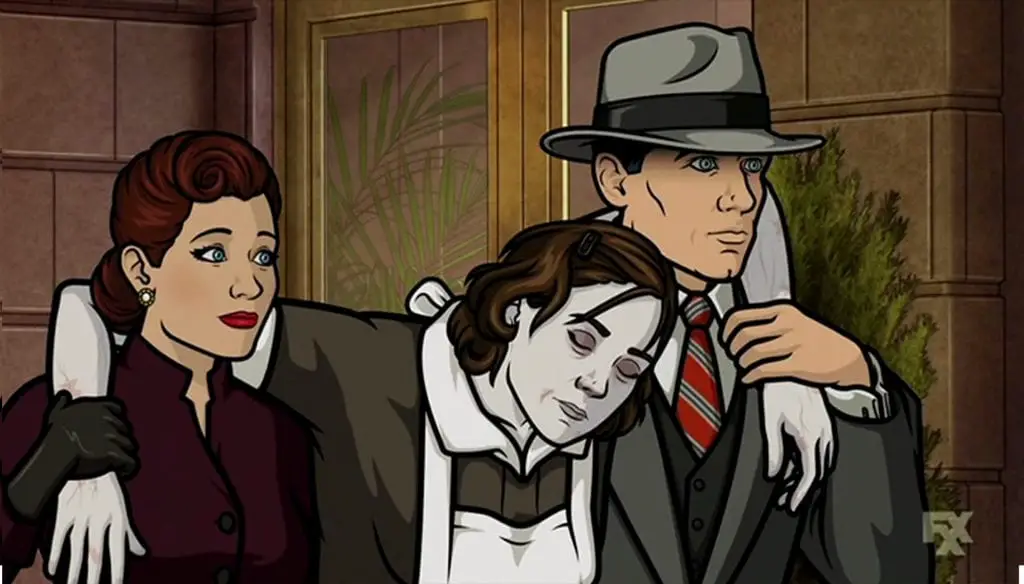
Charlotte provides Archer with the corpse of a maid and the couple spends the day plotting their scheme: they plan on using the maid’s body as a fake out for Charlotte who would “die” in a car crash. Sadly, right before putting their plan into action, they are found by Figgis (who was threatened by Trexler to find the Chinese ladies) and Poovey (who ended up taking the ladies home in secrecy and, throughout the season, starts developing delusional dreams of constructing a family with them and living up to 1100 years old).

The policemen take Archer and Charlotte to jail, but they book the latter as a Jane Doe because Figgis wants to use this opportunity to fake her kidnapping, expecting to get a huge reward from the Vandertunt family.

Throughout the night and with the help of Dreamland’s band players, which includes Ray, Archer manages to escape prison with Charlotte. Lana performs a terrible stand-up number at Dreamland given there was no band to play for her and, hired by Trexler, Krieger picks up Dutch from the hospital to give him new robotic feet.

Day 3

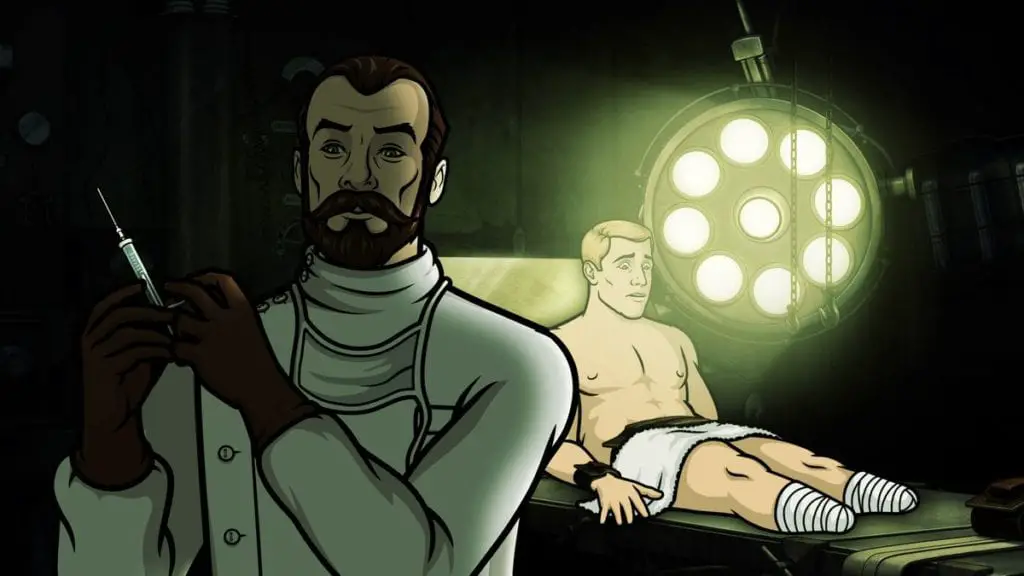
Archer takes Charlotte to Dreamland which prompts Mother to take over Figgis’s plan to get a reward for the kidnapping. She employs Archer to make the appropriate negotiations with Charlotte’s creepy brother Cecil who even asks for a finger as proof. We learn Krieger’s backstory which, while still rooted in Nazism, takes a turn when it is revealed he was a Jewish person working for the Nazi on the robotic division (trying to create an army of men with bionic arms and legs, but they never survived because Krieger kept killing them on purpose) in order to hinder the fascist agenda. He operates on Dutch, not only setting him with a pair of robotic feet, but also full legs and arms, which prompts his mind to start degenerating much like in previous seasons of Archer.

Day 4

The exchange of the ransom money goes wrong when Figgis ends up taking Cecil’s money before Archer, who both took a sex worker to the meeting point — our old acquaintance Trinette McGoon — and was followed by an observant Lana.
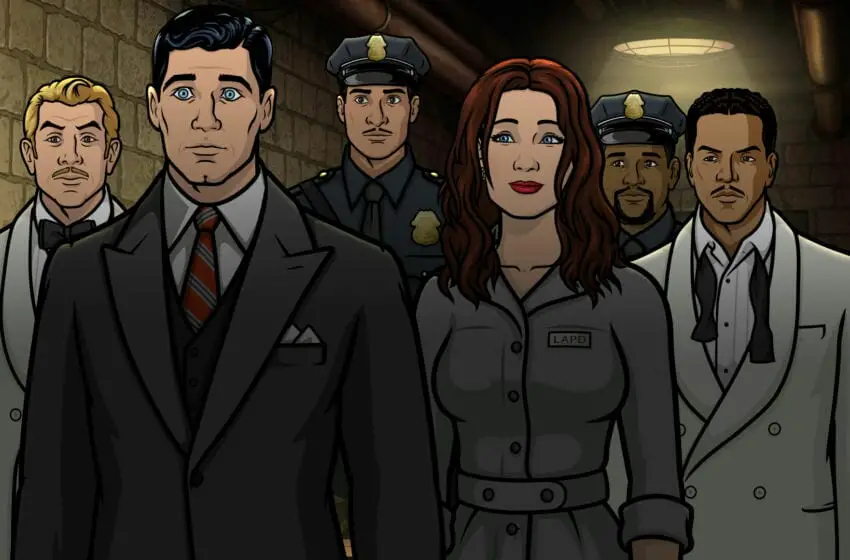
As Figgis manages to escape with the money, Lana, who reveals herself a treasury agent, teams up with Trinette and Cecil to go after both Archer and the policemen, all of them going to Trexler’s house. What they weren’t counting on meeting there was a revenge-stricken Dutch. Using his robotic strength and invulnerability, he sort of creates an homage to “The Last Supper” built off Trexler’s henchmen, all of them maimed and impaled — it’s a strong and incredibly gory image to close episode 6.

Day 5

Somehow, everyone successfully escapes Dutch’s rage and head over to Dreamland because Trexler tells Archer that Mother was the one who killed Woodhouse. When asked about it, Mother denies her involvement and accuses Trexler of lying.

Dutch arrives at the scene serendipitously — he needed to take a shot of a solution created by Krieger to keep him from dying — and more hell breaks loose. Neither Archer nor Mother’s henchman Zirk is able to stop the murderous robot; however, the murderous robot hounds which Krieger had created during his time in Germany do the trick and break his neck.

After Dutch’s demise, things seem to be calming down — he actually ended up confessing to killing Woodhouse on a whim —, but Lana’s cover as a treasure agent is blown. Mother gets pissed and accidentally shoots her six times (well, one time only as the other five were on Poovey trying to control the gun’s hair trigger). The singer takes her last breath while being held by Archer, who storms out of Dreamland.

In its closing moments, Archer, who hadn’t slept in five days and was on a drug abuse bender (Codeine and Dexedrine, supplied by Charlotte to keep him going through the week’s shenanigans), says goodbye to Woodhouse’s grave. Poovey arrives home to find the Chinese ladies gone with a farewell note and breaks down in tears.
Review

Archer has always been known for its tongue-in-cheek and clever dialogue and quite possibly a hundred running gags throughout seven seasons, so obviously we would expect not only callbacks but also entirely new ongoing jokes. The clearest example turned out to be any of the characters saying “So… uh… what are we doing? Are we just jumping right into this?” (or trying to say it before they get interrupted) at the beginning of every episode starting with the second one. This phrase both suited each scene in which it was employed and served as a fun nod to how every episode started exactly where the previous had ended, further promoting the idea of a movie-like-experience instead of the previous “case-of-the-week” format.

One might also cite Poovey’s continuous delusion regarding the Chinese ladies he ended up taking home. Creator of the show Adam Reed stated in an interview that he considered Poovey’s quick attachment to the characters the heart of the season and, thus, they decided on his heartbreak as the closing scene.
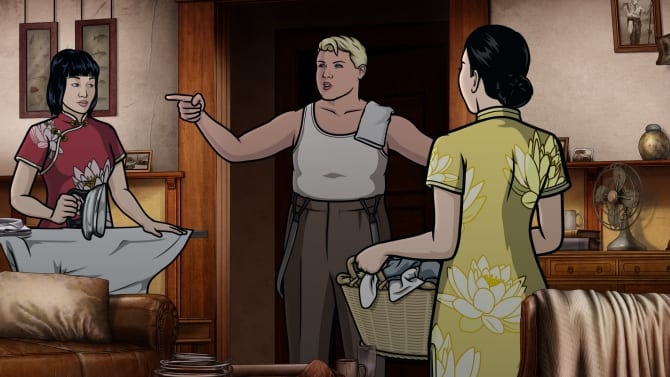
Speaking of Poovey and the Chinese ladies, there is obviously some things that deserve to be said. First, there is more than one angle on how Pamela Poovey, a character who identifies as female in Archer, was transformed into ‘Poovey’, a seemingly male police officer. You can work on the angle that, in 1947, there may not have been a space for female police officers and/or detectives (which is not the case given Alice Stebbins Wells was appointed in 1910, in Los Angeles in fact, as the US’s first policewoman with arrest powers). One can also wonder if this is a callback to how, despite being a confident and proud bisexual woman, she is sometimes taken as a “masculine” character to the point of Malory Archer even thinking that she is a man.

There’s also the possibly transgender point of view which, while showing some great potential, I’m not sure if it is entirely supported by the story. Poovey is, as mentioned, dreaming about being the patriarch of a seriously large expanded family, which seems to imply the detective is male.

However, I do believe there is supposed to be some ambiguity regarding Poovey’s gender if you consider yet another running gag: in Dreamland, characters subvert expectations. They change sentences in which a reference to traditionally masculine traits is expected. An example would be “I’m gonna punch you right in the… genitals”, said by Archer in the first episode, where not only there’s a hesitant pause before the punchline, but also one would expect “balls”  or ” dick”  to be the last word. Such a subversion could apply to Poovey as a transgender character in Dreamland, but I just don’t know enough of the intent to make a call on it.

Now, on behalf of the Chinese women, I have to admit, I absolutely hated — HATED — every single time they were referred to in dialogue as “Chinese whores”, which happened quite a lot. Don’t get me wrong, I know more than enough how Archer is not above including a few selected slurs/slur adjacent words (the show is especially fond of the word “negro/negress”), and it’s not like the word hasn’t already been included in the show several times, but still, it is uncomfortable and problematic as fuck.

This brings us the question of “how politically correct is Archer?”, which I am not even sure if most viewers even think about. Well, to me, that’s a hard question because I do knows Adam Reed is aware of social issues like racism and sexism and takes them into account when penning a season. He even has characters saying “however you self-identify/however you choose to identify” as early as season 3. This particular line of dialogue, in the context of 1947’s Dreamland, is a bit anachronistic (it refers to Lana being confused as a “T-man/transvestite), but as culture is not absorbed in a vacuum, I find those attempts at nodding to gender dynamics quite welcome.

And yet, you still have to realize that pretty much every single character in Archer has either performed some atrocity, suffered some atrocity, or in some cases, both. So, in a world where there are problematic characters right and left, you really gotta decide for yourself what do you find uncomfortable to watch.
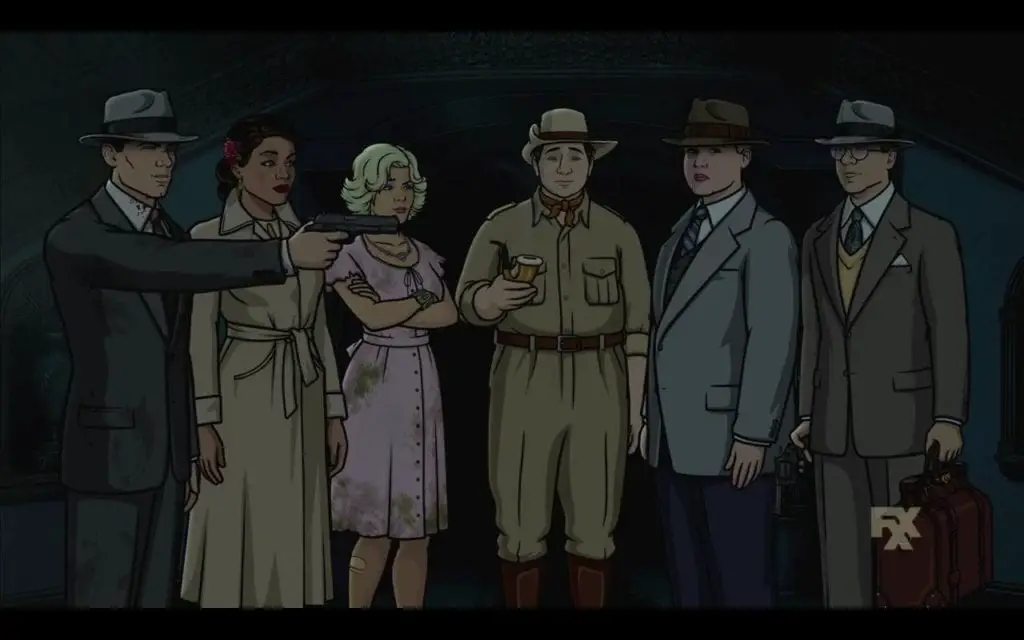
Another way Dreamland mirrors previous seasons is with Dutch and that’s quite obviously on purpose. In both scenarios, Archer is responsible for crippling Barry/Dutch who becomes mentally unstable and murderous when he becomes a cyborg/robot — even Barry’s “double personality”, Other Barry, makes the cut for Dreamland as Other Dutch.

Something that I really appreciated was the twist they gave to Krieger’s story. While he is a mad Nazi-adjacent scientist in the real world, the decision to make him a Jewish man hiding in plain site, wasting Nazi money in order to create robots which he will purposefully kill was really welcome. It felt fresh and gave him a new lens to look at as, while he is still quite the mad scientist building a cat and two dogs with robotic legs, he is also not afraid to kill his own creation (Dutch) when the people in Dreamland are being threatened.

In terms of displeasing scenes, Lana getting killed off out of nowhere and with the flimsy excuse of a “hair trigger” takes one of the top spots. I mean, really, shooting your only African American main character so unceremoniously was not only over the top but also gratuitous. The implications that come from that are pretty obvious: given how Archer didn’t wake up from the coma in the finale, the writers may be planning to either go back to Dreamland next year which would be without Lana (maybe Aisha Tyler wanted some time off?) or next year we will see yet another season in Archer’s imagination as the show reboots itself again. Or maybe Archer will wake up in the next premiere and all will be well again.

What can be said about the situation in which Lana was killed is what Archer himself yelled: Lana was shot six times (he says seven, but it was six) and no one can survive that. This is clearly supposed to be a mirror to the real world where Sterling was shot thrice by Veronica Deane, implying that, really, Archer will never wake up from his coma. The show is already renewed for two more years, which are supposed to be the last ones, so maybe this is gonna be it.

Something I feared for before the season started was whether some characters would end up being underutilized. And by “some characters”, I mean Cheryl Tunt, because she is my favorite. The truth is I was expecting a case-of-the-week kind of deal where each of the main characters would get only one episode to shine. Given how different things turned out, I am glad for Cheryl/Charlotte who had some pretty amazing scenes, but sad for Lana and Ray. The former was underutilized during the first half of the season, and Ray only had significant screen time in one measly episode.
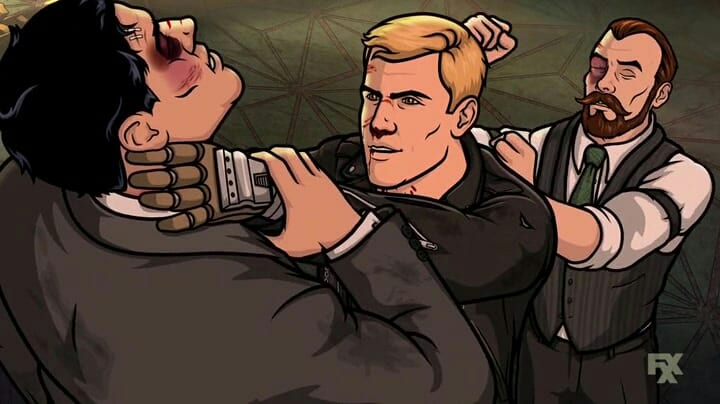
Now, about Archer. There are definitely layers to Dreamland’s rendition of the character. While he maintained the usual qualities we love/hate — his womanizing was a bit retracted, but his alcoholism, drug abuse, lack of fear towards dangerous situations, and general ” swagger/assholism” —, this version of Sterling Archer was also a veteran war hero who got constant flashbacks to his time in the military as a potential sign of PTSD, especially in times where he became violent. This was a real interesting addition to the season, particularly as it climaxed to him realizing that he often engages in these ” unhealthy”  situations one way or another: he merely wanted to find out who had killed his partner but ended up on a five-day spree with multiple casualties.

Aesthetically wise, what can I possibly say about Dreamland that hasn’t already been said? It is stupendous. The animation is so perfect, the movements are so fine tuned, the brand new scenarios are colorful and exciting… Hell, the artists even took the time to pat themselves on the back by creating some very unconventional transition and close-up shots probably just to show off their skills. And you know what? They deserve it. This is a show that in three of the last four seasons had to create pretty much all new backgrounds, clothes, and themes, so they might as well do a close-up of ice falling in a glass of brandy to show the goddamn bubbles! The sad part about it is that for the second season in a row, the episode order has been decreased.

It’s also worth mentioning the noir vibes that inspired Dreamland. Now, honestly, I have barely watched any noir movies whatsoever, so I dug up some information to compare with how Archer took on the genre and, well, in my opinion, it more than succeeded in both homage and satire. You get your noir tropes — a private detective, a murder mystery, a rich woman, cops, mob bosses, the 1940s, a large city, voice overs — and Dreamland takes all of them and puts their own spin to it while adding humor and some anachronisms to maintain the Archer brand.

Overall, this was an amazing season in my opinion. It has a somewhat decreased level of rewatchability, for sure, but new fans might enjoy it given one does not necessarily need to have watched every single episode to get on board. Old fans like me, while probably stung by a year without resolution to the big question “Will Archer live?”, still got plenty to adore.


Images Courtesy of FXX

The post Archer Is Reinvented Under The Murder Mystery Genre appeared first on The Fandomentals.

09 Jun 08:18

Rosalía, la gallega condenada a devolver 'El Gordo': “Me lo he gastado. No lo robé, lo compré”

Un juez obliga a una lucense de 67 años a reintegrar los 320.000 euros que cobró gracias a un décimo que se había encontrado. El billete tenía una inscripción a lápiz ("para Inés"), que ella borró.

09 Jun 08:13

Being Popular Won't Make You Less Sad Inside

by Lauren Oyler

When I was in middle school, I thought my life depended on my butt and my ability to do a back handspring. By high school, I accepted that the former would never look good in the cool jeans and the latter would never happen. I erected a mental barrier between myself and the cheerleaders I would never socialize with: If I couldn't be popular, I reasoned, I could become the proof that the popular kids were wrong. At some point, my emotional palette transitioned from despair and longing and loneliness to a thirst for vengeance and a superiority complex, and although I no longer care what my high school classmates are doing, I would be lying if I said this pattern hadn't repeated itself in college and in my early career. The signifiers have changed—though a good butt will still get you very far—but far from transcending the pettiness of the girls' locker room as adults promised me I would, I have come to understand that popularity is a darkly powerful force at play in basically any endeavor that involves interacting with another human.

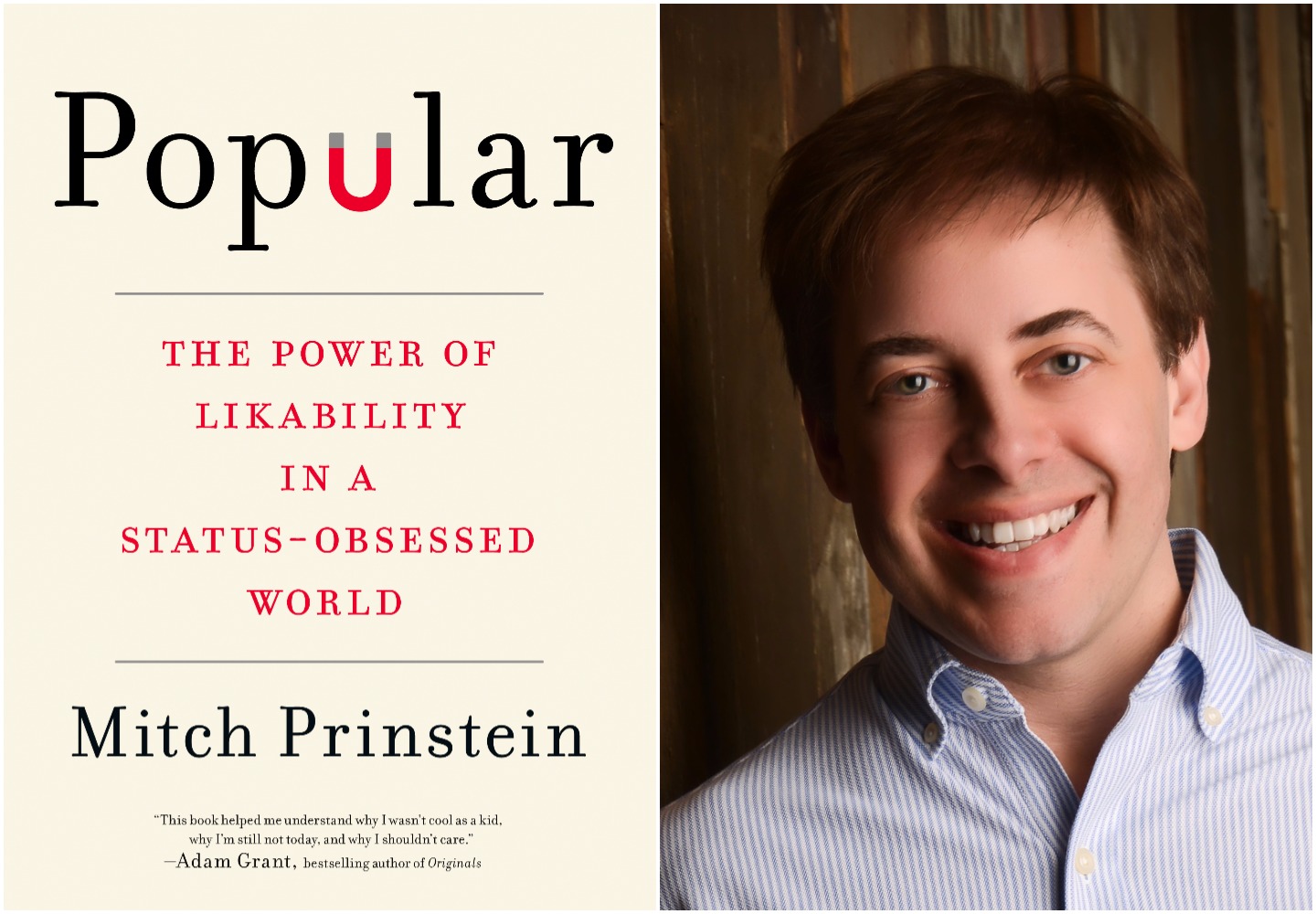
This tension between the real value of popularity and how stupid and destructive it is as a goal is something Mitch Prinstein unpacks in his new book, Popular: The Power of Likability in a Status-Obsessed World, which came out yesterday from Viking. His central argument differentiates between two types of social currency: status and likability. Though both follow us throughout adolescence and into the workplace, he says, one can help us—even allowing us to live longer, research shows—while the quest for the other promises only more strife and gnashing of teeth. You can probably guess which is which. I spoke with Prinstein, who is also the director of clinical psychology at the University of North Carolina at Chapel Hill, over the phone about his book, how our status in school still affects us today, and why popularity is key to saving the world from the American political situation.


Watch on Broadly: Hollywood Bros Speak Their Minds:


VICE: Can you explain the two types of popularity you discuss in the book?
Mitch Prinstein: Likability is a kind of popularity we've all been drawn to since we were little kids, and it's true that those who are more likable really do have a number of benefits in all aspects of life. Even decades later, it's worth attempting to be likable—even as an adult. The second type is a type of popularity reflected by our status, influence, visibility, power, fame, and celebrity. Research clearly demonstrates that these are all things that lead to problems in the long run.

That's a very appealing idea, that status leads to problems.
Most people who are high in status are average or in fact disliked. Only about 30 percent of people who are high in status are also very high in likability. You can think of the celebrities who can fit that category, but that's the case also of politicians, CEOs, etc. The things that can easily get you high status are the exact things that make you disliked—aggressive behavior being the biggest one of those.

"Most people who are high in status are average or in fact disliked."

You begin the book by talking about a horrible girl whom everyone hates but acknowledges is the most popular girl in school. Why are people so impressed by people they dislike?
It doesn't make perfect, rational sense, and that's because it stems from the way we're built biologically. Our brains are constructed in a way that made sense about 60,000 years ago, when it was important for us to be sensitive to being in the herd and having the protection and resources that came from being with others. The person in charge of that herd—the one who had the most access to the resources, was the most central, and determined who was in and who was out—was someone we were programmed to attend to, look toward, feel favorably toward. As we've evolved, we've developed more complex and mixed feelings about those same people.

How does envy play into that?
That's a wonderfully complex human emotion that wouldn't have been relevant 60,000 years ago. We do have a strong tendency to build people up and then tear them down through that process of envy. It's why it's so important for people to focus not simply on dominating others or trying to seem better than they are, but to actually engage in likable behavior that helps others feel important and equal. Likability is not about a hierarchy as much as it is about feeling connected.

Photo by Somer Hadley, Revolution Studi. Courtesy of Penguin Random House

You talk about the importance of breaking the pattern of popularity that creates this sort of hierarchy—breaking the pattern of feeling trapped in one's status. Can you explain how you advise people to do that?
It's important for people to recognize when they're engaging in behaviors, like many of those on social media, that they think will get them the quick fix—many followers or likes or retweets, things that are superficial measures of status. Try and use social media to truly connect and to establish relationships and take an interest in things. Notice how much we're investing in each kind of popularity. I think it's [also] important to recognize how much your own behavior might be subject to biases that come from the way you were treated growing up. There is fascinating evidence that suggests folks who were not popular growing up continue to see the world as a hostile, rejecting place, even when presented objectively with information that is not rejecting or hostile.

Can you explain the "popularity boomerang"?
Psychologists refer to this as the "transactional model," and it refers to the transactions we have with our environment—we put something out there, and the environment responds to us. Based on how the environment responds to us, we change and we modify. One of the reasons popularity plays an incredibly strong role in shaping the rest of our lives is that someone who is popular is being given opportunities to engage in different kinds of social interaction every single day. Popular people are being invited to more social gatherings; they're given opportunities to date more often, and have happier, positive types of interactions. Each of those interactions is a teaching opportunity for someone to learn more sophisticated skills. A rejected person is denied those opportunities—they lose out in each of those teaching moments, only causing them to fall behind and to potentially have more of a deficit socially.

Can you talk a little bit about how popularity relates to "mating," to use an evolutionary term?
I would offer some caution. First of all, physical attractiveness is related to both likability and to status, more so to status. Joe Allen at the University of Virginia did a really interesting study where he showed that those who had high status grew up to think that the status of your mate was a very important attribute. When they were broken up with, they felt that it was probably because they weren't high status enough for their partner. I would strongly caution against the idea of your mate's status as being a marker of success because we have good reason to think that ultimately leads to disappointment, not only in the relationship but also in your feelings about yourself. But among teenagers, we know that dating someone of high status is a surefire way to try and increase your own status.

"Likability is not about a hierarchy as much as it is about feeling connected."

Speaking of teenagers, why do these things feel most potent when you're in middle and high school?
Our brains are built to get us interested in autonomy. We can't live with our parents and be fed by them for our entire lives, so our brain prepares us for that separation by making our peers really cool and making our parents really lame. Because of that, we suddenly have this enhanced desire to do whatever we can to get our peers to approve of us and for us to feel a part of the overall peer group.

What were your goals in writing this book?
I think there are some ways in which people can extract lessons from this, but the book is more about the science behind popularity and hopefully a kind of commentary on where we're headed as a society—and whether we're headed in the exact wrong direction. The changes over the past 100 or 50 years, or some would say since November, have been very rapid, alarming, and dangerous. I hope people come away from the book, in addition to thinking about how they can help themselves, thinking about whether we as a society are starting to change our values in a way that might hurt us in the long run.

Do you think we are?
I think we are.

Did you think Donald Trump would win in November?
I was too tied up in that emotionally. I am not at all surprised that he won. He has become the walking example of everything the book talks about—his insatiable desire for status. No matter what happens, he just wants more and more—if ever there were a lesson about why the pursuit of status only leads to the desire for more status and ultimately failure and despair, we now have that example.

Follow Lauren Oyler on Twitter.

Popular: The Power of Likability in a Status-Obsessed World by Mitch Prinstein is available in bookstores and online.

09 Jun 08:12

John Mulaney’s “What’s New Pussycat?” Prank

Dc2

Tom Jones’ 1965 pop song has been steadily winning the favor of trolls on Tumblr, thanks to a jukebox prank story told by Chicago stand-up comedian John Mulaney.

09 Jun 08:07

Inside the Babadiscourse: How 'The Babadook' Became a Queer Icon

by Diana Tourjee

Three years ago , like everyone else, I watched the much-lauded horror film, The Babadook. The dark, shadow lurker terrified me: It clawed on the wall and croaked its own name like a true freak.

"Baaa..baaaa...dooooook…".

Then, in a swift flight from the ceiling, "Mister" Babadook revealed itself to be a wildly absurd ghoul in a sort of gothic-circus ensemble. The Babadook first manifests in a storybook, in which the creature pops out of every page saying disturbing things while showing you its creepy face and long, slender hands.

Read more: Boneghazi: How a Grave-Robbing Controversy Tore an Online Witch Community Apart

The Babadook turns out to be completely obsessed with tormenting the innocent mother and son at the center of the film, and the whole movie is absolutely depressing, but I did enjoy it. However, I didn't think about the Babadook again after that screening—that is, not until earlier this week when a new phenomenon rose to the internet's surface: Through a series of memes, the Babadook is being worshipped as an LGBT icon.

"It's this tall monster," says Rex, a queer man who believes that the Babadook is obviously also very queer. "He's like—or they, let's not gender the Babadook—the Babadook is in this large overcoat and it has big teeth. They look very campy," Rex explains respectfully. In an interview with Broadly, Rex shared his account of what appears to be a mass cultural happening. He realized that the Babadook is queer seemingly simultaneously with hundreds of other people.

"I didn't really like the movie at the time," Rex says, contextualizing the absurdity of this situation. (The Babadook came out three years ago.) "I don't know why, but I was sitting with my friend like three months ago and I just started talking about the Baba-lewks. I remember, I said: 'These Baba-lewks have me Baba-shook,' The Babadook just looked real good."

But then Rex started finding all these queer memes—pictures of the Babadook beside rainbow flags, or wearing pink flamingo sunglasses. "At first I was like, 'Why is everyone stealing my joke?' But then I just realized that, for some reason, the Babadook has real queer resonance."

"The collective queer hive mind just latched onto the Babadook at the same time," Rex told me. Perhaps the most iconic meme lauding the queer Babadook was created by Twitter user LGBTHanSolo, whose recent music video has garnered the attention of mainstream media and tens of thousands of Twitter fans.

"The Babadook is one thicc bih," the singer announces as the tall Babadook stands center frame. "Let me see that Ba-Bussy!" the song demands, jolting the listener to imagine the very thing that the Babadook warned us we'd never want to see.

LGBTHanSolo told Broadly that she's never even seen the Babadook before—which perfectly illustrates the distance between the creature scripted in the film and the queer Babadook concept that lives in the hearts of people across the internet. "My friend, a Babadookologist if you will, has seen and enjoyed the film," LGBTHanSolo explained to me. "Based on her description of the movie it seems very interesting and I would love to see it sometime soon!"

The Babadook just looked real good.

LGBTHanSolo accepts that the queer Babadook is more of a joke than an actual icon for LGBT people—but she thinks there are aspects about the evil monster's narrative that are relatable to queer people. "Throughout the film, the Babadook took revenge on families that attempted to suppress him," LGBTHanSolo told me, apparently fairly knowledgable of the film despite never having seen it.

"As many members of the LGBT community can attest for, suppression is something that we get used to on a daily basis," she said. "It's nice to see the Babadook fight back against those who attempted to forget him and his existence—that, and it's always nice to have a laugh."

Looking back at The Babadook today, I can see how she became a queer icon. Last night, I viewed the film again, and noticed little details that I'd overlooked before—like, on one page of the Babadook's pop-up book, when you pull a tab, the creature appears to do jazz hands.

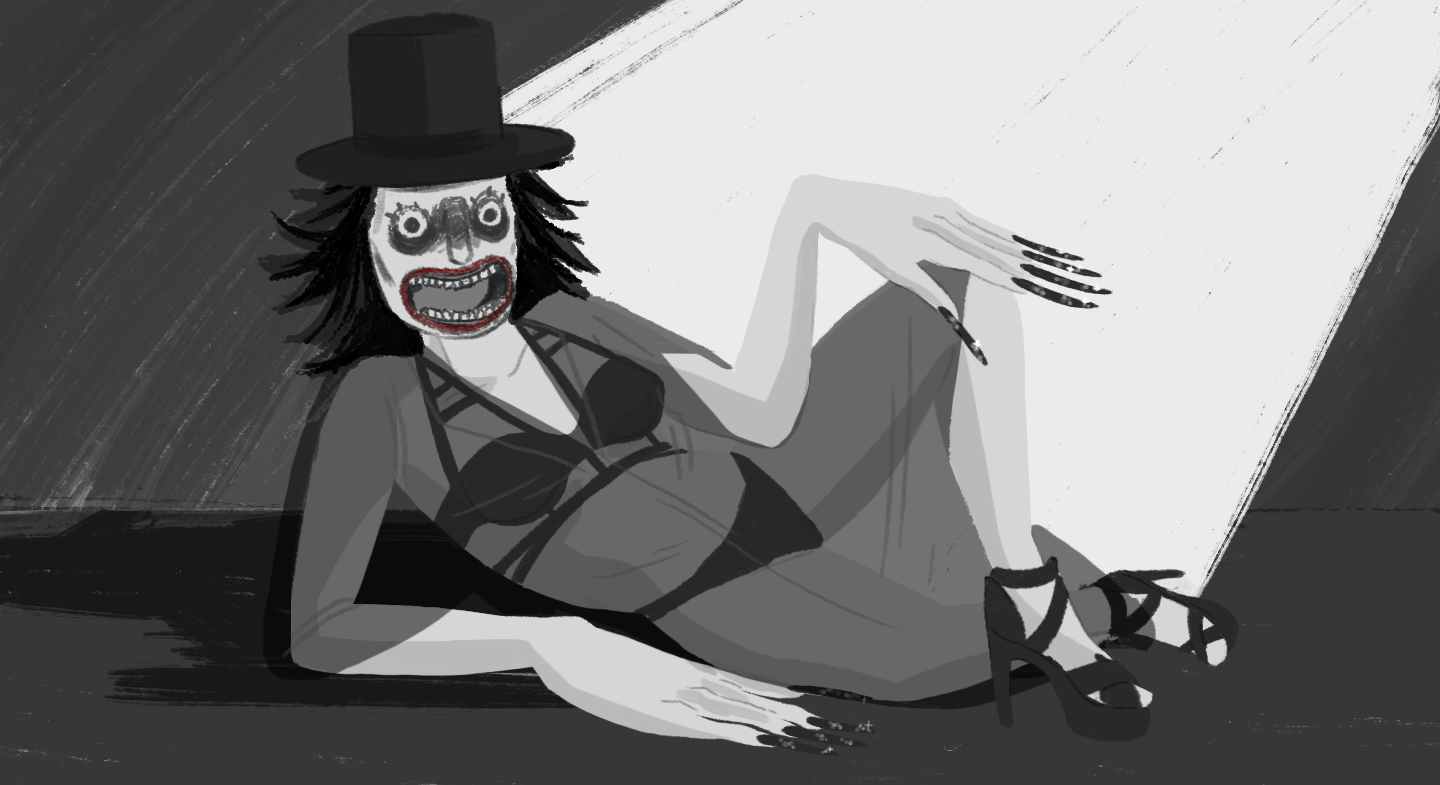
The Babadook is obviously an assigned-male-at-birth individual and yet, unlike other male-type horror-antagonists that are often hulking and brutal, the Babadook is slender and feminine. Rex wasn't comfortable gendering the Babadook because she (that's right) is clearly gender-non-conforming, and falls somewhere on the spectrum between male femininity and non-binary, or trans-femme identity.

She's just like, slithering across the ceiling.

"What I like about the Babadook is there's nothing super-imposing about her," Rex says, giving in to the desire to assign feminine pronouns to the Babadook. "She's just like, slithering across the ceiling. It's just like this top-hat-wearing, grinning thing." Rex, and lots of people, feel that the being itself isn't exactly scary. In the film, it ultimately comes across as a metaphor for the mother's emotional struggles, which just make it even more gay.

"It's just like an off showgirl," Rex muses. "The whole metaphor of it is like, the [mother's] struggle within to finally realize her truth, and like once she does—the Babadook goes away." Rex feels that Babadook is basically the mother's inner goth demon, her "dark, drag persona."

It just so happens that Rex's friend—the woman he was discussing The Babadook with—is also a film critic. "I obviously did not get a queer reading out of the movie when I first saw it, but I do plan on rewatching it with that in mind," Kristen told Broadly. "I suspect it's the combination of him being a dapper dresser (The Babadook is kind of hot, right??) and the 'dook' in his name rhyming with 'look'/'lewk.' Anyway, consider me... babashewk... at this whole thing."

For More Stories Like This, Sign Up for Our Newsletter

LGBTHanSolo feels that the Babadook has been embraced by LGBT people "like any other meme." She explained one circulating origin theory: that the Babadook "became a meme more specifically for the LGBT community because of Netflix placing the film in the LGBT category of their movies."

While the film isn't listed under Netflix's LGBT films, many still say the "B" in LGBT actually stands for "Babadook."

Rex remarked on the way the Babadook "slithered" across the ceiling and jumped around smiling. That's how he'd be if he were a horror monster, he said. "The Babadook's first scare prop is a very heavily illustrated pop-up book," Rex told me, widening his eyes in amazement, emphasizing how obvious it is that the Babadook is queer. "If using art to scare people isn't queer as hell, then what is?"

09 Jun 08:05

Fargo Remains The Best, Most Inexplicable Show On TV

by Patrick Redford

The three seasons of Fargo do not share any of the same characters, timelines, or even locales. The show’s anthology drama allows it to pull in talent like Ted Danson and Billy Bob Thornton for a single season, and what it lacks in the sort of continuity that sustains any long-running TV show, it makes up for in…

Read more...

09 Jun 00:10

Women Are Having Their First Orgasms Earlier Than Ever

by Debby Herbenick

I get asked about orgasms at least once a week—that's just life as a sex researcher for you. Considering how fleeting the actual experience really is—most times, an orgasm lasts just 10 to 20 seconds—I've always found it interesting how much achieving one matters to people. After all, orgasms are just one way that people judge whether a sexual experience was satisfying. But just because orgasms are fleeting doesn't mean there isn't a lot for researchers like me to dig into. Countless studies have been done on orgasms—like who is having the most of them, the weird things that happen after we have them, and yes, how to increase the odds that you have many, many more, if that's what you're after. Here are a few of the most significant—and surprising—things I wish I could explain to everyone who asks.

(Side note: Although most women are females and most men are males, we understand that gender and sex don't always line up. That said, we use the terms "women" and "men" in this article because they best reflect the participants in the studies, who are usually just described as such—meaning, there's no indication how many were cisgendered, transgendered, etc.)

Orgasms aren't just about sex.
Several years ago, a colleague and I published research on exercise-induced orgasm (also known as "coregasm"). We had no idea we were opening ourselves to hundreds of emails from people around the world who, like our study participants, had experienced orgasms while doing crunches, leg lifts, pull-ups, and other exercises that tax the core abdominal muscles. Through subsequent studies, we found that as many as 10 percent of American women and men experience coregasms—though fewer people experience them often. (They're usually rare events.) I also found that, through learning to exercise in certain ways (check out my book The Coregasm Workout if you're curious), most women in our study were able to learn to enhance sexual arousal while exercising.

Women are having their first orgasms earlier than ever.
In a national study of more than 1300 Swedish women, researchers found that women who were 18 to 34 years old at the time of the survey reported having their first orgasm, on average, at the age of 16. And the oldest women in the study were 19, on average. Why such a large difference? Partly because nearly half of younger women now have their first orgasms during masturbation, rather than waiting until they're sexually active with a partner.

Men are often more focused on the clock than their partners.
I was thrilled when, in 2013, a study was published on Belgian men who ejaculate prematurely. The reason I was thrilled was because the study found that the men were not only more distressed about having PE than their partners were, but the they also overestimated their partners' distress. At the time, I had been teaching a human sexuality class at Indiana University for about a decade and—countless times—had found myself reassuring men that PE was not the dealbreaker they thought it was.

In fact, I'd heard from many girlfriends, boyfriends, and spouses of men that they were rarely bothered by it—if anything, their sex lives were more often impacted by a guy shutting down or ruminating after coming quickly, rather than moving on and continuing to enjoy sex in any number of ways. So if you're one of the many guys who comes faster than he'd like (estimates range from 20-30 percent of men at any given time), try to remember that sex is about more than when you come. Also, there are many roads to achieving orgasm that have nothing to do with an erection—oral sex, hand and finger stimulation, sex toy play, and so on.

Gender affirming surgeries have come a long way.
As the number of these procedures has increased in recent years, so has attention to long-term outcomes of genital surgeries for trans people. A recent study by researchers at Karolinska University in Sweden followed trans women up to five years post-surgery and found that the vast majority of them were orgasmic, satisfied with the surgery, and experienced little to no pain. Given the challenges in creating a clitoris from genital tissue (often the glans penis), research continues—for example, a recent study examined whether the size or location of the newly developed clitoris mattered. In this preliminary study, clitoral size didn't seem to matter as much as proximity to the vagina when it came to improving sexual function.

Clitoral stimulation is queen.
Although many women orgasm from vaginal penetration alone, during sex, or sex toy play with partners, studies in Sweden as well as here in the United States have found that women more often stimulate just their clitoris during solo time. If you have sex with women, you might take a cue and ask yourself whether you include clitoral stimulation in your sex play together and, if not, why not? Some women avoid clitoral stimulation with a partner if that person is too rough with their clitoris—so ask her to show you what she likes, or start out more gently. You might also check out the touch-interactive site OMGYes where you can practice techniques on-screen. (Full disclosure: I've conducted research with their team).


Watch More From TONIC: The Truvada Revolution


Sexual orientation can affect how you orgasm.
In a recent US probability survey, researchers from the Medical College of Wisconsin and Duke University School of Medicine found no significant differences in the ability to achieve orgasm among heterosexual, gay, or bisexual men. But they did find slightly less pleasure associated with orgasm for gay and bi guys when compared to straight women. While there were no differences in reported levels of pleasure between women of different sexual orientations, lesbian women did have higher scores on a measure of orgasm ability compared to straight women—but not more so than bisexual women. Achieving orgasm, of course, is about more than your identity—the kinds of sex a person has, how aroused they feel, and how much they desire the sex they're having all contribute in much more significant ways to feelings of pleasure and satisfaction.

The mind matters.
Sex educators often say that the mind is a person's "biggest sex organ"—and for good reason. Study after study shows that everything from mindfulness to greater education (including sex ed) to our everyday thoughts about our bodies and fears of failure and general sexiness can contribute to our orgasmic potential. Sex is part of a bigger whole that's influenced by stress, relaxation, sleep, diet, exercise, and being able to stay focused in the present on sights, sounds, scents, and tastes. Stay open to that, and you'll likely open yourself to greater pleasures—and more orgasms.

Debby Herbenick, PhD, is the director of the Center for Sexual Health Promotion at Indiana University and a research fellow at the Kinsey Institute. She is also the author of several books, including The Coregasm Workout and Great in Bed.

Read This Next: I Asked Experts to Explain Why I Orgasm When I Work Out

09 Jun 00:06

Race for the Galaxy updates, comes to PC on June 27

by David Neumann

iOS, Android, PC •

If you asked me my pick for Game of the Year on May 2, I would have had a hard time narrowing it down. Let’s face it, 2017 has been a pretty great year for mobile apps with releases like Onirim, Card Thief, and Warlock of Firetop Mountain just to name a few. On May 3rd, however, Race for the Galaxy landed on the App Store and I can honestly say that I haven’t played another mobile title this much in a long, long time. It’s nearly perfect in just about every way and the few remaining issues are on Temple Gate‘s radar. In fact, they plan on having them all cleaned up on June 27.

June 27 is when the PC version of RftG will launch, and it will bring with it a host of updates, the likes of which fans have been hoping for since launch. The first major update is cross-linking of accounts across all platforms. Currently, you have a different ID for your tablet and phone, meaning I can start a game on my tablet but cannot play in that game on another device. No longer. Now you’ll be able to continue those multiplayer games on whatever device you have handy.

Also making multiplayer better will be the addition of timers in online games. As everyone I’m currently playing can attest, I’m the slowest damn player out there. My excuse is that I started all those games on my iPad and just don’t have my iPad with me very often. That’s mostly true, but I’m also a procrastinator and timers will force me to play or lose.

Another addition that will make gamers happy is the inclusion of stats. What stats? No idea! Hopefully it’s more than just wins/losses and can include some information about what expansions/variants are included. Maybe even include which Home World you started with? Maybe! We just don’t know at this point, but any stats are better than the lack of stats we currently have.

No word on pricing for the Steam version yet, either, but we’ll find that out together when it launches on the 27th.


08 Jun 23:56

La Cruzada de los Inocentes 1

by Rubén Merino
 
Cruzada_Inocentes_1_Furuya

Edición original: インノサン少年十字軍 (Innocents Shōnen Jūjigun), Ohta Shuppan 2008.
Edición nacional/ España: ECC Ediciones 2017.
Guión: Usamaru Furuya.
Dibujo: Usamaru Furuya.
Formato: Tomo manga rústica con sobrecubierta 288 páginas.
Precio: 11,95€.


No es algo poco habitual que los mangas se inspiren o sitúen sus tramas en épocas históricas. Tenemos muchos ejemplos como la piratería, la Revolución Francesa, la era del Imperio Romano, la de los vikingos, el Lejano Oeste o incluso un costumbrismo más contemporáneo o el corte futurista. No obstante, es cierto que hay determinadas épocas y contextos históricos que parecen siempre olvidados o que no terminan de encajar con la propuesta que acompaña al cómic japonés. Uno de ellos es el período medieval, y más concretamente, el período de las Cruzadas que comenzaron en el siglo XI. Quizá por la lejanía de los hechos y de los términos culturales y religioso que las conformaron, los autores nipones no se han embarcado en historias que involucren esa violenta época de la historia, por lo que choca ver un manga ambientado en una peregrinación de este tipo a Tierra Santa. Y sorprende más aun que haya sido Usamaru Furuya el mangaka que haya decidido dar el paso y traernos una historia de leyenda que se aleja por mucho del tipo de obras a los que nos tiene acostumbrados. Así es La Cruzada de los Inocentes, un manga sorprendente y peculiar.

Comencemos por dar a conocer un poco a su autor. Usamaru Furuya (Tokyo, 1968) es uno de los mangakas más reconocidos, con una sólida trayectoria desde mediados de los años 90. Graduado en la Tama Art University, durante su período escolar se apunto al Curso de Manga por Correspondencia de Osamu Tezuka, y comenzó a desarrollar un estilo oscuro y underground, que tras su paso por la universidad terminaría de convertirse en algo experimental y basado en cierto grado de abstracción. En el año 1994 publica su primera serie, Palepoli, y pese a que su intención inicial era dedicarse al mundo de la ilustración artística, el éxito del manga le decide a llevar su carrera por los derroteros que hoy día conocemos. Desde entonces se ha forjado una prolífica carrera gracias a un estilo propio en el arte y en la temática, con multitud de obras, entre las que destacan El Club del Suicidio, Happiness, Litchi Hikari Club, Genkaku Picasso, 51 maneras de proteger a tu novia o Autoasasinofilia. Las obras de Furuya destacan por su inventiva y por su maravilloso arte, con una tremenda personalidad, así como por las ambientaciones y temáticas de sus historias y la amplia libertad que se toma en su tratamiento, sin dejarse coartar por ser políticamente correcto. Es habitual encontrar en su producción un buen puñado de obras con ambientes malsanos, recurriendo a temas tabú como el sexo, la perversión, la maldad humana…, rizando el rizo con la inclusión en numerosas ocasiones de personajes jóvenes, incluso niños.

Cruzada_Inocentes_1_1

Curiosamente, La Cruzada de los Inocentes tiene como protagonistas a un grupo de niños, y aunque el tratamiento que Furuya utiliza aquí está mucho más volcado al aspecto histórico, de fábula y leyenda, bien es cierto que ciertos temas escabrosos se dejan asomar en mayor o menor medida a lo largo de los capítulos. Este título, como dijimos, tomo como contexto el año 1212, una fecha enmarcada dentro de ese período que tiene a las Cruzadas hacia Jerusalén como elemento caracterizador. La Cruzada de los Inocentes usa como base argumental un conjunto de leyendas reales acaecidas en Europa tras la Cuarta Cruzada y que se reconocen por tener varias características troncales en sus relatos. En todas ellas hay visiones de un muchacho (habitualmente francés o alemán), tienen un interés en propagar la necesidad de la conversión pacífica de los musulmanes al cristianismo, un grupo de niños que marcha hacia el Sur de Europa tras formas una comunidad y la venta de niños como esclavos. Todas las historias que formaron el germen de la leyenda de esta Cruzada tienen esos elementos que dieron lugar a la leyenda definitiva que inspiró a Furuya en su relato.

Ningún historiador da veracidad total a la leyenda de la Cruzada de los Niños, una fábula que narra la formación de grupos de infantes en Francia o Alemania, con uno de ellos reconocido como una especie de enviado de Dios, que peregrinan hacia Jerusalén para propagar el cristianismo y recuperar Tierra Santa y que dio lugar a posteriores historias conocidas por todos, como el cuento de El Flautista de Hamelín o diversas obras de autores como Beauvais o Roger Bacon, e incluso algunas más recientes como La Cruzada de los Niños de Neil Gaiman. Furuya cogió todos estos elementos, y pese a incluirlos en una trama que sigue estando narrada a forma de fábula, los adapta a su estilo, y los utiliza para remarcar ciertos aspectos humanos interesantes que sirven para realizar un análisis de lo que probablemente ocurrió en realidad con esos grupos de niños que abandonaban sus vidas y su familia porque la voz de Dios les enviaba a peregrinar.

Cruzada_Inocentes_1_2

La Cruzada de los Inocentes narra la historia de un grupo de 12 niños de un pueblo del norte de Francia en el 1212. La vida europea en esos momentos estaba tremendamente marcada por la religión en todos los aspectos posibles y muchos de los niños veían en la Iglesia, las Cruzadas o en la Hermandad del Temple una posible salida durante su vida adulta. El protagonista principal del relato es Étienne, un niño tremendamente bondadoso de ese pueblo que un día encuentra una misteriosa corneta supuestamente enviada por Jesucristo con la que puede obrar milagros. Lo que en un principio comienza como un hecho aislado, al salvar a su pueblo del ataque de unos bandidos, pronto se va convirtiendo en un fenómeno de masas, ya que la gente comienza a considerarle un enviado de Dios. Étienne se ve abrumado por ese reconocimiento, pero al juntarse con un grupo de niños del pueblo que tienen el sueño de marchar a Jerusalén recibe una epifanía que le convence de que tiene que liderarlos hasta Tierra Santa con el fin de cumplir la voluntad de Dios y salvar el mundo a través del cristianismo. De esta manera se forma un grupo de 12 niños que, a modo de apóstoles, siguen a su Jesucristo particular, el pequeño Étienne.

El asunto comienza a volverse cada vez más y más grande, ya que Étienne comienza a llevar a cabo más milagros en los pueblos por los que va pasando con su pequeño ejército de compañeros, hasta el punto que llega a oídos de Hugo, un importante caballero templario que pretende utilizar la cruzada infantil en su beneficio. En un primer momento tan solo les inviste como caballeros con la promesa de permitirles ser miembros de pleno derecho del Temple si su misión en Jerusalén tiene éxito, pero poco a poco podremos ver como oculta unas intenciones menos altruistas. Pese a ello, el grupo de niños sigue avanzando y reuniendo más adeptos, gracias a las habilidades de Étienne, hasta el punto de formar un verdadero ejército de niños entre 8 y 14 años que avanzan lenta, pero inexorablemente, a intentar recuperar la ciudad santa de manos de los infieles.

Cruzada_Inocentes_1_3

Como ya hemos dicho, la mayor parte de la historia está narrada a modo de fábula, de leyenda, con un narrador que pone al lector en situación ante los hechos que lee y las acciones de los personajes que van desde las partes más espirituales y religiosas, hasta tramos con epicidad y cierta dosis de humor. Sin embargo la mano de Furuya está siempre presente, y se puede ver en la manera de presentarnos la Cruzada y ciertos elementos críticos con lo mismo que nos cuenta. Desde este punto de vista, el autor hace una crítica al altruismo de la religión y a sus virtudes, a la hipocresía de la misma y su falta de escrúpulos a la hora de utilizar cualquier método para lograr sus propósitos. Alude a no dejarnos llevar por las apariencias, con personajes socialmente respetables que se convierten en auténticos depravados y personajes con penosa reputación que resultan tener un corazón enorme. Tiene también una alta dosis de violencia y ciertos temas realmente escabrosos, sobre todo teniendo en cuenta que hablamos de niños de una media de 12 años de edad entrenando con espadas, peleando, visitando burdeles… Todo ello unido a ciertas escenas típicas y necesarias en una obra ambientada en esta época, como la quema de infieles o castigos físicos para los que se desvían del camino marcado por la Iglesia.

Viendo la obra de manera superficial nos puede parecer una ida de olla de Furuya, una locura motivada por su gusto por este período histórico y por la leyenda de la Cruzada de los Niños. Sin embargo, si se mira en perspectiva, el mangaka utiliza su talento y su medio para, por un lado darnos a conocer esa historia interesante y curiosa, y por otro, a dejar caer su opinión sobre los temas que trata, mismamente por la consideración propagandística que le da a la historia en muchos aspectos, y que se personifica en el personaje de Hugo. En el fondo La Cruzada de los Inocentes va más allá de ser una historia atractiva, que sin duda lo es, sino que también sirve en cierta manera de crónica de una época en la que los poderosos se aprovechan de la gente menos versada y sus buenas intenciones, algo que sigue ocurriendo sin duda. La obra no es un ensayo sobre esto, evidentemente, es un manga con un ritmo narrativo fluido, que incluso en ocasiones se hace demasiado rápido y que por encima de todo entretiene. Pero siempre es bueno que pese a que una serie no tenga pretensiones aleccionadoras o profundas, que haya detalles que permitan al lector extraer algo más que el ser un producto para mantenerte un tiempo pegado a sus páginas.

Cruzada_Inocentes_1_4

Si en el aspecto narrativo y formal hemos visto que se aleja del estilo habitual de Furuya pero que a la vez mantiene retazos que permiten ver al autor en sus páginas, lo mismo ocurre en la parte artística. La Cruzada de los Inocentes tiene un estilo que se aleja de la abstracción, lo oscuro y lo underground, deja lo experimental para adoptar un estilo más clásico en su concepción y ejecución. Pese a que hay destellos en ciertos momentos, como las splash pages o ciertas escenas a las que dota de un gran dinamismo y visceralidad, la maravilla gráfica que suele definir a Furuya no se encuentra presente en esta obra. Es por ello que los diseños destacan menos que en otras ocasiones, y lo clásico de los fondos, y también de la historia con la que se integran, provocan que ciertos elementos se afeen y no brillen o generen un contraste adecuado. Pese a ello, el trazo del mangaka es de una gran calidad y destaca ante todo en la creación de personajes, a los que dota individualmente de una personalidad propia tanto a nivel argumental como, en este caso, artístico.

Personajes

Cruzada_Inocentes_ÉtienneÉtienne. El protagonista principal de la historia, el niño que hace milagros y líder espiritual y moral del grupo de niños. Étienne vive con su madre en un pequeño pueblo del norte francés y un día recibe una revelación por parte de Jesucristo, el cual le envía una carta en la que le pide que peregrine hasta Jerusalén para recuperarla e inspirar al mundo, y una corneta que le otorga la capacidad de hacer milagros. En ese mismo momento su pelo se vuelve blanco y sus ojos azules, características que desde entonces mantiene durante todo el tomo. Es el más bondadoso y altruista del grupo, pero soporta una pesada carga y llega un momento en el que se debate si está haciendo o no lo correcto por el miedo de en qué pueden convertirse sus compañeros, especialmente Nicolas, su mejor amigo.
Cruzada_Inocentes_NicolasNicolas. Es el mejor amigo de Étienne. Huérfano que vive con sus tíos, sueña con convertirse algún día en caballero templario y viajar a Tierra Santa para matar infieles y vengar así la muerte de su padre, que asistió a la Cuarta Cruzada. Pese a tener buen corazón, su ansia de venganza y reconocimiento le llevan a dejarse embaucar por Hugo, que le nombra comandante, un título que define a su herramienta para reclutar niños con la malvada intención de formar un ejército que riegue los campos con la sangre de los infieles. Según pasa el tomo se va volviendo más duro e inflexible, hasta el punto de crear un código de conducta muy férreo para sus propios amigos.
Cruzada_Inocentes_ChristianChristian. El intelectual del grupo. Hijo de una familia de comerciantes, es el único capaz de leer y escribir. Escéptico y no excesivamente religioso, suele poner en duda muchas de las decisiones tomadas, aunque tiene fe ciega en Étienne. Choca en varias ocasiones con Michael y es el personaje que más deja ver la hipocresía y la falta de escrúpulos de la religión y el negocio de la fe.
Cruzada_Inocentes_HenriHenri. Otro de los niños del pueblo. Henri es un muchacho que sufre un cierto acoso por parte de sus vecinos debido a su apariencia y actitud frágil, hecho por el que le conocen como llorón. Sin embargo posee una decisión inquebrantable y se apunta a la peregrinación con el objetivo de demostrarse a sí mismo y a los demás, que él no es ningún llorón, siendo el mayor representante del espíritu de superación.
Cruzada_Inocentes_LucLuc. Es el mayor de los niños, en edad y en estatura. No hay mucho que contar de Luc, es la típica persona que siempre está, pero que no destaca demasiado, aunque tiene muy buena mano con los niños más pequeños y parece el más serio y tranquilo de todos. Es muy habitual verle con Marc y Laurent controlando a la parte de atrás del “rebaño” de niños que siguen a Étienne.
Cruzada_Inocentes_MarcMarc. El humorista del grupo, siempre acompañado de su marioneta llamada Leonardo, que utiliza tanto para hacer sus bromas como si fuese un muñeco de ventrílocuo, como para decir cosas que por sí mismo no se atreve a decir. El contrapunto de humor de la obra gracias a los problemas que tiene con los más pequeños de la historia.
Cruzada_Inocentes_RemyRemy. Remy es un niño enfermo de lepra, y como tal es repudiado por todos hasta que Étienne le tiende una mano y le permite unirse en su peregrinación. Pese a su enfermedad, Remy tiene una visión muy optimista y vital de la existencia y es uno de los miembros más confiables del grupo. Además, su diseño es realmente genial.
Cruzada_Inocentes_LaurentLaurent. El hermano mayor de Lilian. Mantiene una conexión telepática con su gemelo que les permite comunicarse e intuir que le ocurre al otro aun a distancia. Muy amigo de Marc y Luc, es el principal encargado de ocuparse de la parte de atrás de la enorme columna de peregrinos que termina conformando la Cruzada de Niños.
Cruzada_Inocentes_LilianLilian. El hermano pequeño de Laurent. Tiene envidia de su gemelo y su principal objetivo en la vida es quedar por encima de él, sobre todo en cuanto a madurez. Eso hace que tome decisiones muy equivocadas y se una a Guillaume y Pierre en una serie de actividades de dudosa ética que acabará trayendo consecuencias para todos.
Cruzada_Inocentes_GuillaumeGuillaume. Hijo de uno de los mandamases del pueblo, Guillaume es el típico niño rico que se cree con derecho a todo por su ascendencia. Actúa siempre como si estuviese por encima del bien y del mal y se une a la Cruzada por insistencia de sus padres, ante el valor propagandístico que dicha campaña tendría para su familia. En el fondo es muy miedoso e inseguro y de ahí proviene su actitud ante los demás.
Cruzada_Inocentes_PierrePierre. Comparte punto por punto la biografía de Guillaume, pero en su caso prefiere el papel de subalterno, en lugar de ser el cabecilla, de los hechos amorales que comete el trío que conforma con el propio Guillaume y Lilian. Junto con sus dos compañeros de fechorías, prueban en sus propias carnes los castigos que Nicolas idea con el objetivo de dirigir con mano férrea la Cruzada.
Cruzada_Inocentes_GuyGuy. Miembro del grupo de bandidos que atacó el pueblo de Étienne al comienzo del tomo. Es capturado y linchado por los habitantes del lugar sin que sus compañeros de banda acudan en su auxilio en ningún momento. Vive con un profundo arrepentimiento por los pecados que ha cometido a lo largo de su vida y se embarca en la Cruzada buscando la expiación. Es uno de los miembros más valiosos del grupo, por su experiencia con armas y de viaje y por su devoción a Étienne y sus apóstoles, a los que considera familia.
Cruzada_Inocentes_MichaelMichael. Michael es un muchacho de apariencia andrógina que vive en un monasterio hasta la llegada de Étienne y sus apóstoles, a cuyo servicio le pone su superior de manera inmediata. Desde ese momento actuará como consejero moral y de fe de Étienne, aunque debido a su religiosidad es bastante parcial a la hora de tomar decisiones y se deja cegar demasiado por los dogmas religiosos. Posee una prodigiosa voz.
Cruzada_Inocentes_HugoHugo. Importante caballero templario que actúa como valedor y carta de presentación de los niños en la mayoría de los pueblos que visitan. Aunque sus intenciones parecen ser buenas y quiere ayudar a los muchachos a expandir la palabra de Dios y a ofrecer todo su apoyo en su difícil tarea, Hugo esconde mucho en su interior, y manipula a Nicolas con el objetivo de formar un ejército y un arma propagandística en el beneficio de la Orden del Temple.
08 Jun 13:25

Carlitos Fax

by Raúl Silvestre


Edición nacional / España: Carlitos Fax, mayo 2017, ¡Caramba!, Astiberri Ediciones.
Guión, dibujo, tinta y color: Albert Monteys.
Formato: 176 páginas a color editadas en cartoné en tela.
Precio: 22 €.


Albert Monteys es una debilidad. Ergo, esta reseña va a ser poco imparcial, aunque dudo mucho que el catalán sea un autor que genere rechazo. No conozco a nadie que, en cuanto lo conoce, no se deje llevar por su trazo. Monteys parece haber nacido con un lápiz en la mano, pues ya con rapidez sus líneas redondas y su domino del espacio se hicieron evidentes en obras primerizas. Es un consumado profesional, al tiempo, capaz de adaptar su estilo al género que toca, con un imán para el humor que le ha llevado durante años a dejar su impronta en revistas satíricas como El Jueves u Orgullo y Satisfacción. Profesional, como digo, recibió el encargo de llenar páginas de Mister K, revista para niños que lamentablemente fue perdiendo el favor del público, lo que llevó a su cancelación. Pero eso no es siempre sinónimo de la calidad del producto y la revista vio obras de evidente interés, como este Carlitos Fax. ¿Quién es Carlitos? Un obsoleto fax que trata de encontrar su hueco en la redacción de un periódico en un futuro que mucho parece nuestro caótico presente.

Vale, entonces estamos en un tebeo pensado para niños. Tramas sencillas de tres o cuatro páginas, humor blanco y acción sin parar. No parece el panorama para hacer algo más que un entretenimiento. Y quizá sea así, pero no cabe duda que Monteys es más listo que el hambre, dando zarpazos de sátira de ciencia-ficción digamos, seria. Si esta sirve para explicar el presente mirando al futuro, Monteys desarrolla sus tramas poniendo el ojo en las costumbres y los modos del ahora, y quizá del siempre: el egocentrismo, la envidia, las carencias de la prensa, la necesidad de estar conectado… Vamos, el mundo como caldo de cultivo para hacer las cosas de la risa, sí, pero acompañado de un dardo. De este modo, el chaval puede divertirse con el universo retrofuturista que plantea Carlitos Fax, hermoso y brillante, sin aristas ni dobles sentidos, con ese aire a lo vieja escuela francobelga, ese sabor sencillo de dulce comedia, mientras el adulto recibe el mensaje. Y por eso su lectura se convierte en algo tan agradable. No hay cinismo ni necesidad de apabullar. Hay sátira, sí, pero envuelta con cariño. Como un chiste al que acompañan con un doble guiño.

Todo vestido por el eficaz trazo de Monteys, que bebe, como digo, de toda la escuela de línea clara y la Bruguera, en un combinado que no solo no emborracha, sino que borra la resaca.

¡Caramba! edita un integral con todas las páginas del personaje aparecidas en la citada revista para solaz de sus seguidores. Y qué rico, mamita. Formato álbum, tapa dura, buen papel y qué olor, señora. Una delicia en forma y fondo, de modo que ya puedes ir sacando tu billetera. Dale un tiento, que no todo van a ser luchas, disparos y culos.

08 Jun 13:24

Intenté usar un Fidget Spinner como juguete sexual

by Maria Yagoda

No tengo excusa para haberme perdido la fiebre por el Fidget Spinner, pero me la he perdido. Vi los titulares, las noticias con el volumen apagado en el gimnasio, los chistes que hacían sobre él en Twitter los tíos que me gustan, pero no tenía energía emocional para hacer un hueco en mi cerebro y asimilar otra cosa repentinamente súper popular. Sin embargo, cuando mi editora me preguntó si probaría a usar uno ―"si existe algún modo de usar uno"― como juguete sexual, accedí de inmediato, porque mis abuelos están muertos y mis padres han llegado a aceptar con cierta melancolía lo que hago.

Antes de introducir un Fidget Spinner en mi vagina, no obstante, tenía que descubrir qué era. Como me habían dicho que podría encontrarlos prácticamente en cualquier sitio donde vendieran mierdas, deambulé por las calles y entré en un bazar, en tiendas de chinos, supermercados e incluso en una tienda de material de oficina, preguntando: "¿Tenéis Fidget Spinners?" y después haciendo un gesto con los dedos como si usara uno. Dado que todavía no sabía realmente qué eran, mi gesto fue como si hiciera girar y arrojara una masa de pizza al aire. Finalmente encontré una tienda de chinos en la que les quedaban tres de color verde fosforito. El cajero sonrió cuando se lo entregué, como si supiera que lo compraba para usarlo en mis genitales.

Cuando llegué a casa, me fui directa a YouTube y busqué "cómo utilizar un Fidget Spinner". Encontré una demostración muy sencilla de cinco minutos de duración subida por Rhine Reviews. Después de 30 segundos me enamoré del hombre que ofrecía el tutorial, aunque solo se le veían las manos: la agilidad de sus dedos, la calma de su voz, la pasión que sentía por algo tan puro como explicar a los demás cómo sacar el mayor partido de su nuevo juguete... ¿Alguna vez en mi vida me interesaré yo por algo de forma tan entusiasta y sincera? "Toca la parte superior así y después intenta hacerlo girar. No hace falta aplicar demasiado impulso ni demasiada fuerza, lo que hay que hacer es...". FSSSSS.

Cuando pillé el truco de cómo hacer girar el objeto de plástico con tres prolongaciones que tenía entre los dedos, llegó la parte complicada de verdad: dilucidar qué papel iba a desempeñar en mi orgasmo. Una vez que lo haces girar, gira durante bastante tiempo. ¿Quizá suficiente tiempo como para algo excitante? Ya me había ocupado de la parte de la excitación sexual gracias al vídeo del tutorial, pero sabía que necesitaba lubricación. Abrí un frasco de gel lubricante transparente que había recibido hace poco y que promete "seducir tus sentidos" y "despertar tus deseos más íntimos". Perfecto. Limpié el juguete en profundidad, encendí unas velas, apliqué el líquido y puse "Conceited (There's Sometyhing About Remy)", de Remy Ma.

Hice girar el Spinner y lo dirigí hacia mi vagina. Por desgracia, cuando tocas el artilugio aunque sea de forma delicada, ya sea con los dedos o con los labios vaginales, deja de girar, así que en el momento en que los brazos del Spinner me tocaron, su cualidad teóricamente placentera desapareció y me quedé sosteniendo una pieza de plástico junto a mi vulva, preguntándome por qué me molestaría siquiera en asistir a clase de física aplicada en el instituto. Intenté acercarme el chisme girando de forma todavía más delicada, con cierto éxito: siguió girando dos segundos antes de ralentizarse y esos segundos fueron bastante buenos (por supuesto, acercarme el centro del Spinner no me hizo nada, porque esa parte no se mueve. Además, tuve que abrir las piernas muchísimo para no obstruir el giro de los brazos y eso me parece demasiado esfuerzo. Si el aparato fuera mecánico ―y siguiera girando sin tener que darle impulso extra con los dedos― la sensación sería espectacular. Desgraciadamente, cuando llegué a la parte de la canción que dice "Vale, me he puesto un poco gorda / Pero mi novio dice que le gusto así", tiré la toalla y agarré un vibrador de verdad.

Si has leído hasta aquí, probablemente querrás saber si cabe una polla en él. O quizá has llegado hasta esta parte sin pensar si cabe una polla en él. La respuesta sencilla es no, aunque imagino que un micropene o un pene estándar pequeño podría introducirse en una de las hendiduras circulares, si tu pareja y tú quisierais hacerlo, por el motivo que fuera. (QUIZÁ podrías poner tres penes muy pequeños en los tres orificios al mismo tiempo, si los propietarios de dichos penes fueran muy flexibles). Pero si por algún milagro consiguieras introducir pollas en él, dejaría de girar, obviamente, porque los brazos no pueden obstruirse de ninguna manera.

Más tarde se me ocurrió que quizá no había comprado el modelo adecuado. Andaba leyendo historias en Instragram cuando me topé con un post de la destacada influencer Claire Carusillo en el que su novio conseguía hacer girar uno sobre su mejilla. De modo que, en teoría, un divertido truco para sorprender en las fiestas podría ser hacer girar uno sobre un pene erecto particularmente estable. Pero, ¿por qué? Encontré un Fidget Spinner más resistente, pero mis resultados fueron los mismos: el Spinner dejó de girar al cabo de dos segundos cuando entró en contacto con mi vagina.

Hace un par de semanas la gente se echó unas risas en Reddit a costa de un hombre que subió una foto con el comentario "he encontrado el Fidget Spinner de mi mujer". Estaba sosteniendo el vibrador triple de Trojan, que en cierto modo tiene el aspecto de uno de esos chismes. Señoras, sigan usando los primeros, por favor. Aunque no puedo detener a los cientos de personas que probablemente ya se han metido Fidget Spinners por el culo. ¿Quizá eso dé placer? Permaneced atentas al próximo artí.... No, no pienso probar eso.

08 Jun 00:22

Guy makes a solid bronze axe, includes video where the axe falls and slices his legs open

by Mark Frauenfelder

This is an interesting 13 minute video about making a mold from a regural axe and casting a new axe in bronze. Around 10:30 into the video, the axe falls and slices the guy's leg open. For some reason, the guy doesn't mention this at all in the YouTube description, so it comes as a surprise.

And now I want an angle grinder.

07 Jun 09:38

Numaru: unha nova taberna coreana en Compostela

by magago

Duruchigi da taberna Numaru

O outro día comentáballe a un amigo a traxectoria posible de moitos pequenos negocios de restauración en Compostela: pode pasarse perfectamente de que no mesmo local se faga fusión nipogalaica a que un par de anos despois a carta sexa un pizarriño á porta cunha lista de #raxozorzaempanada estándar garabateada con xis. O #raxozorza parece ao final o destino natural de calquera iniciativa hosteleira. Poñer en Compostela un restaurante de cociña internacional é un auténtico deporte de risco do que só teñen sobrevivido con garantías os chineses.

A nova moda da cociña asiática (en realidade, xaponesa) parece que, sen embargo, rompeu esta tendencia. Hoxendía en Compostela hai alomenos cinco negocios que ofrecen esa parte da cociña xaponesa que é o sushi/sashimi, con maiores ou menores visos de autenticidade. Faltaban, sen embargo, comidas do sudeste asiático, cociñas que teñen unha personalidade propia dentro do riquísimo panorama e repertorio gastronómico oriental. E, aínda que non é propiamente a zona, vou encaixar a Corea nesta oferta. Na casa somos fans declarados de toda a cociña asiática.


Empanadillas

Así que o outro día, cando o gran Snob Megalove anunciou no seu twitter a apertura deste bar tardamos apenas nada en ir a ver que se cocía nun sitio tan atípico para a restauración como a avenida Mestre Mateo.


Bibimpap. Foto: Sole Felloza

A Taberna Numaru ten unha historia persoal detrás. Atópase na Avenida Mestre Mateo, nas proximidades da rotonda con Romero Donallo, un pouco máis abaixo do ximnasio e case fronte a entrada do Campus Sur. Rexéntaa un mozo chamado Yum, que fai de camareiro, e a súa muller, que leva a pequena cociña. O local está decorado ao estilo occidental e só Yum te dá idea, en teoría, de que algo é un pouco diferente. Yum vivía en Madrid. Tras facer tres veces -tres- o Camiño de Santiago, Yum decatouse de que os peregrinos coreanos -que hai unha chea deles- botaban moito de menos a súa comida durante toda a peregrinación, así que pensou en crear un local para que se deran unha pequena homenaxe ao finalizar o Camiño en Compostela. O resultado é unha taberna de platos coreanos asequibles, con catro opcións de menú ao mediodía (ramen, bibimpap (tenreira e verduras), Duruchigi (porco marinado e verdura), Bulgogi (tenreira marianada con boniato). O menú acompáñase con sopa, preve e kimchi (a col chinesa marinada), en racións galegas. Pola noite, sírvese unicamente churrasco á coreana, e en calquer momento se pode tomar tamén outros petiscos como unhas empanadillas fritidas estilo gyoza ou polo fritido, coidadosamente rebozado, sen fritangada infame.

O Numaru é un bar/taberna, non un restaurante, pero os pratos son todo sabor, os marinados en soia achéganlle á carne un sabor umami e o picante emprégase de maneira feliz. Máis que recomendable e asequible lugar para disfrutar dunha gastronomía compostelá que, cada vez, incorpora máis referencias asiáticas.

07 Jun 09:09

COMUNICADO DA JUNTANZA DOS CENTROS SOCIAIS ANTE O DESPEJO DO ESCÁRNIO

by Gentalha

faixaescarnioHá pouco mais de três anos que abreu o CSOA Escarnio e Maldizer. Desde entom realizarom-se alí grande quantidade de acçons e actividades: obradoiros de teatro, serigrafia, música; aulas de adestramento deportivo, acroioga, judo, boxeo, baile tradicional galego, pandeireta; infinidade de palestras sobre os mais diversos temas; feiras de tatuagens, jornadas libertárias, apresentaçons de livros, revistas, projectos e documentários; projecçons de cinema, representaçons de teatro e artes cénicas variadas, recitais poéticos, concertos de música de todos os estilos… ademais de dispor de unha extensa biblioteca, umha oficina de serigrafía e umha oficina artística, e de ser o local de grande quantidade de colectivos que faziam alí as súas asembleas e actividades.
Todo isto mantendo sempre uns princípios básicos: funcionamento asemblear, toma de decissons por consenso, trabalho voluntário sem ánimo de lucro, portas abertas, actividades sempre de balde, autogestom, cuidados mútuos e um firme compromisso com todas as causas sociais que defenden e procuram a liberdade.
O Escárnio converteu-se num eixo fundamental da vida de Compostela; nom poderiamos obviar as suas aportaçons nos últimos três anos. Os centos de pessoas que por alí passaron som testemunha de este facto.
Há também seis anos que a empresa inmobiliaria A Rosaleda comprou o edifício da Algália. Esta é umha construtora fraudulenta e especuladora. Umha empresa que nom paga às suas trabalhadoras nen às suas provedoras. Umha empresa que é responsável de que muit@s albaneis, carpinteir@s, electricistas, fontaneir@s ou escaiolistas nom cobrem e se atopem na rúa. Responsével de botar à rúa também @s antig@s inquilin@s do edifício a quenes expulsaron sem piedade das suas vivendas, ofertando-lhes umha mistura de ruína e disparatados alugueiros.
O edificio que pouco tempo antes albergara à Asociación Cultural Cantigas e Agarimos apodrecia agora, vazio e sem uso, abandono e ruína á espera dum “pelotazo urbanístico” que enchera as ánsias especulativas da inmobiliaria A Rosaleda. Abandono e ruína financiados, por outra banda, com o dinheiro dos bancos rescatados polo Estado. Estafa geralizada, a urbanística, para a que só as ocupaçons semelham soluçom. Directa ou indirectamente, o edificio da Algalia comprou-se com dinheiro de gente de Compostela. Assím pois, que menos que ter direito a empregar esse espazo?

Com este comunicado queremos solidarizar-nos comas nossas compañeiras.
Há un par de anos que A Gentalha do Pichel, a Asociación Xuvenil Ítaca e o CSA do Sar traballamosconxuntamente com o CSOA Escarnio e Maldizer: Entrudos, Magustos, Dia das Letras, Jogos Populares e mais projectos que tinhamos em mente. Afiançando e artelhando rede. Somos centros sociais que desenvolvemos o nosso trabalho de jeito autogestionado e com trabalho voluntário, com liberdade e independência, sendo honestas com nós mesmas e com vontade de difundir um activismo social e cultural participativo e nom dirigista, sem licenças e um tipo de lazer alternativo ofrecido a todas aquelas pessoas que desejam participar e fazer parte com nós do projectos e actividades. Por este tipo de filosofia e dinámicas dim que as companheiras do Escárnio som perigosas, criminais.
Somos Gentalha, somos Itaca e somos Sar. Se Escarnio é criminal, nós também o somos!
Dende a Juntança de Centros Sociais queremos manifestar o nosso total apoio ao Escárnio; estamos con vós e apoiamos-vos!

Solidarizamo-nos con vós e sentimos a vossa mesma raiba ao ver anos de traballo, esforzos, ilusións e sonhos decapitados de golpe entre bloques de formigom armado e pelotaços de goma.
Partilhamos com vós o desejo de criar espaços libertados, nos que a gente se sinta cómoda e a gusto, libres da violencia cotiá que cada dia nos esmaga. Lugares ceives e rebeldes, onde a gente cria, vive e transforma superando esta realidade. Onde as pessoas poden recuperarse a si mesmas coma pessoas. Que papel, que absurdo réxime jurídico pode negar isso?

Condenamos radicalmente a bestial intervençom da Policia, dos poderes públicos e a difamaçom e mentiras difundidas polos meios de comunicaçom lacaios do sistema. Todo o que podemos dizer sobre o acontecido a nivel repressom e manipulaçom meiática fica curto ante a magnitude do dano causado.

Companheir@s, seguiremos luitando, apoiando e trabalhando na construcçom de espaços de liberdade e de solidariedade. Seguiremos ocupando os coraçons da gente a golpe de autogestom e retiraremos um a un, cada bloque de formigom de cada janela e porta para construír con eles projectos tam dignos e valentes coma o CSOA Escárnio e Maldizer.

C.S. A Gentalha do Pichel – Asociacion Xuvenil Itaca – CSA do SAR

07 Jun 08:36

Oh! Gunquit - New Album "Lightning Likes Me" & Weirdsville Headline Show on June 24th

by Retro Man

Oh! Gunquit have released a new album "Lightning Likes Me" on Decapitator Records, it features four tracks originally released last year on their "Hot Cross Fun" limited edition cassette only E.P. recorded with Jim Diamond and six superb brand new songs. The album also introduces new saxophonist Chuchi who has previously played with King Salami & The Cumberland 3 and I'm sure he's going to add another dimension to the band's already exceptional live shows. The album is packed full of Oh! Gunquit's strongest material to date, so if you are already aware of the band's previous releases then you'll get some idea of just how good this record is. Oh! Gunquit don't just straddle various genres but gleefully kick them to pieces as you might gather by this description from Dirty Water Records, who released the band's debut album: "Oh! Gunquit are a Rumble-Bop, Surf-Punk Band who concoct a brew of Raw R&R, Wild Garage Rock and Twisted Freak-a-Billy" - try finding that in the record store racks! Their blend of eminently danceable swampy, voodoo-touched Exotica will get even us old-timers bouncing around the room. The album is packed full of clever riffs and twists and turns that defy any categorization and the abundant melodies are nicely underpinned by some welcome off-kilter touches that on occasion remind me of Gallon Drunk meeting the B-52's. My personal highlight off the album has to be "Greasy Moves" which distills the essence of Oh! Gunquit into four lip-smackingly lascivious minutes. You can hear another highlight from the album, the stunning "Fireballs" in our Retrosonic Podcast Episode 25 here.


You can order the "Lightning Likes Me" album direct from the Oh! Gunquit Bandcamp site here. One track from the album "Nomads of The Lost" was released as a limited edition green vinyl single on  Trash Wax Records and it's well worth getting from the label here, now enjoy the video!


Oh! Gunquit will headline the always excellent Weirdsville club night at the Fiddler's Elbow in Camden on Saturday June 24th with support from Emptifish and DJ's until 3am. It's sure to be a busy night so better make sure you book your tickets in advance from Weirdsville at the link here.

Oh! Gunquit photographed by Paul Slattery
For more info check out the Oh! Gunquit Facebook page here. Colour photo copyright Paul Slattery.

07 Jun 08:21

Seis curiosidades sobre el semen que seguro ignoras

Desde cremas faciales hasta tinta invisible, pasando lógicamente por la fecundación, son muchas las aplicaciones y curiosidades detrás del semen y los espermatozoides.

07 Jun 08:18

Polytopia heading to the seas, and online

by David Neumann

iOS, Android •

Few games do what they set out to do as well as Battle of Polytopia. Create a 4X game with depth and strategy that plays in 20 minutes? We can do that. Part of that success comes with developer Midjiwan‘s constant tinkering. Their latest update is set to arrive on Thursday, and it will introduce a new clan to the mix.

This morning, this was found on their Twitter stream:

The new tribe are called the Aquarion, and they appear to be Atlantean in nature. Being from the bottom of the sea, they have no riders or knights, and instead will have two unique units: the Amphibian and the Tridention. They begin the game with the Aquatism technology, allowing them to build water temples right out of the gate and giving their units a huge defensive bonus in water tiles.

That’s not all Midjiwan has been working on. According to their blog, online multiplayer is currently in the works. Not a lot of detail, but they definitely mention that it’s being worked on. Online multiplayer will be a true game changer.

If you haven’t played Polytopia yet, what’s stopping you? Links below, and don’t fret about the free-to-play nature of the game. The only IAP available is more content in the forms of new tribes; there’s no in-game currency or grinding anywhere to be found.