Shared posts

03 Nov 11:57

Zona Manga – Entrevista a Sira Guarido, editora manga de ECC

by Jesús Játiva

Lo primero: una disculpa. Esta entrevista tuvo lugar a mitad de mayo, poco después del Salón del Cómic de Barcelona. Durante ese evento la editorial ECC Cómics anunció una lista interminable de nuevos mangas que se iban a incorporar a su catálogo a lo largo de 2017. Después de la entrevista que realizamos al editor de Ponent Mon con respecto a su línea manga, nos interesaba seguir charlando con otros editores y ver qué podían decir sobre la situación actual del mercado del manga en España, sobre sus propios mangas y su filosofía editorial y qué expectativas de futuro tienen. Después de ese gran anuncio me pareció interesante contactar con Sira Guarido para que ella misma nos pudiera hablar sobre ECC como una editorial manga.

La entrevista llega meses tarde, pero me parece que es un buen momento para publicarla. Casi todas las licencias que comentamos están ahora obras disponibles en las tiendas, además de que muchos otros temas se pueden leer en cualquier otro momento. Ya ha empezado el Salón del Manga de Barcelona de 2017, así que no es mal momento para repasar todo lo que esta editorial ha publicado estos meses y contrastar con los nuevos anuncios.

Quería preguntaros por vuestro comienzo. Tenéis a Batman y Superman, que es muy comercial, pero decidís empezar por una línea manga con obras que no buscan el éxito del momento. ¿Por qué?

Hay dos motivos. El primero serían las trabas legales que te ponen los japoneses. Por mucho cómic que hayas publicado ya, si no tienes ningún manga en tu catálogo eres la última editorial en la cola. Eso te quita todas las posibilidades de tener un súper éxito desde el principio. Si te fijas, todavía no trabajamos con Shueisha, así que mangas como los de la Shônen Jump son, de momento, inaccesibles para nosotros. Si no tienes el catálogo manga suficiente significa que no has demostrado ser lo suficientemente bueno como para que te den esas obras. Eso es lo normal. Pero hay editoriales con las que es más fácil contactar, y también depende de lo que quieras publicar. La otra razón es que nosotros queríamos ofrecer un catálogo de calidad. Cosas como las obras de Kazuo Koike y Goseki Kojima, que no entendíamos cómo no estaban publicadas en español. Son dos autores muy influyentes y nos parecía increíble. Lo mismo con Junji Ito. Autores con potencial que había que sacar y explotar. Crows entra en esta categoría. Hiroshi Takahashi, en su género, es de lo mejor. En Japón funcionó de maravilla. Es una obra que tuvo mucho éxito, con spin-off, con películas de Takashi Miike. En fin, el panorama lo pintaba como algo excepcional. Exagero un poco, pero nos parecía interesante probar. Hay muchas cosas que han ido muy bien. Ito ha funcionado genial, solo hay que ver lo que tenemos publicado ya. Koike y Kojima también. De hecho, Planeta ha reimprimido El lobo solitario y su cachorro.
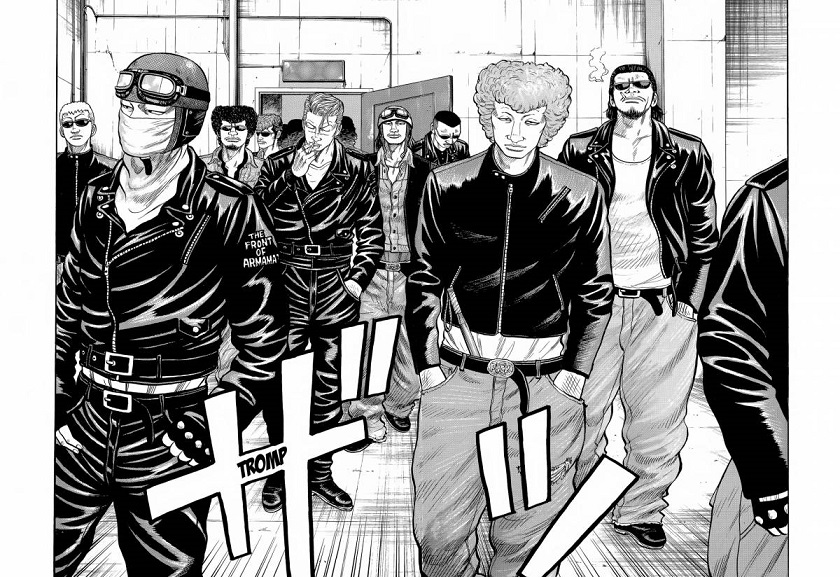
Lo habéis publicado todo muy rápido.

Sí, fue una cosa de contratos. Hay editoriales que te lo ponen muy fácil y tienes en seguida todos los materiales para trabajar. Con Koike y Kojima, algunas de las series son tan antiguas que no tienen formato digital. La editorial japonesa nos manda los tomos y nosotros tenemos que escanearlos. Eso está bien porque podemos hacerlo con buena calidad y no tenemos que esperar a que los japoneses nos manden algo decente con lo que trabajar. Así se ahorra tiempo.

Imagino que al principio todo fue lento.

Desde que nace ECC queríamos tener manga en la editorial. El tiempo que pasa desde que nacemos como editorial hasta que empezamos a publicarlo es lo que hemos tardado en conseguir que los japoneses confíen en nosotros.

¿Teníais un lector en mente?

Nuestra idea era abarcar los tres grandes públicos. El juvenil con el shônen, el femenino con el shôjo y el adulto con el seinen. Pero hay mucho shônen en el resto de editoriales. Entrar en ese mercado es muy difícil, además de que publicar algo competitivo era complicado. Lo mismo con el shôjo. El seinen, al ser más amplia la variedad y el perfil del lector, nos pareció más fácil. El género de terror, que tuvo un auge en el mercado español hace años, estaba abandonado. Nos pareció buena idea empezar por ahí. Aunque tuviéramos muchos lectores de cómics de Superman y Batman, cuando te mueves en otro terreno es como si fueras nuevo. Nadie te conoce, porque la mayoría de lectores nuevos que alcanzas son gente que no estaba interesada en tu otro material.

Ahora vuestras licencias aparecen anunciadas en todos lados. El lector manga os presta atención. Sois una editorial grande, pero hasta hace poco no se os consideraba así en manga.

Exacto. Poco a poco vamos sacando obras que van llamando a todo tipo de público y abrimos horizontes.

¿Tenéis intención de meteros en pugnas por los mangas famosos del momento?

Una gallina de los huevos de oro la quieren todas las editoriales. Siempre intentando respetar a las otras editoriales, claro. Desde el principio nos interesaba mucho Kakizaki. Pero Milky Way lo empezó a publicar y lo dejamos de lado. Pero como pensamos que Rainbow podría no encajarles, nos pusimos a hablar. Intentamos una coedición, pero era muy difícil a nivel legal. Así que colaboramos a nivel de amistad sin entrar en papeleo, porque eso iba a ser complicado. Hicimos campaña juntos compartiendo el mismo stand en el Salón. Nos era más fácil hacer esto. Pero si nos interesa un título, iremos a por él. Luego que los japoneses decidan a quién se lo dan. Las obras que son buenas, no importa el género, son nuestro foco.
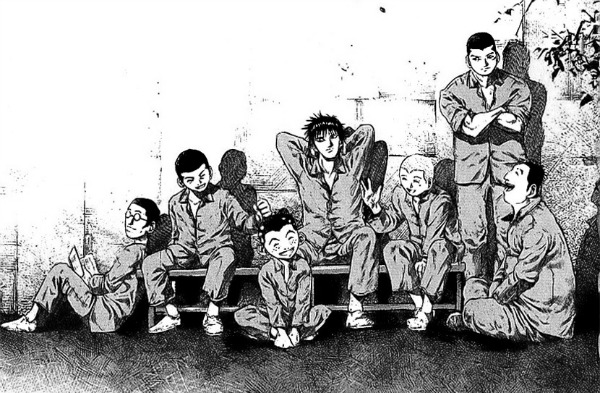
¿Cómo se plantearon las editoriales japonesas este tipo de acuerdo y con compartir autor?

Hablamos con Carlos, de Milky Way, antes de hablar con los japoneses. Les preguntamos si les parecía bien, que nos interesaba Rainbow, pero solo si ellos no la querían. Cuando hablamos con Shogakukan, les dijimos que las dos editoriales ya estábamos en contacto y que estábamos de acuerdo. Les pareció un buen gesto, ya que lo vieron como algo colaborativo, en lugar de una mala competencia. Los japoneses quieren, al fin y al cabo, que se les publique bien fuera de su país, así que esto lo vieron como una buena señal.

Parece que hay buen rollo entre las editoriales de manga en España.

Conozco a la mayoría de editores y nos llevamos bien. No sé, no hay roce. Y si lo hay, yo no lo veo. Cada uno publica lo que cree que va a funcionar, y si apostamos por una serie que al final se lleva otro, pues es una tontería enfadarse porque así funciona el negocio.

Me dijiste en el Salón del Manga pasado que Rainbow os interesaba desde el principio.

Sí, a mí me gustaba mucho. Tenía tomos en japonés. Era un manga que desde el principio estaba en mis planes. Pero cuando haces planes para iniciar la línea tienes que elegir, porque el presupuesto es limitado. Entonces dijimos, vale, tres series solo para empezar. Elegimos a Ito, porque era terror, a Tezuka, por ya era conocido y es una buena carta de presentación, y a Koike y Kojima. A Kakizaki lo fuimos dejando y al final lo acabó sacando otra editorial. Claro, cuando pasa eso, cuando se liga a un autor a una editorial, no vas a robárselo. Pero viendo el tipo de obras que publica Milky Way, vimos que Rainbow era demasiado larga y tal vez no les interesaba, además de que aquí hay otro guionista, George Abe. Y como ese gusanillo seguía ahí, sobre todo a nivel personal, pues contactamos con Milky y luego con la editorial japonesa.

¿Y está funcionando bien?

Muy bien. Aún es temprano para verlo, pero no podemos quejarnos. [La entrevista se hizo en mayo, con siete tomos publicados.]

¿No os da miedo publicar obras tan largas? Desde el principio, con Hanzô, ahora Rainbow, y este Salón del Cómic habéis anunciado Dorohedoro. Sobre todo ahora que las editoriales se están centrando en obras cortas.

Si hay calidad, no importa que la obra sea larga. Lo digo como editora y como lectora. Si una obra tiene 26 tomos y todos ellos son buenos, no me importa. Como Hanzô, que tiene diez, pero que eran 15 en realidad. Tiene más riesgos. Pero cuando apuestas por una serie así es porque crees que de verdad puede funcionar. Luego te puede salir rana y puedes acabar pagando por una licencia que no funciona. Crows, por ejemplo, no nos funcionó. A pesar de que creíamos que sí y de que era muy buena. Claro, era nuestra primera obra. Tenía 26 tomos y tal vez la gente no se fiaba de nosotros. Pero cuando haces algo así es porque sabes que puedes asumir el riesgo.

Aún así sacasteis un tomo cada mes y sin cambiar el precio.

Sobre todo al principio hay que tener cuidado con estas cosas. Si empezamos a cambiar periodicidades y precios es nuestras primeras obras, la gente desconfía. Otra cosa es lo que nos ha pasado con Inspector Kurokochi, que hemos tenido un montón de problemas. Los japoneses nos dijeron que no imprimiéramos porque había algunas cosas que querían cambiar.

Ahora que la nombras, ¿cómo acabáis con una obra así? Es bastante larga, también.

Está abierta. Creo que ha salido ya el tomo 16. Pero bueno, Takashi Nagasaki es coguionista de Naoki Urasawa y con eso nos valía. La serie es muy divertida y según van pasando los tomos te va enganchando mucho. Por eso quisimos publicarla. Está abierta y tiene riesgo, pero nos gusta y tiene calidad, así que creemos que puede tener interés publicarla.

Junji Ito y Nagasaki (Richard Woo) tienen una obra juntos. Algo sobre Rasputín. Tiene todas las papeletas para acabar con vosotros.

De momento no sabemos. Queremos ir poco a poco y no acabar como con Koike y Kojima, que está saliendo todo el mismo año [risas].

Os metéis a publicar manga con una imagen de cómo está el mercado del manga. Una vez empezáis a publicar, ¿cambia esa imagen?

Yo he sido librera mucho tiempo, y hasta hace un año, que he tenido mi segunda maternidad, he estado trabajando directamente con el lector, así que tenía cierto feedback directo. Había un perfil de lector que también es padre y que le compraba algo a su hijo y él se iba fastidiado porque, quitando un Tezuka, no se podía pillar nada. La oferta de seinen ahora es mucho más grande, con los años, pero a mí no me llega a sorprender porque, y esto lo digo como lectora, yo también quería algo diferente. Al principio te leías los shônen en grapa, luego en tomo, pero al final era todo más de lo mismo. Yo tenía esa inquietud y sabía qué era lo que quería, y por lo tanto sabía que existía otro tipo de lector que demandaba un cómic que no se estaba publicando. El mercado está evolucionando porque el lector ha crecido. Igual con los superhéroes: el material de ahora es mucho más interesante y adulto.

En cierto modo, los mangas adultos de ECC son mangas que se podría leer un lector de Vertigo o de cómics adultos de superhéroes. ¿Pensabais en ese lector cuando empezasteis a publicar manga?

Teníamos en mente que queríamos empezar por el seinen. No nos queríamos adaptar a ese lector en concreto. Al lector que solo lee superhéroes o al lector que solo lee manga no lo vas a sacar de ahí, así que no teníamos intención centrarnos en nuestros lectores de superhéroes para hacerles comprar manga, porque no estábamos seguros de que fuera a funcionar. De hecho, con nuestra línea kodomo queremos buscar nuevos lectores, esta vez infantiles.

¿En esta línea vais a publicar más manga?

De momento solo tenemos Shin-chan, que tampoco es lo más infantil, pero algo es algo. Esperamos poder ir sacando cosas más adelante, pero poco a poco.

Dijisteis en el Salón del Manga de 2016 que os gusta seleccionar un autor y apostar por él.

Si creemos que un autor es bueno, la idea es publicar todas sus obras.

Como estáis haciendo con Matsumoto o Kaneko.

Sí, exactamente. Con estos autores en concreto sí que creemos que puede haber un cruce lector, como comentabas. Matsumoto tiene mucha influencia europea y Kaneko americana. Es fácil que alguien que lee a Miguelanxo Padro o Moebius se interese por Matsumoto. Su obra no es manga al puro estilo manga.

Le hace cruzar fronteras.

Exacto. Son obras que pueden interesar a cualquier lector, ya no de americano o europeo, sino a un lector en el más amplio sentido de la palabra. Matsumoto tiene obras muy interesantes que están sin publicar. La edición de Takemitsu Zamurai, por ejemplo, aún está muy cercana, así que no nos lo planteamos, pero Primavera azul, que anunciamos hace poco, creo que tiene algo interesante que aportar.

¿Vende bien Atsushi Kaneko?

Lo que pasa con el manga es que las ventas son más lentas. Con los superhéroes no es así. El día que salen ya tienes un buen montón de compradores, pero con el manga cuesta más, se van vendiendo poco a poco. Deathco creemos va a tirar más que Wet Moon. Su estilo es más americano y más interesante, así que pensamos que esta puede ayudar a vender mejor la otra. Es lo que pasa cuando publicas varias obras de un mismo autor. Las ventas de una se alimentan gracias a la otra. Es un proceso más lento. Matsumoto ya tenía un público en España. De hecho, acabamos de sacar la segunda edición de primer tomo de Sunny y estamos muy orgullosos. Pero como ya era conocido, vende mejor. Con Kaneko hay que verlo aún.

¿Tiene sentido apostar por ese autor aunque no venda, esperando que llegue a cuajar en el futuro?

En un principio, si creemos que lo vale, lo hacemos. Kaneko y Matsumoto tienen peso de autor, no son obras aisladas. Así que sí, apostamos por ellos. Si venden cien ejemplares, pues entonces no, es que nos hemos equivocado. Pero de momento no nos ha pasado.

Chiisakobe ha tenido mucha repercusión, al menos de crítica, y Mochizuki es un autor que os pega, en general, porque tiene obras de terror también y tiene esa categoría de autor.

Nos interesa seguir publicando sus obras. Pero hay un presupuesto limitado. Ahora nos estamos centrando en ampliar el catálogo shônen y que se nos empiece a conocer un poco más. Hemos seguido con Tekkon Kinkreet, que pensábamos que tenía que estar en el mercado sí o sí, y luego hemos anunciado Primavera azul por publicar también algo inédito. Pero de momento nos interesa abrirnos. Y tampoco queremos sacar cincuenta obras cada mes, porque sería matar a los lectores [risas].

Sobre la línea autoral, ¿por qué decidís publicarlos a parte? A Tezuka, a Kamimura.

La línea autoral la lleva otro chico, no yo, aunque colaboramos mucho. Hay autores que, aunque sean japoneses y se publiquen bajo la etiqueta manga, son grandes referentes a nivel mundial. Osamu Tezuka es uno de los autores más importantes de cómic de la historia. Creemos que Kazuo Kamimura entra en esa categoría. A Matsumoto también nos planteamos dónde ponerlo, pero como lo separan bastantes años de los otros dos, decidimos dejarlo en la línea manga. Con esa línea queríamos celebrar las grandes obras del cómic. En general, hacer una distinción. Para lectores que busquen solo clásicos. Tezuka y Kamimura entran en ese grupo. Matsumoto también, según con quién hables.

¿Os interesa otro material clásico?

De momento no puedo decir nada [risas].

¿Por qué unos mangas los publicáis a un tamaño y otros a otro?

Normalmente lo hacemos según estipula el contrato. Los japoneses nos dicen cómo publicarlo. Hanzô, por ejemplo, tiene quince volúmenes, y Planeta publicó en su día varios tomos de esa edición. Pero al final Japón nos obligó a hacer la edición de diez tomos. De hecho, ya habíamos anunciado la edición en quince tomos. A veces nos gustaría hacer cambios, buscar el formato perfecto, pero hay muchas restricciones. Luego hay editoriales que son más flexibles. Mira por ejemplo Suehiro Maruo o Shintaro Kago. Te dejan hacer más cosas, y si por ejemplo son autores a los que ya se les había publicado de una manera, nos permiten hacer cambios con tal de que el comprador tenga una edición uniforme. Con estas restricciones tienes dos opciones: o te aguantas y lo publicas como te dicen, o no lo publicas.

Cuando entrevisté a Amiram, el editor de Ponent Mon, me dijo que él prefiere publicar sus mangas en formato grande. Van a salir más caros y los va a comprar menos gente, pero económicamente salen mejor porque no son obras famosas que vayan a vender mucho más si se publican en tamaño pequeño.

Sí, puede ser. Las editoriales japonesas suelen estar más contentas cuanto más se parezca tu edición a la edición original, y eso es lo que intentamos hacer.

Me decía también que el mercado de manga a 8 euros parece saturado.

Hay más editoriales, hay más novedades y hay más ventas. Pero hay que tener en cuenta que venimos de una crisis y que el ritmo de publicación obviamente tenía que subir, además de que hay lectores nuevos. Antes de la crisis se publicaban muchísimos volúmenes y sin control ninguno. Ahora ya no se hace eso. Las editoriales configuran su catálogo de manera más cuidadosa y lo hacen intentando presentar algo sólido. Publicar obras que nadie conoce y que nadie pide ya no se hace. Se hacía por entonces, pero ahora todo se estudia mucho más.

Van apareciendo diferentes editoriales que publican obras que tenían un público que pedía obras distintas. Tomodomo, Milky Way y vosotros estáis publicando para un público distinto. O el mismo pero con nuevos intereses.

Eso te hace calcular un poco cuánto vas a vender. Si siempre tienes los mismos lectores, que son fieles y sabes lo que les gusta, puedes hacer cuentas y ver si esa nueva obra podría funcionar. Con Crows estábamos probando y no funcionó, y mira que pusimos un precio competitivo. Pero no podíamos cambiar a mitad de publicación el precio o el formato. Es importante cuidar a todas las partes involucradas: el lector, la editorial japonesa.

En España no se hace, pero en Francia o Estados Unidos se publican ediciones con volúmenes que incluyen varios tomos. ¿Crees que algo así funcionaría aquí? ¿O sería como cuando Planeta intentó bajar los precios a cambio de una edición de menor calidad y la gente se quejó?

Es algo parecido. Por ejemplo, a mí me encanta el papel amarillo.

¡A mí también!

Pero aquí no puedes hacer eso. Aunque el papel sea mucho mejor, de más grosor y mayor calidad. Si su tono no es blanco, no lo quieren y piensan que es de peor calidad. Estamos acostumbrados a un tipo de formato, con un tipo de sobrecubierta, con un tamaño, con un precio, y la gente no sale de ahí.

Yo valoro más otras cosas. La traducción, la maquetación, que la impresión sea buena, que el tomo sea cómodo de leer.

Ya. Pero los experimentos que se han hecho no han funcionado. Y cuando haces otra cosa da la sensación de que el producto ya no es de calidad, a no ser que le pongas una tapa dura.

¿Hablamos de los anuncios que habéis hecho ya en el Salón? Fueron muchísimos [muchos de ellos ya están a la venta].

No habíamos hecho presentaciones importantes de novedades hasta la fecha. Queríamos que el lector de manga nos conociera, y anunciar tantos cómics fue un poco una manera de darnos a conocer, de decir aquí estamos y nos tomamos el manga en serio. Esas novedades eran las que se iban a publicar a lo largo del año y son parte del catálogo que estamos construyendo.

Vais a publicar mangas de Project Itoh.

Son tres obras que tienen anime. Una es una especie de adaptación de Frankenstein. Todas tienen un toque adulto y diría que sangriento. No parecen ser obras similares a lo que habíamos publicado hasta entonces, pero aún así comparten la violencia y algunos temas serios. La idea es que queríamos sacar shônen y nos pareció una buena forma de entrar. Tienen la calidad suficiente, están basados en unas novelas que en Japón funcionan muy bien en Japón, y básicamente nos parece que son lo suficientemente buenas como para sacarlas. Igual que Gift Plus Minus. El dibujo es impresionante y ha salido en Francia y en Italia. Nosotros lo queríamos sacar porque parecía que no iba a llegar. Esto ya es seinen, pero sigue en esa línea de obras que nos parece que hacía falta tener en el catálogo.

Quería preguntarte por Shun Umezawa. Me he leído Bajo un cielo como unos pantis y no sé si me ha gustado o me está tomando el pelo.

[Risas] Me pasa lo mismo con Kago. Es muy bizarro y muy pervertido. Pero es muy bueno. Umezawa hace una especie de crítica social y lo mezcla con comedia, terror a veces, algo muy original y muy personal. Te fastidia y te repele al mismo tiempo.

Qué nos puedes decir de Dorohedoro.

Es una apuesta arriesgada. Tiene más de veinte tomos. Pero nos parece buenísimo y necesario que esté publicado. Es similar a Nihei, que se está recuperando también. Es buen momento.

Dorohedoro está dibujado por una mujer, Q Hayashida. ¿Crees que se publican pocas mujeres mangakas en España?

Bueno, en este caso no lo publicamos porque sea una mujer. Normalmente solo nos fijamos en si la obra nos gusta y si es buena. Tal vez es un problema de raíz. Para entrar a publicar tal vez tiene más facilidades un hombre que una mujer, pero eso ya recae en Japón. Yo me fijo en el dibujo, en la narrativa, en la historia. Casi nunca miro el nombre del autor.
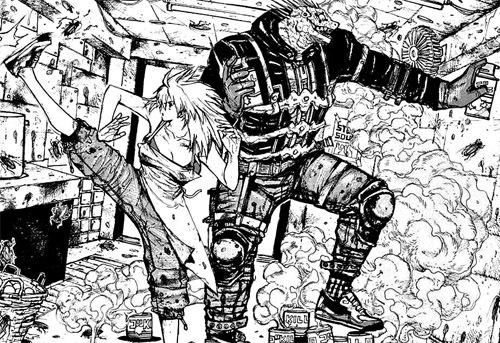
Lo digo porque de las nuevas incorporaciones a vuestro catálogo, las que más me interesan están dibujadas por mujeres: Dorohedoro, Ulna en la torreta y La pequeña forastera. Esta última suscitó mucho entusiasmo en redes cuando la sacasteis. Pensaba que, tal vez, estabais intentando hacer un esfuerzo por dar a luz a nuevas dibujantes.

Cuando La pequeña forastera salió en Francia la teníamos ya en el punto de mira y por suerte no tuvimos competidores. Y me parece una obra fantástica y me hace mucha ilusión que la tengamos nosotros. Pero a nivel de calidad, el dibujo de Nagabe es increíble.

También ha salido en Estados Unidos y tiene tan solo dos o tres tomos.

Claro, nosotros pasamos el día entero estudiando qué se publica y qué publicar. Paso ocho horas diarias en internet mirando sin parar. Mucho más que un fan [risas]. Pasas mucho rato leyendo y buscando, y cuando leí el primer tomo me interesó muchísimo. Cuando además sale en tantos países con tan poco recorrido es porque llama mucho la atención. Ulna también nos encantó. Desde el principio nos gustó mucho. Con la editorial Enterbrain ya habíamos trabajado, así que lo teníamos fácil. A mí me recuerda a Nausicaä, en el dibujo y en el mundo fantástico que retrata. Nos pareció que entraba muy bien en lo que era nuestro catálogo, algo entre bizarro, bonito y delirante.

¿Cómo os informáis sobre nuevos mangas?

Las editoriales te envían muestras de cómics que te quieren vender. Algunas se adaptan a tu catálogo, otras no. Yo sé un poco de japonés. Tengo un nivel muy básico, pero me basta para leer algunas obras como Crows tirando de diccionario. Amazon Japan es muy útil. Pides previews, escribes a la editorial para que te mande una muestra, o las compras. Es bastante fácil ahora con las nuevas tecnologías. MyAnimeList siempre es una buena fuente de información, ya que tiene valoraciones, listas. Luego te traes volúmenes de los viajes que haces a Japón para las negociaciones. Las listas de los libros más vendidos. En Japón no son ilegales, como sí lo son en otros sitios, así que eso te guía un poquito para saber dónde poner el ojo. O cualquier recomendación que me hagan. Ahora mismo me dices algún autor o alguna obra que no conozca y yo la apunto y la miro más adelante.

De repente parece que todo el mundo quiere sacar a Usamaru Furuya.

Es un autor muy bueno, con lo que todo el mundo quiere tenerlo en su catálogo. Lo que pasa es que lo hemos hecho todos al mismo tiempo. Es como Tezuka, que está repartido por muchas editoriales. Incluso Norma, que se centra principalmente en shônen, que es la editorial más potente en ese sentido, tiene un Tezuka por ahí. Cuando el autor es bueno, te fijas y lo apuntas en la lista. Cuando nos enteramos de que Milky Way no estaban interesados en La cruzada de los inocentes, pues nos lanzamos a ello.

Y qué nos puedes decir sobre el resto. No te quiero quitar mucho más tiempo. Girls und Panzer, Servamp, Overlord

Ahora mismo queremos abrirnos a un público nuevo y ampliar horizontes, y estos mangas los publicamos para llegar a ese público nuevo. Es curioso porque pensábamos que con estos anuncios íbamos a tener una respuesta mayor, pero a lo que la gente más ha prestado atención es a aquello que sigue la línea de lo que ya estábamos publicado: La pequeña forastera, Dorohedoro y el resto de obras seinen. Este lector nos ha dado mucho feedback. Girls and Panzer es una obra famosísima en Japón. En Japón es algo muy grande. Hay una adaptación de anime, novelas, videojuegos. Mil cosas. En cualquier caso, las tres obras que yo destacaría sobre todo lo que anunciamos serían La pequeña forastera, Ulna en su torreta y Gift Plus Minus. Son de tres autores que aún no se han publicado aquí, que tienen una calidad enorme y que estamos bastante contentos de poder publicar. De momento, antes de publicar más obras de otros autores, queremos ampliar nuestro rango de estilos. Por eso hemos anunciado todo lo de Project Itoh o Servamp.

Para terminar, ¿cómo os fue con Junji Ito en Barcelona? ¿Tenéis pensado traer a algún otro autor para el próximo Salón?

Fue muy bien. Junji Ito se mostró muy amable y muy simpático y la gente con la que venía también. Además, se notaba que el público quería conocerlo y él se mostró muy abierto a todo. Estamos muy contentos con cómo salió, así que no podemos quejarnos. Sobre un próximo invitado, no puedo decirte nada porque no tenemos nada seguro. Estamos hablando con la editorial ahora mismo y estamos, de momento, concretando los detalles. Pero a no ser que algo salga mal o que nos cancelen en el último momento, te puedo decir al 99% que sí va a haber un invitado para este Salón. [Publicar esta entrevista tan tarde tiene una ventaja: no hay que esperar hasta el salón para saberlo. Es Kakizaki, y ya está firmando en Barcelona].


03 Nov 11:39

Farmers Urged to Bury Their Underpants for Better Beef

by Miss Cellania

The latest advice for farmers sounds like a superstition: to improve yields, dig a hole in your field and bury your underpants for two months. If you have several fields, you'll need to cough up more underwear. The idea began with the "Soil My Undies" challenge from the California Farmers’ Guild, and is now recommended by the Agriculture and Horticulture Development Board (AHDB) and Quality Meat Scotland (QMS). But it's no old wives' tale. The underwear must be made of cotton, and the result is a relatively cheap and easy soil test.

Evan Wiig, Executive Director of the California Farmers’ Guild, said: “Cotton is an organic material and breaks down naturally just like anything else you’d put in your compost pile. So if you bury cotton in soil teeming with life, all those creatures will begin to feast.

“If you have dead soil, if it is totally lifeless you should be able to pull the pants out of the ground, throw it in the washing machine and put them on like nothing ever happened. If you have incredibly healthy soil, you should have nothing left but an elastic strap.”

Soil that is worked over by microbes, insects, and worms will be more nutritious for the plants that grow there, and for the animals that graze the fields. Read more about the underpants test at the Telegraph. -Thanks, Walter!

(Image credit: California Farmers’ Guild)

03 Nov 11:33

Las consecuencias filosóficas y políticas del cisma Luterano

by Julio Llorente

Lutero elimina la mediación de la Iglesia y torna la conciencia humana, iluminada por el Espíritu Santo, en soberana para ordenar su vida religiosa e interpretar los textos bíblicos.

El 31 de octubre de 1517, Martín Lutero publicó sus celebérrimas 95 tesis, ese documento en el que se desacredita la doctrina papal sobre las indulgencias y que constituiría la génesis de ingentes cambios políticos y filosóficos posteriores. Es por ello por lo que en las postrimerías del mes de octubre – y en los albores de noviembre – de este año 2017 han proliferado los festejos y conmemoraciones.

Unas celebraciones a las que – paradójicamente y como consecuencia del contexto de constante exaltación del ecumenismo que vivimos – no ha permanecido ajena la Iglesia católica. No en vano, después de haberle motejado el pasado año de ‘testigo del Evangelio’, el Vaticano anunciaba hace días la emisión de un sello postal de 1 euro en el que se representa al heresiarca Lutero al pie de la Cruz.

Ante estos hechos, hemos de preguntarnos si la Iglesia desatiende las perniciosas consecuencias filosóficas y políticas que la Reforma protestante ha entrañado para la civilización; consecuencias que vamos a tratar de sintetizar en este texto.

El pesimismo antropológico y la salvación por medio de la fe

El gran pilar del pensamiento de Lutero es la llamada doctrina de la justificación por la sola fe; es decir, la creencia de que el hombre, con su naturaleza devastada por la Caída, no puede sobreponerse al pecado y, por tanto, es exclusivamente salvado por la fe y por los méritos de Jesucristo en la cruz (no por sus propias obras, ya que el pecado original le ha incapacitado para hacer el bien).

Esta creencia deriva ineluctablemente en un pesimismo antropológico que rechaza la libertad humana: si el hombre no puede escapar del pecado y hacer el bien, no es verdaderamente libre. De hecho, tampoco puede aspirar a la plenitud vital, a la felicidad, ya que sólo quien obra bien – consigo mismo y con el prójimo – puede ser feliz.

La libre interpretación y el libre examen: subjetivismo

Lutero, además, elimina la mediación de la Iglesia y torna la conciencia humana, iluminada por el Espíritu Santo, en soberana para ordenar su vida religiosa e interpretar los textos bíblicos. Como escribió Castellani, ‘desde que Lutero aseguró a cada lector de la Biblia la asistencia del Espíritu Santo, esta persona del Espíritu Santo empezó a decir unas macanas espantosas’.

Todo ello implica el rechazo de la existencia de una interpretación verdadera y legítima de los textos bíblicos y la afirmación del subjetivismo, esa corriente filosófica por la cual cada uno tiene ‘su verdad’ y, en consecuencia, el individuo es criterio de ésta. Afirmar que cada uno puede extraer el mensaje que guste de las Sagradas Escrituras es negar que las Sagradas Escrituras contengan un mensaje concreto.

Escepticismo filosófico y moral

El heresiarca Lutero fue discípulo de los nominalistas Wesel y Biel, lo que se ve reflejado en su rechazo del realismo filosófico (una doctrina que se basa en la capacidad del hombre para aprehender la verdad, que está en las cosas y no en sí mismo). De este modo, juzga que la razón, atrofiada por el pecado original, es incapaz de abstraer lo universal y, en consecuencia, de discernir un orden moral objetivo.

Esta creencia lleva al hombre a olvidar la búsqueda de la verdad y el bien (si no se pueden encontrar, no tiene sentido buscarlos), a centrarse en los saberes prácticos y a cuestionar toda institución establecida. Como sostiene Belloc en Europa y la fe, ‘al negarse la realidad y hasta el ser, se crean sistemas que se mueven en un vacío atroz, para asentarse finalmente en una negación y desafío universal contra toda institución y todo postulado’.

La monarquía absoluta y la democracia despótica

Si el ser humano es incapaz de alcanzar la verdad, tampoco puede aprehender la ley natural, que es universal e inmutable y que en el Medievo limitaba el poder del monarca impidiéndole promulgar leyes positivas injustas (en palabras de San Isidoro: ‘Rey eres si gobiernas justamente’). Sin ley natural – o siendo ésta incognoscible –, el principio de autoridad queda enterrado y el poder del soberano se torna absoluto e incuestionable. Al no someter la ley positiva a una norma superior, universal, se abre la puerta a la arbitrariedad.

En la Reforma protestante se halla la semilla del absolutismo monárquico, por mucho que éste también se diese en países católicos.

En cualquier caso y precisamente por el mismo motivo, el pensamiento de Lutero también constituye la génesis de la voluntad general rousseauniana y de la teoría de la democracia. Igual que en el caso de la monarquía absoluta, no hay orden moral objetivo que constriña el poder del pueblo, que decide por mayoría lo que está bien y lo que está mal, lo que es justo e injusto.

Calvino, la predestinación y el determinismo moderno.

Alentado por la rebelión de Lutero, el clérigo Juan Calvino desarrollaría su pensamiento, que estriba en la negación del libre albedrío y en una concepción sobremanera pesimista de la naturaleza. De esta manera, Calvino plantearía la doctrina de la predestinación, según la cual el hombre nada puede hacer para salvarse, pues su destino ya ha sido determinado por Dios.

Lo más pernicioso del planteamiento del clérigo es la sentencia que el hombre puede conocer anticipadamente su sino, ya que la prosperidad material y económica es signo del favor de Dios. No en vano, derivaría en la idolatría del dinero, que dejó de ser un medio para tornarse en un fin. Además, la doctrina de la predestinación ampararía el florecimiento del determinismo moderno – presente en ideologías como el marxismo – y, en cierto modo, del darwinismo social, que propugna la vigencia de la selección natural en las comunidades humanas.

La entrada Las consecuencias filosóficas y políticas del cisma Luterano aparece primero en InfoVaticana.

03 Nov 11:29

Herido tras chocar contra un bolardo y volcar en la plaza de la Universidade

by ${contenidoRSS.getValorPropiedad("FirmaAutor")}
Pese a lo aparatoso  del accidente, fueron más los daños que las lesiones <p> <img border="0" src="https://www.lavozdegalicia.es/sc/960x/default/2017/11/03/00121509664082128320680/Foto/SN3C7F3_0642.jpg" /></p>
03 Nov 11:15

Según una investigación, los ositos Haribo se fabrican con mano de obra esclavizada

by Mario Abad

Este artículo se publico originalmente en Munchies, nuestra plataforma dedicada a la comida.

El lunes pasado, la cadena alemana ARD emitió un sorprendente reportaje de investigación en el que se señala que, sin saberlo, la empresa de dulces Haribo tiene contratada mano de obra esclava. El informe indica que, en su empeño por optimizar la cadena de suministro, la empresa ha terminado por someter a condiciones horribles tanto a los trabajadores como a los animales de los que obtiene los ingredientes.

Buena parte del documental, de 45 minutos de duración, muestra en detalle la vida de los trabajadores en varios de los estados más pobres del noreste de Brasil, donde se concentra la mayor parte de los árboles de la cera de carnauba.


MIRA: El mundo de los transgénicos en España


Esta cera es un ingrediente esencial en los productos de Haribo, ya que da a los ositos de goma ese característico acabado brillante y evita que se queden pegados unos a otros. La misma cera se encuentra en el aceite para coches, el betún para el calzado o el protector labial.

Sin embargo, la industria de la cera de carnauba se sustenta sobre una mano de obra mal remunerada y a menudo compuesta por menores de edad. Estos trabajadores ganan unos 40 reales (poco más de 10 euros) al día como pago por pasar largas jornadas recogiendo cera de la parte más alta de los árboles, a la que deben acceder con ayuda de una especie de largos cuchillos curvados. Duermen a la intemperie o en camionetas, la única agua a la que tienen acceso es la de los arroyos cercanos, sin filtrar, y muchas veces ni siquiera tienen permitido usar los lavabos.

Otra parte del documental pone el foco en las granjas industriales del norte de Alemania en las que se crían cerdos para GELITA, la empresa que suministra a Haribo la gelatina para fabricar su producto. En el reportaje puede apreciarse cómo los cerdos están rebozados en sus propias heces y se pasean por las pocilgas con heridas abiertas y sin curar, a menudo entre los cadáveres putrefactos de otros cerdos.

El documental ha hecho saltar las alarmas en Haribo, cuyas oficinas están en Alemania pero que comercializa sus productos en todo el mundo, y desde donde han iniciado, según afirman miembros de la empresa, una rigurosa investigación interna.

En el reportaje puede apreciarse cómo los cerdos están rebozados en sus propias heces y se pasean por las pocilgas con heridas abiertas y sin curar, a menudo entre los cadáveres putrefactos de otros cerdos

"Quisiéramos manifestar nuestra profunda preocupación por las imágenes mostradas la semana pasada en el documental de la cadena de televisión alemana ARD", escribió un portavoz de Haribo en un mail de respuesta a MUNCHIES el martes pasado por la mañana. "Las condiciones tanto en las granjas de cerdos como en las plantaciones de Brasil son intolerables".

La empresa también comunicó a MUNCHIES que llevará a cabo una auditoría a sus proveedores, tanto los directos como a las granjas independientes. Desde Haribo insisten en que el proceso será absolutamente transparente de principio a fin, con el fin de mantener al público al corrientede los acontecimientos.

"En estos momentos estamos investigando, en colaboración con nuestros proveedores, las condiciones exactas de las empresas que les suministran a ellos", añadió el representante. "Si se observara que es preciso aplicar medidas urgentes en este aspecto, insistiremos en su implementación y no descansaremos hasta que eso ocurra".

02 Nov 20:51

Surfadelic Presents: XCEDRIN HEADACHE DANCE PARTY !!! [60’s Punk]

by Mr.Eliminator

Xcedrin Headache a


Yep! Heard you missed it so here’s a brand new Surfadelic 60’s punk comp. Why it’s entitled ”Xcedrin Headache Dance Party”?!? It’s ’cause it was inspired by famous Mouse & The Boys ’68. garage/psych killer tune ”Xcedrin Headache #69” and because it will give you real good buzzing rockin’ headache for sure. Consisting mostly of US 60’s garage punkers [except for few killer Euro bands as Sound Of Imker from Netherlands or The Outsiders from Sweden] with emphasis on PUNK. Ohh Yeahhh! As you know there are too many lame, half assed, popie-hippie-dippie, shitty-evergreen-nostalgia, wanna be 60’s garage comps nowadays, it’s kinda overkill. So this Surfadelic collection is here to bring back the good old days of dangerous, un-safe, demented garage sounds [and livin’ :-)] of groups as The Rogues, The Velvet Illusions, The Bush, The Coastliners, S.J. & The Crossroads, The Savages, Brand X, The Other Half, The Esquires, The Sons Of Barbee Doll … [whatta name]. This comp. is especially recommended to those individuals who are on the brink of nervous breakdown, this stuff will push ’em over the edge. You may faint but you’ll never forget…  Check out some favs down there and remember, FUZZ never lies. Dig!!!


Xcedrin Headache b

***


02 Nov 20:46

Luns, 20 de novembro: “Urraca de León e Diego de Compostela”

by Ateneo
O luns 20 de novembro ás 20 horas o Ateneo de Santiago ten programada na Rúa do Vilar, 19 de Santiago de Compostela unha conferencia organizada pola Sección Compostela titulada “Urraca de León e Diego de Compostela”, que estará impartida polo Profesor Ermelindo Portela. Ermelindo Portela Silva é Licenciado con grado en Filosofía e Letras […]
02 Nov 20:46

As meigas, vítimas da Ilustración

by Ateneo
Conferencia impartida o 30 de outubro de 2017 por D. Xosé Ramón Mariño Ferro, Antropólogo e Profesor da USC.
02 Nov 20:45

Purina Debuts New ‘Slovenly Feast’ For Nasty-Ass Shelter Cats

by Ryan Shattuck

ST. LOUIS—Offering more affordable fare for the animals rotting away in cages, Purina on Monday debuted new Slovenly Feast for nasty-ass shelter cats. “With the flavors these scraggly, half-dead felines have come to expect, Slovenly Feast is the perfect meal for shelter cats,” said spokesperson Linda Brashear, adding…

Read more...

02 Nov 20:45

Kevin Spacey Responds To Assault Allegations By Seeking Treatment For Homosexuality

by Ryan Shattuck on Entertainment, shared by Ryan Shattuck to The Onion

LONDON—Responding to multiple allegations of sexual misconduct, actor Kevin Spacey announced Thursday that he will immediately be seeking treatment for homosexuality. “In light of my prior actions, I am committed to getting the help I need to make sure that I’ll never be gay again,” said Spacey, adding that he was…

Read more...

02 Nov 20:29

4chan Launches “It’s Okay to Be White” Campaign

Okaytobewhite1

Signs with the slogan “It’s Okay to Be White” have appeared in various public places due to a troll campaign launched on 4chan’s /pol/ (politically incorrect) board earlier this week.

02 Nov 20:28

Europe's Largest Legal Weed Farm Is Being Built in a Nuclear Bunker

by Tim Geyer

This article originally appeared on VICE Germany.

"I know we're planning on growing weed, but working here won't just be one big party," Christoph Rossner says while striding ahead of me toward the entrance of a deserted nuclear bunker, in the quiet countryside of the southern German region of Allgäu.

From 1956 to 2003, the bunker was part of the Memmingen military base, from where NATO planned to launch nuclear weapons in case the Cold War ever escalated. It's abandoned now, but not for long if Christoph Rossner can help it. The 47-year-old entrepreneur wants to transform the bunker into Germany's largest cannabis plantation—and he'll be working together with the Bavarian government to make that happen.

One of the many air-locked doors between rooms

Since March 2017, it's become legal to obtain medicinal cannabis in Germany with a prescription. Rossner wants to take advantage of the new law and become Germany's leading legal weed grower. His ambitions aren't necessarily based on delusions of grandeur—the legalization opened up a potentially huge market. The German Monitoring Centre for Drugs and Drug Abuse (DBDD) found that in 2015 alone, nearly 5 million Germans had smoked cannabis at least once that year—and that's just the people willing to admit to it.

The nuclear bunker where Rossner hopes to start his empire is an intimidating structure—164 feet long and 49 feet high, with ventilation shafts like a medieval fortress. "I think our plants will be pretty safe within these walls," Rossner says with a smile.

Christoph Rossner walking through one the bunker's passageways to the main atrium

As we pass through one of the huge doors—190 tons of hardened steel, 26 feet wide, and nearly one-foot thick—it lets out a loud, mechanical groan. From there, we go through another door, before we reach the main atrium. Any eventual future employees of Rossner's company, Bunker PPD, will need to leave their bags and clothes behind when entering the facility, change into overalls, and have their fingerprints scanned. The German government designed those extensive security measures to reduce the chances of any product illegally leaving cannabis labs.

Rossner leads me past the former crew quarters and a radio control center. The ceiling above us is made of five-foot thick reinforced concrete. The space feels tight and suffocating—you almost feel like you need to duck when walking around.


Watch: How to Treat Weed Dealers, According to a Weed Dealer


The planned cannabis farm will be part of a study to investigate the effects of different strains of medicinal weed and to develop quality standards for each strain. The research will be done in partnership with the Technical University of Munich and the University of British Columbia in Vancouver, Canada.

Through the study, Rossner hopes to provide 150 patients with cannabis grown in his bunker. If both the research and the necessary production of marijuana are approved by the Federal Institute for Drugs and Medical Services and the Federal Narcotics Board in Germany, Bunker PPD, could start supplying clients with medicinal weed by March 2018.

On the left, Christoph Rossner standing in his future weed farm. On the right, a former radio control center

Rossner is a strong believer in the healing powers of weed. When he was 18, his left shoulder was crushed by a steel beam during his apprenticeship at an industrial mechanics company. He smoked to ease the chronic pain he was experiencing as a result of the accident, and still does to this day. The only difference now is that he gets his weed legally with a prescription. "In case you're wondering, I'm high right now," he admits.

In 1994, the Federal Constitutional Court in Germany made it legal for individuals to carry a small amount of cannabis—between five and ten grams, depending on the German region. In the late 90s, Rossner took advantage of the increased demand by setting up an illegal "weed pharmacy." His client base grew steadily and included cancer and arthritis patients. But eventually, the police came to see him, too. In 2000, he was sentenced to two years and one month in prison. He ended up spending five months there and four months in therapy.

If at any point the power should fail, Rossner can rely on four diesel generators to supply his cannabis plantation with the necessary light.

Now that medicinal weed is legal in Germany, authorities estimate that the country will need 4,400 pounds of weed per year by 2021 in order to adequately supply every patient. Rossner thinks that officials are structurally underestimating just how many will turn to the drug for relief once it's legal. He estimates Germany will need to produce six times that amount—more than 13 tons of weed.

On the left, one of the bunker's hallways. On the right, one of the many drawings soldiers have left on the walls

We descend deeper into the crypt. It's quite desolate here, a feeling that's only strengthened by drawings on the walls, made years ago by bored soldiers. We walk past a space filled with vaults the size of shipping containers. Here, the plan is to have chemists cloning highly potent strains of cannabis. The industrial furnace next to the space was once used to destroy toxic materials at temperatures of 1600 degrees, but these military-grade incinerators will now be set up to burn any surplus cannabis—another requirement from the state.

A space that will be used to hold one of the 80 strains of medicinal weed to be developed in the bunker

But Rossner has a long way to go. As we step out of the bunker and back into the sunlight, he tells me that his lawyers are preparing a lawsuit against the Federal Institute for Drugs. The agency is requiring potential medicinal weed producers to prove that they've already grown, processed, and delivered at least 110 pounds of cannabis within the past three years. Considering it has been illegal to produce in Germany up until now, Rossner can't understand why the government would expect anyone to have done that—let alone kept some sort of paper trail of it.

The nuclear bunker from the outside

While he's waiting for the German authorities to approve his plan, Rossner is keeping a worried eye on his competitors. In the US, a number of companies are systematically buying up smaller producers—a dynamic that could expand into and take over the German market. Even though his lab doesn't exist yet and there's nothing to buy, Rossner already tells me that he won't be bought. He wants to do it on his own terms, in his own nuclear bunker.

02 Nov 20:26

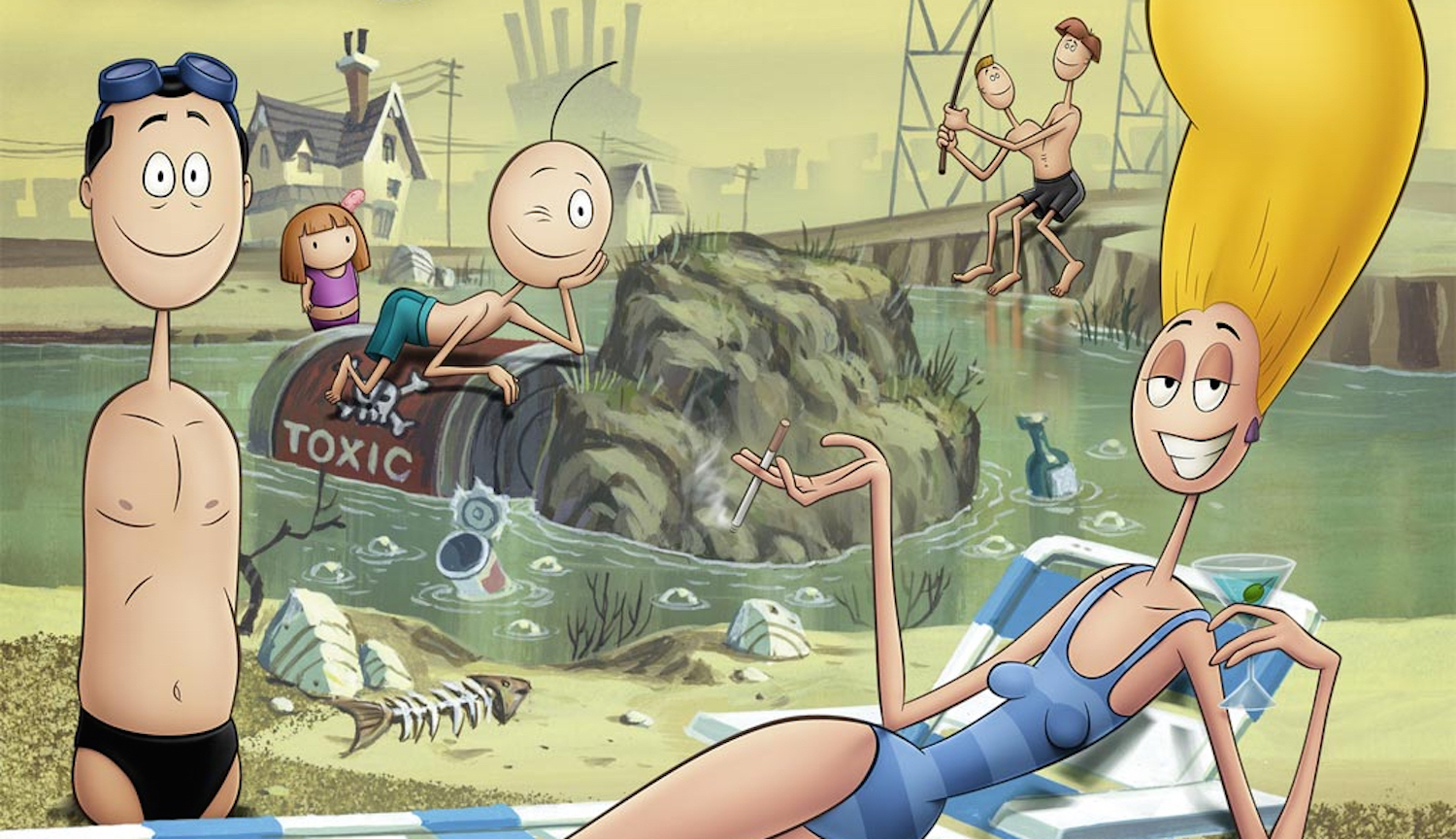
The Creator of 'The Oblongs' Will Crash Your Wedding for $300

by James Charisma

It's been 15 years since The Oblongs was cancelled on the WB. However, reruns on Adult Swim continue to attract new fans to the animated comedy about a deformed family suffering from the effects of chemical waste. It's a show almost as strange as its creator: Los Angeles writer and illustrator Angus Oblong, known for wearing thick clown makeup and a red plastic nose everywhere he goes.

In addition to publishing Edward Gorey-esque children's books that aren't really meant for children, Oblong makes regular appearances in the comic convention circuit and contributes work to art exhibitions throughout LA. For $300 bucks (plus airfare and hotel), he'll also crash your wedding, go drinking with you, and, yes, stand at the foot of someone's bed to scare them when they wake up. "Do you want your kids to listen to you or eat their vegetables? Need your elderly husband to have an early heart attack?" reads the description on the "Special Services" page of his website.

We caught up with Oblong to talk about the successes and failures of The Oblongs, his upcoming projects, and what he'll do for $300.

VICE: How did you go from producing your own children's books to producing a television show?
My highbrow book of short stories, Creepy Susie & 13 Other Tragic Tales for Troubled Children was, at first, self-published. I drew them when I was 15, copied them at a local print shop, stapled them together, and sold them for $20. After a while, I couldn't make them fast enough—the sales were so good! But I submitted them to local publishers with no luck.

I was soon discovered by a talent agency that took me on as a client and asked me to create a animated series. I based the concept on the characters in my book so they could cross-promote, and my agent and I shopped the show around. It sold, went into production and aired! But when The Oblongs aired in Australia, it was stopped halfway through the first episode due to outraged callers. That might be one of my top ten proudest moments.

How close was the television series to what you imagined an adaptation of your artwork to be like?
The Oblongs was pretty close to my original vision, but missed the target on a few points. Showrunner Jace Richdale was a chickenshit afraid of offending anyone out there, so a lot of my jokes, situations, and plotlines ended up getting thrown aside. The show turned out more like The Simpsons and less like South Park; Jace had never seen an episode of South Park and I kept telling him to watch it to see what we could get away with in those days. Anyway, The Oblongs turned out good, but not as great as it could have been.

Angus Oblong

Bob Oblong will always be Will Ferrell's greatest role, to me.
I was one of five producers who had a vote, and I originally wanted Mark Hamill as the voice of Bob—but the other four producers wanted Will. He got the part and did a great job, but Mark's read for Bob was amazing. He was also in that movie from the 70s, Star Wars. If you haven't seen it, you should.

I love Jean Smart. One of my happiest moments was at the first table-read, where I got to introduce Jean to Will: "Pickles, meet your husband, Bob." Honorable mentions to Pamela Adlon, voice of Milo Oblong, Bobby Hill of King of the Hill, and current star and creator of Better Things on FX; and Jeannie Elias, voice of Beth Oblong, Mikey Butts, and Creepy Susie.

Over the years, has audience response to The Oblongs changed? Are there any plans in the works to bring it back or redevelop it?
When it first aired, it was confusing to many—offensive to people with sticks up their butts, and loved by the few who lived their lives as outcasts in society. I found my people. I'm just as surprised as anyone to know that the short-lived animated series I created so long ago is still going strong on many cartoon channels. I spent two years creating and pitching other animated series, but nothing went into production—although two of my pitches did get blatantly ripped off, one as a feature film and another as a failed animated series.

Rights to The Oblongs characters reverted back to me (I had to sign over the ownership rights for the show to go into production) two years after cancellation. If a network out there is reading this, approach me and let's get this party started!

Speaking of parties, tell me about the clown makeup.
Once the show aired, I was interviewed in numerous magazines, newspapers, blogs, and so on. The questions freaked me out: Is 'Angus Oblong' your real name? (It's not.) Are you married? Any kids? Where are you from? How old are you? Do you like unicorn stickers? Then it came time for public appearances and that's where the clown makeup came into play. It worked so well, I'm sticking with it!

What inspired the offer to attend weddings and scare sleeping people? And is it specifically just those two things or are you up for anything if given a plane ticket, hotel, and $300 bucks?
I like going to wedding receptions. And funerals, but I didn't think anyone would want me at their funeral. I've been flown out to go to parties or out bar-hopping with fans. It's always a great time and I'm never worried about being murdered. Hell, if anything, I would murder them.

Did you study art professionally? Who or what influences your work?
I did not study art professionally, although some of my college courses touched on the things I needed some fine-tuning on, like color and design and figure drawing. My last timeclock job was as a waiter in a 50s diner in San Francisco. I wore a paper hat and a nametag that said ELVIS.

My main influence growing up was B. Kliban. In fact, I just bought his entire collection for a talented friend with the same sensibilities I do. Today, my biggest inspiration is the general public. I can people-watch all day, sketching them and scribbling down new ideas.

What are you working on next?
I'm currently seeking a new literary agent to publish my two novels: The Victorian Hotel, which I wrote as a play, had a seven-week run in Los Angeles, and is now being performed again in Seattle in February. And my second novel, Creaky Heights, which is probably my best work, like ever. So watch for those!

I have to go now. My pet pig, Pugsley, is awake and he wants to go potty.

To see more of Angus Oblong's work or hire him to scare your loved ones, visit www.angusoblong.com.

Follow James Charisma on Twitter.

02 Nov 20:25

How to Move in With Your Partner Without Blowing It

by Anna Goldfarb

According to the Pew Research Center, "the transition from courtship to marriage more often than not includes a spell of cohabitation. More than half (58 percent) of women aged 19 to 44 who marry for the first time had lived with their husbands before the wedding." Millennials in particular are more likely to live with their partners before marriage than any previous generation.

It's easy to see why couples move in together. Cohabitation means you get to spend more time together, and splitting rent and bills is a savvy way to save dough. But sharing a mailing address also raises the stakes of a relationship. Problems can arise when couples aren't on the same page about the meaning of the move-in. Is it motivated by mere convenience or is it a step towards marriage? Who pays the bills? And, goddamnit, why don'y you ever do the dishes!? They're mostly your dishes! It's imperative couples understand the financial, legal, and emotional risk they're taking on when they shack up. So we asked love, sex, and money experts to see what people should keep in mind before merging their book and record collections. The answers have been edited for length and clarity.

How to Handle Money

"Start doing things together like paying bills, get a joint checking account just to take care of household expenses. Budget for groceries, meal service, joint gym memberships or even a trip together. This is a great way to experience handling money together. Pay attention to any red flags. Realize you are still dating. You are not married. While living together, think about how this would be if you two were married. Does this work or not? Do you need to tweak some things or are there major issues that need to be discussed? You have to see a person's habits, good days, bad days, disappointments, even how they react to being sick. The divorce rate is over 50 percent now. I would not get married without living together first." —Jennifer Streaks, Financial Journalist and Author of Thrive!... Affordably: Your month-to-month guide to living your BEST life without breaking the bank

How to Handle Fighting

"The biggest mistake people make is believing that a struggling relationship will improve once you move in. Many couples think the strength of their love and attraction is enough to overcome all obstacles or difficulties they might encounter. Keeping the emotional connection active is necessary to achieve contentment. Most couples need to learn how to fight more effectively. When someone is more interested in being right, intimacy diminishes. Prior to moving in, it is imperative to seriously consider how your morals and values match up." —Lisa Brateman, Psychotherapist and Relationship Specialist

How to Handle Fighting (About Money)

"You're going to get into fights. You're going to unearth obnoxious quirks about your partner you didn't know existed before. Those aren't always things for which you can plan. But you can be careful not to make assumptions and instead have transparent conversations. For example, how is rent being paid? One of you might think it's 50/50 while the other assumes it would be prorated based on income. Are you creating a joint bank account, or is one person primarily in charge of paying bills? Will you be having monthly meetings to discuss household expenses? Are you splitting everything completely evenly regardless of income or debt burdens? These are all questions you want answered before signing a lease." —Erin Lowry, author of Broke Millennial: Stop Scraping By and Get Your Financial Life Together

How to Give Each Other Space

"Moving in together doesn't mean you're handcuffed together. You're both going to need space and time on your own. That might be literal space –– separate nights out with your friends –– or metaphorical space so you can do your own thing without interruption. Taking time apart to maintain your individual lives and interests is going to be key not just to feeling like you have a life outside of being part of a couple, but also to not become exhausted and frustrated in dealing with your partner's bullshit." —Harris O'Malley aka Dr. NerdLove, Dating Expert

How to Give Each Other Sex

"The key to retaining passion in long-term relationships, regardless of whether you live together, get married, have kids, etcetera: Prioritize each other and the relationship as a separate, third entity into which you're both invested. Schedule date times, make the kind of effort to flirt with each other like you did at the beginning. Take nothing for granted. Be comfortable in your skin, but remember this person is your partner, not your parent or an extension of yourself." —Timaree Schmit, PhD, Sexuality Educator

Follow Anna Goldfarb on Twitter.

02 Nov 20:24

The Satisfying Joy of Sending Platonic Nudes to Your Friends

by Maria Yagoda

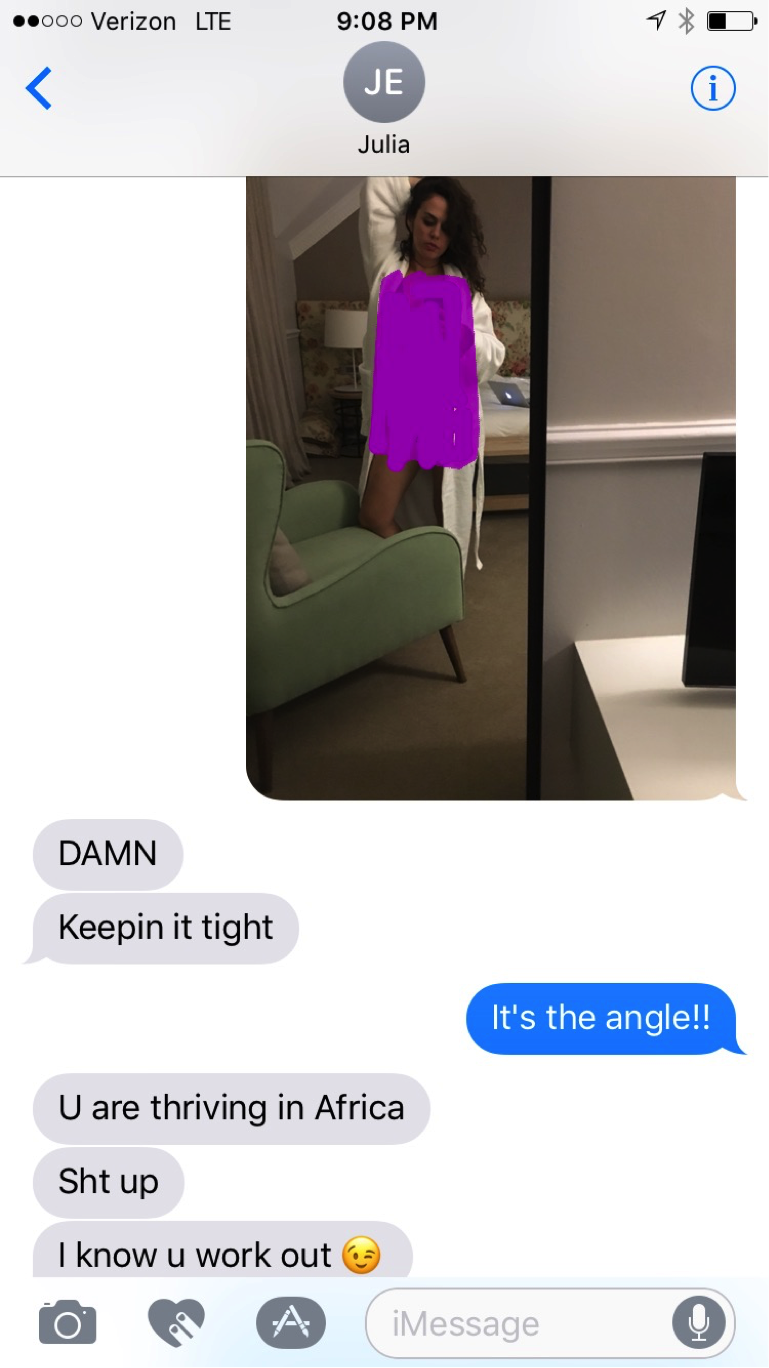
I open Snapchat and my friend is naked on the toilet, a beer in the background. She sent a selfie with the caption, "pooping," and I'm delighted she thought of me. "Happy for u," I type back. A few weeks later, I'm traipsing about a hotel room, wearing a robe that costs more than the retail value of all my jeans combined. I open the robe, flashing the full-length mirror, and snap selfies, putting one foot on a nearby chair and tilting my head, trying to find my light. I send the one I deem hottest to a few of my best friends. For a moment, I lament that I am single, that there's no man in my phone who deserves to see me naked. But then, for a much longer moment, I am overcome with a warm, cozy feeling of satisfaction and peace: I got to share my bod—which, to be clear, bums me out most of the time—with the people I love most.

While I've sent nudes to people I've dated, and in doing so figured out my most flattering (i.e. deceptive) angles, the best way to arch my back, the sneakiest way to round out my ass by way of phone angle, it's the mundane nudes I send to friends—some hot and some actually repulsive—that fill me with more delight than a sexting swap ever could, because to be real here, I'm not trying to see images of dicks. I'm just not. When I send nudes to my female friends, in explicitly platonic contexts and with consent, I'm celebrating my body with people who will celebrate it with me and—again—not interpret my feeling-myself moment as a dick ask. (To be clear, there is a time and a place for a well-timed dick pic, but so often their sexual interpretations of my nakedness get kind of boring—the same dicks from same angles, same phoned-in sexts—while the love and encouragement I receive from friends is anything but. (A male also friend told me, "My thinking is that no one is really super excited to see my dick," and most of the time, I agree.)

So why have nudes become so desexualized for me? I love to sext—and I'm a cross-platform, multimedia sexter—but for me, the written word is hotter, more sexually charged than a context-less organ image. "I haven't sent a nude in like four years," a friend told me. "I now opt more for sexually explicit text messages—less risk and more reward honestly. I have never gotten off on a dude's dick pic before, but I have gotten off on what a guy has written to me."

When you're sending sexy photos of yourself in the dead pigeon of a year that is 2017, trust is paramount, which is why the friendship nude is such a safe space to me; I've always trusted friends more than romantic partners. And over the past two months, my nudes have exclusively gone to friends, as I've made a concerted effort to avoid dating. (I'm busy! I want to get into plants! I don't stretch enough!) This means I'm not having sex, and I haven't for a while. And just as I've found other ways to take care of myself sexually, I've discovered other outlets for my naked just-woke-up-and-skin-looks-dewy photos and boobs-popped-out-of-my-bathing-suit-in-a-cute-way photos: my motherfucking besties. They cheer me on, as I do them when they send me theirs. Sex blogger Kate Sloan of Girly Juice told me that she sends her friends nudes for two reasons: "To be like, 'Should I send [person I'm dating/banging] this picture?' or 'LOOK HOW GOOD MY [butt/chest/mouth] LOOKS!!!'" A gay man, who shares nude photos with his gay male friends, told me, "We know each other very well and have a solid, shared sense of boundaries. We also really like genitals." Another woman explained: "Because it's fun! And my friends are hot."

I send my friends nudes as if to say, "Hey, look at my body, it's here, and it exists, and it's sexy— even when it hasn't had sex in forever and probably won't for forever longer, but that's fine, it's fine, I'm fine, ok? *nervous humming*"

Another text exchange with a friend.

When I start dating again, in whatever kooky version of the future wherein men stop being boring and rude to me, I'm sure as hell going to send nudes, because it's fun, and I'm not scared of the cloud—despite having seen at least 247 trailers for the 2014 romp Sex Tape, the very premise of which is the cloud's unreliability. Most of the people I spoke with for this story, in fact, said they didn't send nudes for fear of the photos getting out. One woman told me she doesn't even send them to her husband because "he's an idiot and would end up putting it on shared cloud with his mom."

Revenge porn is serious and horrifying, too, and it breaks my heart that many women I spoke with don't take nude photos of themselves at all, for fear of them getting into the wrong, vindictive hands. Our bodies are ours, and they are no less ours when we send photos of them to the people we love or even just like enough. Everyone should feel as comfortable sending nudes as my friend does sending them to me when she's pooping. I'm sad that's not the world we live in.

An old ex-boyfriend (who I hope doesn't interpret this shout-out as encouragement to contact me) had a password-protected file on his computer with naked photos of me that I'd sent him. When we were dating, I made him promise that he'd delete the file the second we broke up. When I tell men about that now, they say, "He 100 percent didn't delete the file," and if that's true, which I think it might be, I like to picture his face after jacking off to the photos, morose and remorseful about how badly he messed up, and I feel that's punishment enough for breaking his promise.

For More Stories Like This, Sign Up for Our Newsletter

This is all just to say that I'm never going to run for president or try to be CEO of anything. I don't even have a nice belt! Better to skirt the conflict entirely and bask in the hotness of friends, exchanging nudes to lift each other up and pass time on the toilet or in expensive robes. That is real love.

02 Nov 20:22

Feijóo nega que o único encarcerado polos incendios só asase chourizos: “Trátase dalgunha cousa máis”

by David Reinero

O presidente insinúa que posúe máis información da que trasladou a Xunta ou os investigadores sobre o único dos tres detidos ata agora que está en prisión provisional tras queimar unha hectárea das 35.000 que arderon na pasada vaga

02 Nov 20:21

La Xunta declara BIC el castro de Fazouro, en Foz

by EP

El Gobierno gallego ha aprobado este jueves el decreto por el que se declara Bien de Interés Cultural (BIC) el castro de Fazouro, en el ayuntamiento lucense de Foz, con la categoría de yacimiento arqueológico. Este castro, situado en el lugar de Punta do Castro, en Foz, posee, según la Xunta, "un indudable valor histórico y arqueológico" que se sustenta en que es el único poblado costero excavado y musealizado en la costa cantábrica gallega y, en este sentido, "un referente" para el conocimiento y la difusión de los valores culturales de la época castreña. Añade que, aunque en sus proximidades existen otros castros similares, "no con su grado de conocimiento y puesta en valor".

Seguir leyendo.

02 Nov 20:20

Trump Jr Thinks Sharing Candy Is Evil

By Randall Maynard,Katie Goldin  Published: November 01st, 2017 
02 Nov 20:20

Osama Bin Laden Had Anime And Disney On His Computer

By Katie Goldin,Andrés Diplotti  Published: November 01st, 2017 
02 Nov 17:03

One Punk’s Guide to Rap Music by Chris L. Terry

by admin

One Punk’s Guide to Rap Music originally appeared in Razorcake #96, released in February 2017. Here is a printable PDF and full text of the article.

If you like this piece and want to support Razorcake’s efforts, please consider subscribing to Razorcake.

The pages are sequential. We figured out how to do it on our end, but, man, printers are wildly different.
Here’s how you can do it:
To print this PDF using Adobe Reader (download free here)
(You need a printer with the ability to print on both sides on pieces of paper.)
Open Adobe Reader / Print
Pages to Print: All
Print / Under “Page Sizing and Handling,” select “booklet”
Booklet subset: Both sides
Sheets from: 1 to last page (varies zine to zine)
Binding: Left
Orientation: Portrait
The preview should show the back and front cover.

This zine is also available directly from Razorcake for $2.

One Punk’s Guide to Rap Music by Chris L. Terry

Illustrations by Art Fuentes
Original article layout by Todd Taylor.
Zine design by Matthew Hart and Marcos Siref.

The art of peer pressure

October 2012. I woke up when it was still dark and biked through Chicago’s Far North Side to catch a bus. I was teaching creative writing for a couple of nonprofits, and would sometimes spend half the day taking mass transit to different meetings, trainings, and classes. This morning, I was going to meet with a high school principal and sign paperwork that would allow two of my students to graduate. I was proud.

From my window seat, I sipped coffee and watched the sun rise over beige buildings, then get sliced by newly bare trees. The bus crawled down to the West Side, the black section of Chicago with less name-recognition than South Side.

I could have used more sleep, but I was excited to give Kendrick Lamar’s new album, good kid m.A.A.d city, my undivided attention during the hour-long ride. I was sucked in immediately by the first song, a precise tale of meeting a girl at a party, sneaking off in his mom’s minivan for a booty call, and getting cornered by gangbangers after parking on the girl’s block.

good kid is about coming-of-age in Compton, California, where violence and vices can suck  any young person in. Throughout the album, young Kendrick foams at the mouth after smoking laced weed, gets harassed by cops and gangsters who can’t believe he isn’t gang-affiliated, narrowly escapes arrest after breaking into a seemingly empty house with his friends, and sees one of those friends get shot by a rival.

Kendrick Lamar is an astoundingly insightful and technically gifted rapper. Throughout this album, his perspective is that of an innocent victim of circumstance. This isn’t a deflection. Listening to good kid is an empathetic experience. It makes you feel like these extraordinary bits of bad luck can happen to anyone, and that fifteen minutes can determine the rest of your life.

I’d been thinking a lot about how circumstances can narrow options while teaching high school students and incarcerated kids, who often had a heartbreaking amount of things in common. I led writing exercises that helped my students pinpoint their own turning points. I’d been wondering about mine, too; about things I’m proud to have done, and questions I wish I’d asked.

I was born in March of 1979, two months after the first rap record was ever released. That would be Rapper’s Delight by The Sugarhill Gang. It’s the song that starts off with some funky gibberish: “Hip hop the hibbit the hibbit to the hip hip hop ya don’t stop the rocking…”

You know it.

My parents didn’t play it in the hospital when I was born, but I feel like I’ve been hearing that song for my whole life. In my geekier moments, I’m pleased to be the same age as rap music. We’ve grown up together.

Before I loved punk, I loved rap

It started like most hip hop stories: with educational television.

For those of you not born at the ass end of Generation X, Square One was a public television show that used funny sketches to teach math. I loved it, maybe because my hippyish parents didn’t sanction much TV watching, and I had no real sense of my options.

One evening in 1987, eight-year-old me was watching Square One when this skit came on with funky music and three guys standing outside of a snack truck, shouting about eating lots of burgers. In between verses, one of the guys imitated the beat with his mouth. Out in my suburb, it was the coolest thing I’d ever seen.

At dinner, I tried to beatbox, too. Spaghetti flew. My dad told me to “stop spitting.” I told him and my mom about what I’d seen—the group was called The Fat Boys. That weekend, Dad took me to a record store in Boston, and I picked out my first tape, The Fat Boys Are Back.

The Fat Boys were a New York rap trio originally known as The Disco Three. Their manager remade them as an approachable, humorous act, and this earned them success in an era when the mainstream still viewed rap as profane and far too black.

In the mid ‘80s, The Fat Boys were in a watch commercial, released the legendary “All You Can Eat” video (set at a Manhattan pizza buffet, of course), collaborated with The Beach Boys, and even starred as nurses in a movie called Disorderlies, which features a boob scene that my goon friends and I rewound a solid dozen times at my ninth birthday party.

The Fat Boys were essentially the prototype for the rapping cartoon animals you see in ads for macaroni and cheese, but I’d say that their music is more than just a novelty. Next time you’ve got a few minutes to kill, go online and pull up some of their videos and TV appearances. There are none more likeable.

Raising Hell

To paraphrase Notorious BIG, I let my Fat Boys tape rock until the tape popped, and was talking about it in my third grade class when one of my classmates said, “Oh, you like rap? Do you like DMC? My babysitter likes them.”

This led to my first moment of geeky jealousy, where I suddenly had to know everything about this cool new bit of pop culture.

That night, I asked my dad about DMC.

“Never heard of them,” he said, shaking his head.

My father is a big music fan. By then, he’d already exposed me to music that I still love—Prince, Jimi Hendrix, Muddy Waters—by pulling their LPs from one of his many particle board record crates and cranking them on the living room stereo. Realizing that there was interesting music that he didn’t know about was a big moment. I’d just found out that there was a whole world out there beyond my house.

But Dad wasn’t going to be outdone.

Later that week, I came home from school to find this purple and green record propped up on the hall table. On the cover was a photo of two black guys standing in front of a tall window in leather jackets and fedoras.

Dad swooped in from the kitchen, snapped up the record, and led me to the stereo by the piano.

“They’re not just called DMC,” he said. “They’re called Run-DMC. I guess that’s their names.”

“Which one is DMC?” I asked.

Dad was already sliding the record out of the sleeve. “I don’t know. The clerk at The Coop didn’t tell me that.”

He put the needle down and it was just two voices, louder than I was allowed to speak at home. The first guy shouted, “Now Peter Piper picked peppers,” then the other guy chimed in, “But Run write rhymes.”

They went back and forth a couple more times, then these big drums with bells kicked in. Dad moved to block the record player, a habit from years earlier when my sister and I would dance to Michael Jackson.

Run-DMC’s Raising Hell was my first LP, and I’ve still got that copy, complete with abrasions at the beginning of “It’s Tricky” from the time I almost lost my stereo privileges by trying to scratch it on the family record player.

Most thirty-year-old rap sounds quaint now, but Raising Hell is still a thrilling listen. Rick Rubin’s production is super stripped down. The bulk of the music consists of nothing more than the two MCs’ voices, trading shouted bars over swaggering, bare bones drum beats. Sounds as simple as record scratches, bursts of electric guitar, and extra percussion come in as hooks, but the songs never feel rudimentary or half-cooked. It set the quality bar high for rap records, and I can hear its influence to this day, from the way “My Adidas” inspired tons of rappers to give free product endorsements to giant corporations, to bare bones (and also Rubin-helmed) records like Yeezus by Kanye West.

I’m also reminded of rock bands like AC/DC and The Ramones, who used minimalism for maximum impact. And, speaking of rock’n’roll, the biggest song on Raising Hell is a remake of Aerosmith’s boogie rock classic “Walk This Way,” featuring two members of the band. This single was a smash hit, and is generally credited with (or blamed for) bringing rap music to a white, suburban audience.

The suburbs, and transitive theory

My family—my black father, Irish-American mother, and equally mixed little sister—lived in an upper middle class Boston suburb through the early 1990s. There were hardly any black people around, and I often joke that there were none of us left after two unrelated events: black boy-band New Edition’s breakup and our family’s move to Virginia.

In Massachusetts, most of my classmates were Jewish. Even though we celebrated different holidays, a lot of my friends and I had similar curly hair and full lips. I didn’t feel like I stood out until adolescence set in, and I got old enough to understand that I had a different heritage. I wanted to know more about myself, and rap music was my way into a black identity.

I’ll spare you the oft-told story of rap’s genesis in the black communities of blighted, 1970s New York City, and just say that rap is a black art form. It didn’t cross over to mainstream <ahem, white> audiences for a solid decade, and more than twenty years went by before Eminem showed up and destroyed the idea that white rappers lacked the skills to pay the bills. That cultural fortitude is incredible. It took white people two minutes and seventeen seconds to hijack rock’n’roll from Chuck Berry and Little Richard in the 1950s. And think about how quickly any idea can go global now.

This is all to say that, in suburban Boston, in the late ‘80s, there was still a sense that rap was a dangerous inner city movement. Even when I was only ten years old, classmates would crinkle their noses and ask why I liked it.

This created a conflict for me, a black fish out of water. While listening to controversial music appealed to my budding rebelliousness, I was drawing connections using the transitive theories I was learning in math:

If Rap = Black
and I = Black
then I = Rap

Cool!

If Rap = Black
and Rap = Not around here, buddy
then Black = Not around here, buddy

Uh-oh!

If I = Black
and Black = Not around here, buddy
then I was in a hostile environment.

Run!

Realest babysitter alive

Preteen-me fed his growing record jones by babysitting. One day, a mother asked me to come by to meet her kids. My mom drove me over. We both felt a little weird going in, because this woman was a stranger, and the first person to ever request an interview. Maybe that’s why things got awkward, fast.

The prospective client wanted to talk to me more than she wanted me to hang out with her kids. I stood at the bottom of the stairs, in the house’s foyer, while late afternoon sun streamed through the window between the tall plants in her front yard. My mom stood by the door. I was eleven, mainly concerned with hunting down R-rated movies, and completely unaware of the way a white adult might take my tall frame, scowl, and pubescent deep voice.

I told her I liked rap. She asked if I liked MC Hammer, who was all over the radio that year. I screwed my scowl tighter and said, “MC Hammer’s a sellout.”

My mom’s palm slowly rose toward her forehead. The interview ended shortly after. In the car, my mom told me I’d blown it. I said I didn’t care.

These days, rap is the dominant form of music in the United States, so it’s hard to believe that, a quarter of a century ago, a debate was raging in the hip hop scene over whether rap music should cross over and go pop, or maintain its cultural and artistic integrity in the underground.

Keeping it real can mess up your business—be it music or babysitting—but as someone who linked his hip hop bonafides to his wobbly new black identity, I skewed toward the most hardcore gangsta and political rap I could find. This led to conversations like this with my father:

Me: “Who’s Farrakhan?”
Dad: “Some clown who makes people who need help feel better about themselves.”

And:

Me: “If ‘Ho’ is short for ‘Whore,’ is it spelled W-H-O, like ‘who?’”
Dad: “I think it’s just spelled H-O, but don’t say that word. Your mother will be upset.”
Me: “Okay. … But, that messes up alphabetizing it.”
Dad: “I don’t think ‘ho’ is in the dictionary, but really, it’s best to just not say it.”

I heard “ho” in gangsta rap. The most popular stuff was based in L.A., where NWA had helped to kick off the movement a few years before with their album Straight Outta Compton. Compton garnered a lot of controversy for luridly violent lyrics and a song called “Fuck Tha Police.” NWA were nothing if not direct, and grade school me relished every cuss word.

I heard about Farrakhan, the black Muslim leader who claims to have been abducted by Jewish aliens, in political rap like Public Enemy, Ice Cube, and the X-Clan. In addition, they discussed black issues of the day, which are sadly identical to current concerns: state-sanctioned police violence, mass incarceration, and the cycle of disenfranchisement in poor neighborhoods.

The gangstas thought pop rappers like MC Hammer were wimps. The political guys thought they were sellouts. And they did sell. Think of songs like “U Can’t Touch This” by MC Hammer, “Bust a Move” by Young MC, and “Ice Ice Baby” by Vanilla Ice. To this day, they fill dance floors at otherwise awkward social events like weddings and work parties, and for good reason: they’re catchy, energetic, and patently inoffensive—designed to bring people together, for better or for worse.

Rap vs. Hip hop

Generally, rap is the music while hip hop is the culture that surrounds it.

To call music hip hop is to tie it to certain aspects of the culture. For some, hip hop must include the original Four Elements of 1970s hip hop: MCing/rapping, graffiti, b-boying/breakdancing, and DJing. For others, hip hop’s Golden Age (beginning with the release of Run DMC’s Raising Hell in 1986 and ending in late 1992 with Dr. Dre’s The Chronic) is the standard. This era’s rap had sample-based music and vocals which emphasized lyrical intricacy over melody. Some of rap’s most iconic music came out at this time.

Preserving either of these eras in amber goes against their innovative spirit. That’s why I prefer to say “rap;” it leaves room for the new ideas that constantly spring up.

With that in mind, this narrative is moving into the 1990s, the most formative years of my life, and what many fans would say was the best decade for rap. Since one of my favorite current groups, Shabazz Palaces, says, “Every time we move, we do it straight up,” I’ll try my damnedest not to come off as stuck in the past.

I mean, the ‘90s sucked

Minimum wage was $4.25 and CDs cost seventeen dollars. You’d have to work half a day to gamble on an album that might have three good songs. Meanwhile, only a few people had the internet, and the ones I knew who did weren’t into rap. I got music by dubbing tapes from my friends’ cool older brothers, and spending my babysitting, birthday, and Christmas money on tapes and CDs. My dad, forever supportive of a fellow music fan, would always help me stretch my cash, and would usually let me play my new tapes in the car. I loved riding with him.

It was 1991, the day after Christmas, and I was sitting in the family car while my dad was in the grocery store. I’d stayed behind to listen to “Check the Rhime” by A Tribe Called Quest, the song it had taken me most of the drive to cue up on my new tape.

The Source and every other scrap of hip hop media that I could find said this album was a big deal, and I liked “Check the Rhime” when The Fly Girls danced to a snatch of it on In Living Color. It was cool without being “too cool for you,” and struck a rare balance between sounding refined and lighthearted. The jazz samples gave the music a warmth that I will forever associate with car heaters, ski jackets, and other defenses against the winter cold up north.

I turned the music up a bit, looking through the windshield at the gray snowbanks and the bundled-up suburbanites picking their way across the icy lot and into the market. LL Cool J and Terminator X had songs about pumping hip hop in your car, and I felt like I was taking part in a rite of passage by doing the same. I nodded my head to the beat.

Then Dad—the only black man in sight—came out of the store and hurried toward the car. In the driver’s seat, he frowned, turned the music way down, and said, “We can’t play it this loud.”

“Why?” I asked. “It’s just the car. It won’t bug Mom.”

“But it can still disturb people,” he said, pulling out into the light holiday traffic.

This was just a few months after Los Angeles cops were filmed beating Rodney King during a traffic stop, and the story had been in the news all year. Still, I failed to connect that nightmarish, grainy video to our lazy morning, even though both revolved around black people behind the wheel. Blasting rap in the car, even something as benign as A Tribe Called Quest, could draw the type of negative attention that throws you to the ground, with half a dozen cops going to town on your head, ribs, and crotch with nightsticks.

I couldn’t verbalize it when I was twelve, but I remember finding A Tribe Called Quest accessible in a way that other rap groups weren’t. Tribe had a middle class perspective, and seemed like guys I could be friends with. Seeing some of my own experience and potential in their music gave it more meaning, and began to add dimension to my idea of myself as a black person. It got me thinking that the experiences I was already having were black, because I was having them.

The album with “Check the Rhime” is called The Low End Theory. It’s loaded with spacious, jazz-based music, and lyrics about dealing with the group’s newfound success. “Fame is hard” albums can be a drag, so a lot of people ride for the follow-up, 1993’s anthemic Midnight Marauders. I prefer Low End Theory because it was my first, but both albums are essential.

A Tribe Called Quest were part of a colorful, bohemian-leaning New York crew called the Native Tongues, that also included De La Soul, The Jungle Brothers, and actual women—Monie Love and Queen Latifah. They were among the first well-known alternative rap artists, and pioneered a jazz-rap sound that inspired some other crucial ‘90s albums like Gang Starr’s deadpan Hard to Earn and Daily Operation, and Digable Planet’s slept-on, Black Power-chic 1994 swan song, Blowout Comb.

I used to make myself mixtapes

There’d be rap on one side and alternative music on the flip—Nirvana, Fugazi, and the punk bands I’d found by working backwards from them. I couldn’t figure out how to flow the two styles together, so they existed on opposite sides of the tape.

We had a boombox in my middle school homeroom, and I was quietly playing the rap side of my latest mix one day. The first song was “‘93 ‘til Infinity” by Souls Of Mischief, a crew of motormouth Bay Area teenagers who’d got their hands on the second most iconic horn blast in hip hop history (The first? “They Reminisce Over You” by Pete Rock & CL Smooth). This guy Dave who used to wear his older brother’s Doc Martens but then started hanging out with the preps screwed up his face and said, “You like rap? I thought all you skaters just liked classic rock.”

Dave may have been the last teenager on earth to learn that hip hop and skateboarding were cross-pollinating—maybe because hip hop had become a global force, maybe because the new popularity of street skating brought skateboarding to racially diverse urban areas. Regardless, I shrugged, pointed from the speaker to my griptape-shredded sneakers, and went back to bobbing my head and trying to flirt with the only girl at school who had Manic Panic’d hair.

Souls Of Mischief were part of Hieroglyphics, a young rap crew who went independent early on, and continue to collaborate. In addition to the first Souls album, give Del the Funky Homosapien’s first two albums (I Wish My Brother George Was Here and No Need for Alarm) a spin—he’s got a bottomless vault of P-Funk samples, and a great sense of everyman humor, like on the song “Sleepin’ On My Couch.” Want to get grittier? Casual’s Fear Itself will do you right, especially “Lose in the End” about the People’s Park riots. Maybe it was being from the skateboard-friendly Bay Area, but I think their popularity with skaters was indicative of a bigger cultural shift.

A lot of white ‘90s music mashed up different genres, created by different races of people. The Beastie Boys alternated between rapping about arcane ‘70s pop culture, playing instrumental soul, and ripping through hardcore songs. Beck rapped lackadaisical non sequiturs over a bluesy slide guitar. The Jon Spencer Blues Explosion played a dumpster-dived mashup of Elvis Presley, Isaac Hayes, and James Brown.

This global magpie ethos was liberating for me at the time. It made me feel like my blackness and my whiteness didn’t have to be oil and water, and that the right song off the Beasties’ Ill Communication could create a bridge between The Meat Puppets and Wu-Tang on one of my mixtapes.

It’s funny to feel nostalgic for that era now. At the time, white musicians’ clumsy appropriation seemed like an effort to prove that they weren’t closed-minded racists. But the movement that they set in motion has evolved. Now, the fake Jamaican accent in a third wave ska song, or the Beastie Boys’ take on meditative Buddhist chanting can sound more like colonization than liberation.

1, 2, 3 and to the 4

It was near the end of eighth grade and I was skateboarding in a train station parking lot with a few guys from school. It was one of four commuter rail stops in our town, and we loved grinding and sliding our boards on this one’s tall yellow curbs. This day, something I’d only read about in Thrasher Magazine had happened: girls came to hang out.

Melanie and Kate used to run with the preppy crowd but, they’d come into this school year wearing trendy alternative clothing, like black bellbottoms and super-long knit hats, and started hanging with the skaters. I wasn’t one of the cool skaters, so this didn’t do much but confuse me. I wanted a girlfriend, bad, but I thought being a skater was about being an outsider. Melanie and Kate weren’t outsiders.

They were sitting in the middle of a small traffic island, twisting a pair of headphones to play into both of their ears. I was gearing up to try and impress them by doing a noseslide on the curb at their feet.

Then I heard Melanie rap along with her music, “1, 2, 3 and to the 4.”

Kate smiled and added, “Snoop Doggy-Dogg and Dr. Dre is at the door.”

Later, I’d read that Dr. Dre’s 1992 album The Chronic changed everything for rap. It glossed up gangsta rap’s sound (but not lyrics) and got it on the radio. Commercial ambition and antisocial subject matter started to work hand in hand, and rap hit an even bigger audience, leading to all sorts of awkward shit, like white kids at my Boston school assuming black L.A.’s drawn-out, nasal cadences as they rapped Snoop Dogg songs.

Dre’s biggest albums—The Chronic, Snoop Dogg’s Doggy Style, and NWA’s Efil4zaggin—are still incredible feats of production, with deeply funky samples layered one on top of the other and blown-out to hi-def cinematic proportion, but the lyrics are hard to take if you’ve ever cared about someone who isn’t a cis straight man. There are a lot of bitches and hoes in there, never mind the oddly homoerotic disses (they tell a lot of people to suck their dicks).

I wasn’t thinking that big that afternoon at the train station. When I heard Melanie and Kate rapping, my board clattered into the street. I marveled at how I spent so much time trying to get my own thing going, away from the rich snobs who made me feel excluded at school, and now two of them were hijacking my favorite skate spot, singing along to a tape I’d owned for months. That same broadsided feeling would pop up later in life, too, when drunk randos tried to start trouble at punk shows, or competitive grad school classmates started asking too many questions about what I was writing, but this was the first time I’d ever felt like my sanctuary had been invaded, maybe because it was my first sanctuary.

From Where???

My dad had been out of work for a while, and my parents decided to move us to his inexpensive hometown: Richmond, Virginia. I’d lived in the same house for my whole life, and definitely did not want to leave. It took us over a year to actually go, and in that time, there was some discussion of staying. This uncertainty made that year feel like an eternity, and by the end, all I wanted was stability and close friends nearby, but did not have either.

The last couple rap tapes I got before finding out about the move were The Pharcyde’s Bizarre Ride II The Pharcyde and Kill My Landlord by The Coup, and I played them for all of ninth grade, trying to recapture the innocence and excitement I felt when I plunked down my birthday money and bought them at the Tower Records on Newbury St. They were cool. They were things I’d sought out on my own, and I trusted myself.

The Coup are a Marxist hip hop collective from Oakland. Most of their cheeky protests and references to Maoism went over my head, but their music was organic-feeling funk, and MC Boots Riley’s sarcastic tone matched my mood.

Almost twenty-five years later and I’ve yet to take The Pharcyde’s first album out of rotation. If streaming counts, I’ve owned it on five formats. The Pharcyde were a quartet of cartoon-voiced young guys from Inglewood, California who traded fast rhymes about madcap everyday adventures—fucking each other’s moms, crushing on teachers, waiting for the guy with weed to show up—over super upbeat music. Listening to the album is like watching Roadrunner and Tom and Jerry at the same time, plus it’s loaded with funny quotables like, “I got more flavors than 7/11 Slurpees, and if Magic can admit he got AIDS, then fuck it, I got herpes.”

Even moreso than A Tribe Called Quest, The Pharcyde sounded like a close-knit group of friends clowning each other on the bus, and I wanted that in my life so bad.

Do you wanna get $

Things did not go well in Richmond. We lived with my grandparents, then got an apartment. My Ivy League-educated father still couldn’t find work. I could read out loud without stopping, so I got put in Honors English where we memorized lists of verbs. I got a girlfriend and she cheated on me. I felt like a loser, and like there was no point in risking more humiliation by trying to win.

My favorite rap groups put out uninspired new albums. Puff Daddy and Mase ruled the airwaves with slick and flossy rap that celebrated overcoming adversity, however briefly. I felt like they were rubbing their success in my face. I hated it.

A skater friend took me to a five-dollar punk show at a club in our neighborhood. I loved seeing band members step from the crowd onto the stage to play weird and aggressive music that sounded like inside my head on the nights I couldn’t sleep. It was inclusive. I felt like I could do it. I was hooked.

Blackout

I spent the next three years exclusively into punk and hardcore, peppered with record store guy rock like T. Rex and Big Star. My band drove up and down the coast playing skate parks and gutted tire shops for thirty people. I wrote zines and printed them for free in friends’ parents’ offices. By doing, I was succeeding, and that was something I didn’t think I could achieve elsewhere.

I spent those three years denying myself as a black person. I surrounded myself with white people who didn’t listen to black music. At home, I’d put on headphones and sneak Curtis Mayfield, or worn-out tapes of old rap favorites. I felt awkward around black people, like I was letting them and myself down, but didn’t know how to stop.

I floated in a world that did not seem sustainable, and wanted to create a safety net. Reveling in not having a net requires a fearlessness that’s contrary to my black middle class upbringing. We’ve just arrived and always feel ourselves teetering. So, I couldn’t give myself over to the nihilism of the traveling gutter punks (or gangsters), and I didn’t have the privileged comfort of the white punks who treated this bare-bones lifestyle as an ethical choice.

In my blackout, I missed the Wu-Tang Clan’s murky, mystical, and unimpeachable run of mid ‘90s solo albums (Liquid Swords, Only Built 4 Cuban Links, Ironman). I missed the way the Notorious BIG could say so much with the space between his perfectly chosen, simple words (Ready to Die). I missed the grand detail of Nas’s street narratives (Illmatic). I missed social and cultural touchpoints that would have made it easier for me to relate to the black people I now saw everywhere in Richmond, where they’d never been in Boston.

White hip hop fans bum rushed my life

The harmonica-playing stoner at my bakery job stopped staring into the giant stainless steel bread mixer for long enough to say, “Man, Wyclef is like the next Bob Marley.”

The music on the stereo was a mix of old soul and the boho rap I used to like, shared with an island accent, so I picked up his solo debut, The Carnival, and found a used copy of The Score, the blockbuster second album by him and Lauryn Hill’s group The Fugees. I played these albums before bed, thinking that the Native Tongues had passed Wyclef the torch, and feeling that particular punk rock guilt of loving something mainstream.

I went to visit Boston and my friend Mike had spent the last few years buying records. We sat in his bedroom, where he had set up DJ-grade turntables, and he spun Mos Def and Talib Kweli are Blackstar, a collab album by a couple of underground giants from Brooklyn. They were part of a scene that existed in opposition to what was on the radio, and I found myself agreeing with their scorn for commercial rap, but stopping short of wondering about the long-term possibilities of existing solely to resist. I chased the ripples of their work outward, and got the answers before I could raise the questions when I threw on Mos Def’s Black on Both Sides, a classic album which explores black life, starting off by saying:

“We are hip hop
So hip hop is going where we going
So the next time you ask yourself where hip hop is going
Ask yourself, where am I going? How am I doing?
Til you get a clear idea.”

A goth hockey jock I met in college (Yes, this was the late ‘90s) invited me to his dorm. His white, proto-Juggalo roommate put on Aquemini, the third album by Outkast, the Atlanta duo who put southern rap on the map.

I remember feeling right at home with Outkast’s drawls and humid, soulful music, until the roommate started complaining about how loud “the niggers on (his) dorm floor are every weekend.”

My goth friend and I showered him with, “What the fuck?”s and I left shortly after, borrowing the CD, torn between feeling like this racist didn’t deserve great black music, and thinking I should return it, so he could work out the kinks in his worldview, one unrepentantly black and eccentric Outkast track at a time.

We could have fixed the van’s tape deck, but…

We were a bunch of broke twenty-two-year-olds and that money could go to the bean burritos and cheap beer that sustained our band on tour.

We figured that no tape deck meant no arguing over music, so we listened to the radio. The early 2000s were an innovative time for rap. Outkast was simultaneously getting quirkier and more popular with their Prince-obsessed album Stankonia. Virginia spawned two futuristic producers: the Neptunes, which featured a young Pharrell Williams and created pulsing, ticking minimalist beats for Jay-Z, Snoop Dogg, and The Clipse; and Timbaland, who composed gigantic, shuddering synth opuses for Bubba Sparxxx, Justin Timberlake, and Missy Elliott, a funny, body-positive, hard-partying woman rapper from Virginia Beach.

When Missy’s “Get Ur Freak On” or “Grindin’” by The Clipse comes on, I’m transported back to the bench seat in that beat-up band van, where I’m glugging gas station coffee and staring out the window at the gray interstate, thinking there was fun in the world that I could finally have.

Do You Want More?!!!??

My band broke up after a hundred-day tour and, at twenty-four, I was feeling like the old guy at the party in Richmond. I decided to join my sister and some of my friends in New York City, where they were either working for book publishers or just able to go to the store and not run into half a dozen people they could gossip about.

When I left, some of my Richmond friends said, “Whatever. See you in six months.”

Being around people who couldn’t imagine living elsewhere made me feel like a dick for thinking Richmond wasn’t good enough. Who was I to want more?

I started to understand the aspirational rap that had turned me off in the mid-‘90s—how it strived, and celebrated finally having nice shit. I didn’t need to reach Mase’s “On a yacht, nigga/fuck a boat that row” level of stunting, but I wanted more than just white people around me. More than getting trashed four nights a week. More than minimum wage, to use more than my hands and back.

Kanye West made me feel like that was okay.

His first album, The College Dropout had just come out. Gangsta rap was popular, and people didn’t know what to make of this professor’s son who rapped about self-consciousness, stupid retail jobs, and HBCUs. He was a spazzy preppy underdog who refused to choose sides and worked with conscious, underground rappers like Common and slick mainstreamers like Jay-Z.

It made perfect sense to me.

Kanye has always been an egotistical loudmouth, who interrupts awards shows to give his opinion on the nominees, and says the first thing on his mind during a TV interview. This arrogance is the main reason that his haters don’t like him, but I see it as a form of self-love.

When Kanye says that his new record’s, “not album of the year. It’s album of a life,” I hear another black hero like Muhammad Ali and Prince, who needs to emphasize his prowess to close the gap between his abilities and a world that expects and accepts so little from black people. We have to be twice as good to be recognized. We have to shout twice as loud to be heard. We have to believe in ourselves, because no one else does.

I can’t decide if this form of self-love is in line with punk’s empowering Do It Yourself autonomy, or against its egalitarian humbleness, but it sums up my conflict as a black punk rocker. Ultimately, I hope to draw from Kanye and, say, Fugazi: working to achieve the best while trying to see all as equals.

I played The College Dropout in the moving van that I drove to Brooklyn. When I pulled the CD out of the stereo, Kanye’s chipmunk soul beats were on half the songs on the radio—from Cam’ron’s strange, funny, and vivid Harlem narratives on Purple Haze, to Common’s golden, soulful tributes to black life on Be.

Kanye evolved as I grew up. I got chills when “Diamonds from Sierra Leone,” a song about the cognitive dissonance needed to be a consumer and an oppressed person, debuted on the radio while I was in a Manhattan office building, realizing that I hated my first job that didn’t involve a cash register. I listened to Graduation during my first vacation as an adult. I played Yeezus during an insomniac run along the Chicago lakeshore, trying to beat the anxiety out of my head as I anticipated the release of my first novel.

From forlorn autotune to gospel interpolations, Kanye always tries something risky, and always proves himself to be ahead of the game. While I don’t love all of the trends that he has kicked off, I can’t hate the innovator for his imitators—especially when his music has followed me, eliciting some of my most powerful emotional reactions to art. I’ll cry when I hear a new Kanye song, just like I did the first time I saw Prince step on a stage in person, or like I do almost every time I hear President Obama speak. I feel overcome with emotion because they make things feel possible.

While his music and persona have grown increasingly erratic in the last few years, I could still make a strong case for any Kanye West album. His masterpiece is My Beautiful Dark Twisted Fantasy, a proggy epic made in the emotionally drained years after his mother died. Every song’s production is gigantic and unique, and his lyrics are the most extreme examples of the tension between his arrogance and self-awareness. On a song like “Power,” he sounds triumphant and suicidal all at once, and listening is the audio equivalent of speeding off a cliff.

One time for me, one time for the DJ

Some of my strongest memories are brief snatches of running—a view that I passed, and the song that was on my earphones at the time. I see the sun through the trees near the soccer fields at the bottom of Prospect Park whenever I hear the part of Lil Wayne’s “We Takin’ Over” freestyle where he careens off the rails, ditching the song’s stunning, complicated phrasing, and spitting choppy words, “Beef. Yes. Chest. Feet. Tag. Bag. Blood. Sheets. Yikes. Yeeks. Great. Scott. Storch, can I borrow your yacht?”

I’d finish these runs relaxed, with my head full of ideas. I was in my late twenties and looking for the creative thing that would balance the responsible adult life that I’d been building, to give me a stronger sense of purpose, and bring me the fulfillment that I wasn’t finding.

Lil Wayne is a New Orleans MC who got his start as a teenager in the delightfully sleazy Cash Money/Hot Boyz crew, the same party animals who brought us “Bling Bling” and “Back That Azz Up.” Wayne had a bunch of hits, but no one had him marked as a craft-based contender for Best Rapper Alive. This changed in the mid ‘00s, when he released a nonstop stream of psychedelic, word-drunk mixtapes for free online. Releases like Da Drought 3 and Dedication 2 were loaded with tangled raps about addiction, depression… and blowjobs over the hottest beats of the day. Maybe Google’s algorithms know my interests too well, but Wayne’s name comes up first when I search the names of some of those original songs.

50 Cent may have been the first rapper to get a record deal by releasing mixtapes, but Wayne proved that releasing music for free online could be a smart artistic and business move, and it still has a strong hold on the ever-flailing record industry.

I wound up in Chicago, getting a Master’s Degree in Creative Writing. During afternoons spent writing, I’d hope that my most imaginative pages would find their way out of my computer and flood the world like Wayne’s music.

A word about mixtapes

At first, mixtapes were actual cassette tapes, made by taste-making hip hop DJs, and blending together the latest hits with rarities and tracks from up-and-comers. Over the decades, the format morphed. Now, a mixtape is a rap album that’s available for free online. As record sales drop across the industry, a lot of recent artists have built careers around releasing album-quality mixtapes for free, and making money by touring and shilling for different companies.

Regardless of how you feel about seeing your favorite rapper in a soda commercial, mixtapes give the musicians greater artistic control. They’ve no longer got the label in their ear, telling them to hop on trends or collaborate with popular artists. Instead, you get the musician’s complete vision, and for free.

Some great examples:

Run the Jewels, II. This is the safest bet for a punk rocker who wants to hear some current rap. Killer Mike is a community activist and former Outkast protégé. El-P used to run the label Def Jux, whose motto was “Independent as Fuck.” El-P, known for a dystopian sci-fi style aesthetic, produces beats that make you feel like you can rip the roof off a Chevy. Listening, you get the sense that they’re close friends. Both guys rap, trading rapid-fire bars while bringing out the best in each other—Killer Mike’s southern bounce adding structure to El-P’s clots of words while El’s metaphors inspire Mike to dig a bit deeper personally. Their shit-talk is pro wrestling level ridiculous, and they rap about police violence, government surveillance, and wack rappers with a shockingly personal touch.

Chance The Rapper, Acid Rap and Coloring Book. Chance is an A-list rapper who is not signed to a label, and does not sell his music. He’s a nimble MC with a voice like a jazz trumpet and a penchant for warm-hearted positivity that rarely cloys, because he knows how to balance it with insight and ambivalence. Acid Rap is him being like, “I’m twenty, some of my friends have died, my folks want me to go to college, but I need to drop acid and figure out what these dreams are that I’m chasing.” Coloring Book came out three years later, and has a more nostalgic feel. The songs about god skew too far toward music theatre for my taste, but you can practically see the lightning bugs as Chance raps about summers past.

Danny Brown, XXX. Danny Brown’s a Detroit rapper whose high-pitched yawp of a voice obscures that fact that he’s a technically gifted rapper who draws super-personal connections between trauma and partying. Before he got on the festival circuit by rapping over bombastic EDM, he released XXX, a Wu-Tang raw collection of songs like “Scrap or Die,” about scavenging for sellable scrap metal in abandoned houses.

Das Racist: Shut Up, Dude and Sit Down, Man. The New York duo of Heems and Kool AD made brainy and stoned rap satirizing to-the-minute hipster culture and people’s reactions to their brownness—Heems is Indian-American, Kool is Latino. My favorite song is “You Can Sell Anything,” where Heems raps, “What good is all your money if your style’s still tasteless?/I celebrate the fact I moved into my momma’s basement.”

Shabazz Palaces: Black Up. Shabazz Palaces didn’t release their stuff for free online, but should be mentioned here for their contrary nature. In an age where artists cultivate an air of accessibility through social media, Shabazz did the opposite. No one knew who they were for two EPs, and their Afrofuturistic music had to be taken at face value. Come to find out that they’re a Seattle-based duo, featuring a former member of Digable Planets. They combine booming old school drums with space age synths and live African percussion, and Black Up is one of my favorite albums because it sounds like a cool breeze in the dead of a stifling hot night.

I was insecure because I realized/ain’t no room for the civilized

The world came at me hard in 2012. My parents’ money troubles had them in their least stable position yet, and I wanted to help but hardly could. I’d just finished grad school and was juggling part-time teaching jobs while finishing my first book. I was seeking a stable life as a creative person—two things that can feel mutually exclusive. I felt greedy for following my heart.

Killer Mike’s RAP Music spoke to this conflict. Mike was in his late thirties and contemplating retiring from rap when he first paired with producer El-P to make a classic album that shoveled personality and pathos into the hard-hitting political rap of Ice Cube and Public Enemy.

RAP Music (RAP being an acronym for Rebellious African People) spoke to my conflicts—the excitement of small victories, nostalgia for simpler times with your family, the ways that race-based trauma can ripple through generations, and the dissonance between loving where you’re from and hating the way that it treats its citizens.

It felt like a perfect portrait of the conflicted black adulthood that I was seeing in myself, and I played it over and over—while cooking on my one day off from a sixty-hour workweek, while staring out over houses from the Red Line train, and while running along the Chicago lakeshore and staring at the distant downtown. The trunk-rattling beats dredged up history and pushed me forward, embedding Mike’s nimble cascade of lyrics into my own consciousness.

I felt like I’d found the friend who’d tell me to do better, who I’d sometimes tell to shut up. I played it over and over. I did better. I shut up. This record was me, exaggerated, in the old-school Cadillac I’d never drive. Like Mike says in the title track, “This is what my people need and the opposite of bullshit.”

///

Chris L. Terry’s debut novel Zero Fade was on Best of 2013 lists by Kirkus Reviews and Slate.com, and shortlisted for the American Library Association’s Best Fiction for Young Adults. He lives in Los Angeles, and has contributed to Razorcake since 2006.

///

Art Fuentes: Born in East L.A., like every good Mexican boy, Art was raised in the Imperial Valley of California, where he was bathed in cartoon and monster movie glory from both sides of the border. He began scribbling at a young age and later found out he could get paid meager wages to do artwork and illustration. He currently lives in Orange County CA and spends his time spilling ink on his drawing board and trying to sell his paintings.

///

The best way to never miss an issue of Razorcake is to get a reasonably priced subscription delivered to your door. Click the link below.

The post One Punk’s Guide to Rap Music by Chris L. Terry appeared first on Razorcake.

02 Nov 17:02

Fallece el cantante de beat y twist, Tony Vilaplana

by Magic Pop
Tony Vilaplana

Nacido en Sabadell el año 1945, Tony Vilaplana fallecía el pasado dia 30 de octubre de 2017. Durante su carrera musical que va de 1962 a 1966 grabó 13 Ep’s, dos de ellos en catalán, más uno censurado; el resto en castellano, con varias canciones de twist, beat y rock and roll. 

Antoni Vilaplana trabajaba desde los 14 años en una fábrica textil cuando sus compañeros le animan a presentarse a un concurso de Radio Sabadell. Llega a finalista y se clasifica para cantar en Radio Barcelona.  El locutor Joaquín Soler logra que Vergara le grabe un disco.  En noviembre de 1962, con 17 años,  graba cuatro canciones con un equipo portátil en el local de ensayos del orfeón del barrio de Gracia, en Barcelona.  La canción principal del EP es una versión cantada del “Sueño de amor”, de Liszt, a ritmo de twist. Se incluye una adaptación en  español de “Retiens la nuit”, de Johnny Hollyday.  El disco se distribuye solo en Cataluña y pasa desapercibido.  

Al año siguiente  graba su segundo EP con una versión de la bossa nova “Eso beso”, de Paul Anka.  En Sabadell forma un grupo de acompañamiento con Claude (guitarra), Santi (bajo), Jacky (batería) y Claudio (piano) que se hacen llamar Teen Stars. Juntos actúan por varios locales y fiestas patronales. Ese mismo año graban cuatro discos y Tony se presenta en el Festival de Benidorm, llegando a la final con “Chavala twist”.   Incluso, la discográfica se planteó llevarle a una gira por Sudámerica cuando aún era menor de edad pero necesitaba el consentimiento familiar que su padre no le concedió. 

Consigue algunos éxitos locales con “A mi edad” o “Il tangaccio”, entre versiones en catalán aunque graba en castellano.  Ese año se edita su primer disco en catalán con “El teu besar”, “Retén la nit”, “El tangaccio”, “A la teva edat”. Ya en 1964 saca sus últimos discos con Vergara  y en 1965 saca con Concentric  el Ep tambiñen en catalán “Jo sé d´un lloc / Yeh! Yeh! / El vell / Dos perfils a contrallum”, adaptaciones de Ramon Folch.  Al año siguiente le toca hacer la mili y acaba su proyecto musical.

Nota: Obituario redactado con la información publicada por La Fonoteca.

"Yeh! yeh!" de Toni Vilapana, un tema de Rodgers Grant adaptado por Ramon Folch.


02 Nov 16:45

How Colonialism Fuelled Deadly Anti-Vampire Hysteria in Malawi

by Mark Hay

Late this summer, rumors circulated in the south of Malawi, a small, landlocked country in east Africa, that the population was being stalked by anamapopa, a local term meaning "bloodsuckers" and often translated in English as " vampires." Anamapopa bear little resemblance to the vampires of Western lore—for starters, they're not undead or fanged. Instead, they're said to be humans who extract blood from prey using needles or foreign medical devices. They're also believed to employ magic and technology—chemical mists or electrical charges—to incapacitate victims before vanishing, possibly in a new animal form. And they're rumored to sell the blood at a profit, possibly for use in satanic rituals.

Stories like this have long circulated in Malawi and other nearby nations where belief in vast conspiracies and supernatural forces remain strong—and the legacy of Western colonialism is especially stark. But they have, at least in recent years, tended to fizzle out quickly, or else been limited to fringe thought.

So far, in Malawi, this time has been different.


In mid-September, anxieties over the "vampire" problem surged when vigilantes set up roadblocks and formed mobs to root out the perceived threat. Since then, locals fixated on the situation have reportedly murdered at least nine people, with the two latest fatalities reported on October 19. Adam Ashford, a University of Michigan researcher who has worked in Malawi on and off for some time and is currently on the ground in the affected region, suggested there may be more unreported victims still out there. Vigilantes have reportedly destroyed the property of a number of local officials and public employees, and at least once this fall, the US advised against nonessential travel to the region. On October 9, the UN pulled out some of its own staff.

Despite arrests that have swept up more than 200 vigilantes, as of last week, there were still new accounts of beatings, if no new reports of death, connected to the scare. Meanwhile, on October 19, vigilante violence broke out in communities in neighboring Mozambique, where similar rumors had reportedly spread for some time.

"The bloodsucker rumors are in full swing," Ashford told me via email, describing a recent visit to a rural school in Malawi where children, usually interested in foreigners, fled at the sight of him. He noted that a colleague's car was stoned by a mob, and said his driver's son has a friend who claimed to be a vampiric victim himself.

Outsiders often explain this violence away, when they try to explain it at all, by suggesting Malawi or Mozambique are just superstitious places. Local police sometimes say the saga is the work of thieves looking to exploit chaos. Political leaders have suggested their rivals are spreading rumors and stoking violence to discredit them. But why would constant superstition, thieves' whispers, or political bullshit accelerate into mass violence at this particular moment?

According to Tim Allen, an expert at the London School of Economics who has written on violence related to vampire stories in Uganda, large swaths of sub-Saharan Africa share broad and ancient—if shifting—beliefs in witchcraft and blood's esoteric powers. Vampire tales proper seem to be a recent permutation on these beliefs. While Witches are traditionally described as insiders manipulating their neighbors' lives, vampires are seen as outsiders who would steal from a community.

Unsurprisingly, these themes gained currency in Africa about a century ago, at the height of European colonialism. Their specifics vary greatly, but such stories reflect lingering anxiety "about extraction and harm and uncertainty that is sometimes extremely powerful and sometimes not even mentioned," according to Luise White, a University of Florida historian who wrote the book on them.

"In colonial Zambia in the 1930, Africans claimed their blood was taken and their bodies left for dead to make cough drops for Europeans," she told me. "Can you think of a better description of the exploitation for luxuries for white people? In post-colonial East and Central Africa, there were many stories that blood was sold to this or that country in exchange for weapons. Farfetched, but a good way to talk about how far a repressive regime would go to control its own population."

At times, according to Allen, these stories, vampire- or witchcraft-related, are "benign, and help people make sense of their lives." But during periods of intense stress—think rapid social change or famines—they can act as a lightning rod for rage, leading to what Allen and some other experts call " witch-cleansings."

This isn't an African issue, however, Allen stressed. Witch-cleansings have occurred in the United States, and not just in the 1600s, in Salem. In the 1980s Satanic Panic, fear of social change seems to have primed many Americans to buy tales of demonic rituals in daycares, destroying the lives of innocent people along the way.

Today, large chunks of Africa remain rife with political upheaval, social dislocation, and unfathomable food security and wealth gaps. Politicians and religious leaders have, at least in the recent past, stoked vampire rumors for their own benefit. But this time, social media may be helping such ideas proliferate faster than ever before. And in many of the most violence-prone areas, authorities are thin on the ground to contain outbreaks.

Malawi, Ashford pointed out, is one of the poorest nations in the world, and relies heavily on Western aid. "Coupled with the conviction that no one gives something for nothing," he said, that "leads many to conclude that the sale of blood might well underpin the wealth coming into the country from whites." It may also explain for locals how political elites and businessmen accumulate so much wealth, while the rest of the nation remains so poor. Pentecostal preaching has taken off of late as well, Ashford said, with spiritual leaders encouraging fear of Satanic rituals. And few trust the government.

"It's a reflection of the way the country looks at things, and make sense of tensions and economic pressures," Chiwoza Bandawe, a psychologist at the University of Malawi in Blantyre, recently told Radio France Internationale regarding vampiric rumors in the nation.

Vampire stories crop up almost every year, Ashford noted, often when farmers wait for rain with little else to do. "People have time on their hands and are deeply anxious about the growing season," he said. If the rains come, the rumors fade, he added. But when they do not, starvation can ensue, and food insecurity turns to crisis, rumors flip to violence, and mobs target whites, the wealthy, and state officials.

"This year, people have harvested, but they are going through hardships because the prices of farm produce are very low," Sangwani Tembo, an anthropologist, explained at a conference at the Catholic University of Malawi late last week.

"In recent decades, there have been three major outbreaks" of violence, Ashford said. The first, in 2002, appeared to be connected to a couple of deaths and gained some international attention. It also may have sparked paranoia that led farmers to avoid going out to tend fields, exacerbating a famine. The second hit from 2007 to 2008, but never caught on with the media. Ashford thinks the scale depends on how local chiefs, the most important figures in many insecure communities, handle the scare: Do they join mobs and contain violence from within or oppose them and risk losing control?

Meanwhile, the government's response to this violence may only be exacerbating it. Police are out in numbers, enforcing curfews, and state officials are denying or trying to logically disprove magical beliefs, or even accusing those acting on rumors of being unpatriotic or uncivilized.

"The best way to encourage conspiracy theories is to tell people they are wrong or stupid," Allen told me.

"The rumors are also predicated upon a profound distrust of political authority," added Ashford. "This makes it impossible for the government, the police, medical authorities, or anyone else connected with the modern state to do anything other than make matters worse."

Allen and Ashford agree a broad response by local religious leaders could help curb this violence. They are not a part of the modern state structure in Malawi and locals often seek their help in resisting vampiric dangers, offering them some credibility to help address the issue. There've been some signs religious leaders will do just that; at the same conference Tembo appeared at last week, Father Dominic Kazingatchire of the Catholic University of Malawi called upon his colleagues to "dig deep… to pump sense into the public over this issue." But it is unclear if this will translate into broad action. Without that, it's hard to know if this latest stretch without (at least reported) deaths is a sign of easing panic or just a lull.

And even when this spate of violence fades, belief in vampires and the satanic transformation of blood into inequality will likely persist in Malawi, lingering and ready to explode again. The only way to address it is to address the context that gives rise to vampire stories, which can come and go within any given culture. As Allen put it, that means "increasing economic and social well-being for those who experience poverty and deprivation in the context of the growing wealth of others."

Unfortunately, that's not something those forming mobs over vampire fears in Malawi in recent weeks have much control over.

Follow Mark Hay on Twitter.

02 Nov 16:41

L'advocat belga de Puigdemont: «No em refio ni un pèl de la justícia espanyola»

by Redacció
Paul Bekaert ha explicat que el principal argument de la seva defensa serà que s'han "violat drets humans i drets fonamentals"

02 Nov 15:41

En plena greve das traballadoras de Bershka, Amancio Ortega ingresa 628 millóns de euros

by TAMARA M. PASTORIZA
Amancio Ortega e a súa filla Sandra Ortega configúranse como as dúas primeiras fortunas do Estado español, segundo a lista Forbes.
02 Nov 15:41

El gasto de los hogares gallegas en comida cae hasta los 4.450 euros, pero sigue por encima de la media

El gasto anual de las familias gallegas en alimentación (bebidas incluidas) cayó en 2016 un 6,7 por ciento, hasta los 4.448,45 euros; a pesar de lo cual esa cuantía es superior a lo que invierte en comida la media española.
02 Nov 15:40

As traballadoras de Bershka apelan á mediación do Consello galego de relacións laborais

by X.M.P.
Fan 8 xornadas de greve. “Temos a moral máis alta ca nunca”, afirman.
02 Nov 15:40

“Limpar o monte con gando pacendo é dez veces máis barato que rozalo mecanicamente”

by Gonzalo1977

Rosa Mosquera é profesora de Produción Vexetal da USC no campus de Lugo, preside o consello executivo da Federación Europea de Cultivos Agroforestais (EURAF) e coordina o proxecto AFINET (unha rede europea integrada por 13 países que promove a innovación agroforestal). É, pois, unha voz autorizada como docente e investigadora para falarmos con ela de […]

La entrada “Limpar o monte con gando pacendo é dez veces máis barato que rozalo mecanicamente” aparece primero en Campo Galego.

02 Nov 15:37

Google's AI thinks this turtle is a rifle

by Cory Doctorow

Machine-learning-based image classifiers are vulnerable to "adversarial preturbations" where small, seemingly innocuous modifications to images (including very trivial ones) can totally confound them. (more…)

02 Nov 15:29

Pero… ¿qué fue de Chuck Palahniuk?

by Félix García

De ser saludado como una de las voces literarias más representativas de su generación al frío recibimiento que mereció Eres hermosa, su última novela publicada en España. Las cosas parecen haberse torcido en algún punto para Chuck Palahniuk, un sujeto al que ningún crítico cultural respetable se acercaría hoy en día sin la protección de un traje antirradiación. Como en CANINO no tenemos nada de respetable, nos atrevemos a analizar su figura para ti, querido lector millennial. ¿Quién sabe si no sacarás alguna valiosa lección moral de todo esto?

Dale Guthrie es un académico norteamericano ampliamente respetado por sus trabajos sobre zoología del Paleolítico; es exactamente el tipo de persona al que tendrías que recurrir si quisieras saber cualquier cosa sobre mamuts. Pero Guthrie también es el autor de un ensayo polémico, The Nature of Paleolithic Art (2005), en el que se dedica a llevar la contraria a la versiones aceptadas sobre el origen y significado de las pinturas rupestres. Según este libro, nuestros antepasados no se habrían dedicado a embadurnar las paredes de sus cuevas como parte de un ceremonial chamánico (esta sería la hipótesis mágico-religiosa, la misma que te explicaron en primero de la ESO). Por el contrario, las pinturas serían obra de grupos descontrolados de varones adolescentes, de ahí la profusión de escenas violentas, pollas enormes y mujeres desnudas que, de acuerdo con Guthrie constituyen el grueso de las pinturas rupestres que los estudiosos nos ocultan por no estar bien avenidas con sus propias teorías. Así, el venerable origen del arte occidental no vendría a ser algo muy distinto de la puerta de un baño de tíos, de cualquier baño de tíos, excluyendo los nombres propios y los números de teléfono porque, claro, el hombre paleolítico desconocía la escritura.


¿Qué pasa, apreciado lector millennial? ¿Te parece que esto es irse demasiado lejos para comenzar un artículo ligero sobre el autor de El Club de la Lucha? Pues debes saber que los personajes de Palahniuk se caracterizan precisamente por este tipo de conocimiento detallado y obsesivo sobre temas muy específicos. Tú, por ahora, trata de retener este par de ideas básicas en tu cabeza: (una) el arte nació para dar salida a las ganas de molestar de los adolescentes y (dos) giró desde el principio en torno al sexo escatológico y a violencia, los temas predilectos de ese sector poblacional ayer, hoy y siempre.

Tripas

Aunque a día de hoy la obra más conocida de Palahniuk sigue siendo El club de la lucha, no me cabe la menor duda de que, a medida que el lapso de atención de nuestra especie se vaya reduciendo hasta el punto en que a nadie se le vuelva a ocurrir leer una novela entera, el único texto superviviente de nuestro hombre, si es que queda alguno, será Tripas.

Tripas es el relato de apenas diez páginas que abre su novela, colección de cuentos con marco o como quieras llamarla, Fantasmas (2006), publicada originalmente con el título de Haunted un año antes. Para que te orientes, diré que en 2006 internet ya era algo; ese mismo año Google Inc. compraría Youtube por 1.650 millones de dólares a sus propietarios originales, que habían puesto en marcha la plataforma tan solo un año antes. Pero, por poner un ejemplo, aún habría que esperar un año más para la llegada del hit escatológico 2 Girls 1 Cup. Y no, atento lector millenial, no estoy echando balones fuera otra vez, ten un poco de paciencia.

Tripas comienza como una colección de anécdotas sobre chavales que se hacen pajas y acaban mal. Introducirse hortalizas por el recto, varillas por la uretra, colgarse del perchero como David Carradine, ya sabes, los típicos procedimientos experimentales. Pero eso es sólo el principio, una mera introducción a la peripecia del narrador, que responde al revelador nom de plume de Sam Destripado. El caso es que el Sam adolescente es aficionado a una de esas técnicas masturbatorias radicales. Él la llama “pescar perlas” y consiste básicamente en cascársela bajo el agua dejando que la entrada de aire del filtro de la piscina le succione el ano al mismo tiempo, combinando de este modo asfixia y estimulación prostática. Ni que decir tiene que Sam se cree muy listo. De hecho, su única preocupación es que el esperma liberado en la piscina familiar vaya a dejar embarazada a su hermana mayor. Poco se espera él lo que le va a pasar, que no es otra cosa que un prolapso anal, ese simpático fenómeno con el que sin duda estarás familiarizado, experimentado lector millennial, en el que un trozo del intestino se proyecta fuera del cuerpo como si quisiera conocer mundo. En el caso de Sam, ese trozo de tripa travieso acaba, como no podía ser de otra manera, siendo absorbido por la bomba de aire de la piscina. Lo que sigue es una lucha desesperada por la supervivencia que ríete tú de El viejo y el mar y que concluye con Sam realizándose una resección intestinal de urgencia allí mismo y ganándose así su apodo.

Y encima su hermana mayor se queda embarazada.

Así, breve, escatológico y lleno de frases cortas seguidas de punto y aparte.

Totalmente paleolítico.

No sé, sagaz lector millennial, si empiezas a vislumbrar a dónde quiero llegar.

Por cierto, antes de acabar formando parte de Fantasmas, Tripas había sido publicado por la revista Playboy en 2004 (a la que Palahniuk también habría ofrecido otro relato complementario que los editores se negaron a publicar), y antes de eso había sido el relato estrella de una serie de lecturas públicas que el propio Palahniuk realizó por toda la geografía norteamericana. Se informó de que más de sesenta personas se habrían desmayado durante estas lecturas (algo que también habría ocurrido ocasionalmente, por cierto, durante el visionado de 2 Girls 1 Cup), aunque este dato bien puede ser falso, al igual que el del relato rechazado por Playboy.

De hecho, confiado lector millennial, harías bien en pensar que muchas de las cosas que se dicen sobre Palahniuk son mentiras, incluidas algunas de las que digo yo.

La peli que te cambió la vida.

Parece mentira, pero la película que cambió tu vida fue antes un libro. Cosas del siglo XX.

En realidad, El club de la lucha (1996) no es el primer libro de Palahniuk. Lo preceden Monstruos invisibles, novela rechazada por doce editoriales que vería la luz posteriormente, e Insomnia, un tochazo gótico de setecientas páginas y estatus semimítico. Sin embargo, es con la tercera con la que suena la flauta. Las aventuras de Tyler Durden, Marla Singer y el oficinista anónimo que interpreta en el cine Edward Norton (no, ya no es posible separar la novela de la película, ¿para qué íbamos a querer hacer eso?) tocan la fibra sensible de una generación, concretamente la generación X. La anterior a la tuya. La mía.

La generación X se caracterizó por una especie de cabreo crónico, cosa que los sociólogos explican de diversas maneras, pero que pasan todas por echar la culpa a las madres trabajadoras, el divorcio y la crisis de la familia tradicional; ninguna de estas características sería verificable para individuos que nacimos en España en los años setenta, pero ¿si queríamos ser generación X quién nos lo iba a impedir, eh?

Lo que sí que es verdad es que que nos aburríamos como sólo es posible aburrirse cuando no se tiene internet. ¿Te acuerdas de aquella vez que te quedaste sin wifi durante un par de horas y ya no tenías datos en el móvil? Pues imagínatelo durante diez años seguidos y tendrás una idea de lo que fue aquello. La banda sonora de tanto aburrimiento la ponían el grunge y el hip-hop, que, a través de su fusión con el thrash metal, por fin había calado entre la juventud blanquita. El caso es que si tenías veintitantos años a mediados de los noventa, te drogabas y veías la tele. Por mucho que me esfuerce no encuentro la forma de transmitirte, joven lector millennial, el pozo de mediocridad y valores familiares que era la televisión de los noventa. Series alguna buena había, pero la echaban a las tantas y, mientras esperabas, te metías entre pecho y espalda horas y horas de programas que trataban a su audiencia como si fueran estúpidos y eso cabrea, vaya si cabrea.

Andábamos como locos en busca de alguien que hablase nuestro propio idioma, y ahí es donde entra Palahniuk, pero no sólo Palahniuk, también Douglas Coupland (que, por cierto, popularizó el término Generación X), Irvine Welsh, Bret Easton Ellis y, ya en clave española y, por tanto, picaresca, Ray Loriga, Lucía Etxebarría o José Ángel Mañas.

En medio de este panorama de intentos más o menos desesperados de hacerse con el lector joven a golpe de referencias a los conjuntos musicales de moda, hay que reconocer que El Club de la Lucha brilla con luz propia. Esta versión actualizada del cuento del doctor Jekyll en la que Mr. Hyde resulta tan irresistiblemente atractivo que no suplica ni intenta meterse al lector en el bolsillo poniéndose la gorra al revés. No es tanto que sus páginas contengan referencias a la cultura de las drogas como que cada una de ellas entra como un tiro de cocaína, directa al cerebro. Palahniuk tiene una voz propia, y esa voz dice cosas, cosas que pueden fácilmente confundirse con La Verdad, cosas que te ibas a pasar meses repitiendo a quien quisiera escucharte en tantas y tantas fiestas. Todo en ella parecía pertinente, situacionista, posmoderno. Era como leer a Pynchon o a Foster Wallace, autores de los que habíamos tal vez oído hablar, pero sin necesidad de esforzarse ni prestar mucha atención.

En torno a la novela y a la figura de su autor, más que la promoción, arrecia la mitología. Se dice que Palahniuk se pasó meses viviendo bajo un camión, que durante los tres meses que tardó en escribirla recorría los garitos menos recomendables buscando pelea y que formaba parte de una célula terrorista pop. Un acontecimiento contracultural de tanto calado que hasta tuvo su artículo en Mondo Brutto, nada menos que a cargo de Jordi Costa. Sí, insistente lector millennial, el que escribe en El País, y sí, he dicho “contracultural”. ¿Quieres hacer el favor de callarte que están hablando los mayores? El artículo en cuestión contenía una entrevista realizada por email y en ella Palahniuk desmitificaba su propia figura y se presentaba como un ciudadano integrado para nada parecido a sus personajes; una máquina bien engrasada de producir novelas de Chuck Palahniuk.

En dicha entrevista también se quejaba de la ausencia en nuestra cultura de ritos de paso que marquen el tránsito entre la adolescencia y la edad adulta. Guarda también este dato en la memoria, si no es mucho pedir.

Tócala otra vez, Chuck.

En ese mismo artículo, Costa anunciaba el posible fin de un ciclo narrativo, el constituido por Monstruos Invisibles, El Club de la Lucha, Superviviente y Asfixia y el comienzo de uno nuevo, nada menos que una trilogía de novelas de terror inaugurada por Nana que prometía traernos a un Palahniuk inédito. Corría el año 2002 y la predicción no podía estar más equivocada.

En 2003, otro artículo, esta vez de Laura Miller en Salon.com con motivo de la aparición de Diario: Una Novela, ponía el dedo en la llaga. Diario, como cualquier otra novela de nuestro hombre, está llena de inconsistencias argumentales y escrita en un estilo repetitivo que Miller compara con el de un borracho poseído por una idea fija. Esto, por supuesto, no tiene por qué ser necesariamente malo, tal vez es la característica que Palahniuk buscaba para la voz narrativa en este caso, excepto que… todas las novelas de Palahniuk tienen la misma voz narrativa; da igual que la protagonista sea una camarera o un asesino que viaja en el tiempo, todos se expresan en el mismo tono chillón. Es la voz de Tyler Durden ¿No es esto lo que nos atrajo de Palahniuk en primer lugar? Evidentemente, pero resulta que muchos de sus compañeros de generación han sabido crecer con sus lectores y ahí les ha venido, junto con las canas y/o la calvicie, el reconocimiento crítico y los premios literarios.

Un dato: la primera adaptación cinematográfica de una novela de Palahniuk es una película de David Fincher que se considera un clásico de los noventa; de la segunda, Asfixia (2008), ya no se acuerda nadie y para filmar la tercera, la adaptación de Nana que cuenta, además, con el propio Palahniuk en labores de guión, se ha tenido que recurrir a una campaña de Kickstarter.

Chuck Palahniuk nunca ha sido muy asiduo de los premios. El último, por cierto, lo recibió en ese mismo 2003 y era el de la Pacific Northwest Booksellers Association, el mismo que ya había ganado seis años antes. Ese es el motivo por el que las novelas de Palahniuk no llegan a ti envueltas en vistosas fajitas repletas de galardones y comentarios elogiosos de la crítica. No los hay. Y, sin embargo, sus novelas siguen llegando con la misma cadencia que la gripe. Confundido, recurro a Javier Calvo, traductor encargado de verter a nuestro idioma la mayoría de las obras de Palahniuk, y me informa de que, a juzgar por las liquidaciones anuales, sus libros se siguen vendiendo en cantidad, sobre todo en bolsillo. Acabáramos. El caso que tenemos entre manos es un poco como el de los Ramones (me gustaría ponerte un ejemplo más de tu generación pero no me sale) ¿Para qué vas a cambiar si tienes una formula que dominas perfectamente y resulta rentable? Que evolucionen los perdedores.

Tomemos como ejemplo una de las más recientes, Condenada, inicio de una trilogía hasta ahora inconclusa. Condenada nos presenta a Madison Spencer, Maddy, una niña rica de 13 años a la que encontramos no precisamente en su mejor momento: Maddy está muerta y en el Infierno. Esto no es el final, por supuesto, sino el principio. El principio de una odisea vengativa que promete ser La Divina Comedia de Palahniuk. La novela empieza con fuerza y tiene detalles jocosos como el hecho de que el Infierno no esté empedrado de buenas intenciones sino de dulces y golosinas rechazados por los niños en Halloween, o que los muertos puedan optar a dos formas de trabajo penitenciario, a saber, líneas eróticas o encuestas telefónicas. Sí, sufrido lector millenial, esas personas que llaman a la hora de la cena para conocer tu opinión sobre un posible referéndum de independencia de la Antártida son almas condenadas que llaman desde el Hades. Divertido, ¿verdad? Lo malo es que el resultado, más que a La Divina Comedia, recuerda a Dragones y Mazmorras (y me refiero a la serie de dibujos animados).

Todo ello presidido por el mismo estilo de siempre.

Frases cortas. Escatología.

Puntos y aparte.

Totalmente paleolítico.

Nota autobiográfica: aún así, compré la segunda entrega de la trilogía en cuanto salió y espero hacer lo mismo con la tercera.

Están pasando una fase

Esta es la escena del salón. Ahora el detective, o sea yo, reúne a todos los sospechosos en la misma habitación y les revela lo que ya debería ser obvio para el lector desde hace un buen rato. En este caso, teniendo en cuenta el estilo y la temática paleolítica que es común a toda la narrativa de Palahniuk y el formato económico en el que principalmente se reedita y se vende, podemos concluir que nuestro hombre se ha convertido en una lectura para adolescentes. Mejor aún: en un rito de paso para varones adolescentes cabreados que están buscando algo extremo para molestar a sus padres y a otras autoridades. Vaya, con la preocupación que existe entre los educadores por la falta de familiaridad entre nuestros jóvenes y la lectoescritura ¿quién iba a pensar que la solución no pasaba por edificantes historias de niños en campos de concentración sino por novelas sobre la muerte súbita de los bebés y sobre estudiantes de intercambio que son en realidad expertos terroristas?

Se puede decir que Tyler Durden ha venido a jubilar definitivamente a Holden Caulfield y a mandar al centro de desintoxicación al ínclito Hank Chinaski. Ya era hora.

No es un target demográfico tan limitado como podría parecer. Para empezar, aunque está claro que la adolescencia tiene un principio, no está tan claro que tenga necesariamente un final. Hablo de la adolescencia masculina.

En un reciente artículo de Paulie Doyle para Broadly descubro al lector definitivo de Palahniuk, o, la menos, al lector definitivo de El Club de la Lucha. Se trata, nada menos, que de los neomachistas. Uso este término en sentido amplio para abarcar gamergaters, artistas del ligue, red pillers y hombres que siguen su propio camino, es decir, todos aquellos que, desde el relativo anonimato de internet hacen apología de la violación, proclaman que el feminismo está llegando demasiado lejos y sostienen que el macho de la especie es un depredador agresivo que necesita partirle la cara a un semejante de vez en cuando para sentirse realizado. Bueno, esto último puede sustituirse por trolear un poquito en Twitter si se ve que uno va apurado de tiempo. Pues bien, todos estos colectivos tienen algo en común, algo aparte de la eterna inmadurez, quiero decir: les ha dado por leer El Club de la Lucha no como una novela que satiriza precisamente el tipo de masculinidad tóxica que ellos representan, sino como el Evangelio según Tyler Durden.

Tampoco vamos a reírnos demasiado de la falta de comprensión lectora de estos grupos en los que todo el mundo es biólogo y sociólogo, y en cuyas filas quizá te cuentes, desconocido lector millennial cuando, en 1999 y en el contexto de una entrevista promocional, el propio David Fincher nos regalaba estas declaraciones de profunda visión antropológica: “Somos cazadores en una sociedad de consumidores. No queda nada que matar, nada con lo que luchar, nada que dominar, nada que explorar. El hombre de hoy es producto de esa castración social.

Totalmente paleolítico.

Estando así las cosas, no es de extrañar que se produzca algo así como un chasquido eléctrico cuando uno se está mudando a vivir con su nueva pareja y de pronto se abre la caja que contiene todos los libros de Chuck Palahniuk. Se forman pequeñas líneas en su frente y en esas líneas puedes leer: ¿dónde me he metido? Asumiendo que uno tenga más de, seamos generosos, treinta años y que a ella le guste leer. La mía, mi pareja quiero decir, está mirando ahora mismo por encima de mi hombro. Se te da bien escribir como un gilipollas, dice. Me lo voy a tomar como un halago.

¿Te ha gustado este artículo? Puedes colaborar con Canino en nuestro Patreon. Ayúdanos a seguir creciendo.

La entrada Pero… ¿qué fue de Chuck Palahniuk? aparece primero en Canino.

02 Nov 11:00

Change.org es el vertedero de la esperanza humana

by Ana Iris Simón

Desde que nació en 2007 como "empresa que combina los valores de una ONG con la innovación de una startup tecnológica", Change.org no ha hecho más que crecer. En su web afirman que cuentan con más de 100 millones de personas de 196 países intentando cambiar su entorno y que más de 100.000 organizaciones inician peticiones y consiguen el apoyo de los usuarios en la plataforma.

El procedimiento de esta web, en la que cualquier particular u organización puede dar de alta una petición, ha sido asemejado desde su nacimiento a las Iniciativas Legislativas Populares. Pero ellos han querido desmarcarse de este proceso ciudadano para el que son necesarias medio millón de firmas desde el principio. Y es que en Change.org se han conseguido sacar adelante propuestas con menos firmantes y sin pasar por el Congreso, requisitos sine qua non de las ILP.


MIRA: La reconstrucción de clítoris tras la ablación


En los años que llevan de andadura han conseguido 23.648 victorias en los casi 200 países en los que operan. En España, la primera de ellas fue en 2013, cuando una de las madres de las víctimas del Madrid Arena inició una petición de modificación de la Ley de Espectáculos de la Comunidad de Madrid. Consiguió más de 400.000 firmantes y fue entregada al entonces Presidente de la Comunidad, Ignacio González, que se comprometió a reformarla y así lo hizo a finales de 2013.

Otros éxitos de la plataforma fueron la inclusión de los préstamos de libros de texto gratuitos en la Ley Orgánica de Educación aprobada en 2013 y la paralización de las reválidas como medida de evaluación en la ESO y Bachillerato, impulsada por un adolescente de 14 años que llegó a reunirse con el Ministro de Educación.

Sin embargo, si le dedicas un buen rato a navegar por la página, pronto descubrirás que no todo es tan serio como podría parecer, y que en Change.org hay causas mucho más laxas que las anteriormente citadas. Causas que harán que te preguntes si está en una web cuya finalidad es promover la participación ciudadana o en Forocoches. Causas que harán que vuelvas a creer e incluso en el género humano y otras que seguramente harán todo lo contrario. Ahí van algunas.

Un curso de feminismo para Pablo Motos

44.180 personas le han dado una vuelta al machismo que demuestra el presentador del Hormiguero en cada programa, que a veces roza y/o cruza la línea del acoso, y consideran que, por el bien de todos, Atresmedia debería pagarle un cursillo de feminismo.

Las razones esgrimidas por algunos de los firmantes de la petición son "es un guarrón el Pablo y tiene las manos muy largas" o "yo creo que lo del curso es muy light, un juicio sería mejor". Sea como sea, las invitadas al programa seguramente lo agradecerán.

¿A qué esperan para ilegalizar al PP?

Se lo preguntaba Pol Rodellar en este artículo y nos lo preguntamos muchos españoles- muy españoles, entre ellos los más de 98.000 firmantes de esta petición en Change.org. ¿Qué tiene que pasar para que metan a todo el PP en la cárcel e ilegalicen el partido? Sabemos que Luis el Cabrón era Bárcenas, sabemos de la financiación ilegal de las campañas electorales de las generales del 2000 y de 2008, de las valencianas en 2007, sabemos de la Púnica, de Lezo, de Nóos... y sabemos que el PP ha sido declarado responsable civil subsidiario de la reina de todas ellas, la Gürtel. Y para muchos, ¿no son razones suficientes?

No más ayudas a los inmigrantes sin papeles y no más mezquitas

"Pedimos que se nos aplique el fragmento de la "costitución española" (lo pone literalmente así) donde dice: que todo ciudadano español deba disponer de un trabajo y vivienda digna!!!" Con el título "No más ayudas a los inmigrantes sin papeles ni mezquitas de nuestras ciudades", una de las peticiones que te harán perder la fe en la democracia (estas personas votan igual que tú) es ésta, firmada por más de 2.400 personas. En ella se afirma que el mencionado artículo 47 de la Constitución, que habla de la vivienda digna, "en pleno siglo 21, solo está aplicando al inmigrante (espcialmente musulman) mientras que los españoles carecen de trabajo y perdiendo sus viviendas". Así. Sin tildes y sin vergüenza.

Usuarios de la plataforma han perdido unos segundos de su vida no solo en firmar la petición, sino también en comentar cosas como: "Ya está bien de tomadyras de pelo. Los que no tengan residencia con papeles,se les paga pasaje a sys paises de origen. Y por supuesto... MEZQUITAS NOOOOOOO!!!"

Quiero dirigir la secuela de Death Note

Más de 126.000 personas le han dado su apoyo a Daniel García, residente en España, que afirma que "como fan de Death Note (el anime) SÉ que puedo hacerlo mejor que el rager de Adam Wingard" (director de la versión de la serie manga que Netflix estrenó el pasado agosto).

No cambien la hora en Canarias

"El Archipiélago Canario no está en Europa, por lo tanto no vemos el ahorro energético en nuestras islas". Necesitamos que un canario nos explique mejor esto.

Que retiren la canción y el vídeo de "Cuatro babys" de Maluma

Seguro que con muy buena intención, Laura Pérez Sánchez inició este llamamiento contra uno de los últimos hits de Maluma, machista y cosificador a rabiar. No contó con que, si retiraran "Cuatro babys" también tendrían que hacer lo propio con temazos como "Mi hombre", de Sara Montiel ("si me pega me da igual, es natural") o incluso, como algunos apuntaban hace meses, con ciertas canciones Sabina. Se debería prohibir, además, ese juego de palmas que cantábamos en el colegio y que decía "Don Federico mató a su mujer, la hizo picadillo y la puso a recocer".

Manuela Carmena, candidata a las Elecciones Generales

¿Sería la única manera de salir de esta?.

Letra para el himno español, YA

"Ya es hora, sobre todo con lo ocurrido recientemente en el país, de que nuestro himno tenga una letra con la que todos los españoles puedan expresar con un canto, sus sentimientos por la tierra", dice Ismael Pasamon, autor de esta petición en Change.org.

Y si es el "Que viva España" de Manolo Escobar, mejor

"Porque ha demostrado ser nexo de unión de todos los que amamos este país independientemente de ideologías", todo bien.

Dejen que mi hijo de 2 años vaya al cole con pañal

Leer Change.org es, en ocasiones, sinónimo de abrir la mente, de conectar con realidades hasta entonces totalmente ajenas. ¿Sabías que a los niños que llevan pañal no les dan plaza en los colegios públicos de Educación Infantil solo por no saber usar el orinal? De eso va la petición de "Al cole con pañal", que lleva ya más de 41.000 firmas acumuladas.

Que no prohíban la misa de la 2

"Se llama Mariano. Tiene 89 años y Podemos quiere prohibirle que vaya a Misa". LOL.

Que le retiren las copas falsas al Real Madrid

Hay quien pone en entredicho (por lo visto, yo me acabo de enterar por Change.org), que las cinco victorias seguidas del Madrid, entre los años 1956 y 1960 sean válidas o hayan sido conseguidas limpiamente. Entre ellos están los propulsores de esta petición de Change.org, un colectivo denominado Justicia deportiva, y sus más de 63.000 firmantes.

Que vuelva la flamenca genuina de WhatsApp

Menos mal que hay gente preocupada por lo realmente importante.

Cambio de Comunio a Biwenger

Como el individuo que inició esta petición para el gran cambio social de Comunio a Biwenger.

Juicio a Pablo Casado por amenazar con el fusilamiento a Puigdemont

Pues oye, la verdad que si se ha juzgado a Zapata, a Cassandra Vera o a Strawberry...

Todo apunta a que Change.org se ha convertido, con el paso de los años, en un agregador de noticias además de en una plataforma de denuncia. En un barómetro que refleja nuestras preocupaciones como especie humana. Las más profundas y las más cotidianas. Las más admirables y las más despreciables.