


“Brunch”: J.Crew Meets Madewell #drunkjcrew #brunch #madewell #HolyCramp @drunkjcrewuguys
SamTeeWhat a roller coaster ride of a post. On one hand, Michelle Obama continues to bless DC with her presence and inspires a group of young women, while on the other hand, all joy is fleeting and the cherry blossoms are going to die :(
 Kirk Cousins wants out of Washington, Clickhole hits Chaffetz, and more end-of-day stories. [ more › ]
SamTeewhat about tor tho
A reader writes:
By all accounts, I’m reasonably successful. At 29, I’m on the director level at a small nonprofit and have been in nonprofit leadership roles for several years now. I get great reviews, exceeded my performance measures for this year, and got a promotion and a title change within my first year at this job. My question, though, is that some of my work habits are generally considered to be bad ones, and I’m not sure whether it’s a problem or not.
From reading your blog, I know that you disapprove of distractions like Facebook or gchat at work. For as long as I can remember, including in school, I’ve worked with multiple tabs open, gchatting with friends, checking my feedly, Facebook, etc. while working. Sometimes I do waste a fair amount of time, and on occasional bad days I don’t get much done at all. I’ve never missed a deadline and am fully capable of focusing on one thing when I need to, but it’s not my default working style.
I guess my overall question is, am I normal? I read so much about productivity, etc., but I don’t feel like I have a clear sense of what other people’s productivity actually looks like, and so I spend a fair amount of time feeling guilty about my work habits despite my overall success. Part of me thinks that if I were to start being laser-focused on work, then my success would be off the charts … but the thought of doing that is really depressing. I love my work but a lot of it is grants and spreadsheets, and looking only at those all day feels like it would leave me bored and under stimulated — interspersing it with other things keeps it from getting dreary. Should I try to change, or try to relax and feel confident in my work?
Are you normal? Probably.
Are your work habits aligned with what you want professionally? Maybe, maybe not.
It depends on what you want professionally.
Do you want to be a high performer? Is your organization a high performing one? Your habits might be fine for this organization, but they might not serve as you as well at a more demanding one.
But you might not want to go to a more demanding organization. You might be totally happy with this type of culture.
Or maybe you’re at a demanding organization right now, who knows. Maybe you’re able to perform at a high level in a demanding culture and still use gchat and Facebook while you work, and still have days where you waste a lot of time. I’m pretty skeptical of that though — it’s a pretty rare person who can do that in a truly rigorous environment. (One or two lazy days, sure. Many of them in a year, less likely.)
To be clear, I think nearly all of us waste some time at work. But I think the strongest performers in rigorous environments do it with a lot more moderation than what you’re describing, for the reasons I describe here.
So some of this is about knowing your environment, and what the bar is for “acceptable” versus “pretty good” versus “great” in your particular culture, and what work habits you’d need to reach each of them. And some of it is about knowing your own goals within that environment, and more broadly too.
It’s also worth noting that it frequently gets harder and harder to waste significant amounts of time the higher up you go. Or rather, it gets easier to get away with it in the short-term because you have more control over your own time and you’re not being watched in the same way — but it’s much harder to get away with it in the long-term because the number of things you’re involved in tends to be higher and the stakes much bigger. So one thing to factor in is whether you want to set up work habits that will serve you well a decade from now, which might be a different thing than the ones you’ve made room for currently.
But really, your work habits might be just fine for your particular goals in your particular organization. The trick, I think, is to assess that with a high degree of accuracy — and given that people’s self-assessments are traditionally often fairly off, I’d rather see people err on the side of fewer distractions rather than more.
Ultimately, though, it all comes down to what you want, where you want to do it, and what it will take to achieve that. You can answer that however you want; it’s just smart to make the choice deliberately.
should I try to change my work habits and waste less time during the day? was originally published by Alison Green on Ask a Manager.
SamTeeHappy Friday, here's a livestream of kittens playing in a tiny house.
Thousands of Icelanders are watching a livestream of four siblings – who happen to be kittens – living together in a tiny house in Reykjavík.
The livestream in question, Keeping Up With The Kattarshians, stars Bríet, Ronja, Stubbur and Guðni, all of them kittens living in a tiny house that anyone can watch, any time of day. The project is a joint venture of the production company Skot, SagaFilm, the telecom Síminn and pop culture news website Nútíminn.
In fact, these siblings are up for adoption, and Halldóra Snorradóttir, an employee at the cat shelter Kattholt, told RÚV that it should be no problem finding a home for these kittens, seeing as how thousands of Icelanders have been watching the show.
“It should be no problem,” she told reporters. “Many people have contacted us, by phone and email. If we could, we would have found homes for these kittens three times over.”
Halldóra says people have started identifying with the kittens, and finding a bit of themselves in them.
“For example, Guðni is a bit of a loner and does his own thing,” she said. “Stubbur and Bríet are very social, as is Ronja. She loves to take a bath and is always bathing. They are very individual and fun.”
Follow the adventures of the Kattarshians while you can; they could be adopted any day now.
The post “Keeping Up With The Kattarshians” A Great Success appeared first on The Reykjavik Grapevine.
Yesterday I wrote about Cards Against Humanity’s hilarious “explanation” of why they bought a Super Bowl ad and used it to film a potato with the word “advertisement” on it.
While writing “advertisement” on a potato might be one way to call attention to the inherent cognitive dissonance of the advertising industry, another recent ad attempts to remove all dissonance and present the product—a 2002 Oldsmobile Alero—exactly how it is:
https://medium.com/media/dfca6dd1c9f2bde2f487170dcbb4c293/hrefHere’s an excerpt, although you’re going to want to read the whole thing:
Dont ask me about the check engine light or this light or that light. Its 900 dollars. Its gone be some lights on in this mothafucka. As is. Dont bring this shit back for nothing. It has 200k plus miles. You damn right u gone find something wrong with it but as for now it cranks. Steers an drives.Blows cold ass air. An wont leave your pockets bare.This will get you from A to B. Just dont try to make it to C. An don’t bring that bitch back to me. This car will last you at least ALL SPRING ‘17
Roseman works for Journee Autos, and although he posted the advertisement on his personal Facebook account—a post that went viral after a screenshot of the Facebook ad was shared on Twitter—it’s pretty clear how his employers feel about the whole thing:
https://medium.com/media/2ec2c2b5578dc2aa4bec3fd9748d8eb6/hrefUsed Car Advertisement Promotes $900 Car That “Steers and Drives” was originally published in The Billfold on Medium, where people are continuing the conversation by highlighting and responding to this story.

New York,
19 Nov 1993
To the Editor:
“Excuse Me; I Must Have Missed Part of the Movie” (The Week in Review, 7 November) cites Federico Fellini as an example of a filmmaker whose style gets in the way of his storytelling and whose films, as a result, are not easily accessible to audiences. Broadening that argument, it includes other artists: Ingmar Bergman, James Joyce, Thomas Pynchon, Bernardo Bertolucci, John Cage, Alain Resnais and Andy Warhol.
It’s not the opinion I find distressing, but the underlying attitude toward artistic expression that is different, difficult or demanding. Was it necessary to publish this article only a few days after Fellini’s death? I feel it’s a dangerous attitude, limiting, intolerant. If this is the attitude toward Fellini, one of the old masters, and the most accessible at that, imagine what chance new foreign films and filmmakers have in this country.
It reminds me of a beer commercial that ran a while back. The commercial opened with a black and white parody of a foreign film—obviously a combination of Fellini and Bergman. Two young men are watching it, puzzled, in a video store, while a female companion seems more interested. A title comes up: “Why do foreign films have to be so foreign?” The solution is to ignore the foreign film and rent an action-adventure tape, filled with explosions, much to the chagrin of the woman.
It seems the commercial equates “negative” associations between women and foreign films: weakness, complexity, tedium. I like action-adventure films too. I also like movies that tell a story, but is the American way the only way of telling stories?
The issue here is not “film theory,” but cultural diversity and openness. Diversity guarantees our cultural survival. When the world is fragmenting into groups of intolerance, ignorance and hatred, film is a powerful tool to knowledge and understanding. To our shame, your article was cited at length by the European press.
The attitude that I’ve been describing celebrates ignorance. It also unfortunately confirms the worst fears of European filmmakers.
Is this closed-mindedness something we want to pass along to future generations?
If you accept the answer in the commercial, why not take it to its natural progression:
Why don’t they make movies like ours?
Why don’t they tell stories as we do?
Why don’t they dress as we do?
Why don’t they eat as we do?
Why don’t they talk as we do?
Why don’t they think as we do?
Why don’t they worship as we do?
Why don’t they look like us?
Ultimately, who will decide who “we” are?—Martin Scorsese
SamTeeHas anyone used an app like this? Are they legit, or creepy excuses to gather data? or both?

Although some people still write one large check to a single charity every year, for most of us giving is an online experience and a very social one. We take photos of our volunteer work; we tweet about campaigns our favorite charities are running; and we make a lot of small donations, many of them from our phones. Things have changed.
But for a lot of people, myself included, giving still isn’t something we work into our budget. Can you blame us? When you’re drowning in student loan debt, and you’ll be paying off your Christmas purchases for six months, it can feel impossible to work in a donation no matter how strongly you feel about the cause.
Lately I’ve felt compelled to give more, but I haven’t found a way to do so without throwing my budget into upheaval. So I decided to start exploring my options and figure out a way to give that wouldn’t hinder my financial goals. I found a lot of apps that allow you to give to charity without actually giving any money, which seemed absolutely perfect to me. I tried all of them for a week, and while I didn’t anticipate saving any lives with my microdonations, it wasn’t going to cost me anything, so what did I have to lose?
Charity Miles is an incredibly popular app right now. For every mile you walk, bike or run, money is donated to a charity of your choice. You raise 25 cents per mile for walking/running, and 10 cents per mile for biking. The idea combines donating money with exercise, and since doing more of both were part of my New Year’s Resolutions, I thought it was perfect.
I have a sedentary job, but I tried to do a 30 minute walk per day. I didn’t think about it until the week was over, but you can technically start one walk on the app and leave it running all day—which would base the donation off your entire day’s steps. Instead, I just started the timer when I was going on an actual walk.
A suggestion: Let the app “remind you” to save your miles after your workout. If you don’t save and send, then you did all that running only for your own health, and what’s the point in that?
In total, I donated $1.25, which was split between Girl Up, ASPCA, World Wildlife Fund, and RED. Not changing the world, but more than I would have given otherwise. If I keep up that pace and focus my donations on one charity instead of a different charity every day, I will give $65 in 2017.
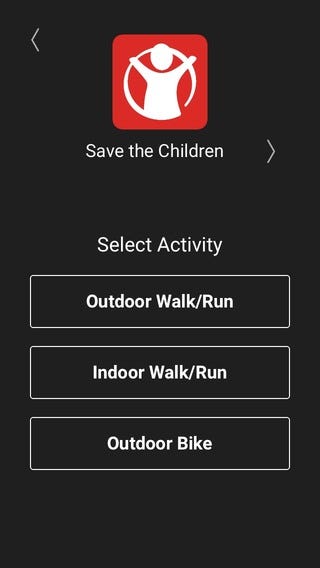
Charity Miles has a pretty easy setup, and daily use is simple. You open the app, pick a charity from about 40 nonprofits, then tell the app what activity you’re doing and whether it’s inside or outside. After that, you just start moving.
Since the app only gives 25 cents per mile, the donations are ultimately very small. They’d be bigger if I was a more athletic person, but since 10 hours of my day is spent at a computer, my donations didn’t amount to much. Also, running would earn more than walking, since the donations are based on miles and not time. But I have the endurance of… well, I don’t actually have any endurance, so walking was the best I could do.
On the first day I tried walking inside, and after about 10 minutes I realized the app didn’t seem very responsive on the treadmill. I lost about .5 miles and went outside to finish the walk.
Because the donation requires you to physically do something, your ability to give is determined by factors like your schedule, your health, the weather. This makes it less reliable than an app where you simply give money. Days 5–7 were a no-go for me, because it was 10 degrees outside, and I just couldn’t do it.
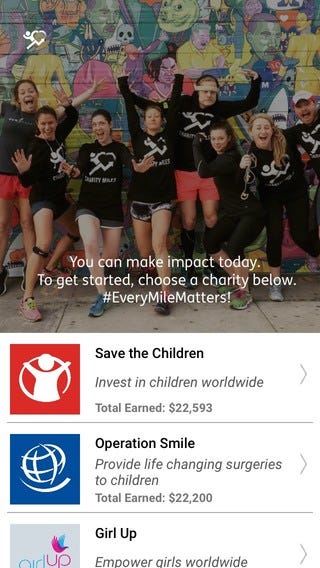
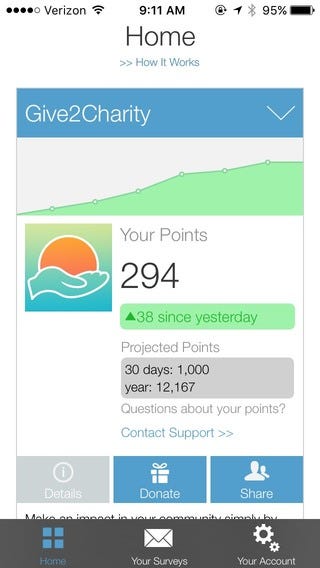
Give2Charity doesn’t require any exercise, so I already liked it more than CharityMiles. Essentially, all you have to do is carry your phone around, which everyone is already doing, and earn points throughout the day. Once you collect enough points (1,500 minimum) you can exchange them for monetary donations like $10 to the ASPCA or $5 to the American Red Cross. (There are about 25 different charity options on the app.)
You get 100 points for signing up and will occasionally get surveys that you can answer for additional points. I used the app for five days, got two surveys, and earned about 20 points for each. You can also collect points for getting referrals and connecting social media accounts, although Facebook and Foursquare are the only options.
$0, but there’s a light at the end of the tunnel! By the end of the week I had 294 points. At that rate, I would get to the 1,500 minimum in about 5 weeks, which would allow me to donate $2. I’d recommend saving the points to get more bang for your buck, since 2,500 points gets you $5, depending on the charity. If I keep going, I could collect a little over 15,000 points over the course of the year. Assuming I use those for the 2,500 point/$5 donations, I’d give a total of $30 annually.
Give2Charity feels like a “too good to be true” kind of thing, but it really is as simple as it sounds. If you’re somewhat weary about apps tracking your location, this is definitely not the app for you. The surveys also seemed a little pervasive at times, asking to verify where you were on a certain day at a certain time.

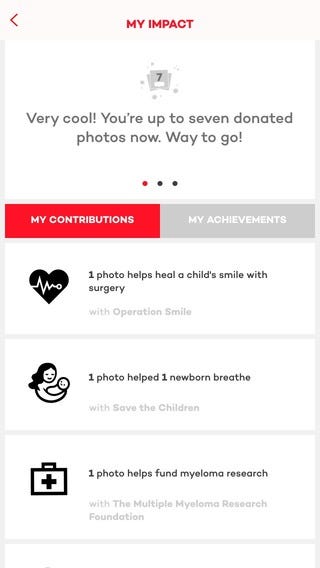
Donate a Photo requires you to do just that: donate a photo. For every photo you donate, Johnson & Johnson donates $1 to a charity of your choice—but there are only 10 charities to choose from, some of which have end dates to their campaign. When one campaign ends, another takes its place. You can donate one photo a day and pick a new charity each time. The campaign tells you what your dollar will go to — a resuscitation device for newborns, a safe space kit for LGBT youth, etc. I loved that, because it helped you feel more connected to the causes.
Donat a Photo took about 10 seconds out of my day — enough time to snap a photo or pick one from your phone. When you donate your photo, you can choose to also share it to Facebook, Twitter, or Instagram, and the app adds some relevant hashtags. This doesn’t earn you any more money, but it does help spread awareness and get more people using the app.
I donated one photo per day for seven days and earned $7. That adds up to $365 a year (I’m really good at math), making it easily the most productive app I tried. In the week I used it, I gave to Operation Smile, Save the Children, The Multiple Myeloma Research Foundation, Sight for Kids, GLSEN, Breast Reconstruction Awareness Campaign, and Americares Tennessee Wildfires Relief.
Honestly, there’s nothing wrong with the app. If I wanted to be picky, I could say that I wish there were more nonprofits to choose from or that you could donate to more than one per day. But that’s just me asking for a little too much, as usual.

If I continue to use all of these apps daily, I will donate $460 this year without ever touching my bank account, which is pretty remarkable. Saving for a goal and paying off debt are everyone’s biggest financial priority. For me, those priorities are followed very closely by donating to charity. It’s something I wish I could do more, and ideally should make room in my budget for, but that’s never as easy as it sounds.
But now that I’ve been using these apps, it seems like there’s no excuse for me to not make it to that $460 mark this year. The only thing it costs me is time, and it barely costs any of that. One day I hope to be able to donate money without worry, but for now, I’ll keep snapping photos, walking a few miles, and answering weird surveys if that means I can help those less fortunate.
Stephanie Ashe is a freelance writer, cat mom, and pop culture devotee. She’s probably talking about a 90’s movie on Twitter right now.
This story is part of The Billfold’s “Resolve” series.
How to Donate Money to Charity Without Actually Spending Money was originally published in The Billfold on Medium, where people are continuing the conversation by highlighting and responding to this story.
SamTeei c o n
Believe us, it’s not for the reasons you might think.
Take a scroll:


She is a ridiculously fabulous and unique Diva/Goddess/Artist and we should all take a moment to bow the fuck down at her stunning chicness.
We’ll wait.


Okay, we’re back. The reason we laughed at this getup? Oh, it’s not because there’s anything laughable about it on its own. Sure, we suppose some might find it a little over the top and even a little clowny, but we are definitely not two of them.
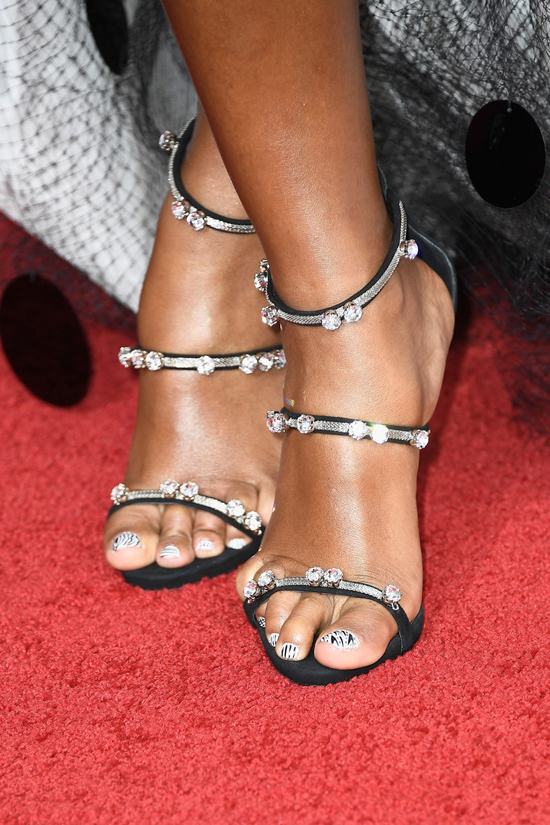
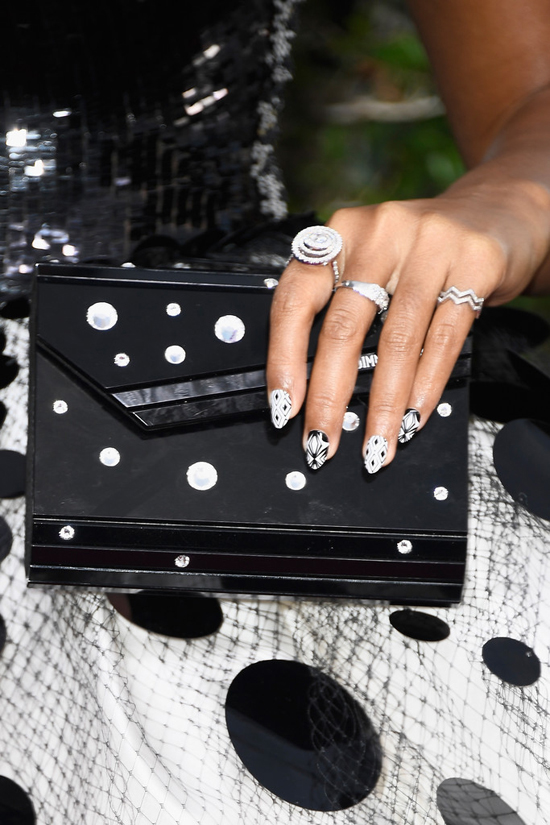

In the past several years, designers have attempted to force a sort of grim, over-the-top whimsy on their wares and we simply weren’t having any of it. THIS is how you do whimsy and stay chic. The polka dot theme is well-rendered, the shape is fun and sexy – she’s got AMAZING legs – and the whole look is so incredibly her.

What it is incredibly NOT is a typical look coming out with an Armani Privé label on it. We laughed because only Janelle Monáe could make Armani bow down to her exact whims and produce such a highly uncharacteristic look. And they were clearly smart to listen to her. Miss Lady knows what the hell she’s doing.
Style Credits:
Custom Black and White Polka Dot Dress
Forevermark Diamond Cuff Earrings Set in 18k White Gold 6.91 ctw
Forevermark by Imagine Bridal Five Stone Diamond Halo Band Set in White Gold 1.25ctw
Forevermark by Imagine Bridal Split Prong Eternity Band Set in White Gold
Forevermark by Rahaminov Cushion Bypass Ring Set in Platinum 1.80 ctw
Forevermark Diamond and Pave Oval Ring Set in 18k White Gold 2.64 ctw
Forevermark Three Stone Diamond Bangle Set in 18k White Gold 2.46 ctw
Forevermark Diamond Bangles Set in 18k White Gold 5.8 ctw
Jimmy Choo Clutch
Giuseppe Zanotti Sandals
[Photo Credit: Getty Images, Paul Drinkwater/NBC]
The post Why We Burst Out Laughing at Janelle Monáe’s Golden Globe Awards Dress appeared first on Tom + Lorenzo.
SamTeeyou guys
The girls are back in town:





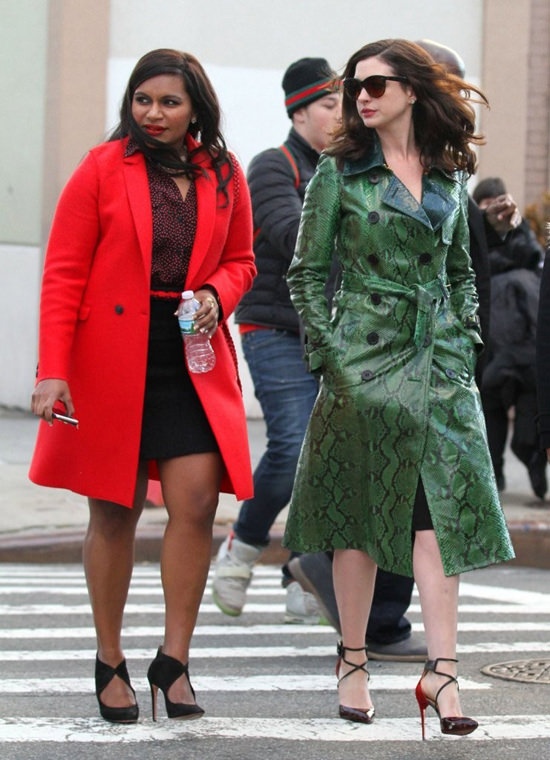


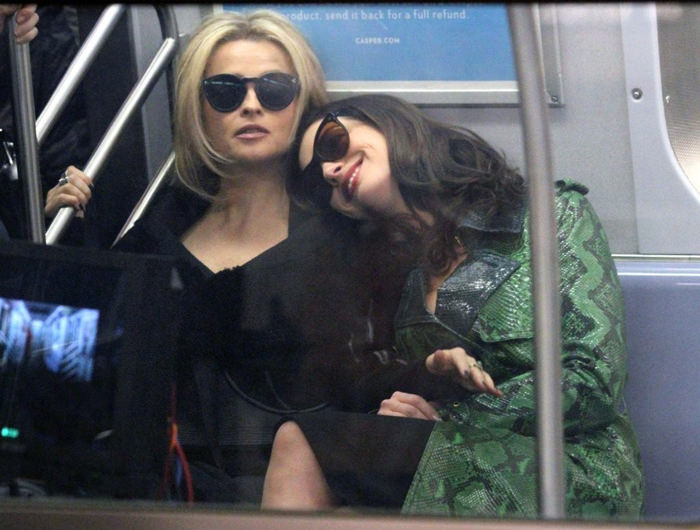

And they are serving up some primo COAT PORN. Suddenly, Anne’s got the best costume in a film apparently loaded with eye-popping or gorgeous costumes. But Sandy looks pretty amazing herself. And while it’s not as attention-seeking as a white fur jacket or a green python coat, Miss Mindy’s red coat is the quietly chic best of the bunch.
All we gotta say about Ri is this: Girlfriend better get a “Chi Chi at the end of To Wong Foo” moment of pure diva at some point to make up for the crap costumes they’ve shoved her into.
[Photo Credit: FAMEFLYNET PICTURES, LGjr-RG/PacificCoastNews]
The post Helena Bonham Carter, Anne Hathaway, Mindy Kaling, Sandra Bullock, Rihanna, Sarah Paulson, and Cate Blanchett on the Set of “Ocean’s Eight” appeared first on Tom + Lorenzo.
SamTeePsyched for this to be my xmas day jew movie and psyched for her to do whatever the heck she wants on the red carpet
Serving up Cindy Lou realness:


We’re dying to see this movie in any case, but we’re really hoping Miss Janelle snags an Oscar nom, just so we can see what kind of cray she’ll bring to the awards season poledance.
Admittedly, the shape of this jacket is a bit hard to get past. And the hair is probably a little too gimmicky for our tastes. But we’ve said it before about her and we’ll say it again: Miss Lady knows how to create a fashion “moment,” which is an incredibly valuable skill to have if your career calls for trips to red carpets on the regular. It’s a little goofy overall and we’re damn sure almost no one else could pull it off as well, but the combo of odd shape, black tights, red beret, goofy hair and bold graphic all combine to make a perfectly Janelle sort of chic.

Style Credits:
Dolce&Gabbana Black and White Macro Houndstooth Oversized Jacket Featuring Geometric-Shaped Buckles from the Fall 2016 Collection
[Photo Credit: Olivier Douliery/Abacausa/Instarimages.com, IMAXTree]
The post Janelle Monáe is the Chicest Who from Whoville at the “Hidden Figures” DC Screening appeared first on Tom + Lorenzo.

“He can’t quite read yet. They told him it says ‘Merry Christmas.’”
(via source)
“He can’t quite read yet. They told him it says ‘Merry Christmas.’”
(via source)
The post Santa Is A Lie appeared first on AwkwardFamilyPhotos.com.
SamTeein case you needed more news about things that are the worst, here are the worst bosses of the worst year. the insane manager stories really kicked it up a notch this year, i have to say!
We have a winner! 9,181 votes are in, and the worst boss of the year is the manager who showed up while an employee was having chemotherapy to talk about work … with 28% of the vote. Congratulations, terrible manager of the year! You suck.
The seven runners-up, who managed to be pretty terrible themselves:
* the manager who threatened to fire people if they didn’t sign up to be a liver donor for his brother – 24%
* the manager whose carelessness caused an employee’s horse to die – 13%
* the boss who crashed an employee’s wedding to ask about work and then wrote her up for having him escorted out – 11%
* the boss who called an employee after midnight to drive hours to pick him up from the airport and then suspended her from work because she was casually dressed – 10%
* The boss who’s letting an employee be verbally abused and sexually harassed by a coworker and Does Not Care – 9%
* the employer that will fire you if your friends and family don’t follow the company’s religious values – 3%
* the boss who stole an employee’s family heirloom and gave it as a gift to someone else – 3%
the worst boss of 2016 is… was originally published by Alison Green on Ask a Manager.

If there’s something someone asks you to do — at work, or in life, or just on the street, maybe — and you really don’t want to do it, the word that arises to your lips and nearly escapes from your mouth is “no.” Saying no is hard when you’re accustomed to saying yes. Saying yes feels polite; it feels correct. It feels like what you should say when asked to do something at work or in your social life, because hey, why not, someone’s asking you, so you might as well.
But if you’re a person who says yes all the time to things you’d really rather say no to, especially in the workplace, where agreeing to tasks is part of the reason they hired you in the first place, saying no feels bad. The great news is that you don’t have to say no. You can say something entirely different and not come off like (too) much of a jerk.
Here's the Most Effective Way to Say No to Things You Don't Want to Do
A study from the Journal of Consumer Research proved that the easiest way to feel better about setting boundaries and saying no to things that you’d really rather not do is to reframe the rebuttal. The trick is to replace “can’t” with “don’t.”
Saying “I don’t eat X” when tempted by an unhealthy snack, for example, made participants feel more “psychologically empowered” than using “can’t.” The same held true with a scenario about resolving to exercise each day: “I don’t skip my workout” was a more powerful motivator to get to the gym than “I can’t skip my workout.”
What a beautifully effective way to set personal boundaries without feeling like you’re cutting yourself off at the pass and hindering your own abilities. Technically, you can find the toner for the printer at work. You are perfectly capable of writing emails on Saturday mornings before you get out of bed, especially if they are flagged with that panic-inducing Microsoft Outlook red exclamation mark. In many office environments, both events are presented with the gravity of an imminent nuclear threat. The former is merely an inconvenience that will surely be resolved by someone else; the latter could be important, but could also be the result of your office manager finally going off on the individual who leaves dirty dishes in the sink even though there’s a dishwasher literally right there.
It feels strangely presumptuous — selfish, even — to say that you “don’t” do things. But breaking yourself of the habit of being an unwitting yes-person at work or in your friendships or in your family isn’t selfish. Don’t say yes to things you don’t want to do. Don’t say yes to things you can’t do. Even if all you do is tell yourself “I don’t go to poetry readings” before politely rebuffing your friend’s invite or whisper “I don’t answer phone calls from my boss on a Sunday” to yourself before letting the call go to voicemail, that’s better than caving to the impulse to say yes, yes, yes to everything out of the need to feel useful or of value. It still counts. If you really don’t want to do something, don’t say you can’t. Just say you don’t.
Say “No” To Stuff You Don’t Want To Do With Just One Word was originally published in The Billfold on Medium, where people are continuing the conversation by highlighting and responding to this story.
SamTeeThe ISS is so amazing. This is a picture taken by an American of a spacecraft launched by Japan and received by a Frenchman using a Canadian robot. It makes me so happy that some humans can cooperate so amazingly, and so sad to think that other humans are doing their best to ruin everything.
SamTeewhen you live in one of the most expensive real estate areas in the country and $445k seems super reasonable for this size house...

When a lot of us run that fantasy math on leaving our overpriced apartments and moving to a more affordable small town, we don’t really imagine ourselves heading to one of the economically depressed Midwestern towns that have been the topic of discussion over the past few weeks or so.
How Half Of America Lost Its F**king Mind
We imagine ourselves moving to Stars Hollow.
Our small town would have a local bookstore and film festivals and a diner where everyone would know who you were as soon as you walked in, so it was like you always had friends. Our small town would have jobs for everyone: one person could run the inn, and one person could run the body shop, and one person could run a contracting firm, and one person could run an ice cream shop and a grocery store, and one person could run a music store, and one person could run a dance studio, and one person could sell vegetables, I guess? We could start our own business, too—because, like Elon Musk’s vision of Mars colonization, our small town fantasy always involves us taking a leadership role in the community and making a good salary, not working as a server at Al’s Pancake World.
But, thankfully, Trulia is here to SHUT THAT FANTASY DOWN. We cannot afford to live in Stars Hollow. We never could.

Trulia looks at housing prices in Litchfield County, Connecticut—where Stars Hollow and its real-life inspiration, Washington Depot, are located—and reminds us that we will never be able to afford Lorelai Gilmore’s home. Even though Washington Depot’s population is 3,500 and that makes it seem like a house should cost, what? $100,000, tops?
But Washington Depot, like Stars Hollow, is not your ordinary small town. The Mayflower Grace, the original model for the Independence Inn—wow, Amy Sherman-Palladino, way to change the name on that one—rents rooms at $675 a night. If you want to stay during Christmas week, be ready to pay $925 a night.
Trulia does the math on multiple Stars Hollow properties, including Lane, Zack, and Brian’s terrible rental, which they price at $165,000. I think they’re assuming you want to buy it. If you wanted to rent a one-bedroom house in Washington Depot (yes, it was a one-bedroom, Zack and Brian slept on bunkbeds in the living room, I know way too much about this show), Trulia suggests one available rental might cost $1,500 a month, and there are no other current available one-bedroom home rentals.
Which, $1,500 a month for a one-bedroom house isn’t that bad. If you wouldn’t have to compete with Lane and Zack and Kirk and who knows who else to rent it.
I will end this with a quote from none other than the late Edward Herrmann himself:
Top "Real Life" Towns like Stars Hollow
According to The Gilmore Girls Companion book, New England resident, Edward Herrmann (Richard on Gilmore Girls) says: “Washington Depot is nothing like Stars Hollow; it is a weekend haven for New Yorkers.”
WE CAN NEVER LIVE THERE.
EVER.
Let’s cry into our coffee together.
We Could Never Afford to Live in Stars Hollow was originally published in The Billfold on Medium, where people are continuing the conversation by highlighting and responding to this story.
SamTeeSuch a fan of this advice.
A reader writes:
My friend and I are both in service jobs (customer service, food service, retail). My friend has had full-time and part-time supervisor positions (one step below management), while I’ve only been a part-time sales associate mostly dealing with customers.
Our main unhappiness in our jobs is not with awful customers, but with poor management, awful/stubborn bosses, and managers hiring bad employees.
Our jobs could be better if they were organized better and had better management, but we know it won’t ever change. We are the most frustrated by poor management/organization at both jobs, and no one else seems to care or isn’t as annoyed as we are.
My friend thinks it’s because we care too much at our jobs. We care too much, so we get frustrated and stressed out when things go wrong and when things don’t work out.
Do you think it’s possible to care too much at your job? Would that apply only to lower level jobs like my friend and I have?
Yes, this is a thing! A known thing! Many of us suffer from it, and it’s not confined to any particular type of job — it’s possible at any type of job, at any level.
When you find that you’re more upset that things aren’t running well than the people at the top of your organization are and that frustration is interfering with your quality of life and peace of mind, you probably care too much. The same thing is true if the amount of emotional energy that you’re putting into your job doesn’t match up with what you’re getting back from your employer. For example, if you work evening after evening because you care about getting your job done well, but your boss refuses to let you leave early one Friday when your workload allows it … well, the amount you care doesn’t line up with the amount they’re incentivizing you to care.*
And sometimes there’s real relief — even liberation — in deciding to care less. It’s not always possible, but sometimes you can make a conscious decision to let things roll off of you that used to drive you crazy. Sometimes you can tell yourself “this one is above my pay grade and I’m leaving it to the people whose job it is to worry about it.” Sometimes you can tell yourself “eh, that’s not the way I’d choose to do it, but it’s not my call and I’m going to focus on the pieces of my work that I can control and that don’t frustrate the crap out of me.”
Sometimes.
Other times you might find that you can’t pull that off and turn off the frustration. And when that’s the case, sometimes that’s actually a sign that it’s time to leave. It’s not good for you to stay in a job that keeps you constantly frustrated. And for that matter, it’s probably not great for your company and your manager to have a constantly frustrated person around either.
* It’s sometimes more nuanced than this, of course. For example, If you’re working with kids, for example, or sick people, the amount that you care shouldn’t be dependent on how much those above you care. But even in those situations, there are limits. It’s okay to decide in those situations, “You know what, I care about these kids, but I also think this organization is fundamentally ill-equipped to serve them and I can leave this job and be helpful to the world in other ways.”
is it possible to care too much about your job? was originally published by Alison Green on Ask a Manager.

“Back when Chris Porsz was a paramedic in the 70s and 80s, he also pursued his passion for photography. He spent hours walking around the city of Peterborough, Cambridgeshire (Great Britain) taking candid shots of punks and policemen, siblings and sweethearts, traders and teenagers. Today, more than three decades later, Chris has reconnected with his subjects and recreated their photos, which he’s compiled in a new book called “Reunions.”


(via source and Chris Porsz)
“Back when Chris Porsz was a paramedic in the 70s and 80s, he also pursued his passion for photography. He spent hours walking around the city of Peterborough, Cambridgeshire (Great Britain) taking candid shots of punks and policemen, siblings and sweethearts, traders and teenagers. Today, more than three decades later, Chris has reconnected with his subjects and recreated their photos, which he’s compiled in a new book called “Reunions.”
(via source and Chris Porsz)
The post Reunions appeared first on AwkwardFamilyPhotos.com.
Please enjoy this moment of thick-thighed Zen.





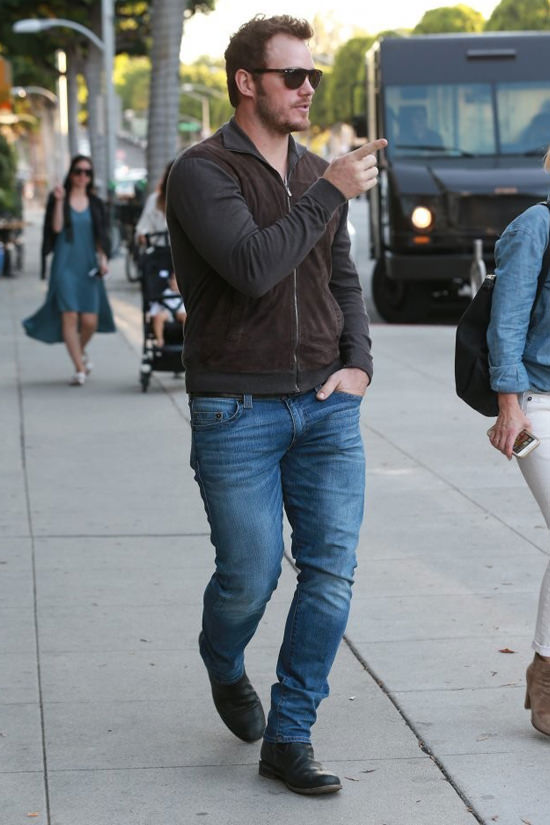


Take a moment to center yourself, breathe deeply, and imagine where, if you were in these photos, your face would be.
Stop making that noise. People can hear.
[Photo Credit: Stoianov/FAMEFLYNET PICTURES]
The post Chris Pratt And His Skinny Jeans are Here to Get You Through The Day appeared first on Tom + Lorenzo.
SamTeeThere's just so much in here that I love. That Samantha, what a dick.

As you might remember from our discussion of Meet Samantha: one of the most important things a young girl can have, whether she is a bright Victorian beauty or a girl from a low-income family who’s trying to fit in at public school, is a roughly 18-inch-high doll that costs the equivalent of $155 in today’s dollars.
You also might remember, from Meet Samantha, that our titular heroine “earns” this doll after a week of piano practice and good behavior, and that she later gives this doll to her less-fortunate friend Nellie.
This means that we begin Samantha’s Surprise with a new doll for Samantha to covet—and in case the stakes weren’t high enough, we learn that Samantha doesn’t have a doll of her own, no doll at all, since she gave that other doll to Nellie.
Which… I can’t believe that. Samantha is a nine-year-old child from a wealthy family. She has a doll. She probably has multiple dolls. (Surely her parents gave her a doll before dying in that boating accident.) What Samantha doesn’t have is a roughly 18-inch-high doll that costs the equivalent of $155 in today’s dollars.
And wow is Samantha feeling that pain.
It’s interesting that even the doll itself reinforces the idea that having a doll is important, because the doll comes with a Nutcracker doll attached to its arm—and the Nutcracker fits into the doll’s arm the way the doll fits into Samantha’s arm the way Samantha fits into a child’s arm, all reiterating that the one thing every young person needs, whether they be child, child’s doll, or child’s doll’s doll, is a roughly 18-inch-high (or proportionally equivalent) doll of their own.
We know without me even having to say it that Samantha gets that doll. (Also, there is apparently only one of those dolls ever, which seems unusual. Didn’t dollmakers have molds? Didn’t we just have a whole Samantha book about the complicated emotions middle-class liberals hold on the realities of mass production?)
The person who gives Samantha the doll is not Grandmary, who has been Samantha’s sole guardian since she was five years old; it’s Cornelia, the “unladylike” and “fun” woman Samantha’s Uncle Gard is courting. (We don’t have time to get into the whole “Cornelia isn’t like other girls” trope, so let’s just state it and be done with it.)
Because of this, Samantha swaps the gifts she plans to give Uncle Gard and Cornelia. She gives the pound of Jolie Chocolates, which she bought specifically because they were Cornelia’s favorite, to Gard. She gives the painstakingly dècoupaged box she’d originally made to hold her uncle’s cufflinks to Cornelia, because it’s her best gift and she wants to give it to the person she loves the most. In her moment of happiness at receiving the 18-inch doll, Samantha decides she loves Cornelia more than Gard.
She never, ever thought about giving that best gift to Grandmary.
Which… wow, just wow, let’s break down all of the things that are terrible about this.
In other words: Grandmary spends Christmas morning discovering that her adopted child had a secret desire that she deliberately chose not to share, that another set of adults were privy to the desire and able to fulfill it, and that Samantha is in the early adolescent stages of breaking away from the immediate family and seeking (and giving) validation elsewhere. Grandmary is a class act throughout, as she always will be.
On the subject of early adolescence: there comes a time in every child’s life when their adorably janky Christmas crafts are no longer the centerpiece of the household’s holiday decorations, and that happens for Samantha this year. Grandmary wants to pay a decorator to put up some legit garlands, not whatever pinecones and cottonballs Samantha glued together, and I’d say there is a perfect developmental parallel between Grandmary making the house less child-centric and Samantha turning her affections towards Gard and Cornelia.
But just because you’re no longer a young child doesn’t mean you can’t covet a beautifully-crafted, 18-inch-high doll—especially if that doll looks like she’s just your age. American Girl fulfills a lot of roles, but those original dolls were exactly what many of us needed to transition from late childhood to early adolescence. They gave us stories in which girls like us—but distanced, because of history—drove the narrative; they let us engage in imaginative play while simultaneously taking ourselves seriously. They were the best gift, and although we might not have realized it at the time, they often came from the people who loved us the most.
What Children’s Literature Teaches Us About Money: Susan S. Adler’s ‘Samantha Learns a Lesson’
What Children’s Literature Teaches Us About Money: Maxine Rose Schur’s ‘Samantha’s Surprise’ was originally published in The Billfold on Medium, where people are continuing the conversation by highlighting and responding to this story.
SamTee***HEARTS FOR EYES***
U.S. President Barack Obama and first lady Michelle Obama with Italian Prime Minister Matteo Renzi and his wife Mrs. Agnese Landini at state dinner at the White House in Washington, DC. President Obama is hosting the last state visit of his presidency.
Politics is the art of being all things to all people. And of all the versions of the Obamas we’ve been treated to over the last 8 years, our favorite by far is going to have to be the “IDGAF I’m Outta Here” version of the Obamas.
See, we’ve been tracking Miss FLO’s style for eight years now and we can tell you she’d never have dared to sport an ass-hugging, drop-dead, fuck-you glam, look-at-my-waist-bitches, drag queen’s wet dream of a Versace gown in the earlier days of their White House years.
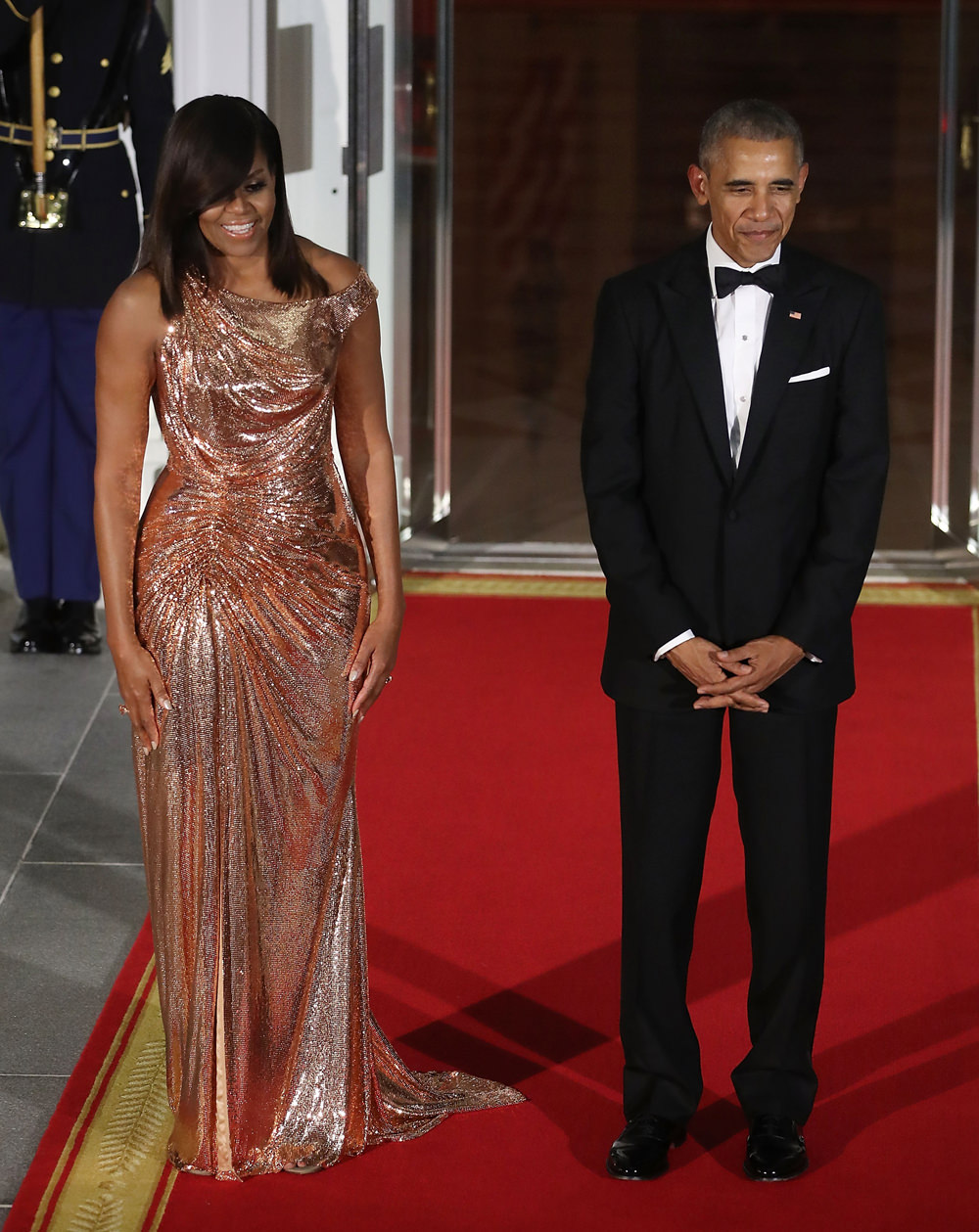








We could weep.
Stunning.
Slaying.
WERQing the high holy fuck – in a divatastic “Miss Ross asks that you please not touch her gown” kind of way – out of the front steps of the goddamn White House? COME THROUGH, MISS MICHELLE.
Someday, we’re going to look back and go, “GodDAMN, can you believe the First Lady of the United States looked like THAT?”
Style Credits:
Michelle Obama: Atelier Versace Rose Gold Chainmail Off-The-Shoulder Gown
Agnese Landini: Ermanno Scervino Crêpe de Chine Bustier Gown Layered with Black Lace and Embroidered with Crystals
[Photo Credit: Mark Wilson/Getty Images]
The post Michelle Obama WERQs a STUNNING Atelier Versace at her final state dinner like a diva making a curtain call appeared first on Tom + Lorenzo.
British actor Tom Hiddleston is the newest face of Gucci’s Cruise 2017 tailoring ad campaign. The campaign was shot at American artist Tony Duquette’s Dawnridge Estate in Los Angeles by Glen Luchford and styled by Joe McKenna.
A Story of Loss and Rebound, in pictures.
And Gucci.

“My heart. It is cracked, Esmerelda. Only the sensual stroking of your luscious hair while lying around in ridiculously expensive Italian suiting can ease my pain.
Is your sister about?”
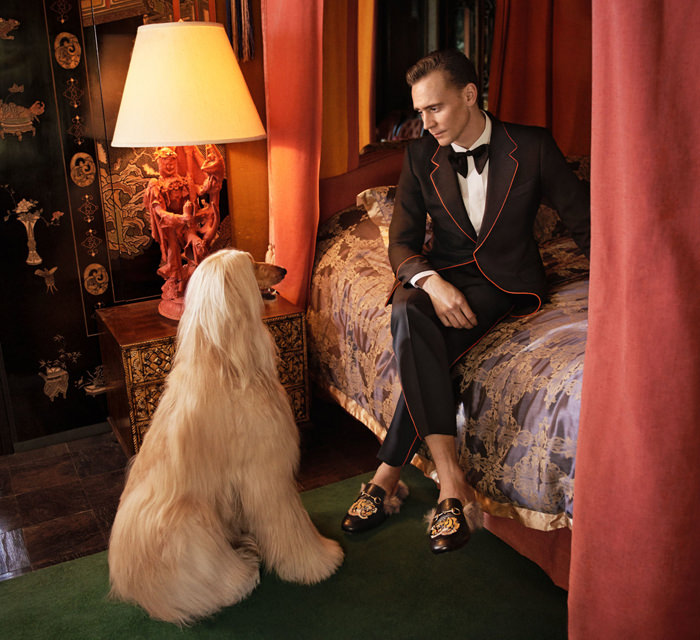
“In truth, it was a form of short-term madness, I suppose. I don’t know what came over me. You know how the Americans can be. After a while, all that cheering and hugging starts getting to a man. Before it’s possible for any right-thinking person to truly get their bearings, one finds themselves giddily rifling through kitchen drawers for a Sharpie so they can write yearbook photo captions on their vest and parade it around in public like a manic sorority sister on a weekend coke bender.
Alas.
Calliope, darling, you haven’t told me what you thought of my slippers.”

“Yes, you’re both right. I was damned by my own folly. How reckless I was! How arrogant! Oh, I wanted Bond. I could taste it, like fine wine licked off the belly of an Italian heiress in the midday Riviera sun. Foolishly, I thought it within my grasp if only I could get the press and public on my side. The siren, the jezebel understood my raging ambitions well and whispered promises of helping me secure it. I would have cut out my own heart if she asked me to. Little did I know then, she would.
Hm.
Men can’t really get away with wearing Mary Janes, can they?”

“No, of course not. I never really loved her. I loved what she represented, you see. Youth! Money! America! Popularity! And I suppose I, for my part, represented the kind of breeding and erudite worldliness that she so tragically lacked. My dears, have you ever heard the line about Astaire and Rogers, that legendary dancing duo of the silver screen? ‘He gave her class and she gave him sex appeal?’ Well you see, it was much the same with us. She gave me Instagram followers and I made people believe she could breathe with her mouth closed.
Oh, you’re so right, Esmerelda. That was cruel and bitter of me. It’s just that these boots make me feel so aggressive!
When is Yvonne arriving?”

“Now our party is complete.
Oh, my beautiful angels, there are not words to express my gratitude for helping me through this difficult time. When a man’s heart is broken and his dreams lie in ruins, when he has betrayed his principles and exposed his shortcomings to all and sundry, it is imperative, lest he risk losing his very soul, that he surround himself with as much beauty as he can find. For you see, beauty is the only truly effective balm for a broken heart, my darlings. Especially if it’s really expensive beauty. Not like, flowers in nature or sunsets or such nonsense.
It is no exaggeration to say that you three, along with very expensive Italian clothing and the free use of this villa, have healed me in ways both profound and gleefully trivial, my darlings. I will always cherish you for that.
Now, who wants to go walkies?”
[Photo Credit: Courtesy of Gucci/Glen Luchford]
The post Tom Hiddleston Heals His Heart with Gucci and Bitches appeared first on Tom + Lorenzo.
SamTeeTruly having trouble believing all of the pictures of this hat are not photoshopped. How is this real???
WTF is this election anymore?

SamTeeYes to all of this. Happy Friday!
Lupita Nyong’o attends the Vanity Fair and Tiffany & Co. private dinner toasting Lupita Nyong’o and celebrating Legendary Style at the Shangri-La Hotel in Toronto, Canada.
Stand back, everyone. Miss Lupita’s going next-level again.



She has officially made some form of headwrap her signature look this season. She’s always worn them in her public life, but she’s really stepped them up lately. No complaints here, of course. She looks stunning from the neck up.
But what we love about the rest of this look – hear us out, because yes, we will stipulate up front that it’s asking a LOT of us all – what we love about this is that she’s taking a more or less traditional form of head covering and pairing it with stuff like this techno-futuristic Star Trekian ensemble, which gets you to see the head wrap in a new light and actually helps the somewhat hard-to-take print situation by balancing it out both visually and thematically. Old and new. Having said that, those pants are SUPER cray. But call us fanboys if you must, she is serving us 21stC proto-Guinan and we’re here for that, darlings, cray pants and all.

Style Credits:
Mary Katrantzou ‘Moss’ Jumpsuit Featuring a Square Neckline with a Wave Strap Across the Front and a Wide Leg Pant from the Pre-Fall 2016 Collection
[Photo Credit: Todd Williamson/Getty Images, Courtesy of Mary Katrantzou]
The post Lupita Nyong’o in Mary Katrantzou at the Vanity Fair and Tiffany & Co. Private Dinner appeared first on Tom + Lorenzo.
SamTeeReally wanted this to be a pic of Paul Rudd.

“My daughter, after I explained that she’ll be going to school for the next 17 years.”
(via source)
“My daughter, after I explained that she’ll be going to school for the next 17 years.”
(via source)
The post Hello Darkness appeared first on AwkwardFamilyPhotos.com.
SamTeeWrong, every Star Trek TNG fan needs THESE bed sheets:
http://17rg073sukbm1lmjk9jrehb643.wpengine.netdna-cdn.com/wp-content/uploads/2015/04/16.jpg
http://66.media.tumblr.com/b60eff687037de0a2cd4ec3b82ab06a0/tumblr_inline_n3965ejsAb1qapo7v.jpg
METALLIC BEDDING = THE FUTURE


