06 Feb 10:00
J. Mater. Chem. A, 2014, 2,3978-3985
DOI: 10.1039/C3TA15055K, Paper
Minwoo Nam, Joongpil Park, Sang-Wook Kim, Keekeun Lee
Broadband-absorbing solar cells with efficiencies approaching 3.48% are developed based on PbS quantum dots and a low-bandgap polymer.
The content of this RSS Feed (c) The Royal Society of Chemistry
20 Jan 10:53
J. Mater. Chem. C, 2014, 2,1233-1247
DOI: 10.1039/C3TC32197E, Feature Article
Qingfeng Lin, Hongtao Huang, Yan Jing, Huiying Fu, Paichun Chang, Dongdong Li, Yan Yao, Zhiyong Fan
Flexible photovoltaic (PV) devices have attracted enormous attention from academy and industry as a convenient alternative energy source for indoor and outdoor applications.
The content of this RSS Feed (c) The Royal Society of Chemistry
20 Jan 10:51
Nanoscale, 2014, 6,2406-2418
DOI: 10.1039/C3NR05749F, Paper
Peter W. Dunne, Chris L. Starkey, Miquel Gimeno-Fabra, Edward H. Lester
A continuous hydrothermal method has been applied to the synthesis of a wide range of metal sulphide nanomaterials with size and shape control.
The content of this RSS Feed (c) The Royal Society of Chemistry

17 Jan 10:37
by Pearl L. Saldanha, Rosaria Brescia, Mirko Prato, Hongbo Li, Mauro Povia, Liberato Manna and Vladimir Lesnyak

Chemistry of Materials
DOI: 10.1021/cm4035598

17 Jan 10:36
by Young-Shin Park, Wan Ki Bae, Lazaro A. Padilha, Jeffrey M. Pietryga and Victor I. Klimov

Nano Letters
DOI: 10.1021/nl403289w

15 Jan 11:46
by Michaela Meyns, Fabiola Iacono, Cristina Palencia, Jan Geweke, Mauricio D. Coderch, Ursula E. A. Fittschen, José M. Gallego, Roberto Otero, Beatriz H. Juárez and Christian Klinke

Chemistry of Materials
DOI: 10.1021/cm4037082

13 Jan 12:30
J. Mater. Chem. C, 2014, 2,2346-2352
DOI: 10.1039/C3TC32260B, Paper
A. H. Reshak, Saleem Ayaz Khan, S. Auluck
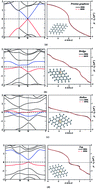
The thermoelectric properties of pristine graphene and H2S adsorbed onto bridge, hollow and top sites of a graphene sheet are investigated using the semi-classical Boltzmann transport theory.
The content of this RSS Feed (c) The Royal Society of Chemistry
09 Jan 10:20
by Sukanta Dolai, Praneeth R. Nimmala, Manik Mandal, Barry B. Muhoberac, Karl Dria, Amala Dass and Rajesh Sardar

Chemistry of Materials
DOI: 10.1021/cm403950f

08 Jan 11:35
Nanoscale, 2014, 6,3777-3785
DOI: 10.1039/C3NR05358J, Paper
Yingwei Li, Qifeng Han, Tae Whan Kim, Wangzhou Shi
The crystal structures of wurtzite-dominant Cu2ZnSnS4 and zincblende-dominant Cu2ZnSnSe4 NCs are found to be related to ternary and binary compounds.
The content of this RSS Feed (c) The Royal Society of Chemistry

07 Jan 10:35
by Marco Cirillo, Tangi Aubert, Raquel Gomes, Rik Van Deun, Philippe Emplit, Amelie Biermann, Holger Lange, Christian Thomsen, Edouard Brainis and Zeger Hens

Chemistry of Materials
DOI: 10.1021/cm403518a

07 Jan 10:35
by Alex W. Robertson, Camden Ford, Kuang He, Angus I. Kirkland, Andrew A. R. Watt and Jamie H. Warner

Chemistry of Materials
DOI: 10.1021/cm403373q

07 Jan 10:35
by Wei Li, Thomas Dittrich, Frank Jäckel, Jochen Feldmann
Pyrite nanocrystals are currently considered as a promising material for large scale photovoltaic applications due to their non-toxicity and large abundance. While scalable synthetic routes for phase-pure and shape controlled colloidal pyrite nanocrystals have been reported, their use in solar cells has been hampered by the detrimental effects of their surface defects. Here, we report a systematic study of optical and electronic properties of pyrite nanocrystal thin films employing a series of different ligands varying both the anchor and bridging group. The effect of the ligands on the optical and electronic properties is investigated by UV-vis/NIR absorption spectroscopy, current voltage characteristic measurements and surface photovoltage spectroscopy. We find that the optical absorption is mainly determined by the anchor group. The absorption onset in the thin films shifts up to ∼100 meV to the red. This is attributed to changes in the dielectric environment induced by different anchors. The conductivity and photoconductivity, on the other hand, are determined by combined effects of anchor and bridging group, which modify the effective hopping barrier. Employing different ligands, the differential conductance varies over four orders of magnitude. The largest redshift and differential conductance are observed for ammonium sulfides and thiolated aromatic linkers. Pyridine and long chain amines, on the other hand, lead to smaller modifications. Our findings highlight the importance of surface functionalization and interparticle electronic coupling in the use of pyrite nanocrystals for photovoltaic devices.

The influence of ligand anchor and bridging groups on the optical and electronic properties of pyrite nanocrystal thin films is investigated systematically. The thin film absorption onset shifts up to 100 meV to the red and the differential conductance varies over four orders of magnitude for the different ligands with ammonium sulfides and thiolated aromatic linkers showing the largest effects.
07 Jan 10:33
by Matthew G. Panthani, J. Matthew Kurley, Ryan W. Crisp, Travis C. Dietz, Taha Ezzyat, Joseph M. Luther and Dmitri V. Talapin

Nano Letters
DOI: 10.1021/nl403912w

06 Jan 13:29
by Idan Hod and Arie Zaban

Langmuir
DOI: 10.1021/la403768j

06 Jan 13:21
J. Mater. Chem. A, 2014, Advance Article
DOI: 10.1039/C3TA14333C, Paper
Yuanyuan Ge, Duo Xiao, Zhili Li, Xuemin Cui
Dithiocarbamate functionalized lignin (LDTC) was prepared to adsorb metallic ions and the metal-loaded biosorbents were firstly proposed as industrial antioxidants.
To cite this article before page numbers are assigned, use the DOI form of citation above.
The content of this RSS Feed (c) The Royal Society of Chemistry
06 Jan 13:19
J. Mater. Chem. A, 2013, Accepted Manuscript
DOI: 10.1039/C3TA14929C, Paper
Heng Wang, Jianli Wang, Xianlong Cao, Jeffery Snyder
The alloys between PbSe and PbS are studied. The effect of alloy composition on transport properties are evaluated and the result are interpreted with theories based on random atomic site...
The content of this RSS Feed (c) The Royal Society of Chemistry
06 Jan 13:19
by Khadijat. O. Abdulwahab, Mohammad A. Malik, Paul O’Brien, Grigore A. Timco, Floriana Tuna, Christopher A. Muryn, Richard E. P. Winpenny, Richard A. D. Pattrick, Victoria S. Coker and Elke Arenholz

Chemistry of Materials
DOI: 10.1021/cm403047v

06 Jan 13:18
by Wenjin Zhang, Qing Lou, Wenyu Ji, Jialong Zhao and Xinhua Zhong

Chemistry of Materials
DOI: 10.1021/cm403584a

06 Jan 13:15
by Matteo Cargnello, Benjamin T. Diroll, E. Ashley Gaulding, Christopher B. Murray

Quasi-quaternary nanocrystal superlattices are assembled by using exclusively core-shell particles as building blocks. The assemblies show an enhancement of energy-transfer from cadmium selenide-based core-shell quantum dots to gold-iron oxide core-shell nanocrystals compared to random mixtures of the same components.
06 Jan 11:40
Nanoscale, 2014, 6,758-765
DOI: 10.1039/C3NR03806H, Paper
Hemant K. Daima, P. R. Selvakannan, Ahmad E. Kandjani, Ravi Shukla, Suresh K. Bhargava, Vipul Bansal
A facile approach to fabricate Ag nanoparticles with a polyoxometalate corona is presented. These materials show outstanding antibacterial properties due to a synergistic effect of polyoxometalate in the presence of Ag, while showing no cytotoxicity against human epithelial cells.
The content of this RSS Feed (c) The Royal Society of Chemistry

06 Jan 11:39
Nanoscale, 2013, Accepted Manuscript
DOI: 10.1039/C3NR04948E, Paper
Liang Wu, Feng-Jia Fan, Ming Gong, Jin Ge, Shu-Hong Yu
Polytypic nanocrystals with zinc blende (ZB) cores and wurtzite (WZ) arms, such as tetrapod and octopod nanocrystals, have been widely reported. However, polytypic nanocrystals with WZ cores and ZB arms...
The content of this RSS Feed (c) The Royal Society of Chemistry

06 Jan 11:17
Nanoscale, 2013, Accepted Manuscript
DOI: 10.1039/C3NR06168J, Paper
Jun Ke, Xinyong Li, Qidong Zhao, Yong Shi, Guohua Chen
A facile phosphine-free approach is presented to prepare Cu doped ternary Zn-In-Se nanocrystals with high performance photoluminescence. By doping during nucleation stage, Cu dopant serving as dominative emission centre was...
The content of this RSS Feed (c) The Royal Society of Chemistry

06 Jan 10:36
Nanoscale, 2013, Accepted Manuscript
DOI: 10.1039/C3NR05749F, Paper
Peter William Dunne, Chris Liam Starkey, Miquel Gimeno-Fabra, Edward Lester
Continuous flow hydrothermal synthesis offers a cheap, green and highly scalable route for the preparation of inorganic nanomaterials which has predominantly been applied to metal oxide based materials. In this...
The content of this RSS Feed (c) The Royal Society of Chemistry

06 Jan 10:31
by Yan Jiang, Xing Zhang, Qian-Qing Ge, Bin-Bin Yu, Yu-Gang Zou, Wen-Jie Jiang, Wei-Guo Song, Li-Jun Wan and Jin-Song Hu

Nano Letters
DOI: 10.1021/nl404251p

06 Jan 10:29
by Wei Qin, Heng Liu and Philippe Guyot-Sionnest

ACS Nano
DOI: 10.1021/nn403893b

06 Jan 10:28
by Clare E. Rowland, Wenyong Liu, Daniel C. Hannah, Maria K. Y. Chan, Dmitri V. Talapin and Richard D. Schaller

ACS Nano
DOI: 10.1021/nn405811p

06 Jan 10:23
by Jianbing Zhang, Jianbo Gao, Elisa M. Miller, Joseph M. Luther and Matthew C. Beard

ACS Nano
DOI: 10.1021/nn405236k

06 Jan 10:22
by Noah D. Bronstein, Lanfang Li, Lu Xu, Yuan Yao, Vivian E. Ferry, A. Paul Alivisatos and Ralph G. Nuzzo

ACS Nano
DOI: 10.1021/nn404418h

06 Jan 10:21
by Alina M. Schimpf, Niket Thakkar, Carolyn E. Gunthardt, David J. Masiello and Daniel R. Gamelin

ACS Nano
DOI: 10.1021/nn406126u

06 Jan 10:21
by Paul D. Cunningham, Janice E. Boercker, Diogenes Placencia and Joseph G. Tischler

ACS Nano
DOI: 10.1021/nn405184j