06 Jan 10:31
by Alicia W. Cohn, Jeffrey D. Rinehart, Alina M. Schimpf, Amanda L. Weaver and Daniel R. Gamelin

Nano Letters
DOI: 10.1021/nl4041675

16 Dec 16:42
Publication date: 15 March 2014
Source:Coordination Chemistry Reviews, Volumes 263–264
Author(s): Ye Yang , Tianquan Lian
In addition to size dependent optical properties, strong quantum confinement in semiconductor nanoparticles (QDs) also affects their exciton relaxation, annihilation and dissociation dynamics, leading to their potential applications in third generation solar energy conversion devices. Multiple exciton generation and hot electron extraction have been proposed as potential approaches to increase the solar conversion efficiencies beyond the Shockley–Queisser limit in QD based solar cells. A common challenge faced by these two approaches is the need for ultrafast exciton dissociation to compete with ultrafast carrier cooling and exciton annihilation. In this review, we summarize our recent studies on multiple exciton generation and dissociation dynamics in PbS-MB+ complexes as well as strong electronic coupling and ultrafast electron transfer from PbS QDs to TiO2 nanocrystalline thin films. In PbS-MB+ complexes, we demonstrate that the multiple exciton generation efficiency in PbS QDs are unaffected by the presence of electron acceptors, and the multiple excitons can be fully dissociated by these acceptors via ultrafast electron transfer. For PbS QDs on TiO2 nanocrystalline films, we observe strong electronic coupling induced broadening of the 1S exciton band, which indicates a ∼6fs electron transfer process according to the Newns–Anderson model of chemisorption. This transfer time is faster than the reported hot electron relaxation time (a few hundred femtosecond), which suggests the feasibility of hot electron extraction prior to their relaxation in these materials.
16 Dec 11:16
by Lee A. Burton, Diego Colombara, Ruben D. Abellon, Ferdinand C. Grozema, Laurence M. Peter, Tom J. Savenije, Gilles Dennler and Aron Walsh

Chemistry of Materials
DOI: 10.1021/cm403046m

16 Dec 11:14
Nanoscale, 2014, 6,1602-1606
DOI: 10.1039/C3NR04457B, Paper
Shiv K. Pandey, Shipra Pandey, Vyom Parashar, Raghvendra S. Yadav, G. K. Mehrotra, Avinash C. Pandey
Sulfur switched lattice anomalies have induced bandgap engineering in zinc oxysulfide nanocrystals with variation in sulfur concentration.
The content of this RSS Feed (c) The Royal Society of Chemistry

13 Dec 11:10
Nanoscale, 2014, 6,1295-1298
DOI: 10.1039/C3NR05014A, Communication
Yanyan Chen, Shenjie Li, Lijian Huang, Daocheng Pan
[similar]3 grams of water-soluble Cu-In-S/ZnS core/shell quantum dots soup was made by an electric pressure cooker in a batch.
The content of this RSS Feed (c) The Royal Society of Chemistry

13 Dec 11:08
by Taylor J. Woehl, Chiwoo Park, James E. Evans, Ilke Arslan, William D. Ristenpart and Nigel D. Browning

Nano Letters
DOI: 10.1021/nl4043328

13 Dec 10:11
by Pabitra K. Nayak, David Cahen
The remarkable advances over the past few years in performance of photovoltaic cells, including the advent of new absorber materials, call for an update to the previous assessment of prospects for future progress. The same simple criteria with some refinements, based on cell and module performance data, serve to evaluate and compare most types of solar cells. Apart from Si and InP, for all types the “best cells” have improved in conversion performances (and crystalline Si modules have made major strides in cost reduction). New cell types, such as “perovskite”, sustainable chalcogenide, and quantum dot cells, are included. CdTe results bring those cells in line with other well-developed ones, lending some credence to the idea that the criteria provide the reader with knowledge, useful for gauging possible future technological developments. Additionally, the developments of the past few years show that, while the advent of more new cell types cannot be predicted, it can be aided and stimulated by innovative, daring, and creative new materials research.

The 2011–2013 period has seen amazing progress of nearly all solar-cell types that have possible or actual practical potential, including significant cost decreases of commercial cells. A concise update of the current status and future prospects of solar-cell research is given.
13 Dec 10:03
Chem. Commun., 2014, 50,1185-1188
DOI: 10.1039/C3CC47301E, Communication
Tiantian Jia, Amy Kolpin, Chensheng Ma, Ruth Chau-Ting Chan, Wai-Ming Kwok, S. C. Edman Tsang
We report a simple but highly cooperative ensemble with CdS and MoS2 nanocrystals dispersed on graphene sheets for hydrogen production from water.
The content of this RSS Feed (c) The Royal Society of Chemistry

09 Dec 18:00
by Joseph M. Grogan, Nicholas M. Schneider, Frances M. Ross and Haim H. Bau

Nano Letters
DOI: 10.1021/nl404169a

09 Dec 14:38
by Liwen Sang, Meiyong Liao, Qifeng Liang, Masaki Takeguchi, Benjamin Dierre, Bo Shen, Takashi Sekiguchi, Yasuo Koide, Masatomo Sumiya

Multiple stacked InGaN/GaN quantum dots are embedded into an InGaN p-n junction to develop multilevel intermediateband (MIB) solar cells. An IB transition is evidenced from both experiment and theoretical calculations. The MIB solar cell shows a wide photovoltaic response from the UV to the near-IR region. This work opens up an interesting opportunity for high-efficiency IB solar cells in the photovoltaics field.
06 Dec 14:39
Nanoscale, 2014, 6,2131-2136
DOI: 10.1039/C3NR05228A, Paper
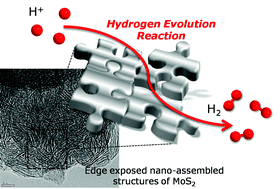
Dong Young Chung, Seung-Keun Park, Young-Hoon Chung, Seung-Ho Yu, Dong-Hee Lim, Namgee Jung, Hyung Chul Ham, Hee-Young Park, Yuanzhe Piao, Sung Jong Yoo, Yung-Eun Sung
Edge-exposed MoS2 nano-assembled structures are designed for high hydrogen evolution reaction activity and long term stability.
The content of this RSS Feed (c) The Royal Society of Chemistry

06 Dec 10:43
by Udit Soni, Anuushka Pal, Sajan Singh, Mona Mittal, Sushma Yadav, Ravikrishnan Elangovan and Sameer Sapra

ACS Nano
DOI: 10.1021/nn404537s

05 Dec 17:10
by C. N. R. Rao, H. S. S. Ramakrishna Matte, Urmimala Maitra
Abstract
The discovery of graphene has created a great sensation in chemistry, physics, materials science, and related areas. The unusual properties of graphene have aroused interest in other layered materials, such as molybdenum sulfide and boron nitride. In the last few years, single- as well as few-layer as well as chalcogenides and other inorganic materials have been prepared and characterized by a variety of methods. These materials possess interesting properties, and some have potential applications. This Review provides an up-to-date account of these emerging two-dimensional nanomaterials. Not only are the synthesis and characterization covered, but also important aspects such as spectroscopic and optical properties, magnetic and electrical properties, as well as applications. Salient features of the composites formed from the layered inorganic structures with graphene and polymers are presented along with a brief description of borocarbonitrides.

Single and few-layer MoS2, BN, and similar layered inorganic compounds are emerging as very interesting materials with numerous potential applications. This Review describes the synthesis and characterization of these graphene analogues and presents some of their physical properties and applications.
04 Dec 17:24
J. Mater. Chem. A, 2014, 2,985-990
DOI: 10.1039/C3TA12877F, Paper
C. Nethravathi, Catherine R. Rajamathi, Michael Rajamathi, Ryosuke Maki, Takao Mori, Dmitri Golberg, Yoshio Bando
Cu1.75Te nanosheet fabrication helps in decreasing the lattice thermal conductivity and thereby increasing the thermoelectric figure of merit.
The content of this RSS Feed (c) The Royal Society of Chemistry
04 Dec 10:49
by Johannes T. Margraf, Andrés Ruland, Vito Sgobba, Dirk M. Guldi and Timothy Clark

Langmuir
DOI: 10.1021/la403633e

04 Dec 10:49
by Subrata Maji, Sudarshan Kundu, L. F. V. Pinto, M. H. Godinho, Ali Hossain Khan and Somobrata Acharya

Langmuir
DOI: 10.1021/la402753n

04 Dec 10:46
by Ayaskanta Sahu, Daniele Braga, Oliver Waser, Moon Sung Kang, Donna Deng and David J. Norris

Nano Letters
DOI: 10.1021/nl4041498

04 Dec 10:43
Chem. Commun., 2014, 50,5958-5960
DOI: 10.1039/C3CC47975G, Communication
Huidong Zang, Prahlad K. Routh, Rabeka Alam, Mathew M. Maye, Mircea Cotlet
Photoinduced hole transfer from a CdSe/ZnS quantum dot to a conjugated polymer is tuned by varying the quantum dot core size.
The content of this RSS Feed (c) The Royal Society of Chemistry

04 Dec 10:41
by Jeffrey D. Rinehart, Alina M. Schimpf, Amanda L. Weaver, Alicia W. Cohn and Daniel R. Gamelin

Journal of the American Chemical Society
DOI: 10.1021/ja410825c

02 Dec 12:11
J. Mater. Chem. C, 2013, Accepted Manuscript
DOI: 10.1039/C3TC32343A, Paper
Jacqueline T. Siy, Eric H. Brauser, Taylor K. Thompson, Michael H. Bartl
The reaction parameters of low-temperature synthesis of colloidal nanocrystals were investigated. It was found the structural and optical properties of CdSe nanocrystals quantum dots synthesized at 130 [o]C are particularly...
The content of this RSS Feed (c) The Royal Society of Chemistry
02 Dec 12:10
J. Mater. Chem. C, 2014, 2,510-514
DOI: 10.1039/C3TC31297F, Paper
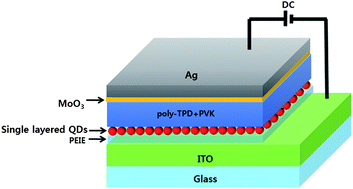
Dong Ick Son, Hong Hee Kim, Do Kyung Hwang, Soonnam Kwon, Won Kook Choi
Inverted quantum dot based light-emitting diodes (QDLED) were simply fabricated by an all solution processing.
The content of this RSS Feed (c) The Royal Society of Chemistry
28 Nov 12:19
by Byung-Ryool Hyun, Joshua J. Choi, Kyle L. Seyler, Tobias Hanrath and Frank W. Wise

ACS Nano
DOI: 10.1021/nn404457c

28 Nov 12:18
Chem. Commun., 2014, 50,679-681
DOI: 10.1039/C3CC47868H, Communication
Weiwei Li, Alice Furlan, W. S. Christian Roelofs, Koen H. Hendriks, Gijs W. P. van Pruissen, Martijn M. Wienk, Rene A. J. Janssen
Biphenyl co-monomers widen the optical band gap of diketopyrrolopyrrole polymers, providing efficiencies of up to 5.7% in solar cells.
The content of this RSS Feed (c) The Royal Society of Chemistry

28 Nov 12:18
by Yu Zou, Xiong Su and Jiang Jiang

Journal of the American Chemical Society
DOI: 10.1021/ja405962k

27 Nov 13:33
Publication date: 15 March 2014
Source:Coordination Chemistry Reviews, Volumes 263–264
Author(s): Ye Yang , Tianquan Lian
In addition to size dependent optical properties, strong quantum confinement in semiconductor nanoparticles (QDs) also affects their exciton relaxation, annihilation and dissociation dynamics, leading to their potential applications in third generation solar energy conversion devices. Multiple exciton generation and hot electron extraction have been proposed as potential approaches to increase the solar conversion efficiencies beyond the Shockley–Queisser limit in QD based solar cells. A common challenge faced by these two approaches is the need for ultrafast exciton dissociation to compete with ultrafast carrier cooling and exciton annihilation. In this review, we summarize our recent studies on multiple exciton generation and dissociation dynamics in PbS-MB+ complexes as well as strong electronic coupling and ultrafast electron transfer from PbS QDs to TiO2 nanocrystalline thin films. In PbS-MB+ complexes, we demonstrate that the multiple exciton generation efficiency in PbS QDs are unaffected by the presence of electron acceptors, and the multiple excitons can be fully dissociated by these acceptors via ultrafast electron transfer. For PbS QDs on TiO2 nanocrystalline films, we observe strong electronic coupling induced broadening of the 1S exciton band, which indicates a ∼6fs electron transfer process according to the Newns–Anderson model of chemisorption. This transfer time is faster than the reported hot electron relaxation time (a few hundred femtosecond), which suggests the feasibility of hot electron extraction prior to their relaxation in these materials.
27 Nov 10:44
by Lev A. Dykman and Nikolai G. Khlebtsov

Chemical Reviews
DOI: 10.1021/cr300441a

27 Nov 10:42
Nanoscale, 2014, 6,931-938
DOI: 10.1039/C3NR04461K, Paper
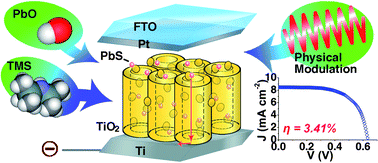
Liang Tao, Yan Xiong, Hong Liu, Wenzhong Shen
High performance PbS quantum dot sensitized solar cells on nanotubes are realized by a novel electric-field-assisted in situ method, without the need of additional chemicals.
The content of this RSS Feed (c) The Royal Society of Chemistry

27 Nov 10:42
Nanoscale, 2014, 6,903-907
DOI: 10.1039/C3NR03641C, Paper
Seung Jin Heo, Seokhyun Yoon, Sang Hoon Oh, Doo Hyun Yoon, Hyun Jae Kim
We propose high-pressure treatment as a nondestructive approach for making conductive CQD solids that are free of chemical and physical defects.
The content of this RSS Feed (c) The Royal Society of Chemistry

27 Nov 01:05
by Robert C. Wadams, Laura Fabris, Richard A. Vaia and Kyoungweon Park

Chemistry of Materials
DOI: 10.1021/cm402863h

27 Nov 01:04
by Nicholas C. Anderson, Mark P. Hendricks, Joshua J. Choi and Jonathan S. Owen

Journal of the American Chemical Society
DOI: 10.1021/ja4086758