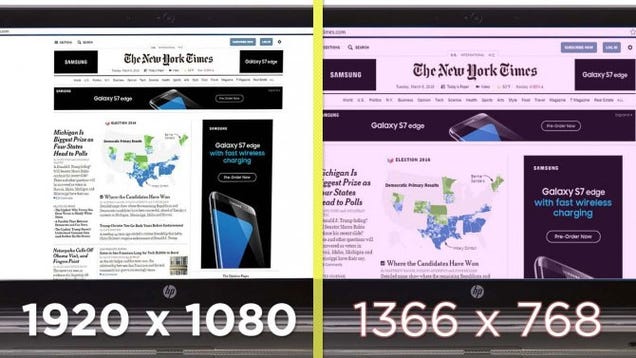
Many PC vendors market their laptops with 1366 by 768 screens as “high definition,” but these are not the laptops you deserve. Laptop Magazine argues that you should never settling for anything less than 1080p for your next laptop.
OnePlus har börjat skicka ut version 2.2.1 av sitt gränssnitt Oxygen OS för telefonen ”2”. Kamera-appen får stöd för att fånga bilder i RAW-formatet, vilket ger betydligt större möjligheter att bearbeta fotografierna i efterhand.
Företaget har även åtgärdat en bugg i kamera-appen som kunde resultera i trasiga bilder. Bluetooth-kompatibiliteten har förbättrats och likaså kompatibiliteten för ”Ultra SIM”. Nya mjukvaran innehåller avslutningsvis en säkerhetsuppdatering.
Oxygen OS 2.2.1 skickas ut stegvis, enligt OnePlus.
I’ve just given the same pep talk to three different writers, so I figure you probably need it to.
Let me speak to you about impostor syndrome. That thing where you are sure everyone knows you’re faking it and they are going to find out any minute and then you will be cast down and they will laugh and OMG EVERYONE WILL KNOW YOU SUCK!!!!11!!1!!!!
Years ago, when I was nominated for the Campbell Award I was having serious, serious impostor syndrome. And Nancy Kress — multiple Hugo/Nebula/Everything award winner with a bajillion books, told me that she still had impostor syndrome. That is at once tremendously heartening — because it means I’m not alone — and terribly sad, because it means that there’s not a point where I will have “made it.”
True. But…
You know how, when you’re playing a video game, you get to see this beautiful loading screen when you level up?
What happens with impostor syndrome to you is that you leveled up while you looking away from the computer. You didn’t see the loading screen, all you see are monsters that are bigger than they were.
But you DID level up and you can totally handle it.
It’s much, much worse to never experience Impostor Syndrome, because that means that you are staying on the easy level. Things will just keep coming that you know how to handle and that, eventually, gets boring.
So next time you feel the Imposter Syndrome hitting, recognize that it’s a symptom of the fact that you levelled up without noticing. It’s a crappy feature and the UI is totally borked, but you are can handle it.
One of the best reasons to use a VPN is to get around pesky location restrictions on streaming movies and other content, but before you shell out money to a VPN that promises servers in dozens of countries, make sure they’re telling the truth about them. Trust, but verify.
Early predictions estimated that Deadpool was going to bring in between $65 and $70 million dollars on its opening weekend, but so far, the movie has pulled over $135 million, and the weekend isn’t even over yet! Can’t wait to see the final number tomorrow!
The movie broke all records for an r-rated film as well as the best opening day for that kind of movie in February, pulling in $47.5 million on Friday alone!
Here is a quick chart comparing the opening weekends of various superhero movies, including Deadpool.
On the evening of Feb. 7, 2016, Expedition 46 Commander Scott Kelly snapped this photo of Levi's Stadium in Santa Clara, Calif. from the International Space Station, writing, "Got to see the #SuperBowl in person after all! But at 17,500MPH, it didn't last long. #YearInSpace"
After logging onto their computers today, staff here at the
Museum of English Rural Life were greeted by an unusual email from the Assistant Curator:
There appears to be a dead mouse in this mousetrap…
It began.
…which is not described as being there on the database.
Can you perhaps check whether it should be there
and/or decide if having a dead mouse in the trap is the best way forward from a
conservation perspective. [/s]
So, this retired rodent had managed to sneak past University
of Reading security, exterior doors and Museum staff, and clambered its way up into our Store. Upon
finding itself there it would have found the promised land; a mouse paradise
laid before it full of straw, wood and textiles. Then, out of thousands of
objects, it chose for its home the very thing designed to kill it some 150
years ago: a mouse trap.
The trap itself was not baited, but this did not stop our
mouse from wriggling inside and, finding itself trapped, meet its demise. The trap
was manufactured by Colin Pullinger & Sons of Silsey, West Sussex in 1861.
It is a multi-catch trap with a see-saw mechanism, and you can see its object
record here. It is known as a ‘Perpetual Mouse Trap’ and proudly declares that
it ‘will last a lifetime’. How apt.
Pests are, of course, a perpetual menace in any museum.
Curators and conservators are always alert for the tell-tale signs of moths,
beetles and rodents which feast on the organic materials we hold in store. Hygiene
and regular cleaning are a first line of defence, as are glazed cases. Objects
are also treated before storage or display to ensure anything lurking within is
killed. And while our most vulnerable objects have always been cased – such as
clothing and leather – the rest of our stored collection made of sturdier wood
and metal was only fully glazed over last year. This mouse may have snuck into
the trap before this glazing, or otherwise managed to get in while construction
work has been carried out for the Museum’s redevelopment.
We have traps set for pests, but we can never catch
everything all of the time. This mouse managed to sign its own death warrant
before it could do any more damage, the extent of which was only a nibbled
label. We will also have to determine whether this mouse was a scout or part of
a larger family. Luckily, because the collection is heavily used it is often only
a matter of time before any kind of infestation is noticed and nipped in the
bud. This mouse was found when our Assistant Curator was in the Stores selecting objects for
use in an interdisciplinary research session on the subject of ‘Animals at
Reading’. Our current MERL Fellow, Professor Karen Sayer, is also particularly
interested in traps as part of her ongoing research into rats and pest control
and regularly views our collection.
For the moment, however, the mouse remains in the trap while
we decide what to do with it. One option is a dignified burial, another is to desiccate
it or have it prepared to remain as a permanent feature of the mouse trap for
our new displays. We’ll let you know what we decide.











 I’ve just given the same pep talk to three different writers, so I figure you probably need it to.