There is no sin greater in gaming than wasting the player’s time.

World of Warcraft players are being advised to be vigilant of a "dangerous Trojan" that could potentially compromise their accounts, even if they are using a Battle.net authenticator to protect themselves.
According to a post on Blizzard's support forum, the reported malware acts in real time by "stealing both your account information and the authenticator password at the time you enter them." Both the mobile and physical Battle.net authenticator are identified as at-risk.
Blizzard support reps said the Trojan can be identified by creating an MSInfo file and then looking in the Startup Program section of that file for either "Disker" or "Disker64." The malware cannot be spotted until after it becomes active and no known security...
There's a fairly large snow storm barreling down on the northeastern United States which will no doubt result in plenty of new images, but the Twitter feed of presidential historian Michael Beschloss is showing many more from the past.
Beschloss, who will soon join The New York Times as a columnist on history, has been sharing vintage images of New York City in the snow along with others from Washington, D.C. and Boston. (He's worth following on Twitter @BeschlossDC if you don't already.)
Check out what he's been sharing:




Join the conversation about this story »

    
|

An online group or person going by the name DERP claims that it is currently attacking EA's login servers, taking Origin down and preventing players from accessing the digital distribution's services.
DERP claims on its twitter account that it's "directed the Gaben Laser Beam" at the EA login servers, taking Origin offline. At the time of writing players can't log in to the service, play EA games on various platforms including PC and Xbox One or make purchases through the storefront.
Earlier this week, the group performed DDoS attacks on games and services like Dota 2, League of Legends, Club Penguin and Battle.net as Twitch streamer James "Phantoml0rd" Varga started streaming them on his Twitch channel. Varga believed that he was...

Respawn Entertainment's Titanfall will not feature modding or mapping tools at launch, Respawn founder Vince Zampella revealed recently, saying that the availability of the features will be evaluated post-launch.
"Not at launch for sure, will have to evaluate after launch," he wrote, responding to a fan's question via Twitter whether mod or mapping tools will be available when the game is released.
Earlier this week, a Respawn representative confirmed that Titanfall will feature sniping but will be "a pretty different animal than you'll find in your run of the mill modern military shooter." The developer also revealed that Titanfall sniping won't allow for the effectiveness of quickscoping and no-scoping techniques.
For more about...

|
|

|
|

Everything seems to be going fine in the world economy, and people are scratching their heads wondering how it could turn south again.
In a new piece up at Project Syndicate, George Soros says to watch China:
There are some eerie resemblances with the financial conditions that prevailed in the US in the years preceding the crash of 2008. But there is a significant difference, too. In the US, financial markets tend to dominate politics; in China, the state owns the banks and the bulk of the economy, and the Communist Party controls the state-owned enterprises.
Aware of the dangers, the People’s Bank of China took steps starting in 2012 to curb the growth of debt; but when the slowdown started to cause real distress in the economy, the Party asserted its supremacy. In July 2013, the leadership ordered the steel industry to restart the furnaces and the PBOC to ease credit. The economy turned around on a dime. In November, the Third Plenum of the 18th Central Committee announced far-reaching reforms. These developments are largely responsible for the recent improvement in the global outlook.
So China could have a meltdown like the US in 2008 or it could drive the entire global economy to new heights.
The ultimate conclusion to China's tension — whether it can successfully rebalance its economy away from debt — will have "profound" consequences for the whole world he says.
Read Soros' whole column here >
Join the conversation about this story »

|
|
Social Insights is delivered first thing every morning exclusively to BI Intelligence subscribers.
 SOCIAL LOGIN LANDSCAPE SHIFTS: Google+ is powering an increasing number of user logins across the Web. Google+'s share of social logins hit its highest level since 2010 in the fourth quarter of 2013, according to Janrain.
Facebook remains the most popular login provider on the Web with a 45% share, but Google is now back up to 35%. For comparison, Google+ had a 38% share in the fourth quarter of 2010, but fell off that mark until recently.
However, the social login landscape is not a zero-sum game. Internet users still enjoy using a variety of services to log in to websites. Yahoo and Twitter each had a 6% share in the fourth quarter.
Social media services want users to log in to other sites and services with their social media credentials, because it helps companies such as Facebook better understand a person's broader web browsing habits. (Janrain)
In Other News …
SNAPCHAT RESPONDS TO DATA LEAK: Snapchat has released a statement in response to the data leak that compromised 4.6 million user names and phone numbers. The company said it will make changes to the app to patch the vulnerability. Among the changes, users will soon be able to opt out of the "Find Friends" feature that lets people find their friends on their app by matching phone numbers. (Snapchat)
FACEBOOK MONITORS MIGRATION TRENDS: Facebook's data science team published a report showing the urban migration patterns among large groups of people. With more than 1 billion users, many of whom disclose where they are from and where they currently live, Facebook has a striking amount of information about trends that could inform the geopolitical landscape. (Facebook)
FACEBOOK LAWSUIT: Facebook is being sued for allegedly serving users ads based on data from private messages. It raises the question yet again, of where exactly Facebook draws the line with user privacy. (Business Insider)
INTERVIEW WITH TWITTER EXEC: Kara Swisher and Walt Mossberg's new technology publication Re/code published an interview with Twitter's Senior Vice President of Engineering Chris Fry. The interview is aimed at getting a better sense of the company's engineering culture. (Re/code)
THE STORY OF NETFLIX: The Atlantic takes a close look at how Netflix has been able to reverse engineer Hollywood and understand the viewing habits of viewers on a very nuanced level. (The Atlantic)
What You May Have Missed On BI Intelligence …
[CHART] WhatsApp Has The Biggest Audience On Android, But Kakao Talk Leads In Time-Spend
[CHART] Pinterest Is Enjoying A Growth Spurt From U.S. Desktop Users
[CHART] The Slowdown In Christmas App Download Growth Is A Microcosm Of The Smartphone Market's Maturation
[CHART] Facebook Pages Have Been Enjoying Record Engagement Levels, But That's About To Change
[CHART] iOS Dominates Christmas Day Mobile Commerce Sales In The US
Join the conversation about this story »

|
|

Complaint filed in California

|
|
Pinterest had the biggest percentage point leap in usage among U.S. adults this year, helping the image-based network surpass Twitter in popularity.
The findings are based on surveys conducted in August and September 2013 by Pew, which published the results in its recent annual report on social media.

Pew also found that 42% of online adults now use multiple social networks.
An impressive 93% of Instagram users also use Facebook, according to Pew. Thus, we can confidently say that Facebook has successfully integrated Instagram with its own platform, which is a critical accomplishment because Instagram has helped strengthen Facebook in areas where it was showing vulnerability to competition, namely photo-sharing.
Facebook's Chief Financial Officer David Ebersman opened a can of worms during the company's third quarter earnings call this year when he admitted that the social network was seeing a "decrease in [teenage] daily users [during the quarter], especially younger teens."
Pew did not survey teens for its study, but we can use its data to see that Instagram usage is strongly correlated with age. Thirty-seven percent of 18 to 29-year-olds use Instagram, but the proportion drops to 18% among people in their thirties and forties.
Download the charts and data in Excel.

Join the conversation about this story »

|
|

New York Times columnist David Brooks, 52, doesn't regret his pot smoking days.
"For a little while in my teenage years, my friends and I smoked marijuana. It was fun. I have some fond memories of us all being silly together. I think those moments of uninhibited frolic deepened our friendships," he writes in a new column.
But he doesn't do it any more, because (1) he had some embarrassing moments while stoned; (2) he didn't like how weed affected his most stoned friend; (3) he developed higher pleasures; (4) he decided that it was making it harder for him to "become more integrated, coherent and responsible."
"So, like the vast majority of people who try drugs, we aged out. We left marijuana behind. I don’t have any problem with somebody who gets high from time to time, but I guess, on the whole, I think being stoned is not a particularly uplifting form of pleasure and should be discouraged more than encouraged," he writes.
Read the full column at the Times, including his criticism of legalization in Washington and Colorado.
But don't take only one man's opinion on the subject. Also check out our scientific rundown of the positive and negative effects of marijuana.
Join the conversation about this story »

|
|

|
|

|
|

A new documentary series by BBC One, called "Dolphins: Spy in the Pod," reportedly shows young dolphins getting "high" off a nerve toxin released by pufferfish and then passing it around.
In a widely-circulated quote from The Sunday Times, zoologist Rob Pilley, who worked as a producer for the series, says that the dolphins "are purposely experimenting with something we know to be intoxicating," which led to them to enter a "trance-like state."
“After chewing the puffer gently and passing it around, they began acting most peculiarly, hanging around with their noses at the surface as if fascinated by their own reflection,” he said.
The assumption is that the dolphins are deliberately antagonizing the pufferfish and know just the right amount of toxin to ingest to get narcotic benefits.
It is certainly funny to think of dolphins passing around a pufferfish like a joint, but Discover Science Sushi blogger Christie Wilcox doubts that dolphins are getting stoned.
"Tetrodotoxin simply doesn’t make sense as a drug," she writes. "Every illicit drug has one thing in common: they alter minds. It’s right there in the definition of narcotic. Tetrodotoxin, however, doesn’t cross the blood-brain barrier; it doesn’t change perception or enhance sensation."
In very small doses, tetrodotoxin can cause numbness and a tingly feeling (which might be considered a "high"), but just a smidgen too much can lead to paralysis or even death, she wrote.
According to National Geographic, tetrodotoxin is 1,200 times more poisonous than cyanide. It's more deadly than even the most hard-core recreational drugs, like meth or cocaine. One pufferfish contains enough toxin to kill 30 adult humans.
Dolphins aren't "crazy enough to take that risk," Wilcox wrote. This probably isn't a common event and it's more logical that the dolphins were caught "paying an uncomfortable price" for harassing a potentially lethal fish.
To make her point, here's a video from 2012 of three dolphins bouncing around a pufferfish like a toy:
Dolphin researcher Justin Gregg, on the hand, thinks there could be some truth to this one:
@MicrobeLover wondering the same thing myself. Seems plausible. We'll know more after the mysterious/much-hyped footage finally airs!
— Justin Gregg (@justindgregg) December 31, 2013
The series primers on Thursday, and the much talked-about pufferfish scene appears in the second episode.
SEE ALSO: Dolphins Are Dangerous Animals That Could Rape You And Kill Your Baby
Join the conversation about this story »

|
|

We wrapped up 2013 the U.S. stock markets closing at an all-time high after booking a 30% return for the year. Gold had it's worst year in decades and the 20+ year bull market in bonds showed signs of ending.
This all came with the Federal Reserve tapering back its monthly asset purchase program to $75 billion. And this came on the back of improving economic conditions in the U.S.
Considering all of this, 2014 promises to be an interesting year in the U.S. and abroad. The emerging markets could be particularly volatile as the year is dotted with political landmines.
To help navigate all of these considerations, David Kelly and the market strategy team at JP Morgan Asset Management just released their Q1 presentation on the state of the markets and the economy.
Note: Thanks to J.P. Morgan Asset Management for giving us permission to feature this presentation.


|
|
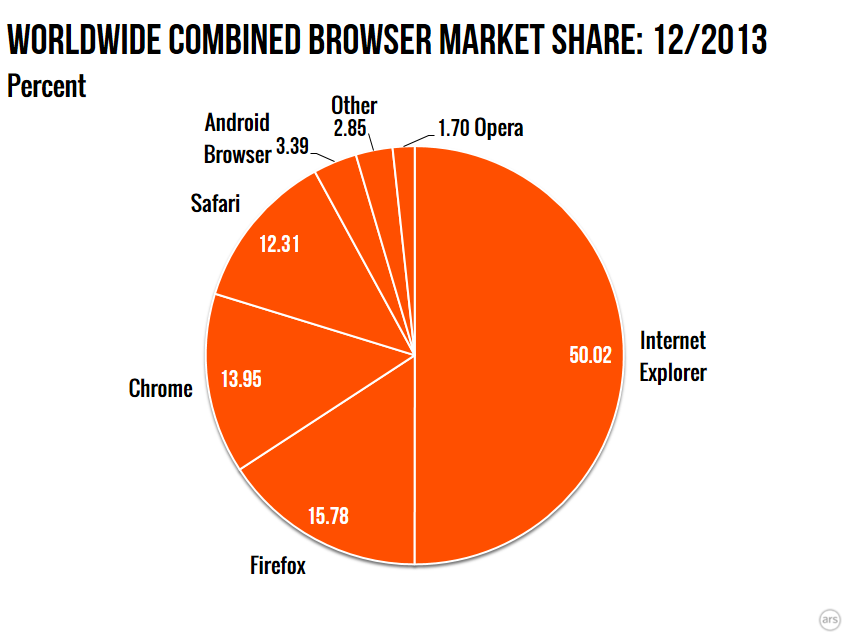
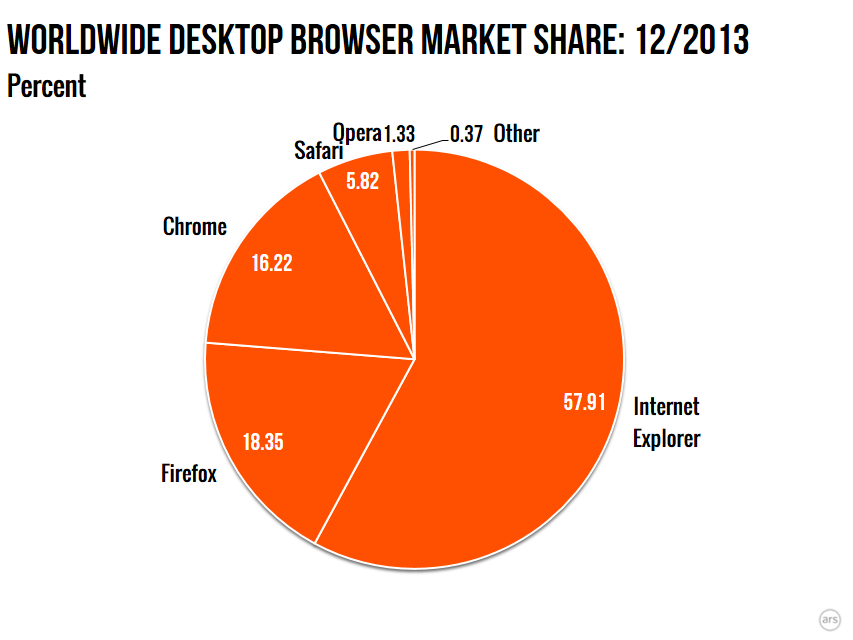
In 2013, Internet Explorer reversed some of its historic losses, Google released Chrome for Android, and Windows 8 surpassed OS X and Windows Vista to become the third most widely used desktop operating system.
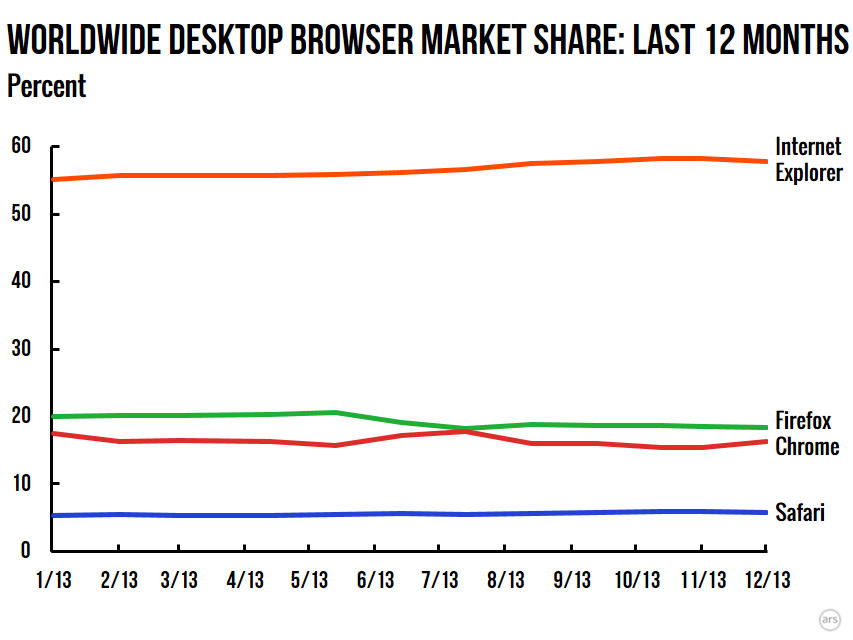
Compared to last month, Internet Explorer actually fell slightly, declining by 0.45 points. Firefox, Safari, and Opera also fell, down 0.19, 0.08, and 0.06 points, respectively. The month's winner was Chrome, which picked up 0.78 points.
Over the course of the entire year, Internet Explorer was up 3.14 points on 2012. Firefox was down 1.47 points. Chrome was also down by 1.82 points. Safari rose 0.58 points.
Read 9 remaining paragraphs | Comments

Here's a prediction I'll make with 100% confidence: At some point in 2014 a celebrity will launch their own currency a la Bitcoin, Litecoin or Dogecoin.
I've had this thought before, but was reminded of it by the fact that someone has launched a cryptocurrency called CoinYe West inspired by Kanye.
He's not connected to it in any way, but it's only a matter of time before a celebrity (possibly Kanye, since he has the ambitious frame of mind for it) does actually do it.
For one thing, it's very easy. All the code to basically replicate Bitcoin is open source.
Furthermore, as Dogecoin has shown, there's a big opportunity for a coin to become the preferred "currency" within an online community. In the case of Dogecoin, it's already the second most popular currency on Reddit for tippers as it has strong uptake among fans of absurd internet memes..
In addition to being shared among fans, the celebrity could create value for the currency by selling tickets in that currency or other merch or other access to the celebrity.
Given the ease, the headlines it will draw, and the obvious boost to the ego, this will happen. Probably pretty soon.
So the question is only: who will do it first.
SEE ALSO: Why Dogecoin is a really big deal
Join the conversation about this story »

|
|

In the middle of November, I bought and installed a Nest thermostat.
For three weeks I loved it. There were no problems whatsoever.
But then, a twist.
The thermostat started to go nuts. The temperature would race over 70 degrees, even though I had the thermostat set for 60 or lower.
The Nest's problems became most pronounced on Christmas Day. My wife and I were away visiting family on Christmas eve and during Christmas Day. When we were heading home, we turned on the Nest to have the house pre-heated. When we got home, the house was more than pre-heated. It was like a sauna.
The temperature was ~72 degrees when we got in. I turned down the thermostat, but the heat kept on cranking. As we sat in the house, the temperature climbed to 76, even though I turned the temperature to 55 on the thermostat.
We went to sleep, but the heat was still cranking. So I got up and turned off my boiler altogether.
In the morning we turned it back on, and the Nest seemed okay. But that later that night, it lost its mind again and cranked the heat in the house.
Two days later, I called Nest to find out what was wrong with the thermostat. I spent 1 hour, 50 minutes talking to customer support people. Luckily, it was two days after Christmas, so it was a slow news day, and I was working from home. I could afford to be on the phone for two hours. Normally, this isn't an option.
The Nest customer support person was really friendly, and quite helpful, despite the long talk time.
Eventually, he decided I had a "power sharing" problem. Basically, the Nest powers itself with the wires in the wall. Those same wires send a signal to the boiler to turn on the heat. Every time it was trying to give itself a charge, it sent a signal to the boiler to heat the house. As a result the heat kept cranking and cranking even though it was just the thermostat trying to get juice.
I'm not the only one that has had this problem, either.
Amazon's reviews of the Nest warn of this happening to other people. For instance, this person had the same problem.
As did this person, who explains the problem, "The method they use to get power is a huge problem. Most wifi thermostats require a C wire so they can power themselves. The issue is, many homes don't have an extra wire to use for this purpose. So in attempt to remain DIY friendly, they implemented a technology referred to in our industry as 'power stealing' which tries to get power from the HVAC control wires and is notorious for many problems. Might as well just be straightforward about it and require a C wire in the first place. There are kits such as Venstar's 'add a wire' which make it easier to solve the problem without having to pull wire."
As one reviewer noted, this is a serious problem. The house can crank up to dangerous temperatures when you're not at home, and the consequences could be deadly.
This is 100% on Nest. When I hooked up my thermostat, it gave no indication that there was anything wrong. And the fact that it worked for a few weeks was even worse since I was lulled into thinking everything was okay.
To fix the problem, Nest recommended I find a local technician from its website. It also offered a $99 credit towards any fixes since I am a new customer. I was told that my $99 credit was not guaranteed, but I would be likely to get it.
(At no point did I say that I am a writer for Business Insider. When I decided to write this up, I reached out to Nest PR to give it a heads up. A spokesperson said she was off, but would get back in touch. I haven't heard back after three hours. When I do I will update this.)
It took four days for a technician to get out to my house. In those intervening days, I had to yank the Nest off the wall when I didn't want the heat on.
When the technician came to the house, he fixed the problem relatively easily, but charged $135. So, if the credit comes through, I'll be paying an extra $36 for the Nest on top of the $250 I paid for the actual thermostat.
I don't mind too much because I really like the product. I would still recommend it to people.
But, the fact that Nest knows its wiring system is faulty and doesn't warn people that'll they need a third wire is a big problem.
Nest is reportedly about to raise $150 million at a $2 billion valuation. A big part of the funding is based on the idea that it makes a product that just works. It oohs and ahhs people with its gorgeous design, and a lovely app. But if it's causing problems for even adept users like myself, this could be a big problem in the long run for the company.
Join the conversation about this story »

|
|

The race to beat the April deadline is on

|
|

Tomislav Uzelac has always had ambition. Not grand delusions of fame and fortune, but the steady and workmanlike desire to create something big. At university that meant reverse-engineering the new international audio standard, the MP3. His graduate thesis became the engine behind Winamp. But the company he built, called PlayMedia, failed. That disaster left him rudderless.
 Over the past couple of months the revelations of Edward Snowden’s leaks have dominated the news.
As a result, interest in anonymity services such as Tor and VPNs has increased as even regular Internet users don’t like the idea of being monitored.
The increased demand for privacy has given an enormous boost to many VPN providers, many of which claim they can protect users from the prying eyes of “monitoring” outfits, to a certain degree.
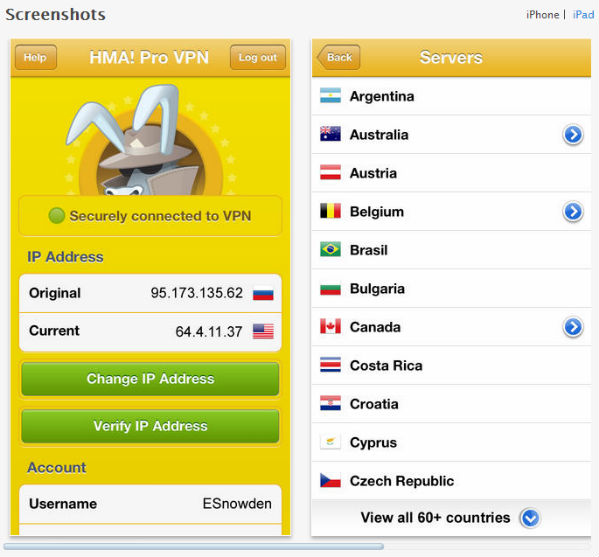
One VPN service takes its response one step further, as it explicitly uses Snowden’s name for PR purposes. As can be seen below, the popular VPN HideMyAss lists a screenshot of an account with the username ESnowden in the App Store.
This ESnowden is apparently trying to connect to a United States IP-address from Russia, a reference to the current location of the NSA leaker.
While this type of PR isn’t particularly tasteful, it’s also rather ironic since HideMyAss’ service does very little to keep users anonymous.
Two years ago HideMyAss made headlines all over the Internet when it became known that they were ordered to share the personal details of one of its users with the authorities. The user in question, the now-jailed LulzSec hacker Cody Kretsinger, was exposed by the VPN which he assumed would keep him safe.
This revelation got a discussion going about the logging policies of various providers, and it was the reason for us to provide an overview of VPN services that store no, or minimal logs.
HideMyAss certainly didn’t make it into this list. The company records the following identifiable information of its users according to its logging policy, which is then stored for a period of two to three months:
· a time stamp when you connect and disconnect to our VPN service;
· the amount data transmitted (upload and download) during your session;
· the IP address used by you to connect to our VPN; and
· the IP address of the individual VPN server used by you.
In other words, in terms of IP-logging HideMyAss doesn’t really offer more privacy than the average Internet provider.
While this is totally fine, since the company is transparent about its policies, using Edward Snowden’s name for their PR is a bit ironic. After all, if the authorities wanted to they could easily obtain Snowden’s IP-address from HideMyAss.
Perhaps this type of PR should serve as a reminder that not all VPNs are as anonymous as they appear to be.
Source: TorrentFreak, for the latest info on copyright, file-sharing and VPN services.

Now available for $29.99, the open-world, standalone version of DayZ – based on the popular ARMA 2 mod with the same name – has sold over 172,000 in its first day of sales through both the official site and Steam.

Microsoft considered creating a version of the Xbox One without a disc drive, head of Microsoft Studios Phil Spencer told the Official Xbox Magazine U.K.
Microsoft was still discussing the alternate version of the next-gen console as recently as mid-2013.
"Obviously, after the announcement and E3, there was some feedback about what people wanted to change," Spencer said. "There was a real discussion about whether we should have an optical disc drive in Xbox One or if we could get away with a purely disc-less console, but when you start looking at bandwidth and game size, it does create issues."
The Xbox One, like Sony's next-gen console, the PlayStation 4, allows users to download full retail games through its online store. The size...

The efficiency of solar panels and electric drivetrains has reached the point where the Sun can easily send cars across Australia. But fully solar-powered vehicles involve a lot of compromises in terms of performance, carrying capacity, and driver comfort. Such vehicles are not something you could use for your daily commute, while commuter cars simply don't have enough surface area to host the panels it would take to run them. But Ford has come up with some clever compromises that will let solar panels partially power one of its concept cars.
The design is based on its C-MAX Energi plug-in hybrid, which has enough battery capacity to cut into its use of an internal combustion engine on shorter trips. The result is a car that the EPA rates at roughly 100MPG. To that, Ford has added an array of solar panels on the roof, enough to generate about 300W of power—nice, but not enough to fully recharge the car's batteries during the daytime.
To get there, Ford added an additional part: a canopy you park the car under. The roof of the canopy is a Fresnel lens, a compact, thin lens that can be manufactured out of inexpensive and light materials; in this case, Ford will use acrylics. The lens will focus light from a broad area onto the roof of the C-MAX Solar Energi, boosting the amount of power it generates.
Read 2 remaining paragraphs | Comments
Bellen onder het autorijden vergroot in principe niet de kans op een ongeluk. Dat blijkt uit onderzoek dat is gepubliceerd in het toonaangevende medische tijdschrift The New England Journal of Medicine.
De onderzoekers houden wel een slag om de arm omdat uit eerdere studies blijkt dat het praten aan de telefoon leidt tot minder concentratie. Ook zijn er kanttekeningen.
Het gaat wel vaak mis bij het intoetsen van een naam of nummer, vooral bij mensen die net hun rijbewijs hebben. Zij hebben tijdens het intoetsen onder het autorijden 8 keer zoveel kans op een ongeluk. Bij ervaren autorijders is dat 2,5 keer.
Er gebeuren ook veel ongelukken en bijna-ongelukken door het pakken van de telefoon, omdat ook dan mensen hun ogen niet op de weg gericht hebben. Onervaren automobilisten hebben tijdens het pakken van hun mobieltje een zeven keer grotere kans op een ongeluk. Bij mensen met meer rij-ervaring is er geen duidelijk verhoogd risico.
Uit de publicatie blijkt ook dat mensen die net hun rijbewijs hebben, relatief weinig bellen en sms'en tijdens het autorijden. Naarmate ze langer rijden, doen ze dat vaker. Waarschijnlijk komt dat doordat ze zich dan zekerder voelen, zeggen de onderzoekers.
Er werden twee aparte onderzoeken gehouden. Voor de ene studie volgden de onderzoekers 42 Amerikanen van 16 die nog maar een paar weken hun rijbewijs hadden. Dat onderzoek duurde anderhalf jaar. Voor het andere onderzoek werden een jaar lang 109 Amerikanen tussen de 18 en 72 gevolgd die al jaren hun rijbewijs hadden.
Tijdens de onderzoeken gebeurden onder de onervaren bestuurders 167 ongelukken of bijna-ongelukken. Bij de ervaren automobilisten waren dat er 518.
Alle gegevens over die (bijna-)crashes konden uitgebreid worden geanalyseerd dankzij apparatuur die in de auto's was geïnstalleerd: vier camera's, een systeem dat de lijnen op de weg detecteerde, een speciale snelheidsmeter, sensoren, radarapparatuur en een gps-systeem. Bij geen van de geregistreerde ongelukken raakte iemand gewond.
If you're one of the few holdouts that isn't into the internet's obsession with cats, you will like this letter to the editor of the NYT published in 1914.
It was tweeted by Hilary Sargent, who you should follow for more gems like this.

Join the conversation about this story »

|
|
Sriracha has taken our taste buds hostage. Every single year, the company behind the beloved hot sauce, Huy Fong Foods, sees at least a 20% business increase.
The sauce of sun-ripened chilies, garlic, and sugar, packaged in a convenient squeeze bottle, adds spice to almost anything: soups, sauces, pastas, pizzas, hot dogs, hamburgers, and chowmein, just to name a few.
Even more, Sriracha embodies hipness (much to the dismay of diehard fans.) If you use it, you love it. And if you don't, you'll probably buy a red, rooster sweatshirt anyway and pretend.
The red sauce has also made its fair share of headlines recently, after neighbors complained about odors emanating from the factory. As a result, the state health department temporarily halted shipping to implement additional safety measures.
Even earlier though, Griffin Hammond, a filmmaker and Sriracha fan himself, found the company's success a bit mysterious. So he launched a Kickstarter campaign to create a documentary about the spicy condiment — and America's obsession with it.
He reached his goal and then some. Last month, "Sriracha: A Documentary" by Griffin Hammond debuted. Do yourself a favor and splurge on $5 to download the full version.
These GIFs from Hammond's recent flick show you how Sriracha goes from the fields to the grocery store shelves.


Check out trailer for the full video below:
SEE ALSO: The Best Science GIFs Of 2013
Join the conversation about this story »