Shared posts
You May Not Even Know You're Spreading Lies
I Will Be Very Sad if Betelgeuse Explodes

Trump Proposes a Cut in Research Spending, but a Boost for AI
Exploring the potential of robotics in the oil and gas industry - Aker BP
The High Cost of a Free Coding Bootcamp


Read more of this story at Slashdot.
We Dug Into Data to Disprove a Myth About Women in STEM

A Calvinesque and Hobbesian look at impeachment aquittal
PLEASE DO join Tom the Dancing Bug's INNER HIVE! Be the first kid on your block to see each week's comic, get extra comics, sneak peeks, insider scoops, and lots of other stuff! JOIN TODAY!
FOLLOW @RubenBolling on the Twitters and a Face Book perhaps some Insta-grams, and even my/our MeWe
READ more Tom the Dancing Bug comics on Boing Boing!

Why it feels like there’s nothing to watch on Netflix, in 6 charts
Netflix’s U.S. library of licensed movies peaked years ago.
There’s a good reason why Netflix has seemed so dull lately.

Why the “business case” for diversity isn’t working
What ever happened to promoting workplace inclusion and fairness because it is the right thing to do?
Workplaces and executive boardrooms should reflect the world’s diversity, and lots of companies are using the so-called “business case” for diversity to instigate action. But, popular as it may be, it’s a failed strategy.

BP’s net-zero pledge is welcome, but detail is required
Making Public Transit Fairer to Women Demands Way More Data
Maps Are Biased Against Animals
Climb up the walls of (and disappear completely inside) the Radiohead Public Library digital archives

Radiohead is so beloved that just about everything surrounding the band’s album releases, from B-sides and interviews to rare performances of unrecorded songs, is pored over, collected, and endlessly discussed by its most obsessive fans. In the past, the group has been pretty strategic about what material it…
MyFonts offers the largest selection of professional fonts for any project
When it comes to immediately grabbing a reader’s attention in any medium, few things are more important than picking the perfect font—regardless of whether you’re advertising your brand online or in print.
The MyFonts Monotype Fresh Font Bundle offers over 50 handcrafted fonts from one of the world’s most revered typeface companies, and it’s available for over 74% off at $49.99.
How you write your content is undeniably important in a world of limited attention spans, and this collection of fonts that covers a wide range of typestyles will help you expand your existing collection with incredible sans serif, serif, script, and display options.
Each font has been handmade and selected by the world-renowned experts at Monotype, and it’s easy to quickly find and select the font you’re looking for based on your individual project and needs.
Gain unlimited access to a growing number of unique fonts for life with the MyFonts Monotype Fresh Font Bundle—available for just $49.99.
You can't beat free! Get $70+ worth of premium Mac apps for free today!
Prices are subject to change.

How the Female Scientist Who Discovered the Greenhouse Gas Effect Was Forgotten by History
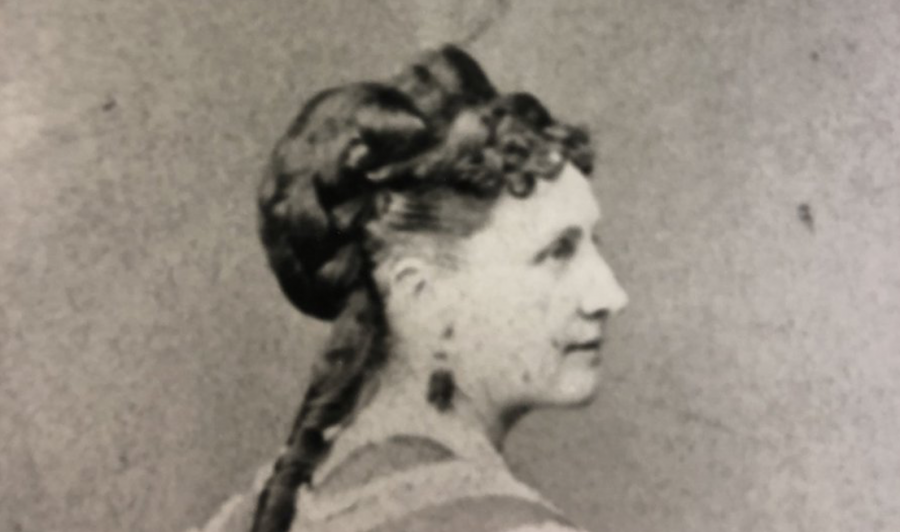
In the early 19th century, Aristotle’s Meteorologica still guided scientific ideas about the climate. The model “sprang from the ancient Greek concept of klima,” as Ian Beacock writes at The Atlantic, a static scheme that “divided the hemispheres into three fixed climatic bands: polar cold, equatorial heat, and a zone of moderation in the middle.” It wasn’t until the 1850s that the study of climate developed into what historian Deborah Cohen describes as “dynamic climatology.”
Indeed, 120 years before Exxon Mobile learned about—and then seemingly covered up—global warming, pioneering researchers discovered the greenhouse gas effect, the tendency for a closed environment like our atmosphere to heat up when carbon dioxide levels rise. The first person on record to link CO2 and global warming, amateur scientist Eunice Newton Foote, presented her research to the Eight Annual Meeting of the American Association for the Advancement of Science in 1856.
Foote’s paper, “Circumstances affecting the heat of the sun’s rays,” was reviewed the following month in the pages of Scientific American, in a column that approved of her “practical experiments” and noted, “this we are happy to say has been done by a lady.” She used an air pump, glass cylinders, and thermometers to compare the effects of sunlight on “carbonic acid gas” (or carbon dioxide) and “common air.” From her rudimentary but effective demonstrations, she concluded:
An atmosphere of that gas [CO2] would give to our earth a high temperature; and if as some suppose, at one period of its history the air had mixed with it a larger proportion than at present, an increased temperature…must have necessarily resulted.
Unfortunately, her achievement would disappear three years later when Irish physicist John Tyndall, who likely knew nothing of Foote, made the same discovery. With his superior resources and privileges, Tyndall was able to take his research further. “In retrospect,” one climate science database writes, Tyndall has emerged as the founder of climate science, though the view “hides a complex, and in many ways more interesting story.”
Neither Tyndall nor Foote wrote about the effect of human activity on the contemporary climate. It would take until the 1890s for Swedish scientist Svante Arrhenius to predict human-caused warming from industrial CO2 emissions. But subsequent developments depended upon their insights. Foote, whose was born 200 years ago this past July, was marginalized almost from the start. “Entirely because she was a woman,” the Public Domain Review points out, “Foote was barred from reading the paper describing her findings."
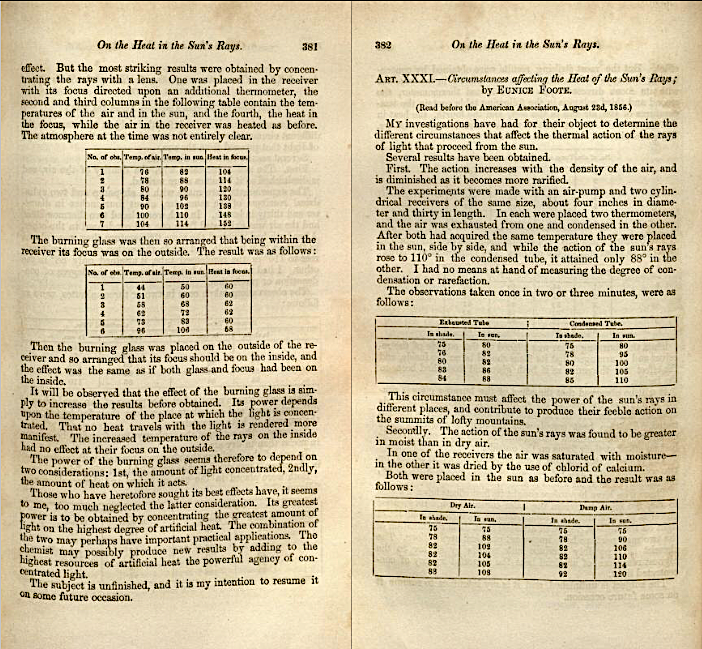
Furthermore, Foote "was passed over for publication in the Association’s annual Proceedings.” Her paper was published in The American Journal of Science, but was mostly remarked upon, as in the Scientific American review, for the marvel of such homespun ingenuity from “a lady.” The review, titled “Scientific Ladies—Experiments with Condensed Gas,” opened with the sentence “Some have not only entertained, but expressed the mean idea, that women do not possess the strength of mind necessary for scientific investigation.”
The praise of Foote credits her as a paragon of her gender, while failing to convey the universal importance of her discovery. At the AAAS conference, the Smithsonian’s Joseph Henry praised Foote by declaring that science was “of no country and of no sex,” a statement that has proven time and again to be untrue in practice. The condescension and discrimination Foote endured points to the multiple ways in which she was excluded as a woman—not only from the scientific establishment but from the educational institutions and funding sources that supported it.

Her disappearance, until recently, from the history of science “plays into the Matilda Effect,” Leila McNeill argues at Smithsonian, “the trend of men getting credit for female scientist’s achievements.” In this case, there’s no reason not to credit both scientists, who made original discoveries independently. But Foote got there first. Had she been given the credit she was due at the time—and the institutional support to match—there’s no telling how far her work would have taken her.
Just as Foote’s discovery places her firmly within climate science history, retrospectively, her “place in the scientific community, or lack therof,” writes Amara Huddleston at Climate.gov, “weaves into the broader story of women’s rights.” Foote attended the first Women’s Rights Convention in Seneca Falls, NY in 1848, and her name is fifth down on the list of signatories to the “Declaration of Sentiments,” a document demanding full equality in social status, legal rights, and educational, economic, and, Foote would have added, scientific opportunities.
Learn much more about Foote and her fascinating family from her descendent, marine biologist Liz Foote.
Related Content:
Women Scientists Launch a Database Featuring the Work of 9,000 Women Working in the Sciences
Josh Jones is a writer and musician based in Durham, NC. Follow him at @jdmagness
How the Female Scientist Who Discovered the Greenhouse Gas Effect Was Forgotten by History is a post from: Open Culture. Follow us on Facebook, Twitter, and Google Plus, or get our Daily Email. And don't miss our big collections of Free Online Courses, Free Online Movies, Free eBooks, Free Audio Books, Free Foreign Language Lessons, and MOOCs.
Become a Piano Savant with This Clever Guide to Classic Tunes by Christoph Niemann

“How to Please Elise” (2020), 16.5 x 11.8 inches, letterpress print on Gmund Colors Matt 21, 200g/m2. All images © Christoph Niemann
Your days of expensive piano lessons are over. Master the foreboding notes in Jaws, a nursery rhyme often repeated by kids, and of course,”Für Elise,” with this straightforward diagram from Christoph Niemann (previously). In his riff on Beethoven’s classic, “How to Please Elise” provides simple instructions on how to play the first 51 notes of the German composer’s masterpiece with ease through a diagrammed sequence similar to an old-school instructional dance chart. Niemann even said on Instagram that the notes are fact-checked and accurate, so anyone attempting to follow his directions should produce the widely recognized tunes. If you want to add one these signed prints to your collection, though, you should hurry: Niemann only printed 100.


Do stories and artists like this matter to you? Become a Colossal Member and support independent arts publishing. Join a community of like-minded readers who are passionate about contemporary art, apply for our annual grant, and get exclusive access to interviews, partner discounts, and event tickets.
Sedimentary Structures: Building Stones of Badami, Aihole And Pattadakal Temples

I recently visited the Chalukya style temples and rock cut monuments at Aihole, Pattadakal and Badami (6th -8th CE) in northern Karnataka and noticed some great sedimentary structures in the building stones. The term sedimentary structures refers to the shape and form sedimentary layers get sculpted into by the action of waves, currents, tides and wind during deposition of the sediment. The size of the deposited sedimentary particles and the orientation of layers are a reflection of both the vigor of the currents and waves and the direction of flow of water or wind.

These monuments are made up of Neoproterozoic age (900-800 million year old) sandstones. Geologists have recognized using detailed sedimentological analysis that the sandstones formed mostly in a large braided river system that flowed in a northwesterly direction.
Between roughly 1800 -800 million years ago, over the course of a billion years, the Indian continental crust sagged due to various tectonic forces to form several long lasting sedimentary basins. The Kaladgi Basin in which the Badami area sandstones were deposited is one such basin. The paleogeographic reconstruction below shows the position of the Indian continent at about one billion years ago and the location of the various sedimentary basins within it.

Source: Shilpa Patil Pillai, Kanchan Pande and Vivek S Kale: 2018: Implications of new 40Ar/39Ar age of Mallapur Intrusives on the chronology and evolution of the Kaladgi Basin, Dharwar Craton, India.
Much of this deposition took place in inland or epeiric seas that flooded the Indian continent. During intervals of sea level fall, rivers carved valleys and deposited coarse sediment. The Badami Cave sandstones are river deposits of the Kaladgi Basin. The stratigraphic column shows various sedimentary deposits of the Kaladgi Basin and their inferred environments of deposition.

The Badami braided river system was receiving sediment eroded from Archean age (>2.5 billion year old) rocks situated SE of the basin. These were granites, granodiorites, and low to medium grade metamorphic rocks of the Dharwar craton (a large block of stable old continental crust).
Land plants did not exist then. Weathered debris was moved quickly by surface flow into streams. Large sediment load, moving by traction i.e. by rolling and sliding on the stream bed, repeatedly choked the channels, forcing bifurcation of streams and formation of braids. Very broad braided rivers formed since there were no plants to stabilize banks. The Badami sandstones (Cave Temple Formation) are technically known as arenites. This term indicates that the rock is made up of mostly coarse sand with very little finer sized mud. Accumulation of mostly coarser sand size and pebbly particles reflects a locale of repeated high discharges and vigorous currents which winnowed away the finer sized mud. The braided river shown below as an example is from the Canterbury Plains of New Zealand.

Source: Braided Rivers: What's the Story?
The Badami rocks preserve a record of various subenvironments of this paleo-river. Picture shows channel and bar deposits in outcrop.

Source: Mukhopadhyay et. al. 2018; Stratigraphic Evolution and Architecture of the Terrestrial Succession at the Base of the Neoproterozoic Badami Group, Karnataka, India.
As river channels episodically migrated sideways and the basin floor subsided to accommodate more sediment, channel deposits and adjacent sand bars got stacked to form thick 'multi-story' sandstones. Each bed tells a story of a discrete depositional episode.

The arrangement of sand layers within each bed tells us about the subenvironments in which it formed and the energy and direction of water flow during deposition. I came across many types of these internal structures. I recognized tabular cross beds, trough cross beds, planar lamination and rippled beds. Water (or wind) can move & shape sand into piles or waves. Sand grains roll along the direction of flow, then avalanche down the steeper side (lee side) of the wave forming a layer inclined (cross) to the orientation of the main sand body. Successive avalanches form a set of cross beds. The graphic shows the formation of a set of cross beds.

Here is an example of cross beds from near the town of Badami.

And this one is from a building stone from Pattadakal temple.

Such cross beds were built by sediment avalanching on the lee side of migrating sand bars during high flow.
This picture show trough cross bedding from near the Badami cave complex. These represent the internal structure of migrating sinuous sand dunes on a channel floor.

See this elegant explanation by Dawn Sumner, a sedimentologist at the University of California at Davis, of how trough cross beds form.
Email subscribers who may not be able to see the embedded video, click on this link: Trough Cross Bedding Video.
And here is a beautiful example of trough cross bedding found in a Pattadakal temple building stone.

This is planar lamination on a slab at Pattadakal. The bed is constructed of parallel layers of coarse sand. It is interpreted to have been deposited in a high flow regime from sheets of water flowing over mid channel sand bars.

Ripples on a slab at Pattadakal. This is a rare preservation of a bedding surface showing rippled sand. Erosion usually cuts off the wavy upper part. These ripples indicate migration of small sand waves in a quieter flow regime on the channel floor.

Remember, cross beds are the inclined layers that form on the lee side of a ripple or wave or dune. Here are small cross sets on the floor of Aihole rock cut temple! These represent the cross beds formed by migration of small ripples. The ripples themselves have been eroded away. Arrows indicate the direction of water flow and cross bed accretion as ripples migrated.

Okay, let's go back to my first question. Is the slab I showed in the picture geologically upside down?
Yes it is. But how to tell?
As sand avalanches down the lee slope it forms a tail at the toe of the slope resulting in cross beds which become tangential to the floor. In picture the cross beds are tangential towards the top of slab i.e. that is actually the base.

Lets see at how the cross bed contact with the top and bottom bedding plane looks in an outcrop. Here is the original depositional orientation of cross beds manifest in this outcrop near Badami caves. They show a tail or tangential contact of the cross beds with the base. Since top of cross beds are not usually preserved they show a high angle contact truncated by upper bedding plane.
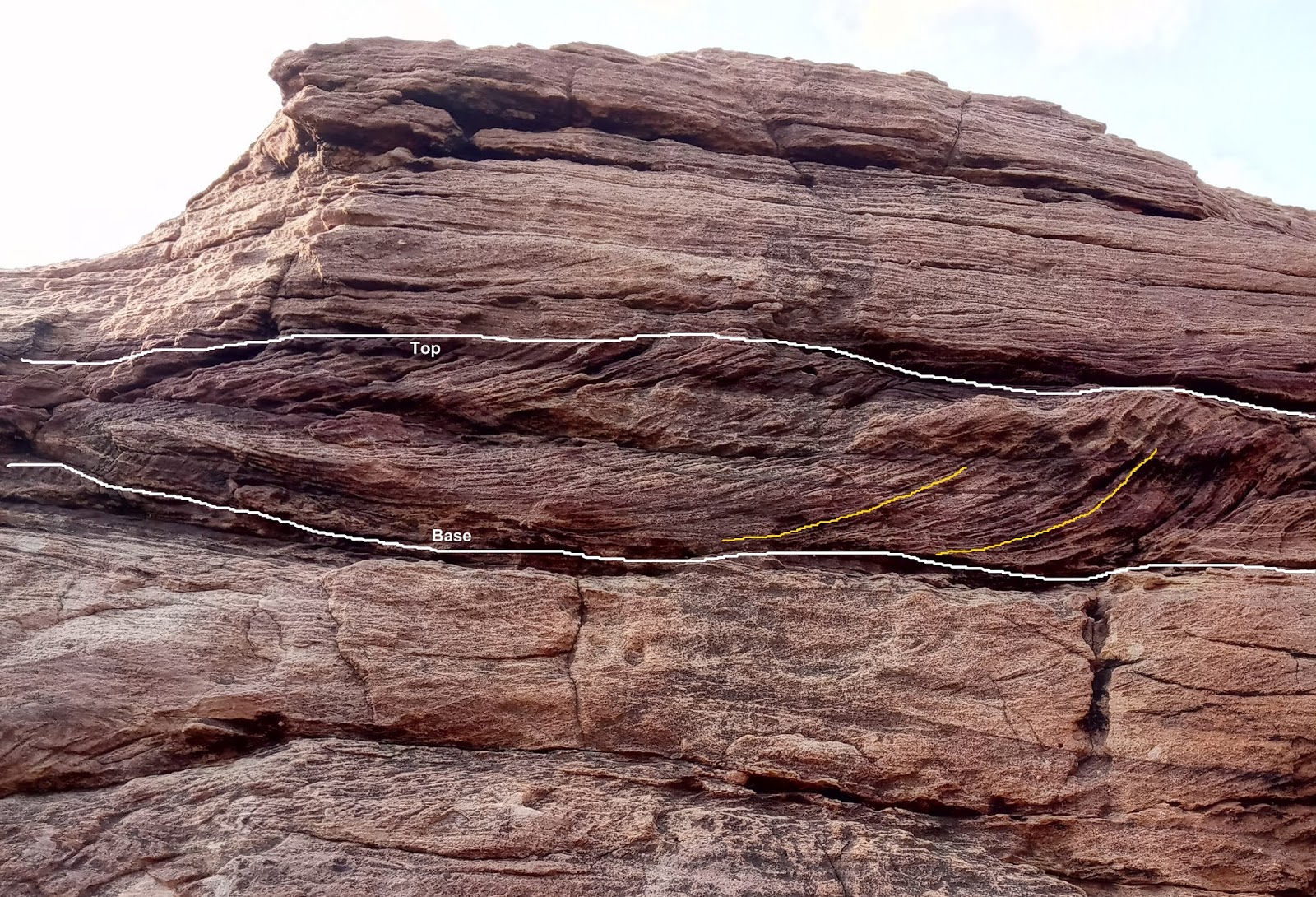
This slab is upside down too! Notice again the tangential contact of the cross beds (white arrow) is towards the top, which means that must have been the base. Yellow arrow points to high angle contact with the upper bedding surface.

Towards the top of the exposed section of sandstone around Badami I came across some truly impressive examples of cross bedding. These particular exposures were on the crags opposite the four main Badami temples. There is a narrow passage past the archaeological museum and a short climb to the top. Take a look at these beauties!

These large cross beds reminded me of the inclined beds of wind blown sand dunes. Is it possible that abandoned sand bars were sculpted by wind in to big dunes? Or does this upper level sandstone represent, as a recent study suggests, the beginning of a marine incursion in to the basin? In this scenario, deposition of sand took place in high-energy shallow waters near the shore. These cross beds represent large migrating sand waves which were eventually shaped in to beach ridges and tidal bars.
The outcrops and building stones of these monuments mostly record the processes within the Badami braided paleo-river. 900 million yrs ago a complex of channels and bars, quieter pools and rippled sand beds existed where these temples stand today.

Do visit Aihole, Pattadakal and Badami and gaze at its splendid architecture and sculptures. But spare some time to appreciate the magnificent record of our natural history that these monuments preserve.

Quiz- Is this slab upside down or in its true depositional orientation? 😉

Until next time....
Can you survive 62 days of corporate hell in this Oregon Trail-style text game?

Some days, the 9-to-5 creeps along slower than usual. If that’s the case, why not pass the time with a text-based adventure RPG that whisks you to the exotic, fantastical world of...surviving your probationary period at a new, white-collar hell office.
IBM's Debating AI Just Got a Lot Closer To Being a Useful Tool

Read more of this story at Slashdot.
The Way We Write History Has Changed
Read more of this story at Slashdot.
Mozilla Wants Young People To Consider 'Ethical Issues' Before Taking Jobs In Tech
Read more of this story at Slashdot.
Unauthorized Charcoal: GE fridges won't dispense ice or water unless your filter authenticates as an official ($55!) component
@ShaneMorris: "My fridge has an RFID chip in the water filter, which means the generic water filter I ordered for $19 doesn't work. My fridge will literally not dispense ice, or water. I have to pay @generalelectric $55 for a water filter from them."
(Image: GE, Cryteria, CC-BY, modified)

The Playbook for Poisoning the Earth
Lee Fang in The Intercept:
 In September 2009, over 3,000 bee enthusiasts from around the world descended on the city of Montpellier in southern France for Apimondia — a festive beekeeper conference filled with scientific lectures, hobbyist demonstrations, and commercial beekeepers hawking honey. But that year, a cloud loomed over the event: bee colonies across the globe were collapsing, and billions of bees were dying.
Bee declines have been observed throughout recorded history, but the sudden, persistent and abnormally high annual hive losses had gotten so bad that the U.S. Department of Agriculture had commissioned two of the world’s most well-known entomologists — Dennis vanEngelsdorp, a chief apiary inspector in Pennsylvania, then studying at Penn State University, and Jeffrey Pettis, then working as a government scientist — to study the mysterious decline. They posited that there must be an underlying factor weakening bees’ immune systems.
More here.
The Muppets Take Fear and Loathing In Las Vegas
We were somewhere east of Fraggle Rock when the drugs began to take hold. I remember saying something like, “I feel a bit light-headed, Miss Piggy. Maybe you should drive.” And suddenly there was a terrible sound around us, and the sky was full of what looked like alien squids going, “Yip yip yip! Uh-huh. Uh-huh,” swooping all around the car, which was going 100 miles per hour with the top down to Las Vegas. And a voice was screaming, “Holy Jesus! What are these fucking puppets?”
Then it was quiet again. Miss Piggy, my attorney, had taken her top off and was pouring beer on her chest to prevent her felt from pilling.
“What the fuck are you yelling about, Gonzo?” she asked. I rubbed my long blue nose.
It was almost noon and we had more than 100 miles to go. My editor had given me $300 cash, most of which was already spent on extremely dangerous puppeteering supplies. We had two bags of grass (the cellophane kind they put in Easter baskets, green); 75 pellets stuffed with stuffing (cotton, unbleached); six packages of jumbo pipe cleaners (multi-colored); and a salt shaker full of glitter cocaine (holographic).
Miss Piggy saw the hitchhiker before I did. “Let’s give this frog a lift,” she said, and before I could mount any argument, she had stopped, and this poor Okie frog was hopping up to the car with a big grin on his face saying, “Hot damn! I never rode in a convertible before!”
“Helloooo,” said Miss Piggy, batting her big felt eyelashes.
“Hello?” he said. “Last night you never even said goodbye. You lied to me! You used me!”
“Oh Kermie, let me explain,” she said.
“I saw you dancing with that mangy cookie thief, you sow,” he said.
“Sow? HI-YAHHH!” she shouted, nearly smacking him right out of the car.
Now, I’ve spent enough time in Muppet Country to know most of them lead pretty dull lives. Eat. Sleep. Fuck. Teach toddlers the alphabet. No wonder some of them drift over the line into cheap thrills once in awhile. But eventually, you start burning out the marionette strings like a 440-volt blast in an inflatable kiddie pool.
Maybe I’d better have a chat with this frog, I thought.
“How about some ether?” I said. “Helium? Perler beads?”
The only thing that worried me was the helium. There is nothing in the world more helpless and irresponsible and depraved than a puppet in the depths of a helium binge.
Kermit shook his head. His mouth fell open, as though he were a puppet with a limited number of ways to simulate human emotion.
Miss Piggy was now fumbling with the salt shaker containing the glitter cocaine. Opening it. Snorting it. Spilling it. Then screaming and grabbing at the air, as our fine iridescent dust blew up and out across the desert highway. A very expensive, very sparkly twister rising up from the convertible.
Her snout had more spangles than Abby Cadabby after a night working the pole at Brought To You By The Letter XXX.
“You’re a fucking narcotics agent!” I shouted. “I was on to your stinking act from the start, you pig!"
And suddenly she was waving a fat black .357 magnum hot glue gun at me. One of those snubnosed ones they sell at Jo-Ann Fabrics. "You flammable lint ball! You polyester turkey! I’ll glue your fucking eyes shut!”
“You swine!” I said. "I’ll cut you into felt bacon strips! Some kid will be frying you on a plastic stove in their Christmas jammies.”
The frog was climbing out of the back seat. “Thanks for the ride,” he yelled. "Thanks a lot. It isn’t easy being green, that’s for fucking sure.” His big webbed feet hit the asphalt and he started hopping back towards Fraggle Rock.
Out in the middle of the desert, not a tree in sight. We continued on to Vegas.
Astronomers Detect Second Planet Orbiting Nearest Star

Scientists used to wonder how common planets were throughout the universe, and now we know — they’re everywhere. Even with our relatively rudimentary methods of detecting exoplanets, we’ve identified thousands of alien worlds, including some in our own backyard. In 2016, astronomers discovered an exoplanet around Proxima Centauri, the nearest star to the sun. Now, it looks like there might be a second “super-Earth” exoplanet orbiting that star.
Proxima Centauri sits a mere 4.2 light-years away from Earth. It’s part of a triple star group along with the nearby Alpha Centauri AB binary system. Proxima Centauri is smaller and cooler than those stars — it’s what’s known as a red dwarf, the most common type of star in the Milky Way galaxy.
While Proxima Centauri is very close in cosmic terms, its planetary plane doesn’t align with Earth. That means the common transit method of exoplanet detection doesn’t work. Instruments like Kepler and the new TESS satellite use the transit method to detect small dips in light output as planets pass in front of their home stars. Since that doesn’t work with Proxima Centauri, astronomers used the star’s radial velocity (also called Doppler spectroscopy) to spot Proxima b in 2016. An international team of astronomers used the same “solar wobbles” to detect the new Proxima c exoplanet candidate.

Image by Wikipedia. Alpha Centauri AB is on the left, Beta Centauri on the right, and Proxima Centauri is at the center of the red circle.
Proxima c is a relatively low-mass exoplanet, believed to be about six times more massive than Earth. Whereas Proxima b orbits the star once every 11 Earth days, Proxima c has an orbital period of five years. It’s 50 percent farther from Proxima Centauri than Earth is from the sun, and Proxima Centauri is a much cooler star. As a result, scientists predict Proxima c is far outside the star’s habitable zone with temperatures as low as -388 degrees Fahrenheit. Proxima b is inside the habitable zone, but radiation from the red dwarf might render it inhospitable.
The team analyzed 17 years of data from the HARPS (High Accuracy Radial Velocity Planet Searcher) and the UVES (Ultraviolet and Visual Echelle Spectrograph) instruments to identify Proxima c. The study reports that the new exoplanet best explains Proxima Centauri’s peculiar gravitational wobble. Now, it’s up to other teams to study the star and confirm the findings. Even if there’s no chance for life on Proxima c, it could be a real boon to the study of exoplanets to have a system with two of them right on our cosmic doorstep.
Now read:
Rush's Neil Peart talks Tom Sawyer, with vintage studio footage
From the 2010 Rush documentary "Beyond the Lighted Stage," Neil Peart, who died last week, talks about the power of Tom Sawyer. What you say about his company is what you say about society.
(via Dust to Digital)


Navy Confirms It Has a Secret Classified Video of an Infamous UFO Incident, Says Releasing It Would Threaten National Security
Read more of this story at Slashdot.
Shocking study of 26,828 women finds that sexual harassment gets even worse with career advancement
Supervisors experience 30-100% more harassment.
Congratulations on your promotion! It comes with a side of sexual harassment. And no, taking a post abroad won’t help.