
The social network is positioning itself as a leader in diversity efforts, even though it still has a lot to learn.
The post Facebook Publishes Its Managing Bias Course For All appeared first on WIRED.

The social network is positioning itself as a leader in diversity efforts, even though it still has a lot to learn.
The post Facebook Publishes Its Managing Bias Course For All appeared first on WIRED.

Earthquakes and bubbles in the sea suggest Kick 'Em Jenny off Grenada is going to erupt soon.
The post There’s a Volcano Called Kick ‘Em Jenny, and It’s Angry appeared first on WIRED.


Primer is The A.V. Club’s ongoing series of beginners’ guides to pop culture’s most notable subjects: filmmakers, music styles, literary genres, and whatever else interests us—and hopefully you. This installment: the sprawling expanse of the Marvel Cinematic Universe.
Back in 2005, the idea of superheroes hanging out together on-screen was as absurd as the thought of someone making another Star Wars trilogy. While superheroes often team up on the pages of comic books, movie licensing deals limited specific characters to specific studios for specific franchises. On the big screen, Superman stayed in Metropolis, Batman in Gotham City, and the X-Men and Spider-Man lived in two separate versions of New York produced, respectively, by 20th Century Fox and Columbia Pictures.
But around that time Marvel Comics was growing dissatisfied with the way its characters were being presented on-screen in critical flops like 2003 ...
Grad trip to @evo2k. 2 stay incognito was Vega who wears a mask. @StreetFighter family. DJ, Dr. Bosconovich, Makoto. pic.twitter.com/b3wOgxPgAG
— Jamie Lee Curtis (@jamieleecurtis) July 18, 2015
This weekend was EVO 2015, and paying a visit was none other than Jamie Lee Curtis along with her entire family. Of course, as one does at EVO, she went in disguise as Vega, one of the Street Fighter characters. In fact, her entire family went in costume, including her husband Christopher Guest who was dressed as Dr. Bosconovitch, from Tekken. They were all there for her son’s graduation trip.
No word yet on whether anyone spotted her or her family. How cool would it be to realize you were sitting next to Curtis after you got home and saw the news?
Don’t forget that Curtis has some of her own fighting game chops. In an interview she did for Spare Parts, she mentioned that she’s all about fighting games, especially Street Fighter. Her main? Cammy. Who else?
(via Vulture)
—Please make note of The Mary Sue’s general comment policy.—
Do you follow The Mary Sue on Twitter, Facebook, Tumblr, Pinterest, & Google +?

Project Linework posts maps in a variety of loosey-goosey styles, for people who want things almost right. Read the rest

Game Of Thrones’ Battle Of Hardhome was, without a doubt, the biggest throwdown in the fifth season of the HBO show. And now, Spanish VFX company El Ranchito has deconstructed the whole thing, demonstrating how the show used green screens, neon spandex, and other effects magic to convince viewers that nothing is more terrifying than thousands of wights attacking the Wildlings and the Night’s Watch as the White Walkers watch atop their undead horses.
El Ranchito released a five-minute video that breaks down the most chilling moments from “Hardhome,” including the invasion of the wight army, Jon Snow shattering a White Walker with Longclaw, and Wun Wun the giant tearing a wight in half.
[Via The Daily Dot]

Sugary drinks kill 184,000 people each year through diabetes, heart disease, and cancer, according to new research from Tufts University. “It should be a global priority to substantially reduce or eliminate sugar-sweetened beverages from the diet,” notes lead researcher Dariush Mozaffarian, who says these drinks have no health benefits.

 I don’t know about you, but I wouldn’t mess with Zoe Saldana.
Speaking with USA Today, Saldana expressed her… frustrations with the reactions to her recent pregnancy (she had twins!).
“Let me tell you something, it will never be the right time for anybody in your life that you get pregnant,” says Saldana, noting that last year, “the productions I was slated to work on sort of had a panic. I heard through the grapevine there was even a conversation of me being written off of one of the projects.”
Her reaction?
“I was like, ‘Oh, my God, are you kidding me? It’s this bad?’ Right when I just feel super-duper happy, is that inconvenient for you? That me, as a woman in my thirties, I finally am in love and I am finally starting my life? And it’s (screwing) your schedule up? Really?”
Yes, really. And of course it’s not an issue that belongs to Hollywood alone. Countless employers are wary of hiring women they believe are about to start a family and some will even straight up discriminate against them. Then of course there’s the paid leave issue for after employees have a baby and USA Today mentions a 2014 study from the Families and Work Institute, writing “only 20% of large employers (with 1,000 or more employees) provide child care at the workplace, and just 5% contribute financially toward it.”
Saldana thinks there’s an imbalance considering studios will
“spend more money sometimes ‘perking’ up male superstars in a movie,” she says, paying for private jets, a coterie of assistants and bodyguards or booking “a really phat penthouse or them staying in a yacht instead of them staying on land.”
“But then a woman comes in going, ‘OK, I have a child. You’re taking me away from my home. You’re taking my children away from their home. And you’re going to make me work a lot more hours than I usually would if I was home. Therefore, I would have to pay for this nanny for more hours — so I kind of need that. And they go, ‘Nope, we don’t pay for nannies.’ “
More and more actors are speaking out every day about the sexism inherent in the industry, both behind the scenes and in front. It took Sony’s recent email hack to get Jennifer Lawrence paid more than her male co-star Chris Pratt — what will it take to help fix Saldana, and others’, issues?
A photo posted by Zoe Saldana (@zoesaldana) on
(via US Weekly)
—Please make note of The Mary Sue’s general comment policy.—
Do you follow The Mary Sue on Twitter, Facebook, Tumblr, Pinterest, & Google +?
Marc Maron and President Obama had a relaxed and fascinating one-hour conversation in Maron's Pasadena, California garage, where Maron produces his popular WTF Podcast.
Read the rest
Above, a map of the "Square and Stationary Earth" (1893) by a Professor Orlando Ferguson of Hot Springs, South Dakota. Read the rest
 Houston is in line to create hundreds of thousands of STEM jobs in the coming years, but we won't have the workers to fill them unless several things change.
By the year 2018, more than 715,000 STEM-related jobs are projected in Texas, according to a study by the Georgetown University Center on Education and the Workforce. The U.S. Bureau of Labor Statistics also projects a 9 percent growth in engineering professions from 2012 to 2022. While that’s promising news for Houston’s economy, and in…
Houston is in line to create hundreds of thousands of STEM jobs in the coming years, but we won't have the workers to fill them unless several things change.
By the year 2018, more than 715,000 STEM-related jobs are projected in Texas, according to a study by the Georgetown University Center on Education and the Workforce. The U.S. Bureau of Labor Statistics also projects a 9 percent growth in engineering professions from 2012 to 2022. While that’s promising news for Houston’s economy, and in…Notice a change to your Gchat? Hate it? Don't panic.
After two years of gently suggesting that users switch from the classic Gchat UI to the newer Hangouts platform, Google surprised Gmail users around the world this week by automatically switching everyone over. Luckily, there's an easy way to get the old Gchat back. Which is a good thing, because Hangouts in Gmail just sucks compared to Gchat.

"Anybody have any ideas?" . . . Anybody? . . . We tackle how to get people talking.
We've all been in that brainstorming meeting: the one where you could hear a pin drop, and the white board of "great ideas" remains blank. It's awkward for participants and downright excruciating for the person leading the meeting.

Last Friday, after we marked the passing of Christopher Lee by featuring his reading of Edgar Allan Poe’s 1845 narrative poem “The Raven,” we stumbled, by chance, upon Lee’s reading of another Poe classic–“The Tell-Tale Heart.” Operating with the theory that there’s no such thing as too much Edgar Allan Poe, and certainly no such thing as too much Christopher Lee reading Edgar Allan Poe, we’ve featured that second reading above. It’ll be added to our collection of 630 Free Audio Books…
via the Edgar Allan Poe Facebook Page
Dan Colman is the founder/editor of Open Culture. Follow us on Facebook, Twitter, Google Plus and LinkedIn and share intelligent media with your friends. Or better yet, sign up for our daily email and get a daily dose of Open Culture in your inbox.

I try to journey once a month from Philly to New York, and on those days, especially in winter, my phone tends to die. I remember carefully planning my afternoon between coffee shops and train stations where I might find an outlet to plug my phone. One of the most frustrating times was trying to visit a wearable tech show in Brooklyn with no power. I made it there, but I knew there was no way I was going to navigate back to my Bolt Bus stop without my trusty subway app. Luckily, Becky Stern was there and gave me a spare power box from her Solar Boost Bag project. I remember liking that project, and it was that moment when I figured out it was the perfect New York solution. So, I set about putting one together.
Choosing the Right Purse/Bag
Although I liked Becky’s bag shown in the tutorial for this project, I really wanted something that would look nice in a business situation, or something more casual. A black purse just seemed right. Here’s what you should be looking for:
Lets’s get down to the details here. First, the material has to be sturdy, but it also can’t be too thick. The screws that come mounted on the solar panel are quite short, so my purse made of vinyl backed with thin foam was just thick enough. Any more would not have allowed the bolt to be tightened on the screw. As for the front pocket, you’ll need to cut open the lining of that pocket in order to get directly behind the fabric on the outside of the bag without compromising the inside fabric. Granted, I could have chosen to puncture holes entirely through the wall of vinyl and the inside layers, but then it would have maxed out the screw length anyway. That front pocket is also handy because it allows you to store the cord for the solar panel, and it also is big enough for the power box when in charging mode.

Construction Tips
Here are some things that made the project easier:
Probably the only tricky thing in this project is snipping off the barrel jack on the solar panel since you have to replace it with a different size jack for the power box. The cable is quite thick and my combination of mini-Leatherman stripper and small nippy cutters took three attempts until I got it right. You really want to have the black and red protective casing exposed on those small wires when you go to solder the new jack. That way when you apply the heat shrink tube you will be sure to have no shorts.

Why I Love It
I’ve had fun taking this purse to a park where it charges nicely laying on it’s side. I’ve also been able to charge it on my windowsill, although the glass window does make the process slower. The cool thing is that wherever you take it, people definitely notice it, and it’s a reminder that alternative power can be incorporated into our lives. So,take advantage of this sunny weather and follow our Solar Boost Bag tutorial. You’ll have something useful for the beach and definitely a good traveling companion.
 Every Wednesday is Wearable Wednesday here at Adafruit! We’re bringing you the blinkiest, most fashionable, innovative, and useful wearables from around the web and in our own original projects featuring our wearable Arduino-compatible platform, FLORA. Be sure to post up your wearables projects in the forums or send us a link and you might be featured here on Wearable Wednesday!
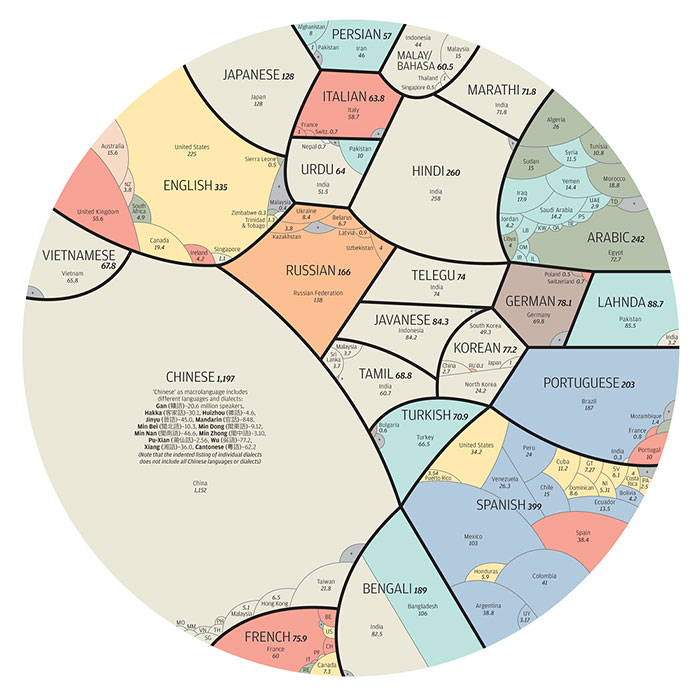
Last week we highlighted for you a beautiful Tree of Languages infographic, created by Minna Sundberg using data from ethnologue.com. This week, we present another visualization of world languages, this one produced by Alberto Lucas Lopéz, on behalf of the South China Morning Post. And, once again, the underlying data comes from ethnologue.com, a research project that catalogues all of the world’s known living languages.
Today’s graphic — click here to view it in a large format — takes the world’s 23 most popular languages, and then gives you a visual sense of how many people actually speak those languages overall, and where geographically those languages are spoken. The more a language is spoken, the more space it gets in the visual.
When you view the original graphic, you’ll note that Chinese speakers outnumber English speakers by a factor of four. And yet English is spoken in 110 countries, as compared to 33 for Chinese. And the number of people learning English worldwide dwarfs the number learning Mandarin.
As you look through Lopéz’s visual, you’ll want to keep one thing in mind: Although the 23 languages visualized above are collectively spoken by 4.1 billion people, there are at least another 6700 known languages alive in the world today. Someone has to cook up a proportional visualization of those. Any takers?
Speaking of learning popular languages, don’t miss our collection: Learn 48 Languages Online for Free: Spanish, Chinese, English & More.
Follow us on Facebook, Twitter, Google Plus and LinkedIn and share intelligent media with your friends. Or better yet, sign up for our daily email and get a daily dose of Open Culture in your inbox.
Related Content:
The Tree of Languages Illustrated in a Big, Beautiful Infographic
The History of the English Language in Ten Animated Minutes
Noam Chomsky Talks About How Kids Acquire Language & Ideas in an Animated Video by Michel Gondry
New report: "The Tradeoff Fallacy: How marketers are misrepresenting American consumers and opening them up to exploitation."
New Annenberg survey results indicate that marketers are misrepresenting a large majority of Americans by claiming that Americas give out information about themselves as a tradeoff for benefits they receive. To the contrary, the survey reveals most Americans do not believe that 'data for discounts' is a square deal.The findings also suggest, in contrast to other academics' claims, that Americans' willingness to provide personal information to marketers cannot be explained by the public's poor knowledge of the ins and outs of digital commerce. In fact, people who know more about ways marketers can use their personal information are more likely rather than less likely to accept discounts in exchange for data when presented with a real-life scenario.
Our findings, instead, support a new explanation: a majority of Americans are resigned to giving up their data -- and that is why many appear to be engaging in tradeoffs. Resignation occurs when a person believes an undesirable outcome is inevitable and feels powerless to stop it. Rather than feeling able to make choices, Americans believe it is futile to manage what companies can learn about them. Our study reveals that more than half do not want to lose control over their information but also believe this loss of control has already happened.
By misrepresenting the American people and championing the tradeoff argument, marketers give policymakers false justifications for allowing the collection and use of all kinds of consumer data often in ways that the public find objectionable. Moreover, the futility we found, combined with a broad public fear about what companies can do with the data, portends serious difficulties not just for individuals but also -- over time -- for the institution of consumer commerce.

The season finale of Game of Thrones was basically a series of vignettes where various characters got their revenge... usually with an ironic twist. It was a lot to take in. But it did disprove once and for all the idea that Littlefinger is a brilliant mastermind. Spoilers avaunt!


I’m devastated at the loss of the great Sir Christopher Lee, arguably cinema’s finest screen villain and certainly one of its most prolific. But as we mourn the man, we should also celebrate his incredible body of work — including this compilation of his many, many fantastic death scenes.


Read more of this story at Slashdot.

The dark, psychological hacker drama Mr. Robot slayed audiences at South by Southwest, and now it’s become a series on USA. It’s one of those rare shows that actually seems to understand what’s corrupt and rotten at the heart of the tech industry — and wants to burn it all down. We talked to the show creator.

Scientists say that GMOs are just fine. But the public thinks otherwise. Are our fears rational?
Think of a science denier, and you might picture someone arguing that climate change isn't real or vaccines cause autism. But the biggest chasm between scientists and the public is actually over GMOs: 88% of U.S. scientists say genetically modified foods are safe to eat, and only 37% of Americans agree.

“More people died in World War II than any other war in history,” explains Neil Halloran in The Fallen of World War II. In his 15-minute film, Halloran uses innovative data visualization techniques to put the human cost of WW II into perspective, showing how some 70 million lives were lost within civilian and military populations across Europe and Asia, from 1939 to 1945. As one commenter put it, “One million, six million, seventy million. Spoken or written, these numbers become … incomprehensible. Presented graphically, they hit closer to the heart. As the Soviet losses climbed, I thought my browser had become frozen. Surely the top of the column must have been reached by now, I thought.” He’s referring to the staggering number of Soviets who died fighting the Nazis. If you fast forward to the 6-minute mark above, you can see what he means.
The video comes accompanied by an interactive website, where users can “pause during key moments to interact with the charts and dig deeper into the numbers.” To use this interactive website, you will need a fairly new computer and a modern browser.
You can contribute money and support the ongoing Fallen of World War II project here.
Dan Colman is the founder/editor of Open Culture. Follow us on Facebook, Twitter, Google Plus and LinkedIn and share intelligent media with your friends. Or better yet, sign up for our daily email and get a daily dose of Open Culture in your inbox.
Related Content:
Watch World War II Rage Across Europe in a 7 Minute Time-Lapse Film: Every Day From 1939 to 1945
31 Rolls of Film Taken by a World War II Soldier Get Discovered & Developed Before Your Eyes
Dramatic Color Footage Shows a Bombed-Out Berlin a Month After Germany’s WWII Defeat (1945)
 Neal Stephenson's no stranger to ambition, but his new novel Seveneves stretches to lengths (and heights) that beggar the imagination. Read the rest
Since I last wrote about it, Pick This! has matured. We have continued to improve the tool, which is a collaboration between Agile and the 100% awesome Steve Purves at Euclidity.
Here's some of the new stuff we've added:
Some of this, such as replaying the entire picking event, is of interest to researchers who want to know how experts interpret images. Remotely sensed images — whether in geophysics, radiology, astronomy, or forensics — are almost always ambiguous. Look at these faults, for example. How many are there? Where are they exactly? Where are their tips?

A seismic line from the Browse Basin, offshore western Australia. Data courtesy of CGG and the Virtual Seismic Atlas
Most of the challenges on the site are just fun challenges, but some — like the Browse Basin challenge, above — are part of an experiment by researchers Juan Alcalde and Clare Bond at the University of Aberdeen. Please help them with their research by taking part and making an interpretation! It would also be super if you could fill out your profile page — that will help Juan and Clare understand the results.
If you're at the AAPG conference in Denver then you can win bonus points by stopping by Booth 404 to visit Juan and Clare. Ask them all about their fascinating research, and say hello from us!
While you're on the site, check out some of the other images — or upload one yourself! This one was a real eye-opener: time-lapse seismic reflections from the water column, revealing dynamic thermohaline stratification. Can you pick this?

Pick This challenge showing time-lapse frames from a marine 3D. The seabed is shown in blue at the bottom of the images.

There’s a universe in which The Hobbit trilogy was a single, fun adventure film with thematic and character groundwork that made The Lords Of The Rings films stronger for its existence, rather than making the audience seriously question whether Peter Jackson’s first crack at the Tolkien universe was as good as everyone remembers. Thanks to some industrious fan editors, the closest thing to the first scenario has already happened in the form of a single 4.5 hour Hobbit film stripped of any non-book material. Completing the circle, this second fan edit, by David Killstein, features only the scenes of Gandalf the Grey (and eventually other members of the White Council) fighting off the gathering forces of The Necromancer at Dol Guldur.
This is a far more enjoyable way to experience this expanded ancillary Rings universe material. At 43 minutes, what was a needless side plot among The ...

