Shared posts

28 Sep 04:00

Top 10 Reasons To Reject Anti-Plastic Hysteria

by Jamie Frater

Plastics have become the ‘bad guy’ of materials recently, largely because they don’t degrade easily or quickly. People throw plastics away and they clog up landfill sites or create unsightly litter. This creates a major problem for a lot of wildlife. Marine animals, in particular, often get tangled up in waste plastic. Even worse, tiny […]

The post Top 10 Reasons To Reject Anti-Plastic Hysteria appeared first on Listverse.

28 Sep 03:56

Top 10 Real-Life Crimes Inspired by the Hit Show Breaking Bad

by Jamie Frater

Breaking Bad is one of the most influential and brilliant shows to ever air on television—in my humble opinion—but that influence can also reach the wrong people. Here are 10 cases of people who followed Walter White on his tragic journey but learned nothing good from it. This list was made as spoiler-free as possible, […]

The post Top 10 Real-Life Crimes Inspired by the Hit Show Breaking Bad appeared first on Listverse.

28 Sep 03:56

Top 10 Most Creative and Funniest Ways People Have Gotten Revenge

by Jamie Frater

Most of the time, when somebody upsets us, we attempt to stay calm, offer our forgiveness, try to be the bigger person, and move on. However, in some scenarios, we just cannot suppress the urge to seek some sort of revenge. And some people out there have resorted to some wacky and hilarious revenge-seeking methods! […]

The post Top 10 Most Creative and Funniest Ways People Have Gotten Revenge appeared first on Listverse.

28 Sep 03:56

10 Things You Didn’t Know About the Manson Girls

by Jamie Frater

Charles Manson may have died in 2017, but his infamy lives on, as do many of his former followers. The women who followed Manson have garnered similar notoriety over the years. The intrigue of what made these women follow an ex-con fresh out of prison, standing only 5’6″ with a strange outlook on the world, […]

The post 10 Things You Didn’t Know About the Manson Girls appeared first on Listverse.

28 Sep 03:55

Top 10 Products Which Aren’t Used for Their Original Purpose

by Jamie Frater

There are many products in our world, some more useful than others! But did you know that some common household names weren’t always used for what we do now? Here are ten products that ended up being used for something other than their original purpose! Related: 10 Victorian Invention We Just Can’t Do Without 10 […]

The post Top 10 Products Which Aren’t Used for Their Original Purpose appeared first on Listverse.

28 Sep 03:53

1973 Porsche 2.7 RSH Coupe

One of 17 Carrera RSH homologation models, this is one of the most desirable Porsches ever made.

Visit Uncrate for the full post.
28 Sep 03:52

2022 Ford Bronco Raptor SUV

Ford unveils the highly-anticipated, 400-horsepower off-road performance version of its Bronco SUV.

Visit Uncrate for the full post.
28 Sep 03:52

Triumph Tiger 900 Bond Edition Motorcycle

Triumph is releasing 250 Bond-themed Tiger 900s for the bike's starring role in No Time to Die.

Visit Uncrate for the full post.
28 Sep 03:50

Twelve Mile Limit Cocktail Recipe

Rum, rye, and brandy make this a boozy drink, while lemon juice and grenadine help it go down.

Visit Uncrate for the full post.
28 Sep 03:49

Vallon Howlin Sunglasses

The Swedish eyewear brand enhances the classic Aviator frame with performance features.

Visit Uncrate for the full post.
28 Sep 03:48

1995 Toyota Land Cruiser FZJ80 SUV

This FZJ80 Land Cruiser is a Stage Three build by TLC and has an LS3 V8 under the hood.

Visit Uncrate for the full post.
28 Sep 03:47

3 Tips to Making Pie in a Cast-Iron Skillet, the Right Way

Aluminum and tin are great conductors of heat, but they’re terrible insulators.

28 Sep 03:46

A Tailor’s Guide to Suiting Fabrics

28 Sep 03:40

Milk Stout Beer: Everything You Want to Know and the 10 Best to Sip

by Steven Johnson
Milk stouts are creamy, delicious, and have no actual milk. Check out these ten best milk stouts to try in 2021.
28 Sep 03:37

An Elaborate Ride Through the Backyard on a Hot Wheels Track

by Miss Cellania

The guy who goes by Backyard Racing has a large back yard and plenty of time on his hands. He spent four months and $9,000 building an enormous Hot Wheels track. Why? So he could strap a camera to some wheels and share a POV video with us! We soar through every corner of the property, including a leap through the air, a couple of underwater sequences, and loop-the-loops.

The effect of watching this is akin to going on a roller coaster ride without waiting in line or tossing your cookies. Keep your eyes on the tracks going around the turns and you'll know what I mean.

26 Sep 13:07

Facebook Data Mining Posts

by Kim LaCapria

On September 22 2021, actor Wil Wheaton shared a warning about data mining on Facebook (one of many circulating at the time), advising followers to educate themselves about data mining.

Facebook Warnings About Data Mining in September 2021

Wheaton’s post was attributed to Paul Belserene; Belserene originally shared the text on September 19 2021. It was one of many posts about Facebook data mining posts and the form they might take in September 2021, and consisted of seven bullet points.

It was prefaced “How account hacking works on Facebook,” touching on the matter of Facebook account theft occurring in 2021. But the actual content of the post spanned myriad issues with Facebook: its algorithms, data and data mining, how Facebook engagement is sought by pages and other entities, and the bizarre prevalence of radio stations in the spread of mundane engagement baiting posts:

1. You see a fun little question pop up in your facebook feed that people answer in the comments. This isn’t a question from one of your facebook friends, it’s from a public account, maybe an account supposedly belonging to a radio station, but not one in your part of the country, where you definitely recognize the station. Maybe it’s from a public account called something cute like “just for laughs” or “no biggie” or “memory lane.” Maybe a facebook friend of yours has already answered the question. It seems harmless and trivial: What food would you never eat? What was the first concert you went to? You answer the question in the comments.

2. Because of the way facebook’s algorithm is set up, answering this question, or even just giving the post a like means Facebook will show you more content by this facebook poster and more content by other, similar posters. You see more and more little quiz questions by facebook accounts who are not your actual friends.

3. Also because of the way facebook’s algorithm is set up, your actual facebook friends can see the post you responded to and your answer to the little question. If they respond to your comment, or like your comment, or answer the question themselves, they also begin to see more little quiz questions from this facebook poster and more similar facebook accounts with other little questions.

4. Some of these questions really are probably harmless, but the more you answer, the more you see, and sooner or later you slip up and answer one or more that help a data miner begin putting together pieces of information that help them steal your identity and get into your bank accounts. “One of these has to go” with a list of four types of candy bars isn’t helpful to anyone, but the more you get used to answering questions, the less carefully you scrutinize the questions. One day you answer one that gives someone your birth year: “how old would you be if the digits in your age were reversed.” A week later you’ve forgotten about that, but the information has been harvested and filed away and you answer another question that gives them your month of birth: “your birth month determines which celebrity you marry, are you happy?” with a bunch of pictures of famous people laid out in a calendar grid. Some questions are straight up complete answers to common security questions: maiden names, grandparents’ names, where you vacationed as a kid, what was your first car, what was your first pet’s name, what was the name of your elementary school.

From there, the warning addresses how a breadcrumb trail of engagement on your part can compromise the security of everything from your Facebook account to your IRS-issued tax refund:

5. When the data miner pretending to be a harmless fun facebook account or radio station has enough pieces of the puzzle put together they can either get into your bank account, sell your information to someone else who wants to get into your bank account, or remotely lock your accounts or take over your whole computer or phone and force you to pay a ransom to get access back. They can impersonate you and steal your tax refund. They can commit social security fraud, pretending to be you, and disappear with the check while you are left to prove it wasn’t you.

6. The worst thing about these social media predators is that the more you comment on these information gathering quizzes, even if you just comment to tell a friend that they have potentially given away the answer to their own security question, the more they spread. All your facebook friends will see more of these quizzes as a result of your comment, and be more likely to comment themselves, and sooner or later one of them will give away important information, even if you never do.

7. So DO NOT COMMENT. Not even to the ones that really don’t share any important information. They post many innocuous questions for every one that actually gathers information, but even the seemingly benign ones help them figure out what style of questions generate the most responses, work the algorithm to get them on more people’s facebook feeds, and lull you into a false sense of security that this is good clean fun. Do not give it a thumbs up or an angry face. If you see a friend post in response to one, talk to them in person about how these work, or call them, or send them a private message, but don’t reply back to their comment on the actual post. That just helps these things spread.

WARNING!!

Another post addressed some of the phenomenon being discussed in the excerpt above, but with respect to engagement begetting additional engagement:

Seeing right wing shit in your feed because your friends have to post their stupid hot take on it?

“This is 100% by design. Facebook changed their algorithms to show content that gets a lot of engagement. What people don’t get is that when they make their snarky comment on some right wing shit, nobody will ever see it except their own friends. But it also encourages Facebook to show that post to even more people because it counts as engagement and bumps it up in the algorithm.

STOP COMMENTING ON RIGHT WING SHIT, PEOPLE. Stop sending it to people, stop sharing it (even with snarky commentary), stop emojing it. I know it feels good to have some witty comeback. But anything you do other than ignore it or click “hide” just counts as “engagement” (which is all Facebook and their advertisers care about) and tells the Facebook algorithm to spread that shit farther and wider.”

While the warning or caution was for different reasons, the underlying mechanism was the same as Wheaton’s post — engagement of any kind, good or bad, boosted posts and made them visible in places they otherwise might not be seen. Both posts were similar to a September 7 2021 post made by user Jeff Hirsch, which was shared over 14,000 times:

Had a bit of an a-ha moment this morning when considering all those data mining “survey” posts facebook has been flooded with lately.

I realized that I should end my practice of leaving humorous or smart-ass responses to those questions because my comments are just going to be used to map the connections between me and my socially networked friends.

Here’s what I suggest…

Ignore these posts asking about your “first car” or your “favorite color” or the “last thing you ate” or the “last show you watched”. Don’t comment, don’t reply, don’t click on the links, don’t engage at all.

While they may look like an innocent radio station survey or other mild amusement, they are actually part of a vast data mining and consumer profiling industry.

Stop giving them the answers to your security questions. (First car, first phone number, childhood address, where your parents met, etc.)

Stop giving them all of your consumer data. (Last purchase, what you just ate, what show you just watched, etc.)

Stop showing them the connections between you and your friends by not commenting at all.

Facebook is free because their entire business model is based on selling your data to their advertisers. Keep that in mind as you interact with the site on a regular basis.

You aren’t the customer. You are the product.

Memes About Facebook Data Mining in 2021

Around the same time, a popular meme addressed the idea that Facebook question posts were a data mining operation. It contrasted how people “think they get hacked” with how they “really get hacked,” with the posts in question showcased at the bottom (and this had been in circulation since at least June 2021):

facebook radio station hacking 2021

A Facebook search for “radio station question data mining” returned another large set of examples of the posts being discussed:
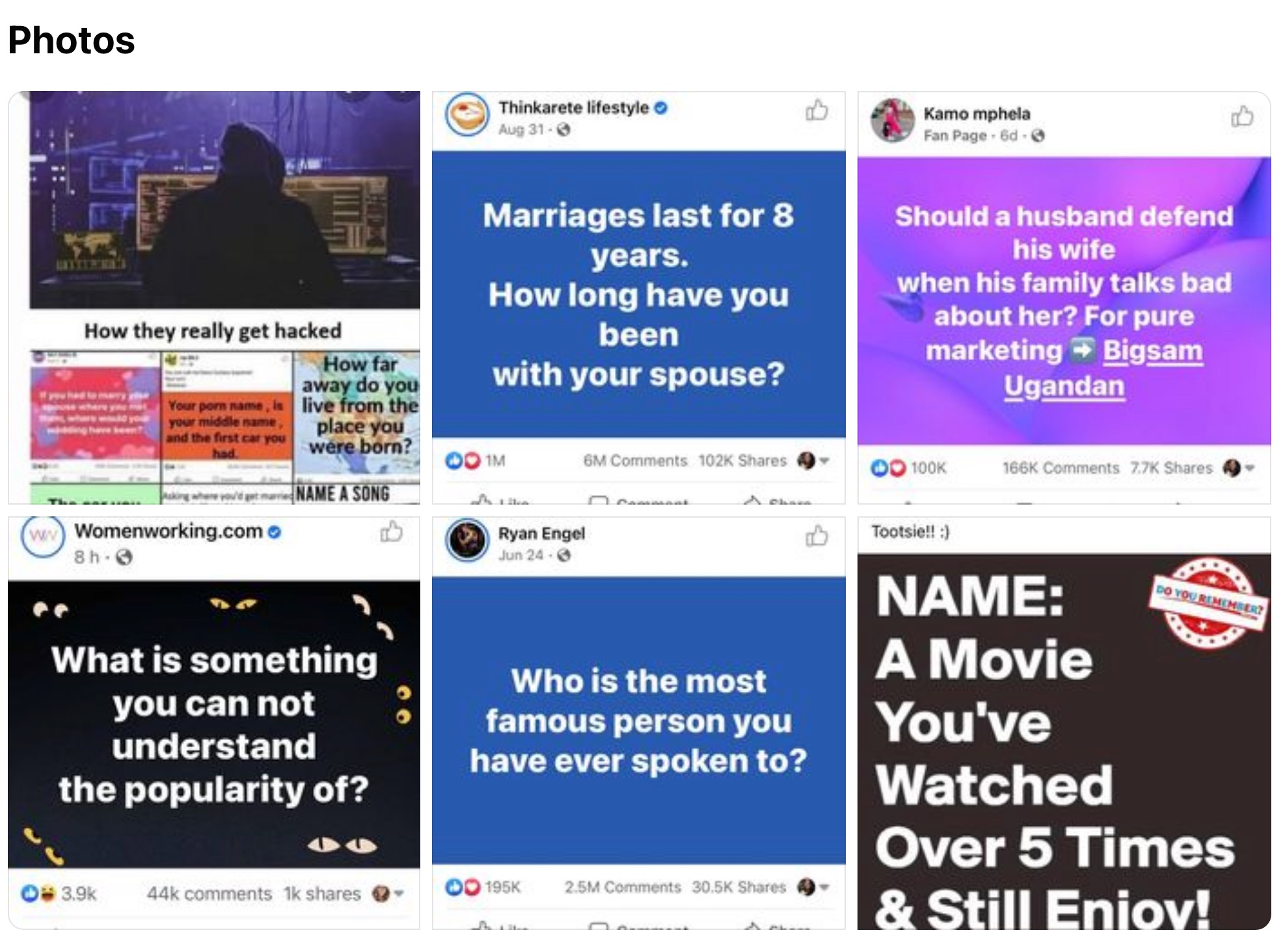
facebook security question hacking 2021

Yes, the Posts Should Be Ignored — But Facebook and Criminals Are Secretive

We’ve addressed Facebook engagement bait repeatedly over the years, with nearly two dozen articles and fact checks defining and discussing it.

Many of the quoted posts warn that criminals slowly compile your activity to whittle down answers to security questions. It’s difficult to “fact check” that part, due to the secrecy of criminal activity.

Likewise, Facebook is notoriously opaque about its algorithms and how they influence content to which users are exposed. A February 2021 Consumer Reports article, “Tech Companies Too Secretive About Algorithms That Curate Feeds, Study Says,” explained:

Later [in February 2021], your Facebook feed will start looking less political. The company says it’s testing a tweak that will surface fewer politics-related posts in users’ feeds, in a bid to keep political content from “taking over” what people see—an adjustment Facebook says users often ask for.

But it’s not clear what the change will look like. In its announcement and in comments made to Consumer Reports, Facebook didn’t share any details about how its systems would assemble the new feeds, or even decide what counts as political content. And if you like your feed just the way it is, well, too bad—you don’t have a say in the matter.

That’s almost always the case when tech companies tweak their algorithmic decision-making systems. These are the systems that determine which products people see when they search for a power drill; what they learn about vaccinations, rolling blackouts, or election results from social media or Google search results; and which of their friends’ posts they see at the top of their feeds—plus the posts they never notice because they are buried so deep.

We know that Facebook’s algorithms govern what we do and do not see, and that those algorithms are both ever-changing and secretive. By design, we cannot definitively say the claims about engagement are true — but we can say that anecdotally, readers report seeing an increase in random question-based posts — from entities like obscure radio stations — as of September 2021.

We have long advised avoiding engagement bait regardless of direct risk. Engagement bait is rarely valuable, and it can easily be exploited in a number of ways.

Summary

Facebook “data mining” discourse got a boost when Wil Wheaton copied and pasted a post by Paul Belserene in September 2021. Facebook does not disclose how its algorithms work, but it’s safe to say that the crux of the post and memes was true. Social media users should avoid engagement bait, even if it does not appear to pose a direct risk. It remains possible that the high-engagement posts could be mined for compromising information, but overall, engagement bait is bad for social media.

The post Facebook Data Mining Posts appeared first on Truth or Fiction?.

25 Sep 23:44

Function Off-Road SUV

Function refits the iconic Defender bodywork to a modern JK Wrangler chassis with GM LS V8 power.

Visit Uncrate for the full post.
18 Sep 20:44

10 Inventions and Theories Made by Women but Credited to Men

by Jamie Frater

Throughout history, as far back as the time when the social construct of society created a division between genders, sexism has existed. It has deprived women of being acknowledged and recognized in the field of science and technology, considering them intellectually inferior to men. As a result, women have been making revolutionary advancements and inventions […]

The post 10 Inventions and Theories Made by Women but Credited to Men appeared first on Listverse.

18 Sep 20:36

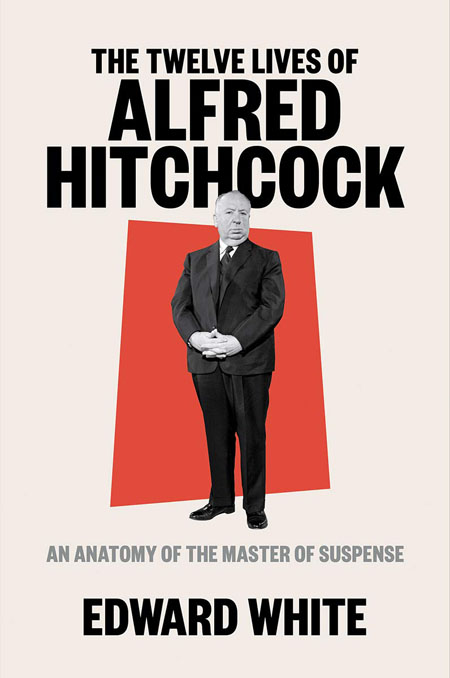
BOOK REVIEW: "THE TWELVE LIVES OF ALFRED HITCHCOCK" BY EDWARD WHITE (W.W. NORTON PUBLISHERS)

by nospam@example.com (Cinema Retro)

BY EVE GOLDBERG

The Twelve Lives of Alfred Hitchcock is not a traditional biography; it’s not even chronological. Instead, the book is a multi-themed, multi-layered exploration of the relationship between Hitchcock’s personality and his art. Each of the twelve chapters looks at the man and his films through a different lens: The Boy Who Couldn’t Grow Up, The Murderer, The Auteur, The Womanizer, The Fat Man, and so on.

White’s take on Hitchcock feels very contemporary. No punches are pulled when it comes to his treatment and abuse of the actresses in his movies, or his issues around gender, sexuality and body image. On the other hand, the tone of the book is even-handed; it’s neither hagiography nor tear-down, but rather a clear-eyed look at a fascinating filmmaker who has given the world a treasure-trove of complicated, entertaining films.

If you’re like me—intrigued by the creative process, interested in how and why films are made— this book is for you!

CLICK HERE TO ORDER FROM AMAZON

18 Sep 20:33

Sun’s Out, Hats Out. How to Clean a Hat and Keep it Clean

by John Jones
Men's hats experts share their best methods for cleaning any type of hat, from straw hats to baseball caps.
18 Sep 20:32

How to order a martini like you know what you’re doing

by Sam Slaughter

You don't have to be James Bond to order this classic cocktail with style. Here's the right way to do it.

The post How to order a martini like you know what you’re doing appeared first on The Manual.

11 Sep 00:37

How I Research Stuff

by Ernie Smith

Today in Tedium: When I first started Tedium six years and nine months ago, I wanted to see how far I could get with it before I reached the point where I forgot that I had written about something previously. I feel like I’m finally at that point, where there are probably things that I’ve written about that I likely will not remember unless I look them up, like this Charlie Sheen-inspired piece about alternative medicine, or this piece on bottle deposits. I have been at this long enough that there are pieces in my archives that I first wrote in 2015 that I wish I could completely rewrite knowing what I know now. (Example: I totally burned through numbers stations less than a month after the first issue, which I’m still kicking myself about.) There’s always a risk of getting meta when it comes to Tedium, but for today’s issue I wanted to explain how I actually go about researching the things I choose to write about, in hopes that it might help someone who needs some editorial inspiration or who wants to become a better researcher. Maybe you might get better at writing after reading this. — Ernie @ Tedium

If you’re looking to start a big, ambitious editorial project of your own, be sure to check out today’s sponsor, Skiff, which helps you do so in private. We got invites:


Skiff

Keep your docs private with Skiff.

Skiff is an end-to-end-encrypted collaboration platform advised by the CTO of Signal. Sign up to create and share documents, links and workspaces with complete privacy.

Tedium readers can skip Skiff’s 60,000+ waitlist.

Sign up for free here


“The scariest moment is always just before you start. After that, things can only get better.”

— Stephen King, in his 1999 book On Writing: A Memoir of the Craft, one of the most important works I’ve ever read. I’m not big on King, but I found the book fascinating because it broke down his own process in some really important ways. I hope I channel a little bit of King with this little rant.

Kristopher roller PC lb S Sx CZE unsplash

(Kristopher Roller/Unsplash)

Where I find sources of inspiration for what I write

Somewhat ironically for a website that gets a lot of search traffic, Tedium seems a bit unfocused and hard to explain, especially to outsiders. Tedium has a reputation of being a website about technology, yet its most popular piece of the year is a story about Tom Waits.

This is actually somewhat by design. See, Tedium is basically focused on telling stories about things that I encounter in the world that inspire me, or seem unheard or not properly explained, that the layperson would not know much about. One of the things that I find inspiring just happens to be technology. I’m sure if I was really into knitting I’d probably have 200 posts on my website about knitting.

Often I’ll look to objects (wandering around a Goodwill, or surfing eBay, is a great point of inspiration, which I’ve written about in the past).

Sometimes I stumble upon a small piece of trivia and try to see if it can be blown out into a bigger yarn. (I read a LOT of articles, probably 200+ per day, on top of tweets.)

Admittedly, not every piece of yarn is long enough to pull. Just to give you an example, around the same time I uncovered the detail about Bob Seger recording a version of “Downtown Train” around the same time Rod Stewart did, I read on a Wikipedia page that Robert Sledge, the bassist for Ben Folds Five, nearly became the bassist for Weezer in 2001. This struck me as very intriguing, both as a fan of early Weezer and a fan of Ben Folds Five. If Sledge had joined Weezer at that specific time, there’s a chance Weezer could have evolved into a significantly different band than it eventually did (nothing against Scott Shriner).

But when I went to research it, digging through old issues of Spin and CMJ New Music Monthly that are made publicly available on Google Books, I could not back up the fact. It was a thinly sourced rumor that didn’t have enough going for it. And not every road is going to lead to an amazing story—but the willingness to try multiple paths is key to figuring that out.

In fact, the only source for this data is an unauthorized biography of Rivers Cuomo for which there was no digital source. Certainly, I can buy the biography to squeeze out the detail, but given that there will be no additional sourcing I can work with to tell the rest of the story? Probably not.

Now, for the Tom Waits story, that also partly leaned on an anecdote from an unauthorized biography. But it was also supported by a lot of news stories and historic quotes from the era, which allowed the story to be followed through in a way that was useful for the reader and seemed to have not been publicly discussed for quite a while.

And maybe it’s something really simple: One day, I was eating a sub in Jimmy John’s and I thought about the sprouts. Boom, story.

Hans peter gauster 3y1z F4h IP Cg unsplash

(Hans-Peter Gauster/Unsplash)

Five tips for telling an in-depth history about something using the internet

  1. Look past the accepted answer. It’s easy to look at a Google search and find a result that seems to answer a trivia question that you’ve had floating around. But simply taking the accepted answer and running with it is bad research. Look it up for yourself where you can. You might uncover previously unseen evidence of prior art, like I did when I found an example of a whiteboard that dated to the 1930s a few months ago.
  2. Build an overall context behind the history. A few years ago, I wrote about Ayds diet candy, a topic that had frequently come up as a point of mockery on various parts of the web but didn’t seem to have additional context behind it. I wrote about it with the plan not to mock it, but to understand it, and explain its overall cultural moment. And the result is that the piece tells a more well-rounded story than most other places online. Another tip: Even if something is really old, find a modern hook that can build a valuable tie to the modern day.
  3. Don’t go into a story looking to tear anyone down. One of my most popular pieces of all time, a story about how Bob Vila was fired from This Old House because of his sponsorship deals, could have easily been written a way that attacked Vila or the franchise that fired him. Instead, it approached the story down the middle, offering a context that pointed at the broader structural issues that led to the conflict.
  4. Focus on interesting framing. A router that accidentally became open-source on its own is an interesting tale. But what makes it a story that people actually want to read is the fact that you or someone you know probably owned that router. Finding an angle that can pull in a bigger tent is always better than simply aiming narrowly.
  5. Make it unique by building in personal anecdotes. My other story this past week, about products with hidden features, could have been written without the tale about how I opened up a Shirt Tales drum and found a completely different design inside of it. But because I added it, it became a tale that only I could have told in that way. In an era when people aggregate information wholesale, putting your own voice in there ensures that your view is the one that sticks.

“The secret of success in becoming a writer is you must write; you must finish what you write; and you must write a lot more.”

— Jerry Pournelle, one of the earliest bloggers on the internet, though he’d never use that term to describe it, discussing how to become a successful writer in a 1996 BYTE essay titled “How to Get My Job.” Pournelle is probably one of my biggest inspirations as a writer, in case you were ever curious. He often took a very conversational approach to writing essays for BYTE, and when I discovered him around age 12, I spent hours at the library reading his columns (along with every other tech magazine I could find). Other inspirations include Rolling Stone cover stories and websites like Fark and Pitchfork.

Amador loureiro B Vy Nlch Wqzs unsplash

(Amador Loureiro/Unsplash)

How do I find these things I look up?

The thing about Tedium is that it’s research-driven. As much as possible, we try to back up our stuff as possible, to uncover quotes and details and highlight them as needed.

And that requires a lot of digging, something that the internet is amazing at. I use a mixture of sources, both free and paid, to do what I do. Among the parts of my toolkit that are most important:

Newspapers.com: This paid platform isn’t cheap—I pay $75 every six months—but it gives me access to more than 200 years of research materials that include most of the world’s English-language newspapers. Beyond finding stories, having access to a huge archive of newspapers makes it useful to do historic language research to figure out where a phrase emerged from. (My clippings page is here in case you’d like to follow along.) It’s perhaps the most important resource I use.

Google Books: This research resource is one of Google’s best features, so of course Google hasn’t done much with it in a decade. Nonetheless, it’s still full of lots of materials, including many reference books that can be viewed in preview mode. It also offers access to some important historic magazines in the context of technology and popular culture, including Billboard, Boys’ Life, InfoWorld, and Popular Science. One challenge Google Books creates is “snippet mode,” in which copyrighted materials are only allowed to appear in a very limited fair-use way. I’ve ranted about this in the past.

Google Patents. Much more up-to-date than Google Books, the patent site helps uncover the origin of common objects, as well as their evolution. I used it to great effect when I did my piece on the Kensington lock earlier this year.

Internet Archive. This resource started out good and has gotten significantly better over time. You may be familiar with the archive’s Wayback Machine, but I really recommend you dive into the archive itself as well, which now lets you check out software, old magazines, and old books. In the latter category, it is now possible to check out individual books for an hour at a time, making it perfect for research.

The New York Times. Of mainstream newspapers, the Times is the one that is best about managing its archives, which go back to 1851 and cover most major stories of the past two centuries. TimesMachine in particular is a victory of deep research.

There are other research sources, of course—I haven’t even discussed academic papers, which are a massive can of worms. I also recommend taking advantage of the never-ending pool or randomness that is YouTube. If something appeared on TV 30 years ago, odds are it’s on YouTube in some form. Especially if it’s an episode of Computer Chronicles.

I also recommend getting a library card. This sounds like a funny recommendation for digital research, I know, but many libraries these days make lots of research available on the internet, making a library card a secret weapon on the internet in a way that it often is in real life. Take advantage of it—it’s free!

I tend to write and research at the same time, as I find it helps me think through my thoughts on a topic to do it simultaneously. After all, my best quips are likely to emerge upon immediate reaction, and it’s more fun that way anyway.

Max saeling Fx Eu Jun GP M unsplash

(Max Saeling/Unsplash)

Why is Tedium broken up the way it is?

This is a long story, but it’s sort of rooted in my background as a graphic designer for newspapers.

Many newspapers are designed to be long, with full pages of in-depth content. But starting in the mid-1990s, a new style of editorial content called alternative story form started to grow in prominence.

They have existed for decades, as long as newspapers and magazines have had briefs, but they became more influential as design capabilities grew. As newspapers became more capable of doing layouts better known in magazine, it became possible to create entire stories, start to finish, in alt-story-form.

One of the biggest shifts happened, strangely enough, with the rise of the “lad mag,” a type of magazine that drew controversy over its scantily-clad photos, in the 1990s. Maxim and FHM are probably two of the most famous examples, and the controversy was deserved. But they did something that was really powerful: Nearly all of their content was done in alt-story-form, meaning it was very scannable content that provided a lot of targeted information that its audience found valuable.

This format, also known as the “charticle,” inspired three separate newspapers I worked at during my newspaper career, and then inspired my old site, ShortFormBlog, which was nothing but alt-story-form.

Tedium is long-form, which is where digital journalism has evolved over the years. But while you can take the alt-story-form out of the medium, you can’t take it out of the writer. So I still write a lot of lists, a lot of fact boxes, a lot of data points.

This makes the style a bit unique compared to other digital outlets, which just use fact boxes. But it also creates an interesting dynamic for editorial reasons. It also ensures that, if there isn’t an underlying plot driving the story forward, I’m not tied to that story as I write, and I can pull in alternate elements that are interesting, but can be self-contained. So a big number or a quote can be interesting on its own, even if it’s only tangentially related to the broader points I’m covering.

I realize I produce a lot of content, much of which you may have never read. And so much of it is done for me as a creator with lots of itches to scratch. I will never get through all of my itches, but it’s not for a lack of trying. As a writer, the best way to keep all of this exciting is to keep inventing new ways to do so. And the way I do that is to treat the internet as a never-ending font of research.

Not everyone has quite the ambition to write thousands of words twice a week. I’m a special case. But I want to encourage you, if you love the internet, to embrace its potential as a research and creation tool.

You’ll be glad you did, and you might learn something along the way. Tell better stories. It’s a great way to bring the internet to life in a way a bunch of ranting on Twitter never will.

--

Find this one an interesting read? Share it with a pal! (Would love to hear from you on this one.)

And thanks again to Skiff for sponsoring. Be sure to sign up—and get early access to Skiff’s beta, no wait required.

11 Sep 00:31

How To Make the New York Bodega Classic — Bacon, Egg and Cheese

by Hunter Lu
These hot sandwiches are pervasive, affordable and handheld, making this the perfect sandwich for busy New Yorkers on the go.
11 Sep 00:19

The Mercedes G-Class Professional Line adds awesome off-road goodies - Roadshow

by Daniel Golson
08 Sep 02:55

El Salvador and Bitcoin: Everything you need to know - CNET

by Julian Dossett
The nation is the first to officially adopt a cryptocurrency as legal tender. The world is watching the rocky rollout in real time.
08 Sep 02:45

Florida’s Backroads Juke Joint

by Dacey Orr

Outside Tallahassee, beneath a canopy of live oak trees, the Bradfordville Blues Club plays on

The post Florida’s Backroads Juke Joint appeared first on Garden & Gun.

08 Sep 02:39

Radiation From Sudden Solar Flares Are A Danger To Airline Passengers And Now Space Tourists, Say Scientists

by Jamie Carter, Senior Contributor
But the frequency of powerful solar flares doesn't justify the costs of countermeasures.
06 Sep 19:52

How We Got Our Wings

by Megan Miller

For travelers, there’s nothing like the feeling of taking off in an airplane, speeding through the heavens on the way to discover a new destination. That privilege of modern air travel is hard won, its foundations laid by the geniuses, scientists, achievers and daredevils who took risks and made the discoveries that allowed them to take flight. To celebrate such pioneering, The Monument to a Century of Flight in Kitty Hawk in North Carolina’s Outer Banks is a must-visit. Dedicated in 2003, just before the First Flight Centennial, there are 14 wing-shaped steel structures with 100 milestones etched onto granite panels. Situated high on a sand dune overlooking the crashing waves of the Atlantic Ocean, it’s easy to feel inspired. Here are six aeronautical highlights from the monument to remind you that inquisitive humans are never finished exploring, and a few recommendations about how to maximize your island experience.

First Flight

Brothers Orville and Wilbur Wright were fascinated by aeronautics. Drawn to the Outer Banks’ regular breezes and sandy dunes (which could provide a softer landing spot), they went to Kitty Hawk in 1900 to start working on their gliders. After more than a thousand successful glider flights from the island’s Kill Devil Hill from 1900 to 1903, on December 17, 1903, they accomplished the world’s first sustained manned flight in a heavier-than-air, motored machine, the Wright Flyer. After that, inventors and pilots were off. In 1909, French aviator Louis Blériot became the first to fly across the English Channel in a 25-horsepower monoplane of his own design. Insider tip: Deepen your connection with a trip to the Wright Brothers National Memorial, where you’ll learn little-known facts and see a life-size replica of their famous airplane. Next, refuel with a meal at Black Pelican, a seafood restaurant housed in a building that once served as Lifesaving Station #6. It was the spot where the brothers sent a telegram announcing their successful flight in 1903.

Audacious Aviatrix

The self-styled Madame La Baronne de Laroche (her real name was Elise Raymonde Deroche) became the world’s first licensed female pilot in 1910. The Paris-born French aviatrix, who also moonlighted as a stage performer, started out as a balloonist and won the 36th license issued by the Aéro-Club de France, part of the International Aeronautical Federation. She was just 24.

Going the Distance

History’s most famous pilot—male or female—is arguably Amelia Earhart. In 1932 she became the first woman (and second person, since Charles Lindbergh flew his Spirit of St. Louis plane the distance in 1927) to fly solo across the Atlantic Ocean. To celebrate, Congress gave her the Distinguished Flying Cross and President Herbert Hoover presented her with the Gold Medal of the National Geographic Society. In 1933, Texas-born aviator Wiley Post completed the first solo around-the-world flight in his Lockheed Vega plane, the Winnie Mae. Sadly, Earhart disappeared somewhere over the Pacific Ocean on her own around-the-world attempt in 1937, creating one of flight history’s greatest mysteries.

Breaking Barriers

Flying is all about doing something once thought impossible. From 1941 to 1946, the Tuskegee Airmen, the first Black pilots in the U.S. military, distinguished themselves in the Air Force. Overcoming overwhelming odds, their ace squads of fighter pilots made an immeasurable impact on World War II. The flight program got a publicity boost when first lady Eleanor Roosevelt took a 30-minute flight with the Airmen’s chief civilian instructor C. Alfred Anderson in his Piper J-3 Cub. During this thrilling and challenging decade, the United States launched the Women Airforce Service Pilots (WASP) program, training women to fly military planes. In 1947, West Virginia-born test pilot Chuck Yeager, who went on to become a Brigadier General, became the first to fly faster than the speed of sound in his Bell X-1 research aircraft, Glamorous Glennis.

Space Race

Once the Earth’s atmosphere became the playground of airplanes—1958 saw more than a million passengers fly across the Atlantic and the Federal Aviation Administration (FAA) was established—innovators began to turn their attention to the next frontier: space. That same year, the United States launched its first satellite, Explorer 1 and established the National Aeronautics and Space Administration (NASA). The space race barreled ahead, and in 1961 Alan B. Shepard, Jr. became the first American in space aboard Mercury spacecraft Freedom 7. On July 20, 1969, Apollo 11’s Eagle lunar module landed on the moon and Neil Armstrong took his “giant leap for mankind” onto the moon’s surface. A little-known fact: fellow astronaut Buzz Aldrin took the Christian sacrament of communion while he waited to take his own moonwalk.

Beyond Expectations

Always pushing barriers has been a hallmark of aviation history. In 1983, after completing its mission to Jupiter, Pioneer 10 became the first spacecraft (technically a probe) to leave the Solar System, headed for deep space. In 1990, NASA launched the Hubble Space Telescope into orbit around the earth to provide a look at our planet and the interstellar space beyond. From colorful nebulas to swirling galaxies, Hubble’s photos engage the imagination.


The Outer Banks have plenty of activities to inspire, whether you want to take a flight of your own or keep your feet firmly planted on the ground. Adventurers can get a bird’s eye view of the islands’ pristine coastline and top-notch photo opportunities aboard a Cessna, helicopter or a WWII biplane or catch some air with an exhilarating hang gliding lesson from the pros at Jockey’s Ridge State Park on Nags Head, the largest living sand dune on the East Coast. Travelers of all levels of daring can spot the heavenly bodies twinkling overhead at night. With little light pollution and plenty of wide open spaces, the Outer Banks are a favorite spot for stargazing, particularly in the fall.

06 Sep 19:51

Lynyrd Skynyrd Monument in Magnolia, Mississippi

Lynyrd Skynyrd Memorial, Gillsburg, MS

This seven-ton, black granite monument was dedicated in 2019 to the memory of those who died and those who lived through the 1977 plane crash of the iconic Southern rock band Lynyrd Skynyrd. 

On October 20, 1977, Lynyrd Skynyrd was flying to Baton Rouge, Louisiana for a concert at Louisiana State University, when their plane ran out of fuel. It crashed into the woods near Gillsburg, Mississippi. Lead singer Ronnie Van Zant, guitarist Steve Gaines, singer Cassie Gaines, manager Dean Kilpatrick, pilot Walter McCreary, and co-pilot William Gray were killed in the accident. Twenty others survived the crash. 

This tragedy abruptly halted Lynyrd Skynyrd's career. Ten years later, Van Zant's brother Johnny reformed the band. The site of the crash became a memorial for fans, rescuers, and survivors. An oak tree nearby has Lynyrd Skynyrd iconography carved into it, and this monument was installed by locals in 2019.

The monument stands eight feet tall and 14 feet wide. Six steps lead up to the memorial, one for every person who died in the crash. The monument is approximately 400 yards from the actual crash site.  The artistic etchings on the backside are not to be missed.

Details of the ill-fated flight, as well as information about the rescuers and survivors, can be found found at the memorial.

06 Sep 15:20

Mercedes-Benz Citan Micro Camper

Mercedes-Benz teams with VanEssa mobilcamping to turn the new Citan van into a compact camper.

Visit Uncrate for the full post.