Shared posts

25 Dec 03:10

Relocated 'nuisance' bear travels 1,000 miles across 4 states to return to park

A black bear that was relocated by a national park after becoming accustomed to eating food from visitors traveled over 1,000 miles for 6 months to make its way back to the park.

The bear, known as Bear 609, started off in Great Smoky Mountains National Park in Tennessee but had to be relocated due to "food-conditioning behavior" which means she had become accustomed to eating garbage and food given to her by campers, KMSP-TV reported.

After the park tried unsuccessful measures to prevent the bear from being so comfortable with people, they were forced to move Bear 609 about 45 or 50 miles away to the Cherokee National Forest where she was fitted with a GPS tracker and released.

Over the next 6 months, digital tracking data showed that Bear 609 traveled more than 1,000 miles through Georgia, South Carolina, and North Carolina before eventually returning to the very same campsite in Tennessee where she was originally captured. 

BEAR SHOT AND KILLED AT JACKSONVILLE ZOO AFTER ESCAPING ENCLOSURE, GOING AFTER ZOOKEEPER

"She never slowed down," Bill Stiver, a wildlife biologist who was tracking the bear, told WBIR-TV. "She just kept on going. This was definitely one of the most bizarre movements I've seen so far."

After returning to the campsite, Bear 609 went to Georgia and was covered by a local TV station while digging through a dumpster and Stiver said she was hit by a car in Georgia but it "didn’t kill her."

CANADIAN POLAR BEARS NEAR 'POLAR BEAR CAPITAL' DYING AT ALARMING RATE, A NEW SURVEY FOUND

It is now believed that Bear 609 is currently denned back in Tennessee’s Cherokee National Forest about 20 miles from where she was dropped off before her long journey.

Stiver said about two-thirds of relocated bears are dead within four or five months which makes it important to tell people the importance of not feeding wildlife. 

"When bear's behavior escalates to a certain level, there are not many options left, either move them or euthanize them and for years we have moved them," Stiver said.

25 Dec 03:07

Why 'Economics in One Lesson' Is as Readable Today as It Was in 1946

by Cruz Marquis

While his contemporary economists denigrated liberty, Henry Hazlitt went against the stream.

25 Dec 02:42

Draconian face ID tech is intensifying

by Juliet Bennett Rylah

When Kelly Conlon took her daughter to see the Rockettes at NYC’s Radio City Music Hall, guards wouldn’t let her in, per NBC.

Why? Facial recognition software had ID’d her as a lawyer whose firm is involved in a lawsuit against the venue’s parent company, MSG Entertainment.

Facial recognition tech…

… has been used in a variety of ways, including:

  • By conservations to track seals
  • By police in India to enforce covid mask mandates
  • By schools to track students and visitors for security and attendance purposes

Sixteen major US airports are currently testing the tech for passenger screening.

It’s a controversial technology.

There are concerns over privacy, government overreach, and inaccuracy. The tech is worse at ID-ing women and people of color than white men, and its use in the US has led to wrongful arrests.

But this case

… is interesting because a business is using the tech to ban specific people who’ve done nothing wrong.

In June, MSG banned all lawyers from firms suing it from its venues — even if, like Conlon, they aren’t involved with that particular case.

Conlon’s firm — Davis, Saperstein and Salomon — has complained to the state liquor authority, which requires all licensees allow the “general public,” and an investigation is pending.

Other firms have sued over the ban

In November, one judge decided that, under state law, MSG could ban lawyers from sporting events, but not concerts or shows. Another called MSG’s policy the “stupidest thing” she’d ever read, per Reuters.

Still, MSG maintains that litigation “creates an inherently adversarial environment,” and that private businesses have the right to limit entry.

We’ll have to see how things shake out, but hopefully it’s not a precedent for AI-driven dystopian pettiness.

20 Dec 01:17

Winter Solstice 2022: The Truth About The Longest Night’s ‘Shooting Stars’

by Jamie Carter, Senior Contributor
Will you see "shooting stars" this week? Everything you need to know about the Ursids meteor shower.
20 Dec 01:01

Around the World in Christmas Food Traditions

by Diana Hubbell

THIS ARTICLE IS ADAPTED FROM THE DECEMBER 17, 2022, EDITION OF GASTRO OBSCURA’S FAVORITE THINGS NEWSLETTER. YOU CAN SIGN UP HERE.

Wherever Christmas is celebrated, special food is always on the menu.

In the Netherlands, children look forward to receiving chocolate letters for their initials on Sinterklaas Day, while in Portugal, Christmas means lampreia de ovos, a sugary likeness of a blood-sucking eel-like parasite.

Globalization may have spread some of these customs beyond their original borders—you’re now just as likely to find a festive German Baumkuchen, or “tree cake,” in a Tokyo department store as at a Bavarian Christmas market—but certain ones are still very much rooted in a specific place. Here are just a few of the ones we love here at Gastro Obscura.

Kentucky Fried Chicken in Japan

article-image

Every year, some 3.6 million Japanese families celebrate Christmas with fried chicken, courtesy of Colonel Sanders. KFC has become such a big deal in Japan that Christmas accounts for roughly a third of the franchise’s annual sales there.

While “Kentucky for Christmas” may be a beloved tradition these days, it most likely started with a bit of corporate deception. For years, English-language media propagated the story that expat families in Japan started ordering KFC's chicken as a substitute for turkey.

This is one case in which the truth is way more interesting than fiction. In the 1970s, Takeshi Okawara, the hard-hustling entrepreneur who brought the fast-food chain to Japan, was struggling to get the failing business off the ground.

He had a breakthrough one day when he dressed up as Santa-san for a local kindergarten. Instead of simply handing out the chicken, “I started dancing, holding the barrel of chicken. ‘Kentucky Christmas, Kentucky Christmas, Happy Happy,’ like that,” he said during a podcast interview. "Kids liked it.”

Okawara saw an opportunity. KFC began selling holiday-themed “party barrels” loaded up with chicken, desserts, and sides, marketing them as traditional Western Christmas foods.

Okawara later sheepishly admitted that he fibbed when asked if chicken was truly the Christmas food of choice. Even if its origins required a few liberties with the truth, the idea has caught on in a very real way for subsequent generations.

Read more →

Rice Pudding for Elves in Denmark

article-image

American children leave out milk and cookies for jolly old Saint Nick just to be nice, but Danish kids have extra incentive to bribe their nocturnal visitors with sweets.

According to legend, mischievous elf-like creatures called nisse live in barns and come out in the dead of night. If not appeased, they have a nasty tendency to harm livestock and wreak low-key havoc. (If you can’t find your keys or your watch, the nisse probably swiped ‘em.)

The best way to keep these troublesome sprites happy is to leave out risengrød, or rice pudding. There’s even a song called “The Nisse in the Barn” that describes how much the little guys like their dessert:

The nisse sits in the loft with his Christmas porridge,
his Christmas porridge, so good and sweet.
He nods and he eats and he is so happy,
because Christmas porridge is his favorite food.

Even if you’re not worried about wicked house elves, cold risengrød is delicious, particularly when garnished with warm cherry sauce, slivered almonds, and whipped cream. It’s also fairly easy to make for yourself.

Read more

Pickles and Lies in Germany

article-image

Perhaps the most puzzling thing about the traditional German Weihnachtsgurke, or “Christmas pickle,” is that it may not be a real German tradition at all.

The way it works is that families hide a glass pickle ornament among the ordinary baubles in their Christmas tree. Whoever finds the pickle in the midst of all that tinsel gets either first dibs on opening their presents, an extra gift, or money—depending on the family.

There are various stories as to how this all got started. Some claim that the people of Spreewald, an area outside of Berlin famous for its pickles, used to hang cukes on the tree in lieu of ornaments, while others say that a Bavarian soldier fighting in the American Civil War requested a pickle on his deathbed and it miraculously restored his health.

The wildest story attests that St. Nicholas himself rescued two boys from being pickled to death by an evil innkeeper during the Middle Ages.

Although I lived in Germany for years, I’d never once seen or heard of a Weihnachtsgurke—and it turns out I’m not alone. While German-American families have been faithfully hanging their pickles for years, a 2016 survey found that 91 percent of people in Germany had never heard of the idea.

Instead of an actual folk tradition, the most likely story is that Woolworths came up with the idea as a way to sell novelty Christmas ornaments in the 19th century.

Read more

Live Carp in the Bathroom in Central Europe

article-image

Nothing says Christmas like a live fish in your bathtub. For families in the Czech Republic, Poland, and Slovakia, there’s a long history of keeping carp alive for a few days leading up to the holidays. In a number of Central and Eastern European cultures, a pescatarian Christmas Eve feast is both traditional and auspicious.

There are a few reasons to go to the trouble of giving up access to your tub for a couple of days. For starters, you know the fish you’re getting will be fresh. And some home cooks swear that giving these bottom-feeders a chance to clear their digestive tracts results in a cleaner flavor profile. Depending on the country, the carp may end up as a savory aspic, a fish soup, or perhaps breaded and fried.

The only real glitch with this method is that you can’t catch feelings for your temporary housepet. In The Carp in the Bathtub, a 1972 children’s book about a Jewish family in New York, two siblings valiantly attempt to save their catch from becoming gefilte fish.

Read more

Cheese and Fruitcake in England

article-image

Pairing savory cheeses with sweet baked goods is one of those ideas that just makes a lot of sense (If you haven’t tried putting a thick slice of cheddar on warm apple pie, get on that.) In Yorkshire, England, Christmas time means Christmas cake—that amalgamation of dried fruit and nuts bound up in a dense, boozy confection the rest of us just call fruitcake—which is best served with cheese.

No one quite knows how this tradition got started, but food historian Peter Brears believes that it dates back to the Victorian era. The town of Wensleydale, Yorkshire is home to a particularly sharp, tangy cheese that reaches maturity right around the holidays.

Nowadays, this historically regional tradition is starting to spread, in part because cheesemongers have realized how brilliant it is. Give it a try this year and you may never crack another joke about using your fruitcakes for doorstops and paperweights.

Read more

20 Dec 00:59

The 32 Best Online Furniture Stores to Check Out Now

20 Dec 00:53

LIST: Fastest growing cities in nation...


LIST: Fastest growing cities in nation...


(Second column, 11th story, link)


Drudge Report Feed needs your support!   Become a Patron

20 Dec 00:35

Running 1 mile a day is gaining popularity online: How it can improve your health

Running a mile per day for a 30-day period has become a popular fitness challenge among workout enthusiasts and beginners.

Content creators on visual platforms, such as YouTube and TikTok, have documented their attempts and quantifiable results with millions of viewers, which have inspired many to partake in the challenge, according to comments and response videos shared on social media.

Fitness experts agree that participating in a running-focused fitness challenge certainly has health benefits, including cardiovascular improvements and potential weight loss, but there are risks that must be weighed before exercisers start an ambitious running program.

THIS NEW YORK MAN IS CHALLENGING YOU TO RUN 50 MILES IN 31 DAYS IN MEMORY OF HIS DAD: 'NO EXCUSES'

In honor of Global Running Day 2023, here's what new and experienced runners should know if they're planning to start a 30-day running challenge or a daily running routine – from biological processes to physiological changes and mental health benefits.

Chris Hinshaw of Cookeville, Tennessee, a running coach who trains CrossFit competitors and founded the endurance coaching website AerobicCapacity.com, said there are many positives that come from a daily running routine.

The "top health takeaways" that come with running a mile per day include an improved heart and cardiovascular system, a stronger and more efficient muscular system and increased aerobic capacity (AKA VO2 max – the maximum rate of oxygen a body utilizes during exercise) by up to 20%, according to Hinshaw. 

Other potential benefits a new runner could experience include improved quality of life and longer lifespan, reduced risk of diseases, such as heart disease, cancer and diabetes, and improved mental health and sleep quality, Hinshaw said.

"Running a mile a day may lead to an increase in red blood cell volume, which can result in an additional increase in the blood’s oxygen-carrying capacity," Hinshaw told Fox News Digital.

ADDITIONAL EXERCISE POTENTIALLY LINKED TO LONGER LIFESPANS AND LOWER DEATH RATES: STUDY

"As the heart gets stronger, stroke volume increases, enabling the heart to pump more oxygen-carrying blood," he continued. "This can result in lower heart rates because the heart becomes more efficient. In addition, capillary building and mitochondria density increase, allowing for greater energy production."

Hinshaw said it’s important for new runners to control their speed and limit intensity during a one-mile run because bones, joints, muscles and connective tissues need time to adjust to faster speeds.

He recommends the Maximum Aerobic Function (MAF) Method – subtracting one’s age from 180 heart rate – to determine the appropriate run intensity for a new runner if laboratory testing isn’t available.

"Assuming the runner progresses normally, we must ultimately vary the stimulus of their workouts to drive additional adaptations and reduce the risk of injuries from running at the same repetitive pace," Hinshaw said.

WEIRD WAYS TO BURN CALORIES: HEALTH EXPERTS REVEAL GO-TO HABITS THAT DON'T INCLUDE SWEAT SESSIONS AT THE GYM

Routine changes runners can add to improve performance and sustain progress include increasing speed over time, varying speeds during a mile run, running intervals, using weights or running on hills and pursuing a maximum effort mile, according to Hinshaw.

William Toro, a Seattle-based personal trainer and rehabilitation therapist at Welcyon, a health club franchisor made for adults over 50, said running a mile per day can yield "fantastic physiological changes" and tests a person’s determination.

"It will improve cardio-respiratory fitness because it forces your cardiac muscle and lungs to work harder, which leads to an increase in lung capacity," Toro told Fox News Digital. "By the end of this course, you will realize your resting heart rate has gone down, which is a good health sign."

Daily running often leads to more oxygen and nutrients being pumped to the blood and muscles, Toro noted.

SLIM BY SUMMER: HEALTH EXPERTS SHARE TOP TIPS TO LOSE 10 POUNDS BY BEACH SEASON

"Your body will adapt how you can recruit type-two muscle fibers in a much more efficient way, you'll be able to utilize stored glycogen and activate your anaerobic glycolysis system," he said.

Other health benefits runners see include balanced stress levels, improved breathing, lowered water retention, strengthen ligaments and bones, maintained blood pressure and cholesterol levels and lower rates of depression, according to Toro.

Tips Toro offers new runners include running at a comfortable pace, taking breaks when needed, focusing on completion, picking appropriate footwear and practicing pre- and post-run stretching.

Pre-run stretches should be "active," "dynamic" and last for about "five minutes," according to Toro. The knees, ankles and hips are areas that reportedly require mobility stretches for two to three minutes.

HOW RUNNERS CAN STAY SAFE FROM ATTACKERS

"When you are done with your run, perform a good cooldown static stretch, which will squeeze out the lactic acid," Toro said.

Nick Bare, an Army Infantry veteran, fitness author and influencer from Texas who has more than 2 million followers, said running a 30-day one-mile challenge might sound daunting to someone unfamiliar with cardiovascular training. Still, it could provide a "life-changing experience."

"To put the distance in perspective, one mile is about 1,500 steps," Bare told Fox News Digital. "You may have heard about the recommended 10,000 steps a day, so 1,500 is a relatively small portion of that."

A month of single-mile runs is unlikely to yield "significant results," but it’s an exercise regimen that can become a regular and more challenging routine, Bare said.

"A meta-analysis published in 2015 found that after one year of running, individuals reduced body mass, resting heart rate and triglycerides," he added.

INCREASED DAILY EXERCISE FOR 10 MINUTES COULD PREVENT MORE THAN 100K DEATHS A YEAR: STUDY

Running has also been found to significantly increase maximal oxygen uptake, high-density lipoprotein (HDL) cholesterol and confidence, according to Bare, the founder and CEO of Bare Performance Nutrition, a supplement and fitness apparel company.

Over-training isn’t a major concern for mile-long runs, though soreness can occur for people who are new to the activity, Bare said.

"If you are brand-new to running and one mile straight isn’t doable, that’s OK," he continued. "Begin with a run-walk approach by running as long as you can, taking a break to walk and then picking up running again when you feel ready. [This] strategy is a great way to get started and also allows you to ease into the new style of training."

Katie Butler, a Tampa-based head trainer at the Orangetheory Fitness club in Tampa, Florida, said it’s important to consult a doctor before making "dramatic changes" to one’s health routine, and this includes running a mile per day.

"Some pros of starting a running challenge like this include lowered blood pressure, lowered cholesterol levels, improved body mass index (BMI) and lean body muscle tissue, while also improving one's resting heart rate," Butler told Fox News Digital.

She noted that lower resting heart rates have been "linked to lengthened longevity and overall health" in research studies.

"One could expect to see some weight loss as well as improved stress levels and improved sleep," Butler added.

EATING PUMPKIN MAY HELP YOU LOOK YOUNGER AND LOSE WEIGHT, EXPERTS SAY 

Butler warned that new runners should be mindful of their running gait, the way a person’s running stance and foot swing work together, and their nutritional needs.

"One could potentially feel hungrier as well due to the increased caloric output of the exercise, so it is important to stay hydrated with plenty of water and electrolytes, such as sodium, potassium and magnesium," Butler said.

Rachel MacPherson, a Nova Scotia-based personal trainer, pain-free performance specialist and expert panelist at Garage Gym Reviews, an at-home fitness resource, said mile-a-day running challengers should think of their fitness level before they begin.

WOMAN LOSES NEARLY 100 POUNDS AND TRANSFORMS LIFE AS A MODEL, SCHOLAR

"Everyone starts somewhere, and pushing yourself too hard too fast can result in common injuries and complaints like shin splints and soreness," MacPherson told Fox News Digital.

MacPherson recommends running for a few minutes and slowing to a walk until one’s heart rate and breathing steadies before attempting to run again.

"Each day, try to run a bit longer with shorter walking periods," MacPherson said. "Soon enough, you will be running the entire mile. If you are new to running, don't worry about your speed, just focus on breathing correctly and taking your time."

MacPherson added that running challenges can be motivating and help someone build a routine, but people should make sure they’re not being hard on themselves.

"If you miss a day, don't be discouraged and quit completely," she said. "Just pick up where you started and keep going."

Matt Claes, the founder and head coach at Weight Loss Made Practical, a personalized weight loss coaching company headquartered in Mechelen, Belgium, said running a mile per day can result in a variety of internal processes that may make a person stronger and fitter over time.

"Some results you can expect from this running challenge include better leg muscle endurance, stronger joints, better cardiovascular health, meaning one gets out of breath less easily, better insulin sensitivity, meaning better blood sugar regulation and better bone density," Claes said.

Running is a physical exercise that burns calories, and when combined with healthy eating habits, it can result in weight loss, according to Claes. 

FOLLOW US ON FACEBOOK FOR MORE FOX LIFESTYLE NEWS

"A 155-pound person will burn around 127 calories when running a mile at about 5.2 mph," Claes said.

Claes warned that running a mile per day, even for 30 days, can be too hard on people who are inactive or injury-prone.

Twisting an ankle is a possible injury new runners can experience when surrounding muscles aren’t strong enough to support a distance run.

Claes recommends other cardiovascular workouts like cycling, swimming, the elliptical and similar gym machines for inexperienced or injury-prone runners because these options are likely to "help you get in shape with less injury risk."

CLICK HERE TO SIGN UP FOR OUR LIFESTYLE NEWSLETTER

"As your body gets stronger over time, you can consider switching over to running a mile a day in a safer way," Claes said.

19 Dec 21:36

Haters Hate, But Why? A New Book Explores Haters And Their Motives

by Marybeth Gasman, Contributor
Wake Forest University professor Gregory S. Parks, a prolific writer, has penned a new book titled Haters: What Defines Them, What Motivates Them, and How to Navigate Them.
14 Dec 20:33

10 Winter Beers That Make Perfect Holiday Sippers

by Jesse Valenciana

The holidays are here, and we’re all (hopefully) cashing in on the PTO we’ve accumulated over the past 12 months. There’s nothing better than kicking your feet up on a comfy recliner beside the fireplace, drinking beers that warm your chest and envelop you in a big liquid hug—but there’s nothing worse than the overly…

Read more...

13 Dec 12:33

Every Automotive Emblem, Explained

12 Dec 23:05

7 Fitness Goals to Set in 2023 and Beyond - CNET

by Giselle Castro-Sloboda
12 Dec 13:14

The Best Portable Hammock

by Colin Rosemont
A person sitting in a hammock outside between two trees.

When it comes to relaxing, no object holds quite as much sway — literally or symbolically — as the hammock. Hammocks rock you, they cradle you, they suspend you ever so slightly in the air. For objects of such seeming simplicity, they can be remarkably transporting.

Packable and lightweight, camping hammocks have the added benefit of traveling with you. These accessories can make your campsite or beach set-up much more enjoyable. (And while we don’t review them for sleeping here, they can also be great for catching z’s.)

To find the best camping hammock for day use, I, along with a group of colleagues and friends, spent three months relaxing, reading, chatting, and napping in hammocks on Oahu. In the end, we concluded that Grand Trunk’s Trunktech Hammock is the best option for most people, and Kammok’s Python 10s are the best straps.

12 Dec 02:04

BOMBS AWAY THE SCIENCE (AND HISTORY) BEHIND THE ATOMIC BOMB WRITTEN BY WILL DABBS, MD

by admin175

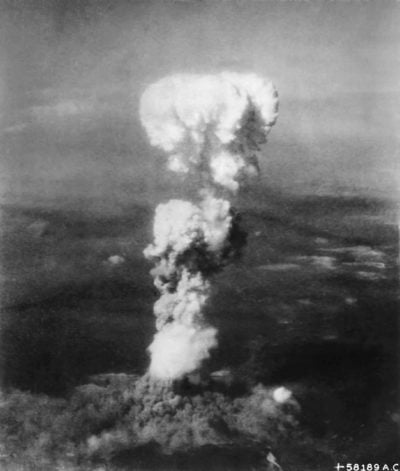
An image captured from the B29 chase plane Necessary Evil
of the actual detonation of the first atomic bomb over Hiroshima.


The law of conservation of mass states that in any closed system the ultimate mass of a system must remain constant over time. The law of conservation of energy posits that the total energy of an isolated system also must remain constant. Mass and energy are therefore said to be conserved over time. Both can change forms, but mass and energy can be neither created nor destroyed. They simply change from one state to another.

Take a match as an example. You strike a match and allow it to burn. What’s left is smaller and different from the original match. However, that excess mass didn’t just disappear. It changed forms. As the compounds in the wood degraded they gave off energy and some portion of it turned into a series of gases. That original stuff is not gone. It’s just different.

In the world of physics, this isn’t only not a good idea. It’s the law. However, there is one glaring exception. Albert Einstein codified the details within his extraordinary equation E=MC2.


Nuclear Fission


In the case of nuclear fission, a small amount of matter actually transforms directly into energy. Unlike our burning match example, some mass of fissile material consumed in a nuclear reaction no longer exists in our universe. This matter is physically transformed into energy. The ratio is driven by that equation where E is energy, M is rest mass or invariant mass, and C if the speed of light. As the speed of light is a big number and you are squaring it, the resulting amount of energy you get for a small amount of transformed matter can be truly astronomical.

As weird as all this seems, we can see the practical results clearly enough. It is this reaction that propels American aircraft carriers and nuclear submarines. It also drives nuclear power plants.

Despite their simply breathtaking size, aboard a nuclear-powered ship, a small amount of fissile material powers everything from propulsion and catapults to hot water and laundry. Producing 200,000 horsepower non-stop to power the USS Gerald Ford for a week requires less than nine pounds of enriched uranium fuel. These massive ships are expected to run for a quarter century without refueling. The tiny amount of fuel that is actually turned into energy in a nuclear reaction is even smaller yet. Now, hold that thought.


Little Boy was the first nuclear weapon fired in anger.

The Little Boy Test


The atomic bomb unleashed on Hiroshima, Japan, on August 6, 1945, was called Little Boy. This was a relatively simple gun-based device that burned enriched Uranium-235. The term enriched stems from the fact that only about one part in 140 of naturally-occurring uranium is the particular desirable U-235 isotope.

Building the bomb was fairly easy. Harvesting that specific uranium isotope was hard. That’s what the Iranians have been hell-bent on doing for the past decade.

Little Boy was little more than a stubby gun. An enriched uranium target sat at one end and a smaller uranium projectile resided at the other. At the point of detonation a chemical explosive fired the projectile down the internal barrel into the target and achieved critical mass for a spontaneous detonation.

The plutonium-based bomb, Fat Man, which dropped on Nagasaki three days later, was a more complicated implosion design. It was this mechanism that was detonated during the Trinity test in New Mexico. The first operational test of the Little Boy bomb was the Hiroshima attack. Most of the uranium used in Little Boy came from the Shinkolobwe mine in the Belgian Congo.


A Single Paperclip


Once ready to go Little Boy sported an all-up weight of 9,700 pounds. Of that mass was 141 pounds of enriched uranium. The average level of enrichment was around 80%. Upon detonation around two pounds of uranium underwent nuclear fission. Of the bit that burned, only 0.7 grams or around 0.025 ounce was actually transformed into energy. This is roughly the same mass as a dollar bill or a paperclip.

The bomb was deployed from the B29 Superfortress Enola Gay at 0815 in the morning. It fell for 44.4 seconds before its dual redundant time and barometric triggers fired the ignition charges. The weapon detonated 1,968 feet above ground, and the resulting explosion released 63 Terajoules’ worth of energy — the equivalent to 15,000 tons or 30 million pounds of TNT (Trinitrotoluene) high explosive.

The fireball was 1,200 feet in diameter with a surface temperature of 10,830 degrees Fahrenheit, roughly comparable to the surface of the sun. Every man-made structure within a mile of ground zero was instantly pulverized. The resulting firestorm was roughly two miles in diameter. Survivors reported a strong smell of ozone, as though they had been near a powerful electrical arc. This unprecedented explosion killed 66,000 people and injured another 69,000, all for the cost a single paperclip’s worth of enriched uranium.

The post BOMBS AWAY THE SCIENCE (AND HISTORY) BEHIND THE ATOMIC BOMB WRITTEN BY WILL DABBS, MD appeared first on You Will Shoot Your Eye Out.

12 Dec 01:16

Stolen rom Historical Firearms (A Great Blog by the Way!)

by admin175

THE MAD MINUTE

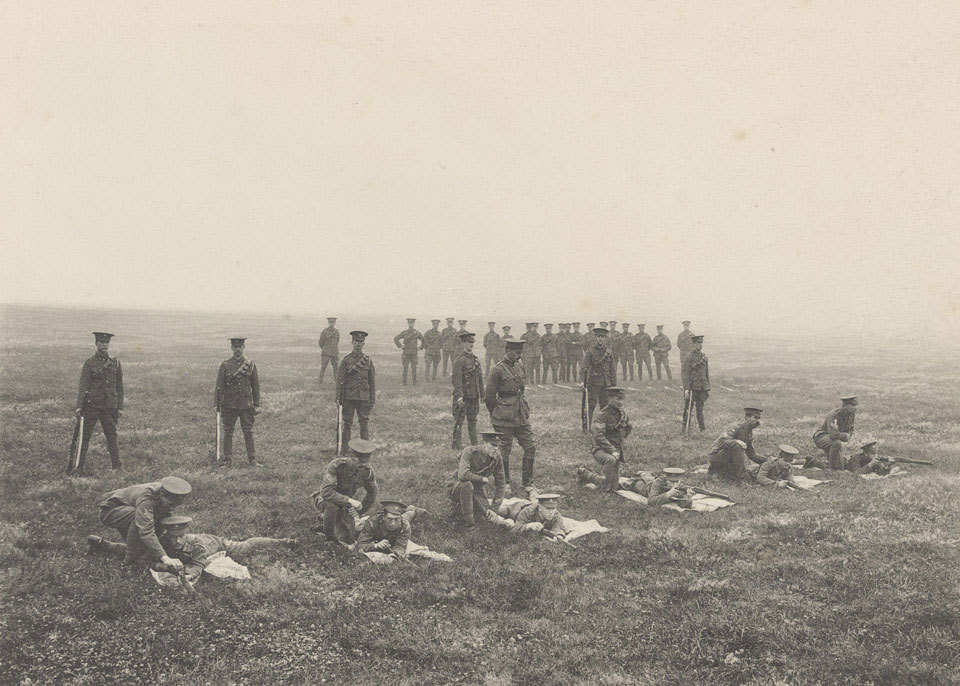
Marksmanship training in the British Army involved an exercise known as the ‘Mad Minute’ in which a soldier was expected to fire at, and hit, a Second Class figure target 300 yards out at least 15 times.   A trained rifleman could hit the target 30+ times with his Short Magazine Lee-Enfield Rifle.   At the turn of the century the British Army was the most professional in the world with each soldier trained to be an expert marksman.   The Mad Minute itself is arguably a myth surrounded by myth, its proper name was Serial 22, Table B of the Musketry Regulations classification course of fire. Which instructed a soldier to fire rapidly into a distant target with 15 rounds being a target.

However, this was not a requirement as the rifleman’s scores were calculated by aggregate with the other stages of the classification. The exercise of firing as many rounds as possible was probably a challenge set for fun to encourage pride in marksmanship and to see just how many rounds it was possible to fire in a minute. During the musketry classifications shoots of recruits and again shot each year by all infantrymen, engineers and cavalrymen to gauge how good of a shot they were.

The classification shoot was shot in several stages shot out to 600 yards, the various stages or serials were laid out in Table B, Appendix II in the Musketry Regulations Pt.1,  these included grouping with 5 rounds at 100 yards, snap shooting with 5 rounds out at 200 yards, two 5 round stages fired slowly with the first at 400 yards from the prone position and another at 300 yards from kneeling.   Then came the so called ‘Mad Minute’ stage fired from prone at a target 300 yards out.

This was to be fired with 5 rounds loaded – 1 in the chamber and 4 in the magazine, the rifleman would then reload with 5-round chargers firing until 60 seconds had elapsed.  The target used for this stage was the Second Class figure target which was a 4 foot screen with a 12 inch high figure silhouette at the centre surrounded by two rings, a 23 inch inner ring and a 36 inch outer ring.   This stage was then followed by three final stages fired from prone out to 500 and 600 yards.

image

The Second Class figure target as shown in the 1910 Musketry Regulations

If the classification was completed with a high enough score the soldier would be classified as a Marksman and given a crossed rifles badge and a 6 pence a day increase in pay – so it paid to be a good shot.  The rapid fire of the ‘Mad Minute’ was accomplished by used a ‘palming’ method where the rifleman used the palm of his hand to work the belt, and not his thumb and fore finger.  Each man to shoot the classification course was allotted points for where each round hit – 4 points for a ‘bull’ figure hit, 3 for a hit in the inner ring and 2 points for an outer ring hit.

Troops could be classified as follows: Marksman (with at least 130 points out of 200 across the classification), 1st Class (105-130 points), 2nd Class and 3rd Class (sub-standard).  The majority of British troops, even cavalry, were excellent marksman with 50% of troops in some battalions scored as Marksman with the rest being 1st and 2nd class shots.

As such when the First World War began the average British rifleman could out shoot his German and French counterparts.  At the Battle of Mons it was well documented that German infantry believed they were facing British battalions heavily equipped with machine guns rather than riflemen.

The first and confirmed record for the most hits on target during a ’Mad Minute’  was set by Sgt-Major Jesse Wallingford – 36 hits at 300 yards in 1 minute in 1908.  However, this was allegedly bettered in 1914, by Sergeant-Instructor Alfred Snoxall with 38 hits within the 24 inch inner ring in 60 seconds.  It has not been beaten since although there is little documentary evidence of the feat readily available. Hitting the target 38 times would require him to fire his first 5 rounds pre-loaded in the SMLE’s magazine and then reload 7 times with 5 round chargers.

Add onto this that the rifle was a single shot, bolt action rifle which required the user to push up and retract the bolt and then return it forward pushing a new round into the chamber, then aiming and fire.  All while maintaining his cheek weld and line of sight.  This means Snoxall must have averaged around 1.5 seconds per shot to hit the target 38 times in a minute. Quite a feat.

Here is a short video of a SMLE owner attempting a very fast ’Mad Minute’, he managed to fire 10 rounds in under 10 seconds.  It certainly gives you some idea of what Snoxall and other professionals could achieve.  

Sources:

Image One Source – British Infantry firing at targets at 500 yards

Image Two Source – Recruits of the 5th (Royal Irish) Lancers at musketry training at Aldershot, August 1907

Image Three Source – Troops training on a miniature range at the School of Musketry c.1915

‘Mad Minute’, bbc.co.uk (source)

Tommy, R. Holmes (2004)

British Army Musketry Regulations pt.1 1909/1914

Thank you to Rob from Britishmuzzleloaders for his invaluable help

The post Stolen rom Historical Firearms (A Great Blog by the Way!) appeared first on You Will Shoot Your Eye Out.

12 Dec 00:15

There's this guy who catches lobsters and gives them snacks for their troubles.


Tags: wholesome, animals, awesome

8793 points, 262 comments.

12 Dec 00:13

Differences between Jaguars and Leopards

by /u/Stoiiven
12 Dec 00:09

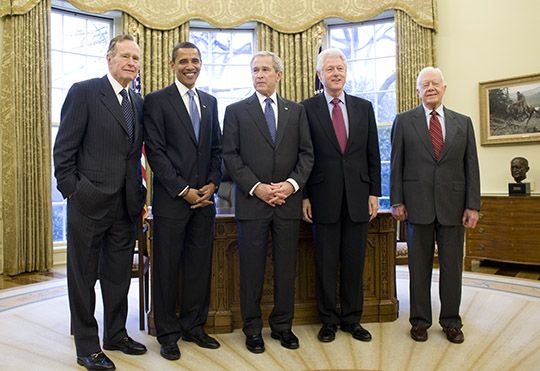
The Net Worth of All the US Presidents

by Miss Cellania

The office of the US presidency comes with a salary of $400,000 a year and some nice benefits, but that is far less than these accomplished folks could make in the private sector. We also know that running for office can really drain one's finances, as some congresspeople learn along the way. It's much easier to start out rich.  

In the early days of the US, a man did not become prominent among the Founding Fathers unless he had land and wealth. However, most of the wealth they had came from inherited land and by marrying up. In the middle part of our string of presidents, some initially poor men rose to the presidency. They amassed small fortunes by their work as lawyers, which paid well even when expenses were relatively low. In the more modern era, presidents could be rich or not all that rich going into office, but they will make tons of money in book deals and speaking engagements either before or after their term in office.

Buzzfeed made a list of the net worth of all 46 US presidents, and tells us where that money came from. The amounts are all converted to 2022 dollars for the ease of comparison.

(Image cedit: Pete Souza)

10 Dec 21:25

The sneaky economics of Ticketmaster

by Mark Dent

It was the type of disaster that made Americans reconsider the concept of live music sales. 

An iconic female artist, whose popular love songs delighted multiple generations, announced a national tour for the first time in many years. Countless fans cleared their schedules to buy tickets the moment they went on sale.

Alas, thousands of hopes were dashed. Tickets sold out instantly and were found for resale at up to 10x face value. Many people claimed they were “confused by the system.”

That tour, of course, was… Barbra Streisand in Concert, in 1994.

Long before millions of fans and bots crashed the Taylor Swift Eras Tour presale, supporters have felt jilted after trying to buy tickets to artists ranging from Babs to Miley Cyrus to Harry Styles and beyond. 

As with Swift, most of their ire has been directed at the same entity: Ticketmaster

The company, by far the most dominant ticketing platform in the world, now faces a class-action lawsuit from Swift fans. The DOJ has opened a broad antitrust investigation of Ticketmaster parent Live Nation. 

But Ticketmaster has been scrutinized many times before. 

“History continually repeats itself,” said former Ticketmaster CEO Fred Rosen, in an interview with The Hustle.

A few recent Ticketmaster receipts from customers who purchased tickets for the Taylor Swift Eras Tour demonstrate the platform’s large fees (via readers of The Hustle) 

Unlike Swift fans, however, Rosen sees the Eras Tour presale as a case of demand far outweighing supply and Ticketmaster as an “easy scapegoat” targeted by people who rarely blame the artists, venues, and promoters that set ticket prices and also try to maximize profits. 

As Ticketmaster’s top boss in the 1980s and 1990s, Rosen pioneered the hated fees that Swifties and politicians have pointed to as an abuse of power propagated by the company’s dominance. Ticketmaster just transacted a record $6.7B of tickets in the most recent quarter.

Is Ticketmaster — and parent company Live Nation — too powerful? Or is the system set up to squeeze live music fans, no matter who challenges them?

The business model that made Ticketmaster a juggernaut

To become so big it faced accusations of being a monopoly, Ticketmaster had to unseat another disruptor that people considered a monopoly. 

In 1967, Ticket Reservation Systems, which later rebranded as Ticketron, developed a computerized system. Instead of waiting in long lines or mailing checks, people could buy ready-to-print tickets from kiosks at retail locations scattered in big cities, all connected to a centralized server.

The convenience came with a cost for the buyer and the venue: 

  • Ticket buyers in the mid-1970s paid a service charge of ~$0.50-$0.75 per ticket, which Ticketron split with the retail locations that hosted the kiosks.   
  • The venues that partnered with Ticketron paid ~$0.25 per ticket sold, and they owed rental fees for kiosks on their premises.    

Ticketron was backed by Seagram’s whiskey magnate Edgar Bronfman, and it fended off competitors — until Ticketmaster entered the market. 

The company was founded by two college students in Phoenix but sputtered until it was purchased by Hyatt hotels founder Jay Pritzker in 1982. He installed Rosen as CEO, who focused on gaining ground in the concert business, where Rosen believed profits would be highest. 

Ticketmaster went from selling ~$1m in tickets during Rosen’s first year in 1982 (~10% of Ticketron’s sales) to ~$600m in 1990 and nearly $2.5B in 1998, Rosen’s last year as CEO.

Fred Rosen, then CEO of Ticketmaster, poses at his desk in 2001, several years after multiplying the company’s tickets sales from $1m to $2.5B per year (Ken Hively/Los Angeles Times via Getty Images)

Rosen said Ticketmaster, which sold at in-person locations and over the phone (and eventually the internet), was faster and more reliable than Ticketron, allowing popular events to sell out in hours rather than days. 

But the business strategy that separated the company from its rival was its fees.  

Rosen believed venues, not concertgoers, were his company’s real customers, and flipped Ticketron’s model: 

  • Instead of charging venues to use their ticketing system, Ticketmaster offered to pay them with a cut of the service charges. 
  • In exchange, Ticketmaster became their exclusive ticketing platform.

Ticketmaster, aided by the deep pockets of Pritzker, even floated advances to venues before the fees came in. Ticketron failed to compete and was bought by Ticketmaster in 1991.

Many concert promoters eventually wanted a piece of the fees, too, and, years later, some top-tier artists started to negotiate for a share, according to Rosen.  

“That’s how Ticketmaster got built,” Rosen said. “Where everybody had a piece.”

More sharing, more charging

Under the sharing system, fees went up, and the added cost was borne by concertgoers.

  • Ticketmaster’s first show, ELO in 1977, featured a $6.50 ticket price with a $0.25 service charge, according to the book Ticket Masters: The Rise of the Concert Industry and How the Public Got Scalped
  • By 1994 in Los Angeles, somebody who used Ticketmaster’s phone service to buy an $18.50 Stone Temple Pilots ticket, the most expensive seat, owed $8.25 in extra fees ($4.25 if they bought tickets at a Ticketmaster retail outlet).

Recent Ticketmaster receipts from customers who purchased tickets through the platform (via readers of The Hustle) 

“When you get through paying everybody, these things are expensive. They’re labor-intensive. There are a lot of people involved,” Rosen said. “And then the buildings get smarter, because as you bring more efficiency they all want more.”

Fans were frustrated by the escalating fees, as well as the opacity surrounding their purpose. The company barely explains what the fees are for. (Ticketmaster did not respond to an interview request from The Hustle.)

The so-called “drip pricing strategy” of attaching fees at the end of the purchase swayed many price-conscious consumers to break their budgets. 

“That increases the number of tickets that are sold because of people…who wouldn’t have bought but now are buying,” said Steven Tadelis, an economics professor at the University of California, Berkeley who has studied drip pricing.   

In the mid-’90s, Ticketmaster claimed that average fees constituted ~14% of a ticket’s face value. Rosen said Ticketmaster took ~20% of total fees as profit during his time as CEO. 

Since then, Ticketmaster has increased its influence, merging with Live Nation in 2010. 

  • Live Nation owns ~400 venues worldwide and holds tens of thousands of shows every year as a promoter. 
  • Industry experts say ~70%-80% of major US venues have exclusive contracts with Ticketmaster. 

Recent Ticketmaster receipts from customers who purchased tickets through the platform (via readers of The Hustle) 

In 2019, the Justice Department found Live Nation had exerted pressure on venues to sign with Ticketmaster or risk not receiving Live Nation shows, violating a consent decree signed when the companies’ merger was approved.

Those deals with venues make it hard for artists to use another ticketing platform. While AEG worked as Swift’s promoter, for instance, AEG claimed it could not use its AXS ticketing platform because the vast majority of NFL stadiums contracted with Ticketmaster.  

“Your choice becomes do a deal with them and do this tour, or don’t and don’t tour,” said Serona Elton, a former executive with EMI and director of the University of Miami’s music industry program.

The partnership with Live Nation has also coincided with an escalation in service charges. Concertgoers are now likely to pay ~30% of a ticket’s face value in fees, according to industry experts. 

Those fees tend to increase with the price of tickets, and Ticketmaster’s recent record for transactions on which it could charge fees came with ticket prices higher than ever because of increased demand.

Zachary Crockett / The Hustle

Ticketmaster can also collect fees on multiple transactions because of its controversial secondary sales market. The gross for fees on its secondary market was up 132% in Q3 compared to the same time period in 2019. 

The Hustle surveyed 606 people about their experiences with Ticketmaster; 601 (99.2%) said they believed its fees were too high. When we analyzed fees on 40 tickets to recent concerts, including the Eras Tour, the average fees took up ~28% of a ticket’s face value.

There were a few notable outliers:

  • 48% for the Backstreet Boys in Charlotte
  • 46% for Earth, Wind, and Fire and Santana in Chula Vista, California
  • 11% for Reba McEntire in Corpus Christi, Texas

One respondent recalled going to Sesame Street Live a few years ago and paying more for fees than they did for tickets. 

Zachary Crockett / The Hustle

Rosen said he didn’t care that the system annoyed fans, noting there’s still high demand for concerts, fees and all.  

“When you bring that up, it’s irrelevant to me,” he said. “The fact that no one shared in the service charge was idiotic. No one thought that ticketing was a business. I thought it was a business. I’m not ashamed of that.” 

The conundrum of more competitors

Although they regularly get called a monopoly, Ticketmaster and Live Nation have some competition. They weren’t even the sole parties involved with the Taylor Swift sale.

SeatGeek had exclusive contracts with a few venues and operated as the ticketing platform for Swift concerts in places like Glendale, Arizona, and Arlington, Texas. Buyers experienced similar problems on SeatGeek as they did on Ticketmaster. 

SeatGeek also charges exorbitant fees for concerts, as does AXS. That begs a question: Would more competition make a difference? 

As Rosen realized decades ago, fans are not the customer. So ticket platforms compete to land exclusive contracts with venues — mostly by offering them large sums of money, as Rosen did when he was CEO and as ticket platforms still do now.  

“And how are you going to offer larger amounts of money?” said Dean Budnick, co-author of Ticket Masters. “Well, it’s got to come out somewhere. The way you’re gonna do it is you’re gonna have larger and larger service fees.”

Budnick says the Great Britain model may provide lower service charges for consumers. 

  • British venues rarely have exclusive ticketing platforms. When companies don’t try to gain exclusivity, they don’t have to offer as large of a cut of the fees, bringing down the amount charged to concertgoers. 
  • Fans typically see fees closer to 15% of the face value of a ticket.  

Absent that type of overhaul to the system, which would likely require government intervention, don’t expect many changes when you buy concert tickets in the near future. 

A Ticketmaster sign at the Beacon Theatre on the Upper West Side in New York City (Noam Galai/Getty Images)

Rosen, in fact, has attempted to unseat Ticketmaster and Live Nation. In 2011, he helped start Outbox Enterprises, a company that assisted venues in selling tickets on their own. It didn’t succeed, he said, because most venues liked their financial arrangements with Ticketmaster.

And fans, despite their hatred of Ticketmaster, keep paying. 

Amy Kelsey, a Central Pennsylvania resident, is one of the many people who has used Ticketmaster in its record-breaking year, purchasing tickets for a Billy Strings concert in New Orleans. The fees for two $69.50 tickets were $39.50 — money she would have preferred to spend on another expense for the trip.  

But Kelsey doesn’t regret her purchase one bit.

“We’ll still go — eat the fees and go have a good time,” she said, “because at the end of it all there’s nothing like live music.”

10 Dec 21:21

SC has 2 of the 25 best rated US restaurants in 2022, new award ranking shows. Check them out - The State

10 Dec 21:19

A Master Blender Hoarded 40 Great Kentucky Whiskeys and Blended Them Into One Bottle

by Dsimms29
Crafted by Drew Mayville for The Last Drop, the spirit is like a bourbon fanatic’s fever dream come to life.
10 Dec 21:11

It’s finally easy to get into Yosemite National Park (No reservations required)

by Shannon Cooper

Yosemite National Park's controversial reservation system is no more. Learn about the program and why you no longer need a reservation (at least for now).

The post It’s finally easy to get into Yosemite National Park (No reservations required) appeared first on The Manual.

10 Dec 20:43

Best Places To Live Off-Grid: Top 7 US States To Live Self-Sufficiently, According To Experts

by Stephanie Vallette
Off-grid house with solar panels in the wilderness

There are many reasons for choosing to live off-grid. Some people want to lessen their impact on the environment. Others desire a different lifestyle than the status quo. This can include becoming more minimalistic and having more financial freedom. Off-grid living can cater to those who prefer to live in a more secluded setting or…
The post Best Places To Live Off-Grid: Top 7 US States To Live Self-Sufficiently, According To Experts appeared first on Study Finds.

10 Dec 20:38

Do you have a sedentary lifestyle? These 5 exercises offset a day of sitting at your desk

by BethAnn Mayer

A sedentary lifestyle isn't good for your health, but you don't have to quit your desk job. These five easy workouts will balance sitting all day.

The post Do you have a sedentary lifestyle? These 5 exercises offset a day of sitting at your desk appeared first on The Manual.

10 Dec 20:33

Best Flower Delivery Services: Top 5 Bouquets Most Recommended By Experts

by Anna Landry
Florist holding bouquet of flowers ready for delivery.

Flowers have the power to brighten a day, express emotions, and celebrate life’s special moments. But with so many flower delivery services out there, choosing the right one can feel overwhelming. Fear not, lovebirds and gift-givers alike! This guide is here to navigate the blooming landscape and help you find the perfect service for your…

The post Best Flower Delivery Services: Top 5 Bouquets Most Recommended By Experts appeared first on Study Finds.

10 Dec 20:29

One Of The Biggest Stars In The Milky Way Is Acting A Little Unstable

by Eric Mack, Contributor
RW Cephei is one of the largest stars known to humanity, a red supergiant thought to be over a thousand times wider than our own sun.
10 Dec 20:09

The 6 baking ratios everyone should know for delicious baked goods every time

by Lindsay Parrill

Here are some useful baking ratios you need to know to understand why baking works the way it does and a bit of the science behind it,

The post The 6 baking ratios everyone should know for delicious baked goods every time appeared first on The Manual.

10 Dec 19:24

How to Upgrade a Rusty Nail, the Classic Scotch Cocktail Your Dad Loved in the ’70s

by Jeremy Repanich
Our resident bartender makes a version your parents probably haven't tried though.
10 Dec 15:36

Here’s Your Insider Guide To Renting A Car In 2023

by Christopher Elliott, Senior Contributor
How do you rent a car in 2023? Flexibility will be an important tool. So will advance planning skill and avoiding certain road hazards.
10 Dec 15:13

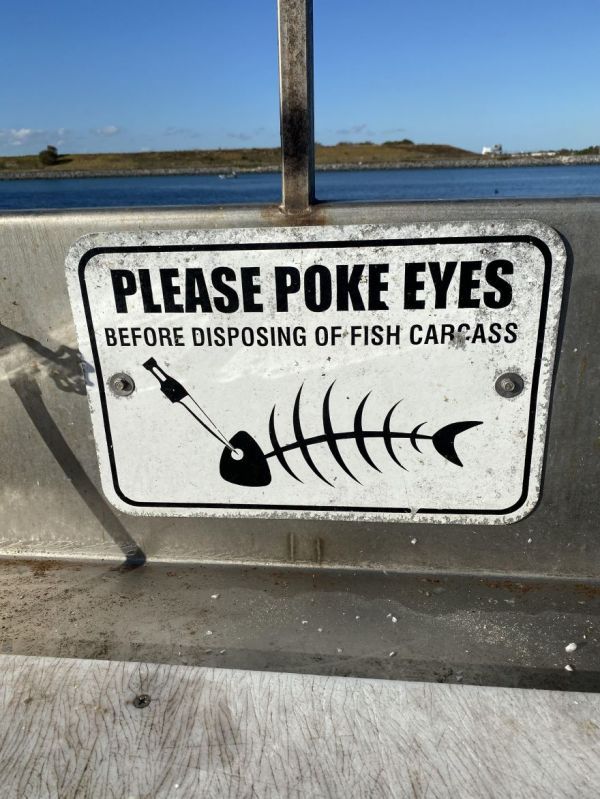
The Reason Behind the "Please Poke Eyes" Signs

by Miss Cellania

If you're not an angler, you might be surprised to see this kind of gruesome sign near fishing piers. When this one was posted at Reddit, it sparked a bunch of Three Stooges jokes. But a few folks helpfully explained why you need to poke the eyes out of a fish before throwing its dead body in the water.

An intact fish carcass will float. Even a fish that has been filleted will float when the head is intact. Poking the eyes out will release that buildup of gasses inside so the fish carcass will sink to the bottom. In the natural world, a dead fish will be consumed by other creatures pretty quick. One that floats will be food for birds, and one that sinks will be food for bottom feeders, like crabs. But in the natural world, a dead fish is in itself rare, as they more often are consumed before dying of other causes.

So this is only a problem when humans are involved, throwing away fish or partial fish they have caught. Floating fish either draw too many seagulls to populated areas, or else the floating decomposing fish cause a mighty stink. Now you know.

(Image credit: u/Bryllant)