Some people seek U.S. citizenship and with it, a U.S. passport, while others seek to renounce it. Why? What are the benefits and the liabilities of U.S. citizenship? What are the steps involved.
Caleb McGillvary …, proceeding pro se, filed this suit against Todd Grande …, alleging that Defendant defamed Plaintiff in a YouTube video …. Plaintiff is an individual currently incarcerated [for first-degree murder] in Trenton, New Jersey. Plaintiff has provided no information as to his domicile prior to incarceration in New Jersey. Defendant, a Delaware resident, is a licensed mental health therapist and counselor with a master's degree in Community Counseling and a Ph.D. in Counselor Education and Supervision. According to Defendant, he does not have any personal or professional presence in the state of New Jersey, nor has he ever advertised, advised, or sought business opportunities in New Jersey.
Defendant operates a YouTube channel … where he publishes videos analyzing mental health topics from a scientific perspective. These videos, on occasion, have included examining the mental health of public figures, such as Jeffrey Dahmer, Lorena Bobbitt, Gabby Petito, Norm Macdonald, and Alicia Head. As of the filing of Defendant's affidavit, the YouTube Channel had 873,117 subscribers. On March 6, 2021, Defendant published a video to his YouTube Channel entitled, "Kai the Hitchhiker | Analysis of 'Hatchet-Wielding' Personality," where Defendant discussed Plaintiff's biography, the viral news video that made Plaintiff famous, and the event that resulted in Plaintiff's current incarceration; he then provided a mental health analysis of Plaintiff.
{In 2013, while hitchhiking in California, Plaintiff rescued a California utility worker being assaulted by attacking the perpetrator with a hatchet. [The murder for which McGillvary was convicted was separate from this attack. -EV] Following the attack, Plaintiff took part in a colorful interview with a local news reporter near the scene of the incident. The video of the interview went viral, and eventually garnered over 1 million views on YouTube.}
On July 22, 2021, Plaintiff filed the present suit, alleging that Defendant's YouTube video contained slanderous remarks defaming Plaintiff. According to Plaintiff, this video caused mental anguish, emotional distress, damage to his reputation, damage to the marketability of his personality and intellectual property, loss of future earnings, and loss of revenue from social media and crowdfunding. As to damages, Plaintiff requests $2,908,630.08, which is the amount of ad revenue Plaintiff believes Defendant has received from the video, as well as injunctive relief removing the video from all platforms and forcing Defendant to surrender to Plaintiff the proceeds from, and ownership of, Defendant's YouTube channel and associated Patreon account….
I find that this Court does not have general jurisdiction over the Defendant. As Plaintiff admits, Defendant's domicile is clearly Delaware. Defendant resides in Delaware, and has worked as a therapist, counselor, and associate professor in Delaware. According to Defendant, he does not have any personal or professional presence in the state of New Jersey, nor has he ever advertised, advised, sought clientele, or pursued business opportunities in New Jersey. Defendant further attests that he has never maintained a bank account, obtained a phone line, held a professional license, and neither owned nor rented property in New Jersey. Indeed, there are no facts in the Complaint or Defendant's declaration indicating that Defendant has any ties whatsoever to New Jersey. As such, this Court does not have general jurisdiction over Defendant….
In the absence of general jurisdiction, a plaintiff may rely on specific jurisdiction where the cause of action is related to, or arises out of, the defendant's contacts with the forum. In analyzing a defendant's contacts, the Court must look "to the defendant's contacts with the forum State itself, not the defendant's contacts with persons who reside there." Practically, this means that "the plaintiff cannot be the only link between the defendant and the forum. Rather, it is the defendant's conduct that must form the necessary connection with the forum State that is the basis for its jurisdiction over him."
To establish specific jurisdiction over a nonresident defendant in an intentional tort case, such as defamation, the Court applies the three-pronged Calder "effects" test …: "First, the defendant must have committed an intentional tort. Second, the plaintiff must have felt the brunt of the harm caused by that tort in the forum, such that the forum can be said to be the focal point of the harm suffered by the plaintiff as a result of the tort. Third, the defendant must have expressly aimed his tortious conduct at the forum, such that the forum can said to be the focal point of the activity."
The Third Circuit has "consistently emphasized that the [effects test of] Calder should be applied narrowly."
Here, after liberally construing the pleadings, I find that Plaintiff has not met the Calder test. Even if this Court assumes that Defendant has met the first two prongs, Plaintiff has plainly not satisfied his burden as to the third prong. Plaintiff argues that this Court has specific jurisdiction because Defendant "continuously and systematically" broadcasts his videos to, and solicits funds from, New Jersey for commercial purposes. But this, alone, is insufficient. Plaintiff avers no specific facts indicating that Defendant expressly aimed the relevant video at New Jersey, rather than to the general public nationwide. And such facts are necessary, as Due Process requires that a defendant "purposely avails" himself or herself of a forum, which "ensures that a defendant will not be haled into a jurisdiction solely as a result of 'random,' 'fortuitous,' or 'attenuated contacts[.]'" As such, the Third Circuit has cautioned that "the mere posting of information or advertisements on an internet website," without express aim at a forum, "does not confer … personal jurisdiction."
Plaintiff has failed to meet his burden of showing that Defendant's video was expressly aimed at New Jersey. Defendant's YouTube Channel and its videos are passive, Defendant's videos are intended for a wide audience and may be viewed by any person in any location…. And while Defendant did publish a video specifically about Plaintiff, this, alone is not enough for this Court to establish personal jurisdiction over Defendant. A "plaintiff cannot be the only link between the defendant and the forum." Other than his mere presence in the state, Plaintiff has alleged no facts indicating that the relevant video is expressly aimed at New Jersey. Nor has Plaintiff provided any other relevant links between Defendant and New Jersey that might be indicia of express aim at New Jersey. Defendant does not have a personal or professional presence in New Jersey, nor has he ever advertised, advised, or sought business opportunities specifically in New Jersey….
The spread at Patria Cocina in Atlanta. | Patria Cocina
Marisquerias, Sinaloan-style chicken restaurants, and taquerias serving tacos, enchiladas, tlayudas, tortas, chimichangas, and tamales
Atlanta and its suburbs feature numerous Mexican restaurants — most family-owned and operated — serving a wide range of dishes from around Mexico. Whether seeking a marisqueria (seafood restaurant), Sinaloan-style chicken, or a comforting taqueria offering heaping plates of tacos, enchiladas, tlayudas, tortas, chimichangas, and tamales, folks will find a Mexican restaurant serving exactly what they’re craving. This map features some of the finest Mexican restaurants Atlanta has to offer.
Val's Rapid Service has been a St. Cloud institution for over 60 years. Originally a Pure Oil gas station, it was purchased by Val and Kathleen Henning in 1959. They remodeled the building into a burger, fry, and shake shop that has stayed true to that mission ever since.
Originally known as "Val's Rapid Serv," the store was a part of the local Rapid Serv restaurant franchise. Today, Val's is the only remaining Rapid Serv location. As the aging sign says, the small building is takeout only, and the ordering process is part of the fun. When it first opened, patrons would place their orders in the lobby by picking up a phone on the wall and calling the kitchen in the back. The system has evolved to feature computer screens that allow patrons to order. (This isn't the only modern update: Customers can order online now, too.)
Val's serves everyone from locals on their lunch breaks to loyal fans who stop by on their way North on Highway 10. The menu features no-fuss burgers, huge portions of delicious, salty fries, and over 20 flavors of milkshakes. It's a time capsule of delicious flavors and retro style, and a must-try when you're in St. Cloud.
Michelle Boggess-Nunley moved from an office job to life as a professional artist a few years ago, which led her back to a childhood passion: hand-drawn mazes. The Grosse Pointe, Michigan-based artist now holds the Guinness World Record for the biggest hand-drawn maze—around 1,500 ft long, so large that it had to be photographed panoramically, wrapped around a soccer field, for the final submission.
Since putting out her first book of mazes in 2019, Boggess-Nunley’s worked on multiple other books (including A.J. Jacobs’s new book, The Puzzler), exhibitions such as ArtPrize2021, and commissions, including a wall mural maze outside a local restaurant. So we tapped her to create a downloadable new maze for Atlas Obscura to help us launch our new puzzles, based on some of the wondrous locations we feature—all of which are clickable in the downloadable PDF.
We spoke with Boggess-Nunley about how she got into mazes, how you stay one step ahead of solvers, and what it was like to make a single maze—in public—for months.
How did you get into making mazes?
When I was in second grade or third grade, my mom let me get one of the Highlights maze books. I was obsessed. I solved them from front to back, finish to start. And then I just memorized them. And then I thought, I could start making my own mazes, so I made a maze book for the entire third grade class.
How did you go from that to making mazes professionally?
There was a long period where I didn’t make mazes at all, maybe 10 years or so. But I’d always solve mazes. I remember drawing my first maze after getting back into it—I was probably 18, 19 years old at that point—and I remembered how much I loved it.
So, one day I’m like, “You know what? I’ll make a book.” I was transitioning from the corporate world. I was a court reporter and went into being an artist full-time. And mazes were that little puzzle piece that was missing. I did a couple children’s maze books and some coloring books with mazes.
Then, during the pandemic, we had that period where nobody was working, especially if you were in the service industry or doing anything with people. And the days went on, the weeks went on, the months went on. I run a little art studio on the side. I teach children and seniors how to draw and paint, and there was none of that going on because the fundraisers weren’t happening for these organizations. So I had the idea of doing a really big maze to raise money for the organization Detroit Living Arts.
How did you go from making a big maze for charity to breaking a world record?
At first it was something that was just going to be fun: We’re going to sit in a gallery window and make this giant maze and people are going to get involved and we’re going to raise money. But then I got connected with a lot of other maze artists. We’re a real niche art form. There’s only maybe a handful of us that do this in the whole world, and every year we make a book together. Two of them are official world record holders, Joe Woes and Eric Eckert. All the pieces just kind of fit together: I can beat the world record, I can raise money for this cause, just burn some time, and make a giant maze.
What’s the process of actually getting a world record confirmed? It sounds like it could be complicated.
When I applied, they gave me a full book of stipulations that I had to follow or I could be disqualified. Drawing the maze was only half the challenge. I think the guidelines are probably the hardest part. Because we were in the middle of the pandemic, things were exacerbated. The maze had to be done in a public place, and they were hard to come by. And they required me to have two witnesses that had to watch the entire process of me drawing. It had to be done for four hours a day. The witnesses had to log in and log out every day.
I found a local art gallery down the street from my house with a really nice front window, Posterity Gallery. The two witnesses were the owner, Sherry McInerney, and the manager, Sherry Allor. Guinness wanted every second of the process video-taped, so I had to get two cameras set up just in case one camera stopped working. I ended up having a whole army of people behind me helping me.
The entire maze had to be solved, which presented the biggest challenge. Solving it probably took just as long as drawing it because there were very intricate paths. The path could only be one centimeter in thickness, so that was another challenge.
People were allowed to come in and ask questions. I did a lot of doodles inside the maze path—that’s how we raised money for Detroit Living Arts. People could sponsor a square foot of that maze, and they could request doodles—portraits of their dog and their kids and symbols. That probably took longer than the actual maze itself. But it was really fun watching people get involved.
How long did it take?
It took three months and 10 days, which ended up being just under 300 hours.
I’d estimate only half of the time I spent was actually drawing the maze itself. The doodles took a lot of time, with more than 300 names, doodles, and hidden images. The other time-consuming part was solving the maze as I went. There was no skimping on any of the complexities to finish quicker, because all the while I had hoped that someone would attempt to solve it.
How did it feel to finish?
It was actually kind of bittersweet. Though part of me was happy to move on to other projects, there was also a layer of sadness. I had made so many friendships along the way. The maze became more about staying connected and getting people involved than breaking a record. There was also this overwhelming sense of gratitude, because I knew this was something that took an entire village to see all the way through. Every obstacle that seemed impossible to overcome, and there were a lot, I was fortunate enough to have a community of people to help me get past it. From the public space to create it in the middle of a shutdown, then finding willing witnesses, to the land surveyors that volunteered to measure it, to the venues that donated their space for measuring, then the videographers that helped raise awareness to the cause, right up to the photographer for the final photograph that Guinness required for the title, and then finding an indoor space large enough to unroll it in. The list is infinite. None of it was easy, but there was so much support behind me at every stage of the process.
How do you come up with and design a maze?
It’s like a maze up here [points to head]. For me, it’s almost a calming effect. When I’m making a maze, I feel clearer I than I ever do. It’s like everything makes perfect sense.
Making a maze is not just designing it. You’re looking into what’s going to happen: Where is this path going and what is it going to connect to? So you have all these different paths going simultaneously and you try to get into the mind of the solver, because people are going to cheat. They’re going to want to start from the finish. I try to think of little tricks I can do, like maybe I’ll put in a fake path. It’s this constant conversation I’m having with myself, trying to figure out what the solver is going to do and trying to design around it. It’s almost like you have to be the solver and the designer when you make it.
How did that work for the Atlas Obscura maze?
I love Atlas Obscura—all the wonders and the crazy, weird places in the world. I went into a hole researching all these things. I picked the places and stories that really stuck out to me, like the goats in trees in Morocco.
It had a twist, because some of the places in Atlas Obscura were in water, some were in caves. I had to show different landscapes. So I did it in an isometric way—like a three-dimensional drawing where it looks like you’re coming in from an angle. It worked well for a lot of the buildings and sites that I included.
What’s the most rewarding part of making mazes?
Having people solve them and get through them is probably the most rewarding for me. I’ve got a 10-year-old, and he’s my go-to guinea pig. I make a maze, and just watching him solve anything, I get excited. I’m always rubbernecking, making sure he’s not cheating! [Laughs.]
How long does it usually take people to solve one of your mazes?
It depends on the maze. There’s not a whole lot of mazes out there that are made for adults. I think it’s an art form that hasn’t quite been tapped into yet, but it definitely has a place in the puzzle world. I feel like this year something is different. It’s the time for puzzles. It’s the time for mazes, whereas a few years ago, you didn’t really see a whole lot of this before.
Do you think the pandemic has pushed people toward these more analog pleasures?
Definitely. You know, I hear a lot more about puzzles and shows popping up all over the place. It’s fun to see. There’s this whole movement happening now.
Mazes have always been here since the beginning of time, in labyrinths, though they’re not technically mazes, and mythology and other forms. But now it’s accepted as something that’s challenging and improves your cognitive skills. I think now finally people are accepting it as one of their other daily puzzles, like they would like a crossword or a sudoku.
This interview has been edited for clarity and length.
Want to try your hand at a challenging paper-and-pencil maze? Check out an original Atlas Obscura maze from world record-holding maze artist Michelle Boggess-Nunley!
On a fall weekend before the pandemic quarantine, I go to the Labyrinth Society Annual Gathering to learn about mazes. This turns out to be a big mistake. A wrong turn, appropriately enough.
I’m informed of my error soon after arriving at the retreat in rural Maryland. One of the conference organizers, a tall man from Tasmania, tells me in a gentle but stern tone that the gathering of the Labyrinth Society is NOT the place to study mazes.
Labyrinths? Yes. Mazes? No.
They are two very different things. And one is better than the other.
“God created the labyrinth to help people deal with the trauma of mazes,” he tells me, as we stand in a field near a stone labyrinth. He is not smiling.
I’d always thought of the two words as synonyms, but devoted labyrinth fans say they are oceans apart.
Mazes are puzzles. You have choices. Do I turn left? Right? Go straight? The point is to get lost before finding the exit.
Labyrinths, on the other hand, are not puzzles. Labyrinths offer zero choices. You follow a single winding path from start to finish. Their purpose isn’t to entertain, it’s to enlighten. According to labyrinth fans, walking a labyrinth can be a profound experience, a meditative and healing experience. Sometimes even a life-altering experience, akin to St. Paul’s road to Damascus or Steve Jobs’s acid trip.
Many of the hardcore labyrinth fans see mazes as a source of anxiety, confusion, and stress. “I don’t want to make any decisions,” one man told me during lunch break. “I make enough decisions in my real life. One path in, one path out, that’s what I like.”
Much to my surprise, I learn that labyrinths have had a considerable resurgence in the last few decades. The modern labyrinth craze was ignited by a 1996 book called Walking a Sacred Path by Lauren Artress, an Episcopal minister. She wrote about her experiences walking the labyrinth made of stones embedded in the floor of the Chartres Cathedral in France, describing it as a powerful way to pray.
Since then, labyrinths have been embraced by various spiritual seekers—Christians, Buddhist-influenced mindfulness fans, New Agers, and users of psychedelics. Thousands of labyrinths, both temporary and permanent, have popped up in private homes, hospitals, retirement communities, rehab centers, and church parking lots. Some are made of rocks artfully arranged in grass. Others are painted on pavement. Still others are printed on portable tarps. (Unlike mazes, labyrinths rarely have high walls; they are usually knee-high or lower.)
But all labyrinths share one trait: “The labyrinth is not a puzzle to solve,” a woman tells me. “The puzzle is you. And you solve it by walking the labyrinth.”
Since I’m writing a book on puzzles, what should I do? Maybe I should take the next train home and never speak of this again. Or maybe I need to relax and explore the idea of the anti-puzzle. The joys of freedom FROM choice. The novel idea of not subjecting myself voluntarily to confusion and hardship. And maybe work on that “puzzle of you” thing.
So I spend the day exploring labyrinths with about a hundred other gatherers from all over the world. I attend speeches about the history of labyrinths, from patterns drawn on pottery in ancient Syria, to medieval Swedish stone arrangements.
I listen to testimonials of people who talk about energy vortexes and chakras. (This New Age lingo is partly why some conservative Christians disapprove of labyrinths, seeing them as too pagan.) I read pamphlets about how labyrinths have supposedly cured people’s arthritis and nearsightedness and I hear about how labyrinths can enhance life’s rituals, including marriage (the couple walks in separately, and leaves together) and divorce (the opposite, of course).
And, of course, I walk a labyrinth.
The organizers have set up several on the hotel grounds, and the one I choose sits in the field behind the hotel. The labyrinth consists of dozens of square stones arranged in a spiral and embedded in the patchy brown-green grass. It’s about the size of a tennis court.
I’ve joined a dozen other walkers for a workshop being led by Mark Healy—the Tasmanian who warned me of mazes’ psychic toll. Mark is a young-looking blond man of 62 and father of seven. He’s wearing a black T-shirt that says, “I lost my mind in a labyrinth but gained my heart.”
In a speech the previous night, Mark had talked about how labyrinths saved his sanity. In 1999, he was the owner of an organic food business that went bankrupt. He spent six months building a labyrinth to help him through the ordeal. “It purged me of shame and grief,” he said.
This labyrinth has two entrances side-by-side.
“If you are feeling masculine energy,” Mark tells us, “then go right and come out left. If you are feeling feminine energy, go left and come out right.”
Hold on. I thought the whole point is I wouldn’t have to make choices! Regardless, I’m not feeling either gender’s energy particularly strongly. I decide to go with the male route.
I step onto the path and walk slowly, like I’m in a funeral procession. I’m hoping for a mind-blowing experience. A blast of trumpets, a technicolor hallucination of a world beyond. This is not happening. But I’m going to do my darndest to get the most that I can out of this labyrinth. I focus on the sound of the grass crunching under my sneakers, the breeze on my cheek, the brisk air filling the alveoli in my lungs, the slight dizziness when I do a 180-degree turn, which makes me wobble drunkenly and almost bump into another walker.
I focus on not focusing so much.
Three minutes later, I step out of the labyrinth. Mark is waiting at the end with a beatific smile and his hands in the “namaste” position.
“You lost your virginity!” Mark congratulates me.
I smile. I can’t say I am reborn. But I do feel my pulse has slowed. I’m relaxed, serene, like I’ve just had a nice glass of white wine. Which is not nothing.
It’s certainly a contrast to wrestling with a puzzle. And in some ways, a welcome one. I think of Barack Obama’s dream of opening a T-shirt shop. He once said he was so sick of hard decisions that he fantasized about opening a T-shirt shop on the beach that sold only one item: a plain white T-shirt, size medium. Freedom from choice. Several years ago, I wrote a book in which I followed all the rules of the Bible, and even though I’m not religious, I saw the appeal of a highly structured life. The freedom to choose has many benefits, but in certain circumstances, so do strict limitations. Should I work on the Sabbath? No. I don’t have to think about it or weigh the pros and cons. The answer is clear.
Puzzles follow a narrative: You struggle, you struggle some more, then you break through to the joy of the solution. It’s the same narrative we like in our books and movies. Conflict, then resolution. But sometimes I agree with Mark: Why should we have to endure that painful conflict phase if we don’t have to? Maybe we’re unhealthily masochistic. It’s why I have an odd habit that drives my wife crazy: Sometimes I watch the first half of a romantic comedy, then turn it off. I just want to see the part where the couple is falling in love and the montages of ice-cream eating and roller skating. But as soon as Act 2 starts, with those stressful misunderstandings and complications, I’m out.
Don’t get me wrong. I still love puzzles, even with the anxiety they provoke. Partly because of the anxiety. But I can see the appeal of the labyrinth.
Before I leave the Labyrinth Gathering, I buy a book in which each page contains a simple black-and-white labyrinth. You’re supposed to trace the labyrinths with your index finger and get that mental peace without leaving your sofa. Perhaps, when I’m banging my head against a frustrating puzzle, tracing these simple, choice-free paths will be a meditative gift.
The Michelangelo of Mazes
After so much maze skepticism, I wanted to hear a pro-maze perspective. So I set up a Zoom call with a British man named Adrian Fisher. Adrian is the most prolific maze designer “in the history of humankind,” as he puts it, modestly. He and his company have designed more than 700 mazes to date. He’s created mazes that can be found in 42 countries on six continents. He’s designed them for amusement parks, museums, and private homes. He’s made them out of hedges, mirrors, corn, colored bricks, and spraying water. He has set nine world records, including for the biggest permanent maze, called “The Maze of the Butterfly Lovers,” in China, with more than five miles of hedge-lined paths. (Another maze in China, this one in the shape of an elk, recently broke the Butterfly Maze’s record for largest maze.) The polar opposite of Mark Healy, Adrian is convinced that mazes are a great source of pleasure.
Sometimes very physical pleasure.
“I was in a corn maze in Southern England and there was a couple there with a baby,” Adrian tells me. “They came up to me and said, ‘Did you design this maze?’ I said yes. They said, ‘This little baby was conceived in this maze two years ago.’ ”
“Weren’t they afraid of getting caught?” I ask.
“I suppose that was the fun of it.”
Adrian is speaking to me from his home office in Dorset, England. He’s got bushy gray eyebrows, and he is wearing a navy blazer. His office is packed with piles of books on gardening and masonry.
Adrian’s conversational style is, appropriately enough, filled with unexpected byways and occasional dead ends. He talks about water skiing barefoot in Hong Kong and longbows in medieval warfare.
“As you may have detected,” he says, “my life consists of telling stories. Some of them are true.”
Eventually, we do discuss mazes, his first love.
“I’m an artist,” Adrian says. “And my chosen medium is mazes.”
How did he embark on this curious career path?
A puzzle fan since childhood, Adrian created a hedge maze in his father’s garden when he was 24. He decided it was his life’s calling. His first commissioned maze opened in 1981 at a historic British manor near Oxford.
Some of his more notable mazes? He helped design a Beatles-themed maze in Liverpool with a yellow submarine at its center. “The Queen opened that one,” he says.
There’s the maze at the passenger terminal at Singapore’s Changi Airport. “Doesn’t that cause people to miss flights?” I ask.
“Yes, I’ve read that has happened several times.” He doesn’t seem particularly guilt-stricken.
And the maze on the side of a 55-story skyscraper in Dubai. “It’s not to be attempted unless you happen to be Spider-Man,” Adrian says.
He’s incorporated rotating floors, walls that change colors, and waterfalls that part when you walk through them.
The beauty of a maze, says Adrian, is that when you solve it, “you walk out one inch taller.” It imbues a sense of danger, but not too much danger, followed by joyous accomplishment.
“When I’m designing a maze, it’s like I’m playing a chess game with you. But I have to make all my moves in advance. And I have to lose.”
He says mazes are best when they’re a social activity. “You have to share the decisions, figure out how to work together.”
He loves the symbolism of mazes. “Mazes can work on so many levels. They contrast the rigidity of man’s designs with the exuberance of nature—and the folly of man trying to control nature.” And he adores the mystery. “Mazes are like bikinis of life. They have to hide the important bits, but still reveal enough to keep things interesting,” he says. I suspect I’m not the first one he’s used that line on.
Mazes Start Here
Adrian is also a writer, and has authored no fewer than 15 books on mazes. Some are collections of his pencil mazes, a genre that was faddish in the 1970s and 80s. Others focus on the history of mazes. As I dug into Adrian’s history books, as well as those by other authors, they reinforced my contention that history is almost always far weirder than we imagine.
Consider the tale of the most famous maze of all time: the ancient Greek labyrinth, home to the fearsome Minotaur. (Just to complicate things, it’s usually called a labyrinth, but it might have been a maze, since people got lost in it.)
I knew the bare bones of the Minotaur myth but not the full story. And the full story isn’t just weird. It’s depraved. As in Human Centipede–level depraved. It reinforces my belief that ancient societies were far more disturbing than the sanitized versions we are taught.
With that warning, here goes:
The Greek god Poseidon got angry at King Minos of Crete for failing to sacrifice a white bull to him. So Poseidon, using flawless misogynistic logic, decided to punish King Minos’s wife. He put a curse on the queen that made her fall madly in love with the white bull.
The queen tried to seduce the bull, but the bull wasn’t interested. Not his species. Desperate, the queen hired Daedalus, Greece’s greatest inventor, to help with her cause. Daedalus’s task: build a realistic-looking cow out of wood and cowhide. And make sure that the wooden cow has a secret compartment that could fit a naked person. Daedalus did his job. The queen climbed into the compartment sans toga, and the cow was wheeled over to the bull. This time, the bull took the bait and mated with the wooden cow, perhaps figuring that if someone went to that much trouble, it was the least he could do.
The bull impregnated the queen, and she gave birth to a monster: a creature with the head of a bull and the body of a man. The Minotaur.
Horrified by his wife’s bastard child, the king ordered Daedalus to build a maze. And in this maze, the king imprisoned the Minotaur, where it grew into a fearsome beast that, every year or so, ate 14 virgins captured in Athens. (Not addressed in the myth: Why an herbivorous bull would require human flesh to survive.) This bloody ritual continued until the hero Theseus slew the Minotaur and escaped the maze with the help of a ball of yarn.
The tale has an interesting maze-related coda: Daedalus later ran afoul of the king and was imprisoned in his own maze. But clever Daedalus and his son Icarus escaped by making wings of wax and feathers and flying away. That’s some impressive, out-of-the-box puzzle solving by Daedalus (despite the well-known mixed results of that flight).
So there you have it: cannibalism, bestiality, and high-end carpentry. Not the storyline taught to my kids during their sixth grade Greek Festival, where they recited myths in togas made of bedsheets.
Despite centuries of digging, archaeologists have not found the ruins of King Minos’s original labyrinth. Likely, it didn’t exist in the form described by the legend. The closest parallel is the ruins of a palace from the Minoan civilization on Crete. The palace’s many connecting rooms might have inspired the myth.
After the mazes of Greek myth, the most famous mazes are probably the great hedge mazes of Europe. Starting in the Middle Ages, it became fashionable for nobles to construct giant leafy puzzles on their palace grounds. Some still survive, including the Hampton Court Maze built circa 1700.
The Hampton Court Maze has six-foot-tall hedges made of yew. It’s a pretty simple maze, just five turns, but still, a questionable legend says that a man once got lost in it overnight and froze to death. What is certain is that the Hampton Court Maze has made an impressive contribution to science. It inspired 19th-century psychologist Edmund Sanford to put rats in mazes.
The Hampton Court Maze attracts thousands of tourists a year, in part because most mazes of yore no longer exist. Some were chopped down during the rule of Puritan Oliver Cromwell, who detested them as trivial pursuits. Others just languished.
Perhaps the most popular type of maze nowadays is made of a different plant: corn stalks.
The corn maze is of surprisingly recent origin. In the early 1990s, a former Disney producer was flying over corn fields in the Midwest when he had an epiphany. Let’s turn these boring farms into something fun. Agri-tainment!
He hired Adrian Fisher (of course) to design the first corn maze, which opened in 1993 in Pennsylvania. And here we get an unexpected cameo from Stephen Sondheim. Turns out, the Disney producer was friendly with Sondheim, and the legendary lyricist told him, “You have to call it the Amazing Maize Maze.” Which he did.
Maize mazes are now an established autumnal ritual. Late every summer, hundreds of corn fields in America get converted, a boon to struggling farmers and puzzle fans alike.
The Hardest Maze
A few months later, I did an Internet search for “Hardest Maze in America.” There’s no governing body that officially ranks mazes by level of difficulty, but one result seems intriguing: the Great Vermont Corn Maze. As one article puts it, “It’s not the Mediocre Vermont Corn Maze.”
I phone the number on the website and speak to the owner, Mike Boudreau.
“I’d love to come up,” I say.
“That’d be great,” Mike says.
“I’m thinking of bringing my son to do it with me,” I say. “How old is your son?” Mike asks.
“Thirteen.”
Mike pauses. I sense some concern.
“It’s just that 90 percent of teenagers hate the maze. They give up after an hour or so. It’s too hard for them.”
I like what I’m hearing. This maze sounds nice and frustrating.
Mike explains that it usually takes at least three hours to finish the maze, sometimes as much as five or six. “Most people find themselves back at the start after two hours.”
This is getting better and better.
Mike says he’s had plenty of customers burst into tears out of frustration. He’s seen dozens of bickering couples. “Let me put it this way. It’s NOT recommended for a first date.” One father got so exasperated, he abandoned his family in the maze, went to the parking lot, and drove off without them.
Crying? Screaming? Splintered families? I’m sold! It’s like Mark Healy’s warning came true.
“Hopefully I’ll make you hate me as much as everyone else does,” Mike says.
On a late summer day, I rent a car and drive up to rural Vermont. As recommended, my teenage son is not with me. I meet Mike, who is wearing mirrored sunglasses and a khaki jacket. He walks me to the start of the maze, a clearing with an eight-foot statue of a relatively demure Minotaur. (The monster is shirtless but is wearing a pair of blue jeans.)
I ask Mike how he got started. He says he married a farmer’s daughter, and, in 1999, in a quest to help get new income for the family farm, he set up a relatively simple maze and opened it to the public. Every year since then the maze has grown bigger and more elaborate. This year it’s approximately 24 acres. Over the years, Mike has added tunnels, bridges, statues, a platform with a motorboat. And themes! One year had a dinosaur theme, with a T-Rex carved into the rows of the maze that was only visible from a bird’s-eye view.
The year I visit—2020—the theme is more sentimental: a big thank you note to the essential workers who kept us alive during Covid. If you look at it from above, you can see the words “Thank you,” along with the symbol for medical workers, the Staff of Hermes surrounded by twisting snakes.
Because of the pandemic, Mike’s maze is allowing in fewer than half as many solvers as normal.
“I’m going f-ing broke, but I thought I’d do something to thank people.”
Another couple comes to the entrance. They’ve been here before and don’t need to hear Mike’s intro spiel. They set out on the journey.
“See you tomorrow!” Mike says.
Mike tells me that Covid is just one of the challenges of maintaining his maze. He reels off a list of problems he faces every year:
Cheaters who use video drones to try to hack the maze.
Hungry bears. “They’ll come at night and eat up two whole squares. They just keep eating till they throw up.”
Climate change has made them sprout more quickly.
Women who wear high heels. Not only is it painful for the wearer, but they leave little holes throughout the maze. Hiking boots are recommended.
Petty thieves who steal ears of corn. “The thing is, this is feed corn,” says Mike. This type of corn is meant for pigs, not humans. “I’ve been told it’s a laxative. So when I see people walking out with their pockets stuffed with corn, I’m like, ‘You got me! You got one over on me, buddy!’”
Mike is old school. He designs the mazes himself by hand. He and his family plot the paths out with a tape measure and clear the rows with hoes and a rototiller.
“This is not a McMaze,” he tells me. Some corn mazes are made using prefab computer programs that are like giant stencils. Instead, Mike sees himself as an artisan, akin to a Brooklyn pickle maker.
It’s time for me to set out on this homemade wonder. There are three paths at the entrance, marked “eeney,” “meeney,” and “miney.” I choose meeney. I enter, and I walk between the corn stalks towering over my head. I try to use the clouds to orient myself as I make a left, then a right, then a right.
Navigating the maze is a surprisingly emotional experience. Over the next four hours, I cycle through the following feelings:
Optimism. Frustration. Extreme frustration.
Resentment—I feel manipulated, like a lab rat.
Bitterness—when I get to a dead end, I laugh out loud.
Joy—I’m making progress!
Discomfort—I’m thirsty, and my shoulders are sore from my backpack.
Smugness—I pass a dad carrying his kid in a BabyBjörn. At least I don’t have a 20-pound whining weight pulling me down.
Guilt—I inadvertently cheat by taking one of the emergency exits. Yes, this maze has emergency exits. Mike guides me back to where I made the wrong turn.
There is a science to solving a maze. Mathematicians have developed several algorithms, and before my trip, I’d printed out a list from the internet.
I’d planned to start with the easiest tactic: the Wall Follower algorithm. So named because you put your right hand on the wall, and make every right turn you can. The solver may double back a few times, but eventually you’ll reach the exit.
Or not. The maze designer can mess with the Wall Follower strategy by creating islands in the maze unattached to walls. Which Mike has done. Don’t even bother with that trick, he tells me.
I try another couple of mathematical strategies, including Trémaux’s algorithm: If you walk a passage, mark it with an X at the start and end, then avoid all passages with two Xs (I arrange twigs on the ground to make the Xs).
But if I’m being honest, my most reliable strategy is the Random Mouse algorithm. As Wikipedia describes it: “This is a trivial method that can be implemented by a very unintelligent robot or perhaps a mouse. It is simply to proceed following the current passage until a junction is reached, and then to make a random decision about the next direction to follow. Although such a method would always eventually find the right solution, this algorithm can be extremely slow.”
It is indeed slow. Four hours and 22 minutes. And that’s with an embarrassing number of hints from Mike, whom I called on my cell.
I finally finish. I reach a clearing with a red bell labeled “Bell of Success.” I kick it until it clangs. And then I get the real reward: the use of the Porta Potty of Relief (not its actual name).
Before I drive home, I reenter the maze and say goodbye to Mike. He’s standing on a wooden bridge, and I climb the stairs to join him.
“I kind of feel like a god up here, controlling people’s fates.”
He tries to be a compassionate god, smiling and bantering and giving copious hints. Less like Poseidon, more like George Burns in Oh God! Book II.
I ask Mike what life lessons he’s learned from 20 years of observing mortals.
“A lot,” he says. “I feel like I’ve gotten a PhD in sociology.”
First, the folly of inflexible thinking. “Some people learn from their mistakes. Other people—especially young men—you just watch them and are like ‘Why do you keep returning to that wall? You can’t go through the wall!’ They just won’t let go of it because they think they are right.”
Second, the dangers of trying to take the shortcuts.
“When people hear the bell, they’re like lemmings. They all just start heading toward the sound of the bell. But you’ll never find the exit just by going in the direction of the exit.”
The easy straight path is rarely the correct one. This is a circuitous maze.
A few years ago, Mike tried to emphasize this lesson by adding a second bell in the middle of the maze—the Bell of Frustration. He hoped this would dissuade people from just following the clangs.
The point is, don’t always be looking for a shortcut. Realize that sometimes, as with solving a Rubik’s Cube, you have to retreat further away from your goal before you get on the correct path.
I say goodbye to Mike and drive home. As suggested by my GPS app, I take an appropriately circuitous route of obscure back streets to get onto the George Washington Bridge.
In the days that follow, I give some more thought to the idea that mazes are metaphors for life. It’s an old theme. There’s a famous (at least to mazers) 1747 poem by an anonymous British writer:
What is this mighty labyrinth—the earth, But a wild maze the moment of our birth? . . . Crooked and vague each step of life we tread, Unseen the danger, we escape the dread! But with delight we through the labyrinth range, Confused we turn, and view each artful change.
The poem goes on until a few lines later the Maze of Life inevitably ends:
Grim death unbinds the napkin from our eyes . . . And Death will shew us Life was but a jest.
So you die and the big reveal is: life was all a big joke! Even for a secular skeptic like me, that’s a little bleak. I hope life isn’t just a cruel cosmic joke. I hope it’s not an elaborate bait-and-switch prank, like when parents tell their kids that Christmas is canceled and then post YouTube videos of them crying. If life is a joke, I hope it’s a gentle and goofy joke, like a Steven Wright one-liner. (For example, “All those who believe in psychokinesis raise my hand.”)
But regardless of what lies at the end, the poem gives us some solid advice for the present: Delight as we range through life’s corridors, embrace the confusion and the inevitability of change. Enjoy that arrow between the question mark and the exclamation point.
Under the Blue Mountains of Oregon lurks something massive and prehistoric. Yet the largest recorded organism on Earth, weighing more than 200 blue whales and dwarfing even Pando, Utah’s famous grove of quaking aspens, is nearly invisible to the untrained eye. It’s a single, genetically identifiable specimen of honey mushroom, or Armillaria ostoyae, that has been growing for thousands of years.
Nicknamed the Humongous Fungus, it covers nearly four square miles within Malheur National Forest and weighs perhaps 7,500 tons (some estimates range as high as 35,000 tons). The fungus likely attained its record-setting dimensions in part thanks to conditions created by 20th century forest management. And it continues to grow, expanding mostly underground in networks of thin filaments called mycelia. As the fungus spreads, it moves up into trees, hidden beneath their bark. It then slowly eats away at its host, often killing the tree and then continuing to munch on the dead wood for decades. More than just an insidious parasite, the Humongous Fungus is a symbol of an ailing, at-risk forest, unintended consequences of fire suppression, and the challenge of restoring an ecosystem’s health.
“If there were no trees dying, I wouldn’t have a job,” says forest pathologist Mike McWilliams, who calls himself the unofficial tour guide of the massive fungus. “But I like this thing because it’s super interesting.”
McWilliams, whose official duties center around conservation efforts at Malheur, meets visiting researchers (and the occasional curiosity seeker) along U.S. Highway 26, where a country store under towering pines advertises its famous huckleberry ice cream and buffalo burgers. From there, he leads the way along one Forest Service gravel road and then another. Eventually, the party must get out to hike.
Soon, dense forest gives way to a balding hillside. The few trees here are more spread out, and some are clearly dying—the work not of the Humongous Fungus, but a smaller relative. In Malheur, there are several different armillaria specimens, and it’s hard to tell with boots on the ground where one fungus ends and another begins. So researchers collect samples and map them genetically.
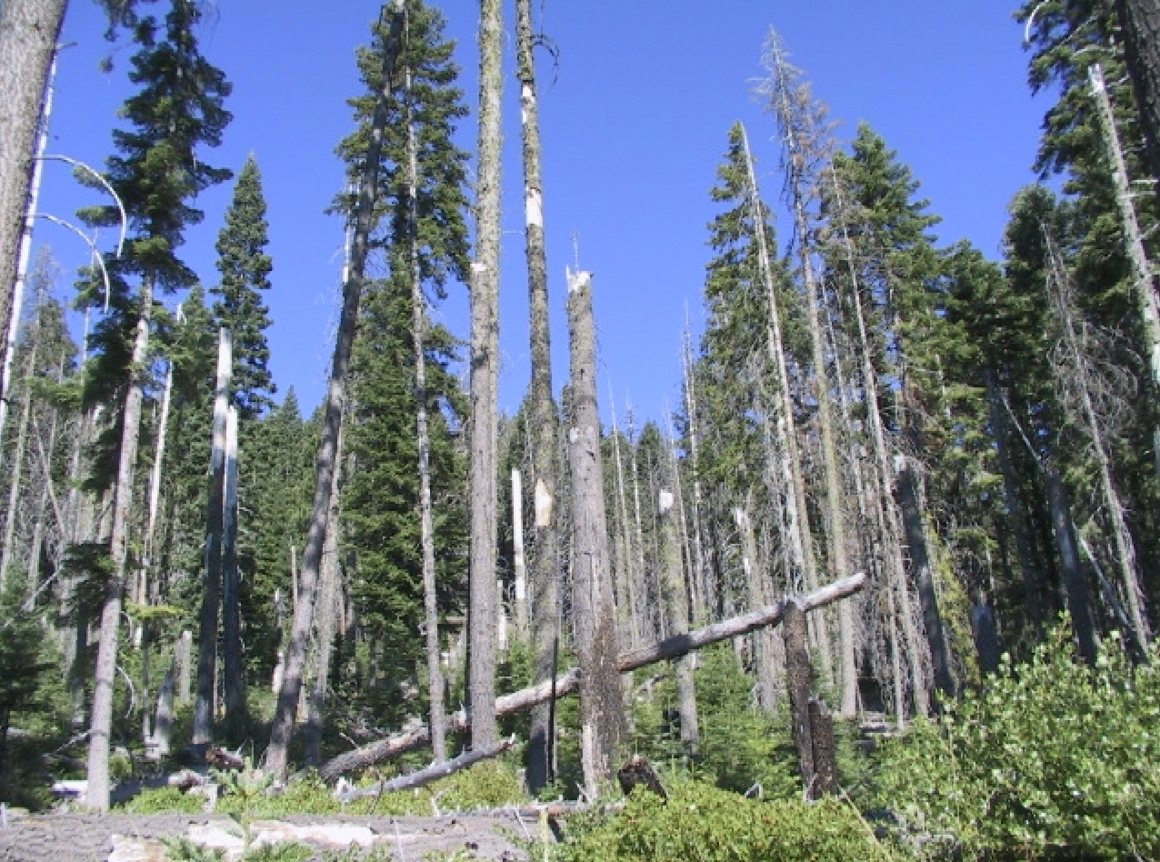
McWilliams continues driving, following dirt roads deeper into the forest, where the trees become smaller and closer together. The ground is littered with fallen trees and brush, what foresters call surface fuel. Then, at last, the tour arrives at the main attraction: the Humongous Fungus.
It’s easier to see the decay that Malheur’s most famous resident leaves behind than the fungus itself. What should be a thick and thriving forest is instead a collection of toppled trees, with many more dying. McWilliams uses his Pulaski, an ax-like forestry tool, to chip away at bark and reveal subtle, cream-colored fans on the exposed wood: evidence of the fungus spreading within an infected fir.
“Part of the reason [the Humongous Fungus] got so big is because of the history of fire suppression,” McWilliams says, referring to the dominant tenet of the last century of forest management. “Fires would have reduced the proportion of highly susceptible hosts, and you’d have a functional, healthy forest there.”
Just as fire has an important role in a forest ecosystem, so do various species of fungus. Simply put, terrestrial forests couldn’t exist without fungi. Some fungi exchange nutrients with plant roots in return for the sugars that come from photosynthesis. The ponderosa pine, a fire-resistant tree with reddish bark and a distinctive butterscotch smell, requires fungal assistance as a vulnerable seedling: It can grow to more than 100 feet tall, but it couldn’t make it to one foot without fungi, which help keep surrounding soil moist and ferry nutrients through the soil to the young tree’s roots.
A. ostoyae, the Humongous Fungus species, isn’t one of these beneficial fungi—at least, not for the trees it infects during the parasitic stage of its life cycle, eventually killing them. But during its saprophytic stage, when it feeds off its dead host, armillaria, like many other fungi, facilitates the crucial process of decomposition and helps return resources to the soil; we now know it’s what makes the fungus important to the overall ecosystem.
“There’s been an increase in understanding of how fungal pathogens play an important role in the forest: They remove the weakened trees and aid a resistant and vigorous pool of tree genetics,” says Oregon State University regional wildland fire specialist Ariel Cowan, who studies the intersection of soil health, wildfires, and fungi.
Improved knowledge about the positive role of armillaria is part of an emerging, broader view of forest ecosystems. As scientists learn more about a forest’s natural defenses against fire and other threats, and its ability to regenerate after being damaged, those mechanisms are being incorporated into a new way of forest management. “The definition of forest health is different and more holistic today than it was in previous times of forestry,” Cowan says.
Cowan’s own career choices are reflective of that more comprehensive approach: She took a break from academia to work as a wildland firefighter. She wanted to understand fire’s behavior firsthand, and to experience the impact humans have on overall forest health.
“The definition of forest health is different and more holistic today.”
Before humans arrived in what’s now the American West, fires resulting from lightning strikes regularly cleared out scrub and debris in the underbrush. Trees grew further apart, at irregular intervals rather than the neat grid of modern forest plantations, which made it harder for fire and pathogens—even giant fungi—to move unchecked from tree to tree.
The first humans to enter the western forests learned the rhythms of these ecosystems over millennia. In several regions, Native American tribes set fires regularly to remove excess brush and assist fire-adapted species, such as the lodgepole pine, which has seeds that require the extreme heat of a fire to sprout. This traditional approach to forest management minimized surface fuel created by a scrubby, cluttered understory. When a lightning strike ignited a blaze naturally, it would not become intense enough to threaten established trees with thick bark and soaring canopies that provided the roof of the entire ecosystem. The forest continued to protect itself, with an assist from the people who relied on it and respected its natural rhythms.
The cycle broke when European settlers forced Indigenous communities off their lands throughout the West, and began managing the forests to suit their own needs, including for cattle grazing and timber. Logging projects left piles of organic detritus on the forest floor as ready fuel. When a fire inevitably broke out, attempts to control it were often disorganized.
In 1910, one of the most catastrophic fires in history, called the Big Burn, scorched 3 million acres across Idaho, Montana, and Oregon, and killed more than 80 people. The monstrous fire “cemented in the American psyche that fire is bad and should be put out at all costs,” says Paul Hessburg, a fire ecologist with the U.S. Forest Service.
In the 1930s, the government poured resources into fire suppression as part of large-scale public investments and job creation programs. Even then, some foresters were wary of removing fires from the landscape entirely. Harold Weaver, an Oregonian who studied prescribed burnings, thought taking fires out of the ecosystem could have terrible, unintended consequences.
Despite concerns raised by Weaver and others in the field, fire suppression became a cornerstone of forest management. And at first, coinciding with a relatively cool, wet period, it seemed to work. Fires across the American West were limited and generally controllable. For about 50 years, this fire regime was presumed to be normal. The main goal of the forest service during this era was to support the timber industry and, for decades, it thrived in a stable, fire-free environment. Forests were first cleared of old growth, because large trees made more money than small trees. New-growth trees were then seeded on a grid-like pattern, and reliable, fast-growing species, such as fir trees, were preferred.
As a result, there are now more fir trees in western forests than there should be. Douglas firs and grand firs, specifically, are common—and are not adapted to withstand fires. Though these firs are native, they are proliferating in “non-native numbers,” says McWilliams. A 2017 study in the journal Trees, Forests and People found that firs and other species lacking fire adaptations are nine times more common today than in past centuries—in some areas, they comprise more than 90 percent of a forest’s tree mass.
Douglas firs and grand firs have allowed something else to happen. These species are highly susceptible to infections of the fungus A. ostoyae. While the Humongous Fungus predates 20th century forest management through fire suppression by thousands of years, it probably would not have gotten so enormous without it.
The A. ostoyae specimen known as the Humongous Fungus is not alone; in the late 20th century, another outsized armillaria, this one in Washington State, achieved similar proportions. “I always say that this is the largest documented organism,” McWilliams says. “It’s highly likely that there’s a bigger one out there somewhere.”
Ironically, these giant fungi slowly destroying the forest may also be tools to help it recover from a century of problematic fire management—and to protect it from a changing climate that’s hotter, drier, and at greater risk for catastrophic fires.
While it’s unclear whether a fire burning above it would damage the Humongous Fungus itself, McWilliams notes that in areas of the forest where armillaria infection is most advanced, trees are spaced further apart and organic material on the ground has been broken down. As the Humongous Fungus and other armillaria expand at a rate of up to 5 feet per year in all directions, they chomp through the highly susceptible Douglas firs and grand firs—creating space, and filtering nutrients back into the soil, to support the potential growth of species more resistant to fire (and fungus). Eventually, armillaria could clean out all the overgrowth and natural debris on the forest floor—but not on a timeline that’s acceptable to humans.
Now, more forest management experts are starting to reintroduce fire into the landscape across the American West through small, highly controlled fires known as prescribed burns. Intentionally setting fires can be politically tricky, even in communities where people understand the benefits, but, says McWilliams, “You’re going to have smoke one way or the other. Do you want a little bit of smoke one day or a lot of smoke when you can’t control it?”
He and other forest scientists hope that we can restore our symbiotic relationship with the forest, aiding the cycles of natural fires that benefit many fire-adapted species, and respecting the ecosystem’s natural rhythms.
Meanwhile, the Humongous Fungus of Malheur National Forest will keep growing.
At Total Motorcycle, our tagline is By Riders for Riders and Triumph thinks so too. Welcome to this week’s Inspiration Friday: Triumph 120-Years Celebration! 120 Years of Triumph from the first Triumph motorcycle that went [...]
Criticize Suzuki all you want for recycling the K5 GSX-R1000 engine over and over again, but when something works, why change it? Instead of wasting time and money developing a new engine, Suzuki poured its energy into making one hell of a sport-touring bike – the 2022 GSX-S1000GT+. Boasting bodywork and wind protection developed in the wind tunnel, a comfortable seating position, big saddlebags, some must-have electronics – and yes, that awesome engine – Suzuki might have outdone themselves this time.
Established in 1994, Motorcycle.com is the premier online resource for motorcycle and scooter enthusiasts. With hundreds of high quality, detailed video reviews on bikes from Harley-Davidson, Honda, Yamaha, Suzuki, Kawasaki and just about everybody else, it's the best place to go to learn about the latest and greatest two-wheeled creations. There's simply no better resource if you're planning on buying or if you just want to check out some awesome machines.
Several hundred watches, collected over 35-plus years, at a cost of hundreds of millions of dollars, curated down to 160. . .The numbers alone are enough to make The OAK Collection—which is about to open at The Design Museum in London ahead of its bow in New York this Fall—a must-visit for any horolophile, anywhere. […]
The very last stop on my 5-day trip with Haggis Adventures was the Lindores Abbey Distillery, possibly the birthplace of Scotch whisky as we know it. We were lucky enough to get a tour by the head of the distillery, and I learned even more about whisky than I had already picked up on all my other distillery tours.
In a recent study published in the journal JAMA Network Open, researchers analyzed how exposure to residential green space is highly beneficial for your brain.
Why do Americans eat bacon or sausage and drink orange juice for breakfast? Why do we shave our armpits? Why did we ever buy a tie for Fathers Day? So many of the everyday rituals we take for granted aren't because of tradition, but because someone wanted to sell us something. While some of these schemes are pretty well known, at least to Neatorama readers, others may surprise you. You know how churches want to put up a plaque or a stone monument with the ten commandments at government buildings? You might have wondered why they chose that instead of, say, the Sermon on the Mount, or John 3:16. That started with Cecil B. DeMille.
People are pretty protective over the monuments to the Ten Commandments that appear on government property across the country considering they didn’t exist until Cecil B. DeMille needed to promote a movie. The Fraternal Order of Eagles had wanted to put them up for some time, but they couldn’t raise the funds until they teamed up with the director, who paid for hundreds of monuments modeled after the tablets in his 1956 movie. He even sent Charlton Heston out to the unveiling ceremonies.