Shared posts

04 Mar 16:18

Papa Pours

by jared

How did Hemingway like his drinks made?

Cocktail Kremlinologists have gone into the topic in depth.

And while there are plenty of pix of the legendary author quaffing, there are not many of him actually making his own.

This photo, an outtake from a Life magazine shoot, shows Papa at home in Havana in 1960 carefully constructing a cocktail.

It may have been a farewell drink; he and his wife Mary left Cuba in July of that year in the wake of Fidel Castro’s nationalization fever.

601px-Ernest_Hemingway_1950

We’ll leave you with one of Hemingway’s dictums re: drink mixing—throw away the sugar.

Simply put, if you’re having a dozen daiquiris, too much sweet stuff will “make you sick.”

And anything less than a dozen isn’t really drinking…


04 Mar 16:13

Triple Creek Bitterroot Skwala Hatch

by jared

April is fast approaching, when well-rounded gents make the transition from winter sports to spring ones.

And the smart ones make tracks for Montana’s ruggedly elegant Triple Creek Ranch.

There in the Bitterroot Mountain Range of the Montana Rockies, the annual skwala stonefly hatch takes place—aka the unofficial start of the Western trout fishing season.

cn_image_1.size.triple-creek-ranch-darby-darby-montana-104215-2

Guests at the world-class Relais & Chateaux ranch cast their flies with the aid of Orvis-approved guides and shoot sporting clays by day, and then wine and dine by firelight during the five-day Bitterroot Skwala Hatch Celebration.

$5,500 gets you one of the 23 luxury cabins, decorated with the owners’ museum-quality Western art collection, for the duration, plus all manner of James Beard and Wine Spectatorinfused meals after and in between sporting excursions.

cn_image_4.size.triple-creek-ranch-darby-darby-montana-104215-5

It runs April 10 to 14—and once the cabins are full, the book is closed.

So pack your Filsons and tie your flies—the game is on…


21 Feb 16:28

Feb 7, Can I boil raw peanuts that are not in their shells?

Can I boil raw peanuts that are already shelled?
20 Feb 16:39

Southern Food Group: Gumbo

by rreed

As a child, chances are you learned about the five food groups: fruits, vegetables, dairy, grains, and meat. Now, the Southern Foodways Alliance has decided to rewrite the pyramid by introducing the twelve Southern food groups. Each month in 2014, the SFA will pair up with Garden & Gun to explore one dish that’s essential to our region’s cuisine.

Last month, we began with oysters. This month, we turn to gumbo. The iconic, hearty stew has its roots in the multicultural influences of colonial Louisiana’s foodways, including African, Native American, French, and Spanish.


Photograph by Peter Frank Edwards

Like barbecue, gumbo is a source of plenty of debate among Southerners—especially Louisianans. What shade of roux lays the perfect base? Is okra the superior thickener—or is it filé powder? And where to settle on the matter of meat: seafood, fowl, sausage, or a combination?

The Southern Foodways Alliance knows better than to play favorites in this matter. In the videos from A Spoken Dish, the SFA’s video partnership with Whole Foods Market, passionate epicures, storytellers, and Louisiana natives Pableaux Johnson and Lolis Eric Elie share their divergent gumbo philosophies.

If you’re still hungry… 

  1. Gumbo GPS: Next time you’re in Louisiana, let the Southern Foodways Alliance point you toward the best bowl of gumbo in your neck of the woods. Our Southern Gumbo Trail features oral histories with chefs, home cooks, and purveyors of gumbo staples like rice, sausage, and shrimp. You can access the establishments on the Gumbo Trail—along with hundreds of other pit stops across the South—through the SFA Stories app for iPhone. It’s searchable, mappable, free, and sure to give you culinary wanderlust.

  2. The right touch: Whisk along with Billy Gruber of Liuzza’s by the Track in New Orleans as he makes a black roux for SFA oral historian Amy Evans. While many home cooks stop at the so-called “peanut butter” or “mahogony” stages, Gruber fearlessly takes his roux all the way, pulling it off the stove just seconds shy of burning.

  3. Green with envy: Leah Chase’s gumbo z’herbes, or green gumbo, is one of the most famous in New Orleans—a city with no shortage of world-class gumbo. Mrs. Chase, still cooking at age ninety-one, traditionally serves gumbo z’herbes at Dooky Chase’s restaurant on Holy (Maundy) Thursday, just before Easter. She makes sure to add an odd number of greens—seven, nine, or eleven—to the pot for good luck, and promises diners that they’ll make a new friend for every green variety. Writer and oral historian Sara Roahen successfully begged Chase for the recipe, which you can find here.

Shared: 
4
20 Feb 16:38

Bassmaster Classic Visitors Guide

by Florida Sportsman Editor

By Frank Sargeant

The little village of Guntersville truly is the jewel of North Alabama, and Lake Guntersville creates a mosaic pattern totally permeating the community and its culture. You can’t go anywhere in town out of sight of one of the arms of the lake, and sometimes it seems there are more bass boats here than people. The Bassmaster Classic, which gets underway Friday and continues through Sunday on the lake, is a great excuse to visit if you haven’t been there before, or to renew acquaintances, if you have.

Guntersville State Park Lodge, situated on a mountain bluff overlooking the lake, is one of the most spectacular state-owned facilities in the eastern U.S. (Frank Sargeant photo)

The downtown area has preserved many of the oldest shops and converted them into smart shopping boutiques, art galleries and antique stores, and there are a few destination-type shops that you just have to experience–Fant’s Department Store on Gunter Avenue is one. You can find anything from kitchen sinks and plastic flower bouquets to business suits to rattlin’ horns and turkey calls, a lot of it at very low prices, all in a creaky old wood-floored store that looks like it was doing business in Civil War days.

And Mike’s Merchandise is worth the drive, alone: It’s a 200,000-square foot polyglot, also on Gunter Avenue, where used and new merchandise on any given day can range from collectibles, building materials, jeep paint, mattress, tarps, tools, toilet paper, name brand clothes, housewares, used books by the thousands and cleaning supplies, to the one of a kind. Customers have been able to find such crazy items over the years as F-16 airplane parts, coffins and gas pumps. Reportedly, Mike even got a live grenade in one time, pointed out by an alert customer–they had to call in the National Guard to take it away.

The whole thing is set in soaring emerald mountains, the lower end of the Appalachians, and the drive out there from Huntsville via U.S. 431, about 35 miles, is all low-traffic four-lane through the mountain valleys.

RESOURCES:

The Alabama Bass Trail is a great resource for anglers visiting any lake in the state, including Guntersville-it includes maps, ramps, places to stay, guides and lots more-visit their site at www.alabamabasstrail.org.

The Guntersville Chamber of Commerce is located at the south end of the 431 bridge just as you get into town-maps, lodging info, restaurant recommendations and lots of Southern hospitality;
www.lakeguntersville.org. Note that the site of the daily daybreak take-off for the Bassmasters Classic is right across the street at the city harbor. Parking will be a big problem-use the designated parking areas and ride the free busses.

For a complete list of boat ramps on the lake go to http://www.outdooralabama.com/fishing/freshwater/where/reservoirs/guntersville/access/ All ramps will be crowded during Classic week–depend on it.

Cathedral Caverns State Park is just a few miles up the mountain from Honeycomb Creek arm near the village of Grant. The vast cave system is some 3500 feet long and has an entry over 125 feet wide. Pre-teen kids love this place, and the guided tours are interesting; http://www.alapark.com/cathedralcaverns/

Guntersville State Park has one of the more spectacular restaurant/lodge locations in the Southeast, with the glass-walled facility sitting atop a mountain that gives 20-mile views of the lake and surrounding terrain. Lots of nearly-tame white-tail deer are a bonus for morning or late evening hikers, and there are excellent launch ramps and docks as well as a huge campground, waterfront cabins and 18 holes of golf; http://www.alapark.com/lakeguntersville/

Buck’s Pocket State Park is a neat side trip, within a few miles of Guntersville State Park-it’s a spectacular canyon with a striking overlook that’s rare in the Southeast; http://www.alapark.com/buckspocket/

Weigh-Ins: Daily weigh-ins will not be at the lake. The boats are trailered to Birmingham-Jefferson Convention Center at 2100 Richard Arrington Jr. Blvd in Birmingham for weigh-ins. The location is also site of the free Bassmaster Classic Outdoors Expo, open from noon to 8 p.m. on Feb. 21, 10 a.m. to 7 p.m. Feb. 22 and 10 a.m. to 4 p.m. Feb. 23. Highway 79, a two-lane road, is the most direct route from Guntersville. For details visit www.bassmaster.com.

Waterfront Restaurants in Guntersville

Lake House; www.lakehouserestaurant.com.

Wintzells Oyster House; www.wintzellsoysterhouse.com

Somewhere on the Lake www.somewhere2b.com

Outlaw’s Steakhouse; www.outlawsteakhouseguntersville.com

Top O’ the River; www.topotheriverrestaurant.com.

20 Feb 16:37

La Aduana: 1990 Jeep Grand Wagoneer, 39,000 Miles

by christophe@overlandinternational.com (Christophe Noel)

It’s hard to believe this beautiful Grand Wagoneer is from 1990. It seems like it’s from an era much earlier than that, doesn’t it? Maybe I’m just getting old. At any rate, this vehicle is not just transportation to another time and place, it’s a glorious example of what vehicles looked like before they were wrapped in plastic, crammed full of electronics, and tweaked to sip fuel at a socially acceptable rate. One of the last cars to sport wood panels, the Grand Wagoneer is a beautiful rig spawn of the heartland of America for the yuppy elite of the 1980s. Many of these trucks ended up making the rare snow-day trek from a weekend home to the local train station, venturing beyond only to fetch the rare bag of groceries. As such, many never tipped 50,000 miles nor traveled a road not flanked by curbs. This particular Grand Wagoneer has but 39,000 miles. If I only had $42,000 to spend on a 25 year old truck I’d look forward to adding the next 39,000 to the clock.

20 Feb 16:36

Map of the Week: The Middle of Nowhere

by christophe@overlandinternational.com (Expedition Portal Staff)

20 Feb 16:34

RARE JAMES BOND BEHIND THE SCENES "THUNDERBALL" FOOTAGE SURFACES

by nospam@example.com (Cinema Retro)

Eagle-eyed subscriber Frank Coronado sent us a YouTube link to some fascinating B&W footage shot on the Pinewood Studios set of Thunderball in 1965. You'll see Terence Young directing actors Sean Connery, Claudine Auger, Adolfo Celi and Philip Locke in the casino sequence. The footage originated with a Dutch television program. 

20 Feb 16:31

Building Workshops

by mark

setting-up-shop-cover-sm

Tools need a home. Setting Up Shop is the best guide I’ve found for designing a workshop. It focuses on the practical details that other workshop books tend to ignore, like how to arrange the lighting, or set up dust collectors, design the placement of wiring, even determining the height of work surfaces. It got me thinking about aspects of a shop I had not considered before and helped me improve the plans for my shop. Its very thorough coverage of sound, light, air, and movement options makes it the most useful of the three books mentioned here.

workshop-idea-book-cover-sm

Workshop Idea Book is a scrapbook of hundreds of tips and clever solutions for a shop discovered by others. It showcases a lot of storage suggestions, and ideas for arranging stuff, such as how to handle large sheets of materials. Think of it as a kind of great, well-curated Pinterest board for workshops.

the-workshop-book-cover-sm

Both of these books are biased to wood. A better version of either book would include metal and plastic working tools, which are ignored. This failing is somewhat countered by The Workshop Book which tours through a much larger variety of work places. It documents several workshops installed in trucks, or fit into apartments, or made portable with everything mounted on casters. I found the greater diversity of shops covered in this collection to be more useful to me since my shop is more general purpose.

The great designer’s guide to creating a small-time prototype shop with laser cutters, 3D printers, solder stations, as well as drill presses and table saws, has not be written yet. In the meantime, these three idea books will get you started.

-- KK

Setting Up Shop
By Sandor Nagyszalanczy
2006, 236 pages
$17
Available from Amazon

Workshop Idea Book
By Andy Rae
2007, 170 pages
$8
Available from Amazon

The Workshop Book
By Scott Landis
1998, 216 pages
$17
Available from Amazon

Sample Excerpts:

From Setting Up Shop
setting-up-shop1sm

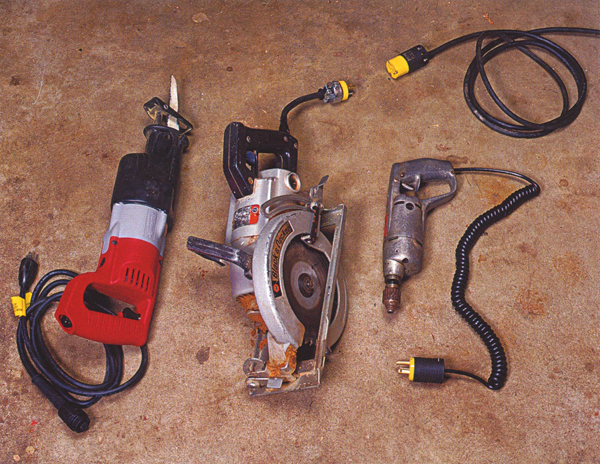
Three strategies for preventing long cords on portable power tools from ending up snarled and tangled are (left to right): Buy tools with detachable power cords, such as this Sawzall; fit each tool a short pigtail and plug it into an extension cord (using locking plugs) before using it; and refit existing power cords with tangle-resistant, self-retracting coil cords.

*
setting-up-shop2sm

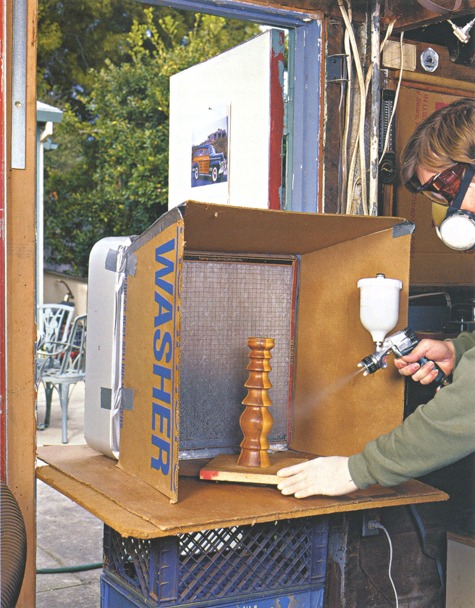
A box fan, a furnace filter, three pieces of cardboard, and a little duct tape are all it takes to build a simple spray booth that sets up in minutes in front of a window or doorway, allowing you to spray-paint or clear-finish parts and small projects.

*

Orienting Machines in a Line

By carefully coordinating the positions and table heights of stationary machines, you can reduce the amount of clearance between certain machines. For example, by placing machines such as a shaper/router table, oscillating-spindle sander or disc sander, and horizontal boring machine in line, then setting them up with all their tables level and at the same height, a long workpiece may rest or slide on an adjacent machine’s table (as shown here). Such an arrangement allows you to handle large or long work without having to rely on outfeed tables or roller stands for support. For this same reason, it’s a good idea to level the tabletops of benchtop tools that are in close proximity to one another.
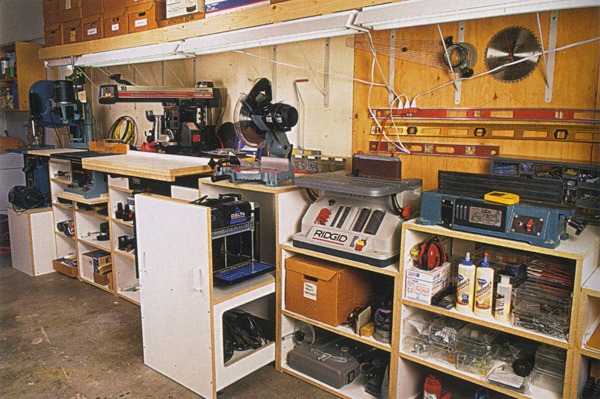
setting-up-shop3sm

By setting tables to the same height and leveling them, a workpiece can pass over any or all of these machines.

*

Machine Layout against a Wall

Machines such as a bandsaw, drill press, router table, shaper, stationary sanders, lathe, joinery machines, and overarm routers are ideal to locate along a wall. Power and dust collection are easy to hook up.
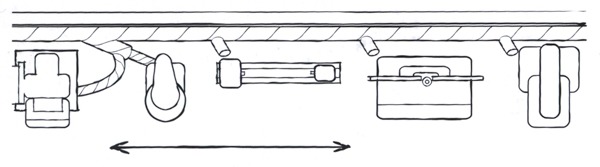
setting-up-shop4sm

***

From Workshop Idea Book

Untitled

THREE SAWS IN ONE. For serious production work, two or more saws combined into one sawing station let you mill wood and cut joints without breaking down your setups. The three cabinet saws at Placeways Woodworking share a central shopbuilt table, which doubles as an auxiliary work surface.

*
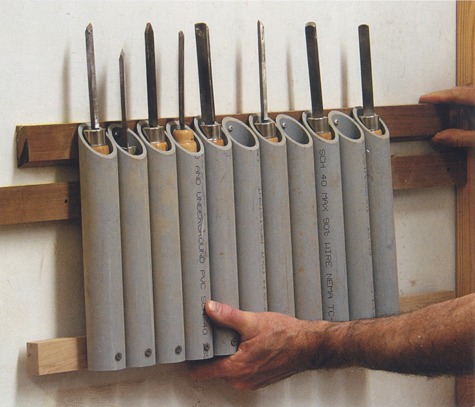
workshop-idea-book2sm

PLUGGED PIPES. Make good use of inexpensive PVC pipe to store lathe tools and make them portable as well. Doug Stowe’s pipes are mounted to a French-cleat system on the wall and can be moved to the lathe when needed. The top of the pipes are cut at an angle to facilitate loading, and the bottoms are plugged with wood.

*
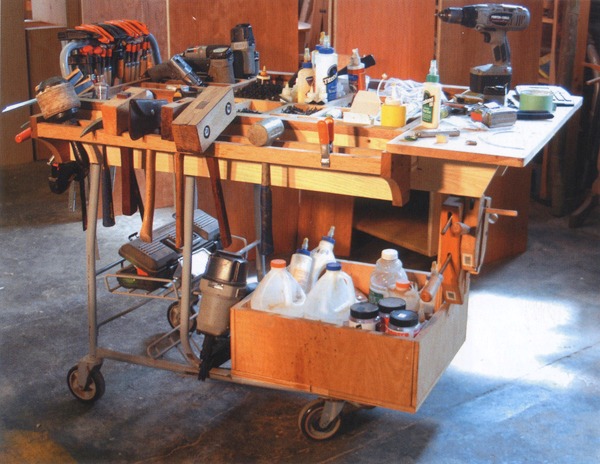
workshop-idea-book3sm

SHOPPING IN THE SHOP. A converted shopping cart makes a convenient rolling hardware station. For his cart, dubbed the “piercing pagoda,” Gabe Aucott added a plywood top fitted with divided boxes to keep screws and other hardware neatly sorted and a staging platform at one end. Below, a large plywood box holds glue and other assembly tools.

***

From The Workshop Book
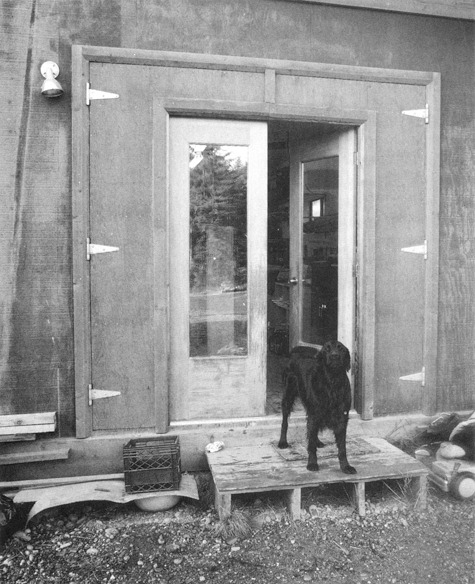
the-workshop-book1sm

By hanging two narrow doors within two larger doors, Martha Collins can create four different openings to accommodate movement of objects large or small.

*
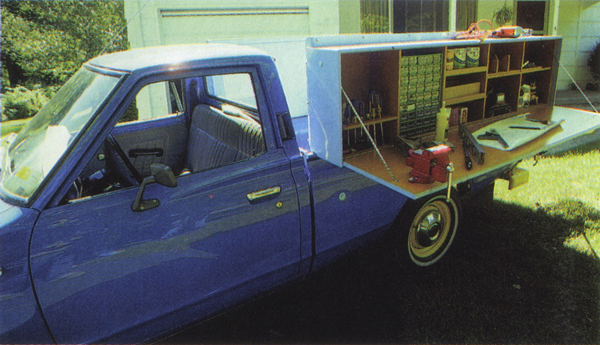
the-workshop-book2sm

Two plywood cabinets flank the box of Lester Walker’s Datsun Pickup truck. Walker, of Woodstock, New York, built one cabinet for woodworking tools and supplies and the other for camping equipment. On the road, the space between the two cabinets is covered with waterproof canvas and serves as a tent.

*
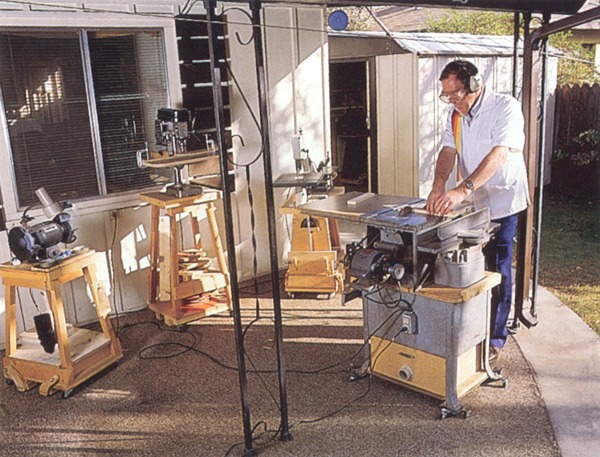
the-workshop-book3sm

Donald Kinnaman packs the contents of an entire workshop into a 90-sq. ft. metal shed next to his Phoenix, Arizona, home. He rolls the machines he needs out onto the covered patio behind his house and goes to work.

*
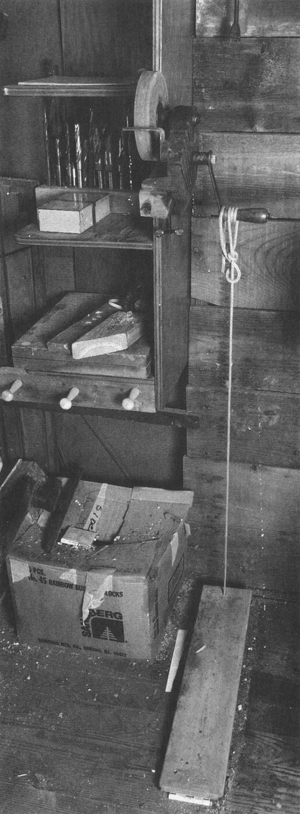
the-workshop-book4sm

Years ago, when I worked in a shop without electricity, I had a hand-cranked grinder. It did the job, and I liked the slow speed, but I found it irritating to hold the tool with one hand and crank with the other. Fred Matlack converted his handcranked grinder to foot power by adding a rope and a hinged pedal. He gets the wheel going with the crank, then keeps it going with the pedal. The arrangement frees both hands to guide the tool.

20 Feb 14:58

Website names 50 safest Georgia cities (SLIDESHOW)

by Carla Caldwell
A safety advocacy website ranks Auburn No. 1 on a list of 50 safest Georgia cities. Coming in at No. 2 is Johns Creek, followed by Milton at No. 3. SafeWise, which offers analysis of home security systems and security tips, says it ranked cities using FBI Crime statistics. The list includes cities with a population of 5,000 or more residents as of 2012. The Top 10 are: No. 1 - Auburn No. 2 - Johns Creek No. 3 - Milton No. 4 - Holly Springs No. 5 - Peachtree City No.6 - McRae No. 7 - Tyrone No.…
20 Feb 02:20

Keystone XL pipeline could face extra delays because of Nebraska's constitution

by Josh Lowensohn

The Keystone XL pipeline, the $5.4 billion project that would directly connect Canada's oil supply to the US' Gulf Coast, could face future delays following a ruling by a Nebraska judge. In an order today, US District Court Judge Stephanie Stacy said that last January's approval by Nebraska Governer Dave Heineman to go ahead with the project violated the state's constitution. As a result, Judge Stacy says the decision is now null and void, The Washington Post reports.

Continue reading…

20 Feb 02:19

84-year-old nun sentenced three years for anti-nuclear protest - MSNBC


84-year-old nun sentenced three years for anti-nuclear protest
MSNBC
Sister Megan Rice, an 84-year-old nun, was sentenced to 35 months in prison for her role in a protest at a Tennessee nuclear facility. Rice was found guilty in May, along with fellow anti-nuclear activists Greg Boertje-Obed and Michael Walli, of destroying U.S. ...

and more »
20 Feb 02:18

Here's Video of a Guy Downing Four Chipotle Burritos in Three Minutes

by Adam Weinstein on Gawker, shared by Albert Burneko to Foodspin

With a Diet Coke.

Read more...

20 Feb 02:16

He Wanted A Job; Facebook Said No -- In A $3 Billion Mistake

by George Anders, Contributor
Check out the real story of how Jan Koum built WhatsApp into Facebook's new $19 billion baby.
20 Feb 02:11

Japan’s Deep Sea Abalone Hunters are Free-diving ‘Ama’ Women

by Sahara Borja

Nina_Poppe_Photography

Nina_Poppe_Photography

The Ama were very open and friendly with me. I don’t think they understood what I was doing there, but they took me on their boat and let me into their huts. The Ama are very open towards other women and they were maternal with me as if I could have been their daughter.—Nina Poppe

Not quite mermaids but not quite of this world either, the Ama women of Japan dive up to 30 meters deep without equipment in search of abalone just off the coast of Japan. Nina Poppe, photographer and filmmaker based in Cologne, Germany, captured a mostly older generation of these deep sea divers for her book aptly titled Ama.

Poppe’s images are a quiet, peaceful testament to the type of life these women have led in this part of Japan, many of them since they were teenagers. She interspersed portraits taken on various boats—pre and post diving—with images of the gardens they keep and exteriors of their abode. Poppe’s collection of images stay above sea level, recognizing that the world below belongs to the Ama.

Nina_Poppe_Photography

Nina_Poppe_Photography

Nina_Poppe_Photography

Nina_Poppe_Photography

Nina_Poppe_Photography

Nina_Poppe_Photography

Nina_Poppe_Photography

Nina_Poppe_Photography

Nina_Poppe_Photography

The post Japan’s Deep Sea Abalone Hunters are Free-diving ‘Ama’ Women appeared first on Feature Shoot.

19 Feb 15:33

Video: Joe Trippi: There Will be a Libertarian President. And Sooner Than You Think.

by Todd Krainin

Joe Trippi: There Will be a Libertarian President. And Sooner Than You Think. is the latest video from ReasonTV. Watch above or click on the link below for video, full text, supporting links, downloadable versions, and more Reason TV clips.

View this article.

19 Feb 14:34

11 Career Tips from a Marketing Manager

by Adam Rowe

A mobile marketing manager for American Eagle Outfitters spoke at my college last week. Her position is too specific to be on most college students’ short list of potential careers, and there’s always a chance that they — and you — are missing out.

This list of facts and advice holds knowledge from American Eagle’s Leah Curry, both about marketing in particular and about career tips for college students and the job-searching process in general.

Related4 Tips for New Graduates from Richard Branson

Mobile Marketing is the New Wave

For anyone wondering about the future of advertising, the statistics behind mobile marketing responses should be enlightening: SMS campaigns from American Eagle nets unprecedented engagement rates from customers compared to other marketing vehicles. Mobile marketing is a fast-growing medium.

Retail is Difficult

“It’s not for the faint of heart,” Leah mentions. It’s a demanding and ever-changing environment.

Job Competition is Tough

At Leah’s current job, a position was recently opened for just six days and received hundreds of applicants. Be aware of the odds against you.

Pick a Job, Not a Title

When deciding what jobs to look for, don’t skim job titles looking for the most prestigious one. Human resources can tell when you have the right background and when you’re angling for a cooler job title like, say, an employee of American Eagle.

Research the Company

Make sure you fact-check your job applications. You’ll both need to know that you can keep up with the job requirements and that nothing you’ve claimed is wrong about them. And whatever you do, make sure you spellcheck.

Have Two Resume Strategies: Online and In-Person

Applications submitted online can be plain text, with key words. In person, however, resumes should be to the point and arrestingly unique. “Don’t just use a word template,” Leah advises.

Her own resume, which she tweaks periodically, currently features her name in cursive, flowing across the top of the page outside of the normal boundaries that a word template would impose.

Use LinkedIn

Too many people don’t link with enough connections, or don’t use the ones they have. Keeping your profile updated gives you one more channel to attract attention.

Apply for Everything

Leah applied to jobs she didn’t even want. There’s never too much effort in the job application world, or even in the career environment as a whole, which she went on to explain with the advice to…

Be Crazy

Leah brought a 20-page portfolio as an internship application when a portfolio wasn’t even a requirement. She got the position not because she demonstrated that she was experienced enough, but because she demonstrated she was willing to work “way above and beyond.”

“Everyone hands them a resume,” she says of potential employees, “but not a detailed rationale of why they should have the job.” To fill the portfolio in question, she explained, she included not just a cover letter, resume, and samples of past work, but also a write-up of how she might respond to hypothetical scenarios drawn from the company’s website.

Don’t Use Grad School to Escape the Job Market

Post-graduate education can be worthwhile, depending on the particular demands of one’s job, but no one should run to it in order to post-pone a difficult job search. They’ll end up overqualified and under-experienced.

“Education should be supplementary to experience, not vice versa,” Leah says.

Learn from Your Early Experiences

Once she got her first internship in the field of public relations, a natural extension of her public relations major, Leah realized that she didn’t enjoy her work. She was worried she’d spend her time doing “damage control” rather than investing in creative strategies that grow a brand.

Marketing faces its own damage-control scenarios, of course, but branding remains the main – and the more fun – focus. Leah shifted careers to marketing, and hasn’t looked back.


Related4 Best Job-Searching Apps

career tips for college students

The post 11 Career Tips from a Marketing Manager appeared first on HackCollege.

19 Feb 14:19

Point & Click: Street Stencils Show Tourists Where to Shoot

by Urbanist
[ By WebUrbanist in Global & Travel & Places. ]

shitty photo standing spot

Urban travelers love taking pictures, but ideal angles are not always obvious to visitors – many ultimately either stand in same hard-to-find spot or fail to take an interesting photograph altogether.

shitty photos shoe stencil

shitty photo stencil yellow

shitty perspective angle picture

That’s where Mimi Chan and Utsavi Jhaveri step in, spray-painting a set of shoe prints around cities. These markings in turn tell people where to place their feet, point and click to capture the ‘perfect’ (if a bit redundant) image of a given monument or sight.

shitty pic street graffiti

Starting with San Francisco and New York City, the pair found some of the project upsides included: having an excuse to wander cities (especially after dark), getting external sponsorship to cover expenses and ultimately being thanked by tourists who genuinely appreciated being told how and where to take a better picture – all that and increasingly copious press coverage, of course.

no shitty photos project

no shitty photos coverage

Overtly, the #noshittyphotos project is aimed at reducing poor photography via these cookie-cutter stencils, but of course it makes you wonder: does the world really need more photos taking from the same angle of the same thing? What is it about retaking the same shot that attracts people to documenting something over and over again? Does it help us remember or is it simply a way to lay our own small claim to having seen something?


Want More? Click for Great Related Content on WebUrbanist:

Banksy Art: Street Graffiti, Paper Drawings & Wall Stencils

Some of the many works of prolific street artist Banksy in the media of graffiti, stencils, and drawings. Click Here to Read More »»


Night Graffiti: Shake-Powered LED Spray Paint Can Sleeve

The nature of graffiti tends to result in nocturnal excursions, but painting completely in the dark can be a be problem and sometimes you just need a little ... Click Here to Read More »»


Mind Your Step: Dizzying 3D Street Art Mural [Pics & Vids]

Pedestrians seem to hover over a terrifying geometric sinkhole as they walk across the street art exhibit 'Mind Your Step' in Stockholm, by Erik Johansson. Click Here to Read More »»


Share on Facebook

[ By WebUrbanist in Global & Travel & Places. ]

[ WebUrbanist | Archives | Galleries | Privacy | TOS ]


19 Feb 14:16

A No-Heat, No-Filter Technique for Making Cocktail Syrups

by Kevin Liu

20130212_lime_with_sugar.jpg

[Photos: Kevin Liu]

So you've decided to try your hand at stirring up a few classic cocktails at home. Maybe you started with the Manhattan—a drink that requires only three ingredients, all simply dispensed from shelf-stable(ish) bottles. Then you probably moved on to sours and started juicing fresh citrus. But you're ready to get creative, so you decide to try making a few signature syrups for, say, a Gimlet or a nice punch.

But making syrups from scratch is a pain in the butt, isn't it? First, you have to mince/zest your ingredients up into tiny bits. Next, you're stuck waiting as you cook your syrup to make sure the pot doesn't overflow or dry out. Then after all that, there's a painful process of straining and filtering—and you still might end up with a cloudy syrup.

There's a better way.

20140212_bags_of_syrup.jpg

I learned this simple trick from a post by clever bartender Jeffrey Morgenthaler. He wrote about how he vacuum-sealed lemon peels with granulated sugar to create oleo saccharum—a type of strongly-flavored sugar syrup often used in classic punch recipes.

Although both Morgenthaler's method and our own Michael Dietsch's techniques for making oleo saccharum are pretty straightforward (Michael recommends muddling the peels with sugar first and then allowing to sit for about 30 minutes) I wondered if the technique could be simplified even further and applied to more than just lemon peels.

Here's the science. The basic mechanism at work here appears to be osmosis: the tendency for liquid to move from areas of low solute concentration to areas of high solute concentration. It's the same reason that salting a piece of meat will draw liquid to its surface. With syrups, sugar draws the liquid out of fruits and vegetables, and with these guys, aromatic oils join in on the flavor party.

Although Morgenthaler's original technique calls for vacuum sealing the flavoring ingredients in special bags, you don't actually need to use a vacuum to get osmosis to happen. I chose to use zip-top bags because they allow for easy contact between sugar and peels, but you could also use simply stir all your ingredients and leave them in a sealed container. Just make sure that the container is really sealed so that you've trapped all those tasty aromatics.

I decided to try this technique with a few of my favorite flavors that also happen to be my least favorite ingredients to deal with when making syrups the traditional way. Many syrup recipes call for zesting lemon and lime peels with a microplane. But fine zesting causes a ton of the oils to be lost into the air (and onto your microplane). I also thinly sliced some peeled cucumbers and ginger and bagged them with sugar because I love the flavors these ingredients add to cocktails, but it's almost impossible to strain the fibers from these guys if you muddle or mince them in any way. Plus, the complex flavors of both cucumber and ginger don't hold up well to heat (more on that later).

20140212_lemon_backlit.jpg

I haven't had a chance to really refine the exact amounts of ingredient versus sugar yet. I basically just tossed some of the ingredients into a zip-top bag, then added enough sugar to cover everything. I did, however, take notes:

4 large limes = 50g peels, to which I added 75g demerara sugar
4 medium lemons = 50g peels, to which I added 100g granulated white sugar
one hunk of ginger = 70g, to which I added 75g demerara sugar
half a cucumber = 120g, to which I added 60g of granulated white sugar

After combining, I left the baggies on the counter for 4 hours and then checked on them. The cucumbers turned to syrup almost immediately, but it took another 4 hours for the other ingredients to really liquify.

As you can see from the image above, the lemon peels dissolved almost all their sugar. The lime syrup, however, stayed partially crystallized even though I used less sugar.

20140212_lime_granulated.jpg

Luckily, it was pretty straightforward to add a little water to the bag and dissolve the rest of the sugar.

The lemon and lime syrups tasted exactly how you might expect: intensely-flavored, sweet, and aromatic. Both were perfect for use in a punch, but a bit more thick than is practical for mixing drinks with, so I would recommend adding a little water until the consistency is what you need.

20140212_cucumber_clear.jpg

The cucumber and ginger syrups were the most successful. The cucumbers practically melted before my eyes and released a crystal-clear syrup (pictured above) that tasted both fresh and subtly salty with a bit of umami. Ginger took a bit longer, but the end result was worth waiting for. The syrup had a complex vegetal component absent from most cooked versions. Kind of like cucumber, but with a tinge of green pepper and the earthiness of a turnip.

As far as 'spice' goes, uncooked ginger syrup maintains the pungency of cooked ginger without any of its characteristic burn. I geeked out on this a while back, and found that Harold McGee explained it best: Fresh ginger contains a spicy chemical called gingerol. Unfortunately, if you cook gingerol, it degrades over time into a less-spicy chemical called zingerone. But, here's the interesting part: cooking gingerol also produces shogaol, a very spicy chemical that can be compared to the burn of capsaicin.

So, both fresh ginger syrup and cooked ginger syrup can deliver a punch of pungency, but the chemicals in play are different, so the exact taste and feel of the spice will vary depending on your technique.

20140212_candied_ginger.jpg

One more thing: don't forget that although sugar sucks much of the goodness out of your peels and sliced veggies, the leftover bits can be used to make a cool garnish. Simply toss the slices into a low oven until they dehydrate, and you'll be left with candied, crunchy, slices of ginger (or whatever you started with.)

I can't wait to try this technique with other finicky fruits once they come back into season. I'm thinking peaches and berries, but I'd love to hear your thoughts.

What homemade syrups give you the most trouble? If you could turn anything into a cocktail syrup, what would you use?

About the author:Kevin Liu likes to drink science and study cocktails. Wait, that's backward. Ask him geeky food and booze questions on twitter @kevinkliu. While you're at it, check out his book about cocktail science.

19 Feb 14:16

Staff Picks: Our Go-To Drinks

by The Serious Eats Team
Slideshow

VIEW SLIDESHOW: Staff Picks: Our Go-To Drinks

It's always fun to try new drinks, but most of us have a go-to, a drink that we order while we're looking over the cocktail menu, a drink that we mix at home in an after-work fog, a drink that just hits the spot wherever we are. For some folks, it's a classic cocktail that you can trust almost any bartender to get right. For others, it's an ice-cold can of beer. Here's what the Serious Eats crew turns to when they're looking for something reliable.

What's your go-to drink? Do you have a standard order in a bar?

Want to keep in the loop? Sign up for our weekly newsletter here.

19 Feb 14:16

Coffee Maker History: The Moka Pot

by Liz Clayton

SE-coffee-021914-mokapot.jpg

[Photo: fakelvis on Flickr.]

The beautifully designed Moka Pot, equally ubiquitous and divisive among coffee fans, was invented in 1933 by Luigi di Ponti. The machine was quickly put into production by a mustachioed metal machinist from Piedmont, Alfonso Bialetti, who transformed di Ponti's so-called "Moka Express", an aluminum, pressure-driven stove-top coffee brewer, into one of the most famous, familiar brewers in the world.

Though it's essentially a percolating device, Bialetti legend suggests that the machine was inspired by early clothes-washing machines which used a heat source to boil a pail of sudsy water and cause it to rise up out of a tube, which could be aimed at soiled laundry. Instead, of course, the Moka Express causes hot water to pass upwards, through coffee grounds, and rise up out of a tube—meaning brewed coffee does not have to pass through any additional coffee filters, as the grounds stay below the final extraction.

The charmingly octagonal Moka Pot, sometimes also called a caffettiera, a macchinetta or stovetop espresso maker, carries with it a strong, sludgy cup of historical significance in coffee. As a design piece, it's internationally renowned, rivaled perhaps only in comeliness by the Chemex. (Look for both in the Cooper-Hewitt, National Design Museum, and many others.) As an industrial innovation, it's noteworthy, too: the brewer's aluminum construction was revolutionary in coffee at that time, and the brewer's gradual rise in popularity dovetailed with a modernist shift towards aluminum's prominence in the kitchen. (Many contemporary models are, however, available made of stainless steel, and even available in smoother, sexier shapes, like the design named "Venus".)

Culturally, the Moka Pot marked a historical shift from espresso as an out-of-the-house-only beverage to one that could be approximated in the home, which coincided nicely with Italy's economic downturn of the 1930s. Bearing in mind that espresso made in commercial-grade machines is brewed with a much higher amount of pressure (9 bar) than the boiling water in a stovetop pot can provide (maybe 2 bar, if you're lucky), these brewers are able to produce an intense, concentrated brew that many home drinkers enjoy as a substitute for traditional espresso. This democratization of a style of coffee that was previously tied to a cafe or restaurant experience was one of the first home brewing revolutions.

To brew, water is placed in the lower chamber of the pot (starting with very hot water works best, to avoid "baking" your coffee grounds before extraction begins), and drip-sized ground coffee is placed evenly in the coffee chamber. The pot is then placed on a heat source, lid open, where water heated slowly over medium-high heat will eventually boil and rise through the coffee, extracting it, and sending it up the spout into the top chamber. Once it's finished extracting, one may close the lid and dispense their strong brew from their historic octagonal pitcher.

In 1953, the company commissioned a drawing that would become as iconic as the Moka Express itself: a drawing of Bialetti as a pointy-fingered, squat man with an impressive moustache. (The moustachioed little man adorns the side of Bialetti Moka pots to this day.)

While it's not for everyone—many argue poor extraction and metallic taste among the Moka's shortcomings—it's a method of brewing venerated by many, and worthy of respect in the continued canon of coffee invention and innovation. (After all, if a metalworker had never made a home espresso maker, a flying-ring sports toy manufacturer probably wouldn't have invented one either.)


About the author: Liz Clayton drinks, photographs and writes about coffee and tea all over the world, though she pretends to live in Brooklyn, New York. She is the creator of Nice Coffee Time, a book of photographs of the best coffee in the world, published by Presspop, is the New York City correspondent for Sprudge.com, and contributes to other outfits worldwide.

10 Feb 14:54

“Bankrupt”: Down and out in Detroit

by John Hayward

Ben Howe of RedState has created an excellent 40-minute documentary called “Bankrupt: How Cronyism and Corruption Brought Down Detroit.”  It’s one of the most important cautionary civic tales in America – not just a requiem for a once-mighty city, but a warning to all the others lined up to fall in much the same way.

A recurring theme you’ll pick up from “Bankrupt”  is that many fateful decisions were made in Detroit on the assumption that tomorrow would never come… and then it came.  Rarely has a phrase like “legacy cost” carried such apocalyptic meaning.  And you’ll notice that the people who make these ticking-time-bomb decisions have a gift for using the power of government to escape the consequences.  Most of the people who tell you debt and corruption don’t matter are confident they won’t be around on the day when it suddenly does.

Decades of accumulated obligations leave very little room for anyone to maneuver when a crisis occurs.  We should think not only about the costs we expect the next generation to bear, but also how many choices we are taking away from them.


The post “Bankrupt”: Down and out in Detroit appeared first on Human Events.

10 Feb 14:54

Farm Bill lacks a dry match

by Lawson Bader

The U.S. Capitol Police might investigate me for saying this, but Guy Fawkes was onto something that fateful evening beneath the House of Lords in 1605. Last week’s passage of the Farm Bill is one of those moments when lawmakers should thank goodness that outraged citizens can’t find a dry match. If one piece of legislation can stand for all that is wrong in Washington, D.C., this is it.

There are so many fingerprints on this monstrosity, that there’s plenty of blame to go around. From Republican and Democratic leadership to corporate special interests to farm state lawmakers to lobbyists from one end of K Street to the other, we can now see the result when they band together to hold the federal budget hostage. Now, $1 trillion later, I can only conclude it would have been better for Congress to do nothing and keep the slightly-less-horrible 2008 bill that was law of the land until recently.

So what are takeaways for us trounced taxpayers?

First of all, this is what we get, America, when we have “true bipartisanship.”  The two parties herd new horrible, wasteful, cronyist bills through the legislative logroll. Congressional comity, in short, usually finds a way to make the situation worse. Instead, we should wish for gridlock. Private cooperation makes sense within families and between spouses, neighbors, friends, businesses, and consumers. But public “compromise” usually leads to some group or institution, public or private, taking something unearned from the labor and wealth of others.

Second, I thought we were broke. Heck, even President Obama’s latest budget request would cut $29 billion from agricultural and farm programs. Last time I checked, though, he is not a Chief Executive with a penchant for reducing spending. Instead, he seems to believe money magically appears in the underground tunnel between the White House and the Treasury Department. Meanwhile, Republican support for this porker of a farm bill further diminishes their already weakened moral authority to advocate for genuine regulatory and budget reform.

Third, the Farm Bill should serve as clear evidence of the uselessness of “grand bargains” and “balanced approaches”—usually code words for tax increases—to budget woes.  As the Mercatus Center’s Veronique De Rugy says, “Our politicians are like Lucy holding the football, as they promise spending cuts … and WHOOSH! Americans are like Charlie Brown and fall for it every time.”

Fourth, this is an example of classic legislative bait-and-switch. Much ado was made by the bill’s managers about the elimination of direct farm subsidies. That sounded deceptively good, especially given the fact that it was mostly wealthy farmers who benefited from those subsidies. But lawmakers then handed out new crop insurance guarantees for which the federal taxpayer bears the risk. And the total bill for crop insurance subsidies—at least $89 billion over 10 years—may even outweigh what taxpayers would have contributed in direct subsidies. And of course, there will be some expensive hidden gems yet to be discovered in this massive bill.

But perhaps the Farm Bill merits one small cheer, after all. If signed into law, it will permit a test program allowing 10 states to grow industrial hemp for research. Those 10 states currently have legalized cultivation but are unable to produce because of current federal drug laws, which themselves are an egregious example of misallocated efforts and wasted tax dollars. Unfortunately, for my friends at the Hemp House in Paia, Maui, this regulatory relief comes six months too late.  After decades of trying, they closed shop—yet another example of small business done in by onerous federal regulations. So yeah, the government’s going to allow some of the little people to grow a bit of industrial hemp, so there’s that. But still, that’s not good enough—not just for me, but also for the liberal Washington Posts of the world.

President Obama recently declared that 2014 would be a year of action. Well, if there’s on action he should take, it is to veto this bill and demand Congress strip it of cronyist giveaways.  While we wait, the rest of us will be reading up on Guy Fawkes.

The post Farm Bill lacks a dry match appeared first on Human Events.

10 Feb 02:11

CBO: Obamacare will cause 2.5 million Americans to drop out of work force

No, I didn’t choose the photo for this story because I wanted to imply that the White House somehow thinks Obamacare causing 2.5 million Americans to drop out of the work force is a good thing.  I chose the photo because the White...
10 Feb 02:10

VIDEO: Attorney Cleta Mitchell's explosive testimony before Congress about the IRS targeting scandal

Cleta Mitchell is a tax attorney who represents several of the conservative groups that have been targeted by the IRS.  She testified before Congress today, and her opening statement is absolutely stunning.  She lays out very clearly that the IRS...
10 Feb 02:10

44% of US companies considering dropping insurance coverage of current workers due to Obamacare

If you receive health insurance benefits through your job, it might be a good idea to start looking for other alternatives. According to a study by Duke University, 44% of US companies are considering dropping the health insurance plans of their...
10 Feb 02:10

Pro-abortion Obama at Prayer Breakfast: "killing the innocent...the ultimate betrayal of God's will"

This excerpt from Obama’s speech at the National Prayer Breakfast starts with the irony of the President (who is currently fighting in court with the Catholic Church and other Christian groups) decrying the encroachment on religious freedom in...
10 Feb 01:48

Number of Americans Renouncing Citizenship up 221%

From Forbes:

America is a great land and lures immigrants worldwide, yet record numbers of U.S. citizens and permanent residents are giving up their citizenship or residency. For all the immigrant arrivals the trickle the other direction is increasing. The number is still small, with the “published” expatriates for the quarter was 630 for the last quarter or 2013.

That brings the total number to 2,999 for all of 2013. The previous record high for a year was 1,781 set in 2011. It’s a 221% increase over the 932 who left in 2012. You can call it a shaming or a public record, but the Treasury Department is required to publish a quarterly list of Americans who renounced their U.S. Citizenship or terminated their long-term U.S. residency. The public outing puts Americans on notice who relinquished their rights.

Those seem like tiny numbers, yet the total thus far for 2013 is 2,369. See Number of Taxpayers Who Renounced U.S. Citizenship Skyrockets to All-Time Record High, quoting Andrew Mitchel. Under U.S. tax law, it is not relevant why someone expatriates. Whether the expatriation was motivated by tax avoidance or something else used to matter, but the law was changed in 2004.

Read the rest of the story here.


10 Feb 00:11

A Writer’s Time

by mark

There I was with a nice advance from a New York publisher to write a book, and there was only one tiny problem, which I did not discuss with the publisher. I’d never written a book and didn’t know how. I knew how to write, to edit, even to publish, but authoring? Help!

Help came in the form of a little book (read it in an evening; read it again the next evening) that spelled out precisely the task at hand: how to write a book. I got innumerable good things from Atchity’s counsel, but the main three probably were these:

• Time is everything in the labor of writing. Organize your time, and the writing will have a chance to organize itself. I used most of Atchity’s tips except the taking of many mini-vacations (I didn’t have time).

• Use 5 x 8 cards! Salvation. Every idea, every separable quote, every item from the literature I was researching, each went onto its own card. Organizing the eventual 1,800 cards into piles was defining the chapters; subpiles defined the sections; sequence within the subpiles defined the sequence of the day’s writing. This was THE handle without which I would have floundered for months.

• Define in a sentence what the book is about. Searching for that sentence organizes your thinking; using it organizes your writing. Revising consists of removing everything that isn’t in support of that sentence.

If this review sounds like a burble of gratitude, that’s because it is.

-- Stewart Brand

[I also used Atchity to help me write my second and third books. I would reduce his advice to this: The work for a book is never-ending, unlimited. The time you have to write it is limited. Therefore you don't manage your work, you manage the only thing that can be managed: your time. I followed his card system, too. These days a good substitute for 3x5 cards is the software Scrivener for the Mac and Windows. You make notes on virtual cards in the research phase. Cards can contain images, video, all kinds of notes. You then write onto the "cards" expanding and deepening their content as much as you want, or cutting/pasting off pieces to make new cards. These cards can then be arranged and re-arranged into the order of your book. When you are finished arranging, you export all the text into one seamless document. It's the only way I write long form now. And like any great software, it has capabilities I haven't even touched yet. Four of my best-selling author friends in both fiction and non-fiction swear they couldn't complete books without Scrivener. -- KK]

A Writer’s Time: Making the Time to Write
$15

Available from Amazon

Sample Excerpts:

Always head for drama at this point in the process [first draft]: choose the more dramatic alternative at every crossroads. Writing yourself “into a corner” guarantees drama as much as it does anxiety: the reader will relish watching you write yourself out of the corner.

You can edit objectively after three days have passed and you cannot edit objectively after three minutes have passed. So the attempt to edit instantly is negating the natural process, not allowing time to do its job.

No time is more important than the time used to examine and schedule your time.

Don’t sit down to write without knowing what you’re going to write. Never waste writing time deciding what to write. Writing time is for writing, not for the gestation of writing.

If you’re wondering whether you’re experiencing End Time, you’re not. True End Time displaces all other thoughts.

*
In Middle Time most writers have problems maintaining perspective toward their work. Middle Time’s greatest pitfall is exhaustion, and its most common side effect is confusing that exhaustion with depression or with a dismal reevaluation of the work at hand. . . . During Middle Time you need vacations, as many as you can fit into your schedule.

06 Feb 15:58

Safeplug

Privacy may not be your chief concern when you're browsing the web — but it probably should be. Each time you venture out onto the web, you're vulnerable, because each...

Visit Uncrate for the full post.