KWBaker
Shared posts
An unconscionable silence
LUCKY RIDERS | AMERICAN PICKERS’ MIKE WOLFE & DAN AUERBACH RIDE THE OPEN ROAD

The 10 Commandments of the Bolo Tie

It would seem the bolo tie is poised for a renaissance—between Philip Rivers noticeably wearing one as a good luck charm this past football season, the Grammys and the surprising number of braided-leather strings we saw hanging around fashion week this month.
Really, in the grand scheme of things as menswear continues to mine deeper and deeper into Americana, it was only a matter of time after the rise of the denim dress shirt that the bolo tie would follow suit. And since we’ve got it on good authority we’ll all be wearing bolo ties by year’s end, we’ve put together this comprehensive guide…
Behold, the 10 Commandments of Bolo Ties.»

The Power of Perspective in Photography
How you shoot a scene determines what kind of story you want to tell and what kind of mood you want viewers to feel when they look at a photo. The power of perspective is beyond the consideration of your photography subjects; it is about the angle of your camera, your proximity to the subjects and what you include in the frame that plays an important role in your final image.
Below are examples of different perspectives and why you’d want to take a photograph in that way.
Examples of Different Perspectives
Shoot from a low position and straight on – to get the perspective of a child


Shoot downward – to get a sense of scale (ie, that the child is small), to eliminate distracting elements in the background, or to get natural catchlights in your subject’s eyes


Shoot upward — to turn tall scenery, like trees or cityscape, into the backdrop

Shoot wide – to show the environment

Shoot up-close – to give an intimate feel or to highlight a particular action or detail


Include reflections – to give an additional dimension to an image


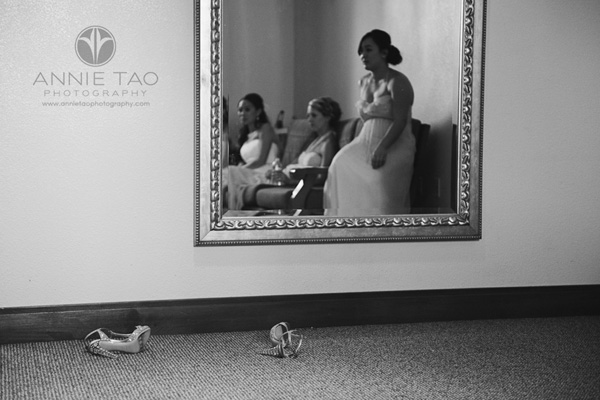
Shoot behind things – to make it feel like you’re peeking into a private moment


What you’ll find is: PERSPECTIVE influences a viewer’s PERCEPTION!
Conclusions:
- Before you press the shutter, take a moment to think about how you want your subject to be perceived in the image. Is there anything you want to highlight? A story you want to tell?
- You don’t need fancy camera equipment or a bunch of expensive lenses to create different perspectives. You just need creativity and the ability to move around…and BAM! You have it all.
Have you got some others to share? Please do in the comments below.
For more on perspective see these:
- Perspective in Photography – Don’t just stand there move your feet!
- Why are my Buildings Falling Over? A Short Guide to Perspective Distortion and Correction in Photography
- 10 Most Common Mistakes in Landscape Photography – and How to Overcome Them
The post The Power of Perspective in Photography by Annie Tao appeared first on Digital Photography School.
The FBI Believed Clay/Liston I Was Fixed

There has long been chatter that Clay/Liston II, in which Sonny Liston went down to a phantom punch, wasn't on the up-and-up. But documents obtained by the Washington Times show the FBI suspected that their first fight, in 1964, may have been fixed by the mob.

    
|
Spare Tire Mount BBQ Grate

Yes, your Jeep or FJ can crawl over tree stumps and climb effortlessly up mountainsides but fitting all your getaway gear inside isn’t quite as easy. For you guys, this spare tire mounted stainless steel BBQ grate will give you a great place to grill without taking up precious cargo space inside your little four-by. Fits tires 29”-37”.
For purchase information, Click HereDub Box VW-Style Camper Trailer

The Dub Box has everything that’s awesome about a classic Volkswagen camper bus minus the miniscule engine. Ditching that and turning it into a trailer makes it much more roadworthy while still retaining its charms as a classic stabbin’ cabin. The trailers are not made from old busses but made entirely of fiberglass and Custom-built to order in Oregon.
For purchase information, Click HereSIGNALS

- 101 purveyors of the great American Donut. [Grub Street]
- A beautiful photo essay of Bonneville Speed Week [Storehouse] [Pictured]
- Clocking Frank Underwood’s style. [Kempt]
- Millennials (for real) don’t understand the concept of selling out. [PaleoFuture]
- Things done changed. This is how you rent a tux now. [Wall Street Journal]
— Follow ACL on Twitter, Facebook and Instagram—
La Aduana: Military-Spec 230GE G-wagen

via West County Explorers Club: This matte-black, milspec G-wagen, a 1990 Mercedes-Benz/Puch 230GE, is the the upmarket G500′s bare-bones, older cousin. While locking front, rear, and center differentials, and legendary off-road capabilities, are baked into the G-wagen DNA, you’ll have do without the brawny V8, and front-and-rear heated, leather seats in this version.
Power, in this case, comes from a 2.3-liter, 4-cylinder, gasoline engine good for 125 hp and 141 lb-ft of torque. Whether that’s enough to motivate a long wheelbase (LWB) G-wagen, you’ll have to determine with a test drive. Out back it’s configured as a soft-top with seating for six, most likely via two, long, folding, bench seats (in addition to the two seats in the front, of course). The transmission is a 4-speed manual.
Mileage is listed as 69,300 km, but, if the odometer has only five digits, look carefully around the truck for wear to make sure the odo. hasn’t been rolled over. One good place to check are the rubber pads on the foot pedals. On a high-mileage car, they’ll be quite worn. Also make sure the odometer is running consistently and doesn’t cut out after five miles or so. It's currently located in Canada. More on that after the jump.
The Ten Best Views in America
The United States, with its vast diversity of terrain and its vibrant cities that have grown to contain millions in a matter of 300 years, is replete with unforgettable views. Whether coast or canyon, forest or sandstone, D.C. or NYC, the landscapes included in this list will leave an indelible mark on the cast of your imagination.
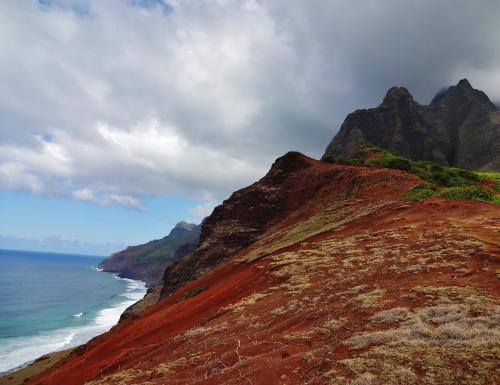
Walk along ridged rainforest-riven cliffs on the Na Pali Coast of Kauai
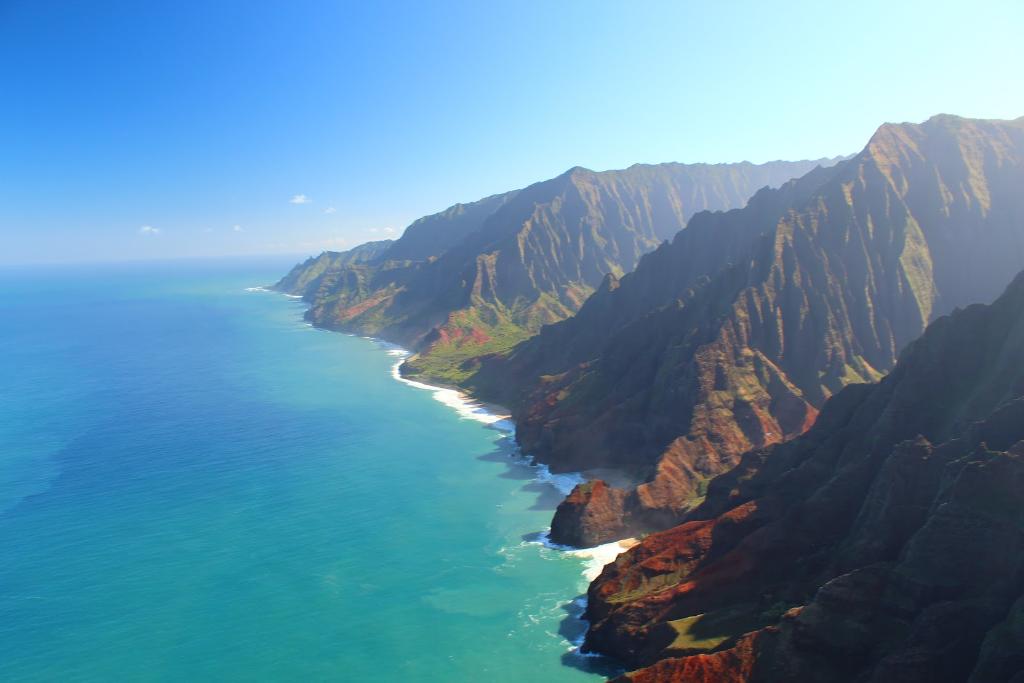
The red dirt for which the Hawaiian island of Kaua’i is famous rolls into lush green slopes that bunch and rise into giant igneous cliffs, rearing up to 1200 meters above the blue Pacific below. Sharp ridges dissect these cliffs and, within their folds, small forested glens are cradled in unique, glistening seclusion. White scallop-shell beaches and rocky caves run along the base of the cliffs at sealevel, held between tendrils of rock that reach out into the ocean like the roots of some vast Pacific tree. Blessedly, the Na Pali Coast is inaccessible by land vehicles, which accentuates the tranquility. It can be approached by boat, or by following the jaw-dropping Kalalau Trail on foot.
See what visitors have to say about the Na Pali Coast:
Look out across the Big Apple from the Museum of Metropolitan Art’s Roof Garden
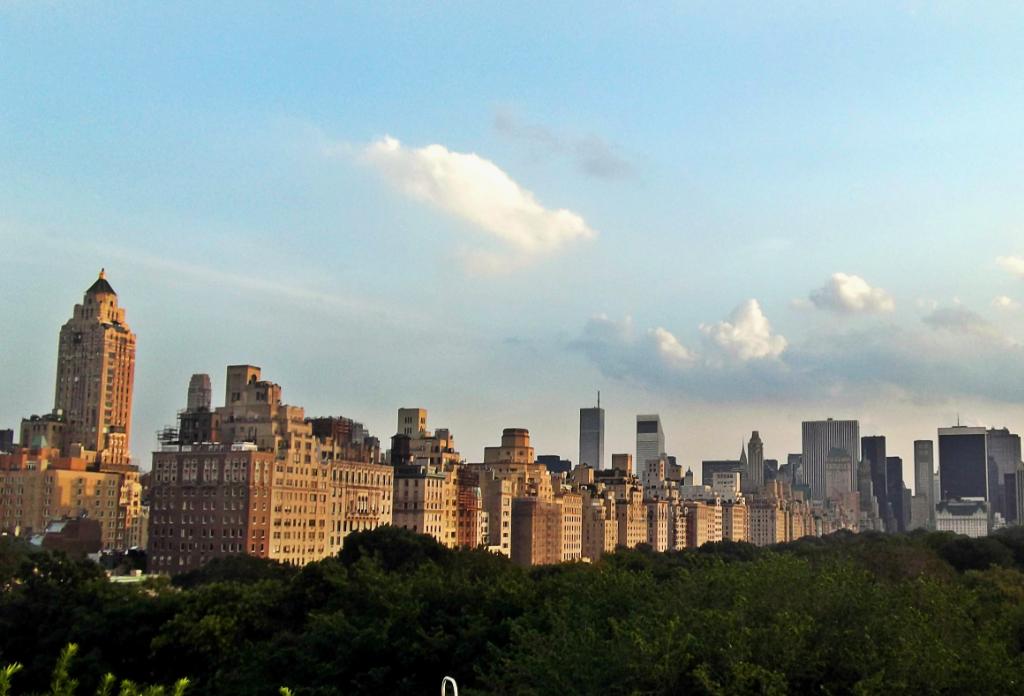
The urban landscape of New York gleams and shimmers around the Met´s roof garden. It looks out over Central Park, beyond which the skyline is sharply cut by the jostling buildings of a city that has sprung skywards with incredible speed since it was established 350 years ago. The garden is a great way to escape the grey granite canyons of NYC, a small green oasis amid the concrete, its peacefulness accentuated by a design that draws on Japanese dry Zen gardens.
See what visitors have to say about the Metropolitan Museum of Art Roof Garden:

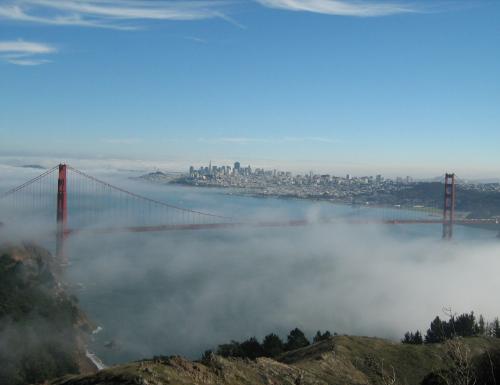
See San Francisco framed by the arches of the Golden Gate Bridge from the Marin Headlands
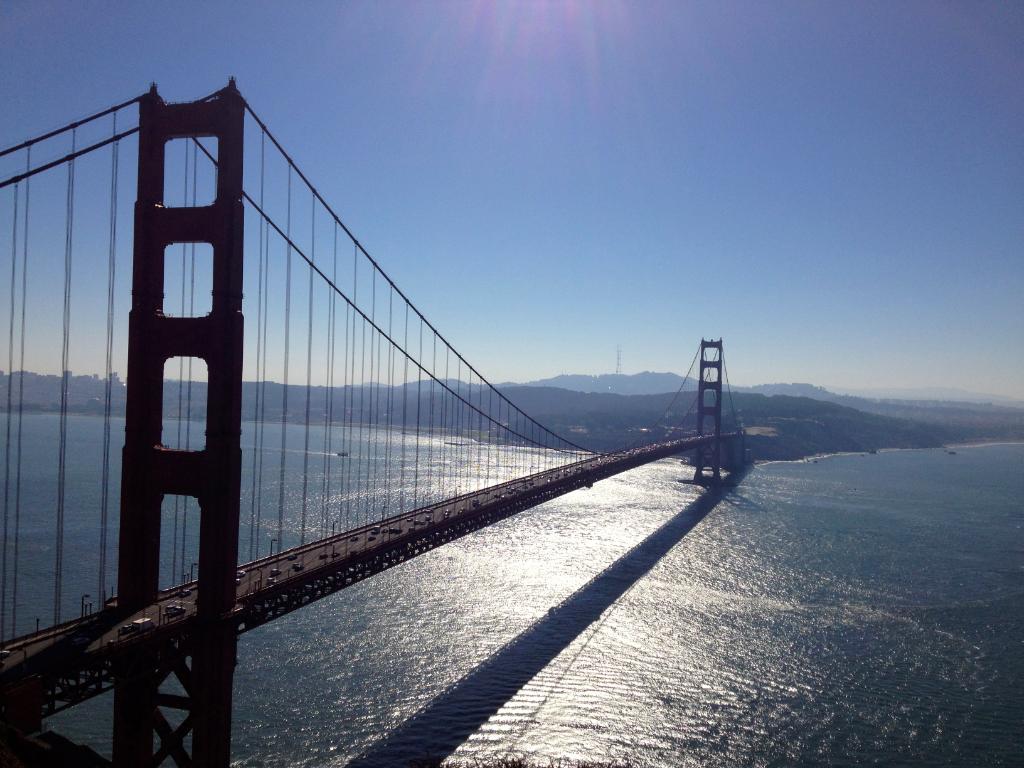
The Marin Headlands are a glorious place to hike in their own right, a wilderness of valleys and lagoons spread over a hilly peninsula jutting out into the Pacific. But it is the park’s position to the north of San Francisco that throws it into this list, as one viewpoint looks down on the Golden Gate Bridge and onto the city beyond, drawing both together into a single frame.
See what visitors have to say about the Marin Headlands:
Stride alongside a geologic wonder on the Grand Canyon Rim Trail
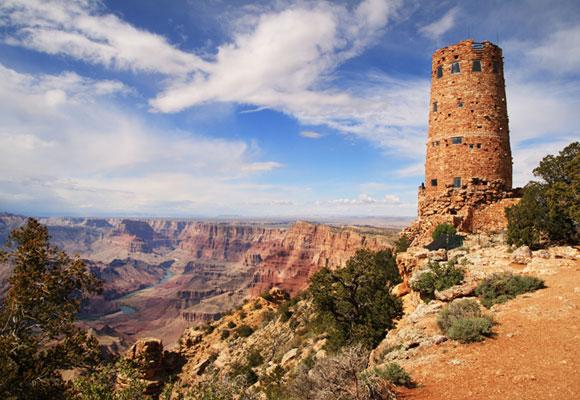
The Rim Trail is perhaps the most scenic of all the hiking paths that run alongside the Grand Canyon. It weaves for 13 miles through a gorge-side landscape of pine and juniper, knotting together a string of viewpoints down onto the Canyon below. At the best of these, on a clear day, you can see the far side of the gorge and up to 40 miles along its length. Light and shadow dance across the Canyon as you walk, projecting a vivid light show onto the eons of exposed red rock.
See what visitors have to say about the Grand Canyon Rim Trail:

“Blows my mind.”
“It was a pretty eerie feeling”
“I was spellbound and drunk on nature at this point”
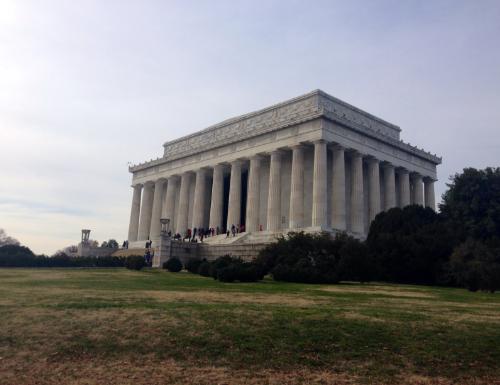
Meditate on American history while dwarfed by the Lincoln Memorial in the National Mall

Photo by lalo_pangue/Flickr.
The Lincoln Memorial stands among the chain of monuments that line the National Mall. Located in the heart of Washington D.C., this stretch of statuary commemorates some of the defining figures and ideals of United States history. A giant Abraham Lincoln presides over the scene, cast in white marble and seated in a Grecian temple enclosed by 36 fluted Doric columns. Looking down the National Mall, over the age-old device of the reflecting pool and onto the Lincoln Memorial, you see the US’s self-mythology at its most majestic. Suspend your scepticism and immerse yourself in its optimistic grandeur.
See what visitors have to say about the Lincoln Memorial:
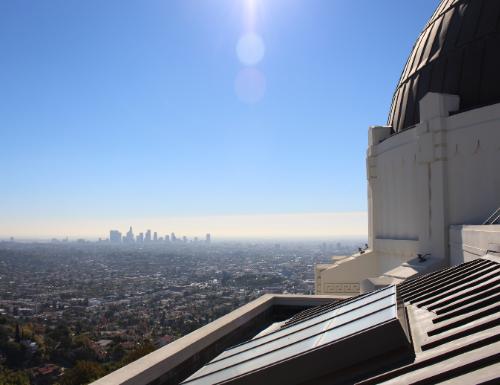
Look down on Los Angeles from the Griffith Observatory
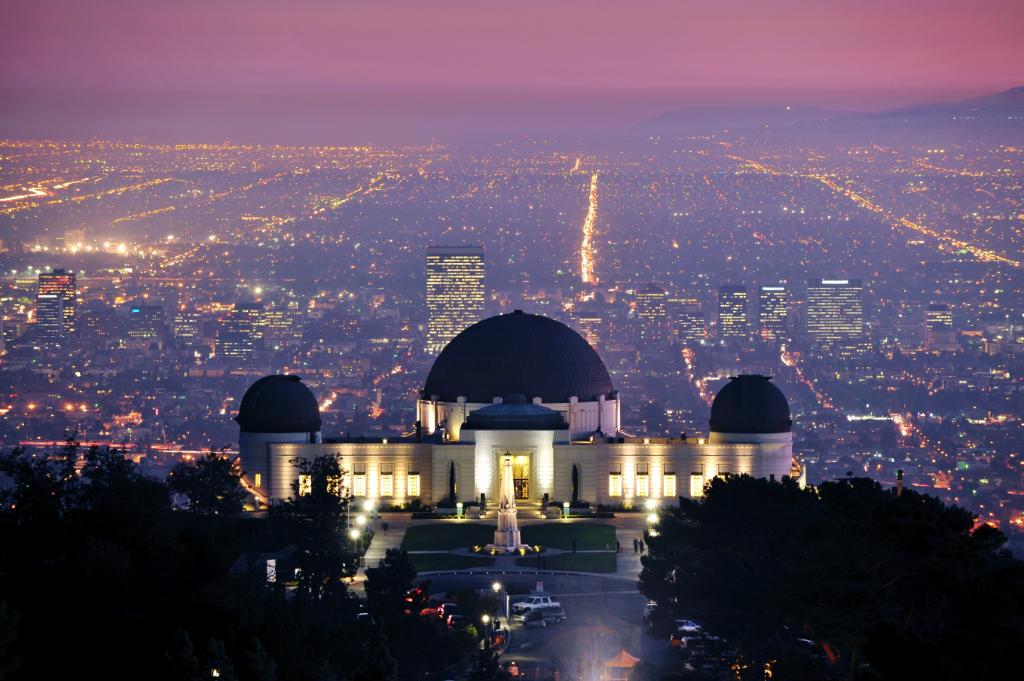
Another side of the United States spreads before your eyes from the Griffith Observatory, perched on the southern slope of Mount Hollywood. This bronze-domed structure looks out over a panorama of Hollywood and downtown Los Angeles, with the wide Pacific glinting on the far horizon. The frenetic activity of the US’s second-largest city, millions of lives swarming and unfolding beneath the Observatory’s viewing platform, marks the living, breathing reality of modern America, a vibrant contrast to the petrified monuments of the National Mall.
See what visitors have to say about the Griffith Observatory:
Stand at the heart of an immense wilderness atop Sentinel Dome in Yosemite National Park
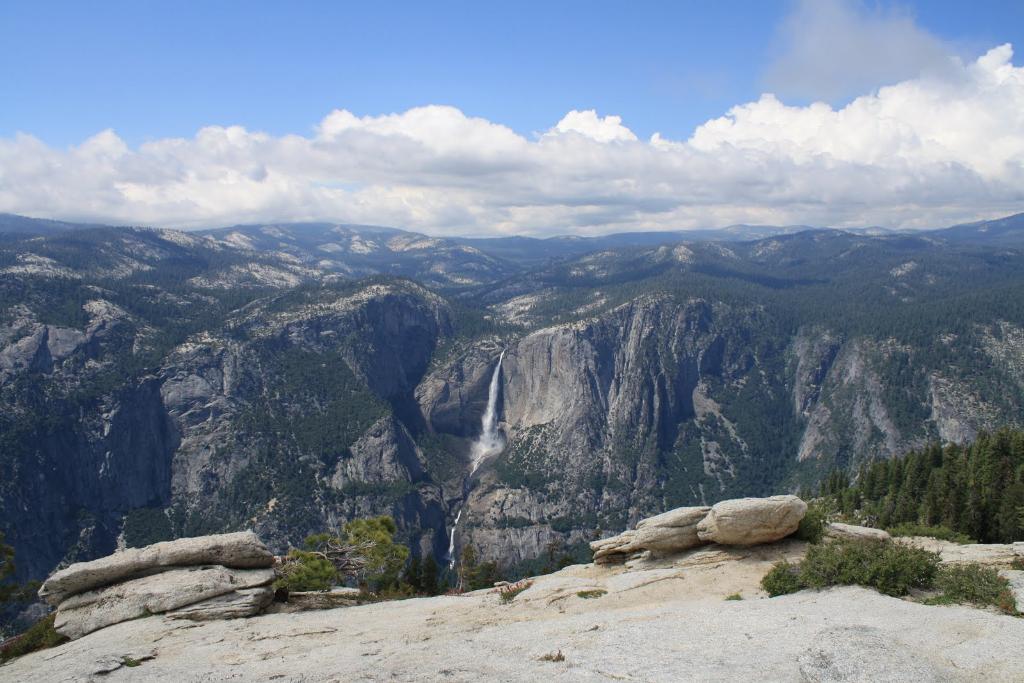
The granite dome of Sentinel Rock stands tall and exposed among the rugged terrain of Yosemite National Park . A scramble to its summit opens up panoramic views over the Park’s patchwork of shadowy forests, wildflower meadows, serrated cliffs and crashing waterfalls. The buzzing urban landscape of Los Angeles gives way to a wild world just as full of life, the natural habitat of of brown bears, woodpeckers, bobcats and lizards, and the temporary home of the occasional speck-like homo sapien ambling through the immense wilderness.
See what visitors have to say about the Sentinel Dome:

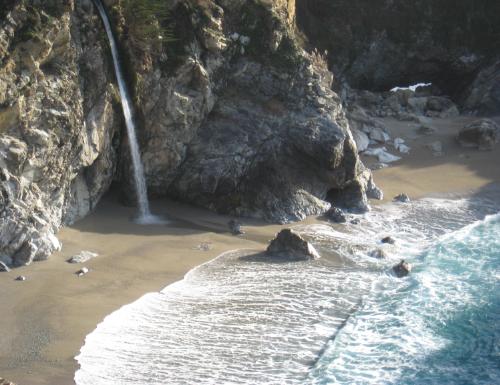
See mountains, the sea and the world’s tallest trees in Julia Pfeiffer Burns State Park, Big Sur

The vertiginous contrast of mountain and sea makes Big Sur a sight in itself, and the Julia Pfeiffer State Park covers some of its most spectacular terrain. It is dotted with 300-foot Redwoods, some of which have overlooked the shoreline for 2000 years. And the heart of the park contains the legendary McWay Falls, an 80-foot waterfall that rolls off the edge of granite cliffs and tumbles straight into the turquoise Pacific. Fabulous views over McWay and the craggy coastline that surrounds can be reached with a short 10 minute hike from the Julia Pfeiffer Burns car park.
See what visitors have to say about the Julia Pfeiffer Burns State Park:
Watch the sun set over Arches National Park in Utah
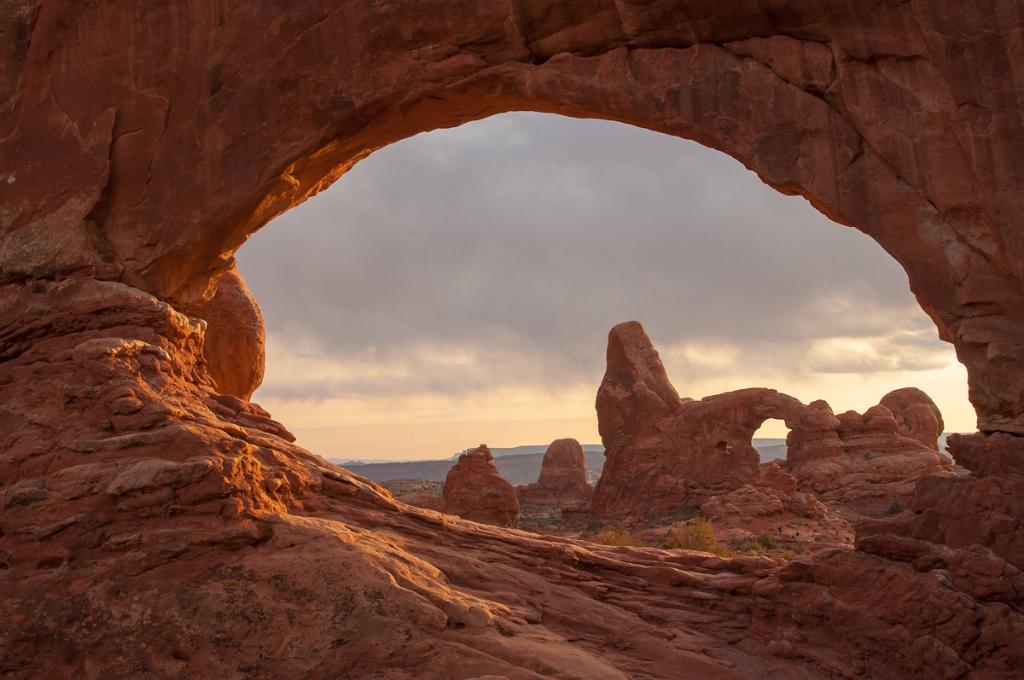
Arches National Park rises out of acres of flat and monotonous arable land, scoring the broad horizon with stark sandstone structures. Climb through this wind-blown landscape until you come to its most moving sight, the evocatively named Delicate Arch, which frames the pinnacles, fins, loops and boulders of the park against the solid backdrop of the La Sal Mountains. Once you’ve reached this point there’s only one thing to be done: wait until sunset, when the changing light captures the subtle orange and green tones embedded in the sandstone and kindles the whole landscape into flickering life.
See what visitors have to say about Arches National Park:
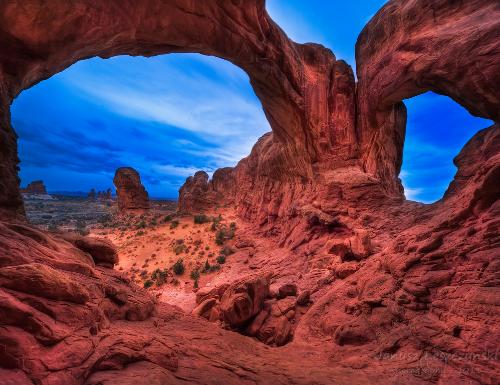
“Has over 2000 natural sandstone arches.”
Gaze into the jagged red and green Waimea Canyon on Kauai
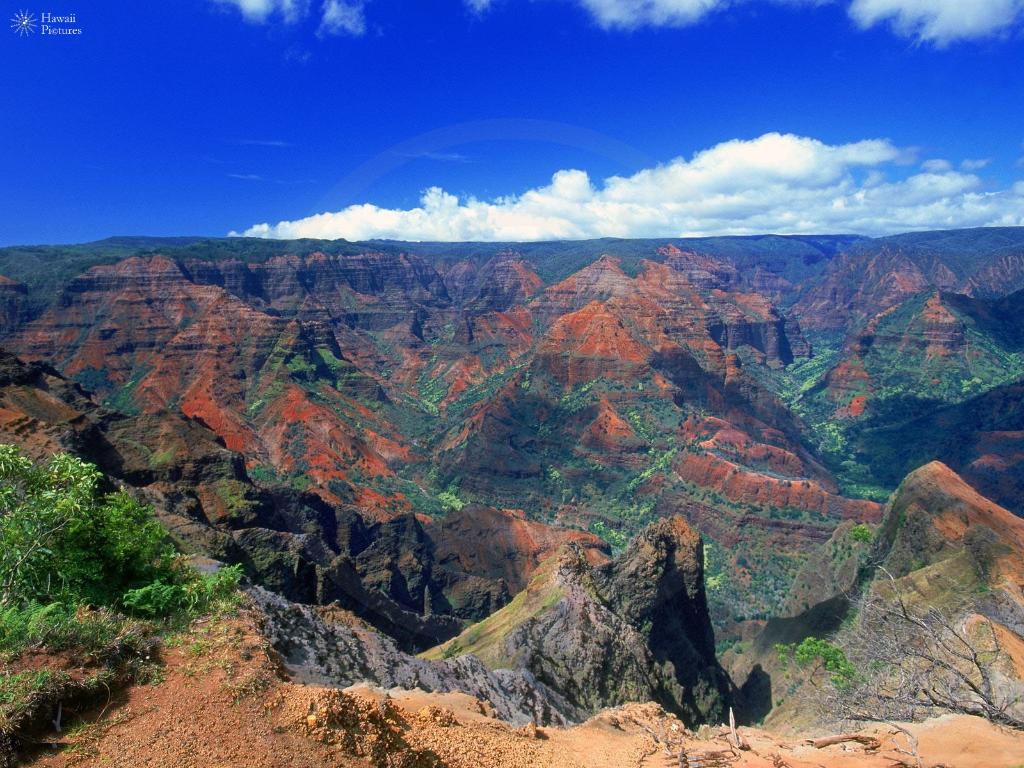
Waimea Canyon is often called “the Grand Canyon of the Pacific,” but this is actually a rather lazy appellation – Waimea is an entirely different phenomenon. Its walls of red rock share a similar color, but trees and plant life cling to them and waterfalls crash down them, striping the sides of the gorge with green and blue. In the center runs not a rock-cradled river but a bright and verdant valley, suggestive of some peaceful, fruitful idyll hidden for millennia from the wounded modern world. In fact its formation was very violent – a result of the sudden, catastrophic collapse of the volcano that first created Kaua’i, and later ripped it apart.
See what visitors have to say about Waimea Canyon:
The post The Ten Best Views in America appeared first on Hopper Blog.
Use Layout-Based Grocery List Templates to Save Money While Shopping

Grocery stores have lots of tricks to get you to spend more money, but one way to fight back is to go armed with a list—not just any list though, one organized by the layout of the store, so you know what to get, where to get it, and when to move on.

|
|
Nat Geo Photo Editor On Listening to Your Inner Voice and Putting the Photo First
If you’ve ever dreamed of being published in National Geographic — and let’s be honest, a good number of us have fantasized about that career path — then you’re going to want to pay special attention to the short video above.
At the request of Nat Geo photographer and burn magazine editor David Alan Harvey, Nat Geo photo editor Susan Welchman gives you some concise advice on what she’s looking for from her photographers.
This is just a short preview of a longer talk (which, by the way, we can’t wait to see) but there’s still some gems in there at the very end. The good stuff starts around 2:15 and goes for the last minute of the video.

We won’t spoil it, but the overall gist is to just be yourself. Who knew, the Genie from Aladdin had it right. Don’t copy successful photographers, don’t try to BE them, because you’re not them. And it’s your own inner voice and vision that, once developed, the magazine will want to publish.
For the full spiel, check out the video at the top.
(via burn magazine)
Make Your Website More Reader, Printer, And PDF Friendly With PrintFriendly

Printing is becoming less common, and it’s not hard to see why. There’s the growing popularity of going paperless, and there’s the ridiculously high ink prices. PDFs have been the solution for many, but how does one take a cluttered, ad-ridden webpage and turn it into an easy-to-read document? As a website owner you should provide a cheap and green solution for your readers, who want to take your content with them either on paper or in a PDF. If you have a self-hosted WordPress site, the solution is simple – the PrintFriendly And PDF Button plugin, one of our favorite WordPress...
Read the full article: Make Your Website More Reader, Printer, And PDF Friendly With PrintFriendly
Shelter: PodHouse

Simple, earth loving, miniature, and modular–the PODhouse by the Swiss design firm, Robust Outdoor Brands, is the culmination of an efficiently streamlined design with the implementation of an ideal “pick-and-plot” homestead. The result is the ultimate in micro homes that boast an infinite amount of possibilities.
Whether used as backyard office, a cozy guesthouse, or a secret getaway for you and the misses, this is could be your next home away from home. The POD, which has been in development since 2003, has gone through the rigors of continued testing, improvements, and optimization in order to ensure the highest quality, construction and overall flexibility of shelter.

Built to sustain every climate, the PODhouse was also designed with nature in mind. The home uses 100% FCS certified wood, which means it’s Mother Nature approved. The larch wood used, which is native to cold temperatures of the northern hemisphere (i.e Russia, Canada), takes the brunt of the weather as the exterior of the home. While the pine interior offers that classic rustic look, sealed tight from the elements.
With double glass windows and doors and integrated insulation in the roof (wall) and the floor, this home offers some of the same commodities you’d expect from a modern home. Electrically wired and easily transportable with forklift-tested iron beams at the base, the POD can literally be placed wherever you want.

Easily the most alluring aspect of the home, its sturdy build and overall size removes a lot of the leg work when it comes to choosing where to place your POD, which opens doors to locations and environments you would have never thought of before.
Sure, you can’t necessarily live comfortably for extended periods of time in a space like this (there's no plumbing or cooking set up), but if you park it near a river and dig a deep enough hole to do your business, you’ll quickly develop a new sense of comfort with a home designed to be a part of nature, not an imposition.


Images ©: Markus Zimmerman via Ignant.
Gmail adds unsubscribe button to rid your inbox of promotions

Google is making it a bit easier to rid your inbox of spam. It's beginning to add an unsubscribe button to Gmail that will automatically appear in the header of emails that it detects might be unwanted messages from marketers. IDG News Service reports that Google announced the new feature at an event last week, and that the unsubscribe option began to roll out thereafter. Clicking the button won't lead you through the marketers' standard unsubscribe dialogue though — it will instead have Google send an automated email to the marketer requesting that it remove you from future mailings.
Video: Volvo working to allow groceries delivered to your car, even when you aren't there
Filed under: Technology, Videos, Volvo, Infotainment

Volvo cites research showing that 60 percent of online shoppers had problems with their deliveries in 2013, and that missed first deliveries cost the industry roughly one billion euros ($1.37B US) in re-delivery costs, as impetus for its "Roam Delivery Service" that delivers packages to your car. The service uses Volvo On Call and Sensus Connect car-connectivity and telematics apps already installed in vehicles, and a digital key with a timed window of operation.
The car owner is notified if delivery to or pickup from the car would be the best option, which they then have the option to approve or decline. If approved, the position of the vehicle is sent to the delivery driver, as well as a digital key that can open the car. Once the delivery has been made, the owner is notified and the digital key is erased, leaving only a time stamp to record when the car was opened and then locked.
The technology will be shown to the public at the Mobile World Congress later this month. There's a video and a press release below with more on the details.
Continue reading Volvo working to allow groceries delivered to your car, even when you aren't there
Volvo working to allow groceries delivered to your car, even when you aren't there originally appeared on Autoblog on Mon, 24 Feb 2014 08:58:00 EST. Please see our terms for use of feeds.
Permalink | Email this | CommentsIwo Jima: ‘The Ghastly Price of Freedom’

This Wednesday, February 19, marked the 69th anniversary of the Battle of Iwo Jima. One of the bloodiest battles in the Pacific War and all of World War II, the month-long slug-fest between American and Japanese forces in many ways set the stage for the firebombing of Japan and the dropping of atomic bombs on Hiroshima and Nagasaki.
In the final stages of the fighting, an iconic picture was taken of U.S. Marines and a Navy corpsman raising an American flag atop Mount Surabachi, an image that perfectly captured American resolve and military strength.
The men that raised the flag were Cpl. Harlon Block, Navy Pharmacist’s Mate John Bradley, Cpl. Rene Gagnon, PFC Franklin Sousley, Sgt. Michael Strank, and Cpl. Ira Hayes. Strank, Sousley Strank, and Cpl. Ira Hayes were killed before the fighting ended. Associated Press photographer Joe Rosenthal won a Pulitzer Prize for the photograph, and it became the inspiration for the Iwo Jima memorial in Washington, D.C.
(Photo Credit: AP)
In what became a battle of inches, the fighting at Iwo Jima was some of the most ferocious in the entire Second World War. Nearly 7,000 Americans lost their lives in the fighting, and just fewer than 20,000 Japanese were slain as well, with very few taken captive. Twenty-seven Americans were awarded the Medal of Honor for heroic action in the battle, about half posthumously.
The capture of Iwo Jima was seen as critical for American strategy as it would be a useful launching point for future aerial attacks on mainland Japan, a tactic that would be relied more heavily on as the American people learned of the staggering casualties sustained during the fighting.
MARCH 3, 1945 U.S. Marines receive Communion from a Marine chaplain on Iwo Jima. The battle for the island was extremely costly for both sides: only about a thousand of the 25,000 Japanese defenders survived; the Americans suffered about 26,000 casualties. The island was not fully secured by the American forces until March 26, but the needed airfields were up and running earlier. (Photo Credit: AP)
In Robert S. Burrell’s book, The Ghosts of Iwo Jima, he wrote of President Harry Truman’s reaction to the horrific blood-letting of the battle:
Despite attempts to calm Truman’s fears, even the sanitized version of losses on Iwo Jima gave the President pause. Quite simply, the extensive manpower losses on Iwo Jima in comparison to the size of the enemy force hindered the approval of future, and inherently more vital, ground offenses.
As the American military inched its way toward the Japanese homeland, fighting became more bloody and intense as Japanese soldiers and civilians became desperate. The ground assault on Iwo Jima led to almost complete extermination of every Japanese soul living on the island, and the ones not outright killed by the U.S. military often took their own lives.
It was a sobering reminder of the depth of suffering that was all too common in the “total war” that the War in the Pacific had become. The American fighting man had made incredible sacrifices in that brutal month of fighting; the nation and the world saw the incredible American fighting spirit. However, the battle also demonstrated the necessity of ending that terrible war and bringing the weary soldiers home.
Burrell quoted Republican Rep. Otis Hal Holmes’s delivered address to Congress on November 5, 1945, prepared by Chaplain Rolland B. Gittelsohn and given at the 5th Marine Division cemetery at Iwo Jima:
Power of speech can add nothing to what these men and the other dead of our division who are not here have already done. All that we hope to do is to follow their example. To show the same selfless courage in peace that they did in war. To swear by the grace of God and the stubborn strength and power of human will, their sons and ours will never suffer these pains again. These men have done their job well. They have paid the ghastly price of freedom. If that freedom be once again lost, as it was after the last war, the unforgivable blame will be ours, not theirs…
The reality of unrelenting, horrific casualties that had become commonplace in the war against Japan convinced President Truman and American top brass that usage of the secret atomic weapons would be necessary to end the war. Though the dropping of the atomic bombs continues to inspire controversy, the depth and horror of the fighting on the tiny island of Iwo Jima provides a good point to the case that use of the weapons saved many lives and brought an early end to the war.
Upon dropping the bomb on Hiroshima, Truman wrote in a press release to the American people, “We are now prepared to obliterate more rapidly and completely every productive enterprise the Japanese have above ground in any city… we shall completely destroy Japan’s ability to make war.”
The anniversary of Iwo Jima is an important reminder of the price paid for freedom and security. However, as terrible as that cost may be, once war has started there is no substitute for victory.

|
|
High-speed Ballistics Photography by Herra Kuulapaa


Finnish photographer and quite the experimentalist, Herra Kuulapaa, has been fine-tuning the art of high-speed ballistics photography for the last seven years, managing to freeze frame bullets whipping through the air just microseconds after they have been fired from pistols, rifles, and revolvers. With an emphasis on firearm safety, Kuulapaa’s images remind us of the sheer force and power behind these small weapons—apparent in the fast-flying lead and powder particles captured here—and provide scientific insight when it comes to the compressed air and gas that is released when a gun is fired.


The post High-speed Ballistics Photography by Herra Kuulapaa appeared first on Feature Shoot.
South Carolina Could Go All in for Alligator Farming
Residents of the state can already hunt alligators and buy alligator meat, but there is no way for residents to raise the nation’s largest reptiles as livestock.
The idea came to Sen. Hutto by way of Joel Sleeman, who works for a construction prep company in the tiny town of Allendale. Sleeman hasn’t yet tried his hand at farming or raising livestock, but his wife is from Louisiana where the vast majority of the nation’s alligator farms dot the off-roads of swamp highways.
If he succeeds, he will be joining a industry where hardy farmers supply the raw materials for purses that fetch $22,400 in a Louis Vuitton storefront.
“It should be a profitable business,” Sleeman told the Charlotte Observer in their report on the bill. “There’s definitely a market for the meat and the hide.”
Greg Lutz, a professor at the Louisiana State University Agricultural Center, isn’t so sure Sleeman should get his hopes up. As an adviser to the state’s gator farmers, he has watched Louisiana’s 55 alligator operations struggle with a fickle economy for luxury goods and high prices for feed and upkeep.
New alligator farmers also need a huge amount of capital to get started. In the wild, alligators enter a state of winter dormancy in which they can go months without a meal. Farmers must build heated concrete pools so the animals will keep eating and growing throughout the year.
And that food? It doesn’t come cheap either.
In his comments, Sleeman mentions partnering with slaughterhouses to get waste material for gator feed, but Lutz says that most big gator farms have switched to nutritionally designed feed pellets … lots of feed pellets. Florida officials estimate an alligator requires 400 pounds of protein to reach 6 feet.
But when it works, Lutz says alligator farming doesn’t just make for a good business — it’s good for the state’s thousands of wild gators.
Unlike most forms of of livestock production, Louisiana alligator farmers rely on a vibrant population of wild gators to supply their farms with a new batch of eggs every year. That’s because farmers slaughter the gators before they reach sexual maturity and start fights, scratching and scaring each other’s valuable skins.
Here’s how the system works: Each June, officials of the survey the marshy Louisiana coast for alligator nests. They then contact private landowners with a quota of the number of eggs they can sell off their property.
‘For decades and decades, all that marshland had no productive value. Suddenly, [landowners] have a way to generate revenue on that property.’
Egg collectors — many of whom are alligator farmers — show up in helicopters and ultralight aircraft to mark the specific location of each nest before they span out in fan boats to collect eggs.
After 65 days of incubation, most of the approximately 350,000 eggs the state collects each year become a new set of baby gators.
As callous as the process sounds, it has brought new life to the state’s gator population. Landowners have a reason to protect wild gator habitats and each year farmers release 12 percent of the gator hatchlings back into the wild to keep up a healthy supply of eggs. 31 years after the American alligator became one of the first species to be protected under the Endangered Species Act, there is now a stable population of 2 million wild alligators lurking in Louisiana swamps.
“For decades and decades, all that marshland had no productive value,” explains Lutz. “Suddenly, [landowners] have a way to generate revenue on that property.”
After some turbulence around the great recession, farmers have also found some economic stability. In 2012, Louisiana farmers sold 292,657 alligator skins at a total value of $64.5 million. While alligator meat makes for a lean alternative to chicken or pork, alligator skins drive the majority of industry profits. Meat value only came to about $6 million.
Right now, its not clear if South Carolina will adopt the Louisiana model for its future gator growers. The S.C. Department of Natural Resources has given its tentative approval as it looks into the relationship between captive and wild gators. And the South Carolina Department of Health and Environmental Control has yet to weigh in.
But Lutz sees the expansion of gator farming as something that should be a point of agreement for industry leaders and environmentalists.
“My gut feeling about that law is that environmentally and ecologically, there is probably nothing to be concerned about if it’s managed well, but its a big question as to whether people are going to make money any time soon, because there is a pretty steep learning curve.”
The post South Carolina Could Go All in for Alligator Farming appeared first on Modern Farmer.
Goldman Sachs says, Don’t reduce regulation – we want “smart” regulation. (Yeah right)

Why would Goldman Sachs be for more regulation? It’s not like Goldman Sachs is full of the shrewdest crony capitalists in the world or anything. It’s not like Goldman Sachs has worked its way into every nook and cranny of government. It’s not like they have their alumni carefully placed in nearly all of the world’s central banks. It’s not like Goldman helped write the Dodd-Frank regulations. It’s not like Goldman benefits from a giant subsidy given to them by virtue of its “too big to fail” status. It’s not like Goldman showers presidential candidates from both major parties with hundreds of thousands of dollars.
Why would Goldman Sachs ever want LESS regulation? They control to a significant extent the regulatory process. It’s a competitive advantage for them. They like regulation. If regulation was reduced the competitiveness of the marketplace might hurt Goldman’s bottom line. No, much better to have “smart” regulation.
And I love how Gary Cohn, Goldman CEO, says that his bank has always been able to stand on its own. (It would be dead if it were not for the taxpayer funded bailout.) But he’s very smart. He says “We want to be in a position where we can take care of ourselves. I believe we at Goldman Sachs have always been in that position.”
He may believe it. But it’s a lie he is choosing to believe.*
* In a a sense though he’s right. Goldman has and had the friends in government which enabled it to survive on the taxpayer dime. In a sense they were able to take care of themselves.
NPPA Attorney Explains Photographers’ Rights and How to Deal with the Police

The folks over at PDN recently sat down with National Press Photographers Association attorney Mickey Osterreicher to talk about photographers’ rights, police intimidation and how to handle yourself around cops who don’t understand what you are and are not allowed to photograph.
Given that a new confrontations between a police officer and a photographer seems to cross our desks weekly, the video could not have come at a more pertinent time. Educating yourself on your rights, the officers’ rights and how to calmly and politely handle a situation that is quickly going south is crucial info that any photographer who practices his craft in public ought to know.
The main gist of Osterreicher’s message is how to stay OUT of trouble while also getting the photos you need. He also suggests ways to explain your rights to an irate officer without getting arrested. And, on the maybe not-so-off chance you DO get arrested, he explains who to call for legal counsel.
Unfortunately the video is not embeddable, but you can watch the full interview over on Vimeo by clicking here.
Slashing Our Grocery Bills and Cooking on a Budget
Earlier this month, one of our favorite food bloggers, Beth Moncel of Budget Bytes, released a new cookbook with more than 100 recipes geared towards helping people slash their grocery bills. Beth and her publisher were kind enough to give us an excerpt of the intro to her book as well as one of her favorite recipes.
 Budget Bytes is available at many of your favorite booksellers.
• Indiebound
• Amazon
• Barnes and Noble
• iTunes
• Books A Million
I had just earned a degree in nutritional science for which I’d spent considerable time learning how to create healthy meals on low-income budgets. I dutifully employed the basics, like brown-bagging my lunch, avoiding convenience foods, and cooking meals at home, but it just wasn’t enough. Not only was I bored with the food that I ate, but somehow I always seemed to spend more money and waste more food than I meant to or could afford. Certain that I could do more to ease my money problems, I decided to buckle down and crunch the actual numbers . . . like down to the penny. I had taken many foodservice management courses and, while I didn’t particularly enjoy them at the time, the lessons suddenly flashed through my mind. I thought about how commercial kitchens managed expenses by planning menus, calculating recipe costs, and always repurposing leftovers. Maybe I could do the same thing in my kitchen, I thought. I knew it was going to take some effort and serious dedication, but hey, I love a good challenge and I desperately needed to save some money! I can’t lie—the data geek in me was a little giddy with excitement about the project. So, I started planning, cooking, and calculating.
I initially started with the goal of eating on less than six dollars per day, using Excel to track the cost of every single thing that went in my mouth. It was pure nerdy fun and I was totally into it. The calculations were extremely insightful from the start. I quickly learned which ingredients burned through my food budget and which helped stretch it.
Putting my newfound knowledge to work, I was soon cooking twice as much food for half the cost.
At work, my delicious home-cooked lunches started to make my coworkers jealous.
While they ate soggy submarine sandwiches, I indulged in stir-fried ginger beef and fragrant jasmine rice. The ooohs and ahhs that erupted as I heated my homemade lunches let me know that I was onto something. On one particular occasion I was so excited about my low-cost creation that I posted about it on Facebook. Friends started asking for the recipe and that got me thinking . . .
Should I start a blog?
Honestly, I barely knew what a blog was, but I did know that the economy had just tanked and I wasn’t the only one who might need low-cost recipes. I also knew that the art of cooking had nearly been lost on my generation. When manufacturers start selling microwavable cups of macaroni and cheese because boiling water is too complicated, you know that there is a need for basic cooking instruction. Maybe I could help, by posting my simple, inexpensive recipes and step-by-step instructions. I decided to go for it.
And thus, Budget Bytes was born.
As it turned out, I severely underestimated the number of people who were in need of easy, delicious, and inexpensive recipes. Just a few short months after I started the blog, comments began to pour in. I got e-mails from all sorts of people who were, like me, struggling to make ends meet, but not willing to sacrifice good food or their whole paycheck to get it. College students, recent graduates, single parents, bachelors, military families, people struggling with medical conditions, and more were all looking for great food on a dime. With every e-mail, every comment, every “thank you” from a reader, I was motivated to create more. The more I created, the more I learned, and the more fun
I had sharing what I learned.
Although my budget today is not nearly as tight as it once was, I continue to live and eat by my Budget Byting philosophy and share my experiences with anyone who is interested.

Budget Bytes: Easy Pad Thai recipe

Serves 4
I’m probably not supposed to play favorites, but this recipe is definitely my favorite. Pad thai is the epitome of simple ingredients creating dazzling flavor. It’s fresh, light, exotic, and faster than any takeout (unless, of course, you happen to live above a restaurant that delivers). Fresh lime is key to creating the unique flavor, but one lime should be enough for a single or even double batch of this noodle dish. Fish sauce, which you can find in the Asian section of most major grocery stores or at Asian markets, gives this pasta a more authentic flavor, but if you can’t find any, skip it; this dish will still rock your world.
INGREDIENTS
8 ounces pad thai or lo mein noodles
2 tablespoons vegetable oil
1 clove garlic, minced
2 large eggs
1 1/2 tablespoons soy sauce
2 tablespoons fresh lime juice (from about 1 medium lime)
2 tablespoons brown sugar
1 teaspoon fish sauce
1/8 teaspoon red pepper flakes
3 green onions, sliced
1/4 bunch fresh cilantro, leaves only, roughly chopped
1/4 cup chopped, unsalted peanuts
INSTRUCTIONS
Bring a large pot of water to a rolling boil. Add the noodles and cook for 7 to 10 minutes or until tender. Drain the noodles and set aside.
In a large skillet, heat the vegetable oil over medium heat. Add the garlic and cook for 1 to 2 minutes, or until tender.
Whisk the eggs lightly with a fork. Pour them into the skillet and cook just until they solidify, but are still moist, moving the eggs around the skillet slightly as they cook so that they lightly scramble. When the eggs are cooked, remove the skillet from the heat and set aside.
In a small bowl, stir together the soy sauce, lime juice, sugar, fish sauce, and red pepper flakes. Pour the sauce into the skillet with the scrambled eggs. Add the noodles and toss to coat in the sauce.
Sprinkle the green onions, cilantro, and peanuts over the noodles. Toss lightly to combine. Serve warm.
BUDGET BYTE: Pad thai noodles have a unique flavor and texture, but if you can’t find them in your area, try substituting another flat pasta like linguine.
CHEF’S TIP: To get the most juice from your lime, roll it on your countertop while applying pressure before cutting it open. This causes the juice capsules to burst and release more juice.
Reprinted by arrangement with Avery, a member of Penguin Group (USA) LLC, A Penguin Random House Company. Copyright © BETH MONCEL, 2014.
21 CommentsThey Win, Part 2—The Man Who Saw It Coming

In the first installment of this trilogy, we explored how many big decisions in America are made as the result of institutional behavior, as opposed to any sort of ideology, left or right. That is, institutions have their own gravity, and their own momentum--and often there’s no stopping them.
And so, for example, Comcast’s acquisition of Time Warner Cable seems destined to happen. Sample headline in The Financial Times: “Comcast confident of TWC deal approval.” Speaking of Comcast executive vice president David Cohen, the FT noted:
Mr. Cohen is a major fundraiser for the Democratic Party, has held events for President Obama at his home and attended the recent White House state dinner for French President François Hollande.
In other words, when big institutions meet politics, the result is usually a victory for both. The institutions get the legal clearance that they want, and the politicians get the campaign contributions that they want--and the bureaucrats tidy everything up and declare it all to be legal. That’s the way things go these days; it’s a fusion of big business and big government.
Still, we might wonder where these acts, and their actors, came from. As we asked in the first installment, “Who is 'They?'” Where, for example, did we get our current ideas about corporations and their corporate managers? And where did we get the professionalized and credentialized civil service that ratifies these corporate actions?
We can immediately observe that this corporatist rise is relatively recent. The first business school, for example, was founded in France in 1819; the first business school in the US, Wharton, was founded in 1881. Schools of public administration are yet more recent; the origins of Harvard’s Kennedy School reach back only to 1936.
One who described and analyzed this process, in real time, was the American writer James Burnham. More than seven decades ago, Burnham, then a leftist journalist, published The Managerial Revolution: What is Happening in the World. The work was the surprise best-seller of 1941, resonating with readers because it made a bold claim: the managers were taking over.
That is, managers, and not the communists, were winning--although there were communist managers. And not the fascists, either--although there were fascist managers. And not the capitalists, either--because the capitalists had ceded control of their assets to the managers.
Burnham’s sly genius was to sweep all managers--red, brown, and red-white-and blue--into the same category, without any regard to their espoused ideology. After all, Burnham declared, it was not ideological behavior that mattered, but rather, institutional behavior. First and foremost, managers were loyal to themselves, to each other, and to their organization. And that was their ideology, not some far-off notion of God, country, or the class struggle. The managers were a class, boasting a class consciousness, and they would do whatever was necessary to stay in power.
In Burnham’s telling, all across the planet--from Washington, DC, to London, to Berlin, to Moscow, to Tokyo--powerful men were sitting in their offices, hunching over reports and documents to read and sign, attending meetings and conferences, issuing orders that would move down through the hierarchy so that the lowliest functionary would know what to do.
Were these men--and they were almost all men--wearing uniforms, or were they wearing business suits? According to Burnham, it didn't really matter. Were they on the left, the right, or in the middle? That didn’t really matter, either. What mattered was that they were managers, in charge of industries, armies, and societies.
As Burnham said of the managers, “What’s clear is that there is a universal class, with universal assumptions.” And so wherever they were, they behaved in pretty much the same way; all differences--theological, political, ideological --mattered less than their similarities. They were all “technocrats,” a word that came into existence only in 1919.
We might note, incidentally, that Burnham’s point was made earlier, in fictional form, by the haunted novelist Frank Kafka. In Kafka’s bleak vision, modern society had created forbidding castles of bureaucratic power, and the individual was powerless in the presence of such power.
Meanwhile, Burnham, writing from the perspective of 1941 as World War Two raged--even before the Japanese attack on Pearl Harbor – observed:
Today the managers are carrying on a similar triple battle… against the capitalists… against the masses… and against each other for first prizes in the new world.
And who would win this triple battle? Who would gain these planetary first prizes? Burnham was betting on the managers, and many important contemporaries agreed with his analysis. The great Christian writer C.S. Lewis, in the preface to The Screwtape Letters, published the following year, 1942, was moved to observe:
I live in the Managerial Age, in a world of “Admin.” The greatest evil is not now done in those sordid "dens of crime" that Dickens loved to paint. It is not done even in concentration camps and labour camps. In those we see its final result. But it is conceived and ordered (moved, seconded, carried, and minuted) in clean, carpeted, warmed and well-lighted offices, by quiet men with white collars and cut fingernails and smooth-shaven cheeks who do not need to raise their voices. Hence, naturally enough, my symbol for Hell is something like the bureaucracy of a police state or the office of a thoroughly nasty business concern.
In other words, Lewis accepted Burnham’s concept, even as he abhorred it.
Another who accepted Burnham was George Orwell. In 1946, Orwell wrote, “As an interpretation of what is happening, Burnham's theory is extremely plausible.” Indeed, Orwell’s classic 1984, published three years later, owes a debt to Burnham, insofar as Orwell’s three mega-nation states were basically the same, even as they continuously warred against each other. As we have seen, Burnham had called it earlier in the decade. The managers would be fighting “against each other for first prizes in the new world.”
So where does Burnham stand now? What to make of The Managerial Revolution 73 years later? We might note that in his later years, Burnham became a conservative; he was a prominent part of William F. Buckley’s National Review.
Yet that 1941 work is his most famous, and it haunts us still. To be sure, he did not know about the full horrors of Hitlerism and Stalinism. So in that sense, Burnham was giving American managers a bad rap by lumping them together with the managers of death camps.
Nevertheless, in his argument that managers would displace fascists and communists, he was correct; today, there are no fascists and communists to speak of. Of course, as we survey the economic systems in, say, China and Russia, we see that something much less than free enterprise is dominant there. Indeed, the authoritarian systems of those countries--in which the capitalists can be rich only so long as they kick back some of their wealth to the managers--could be described as a kind of residual communism, fascism, or both.
In America today, what’s the situation? Do we have a free market, or is it a kind of crony capitalism? Do the people rule, or do the institutions rule? Are we in charge, or are "They" in charge? We all sense the answer to those questions.
Today, the course of our lives, whether we like it or not, is substantially defined by managers in the conflated public and private sectors--just as Burnham had foreseen, many years ago.

|
|
Gear Scout: Helinox Chair One

It’s not all too often I find a product that I feel deserves the oft overused label of––game changer. I see my fair share of cool widgets at trade shows and unique gear crosses my desk almost daily, but few items are as noteworthy as the Helinox Chair One. For years I was more than okay with sitting on the ground, but those days are becoming more rare with each outing. Not to say my 42 year old bones can’t handle it, I have just become rather particular about my choice of sitters. I’ve burned through the usual fan favorites like the venerable Paco and Kermit Chairs, but I have now found my new favorite, the Chair One. Launched over a year ago, I admit I was a skeptic. I’m now a raving fanboy.
Get King Cake Burgers from Food Drunk in New Orleans

[Photograph: Food Drunk]
Food Drunk, a New Orleans-based food truck specializing in "chef-inspired, alcohol-influenced cuisine" has come up with a new, boundary-pushing burger just in time for Mardi Gras: King Cake burgers. The sweet-meets-savory creation features a brioche bun smeared with white icing and bedecked with purple, green, and gold sprinkles, in homage to the official cake of Mardi Gras.
Between the buns, there's a Black Angus brisket patty and a slice of sharp cheddar cheese.
The King Cake burgers will be sticking around until Mardi Gras. To track down the truck, follow Food Drunk on Twitter.
About the author: Erin Jackson is a food writer and photographer who is obsessed with discovering the best eats in San Diego. You can find all of her discoveries on her San Diego food blog EJeats.com. On Twitter, she's @ErinJax
Love hamburgers? Then you'll Like AHT on Facebook! And go follow us on Twitter while you're at it!
British academic claims to have made a breakthrough in his quest to unlock the 600-year old secrets of the mysterious Voynich Manuscript

Written in an unknown language more than 600 years ago, it’s a mysterious document which has baffled scholars, cryptographers and historians, who have not been able to decypher a single letter or word for decades.

|
|
Italian cleaning woman throws away modern art she believed to be biscuit crumbs

A cleaning woman in southern Italy has unwittingly thrown away contemporary artworks she believed to be rubbish, that were actually supposed to be part of an exhibition.

|
|
Jesus is 'returning to earth with a gun', says former US General

He served as a general during George Bush's tenure as US president, so perhaps it's fair to say that Jerry Boykin's latest comments should be taken with a pinch of salt.

|
|
Biden: Coming in 2 Million Short on Obamacare Would Be "a Hell of a Start"
 Speaking in
Minnesota, Vice President Joe Biden talked up Obamacare's
enrollment problems, including the program's awful start and
lagging enrollments. Not to worry,
the VP said:
Speaking in
Minnesota, Vice President Joe Biden talked up Obamacare's
enrollment problems, including the program's awful start and
lagging enrollments. Not to worry,
the VP said:
Biden acknowledged that “we may not get to 7 million, but if we get to 5 or 6 million that’s a hell of a start.”
In total, nearly 3.3 million had enrolled through the end of January. That’s about 75 percent of what the administration had hoped to achieve by that point in the open enrollment period.
Channeling the wisdom he learned over years of occasionally plagiarizing other people's life stories, Biden also offered up this defense of the program's rollout:
“We didn’t want this to start off as shaky as it did,” he said. “But it’s complicated.”
Yes, it is, Joe. Yes, it is.
Let's assume that the program only enrolls 5 million in the individual markets. Let's further assume that the demographic mix of those people isn't the acturial balance needed to keep costs the way they were predicted. What happens next? At what point does "a hell of a start" just turn into a hell of a program? Find answers in Reason's ongoing Obamacare coverage.
In 2009, Reason TV celebrated "Joe Biden: Real Man of Genius."