Shared posts

16 Jun 18:22

Author Howard Rheingold [Cool Tools Show #003]

by mark

Howard Rheingold is a critic, writer, teacher, and artist; his specialties are on the cultural, social and political implications of modern communication media such as the Internet, mobile telephony, virtual communities, digital media and learning, and online co-learning. He joins the Cool Tools podcast this week to discuss how his budding interest in woodworking has enriched his creative projects and led him to amass a whole new arsenal of cool tools. In this episode, Howard shows us a thorough list of must-haves for any beginner in woodworking or circuit tinkering, as well as some quality-of-life items to cultivate a healthy working environment.

Subscribe to the Cool Tools Podcast on iTunes | RSS | Download episode | Transcript

Subscribe to Cool Tools Show

Show notes:

Howard’s Etsy Page

Here are Howard’s tool picks, with quotes from the show:


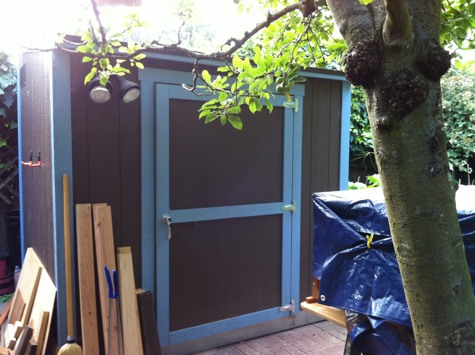
6′ x 8′ Tuff Shed: ~$2,000.00 (See website for exact pricing.)
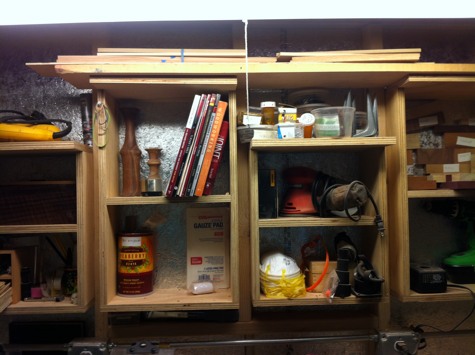
“I’ve got a six by eight foot shed installed. They broke it down into parts and moved it through my narrow garden gate and installed and painted it, all level and nice, for two thousand dollars for an eight by six foot shed. You’ll be amazed at the amount of stuff I’ve been able to cram in there.”


Makita Compound Miter Saw: $449.00-$796.00
“I’ve got a Makita compound miter saw, which is invaluable. Compound means you can move it in an angle in the horizontal plane, but you can also move it at angles in the vertical plane to make bevels. That’s very useful especially if you get a blade with more teeth on it so that you can make finer cuts.”


Survivair S-Series Half Mask respirator mask: $27

“The respirator I’m using is the Survivair, S. Series Half Mask Respirator. Cost me thirty bucks and I figure it’s worth it to not have to worry about my lungs.”


Jet 10-inch lathe: $419 – $521

“I have a Jet mini-lathe. Again, I took a wood turning class and the teacher recommended it. It’s a 10-inch, which enables me to work in a pretty small space.”


Rikon 8-inch grinder: $140


Wolverine Grinding Jig: $92

“By the way, if you get a lathe you have to get a grinder, I found out, because your tools get dull very quickly, so I’ve got a Rikon eight-inch grinder and at the recommendation of my wood turning teacher. I got the Wolverine grinding jig with it.”


Uvex Bionic Face Shield: $42 – $54


Roker Wireless portable bluetooth speaker: $23

“I just put on Spotify or my iTunes, click ‘Library,’ start playing it on my iPhone, and then just turn on my speaker and turn on Bluetooth and, bang! It’s pretty substantial.”


Spoonflower Fabrics: See website for pricing.

“If you go to Spoonflower.com you can upload any image and they’ll send you fabric.”


Copy Paste Pro: Free

“Copy Paste Pro will remember up to the last two hundred things that I either cut or copied to my clipboard. The clipboard, by the way, Ted Nelson calls “the abominable hidey hole.”


Radio Shack Wire Wrapping Tool: $3 – $13

“It wraps wire around a pin and makes just as good an electrical connection — and just as good a mechanical connection — as soldering does. You put a little shrink wrap on it and it can be quite robust if you’re not going to move it around too much.”


Adafruit Perma-Proto Breadboard: $7.00

Mark: “Adafruit makes these really great printed circuit boards that have the same letter and numbering system as a solderless breadboard”


Palomino Blackwing 602 Pencils: $23/doz.

“One thing that Boing Boing turned me onto are Blackwing pencils. I’ve got those out in the shed. I’ve got them in my sketchbook here in the office.”


Felco Pruners: $54 – $63

“I use them for cutting up anything that’s basically smaller than your thumb and there’s a lot of it in my garden. If you’ve got fruit trees or you’ve got bushes or blackberries or ivy, anything like that you’ll use it a lot.”


Paper Clay: $12/16 oz.

“It’s mostly paper but it’s also got a little bit of clay in it. You don’t need to bake it. It takes a couple of days to dry and after it dried you can sand it and paint it or put something more substantial over it and it’s very, very lightweight which is a good reason for using it.”

16 Jun 00:55

Repurposed abandoned trailer in Milly-la-Forêt,...


Repurposed abandoned trailer in Milly-la-Forêt, France.

Contributed by Raf Gorissen.

12 Jun 19:20

Dynamic Photos of New York at Night

by Ellyn Ruddick

Adam_Garelick_77719

© Adam Garelick / Offset

Adam_Garelick_77720

© Adam Garelick / Offset

Through the lens of photographer Adam Garelick, the streets of New York City appear dark and empty, stalked only by shadows of a bustling day. The artist works exclusively in black and white, reducing the urban architecture to a stark minimalist landscape of form and light. Rarely capturing human subjects, he catalogs the city’s precious moments of silence, the glimmering calm that descends over the park and skyscrapers at night.

Using a 1960s Hasselblad, Garelick shoots on film and develops is own negatives, embracing the tactile nature of his medium. For this reason, each image requires abundant time and concentration, containing within it the serendipitous accidents of his careful process. Much of Garelick’s body of work is richly evocative of early street photographers like Robert Frank or Walker Evans; here, the architectural beauty of our own century is archived, carrying with it the pulsing heart of a city ripe with culture and achievement.

Adam_Garelick_77731

© Adam Garelick / Offset

Adam_Garelick_85325

© Adam Garelick / Offset

Adam_Garelick_85329

© Adam Garelick / Offset

Adam_Garelick_85331

© Adam Garelick / Offset

Adam_Garelick_85332

© Adam Garelick / Offset

All photos featured in this post can be found on Offset, a new curated collection of high-end commercial and editorial photography and illustration from award-winning artists around the world. Offset is an exclusive category channel partner on Feature Shoot.

The post Dynamic Photos of New York at Night appeared first on Feature Shoot.

12 Jun 00:39

Gold As Money?

by Editor

treasure3

It is an idea that is popular in at least 4 states.

Read More

11 Jun 16:29

Ask a Cicerone: How to Get the Most Out of a Beer Festival

by Maggie Hoffman

20130728-260939-7-obf-sea-of-people.jpg

Beer pros share their advice on the best way to approach a beer fest. [Photo: Adam Lindsley]

Outdoor beer festivals make summer better, and not just because they offer an opportunity to drink outside. At a beer fest you get the chance to taste rare, less-available beers, meet your beer heroes, try beers of the same style side by side, and learn a thing or two. But is there a best way to attack a massive beer event? Are there any tips you should keep in mind?

We asked our crew of Certified Cicerones for their expert advice on how to get the most out of a beer festival. Here's what they had to say.

080413-261755-cheers.jpg

[Photo: Chris Lehault]

"If you're going for a more casual outing, basic advice is to start with lighter flavored beers first, so as not to blow out your palate. Then move on to stronger beers as you make your way through the event. For example: start with lagers or blonde ales, move onto reds or amber ales, up to stouts and porters, then end with the super hoppy IPAs or strong imperial stouts.

However, the great thing about beer festivals is that they allow you to try new styles for the first time without having to invest in a sixpack. Pick a style that is new to you and try all the different versions from multiple breweries. This will give you the full spectrum of what that style can taste like and allow you to make an informed decision the next time you're at your favorite pub or beer store."—Hannah Davis (Molson Coors UK)

"Beer festival planners rarely provide the optimal setting for assessing the quality of a given beer, but there are a few tricks you can implement to bypass these conditions. One of them is to bring your own glass. Polyethylene mugs common at beer festivals quickly volatilize aromatics and give off a plastic aroma that interferes with the beer. By assessing beer out of proper glassware (snifter, tulip, etc.) you'll be able to fully identify flavor. Consider waiting for your beer sample to rise in temperature—often jockey boxes used at beer festivals are too effective in chilling beer, dulling the beer's flavor and aroma. By waiting a second or warming the beer up in your hand, you can bring the sample up to proper serving temperature and get the most out of your 4 ounce pour."—Ryan Spencer (Bailey's Taproom)

"Limit your beer intake. Don't spend a lot of time drinking beers you have had before; seek out new and exciting ones. Pay extra for the VIP tent where the most interesting ones usually reside. Avoid driving by recruiting a designated driver or take a cab."—Chris Kline (Schnuck Markets)

20120529-208126-small-batch-festival-kiwi-ipa.jpg

[Photo: Sean M. Buchan]

"Get there early. You'll avoid the crowds and the people who only show up to get wasted. The first thing I do when I get to a beer festival is locate the washrooms, it can save a lot of trouble later. I like to have a walk around and see who's pouring what and then make a bit of a game plan on what to try in which order. Obviously going lighter to heavier is best for your palate, but if there's a great brewery pouring a one-off that you know everyone is going to want to try, you might not want to wait."—Jesse Vallins (The Saint Tavern)

"A big breakfast and lots of water will help your body weather the punishment you're about to submit it to by drinking considerable quantities of what may be high gravity brews under the blazing sun. A breakfast full of protein and fat (and especially eggs) gives you a nutritional foundation. You really can't drink enough water at a festival, and a one-for-one taster glass of H2O to beer is a good target to set."—John Verive (Beer of Tomorrow, Beer Paper LA)

"Avoid long lines, seek out booths where the brewers are pouring their own stuff as opposed to an intern or hired help. If you like a beer, or taste something you can't quite wrap your head around, don't hesitate to ask the brewer about it. When asking about beers, please don't ask questions designed to show off how much you already know!! This happens all the time, guys stick their nose over a beer and immediately start assuredly pontificating about the beer's ingredients and brewer's intentions/process. At a festival you often have access to the guy who actually designed the beer. Why not simply say, "Hey, I really like this, can you tell me a bit more about it?" or "I am not sure what to make of this beer, can you help me?" Most brewers are more than willing to engage in these conversations."—Sayre Piotrkowski (Hog's Apothecary)

"If there are more beers than you can sample, which is usually the case, look at the list and pick out some that look interesting. Go to those brewery tables first and enjoy their selection of beers. While you're at the tables, talk to people about which beers are their favorites so far or which are rare or one-off beers that you may not be able to find again. Craft beer drinkers generally like to share their opinions!"—Judy Neff (Pints & Plates)

10142013-6-beers-that-blew-our-minds-at-GABF-prairie-bomb.jpg

[Photo: Sean M. Buchan]

"Try new things! You're not getting married—it's just a few ounces at a time. Also, avoid the lines. Seriously, there are 200+ beers at any given festival, do you really need to get a couple ounces of that limited edition hyped-up brew while half the other booths at the fest are nearly empty? Forget the hype and cool factor—go taste a broad selection of beer that just sounds good to you!"—Chris Cohen (San Francisco Homebrewer's Guild)

"Water. Most festivals don't allow you to carry hydration packs, but they offer plenty of water stations. Take a permanent marker with you and make it your goal to hit these spots at least 5 times every hour for a full cup. Mark that visit on your hand, grab a slice of pizza and continue on."—Becki Kregoski (Bites 'n Brews)

"There is usually a list of participating breweries and beers that will be served on the festival website. I like to look through the list of beers and breweries online to get a feel for what I really want to taste, but I'm not 'married' to those beers. I see too many attendees walking around with lists and missing out on the main point of any beer festival, fun! I like to make a list of about 4 to 6 beers that are must trys and then let the other beers be ones that people are talking about or maybe from a brewer that I was able to get introduced to. Be organized but not too organized—it is a day of beer drinking after all!"—Bill Carl (Southern Wine & Spirits of Hawaii)

"Slow down. Beer festivals aren't a race. Take the opportunity to chat it up with the brewers and reps. This is a really unique setting and time to talk to these professionals about something they are passionate about. You can learn a lot and many of these guys and girls are some of the most fun people you will ever have a beer with. Also, eat. Skip the pretzel necklace—most events now have great vendors, food trucks, etc. You may not remember everything from a beer festival but you will never forget that time you were chowing down a bahn mi, sipping the market's newest brew, and chatting it up with your favorite brewer."—Daniel Parker (Original Gravity)

11 Jun 16:16

I Say Tomato: 1937

by Dave
January 1937. Deerfield, Florida. " 'Fruit tramp' at rooming house for employees of the tomato packing plant." Photo by Arthur Rothstein. View full size.
11 Jun 15:13

Are School Homicides 'Becoming the Norm'?

by Jesse Walker

This is a still from Gus Van Sant's ELEPHANT. I thought about using a still from Rene Daalder's MASSACRE AT CENTRAL HIGH, which is a much better movie, but this image seemed to be a better fit. And that's it for this episode of 'Behind the Scenes at Hit & Run.'In the aftermath of yesterday's shooting at an Oregon high school, the president worried that such slayings are "becoming the norm." I've written skeptically in the past about whether the number of mass shootings in America is actually increasing, as the word becoming implies—see my posts here, here, and here—but there's always a haze of uncertainty around those numbers, thanks to the varying definitions of "mass shooting" that different people use.

But maybe that isn't the best thing to be measuring in the first place. The Oregon incident isn't a "mass" shooting at all—the gunman killed two people, and one of those was himself—but it obviously speaks to the same sorts of fear and grief. If your son was just shot, after all, it's hardly a comfort that his classmates survived. A map darting around the Internet this week claims to show all the school shootings since Sandy Hook. Note the modifier: school, not mass.

So how frequently are people killed at school? The Bureau of Justice Statistics (BJS) keeps a running count of such homicides, with "at school" defined to include deaths not just on school property but "while the victim was on the way to or from regular sessions at school or while the victim was attending or traveling to or from an official school-sponsored event." You might quibble about whether those off-campus killings belong in this category, but still, it's a straightforward definition that doesn't get bogged down in how many people die in one attack or, for that matter, what weapon was used to murder them.

As it happens, the bureau published a new report on school violence this month. Here is the relevant chart:

With the caveat that with numbers this low it's easy to be misled by random noise, I'll point out that the figure has fallen. Note also that these are raw totals, not deaths per population. A chart of school homicide rates would show an even steeper decline.*

But has that decline come to an end? As you can see, the bureau's figures only go through the 2010–11 school year, thus excluding the Sandy Hook massacre and everything since. Twenty children and six adults were murdered at Sandy Hook, making the event bloody enough to cause a spike in 2012–13 all by itself. We don't have enough data to say for certain whether that year was an outlier like 2006–07 or the start of a new trend, but the authors do offer some tentative numbers for the period since the massacre. According to "preliminary counts from media reports," they write, the U.S. saw "17 school-associated violent deaths between December 15, 2012, and November 14, 2013"—11 homicides and six suicides, with six of the dead being of student age.

Those numbers might sound surprisingly low if you've seen the aforementioned map of school shootings since Sandy Hook, which draws on data from the gun-control group Everytown. In part that's because its count stops this month instead of last November, but it's also because it includes colleges. (Of the 74 incidents listed by Everytown, 35 occured on or near a college campus.**) The map also includes nonfatal shootings, including accidental discharges and at least four events in which no one was injured at all. And some of its items qualify as "school shootings" only under a rather broad understanding of the phrase. While this killing, for example, did take place in an elementary school parking lot, it happened at night, long after the students and teachers had gone home. The victim was 19.

This much is clear: If you're wondering where kids are likely to die, the answer plainly isn't a classroom. (Quoting the BJS report one more time: "During the 2010–11 school year, 11 of the 1,336 homicides among school-age youth ages 5–18 occurred at school.") And in the period for which we have clear data, the school homicide rate moved in the same direction as the overall homicide rate: downward. To bring it still lower, the first question to ask is what happened to get us that far.

(* The researchers are still interviewing officials about some of these incidents, so there's a chance that some will be reclassified in future reports.)

(** The BJS report includes a separate discussion of college-level crime. "Fifteen murders occurred on college campuses in 2011, the same number as in 2010," it notes. The authors don't go into detail about homicides in earlier years, but they do say the "number of on-campus crimes reported in 2011 was lower than in 2001 for every category, except for forcible sex offenses.")

11 Jun 15:12

Our Short National Cheese Nightmare Is Over: FDA Backtracks on Wood-Aged Cheese

by Elizabeth Nolan Brown

Earlier this week, I posted about a potential Food and Drug Administration (FDA) crack down* on cheese aged on wood surfaces. It's a practice that's been going on for hundreds of years, and may be more sanitary than aging cheese on plastic. Cheesemakers, libertarians, and a whole bunch of others were rightly outraged, and began making this known. 

Well, good news: The FDA announced Tuesday that wood-aged cheese is safe. From Dairy Herd Management magazine:

The agency said it did not have a new policy banning wooden shelves in cheese-making, adding there was no requirement in recent food safety regulations requiring the agency to address the issue.

Well, okay, but is there an old policy or an old requirement? Because in January the agency cited several New York cheesemakers for using wooden shelves. Industry blog Cheese Underground said this was unusual, as the FDA has traditionally deferred to state policy on this; but the rollout of 2011's Food Safety Modernization Act (FSMA) has been compelling all sorts of weird new FDA meddling

When the New York Agriculture Department asked for clarification, Monica Metz, an official with the FDA's Dairy and Egg Branch, said the wooden shelves didn't conform to FDA "good manufacturing practice" regulations. But the FDA clarified Tuesday that it had never taken action against a cheesemaker based solely on the use of wood. It's just that these particular wooden shelves at these particular places were poorly cleaned.

Oh my. Has this all just been so much dairy industry hysteria? Or is the FDA backpedaling amidst the criticism? From the FDA's statement yesterday, it sounds to me like more of the latter.  

"In the interest of public health, the FDA's current regulations state that utensils and other surfaces that contact food must be 'adequately cleanable' and properly maintained," Lauren Sucher, an FDA spokeswoman, said in a statement.

"Historically, the FDA has expressed concern about whether wood meets this requirement and has noted these concerns in inspectional findings," she said. "FDA is always open to evidence that shows that wood can be safely used for specific purposes, such as aging cheese."

My takeaway from all this seems to be that the FDA isn't mulling some major push to end aging cheese on wooden surfaces. But if it comes across it in (routine?) inspections, cheesemakers may be cited. 

"Good for the FDA for backing down," wrote Forbes contributor Greg McNeal. "Although it’s unfortunate that they are dodging accountability by claiming they did not change their policy." At Cheese Underground, Jeanne Carpenter thanked consumers for writing letters, signing a petition, posting on Facebook, and generally making "standing up for artisan food a main-stream American issue." The FDA's "back-stepping in both tone and message is welcome news for the hundreds of cheesemakers across the country who have invested their life savings in making premium artisanal cheese and aging it on wooden boards," she wrote.

* I despise this phrase, but I've yet to find a better alternative. Taking suggestions...

11 Jun 14:29

Coke Introduces an Electricity-Free Evaporation Cooler

by delana
[ Filed under Science & in the Energy & Power category ]

electricity free biological evaporation cooler

If you’re environmentally-minded, powering a little fridge just to keep your sodas cool in the summer probably seems like an unreasonable luxury. Soda giant Coca-Cola has introduced a bio-cooler that keeps cans of Coke cool without the use of electricity.

coca-cola bio-cooler

Developed by Leo Burnett Columbia and the International Physics Centre in Bogota, the cooler works on the natural biological process of evaporation. Contrary to logic, the cooler actually works better the hotter it gets outside. The cooler is topped by a small bed of plants. Watering those plants causes evaporation to take place inside of the cooler, bringing the interior temperature down. A mirror harnesses the power of the sun to convert gaseous water into liquid water, making it even cooler inside of the small soda machine.

The cooler was used as a marketing device in Aipir, Columbia – a place that is unthinkably hot and where residents travel 12 hours to fetch ice. While it may seem cruel to provide such a device in a place that would clearly be better served by technology that can help residents rather than provide them with unhealthy sugary drinks, the ad campaign focuses on providing the residents with a luxury that they otherwise would not have access to. Still, the brilliant idea – based on principles that have been known for centuries – could easily be replicated to provide natural refrigeration for food and water.

(via: Adweek)


Share on Facebook

[ Filed under Science & in the Energy & Power category ]

[ Gajitz | Archives | Categories | Privacy | TOS ]

11 Jun 13:39

TWITTER feed debunks Bloomberg's gun data on 'school shootings'...


TWITTER feed debunks Bloomberg's gun data on 'school shootings'...


(Third column, 18th story, link)
Related stories:
11 Jun 01:20

15 Quotes From The Founding Fathers About Economics, Capitalism And Banking

by Tyler Durden

Submitted by Michael Snyder of The Economic Collapse blog,

Why have we turned our backs on the principles that this nation was founded upon?  Many of those that founded this nation bled and died so that we could experience "life, liberty and the pursuit of happiness".  And yet we have tossed their ideals aside as if they were so much rubbish.  Our founders had experienced the tyranny of big government (the monarchy) and the tyranny of the big banks and feudal lords, and they wanted something very different for the citizens of the new republic that they were forming.  They wanted a country where private property was respected and hard work was rewarded.  They wanted a country where the individual was empowered, and where everyone could own land and start businesses.  They wanted a country where there were severe restrictions on all large collections of power (government, banks and corporations all included).  They wanted a country where freedom and liberty were maximized and where ordinary people had the power to pursue their dreams and build better lives for their families.  And you know what?  While no system is ever perfect, the experiment that our founders originally set up worked beyond their wildest dreams.  But now we are killing it.  Why in the world would we want to do that?

Most people are under the illusion that the United States has a "capitalist economy" today, but that simply is not accurate.  At best, we have a "mixed economy" that is becoming a little bit more socialist with each passing day.  We pay dozens of different types of taxes each year, and some Americans actually end up giving more of their earnings to the government than they keep themselves.  But that is still not enough, and so our state governments have accumulated astounding amounts of debt, and our federal government has amassed the largest single debt that the world has ever seen.  If future generations of Americans get the chance, they will curse us for the chains of debt that we have placed upon their shoulders.

So what do our government officials do with all of this money?

Well, today approximately 70 percent of all federal government activity involves taking money from some Americans and giving it to other Americans.

Despite this unprecedented wealth-redistribution program, poverty is absolutely exploding in this country and 49 million Americans are dealing with food insecurity.

Meanwhile, the bankers have been getting fabulously wealthy from all of this debt.  The Federal Reserve system was designed to trap the U.S. government in an endless spiral of debt from which it could never possibly escape, and that mission has been accomplished.  In fact, the U.S. national debt is now more than 5000 times larger than it was when the Federal Reserve was first created a little more than 100 years ago.

Most people like to think of big banks as "capitalist" institutions, but that is not really accurate.  In the end, giant corporate banks like we have in the United States are actually collectivist institutions.  They tend to greatly concentrate wealth and power, and socialists find those kinds of banks very useful.

In fact, Vladimir Lenin once said that "without big banks, socialism would be impossible."

While there may be a bit of animosity between big government and big banks once in a while, the truth is that they are usually very closely tied to one another.  We saw this close relationship very clearly during the financial crisis of 2008, and it is no secret that there is a revolving door between the boardrooms of Wall Street and the halls of power in Washington.  The elite dominate both spheres, and it is not for the benefit of the rest of us.

In America today, government just keeps getting bigger and the banks just keep getting bigger.  Meanwhile, the percentage of self-employed Americans is at an all-time low and the middle class is steadily dying.

What we are doing right now is clearly not working.

So why don't we go back and do the things that we were doing when we were extremely successful as a nation?

In case you don't know what those things were, here are some clues...

#1 "A wise and frugal government… shall restrain men from injuring one another, shall leave them otherwise free to regulate their own pursuits of industry and improvement, and shall not take from the mouth of labor the bread it has earned. This is the sum of good government." — Thomas Jefferson, First Inaugural Address, March 4, 1801

#2 "A people... who are possessed of the spirit of commerce, who see and who will pursue their advantages may achieve almost anything." - George Washington

#3 "Government is instituted to protect property of every sort; as well that which lies in the various rights of individuals, as that which the term particularly expresses. This being the end of government, that alone is a just government which impartially secures to every man whatever is his own." – James Madison, Essay on Property, 1792

#4 "Banks have done more injury to the religion, morality, tranquility, prosperity, and even wealth of the nation than they can have done or ever will do good." - John Adams

#5 "To take from one, because it is thought his own industry and that of his fathers has acquired too much, in order to spare to others, who, or whose fathers, have not exercised equal industry and skill, is to violate arbitrarily the first principle of association, the guarantee to everyone the free exercise of his industry and the fruits acquired by it." — Thomas Jefferson, letter to Joseph Milligan, April 6, 1816

#6 "The moment the idea is admitted into society that property is not as sacred as the laws of God, and that there is not a force of law and public justice to protect it, anarchy and tyranny commence. If ‘Thou shalt not covet’ and ‘Thou shalt not steal’ were not commandments of Heaven, they must be made inviolable precepts in every society before it can be civilized or made free." — John Adams, A Defense of the Constitutions of Government of the United States of America, 1787

#7 "I place economy among the first and most important virtues, and public debt as the greatest of dangers to be feared. To preserve our independence, we must not let our rulers load us with perpetual debt. If we run into such debts, we must be taxed in our meat and drink, in our necessities and in our comforts, in our labor and in our amusements." - Thomas Jefferson

#8 "Beware the greedy hand of government thrusting itself into every corner and crevice of industry." - Thomas Paine

#9 "If we can but prevent the government from wasting the labours of the people, under the pretence of taking care of them, they must become happy." - Thomas Jefferson to Thomas Cooper, November 29, 1802

#10 "All the perplexities, confusion and distress in America arise not from defects in the Constitution or Confederation, not from a want of honor or virtue so much as from downright ignorance of the nature of coin, credit and circulation." - John Adams, at the Constitutional Convention (1787)

#11 "The principle of spending money to be paid by posterity, under the name of funding, is but swindling futurity on a large scale." - Thomas Jefferson

#12 "Liberty must at all hazards be supported. We have a right to it, derived from our Maker. But if we had not, our fathers have earned and bought it for us, at the expense of their ease, their estates, their pleasure, and their blood." – John Adams, 1765

#13 "If ever again our nation stumbles upon unfunded paper, it shall surely be like death to our body politic. This country will crash." - George Washington

#14 "I wish it were possible to obtain a single amendment to our Constitution. I would be willing to depend on that alone for the reduction of the administration of our government to the genuine principles of its Constitution; I mean an additional article, taking from the federal government the power of borrowing." - Thomas Jefferson

#15 "When the people find that they can vote themselves money, that will herald the end of the republic." — Benjamin Franklin


11 Jun 01:14

Things That Make You Go Hmmm... Like Conscious Uncouplings

by Tyler Durden

Across the world, the number of people who say the economic situation in their country is "bad" is climbing - despite the much-vaunted recovery we all keep hearing about from politicians.


It seems though, as Grant Williams explains in great detail, that the voice of the people is on the rise. This is a problem, because whilst the anti-EU bloc failed to get enough seats to derail the bureaucracy of Brussels, they did win enough to create some serious waves and make it far harder to railroad through policy the next time the wheels on the wagon start to wobble... and wobble it is.

The other interesting thing to come out of the EU elections is the sheer level of antipathy towards being one big, happy European family that rages right across the continent.

A desire to NOT be part of the greater whole is hardly something new or unexpected in Europe — far from it. A quick look at the map below will tell you all you need to know.

The map shows all the currently active separatist movements in Europe, from the more widely known Basques and Catalans in Spain that both seek secession from Spain proper to the citizens of Venice, who want out of Italy (the word ballot actually originates from the Venetian word ballotta or “little ball”), and the Cornish Nationalist Party of Southwest England, who demand independence for Cornwall.

...

Shameless politicians who are willing to put aside technicalities such as the truth and a voting population that is tired of the status quo and looking for a change?

The conscious uncouplings may have only just begun.
 

Full Grant Williams Letter below...

TTMYGH_Jun_09_2014


11 Jun 00:49

Lonely dude plus all-nighter in empty airport equals awesomeness

A guy named Richard Dunn got stuck at McCarren International Airport overnight, after giving away his seats on two different flights for travel vouchers.  He had to kill time until 6:00 AM in an empty airport.  This is how he kept himself occupied.

All by myself from Richard Dunn on Vimeo.

He did all this by himself, in less than four hours, equipped with only his video camera, a tablet, luggage, a ruler, and some tape, using escalators and automated walkways to produce the camera movement effects.  He didn't even know the words to the song when he began - he had to look them up online.  CBC News has the details of how each shot was accomplished.  

What an amazing bit of commando filmmaking!  Some movie studio should give him a shoestring budget and see what he can do.  The current practice of dumping $200 million into the hands of big-name directors is yielding diminishing returns.


10 Jun 16:31

Use Live Bait As A Tool To Help You Catch More Bass On Lures

by Joe_Cermele

There is a widespread vibe in the bass fishing world that live bait somehow makes the game too easy, or that it’s beneath serious anglers. I’m here to tell you it’s not beneath me. In tournament competition or official practice, of course, it's not allowed, but I’m not talking tournies, I’m talking fun fishing. I couldn’t even begin to count the times I’ve been schooled by someone nearby fishing live bait while I struggled to get a single bite on artificial. Just last week, a guy cleaned my clock drifting live shad under the same bridge I was fishing. But what I don’t think many anglers realize is that live bait isn’t just an “easy” way to catch bass; it’s a useful tool that will help you catch more bass with artificials.

Years ago, in the very first small bass tournament I ever won, I caught my bass by vertical jigging a spoon around suspended offshore schools of alewives. I found the bass around them, and figured out how they would bite, by practicing with live shiners the week before. I haven't forgotten that lesson. These smallmouths were suspended in small key areas on a river channel edge in the middle of the lake. I noticed that they would only eat the live shiners presented while popping the rig up and around the suspended bait schools. During tournament day the next week, I kept the spoon high and moving around the suspended schools of bait, consequently catching the winning bass stringer. I certainly caught fewer on the spoon than I did with the live shiners, but it taught me a lesson that paid off that day, as well as down the road.

Many more lessons were learned during all the years I spent wading in the Susquehanna and Delaware Rivers. In those days, I found it hard to beat drifting a live hellgrammite or stone cattie. I spent lots of time tweaking leader lengths, how to best hook the bait, the exact weight necessary to get just the right drift or hold, and the perfect size and shape hook for best landing ratios. Over time, I was able alternate live bait with artificial lures more often and with more success. The live bait rigs jump-started that learning curve for me. To this day, I still use the info gained from live bait fishing every time I hit the water.

10 Jun 16:30

The Producers: 5 Best Muskie Fishing Lures

by Online Editors

Tackle-shop owner Josh Stevenson (mighty​musky.​com) is one of the best muskie hunters and most sought-after guides in Minnesota. These five lures caught more muskies in 2013 than any others in Stevenson’s arsenal. (See the feature on Stevenson's season here.)

1. Dreamcatcher Bucktail


Photos by Luke Nilsson

“These bucktails probably accounted for half the fish in 2013. The hair is reverse tied, so the lure has incredible flutter. Plus, people of any skill level can use one.” dreamcatcherlures.com

2. Suick Thriller

“I can get a fish to eat this lure when they won’t eat anything else. Of course, I modify mine to make them act exactly the way I want, and those tweaks shall remain secret.” suick.com

3. River2Sea Whopper Plopper 190

“You can bomb this lure a mile, and all you have to do is reel it in. I think it catches so many fish because it makes a much deeper plopping sound than similar topwaters.” river2seausa.com

4. Monster Lures Lil’ Creeper

“Most creepers are a real pain to tune. This one performs right out of the box, and unlike the majority, I can work it at any speed. I always have at least one in the boat.” ­monster​lures.net

5. Supernatural Headlock

“Muskies often follow cranks without hitting on the troll. You end up whipping the rod to impart action. This one naturally kicks right or left at random. It’s a unique crankbait.” blueribbonbait.com


10 Jun 16:25

Farm workers’ cabin in Sossusvlei, Namibia. Contributed...


Farm workers’ cabin in Sossusvlei, Namibia.

Contributed by Caleb Pedersen.

10 Jun 16:25

Daisyfield Retreat in Seasalter, Kent, UK. Contributed by Sonja...


Daisyfield Retreat in Seasalter, Kent, UK.

Contributed by Sonja Vermeulen.

09 Jun 18:51

How to Smoke Brisket [VIDEO]

by Brett

In our final video for Smoking Meat Week, Karl Engel from Pigcasso shows us how to smoke beef brisket. We hope you enjoyed and found this series useful. Happy smoking!

Karl’s Smoked Brisket Recipe

Ingredients:

  • 1 whole packer brisket (10-12lbs) – you could just use a flat brisket as well
  • Salt, pepper, and garlic or BBQ rub of your choice

Instructions:

Trim Brisket fat all over to less than ¼ inch on all sides. Eliminate all hard feeling fat.

Spray with pam or some type of spay oil. Season with salt, pepper, and granulated garlic (not garlic salt).

Place on smoker at 225 degrees fat side down. Cook for approx 4 hrs and then open cooker and spray with beef broth. Cook for another 2-3 hrs or until internal temp is about 165 or the color is what you desire. Take off and double wrap in foil and place back on the smoker for another 1-2 hrs or so (brisket should have internal temp of about 190 degrees). Then take off and let rest in a dry cooler and cover with a towel inside the cooler. Rest time is about 2 hrs.

Slice and serve.

09 Jun 18:03

010: How the Fed Works (and its massive conflict of interest)

by Simon Black
010Img 010: How the Fed Works (and its massive conflict of interest)

Henry Ford once said, “It is well that the people of the nation do not understand our banking and monetary system, for if they did, I believe there would be a revolution before tomorrow morning.”

He was right about at least one thing– it’s true that hardly anyone on the planet really understands the monetary system… or the way that central bankers manipulate the entire global economy.

09 Jun 17:14

Bison Bag

by werd.com

Bison Bag

The Bison bag is the world’s first hammock with a built-in sleeping bag. Makes sense, right? It comes with everything you need: carabiners and cordage, plus the sleeping bag’s 225 grams of synthetic fill will keep you cozy all night out there under the stars.

For purchase information, Click Here
06 Jun 16:34

TeamSnap

by mark

TeamSnap is the coolest tool I have come across in a very long time. I use this app to help manage my daughter’s high school tennis team. It does everything from schedule, post, update, change, notify players and parents about events. It builds rosters, keeps scores, lists directions, links navigation. Includes email and text messaging. It has player and parent forms. And fundraising and refreshment information for the whole team. The app doesn’t stop there — it also includes a record keeping task for billing and stores all of the team’s statistics in one place. It is by far the best tool I have ever used or heard of to help organize and maintain a recreational sports team.

-- Kristin Lawrence-Monroe

TeamSnap
Free and paid version available

06 Jun 16:28

D-Day: War Then. War Now

The word "War" instantly brings certain images and sentiments to the mind. 

For the longest time it was images of apocalyptic trenches, shattered cities, tank battles and dog fights. For decades, the word war was intimately associated with horrific civilian casualties coupled with an unswerving sense of duty to risk all in a fight for civilization. That is the why we commemorate the D-Day landings today. The pivotal operation that would break the back of the mass-murderer Adolf Hitler's "thousand-year Reich." 

After the religiously-motivated mass murders of September 11th 2001, our feelings and attitude toward war changed. 

Many came to associate it with god-forsaken "quagmires," faulty intelligence on the weapons of our enemies, and a desire to pull back from the world and focus on our needs back home. 

Has war changed that much since the D-Day landings? No it hasn't.  

As the master of modern war, Carl von Clausewitz, explained 200 years ago, the form and shape of war always changes, from the Trojan Horse of Ancient Greece to the atomic weapons of the 20th century. But it's essence never changes. At its very core war has always been a battle of wills. Victory comes when one side successfully imposes its will on the other side and the killing can finally stop. 

Although today our warriors are not testing their mettle against enemy fighter pilots above the British Channel or joining battle in tank platoons across the flatlands of Europe, they still risk all in a 'Them or Us fight' with an Enemy that will not back down.

And while Operations Enduring Freedom and Iraqi Freedom looked very different from the Normandy landings, in response to the growing crisis in Eastern Europe, Der Spiegel, perhaps the most influential German news magazine, this week described the Ukrainian conflict the new "European War," within Ukraine now in the position Poland was in in 1939. This is a remarkable statement given the country in which Der Spiegel is published.

Whatever happens in Europe, war will not have radically changed. Why? Because of the brave soldiers, sailors, airmen, and marines who fight our wars for us. 

The D-Day commemorations are less about the events on Omaha Beach then they are about the common character of all who have, do and will, don the uniform of the United States. D-Day is about a commitment to the principles upon which our Republic was founded, and the willingness to lay down one's life for the values they represent.

When you consider D-Day today, think of your fellow American in a far away field on patrol, in a submarine hundreds of feet under the sea, or flying an aerial mission for us. For what war looks like and where we fight it may change, what is required to fight never will.

Sebastian Gorka PhD has been appointed the Major General Horner Chair of Military Theory at Marine Corps University and is the National Security Editor of Breitbart.com .


06 Jun 13:49

Garden, Meet Edyn: How the ‘Internet of Things’ Has Moved Outside

by Caleb Garling

Edyn crept out of stealth mode today, launching a Kickstarter campaign (goal: $100,000) and revealing their modern-design solar powered garden sensors and water valves. The idea is that using Bluetooth and a house’s WiFi, the devices will feed data straight from the soil to your phone in order to monitor tomatoes, basil or whatever else is in the garden. Sensors test the soil. For the water valve, if the crops are getting a little dry, tap a few buttons on the iPhone from work and give them a drink, or the software does so automatically.

The target demo of Edyn: Busy folks that have an interest in fresh produce but can’t always get to their garden. “A lot of people are passionate about food but simply don’t have the time,” says CEO Jason Aramburu.

“The Internet of Things” has become a catchall term to encompass anything with a sensor and a connection. But the definition of “thing” has almost no limits. A chair could tell you when its joints are dangerously weak, a toilet brush when the bacterial levels are too high.

Farmers with big plots of land have used sensors for some time but as costs of circuitry and wireless communication dropped, so too has the cost of bringing those tools to the more casual gardener. Not to mention the sensors built by Do-It-Yourselfers with Arduino microcontrollers, have opened up a new world of garden management.

edyn3_resaved

One factor that fuels a lot of the tech-and-garden bloom is that while Silicon Valley (and nearby areas) is full of engineers, it’s also full of foodies. Those foodies want new ways to get fresh fruits and veggies and since they don’t have room for farmland, they look for ways to get the most out of tight living quarters. So you get Palo Alto-based companies like Click and Grow making “NASA-inspired” herb gardens that fit on a kitchen counter. When the company asked the Kickstarter community for $75,000 to get off the ground, people ended up donating over $625,000.

For most pieces of technology the equation is simple: First comes function, and then comes form. Take thermostats. People had dials or keypads on the wall that looked roughly the same for decades. But then a few years ago came Nest, which made them controllable from a smartphone. Not only that, but founder Tony Fadell’s had spent half a decade designing Apple’s iPod and injected that focus on aesthetic into Nest’s thermostat and smoke detector. The company showed quick success and Google bought the company in January for the tidy sum of $3.2 billion.

Garden sensors are no exception to this trend. Parrot, often known for its AR.Drones, and Koubachi (neither located in the Bay Area) make slick garden sensor competitors to Edyn. But Edyn is bringing its own firepower. Yves Behar, the chief creative officer for Jawbone and often considered a leading voice in the field of design, has invested in the company and has been the driving force behind the product’s look and feel.

edyn2_resaved

It’s not hard to see how the smooth curves and warm colors want to stand apart from decades of clumsy buttons. And for urban foodies who might have a little more disposable income, the $99 price tag ($149 for the sensor and water valve combo) could justify avoiding the exposed wiring, two-toned screens or clunky software of many traditional garden sensors.

In fact, the only power supply for the sensor is the small solar panel that sits on top of the unit. Otherwise the devices are controlled straight from an app. And just like an Apple product, the company plans to ship the devices in stylish and elaborate packaging — all to make the unwrapping that much more exciting. In the tradition of Silicon Valley hype: Edyn may be the next step of evolution. Could the Singularity start in in your garden?

The post Garden, Meet Edyn: How the ‘Internet of Things’ Has Moved Outside appeared first on Modern Farmer.

06 Jun 12:34

The 10-Minute Rule for Cooking Fish

by Online Editors

I shied away from cooking fish for many years. I grew up hating eating fish. But after my tastes matured and I realized that finned flesh is pretty damn tasty, I was intimidated to cook it. Then I discovered what’s referred to as the “Canadian Cooking Method” for fish.

First posted by the Canadian Department of Fisheries in its 1959 “Canadian Fish Cook Book,” this method was a way for the department to demystify the process of cooking fish and, hopefully, sell more fish. Here it is as it was printed:

- Measure the fish at its thickest point. If the fish is stuffed or rolled, measure it after stuffing or rolling and then time it accordingly.

- Cook fish 10 minutes per inch, turning it halfway through the cooking time. For example, a one-inch fish steak should be cooked 5 minutes on each side for a total of 10 minutes. Pieces of fish less than 1/2-inch thick do not need to be turned over.

- Add 5 minutes to the total cooking time if you are cooking the fish in foil, or if the fish is cooked in a sauce.

- Double the cooking time for frozen fish that has not been defrosted. Use this rule as a general guideline since fillets often don’t have uniform thickness.

The 10-minute rule has its exceptions, but overall, it’s a pretty good guideline. No matter what cooking method you’re using – frying, sautéing, baking – it all works. Of course, after you use it a few times, you’ll get a feel for how to cook any fish perfectly and won’t have to follow the rule to the letter. Until then, consider the Canadian Cooking Method and eat more fish.

06 Jun 12:34

Gunfight Friday: Beretta BL3 vs. Crescent Arms

by Online Editors

It’s a shotgun gun fight this week, with a neat side-by-side piece of gun-making Americana going up against a Beretta O/U from the early 1970s. The double was made by Crescent Arms, probably the most famous “hardware store” gun. Crescents were made under about literally* 450 different names for various hardware stores from around 1900 until around 1930. If you ordered a dozen or more, Crescent put your name on the gun and you could sell it as your store brand. They are not especially valuable guns, but when a lot of people dig out an old double that belonged to their great-grandfather, it’s a Crescent, and for that reason, they are cool.

The Beretta BL series were made from 1968-1976. There were trim, affordable, excellent upland hunting guns. They came in six grades, BL-1 through BL-6, and you can still pick them up today for well under $1,000.

Marty’s BL-3

Here's my my 20 gauge Beretta BL-3, made in 1972. I bought it forty years ago when it was practically new.  The BL-3 model was similar to the current 686, but has no ejectors.  The BL-4 model had ejectors. It has been used plenty, taking doves, quail, chukar, woodcock, grouse, and numerous pheasants.  It has broken plenty of clay targets as well.  It has never failed to go "bang".

It came with 26" Skeet/Skeet barrels, which I had Briley convert to their thinwall screw-in choke system in the 1980s.  A few years ago, I had Wenig Gunsmithing restock it in semi-fancy walnut, and I had the receiver reblued.  I have four other shotguns, including Beretta 686s in 12 and 28 gauges, but I reach for the BL-3 more than any other.

I'm not particularly sentimental about my guns, but this one is an exception.

Evan’s Ender’s Special Service

Here is my Ender's Special Service 12ga double. It has 30-inch barrels, 2 ¾-inch chambers, double triggers, gorgeous checkering and wood, faded case coloring on the action, and is choked Mod/Mod. The gun was actually made by the Crescent firearms company, who made guns under contract labels for various vendors from the late eighteen-hundreds up until 1932. As the gun is easily pushing 100 years old. I only put lead ammo through it, but when I finally take it out for an upland hunt I will probably use bismuth (the article about bismuth shot made me exceptionally happy). So far it has only been used to bust clays, but I am quite happy to have snagged what I intend to be a gorgeous field gun for only about $350. In my mind, if it ain't broke, still use it!

Which one do you like? It’s not quite a fair fight, as Marty has put about twice the price (maybe more) of his gun back into it with the new tubes and stock, while Evan’s is being allowed to age gracefully. Vote for your favorite, post comments below, and keep sending those gun pictures to FSgunnuts@gmail.com.

*I am using “literally” literally here, not figuratively.


06 Jun 02:25

Hollywood's D-Day Tributes Forget Invasion's U.S. Civilian Hero

“D-Day was a completely incredible experience and one that I haven’t yet been able to write about satisfactorily. So much of it is a matter of feeling and sensation that you don’t write when you’re writing for a newspaper or a magazine. I suppose I’ll have to break down and write a book to get it off my chest.”

– Bill Walton Letter, July 26, 1944

Hollywood’s portrayal of the Allied invasion of Normandy that took place 70 years ago today to rescue France from Hitler’s grip, notably includes Steven Spielberg’s Saving Private Ryan (1998), transforming Robert Capa’s poignant photos of the Omaha Beach landing into motion pictures.

Then there’s the Oscar-winning Darryl F. Zanuck film, The Longest Day (1962), and Tom Hanks’ Emmy-winning Band of Brothers (2001), brilliantly portraying paratroopers going in during the early hours of June 6, 1944, to take key locations at the start of D-Day.

Of those 24,000 paratroopers, just one was an American civilian. His name was William “Bill” Walton. He was a Time-Life correspondent.

Working out of the London bureau as “Operation Overlord” kicked into high-gear, he knew he’d have difficulty getting credentials. A mere fraction of some 550 journalists covering the war would get them, i.e. three per news organization division, plus three photographers. Ships filled to the gills with troops going ashore would have little room.

So he vowed to find another way to get the story. He soon learned Major Barney Oldfield of the 82nd Airborne had offered to train correspondents willing to jump or glide into Normandy—promising them a spot with the 82nd Airborne.

As Oldfield braced for the crush of journalists, just one—Bill, then 34, signed up. In January 1944, waving off his boss’ concerns, he entered Jump School in England—a three-week training program, including jumps with paratroopers.

“Four hours of exhaustion are rounded off by a three-to-five-mile run,” wrote Philip Bucknell, Stars and Stripes staff writer of the experience. Little wonder Oldfield had only one recruit—along with British journalist Bob Reuben, the 101st Airborne’s lone recruit.

Bill’s attempts to do Oldfield’s exercises—walking and quacking like a duck going uphill, and walking and roaring like a bear—elicited gales of laughter. But no one knew how badly he had injured his right ankle on his first jump; he was mum, lest he be disqualified. Bandaging it up, he made four more jumps in excruciating pain—completing the requisite five.

A nearby scenic village overlooking Bristol Channel provided some respite from the rigors. At night, under the “blackout’s” total darkness, social life was restricted to two pubs—having plentiful beer, no whiskey, darts and conversation. Nor, he wrote his mother on January 30, 1944, could he read in his “barren room (with) two canvas cots and nothing else.”

By the end of February 1944, he was both a qualified parachutist and inspiration to the younger men. “If a 34-year-old correspondent could endure the regimen, so could they,” Mary Hackett wrote in William “Bill” Walton: A Charmed Life.

“For his efforts, Bill could now strut around with wings on his chest... But, like all young men, he was naive about what lay ahead... Some events he would never discuss.”

On June 5th, he and his fellow paratroopers waited inland at airfields across southern England, wiling away the hours playing poker as Allied planes, black and white insignia painted on wings and fuselage, waited expectantly outside.

Then, as the weather cleared, General Dwight D. Eisenhower gave the order to proceed, high waves notwithstanding—starting with the pilots and paratroopers, 50-75 percent of whom were not expected to survive. (Though far more survived.)

Meanwhile off the coast of Normandy, thousands, their uniforms drenched, jammed into some 1,500 windswept and water-soaked flat-bottomed craft and continued to wait.

Big steak dinners, coffee and doughnuts were served to the paratroopers—too spun up to sleep—while jazz bands played tunes like Tiger Rag to keep spirits high. But, mostly they sat pensively as B-17 aircraft were loaded with thousands of leaflets for scattering over the countryside in the early morning prior to the invasion, warning the French citizens to stay away from railroads and highways, along with essential information for identifying their Allied rescuers.

An hour before the operation commenced, experienced all-volunteer paratroopers jumped into the Cherbourg area. Their mission: Designate the zones for the drop; cut all telephone lines, preventing the German units from communicating; and divert the enemy as the warships moved into position.

Finally, it was time to board the C-47s—General James “Jumpin’” Gavin telling them as they did: “When you land in Normandy, you will have only one friend: God.” Even General Eisenhower was on hand to boost morale.

“When Bill was boarding,” wrote Hackett, “an officer noticed that he did not have a hunting knife, so he strapped one to Bill’s boot.”

The 82nd Airborne he was jumping with proudly wore their double A shoulder patch—dubbed “All American,” a double entendre also indicating they hailed from all 48 states. Bill would fly with General Gavin, who wanted the 82nd Airborne’s death-defying feats reported.

With all the preparations complete, at midnight, under a clear sky, some 16,000 paratroopers from the 82nd and 101st divisions, and half as many British paratroopers, began taking off at roughly 3-5 second intervals—in a 300-mile long formation, nine planes wide. Mid-air collisions were their biggest fear.

Most of the pilots lacked combat or instrument weather or night flying experience. They were flying nearly incognito, only two small white lights on either side of the aircraft nose, along with a small red flashing light on the belly, signaling their presence; and were flying low to reduce detection and lessen time descending, when they would be subject to enemy fire.

As the last plane took off, Eisenhower departed, fighting off the tears.

Arriving in Normandy, roughly 24,000 paratroopers began parachuting into the darkness—taking incredibly high-risk jumps. Upon reaching the coastline, it was zero visibility. Suddenly they were under attack. The planes hit were heading down—men anxious to jump to evade the crossfire, even if the enemy waited below.

After Bill jumped, typewriter strapped to his chest—in addition to other paraphernalia doubling his weight—he landed in a pear tree a few feet above ground, hanging helplessly, his parachute harness having tightened over the knife now in his breast pocket. None of them had quick-release harnesses, later standard issue. Many lost their lives because they were dropped miles from the target area or dropped too low, their chutes only partially opened.

Soon, greeted by a soldier with a friendly Midwest accent, Bill called out “Flash,” and heard “Thunder,” signaling he was, in fact, a friend.

The small group finally located General Gavin about four o’clock that morning and proceeded to complete their mission—wresting control of Ste.-Mere-Eglise from the Germans, the most critical contribution of the 82nd Airborne to the war effort. The only road from Cherboug went through the town and was critical for transporting reinforcements to the Normandy beaches.

Afterwards, seeing saw some soldiers resting in their parachutes, Bill joined them for a long, much-needed snooze. Later, a soldier awoke him to give him their new orders, only to discover the others were RIP.

Getting up, Bill surveyed, the “fields among the daisies and Queen Anne’s lace,” now blighted by the signs of war: holes riddling homes and barns, trees cut down, equipment demolished, and the animals—cows and horses—stinking and mostly dead, as he wrote his mother on June 30, 1944.

“Now battle-hardened,” wrote Hackett, “he sat at his Hermes typewriter, on a makeshift table, and recorded the events of the past three days… Bill had his story, well aware he was lucky just to be alive. It would be the last large-scale nighttime paratrooper drop. The price had been too high, the loss too great.”

As for writing his book, he never did. The experience, and its aftermath—all the raw emotions—were better left untapped. Though he did edit and write, respectively, two books later in life, A Civil War Courtship: The Letters of Edwin Weller from Antietam to Atlanta about his grandparents; and The Evidence of Washington, about the nation’s capital, which he had played the most significant role in transforming, next to President Theodore Roosevelt.

An amazing man, whose story just might make it to the silver screen, as well.

Mary Claire Kendall is a Washington-based writer. She edited William “Bill” Walton: A Charmed Life, published in fall 2013 and is currently writing a book about 12 legends of Hollywood for publication in spring 2015.


06 Jun 02:22

America Remains Exceptional Because of Reagan’s ‘Informed’ Patriots

Ronald Reagan ended the Cold War without firing a shot. He willed himself to victory over the Republican establishment during an era when Rockefeller Republicans had more firewalls, and brought America out of Jimmy Carter's malaise. RFK loyalists from 1968 proudly became Reagan Democrats as national Democrats started to morph into a hybrid of "limousine liberals" and multiculturalists who always blamed America first. 

Events in Eastern Europe today, America's sluggish economy, and a Republican Party that has trouble connecting with American workers of all backgrounds cast an even brighter glow on Reagan's legacy.

Yet with all that Reagan accomplished, he said in his Farewell Address that "one of the things I'm proudest of in the past eight years" was "the resurgence of national pride that I called the new patriotism."

Reagan knew that though "this national feeling is good," it would not "count for much" or "last unless it's grounded in thoughtful and knowledge" that he called an "informed patriotism."

"I'm warning of an eradication of the American memory that could result, ultimately, in an erosion of the American spirit," he said. "Let's start with some basics: more attention to American history and a greater emphasis on civic ritual."

Though Reagan's memory would fade with the onset of Alzheimer's, he would never lose his sense of what made American exceptional. That's in the soul. 

Delivering his homily at Reagan's funeral in California 10 years ago, Sen. John Danforth read from the Gospel of Matthew: "You are the light of the world. A city set on a hill cannot be hid."

"It was his favorite theme, from his first inaugural address to his final address from the Oval Office," Danforth said. "For him, America was the shining city on a hill."

Reagan knew that for America to always be the world's North Star, its citizens had to be informed about what made the country and its common culture so exceptional and indispensable. And he was fierce in fighting to preserve a nation that the Founders could still recognize. 

Yet 10 years after his passing, establishment Republicans who never liked Reagan or understood why the unwashed did are trying to whitewash history, claiming Reagan would have trouble winning over a conservative movement that is fighting for the same ideals in a different--and more digital era--where Twitter has replaced newspapers and the news cycle has become a constant, ceaseless, and unrelenting news stream.

Craig Shirley, one of the most esteemed Ronald Reagan biographers, recently wrote that those who falsely assert that Reagan would find not fit in today's conservative movement "confuse tactics with principles."

"They charge that it is forgotten that Reagan compromised; but in fact, conservatives celebrate him for compromising on tactics, but never on goals or principles," Shirley wrote. "Changing tactics can be smart politics. Changing principles is not." 

Shirley, as Mark Levin has so often mentioned, observed that "the very forces of the establishment Republicans who made war against Reagan before he was REAGAN are at it again, saying the Gipper could not have survived in the modern Republican party or would have been rejected by the tea party or could not have been elected today."

Jeb Bush has said Reagan would be too liberal for the modern GOP. Jon Huntsman has made the same claim. As scions of wealthy, establishment families, their observations need to be taken with a little more than a grain of salt. Actually, the fight inside the GOP today, pitting the insider elites against the outsider reformers, is very much like the fight in which Reagan found himself in the mid-1970s. Reagan, the intellectual populist, was a tea-party leader long before there was a tea-party movement--but there was a conservative movement, and he was very much the leader of that vibrant political force.

"Actually, the Constitution would forbid him from completing a third term, and we all know in what reverence he held that sacred document," Shirley wrote. "Those same forces who thought men like Bill and Jim Buckley were unsophisticated and out of touch are now making war against the intellectual conservative forces of the tea party. It’s as if an Iron Curtain has fallen across the GOP, with the statists on one side and the forces for individuality on the other."

Reagan's critics within the Republican Party and those who actively wrote missives opposing him from the other side in the 1970s and 1980s continue to prove how ignorant they are of Reagan's appeal by mocking limited-government and working-class conservatives who seek to fundamentally restore America's greatness. But even his harshest critics, some of whom have even become Republicans, pay homage to Reagan's prescience and all of his accomplishments. How could they not? 

By the time of the Goldwater speech, he was already a champion of the individual over the state, the essence of American conservatism. In his adult life, he never awakened in the morning saying to himself, “Government is popular now, so I will switch my principles and embrace big government.” In fact, his mature American conservatism, including the opposition to centralized authority, came at a time when the American people still generally believed in government. His embrace of the pro-life cause came at a time when the science wasn’t what it is today and the pro-abortion position was the more popular position for politicians, including within the GOP. Indeed, it was allies of Reagan’s who added the pro-life plank to the GOP platform in 1976, where it remains to this day.

His rejection of containment and détente and advocacy of actually winning the Cold War shocked the establishment, but by the end of the 1980 campaign, the American people had come to share his viewpoint and in point of fact supported nuclear superiority over the Russians.

But as Shirley noted, Reagan did not need titles, accomplishments, or praise to be complete as a man. He knew what was important and focused on America's long-term health. He asked Americans, "Are we doing a good enough job teaching our children what America is and what she represents in the long history of the world?"

"Those of us who are over 35 or so years of age grew up in a different America. We were taught, very directly, what it means to be an American. And we absorbed, almost in the air, a love of country and an appreciation of its institutions," he reminisced in his Farewell Address. "If you didn't get these things from your family you got them from the neighborhood, from the father down the street who fought in Korea or the family who lost someone at Anzio. Or you could get a sense of patriotism from school."

And if all else failed back then, Reagan said that Americans could still "get a sense of patriotism from the popular culture. The movies celebrated democratic values and implicitly reinforced the idea that America was special. TV was like that, too, through the mid-sixties."

Reagan lamented that as the country was about to enter the nineties things were changing. He observed that "younger parents aren't sure that an unambivalent appreciation of America is the right thing to teach modern children" and "well-grounded patriotism is no longer the style" for those who create popular culture. 

"Our spirit is back, but we haven't reinstitutionalized it. We've got to do a better job of getting across that America is freedom -- freedom of speech, freedom of religion, freedom of enterprise. And freedom is special and rare. It's fragile; it needs [protection]." he said, echoing his previous words about how freedom is only one generation away from extinction. 

Reagan feared a dangerous future in which reparations and balkanization would further disunite America, as the late historian Arthur Schlesinger Jr. often noted.

The Gipper told children to call their parents out if they were not being taught to be informed patriots. And were he alive today, he would relish the many opportunities he would have to use new media to remind Americans about its common culture.

Reagan mastered radio, "talking pictures," commercial television, and the news cycle dominated by the big-three networks. And, as Shirley delightfully mentions, he would "probably be using Facebook and Twitter (perfect for his quips!) and all the other new forms of communication to advance his ideas" because "technology always fascinated him as a method of spreading ideas." No doubt, Reagan would have made Americans more informed patriots 140 characters at a time or with YouTube videos that would have effortlessly cut through today's fragmented media landscape.

Shirley concludes that "to say Reagan would not fit in today’s GOP or modern politics is to underestimate him once again" and is a flat-out "indolent argument." 

"Some have suggested that Reagan could not survive in today’s GOP because he was 'a man of his times,'" Shirely writes. "In fact, given his principles, his vision, and his moral convictions, Reagan was a man for all times, for all seasons."

The day there is no place for Ronald Reagan in the conservative movement will be when America is no longer exceptional, all cultures are viewed equally, and the United States is considered just one of many countries on a map. The world will have lost its "last, best hope." Worst of all, it will also probably be a day when there are two pastel globalist political parties that represent two sides of the same coin without a vibrant grassroots, non-elite movement to fight for an America that represents that shining city on a hill that Reagan personified.

Do those who seek to vindictively and pettily distort Reagan's legacy want to live in such a world? 


06 Jun 02:22

Ronald Reagan: Beau Ideal Statesman for Young Americans

American civilization endures because it has been placed on the rock of the Constitution. However, that Constitution, under relentless assault by those who wish to undermine and fundamentally transform it, requires support and aid from those who believe in its principles. June 5th, 2014 marks the 10-year anniversary of the passing of Ronald Reagan, a conservative giant who understood this better than anyone.

Ronald Reagan once famously said in a 1961 speech:

Freedom is never more than one generation away from extinction. We didn't pass it to our children in the bloodstream. It must be fought for, protected, and handed on for them to do the same, or one day we will spend our sunset years telling our children and our children's children what it was once like in the United States where men were free.

It should go without saying that Ronald Reagan was the unsurpassed conservative champion of his time. Picking up the reins from Arizona Sen. Barry Goldwater, Reagan brought his conservative principles and ideas to the White House in 1980. The Reagan Revolution transformed American politics and shaped the world in the decades that followed. It is from Reagan’s life that we may look to for inspiring examples of leadership and unswerving dedication to timeless principles.

Abraham Lincoln once called Henry Clay, the great Kentucky Legislator that dominated Congress in his time, his “beau ideal of a statesman.” Lincoln tried to emulate Clay, and in doing so became far greater than his hero ever was. In the same way, Reagan idolized Franklin Roosevelt as a young man, picking up on FDR’s incredible ability to communicate ideas to the American public. Reagan’s political life was to a certain extent dedicated to undoing many of the policies of his hero, yet his understanding of how to communicate grand ideas with a simple message stuck.

Reagan, like all good leaders, looked beyond his own time and saw the need to perpetuate American ideas past transient election cycles. He wanted to ensure that there would be many more informed patriots in the future who would stand by the principles of the Founding Fathers and the American Revolution.

Reagan specifically addressed young Americans in his 1987 State of the Union Address. He explained how he had educated himself about the ideas of the American Constitution and studied many other constitutions throughout the world. Reagan highlighted why the American Constitution was special in particular:

In our Constitution, we the people tell the Government what it can do, and it can do only those things listed in that document and no others. Virtually every other revolution in history has just exchanged one set of rulers for another set of rulers. Our revolution is the first to say the people are the masters and government is their servant. And you young people out there, don't ever forget that. Someday you could be in this room, but wherever you are, America is depending on you to reach your highest and be your best—because here in America, we the people are in charge.

Reagan was above all a man of ideas, and it is important to highlight the juxtaposition of his views and those of several current and Supreme Court Justices. For instance, Justice Ruth Bader Ginsburg explained to an Egyptian audience in 2012 that the U.S. Constitution is inferior because it is old. She said, “I would not look to the US constitution, if I were drafting a constitution in the year 2012. I might look at the constitution of South Africa.” Recently retired Justice John Paul Stevens also found fault in the Constitution, opining that the individual right to bear arms protected by the Second Amendment should be changed to a collective right that the government can take away through regulation.

There were unmistakable differences between the principles of Reagan and the philosophy of modern progressives and Reagan’s goal was to show the public the clear distinction between them. Ultimately, a man with sound judgment, common sense, and unshakeable convictions has more lasting appeal than politicians that spout focus-group tested platitudes.

Though Reagan was the oldest president to serve in the Oval Office, it was his principles that appealed greatly to young Americans. In 1980 only 20 percent of the youth vote went to the GOP compared to 46 percent who supported the Democrat Party, but the two parties were roughly even by 1988. This was the power of strong leadership, and effective communication of ideas.

Undoubtedly, like Washington, Jefferson, and Lincoln, Reagan will continue to influence Americans for generations to come. By perpetuating the Founder’s principles and ideas, and standing on the foundation of the Constitution that those men built, Reagan paved the way for a bold, robust conservative movement to restore the nation.

Reagan challenged Americans in his 1982 State of the Union, saying:

Let it be said of us that we, too, did not fail; that we, too, worked together to bring America through difficult times. Let us so conduct ourselves that two centuries from now, another Congress and another President, meeting in this Chamber as we are meeting, will speak of us with pride, saying that we met the test and preserved for them in their day the sacred flame of liberty—this last, best hope of man on Earth.

A decade after Reagan’s death, American founding principles, though seemingly battered and derided, live on through the vast network of organizations and individuals that take inspiration from Reagan. In Reagan, young Americans have a shining example of a man who effectively communicated powerful ideas about governance and the Constitution in a way that could be easily understood by anyone with common sense. It is for us, the living, to educate ourselves about the ideas of the founding and communicate that message like Reagan did, so that both in our time and in the future, freedom may endure.

The "Great Communicator," as Reagan came to be called, emulated the great men from American history and insisted that our country's greatness stemmed from timeless ideas and its fundamentally good people. It is now our turn to emulate Reagan.


04 Jun 18:33

Pizzeria Pronto Outdoor Pizza Oven

by mark

The most important aspect of pizza is the crust, and a conventional home oven does not achieve the high temperatures needed to cook pizza crust properly. There is a whole subculture of pizza enthusiasts seeking a solution to a higher temperature cooking environment short of buying a wood-burning pizza oven.

Everyone acknowledges the wood-burning oven is the best choice but it costs thousands of dollars and requires hours of preparation time when you want to use it. One shortcut gaining in popularity has been to modify outdoor grills with pizza stones. The Pizzeria Pronto oven is essentially a purpose-built outdoor grill. It contains a gas burner beneath a double pizza stone — the company sells the same stone combination for conventional grills — with a top that is open in the front so you can slide the pizza onto the stone.

The oven will “only” get up to 700 degrees while a real wood-burning oven can reach 800 degrees. However, it is ready in 15 minutes — you just connect it to a propane tank and turn it on. The results are quite good — much better than anything I’ve been able to achieve with a conventional oven (and I’ve tried every trick out there). Because the oven is fairly small, you’ll only be able to make a plate-sized pizza and it takes some practice to negotiate the pizza through the short opening. However, the small size is a plus since you can take it with you on vacations, and the clever design allows it to sit on a table so you aren’t forced to slide pizzas while on your knees.

Other than the oven, pizza-making requires little infrastructure, so I like to think of this little thing as a tool that enables vegetarians to compete with the portable outdoor cooking fun that was previously the exclusive province of meat-eaters.

Here are a couple of additional thoughts:

I use two pizza peels with the oven. They have to be less than 13” in width in order to fit inside the opening. When the uncooked pizza is first slid into the oven, I use a very smooth wooden peel made by Epicurean.

Even when you coat the peel in flour, pizza dough tends to stick to the peel — one of life’s major frustrations as attempting to liberate it with more flour often means you end up poking a hole in the dough. The Epicurean peel gives you the best chance for a pizza to slide properly of any I’ve tried. I don’t know how anyone gets an uncooked pizza to slide off of a metal peel. By contrast, to remove the pizza, you want a peel with an extremely thin edge to liberate the crust from the stone. Since in the Pizzeria Pronto the stone is extremely hot, you also want one made of metal, so you don’t burn or discolor your wooden peel — charred wood does not add to the flavor of your pizza. I use this 12” one. Two peels also allows a bit of pipelining in the pizza-making process.

Because this oven heats the air by heating under the stone, the bottom of the crust can burn unless you use the right recipe. I’ve had excellent results with the pizza dough recipe in the book Flour Water Salt Yeast by Ken Forkish, owner of Ken’s Artisan Pizza in Portland, Oregon. (This book, by the way, is a Cool Tool in and of itself. Absolutely stunning results using only four ingredients, your hands, and a plastic tub.)

Combine Ken’s recipe with this oven and you can achieve a crust with a crisp exterior and puffy interior you might have thought was completely beyond your grasp.

-- David Zicarelli

Pizzacraft Pizzeria Pronto Outdoor Pizza Oven
$300

Available from Amazon

04 Jun 11:58

Crickets: Troops React With Silence to Sec. Hagel's 'Happy' News About Bergdahl's Release (Video)

U.S. Defense Secretary Chuck Hagel met with members of the special operations team who participated in the release of Sgt. Bowe Bergdahl, in Afghanistan, Sunday. 

According to a U.S. official, Hagel thanked them and told them they represented the true spirit of never leaving a comrade behind.

He also spoke before a large group of US troops in a Bagram Air Field hangar, and when he announced the "happy" news about Bergdahl, he was met with complete silence. 

 "This is a happy day. We got one of our own back," Hagel said cheerfully. 

*Crickets*

According to CBS News, "it was unclear whether the absence of cheers and applause came from a reluctance to display emotion in front of the Pentagon chief or from any doubts among the troops about Bergdahl."

I'm guessing it was the latter. 

It's amazing the the Obama administration thought this horrendous deal was going to be met with jubilation - especially from members of the United States military - who knew the truth. Hagels announcement and the troops' non response comes at 2:05:

Hat tip: Weasel Zippers

