
Modeled after the hanging nest of the Weaver Bird, the Cacoon is an outdoor shelter that will hang from any large tree branch and house up to two people. Available in 3 sizes and a variety of colors.
For purchase information, Click Here
Modeled after the hanging nest of the Weaver Bird, the Cacoon is an outdoor shelter that will hang from any large tree branch and house up to two people. Available in 3 sizes and a variety of colors.
For purchase information, Click Here
Spray-painting on a wall in your house is usually a one-way trip to somebody getting really, really angry. The Spraycan Projection Clock is the best way we’ve seen to get out all of your hooligan-esque tendencies by “spraying” the time onto a wall – temporarily and completely reversibly.

The Spraycan Projection Clock is the creation of GAMAGO, an independent San Francisco consumer products design company. The clock looks just like a can of spray paint, but when you push down on the button on top of the can, instead of a blast of color you get a lighted projection of the current time.

The time is displayed as numerals inside a beam of light. When the light hits a surface, the time is temporarily “painted” on it. The clock, a perfect gift for retired taggers, works on two replaceable AA batteries and goes for $20 from GAMAGO.







The way we take photographs has changed drastically in the past decade. So, too, have the instruments we use. Now more than ever, our important moments are being captured on cell phones and sports cameras like the GoPro. Casio is taking us one step further toward the future of photography with the Exilim EX-FR10, a camera that splits in half to double its photo-taking power.

The Exilim looks a lot like a normal (if somewhat clunky) digital camera in its connected form. It can be used in this form for taking photos, or the viewfinder can swivel around to help you take the perfect selfie. The camera goes one step further, though, by detaching entirely into two parts. The lens unit and controller unit can then be placed and used in separate locations.

The camera’s lens unit comes with accessories that let it be worn on a strap around the user’s neck, on a hat, on a wrist, or clipped to a backpack strap. It can be attached to a tripod for standard, steady shooting.

When separated, the control unit lets the user preview and frame shots. It also comes with a clip and loop so it can be attached securely to the user’s clothing or gear between shots.

Bluetooth lets the two pieces communicate, and both are tough enough to handle dust, rain, and fall of up to two meters. With HD video capability and decent (if somewhat surprisingly low-res) 14 megapixel stills, the Exilim EX-FR10 might be the next must-have adventure camera for outdoor selfie enthusiasts.
Dean Putney is a software developer, photographer and Internet superhero. He recently published a book of his great-grandfather’s photos from World War I
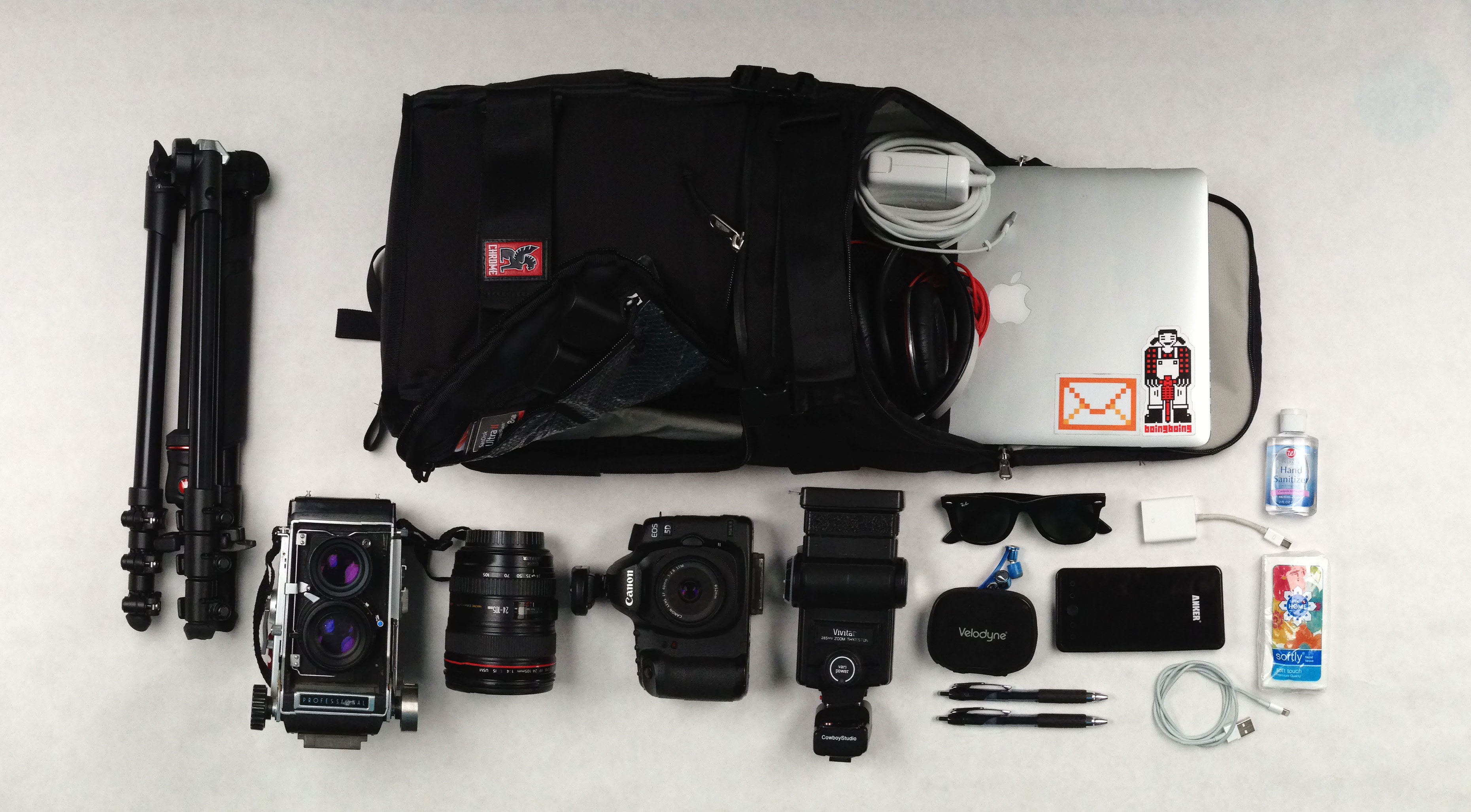
I recently completed an extensive search for a new bag. The goals were to provide space for my work items (laptop, etc), easy access to camera equipment with a quick shoulder sling, and a compact design for riding my motorcycle.
The solution was the Chrome Niko Pack. This bag has two spaces: one at the top for my work items and laptop, and one at the bottom with a side zipper for camera equipment. The velcro straps on the back make a great spot to attach a tripod.
Here’s what’s in my bag on a regular basis:
Bottom half:
Strapped on the outside:
In the top compartment:
[Cool Tools Readers! We will pay you $100 if we run your "What's in My Bag" story. Send photos of the things in your bag (and of the bag itself, if you love it), along with a description of the items and why they are useful. Make sure the photos are large (1200 pixels wide, at least) and clear. Use a free file sharing service like Bitcasa to upload the photos, and email the text to editor@cool-tools.org. See all of our What's in my Bag? posts. -- Mark Frauenfelder]
 The ground has been shifting in the battle over
the minimum wage. With President Obama's proposal to hike the
national minimum from $7.25 to $9 an hour stalled in Congress,
local labor activists have been aiming even higher, getting behind
a vastly higher minimum wage of $15 an hour. The proposals are
gaining steam. The small city of SeaTac, Wash., which includes
Seattle-Tacoma International Airport, already has a $15 minimum in
force, while Seattle plans to implement one over time. Similar
"super-minimum" proposals also are under consideration in cities
like San Francisco and Chicago. Recent state-level legislation will
phase in a minimum wage of greater than $10 in California,
Connecticut, Maryland, Hawaii and Vermont. Massachusetts' minimum
will rise to $11 by January 2017, while the District of Columbia's
is set to rise to $11.50 by July 2016.
The ground has been shifting in the battle over
the minimum wage. With President Obama's proposal to hike the
national minimum from $7.25 to $9 an hour stalled in Congress,
local labor activists have been aiming even higher, getting behind
a vastly higher minimum wage of $15 an hour. The proposals are
gaining steam. The small city of SeaTac, Wash., which includes
Seattle-Tacoma International Airport, already has a $15 minimum in
force, while Seattle plans to implement one over time. Similar
"super-minimum" proposals also are under consideration in cities
like San Francisco and Chicago. Recent state-level legislation will
phase in a minimum wage of greater than $10 in California,
Connecticut, Maryland, Hawaii and Vermont. Massachusetts' minimum
will rise to $11 by January 2017, while the District of Columbia's
is set to rise to $11.50 by July 2016.
Raising the minimum wage is simply a terrible way to help the poor, writes El Lehrer. Even if it's not as disastrous as some market advocates claim, it's likely to do more harm than good.
 If
youth is wasted on the young (and it is!), it's also a constant
source of desire and anxiety in American society. There's virtually
no social panic or cultural love affair like the ones about the
kids these days, whether it's fear of fawning over flappers; hating
on or hailing hippies; or freaking out or rhapsodizing over ravers.
Millennials and even-younger kids are dismissed as a narcissistic
"Generation Selfie" that is dangerously self-obsessed. At least
when they are not being praised as independent and
individualistic. Nick Gillespie takes you on a quick tour of
a century's worth of mesmerizing, terrifying, cringe-inducing youth
icons.
If
youth is wasted on the young (and it is!), it's also a constant
source of desire and anxiety in American society. There's virtually
no social panic or cultural love affair like the ones about the
kids these days, whether it's fear of fawning over flappers; hating
on or hailing hippies; or freaking out or rhapsodizing over ravers.
Millennials and even-younger kids are dismissed as a narcissistic
"Generation Selfie" that is dangerously self-obsessed. At least
when they are not being praised as independent and
individualistic. Nick Gillespie takes you on a quick tour of
a century's worth of mesmerizing, terrifying, cringe-inducing youth
icons.
So we're at war again in Iraq and President Obama has said we'll be adding bombing runs and other actions in Syria too. A growing number of congressional members are calling for boots on the ground in the Middle East too—or saying that we can't rule out that eventuality.
The target this time isn't Saddam Hussein or Bashar al Assad or al Qaeda. It's the Islamic State (ISIS), the brutal terrorist group that controls territory in Iraq and Syria and beheaded two American journalists for all the world to see.
But is ISIS an actual threat to the United States that requires American power to re-enter Iraq? And what does it mean that our military is now working to stamp out a group that is also a sworn enemy of the Assad regime and Iran?
Click above to watch "3 Reasons to NOT Fight ISIS." And click below for full text, more links, and other resources on the matter.
"NY's 9/11 Memorial: When Did Honoring the Dead Become an Occasion for Fleecing the Living?" written by Jim Epstein and Nick Gillespie, narrated by Kennedy, and shot and edited by Epstein, with help from Anthony L. Fisher. About 2 minutes.
Original release date was September 10, 2012 and original writeup is below.
More than a decade after the 9/11 attacks, a new World Trade Center is finally rising, along with a memorial, museum, and a transit hub.
When the projects are slated to open they'll supposedly symbolize America's strength, determination, and refusal to cave in. But they really tell a different story about taxpayer rip-offs, public-sector incompetence, and union and corporate greed.
One World Trade Center, formerly known as the Freedom Tower, will be the most expensive office building in American history by a long shot. Cost overruns have driven the price tag to $3.8 billion. The Port Authority of New York and New Jersey, the public agency that’s running the show, is sticking commuters with part of the tab by hiking tolls across the Hudson River to $12.
The new complex will dump 3-million square feet of office space into a soft rental market meaning Condé Nast, the flush publisher of The New Yorker, Wired, and Vanity Fair, got beau coups subsidies to move in. And who-other-than the federal government signed on to fill up five floors at a cost of $351 million over 20 years?
Even The New York Times' stimulus-pimping columnist Joe Nocera has called World Trade Center rebuilding an "example of just about everything wrong with modern government," asking, "where's the Tea Party when you need them?"
Just down the street from the Trade Center, a federally-financed transit hub is a billion dollars over budget, now coming in around $3.4 billion. Construction costs for the September 11th Memorial and Museum have climbed to $700 million, with taxpayers footing a portion of the bill.
New York's politically connected construction industry has benefited the most from 9/11 largess, but the city's real estate and banking cartels have gone whole hog at the taxpayer-funded trough, too.
The Bush administration gave New York $8 billion in tax-free Liberty Bonds, only to see a big portion of that gift go for projects that have nothing to do with September 11th. Brooklyn’s Atlantic Yards benefited from subsidized bonds, as did a midtown Manhattan office project. Even Goldman Sachs, which has nearly a trillion dollars in assets, got almost two million dollars towards its new headquarters.
Since when did honoring the dead become an occasion for fleecing the living?
After September 11th, small townships in New Jersey and Long Island quickly built modest but moving memorials to pay tribute to the loved ones they lost in the attacks. In Lower Manhattan, something else completely is being built: an overdue, over-budget monument to the ease with which politicians, bureaucrats, and opportunists spend other people’s money.
Written by Jim Epstein and Nick Gillespie, narrated by Kennedy, and shot and edited by Epstein, with help from Anthony L. Fisher.
About 2.30 minutes.
Scroll down for downloadable versions and subscribe to Reason TV's YouTube Channel to receive automatic updates when new material goes live.
The New York Times on Sunday gets around to admitting at length what readers of Reason (or anyone who actually knew much about the topic) have known for years: so-called "assault weapon" bans are a load of useless nonsense.

As the op-ed's author Lois Beckett of ProPublica explains:
OVER the past two decades, the majority of Americans in a country deeply divided over gun control have coalesced behind a single proposition: The sale of assault weapons should be banned.
That idea was one of the pillars of the Obama administration’s plan to curb gun violence, and it remains popular with the public. In a poll last December, 59 percent of likely voters said they favor a ban.
But in the 10 years since the previous ban lapsed, even gun control advocates acknowledge a larger truth: The law that barred the sale of assault weapons from 1994 to 2004 made little difference.
It turns out that big, scary military rifles don’t kill the vast majority of the 11,000 Americans murdered with guns each year. Little handguns do....
The continuing focus on assault weapons stems from the media’s obsessive focus on mass shootings, which disproportionately involve weapons like the AR-15, a civilian version of the military M16 rifle. This, in turn, obscures some grim truths about who is really dying from gunshots.
Annually, 5,000 to 6,000 black men are murdered with guns. Black men amount to only 6 percent of the population. Yet of the 30 Americans on average shot to death each day, half are black males.
So in 1994 the Democratic Party decided to wage war on the non-existent "assault weapon" and managed to pass a ban on a set of rifles based almost entirely on cosmetic features that had nothing to do with whatever inherent danger to the public they were supposed to present.
This politically defined category of guns — a selection of rifles, shotguns and handguns with “military-style” features — only figured in about 2 percent of gun crimes nationwide before the ban......
Crime fell, but when the ban expired, a detailed study found no proof that it had contributed to the decline.....
Most Americans do not know that gun homicides have decreased by 49 percent since 1993 as violent crime also fell....A Pew survey conducted after the mass shooting at Sandy Hook Elementary School in Newtown, Conn., found that 56 percent of Americans believed wrongly that the rate of gun crime was higher than it was 20 years ago.
Maybe now that they read it in the Times, legislators will start believing it? Or continue to harp on this "assault weapon" canard every time they have to pretend they can or ought to "do something" about gun violence?

When someone tells you that the minimum wage in Australia is $16/hour one must keep in mind what the $16/hour will actually buy. Not much.
So why not raise the minimum wage to $20.00/hour in the US? That way we’d be ahead of the curve?

It’s an encrypted “Reddit” for cops looking to outdo each other civil forfeiture revenue-wise. They share tips and brag about how much they brought in, how they scared perps, etc. It sounds kind of like a gearhead message board actually.
A minuscule move up in mortgage rates caused a significant downdraft in mortgage applications.
And with cash buyers increasingly out of the picture, mortgage dependent buyers are where it’s at for real estate. The problem is the latter group is still on very shaky economic ground.
 All the meddling in the housing market by the government. All the below market rates of interest from the Fed. All the “stimulus.” And this is where we are, spinning our wheels.

On Friday of last week “a senior official” at the DOJ called Darryl Issa’s office by mistake thinking it was a Democratic office. The official wanted to leak documents to the Dems and reporters before the Republicans saw them.

Another good one from Charles Hugh Smith.
I wouldn’t say that we’ve ever totally had classical capitalism and truly free prices, but we have been light years closer to them than we are now.

Just a little window into the state of affairs currently.
On the one hand the security people are doing their jobs and the videographer does appear to wander onto private property. (Though it is not marked and he immediately retreats back to the public sidewalk.) The rent-a-cops would probably lose their jobs if they didn’t confront the kid. On the other hand it’s pretty creepy that a mere camera elicits this kind of response. The intimidation methods employed are also pretty suspect. At one point one of the security guards reaches into his breast pocket clearly trying to give the impression that he is reaching for a weapon. (Whether he was is not clear.) That is not OK.
Remember, this is just a kid with an iPhone.
It is also interesting to note that once security realizes the kid is well versed in his rights their tone changes considerably.
The third and final installment in the film adaptation of Ayn Rand's staggering (and staggeringly successful, even 57 years later) novel Atlas Shrugged, a brutal and vivid dramatization of the horrific places the logic of statism and collectivism lead, premieres nationally on Friday.
The makers of the film have issued an interesting 29 minute documentary, called Atlas Shrugged: Now, Non-Fiction, containing clips from the forthcoming film Atlas Shrugged: Who is John Galt?
Watch it here, starring, among others, Ron Paul:
a list of theaters screening the film starting Friday.
See my report from the set of the film from March.
In 2009 I wrote for Reason on the theme of the documentary, the inescapable presence of Rand's ideas in the real world today.
Selling lecture notes for beer money keeps getting easier. According to The Boston Globe, publishing company Cengage Learning has partnered with Flashnotes to create the "Airbnb of education," an online bazaar for college students to buy and sell class notes, study guides, video tutorials, and other educational materials.
While this sounds like great news for frat boy slackers and high achievers alike, the commoditization of college study has raised some concerns about "blurring the line between collaborating and cheating," particularly in light of the Harvard cheating scandal back in 2012. Cengage, however, plans to address the concerns of university professors and administrators about cheating and other academic tomfoolery:
The exchange will be included in an existing online portal, MindTap…that Cengage offers to college professors for posting supplemental learning tools…Professors using MindTap will be able to activate or disable the function that lets students swap study help for money.
Flashnotes, which has been operating an online marketplace for study materials for several years now, also has a strict policy banning the "sale of test answers, essays, or homework, and uses a keyword screening algorithm to flag content that could be considered cheating." In addition, users can report ethics violations.
Yet for all its supposed problems, the online marketplace offers a rewarding opportunity for diligent students to benefit materially as well as intellectually from their hard work. One student from Northeastern "pocketed between $400 and $500 last spring semester by selling study guides on Flashnotes." A former Florida State University student has earned almost $12,000 selling his materials. That's a lot of kegs.
Some, like Craig R. Vasey of the American Association of University Professors, worry that the buying and selling of lecture notes is "at odds with the spirit of higher education." But Vasey's skepticism betrays a distaste for monetary exchange more than it does a worry about the philosophical underpinnings of the university, considering the prohibitive expense of official educational resources such as college textbooks—not to mention the exorbitantly high price of participating in the "spirit of higher education" in the first place.
And, as The Boston Globe is quick to point out, students have been swapping and selling lecture notes long before Flashnotes and Cengage came along. For every lazy student there is an entrepreneurial high achiever ready to make some cash. The online marketplace merely connects buyers with sellers and facilitates exchange between the two—an exchange that would occur offline anyway.
 When freshmen arrived at The
University of Western Ontario this year, they encountered a student
publication's special orientation issue. It included a clearly
satirical article titled, "So you want to date a teaching
assistant?"
When freshmen arrived at The
University of Western Ontario this year, they encountered a student
publication's special orientation issue. It included a clearly
satirical article titled, "So you want to date a teaching
assistant?"
If any hard-of-humor students didn’t understand the ironic nature of the advice, there was this: “Know when to give up. At the end of the day, TAs are there to guide you through the curriculum – so there’s a good chance you have to be okay with that and only that. They may not be giving you head, but at least they’re giving you brain.”
The piece immediately set off “a furor,” with the union representing T.A.s calling for the piece to be taken down for promoting sexual harassment and the university provost publicly castigating the paper for being “disrespectful.” The offending material was quickly pulled off from the paper’s website and the editors wrote a groveling, ritualistic apology, promising to report “on these issues in a more serious manner in the future.”
 That's from my latest
Time column, which goes on to argue:
That's from my latest
Time column, which goes on to argue:
Why are we treating the next generation of leaders, entrepreneurs, and citizens as hot-house flowers that cannot for one second be discomfited by what they see, hear, or read? Isn’t one of the main reasons to go to college precisely to be pulled out of the world in which you grew up? It is not particularly difficult to espouse free expression for all without endorsing everything that gets said in the marketplace of ideas. It’s exactly in the conversations among those with whom we disagree that old ideas get made better and new ideas flourish. But suppression of speech, whether done by the medieval Church, anti-sex crusaders in the 19th century, or contemporary campus commisars, leads nowhere good....
As the Western Ontario case demonstrates, when offense is taken, open discussion and debate is no longer the preferred method for dealing with disagreements. No, the bad words must be disappeared and the malefactors forced not simply to apologize but to admit their errors in thinking and promise not to do it again. That’s the way a cult operates, not a culture. And it’s certainly no way to help young adults learn how to engage the world that waits them after graduation.
 On Monday I noted The
Washington Post had put together a
series of stories offering a deep look at the abuse by law
enforcement agencies across the country of civil asset forfeiture
laws and how they’ve been able to line their pockets with citizens’
money without ever actually proving said citizens had committed any
crime.
On Monday I noted The
Washington Post had put together a
series of stories offering a deep look at the abuse by law
enforcement agencies across the country of civil asset forfeiture
laws and how they’ve been able to line their pockets with citizens’
money without ever actually proving said citizens had committed any
crime.
The final chapter is, as teased, a collection of terrible stories of American citizens who happen to be transporting cash being stopped by law enforcement officers for relatively minor reasons and conclude with these people having said cash taken away from them. Here’s just one of several stories highlighted:
Matt Lee of Clare, Mich., got snared in an interdiction net in 2011 on Interstate 80 in Humboldt County, Nev. Lee was a 31-year-old college graduate who had struggled to find work and had moved back in with his parents to save money. When a friend promised him an entry-level job as a sales rep at a photo studio in California, Lee’s father, a postal employee, loaned him $2,500 in cash and Lee drove west in a decade-old Pontiac Bonneville.
On his third day, Lee was passing through the Nevada desert, wearing aviator sunglasses. A sheriff’s deputy raced up alongside the Bonneville, stared at Lee and then pulled him over.
Humboldt County Sheriff’s Deputy L.A. Dove, a member of the K-9 drug interdiction unit, has received instruction from the 4:20 Group, a contractor for the DEA and one of the leading interdiction trainers in the country.
Dove asked whether Lee was carrying any currency and summoned a K-9 officer. Dove told Lee, who is white, to get out of the car and stand at the edge of the desert, while a dog sniffed for drugs. The deputy told Lee that he didn’t believe his story that he was moving to California, because he was carrying so little baggage, Lee told The Post. Lee has no criminal record.
When a search turned up Lee’s remaining $2,400 in cash, Dove and his colleague exchanged high-fives, Lee said. Dove said he was taking the money under state law because he was convinced that Lee was involved in a drug run. Lee was left with only the $151 in his pocket.
Lee got an attorney and eventually they agreed to give him his money back. But his attorney ended up taking half in fees.
For other cases, when challenged, officials offer to give the citizen half the money they’ve taken back if their victim will shut up and go away. Another victim, despite winning his battle and getting all his money back (and forcing the government to pay his legal fees) still ended up screwed over. The seized cash was to be used for costs of operating his small Virginia restaurant. Without the money, he ended up having to shut it down during the course of fighting for his property back.
Read the full story here. That at least nobody got beaten or shot is about the best you can say about the tales.

James Madison knew that kings became tyrants through war. He fervently believed that by keeping the war-waging power in the hands of the president and the war-making power in the hands of Congress, the Constitution would serve as a bulwark against tyranny. Madison is instructive for us today as President Obama decides whether to ask the nation to go to war or to order hostilities on his own.
Yet in addition to Madison's fears about foreign wars leading to domestic tyranny, there are profoundly practical reasons why war is a decision for Congress alone, argues Andrew Napolitano. War often has surprise endings and unexpected human, geopolitical, and financial consequences. A debate in Congress will air them. It will assure that the government considers all rational alternatives to war and that the nation is not pushed into a costly and bloody venture with its eyes shut. A congressional debate will compel a written national objective tied to American freedom.
...we’re being gulled into a new-and-improved crusade to fix a Middle East still utterly destabilized in large part due to our still-smoldering failure to reshape desert sand into a form more to our desires. As we prep for the next "smart war" engineered by [President] Obama (he’s against "dumb wars," remember, and lives by the credo "don’t do stupid shit"), it’s worth acknowledging that the signature characteristic of America’s 21st-century war on terrorism and foreign policy has been massive threat inflation at every level. Until we fully grok that terrorism—whether state-sponsored or stateless—thrives on the overreaction of its targets and that we have overreacted so far at virtually every turn, we have no hope of enacting real solutions.
That's from my new Daily Beast column, which argues that U.S. foreign policy and war-making in the 21st century has consistently failed in part because it is rarely tethered to realistic assessments of the dangers from our enemies.
The original sin of post-9/11 foreign policy stems from the intertwined and equally mistaken ideas that al Qaeda was a potent, ongoing "existential" threat to America and that the United States had a responsibility to "nation build" in the Islamic world rather than avenge monstrous acts against its citizens. As [John] Mueller and Mark G. Stewart note in their 2012 survey of "Terrorism and Counter-Terrorism Since 9/11" (PDF), the 9/11 attacks were not the start of a new era of mass terroristic violence in the West. "Terrorists are not really all that capable a bunch, terrorism tends to be a counterproductive exercise, and 9/11 is increasingly standing out as an aberration, not a harbinger," they write in their survey of 50 Islamist terrorist acts since 2001....
At the very least, it’s worth holding the president and his planners accountable for clarifying whether ISIS in fact poses any sort of threat to the United States homeland and narrowly defined American interests, the two things on which foreign policy and military action should be built. Rep. Ed Royce (R-Calif.), the House Foreign Affairs Committee Chairman, has stated flatly "we don't have any information about credible planning for an attack" by ISIS, an assessment that has been corroborated by both the FBI and The Department of Homeland Security.
A wise foreign policy—or at least one that doesn’t constantly make the world worse off—would start by countering threat inflation here and abroad with a heavy dose of reality.
The president will give a speech on ISIS and the Middle East tonight at 9 P.M. ET. The early word? "Obama wants a blank check to fight ISIS—and Congress is ready to give it to him." So, hey, grandkids, start getting ready for the fourth, fifth, and sixth Iraq Wars...

Nearly fifty senior commanders of a major coalition of Islamic 'moderates' opposed to ISIS in Syria have been killed by an explosion at their secret command bunker as they met to discuss strategy against the the Islamic State.
The blast in the Northwest region of Idlib, Syria on Tuesday killed senior members of rebel group the Ahrar-al-Sham brigade (AaS), including leader Hassan Abboud and 45 others including senior members from other rebel alliance groups, reports The Times. The Idlib region stands in AaS territory, but it is close to the front-line with ISIS in neighbouring Aleppo.
Sources dispute the source of the blast, with it being unclear whether it was an opposition group, suicide bomber, or accidental explosion at a nearby ammunition dump. Regardless, the incident will destabilise and possibly tear apart the AaS group and associated Islamic Front Coalition which was recently described as "the most powerful armed group in Syria".
Islamic group Ahrar-al-Sham, whose name translates as 'The Free Men of Syria', is one of many movements competing in the inter-rebel conflict in Syria. A number of rebel groups are presently fighting each other as well as besieged Syrian President Bashar al-Assad, whose power base is in West and South-West, for overall control of the Region.
As the main rival to ISIS for control of Syria, the AaS blast if not orchestrated by the Islamic State will certainly be greatly beneficial to them. The 'decapitation' strategy, targeting Ahrar-al-Sham’s political, military and spiritual leadership is reminiscent of the United States’ targeted strikes against the leadership of Al-Qaeda.
The death of Abboud and his followers in Idlib highlights the difficulty of Western involvement in the conflict, where enemies of the apparent first enemy ISIS also make fairly poor potential allies. Many members of AaS have come from groups like Al-Qaeda and would in any other context be considered hard line Islamists.
The Ahrar-al-Sham brigade has also been extremely critical of Western involvement in the conflict. In an interview before his death leader Abboud rejected the Geneva peace conference saying: "We see Geneva as a tool of manipulation; to derail the Syrian revolution away from its goals and objectives .... Whatever outcome the conference may yield, will be binding on the Syrian National Coalition only. For us, we will continue to fight for our revolution until we restore our rights”.
Ahrar-al-Sham has appointed a new leader, Hashim al-Sheikh, who will attempt to hold together the fragile coalition which has lost most of its senior thinkers and strategists. al-Sheik said the attack "will only make us more resilient to fight and continue the fight until we liberate our homeland" on Wednesday.

Submitted by Michael Snyder of The Economic Collapse blog,
Are you ready to have your veins scanned every time you use your bank account? Are you ready to use a "digital tattoo" or a microchip implant to unlock your telephone? Once upon a time we read about such technologies in science fiction novels, but now they are here. The era of widespread biometric identification and microchip implants is upon us, and it is going to change the way that we live. Proponents of these new technologies say that they will make our private information and our bank accounts much more secure. But there are others that warn that these kinds of "Big Brother technologies" will set the stage for even more government intrusion into our lives. In the wrong hands, such technologies could prove to be an absolute nightmare.
Barclays has just announced that it is going to become the first major bank in the western world to use vein scanning technology to control access to bank accounts. There will even be a biometric reader that customers plug into their computers at home...
Barclays is launching a vein scanner for customers as it steps up use of biometric recognition technology to combat banking fraud.
The bank has teamed up with Japanese technology firm Hitachi to develop a biometric reader that scans a customer's finger to access accounts, instead of using a password or PIN.
The biometric reader, which plugs into a customer’s computer at home, uses infrared lights to scan blood flow in a person’s finger. The user must then scan the same finger a second time to confirm a transaction. Each “vein profile” will be stored on a SIM card inside the device.
Vein recognition technology is used by some banks in Japan and elsewhere at ATM machines, but Barclays said it is the first bank globally to use it for significant account transactions.
But Barclays is not the only one that is making a big move into biometric identification.
Online retailing behemoth Alibaba is going to start using fingerprint scanning in an attempt to make their transactions more secure...
Alibaba, the giant Chinese online retailer, is integrating fingerprint scanning into its Alipay Wallet app. Foxconn, the Taiwanese manufacturer of the iPhone and iPad, threw nearly $5 million at Norway’s NEXT Biometrics, which develops fingerprint scanning technology, back in May. And earlier this month it took a 10% stake for $2 million in AirSig, a Taiwanese company that uses smartphones’ built-in gyroscopes to track air handwriting. The company says AirSig provides three-factor authentication: your signature, your phone, and the way you sign with a flourish in mid-air.
It is only a matter of time before more banks, online retailers and major websites start using this kind of technology. We live at a time when theft on the Internet threatens to spiral out of control, and big corporations are going to be continually looking for answers.
Cell phone security is another area of great concern these days. If someone can get a hold of your phone and unlock it, that person can potentially do all sorts of damage.
So Motorola has developed a "digital tattoo" that will be used to ensure that only the owner of a phone is able to unlock it. The following is how Motorola described these new digital tattoos...
Made of super thin, flexible materials, based on VivaLnk’s eSkinTM technology, each digital tattoo is designed to unlock your phone with just a touch of your Moto X to the tattoo, no passwords required. The nickel-sized tattoo is adhesive, lasts for five days, and is made to stay on through showering, swimming, and vigorous activities like jogging. And it’s beautiful—with a shimmering, intricate design.
It’s another step in making it easier to unlock your phone on the go and keep your personal information safe. An average user takes 2.3 seconds to unlock their phone and does this about 39 times a day—a process that some people find so inconvenient that they do not lock their phones at all. Using NFC technology, digital tattoos make it faster to safely unlock your phone anywhere without having to enter a password.
And below I have posted the video that Motorola shared on YouTube about these tattoos...
Pretty bizarre stuff, eh?
But others are taking cell phone security to even greater extremes.
For example, some people were actually implanting themselves with microchips in anticipation of the release of the iPhone 6 on September 9th...
With a wave of his left hand, Ben Slater can open his front door, turn on the lights and will soon be able to start his car. Without even a touch he can link to databases containing limitless information, including personal details such as names, addresses and health records.
The digital advertising director has joined a small number of Australians who have inserted microchips into their skin to be at the cutting edge of the next stage of the evolution of technology.
Slater was prompted to be implanted in anticipation of the iPhone 6 release on September 9.
The conjecture among pundits and fans worldwide over what chief executive Tim Cook will reveal is building.
At present the iPhone cannot read microchip implants. However, Mr Slater believes the new version will have that capability. His confidence is now lodged between his thumb and forefinger.
Of course this kind of thing is not new. People have been getting implanted with microchips for years. If you doubt this, just do an Internet search for "biohackers" and see what you find.
But it is starting to become more mainstream, and there are already some thinkers that are quite eager to use such technology for very authoritarian purposes.
For example, one prominent philosopher recently suggested that we should use implantable microchips to prevent anyone that is "deemed unworthy" from becoming a parent...
Although he admits it “sounds blatantly authoritarian” and “violates just about every core value we possess in a free society,” a noted transhumanist author has said a world government body should forcibly sterilize anyone “deemed unworthy” of parenthood by using implanted microchips.
Constitutional attorney and civil liberties expert John W. Whitehead, founder of The Rutherford Institute, warned LifeSiteNews earlier this year that political officials would long to use this seminal technology.
In an article for Wired.com today, philosopher Zoltan Istvan wrote that the notion first crossed his mind when he heard a blonde nurse say, “with 10,000 kids dying everyday around the world from starvation, you'd think we'd put birth control in the water.”
After careful thought, in an effort to “give hundreds of millions of future kids a better life, I cautiously endorse the idea of licensing parents,” Istvan wrote today.
You might be tempted to think that this is crazy talk.
But the truth is that this kind of technology is already being developed.
In a previous article, I quoted a news article which discussed how billionaire Bill Gates is funding the development of a birth control microchip that "acts as a contraceptive for 16 years"…
Helped along by one of the world’s most notable billionaires, a U.S. firm is developing a tiny implant that acts as a contraceptive for 16 years — and can be turned on or off using a remote control.
The birth control microchip, funded by the Bill and Melinda Gates Foundation, would hold nearly two decades worth of a hormone commonly used in contraceptives and dispense 30 micrograms a day, according to a report from the MIT Technology Review.
The new birth control, which is set to begin preclinical testing next year with hopes of putting it on shelves in 2018, can be implanted in the buttocks, upper arm or abdomen.
Yes, I know that a lot of the things that I have talked about in this article sound really weird.
But the reality of the matter is that technology is changing at an exponential rate, and our world is going to get crazier and crazier as time goes by.
Are you ready for what comes next?


The bill is coming due for ObamaCare and it’s a whopper. According to Medicare Care’s own actuaries, U.S. health care spending is about to skyrocket.
Federal meddling in what was once the finest and most cost-effective health care system on the planet is nothing new.
Back in the 1960s, many Americans paid for doctor and hospital services out of pocket or through modestly priced private insurance. Health care spending was about 6 percent of GDP.
Enter President Johnson and Medicare. He bought millions of votes by giving seniors free health care that they never paid for through payroll taxes during their working years. As insidious, he helped lay the foundations for the entitlement state with Medicaid. The latter, first conceived to help poor children, has been gradually expanded to include many working families.
Today health care spending is more than 17 percent of GDP. Life extending treatments are part of the jump, but Germany and Holland spend about 12 percent and have those. The extra US costs are federally mandated giveaways, inefficiencies and abuse—about $850 billion and much more than spent on defense.
Federal programs set reimbursements for providers and limit use of many drugs and procedures. Those rules are intended to mirror market prices and informed private decisions but often do not.
No bureaucratic rule or computer program can even capture all the judgments we put into purchasing decisions to maximize what we squeeze from our incomes to meet our family’s needs. Those decisions build up to become what economists call the invisible hand of the marketplace that guides businesses to make what we need.
Just as Soviet central planning failed to put enough TVs and beef on store shelves, federally managed health care creates long waits to see doctors and lots of opportunities for soft fraud—activities by health care providers that game federal rules—and outright stealing.
For example, Medicaid pays doctors a small fee for drawing blood but labs pay doctors handling fees up to six times as large to get their business. Doctors prescribe questionable, expensive treatments that may be administered in their offices and push up Medicare reimbursements into the millions for each practice.
Before ObamaCare, federal and state governments were already financing about half of all health care spending. At that level, federal reimbursement rates and rules no longer mirror the market—those become the market. The decisions of private insurers—each much smaller by dollars spent than federal outlays—fit in around those policies.
It was already Soviet health care but without the benefit of free access, as private premiums, deductions, and co-pays soared.
Now ObamaCare is throwing new sand into the gears by fining individuals who lack employer provided insurance and fail to purchase a plan from the government marketplace.
No surprise, next year those policies are expected to jump in cost by as much as 30 percent. Medicare actuaries are forecasting health spending will rise at 6 percent a year over the next decade and are on pace to reach 20 percent of GDP by 2025.
The Administration has obfuscated the issue. Government numbers show Medicare expenditures growing more slowly—but that’s because the new law raises premiums, cuts benefits, and slices reimbursements to doctors and uses the cash saved to subsidize the federal and state insurance exchanges.
Small businesses are shedding employees and larger ones are scrambling to find machines to replace lower paid workers—or leave the country altogether to escape the burdens of health insurance.
Good jobs are scarce, and America is losing its brand.
The United States, once the home of free markets, is no longer the most vibrant economy on earth. It’s China, where bureaucrats are better at imposing the tyranny of a state managed economy.
Peter Morici is an economist and business professor at the University of Maryland, national columnist and five-time winner of the MarketWatch best forecaster award. He tweets @pmorici1


This article originally appeared in the New York Post:
When it was revealed that the Boston Marathon bombers attended a Cambridge, Mass., mosque, its leaders were quick to disavow their actions.
Elder brother Tamerlan Tsarnaev’s ideology was not their own, the leaders of the Islamic Society mosque claimed. In fact, he was admonished for an extremist outburst he made during one sermon.
So, one crackpot in a congregation. Who can blame the mosque?
But what about eight — including a prominent member of ISIS?
As it turns out, worshippers at the Islamic Society have included:
Now it can be revealed that another regular worshipper at the Islamic Society mosque was Ahmad Abousamra, who is now the top propagandist for ISIS.
Read the full story at the New York Post.


