Invisible Studio’s workshop near Bath, UK.
Built for $25,000 using lumber milled from the property.
Photography by Andy Matthews.
Invisible Studio’s workshop near Bath, UK.
Built for $25,000 using lumber milled from the property.
Photography by Andy Matthews.
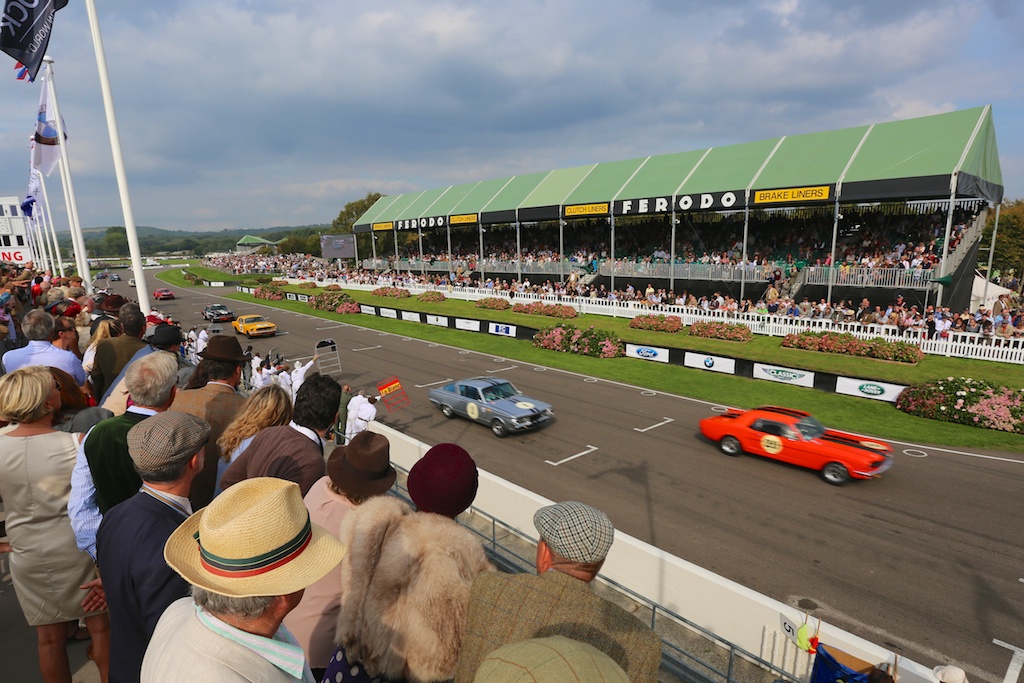
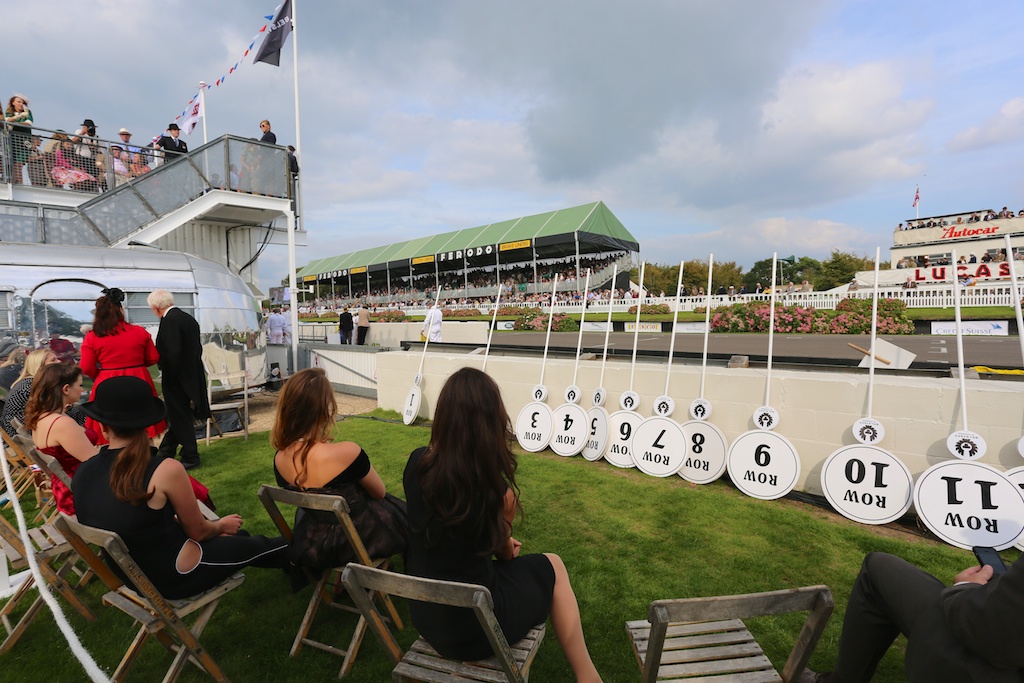
The scene consists of cars and vintage style of every stripe. The Goodwood Revival in England is like nothing I have ever seen. I’ve been to vintage clothing centric events and I’ve been to amazing car gatherings, but this blows everything I have seen out of the water. Earlier this year I went to The Quail in Carmel, California and to the Pebble Beach Concours d’Elegance and neither give off the nice vibes that Goodwood does. I’ve frankly never been to anything in America that is like this event. If you are someone who likes vintage style, beautiful rare autos and the spectacular surroundings of Chichester, England, then mark this on your list.



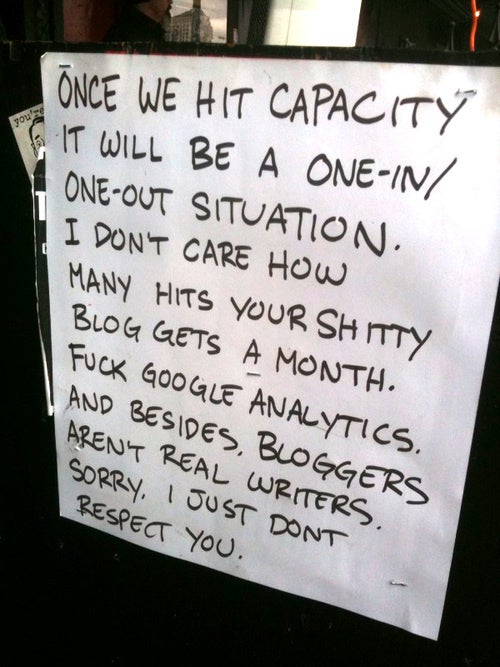
A few things that stood out at the Goodwood Revival. First, there was quite a bit of marketing, but the major modern car companies didn’t have much of a presence. Everything that was sponsored was done so in a very restrained way. That’s to not to say that it wasn’t commercial, it certainly was. But attendees had a pretty wide birth to enjoy the quirky style and reenacted elements of the event unobstructed by sponsors. And there was a certain amount of weird-ness that seemed to be encouraged. There was an amazing track-side hospitality area where sponsors and other important people (as professional interlopers we managed to get back there too. “I used to be an important blogger in America” I told them to little avail. Just kidding I didn’t actually say that – that’s the type of statement that makes me cringe. This girl/guy has it right.) Then the fellas from Private White V.C. pulled us back to the hospitality area so we could enjoy tiny sandwiches, free booze and great views of the action. In order to get there you have to walk through this insane “War Room” thing (which is why I am telling you about the special areas in the first palce) with WWII reenactors performing as if they are in a battlefield HQ. It was both absurd and incredible at the same time.
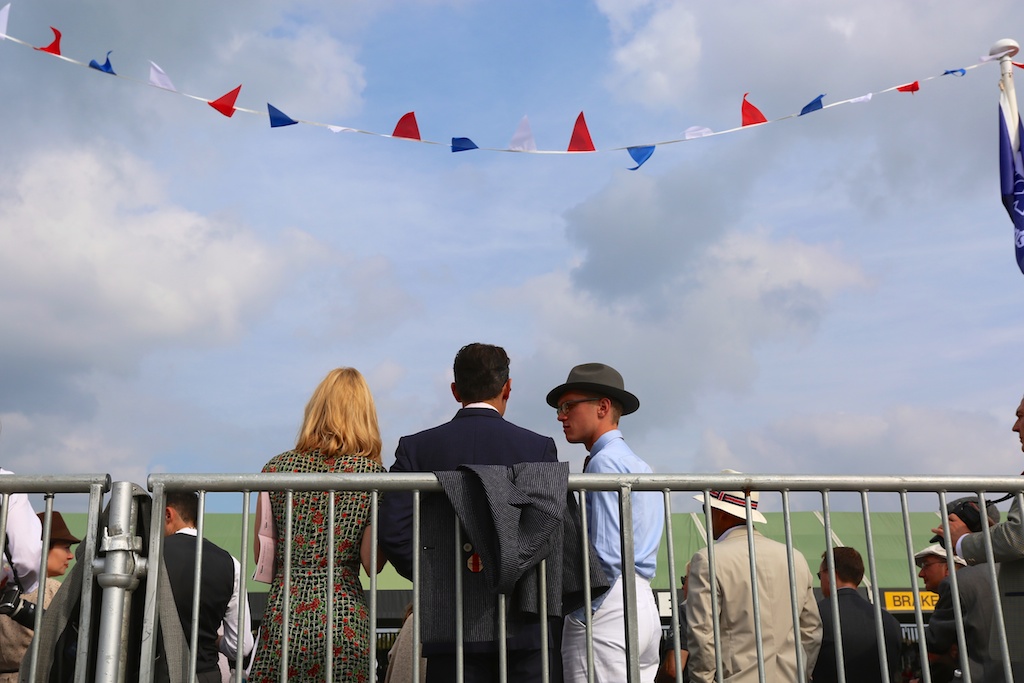
Having never been to an auto event where so many people got dressed up in such an amazing way, Goodwood was truly an eye-opening experience. At this point I had thought I had seen it all when it comes to menswear, but this was an unexpected and delightful encounter. I spent half of the day walking around being overwhelmed by the cars (and oh man, the cars!) and being taken back by both the guys and girls in their awesome outfits. I didn’t even see any Japanese street style photographers or bloggers. Only great style, Men’s File and a bunch of well-dressed folks enjoying a perfect September Saturday in the English countryside. It’s good to know that there are still rocks to un-turn. I just hope a bunch of American bloggers don’t catch on. Like that Michael Williams guy from ACL. He’s the worst.












Our hosts Nick Ashley (with daughter) and Jame Eden from Private White V.C. Nick was getting his toga ready for the Goodwood Ball that was taking place that evening.


The Swiss people may vote to once again partially back their currency with gold. This is a fantastically good idea. I know I will find a way to own at least a few Swiss francs if that happens.


We could all use a little less stress at work, but for a lot of people that stress leads to serious consequences. Product designer Tomomi Sayuda knows those consequences first-hand: her father committed suicide in 1995 due to work-related stress. Her Desktop Fireworks installation art is a fun reminder that we all need a bit of a break in the midst of a pressure-filled day.

Desktop Fireworks is an office desk set that looks pretty mundane on the surface. There are a set of drawers, a mug, a pencil cup, some binders, a memo board, and a tape dispenser. And then there’s that big red button that practically screams “Push Me!”

In a moment of mounting stress, the worker pushes the button to unleash a short but sweet stress-relieving party for one. Disco lights flash, confetti shoots up, bubbles waft around, and for a few brief moments the office seems like an ultra-exclusive club and you’re the only one who got in.
The installation might be humorous in nature, but it is a reminder to everyone that work isn’t everything. You need to indulge your human side by having some fun during the work day, even if it is just for a few minutes. The effect of this little mini-break can be surprisingly positive on a stressed-out office worker.






To hear the incessant liberal bleating about the Koch Brothers - Senator Harry Reid commandeers the floor of the World's Greatest Deliberative Body at least once a week to rail against them, secure in the knowledge his targets can't sue him for slander as long as he's stealing America's time for his little tirades - you'd think they were biggest source of corrupting political money in America. In fact, they come in about sixty-eight slots down the list of big givers. The top ten are all Democrat donors, quite a few of them labor unions.
And then you've got the Left's billionaire sugar daddies. Harry Reid and his ilk never have a bad word to say about them, for some reason. Just try to imagine if the Koch Brothers were involved in the kind of skulduggery the Media Research Center finds that lovable old liberal grandpa George Soros financing:
Legal battles against state governor’s with higher political aspirations keep cropping up. But looking deeper into attacks on Republican governors from Texas, Wisconsin and Louisiana reveals George Soros’ checkbook was behind it all – but the news media aren’t about to point that out.
The group that first filed an indictment charge against Texas Gov. Rick Perry was funded by Soros, the liberal billionaire, but the trail of his money didn’t end there. Both the recall election for Wisconsin Gov. Scott Walker and an even less successful recall attempt for Louisiana Gov. Bobby Jindal were rooted in Soros-funded groups. Between them, these three potential Republican presidential candidates were targeted by groups receiving more than $6.3 million from Soros.
The media should be reporting on this connection, but so far they have completely ignored it. None of the broadcast news coverage of Walker’s recall election or Perry’s indictment on ABC, CBS or NBC have mentioned Soros. Attempts to recall Jindal weren’t mentioned by the networks, although left-wing outlets like The Huffington Post tried to promote them.
Yes, I somehow think that if the Kochs were surreptitiously funding groups that launched political assassinations against successful Democrat governors - absurdly abusing the authority of state officials in the effort to indict Governor Perry for threatening to defund the office of an obnoxious drunk who threatened the cops who busted her, or the mind-boggling witch hunt in Wisconsin that never came up with a speck of dirt on Governor Walker, but intimidated conservatives in the state so thoroughly that he's now in a neck-and-neck race for re-election - we'd be hearing a lot about it in the media, to say nothing of the national resources congressional Democrats would hijack to stage theatrical productions on Capitol Hill.
The Kochs have never even contemplated anything like the shadowy spiderweb of pressure groups and pliant Democrat officials Soros has created, or environmental extremist Tom Steyer's flat-out cash-on-the-barrelhead offer to purchase the Democrat Party. It's standard procedure in politics to claim that the other side's money is all "dark" and scary, their allies are all nefarious "special interests," and their supporters are short-sighted and selfish. But the drama emanating from liberals ever since the Citizens United decision is an eye-rolling embarrassment that can only be swallowed by those who pretend the likes of Soros, Steyer, and numerous other left-wing cash dispensers don't exist at all.


Businesses can’t seem to stop hackers looking to steal customer data. The list of companies prayed on has grown long indeed and includes well known names like JP Morgan, Home Depot and Target. And that’s just what we know about. Every unexplained website outage is met with raised eyebrows. Was it a glitch? Was the site hacked? And when would they us if the latter was true? Everyone seems to agree that companies should do more to protect the people who’ve entrusted them with valuable data, but the trend of high-profile hacks seems likely to continue in the near future. For now, consumers...
Read the full article: Store You Shop At Get Hacked? Here’s What To Do

When Anheuser-Busch speaks, the NFL listens.
The leading television sponsor of the last five Super Bowls has chastised the league for its handling of player misbehavior. Video of three-time Pro Bowler Ray Rice knocking out the woman he subsequently married, the indictment of 2012 NFL MVP Adrian Peterson on a child-abuse charge, and the suspension of Indianapolis Colts owner Jim Irsay for driving under the influence with a large amount of narcotics in his car rank as a few of the more embarrassing headlines that have migrated from the sports page to the front page in recent weeks.
"We are disappointed and increasingly concerned by the recent incidents that have overshadowed this NFL season," the company said on its website. "We are not yet satisfied with the league’s handling of behaviors that so clearly go against our own company culture and moral code. We have shared our concerns and expectations with the league."
The NFL remains mute on Anheuser-Busch's influence on "behaviors that so clearly go against" the league's "company culture and moral code." NFL spokesman Brian McCarthy did say of the alcohol corporation's scolding: "We understand. We are taking action and there will be much more to come."
The beer behemoth, like Pepsi, Campbell's Soup, McDonald's, and other companies publicly expressing displeasure, has yet to put its money where its mouth is. A-B's American-market leader Bud Light replaced Coors Light as the official beer of the NFL in 2011. Anheuser-Busch finds itself in the middle of a six-year, $1.2 billion dollar deal with the league that enables it to display the NFL shield on its containers, among other perks. Anheuser-Busch's products serve as a ubiquitous presence in NFL stadiums and for television viewers at home. The symbiotic relationship sees the NFL gobble up Anheuser-Busch cash while the league's fans guzzle down Budweiser, Bud Light, Busch, Michelob, and other A-B brands in parking lots, on couches, and in the stands.
“The NFL is all about the fan, about action, and about fans getting together,” A-B CEO Carlos Brito declared upon agreeing to the deal making Bud Light the NFL's official beer three years ago. “And as such, it is perfectly aligned with the Bud Light brand.”


Tuesday at a joint hearing of the Senate Health, Education, Labor and Pensions Committee and Senate Appropriations Subcommittee on the Ebola outbreak in West Africa, the director of the Centers for Disease Control and Prevention Dr. Beth Bell, visibly shocked Sens. Barbara Mikulski (D-ML) and Tom Harkin (D-IA) with the admission that to this point only USAID is in charge of running the operation to combat the outbreak.
The USAID is the Office of U.S. Foreign Disaster Assistance, which is the government agency that works to end extreme global poverty. The agency also is in charge of DART, the deployment Disaster Assistance Response Team, which is meant to be a rapid response team of experts deployable within hours of an emergency.
"'It's a disaster when a disaster is declared," she said.
Follow Pam Key on Twitter @pamkeyNEN


The FBI's Next Generation Identification (NGI) system is now fully operational, after more than three years of development. The bureau announced today that development on the project is complete, and it would be rolling out new features for ongoing criminal notifications as well as a controversial facial recognition feature called the Interstate Photo System, or IPS. IPS will serve as "an image-searching capability of photographs associated with criminal identities," according to the release.

On September 15, we mark the seventieth anniversary of the landings on Peleliu island in the Palau chain by the First U.S. Marine Division during the Pacific War. This was one of those battles that often gets passed over in our national memory. Those marginally knowledgeable of World War II will no doubt be familiar with places like Normandy, Iwo Jima, or Guadalcanal.
But like many of the other battles into which American boys were thrown, few but the most ardent history buffs can relay much, if anything, about the agony that was the struggle for Peleliu. Considered vital to protect MacArthur’s flank in his advance towards the Philippines six hundred miles farther west, the First Marine Division was sent to this 14 square-mile dot in the Pacific to seize its airfield and clear the island of its estimated 11,000 Japanese defenders. The operation, prophetically code-named Stalemate II, was expected to last a mere three days.
It didn’t…
The Japanese, mimicking a new and bloody strategy first utilized on Biak several months before, did not meet the Marines on the beaches with anything but a skirmish line of machine guns, mortars, and well-sighted artillery. (Although for the men who landed ashore that day, the carnage and mayhem even this initial action inflicted would haunt them forever.) The real battle for Peleliu, however, would be fought against a tenacious enemy burrowed deep into the island’s rock-hard coral ridges, hidden within a network of caves, bunkers, pillboxes, and interconnected tunnels that were impervious to even the heaviest naval gunfire. The defenders had to be rooted out like rats, one position at a time, with small arms, grenades, demolition charges and, most terrible, flamethrowers. It was a brutal affair that went on for seventy-three tortuous days; the Marines and their Army replacements suffered crippling casualties. When a journalist caught up with an exhausted file of Marines rotating off the sheer coral escarpments that dominated the island, he asked them if this was the 1st Marine Regiment. “Mac, there ain’t no more 1st Marines,” a grim veteran replied.
Adding to the terror of battle itself, the Americans found themselves in a struggle with Peleliu’s forbidding topography. The coral base of the island was too hard to dig adequate foxholes, or bury the dead, so many an American had to share what little shelter he could find with bloating, maggot, and fly-infested corpses…of enemy and friend alike. Adding to the misery, the temperature at times rose to 115 degrees in the shade, the ever-present vile stench of rotting flesh and swamp was in the humid air, and fresh water was scarce due to supply problems. For many veterans who fought throughout the Pacific—the First Marine Division saw action at Guadalcanal, Cape Gloucester, and Okinawa—Peleliu remained the battle that stayed with them in the sheer savagery of the action, hostility of the terrain, and abject misery of the conditions.
The visceral hatred such protracted “get or get got” fighting engendered in the combatants gave this and other Pacific battles a distinctly personal and barbaric character. The Japanese were driven by a fanaticism to die for their god emperor—and a military code that viewed surrender as the worst of disgraces. Trapped on an island with no escape, the Japanese steeled themselves to sell their lives dearly, vowing to fight to the last man and take as many Americans with them. For the Marines and soldiers, any pretense of quarter was quickly abandoned as they came upon the mutilated bodies of captured comrades who had been sadistically tortured to death. And given the Japanese penchant for trickery by feigning injury and death only to blow up with hidden grenades both themselves and the unsuspecting corpsmen or medic ostensibly coming their aid, no one was in a mood to take prisoners. Marine veteran Eugene Sledge likened Peleliu to “…two scorpions in a bottle. One was annihilated, the other nearly so.”
When on November 27, after more than two months of non-stop fighting from one end of the superheated rocky island to the other, Peleliu was finally declared secure, both sides had paid a horrific price for their efforts. The fine First Marine Division was shattered. It lost 1,252 KIA and 5,274 wounded. The Army’s 81st Infantry Division lost another 542 KIA and 2,736 wounded. This was the highest casualty rate of any amphibious operation of the war. The Japanese garrison was almost entirely wiped out. Only 202 of the 11,000 defenders were taken alive...and of them only 19 were Japanese military; the rest were Korean and Okinawan laborers.
Tragically, it is debatable whether Peleliu ever needed to be captured at all. The main purpose of the operation, to secure an aerodrome from which to cover the landings on Mindanao, was rendered unnecessary when MacArthur opted to bypass Mindanao and strike first at Leyte in the central Philippines. Admiral Halsey, in fact, had recommended cancellation of the landings in favor of using the Marines on Leyte. But, as author William Manchester, a wounded Pacific War Marine veteran himself, would bitterly write: “[Admiral] Nimitz decided it was too late to recall the Palau force and 9,171 (sic) Americans fell there, tragically and pointlessly.” Since it was expected to be a quick fight, few journalists covered the landings. And those who did found their stories overshadowed by events in the Philippines and Europe. So Peleliu, perhaps the most brutal battle of our most brutal war, remains in relative obscurity. The men who fought there deserve better.
Whether or not the Marines and soldiers of Peleliu suffered and died needlessly, there is no debating they successfully carried out their mission with extraordinary bravery, skill, and perseverance in one of the most inhospitable battlefields onto which men-at-arms have ever been placed, against an enemy whose homicidal fanaticism was matched only by their skill as warriors. We owe this moment, then, to the men of Peleliu, many of whom have now died from causes far removed from that terrible battlefield, to remember their sacrifice, to honor their courage, and give them one final salute as they move into their twilight. Indeed, they should know they are not forgotten...that the seminal moment of their young lives, one they carried to the end of their days, has not slipped away into the collective amnesia of a peaceful society that can never comprehend what happened there and what they overcame to move the country one step closer to a just victory and lasting peace.


As President Obama launches a new campaign against the brutal ISIS militants in Iraq, he may not want to call it a war, but it sure looks like one. And he's getting a lot of advice from former military commanders, both directly and through the news media.
Speaking to Fox News on Sept. 10 (as quoted by Byron York in the Washington Examiner), retired Gen. Jack Keane, a former Army Vice Chief of Staff, said, "The ground campaign is what is going to defeat ISIS in the end. In that ground campaign, we are totally dependent on surrogate forces. Whether we can do this or not, nobody knows."
In the same article, retired Gen. David Petraeus was quoted as saying earlier in the summer, "This cannot be the United States being the air force for Shia militias or Shia-on-Sunni Arab fight. It has to be a fight of all of Iraq against extremists, who do happen to be Sunni Arabs."
Both Keane and Petraeus are among the 11 active and retired U.S. Army generals featured in the National Geographic Channel documentary American War Generals, premiering Sunday, Sept. 14, at 8 p.m. ET/PT in the U.S. (and globally later in the year).
Joining them are retired Gens. Colin Powell, Stanley A. McChrystal, Wesley Clark, George William Casey, Barry McCaffrey; and retired Lt. Gen. Karl Eikenberry. Still on active duty are Gen. Raymond Odierno, Lt. Gen. Michael T. Flynn, and Major Gen. Herbert R. McMaster.
From Vietnam to Iraq and Afghanistan, they review a half-century of American military engagements and strategy, in their own words.
Speaking to Breitbart News and assembled press in July in Beverly Hills, California, Tresha Mabile, who shares executive-producer credits with her husband, author Peter Bergen, explained her philosophy and how she was adapting to changing circumstances.
"Two of the main generals," she said, "Gen. Petraeus and Gen. H.R. McMaster, had settled cities of Mosul and Tal Afar by using counterinsurgency tactics, and those two cities have been taken over by ISIS. So we brought the show up to date and may update it [more]."
She continued, "The generals do the talking, and their stories are so fascinating, you don't hear that much from us. We're pulling it together and stitching the pieces together. But starting with the Vietnam War -- they were all involved in the Vietnam War, and the fact that the Vietnam War sort of looms of the thinking, and how the military reacts in the future to conflicts.
"But it's not us telling you about this story. It's their stories and their words."
For example, talking about Operation Iraqi Freedom, McChrystal said, "It's funny, the U.S. military and the U.S. politicians never talked about losing, but we absolutely knew we could lose. You can lose battles, and ultimately you can lose a war. And in the summer of 2005, that was starkly apparent to me and the people that I served with."
Said McCaffrey, "I think taking down Saddam was actually the right thing to do. Screwing up the military operation was not. So, I have a permanent sense of hatred for that Secretary Rumsfeld in particular, and these people that got in there and convinced themselves that they could do this with a minimalist approach of military power."
But in the end, it's all down to the troops.
As Clark observed, "Winning starts at the bottom. A soldier can overcome incredible issues if he's well-trained and competent and can put steel on target. That's the difference in the battle."
Also on hand in July was McCaffrey, who was blunt in discussing what he felt were failures of Vietnam and what effect they have had over the years, and what effect forgetting the lessons of Vietnam may have.
"I think we're on the verge, by the way," he said, "of having the sane thing happen. These kids have been out there now fighting for 12 years. This has been a bloody conflict. We went into downtown Fallujah on the second takedown, and in four days, had 1,200 people killed or wounded Marines and Army. I think there was a sense of caution.
"By the ay, we're also seeing now generals come along that didn't serve in Vietnam. None of them. And in many cases, they didn't fight as company-grade officers. That, in a major way, modifies your view of warfare. Most of us simply want to find other ways to deal with international phenomena, with economic aid, covert action, diplomatic leverage.
"Because, when you pick up the military tool, you're never sure how it's going to come out."


On September 13, the 20th anniversary of the signing of the federal assault weapons ban, The New York Times ran a column explaining that the very term "assault weapon" is one the "Democrats created" in the 1990s in order to ban "a politically defined category of guns."
Moreover, the Times points out that the threat posed by the private ownership of "assault weapons" is mythological in comparison to FBI stats on the actual use of such guns in crime.
According to the NYT, America was "suffering from a spike in gun crime...in the early 1990s" so "Democrats created and banned [an entire] category of guns." The ban lasted from 1994 to 2004 and although crime fell during that time, a "detailed study found no proof" the decline was due to the ban.
Hard numbers showed the percentage of "assault weapons" recovered by police during the ban only rose from 1 percent to 2 percent.
On top of all this, the Times points out that "assault weapons" are not the gun of choice for criminals anyway--and never have been. "In 2012, only 322 people were murdered with any kind of rifle, FBI data shows." And as Breitbart News reported on January 15, 2013, deaths in which an "assault rifle" were involved constituted less than .012 percent of the overall deaths in America in 2011.
The New York Times did report one clear outcome of the "assault weapons" ban in 1994--Democrats got creamed at the polls in November.
Follow AWR Hawkins on Twitter @AWRHawkins Reach him directly at awrhawkins@breitbart.com.


Fifteen years ago, a drunk driver left Ben Rothwell for dead. The Kenosha cage fighter—34-9 in mixed-martial arts (MMA), 1-0 against the Grim Reaper—now fights for a shot at the UFC heavyweight title.
The long, rocky road to stardom started on the road to his parents’ house. “He was driving a Ford 250,” Rothwell remembers. “I was driving a Hyundai Elantra. I didn’t stand much of a chance.”
Tomorrow looked bright the day Ben Rothwell went dark. Three weeks earlier, the 17-year-old had entered, and won, his first amateur MMA tournament. In Cedar Rapids that summer, he witnessed his future at UFC 21, meeting several fighters and hearing his life’s calling over the roar of the crowd. After screwing around in high school, martial arts had screwed Rothwell’s head back on straight. He was coming from a good place, literally and figuratively, that terrible night.
“We were coming home from, of all things, a church festival,” Rothwell tells Breitbart Sports. “I was turning into my driveway at my parents’ house. He was driving a Ford 250 approximately 110 miles-an-hour. He knocked down a tree. On that impact, my friend was on the wrong side.” The crash sent Rothwell into a coma, broke several ribs, and left his head battered. Ben’s buddy wasn’t so fortunate, subsequently dying from his injuries.
The car that killed Ben’s friend stopped. Passengers swiftly surveyed the scene. And just as hastily, they departed it. They unwittingly left a souvenir from their death ride for the police. Rothwell notes, “The license plate fell off in my yard.”
At 17, after being abandoned on the side of the road, Ben faced a crossroads. “I was desperately searching for something,” the heavyweight remembers. “I knew then what I know now. I knew I was going to be one of the best fighters in the world. To not show the world that—it bothered me so much. As hurt as I was, I got back into training.”
In 2001, less than two years after surviving a deadly automobile accident, Rothwell debuted professionally. He coaxed a first-round corner stoppage after administering punishment. “I was happy making a $1,000,” the 260-pounder reminisces about his early fights on the MMA circuit. He fought for low to next-to-no pay and made ends meet working in a body shop, in construction, and waiting tables. Not until 25 fights into his career, when the pay enabled him to quit his day jobs, did Ben consider himself a professional. He made $10,000 knocking out Dan Bobish in Columbus, Ohio in 2006. “Guys are complaining about working 40 hours a week,” Rothwell says of up-and-coming MMA fighters. “Cry me a river. I paid my dues.”
After wins over Krzysztof Soszyński, Roy “Big Country” Nelson, and former UFC heavyweight champion Ricco Rodriguez in the International Fight League, Rothwell heard the UFC’s call. His up-and-down performances in the promotion’s violent and volatile heavyweight division made him a decided underdog earlier this month against Alistair Overeem, a hulking Dutchman owning dominant victories over Brock Lesnar, Frank Mir, and Fabricio Werdum. Rothwell had faced long odds before.
Overeem would look comfortable on the cover of Muscle & Fitness; Ben, on a tractor shirtless wearing overalls. Whether based on their body of work or their bodies, pundits counted Ben Rothwell out before he even stepped in the octagon with Overeem. He insists, “I‘ve got to be the guy who shows everyone: don’t judge a book by its cover.”

When the pair meet in the octagon on September 5, Overeem initially affirms the predictions of commentators with jabbing kicks to Ben’s legs, a knee to Ben’s midsection, and several punches that crash into Ben’s face. After Big Ben awkwardly blocked an Overeem kick, both fighters assume it broken. Without the cage fighting allowing timeouts or substitutions like other sports, Ben did what he has always done: fight. About the busted-up limb, Rothwell believes: “Everything happens for a reason.” Sensing his opponent’s right side vulnerable, Overeem went to work. Rothwell explains, “He claims he heard the snap, which enticed him to throw his left, which led me to throw my right.” Rothwell landed a massive overhand right to the side of the head which felled the former Strikeforce champion. Ben followed him to the mat with hammerfists that convinced referee Keith Peterson to call a halt. The same right arm unanimously believed broken by the combatants dramatically delivered the knockdown blow.
The Wisconsin contingent that traveled to Foxwoods Resort Casino for the fight erupts. Big Ben dances an awkward jig. His wife, seated behind press row, fights back tears of joy when her husband dedicates the victory to her. “She was fighting too,” Rothwell tells Breitbart Sports. “She put in as much into my training camp as I did.”
And the training partners and fighting enthusiasts in attendance from Rothwell MMA appear only slightly less overcome than Ben’s wife. “That’s why they’re there,” the gym’s namesake explains. “I built a gym based on a family atmosphere. It’s positive energy. I believe in it.”
That positive energy, adrenaline in the victor’s case, helped fuel Ben after his body tried to hit the brakes. “After the fight, I had some pretty weird looking swelling,” Rothwell explains. “The doctor there immediately said it was broken.” But an x-ray overruled the assessments of the two professional punishers and the one professional healer. “I’ve got strong bones.”

The Badger State brawler, and a considerable number of those covering the sport, figure he stands one win away from a championship fight. “The fight that intrigues me the most, the only fight that I want is JDS,” Rothwell tells Breitbart Sports. “Beating [Junior Dos Santos],” he gathers, “there’s no dispute. To me, that’s the only fight that makes sense.” Should injuries or matchmakers prevent the only man to knock out Cain Velasquez from knocking on Rothwell’s door, he sees another up-and-coming Midwestern heavyweight, Stipe Miocic, as a challenger with the credentials to put him in a title fight. “Stipe would be my next pick.”
Rothwell clearly relished proving the pundits wrong in his stunning, Cinderella Man victory against Overeem. But he thinks it’s time for the mixed-martial-arts world to recognize that it’s his time. “I guarantee I’m not going to be a five-to-one underdog again no matter who I fight,” Rothwell reasons. But should the oddsmakers discount his chances, Ben has grown accustomed to the role of underdog. “I’ve been counted out lots of times.”
Daniel J. Flynn, the author of The War on Football: Saving America’s Game (Regnery, 2013), edits Breitbart Sports.
Photo credits: Daniel Flynn, Todd Monaghan


Amidst the kerfuffle of the Scottish referendum, a Private Members’ Bill brought by Liberal Democrat MP Michael Moore passed relatively unnoticed through Britain's House of Commons on Friday.
Moore’s International Development (Official Development Assistance Target) Bill will enshrine in law a requirement to spend 0.7 percent of our annual Gross National Income on Foreign Aid. Right now, that’s about £11 billion. Not only that, but the money will be ring-fenced.
I always get nervous when taxpayers’ money is ring-fenced for anything unless there’s a clear need for a specific amount to meet nailed-down objectives. Otherwise, it reminds me of my days back at the BBC, when two decorators came in to paint the walls of the Radio WM newsroom just a couple of weeks before the building was due to be demolished. Well, there was money left in the budget wasn’t there? The fatuous edict that the money had to be spent, come what may, totally overrode the utter idiocy of actually spending it.
480 of our distinguished elected representatives didn’t bother to show up to vote on Moore’s Bill. Those that did voted it through by 164 to six, thereby showing themselves up to be as senseless and out of touch as whichever hair-brained BBC manager sent those decorators to emulsion our office.
Among those who voted against was Philip Davies, who rightly called the bill a "sop" to the "Guardian-reading, sandal-wearing, lentil munching liberals.”
Sir Gerald Howarth asked why international aid spending was being singled out when defence spending was "allowed to go hang?" Sir Edward Leigh hit the nail on the head, pointing out it should not be about "how much we spend on something" but the "value for money of what we achieve."
They were whistling in the wind. Since the start of the economic crisis, Britain has been the only G8 country to increase its international aid budget and the Department for International Development (DFID), a profligate spender, escaped the cuts faced by other departments, quite wrongly, in my view.
The TaxPayers’ Alliance reckons foreign aid costs £500 per household. We could be getting much better value for money.
We could stop sending money to Brazil, which has its own foreign aid budget. Why should we fund countries that can afford to fund other countries? And why should China get any of our money? Not only is the country’s human rights’ record appalling, they’ve got £2 trillion in reserves in their own national bank account.
The issue of where the money goes needs greater scrutiny too. Africa has received some $400 billion in aid over the last 40 years yet it’s still the poorest continent on the planet. Yes, many projects are vital, especially those which provide emergency disaster relief and vaccination programmes for instance, but really: £1.2million towards the privatisation of utilities in Nigeria? That’s not aid, that’s politics.
Then there’s the out and out corruption. The ‘urban myths’ about British taxpayers’ money going to buy dictators’ jets that are actually true - Uganda’s President bought a £30million Gulfstream in the same year we gave him £70million. And when you and I helped fund the £500 million handed out by the European Union to Egypt to fight corruption, the inevitable happened. Yes, the money disappeared without a trace.
Meanwhile, charity desperately needed here at home isn’t forthcoming. When the Somerset levels flooded in 2014 for instance, the government refused to divert money from the foreign aid budget to stem the quite literal tide.
Few would begrudge handouts as part of our international civic duty, but Michael Moore’s Bill is likely to fuel a deepening public resentment about how much we give, to whom, and how money is spent.
I see no justification for making foreign aid payments to countries with poor human rights’ records, or to regimes that have previously abused or misused British aid; they shouldn’t get a second chance to fritter it away. Yet Moore’s Bill, if it passes its ongoing journey through Committee and the House of Lords, is likely to mean DIFD will find itself with more money than it knows what to do with and checks and balances will therefore inevitably slip.
I very much doubt the Bill will deliver ‘for the poorest in the world’ as Moore claims it will, because it is likely to make Foreign Aid spend less rather than more accountable. The people it is designed to help are almost certainly less likely to get to see any of it.
Suzanne Evans is Deputy Chairman of UKIP and the party’s PPC for Shrewsbury and Atcham.

The kids are back in school, which means it's time to meticulously plan every moment of their lives and overreact about every real and imagined danger they face as soon as they leave the house...or so the conventional wisdom goes.
Free Range Kids' doyenne, Lenore Skenazy, explains to Reason TV how to resist the forces of fear and authoritarianism that would turn many parents into criminals simply for occasionally trusting their kids to be safe out of their sight.
"Stop Criminalizing Parenting: Free Range Kids' Lenore Skenazy on Our Irrational Fears over Child Safety." About 12 minutes. Produced by Anthony L. Fisher.
Original release date was September 10, 2014 and the original writeup is below.
"People say, 'Now that I can get arrested any time I let my child play outside or walk to school, I won't do it. And that's the opposite of what Free Range Kids is about," says Lenore Skenazy, proprietor of the blog FreeRangeKids.com. She adds, "Free Range Kids is about getting so many kids outside, that it doesn't seem strange to see a child playing in the park."
In a conversation with Reason TV's Nick Gillespie, Skenazy debunks the myth that children left unattended in a car for a few minutes are in mortal danger, decries "busybodies" who feel a civic duty to call the police when they see an unaccompanied child, and offers helpful tools for terrified parents on how to let their kids enjoy more freedom to explore the world.
About 12 minutes.
Produced by Anthony L. Fisher. Camera by Jim Epstein and Fisher, with help from Brett Crudgington.
Music: "Applicant" by The Matt Kurz One (http://www.angelfire.com/crazy/mattkurz/)
Scroll down for downloable versions and subscribe to Reason TV's YouTube Channel for notifications when new material goes live.

I have always hated the term “homeland security.” What are we part of Bismark’s Germany? That aside the name of the agency isn’t the only thing wrong with the agency. There’s the whole “that it exists at all” thing.

In January, President Barack Obama dismissed the Islamic State (ISIS) as merely a “JV team.” Last week, Obama reversed that position and told NBC News ISIS is “not a JV team.” Similarly, two weeks ago Obama said the Islamic State can be shrunk to “a manageable problem.” Then on Friday, as NBC News reported, “The Obama administration said for the first time Friday that the United States is ‘at war’ with ISIS militants.”
Given the Administration’s contradictory and muddled messages, here, then, are seven ISIS facts:
1. ISIS Began in the 1990s
While the Islamic State may be new to some Americans, as The Atlantic notes, “The group that recently renamed itself simply ‘Islamic State’ has existed under various names and in various shapes since the early 1990s.” The Washington Institute for Near East Policy notes that in its 1999 incarnation, ISIS was known as Jamaat al-Tawhid wa-l-Jihad (JTWJ).
2. ISIS is Led by a Man Released from a U.S. Detention Camp in 2009
The leader of ISIS is Abu Bakr al-Baghdadi. Baghdadi was released from the U.S. detention camp named Camp Bucca near the Kuwaiti border in 2009. When he was freed, Baghdadi reportedly told U.S. Army reservists from Long Island, New York, “I’ll see you guys in New York.”
3. ISIS is the Richest Terror Organization in the World
Through its seizure of oilfields, banks, weapons, and other resources, ISIS has amassed a war chest estimated to total $2 billion, according to NBC News. Sen. Dianne Feinstein (D-CA) warns that “the threat ISIS poses cannot be overstated.” Feinstein, who has criticized President Barack Obama for being “too cautious” in confronting ISIS, calls the terror group “the most vicious, well-funded and militant terrorist organization we have ever seen.”
4. The Number of ISIS Fighters Has Tripled to 31,500
On Friday, a CIA spokesman told CNN that the Islamic State “can muster between 20,000 and 31,500 fighters across Iraq and Syria.” Months prior, U.S. official put the figure at just 10,000.
5. ISIS has an Estimated 2,000 Westerners in its Ranks
Through its sophisticated social media recruitment and other means, ISIS has successfully recruited 2,000 Westerners—a key terror asset whose passports could allow re-entry into Western countries to carry out attacks. Intelligence reports indicate that over 100 Americans have enlisted as Islamic State fighters. Sen. Ted Cruz (R-TX) and other Republican members of Congress have advanced legislation to “revoke their passports and strip them of their U.S. citizenship,” reports the Houston Chronicle. Last week, the Daily Mail reported that at least three Minnesota women have traveled to Syria to assist ISIS fighters. Two American ISIS members have already been killed, both from Minnesota.
6. ISIS Now Controls 35,000 Square Miles in Iraq and Syria
In its drive to expand the caliphate, ISIS now controls 35,000 square miles of territory—an area roughly the size of Indiana. As former Pentagon official Janine Davidson told the New Yorker, “ISIS now controls a volume of resources and territory unmatched in the history of extremist organizations.”
7. In Addition to Beheadings, ISIS Has Carried Out Mass Executions and Rapes
In addition to ISIS’s videotaped beheading of American journalists James Foley and Steven Sotloff and British aid worker David Haines, the terror group has slaughtered innocents in mass killings, raped women, abducted thousands of women and girls for use as sex slaves, and, according to the State Department, has forced parents to watch as ISIS terrorists “beat their children to coerce the women into converting to Islam.”