
Shared posts

21 Oct 01:56

Dim The Lights | NYC’s Bygone Music Venues

by Jake Gallagher

Ramones_by_ian_dickson_1977

On any given night within New York’s incalculable array of musical venues, you can find pretty much every act imaginable. From whisper quiet jazz quartets, to over-distorted art rockers, to spoken word slam poets backed by garbage can percussionists, the nightly roster of musical acts can be as diverse as the city itself.

Regardless of your melodic tastes, there’s bound to be a show each night that you’ll find at the very least amusing, but honestly the venues themselves all fall a bit flat. Music clubs in New York used to have as much (if not far more) character as the bands that played in them, but nowadays, these venues just sort of blend together. Whether big or small they all just feel boring, if not altogether sterile. So let’s reset the record and raise a glass, or at least raise the volume to New York’s rowdy, raucous, rough-around-the-edges clubs of yore.
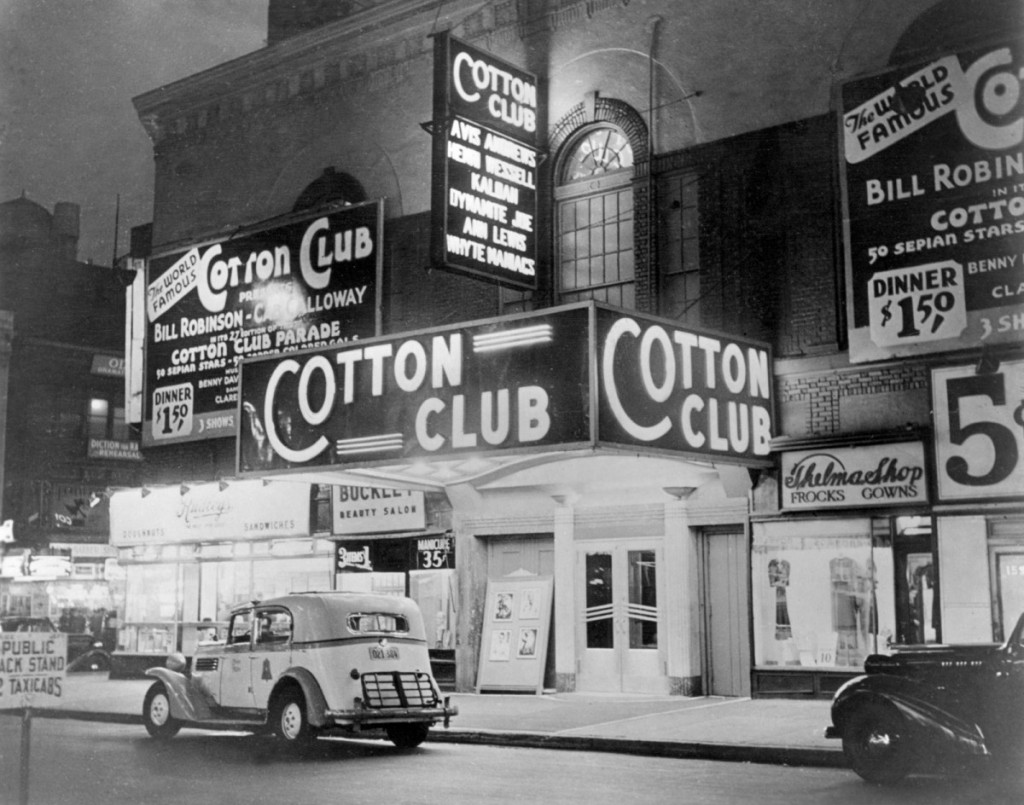
Cotton Club

The Cotton Club

Opened: 1923

Closed: 1940

Location: 644 Lenox Avenue

Famous Performers: Cab Calloway, Duke Ellington, Louis Armstrong, Count Basie, Fats Waller, Avon Long, Aida Ward, The Dandridge Sisters, Billie Holiday, Lena Horne, Earl “Snakehips” Tucker

Fact: Despite being located in Harlem, and showcasing many black performers, The Cotton Club actually had a strict “whites only” policy.

Savoy

Savoy Ballroom

Opened: 1926

Closed: 1958

Location: 596 Lenox Avenue

Famous Performers: Chick Webb, Ella Fitzgerald, Fess Williams, Teddy Hill, Dizzy Gillespie, Charlie Parker, Art Blakey, Thelonious Monk

Fact: Back when dance fads were popular, The Flying Charleston, The Lindy Hop, The Stomp, The Big Apple, and The Jitterbug Jive were all invented at the Savoy Ballroom.

HalfNote copy

Half Note

Opened: 1957

Closed: 1972

Location: 289 Hudson Street

Famous Performers: Budd Johnson, Buddy Tate, Al Cohn, Zoot Sims, John Coltrane, Charles Mingus, Wes Montgomery, Herbie Mann, Cannonball Adderley, Anita O’Day, Billie Holiday, Judy Garland

Fact: Owner Mike Canterino was one of the first promoters to book integrated acts, also allowing them to play as long as they wanted, breaking the normal forty on/twenty off pattern.

Gaslight copy

The Gaslight Cafe

Opened: 1958

Closed: 1971

Location: 116 MacDougal Street

Famous Performers: Bill Cosby, Bob Dylan, Bruce Springsteen, Richie Havens, Jimi Hendrix, Eric Clapton, Link Wray, Bonnie Raitt

Fact: The club started out as a performance space for Beat poets including Allen Ginsberg.

Palladium copy

The Palladium

Opened: 1960′s

Closed: 1997

Location: 126 East 14th Street

Famous Performers: Rolling Stones, Blue Oyster Cult, KISS, Fugazi, The Clash, The Boomtown Rats, Graham Parker & The Rumour, U2, Roxy Music, John Cale, Ramones, Patti Smith, Judas Priest, Iron Maiden, Def Leppard, Ozzy Osbourne, Lil’ Kim, P. Diddy.

Fact: Today the club, much like many places downtown, is an NYU dorm.

<axs

Max’s Kansas City

Opened: 1965

Closed: 1981

Location: 213 Park Avenue South

Famous Performers: The Velvet Undergound,  David Bowie, Iggy Pop, Lou Reed, Alice Cooper, The New York Dolls, Patti Smith, Tom Waits, Talking Heads, Sid Vicious, Television, Bad Brains, Beastie Boys.

Fact: In his first New York City show, Bob Marley opened for Bruce Springsteen at Max’s in 1973, kick-starting his success on a global scale.
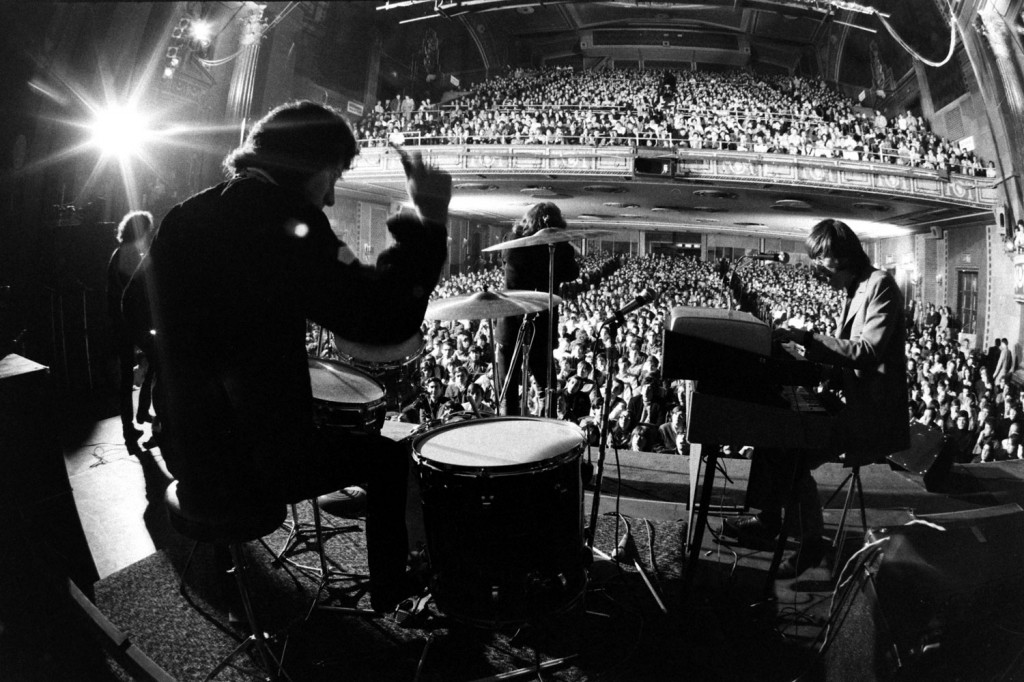
FillmoreEast copy

Filmore East

Opened: 1968

Closed: 1971

Location: 105 Second Avenue

Famous Performers: The Allman Brothers Band, Grateful Dead, Miles Davis, Joe Cocker, Crosby, Stills, Nash, and Young, Derek & The Dominoes, King Crimson, Jefferson Airplane, Jimi Hendrix, Frank Zappa, Johnny Winter

Fact: Through 1971 bands were booked on weekends to play two shows a night, one at 8 and one at 11.
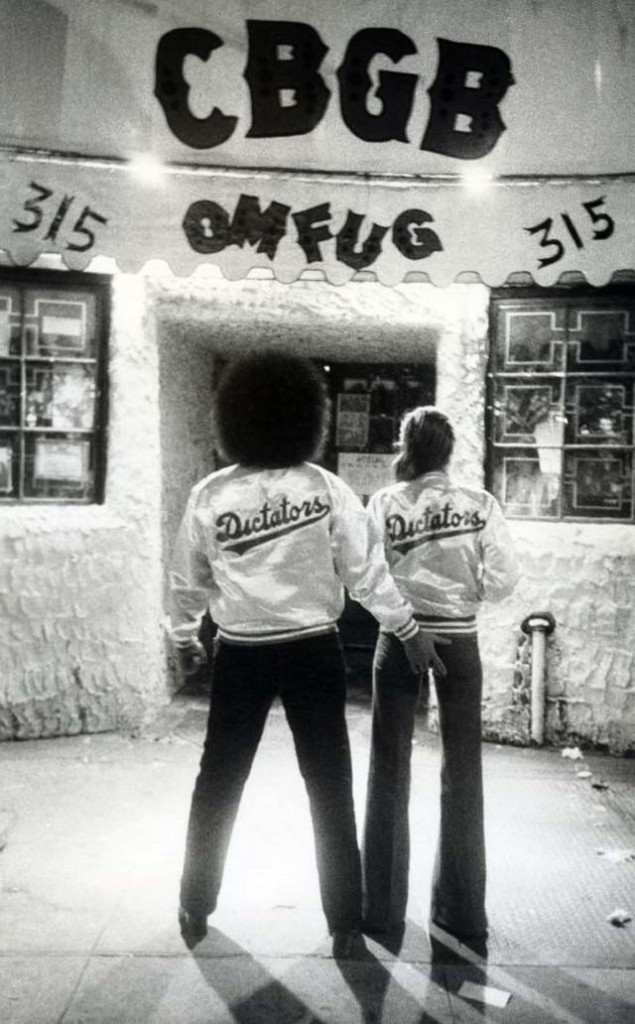
DBGB copy

CBGB

Opened: 1973

Closed: 2006

Location: 315 Bowery

Famous Performers: Ramones, Misfits, Television, Patti Smith Group, The Dictators, The Cramps, The B-52′s, Blondie, Joan Jett & the Blackhearts, Talking Heads.

Fact: Despite their importance to Punk in New York, CBGB actually stands for “Country, Blue Grass, Blues.”
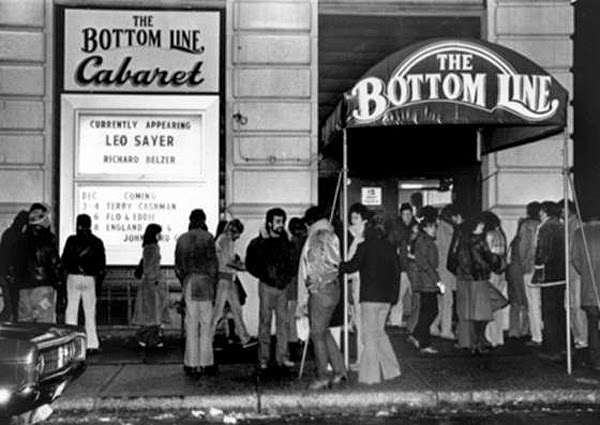
BottomLine copy

The Bottom Line

Opened: 1974

Closed: 2004

Location: 15 West 4th Street

Famous Performers: Bruce Springsteen, Lou Reed, Eric Clapton, Linda Ronstadt, The Police, Prince, Daryl Hall & John Oates, Van Morrison, Neil Young, Barry Manilow, Laura Nyro, Loudon Wainwright III, New York Dolls, Dolly Parton, Ramones, Miles Davis, Peter Gabriel, Tom Waits, Melvin Van Peebles, Billy Joel, Patti Smith, Cheech & Chong, The Violent Femmes

Fact: Much like The Palladium, The Bottom Line now houses NYU classrooms.

Hurrah copy

Hurrah

Opened: 1976

Closed: 1980

Location: 36 West 62nd Street

Famous Performers: Suicide, Johnny Thunders, Mission of Burma, The Slits, The Feelies, David Bowie, Sid Vicious

Fact: After Ian Curtis committed suicide, the members of Joy Division regrouped at Hurrah to form New Order in 1980.

1398719324-lamour-bk

L’Amour

Opened: 1978

Closed: 2004

Location: 1546 62nd Street Brooklyn

Famous Performers: Metallica, Kiss, Blue Öyster Cult, Megadeth, Guns N’ Roses, The Ramones, Slayer, Poison, Anthrax, Quiet Riot, Motörhead, Cheap Trick, Jane’s Addiction, Soundgarden, Faith No More, Cro-Mags, Iron Maiden, Hatebreed

Fact: Known as the “Rock Capitol of Brooklyn”

Danceteria copy

Danceteria

Opened: 1979

Closed: 1986

Location: 30 West 21st Street

Famous Performers: Madonna, New Order, Duran Duran, Billy Idol, The Smiths, Squeeze, Cyndi Lauper, Jean-Michel Basquiat, Keith Haring, Run-DMC, Depeche Mode, Butthole Surfers, The B-52′s, RuPaul, Berlin, Sonic Youth, Swans, Nick Cave and the Bad Seeds, The Cult, Karen Finley, Violent Femmes, Soft Cell, The Jesus and Mary Chain, the Beastie Boys, LL Cool J, Rob Zombie

Fact: Owner John Argento founded a Danceteria outpost in the Hamptons in 1984, becoming the first major club promoter to do so.

Ritz copy

The Ritz

Opened: 1980

Closed: Early 1990′s

Location: 119 East 11th Street

Famous Performers: U2, Guns & Roses, Depeche Mode, Ozzy Osbourne, Run-DMC, Duran Duran, Sting, Iggy Pop, Danzig, Bo Diddley

Fact: MTV debuted at The Ritz in the 80′s.

 

21 Oct 01:48

Ralph Lauren and The Boy Scouts of Nippon.

by Jake Gallagher

Jap1

There are vintage finds that make you cry tears of joy. There are vintage finds (mostly of the stained variety) that make you weep for what could have been. And then there are vintage finds that simply leave you scratching your head. A few weeks back, in a downtown consignment store I came upon a vintage find so confounding, so downright unexpected that it has sent me on a quest. The shirt itself was nothing out of the ordinary. Two front pockets, patches on each sleeve, epaulettes up top, really, it looked like any old scouting shirt. Which is why I was drawn to it. Why was this shirt here? Why would a store that sells everything Thom Browne, Rick Owens, and Junya Watanabe be selling a regular old Boy scout shirt? And then I saw the tag. “Boy Scouts of Nippon Designed By Ralph Lauren.”

BSN2

Now, like any good suburban raised kid, I of course was familiar with the Boy Scouts of America, but I’d never heard of these Boy Scouts of Nippon before. I didn’t even know that there were scouts outside of America, let alone the fact that they would have uniforms designed by Ralph Lauren. And so, I took to the internet, where I discovered that the Boy Scouts of Nippon were founded in 1922 as the Boy Scouts of Japan, twelve years after the Boy Scouts of America were created. In 1971, they changed their name to the Boy Scouts of Nippon, and from what I understand, it was in the nineties that they contracted Ralph Lauren to do their uniforms. And this is where the trail runs cold. I have no idea why the BSN hired Ralph Lauren, nor could I figure out if he designed the uniforms himself, or if this contract was merely a licensing deal. What I have been able to discover though is that the BSN not only had RL approved uniforms, but they also had some pretty incredible graphics as well. Unfortunately, the Boy Scouts of Nippon do not have a public archive (nor does Ralph Lauren) but here a few items that I was able to collect from the around the internet to give a sense of what the BSN was like back when their uniforms read “Designed By Ralph Lauren.”

il_fullxfull.575432777_26iy

JP0278

Nippon

$_57 (1)

$(KGrHqJ,!qoFDkmU81m,BREUHbvlJw~~60_12

Exif_JPEG_PICTURE

21 Oct 01:18

Abandoned Allies: Afghan Interpreters Left Behind By US

by Amanda Winkler

Last Week Tonight with John Oliver recently featured a segment about the US abandonment of its Afghan interpreters. As Oliver notes, these Afghan interpreters served the US government by fulfilling the much needed role as a liaison between the military and local Afghan populations. They made themselves targets of the Taliban by doing so. Although promised a US visa should their lives become endangered, red tape is making it impossible for many to leave their country.

Reason TV had the story first, releasing a documentary in July featuring Janis Shinwary, an Afghan interpreter who escaped Afghanistan and is now speaking out on behalf of the interpreters left behind.

Original text below. Initially published on July 22, 2014:

"I was getting letters from Taliban, they were showing up at my house and everywhere. They were telling me that they were going to kill me or a member of my family, or kidnap my son," says Janis Shinwari, a former Afghan interpreter for the American military.

The U.S. military relies heavily on locals in Afghanistan and Iraq to serve as interpreters. The Iraqi Refugee Assistance Project estimates that 50,000 Iraqi and Afghan nationals served as U.S. military interpreters over the past decade-plus.

Interpreters provide one of the most crucial roles in a military unit—without them, service members would not be able to communicate with local populations. It's also one of the most dangerous roles. In Afghanistan, the Taliban labels interpreters traitors and has no compunction about killing them and their loved ones.

"Interpreters have become a very big target of the Taliban and Al Queda," says Rep. Adam Kinzinger (R-Ill.). "There's been a lot of beheadings of people that have worked with the West." 

The U.S. was able to recruit interpreters by promising them American visas when the war ended. "If we completely pull out of Afghanistan and we don't bring these interpreters back," says Kinzinger, "they're going to be killed. Their families are being killed too. Their houses are being burned down. It is very messy over there." 

An officer in the Air National Guard and a veteran of Iraq and Afghanistan, Kinzinger is pushing Congress to extend and amend the Afghan Special Immigrant Visa Program. The program was established in 2009 to give visas to Afghan nationals who helped the U.S. military. The program has been extremely inefficient and it can take years for an application to be processed. From 2009 to 2013, Congress said 7,500 visas could be issued but the State Department approved only 2,000

"A lot of it is because of bureaucratic wrangling," says Kinzinger. "While we do need to have good background checks and we do need to be cautious about this, its been way too slow at this point and a lot of translators have given their lives in the wait."  

The State Department has responded to the criticism by improving the processing time. So far in 2014, approximately 2,300 Afghans received visas out of an allocation limit of 3,000. But State expects to run out of allocated visas within a few weeks and the whole program expires in September, leaving 6,000 applicants in limbo

Secretary of State John Kerry has appealed to Congress to extend the program and to grant more visas for the remainder of the fiscal year, which ends on September 30.
If left behind, many interpreters will die at the hands of the Taliban. Janis Shinwari was able to escape that fate and moved to Virginia in October with his wife and two children. His visa came largely due to the efforts of Army Capt. Matt Zeller, whose life he saved (Shinwari is credited with saving the lives of at least four other American soldiers). In 2008, Zeller returned to the U.S. while Shinwari stayed in Afghanistan to continue his work as an interpreter.

"It was the hardest goodbye I've ever had in my life," says Zeller. "If he had been an American he would have been getting on that plane with us. It didn't feel right."
Zeller relentlessly pressured the State Department to issue Shinwari his visa. He eventually succeeded and now the two friends are focused on not only bringing more interpreters to America but also providing food, shelter, and job opportunities to them once they arrive through Zeller's nonprofit, No One Left Behind.

Increasing and extending the visa program is "the right thing to do," says Rep. Kinzinger, who stresses not just the promises the U.S. made in the past but how abandoning local partners will affect operations in future wars. "America is going to find itself in another war one day—it's a reality. And then if we go in and we try to bring the local population on our side, and they look at history and look at all the promises we made in the past that we didn't follow through [on], that harms our national security because we can't convince them that America stands by its word."

About 6 minutes.
Produced by Amanda Winkler. Camera by Joshua Swain, Tracy Oppenheimer, and Winkler. Narrated by Todd Krainin.
Scroll below for downloadable versions and subscribe to Reason TV's YouTube channelto receive automatic notifications when new videos go live.
Music by The Abbasi Brothers.
21 Oct 01:11

Pronto Fast-Charge Battery Modern backup batteries often pack...

by bernardcapulong


Pronto Fast-Charge Battery

Modern backup batteries often pack enough juice to top up your smartphone two to ten times over. Problem is they still take an eternity to charge up to full capacity. Power practical’s Pronto Fast-Charge Battery is designed specifically to remedy the long wait, instead storing enough power to fully charge an iPhone 5 (1,450 mAh) in five minutes flat, or charging to 100% capacity in one hour…

READ MORE

21 Oct 01:10

Nikon Monarch 7 Binoculars ($477) Snapzoom Universal Digiscoping...


Entrepreneur in Honolulu, HI

These items are my essential EDC and I always have them with me. The binoculars, Snapzoom adapter and my iPhone 6 Plus have basically replaced my DSLR and telephoto lenses for most situations. The Flat Head wallet is super tough and the cordovan has held up beautifully over the last 4 years. The Montblanc is the perfect pocket sized pen, and the Peak Eiger flashlight is super handy. 

21 Oct 01:07

CDC, PHARMA, And Mainstream Media On The Same Team

by Hunter Lewis

CDC cc cc

Unfortunately this team seems to be covering up a possible risk to black children.

Read More

21 Oct 01:04

No, Fellow Patriot, You Can’t Get the State Out of Marriage

by Steve Deace
There are three kinds of people nowadays advocating that states get out of the marriage business altogether.

One group is just using this terminology to camouflage the fact they’re really pro-homosexuality, and they just don’t want the conservatarian crowd they’ve aligned themselves with to know it while they infiltrate their ranks.

The next group is made up of politicians more concerned about earning the approval of the secular/liberal media than they are honoring their sworn oaths of office, or their own voters, so this is their attempt to punt rather than fight. They clumsily adopt this position with tortured statements that make them look like they’ve never seriously thought about the purpose behind the oldest institution of God’s created order. While attempting to be wise they come across as fools on this issue.
The third and final group is people who genuinely want to see the power of the state over our lives, liberty, and pursuit of happiness put back within its original Constitutional limits. It is to this third group I am writing this column. Since the first group is frauds, and the second group is gutless, I prefer to spend my time speaking to those who are honest and critical thinkers.

If you’re going to advocate the state get completely out of the marriage business, you need to understand what it is you’re really asking.

If you’re going to advocate the state get completely out of the marriage business, you need to understand what it is you’re really asking. People repeat the “get the state out of marriage” mantra as if this is as simple as waving a magic wand.
But it’s not that simple at all.

Consider you cannot remove the marriage question from the state completely, unless you are willing to also remove probate courts and divorce courts as well and put them back in the hands of the church and not the state. Then you’d also have to completely reform the tax code and tax law, since much of that is also based on marital status. Then you still have the question regarding things like spousal privilege (i.e. you can’t be compelled to testify against your spouse in open court). If folks are going to retain that right, don’t we have to first know what a “spouse” is?

I think many people that are sincerely advocating the state get out of the marriage business don’t really understand the depth of what it is they are asking. You are essentially asking us to return to a pre-Civil War civilization (the first government-issued marriage licenses occurred in the mid-1800s). Therefore, it would take a greater uprooting of our current understanding of Americanism than elimination of sacrosanct entitlement programs would. The state’s regulation of marriage is older and far more embedded than even the welfare state itself. It would be easier to privatize social security than it would be to de-regulate marriage.

Thus, if you really would prefer the state get out of the marriage business altogether, it’s not the simple route to diffusing the hot-button political battle over marriage that threatens to rip apart the Republican Party at the seams. Quite the contrary, it is the most radical and difficult to implement solution of them all. Ironically enough, because the church would have to step in to fill the void left by the state in most of these situations (including divorce and child custody cases), this solution would actually empower religious institutions’ influence over the culture all the more.

Read more at – See more at www.conservativereview.com

The post No, Fellow Patriot, You Can’t Get the State Out of Marriage appeared first on Daily Surge.

21 Oct 00:57

GAO: Allowing Oil Exports Could Drive Gas Prices Down Even Further

by Daily Surge

Removing restrictions on the export of crude oil would boost the economy, increase U.S. oil production and lower gasoline prices, according to a report by the Government Accountability Office.

GAO reviewed 1970s-era policies that restrict oil exports in the name of energy security. But these policies are thwarting economic growth and hampering U.S. oil production, according to studies the agency reviewed. Allowing more oil exports could decrease gasoline prices, according to GAO.

“The studies we reviewed and most of the stakeholders we interviewed suggest that consumer fuel prices, such as gasoline, diesel, and jet fuel, could decrease as a result of removing crude oil export restrictions,” GAO found. “A decrease in consumer fuel prices could occur because they tend to follow international crude oil prices rather than domestic crude oil prices, according to the studies and most of the stakeholders.”

The oil and gas industry and some Republican lawmakers have been pushing hard for reforms to allow for crude oil exports onto international markets.Export proponents have also lobbied the Obama administration to use its executive authority to allow for increases in oil exports while Congress debates the issue.

“This latest review by the GAO is a welcome addition to the growing body of analysis supporting the case for greater oil exports,” said Alaska Republican Sen. Lisa Murkowski, the lawmaker that asked the GAO to review oil export studies.

According to experts, restrictions on U.S. exports mean that oil producers must sell their product to refiners at a discounted price — about $8 per barrel on average in 2014 — since it can’t be put onto international markets.

Refiners get a nice discount on crude to make into gasoline and other products, but gasoline prices are set on international markets which means that consumers are still paying gas prices set on international markets, largely without seeing benefits from cheaper U.S. crude.

Allowing exports would increase the price of U.S. crude oil, but would in turn mean more oil is on the world market, driving down gas prices paid by consumers. Higher oil prices would also incentivize more U.S. oil production.

“Removing export restrictions would increase domestic production—8 million barrels per day in April 2014—because of increasing domestic crude oil prices,” GAO said. “Estimates range from an additional 130,000 to 3.3 million barrels per day on average from 2015 through 2035.”

Environmentalists have criticized allowing increased oil exports on the grounds that it would exacerbate global warming and possibly lead to more oil spills as the fuel is shipped around the world. They argue that allowing oil exports, along with natural gas exports, would increase the amount of hydraulic fracturing, or fracking, used to extract oil and gas — one of the main practices environmentalists are bent on stopping.

Stephen Kretzmann, head of Oil Change International, said that lifting the oil export ban would be “climate denial in a new, and very dangerous, form.“ He told the news site Responding to Climate Change that only “climate deniers such as the oil industry and their paid Representatives on Capitol Hill would propose lifting the crude oil export ban.”

Many environmentalists argue that two-thirds of the world’s fossil fuel reserves have to stay in the ground if the world is to avoid catastrophic global warming. This claim, however, has been disputed since fossil fuel use has grown significantly in the last two decades, all while global temperatures stopped warming.

Though GAO did warn that increasing oil exports could come with environmental risks. The agency said more “crude oil production may pose risks to the quality and quantity of surface groundwater sources; increase greenhouse gas and other emissions; and increase the risk of spills from crude oil transportation.”

But so far, there has been no confirmed case of fracking causing water contamination. Places where there have been harms to water supplies have been limited and caused largely by faulty well casings and other failures not related to the fracking process.

Follow Michael on Twitter and Facebook

Content created by The Daily Caller News Foundation is available without charge to any eligible news publisher that can provide a large audience. For licensing opportunities of our original content, please contact licensing@dailycallernewsfoundation.org.

Powered by WPeMatico

The post GAO: Allowing Oil Exports Could Drive Gas Prices Down Even Further appeared first on Daily Surge.

21 Oct 00:57

Obama To Delay Major Climate Regulations Until After The Election

by Daily Surge

Since March, the Obama administration has been looking to impose new regulations on methane emissions as part of its crusade against global warming. But it looks like the White House is putting its climate plans on hold until after the November elections.

Earlier this year, President Obama ordered the Environmental Protection Agency to look into possible new regulations for methane emissions and ordered the Interior Department to ready new rules for flaring methane from oil and gas production on federal lands. But the public won’t see either of these agencies act on methane emissions until after the election next month, according to a tip received by Marcellus Drilling News.

MDN said it “received an email alert from the Independent Petroleum Association of America (IPAA) about this very issue” which said the “EPA (and the Bureau of Land Management)… will unveil devastating new regulations AFTER the November elections.”

“Of course the president is going to delay this rule. It’s the next step of his effort to put the oil and gas industry out of business,” Oklahoma Republican Se. James Inhofe told The Daily Caller News Foundation.

Democrats face tough races in key oil and gas states across the country. According to RealClearPolitics, polls suggest that Alaska, Colorado and Louisiana all “lean GOP” and could see their Democratic incumbents without a job next year. Arkansas, another key energy state with a competitive election has the GOP ahead in the polls.

“These regulations will hurt industry in Arkansas, Louisiana, and everywhere else there is oil and gas activity, and if he were to put these regulations out before the election, they’d hurt his chances of keeping the Senate in Democrat control,” Inhofe added.

Inhofe has been tracking the EPA’s progress on crafting potential new methane rules. The senator recently criticized the agency for releasing a series of white papers on methane emissions which, he argued, made dubious assumptions about the industry and the government’s ability to make it more efficient.

“The president’s true agenda will be revealed after the election,” Inhofe said. “With no electoral consequences remaining for him, he will set his crosshairs on the oil and gas industry with ever tighter regulations that threaten the health of our economy.”

The U.S. is in the midst of an energy boom due mainly to the widespread use of hydraulic fracturing, or fracking, and horizontal drilling. These techniques have allowed drillers to unlock vast underground shale reserves and caused the U.S. to become the world’s largest liquid fuels producer.

But a byproduct of oil and gas production from shale has been methane, which companies often flare off into the atmosphere. Environmentalists argue this practice will cause more global warming since methane is a much more potent greenhouse gas than carbon dioxide. Eco-activists want to see stricter regulations put on methane flaring.

“We urge you and your administration to build on this legacy by announcing enforceable national methane emissions standards for new and existing oil and gas sources this fall,” environmentalists wrote to Obama last month. “The oil and gas industry needs to be held to the same federal environmental standards as other major industries while we work as a nation to swiftly transition to a clean energy economy”

But the EPA has so far not committed to whether or not it will craft new regulations or expand voluntary programs to reduce methane emissions. The agency expects to make an announcement later this fall on whether or not it will move to regulate methane.

“EPA is carrying out its work under the Methane Strategy issued by the White House in March,” an EPA spokeswoman told TheDCNF. “Having released a series of technical ‘white papers’ addressing volatile organic compound and methane emissions from the oil and gas sector and received public and expert comment on those papers, the Agency is now evaluating a full range of policy options for further action as identified in the Methane Strategy and expects to provide information on future actions later in the Fall.”

Follow Michael on Twitter and Facebook

Content created by The Daily Caller News Foundation is available without charge to any eligible news publisher that can provide a large audience. For licensing opportunities of our original content, please contact licensing@dailycallernewsfoundation.org.

Powered by WPeMatico

The post Obama To Delay Major Climate Regulations Until After The Election appeared first on Daily Surge.

21 Oct 00:56

Satellite Data Shows September Was Not The Warmest On Record

by Daily Surge

Media outlets have been tirelessly reporting new data claiming that September 2014 was the hottest on record, according to the National Oceanic and Atmospheric Administration.

But satellite data shows that last month was far from the hottest September ever recorded. University of Alabama, Huntsville satellite datasets show that September was the seventh warmest on record and Remote Sensing Systems datasets show last month was only the ninth warmest ever recorded.

Source: RSS and UAH datasets compiled by Steven Goddard

This runs counter to media reports citing NOAA figures that this is the fourth heat record-setting month in a row. NOAA says the globe averaged 60.3 degrees Celsius last month — the hottest September ever going back through 135 years of record-keeping. NASA data also shows that last September was a record-setting month.

NOAA climate scientist Jessica Blunden told the Associated Press “it’s pretty likely” that 2014 will become the hottest year on record, beating out 2010.

“This is one of many indicators that climate change has not stopped and that it continues to be one of the most important issues facing humanity,” University of Illinois climate scientist Donald Wuebbles told the AP.

It’s also been noted that this year’s record-setting temperatures were well below what climate models predicted they would be. Libertarian Cato Institute scientist Chip Knappenberger tweeted that the record temperatures are actually 0.21 degrees Celsius below what climate models predicted.

.@NOAANCDC No worries! I did it for you! Year-to-date “record” temps are 0.21C *below* climate model progs. @CatoCSS pic.twitter.com/tiYeSTCIlT— Chip Knappenberger (@PCKnappenberger) October 20, 2014

Many scientists, environmentalists and politicians have been focusing on global temperatures as the U.S. continues to experience cold weather across much of the country. Last winter saw thousands of record-low temperatures set across the country and cooler,overcast weather continued for many throughout the summer.

The Midwest, for example, is seeing record-cold temperatures so far this year. The region is currently on track to see its coldest year on record, not too long after farmers in the area experienced a devastating drought.

California, on the other hand, has been going through its own drought this year as well as many hot, dry days.

With an election coming up, Democrats who push climate policies have pointed to record-high temperature summer months as evidence of why the government needs to impose more regulations on energy producers.

But all-out support for climate policies, like carbon taxes and cap-and-trade schemes, have been muted among Democrats. Colorado Democrat Mark Udall has touted his support for such policies, warning about rising global temperatures. So far, though, Udall has been hesitant to give specifics on his climate policy stances.

“Carbon pollution is real,” Udall said in a debate against his Republican opponent Rep. Cory Gardner of Colorado. “We’re prepared to put a price on carbon… I support putting a price on carbon.”

Note: Satellite temperature graphs were provided by Steven Goddard of the Real Science blog.

Follow Michael on Twitter and Facebook

Content created by The Daily Caller News Foundation is available without charge to any eligible news publisher that can provide a large audience. For licensing opportunities of our original content, please contact licensing@dailycallernewsfoundation.org.

Powered by WPeMatico

The post Satellite Data Shows September Was Not The Warmest On Record appeared first on Daily Surge.

21 Oct 00:56

Indiana To Cut Off Food Stamps For Workers After 3 Months, Waves Away Aid From Feds

by Daily Surge

Starting next year, Indiana is set to eliminate food stamp benefits for tens of thousands of people who either cannot get a job, or refuse to attend job training, the Indianapolis Star reports.

If able-bodied adults without children do not find work or participate in a 20-hour-a-week job training program, benefits will be strictly limited to a three-month period. Workers usually receive $131 a month from the food stamp program.

The time limit is normally listed as a necessary condition to receiving benefit money. Most states qualify to waive the requirement, but although Indiana is a state that similarly qualifies, they have decided that time-limits are a useful tool to keep around. In the rest of the country, 28 other states are taking advantage of waiver for the entire fiscal year, while 14 only rely on the waiver for part of the year.

“We view…time-limited benefits in Indiana as an opportunity to help improve the skills of our fellow Hoosiers and advance their prospects for meaningful employment, while at the same time establishing a pool of better-prepared candidates for the Indiana workforce,” Lance Rhodes, director of the division of family resources for the Indiana Family and Social Services Administration, wrote in a letter to the U.S. Department of Agriculture.

Already, the state is on its way to economic recovery. Since 2009, the state unemployment rate has shrunk from 10 percent to 5.8 percent.

In the meantime, opponents are upset that the 65,000 out of 877,000 workers affected by the upcoming policy switch will have nowhere else to turn. Advocates of the poor instead prefer for new programs to be in place for these workers to fall back on, come next spring. “Let’s figure out what the goals are for these able-bodied adults without dependents, and then let’s build a program that meets those goals,” said Jessica Fraser, program manager for the Indiana Institute for Working Families. “That seems to make a little more sense to me.”

The time-limit requirement is expected to take effect next year sometime in March, April, or May.

Follow Jonah Bennett on Twitter

Content created by The Daily Caller News Foundation is available without charge to any eligible news publisher that can provide a large audience. For licensing opportunities of our original content, please contact licensing@dailycallernewsfoundation.org.

Powered by WPeMatico

The post Indiana To Cut Off Food Stamps For Workers After 3 Months, Waves Away Aid From Feds appeared first on Daily Surge.

21 Oct 00:50

PAPER: Thousands of federal workers on extended paid leave...


PAPER: Thousands of federal workers on extended paid leave...


(Second column, 12th story, link)

21 Oct 00:47

As Girl Scouts Membership Plummets, Threats of Split Emerge

The Girl Scouts USA has just ended its 53rd Convention amid sharply declining membership numbers, serious financial problems, cookie boycotts due to the organization’s known ties to Planned Parenthood, and now, the threat that those who want the group to retain its former, traditional values will split off to get the Girl Scouts back on track.

As CBS News reports, for the second straight year, both youth and adult membership in the Girl Scouts has dropped dramatically. Over the past year, the total youth members and adult volunteers declined by six percent, from 2,994,844 to 2,813,997. The past two years have seen total membership down 11.6 percent, and since 2003, when membership peaked at more than 3.8 million, total membership has plummeted 27 percent.

Girl Scouts CEO Anna Maria Chavez attributes the falling numbers to overarching societal factors, such as less financial stability among parents and families, leading to the need for parents to work several jobs with little time to take children to activities or to volunteer themselves.

Chavez said the dearth of volunteer adults has forced some Girl Scout councils to turn away girls who want to join. She added there are approximately 30,000 girls on waiting lists around the country.

“The need for what Girl Scouts has to offer is not decreasing – more than ever girls need our time and our commitment,” Chavez said. “Our challenge is to meet them where they are with enough caring adults to serve them.”

To draw new members, the Girl Scouts has developed online toolkits to help make becoming a member easier and to assist troop leaders with meeting and activity planning.

However, as Will Doig at The Daily Beast observes, the Girl Scouts is facing a split between those who believe the organization should return to its traditional values and principles and those who want the group to focus on more “global” concerns and issues, such as “female body image” and how to reduce one’s carbon footprint.

“We’ve got a group of people organized,” says Marty Woelfel, a volunteer with Girl Scouts of Kentuckiana. “I won’t tell you how many.”

According to the Beast, Woelfel and others are prepared to return the Girl Scouts organization to its traditional core principles and activities such as canoeing, archery, fire building, and other wilderness skill building.

Nowadays, girls work toward merit badges for analysis of how fashion blogs portray women, developing a plan to reduce one’s carbon footprint, or how to commit to an “eat local” diet plan that is “sustainable.”

“We listen to and move at the speed of girls, and research shows that today’s girls not only love camping and being outdoors, they also enjoy technology and helping the world while having fun, all of which can be found in Girl Scouts,” says Kelly Parisi, chief communications executive for Girl Scouts USA.

However, as Breitbart News has extensively reported, not all is “fun” at Girl Scouts USA, and Parisi, formerly vice president of Marketing and Communications at the Ms. Foundation, had joined a national campaign during her tenure there to punish the Susan G. Komen Foundation for trying to defund Planned Parenthood.

The Girl Scouts' ties to Planned Parenthood, abortion, and other “non-traditional” activities include the fact that Josh Ackley - its main media spokesman – also happened to be the lead singer of a “homopunk” band that filmed several controversial videos, including one in which a woman is strangled, and another in which a young man writhes naked on the ground and appears to be masturbating. As Breitbart News’ Austin Ruse reported in January, when Ackley’s extracurricular activities were exposed, the Girl Scouts merely scrubbed him from its media page but still tweeted that “not only is Josh Ackley still employed, no one has been demoted.”

In May of 2013, a Girl Scout-sponsored event in New York City, billed as one to “celebrate women and girls” featured a live screening and panel discussion of the documentary MAKERS, a feminist, pro-abortion video account of prominent women described as “trailblazers.”

The Girl Scouts organization even stepped into designating pro-abortion Texas gubernatorial candidate Wendy Davis an “incredible woman” who deserved to be on the list of the 2013 “Women of the Year.” Additionally, on its Facebook page, the organization promoted former HHS Secretary Kathleen Sebelius as a woman of “courage.”

The non-traditional, “modern” Girl Scouts organization also hired a “Girl Experience Officer” named Krista Kokjohn-Poehler, who is a lesbian married to Ashley Kokjohn.

Among the internal issues that have led to expressions of public resentment among alumnae and regional councils of the Girl Scouts have been an unfunded pension plan, revenue deficits that have led to the elimination of about one-fourth of the staff at national headquarters, and the closure of some Girl Scout camps and what has been perceived as a shift away from camping and other outdoor activities that were once synonymous with scouting itself.

Another decision that has ruffled feathers has been the business partnership with the Mattel toy company, which manufactures Barbie, and the Girl Scouts’ creation of a Barbie patch that girls wear on their uniforms, as well as a Barbie Girl Scouts doll.

Both the Campaign for a Commercial-Free Childhood and the Center for a New American Dream have called for an end to the Girl Scouts-Mattel partnership, arguing that Barbie is an inappropriate role model for young girls.

As CBS News observes, as the Girl Scouts’ membership has plummeted, the American Heritage Girls, formed in 1995 as a Christian-oriented alternative, now has over 35,000 members.


21 Oct 00:45

6 Times Obama Declared Crisis, Then Did Nothing

Last week, President Obama finally began taking Ebola seriously – so seriously that he cancelled a campaign trip in order to hold an emergency meeting on Ebola. He then appointed a new Ebola czar, Ron Klain, whose stellar qualifications for handling a possible Ebola outbreak include flacking for Janet Reno, Al Gore, and Joe Biden. Finally, Obama held another Ebola meeting after going golfing. Klain skipped the meeting. It was the second such meeting Klain skipped.

Don’t worry. The Obama administration has top men on the job. Top. Men. 

This makes the 1,297th crisis the Obama administration has initially ignored, then declared a crisis, then ignored again. Which doesn’t mean that the crises disappear – far from it. They accelerate, grow, metastasize. But since prestidigitator Obama has busily misdirected to the next pseudocrisis – Global warming! Sexual assault on college campuses! Fat kiddies shoving fast food down their drooling pieholes! – the media never return to the scene of the continuing crime.

Here are the top crises declared by the Obama administration – and the unreported-upon aftermath:

IRS Scandal. In the aftermath of the IRS admitting that it had targeted conservative non-profit applicants, President Obama said, “Americans are right to be angry about it, and I am angry about it.” He then said that there was no need for a special prosecutor – Eric Holder would clearly clean up this mess. Today, conservatives are still being targeted, and the Obama administration continues to obstruct any attempt to find the wrongdoers.

Fast and Furious. “People who have screwed up will be held accountable,” Obama said in October 2011 of an operation approved by his government in which guns were smuggled from the United States to Mexican drug cartels. “It’s very upsetting to me to think that somebody showed such bad judgment that they would allow something like that to happen.” Nobody has been fired. Nobody has been prosecuted. Attorney General Eric Holder, who greenlit the operation, just stepped down as an honored member of the Obama inner circle.

Benghazi. According to then-White House press secretary Jay Carney, the president was “committed to finding out what happened. He is committed to making sure that those who killed four Americans are brought to justice, and he is committed to ensuring that actions are taken after the Accountability Review Board thoroughly assesses this matter, to make sure that what happened in Benghazi never happens again.” Not a single person was fired over the murder of four Americans including an ambassador of the United States in Libya. A year later, according to CBS News, “The State Department still has not fully implemented recommendations.” But hey, it’s been like two years, dude.

The Veterans Administration Scandal. After news broke that the VA had deliberately lied to veterans about their waitlists, leading many vets to die waiting in line, President Obama declared a state of political emergency: “If these allegations prove to be true, it is dishonorable, it is disgraceful, and I will not tolerate it, period.” After initially backing VA Secretary Eric Shinseki, he then threw Shinseki under the bus. And that’s been about it. Nothing material has actually been solved.

ISIS. After stating that ISIS was actually a “jayvee” version of al Qaeda and allowing ISIS to then run roughshod over half of Iraq, President Obama declared ISIS a serious threat to America’s national security and pledged to fight them. “There can be no reasoning – no negotiation – with this brand of evil. The only language understood by killers like this is the language of force,” Obama explained. Obama has spent the last month bombing our allies, sending humanitarian aid to our enemies, and downplaying ISIS moves toward Baghdad and the Turkish border.

This isn’t simple incompetence. It’s uncaring incompetence. Unless the polls force him to care about a given crisis, Obama’s off golfing. If the polls do force him to care, he can muster up the emotional wherewithal for approximately as much time as it would take him to play nine holes. Then we go back to crisis, worse off than we were before.

But don’t worry. Top men are on the job. Top. Men.

Ben Shapiro is Senior Editor-At-Large of Breitbart News and author of the new book, The People vs. Barack Obama: The Criminal Case Against The Obama Administration (Threshold Editions, June 10, 2014). He is also Editor-in-Chief of TruthRevolt.org. Follow Ben Shapiro on Twitter @benshapiro.


20 Oct 00:45

Research Sheds Light On Corporate Welfare In The States

by Daily Surge

Although state governments tend to be less than forthcoming on the matter, researchers are beginning to shed light on the extent to which states subsidize private businesses.

The Mackinac Center published research by Jack McHugh analyzing corporate welfare costs in Michigan between 1995 and 2011, a process made challenging, McHugh said, by “frequent changes in programs and goals, a lack of transparency, and an abundance of spin and puffery in the information that is released.”

In 1995, Republican Gov. John Engler launched the Michigan Economic Growth Authority (MEGA), which became “the state’s flagship economic development program in the 2000s.” As McHugh puts it, MEGA was created to “[grant] ‘refundable’ tax credits to particular firms selected by political appointees on the entity’s board.” (RELATED: Coburn Blasts Tax Credit as Subsidy for Large Corporations)

The program experience moderate growth for the duration of Engler’s tenure, and continued to do so in the first term of his successor, Democrat Jennifer Granholm, but stayed below $400 million through 2007.

However, “the volume of MEGA activity rose sharply…, both in the quantity of deals and their size” starting in 2008, during Granholm’s second term, when they surpassed $600 million. MEGA subsidies grew to more than $1.2 billion the following year before falling back to around $600 million in 2010—still significantly higher than at any point in the past. (RELATED: ‘Oz’ Film Cost Michigan Taxpayers $40 Million)

In 2011, the first year of Republican Gov. Rick Snyder’s term in office, “MEGA was replaced…by a direct subsidy program, with amounts appropriated annually by the Legislature.” As a result of the increased oversight, MEGA spending that year dropped to its lowest level since 2003.

Yet while Michigan is among the most generous states in handing out corporate subsidies, it spends less than half as much as the top offender, New York, according to research by Veronique de Rugy of the Mercatus Center.

De Rugy, like McHugh, laments the dearth of comprehensive data on state aid to corporations, asserting that, “the relevant information has been inconsistently scattered among various government reports and websites.”

Such difficulties are gradually being overcome, however; in de Rugy’s case through such tools as the Subsidy Tracker 2.0 dataset compiled by Good Jobs First, a group that advocates for corporate and government accountability.

Although the Subsidy Tracker is still a work-in-progress and “does not yet contain every single state subsidy,” de Rugy calls it “one of the most comprehensive sources of state subsidies assembled so far.”

She does take some issue, though, with its identification of “sales tax exemptions on business purchases of inputs,” as a subsidy, pointing out that, “some economists argue that applying sales taxes to input purchases would inefficiently favor vertically integrated firms over firms that purchase inputs from other businesses.”

Phillip Mattera, research director for Good Jobs First, told The Daily Caller News Foundation that the group has actually accounted for that concern, leaving out the “provisions applicable to all firms that are written into tax codes to avoid the sort of issues de Rugy mentions.”

Mattera explained that the only type of sales tax exemptions the Tracker includes “involve awards to specific companies to offset costs of constructing and equipping new facilities,” and added, “We believe it is appropriate to treat these awards as economic development subsidies.”

In a series of charts, de Rugy shows that just nine states, including New York and Michigan, account for 58 percent of the $152.9 billion in known corporate subsidies handed out at the state level.

Of those, four states — New York, Washington, Louisiana, and Michigan — handed out more than $10 billion in corporate subsidies, while another five—Kentucky, Oregon, Indiana, Texas, and Missouri—provided at least $5 billion.

“All states but two dispersed at least over $5 million each,” de Rugy notes, but as the aforementioned statistics demonstrate, “the top offenders are major offenders.”

She found a similar pattern among the corporate recipients of state largesse, determining that, “established corporations, not small businesses or startups, are the overwhelming recipients of state benefits.”

Of the 20 corporations that received the greatest amount of state subsidies, nearly all are household names; and several, such as Boeing and General Motors, are well known for receiving generous assistance from the federal government, as well.

“Targeted state subsidies,” de Rugy claims, “misallocate scarce public resources while encouraging rent-seeking, regulatory capture, and cronyism.” In place of policies favoring specific firms, she advocates “policies that create a general environment in which all can flourish.” (RELATED: Europe’s Green Energy Industry Faces Collapse as Subsidies Are Cut)

Follow Peter Fricke on Twitter


Content created by The Daily Caller News Foundation is available without charge to any eligible news publisher that can provide a large audience. For licensing opportunities of our original content, please contact licensing@dailycallernewsfoundation.org.

Powered by WPeMatico

The post Research Sheds Light On Corporate Welfare In The States appeared first on Daily Surge.

20 Oct 00:45

Report: Government Really Does Waste Most Taxpayer Dollars

by Daily Surge

The federal government wastes most taxpayer dollars, not only by making poor or fradulent spending decisions, but also by funding inefficient entitlement programs and unnecessarily redistributing wealth, argues Heritage Foundation budget economist Romina Boccia.

“Any Social Security check going to a millionaire, I call that government waste,” Boccia told The Daily Caller News Foundation. “If we decide that the government has a role to protect the elderly and disabled from destitution, if we think that a federal role is required there, then sending Social Security checks to millionaires is a waste.”

Much attention is given to wasteful discretionary spending on things like completely unnecessary bridges or lavish parties for bureaucrats, and a 2014 Gallup poll showed Americans believe the government wastes 51 cents of every dollar, Boccia points out in her new report, titled “Eliminating Waste and Controlling Government Spending.” But in terms of economic principles, most of that waste happens in the realm of mandatory spending on programs like Social Security and Medicare.

Mandatory spending now consumes two-thirds of the federal budget, and by 2030 Medicare, Medicaid, Social Security and U.S. interest payments will consume 100 percent of tax revenues, according to the Congressional Budget Office.

“Paying government benefits to people who shouldn’t receive them, and creating bad incentives for people to work less and retire earlier — that is really what we think of as waste,” Boccia told TheDCNF. “The baby boomers who don’t need their Social Security checks still take them, and they’ll live off of them, and they’ll just leave a greater inheritance to their children, who are also well off.”

She also pointed to massive waste in Medicare and Medicaid spending.  “If we want to provide health care for these people, it doesn’t mean that the government has to provide it,” Boccia said. Rather than insist the government finance and provide health care to the elderly, for example, she suggests giving them a check and allowing them to purchase health insurance in the relatively efficient private market.

Medicare and Medicaid have the highest rates of “improper payments.” Last year the federal government reported over $100 billion of improper payments to the programs, including overpaying for medical equipment and paying benefits to dead people.

“Mistargeted and poorly run entitlement programs have for years driven and continue to drive the increase in federal spending and debt,” Boccia said. “And if we include that then it makes sense that you might think that the government wastes most of the dollars it takes in.”

“Instead of just thinking about mismanagement, fraud, and stupid spending examples like RoboSquirrel,” she added, “we really ought to look at a definition of government waste that is based on economic principles.” (RELATED: San Diego State Defends Using $325,000 In Federal Tax Dollars On RoboSquirrel)

Follow Rachel on Twitter


Content created by The Daily Caller News Foundation is available without charge to any eligible news publisher that can provide a large audience. For licensing opportunities of our original content, please contact licensing@dailycallernewsfoundation.org.

Powered by WPeMatico

The post Report: Government Really Does Waste Most Taxpayer Dollars appeared first on Daily Surge.

20 Oct 00:42

LA Cops' Claim That All Cars Are Under Investigation Challenged in License Plate Camera Tussle

by J.D. Tuccille

Earlier this year, the Los Angeles Police Department and Los Angeles County Sheriff’s Department refused to release data about what license plates police cameras had captured on the grounds that every single car seen is under investigation. All of them. And a judge bought that argument.

Now, the Electronic Frontier Foundation and the ACLU of Southern California are looking to the California Court of Appeal for a dose of sanity (yes, that strikes me as a Hail Mary pass, too) and a ruling that the public has a right to know how many people's movements are being monitored by the police, whether deliberately or through incidental data gathering.

That information can hit the creepy level very quickly, as the Minneapolis Star-Tribune discovered two years ago. After press inquiries, the police revealed a list of dates and places a reporter's car had been, and even the routes followed by the city's mayor.

I'm guessing it was that second point that spurred Minnesota legislation to limit access to license plate data, as well as how long it can be held.

Boston police stopped using license plate scanners entirely after they inadvertently data-dumped tracking information on 68,000 vehicles to the Boston Globe. The incident revealed that the cops weren't actually putting the data to good use (they kept recording the same stolen vehicles without following up) and were perhaps less than ideal stewards of sensitive material.

Who knows? Maybe LA cops are better than their colleagues elsewhere at using and protecting the information they gather on people's movements.

Heh.

Patrick Hannaford noted yesterday that some police departments are getting squirrelly about revealing what license plate data they've gathered.

20 Oct 00:37

Humanitarian Aid is No Job for the Military

3 Reasons the U.S. MILITARY Should Not Be Fighting EBOLA was Produced by Amanda Winkler and co-written with Nick Gillespie, who narrates. Camera by Jim Epstein with Anthony L. Fisher. About 2 mins.

Original release date was October 14, 2014 and original write up is below.

President Obama is sending thousands of U.S. troops to West Africa to fight the deadly Ebola virus. Their mission will be to construct treatment centers and provide medical training to health-care workers in the local communities.

But is it really a good idea to send soldiers to provide this sort of aid?

Here are 3 reasons why militarizing humanitarian aid is a very bad idea:

1. Militarized Aid Erodes Humanitarian Principles

Humanitarian aid must be perceived as neutral and not driven by political or military objectives. Using the military in a humanitarian crisis works against that and potentially instigates further unrest.

Attacks against humanitarian personnel have been rising in the past decade precisely because of a perceived blurring of humanitarian, political, and military goals.

And our track record in Africa warrants such skepticism. In the past six years, the U.S. military has expanded its troop presense in Africa via humanitarian missions specifically designed to establish points of entry for future military missions.

Local communities face a hell of a bind: if they don't accept help from the military, they run the risk of missing out on much needed humanitarian aid. That erodes the trust needed to establish a working relationship between aid workers and local communities.

2. Militarized Aid is Ineffective in the Long Term

Militarized aid is often backed by huge budgets that are supposed to be spent quickly.

Indeed, the Department of Defense has already allocated $1 billion to fight Ebola.

The pressure to spend massive amounts is often coupled with pressure to achieve short-term political goals.

That in turn translates into an ineffective use of funds. Accountability and follow-up are in short supply, too, meaning the same mistakes get repeated over and over.

3. Militarized Aid Diminishes the Supply of Civil Aid

Many politicians who support militarized aid claim that the military is the only institution capable of handling the humanitarian crisis at hand.

If this is true—and too often it is—this highlights the neglect of civilian-led programs that are more likely to get the job done.

By constantly relying on the military for humanitarian efforts, we're stifling efforts to grow civilian-led organizations that can handle the complicated logistics necessary to address large-scale humanitarian crises. 

View this article.

19 Oct 22:42

Review: The Yanks are Coming! A Military History of the United States in World War I

The 100th anniversary of World War I has generated an enormous amount of interest in the Great War, especially given its startling parallels to current events. Harry W. Crocker III’s new book, The Yanks are Coming! A Military History of the United States in World War Ipublished by Regnery History, explains the impact of American involvement in the war and how it shaped the “American century.” 

There are a number of great books on the First World War. John Keegan’s comprehensive The First World War delves deeply into the details of the Great War’s battles and political squabbles, while Barbara Tuchman’s masterfully narrated and Pulitzer Prize winning The Guns of August provides an incredible amount of insight into the opening stages of the war. However, most of these books focus on European politics, leaders, and military campaigns, and relatively few give a purely American account of the war. Crocker’s book fills that gap in the scholarship perfectly.

Crocker, author of The Politically Correct Guide to the Civil War and Don't Tread on Me: A 400-Year History of America at War, from Indian Fighting to Terrorist Hunting among many others, has a talent for crafting interesting narratives out of detailed historical topics. His newest work is no different, as The Yanks Are Coming! is informative while being a genuine pleasure to read.

The Yanks Are Coming! is broken up into five parts, each describing an important aspect of America’s involvement in the “War to End All Wars.” The first section focuses on the political debates in the United States in the lead up to American involvement. War raged in Europe before the United States committed itself to the fighting, and back in the states, an overwhelming public sentiment to stay out of Europe’s quarrels remained. Though Crocker makes the argument that American President Woodrow Wilson had left the country entirely unprepared for war, he nevertheless persuades his readers that the United States had a just cause in entering the conflict.

“Americans are easily forgetful of history, but we should not forget the first World War or our far from discreditable role in it,” Crocker wrote. “American intervention was decisive in the Anglo-French victory, a victory that deserves celebrating.”

President Wilson has often been criticized for failing to uphold his promise to keep the United States out of war. However, Crocker argues that Wilson really never wanted to be involved until he got backed into a corner; a classic case of weakness inviting war. Wilson’s focus was entirely on domestic affairs and he had little interest in issues concerning national security. The former “Princeton President” wrote to a friend just after his election in 1912, “It would be an irony of fate if my administration had to deal with foreign problems, for all my preparation has been in domestic matters.” It is hard to read Crocker’s account of Wilson without noticing the strong resemblance in background and temperament to President Obama.

Former Republican President Theodore Roosevelt routinely chastised the administration for its lack of war preparedness and scorched Wilson and his cabinet for being unfit to command the United States’ military efforts.

Roosevelt said of Wilson and his pacifist Secretary of State William Jennings Bryan, who had been known for dramatic, populist speechmaking:

It is not a good thing for a country to have a professional yodeler, a human trombone like Mr. Bryan as secretary of state, nor a college president with an astute and shifty mind, a hypocritical ability to deceive plain people and no real knowledge or wisdom concerning internal and international affairs as head of the nation.

Though the country was unprepared for war and there were questions about the leadership of the administration, the threat of unrestricted warfare from German U-boats, the sinking of the passenger ship Lusitania with American civilians on board, and the dubious telegram sent from Germany to Mexico—promising a return of territory in the American southwest if the central American country joined Germany in a war against the United States—drew America into World War I.

The next section of Crocker’s book describes America’s entrance into the war and the most important battles that the American Expeditionary Force took part in, including Cantigny, Belleau Wood, the Meuse-Argonne offense, and many more. 

Crocker explains how dramatically the United States military had to be improved in a short amount of time. Initially fielding a tiny military force, “on par with Portugal,” wrote Crocker, the “American Army was hardly prepared at all.” The small, undermanned American military had to change its focus from chasing bands of hostile American Indian tribes around the great plains and cracking down on insurgents in the recent Philippine rebellion to waging mass warfare against the most modern and powerful nations in Europe. 

The American military had to be supplied mostly by the great foundries of European allies France and Britain, but it could contribute a great deal in terms of raw manpower. America would have to wait until World War II to become the “arsenal of democracy,” but the teeming waves of strong, healthy American fighting men immediately raised the spirits of beleaguered French and British soldiers. War-weary British Tommys and French Poilus, worn ragged from years of hellish trench fighting on the Western Front, felt elated as strong, well-fed American soldiers marched to the front lines. 

Lead by the brave and experienced General John “Black Jack” Pershing, the only American “General of the Armies” besides George Washington, the United States armed forces played a critical role in a number of battles. For instance, the Marine Corps would create much of the legend and mystique of their branch while participating in some of the most ferocious fighting of the war. At the Battle of Belleau Wood, in which they suffered 5,200 casualties, the Marines earned their famous nickname, “Devil Dogs,” for their dogged determination and relentless drive to crush the German army. 

The next two sections of The Yanks Are Coming! detail the most important generals that lead American forces in WWI, along with the “young lions” who became famous during and after the fighting. Crocker’s profile of the legendary Sargent Alvin York, who won a Medal of Honor for killing 28 German soldiers and capturing 132 more in a single assault on a German machine gun nest is tremendous, and his overview of the life of the now-forgotten ace pilot, Eddie Rickenbaker are some of the high points of the book.

Crocker’s narrative is a tremendous account of every aspect of the war from the American side, and he leaves no stone unturned. He convincingly argues that American intervention on the continent was vital for allied victory and that some of American greatest heroes were shaped by their experiences in the war. For anyone wishing to get a better grasp of how and why the United States got involved in the conflict that shaped the last 100 years, The Yanks Are Coming! is the right book to pick up.


19 Oct 22:20

AIRBUS pilots stunned as 'flying man' whizzes past aircraft at 3,500 feet...


AIRBUS pilots stunned as 'flying man' whizzes past aircraft at 3,500 feet...


(Third column, 5th story, link)

19 Oct 22:19

STUDY: Elephants know when it's raining -- 150 miles away!


STUDY: Elephants know when it's raining -- 150 miles away!


(Third column, 16th story, link)

19 Oct 11:52

Two Ways to Use Your Leftover Game-Day Barbecue

by rreed

Real, wood-smoked barbecue requires serious quantity in order to make any sense. When prescribed cooking times range from several hours to overnight, you aren’t going to playBarbecue Nachos around with a few chops—no. The twelve or thirteen active hours required to tenderize a whole hog with hot smoke pay off with enough delicious pork to feed the parents, aunts and uncles, cousins, and their friends, or a bunch of hungry tailgaters, with meat left over.

But what do you do with those leftovers? Of course, you can toss them in a little warm sauce and fork them up plain, or shovel them onto a bun. Or you can repurpose those chilly strands of smoked pork into something new, to appease a crowd that has already taken down a few plates of straight-up pig. Memphis-style barbecue spaghetti, a regional oddity from the same town that gave us barbecue pizza, is a good bet. A simmer in the thick barbecue sauce favored in those parts has the same effect on pork that’s a few days off the smoker as it does on fresh meat: the smoky barbecue melts into a rich, tomato-based gravy that sticks to noodles like macaroni and cheese to your ribs on a cold day.

Another great next-day use for pulled pork is a plate of hot, cheese-smothered nachos. Nuke the pork briefly to heat it through, then scatter it on top of a layer of thick corn tortilla chips on an over-proof platter and top with plenty of shredded cheddar and Monterey jack. Broil until the cheese is gooey. And if you’re willing to put a little work into your leftovers, chef Aaron Siegel of Home Team BBQ in our hometown of Charleston, South Carolina, tops barbecue nachos with a corn salsa that’s worth firing up the smoker a second time. To copy his nachos exactly, pair the salsa with heaps of pico de gallo, guacamole, and a simple relish composed of carrots and pickled jalapeños blended with pineapple juice.


Smoked Corn Salsa Verde
From Aaron Siegel, Home Team Barbecue, Charleston, South Carolina
Makes about 1 quart

Siegel serves this salsa with pulled-pork nachos and smoked chicken chili.

1 jalapeño pepper
1 lb. poblano peppers
2 cobs corn
2 cloves garlic
¼ cup canola oil
1 tbsp. kosher salt
1 tsp. freshly ground black pepper
½ lb. tomatillos, halved
2 tbsp. apple cider vinegar

Preheat smoker to 225 degrees. In a large mixing bowl, toss peppers, corn, and garlic in oil, salt, and pepper. Smoke for 1 hour. Then de-stem and roughly chop peppers. Add to a food processor with all ingredients except for corn and pulse until roughly puréed but still chunky. Slice kernels off the cobs and fold into the mixture. Refrigerate in an airtight container for up to five days.

Photograph by Jonathan Boncek

16 Oct 19:35

Kurdish Female Soldier Gains Internet Fame for Allegedly Killing More than 100 ISIS Jihadis

A woman known as "Rehana" has become a hero across the internet as news spread that the Kobani soldier has reportedly killed more than 100 Islamic State terrorists single-handedly.

Rehana became famous in Kurdish Twitter circles after a photo of her giving a peace sign began to circulate on the social network.

Rehana has killed more than a hundred #ISIS terrorists in #Kobane . RT and make her famous for her bravery pic.twitter.com/YvmfXMpuu1

— Pawan Durani (@PawanDurani) October 13, 2014

According to the International Business Times, Rehana is a YPJ (Kurdish female Peshmerga) soldier under the command of famed female soldier Mayssa Abdo, who herself has become famous for running the operation to keep the Syrian border town of Kobani out of the hands of the Islamic State. Shortly after this photo of Rehana began to circulate, rumors followed that she had been killed in battle, none of which have been confirmed independently by news sources. 

Rehana is one of many Female Kurdish soldiers who have become the front lines in the battle against the Islamic State. Islamic State jihadists believe that their martyrdom will not result in the promised gifts of the afterlife should they die at the hands of a woman, making the YPJ particularly indispensable against this enemy. YPJ units fight in both Syria and Iraq, and regularly post to social media to report on their successes in battle. 
 

It is estimated that up to 10,000 women fight in the Peshmerga forces, though estimates vary. In an interview with BBC, Col. Nahida Ahmed described their daily training as intensive and noted that many had battle experience even before organizing against the Islamic State in recent months.

The fight to keep Kobani, a border town that would allow for almost complete border access between Syria and Turkey, out of the hands of the Islamic State, has been arduous and bloody. Witnesses that have escaped the town recall streets lined with severed heads and Islamic State terrorists gouging the eyes out of Kurdish civilians. Turkish President Tayyip Erdogan repeatedly claimed that airstrikes by the United States and allies would not be enough to save the city, though without offering any help to those on the ground (instead bombing targets essential to the Kurds).

Despite Erdogan's claims, however, it appears that the coalition strikes have made a difference, due in large part to the organization of the Kurdish soldiers on the ground. According to Reuters, the Islamic State has had to retreat from a number of Kobani streets to avoid the airstrikes, allowing greater mobility for Kurdish forces.


16 Oct 19:34

CDC Director: 'Ebola is Not a Significant Public Health Threat to the US'

Embattled Center for Disease Control Director Dr. Thomas Frieden told lawmakers on Thursday that Ebola is not a significant threat to America. 

"We remain confident that Ebola is not a significant public health threat to the United States," Frieden said in written testimony before his Thursday appearance before the House Energy and Commerce Subcommittee on Oversight and Investigations. "It is not transmitted easily, and it does not spread from people who are not ill, and cultural norms that contribute to the spread of the disease in Africa--such as burial customs and inadequate public health measures--are not a factor in the United States." 

Despite Frieden's assurance that Ebola remains an insignificant public health threat, the CDC director admitted he and the CDC "do not yet know exactly how these transmissions occurred." 

Reps. Tom Marino (R-PA) and Pete Sessions (R-TX) have called on Frieden to resign in the wake of a second Ebola patient and the CDC's decision to tell the victim she was fine to fly in an airplane despite having a mild fever.


16 Oct 19:32

MONDAY: DAWN OF APPLE PAY...


MONDAY: DAWN OF APPLE PAY...


(Second column, 1st story, link)

16 Oct 19:32

AFRICA: BORDER CLOSURES SAVED US


AFRICA: BORDER CLOSURES SAVED US


(Main headline, 1st story, link)

16 Oct 19:32

Biden: 'Middle Class Getting Killed'...


Biden: 'Middle Class Getting Killed'...


(Second column, 4th story, link)

16 Oct 14:58

Butter, meat, and cheese vital to healthy diet?

by Jay Lehr

This article originally appeared on heartland.org.

BOOK REVIEW: THE BIG FAT SURPRISE : Why Butter, Meat & Cheese Belong in a Healthy Diet, by Nina Teicholz

In this outstanding book, investigative journalist Nina Teicholz reveals that everything we thought we knew about dietary fat is wrong. She documents how the low-fat nutrition advice of the past 60 years has amounted to a vast uncontrolled experiment on our entire population, with disastrous consequences for our health.

For decades, we have been told that the best possible diet involves cutting back on fat, especially saturated fat, and that if we are not getting healthier or thinner it must be because we are not trying hard enough. In fact there is now undeniable proof that the low fat diet is the problem and the very foods we have been denying ourselves including butter, eggs, milk and meat are the key to reversing the virtual epidemic of heart disease, obesity and diabetes.

Teicholz’ nine year investigation of this subject uncovers how the misinformation about saturated fats took hold in the scientific community and the public imagination and how recent findings have overturned these beliefs. This history demonstrates how nutrition science has gotten it so wrong: how overzealous researchers through a combination of ego, bias and premature institutional consensus, have allowed dangerous misrepresentations to become dietary dogma.

Instead of animal products we’re supposed to eat plants according to the advice we have been living with for decades when in fact plants are the least nutrient rich foods while animal meat is far and away the most nutritionally dense.

She quotes story after story of century old cultures that thrived on a meat and fat diet. In Africa and Asia explorers, colonists and missionaries in the early 20th century were repeatedly struck by the absence of degenerative disease among isolated populations they encountered on this diet. While life expectancy was not long, death came from the infectious diseases readily cured today by modern medicine not available then.

Teicholz tells us that “The idea that fat and particularly saturated fat are unhealthy has been so ingrained in our national conversations for so long that we tend to think of it more as “common sense” than a scientific hypothesis.”

It all began in the 1950s when Ancel Benjamin Keyes, a biologist and pathologist from the University of Minnesota, came up with the theory that animal fat was the cause of heart disease. He ran numerous studies, now known to be flawed, to prove his point including a well-funded study of seven countries where he knew that meat intake was low. He cherry picked his data, determined to prove his theory, and then with a very persuasive personality succeeded in getting the American Heart Association to adopt his theory and recommendation for a low fat diet in 1961.

Years later when scientists studied a random collection of the diets in 22 countries the correlation between heart disease and animal fat that Keys thought he found in his seven countries completely disappeared.

Teicholz methodically eviscerates Keys research in the manner of a spy novel. She was able to find dozens of counter studies, but as Keys ideas spread and became adopted by powerful institutions those who challenged him faced a difficult battle. Professional lives suffered, jobs, research funding and speaking engagements and often prestige was lost.

Teicholz also tells the complete 50 year story of how cholesterol came to be erroneously believed to be the primary indicator of potential heart problems, and how it was clearly established that cholesterol laden food did not raise blood level cholesterol.

Virtually all of the data supposedly in support of a low fat diet was epidemiological data which tries to indicate relationships of variables with disease without tests or trials on a population. Essentially all the trials where diet was controlled and health outcomes measured proved the lack of a relationship between high fat and disease.

Early on, the author gives a simple tutorial on the chemical bonds which differentiate the saturated, unsaturated and polyunsaturated and monounsaturated fats that confuse most of us, and further on explains the more recent transfat scares.

One surprising discovery was that as early as 1957 a scientist by the name of Fred Kummerow had unearthed all the damage that transfat can achieve in the human body. Created by hydrogenating vegetable oil to make a stable compound, transfats accumulate in fat tissue. There, they supplant normal fatty acids which are the building blocks in every cell membrane, carefully regulating everything going in and out of the cell.

Kummerow found that when transfats occupy cell membrane positions, obstruct the normal functioning of the body. This was such a threat to the reigning paradigm that he was effectively shut out of work and had difficulty publishing. This cover up lasted almost 50 years.

Teicholz documents the American diet in the 19th century in great detail from the writings of many who visited our nation from abroad, all who were amazed by the tremendous quantities of red meat and the absence of vegetables when heart disease was rare. She goes on to describe the reduction of red meats and fat over the last 50 years of the 20th century, while the government and the American Heart Association claimed that an increasing intake of red meat and fats were the cause of skyrocketing rates of heart disease and diabetes.

The author describes the unfortunate negative impacts of a low fat diet on children and exposes one of the great fallacies that breast cancer relates to a high fat diet. As far back as 1987 the epidemiologist Dr. Walter Willett at the Harvard School of Public Health had found fat consumption not to be positively linked to breast cancer.  Willett found just the opposite to be true among the nearly 90,000 nurses whom he had followed for five years.

The author carefully points out that a fat starved pubic readily jumped to the highly touted Mediterranean Diet that heaped praise on olive oil, brought back nuts, eggs and cheese, lots of seafood and chicken and a little red meat. Teicholz writes “This diet has been a boon in certain ways. It offered relief during a particularly austere and restrictive period of American cuisine. It offered a corrective to mistaken low-fat policies. It demonstrated a more relaxed attitude toward dietary fat.”

And even if olive oil’s health promises do not stand up, it is a relatively stable oil that does not oxidize easily and is clearly a healthier alternative to the more unstable vegetable oils. But the greatest proof of the scam foisted upon us by the high carbohydrates in our diet is the mounting evidence described in detail in this book, that ultimately sugar is our problem because all carbohydrates, complex or otherwise, end up becoming sugar in our bodies. These sugars cause our pancreas to generate more insulin than our bodies can handle, leading to a tidal wave of problems.

The crowning blow to the low fat, high carb diet was a 2008 review of all studies of this diet by the United Nation’s Food and Agriculture Organization. It concluded that there is “ no probable or convincing evidence” that a high level of fat in the diet causes heart disease or cancer. Then in 2013 an expert health advisory group in Sweden concluded after reviewing 16,000 studies that a low-fat diet was an ineffective strategy for tackling either obesity or diabetes.

It is not possible to read this book without concluding that our national diet was never properly, truly scientifically tested and that it has been a terrible, costly mistake for the American public. And the author reports that these facts have been available for some time. As early as 2001 Frank Hu, a nutrition Professor at Harvard, wrote “It is increasingly recognized that a low-fat campaign has been based on little scientific evidence and may have caused unintended health consequences”.

With this growing pile of evidence on the table Teicholz says “health authorities clearly see the need to update their advice. Yet they are understandably reluctant to reverse course too loudly on fifty years of nutrition recommendations”.

This could well prove to be one of the most important books written in the 21st century. It has been receiving a great deal of deserved attention and only time will tell if the government and the food industry will ultimately relent and bring America back to a healthier diet.

16 Oct 14:58

Study: World’s economic freedom ascends, as U.S. freedom falls

by Dotty Young

This article originally appeared on heartland.org.

An annual study conducted by an international group of non-partisan think-tanks found, shockingly, that the United States, once rated as the third most economically free nation in the world, is now little more free than the United Kingdom and other big-government European nations.

Each year, the Economic Freedom of the World Annual Report is released by the Canadian free-market think-tank Fraser Institute, the Cato Institute, and the international Economic Freedom Network.

Compiling objective data from over 150 countries, the annual survey attempts to quantify the degree of personal economic freedom in five primary categories: “size of government,” “legal system and security of property rights,” “sound money,” “freedom to trade internationally,” and “regulation.”

10-Point Scale

Each of the areas contains several subcategories. with a total of 42 variables used determine each country’s “EFW” ranking. Countries’ scores are then calculated on a 10-point scale, with “10” being a country with maximal economic freedom.

According to the study, “the data used to construct the index ratings are from external sources such as the International Monetary Fund, World Bank, and World Economic Forum that provide data for a large number of countries. Data provided directly from a source within a country are rarely used.”

Overall, economic freedom has increased across the world, increasing from 2000’s average rating of 5.78 to the current global average of 6.84. However, as the world becomes more free, the United States is on an opposite trend. In 1990 the US ranked at 8.43 overall, peaked in 2000 at 8.6, but had fallen to 7.81 by 2012.

While all five areas showed some decline, the worst was in Area 2, “Legal System and Security of Property Rights.”  In 2000, the US was ranked at 9.23, the ninth highest in the world. However, by 2012, the country’s rating had tumbled to 6.99 out of 10 possible points, or thirty-sixth overall.

To contrast, Saudi Arabia’s defense of citizens’ property rights received a 7.3 rating. In this area, Oman received a 7.6 score, and the United Arab Emirates a score of 7.7.

Eroding Incentive to Produce

Other areas of study in which the U.S. showed the most declines include categories measuring “how effectively the protective functions of government are performed,” explaining “when individuals and businesses lack confidence that contracts will be enforced and the fruits of their productive efforts protected, their incentive to engage in productive activity is eroded.”

Synthesizing data from commercial risk forecasting firms, the World Economic Forum, and the World Bank, the study determined that the strength of property rights and legal contracts has declined significantly, as has the impartiality and independence of judges. Between 2000 and 2012, the score assigned to the impartiality of the U.S. court system had plummeted by 34.8 percent, falling from 9.02 to 5.88.

Additionally, other disturbing trends emerge when data is compared between the U.S. and other countries. For example, despite the humanitarian abuses and lack of equal rights for Saudi Arabian women, courts in the United States are barely more impartial and fair than those found there.

The study’s authors note that, “to a large degree, the United States has experienced a significant move away from rule of law and toward a highly regulated, politicized, and heavily policed state.” The decline in Americans’ liberty does not occur in a vacuum, however. The study notes that “scholarly work on this topic indicates that a one-point decline in the EFW rating is associated with a reduction in the long-term growth of GDP of between 1.0 and 1.5 percentage points annually,” concluding that the United States’ decreasing economic liberty may result in significant economic stagnation.

Dotty Young (dottyjyoung@yahoo.com) writes from Ashland, Ohio.

16 Oct 02:09

Houston's 'Redneck Country Club' Celebrates One Year Anniversary

HOUSTON, Texas -- The American entertainment industry isn't usually a place that's ripe with conservative and liberty oriented thinking. From music to film, from production companies to performance venues, generally the world of entertainment here in the United States is chock full of liberal propaganda. 

That is, unless you live near Houston and have a membership at conservative talk show host Michael Berry's Redneck Country Club, a music venue and social club with a substantially large number of members.

The typically-liberal Houston Press recently named it “Best Honky Tonk” in the fourth-largest city; that, too, in a region known for honky tonks (the Houston metro includes Pasadena, once home to Hollywood’s most celebrated honky tonk of all time — Gilley’s). In fact, Mickey Gilley himself has played at the venue, as have fellow Urban Cowboy singers Johnny Lee and Charlie Daniels. The diverse line up doesn't stop there.  In the past year they've had Collective Soul, Marshall Tucker Band, the Spazmatics, and even former Little Richard and Sam Cooke band leader Grady Gaines. 

The Redneck Country Club appears to show that people's politics, or maybe their values, are affecting where they spend their dollars, and their time. The talk show host-turned-entrepreneur Michael Berry says, “Married couples get so busy running their business, raising their kids, taking care of their daily chores, that they forget to nurture that romantic lifeline so critical to their marriage.  We wanted to give married people a place to go enjoy live music, drink a beer or a bourbon, smoke a cigar, and not worry whether a fight would break out.”  It appears this is a recipe for success, with over 5,000 members in just a year, and growing.  

It’s not just married couples that are the focus of Berry’s club.  Every night, before the headliner appears on stage, Berry takes the stage and asks every veteran to raise their hands.  Many nights, those veterans have their membership fee waived and become automatic members, to the rousing applause of the crowd.  He encourages the members to buy the veterans around them a drink, and they dutifully oblige. The pro-veteran sentiment drives much of the club’s activities, including raising $240,000 for Camp Hope (a treatment center for PTSD Foundation of America) and over $100,000 for the Danny Dietz foundation benefitting Navy SEALs. On the Marine Corps' birthday, the RCC hosted over 1,000 Marines, for whom they provided barbeque and free booze. “Our business model is awful. We do too much free stuff. But it’s the right thing to do, and we just figure if we do what is right, people will keep bailing us out to keep the place running. People support what we’re doing, and they want to help.”

Another quirk in this bar-cum-club-cum-philanthropic live music venue is that almost the entire leadership team is made up of women. “No war on women here. Or anywhere else, for that matter. Great employees are the lifeblood of great organizations, regardless their chromosomal makeup.” Berry has turned down five different offers from producers for a reality show based at the Redneck Country Club, because he believes the producers never really understood what makes the RCC special. “One of them wanted to do a show about women in a men’s world, like we were Hooters. That’s not us. Another wanted to do a show where the employees backbite off camera, with all that silly drama. Again, that’s not us. Our place is not special because of me, the facility, the ladies and men who lead and work here. Our place is special because random strangers come together, sharing only their culture and values. People who want a place where veterans are honored, wives are respected, and good music and drinks can be enjoyed together.” The feel of the place is as much a small-town community center as a major city bar. The special “family day” or veteran events take on the tone of a country church’s spring picnic.  

Has the ironic name brought any criticism? “Absolutely. Some people have no sense of humor. We are self-described Rednecks (Berry insists the term has to be capitalized to show respect for the culture). Some minorities were hesitant to come the first time, but found that they had a blast. We just explain, ‘Hey, Redneck is a state of mind, not a skin color. If you help your neighbor when they are in need, if you stop to change a tire for a lady in the dark when it’s raining, if you would stop a thug from beating his woman, they you, too, are a Redneck.’”