Shepard’s lodge in the Breite Oak Tree Reserve near Sighisoara, Transylvania, Romania.
Contributed by Andrei Becheru.
Shepard’s lodge in the Breite Oak Tree Reserve near Sighisoara, Transylvania, Romania.
Contributed by Andrei Becheru.

Dr. Ben Carson, Professor Emeritus at Johns Hopkins University Medical Center, argued the US should implement a travel ban on countries with outbreaks of the Ebola virus as a “minimal” precaution, and that the US should ramp up efforts to combat the disease in Africa on Wednesday’s “Your World with Neil Cavuto” on the Fox News Channel.
“Travel ban is minimal [in terms of protection]. What we really need to do is get the resources in there, get the equipment in there, get the people in there and stop it there” he said.
Carson argued “what we have to recognize is that the world health organization has really sounded the alarm on what could happen here…for the most we're very good here. But the problem is this is raging in Western Africa, and we're not really, all I’m hearing are stories about there not being enough isolation gear, enough personnel, and it's spreading like crazy. If we don't get it under control there, it's going to come here, no matter how good our protocols are. Somehow that message has to be gotten across to those in authority.”
He also stated that CDC Director Dr. Tom Frieden should not resign, calling him “a very excellent person,” adding, “I recognize he's in a political situation, and he can't be completely free to say what he wants to say, but replacing him probably is not useful, because he's got a learning curve like everybody else does.”
Carson did declared the US government was “in the process of botching,” its Ebola response, but could recover.
He recommended, “we should be getting in the real experts in this disease, and in the transmission and quickly putting together the right kind of protocols and everybody who has been in contact with the disease should be strictly monitored, and it shouldn't be left up to them. They shouldn't be doing self-monitoring, this is too important.”
Follow Ian Hanchett on Twitter @IanHanchett

Are roads a public good (i.e., a product that markets won't adequately provide)? That's presumably the rationale behind the government's near monopoly on road construction and maintenance. As a society, we've delegated responsibility for everything from country lanes to transcontinental highways to bureacrats somewhere. But need it really be that way?
A recent story from the U.K. offers more evidence the answer is no. From the YouTube description:
Fed up with a 14-mile diversion caused by a landslip, businessman Mike Watts has taken a £300,000 risk and set up his own private toll road. It costs £2 for cars to travel the 400 metres -- which is slightly less than the cost of the petrol to take the detour. And the odd thing is this: despite the Kelston Toll Road not being approved by the local council, Mike is still on the right side of the law.
Watch the full video below.
The biggest barrier to innovation in the United States is the government itself—so says a panel of "50 executives, innovators, and thinkers" surveyed by The Atlantic. Specifically, 20 percent of them say that government regulation/bureaucracy is the worst hurdle to creativity, while another 16 percent finger immigration policies as the worst offender.

Unsurprisingly with this tech-savvy audience, more than three times as many (35 percent) consider Edward Snowden a "hero" as consider him a "traitor" (11 percent). Twenty-four percent pick "neither/it's complicated."
And what's the biggest threat to privacy? While 8 percent of the panel picks government, twice as many put the blame on unconcerned citizens and a complacent culture (14 percent said Facebook and 11 percent tag Google).
See the full survey here.

Yeah, that's real. It's a Cubs cap with a 2003 World Series patch, and it was placed in players' lockers late in Game 6 of the NLCS, anticipating a almost-certain Chicago victory.

 The European Space Agency's (ESA) Philae lander has a knack for taking selfies. Last month, it passed by Comet 67P/C-G at a distance of 50 km (31 miles) attached to the ESA's Rosetta spacecraft. This time around, Philae got even closer before...
North Carolina’s film tax credit will expire at the end of the year, prompting some Tar Heels to reconsider whether incentives to attract businesses to the state are ultimately beneficial.
The state began losing film productions to neighboring states and Canada around 2000, WRAL reported on Monday, inducing lawmakers to create an incentive program in 2005 to lure producers back to the state through tax credits.
“Since 2010, productions have been able to claim a 25 percent refund on qualified spending on a production,” in the form of refundable tax credits worth up to $20 million. That program will expire on December 31, to be replaced with a grant program that will have $10 million in funding for the first six months of next year.
Republican state Sen. Bob Much told WRAL that a grant program, “will allow film incentives to receive greater scrutiny from lawmakers, forcing it to compete against other priorities like roads and schools.” (RELATED: Leftist Actor Rallies for Hollywood Movie Tax Credits)
The film industry, however, contends that, “film and television credits spur so much economic activity that the taxes on that additional work repay the state in full for its investment.”
One study, sponsored in part by the Motion Picture Association of America, “concluded that for every $1 spent in film and television credits the film and television industry generated $1.52 of tax revenue and $9.10 of direct spending.”
The North Carolina General Assembly subsequently commissioned it own report, which “estimated that in terms of return to the state’s coffers, North Carolina only recouped 46 cents on every dollar in credit spent,” a figure that “is more in line with studies conducted in Ohio, Massachusetts, Michigan and other states.”
Yet film credits are just one aspect in a larger conversation about the efficacy of business incentives, discussed Monday by WRAL in the first of a three-part series.
“States in the southeast have used incentive strategies to lure industry inside their borders since at least the 1930s,” according to the article, but the practice has expanded particularly rapidly over the past two decades due to competition between states.
“If you want to be in the recruiting game today, incentives are part of the deal,” former North Carolina commerce secretary Norris Tolson told WRAL. (RELATED: Texas Gov. Rick Perry Wants Tesla in Texas)
For North Carolina, the turning point came in 1993, when the state lost a competition to attract a new Mercedes-Benz manufacturing facility. In that case, the state failed to persuade Mercedes that North Carolina’s “infrastructure, geography, and education system” could be more advantageous than the tax credits offered by neighboring states, causing a Winston-Salem banker to lament that, “In the end, it’s a zero-sum game with a minority of companies profiting at the expense of the majority of existing industry and taxpayers.”
Legislators took a different lesson from the episode, creating a $5 million Governor’s Industrial Recruitment Competitiveness Fund in 1993, and adding a system of tax credits in 1996 that “generated about $2 billion for 3,000 companies,” in its first decade.
“By 2002, state officials decided those efforts weren’t paying off in the jobs North Carolina needed,” but rather than scale incentives back, “the legislature added more money to the governor’s recruitment program,” and created the Job Development Investment Grant program to further supplement the effort.
The state’s tax rebate program expired earlier this year—though it remains “committed to paying out nearly $800 million through 2027″—leaving the two grant programs as North Carolina’s largest business development programs.
Sarah Curry, director of fiscal policy studies at the conservative John Locke Foundation, told WRAL that her organization would like to see those programs ended as well, arguing that, “the state can become much more competitive with a lower tax rate and more targeted infrastructure improvements.” (RELATED: Former Tea Party Darling Nikki Haley Now Attracts Scorn from SC Conservative Groups)
A few of the state’s current leaders seem to agree, but are reluctant to “unilaterally disarm” while other states continue to offer incentives, and have mused that a federal moratorium could provide a way around that problem.
“I’d love to see the federal government say we’re not going to deal with this anymore,” North Carolina Commerce Secretary Sharon Decker said, adding, “Until that happens, we really can’t afford not to be in the game.”
Follow Peter Fricke on Twitter
Content created by The Daily Caller News Foundation is available without charge to any eligible news publisher that can provide a large audience. For licensing opportunities of our original content, please contact licensing@dailycallernewsfoundation.org.
Powered by WPeMatico
The post Film Subsidies Under Scrutiny In North Carolina appeared first on Daily Surge.
Venture capitalist Vinod Khosla has refused to apologize or substantiate his own claims that so-called “green energy” experiments — which have resulted in millions of dollars in lost taxpayer money — were akin to cancer research.
Jason Mattera, author of the blockbuster new book CRAPITALISM: Liberals Who Make Millions Swiping Your Tax Dollars, caught up with Khosla at a conference in Washington, D.C. to ask him whether the analogy was appropriate.
“When are you going to relieve taxpayers of all of these green energy boondoggles you’ve been wanting them to fund over the years?” asked Mattera.
“I think the topic here is different,” answered Khosla, referring to the event he was participating in.
“Do you still compare clean tech funding to cancer research?” asked Mattera.
“Yes, I do,” replied Khosla.
“You do? You can see how that’s wildly offensive,” remarked Mattera.
During an interview with “60 Minutes,” Khosla dismissed concern over all the money taxpayers have lost in the green-energy sector the last six years by offering this bizarre analogy: “We’ve been looking for a cure for cancer for a long time. How much money has the U.S. government spent? Billions and billions of dollars. Should we stop looking for a cure for cancer because we haven’t found a cure?”
Mattera, who publishes Daily Surge, continued to press the billionaire businessman about his past remarks, but Mr. Khosla wanted the conversation to end. “I’m trying to meet somebody, so you’re being offensive now,” he said.
“I’m being offensive?” asked an incredulous Mattera. “You compared green energy schemes to cancer research, and I’m being offensive?”
Vinod Khosla found success as a co-founder of Sun Microsystems in 1982. Today, his clean technology investments are largely dependent on taxpayer subsidies. However, many of those green energy companies have either gone bankrupt or have come dangerously close to bankruptcy. Range Fuels, as Mattera points out in CRAPITALISM, was a Khosla-backed company that claimed it would convert wood chips to ethanol fuel. Instead, it went belly up and costed taxpayers an estimated $64 million.
“When it’s all said and done, how many millions of dollars will taxpayers be fleeced?” asked Mattera. “Do you want to give taxpayers an explanation for the tens of millions of dollars you fleeced them?”
“Can you stop?” pleaded Khosla.
“What do you think will go down as your most favorite clean tech failure?” asked Mattera. “KiOR? Range Fuels? I guess I could mention Nordic Windpower, funded by taxpayers.”
To be fair, the Khosla-backed KiOR is only teetering on bankruptcy, while the other two taxpayer-funded companies connected to him have already gone bust.
“You’d think that green energy companies would exist to produce energy,” writes Mattera. “Not act subsidies for the rich and tax obligations for the rest of us.”
Mattera included a chapter on Khosla in CRAPITALISM, he has explained, because Vinod’s “clean-tech’ dreams won’t work unless they’re funded by taxpayers. “That’s what’s so messed up about Crapitalism: It snuffs out the magic of true, rock-ribbed American competition.”
“Americans are tired of waving good-bye to the hundreds of millions we’ve sent to green energy fantasy camp so that people like Vinod Khosla can minimize their own risk.”
.
The post Venture “Crapitalist” Vinod Khosla Gets Called Out for Equating Green Energy Failures With Cancer Research appeared first on Daily Surge.
Remember when the press wasn’t biased? I don’t either. But at least the majority of folks who populate the nation’s newsrooms once made a half-hearted effort to appear fair and balanced in their coverage. In the era of Obama however, many in the press don’t even bother to cloak their bias. The preferential treatment can be seen in how they ask tough questions of the GOP that they’d never dream of asking Democrats, but also in the stories the press doesn’t cover.
How has Senate Majority Leader Harry Reid (D-Nev.) managed to acquire $6.7 million of wealth after spending his life earning a public salary? Where are Lois Lerner’s missing emails? Is she sorry she targeted conservatives using the tax code as a weapon? The last question really rubbed Bob Beckel of the Fox News the wrong way: he took particular exception to Jason Mattera asking questions of Lerner while she was walking her dogs.
Mattera, the author of “Crapitalism,” gets further than congressional committees or anyone in the mainstream press in getting answers from these public figures.
ATTENTION JOURNALISTS: grab your notepads and cue it to 58:49 to hear what it sounds like to hold extremist liberals accountable! You just may learn something.
Read more at theblaze.com
The post Fox News’ Bob Beckel Challenges Jason Mattera To Fight, Then Nothing appeared first on Daily Surge.
Evidence of collusion between environmental groups and the Obama administration is piling up, as Republican lawmakers release more correspondence between top agency officials and eco-lobbyists.
Republicans Sen. David Vitter of Louisiana and Rep. Darrell Issa of California have launched an investigation into the influence the Natural Resources Defense Council, a prominent environmental group, over the Environmental Protection Agency’s “Clean Power Plan” — a contentious rule that aims to cut carbon dioxide emissions from power plants already in operation.
Vitter and Issa have dug up emails between NRDC and EPA officials suggesting close coordination between the two groups. The Republicans’ latest email release, however, contains one email that got lawmakers especially concerned.
“Thank you for today’s announcement. I know how hard you and your team are working to move us forward and keep us on the rails. This announcement is a major achievement… We will be with you at every step in the year ahead,” NRDC lobbyist David Doniger wrote in December 2010 to the EPA’s Gina McCarthy, who headed up the agency’s clean air office at the time. McCarthy now runs the entire EPA.
The announcement Doniger was thanking McCarthy for regards a 2010 legal settlement between NRDC (and other groups) and EPA. The settlement forced the EPA to begin crafting ways to regulate carbon emissions from power plants — the very rule that prompted Republican inquiries.
McCarthy responded, “Thanks David. I really appreciate your support and your patience….The success is yours as much as mine.”
This email, along with many others, have Republican lawmakers concerned that NRDC and possibly other environmental groups played an outsized role in crafting EPA power plant regulations which would force many coal plants to permanently shut down.
“The EPA is clearly allowing the NRDC to assist in drafting federal regulation, with a heavy-hand in numerous economically destructive policies,” Vitter said in a statement. “This influence is putting American families and future generations on the hook for years of lost opportunity and regulatory burden.”
The EPA and NRDC have denied allegations made by Republicans.
”These emails show an advocacy group doing its job,” said David Goldston, NRDC’s director of government affairs. “We sent our priorities to EPA and made personnel suggestions. Welcome to Washington.”
But a July New York Times report paints a different picture of NRDC’s role in crafting the power plant rule.
Times reporter Coral Davenport wrote that NRDC lobbyists “worked with a team of experts to write a 110-page proposal, widely viewed as innovative and audacious, that was aimed at slashing planet-warming carbon pollution from the nation’s coal-fired power plants.” Their study was completed in late 2012 and NRDC lobbyists, including Doniger, started pitching the plan to the Obama administration.
“By late 2012, [NRDC lobbyists] had finished their proposal and began to travel across the country to present it to state regulators, electric utilities, executives and anyone else they expected to have a hand in shaping the rules,” Davenport reported. “In Washington, Mr. Doniger briefed Mr.Goffman [the EPA’s top clean air lawyer] and Mr. Obama’s senior climate adviser at the time, Heather Zichal.”
“Indisputable, however, is that the Natural Resources Defense Council was far ahead of the E.P.A. in drafting the architecture of the proposed regulation,” Davenport wrote.
Follow Michael on Twitter and Facebook
Content created by The Daily Caller News Foundation is available without charge to any eligible news publisher that can provide a large audience. For licensing opportunities of our original content, please contact licensing@dailycallernewsfoundation.org.
Powered by WPeMatico
The post Evidence of EPA-Environmentalist Collusion Continues To Pile Up appeared first on Daily Surge.
The Congressional Budget Office underestimated the cost of Obamacare by $300 billion in its most recent report, in large part because it failed to account for the law’s impact on the job market, a new analysis of CBO data finds.
A 2010 CBO projection that Obamacare would reduce the deficit by $124 billion over ten years was changed in 2012 to $109 billion. But the new Senate Budget Committee Republican staff analysis of the 2012 data, incorporating new information and changes to the law, projects the law will actually add $131 billion to the deficit.
In 2014 the CBO analyzed for the first time what effects Obamacare will have on labor, and found that by 2024 the equivalent of 2.5 million full time workers will leave the job market as a direct result of the law. It also found wages, salaries and benefits will fall by 1 percent and the total number of hours worked will fall from 3.5 percent to 2 percent.
The Senate Budget Committee Republican staff estimated the loss of revenue from those effects of Obamacare to be $280 billion from 2017 to 2024. And when that number is incorporated into the CBO data, federal revenue from the law falls by $262 billion and accounts for most of the difference between the CBO and GOP staff projections.
Because an unexpectedly low number of people have signed up for Obamacare, the insurance coverage part of the law will cost $83 billion less than expected, the staff analysis found, but those savings are negated by $132 billion of federal health care savings that have disappeared.
President Obama promised he would not sign a health care law that added “a dime” to the deficit, and recently boasted that Obamacare is responsible for reducing the current deficit.
“Health care has long been the single-biggest driver of America’s future deficits,” he said in a speech at Northwestern University. “It’s been the single-biggest driver of our debt. Health care is now the single-biggest factor driving down those deficits.”
Senate Budget Committee Republican staff started with the CBO’s July 2012 projection, added two years so their projection would account for the current ten-year budget window and incorporated more recent adjustments and assessments to conduct their analysis.
Content created by The Daily Caller News Foundation is available without charge to any eligible news publisher that can provide a large audience. For licensing opportunities of our original content, please contact licensing@dailycallernewsfoundation.org.
Powered by WPeMatico
The post Report: CBO Underestimated Cost Of Obamacare By $300 BILLION appeared first on Daily Surge.
There is “virtually no evidence” that the use of eminent domain for private redevelopment increases state or local tax revenue, and “some limited evidence” that the practice may even depress future tax revenues, according to a study by the Mercatus Center.
The study, conducted by economists Carrie Kerekes and Dean Stansel of Florida Gulf Coast University, builds on research conducted in the wake of the United States Supreme Court’s decision in the case of Kelo v. City of New London, in which the court “allowed the use of eminent domain to transfer property…for private benefit, not for public use.” (RELATED: Five Years After Kelo)
Eminent domain authority is derived “from the takings clause of the Fifth Amendment to the U.S. Constitution,” the interpretation of which has changed over time.
“The traditional interpretation of public use includes taking private property for the provision of public facilities and infrastructure,” the authors say, but through a series of court cases, the definition was expanded to include the transfer of property from private citizens to other individuals (including corporations), provided the government could justify the transfer as being of public benefit.
In the Kelo case, a homeowner attempted to prevent the City of New London from seizing residential property in order to make room for “a hotel and shopping center and research, office, and retail space to accompany a new facility for the pharmaceutical company Pfizer.”
The court ultimately ruled in favor of the city, claiming that, “eminent domain used for redevelopment results in increases in the tax base that, in turn, convey public benefits,” which according to the authors “implied that eminent domain can now be used to transfer private property from one private party to another for private benefit.”
Recognizing “the importance of secure, well-defined property rights for economic development,” Kerekes and Stansel were dubious about the court’s assertion, and set out to determine whether eminent domain activity truly has a positive correlation with subsequent revenue levels or growth.
To do this, they used state data to quantify eminent domain activity for the periods of 1998-2002 and 2005-2006, then examined “tax revenue levels in 2004 and 2008 and tax revenue growth from 2004 to 2007 and from 2008 to 2011,” allowing a two-year lag for the revenue effect to become apparent.
For both state and local governments, they find “no statistically significant relationship between eminent domain activity and the level of government revenue,” suggesting that eminent domain neither shrinks nor grows the tax base. (RELATED: Taxpayers May Bear Burden of Eminent Domain Scheme)
However, they do “find limited evidence of a negative relationship between eminent domain and revenue growth.” In terms of combined state and local revenue growth, they conclude that, “a one standard deviation change in eminent domain activity is associated with a decline in the three-year growth rate…of about 0.74 to 0.77 percentage points.”
One possible explanation for these results, the authors claim, is that “more expansive eminent domain powers undermine the security of private property rights,” making individuals “less likely to undertake capital investments as the threat of expropriation of property and physical assets increases.”
Another possibility is that, because “economic impact studies of new local developments are often plagued by double counting and the omission of opportunity costs…the subsequent impact on the local economy, and therefore on government revenue, is often much lower than anticipated.”
The anecdotal evidence from the Kelo case seems to support their conclusions, as “failed fundraising attempts and a lack of financing derailed components of the initial development plan.” As a result, the promised 3,169 new jobs and $1.2 million a year in tax revenues failed to materialize, and “the property at the center of this landmark Supreme Court case sits vacant.” (RELATED: This Week Marks an Unhappy Anniversary for Homeowners)
Follow Peter Fricke on Twitter
Content created by The Daily Caller News Foundation is available without charge to any eligible news publisher that can provide a large audience. For licensing opportunities of our original content, please contact licensing@dailycallernewsfoundation.org.
Powered by WPeMatico
The post Study: ‘Virtually No Evidence’ Eminent Domain Increases Tax Revenue appeared first on Daily Surge.
A new report shows that the Small Business Administration, an agency tasked with providing loans to small businesses, is associated with negative income growth, as it encourages loans to risky projects.
Over the last three years, the Small Business Administration (SBA) has provided nearly $100 billion dollars worth of loans to small businesses as a way to spur economic recovery. But a study from the National Bureau of Economic Research indicates that the SBA’s program actually encourages banks to loan to risky projects, instead of more profitable and secure firms. The SBA often uses the sheer number and dollar amount of the loans as evidence of positive economic activity.
To examine the effects of the program, the study compared three decades of lending data with income growth in over 3,000 counties across the United States. Researchers found that a 10 percent increase in SBA loans is associated with a growth rate lagging 2 percent behind the normal rate. Negative effects on income also spread to neighboring counties.
The reason for the lack of income growth, according to researchers, is that the loans offered to risky businesses “come at the cost of loans that would have otherwise been made to more profitable and/or innovative firms.”
Banks loan to risky firms because the SBA insures financial institutions by providing a loan guarantee. This guarantee covers between 50 and 90 percent of the bank’s loan in case the borrower defaults. The insurance incentivizes banks to provide capital to firms who are judged unlikely to provide enough value to warrant the loan on their own merits.
Based on SBA data, Wells Fargo Bank, The Huntington National Bank, and JPMorgan Chase Bank rank among the top five banks with the greatest amount of loans. JPMorgan Chase clocks in at 2,540 loans, totaling $249,692,480 million dollars for fiscal year 2014.
Despite political favor and wide popular support for small businesses, a study in 2011 from researchers at the Census Bureau and the University of Maryland found that youngness, rather than smallness, better predicts a company’s rate of growth. Young firms generate the majority of new jobs, not small firms. And according to researchers at the National Bureau of Economic Research, the results of their study should cause lawmakers to reconsider the hype surrounding small businesses.
Follow Jonah Bennett on Twitter
Content created by The Daily Caller News Foundation is available without charge to any eligible news publisher that can provide a large audience. For licensing opportunities of our original content, please contact licensing@dailycallernewsfoundation.org.
Powered by WPeMatico
The post Report: Subsidizing Loans For Risky Small Businesses Reduces Growth appeared first on Daily Surge.
In a recent interview with the Radio Times, 50-year-old Hollywood superstar Brad Pitt opened up about his love for firearms.
My father “instilled” in me “a profound and deep respect for the weapon,” Pitt says. Pitt’s father gave him his grandfather’s gun when he was just six-years-old.
“There’s a rite of passage where I grew up of inheriting your ancestors’ weapons,” Pitt explained. “My brother got my dad’s. I got my grandfather’s shotgun when I was in kindergarten.”
However, liberal blowhard Piers Morgan wasn’t happy to hear about Brad Pitt’s affinity for firearms. Morgan took to Twitter today and called it “depressing.”
How depressing > RT @defamer Brad Pitt: I don’t feel safe without a gun in the house. http://t.co/4QCidBjcon
— Piers Morgan (@piersmorgan) October 14, 2014
But of course Morgan, who protects himself and his home with gun-toting guards employed by Armed Response Security Systems, is showing his hypocrisy here.
Piers Morgan is also probably jealous of Brad Pitt. After all, the actor is about to watch his latest film “Fury” rake in hundreds of millions of dollars–money Brad Pitt will likely use to buy more guns.
As for Piers Morgan, well, he’s doing some stuff.
After being booted by CNN, Morgan’s been busy trying to save himself from perpetual irrelevance.
He’s waited six years to be critical of Obama and he’s also now an expert on Ebola.
The post Brad Pitt Says He Doesn’t Feel Safe Without A Gun In The House; Piers Morgan Butthurt appeared first on Daily Surge.

An African grey parrot name Nigel that spoke with a British accent when it disappeared from its home in Torrance, California four years ago was reunited with its owner last week. Except now, Nigel's lost his British accent--and he speaks Spanish.
"It's really weird. I knew it was him from the minute I saw him," said Nigel's owner Darren Chick to Torrance-based newspaper The Daily Breeze. Chick is originally from England but now lives in Southern California.
Very little is known about where Nigel was or what he did during those four years.
Chick said the reunion brought tears of joy to his eyes, even though Nigel initially bit him when he tried to pick him up. Micco said that the behavior was not unusual and that Nigel would settle back in soon enough, notes the Breeze.
Micco has facilitated five parrot reunions since her parrot Benjamin took flight.
"In my pursuit to find him, I've recovered five other lost African greys. So hopefully, that karma is going to come back," Micco said.
Photo: Kimberley White/Reuters


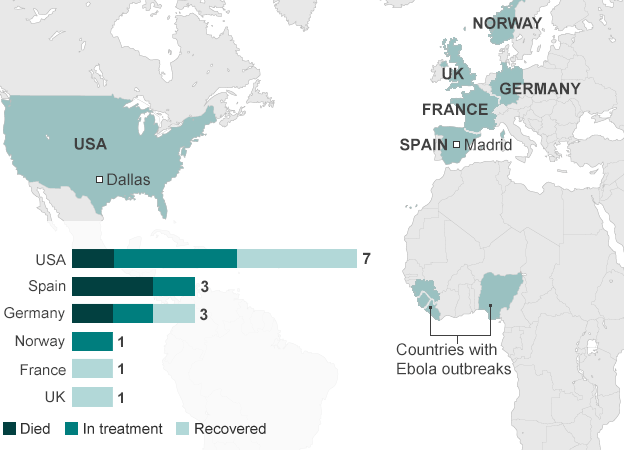
A Sudanese national who was employed as a UN medical worker in Liberia has died of Ebola at a hospital in Germany. Despite receiving multiple experimental drugs to help combat the deadly virus, the UN aid worker died of hemorrhagic fever nine days after first arriving at the hospital.
Ebola Patients Outside Of West Africa (Credit: BBC)
The deceased UN worker reportedly contracted Ebola while in Liberia, where over half of Ebola infections and deaths have occurred. He was flown to Germany last Thursday and was immediately quarantined. “Despite intensive medical measures and maximum efforts by the medical team, the 56-year-old UN employee succumbed to the serious infections of the disease,” said a statement from St Georg medical hospital. He was admitted last week in “critical condition, while stable.”
The UN employee was Germany’s third Ebola patient and the second UN worker to die from the recent Ebola outbreak.
WHO Ebola Deaths’ Chart (Credit: BBC)
A Frankfurt hospital is currently treating a Ugandan doctor who contracted the virus while in Sierra Leone. A Senegal native was recently released from a Hamburg hospital after five weeks of intensive treatment.
On Tuesday, the World Health Organization (WHO) warned that as many as 10,000 new cases per week may arrive within the next two months. Officials also noted that the death rate of Ebola has risen to 70 percent of all cases. The last four weeks have seen an average of 1,000 new cases per week, according to WHO.
WHO also increased the total Ebola death toll to 4,447 on Tuesday.

During the 2006 campaign season, President Bush was seen as a drag on Republican candidates. With his approval rating hovering in the low forties, it was considered politically risky to be seen with the president.
Despite that, in October of 2006, Bush wasn't so unpopular that candidates were unwilling to be seen with him.
The Los Angeles Times reported on October 1, 2006 that he the "Fundraiser in Chief" was still in demand.
Bush will spend more time campaigning for GOP candidates in these weeks before election day, aides said. The White House continues to receive more requests for Bush's time as a campaigner than he can meet, said Deputy Press Secretary Dana Perino. "Supply is not keeping up with demand," she said.
The National Journal reported that in October and November alone, Bush traveled to 18 states and went to public rallies with candidates in ten states.
The GOP went on to get creamed in the 2006 mid term elections - which is perhaps why the Dem strategy this year is to treat the even more unpopular President Obama as persona non grata.
Yesterday ABC made the stunning admission that Obama has been to ZERO campaign events for Democrats, this year.
Just three weeks to go until the midterm elections and with control of the Senate hanging in the balance, candidates are scrambling toward the finish line.
One key figure, however, has been largely absent: President Obama.
President Obama has appeared at zero public campaign events this cycle, opting instead to tap into his fundraising prowess to boost Democratic candidates behind closed-doors.
The media often chided Bush for being the "Fundraiser-in-Chief," but on that score, Obama blows him out of the water. According to the National Journal, Bush raked in a total of $182 million with about 50 fundraisers by October of 2006.
Obama, on the other hand, had done 85 fundraisers by September 23 of this year.
Bush averaged approximately $3.6 million per event. At that average, Obama would have brought in about $309 million to the party so far during this cycle.
But Obama is so toxic, the DSCC doesn't even want to reveal how much money he's raised for Democrats, this cycle.
According to the Federal Election Commission, Democratic committees overall have raised about $365 million this cycle. But trying to ballpark Obama's contribution is purely guesswork. For one thing, the maximum amount a donor can give to a party committee is now some $5,700 higher than it was in 2006. For another, there are huge variations in admission prices at fundraisers Obama attends. (Tickets for DNC events can run between $1,000 and $32,400, for example.) Obama has also done events for Senate Majority PAC, a super PAC dedicated to helping Democratic Senate candidates.
The bottom line is that no one, beyond Democratic Party accountants, knows for sure. "It is impossible to know how much money was raised at a particular event," says Meredith McGehee, policy director of the Campaign Legal Center, a nonprofit that analyzes campaign finance laws. "There really are no tracks in the snow."
Chalk another one up for the party of integrity and transparency.


Experts have reportedly not tested whether Ebola patients can infect others by coughing or sneezing even as one of the top experts on the particular strain of Ebola that has ravaged West Africa believes the virus is "primed" to go airborne.
Dr. David Sanders, a Purdue University biology professor who "has been studying the virus since 2003 – specifically how this particular Zaire strain of Ebola enters human cells," told The Indy Channel (rtv6 ABC) that the Ebola virus "can enter the lung from the airway side" and is "primed to have respiratory transmission."
"We need to be taking this into consideration," Sanders said. "What if? This is not a crazy, 'What if?' This is not a wild, 'What if?'"
According to a Pittsburgh Tribune-Review report, "in August, researchers in West Africa, Europe and the United States sequenced the genomes of Ebola virus isolated from dozens of patients and found it acquired mutations as it spread," but "they did not test whether those genetic changes affect its ability to infect and survive."Charles Bailey, executive director of the National Center of Biodefense and Infectious Diseases at George Mason University, told the outlet, “Is a mutation capable of making it airborne transmissible? Nobody knows.” He also reportedly "said that... concentrated aerosols of Ebola have shown the ability to infect" in experiments with monkeys.
“That experiment hasn't been done yet,” Bailey said. “If there was no concern about aerosol transmission, then why are people wearing masks? There's no absolutes.”
This weekend, a nurse at the Texas hospital that treated Thomas Eric Duncan, the Liberian immigrant who died last week after becoming the first person on American soil to be diagnosed with Ebola, was diagnosed with Ebola. She became the first person on American soil to get Ebola via person-to-person transmission even though she wore full protective gear at the hospital. Officials are trying to determine how she contracted the virus.
The Centers for Disease Control (CDC) has sent mixed messages on the threat of airborne transmission, denying that that Ebola could be transmitted through the air before saying airborne transfer of Ebola is possible but unlikely.
"It's a virus that doesn't spread through the air, and that we do know how to control," CDC Director Tom Friedan recently said during a press briefing. "We do know how to stop it." Officials later conceded that mutations could make the virus airborne though continuing to stress that it was unlikely.
As the Dallas Morning News noted, a CDC poster also states, "You can’t get Ebola through air.” But on the CDC's website, it states that Ebola could possibly be transmitted by sneezing our coughing.
"Although coughing and sneezing are not common symptoms of Ebola, if a symptomatic patient with Ebola coughs or sneezes on someone, and saliva or mucus come into contact with that person’s eyes, nose or mouth, these fluids may transmit the disease," the website says.
Anthony Banbury, the United Nation's Ebola chief, "has said there is a 'nightmare' prospect the deadly disease will become airborne if it continues infecting new hosts," as the Daily Mail noted.
"It is a nightmare scenario, and unlikely, but it can’t be ruled out," Banbury said.

A new documentary from the Tea Party Patriots will highlight the insecure border with Mexico, featuring interviews with Sen. Jeff Sessions (R-AL), Reps. Steve King (R-IA) and Louie Gohmert (R-TX) and scores of law enforcement officials who serve along the entire U.S. border with Mexico.
The documentary, titled “Border States of America,” is hosted by Nick Searcy—a star from the FX television series Justified where he plays a U.S. Marshal.
“Every day brings another example of the disastrous consequences of open borders and amnesty,” Tea Party Patriots president Jenny Beth Martin said in a statement about the documentary. “First, it was a humanitarian wave of crime and disease, now suspected terrorists are being apprehended with who knows how many slipping through; and of course there’s now the question of Ebola. Border States of America with Nick Searcy is a must-watch for those who care about the Republic's security and sovereignty.”
In the statement, Searcy said that this is something that should concern every American.
”Every American who locks the house at night should care about this. The rest of you should keep your house open. Somebody might need something,” Searcy said.
It is set to premiere at the Landmark Theater in Los Angeles on Thursday at 5:30 p.m. PT.
The documentary, which Breitbart News was provided for an exclusive review and sneak peek ahead of its public release, takes viewers from one end of the border to the other—across all of Texas and Arizona. Local law enforcement officials, Border Patrol agents, sheriffs, citizen volunteers and ranchers all go on the record in the film to detail how the border crisis is not limited to just a few tens of thousands of illegal alien children from Central American countries.
“Who’s coming across that wide-open border?” Searcy says at one point in the film. “The current surge of illegal immigrants includes many people officials refer to collectively as OTMs, or people who are Other Than Mexicans. For those OTMs from Central American countries like Guatemala, El Salvador and Honduras, it can be a 1700-mile journey to the U.S. border. A dangerous journey that can include a long train ride on what is called The Beast. Then miles of walking through miles of desert tundra where they may face predators, both human and animal; where poisonous snakes and spiders are more plentiful than cactus. Sexual abuse, other physical abuse, and even death are not uncommon real possibilities.”
The film shows the places where dead bodies are discovered—even showing a few dead bodies—and where rapes of illegal aliens who are being exploited by drug cartels purportedly take place.
There’s a heavy focus in the film on the connection between terrorism and illegal immigration.
“One fact that the politicians and news media aren’t telling the American people is is the fact that illegal immigrants from more than 75 countries have also been identified, including Syria, Albania, Yemen, China, Egypt, Pakistan, Somalia, even people from nations currently suffering from the world’s largest Ebola outbreak have been apprehended attempting to sneak across the wide open U.S. border,” Searcy says at another point in the film.
One local official from the border at one point held up an English to Urdu dictionary, saying it was dropped by a smuggler who was sneaking people purportedly from Afghanistan or Pakistan—where Urdu is spoken—into the U.S. illegally.
“Last year, during one of our border operations we identified a group of 10 coming out of a ranch on a known trail,” the official, Texas Border Volunteers co-founder Dr. Michael Vickers said as he held up the dictionary. “As they went over the fence one of them dropped this out of his pocket. This is an Urdu-English translation dictionary. Urdu is spoken in Afghanistan, and in Pakistan. It’s the national language of Pakistan. A lot of different phrases throughout this book circled and marked and no question this was a coyote who was communicating with some people from the Middle East and they got away.”
There’s also a focus on how Sessions says there’s not a need for increased immigration in the U.S., because there’s not a need for more workers as the American people are hurting economically.
“We don’t have a shortage of workers, we have a surplus of workers. We have a shortage of jobs,” Sessions says in the film. “It’s not in the national interest to bring in huge numbers of workers in a time when wages are falling and jobs are hard to get. And Peter Kirsanow who’s a member of the US Commission on Civil Rights, an African American, he has made clear in repeated articles that immigration as they’re planning it and they have proposed will hurt African Americans the most.”
“So the last thing we should be doing is doubling the number of people coming into the country to take jobs allowing us a lawful system of immigration to collapse,” Sessions adds.
Michael Cutler, a retired federal immigration agent who worked for INS—an agency that’s since been split into three: Border Patrol, Immigration and Customs Enforcement (ICE) and U.S. Citizenship and Immigration Services (USCIS)—says in the film that Americans can be “humanitarian” with how they deal with this, but the focus of the federal government’s solution needs to be aimed at helping “Americans first.”
“The rule of law coincides with being a humanitarian but understand that the humanitarian instincts have to care for Americans first,” he said. “We can’t take care of our own people if we keep driving down the wages and displacing American workers.”
Sponsored By Tea Party Patriots


“FEMINIST” blared the stage behind Beyoncé at MTV’s Video Music Awards in August this year. No true megastar would feel the need to declare themselves on the subject one way or another, but the stunt was typical of the neediest, most inconsistent and most irritating pop artist of our age.
After all, the Texan Methodist gospel girl who grew up to be a star, and whose last tour was named “The Mrs. Carter Show World Tour,” in honour of her husband, is the last person today’s independently-minded, socially liberal, stridently atheist feminists ought to relate to.
In 2006, Beyoncé Knowles-Carter was a registered Republican voter, as were all of her immediate family members. “I grew up in a very nice house in Houston, went to private school all my life and I’ve never even been to the ’hood,” she once told an interviewer, before quickly adding: “Not that there’s anything wrong with the ’hood.”
She sang at Barack Obama’s inauguration, though not, she said at the time, because she sympathises with his political ideals. She has since hosted fundraisers for Obama but has never denied she goes home and votes for the GOP. Then again, she wasn’t entirely on board when she played for George W. Bush either: “I played at the inauguration because there were a lot of kids in the audience that I wanted to reach, that’s all,” she said afterwards. “Maybe one day I will speak of my political beliefs, but only when I know what I’m talking about.”
Wanting to speak but having nothing to say is a fair summary of the entire Beyoncé project. “She just wanted to be a normal child,” says her uncle, Larry Beyince. “She loved to watch cartoons and be with her friends. She was forced into singing. It took away her whole childhood. Everything was geared toward being famous. She used to get angry at [her father] a lot for taking away her childhood. That affected her.”
Beyoncé’s great artistic mistake has been to think that her personal frustrations should be hidden from the public, rather than marshalled as a creative force. We crave realness from our celebrities, to the point that reality stars are afforded endless column inches, no matter how odious they are, if they will only bare their souls to us. Great singer-songwriters have one biographical detail in common, above all else: they say that if it weren’t for music, they’d have died. They need to sing. We don’t get that from Beyoncé.
Beyoncé was railroaded into a singing career by her father, and, later, her husband. Jay Z groomed Beyoncé for stardom, some say in return for marriage. A recent, well-publicised dust-up in a lift between Jay and Beyoncé’s sister Solange is emblematic of the star’s ambivalence to family: she stood by impassively while an argument between her husband and her sibling spilled over into violence, only paying attention enough to move her dress out of the way. She came out the lift smiling.
It wasn’t the first time Beyoncé demonstrated cold-hearted indifference to family. She famously cut her parents out of her life shortly after their divorce, arguably the moment they ceased to be useful to her. She was furious at their insistence that she should be a star. But she became one anyway, trading in her father’s overbearing male presence for another alpha male, Jay Z. Her family, who in 1995 had taken a 50 per cent cut in household income, moving in to multiple, smaller apartments to give Destiny’s Child a shot, were left in the dust. And then, of course, watched by millions, she reduced her former bandmatesto the status of backup singers in her over-produced, overblown Superbowl half-time show.
To say Beyoncé is defined by her marriage is an understatement. Jay Z created and nurtured her celebrity in what looks a lot more like a business than a personal relationship—before, reportedly, cheating on her with Rihanna. Her relationship with the men in her life may explain why so many of Beyoncé’s lyrics go beyond “girl power” and into borderline misandry. It’s a cycle of dysfunction that continues with Blue Ivy, Beyoncé’s daughter by Jay Z. Blue Ivy is the most famous stage prop in the world. Even North West, Kim Kardashian and Kanye West’s baby, isn’t wheeled out so cynically.
Knowles-Carter has a reasonable claim to the title of loneliest woman in the world. In Beyoncé’s world, others are stars, but she is the Sun, emitting a light so blinding it excludes all other sources of radiation. Other artists are refracted through her, and intelligible only in terms of their distance from her. She is pop music’s Meryl Streep: an overbearing, vampiric creature who sucks life out of the rest of the world, and disappears from memory as soon as she leaves the stage. Her voice is technically spectacular, sure. But that’s all it is, and its technical wizardry leaves no space for feeling, and, thus, enduring memory.
That doesn’t mean she’s not confident—or, at least, that she doesn’t project confidence through spectacle. “I have an authentic, God-given talent, drive, and longevity that will always separate me from everyone else,” she once said, in response to a question about her rivalry with Rihanna. If you say so, dear.
* * *
The world has been failing Beyoncé in the last few years, mocking her clumsy attempts to muzzle photographers and her cowardice at the aforementioned inauguration: she bottled out of singing live, then had to be wheeled out at a press conference to belt an over-the-top, face-saving a cappella version of “The Star-Spangled Banner.” We already knew she could sing. The question was why she hadn’t. What’s a chanteuse for, if she can’t sing live on the day?
That was the first of a series of signs that Beyoncé was annoyed with us for not recognising her transcendent brilliance. It’s an anxiety that never makes it into her music—more’s the pity. There is no true agony in a Beyoncé record. What separates her music from the greats of the past—compare her frivolous riffs with the exquisite torture of late Billie Holiday album Lady in Satin—is the impression that she’s never known pain, and that her heart’s not really in all this. That’s not true of her contemporaries. No serious person pays attention to, or can even tell the difference between, those bland white girls Taylor Swift and Katy Perry. But consider Céline Dion, who is in so much pain she shares it with us every time she sings. Or Mariah Carey, whose defining professional characteristic is success against the odds.
In place of redemptive fables, those essential human experiences we look to our pop icons to make sense of, Beyoncé offers cold, theatrical certainty. “Why Don’t You Love Me” from 2008’s I Am... Sasha Fierce comes closest in the Beyoncé canon to delivering genuine anguish. But the video shows up the song’s failings: even at her most desolate, Beyoncé cannot bear the thought of being ugly. So she invents an aesthetic of despair more beautiful than any video she'd previously produced.
Part of the reason Beyoncé has lost spiritual purchase on listeners is that she has drifted from her faith. Her waffly, incomprehensible live interludes between songs and her non-committal answers in interviews, though drenched in thanks-be-to-God apophthegms, have less in common with her religious upbringing than they do the faux-spirituality of Oprah Winfrey. Predictably, Beyoncé and Oprah adore each other. Like Winfrey, she has left religion behind in favour of “spirituality,” convenient to both women because it is infinitely extensible, adaptable to circumstance and because, with God out of the picture, Beyoncé and Oprah are free to indulge their own gigantic egos. When Beyoncé says “God,” she means “Beyoncé.” Even Kim Kardashian has more intellectual integrity than that.
As the biggest pair of lungs in Destiny’s Child, Knowles-Carter revealed a self-awareness and humility that might have developed into an inspirational personality. When she sang in praise of the Lord in the late 1990s, we believed her: the Amazing Grace outro on 1999’s The Writing’s On The Wall is Beyoncé at her most ecstatically revealing and spiritually engaged. (The schmaltzy, self-conscious harmonies of the gospel medley on Survivor, two years later, have none of the same soul.)
But any trace of duty or reverence before God disappeared after 2003’s “Crazy in Love,” perhaps her last genuine expression of emotion. Beyoncé has become the deity she used to worship. Yet, for all her power and ubiquity, she remains the most radically insecure figure in the heavens, approving only those images of herself that project a spiritual and sexual serenity she has not worked to achieve in her personal life. She tried to have unflattering images from that Superbowl performance scrubbed from the internet (imagine it), and she has banned press photographers from her latest tour. Other stars use photo ops to send messages, but Beyoncé’s relationship with the camera tells us nothing, except that she is vain and controlling.
Beyoncé herself gives us a clue just how bad things are at home on the opening track of her self-titled 2013 album, BEYONCÉ. “My aspiration in life… would be… to be happy,” she confesses. If the preternaturally perfect Beyoncé’s not happy by now, what hope is there for the rest of us? And in there is the clue: once again, it’s not really her speaking. You can never quite connect with Beyoncé, and when you get close, you sense that there’s not a particularly likeable person underneath all the sequins and lace.
Like Lady Gaga, another unspeakably boring and over-rated performer, Beyoncé the artist has no dark double, no secret, amoral place from which her artistic motivation springs. She is an invention. She and Sasha Fierce, her supposed 2008 alter ego, share the same persona: flat, attention-seeking, brash. Beyoncé doesn’t appear to believe in anything and she isn’t wrestling with anything either. That’s alright for a lot of people, at least while she’s churning out records that make people feel good about themselves.
But you can’t have an enduring relationship with a brick wall, which is why, the moment Queen Bey stops releasing feel-good crowd-pleasers, you have to figure she will evaporate from popular consciousness. Perfection of a flippant, trivial sort define Knowles-Carter, from the pseudo-religious cult that surrounds her to the royal pretensions of her music videos. She is “Queen Bey” to her acolytes: a fierce, fabulous icon of strong female sexuality, married to Jay Z, one of the most powerful men in the business. It’s a wonder so many people think they identify with such fakery and vacuousness, and a tragedy that the real Beyoncé is so committed to evading authenticity and such a—dare I say it—laugh-free zone.
Although, given what we know about her private life, we might conclude that enjoying an uncomplicated façade is preferable to getting to know the woman. This is speculation, of course, because Beyoncé will never give us enough information to decide. (Even the word “Beyoncé” is made up, a riff on her mother’s maiden name, reimagined as an exotic-sounding epithet by overbearing, fame-hungry parents.)
Crass pyrotechnics, sexual titillation and ego boosts for the sisterhood are unconventional routes to female empowerment. But it is what we have come to expect from Beyoncé, in whom it is the male idea of female beauty that finds highest and most perfect expression. She is what men demand of her, less than the sum of her body parts. Living art, but art that says remarkably little. Her collaboration with Gaga on Telephone was a perfect marriage; the empty masquerading as the enigmatic.
Beyoncé is a success as a pop star but a failure as an artist, which makes the rabidity of her enormous fan base, the “BeyHive,” a bit saddening. Perhaps Beyoncé’s cultic following is a product of our time. Certainly, the fetishisation of the insubstantial takes many forms, Beyoncé-worship perhaps the most obvious. She is a pop star for people who refuse to think. Maybe that is why, when she reaches for profundity, she stumbles. “Halo,” which often closes out her shows, is cited as her greatest achievement. But, like her voice, it is thin, reedy and unsatisfying: a spectacle of pomp, signifying nothing.
It’s a song whose lyrics are about stripping down walls and showing the real person inside, but musically speaking it’s the most superficial and manipulative record she’s ever released. Everything Beyoncé does is predictable, but “Halo” is the most predictable, timorous, trashy anthem of the last two decades. Its climax serves up empty ineffability, like a bad Philip Larkin poem. It is, like so much of what Knowles-Carter does, trying too hard.
Real artists don’t have to tell you to bow down, and, when they speak, they bring something fresh. But when Beyoncé demeans herself with attempts to “do politics,” such as her terrible mini-essay on gender equality, which an Oberlin freshman would have been embarrassed by, it’s simply another way for her to scream: “Please love me.” Everyone wants to be loved, but Beyoncé scales new heights of desperation in demanding reverence while providing no emotional sustenance or intellectual nourishment to her subjects. If she were capable of humour, we might have written off her “FEMINIST” statement as a clever provocation. But she is probably the least funny, least cerebral star in the cosmos, so we can’t.

By Raúl Ilargi Meijer of The Automatic Earth
How To Blow Up OPEC In Three Easy Steps
It’s easily been longer than I care to remember that I first wrote it was only a matter of time before individual OPEC members would throw out the cartel’s agreements on prices and production, and just produce at full force and capacity, and then some. We may have seen that time arrive.
The underlying reason I first talked about it was two-fold. First: the economic crisis, which could lead to one thing only: less global demand. And second: the fast increasing wealth and population numbers in oil-producing nations which, as initially defined by Jeffrey Brown and Sam Foucher in the Export Land Model, has proven to be a much bigger factor in OPEC economies than people realized.
Hardly anyone, still to this day, talks about the Export Land Model, but birth rates in Arab oil producing nations have been sky-high for many years, and the fact that in a country like Saudi Arabia some 50% of the population is younger than 20 years old, has enormous consequences domestically. Certainly with the King and the rest of the reigning class seriously getting on in age.
A generational clash can be avoided only by pampering the young, and that comes with a big surge in domestic demand for oil. And since for many young people there are no jobs, Saudi Arabia has no industries to speak of, there are many who follow the example of Saudi’s like Osama Bin Laden into extremism.
Wait, first let me point to a nice piece of Fed ‘communication’. There’s been an entire parade of Fed heads paraded in the media lately, and one of the major issued addressed is that the global slowdown, which finally looks to have sunk in all over the place, would cause Yellen et al to be careful with, and postpone if needed, its interest rate hikes. Analysts and ‘experts’ also look to be wholly convinced of this. But then comes vice head Stanley Fisher and says a rate hike wouldn’t hurt anyone anyway:
Fed’s Fischer Says Rate Hike Won’t Damage Global Economy
The Federal Reserve’s eventual rate increase, the first since 2006, will not damage the global economy, Federal Reserve Vice Chairman Stanley Fischer said on Saturday. While there could be “trigger further bouts of volatility” in international markets when the Fed first hikes, “the normalization of our policy should prove manageable for the emerging market economies,” Fischer said in a speech at the IMF’s annual meeting.
[..] Since last year, Fischer said, the Fed has “done everything we can, within limits of forecast uncertainty, to prepare market participants for what lies ahead.” The Fed has been as clear as it can be about the future course of its policy course, and markets understand, Fischer said. “We think, looking at market interest rates, that their understanding of what we intend to do is roughly correct … ”
Any emerging market governments paying attention should feel a shiver of cold air when reading that. Fisher provides the Fed with an alibi here: if, make that when, rate hikes start makes victims, Fisher and Yellen can say they had no idea, that their models clearly stated that would not happen. Don’t count on them waiting.
Then back to OPEC. Like the EU, 54-year old OPEC has lived past its best before date. Predictably, individual members’ interests have started to diverge too much for it to remain a coherent entity. And the divergence widens fast these days.
I’ve hinted before at the long-standing cooperation between the US and Saudi Arabia, and there’s little doubt in my mind that the two are up to something. Washington has it in for Putin, first and foremost. The ‘Ukraine project’ has not brought what was intended.
Russia also still stands behind its only Middle East sphere of influence, Syria, something the Saudis like as little as America (but which Moscow won’t give up and and end up with zero say in the region) . And there’s always Venezuela, OPEC member and very vulnerable to power oil prices. Then there are a dozen other possible ‘targets’ among oil producers that the Saudi/US partnership may want to weaken. Who likes Iran, for one thing?
We’ve known for a while that the Saudis were lowering their prices. Which is something other OPEC members will be plenty upset about. But now we find out they’re also increasing production, and trying to catch EUropean and Asian customers before other fellow members can. That adds a whole extra dimension to the story:
Saudis Make Aggressive Oil Push in Europe
Days after slashing prices in Asia, Saudi Arabia is now making an aggressive push in the European oil market, traders say. The kingdom is taking the unusual step of asking buyers to commit to maximum shipments if they want to get its crude. “The Saudi push is not just in Asia. It’s a global phenomenon,” one oil trader said. “They are using very aggressive tactics” in Europe too, the trader added.
This month, state-owned Saudi Aramco stunned the rest of OPEC by slashing its November prices to defend its market share in Asia’s growing market. The move, setting a price war in the oil-production group, was combined with a boost in the kingdom’s output in September.
But Riyadh is also moving to protect its sales to Europe, a declining market where it is facing rivalry from returning Libyan production. After cutting its November prices there, Saudi Aramco is also asking refiners to commit to full, fixed deliveries in talks to renew contracts for next year, the traders say. [..] “They are threatening buyers” to discontinue sales if they don’t agree with the fixed deliveries, another trader said.
What follows from that is that Saudi Arabia more or less unilaterally decides where oil prices are going. Iran and Iraq have already announced price cuts, and the rest has no choice but to follow, no matter how badly they need higher prices. It’s a kind of musical chairs, and quite a few nations will fall be the wayside. Though not necessarily Russia.
Algeria and Kuwait, for whatever reasons, seem to be lined up with the Saud family against the rest of OPEC:
Oil Bear Market Tests OPEC Unity as Venezuela Seeks Meeting
Oil ministers from Kuwait and Algeria dismissed possible production cuts as crude’s slump to a four-year low prompted Venezuela to call for an emergency meeting of OPEC. [..] Bear markets for Brent and U.S. crude are putting pressure on OPEC’s consensus on output ahead of the group’s scheduled Nov. 27 meeting in Vienna …
OPEC supplies 40% of the world’s oil, and its largest Persian Gulf producers, including Saudi Arabia, Iraq and Iran, are offering deeper discounts to buyers in Asia to maintain market share amid a global glut. “If we had a way to preserve the stability of prices or something that would bring it back to previous levels, we would not hesitate in that,” Kuwait’sAl-Omair said in remarks reported by KUNA yesterday. “There is no room for countries to reduce their production,” he said, without giving details.
Ample supply, helped by surging U.S. and Russian output, pushed Brent crude into a bear market last week. The European benchmark slumped more than 20% from its peak for the year on June 19, meeting a common definition of a bear market. Brent fell on Oct. 10 to its lowest since December 2010.
“This is going to increase pressure for Saudi Arabia to cut output to raise prices …” “They are increasingly giving signs they won’t do it on their own. Saudi Arabia doesn’t want to lose market share in Asia … ”.
OPEC is boosting production as its members fight for market share and seek to meet rising domestic demand. [..] Saudi Arabia, Iran and most recently Iraq all widened the discounts they’ll offer on their main grades sold to Asia next month to the most since at least 2009.
Venezuelan President Nicolas Maduro gave instructions to ask for an extraordinary OPEC meeting, the country’s foreign ministry said in a post on its Twitter account on Oct. 10. “The price of oil is important for our country, and we’ll start actions to stop its fall,” the ministry cited former oil minister Rafael Ramirez as saying.
Crude prices have fallen because of several factors, including U.S. shale production, geopolitics and speculation, Algeria’s Yousfi said yesterday at a news conference in the city of Oran. “We follow with great attention the level of oil prices, but we are very tranquil,” he said. Crude probably won’t fall below $76 to $77 a barrel because that price level represents the highest cost of production in the U.S. and Russia, Al-Omair of Kuwait said. Both countries have abundant supply and are outside the group..
‘There is no room for countries to reduce their production’, says Kuwait. In other words, it’s everybody for themselves. Because supply and demand numbers seem to indicate there’s lots of room to cut production. So that can’t be it. Still, production rises in Saudi Arabia, US, Russia and undoubtedly many other producing nations. What else can they do when prices fall, but try and sell higher volumes to the highest bidder, as demand wanes in a shrinking global economy that’s done blowing bubbles? There’s nothing left but to pump all out and hope for the best.
OPEC Members’ Rift Deepens Amid Falling Oil Prices
A rift between OPEC members deepened over the weekend, as producers in the cartel moved in different directions amid falling oil prices. Venezuela, which has been one of the most outspoken proponents of a production cut by the Organization of the Petroleum Exporting Countries, called over the weekend for an emergency meeting of the group to respond to falling prices. But Kuwait said Sunday that OPEC was unlikely to act to rein in output.
Also on Sunday, Iraq’s State Oil Marketing Company cut the price of Basrah Light crude in November for Asian and European buyers by 65 cents to a discount of $3.15 a barrel below the Oman/Dubai benchmark for Asian customers and $5.40 below the Brent benchmark for European customers…
The moves and countermoves are the latest in a time of particular discord in OPEC. The organization was founded to leverage members collective output to help influence global prices. In recent periods of low prices, Saudi Arabia, OPEC’s top producer and de facto leader has managed to cobble together some level of consensus.
But even modest cooperation between many members has broken down, and Saudi Arabia, in particular, has moved to act on its own. While it cut output earlier this summer, other members didn’t go along. Since then, it has dropped its prices.
Each member has a different tolerance for lower prices. Kuwait, the United Arab Emirates and Saudi Arabia generally don’t need prices quite as high as Iran and Venezuela to keep their budgets in the black.
The 3 easy steps to blow up OPEC are easy indeed. The question may be why now, and why the way it happens. But that it’s happening is clear.
This is not a purely economic issue, it’s political. The US has a large voice in it in the director’s role, and the House of Saud plays the part of the protagonist. This is a major development in world politics, it’s not just some financial market-driven move.
World power relations are being hugely changed on the fly as we’re all watching and trying to figure what to make of all this. One thing’s for sure: the world will never be the same.
Why it happens now is a great question, which is impossible to answer. And that’s fine: it’s enough to try and understand exactly what is going on, let alone why.
But I bet you it has to do with the US and Europe realizing they can no longer keep pretending their economies are growing or recovering or doing fine.
We’ve landed in the next phase of what arguably started in 2007, but what you could place back many years before that, an economic system based on the fantasy that is debt driven growth, inflated by a factor of a trillion, give or take a few zeros.
That system is in the process of dying. And the people who have tried to make you believe, and succeeded, that it would all be fine in the end, are now jockeying for position in the aftermath of the demise of a world built on debt.
And they are the same people who built that world, profited from it to an insane degree, and want to use those profits to hang on to power in a world that will be dramatically different from the one they called the shots in. And that doesn’t bode well; it tells us violent clashes will be on the horizon.


Demand for cured meats made without synthetic nitrates/nitrites is rising, and processors are seeking information on safe and effective methods. On this webinar, meat scientists, a processor, and an organic meat marketer explain ingredients, processes, and challenges to natural curing, along with product labeling and regulations.
Date: March 4, 2010
Duration: 60 minutes
Presenters:
* (c) Niche Meat Processor Assistance Network 2009
Audio Text
Interview with the farmer: "My name is Bruce Dunlop, I raise pigs and sheep here on this farm. We've been making use of having our co-op, which runs this mobile slaughter trailer, for all of our processing. They operate under USDA inspection, and that's given us a big advantage, where we can sell our products and the quality of the products that gets done. So we're really quite happy with that."
NARRATOR: In this video, you’ll see what a USDA-inspected mobile slaughter unit looks like, and also how the farm site is set up.
This is the Island Grown Farmers Cooperative mobile slaughter unit. Today it’s visiting a farm on Lopez Island, in the San Juan Islands of Washington State. The unit arrived last night – after a slaughter day at a different farm – and pulled in to its usual spot next to the barn. The unit comes to this farm on a monthly basis. Other members of the co-op occasionally arrange to bring their animals here for slaughter. This unit visits approximately 30 farms each year, all co-op members.
Mobile units vary in size, but this one is 24 feet long, without the hitch. It is pulled by a small semi- tractor. This is the processing room. Through those doors is the cooler, where the carcasses will be hung. The mobile unit arrives at the farm with everything it needs to slaughter, split, and clean a carcass, including all its wash water.
Two butchers are operating the unit today: the Managing Butcher and an assistant. An MSU can be operated by just one butcher, but two can do nearly twice as many animals in one day. The farmer is having pigs and sheep slaughtered today, and another co-op member has brought two cattle. The inspector, from USDA’s Food Safety and Inspection Service, is here for the full 8 hour day, to inspect every animal before and after slaughter.
Interview with the USDA inspector: "I'm Jim Donaldson, and I'm a GS-9 with the USDA. I come along with the mobile unit & do all the inspection. One of the major things for this plant is that the farmers, instead of taking their animals off island or to the closest plant, which is probably a couple hundred miles, we can come to them. So there's less stress on the animals...it cuts the stress."
NARRATOR: In lieu of an office for the inspector, as FSIS usually requires, the co-op has provided the inspector with a locking file cabinet, kept on the mobile unit, to keep inspection records. Clean, convenient bathroom facilities are available in the farm house; some farms provide a port-a-pot.
FSIS has a few basic requirements for the farm site to assure humane treatment of the animal, the safety of the inspector, and, of course, food safety. First, the animals need a place to relax for inspection without putting the inspector in danger. What this looks like depends on the species of animal.
The cattle were brought to the farm in a trailer, and they stay here for inspection. The pigs and sheep are inspected in their corral. Then one is brought out into the chute.
Here’s how a different member farm does it, with a chute and a head-gate. After stunning, the outer gate opens to release the animal onto a concrete pad.
If the inspector condemns an animal, there must be a place to keep that animal separate from other livestock, for example a partitioned off corner of a corral. If a vet is called out to inspect, the animal needs food and water during the wait.
Finally, there must be a concrete pad, or clean and dry dirt, or clean grass where the animal falls after stunning, for initial bleed-out. This concrete pad cost the farmer $1000, because he did the labor himself. While not required, the pad makes clean up easier, especially if the farm is hosting the unit on a regular basis.
This video project was funded by the W.K. Kellogg Foundation. Many thanks to Bruce Dunlop and the Island Grown Farmers Cooperative; Yer Vue, Xang Chang, and Chris Benedict at Washington State University; and Zach Mull.
This is a Niche Meat Processor Association article and was reviewed for compliance with federal, state, and local regulations by members of the NMPAN community. Consult with USDA's Food Safety and Inspection Service and/or the appropriate state or local regulators before making changes in your operation. For more information, refer to NMPAN's articles on mobile slaughter units.

Florida State's huge lead in the Pythagorean Ratings has shrunk to a fraction of a point against Mississippi and Mississippi State.
But the Seminoles held onto No. 1 in these rankings. Below each team is listed in order from 1st to 128th with their projected score and opponent for this week. Notre Dame dropped to No. 16 in these rankings due to a poor showing against UNC, but they will have a chance this week prove they are a playoff team by beating Florida State. Baylor has the final playoff spot in these ratings, but will have to visit a West Virginia team that almost upset both Alabama and Oklahoma.
1. Florida St (ACC) projected 39-22 host No. 16 Notre Dame (Ind)
2. Mississippi (SEC) projected 36-16 host No. 34 Tennessee (SEC)
3. Mississippi St (SEC) is idle
4. Baylor (B12) projected 51-29 at No. 39 West Virginia (B12)
5. Oregon (P12) projected 32-17 host No. 31 Washington (P12)
6. Alabama (SEC) projected 43-24 host No. 30 Texas A&M (SEC)
7. Michigan St (B10) projected 35-18 at No. 59 Indiana (B10)
8. Georgia (SEC) projected 31-24 neu No. 19 Arkansas (SEC)
9. Stanford (P12) projected 27-21 at No. 41 Arizona St (P12)
10. Auburn (SEC) is idle
11. Clemson (ACC) projected 42-31 at No. 43 Boston College (ACC)
12. TCU (B12) projected 27-23 host No. 15 Oklahoma St (B12)
13. Ohio St (B10) projected 38-21 host No. 51 Rutgers (B10)
14. Oklahoma (B12) projected 28-25 host No. 17 Kansas St (B12)
15. Oklahoma St (B12) projected 23-27 at No. 12 TCU (B12)
16. Notre Dame (Ind) projected 22-39 at No. 1 Florida St (ACC)
17. Kansas St (B12) projected 25-28 at No. 14 Oklahoma (B12)
18. USC (P12) projected 40-14 host No. 98 Colorado (P12)
19. Arkansas (SEC) projected 24-31 neu No. 8 Georgia (SEC)
20. Wisconsin (B10) is idle
21. Nebraska (B10) projected 25-19 at No. 55 Northwestern (B10)
22. South Carolina (SEC) projected 41-14 host No. Furman ()
23. LSU (SEC) projected 34-26 host No. 38 Kentucky (SEC)
24. Louisville (ACC) projected 46-23 host No. 74 NC State (ACC)
25. East Carolina (AAC) is idle
26. UCLA (P12) projected 38-23 at No. 82 California (P12)
27. Maryland (B10) projected 21-18 host No. 28 Iowa (B10)
28. Iowa (B10) projected 18-21 at No. 27 Maryland (B10)
29. Utah (P12) projected 29-25 at No. 53 Oregon St (P12)
30. Texas A&M (SEC) projected 24-43 at No. 6 Alabama (SEC)
31. Washington (P12) projected 17-32 at No. 5 Oregon (P12)
32. Duke (ACC) projected 39-31 host No. 46 Virginia (ACC)
33. Missouri (SEC) projected 23-22 at No. 47 Florida (SEC)
34. Tennessee (SEC) projected 16-36 at No. 2 Mississippi (SEC)
35. Miami FL (ACC) is idle
36. Texas (B12) projected 31-20 host No. 61 Iowa St (B12)
37. Arizona (P12) is idle
38. Kentucky (SEC) projected 26-34 at No. 23 LSU (SEC)
39. West Virginia (B12) projected 29-51 host No. 4 Baylor (B12)
40. Minnesota (B10) projected 28-16 host No. 73 Purdue (B10)
41. Arizona St (P12) projected 21-27 host No. 9 Stanford (P12)
42. Virginia Tech (ACC) projected 35-26 at No. 79 Pittsburgh (ACC)
43. Boston College (ACC) projected 31-42 host No. 11 Clemson (ACC)
44. Utah St (MWC) projected 20-20 at No. 50 Colorado St (MWC)
45. UCF (AAC) projected 37-12 host No. 119 Tulane (AAC)
46. Virginia (ACC) projected 31-39 at No. 32 Duke (ACC)
47. Florida (SEC) projected 22-23 host No. 33 Missouri (SEC)
48. Marshall (CUSA) projected 39-32 at No. 75 Florida Intl (CUSA)
49. Georgia Tech (ACC) projected 35-36 at No. 56 North Carolina (ACC)
50. Colorado St (MWC) projected 20-20 host No. 44 Utah St (MWC)
51. Rutgers (B10) projected 21-38 at No. 13 Ohio St (B10)
52. BYU (Ind) projected 43-31 host No. 72 Nevada (MWC)
53. Oregon St (P12) projected 25-29 host No. 29 Utah (P12)
54. Syracuse (ACC) projected 21-15 at No. 103 Wake Forest (ACC)
55. Northwestern (B10) projected 19-25 host No. 21 Nebraska (B10)
56. North Carolina (ACC) projected 36-35 host No. 49 Georgia Tech (ACC)
57. Boise St (MWC) projected 43-25 host No. 97 Fresno St (MWC)
58. Houston (AAC) projected 31-25 host No. 63 Temple (AAC)
59. Indiana (B10) projected 18-35 host No. 7 Michigan St (B10)
60. Texas Tech (B12) projected 35-18 host No. 106 Kansas (B12)
61. Iowa St (B12) projected 20-31 at No. 36 Texas (B12)
62. Louisiana Tech (CUSA) projected 35-29 host No. 68 UT San Antonio (CUSA)
63. Temple (AAC) projected 25-31 at No. 58 Houston (AAC)
64. Michigan (B10) is idle
65. W Kentucky (CUSA) projected 31-26 at No. 95 FL Atlantic (CUSA)
66. San Diego St (MWC) projected 34-27 host No. 84 Hawaii (MWC)
67. UAB (CUSA) projected 42-43 at No. 78 Middle Tenn St (CUSA)
68. UT San Antonio (CUSA) projected 29-35 at No. 62 Louisiana Tech (CUSA)
69. Navy (Ind) is idle
70. Memphis (AAC) is idle
71. Illinois (B10) is idle
72. Nevada (MWC) projected 31-43 at No. 52 BYU (Ind)
73. Purdue (B10) projected 16-28 at No. 40 Minnesota (B10)
74. NC State (ACC) projected 23-46 at No. 24 Louisville (ACC)
75. Florida Intl (CUSA) projected 32-39 host No. 48 Marshall (CUSA)
76. Bowling Green (MAC) projected 26-15 host No. 112 W Michigan (MAC)
77. Rice (CUSA) is idle
78. Middle Tenn St (CUSA) projected 43-42 host No. 67 UAB (CUSA)
79. Pittsburgh (ACC) projected 26-35 host No. 42 Virginia Tech (ACC)
80. Washington St (P12) is idle
81. Penn St (B10) is idle
82. California (P12) projected 23-38 host No. 26 UCLA (P12)
83. UTEP (CUSA) is idle
84. Hawaii (MWC) projected 27-34 at No. 66 San Diego St (MWC)
85. Arkansas St (SBC) is idle
86. C Michigan (MAC) projected 29-20 host No. 109 Ball St (MAC)
87. San Jose St (MWC) projected 40-36 at No. 104 Wyoming (MWC)
88. Cincinnati (AAC) projected 24-23 at No. 105 SMU (AAC)
89. Air Force (MWC) projected 38-32 host No. 99 New Mexico (MWC)
90. North Texas (CUSA) projected 40-18 host No. 122 Southern Miss (CUSA)
91. Toledo (MAC) is idle
92. N Illinois (MAC) projected 36-12 host No. 127 Miami OH (MAC)
93. Old Dominion (CUSA) is idle
94. South Florida (AAC) projected 28-27 at No. 107 Tulsa (AAC)
95. FL Atlantic (CUSA) projected 26-31 host No. 65 W Kentucky (CUSA)
96. Vanderbilt (SEC) is idle
97. Fresno St (MWC) projected 25-43 at No. 57 Boise St (MWC)
98. Colorado (P12) projected 14-40 at No. 18 USC (P12)
99. New Mexico (MWC) projected 32-38 at No. 89 Air Force (MWC)
100. Ga Southern (SBC) is idle
101. UNLV (MWC) is idle
102. Akron (MAC) projected 22-19 at No. 116 Ohio (MAC)
103. Wake Forest (ACC) projected 15-21 host No. 54 Syracuse (ACC)
104. Wyoming (MWC) projected 36-40 host No. 87 San Jose St (MWC)
105. SMU (AAC) projected 23-24 host No. 88 Cincinnati (AAC)
106. Kansas (B12) projected 18-35 at No. 60 Texas Tech (B12)
107. Tulsa (AAC) projected 27-28 host No. 94 South Florida (AAC)
108. Troy (SBC) projected 32-18 host No. 123 Appalachian St (SBC)
109. Ball St (MAC) projected 20-29 at No. 86 C Michigan (MAC)
110. South Alabama (SBC) projected 29-11 host No. 126 Georgia St (SBC)
111. Connecticut (AAC) projected idle
112. W Michigan (MAC) projected 15-26 at No. 76 Bowling Green (MAC)
113. Army (Ind) projected 26-12 at No. 128 Kent (MAC)
114. Texas St (SBC) projected 23-18 host No. 117 ULL (SBC)
115. Massachusetts (MAC) projected 27-17 host No. 121 E Michigan (MAC)
116. Ohio (MAC) projected 19-22 host No. 102 Akron (MAC)
117. ULL (SBC) projected 18-23 at No. 114 Texas St (SBC)
118. ULM (SBC) is idle
119. Tulane (AAC) projected 12-37 at No. 45 UCF (AAC)
120. New Mexico St (SBC) projected 27-25 at No. 125 Idaho (SBC)
121. E Michigan (MAC) projected 17-27 at No. 115 Massachusetts (MAC)
122. Southern Miss (CUSA) projected 18-40 at No. 90 North Texas (CUSA)
123. Appalachian St (SBC) projected 18-32 at No. 108 Troy (SBC)
124. Buffalo (MAC) is idle
125. Idaho (SBC) projected 25-27 host No. 120 New Mexico St (SBC)
126. Georgia St (SBC) projected 11-29 at No. 110 South Alabama (SBC)
127. Miami OH (MAC) projected 12-36 at No. 92 N Illinois (MAC)
128. Kent (MAC) projected 12-26 host No. 113 Army (Ind)
FCS. Furman (FCS) projected 14-41 at No. 22 South Carolina (SEC)