Photographer Seph Lawless—known for his work with abandoned malls—has now turned his lens on abandoned amusement parks
KWBaker
Shared posts
17 Jun 00:40
Hauntingly Beautiful Photos of 10 Abandoned Amusement Parks
by Rebecca OConnell
Baker likes this
17 Jun 00:39

Rick Perry’s ACTUAL Legacy
by Caleb Howe (Diary)
When Rick Perry announced his run for office, the emergence of a raft of memes from the rabid left was a foregone conclusion. They despise Rick Perry, just as they despise all of Texas. Because Wendy Davis. Because guns. Because Bush. And because Rick Perry already ran in 2012. Like the sun rising in the east and setting in a carefully concealed sound stage run by the CIA, the reaction was utterly predictable.
One meme, one graphic, took an early lead as the most shared. If you have any democrat friends on Facebook or follow any on Twitter, you’ve certainly seen it by now. It purports to be a summary of Governor Perry’s legacy in Texas, and is included below.
It will no doubt fail to surprise you to learn that this meme came out during the 2012 election cycle, and is simply being recycled for this go around. (Ha! ReCYCLEd!)
Equally inevitable and likewise as predictably, the leftists newly and again favored jab is full of absurd lies. Nothing fires up a lefty like a lie. Just ask Rachel Dolezal. Now before we get into the itemization, it is important to note that a meme is a powerful thing. Shareable, impact media that people see and are influenced by and remember. Given that, it is not enough to simply tell you about the lies. We must correct the record in kind. To that end, please enjoy the following shareable meme on Rick Perry’s ACTUAL Legacy.
(Note: Where possible, creators of original meme were given benefit of the doubt and data was limited to 2012/2013 time frame of when it was created.)

This meme has the virtue of being true. The Texas economy is a nationwide leader, and under Rick Perry jobs, wages, and education soared. This is DESPITE cutting budgets and lowering taxes. So already, the entire premise of the dumb meme, which by the way was produced and distributed on Facebook by GOP Stoppers, is entirely, utterly, and irrevocably destroyed.
But wait, there’s more!!
Take, for example, the very first and arguably most alarming item on the leftist legacy rewrite: #1 in Worker Deaths. Can this be true? Well let’s just check with left-leaning fact checker Politifact and see what they think:
Texas ranked 18th, with a rate of 1.7 such deaths per 100,000 workers. Observing that the five states with the “worst” rates all employed fewer than 1 million people in 2011, we checked to see how Texas fared among states employing more than 1 million. The answer: 10th place.
“Worst” among the states were Montana (3.4 deaths per 100,000 workers), North Dakota (3.3), West Virginia (3), Alaska (3) and New Mexico (2.8). “Worst” among states with more than 1 million employed were Arkansas (2.6), Louisiana (2.3), Kansas (2.3), Missouri (2.1) and Kentucky (2).
During our look into the Everlasting GOP Stoppers’ claim, a bureau spokeswoman, Cheryl Abbot, responded to our inquiry about worker deaths in general by emailing us a federal document showing 2011 workplace fatality rates state by state. That year, according to the document, Texas had a rate of 4 fatal occupational injuries per 100,000 full-time equivalent workers.
That tied the state for 22nd with Alabama. North Dakota ranked first with a fatality rate of 12.4, according to the document, with Wyoming second (11.6) followed by Montana (11.2), Alaska (11.1), Arkansas (8.0), South Dakota (6.7) and New Mexico (6.6). Among the 10 most populous states, Texas ranked second to Ohio, which had a 5.5 fatality rate, according to the document.
So … nope. Lie.
Poverty level jobs is addressed above in the graphic. For this, let’s visit the Federal Reserve Bank of Dallas, in a PDF titled “Texas Leads Nation in Creation of Jobs at All Pay Levels” (which kind of says it all right there.)

As you can see, wages in the state rose in every category. Of course, that doesn’t address job growth. For that, another chart from the same document.

Do people still say boom? I’m going to assume that they do. Boom.
Texas created jobs across all levels of wages AND INCREASED THE WAGES FOR THOSE JOBS under Gov. Rick Perry. I’m going to say it again gratuitously. Boom.
What about carbon emissions? I will grant this is not something likely to provoke the interest of any real Texan, but just for fun, let’s check their facts.
Back to Politifact we go:
So, Texas has been No. 1 in total CO2 emissions, though it would have tied for 13th if each state’s emissions were adjusted for its population.In per-capita emissions, less populous states led the nation, topped by Wyoming (108 metric tons per capita); North Dakota (76); Alaska (56); Louisiana (50); Montana (36); Kentucky (35); Indiana (34); Iowa (30); Alabama and New Mexico (28); Nebraska and Oklahoma (27). Kansas and Texas each had 26 metric tons of CO2 emissions per resident.
This doesn’t even address the clear logical flaws. Among 50 states, someone must be last. And it stands to reason that states in the energy industry would lead the way.
So what does it mean to be number one? The implication is “worst offender.” By every possible measure, Texas is not the worst offender.
A third point, utterly destroyed. This is easy you guys. This isn’t even hard.
Next up was 49th in school funding. Oh those lefties and their tropes. It is not even a question to them that spending less equals worse outcomes. It is an article of faith. If you spend less, you care less. It is the essence of their very being. So of course, they rank the spending, not the outcome.
In reality, the outcome in Texas is phenomenal. Number two in America for on time graduation of students. Texas is number one in graduations for hispanic students, for black students, and for students from low income families.
Is that not the goal? Is that not what the purpose of education is? Is it not laudable that the most disadvantaged get the most advantage if they live in Texas?
Where is that info from? Why right here at The Washington Times. And right here, at the Department of Education.
50th in High School graduates indeed.
I’m going to say kablammo this time. KABLAMMO.
But we can give the Facebook meme creators one thing about Gov. Rick Perry’s legacy. Under his leadership, taxes were slashed in Texas.
Sorry?
The post Rick Perry’s ACTUAL Legacy appeared first on RedState.

Baker likes this
17 Jun 00:37

Putting a camera on the front of a truck with a TV on the back so you can see when to pass.
Baker likes this
15 Jun 13:32

The true tale of Ernest Shackleton and crew on their Endurance expedition would not be believed if a fairy tale. And may not be a first guess as a children's book (though better than Scott's journey to the Antarctic - the jokes really tail off at the end...).
This is a fascinating, descriptive, illustrated account of early 20thC exploration and daring-do. The story demands it really. Super human leadership and willpower and *ahem* endurance shown by the crew. Come on, at one point they spent over a year camping out on an ice floe... #mindblown


Lots more of this in Robert Lansing's fantastic 1959 book Endurance.
10E2440: Shackleton's Journey - William Grill
by james at 10engines
Images via publisher Flying Eye Books
This is a fascinating, descriptive, illustrated account of early 20thC exploration and daring-do. The story demands it really. Super human leadership and willpower and *ahem* endurance shown by the crew. Come on, at one point they spent over a year camping out on an ice floe... #mindblown
Lots more of this in Robert Lansing's fantastic 1959 book Endurance.
Baker likes this
15 Jun 13:31
10E2441: Richard Scarry's Miller High Life Beer Ads
by james at 10engines
In 1971 Richard Scarry (children's author and illustrator of "What Do People Do All Day") pioneered the new advertising hook of "Miller Time". These ads focus on the end of the work day and a celebratory beer for a job well done - through a sunset-soaked beer glass.
It's a world of flannels and trucker caps, down vests and denim shirts. Not cruises, ballgames or picnics. Wait, Circus Operators and Surfers too? Not many women in Miller Time though, unless as friendly barmaids or wives... If you've got the time, we've got the beer...
Read the below for a little background on how this marketing change happened.
OK the first part of this is made up...
It's a world of flannels and trucker caps, down vests and denim shirts. Not cruises, ballgames or picnics. Wait, Circus Operators and Surfers too? Not many women in Miller Time though, unless as friendly barmaids or wives... If you've got the time, we've got the beer...
Read the below for a little background on how this marketing change happened.
During much of the 1950s and '60s, advertising agencies that handled beer accounts were saddled with a unique dilemma. The average beer drinker (the guy who was unflatteringly dubbed "Joe Six-Pack" by beer marketers), perceived little difference between one domestic brand of beer and another...
[In 1971] Tobacco giant Philip Morris had just acquired full ownership of Miller Brewing during the previous year. The company had big plans for Miller, hoping to apply the same advertising strategies to the beer industry that it had used to propel Marlboro cigarettes to the top position within the tobacco industry. (The company even test-marketed "Marlboro Beer" but ultimately shelved it.) [That is not an April Fools - ed.]
TV spots for Miller High Life bore a strikingly similar look and feel to Philip Morris' venerable Marlboro Man commercials. The new ads invariably depicted tough and rugged he-men drinking Miller Beer - not because they enjoyed its delicate balance of flavors, not because they fancied the easy-to-open bottle, but because they worked hard all day and, dammit, now it was Miller Time.
-via BeerHistory
OK the first part of this is made up...
Baker likes this
15 Jun 13:11


5 Legal Issues No Photographer Can Afford to Ignore
by Joel Lee
In general, photography is lighthearted. The vast majority of camera owners are in it as a hobby, whether as a form of relaxation or a way to expend creative energy. Very few think about the legal repercussions of photography, which is why it can be so frustrating — and even frightening — when something goes wrong. Whether you’re snapping photos as a true beginner or following in the footsteps of professional shutterbugs, legal issues are never more than one mistake away. It only takes one misstep or lapse in judgment for the stresses of the law to suck the fun...
Read the full article: 5 Legal Issues No Photographer Can Afford to Ignore
Baker likes this
15 Jun 13:09

The DIY Flag Designs of the Early Republic
by Jesse Walker
Today is Flag Day, which in theory exists to commemorate the birth of the American flag on June 14, 1777. But the flag wasn't actually adopted that day—not in the sense that we think of when we hear the phrase "the flag." A former Reason editor explains:
In the early Republic, different people put forth all sorts of seals, mottoes and flags, representing both competing ideas of liberty and different graphic heritages. The Stars and Stripes, [David Hackett Fischer] notes, emerged as a national banner not out of an official committee but through a decentralized process of experimentation.
In 1777, the Continental Congress finally voted that the national flag should combine the red and white stripes used by Boston's Sons of Liberty with the star-strewn field of blue carried by George Washington's Army. But even that decree left the exact design open. "American citizens received it not as a fixed instruction but as an invitation to creativity," Fischer tells us. "The result was an outpouring of stripes and stars in many designs." Some flag makers arrayed the stars in rows, others in a circle, still others in an ellipse; five-, six- or seven-pointed stars appeared. Some flags included mottoes ("Virtue, Liberty, Independence"), additional images (the Liberty Tree) or the Masonically significant number 76. John Adams added the constellation Lyra to his version. Only in 1912 was the flag's form fixed by law, a symbol, unremarked by Fischer, of that centralizing era.
That's from Virginia Postrel's review of David Hackett Fischer's Liberty and Freedom; both the article and the book are worth reading in full. That spirit of centralization would soon intensify: From 1918 to 1920, it would become illegal to "willfully utter, print, write, or publish any disloyal, profane, scurrilous, or abusive language" about the flag. What had been a source of self-expression was now a center of censorship.
For an assortment of early American banners, some of which fit the Continental Congress' specs and some of which do not, go here and here.
Baker likes this
15 Jun 13:08

Iowa Supreme Court Says Porch Drinking Is Not a Crime
by Jacob Sullum
 Late one night in June 2013, the police department in Waterloo, Iowa, received a 911 call from Patience Pye, who reported that she had been a victim of domestic violence. Upon arriving at Pye's house and conferring with her boyfriend, Kendrall Murray, two officers concluded that Pye had been the aggressor in the altercation. Murray reported that she had become enraged and punched him the eye when he refused to give her the car keys because she was drunk (and in any case did not have a driver's license). He claimed Pye often became belligerent when she was drinking. The cops arrested Pye—not for assault but for public intoxication, even though she ventured no further than the front steps of her own house.
There was no question that Pye was intoxicated. Two separate breath tests indicated that her blood alcohol concentration was above 0.26 percent, more than three times the level deemed too drunk to drive. But was she in public? On Friday the Iowa Supreme Court ruled that she was not. "Paye cannot be guilty of public intoxication because she was not intoxicated in a public place," writes Justice Daryl Hecht in the unanimous opinion. To conclude otherwise, he observes, would lead to "absurd results."
Hechr notes that "Iowa is one of few states to criminalize the mere fact of intoxication." The relevant statute makes it a misdemeanor to "use or consume alcoholic liquor in any public place except premises covered by a liquor control license." Iowa defines a "public place" as "any place, building, or conveyance to which the public has or is permitted access." In 1991 the court ruled that a passenger in a car could not be charged with public intoxication, because the general public does not have access to a private vehicle, even one located on a public road. But 12 years later, the court concluded that the front steps and common areas of an apartment house counted as public places, reasoning that tenants should not have to put up with the drunken antics of their neighbors in parts of the building open to all residents.
In Pye's case, the court decided that single-family homes are more like cars than apartment buildings. It rejected the government's argument that the implied permission for salesmen, postal carriers, petition circulators, and charity collectors to approach and knock was enough to render Pye's porch a public place (although it allowed that a general invitation, such as advertising for a yard sale or an open house, might make the ban on public intoxication applicable). "If the front stairs of a single-family residence are always a public place," Justice Hecht notes, "it would be a crime to sit there calmly on a breezy summer day and sip a mojito, celebrate a professional achievement with a mixed drink of choice, or even baste meat on the grill with a bourbon-infused barbeque sauce—unless one first obtained a liquor license. We do not think the legislature intended Iowa law to be so heavy-handed."
Hecht adds that reading the statute so broadly would penalize people for acting responsibly. "Holding the front steps of a single-family home are always a public place," he writes, "would mean any intoxicated person who responsibly secures a ride home from a sober designated driver could be arrested for and convicted of public intoxication because they traversed the stairs of their single-family house while intoxicated."
Aside from the definition of a public place, of course, you might wonder why mere intoxication should ever be illegal. As Hecht notes, "public intoxication statutes are not the only means of establishing consequences for unruly behavior by intoxicated persons," since "the legislature has enacted many other statutes that may apply to actions taken by rowdy and intoxicated individuals," such as laws against harassment and disturbing the peace. If someone is buzzed but not bothering anyone, why bother him?
[Thanks to Mark Lambert for the tip.]
Baker likes this
12 Jun 14:04

Friday A/V Club: Shedding Their White Identities
by Jesse Walker
Yesterday we learned that Rachel Dolezal, president of the Spokane NAACP, was born of Czech/German stock before she started presenting herself to the world as black. Such "reverse racial passing," as it's called, has been around for a long time, and not just across the line supposedly separating black from white. The Dolezal story reminds me of another American who became a famous face of an ethnic group he hadn't been born into.
You may recall this public service announcement of the 1970s:
That man with the tear was known as Iron Eyes Cody. Here's what Snopes has to say about him:
Iron Eyes Cody was born Espera DeCorti on 3 April 1904 in the small town of Kaplan, Louisiana. He was the son of Francesca Salpietra and Antonio DeCorti, she an immigrant from Sicily who had arrived in the USA in 1902, and he another immigrant who had arrived in America not long before her. Theirs was an arranged marriage, and the couple had four children, with Espera (or Oscar, as he was called) their second eldest. In 1909, when Espera was five years old, Antonio DeCorti abandoned his wife and children and headed for Texas. Francesca married again, this time to a man named Alton Abshire, with whom she bore five more children.
As teenagers the three DeCorti boys joined their father in Texas. He had since altered his name from Antonio DeCorti to Tony Corti, and the boys apparently followed suit as far as their surname was concerned. In 1924, following their father's death, the boys moved to Hollywood, changed "Corti" to "Cody," and began working in the motion picture industry. It was about this time Iron Eyes began presenting himself to the world as an Indian. Iron Eyes' two brothers, Joseph William and Frank Henry, found work as extras but soon drifted into other lines of work. Iron Eyes went on to achieve a full career as an actor, appearing in well over a hundred movies and dozens of television shows across the span of several decades.
Although Iron Eyes was not born an Indian, he lived his adult years as one. He pledged his life to Native American causes, married an Indian woman (Bertha Parker), adopted two Indian boys (Robert and Arthur), and seldom left home without his beaded moccasins, buckskin jacket and braided wig.

For more, read Ron Russell's great 1999 story about DeCorti for the Los Angeles New Times.
Iron Eyes isn't the only well-known American who's gone to Croatan this way. (An especially peculiar case is that of Asa "Forrest" Carter, whose alleged memoir The Education of Little Tree moved many readers with its account of a Cherokee boyhood. In fact, his early life had been not just white but white supremacist—Carter's other contributions to American letters include George Wallace's "segregation now, segregation tomorrow, segregation forever" speech.) But Iron Eyes' path is particularly twisty, because it wasn't all that long ago that Italians themselves weren't considered white. As tightly policed as America's racial identities have traditionally been, they've also always been rather fluid, even when you don't introduce actual fraud into the mix. Indeed, that fluidity is one reason for the policing in the first place.
Bonus video: Mr. Johnny Otis, born Greek:
"As a kid," Otis famously said, "I decided that if our society dictated that one had to be black or white, I would be black."
(For past installments of the Friday A/V Club, go here.)
Baker likes this

11 Jun 19:09


About Inequality: Rich Get Poorer Over Time, Not Richer
by Nick Sorrentino
Sell! Sell!
I did not grow up with money. But I did work in finance for years and I have known a number of people with significant wealth. I also live in an old money town, Charlottesville, Virginia.
There is an adage about significant wealth which I think holds generally true and that is that “old money” is smaller than “new money.”
Often with older money there is some patriarch a few generations ago who made a pile of cash in some endeavor, rubber, banking, textiles, whatever. And sure, properly taken care of this wealth should grow from generation to generation. And this sometimes happens.
But never underestimate the destructive ability of an idiot son or grandson or grandsons given too much responsibility and too much money. Over time fortunes very often erode. Not always, but often. And they are always split up through the generations.
Of course this assumes a capitalist, or close to capitalist system, not a crony capitalist one like we have now.
Baker likes this
11 Jun 18:47
A Bucket-List Barbecue Joint Goes Up in Flames
by kalexander
Last week, pit master Bryan Furman of B’s Cracklin’ Barbeque in Savannah, Georgia, served crowds larger and hungrier than any he had ever seen before. Not only was he profiled as one of five pit masters serving real-deal barbecue in the June/July issue of Garden & Gun, and included on our Barbecue Bucket List, but Southern Living had also named his joint one of the best in the region, and local media had followed suit. The sudden attention amazed the former welder, who traded his torch for tongs less than a year ago.

Photograph by Andrew Thomas Lee
“When we ran out of food on Saturday, people waited outside the building until I opened back up three hours later,” he says. “We told people it was going to be an hour wait, and they were putting in orders. Then they waited for two hours, and I was like, What the—”
This week, he prepared for the crowds by investing thousands of dollars in new equipment and more than nine hundred pounds of whole hog. But when he showed up at his restaurant this morning, it was almost completely destroyed. He and his wife had gone home at 1:30 a.m., and a fire had started soon after. According to witnesses, the building was engulfed in flames by 2:20.
While the pit master makes a living stoking fires, this one was probably an unrelated accident. “The fire investigator believes it was the Coca-Cola machine,” Furman says. It had been acting up in recent weeks, he says, and the worst of the damage is concentrated around the spot where it sat. Two hogs and a brisket that were resting on the pit are burnt but not incinerated, as they would likely be were a pit fire the culprit.
Friends, neighbors, and fellow pit masters have already reached out to Furman to offer meat, smokers, and help with the rebuilding process. Although the ashes have hardly settled on the skeleton of his restaurant, the pit master knows what he needs to do now.
“Our plan is to knock it down and build it bigger,” he says.
Baker likes this
11 Jun 17:55


The Trees Are Escaping! Abandoned Prison in French Guiana
by Avi Abrams
 "QUANTUM SHOT" #891 "QUANTUM SHOT" #891 Link - article by Avi Abrams Devil's Island and Other Islands of "Salvation": The Prison Complex Was Abandoned in 1953, and Now Trees Are Reclaiming The Dark Past French Guiana is a fascinating place in itself (one of the three Guianas, probably the least known tropical country to English-speaking tourists), but the Iles du Salut (nothing to do with "Salvation", apparently) - Devil's Island, Isle of St. Joseph and Royal Island - are simply off the charts when it comes to so-called "grief tourism", i. e. visiting places where terrifying suffering took place in the past... This sinister prison complex of French government dating from Napoleon times was closed down in the 1950s, but as you can see from the following photographs, another sort of activity is taking place there - the Old Mother Nature steps in, and trees are now growing in and around the cells like some giant snakes or tentacled monsters:  (image credit: Tom Parrott) The islands today are tourist destination, but they were once a place of unimaginable misery: "over 80,000 criminals were imprisoned, and most died on these islands during the estimated 100 years that the prisons were in existence."  (image credit: Hauteboy) 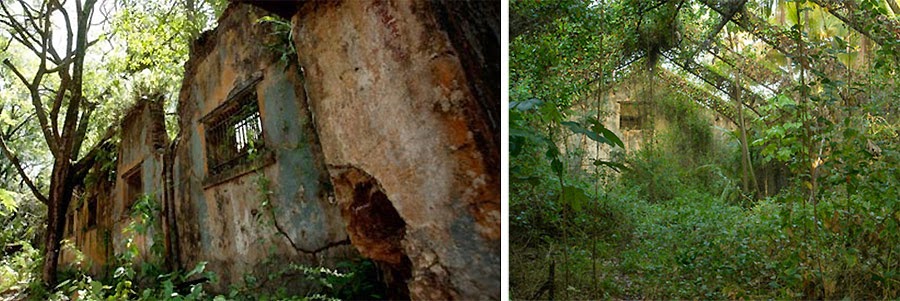 (images credit: Martin Argles, David Cothran, National Geographic) Here is a panorama of these mostly overgrown ruins (by the way, this is were the 1973 prison film "Papillon" was set, though the filming mostly occurred in Jamaica):  (image via) Some of the people incarcerated in these horrific French penal colonies were put there unfairly, or for political reasons: one famous example being Alfred Dreyfus who was wrongly accused of spying for Germans during the Franco-Prussian War. Escape was nearly impossible, and survival doubtful: "a common way for convicts to earn money (and get food) was to trap butterflies, which were sold to collectors". All three islands are quite small and can easily fit in one aerial photograph:  (image via) The country of French Guiana today offers some charms for those willing to go off the beaten track (no roads were even connecting this country with outside world until the late 1960s): awesome Amazon rain forests and wildlife, laid-back lifestyle combined with great espresso, apple pies, French joie-de-vivre, the wonderful climate and the fact that this territory is legally part of the European Union (so you can spend euros there). If you'd like to visit these islands (here are GoogleMaps coordinates), be aware of a few dangers associated with this place (which is the main reason prisoners were sent there to begin with): - Definitely no swimming! The black rock beaches may look inviting, but the waters are infested with sharks (which are hungry enough to bite: you can, in fact, fish for them straight from the beach (see video) - Treacherous rough currents (no ship could dock to some of these islands in the past, though today some tour operators will take you there on a Zodiac) - Challenging lack of infrastructure for English-speaking travelers. They're launching rockets nearby! There is however one other great reason to visit this exotic locale: the area is also home to a functioning European Union Spaceport! The rockets are regularly launched at the Guiana Space Center near Kourou, a great location for a spaceport, as it is quite close to the equator which gives extra velocity to rockets when launched toward the East:  (image via) Article by Avi Abrams, Dark Roasted Blend. Sources: 1, 2, 3 CONTINUE TO "GHOST TOWNS OF PACIFIC NORTHWEST"! -> READ THE REST OF OUR "ABANDONED PLACES" CATEGORY ->
|


Baker likes this
11 Jun 16:11
Five Top Southern Fishing Spots
by rreed
Late spring, before the temperatures turn stupefying, bring some of the year’s best angling, with fish ready to gorge on the season’s hatching insects. So, throttle back your time at the office and hit any of these five Southern fly-fishing spots, beginning in the Appalachians and continuing toward the coast.
The South Holston River, near Bluff City, Tennessee
Tucked alongside the base of Holston Mountain, in northeastern Tennessee, the South Holston River offers 14 miles of water primed for drifting and unrivaled quantities of 20-plus-inch stream-born brown trout. Ace guide Patrick Fulkrod, of Mountain Sports Ltd., recommends a CDC sulphur comparadun pattern during the sulphur-mayfly hatch and a black-and-copper-zebra midge through the rest of the season. As far as fishing a particular portion of the South Holston, Fulkrod says the river is top tier anywhere from where it starts, at the South Holston Dam, to where it concludes, at Boone Lake; although, he jokes, “My favorite section is where there are no other anglers!”

Photograph courtesy Patrick Fulkrod
The Little River, near Townsend, Tennessee
The Little River spans more than 50 miles in East Tennessee, but the stretch near its source, at Clingmans Dome, is among the most pristine and bountiful waters in the Great Smoky Mountains for hooking native brook trout. In fact, the variety of brookies in Southern Appalachia is genetically distinct from their Northeastern brethren, which makes catching them only that much more of a treat. Guide Josh Pfeiffer, of Frontier Anglers (who regularly updates his blog, so you can know what’s taking), recommends a parachute Adams or a brown stonefly, but he’s quick to note that staying obscured should remain an angler’s primary concern when fishing the Little River. “Since it’s wider than most streams in the park, there aren’t as many hiding places,” he says. “Wearing natural colors, or even camo, and crouching will help not spook the fish.”

Photograph courtesy Frontier Anglers TN
The Davidson River, near Brevard, North Carolina
It’s no surprise why the Davidson, in the mountains of Western North Carolina, is among the most celebrated rivers south of the Mason–Dixon Line: it boasts more massive rainbow trout than likely anywhere else in the region. The river’s slow, clear currents and accessible streamside don’t hurt, either; however, don’t assume that just because there’s a lot of fish in the water that you won’t have to fight for them. Rainbows in the Davidson are notoriously picky and keen at identifying fishermen’s flies. Local guide Brown Hobson, who was named Orvis’ 2015 Guide of the Year, favors a bead-head soft-hackle pheasant-tail fly in early spring but switches to an inchworm pattern as the weather warms. “The trout are hard to catch,” he admits. “But when I know I’m in a spot that holds them, I’ll camp out for a while and change flies and tactics until I figure out what they want to eat; once that happens, I’ll land several.”

Photograph courtesy Beth Grant
The Savannah River, near Augusta, Georgia
If you’ve had your fill of chasing trout, the Savannah River teems with an array of fish difficult to find elsewhere in one body of water: bluegill; hybrid bass; largemouths; redeyes; smallmouths; stripes; sunfish; yellow perch; and, yes, trout, too. The Savannah spills from Lake Hartwell and slinks across the state to the coast, but the seven miles of wadeable shoals north of Augusta comprise its best fishing, especially in the spring once the river’s flow begins to ebb. For easy access, park at the Eisenhower Athletic Center & Park and follow the trail to the riverside, but, before you do, swing by Rivers & Glenn Trading Co. and let the good folks there help you pick out the right fly pattern for what you want to nab. Master fly-fishing scribe Ray Bergman once wrote, “It is a good rule always to blame yourself if you have poor luck,” and when fishing the Savannah, with its many species and opportunities to bring a prize to hand, consider that sound advice.

Photograph courtesy Sir Mildred Pierce/Flickr
The Ashley River & Charleston Harbor, near Charleston, South Carolina.
The vast saltwater flats that wrap Charleston, South Carolina, provide anglers ample opportunities to wrestle the schools of redfish that haunt them. But, as any coastal fisherman can attest, there’s a good way to fish the flats and an awful way: good involves catching fish and staying comfortable; awful results in stomping through pluff mud and chest-high, itchy grass and coming home empty-handed. Captain Harry Demosthenes, of Drum Runner Charters, has fished the waters around Charleston for 25 years and knows how to accomplish the former. He scouts for flats with hard bottoms, low grass, and moves among spots after catching a fish or two in each. Likewise, to hook a red in the spring, he employs crab and spoon patterns, casting in front of roving schools and slowly retrieving the fly. As the water temperatures rise throughout the season, he transitions to baitfish patterns, such as a Clouser minnow. Besides that, though, his advice is straightforward: “Wait to get a good cast in. Don’t rush it.”

Photograph courtesy Ann Millspaugh/Flickr
JR Sullivan is from Franklin, Tennessee, and is an editor for Field & Stream.
Baker likes this

11 Jun 14:17

Hands Off Americans' Private Information, Tech Industry Tells President
by J.D. Tuccille
 Last September, Scott Shackford asked, "What does it say about the state of Americans’ relationship with their own government that its largest tech company can use the ability to conceal private information from authorities as a selling point?" He referred to plans voiced by both Apple and Google to encrypt smartphones by default so that only the owners would have access to stored data. Previously, Google offered encryption as an option, and Apple retained some access to devices it sold. With growing concern over government snooping post-Snowden, improved privacy has become very desirable feature for many people. Needless to say, the federal government has not been happy about the tech giants' stance.
"What concerns me about this is companies marketing something expressly to allow people to hold themselves beyond the law," FBI Director James Comey whined in response to Apple's and and Google's announced plans.
Months later, during a Senate hearing, Secretary of Homeland Security Jeh Johnson complained that "the marketplace is demanding deeper and deeper encryption into places where the warrant authority of the government does not extend." He added that "with encryption there are communications...records of which are simply not being maintained because of the added security that is being put in place because of the privacy demands that exist in the marketplace.
For their part, tech companies continue their push for strong encryption, most recently with a letter to the president warning about the danger to America's economy and people's liberties "[s]hould the U.S. government require companies to weaken encryption technology."
The commercial fallout of surveillance fears to American companies, a study finds, could be as high as $35 billion.
Sen. Rand Paul (R-Ky.) and Rep. Ted Lieu (D-Calif.) are among the handful of legislators who also slapped back at intrusive officials, pointing out that the government helped create demand for privacy products with its own actions. And there is demand for privacy. One in three American make some effort to hide their data from prying eyes—the government in particular. A new Gallup poll finds that Americans continue to prioritize civil liberties over "anti-terrorism" efforts by more than a two-to-one margin.

The public just doesn't share government officials' preference for security over freedom. By and large, people are not ready to compromise due process, privacy, or freedom of speech in the name of some search for imaginary threats by overbearing law enforcement officers, intrusive intelligence snoops, or power-hungry U.S. Attorneys.
In keeping with their customers' priorities, tech companies have also pushed back against the government. A letter sent yesterday to President Obama by the Information Technology Industry Council and the Software & Information Industry Association cautions, in part:
We are opposed to any policy actions or measures that would undermine encryption as an available and effective tool. As you know, encryption helps to secure many aspects of our daily lives. Encryption is an essential asset of the global digital infrastructure, enabling security and confidentiality for transactions as well as assurances to individuals that their communications are private and information is protected. For example, the rapid growth in online commerce would not have happened but for consumers’ trust that their payment information is secure. Consumer trust in digital products and services is an essential component enabling continued economic growth of the online marketplace.
Accordingly, we urge you not to pursue any policy or proposal that would require or encourage companies to weaken these technologies, including the weakening of encryption or creating encryption “work-arounds.” We appreciate that, where appropriate, law enforcement has the legitimate need for certain information to combat crime and threats. However, mandating the weakening of encryption or encryption “work-arounds” is not the way to address this need. Doing so would compromise the security of ICT products and services, rendering them more vulnerable to attacks and would erode consumers’ trust in the products and services they rely on for protecting their information.
In addition to these security and trust concerns, the U.S. policy position on encryption will send a signal to the rest of the world. Should the U.S. government require companies to weaken encryption technology, such requirements will legitimize similar efforts by foreign governments. This would threaten the global marketplace as well as deprive individuals of certain liberties.
The two organizations, notably, represent Apple and Google, which have already provoked the feds, as well as Microsoft, Facebook, Twitter and other major companies that serve huge markets and have the potential to protect the public's privacy—or damage it under the weight of government commands and threats.
Read the whole letter here.
Baker likes this
11 Jun 14:12

Video: How California Could Have Avoided Its Epic Water Crisis
by Alex Manning
"How California Could Have Avoided Its Epic Water Crisis" is the latest video from ReasonTV. Watch above or click on the link below for video, full text, supporting links, downloadable versions, and more Reason TV clips.
Baker likes this
11 Jun 14:12

Andrew Napolitano on Lies the Government Is Telling Us

The Supreme Court has ruled consistently that the government must obtain a search warrant in order to intercept any nonpublic communication. The Constitution requires probable cause as a precondition for a judge to issue a search warrant for any purpose, and the warrant must "particularly (describe) the place to be searched, and the persons or things to be seized." Probable cause is evidence about a person or place sufficient to permit a judge to conclude that evidence of a crime will probably be found. Yet both the Patriot Act and the USA Freedom Act disregard the "probable cause" standard and substitute instead a "government need" standard.
This is no standard at all, argues Andrew Napolitano, as the NSA has claimed under the Patriot Act that it needs all telephone calls, all emails, and all text messages of all people in America. Today it may legally obtain them by making the same claim under the USA Freedom Act. When politicians tell you that the NSA needs a court order in order to listen to your phone calls or read your emails, they are talking about a court order that is based on government need—not a constitutional court order, which can only be based on probable cause. This, writes Napolitano, is an insidious and unconstitutional bait and switch.
Baker likes this
11 Jun 14:05

Portraits of Backpackers Living in a Tiny, Hidden Hotel in Tokyo
by Sukruti Anah Staneley

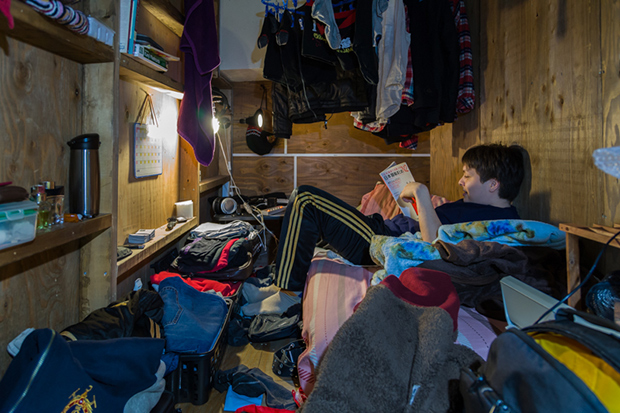
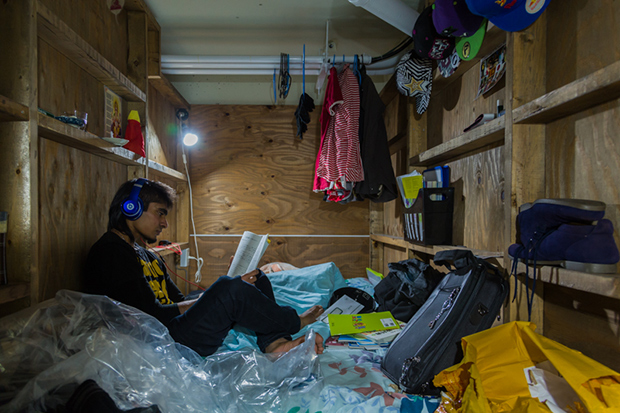
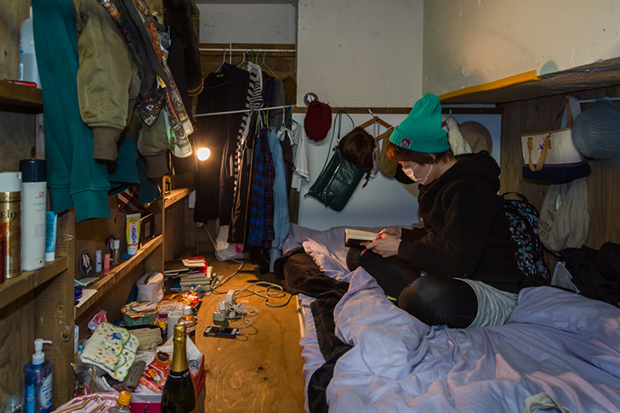
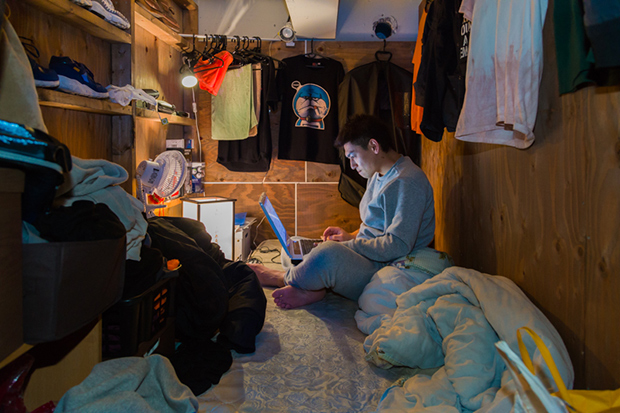
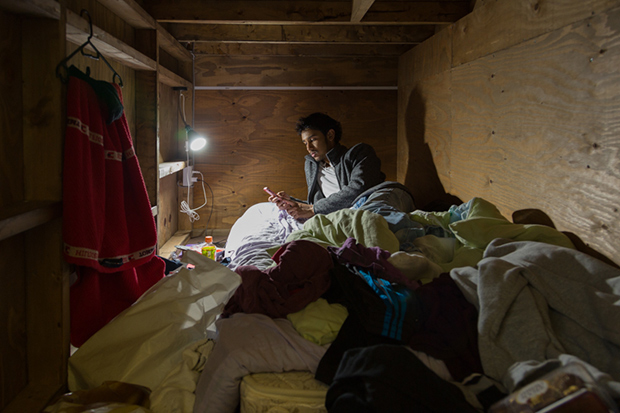
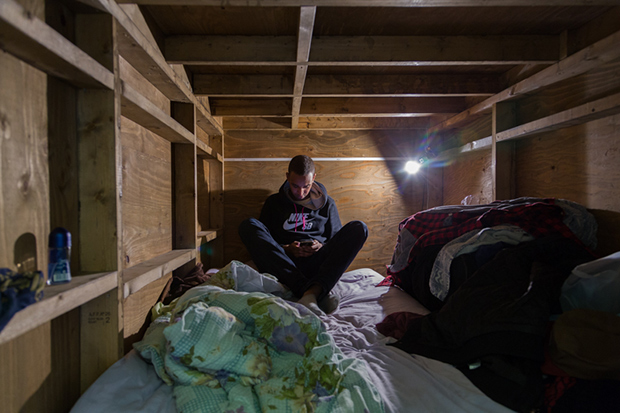
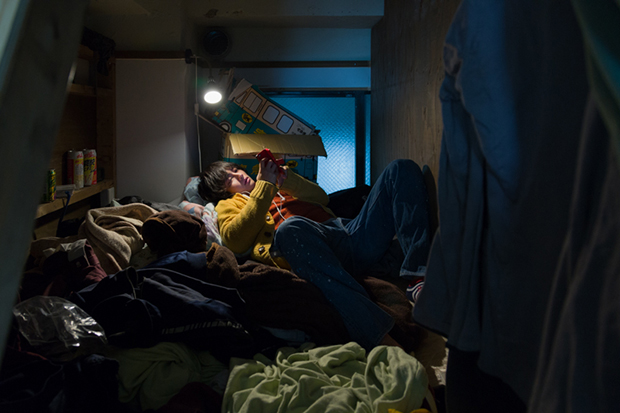
Almost two years ago, the photographer Won Kim was back-packing across Japan and passed through Arakawa-ku, a ward in northeastern Tokyo. There he ran into a tiny hotel which was set in one of the larger buildings that lined the street, with no signboards to guide you there, it was almost hidden away. Kim immediately fell in love with the unusual vibes of the establishment, which was like a home to people from all over the world, unlike the typical homogenous societies in Japan – he was determined to revisit this space.
In November 2014, he returned to the same backpacker’s guesthouse and took up residence there for a couple of months. Soon, Kim began to befriend his neighbors, giving them the time and space to allow him to work with his camera inside their small rooms. “I have a fetish for a womb-like space,” Kim told me – it gave him a feeling of security and comfort, not confining in any way.
Over the time Kim spent in the hotel, he met with various people and witnessed how each transformed their temporary lodgings into spaces that reflected their individual dispositions, “full of possessions, often complete with hanging wardrobes and improvised bookshelves—even “decorated.” Of these, some are neat and orderly and others are chaotic, with personal items strewn everywhere. In each case, the sharply-defined space and its contents tell something about its occupant’s personality, and his or her ability to function in such a strange, enclosed environment” Kim wrote. While he began planning this project a year in advance, Kim could not have anticipated the process of getting people’s permissions to photograph, which was indeed pivotal to a project of this kind. In return, he gave a 15-minute shoulder massage to each person who agreed to be photographed – the simple pleasures of the uncomplicated traveller.
Won Kim’s series Enclosed: Living Small, records the private folds of more than 20 different people in Tokyo, which is telling of the efficiency inherent to the Japanese lifestyle of living in small spaces with minimalist tones.


All images © Won Kim
The post Portraits of Backpackers Living in a Tiny, Hidden Hotel in Tokyo appeared first on Feature Shoot.
Baker likes this
11 Jun 14:00

How to Travel Like a Gentleman: Advice from 1875
by Brett and Kate McKay
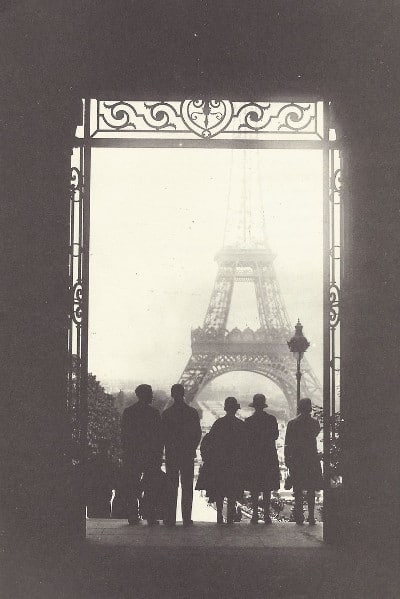
Editor’s note: The excerpt below comes from a book published in 1875: A Gentleman’s Guide to Etiquette by Cecil B. Hartley. Hartley has previously edified us with some incisive and amusing conversation rules. Today he offers tips on how to travel like a gentleman, especially when going abroad. While it’s no longer advisable to refer to the common folk in the countries you visit as “the peasantry,” the bulk of Hartley’s advice still holds true.
If you are going to travel in other countries, in Europe, especially, I would advise you to study the languages, before you attempt to go abroad. French is the tongue you will find most useful in Europe, as it is spoken in the courts, and amongst diplomatists; but, in order fully to enjoy a visit to any country, you must speak the language of that country. You can then visit in the private houses, see life among the peasantry, go with confidence from village to town, from city to city, learning more of the country in one day from familiar intercourse with the natives, than you would learn in a year from guide books or the explanations of your courier.
The way to really enjoy a journey through a strange land, is not to roll over the highways in your carriage, stop at the hotels, and be led to the points of interest by your guide, but to shoulder your knapsack, or take up your valise, and make a pedestrian tour through the hamlets and villages. Take a room at a hotel in the principal cities if you will, and see all that your guide book commands you to seek, and then start on your own tour of investigation, and believe me you will enjoy your independent walks and chats with the villagers and peasants, infinitely more than your visits dictated by others. Of course, to enjoy this mode of traveling, you must have some knowledge of the language, and if you start with only a very slight acquaintance with it, you will be surprised to find how rapidly you will acquire the power to converse, when you are thus forced to speak in that language, or be entirely silent.
Your pocket, too, will be the gainer by the power to arrange your own affairs. If you travel with a courier and depend upon him to arrange your hotel bills and other matters, you will be cheated by every one, from the boy who blacks your boots, to the magnificent artist, who undertakes to fill your picture gallery with the works of the “old masters.” If Murillo, Raphael, and Guido could see the pictures brought annually to this country as genuine works of their pencils, we are certain that they would tear their ghostly hair, wring their shadowy hands, and return to the tomb again in disgust. Ignorant of the language of the country you are visiting, you will be swindled in the little villages and the large cities by the inn-keepers and the hack-drivers, in the country and in the town, morning, noon, and evening, daily, hourly, and weekly; so, again I say, study the languages if you propose going abroad.
In a foreign country nothing stamps the difference between the gentleman and the clown more strongly than the regard they pay to foreign customs. While the latter will exclaim against every strange dress or dish, and even show signs of disgust if the latter does not please him, the former will endeavor, as far as is in his power, to “do in Rome as Romans do.”
Accustom yourself, as soon as possible, to the customs of the nation which you are visiting, and, as far as you can without any violation of principle, follow them. You will add much to your own comfort by so doing, for, as you cannot expect the whole nation to conform to your habits, the sooner you fall in with theirs the sooner you will feel at home in the strange land.
Never ridicule or blame any usage which seems to you ludicrous or wrong. You may wound those around you, or you may anger them, and it cannot add to the pleasure of your visit to make yourself unpopular. If in Germany they serve your meat upon marmalade, or your beef raw, or in Italy give you peas in their pods, or in France offer you frog’s legs and horsesteaks, if you cannot eat the strange viands, make no remarks and repress every look or gesture of disgust. Try to adapt your taste to the dishes, and if you find that impossible, remove those articles you cannot eat from your plate, and make your meal upon the others, but do this silently and quietly, endeavoring not to attract attention.
The best travelers are those who can eat cats in China, oil in Greenland, frogs in France, and macaroni in Italy; who can smoke a meerschaum in Germany, ride an elephant in India, shoot partridges in England, and wear a turban in Turkey; in short, in every nation adapt their habits, costume, and taste to the national manners, dress and dishes.
Do not, when abroad, speak continually in praise of your own country, or disparagingly of others. If you find others are interested in gaining information about America, speak candidly and freely of its customs, scenery, or products, but not in a way that will imply a contempt of other countries. To turn up your nose at the Thames because the Mississippi is longer and wider, or to sneer at any object because you have seen its superior at home, is rude, ill-bred, and in excessively bad taste. You will find abroad numerous objects of interest which America cannot parallel, and while abroad, you will do well to avoid mention of “our rivers,” “our mountains,” or, “our manufactories.” You will find ruins in Rome, pictures in Florence, cemeteries in France, and factories in England, which will take the lead and challenge the world to compete; and you will exhibit a far better spirit if you candidly acknowledge that superiority, than if you make absurd and untrue assertions of “our” power to excel them.
You will, of course, meet with much to disapprove, much that will excite your laughter; but control the one and keep silence about the other. If you find fault, do so gently and quietly; if you praise, do so without qualification, sincerely and warmly.
Study well the geography of any country which you may visit, and, as far as possible, its history also. You cannot feel much interest in localities or monuments connected with history, if you are unacquainted with the events which make them worthy of note.
Converse with any who seem disposed to form an acquaintance. You may thus pass an hour or two pleasantly, obtain useful information, and you need not carry on the acquaintance unless you choose to do so. Amongst the higher circles in Europe you will find many of the customs of each nation in other nations, but it is among the peasants and the people that you find the true nationality.
You may carry with you one rule into every country, which is, that, however much the inhabitants may object to your dress, language, or habits, they will cheerfully acknowledge that the American stranger is perfectly amiable and polite.
Baker likes this
11 Jun 12:48
Former Congressional Leaders Paid By Foreign Govts To Sell Trade Bill...
(Third column, 4th story, link)
Related stories:


Former Congressional Leaders Paid By Foreign Govts To Sell Trade Bill...
Former Congressional Leaders Paid By Foreign Govts To Sell Trade Bill...
(Third column, 4th story, link)
Related stories:
RYAN SNAPS: YOU'LL READ OBAMATRADE AFTER WE PASS IT!
Republicans vote to repeal country-of-origin labeling on meat...
Food safety fears...
Global album releases to start on July 10...
Republicans vote to repeal country-of-origin labeling on meat...
Food safety fears...
Global album releases to start on July 10...
Baker likes this
11 Jun 12:48

RYAN SNAPS: YOU'LL READ OBAMATRADE AFTER WE PASS IT!
(Third column, 3rd story, link)
Related stories:


RYAN SNAPS: YOU'LL READ OBAMATRADE AFTER WE PASS IT!
RYAN SNAPS: YOU'LL READ OBAMATRADE AFTER WE PASS IT!
(Third column, 3rd story, link)
Related stories:
Republicans vote to repeal country-of-origin labeling on meat...
Food safety fears...
Global album releases to start on July 10...
Food safety fears...
Global album releases to start on July 10...
11 Jun 11:56

Sauna on Basshaunt Lake near Eagle Lake, Ontario.Contributed...
Sauna on Basshaunt Lake near Eagle Lake, Ontario.
Contributed by Peter Bowers.
Baker likes this
10 Jun 14:28

These 19 passports will be a lot more valuable on July 1st
by Simon Black
May 27, 2015
Santiago, Chile
It seems strange that a complete accident of birth has such a massive impact on someone’s life.
We don’t get to control where we’re born. It’s a fluke really. Yet as soon as we come into this world a particular nationality is thrust upon us like a birthmark that stays with us for life.
Our nationality dictates so many things throughout our life.
It might mean that we’re required to serve in the military– to go fight and die in some foreign land at the behest of an insensitive, out of touch politician.
It might mean that we’re required to pay an ever increasing portion of our income to finance government largess that we don’t agree with at all.
It can also substantially restrict the places we can go and travel in this world.
That last one is a major issue, because travel is a huge opportunity.
The world is a massive place. It’s gorgeous and there’s so much to explore. Anyone who ever says it’s a small world clearly never spent 26 hours on a plane trying to get to Palau.
There are so many opportunities and so many amazing people to meet that it’s only possible to capture the full human experience through travel.
Yet if you happen to be born on a particular piece of dirt, your travel opportunities are limited.
United States citizens, for example, have a lot of latitude in terms of where they can go. Though there are still a lot of restrictions.
Americans need a visa to go to a number of countries, including Russia, China, and several countries in South America.
If you’re from Ukraine, on the other hand, you can travel to Russia without a visa. However the vast majority of the world is off-limits unless you first jump through a number of administrative hoops.
Representatives from the European Union recently closed out a summit in Riga to decide the future of EU visa policy with respect to Ukraine.
Once again, Ukraine was denied visa-free access to the EU, proving that “European support” for Ukraine against Russia is just hot air and empty promises.
There are, however, 19 other countries, which will be joining the EU visa-free list as of July 1, 2015. They were officially approved late last year and reaffirmed at the summit.
They are: Colombia, Peru, Dominica, St. Lucia, Grenada, St. Vincent & the Grenadines, Trinidad & Tobago, UAE, Marshall Islands, Kiribati, Nauru, Palau, Micronesia, Samoa, Solomon Islands, East Timor, Tonga, Tuvalu, and Vanuatu.
The thing that’s interesting about nationalities is that even though we’re born with one, you don’t have to live your entire life with that single option.
It is possible to obtain citizenship and a passport from another country. This means more options to travel and more options to live and work somewhere else should you want.
Panama is a great example.
There’s still an easy and inexpensive process to obtain residency in Panama, and in 5-years time you’ll be able to apply for naturalization, and then a passport.
Of the 19 countries that join the EU visa-free list this July, both Grenada and Dominica have “economic citizenship” programs where you can make a low six-figure investment in the country in exchange for citizenship.
Colombia and Peru are two places where you can become a legal resident and apply for citizenship in 2-5 years.
This can be very cost-effective, as in Colombia it can cost less than $1,000 to obtain residency, including legal assistance.
Bottom line– there are always options. You don’t have to go your entire life being restricted by something that was an accident of birth.
Having a second passport means having more freedom and more possibilities.
So, finding expedited or cost effective ways to obtaining one is a great tool and insurance policy for anyone to consider.
10 Jun 14:26

Great financial advice from a 2,400-year old medical textbook
by Simon Black
June 9, 2015
Oxford, England
In the 5th century BC during the Golden Age of Athens, culture and intellect flourished in Ancient Greece more than at any other time or place in history up to that point.
It was an amazing period of discovery.
Philosophers Socrates and Plato, writers Sophocles and Euripides, historians Herodotus and Thucydides, all lived during this period and completely revolutionized their fields.
One of their contemporaries was the physician Hippocrates, who did more to advance medical science than any other human being until Louis Pasteur.
In his book “On Sacred Disease,” Hippocrates became one of the first to propose that illness wasn’t a curse from the gods, but rather the result of some natural cause.
In his book “On Ancient Medicine”, he wrote extensively about how good food and regular physical activity were the best ways to ward off disease and stay healthy.
But most famously, his book “The Oath” describes his solemn vow to practice medicine exclusively for the benefit of the patient, which is often colloquially summarized as ‘do no harm.’
To this day physicians still recite some version of the Hippocratic Oath, swearing to uphold standards of integrity and professionalism for the benefit of the patient.
Over drinks last night in London, my colleague Tim Price wondered aloud why there is no Hippocratic Oath in finance.
It’s incredible when you think about it– finance is one of the most heavily regulated industries on the planet.
And yet with legions of bureaucrats regulating their every move, and compliance officers looming over banking like Dark Lords of the Sith, there’s still an incredible amount of impropriety going on.
Brokers and exchanges happily sell away our investment data to give an edge to High Frequency Trading firms.
Just a few weeks ago some of the largest banks in the world pled guilty to CRIMINAL charges of rigging foreign currency rates.
In fact, they’ve fixed just about every market they’ve ever gotten their hands on, from silver to LIBOR to just about everything else in between.
Banks gamble away their depositors’ savings on risky investment fads, and money managers stuff their clients’ retirement accounts full of overpriced stocks and ho-hum mutual funds.
Where is the oath for bankers and money managers to stand up and say “I promise to do my best for the sole benefit of the client”..?
It doesn’t exist. Even more importantly, every incentive in the industry is to do the exact opposite.
Chuck Prince, who once presided over banking giant Citigroup famously said once that “as long as the music is playing, you’ve got to get up and dance.”
Prince ultimately resigned from Citi after the bank suffered massive losses in the credit crisis. Apparently his dancing skills weren’t up to snuff.
But consider the magnitude of that statement if you’re a young banker.
The guy who dominates your industry is basically telling you that you’ve got to get out there and keep dancing, even when all the indicators suggest that the market is about to collapse.
This pretty much sums up the financial industry today.
It’s not that these guys are stupid. It’s not that they can’t see the writing on the wall. It’s not that they’re blind to the tremendous amount of risk in the system.
The issue is that their jobs are on the line.
Finance doesn’t take kindly to mavericks. Despite all multi-million dollar bonuses and huge salaries, people have absolutely every incentive to follow the herd and continue putting their clients’ savings in risky investments.
Anyone who doesn’t tow the line is quickly fired.
This is nowhere close to ‘do no harm.’ It’s much closer to ‘screw anyone you have to screw to keep your job.’
Sound, safe, objective financial advice is a rare thing. And that’s why your ultimate financial decisions, like your health decisions, should never be outsourced.
If you don’t understand investing and personal finance, that’s not a reason to outsource everything to a money manager.
Rather, it’s a reason to educate yourself about investing and personal finance.
But like Hippocrates told us about health, it doesn’t need to be complicated.
Just like a brisk walk and a quality meal go a long way in promoting good, long-term health, sometimes good, long-term investing can be as simple as buying quality companies run by honest, talented managers.
Baker likes this
10 Jun 14:23


Johnnie’s Drive In, 1945, Fitzgerald
by Brian Brown

Upon learning that Johnnie’s Drive In would soon be a memory, I immediately felt the need to take my camera and record some of the energy that makes this place so special. It’s important to many people for many reasons. It’s an anchor of my memory, where I’ve spent many evenings with dear friends who worked and socialized here, and where I’ve always felt at home. But it represents more than sentiment. It’s among the last generation of roadside diners and beer joints that rose to popularity during World War II where kids hung out beside juke boxes and car hops came to you and took your order. The car hops at Johnnie’s were gone by the late 1990s but I remember them well. Many thanks to Phillip Joe Luke for sharing this wonderful history. His words are in italics.

Johnnie Rochester Wise and Ollie Mae Roberts Luke Wise (Archival Images Courtesy of Phillip Joe Luke, unless otherwise noted). Johnnie and his family moved to Fitzgerald from Columbus in late 1930s.

The first family restaurant was in the 800 block of North Grant Street and it was called The Silver Moon. (It was opened by Johnnie’s father, John Franklin Wise). About 1943 or so they opened Johnnie’s Drive In. The Johnnie scrambled hamburger (better known as the Johnnie Burger) was his creation. The scrambled dog idea came from the Dinglewood Pharmacy in his native home of Columbus (it has a slightly different recipe).
Silver Moon business card from my collection.

On the same lot of Johnnie’s Drive In was the old motel and the Princess Club. The Princess Club burned down many years ago and the remains of the motel are still there.

The name of the motel has been long forgotten.

Here’s an image of Johnnie’s, in the early 1950s.

Beer was served, along with fried shrimp and fried oysters on the short order menu. The Scramble (not Scrambled, as many call it today) Dog and the Dog Cicle were popular items from the start, but the Dog Cicle, akin to a corn dog, has been gone for many years.
Johnnie died in 1969 and my grandmother carried on the tradition for many years. All of my family members dedicated their lives to Johnnie’s until their health failed and could no longer operate the restaurant. Uncle Coot managed during the day, Uncle Carl at night.

Russell (Coot) Luke, Jr., with Johnnie Wise (right).

Carl Luke manning the register at Johnnies.
Uncle Flop scrubbed that exhaust hood every Monday until it sparkled. Aunt Betty worked there off and on through the years. Even my mother served as a carhop while I was inside in a play pen. Many of you will remember Mary McElroy as one of the finest cooks in the history of Johnnie’s. Mary left us way too soon. We are so thankful that Jimmy and Carolyn Puckett came along to manage the restaurant in the mid 1980s. Restaurant management is not an easy task and Carolyn succeeded and made it look easy. Thank you so much. And thanks to all of the faithful customers for 70+ years of business in Fitzgerald. We couldn’t have done it without you.

Carolyn Chambers has managed Johnnie’s for over 25 years and kept this landmark alive. Customers think of her as family and Johnnie’s a home away from home.

Carolyn’s sister, Estelle Stapleton, has been cooking here for years. People love her as much as they love her food.

Ruby Chambers, Carolyn’s sister-in-law, usually knows your order when you walk in the door. Love this lady!

Denise Jordan helping Carolyn. I’ve known Denise all my life, too.
I want to thank Carolyn for giving me access for these photographs. I know she doesn’t really like to have her picture taken so it means a lot. I love all of you at Johnnie’s, past and present!


Baker likes this
10 Jun 12:50
Soldier returns to Iraq alone to help fight ISIS...
(Second column, 15th story, link)
Related stories:


Soldier returns to Iraq alone to help fight ISIS...
Soldier returns to Iraq alone to help fight ISIS...
(Second column, 15th story, link)
Related stories:
Baker likes this