Shared posts

01 Jul 17:30

How the Great Society Paved the Way for Modern Mass Incarceration

by Jesse Walker

In the June Journal of American History—a special issue devoted to the carceral state—the Harvard historian Elizabeth Hinton argues that President Lyndon Johnson reacted to the riots of the mid-1960s by reshaping his Great Society reforms, blending

ATTICA! ATTICA! ATTICA!the opportunity, development, and training programs of the War on Poverty with the surveillance, patrol, and detention programs of Johnson's newly declared "War on Crime." This entanglement of Great Society policies allowed law enforcement officials to use methods of surveillance that overlapped with social programs—for instance, antidelinquency measures framed as equal opportunity initiatives—to effectively suffuse crime-control strategies into the everyday lives of Americans in segregated and impoverished communities. In time, the entire spectrum of domestic social programs actively participated in national law enforcement, thereby pushing the boundaries of the carceral state beyond penal institutions. By the time Johnson's Omnibus Crime Control and Safe Streets Act passed in 1968, the carceral state had already begun to metastasize into a vast network of social programs originally created to combat racial exclusion and inequality.

"During the first half of the 1960s, antipoverty programs expanded the degree of federal influence in the everyday lives of black urban Americans," Hinton writes. "By fashioning a new liberal synthesis that brought crime-control strategies under the fold of social welfare programs, federal policy makers eased the shift toward national punitive programs in the second half of the decade." In this way, LBJ helped lay "the groundwork for contemporary mass incarceration."

To read the whole paper, go here. To check out the rest of the issue, go here. Naomi Murakawa's recent book The First Civil Right makes an overlapping argument; to see Reason's review of it, go here.

01 Jul 17:29

ESCAPE: 1 IN 3 AMERICANS WOULD CONSIDER LEAVING COUNTRY!


ESCAPE: 1 IN 3 AMERICANS WOULD CONSIDER LEAVING COUNTRY!


(First column, 1st story, link)

01 Jul 17:28

DOLPHIN LEAPS ONTO BOAT, BREAKING WOMAN'S ANKLES...


DOLPHIN LEAPS ONTO BOAT, BREAKING WOMAN'S ANKLES...


(Third column, 4th story, link)

01 Jul 11:47

A small stone house used by vineyard workers on Samos Island,...


A small stone house used by vineyard workers on Samos Island, Greece

Contributed by Brett Jackson 

30 Jun 15:15

Sarpaneva Cast Iron Pot

You know you've got a great design on your hands when it makes it onto a postage stamp. Sure, it was in Finland, but that doesn't take away from the...

Visit Uncrate for the full post.
30 Jun 15:15

Asserbo House

A clean geometric shape and floor-to-ceiling windows help set the Asserbo House by Christensen & Co apart from your common summer cottage. The whole of the space is defined by...

Visit Uncrate for the full post.
30 Jun 14:37

WWI Centennial: New Offensive on Eastern Front, First Battle of the Isonzo

by Erik Sass

June 29, 1915: New Offensive on Eastern Front, First Battle of the Isonzo 

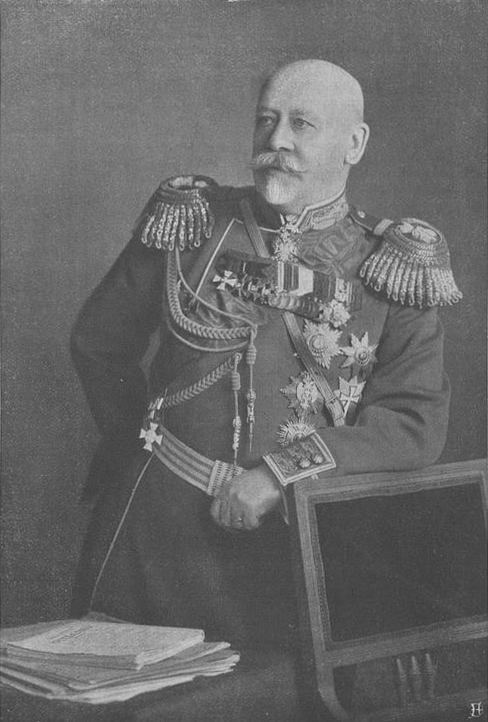
The unraveling of the Russian armies that began with the breakthrough at Gorlice-Tarnow in May 1915 accelerated in the months that followed, as the German Eleventh Army under General August von Mackensen  (below) launched a series of major offensives supported by the Austro-Hungarian Second, Third, and Fourth Armies. The new attacks widened the gap in the Russian lines and forced the Russians to withdraw again and again in what became known as the Great Retreat. 

While hardly a blitzkrieg of the type unleashed on the Soviet Red Army in the Second World War, the Austro-German advance through Poland and Galicia in May-September 1915 was methodical and relentless, following a cyclical pattern with occasional pauses to consolidate and regroup. First punishing artillery bombardments blasted apart Russian defensive works (top, a German 30.5 centimeter gun on the Eastern Front), followed by massed infantry charges that captured huge numbers of prisoners (below, German uhlans escort Russian prisoners); then the Russians would withdraw to a new line of trenches further back, their pursuers would bring forward the heavy artillery, and it would start all over again. 

Mackensen’s success allowed German chief of the general staff Erich von Falkenhayn and his Austro-Hungarian counterpart Conrad von Hötzendorf to withdraw some troops for operations elsewhere, including the Western Front and the Balkans. After the fall of Przemyśl on June 3, on June 10 the Austro-Hungarian Third Army was dissolved and many of the troops were sent to the Italian front; a new Third Army would be formed in September for the fall campaign against Serbia. 

However Mackensen still had plenty of manpower to continue the offensive: on June 13 he launched an all-out assault along a 31-mile front, aided by the composite Austro-German Südarmee (South Army). By June 15 the Russian Third Army was reeling back, allowing Mackensen to turn on the Russian Eighth Army, which also beat a hasty retreat. After a six-day battle the Central Powers recaptured Galicia’s capital Lemberg (today Lviv in western Ukraine) on June 22, while the Russian Eleventh Army joined the general withdrawal. 

Meanwhile in Petrograd the blame game was heating up. On June 26 Minister of War Vladimir Sukhomlinov (below, left) resigned amid allegations of incompetence stemming from the string of defeats as well as the critical shortage of artillery shells, which he had totally failed to remedy; he was succeeded by Alexei Polivanov (below, right) who would himself be removed in March 1916 due to the animosity of the Tsarina, egged on by the sinister holy man Rasputin. 

Wikimedia Commons [1,2]

A New Direction 

There would be no respite for exhausted Russian soldiers. On June 29, 1915, Mackensen launched the biggest offensive yet, attacking in a surprising new direction that forced the Russians to accelerate the Great Retreat. 

After the fall of Lemberg, Falkenhayn and the overall commanders on the Eastern Front, Paul von Hindenburg and his brilliant chief of staff Erich Ludendorff, met to consider options for the next stage of the campaign. Thus far the Austro-German advance had followed a straightforward west-to-east direction, more or less dictated by the need to pursue the withdrawing Russian armies. However the liberation of most of Galicia opened up a new possibility: Mackensen’s chief of staff Hans von Seeckt pointed out that they could now exploit a gap between the Russian Third and Fourth Armies to attack north into Russian Poland, capturing the important rail hub at Brest-Litovsk and cutting off the Russian First and Second Armies defending Warsaw further to the west. To fill the gap left by the Eleventh Army they would also transfer the Austro-Hungarian First Army across the rear of the advancing Eleventh and Fourth Armies, while Army Detachment Woyrsch took over the First Army’s lines. 

At first advance units of the German Eleventh Army faced virtually no resistance as they crossed north into Russian Poland on June 29, 1915, supported by the Austro-Hungarian Fourth Army on its left flank. By July 2 however the Russian Third Army had rumbled into action, launching a fierce counterattack against the Eleventh Army’s advancing right flank along the Bug River, while Mackensen’s forces also encountered elements of the newly formed and short-lived Russian Thirteenth Army (above, Russian troops in a temporary defensive position). Dominik Richert, a German soldier from Alsace, described a nighttime battle along the Zlota Lipa river on July 1-2: 

When the sun had already dipped below the horizon, I thought that we would be spending the night behind the embankment and that the attack would not take place until the following morning. It turned out that I was wrong. Behind us artillery shots could be heard; the shells whizzed over us and exploded further up at the Russian position… “Advance!” called the Commander of our Regiment from the back of the embankment. How these words made me shudder! Each of us knew that it would be the death sentence for some of us. I was most afraid of being shot in the stomach, as the poor pitiful people would normally live on, suffering the most terrible pain, for between one and three days before breathing their last. “Fix bayonets! Forwards to attack! March! March!” Everyone ran up the hill. 

Richert was lucky enough to survive the charge on the Russian trenches, although the terror and confusion continued: 

Despite everything we made progress. Amidst the roar of the infantry fire you could hear the rattle of the Russian machine guns. Shrapnel shells exploded overhead. I was so nervous that I did not know what I was doing. Out of breath and panting we arrived in front of the Russian position. The Russians climbed out of the trench and ran uphill towards the wood nearby, but most of them were shot down before they got there. 

To deal with the threat to Mackensen’s right flank, on July 8, 1915 Falkenhayn formed a new composite Austro-German army, the Army of the Bug (named for the Bug River area where it would operate) commanded by Alexander von Linsingen, formerly of the Südarmee. He also gave Mackensen direct control over the Austro-Hungarian First and Fourth Armies, much to the chagrin of Conrad, who found himself and his officers increasingly sidelined by the imperious Prussians of the German general staff. Conrad’s position wasn’t helped by the embarrassing (but temporary) rebuff of the Austro-Hungarian Fourth Army by the Russian Fourth Army near Krasnik on July 6-7. 

The Central Powers commanders also faced growing logistical difficulties, as their advance took them further away from their rail supply lines and deeper into territory where the retreating Russians had destroyed the railroads as well as most – but not all – sources of food (above, a Russian wheat field burning). Richert recalled hungry German troops finding scraps of food in an abandoned Russian trench: “In their trench were still pieces of bread left lying around and we eagerly consumed them. Many soldiers pulled the grains from the green heads of wheat, blew away the chaff and ate them, in order to overcome their pangs of hunger.”

After pausing to move up supplies and reinforcements, the Central Powers returned to the attack on July 13-16, 1915, with advances by the Austro-Hungarian First and Fourth Armies and the Army of the Bug setting the stage for the main push by the Eleventh Army on July 16. Elsewhere Army Group Gallwitz attacked south from East Prussia, smashing the Russian First Army, while the Ninth Army and Army Detachment Woyrsch tied down the Russian Second and Fourth Armies near Warsaw. As usual, the new offensive opened with a huge artillery bombardment. Helmut Strassmann, a gung-ho junior officer, described the furious barrage unleashed by the German guns on July 13: 

From 8 to 8.30 there was rapid-fire and from 8.30 to 8.41 drum-fire – the quickest of all. During these twelve minutes there fell into the Russian trenches, on a breadth of about 200 yards, about 10 shells per second. The earth groaned. Our chaps were keen as mustard, and our blessed guns simply rushed them along… When our bayonets began to get to work the enemy surrendered or bolted. Very few got away, for we were so near that every bullet reached its mark… The Company shot down quite 50 men and took 86 prisoners. Our own casualties were 3 killed and 11 wounded. One of our best men fell close to me during the attack, in the very act of shouting “hurrah”. He was shot through the head, so had a lucky death, being killed instantly. 

After heavy fighting, by July 19 Mackensen’s main force had advanced up to seven miles along a front stretching 20 miles west and south of Lublin. A Russian soldier, Vasily Mishnin, described the chaotic evacuation of Makov, a village west of Lublin on July 16, 1915:

It is raining heavily. Shells are already exploding nearby. Refugees are walking and driving from all directions. We are ordered to pull out of Makov immediately…  The battle is raging, everything is shaking. In Makov there is a crush of people, an endless procession of carts, no way to get out of here fast. Screaming, noise and crying, everything is confused. We are supposed to be retreating, but in two hours we only make it down one street… Everyone is desperate to avoid being taken prisoner by the Germans.

Meanwhile to the east the Army of the Bug and the Austro-Hungarian First Army had established bridgeheads across the River Bug, clearing the way for further advances towards Chelm, another key transportation junction on the way to the main objective of Brest-Litovsk (below, a Russian hospital train). 

The Central Powers’ advance slowed somewhat in the face of fierce Russian resistance beginning July 20, but it still posed a clear threat to the rest of the Russian forces to the west, prompting the Russian commander on the northwestern front, Mikhail Alekseyev, to order the evacuation of Warsaw on July 22. This was the first step towards the final Russian withdrawal from all of Poland, leaving thousands of square miles of scorched earth in its wake. 

Indeed, the fighting inflicted a heavy toll on the region’s inhabitants, as hundreds of thousands of Polish peasants abandoned their homes to flee with the retreating Russian armies into what are today Ukraine and Belarus. Ironically the German advance also destroyed the livelihoods of German settlers who had lived throughout the region for centuries. Richert recalled the scene in one small settlement: 

We came to a village, half of which had been set on fire by the German artillery. The inhabitants were standing around bemoaning the loss of their burnt out homes, from which smoke was still rising. Most of the inhabitants of the village were German settlers. A woman who was standing by her burnt out house told us that her house had already been burnt out the previous autumn when the Russians advanced. They had rebuilt it in the spring, and now she was homeless again. 

Not everyone fled: some Polish peasants decided to stay behind and take their chances with the conquering Germans and Austrians, as Richert discovered when he wandered into a peasant hut he believed to be empty, only to find a terrified woman with her child. Luckily for her, he was a co-religionist – and happily for him, she had food to share: 

When she saw me, she fell to her knees from fear and held her child towards me. She said something in her language – probably that I should spare her for the sake of her child. In order to calm her down I gave her a friendly pat on the shoulder, stroked her child and made a sign of the cross to it, so that she should see that I too was a Catholic, like herself. Then I pointed at my gun and then at her and shook my head to show her that I would not do anything. How happy that made her! She told me a great deal, but I did not understand a word of it… She gave us boiled milk, butter and bread. 

However most interactions probably weren’t quite so friendly; for one thing the Germans and Austrians, while still hoping to woo the Poles to their side, couldn’t conceal their racist disdain for “backwards” Slavs. Helena Jablonska, a Polish woman living in Przemyśl, complained in her diary: 

It pains me to hear the Germans bad-mouth Galicia. Today I overheard two lieutenants asking “Why on earth should the sons of Germany spill blood to defend this swinish country?”… I had managed to keep quiet up till then, but this was really too much for me. I told them they were forgetting that it was to defend their Berlin from a Russian onslaught that we had been made to sacrifice Lwow [Lemberg] and devastate Galicia. I said that, in fact, we had deserved their help much sooner than it came. 

Although few Poles welcomed the occupiers with open arms, as Jablonska’s comment indicates they weren’t necessarily afraid of arbitrary acts of violence either, in marked contrast to the capricious barbarity of Nazi German troops in the Second World War. In fact most rank and file soldiers were probably too tired and hungry to expend much energy on oppressing the locals, beyond requisitioning any food they might have. By mid-July some German troops had marched over 200 miles in the previous two months, and the advance was set to continue unabated through the hot Eastern European summer. Richert remembered: 

We marched on. As a result of the intense heat, we suffered greatly from thirst. As a result of the dry weather, there was a great deal of dust on the poorly made-up roads and tracks; the marching columns of men stirred it up so much that we were advancing in a real cloud of dust. The dust landed on your uniform and pack, and worked its way into your nose, eyes, and ears. As most of us were unshaven, the dust gathered in our beards, and the sweat ran down continuously, forming streams in the dust-covered faces. On marches like this, the soldiers looked really disgusting. 

While many Polish peasants fled voluntarily, that wasn’t the case for hundreds of thousands of Jews, as the Russians – angered by the fact that the Jews obviously preferred German rule and collaborated with the German military – continued their policy of forcible mass deportations into the Russian interior (below, Polish Jewish deportees). Ruth Pierce, a young American woman living in Kiev, witnessed the arrival of Galician Jews who were confined to camps before being shipped onwards to Siberia: 

And down the hill was passing a stream of people, guarded on either side by soldiers with bayonets… They were Jews, waxen-faced, their thin bodies bent with fatigue. Some had taken their shoes off, and limped along barefooted over the cobble-stones. Others would have fallen if their comrades had not held them up. Once or twice a man lurched out of the procession as though he was drunk or had suddenly gone blind, and a soldier cuffed him back into line again. Some of the women carried babies wrapped in their shawls. There were older children dragging at the women's skirts. The men carried bundles knotted up in their clothes. “Where are they going?”--I whispered to Marie. “To the Detention Camp here. They come from Galicia, and Kiev is one of the stopping-places on their way to Siberia.” 

Italy Defeated at First Battle of the Isonzo 

As the Central Powers pushed deeper into Russian territory on the Eastern Front, to the south the Allies suffered another defeat on the Italian front, where chief of the general staff Luigi Cadorna flung his armies against well-entrenched Austrian defenders at the First Battle of the Isonzo, with predictable results. As its name indicates this was just the first of twelve battles along the Isonzo River, most employing massed infantry charges that produced huge casualties for minimal gains (below, the Isonzo River valley today). 

After Italy declared war on Austria-Hungary on May 23, 1915, the Austrians immediately withdrew to strong defensive positions built along foothills and mountainsides over the preceding months in expectation of an Italian attack, giving up a small amount of low-lying territory in return for a huge tactical advantage. Over the following weeks four Italian armies crept forward cautiously until they reached the Austrian defenses, in what became known – rather inaccurately – as the “Primo Sbalzo” or “first leap” (it was less of a leap and more of a crawl). The advance then halted until the disorganized Italians could complete their mobilization and bring up artillery and shells. Finally, by June 23, 1915, everything was ready, more or less, for the first major Italian offensive. 

The main Italian war aim was capturing the port city of Trieste, with its mostly Italian population, and the first attack was accordingly carried out by the Italian Second and Third Armies, under General Frugoni and the Duke of Aosta, respectively, against the Austro-Hungarian Fifth Army under Svetozar Boroević von Bojna, entrenched on the high ground above the Isonzo River. The attack would focus on the defensive positions above Tolmein (Tolmino in Italian, today Tolmin in Slovenia) and Gorizia, now part of Italy; as a result much of the fighting would take place in rough, craggy terrain at elevations over 2,000 feet.  

Cadorna doesn’t seem to have benefited much from the lessons learned by Allied generals at painful cost over almost a year of war on the Western Front, but he at least understood the value of prolonged artillery bombardments to soften up the enemy’s defenses. Thus the opening week of the First Battle of the Isonzo was devoted to heavy shelling, which however failed to break up the massive barbed wire entanglements in front of the Austro-Hungarian trenches, sometimes literally dozens of meters wide. Conditions were made worse be heavy rains that turned hillsides into slippery cascades of mud, which somehow had to be scaled beneath Habsburg machine gun and rifle fire. 

The big infantry charge sent 15 Italian divisions forward along a 21-mile front on June 30, but despite a numerical advantage of almost two-to-one the assault failed almost completely, gaining a single bridgehead across the Isonzo through a huge expenditure of blood and ammunition (above, crossing the Isonzo; below, Italian wounded). 

On July 2 the Italians launched another attack towards the Carso (Karst) Plateau, a strategic elevated plain riddled with pits and caves, and managed to capture Mount San Michele on the western edge of the plateau. A third attack against the Doberdò Plateau advanced less than a mile; elsewhere the Italians were pushed out of their hard-won positions in the hills above Gorizia. By July 7, 1915, it was all over; the Italians had suffered 15,000 casualties, compared to 10,000 for the Austro-Hungarians, for negligible gains. With every hour that passed the Habsburg defenders were receiving reinforcements and digging in deeper (below, Austrian troops in the Isonzo). 

However none of this deterred Cadorna from launching another offensive, again relying on overwhelming numerical superiority and using substantially similar tactics, in the Second Battle of the Isonzo from July 18-August 3, 1915. The Italians scored some modest successes in this battle, but as so often in the First World War it proved a Pyrrhic victory, costing 42,000 Italian casualties.

See the previous installment or all entries. 

30 Jun 12:26

USA NOW SECOND LARGEST SPANISH-SPEAKING COUNTRY...


USA NOW SECOND LARGEST SPANISH-SPEAKING COUNTRY...


(Third column, 11th story, link)

30 Jun 12:03

Joe Brooks: The Story of How Love Changed Fishing Forever

by El Guapo

"Joe changed our fly fishing world as no one else has. If you are an avid fly fisherman and under the age of 50, chances are you have never heard of Joe Brooks, but you owe him a debt of gratitude. One of Joe's greatest gifts to fly fishermen is that he opened up the world to all those who followed. Fly fishermen today jump on airplanes to test the waters of the upper Amazon Basin, the trout streams and lakes of New Zealand, and the distant atolls of the South Pacific. But no one dared or thought of this until Joe opened up the doors."

-Lefty Kreh

This is a film about a man who was the epitome of the word “sportsman.”

LINK

30 Jun 11:56

Leap second in numbers: When the world jumps forward by one second what will happen?

The world will gain an extra second this evening as authorities’ co-ordinate to bring clocks in line across the globe.


27 Jun 23:18

Drive plays Smokey, Bandit with turbo Trans Am

by Chris Bruce

Filed under: Videos, Pontiac, Coupe, Performance

The Pontiac Firebird Trans Am with a turbocharged V8 is a largely forgotten muscle car today. However, Drive's Mike Musto gets behind the wheel of one to explain what makes this rarity so special, and it's definitely not the performance.
Continue reading Drive plays Smokey, Bandit with turbo Trans Am

Drive plays Smokey, Bandit with turbo Trans Am originally appeared on Autoblog on Sat, 27 Jun 2015 19:01:00 EST. Please see our terms for use of feeds.

Permalink | Email this | Comments
27 Jun 18:19

Cars

by burn magazine

Edit this

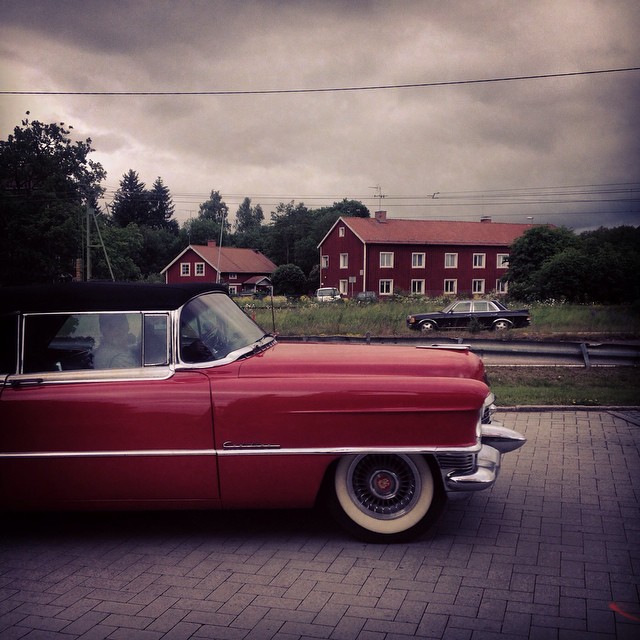
When the weekend begins, handsome cars are taken out of the garage. A red Cadillac drives through the city, in tune with wooden houses painted in a traditional red. day #5. @dakiloulou for @burndiary #falurödfärg #cadillac #weekend #red #sweden

27 Jun 15:32

With $21 Trillion, China's Savers Are Set to Change World...


With $21 Trillion, China's Savers Are Set to Change World...


(First column, 17th story, link)

27 Jun 15:31

POLL: 72% fear economic crash, concern 'highest ever'...


POLL: 72% fear economic crash, concern 'highest ever'...


(First column, 4th story, link)
Related stories:
27 Jun 15:18

Paddeljacka av – paddeljacka på

by GOTT UTE OCH INNE

Tanken var ju att fira lite midsommar med Malmö-gänget som skulle till MrHult, men SMHI levererade usel ösregnsprognos. Blekinge likadant. Så småningom dök det upp en strimma hopp, dvs sol, på västkusten. Så fick det bli. Sagt och gjort. Inget att snacka om. Beslutet fattat. Paddelkompisar Kenneth & Kerstin tänkte samma tanke, så vi bestämde dejt på fina Vallerön utanför Stocken och Orust.

Sent, sent torsdag kväll checkade vi in på Stockens camping, sekunder innan stängningsdags. Känns förstås lite konstigt att bo på camping, men vi orkade bara inte packa och dona trots fint kvällsljus. I alla fall fanns det gott om trevliga och pratsamma husbilsägare som var helt förundrade över hur man kan bo i ett så litet tält – ”…är det inte kallt?…” etc.

På midsommarafton gled vi ut till Vallerö där Serneviarna ställt upp sin portabla 2-rummare. Kajakkompis Mats Mellberg dök upp på snabbvisit på midsommarkvällen. Han hade jouren på Sjöräddningen på Käringön.

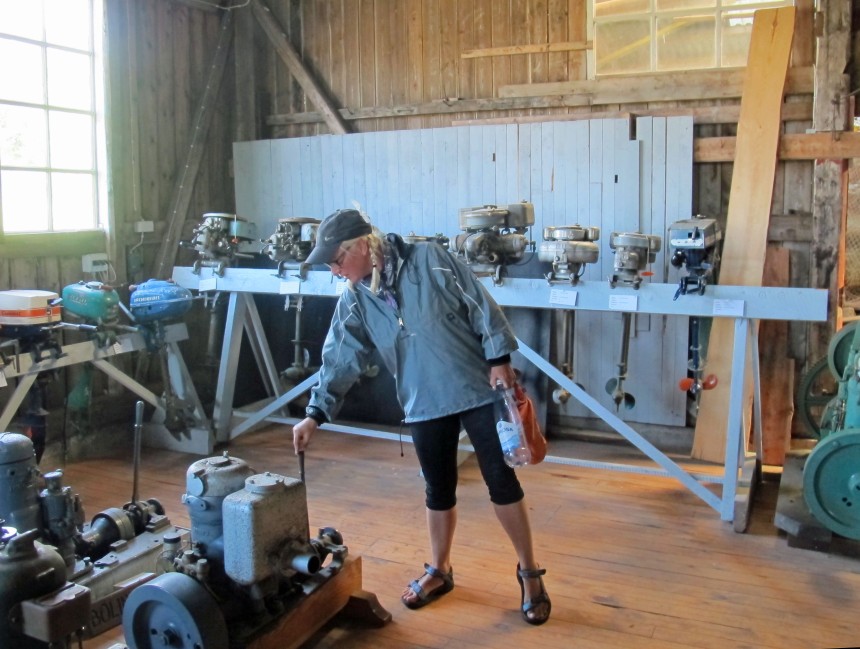
För mig var turens riktiga höjdare att jag äntligen – tredje försöket –  fick komma in på träbåtsmuseet på Bassholmen. Helenes entusiasm var väl sisådär, balanserade farligt när oförstående… Tur att Kenneth också hängde med in, så man kunde dela lite på nörderiet. :-)

Det blev fyra överraskande fina dagar i skärgården kring Orust. Visst kom det en och annan skur, men på det hela taget hade vi en superfin helg. Återigen kan vi konstatera att vi aldrig nånsin ångrat att sticka ut, trots lite chansartat väder. Övernattning på Stocken, Vallerö, Vasholmarna och Högholmen, och de två sistnämnda nya öbekantingar!

Stocken

Ödsligt på tältavdelningen. Fick i alla fall ett trevligt morgonsnack med paddlarna Henrik och Camilla från Växjö.

IMG_1764

Vallerö är ett säkert kort.

IMG_1774

Jodå, vi hittade både jordgubbar och Vallerö!

IMG_1786

Bästa midsommardoppet!

P1030291

Helene är jättejättenöjd med packningen.

P1030286

Snälla kossor på ön.

IMG_1750 IMG_1752 IMG_1755

Mats Mellberg tittade förbi och önskade glad midsommar – kul att ses! :-)

IMG_4189Från Vallerö såg vi denna fantastiska dubbelregnbåge inne över land.

P1030293

Kenneth och Kerstin bara packar och packar och packar….men vem bråttom?! :-)

P1030305

På väg mot Gräasholmarna och snäckstranden hade vi riktigt sköna dyningar.

IMG_1792

Bra hällar på Vasholmarna.

IMG_1790

På Vasholmarna träffade vi trevlige Utz från Köln.

IMG_1800Utz smet iväg tidigt på söndag morgon.

IMG_1807

Äntligen besök på Bassholmens träbåtsmuseum.

IMG_1810

Gör man kebab med den här mojängen undrar Helene?

IMG_1805

Snipa eller kajak, det är frågan.

P1030323

Nära Strutsholmen hittade vi ett musselfält stort som ett par fotbollsplaner.

IMG_4234

Högholmen.

IMG_4236

Packat och klart för hempaddling.

IMG_1836

That’s all folks! :-)


Postat i:Övrigt Tagged: midsommar, stocken, vallerö
26 Jun 23:13

Amazon Takes Down Confederate Flag, Continues to Sell Communist Merchandise

Amazon Takes Down Confederate Flag, Continues to Sell Communist Merchandise: Liberals never seem to be afraid of being hypocrites…it’s always style over substance. In a marketing move that will shock no one, Amazon removed the Confederate flag...
26 Jun 14:26

How Protecting Hatred Preserves Freedom

by Andrew Napolitano

The tragedy of a mass murder in Charleston, S.C., last week, obviously motivated by racial hatred, has raised anew the issue of the lawfulness of the State expressing an opinion by flying a Confederate flag at the Statehouse, and the constitutionality of the use of the First Amendment to protect hate speech and hate groups. The State has no business expressing opinions on anything, and it is required to protect hate. Here is the law.

Let's start with the proposition that hatred of persons is a profound disorder, and it is no doubt motivated by far deeper errors of thought and judgment than admiration for a flag. I recognize that to some in our society, the Confederate flag represents resistance to federal authority enforced by military aggression; while to others, it represents racial oppression under color of law bringing about the worst violations of the natural rights of born persons in American history—namely slavery. To me, it represents both. Yet, the government has no business flying it.

In a lawsuit brought against the State of Texas seeking to compel Texas to offer automobile license plates bearing the Confederate flag, the Supreme Court in dismissing the suit ruled just two weeks ago that the government enjoys the same freedom of speech as do persons. This is a novel and dangerous idea. It places government—an artificial creature based on temporary consensus and a monopoly of force—on the same plane as human beings, who are natural creatures with immortal souls endowed by our Creator with natural rights.

Natural rights, foremost among which after life itself is freedom of expression, are gifts from God. They are not manmade and hence cannot be transferred to a manmade entity. They are as natural to us as are the fingers on our hands. We don't need a government permission slip in order to exercise them.

In the case of speech, it is especially dangerous to accord the natural rights of persons to the government because the state can use its monopoly of force to silence, drown out or intimidate the speech of any persons it hates and fears. When the state speaks, its expressions have an aura of legitimacy and can be used for narrow, sectarian, even hateful purposes. But the whole purpose of the First Amendment is to keep the government out of the business of speech.

If I were in the South Carolina legislature, I'd vote to remove the Confederate flag from the Statehouse because I'd silence all government speech except that which is universally accepted (like the American flag), utterly innocuous (like the library is closed on Sundays), or absolutely necessary for governance (like speed limits on state roads). Otherwise, who cares what the government thinks?

The First Amendment to the Constitution also protects the rights of every person to embrace hatred. It guarantees all persons the freedom of thought, expression, and association. Thought and association are guaranteed unconditionally. Imagine the dangers of the government telling us how to think.

The rule on speech is that all innocuous speech is absolutely protected, and all speech is innocuous when there is time for more speech to address it before the violence it suggests may come about. Stated differently, the First Amendment absolutely bars the government from interference with a person's thoughts or associations, and permits interference with a person's expressions only if necessary to prevent immediate lawless violence when there is no time for more expression to do so first.

But the government may never, consistent with the First Amendment, interfere with expression because it despises or fears the views animating the expressions. This temptation is another danger of according the government the freedom of speech.

Hatred, though invariably destructive to those it animates, is a protected mode of thought and expression and may form the basis for association. Groups may be formed based on hate, and the government may not interfere with them because it hates and fears their hatred. Some hate groups are merely a vessel for folklore and group comfort; some are willing to use violence to advance their nefarious beliefs.

But the willingness alone to use violence is not criminal; it is only the actual use of violence that is. Thus, it is the manifestation of hatred as lawless violence that may be prosecuted, but the manifestation of hatred as a unifying idea is protected and may not be prosecuted.

The remedy for hatred is reason. Hatred of persons is always unreasonable. It takes a characteristic of birth—color, ethnicity, religion, for example—and unreasonably ascribes mythological and unitary traits to it. Those ascribed traits usually appeal to the base fears and biases of the hater, feed his weaknesses, and provide him with a mental haven for his failings. Yet, reason and overwhelming opinion to the contrary can dilute hatred.

Hatred sometimes provides a dark place of comfort for the weak, and it can be addictive. We must guard against its allurements. Lord Byron in "Don Juan" warned of hatred's irony:

Now hatred is by far
The longest pleasure.
Men love in haste, but they
Detest at leisure.

Yet, God, too, hates. He hates sin, and we, as well, must hate sin. Like the families of those murdered in Charleston, we must imitate our Creator: We must love the sinner and the hater.

COPYRIGHT 2015 ANDREW P. NAPOLITANO || DISTRIBUTED BY CREATORS.COM

26 Jun 14:26

Gun Rights Benefited Black Americans During the Civil Rights Movement and Still Do

by Sheldon Richman

Dylann Roof’s racially motivated murders of nine black churchgoers have brought predictable calls for new restrictions on the right to keep and bear arms. How ironic this is we shall soon see.

Advocates of gun rights argue that the best way to prevent such atrocities is for would-be victims to arm themselves; killers will break gun laws without hesitation (though Roof obtained his .45-caliber handgun legally), so legal obstacles to gun ownership only impede the innocent. Relying on the police for defense is futile—or worse.

This argument persuades few who are committed to "gun control" (a misnomer because law-abiding people, not guns, are subject to control). But those who demand it while grieving over the racist massacre at Emanuel AME church in Charleston, S.C., ought to understand that "time and again, guns have proven pivotal to the African American quest for freedom."

That sentence is found in Charles E. Cobb Jr.’s important book That Nonviolent Stuff’ll Get You Killed: How Guns Made the Civil Rights Movement Possible

Guns made the civil rights movement possible? What about the philosophy of nonviolence embraced by most prominent civil rights leaders, such as Martin Luther King Jr.?

As Cobb, a journalist and veteran civil rights activist, explains, for many civil rights activists in the South, nonviolence did not rule out "armed self-defense," which meant keeping firearms. "In these communities, where the law was generally weighted against them, armed self-defense was a natural response to white terror," he writes.

True, many activists believed in a turn-the-other-cheek strategy. But others rejected strict passivism. "Whether the question was one of picking up a gun in response to attack by night riders," Cobb writes, "or of curling one’s body tightly and protectively while being assaulted by a mob during a lunch-counter sit-in, or of shielding an elderly person under attack for trying to register to vote, the decision of what to do centered not on the choice between nonviolence and violence but on the question of what response was best in each situation." As one Mississippi activist and farmer, Hartman Turnbow, put it after scaring off night riders with his gun, "I wasn’t being non-nonviolent; I was just protecting my family."

Guns of course pervaded the South before the civil rights movement, and this was true of black culture too. Moreover, many black war veterans came home with guns, determined to win their freedom. As the black freedom movement emerged after World War II and the Korean War, it was only natural for guns to be seen as important in the defense against the daily threat posed by the Ku Klux Klan and other white supremacists.

Cobb’s book is filled with accounts of incidents in which brutal racists were persuaded to retreat by black men armed and ready to defend themselves and their families. For example, "There is ... no shortage of examples of black resistance to the vicious and violent white supremacy that continued to prevail in Louisiana as CORE [Congress of Racial Equality] organizers began their work." Guns were no guarantee against white aggression, but Cobb’s message is that more blacks would have been killed had they been unarmed.

This book taught me, among other things, that 1) Martin Luther King’s home in the 1950s was "an arsenal" and was always guarded by armed men, 2) that King in 1956 applied for a concealed-carry permit (and was turned down), 3) that Daisy Bates, who advised the Little Rock Nine, carried a .32-caliber handgun in her purse, 4) and that Medgar Evers always was armed. (Evers of course was murdered; guns are no panacea.)

Cobb understands that "America’s first gun control laws … were designed to prevent the possession of weapons by black people," and he writes that “it can easily be argued that today’s controversial Stand Your Ground right of self-defense first took root in black communities." (Whites expected blacks to "back down or submit—never to stand up for themselves.") He concludes, "There was a time when people on both sides of America’s racial divide embraced their right to self-protection, and when rights were won because of it. We would do well to remember that fact today.”

This piece originally appeared at Richman's "Free Association" blog. 

26 Jun 14:25

Taxpayers get $866,615.40 bill for jet fuel for Obama’s Air Force One flight...on Earth Day

Obama is perpetually undone by his own hypocrisy.  from Washington Examiner: President Obama’s decision to take his Earth Day speech attacking climate change “deniers” to Florida, home of two GOP presidential candidates, cost...
26 Jun 14:19

Cabin atop Cerro Catedral, Bariloche, Argentina. Contributed by...

by paula-ingaramo


Cabin atop Cerro Catedral, Bariloche, Argentina.

Contributed by Paula Ingaramo.

26 Jun 14:19

Shelter at the Keyhole on Longs Peak in Rocky Mountain National...


Shelter at the Keyhole on Longs Peak in Rocky Mountain National Park, Colorado.

Contributed by Tyler Oestreich.

26 Jun 14:18

Villa Ardilla in Granada, Spain. Made by Danie Cabezas, Rosario...


Villa Ardilla in Granada, Spain.

Made by Danie Cabezas, Rosario Velasco, Joan Sanz. Contributed by photographer Cris Beltran.

26 Jun 14:18

Hunting shelter in Panther Town Valley, North...


Hunting shelter in Panther Town Valley, North Carolina.

Contributed by Tom McMahon.

22 Jun 15:38

Tom Waits Reads Two Charles Bukowski’s Poems, “The Laughing Heart” and “Nirvana”

by Josh Jones

Opportunities to meet one’s heroes can go any number of ways. They can be underwhelming and disappointing, embarrassing and awkward, or—as Tom Waits found out in meeting Keith Richards and Charles Bukowski—completely overwhelming. Both encounters became too much for Waits for the same reason: when you “try to match them drink for drink,” he says in an interview, “you’re a novice, you’re a child. You’re drinking with a roaring pirate.” Waits “wasn’t able to hang in there” with these veteran imbibers—“They’re made out of different stock. They’re like dockworkers.” But of course it wasn’t just their legendary drinking that impressed the sandpaper-voiced L.A. troubadour.

Waits calls both Richards and Bukowski artistic “father figures”—two of many stand-ins for his own absent father—but it’s Bukowski who had the most profound effect on the singer and songwriter. Both Southern California natives, both keen observers of America’s seedier side, as writers they share a number of common themes and obsessions. When he discovered Bukowski through the poet’s “Notes of a Dirty Old Man” column in the LA Free Press, Waits observed that he “seemed to be a writer of the common people and street people, looking in the dark corners where no one seems to want to go.” Waits has gone there, and always—like his literary hero—returned with a hell of a story. His songwriting voice can channel “Hank,” as Bukowski’s friends knew him, and his speaking voice can too—with sharp glints of dry, sardonic humor and surprising vulnerability, though much more ragged and pitched several octaves lower.

Waits’ artistic kinship with Bukowski makes him better-suited than perhaps anyone else to read the down-and-out, Dostoevsky-loving, alcoholic’s work. At the top of the post, hear him read Bukowski’s “The Laughing Heart,” a poem of weary, almost resigned exhortation to “be on the watch / There are ways out / There is light somewhere,” in the midst of life’s darkness. Below it, Waits reads “Nirvana,” a poem we’ve featured before in several renditions. Here, the poet tells a story—of loneliness, impermanence, and a brief moment of solace. For comparison, hear Bukowski himself, in his high, nasally voice, read “The Secret of My Endurance” above.

Waits almost became more than just a Bukowski lover and reader; he was once up for the role of Bukowski’s alter-ego Henry Chinaski in Barbet Schroeder’s 1987 Bukowski adaptation, Barfly. “I was offered a lot of money,” says Waits, “but I just couldn’t do it.” Mickey Rourke could, and did, but as I hear Waits read these poems, I like to imagine the film that would have been had he taken that part.

Related Content:

Four Charles Bukowski Poems Animated

Hear 130 Minutes of Charles Bukowski’s First-Ever Recorded Readings (1968)

Charles Bukowski Rails Against 9-to-5 Jobs in a Brutally Honest Letter (1986)

Josh Jones is a writer and musician based in Durham, NC. Follow him at @jdmagness

22 Jun 15:18

Brickbat: To Protect and Serve

by Charles Oliver

Cops in Greenwood Village, Colorado, have offered $5,000 to a family whose home they destroyed in a standoff with a shoplifting suspect.  A officer tried to arrest Robert Seacat for shoplifting at a local Wal-Mart, but Seacat fled and entered the house at random. Officers used explosives to knock holes in the walls knock out windows and force Seacat out.

19 Jun 23:31

What happens when someone falls off a US Navy aircraft carrier?

If someone sees the person fall overboard, they report "man overboard starboard/port side" to the navigation bridge. It is important to provide the side of the ship, as the ship will be turned in that direction. A life ring is immediately thrown over the same side, even if the person in the water is not visible. This marks the approximate point the person went over for navigation purposes.


18 Jun 23:04

Talking with the Man Who Climbed the Unclimbable

  • Jeff Dufour
Talking with the Man Who Climbed the Unclimbable

There aren’t many people who can say they’ve done something no one on the planet has ever done. Tommy Caldwell is one of those people. The Sir Edmund Hillary of Yosemite National Park, Caldwell famously scaled the nearly sheer Dawn Wall of El Capitan earlier this year along with partner Kevin Jorgeson.

Still very much in the throes of after-the-fact publicity, Caldwell was giving a talk at National Geographic headquarters in Washington, DC, earlier this month when we caught up with him for a Q&A that touched on the value of suffering and the value of whiskey.

18 Jun 23:03

Five Things You Never Knew About Ducks   

by Brian Barth
Male ducks are called drakes and female ducks are usually referred to as, well, ducks. A group of ducks may be called a brace, raft, skiff, team, paddling or sord, depending on where you’re from. Here are a few other duck facts we bet you didn’t know:There are many ways to sex a duck. Besides listening to their call, visual cues are the easiest way to tell boy ducks apart from girl ducks. In most breeds the males are larger and have more colorful feathers and markings. Even on breeds with little to no sexual dimorphism, the males tend to have curly tail feathers. Another clue is that female ducks, once they reach egg-laying age, develop freckles on their bills, while male ducks have bare bills throughout their lives.Some ducks run fast! Indian Runner ducks are originally from Southeast Asia, where they were herded from the house to the rice paddy each day. They had to run fast to keep up with their human herders. With tall, slender, upright bodies, they look like a cross between a mallard and a penguin. Indian Runner ducks are known for their ability to hunt down bugs, slugs and snails and were traditionally employed to perform pest control in the rice paddies. Today they are often used for backyard garden pest control.Ducks with funny hairdos have a genetic disadvantage. Crested ducks, which are popular in duck shows, have an orb-shaped clump of feathers on the top of their heads that, depending on the breed, can resemble the hairdo of George Washington, a rock star with a mohawk or an old woman with a bun. Unfortunately (for the ducks) the fancy hair is a result of inbreeding and is often associated with other, more problematic deformities. If you breed a crested duck with a crested duck, many of the offspring die before they hatch, while others emerge with twisted necks or other problems that leave them disabled.Ducks turn white with age. White ducks are white their whole lives, but dark-colored ducks slowly develop white patches in their feathers as they age, just like human hair. Eventually, when they are very old, they may become entirely white.Ducks have very unusual sexual organs. Most birds do not have penises or vaginal canals at all, mating instead with a ‘cloacal kiss’. But ducks are one of the few birds whose genitalia (vaguely) resembles our own. The subject has only recently been studied by scientists, but it turns out that males have springy corkscrew-shaped penises up to 16 inches in length and females have a corresponding spiral-shaped vaginal canal.The post Five Things You Never Knew About Ducks    appeared first on Modern Farmer.
17 Jun 00:47

A 4K Timelapse of the Calbuco Volcano That Exploded Over Chile

by Michael Zhang

When the Calbuco volcano in southern Chile erupted back in April, one photographer captured footage from the moment of explosion and another one managed to shoot a short time-lapse sequence of the plumes. German time-lapse photographer Martin Heck of Timestorm Films just released an amazing video of his own.

Above is his 2.5-minute time-lapse titled “Calbuco,” which has gotten quite a bit of attention on the Internet over the past few days since it was published.

red

Heck says that he was in the area shooting a time-lapse project and on a ferry down to Patagonia when he noticed the eruption. “We noticed a massive, almost nuclear looking cloud boiling upwards just were we left a few hours ago,” he writes.

After “frenetically” searching for a good vantage point, he set up a Canon 6D, Sony A7s and Pentax 645Z to capture 4K and 8K frames for a time-lapse. “We filled almost all of our memory cards in the prior night so I had to do backups while shooting all this stuff,” he says.

white

“This was for sure the most incredible show I’ve ever seen. I think this is a one in a lifetime event and I am so happy that we were able to capture it in all its glory.”

(via Timestorm Films via SLR Lounge)


Image credits: Video and still frames by Martin Heck

17 Jun 00:42

'We': The Novel That Inspired George Orwell’s '1984'

by Sarah Stodola

In January 1946, George Orwell published a review of a fairly obscure Russian novel titled We, by Yevgeny Zamyatin, in the Tribune. Originally released in New York in 1921 after being banned prior to publication in Russia, We had recently been translated into French, in which Orwell was fluent. As the recent author of Animal Farm and a writer for whom fiction and politics belonged together, Orwell seemed a natural choice to examine this dystopian work.

We tells the story of D-503, a man living in a dystopian city of the future in which people no longer have Christian names and are known instead by a letter followed by a series of numbers. In this city, citizens are subjected to constant surveillance by a branch of government called the Bureau of Guardians, with an all-powerful leader called the Well-Doer ("the Benefactor" in some translations). At a point early on, D-503 notices a particular woman showing up wherever he goes. Filled with suspicion, he first hates her, but soon falls in love with her. She inspires him to commit acts of rebellion against the state.

In his review, Orwell praised the book’s “intuitive grasp of the irrational side of totalitarianism.” Three years after writing those words, Orwell published 1984, a dystopian novel about a man named Winston living in a dystopian city of the future. In this city, citizens are subjected to constant surveillance by a branch of government called the Thought Police, with an all-powerful leader called Big Brother. At a point early on, Winston notices a particular woman showing up wherever he goes. Filled with suspicion, he first hates her, but soon falls in love with her. She inspires him to commit acts of rebellion against the state. Sound familiar?

Orwell never acknowledged having borrowed from We for his masterpiece, but the timing of his reading it, along with some of the uncanny similarities between the two novels, make it hard to conclude otherwise. Along with the basics of the plot outlined above, both D-503 and Winston (DOUBLE SPOILER ALERT) ultimately find themselves subjected to procedures that remove their ability to reject the government’s philosophy, after which both men find that they no longer care for their former lovers. In both novels, freedom is considered by the state to be an evil and the enemy of a proper life. In We, this idea manifests in statements about “when human beings still lived in the state of freedom, that is, in an unorganized primitive state.” In 1984, it is most clearly illustrated in the Party’s oft-repeated slogan:

WAR IS PEACE
FREEDOM IS SLAVERY
IGNORANCE IS STRENGTH

The two books share certain smaller details in common as well. In both, the protagonist keeps a diary that he is composing at great risk and which he hopes will be read by future generations. Both feature public executions as a means of rousing frenzied loyalty to their respective leaders by the citizenry. In both, the 12-hour clock is no longer in use. In We, D-503 writes:

There is but one truth, and there is but one path to it; and that truth is: four, and that path is: two times two.

In 1984, Winston writes in his diary:

Freedom is the freedom to say that two plus two makes four. If that is granted, all else follows.

To be fair, Orwell was not the only writer to borrow copiously from We. For all of its lack of recognition with the general population, many 20th century authors of literary dystopian novels have considered We to be something of a benchmark—Ayn Rand is said to have taken inspiration from it, as had Vladimir Nabokov, who apparently read it before he wrote Invitation to a Beheading. In his own review of A Brave New World, Orwell suggests that Aldous Huxley may have borrowed his novel's plot from Zamyatin. Kurt Vonnegut alludes to this in an interview with Playboy when he mentions Player Piano's debt to We, saying, "I cheerfully ripped off the plot of Brave New World, whose plot had been cheerfully ripped off from Yevgeny Zamyatin's We." For his part, Huxley claimed to have written his own dystopian novel before he’d ever come across We.

There are differences between We and 1984, of course. The United State (One State in some translations) in We is an imaginary city that seems to have been built from scratch, while the London of 1984, now located within “Airstrip One” rather than Great Britain, features “rotting 19th century houses” and a layout that would be recognizable to readers familiar with that city. In We there is a single class to which all but government officials belong. In 1984, the Inner Party members represent the upper class, the Outer Party members a sort of middle class, and the proles the lower. In We, the entire city is made of glass, which enables the constant surveillance. In 1984, telescreens installed in every home and public place do so. Winston works in the Ministry of Truth, rewriting documents in order to alter the historical record to the Party’s specifications. D-503 is the lead engineer on the Integral, a spaceship with which to conquer other planets.

And then there’s the biggest difference: that 1984 became one of the most important novels ever written in terms of political and societal influence while We fell into obscurity. Here, the reasons become a little harder to pinpoint. 1984 is better written; Orwell’s ability to inhabit Winston’s daily life and have the reader experience his horror at the oppression imposed on him as if firsthand give 1984 an immediacy that We sometimes lacks. And Orwell never loses sight of his own story, while there are sections of We in which Zamyatin meanders in his depiction of the very world he has imagined, leaving the reader puzzled.

In addition, Orwell was wise to set his dystopia in a recognizable location and in a near future that might hit close to home for readers. We, on the other hand, is set in the 26th century and in a city that no reader would directly relate to as their own gone wrong. Zamyatin, who as a dissident writer found himself persecuted by the Soviet regime—he was imprisoned and eventually exiled to France—likely aimed to instill his novel with a milieu not identifiably Soviet, but universal in nature. But the move creates a distance between the reader’s world and the world in the novel, a gap that 1984 closes with aplomb.

Orwell endowed Winston with a barely contained contempt for the political system in which he is trapped from the outset, creating a tension that compels the plot forward. Zamyatin’s D-503, on the other hand, believes in the system and acts against it only after being convinced to do so by the woman with whom he has fallen helplessly—and ruinously, it turns out—in love. Hers are the actions that drive the plot, while D-503, though the protagonist, never manages to become truly sympathetic.

Still, the reaction to We in Russia suggests that it was an important book there: Soviet censors banned publication of the book—it didn’t officially appear in Russia until 1988. But a Russian publisher in Prague printed the novel in its original Russian in 1927 and copies were smuggled back into Russia, passing from reader to reader. Had the book not struck a nerve, it would have been a different story. Zamyatin was certainly onto something with his dystopian novel, and the Soviets’ efforts to thwart its publication only confirm that fact. We successfully takes the emergent ideology of his time to a terrifying logical endpoint.

If Zamyatin came up with the template for the 20th century dystopian novel, then Orwell perfected it. Art always builds upon art that came before it, but rarely does such an overt appropriation remain so little known. 1984 showed just how valuable literature can be for the collective conscience, but failure to acknowledge its debt to We resembles the very kind of obliteration of history that Winston performs every day at work in 1984.