Shared posts

25 Jan 18:02

5 Apple Mail Alternatives for Mac OS X

by Bryan Wolfe
apple-mail-alternatives

Every Mac comes with a free email application, appropriately named Mail. Using the native Mail application is fine for most people, especially for those who only use iCloud, but things get trickier when you’re dealing with multiple email accounts. For Gmail users in particular, more thorough solutions are available, many which are free. Here’s a look at five Mail alternatives and why they might work for you. AirMail ($10) Marketed as being a “lighting-fast email client for Mac,” AirMail is also the most beautiful application on the list. Offering Split Screen support for OS X El Capitan, the application looks and...

Read the full article: 5 Apple Mail Alternatives for Mac OS X

25 Jan 18:02

3 Career Lessons From Quentin Tarantino

by Tom Ward, Contributor
(Photo by Paul Drinkwater/NBCUniversal via Getty Images) Quentin Tarantino has earned over $1.5b in career box office numbers, two Oscars, and 113 other awards. With his latest film, The Hateful Eight, getting three Oscar nominations, let’s see what lessons we can learn from his impressive career: 1. Collaborate With Great People: Tarantino [...]
25 Jan 18:02

How Long Could the U.S. Go Without Electricity?

by A. Barton Hinkle

The power is still out, and things are getting scary.

The house is so cold you can see your own breath. Some of the food in the refrigerator is good, but there's no way to cook it. The water is still running, barely, but it smells bad and tastes worse. The grocery store is open, but it's only taking cash—which you can't get, because the banks are closed. But it doesn't really matter since the shelves have been picked clean anyway.

You went to work on Monday, but after a couple of hours the boss sent everyone home. Come back when the power comes back on, she said.

That was nine days ago.

The family has been warming up in the car for short stints, and you've been charging your cell phone, but the gas gauge is now sitting on Empty. The gas station closed because there's no power to run the pumps.

The emergency numbers you've called are busy or not answering. Nothing on the radio but static. No wi-fi. Your neighbors are just as clueless as you are.

Somebody better get the power back on soon, or you and your family are going to be up the creek.

But suppose they don't. Then what?

* * *

This cheery scenario is the subject of a recent book by Ted Koppel, Lights Out, which discusses the possibility of a major blow to the nation's power grid—either through a cyberattack or an EMP. An EMP is an electromagnetic pulse caused by a high-altitude (as in 30 or 40 miles) detonation of a nuclear warhead. A sufficient blast over Ohio could fry circuits on the Eastern Seaboard down to Florida and as far west as Omaha, Nebraska. A cyberattack would have less far-reaching effects—unless it were either a coordinated, distributed assault or hit nerve centers hard enough to cause a cascading power failure.

Koppel explores the likelihood of such an event. The experts he interviewed, including former heads of Homeland Security,  rate the chances everywhere from minute to almost inevitable. He asks how effective such an attack might be. The answer to that is: It depends. He also asks how well prepared the country is to cope with a long-term, widespread power failure. The answer to that is: Not one little bit.

Experts in the utility industry contend that fears of a nationwide blackout are overblown. Dominion, Virginia's chief supplier of power, will be spending $500 million to harden its critical infrastructure.

The industry spends billions on cybersecurity. There's no way for an outsider to hack into the control systems, they say. Cyber-security experts seem rather less sanguine. Hackers always find a way—just ask Target, or Sony Pictures, or the Office of Personnel Management or countless other major institutions that have the resources to guard against cyber-infiltration, but couldn't stop it. A terrorist or foreign power that hacks into a power company's network might be able to wreck its hardware, just like the Stuxtnet virus developed by the U.S. and Israel wrecked Iran's uranium centrifuges.

* * *

An EMP attack, which would affect not just power companies but electronic circuits everywhere, is equally feasible—so feasible that more than a decade ago, Congress established a commission to examine the issue. Its findings are not exactly reassuring. They point out, for instance, that a successful EMP attack does not require an intercontinental ballistic missile. As one commission member testified to the House Armed Services Committee in 2008, "such an attack could be launched from a freighter off the U.S. coast using a short- or medium-range missile... Iran... has practiced launching a mobile ballistic missile from a vessel in the Caspian Sea."

The effects of such an attack, the commission says, "could be sufficient to qualify as catastrophic to the Nation." Why? Because every major system of our high-tech society depends on electrical power, and lots of it. And while most of those systems have safeguards against failure and emergency plans if failure occurs, the commission's 2008 report notes that their recovery plans "generally depend on the proper functioning of the rest of the national infrastructure." So, for instance: Even if power companies could find enough replacement transformers—and that is not at all clear; large transformers are usually custom-built by foreign suppliers and take more than a year to arrive—how would they get the replacements delivered?

Or take food: "Tractors, planters, harvesters, and other farm equipment are fueled by petroleum products supplied by pipelines, pumps, and transportation systems that run on electricity," the commission points out. "Food processing—cleaning, sorting, packing, and canning of all kinds of agricultural and meat products—is typically an automated operation, performed on assembly lines by electrically powered machinery." Food distribution needs refrigerated warehouses. Grocery stores need to be able to send orders for more. How?

Yes, the military has large stores of supplies—for itself. It can't feed half the country. People would get desperate, fast—and local law enforcement likely wouldn't be in much better shape than the rest of us.

On the bright side, many people wouldn't have to worry about starving because they would die first from the lack of clean water. "The water infrastructure is a vast machine, powered partly by gravity but mostly by electricity," says the EMP commission. Without energy to run purification plants, pumps, sewage treatment, and so on, "local water supplies would quickly disappear... People are likely to resort to drinking from lakes, streams, ponds, and other sources of surface water. Most surface water, especially in urban areas, is contaminated with wastes and pathogens and could cause serious illness if consumed." Medical care, however, is likely to be hard to come by—which means even minor injuries, such as a cut that gets infected by tainted water, could become life-threatening very quickly.

* * *

It's nice to think this is all very far-fetched silliness—a bad script for a late-night movie on an unwatched channel. Let's hope so. We've gone decades now without a nuclear attack, after all. A look around the world, though, suggests people  should take the possibility seriously—and think about how to manage by themselves. Because if an event of that magnitude did occur, help might not come for weeks. Or months. Or years.

This column originally appeared at the Richmond Times-Dispatch.

25 Jan 17:59

Dog runs half-marathon, finishes seventh.

by Barry Petchesky

Dog runs half-marathon, finishes seventh.

Read more...


25 Jan 17:57

Are You Ready? The Farm Tax Man Cometh

by Dan Sullivan
It’s been said that life offers two certainties. The only iffy part is which one’s scarier: a visit from the Grim Reaper or an IRS auditor. Luckily, Uncle Sam provides generous agricultural tax breaks; you just need to know how to take advantage of them.Seek Professional Help“A lot of tax code is written specifically for farmers,” says CPA Andy McCarty, who specializes in agricultural accounting at Badgerland Financial in Prairie du Sac, Wisconsin. “It’s one of the ways our government tries to make food affordable.” But not every tax preparer grasps the finer points of Publication 225, the Farmer’s Tax Guide, and Form 1040, Schedule F, Profit or Loss From Farming. McCarty advises working with an agency that truly understands farm taxes, preferably one affiliated with Farm Credit, a network of government-sponsored financial-services institutions. Alternatively, your local cooperative extension can steer you toward an expert.Ask Yourself Hard QuestionsNamely, are you really running a business? Hobby farms serving as tax shelters are common enough that the IRS actively looks for red flags. Though you’re not expected to turn an immediate profit, you should be able to demonstrate some kind of income within three years.Become Your Own Best BookkeeperWhile farmers typically excel at keeping meticulous field notes, they often fail when it comes to financial records. Invest in a simple computer program, such as QuickBooks or the ag-specific CenterPoint, to track basics, including cash accounts, checking accounts, loans, purchases, and other operating expenses. Save all receipts pertinent to your farm business, and force yourself to enter the data every week.File Early, And Average Your IncomeThe IRS understands that farm income tends to come in seasonally. Farmers can avoid making estimated tax payments throughout the year if they file by March 1. (Unable to meet the deadline? You can still bypass interest and penalties by making an estimated payment in January, then filing by April 15.) You can also average income over four years, thereby affording flexibility in years of high income. Assume, for example, that you’re in the 15 percent bracket for three years in a row. Income goes up in year four, pushing you to the 25 percent bracket. As a farmer, you can backfill your income into previous years, as long as the revised total amount reported in a given year doesn’t push you out of the lower bracket.Appreciate DepreciationDepreciation on farm equipment can be taken over seven years. Congress often allows for a periodically determined larger amount to be taken in the first year. (Since the 2008 recession, the amount has fluctuated between $25,000 and $500,000.) It pays, in other words, to invest in big equipment during a robust year. Depreciation on general-use farm buildings, such as barns and equipment sheds, can be taken over 20 years, while depreciation on singlepurpose buildings (such as |a milking parlor) can be taken over a decade.Invest In Tomorrow TodayLike most independent businesses, farms are allowed to reduce their current tax burden by spending money in this tax year on items (such as seed, feed, and soil amendments) not intended for use until next year. To be valid, the payments must be made before January 1 and meet other IRS requirements.The post Are You Ready? The Farm Tax Man Cometh appeared first on Modern Farmer.
24 Jan 22:21

You Can Now Step Inside a Salvador Dalí Painting Thanks to VR

by Alexis Garcia

Salvador Dalí is known for his surrealist paintings featuring melting clocks and trippy landscapes. But now the Spanish painter’s work is going into another dimension with The Dalí’s Museum new "Disney and Dalí: Architects of the Imagination" exhibit.

Fast Company reports:

"To help celebrate the opening of its new exhibition 'Disney and Dalí: Architects of the Imagination' on January 23rd, which looks at the relationship between the artist and Walt Disney, the museum enlisted agency Goodby Silverstein & Partners to create 'Dreams of Dalí' to give viewers a new way to experience his work.

Users will be able to move around inside and explore the elements in the painting, and the VR experience also incorporates some of the recurring motifs from his other paintings in the museum’s permanent collection, including Weaning of Furniture Nutrition (1934), Lobster Telephone (1936) and First Cylindric Chromo-Hologram Portrait of Alice Cooper’s Brain (1973)."

The exhibit is fitting for Dali, who was unapologetic in his love of commerce. In the video below, Reason TV documents their visit to the Dali Museum to explore surrealisms most famous figure. 

Salvador Dali attained international acclaim as a young artist in the 1930s. In 1933, curator Dawn Ames described Dali as "surrealism's most exotic and prominent figure." Surrealist poet Andre Breton wrote that Dali's name was "synonymous with revelation in the resplendent sense of the word." In 1936, Dali made the cover of Time magazine.

Dali didn't simply sit back and enjoy the acclaim. He exploited it. Dali was a shameless self-promoter and admitted to having a "pure, vertical, mystical, gothic love of cash." Ultimately, it was Dali's unapologetic drive for fame and fortune that proved to be too surreal for the Surrealists. Andre Breton, whose opinion of Dali soured over time, created an anagram of Dali's name: Avida Dollars ("greedy for money"). Breton and the other Surrealists, many of whom were closely allied with the French Communist Party, expelled Dali from their group in 1939. Dali responded, "I myself am surrealism."

Over the next several decades, Dali became increasingly flamboyant and controversial. He arrived at a lecture in Paris in a Rolls Royce filled with cauliflower. He did commercials for Alka-Seltzer and chocolate bars. He was thrilled when Sears sold his prints to the masses. He signed sheets of blank lithograph paper and sold them for $10 a sheet. As Dali became increasingly popular with the masses, however, his reputation among art critics suffered.

"There was an era when being a successful artist made you suspect, made your art suspect," says Hank Hine, executive director of The Dali Museum. "When I was going through school, we were not shown Dali. He was not part of the canon. Yes, we would buy posters, we could find his images, but largely he was not part of the serious discussion of values, which is what constitutes serious art. I believe that has changed." Others in the art world agree. The Philadelphia Museum of Art's Michael R. Taylor, for example, believes that "Dali should be ranked with Picasso and Matisse as one of the three greatest painters of the 20th century."

24 Jan 22:16

How Larry Page's Obsessions Became Company's Business...


How Larry Page's Obsessions Became Company's Business...


(First column, 10th story, link)
Related stories:
20 Jan 15:33

Land Rover Series III Adventuremobile

Even after more than 30 years, the Land Rover Series III remains one of the best looking SUVs around. This Land Rover Series III Adventuremobile was fully restored to Defender...

Visit Uncrate for the full post.
20 Jan 14:49

Breathtaking — Giant Black Marlin Take Flight

by Doug Olander
Giant black marlin leaping

Kelly Dalling Fallon

We Have Liftoff!

Fallon says, "It's truly amazing to see these big fish get their entire bodies out of the water." That seems particularly true when one consider that upwards of 1,000 pounds are going ariborne.

With a lifetime steeped in sport fishing and a photographer’s eye for composition, Australian Kelly Dalling Fallon has added photography to her crew duties aboard the Cairns-based 56-foot O’Brien big-game boat Kekoa. She spends nearly 200 days each year on the water alongside her husband, Capt. Luke Fallon, a part of that fishing for giant black marlin off the Great Barrier Reef. Coupling opportunity with ability, Fallon’s talent is clearly on display in this Sport Fishing gallery. You can see more of Fallon’s work in photos and words on her Marlin Fishing Blog web site and facebook.

Giant black marlin leaping

Kelly Dalling Fallon

Nothing Casual Here

Strong winds, rugged seas and big fish make this a serious game. The soaked hand, bottom right, belong to angler Jason Hassett. Location: Number 8 Ribbon Reef.

"THE BIGGEST BOAT IN THE FLEET CATCHES PLENTY OF FISH."

Kelly Dalling Fallon

Giant black marlin leaping

Kelly Dalling Fallon

The Aptly-Named Ultimate Lady hooked up

Note how much of this 90-footer with an amazing 33-foot beam is lost in the wave trough. Fallon cites this renowned Vanuatu-based game fisher with having incredible sonar "capable of marking fish from more than 200 yards away!"

Giant black marlin leaping

Kelly Dalling Fallon

On Fire

Capt. Corey Hand on Askari was one of many game boats on fire in 2014, Fallon says.

black marlin leaping

Kelly Dalling Fallon

Smaller Fish Hang Inside

In September (just before the real giant-marlin season kicks in), anglers can hook many juvenile marlin inside the reef.

Giant black marlin leaping

Kelly Dalling Fallon

Near-Grander Gets a Tag

This estimated 900-pound black was brought to Kekoa by angler Alex Kaiko during the Lizard Island Black Marlin Classic where it received a satellite tag. "The tag popped off the fish after six months, by which time she had traveled a modest 881 nautical miles to the Solomon Island," says Fallon.

Dinner at Cooktown, Australia

Kelly Dalling Fallon

Evening Before the Tournament

Teams have gathered for the 2014 Lizard Island Black Marlin Classic briefing, only that year's event was held out of Cooktown, with Lizard Island undergoing renovations courtesy of Cyclone Ita.

Giant black marlin leaping

Kelly Dalling Fallon

A Wireman's Tough Assignment

Acrobatics at the end of the leader demand the greatest concentration from a wireman.

EVERYONE ON THE BOAT GOT A GOOD AND THOROUGH DRENCHING!

Kelly Dalling Fallon

Giant black marlin leaping

Kelly Dalling Fallon

Nearing the End Game

Angler Jada Van Mols is steered in the chair by her father, legendary Kona skipper, Chip, in October. Fallon calls the sea condition typical for that time of year. "It was eventually released in healthy condition but not before everyone on deck got a good and thorough drenching!"

Giant black marlin leaping

Kelly Dalling Fallon

Head Shake

The photographer says this is one her faves. "A slower shutter speed captured the moment almost like a painting," she adds.

Giant black marlin leaping

Kelly Dalling Fallon

Leap Year

Even fish of "average" size offer a tough fight and often-fabulous aerial displays.

black marlin leaping

Kelly Dalling Fallon

Little, Hungry and Fiesty

Plenty of aggressivel "little" males patrol the same waters as the giant ladies. "These smaller males are notorious for trying to eat baits too big for them, getting all wrapped up in the process," says Fallon.

Giant black marlin leaping

Kelly Dalling Fallon

Broad Jumper

Low leaps across the water make wiring a big fish that much trickier.

Giant black marlin leaping

Kelly Dalling Fallon

View from Above

Another perspective of the excitement is offered from the flying bridge.

Giant black marlin leaping

Kelly Dalling Fallon

Number 10 Ribbon Reef

This famed spot draws in both big marlin and big game boats looking for them, both visible here.

Giant black marlin leaping

Kelly Dalling Fallon

Freight Train with a Bill

A huge black barrels toward the horizon at high speed in the late afternoon.

Giant black marlin leaping

Kelly Dalling Fallon

When the Fleet Heads Wide

Typically, late in the big-marlin season, Fallon says, "As the weather calms for longer stretches, the fleet heads wide to big blacks on the tuna aggregations, and blues as well." This particular fishery hasn't fired up significantly in recent years but could reignite any time.

Giant black marlin leaping

Kelly Dalling Fallon

High Flyer at Number 5 Ribbon Reef

This small spot can be quite productive; boats fishing here often take turns trolling over the hot spot.

Giant trevally

Kelly Dalling Fallon

GT Sideshow

Often, Fallon says, the crew of the Kekoa will give anglers the chance to tussle with a giant trevally, throwing poppers on shallower reefs.

Giant black marlin leaping

Kelly Dalling Fallon

Jaw Droppin' and Eye Poppin'

Marlin off the Great Barrier Reef register some astounding jumps.

20 Jan 14:48

Why Are Some People Healthier Than Others?

by John C. Goodman, Contributor
There are vast differences in the health of population groups in the United States. For example at the county level life expectancy for men ranges from a low of 65.9 years in Holmes County, Mississippi to a high of 81.1 years in Fairfax County, Virginia (a wealthy suburb of Washington, [...]
19 Jan 20:07

DRB Feel-Good Issue #36

by Avi Abrams
"FEEL-GOOD SHOT" #36
Link - by Avi Abrams

Some joyful stuff to brighten up your day
Mixed images flow: cars, girls, etc.

Welcome to the new issue of Dark Roasted Blend's "Feel-Good" series: mostly bright and sweet collection of images designed to propel you along your day with a smile on your face and a spring in your gait.

Great Japanese 1970s toy box art (incorporated into a modern CD-cover layout):


Some of the fascinating Japanese 1960s manga magazines (interesting from a design standpoint... of how now-standard cute "kawaii" manga eyes and faces developed; click to enlarge):


Guild Houses at the Brussels' Grand Place:


A Farm Organ, proudly displayed - mroe info:


The David Hilton family near Weissert, Custer County, Nebraska. 1887 - image via)


Soviet hockey game boys:


"Dame Alice Ellen Terry" (more info), by George Frederic Watts:


photo by Julia Margaret Cameron

Another photo by Julia Margaret Cameron - "Florence Anson, 1866":


photo by Julia Margaret Cameron

------------

Mixed fresh links for today:

National Geographic Best 2015 Photos - [spectacular]
Beautiful Space Art by Nick Gindraux - [scifi]
Starship Size Comparison - [wow scifi video]
H.P. Lovecraft's "Arkham" Built With Toy Trains - [geek info]
Marshall Amps: How Loudness Changed Music - [interesting]
Cuttlefish is on the move! - [awesome, nature]
Original Instructions for "Gone With The Wind" Projection - [fascinating]
Dumbest Kitchen Gadgets: Hilarious Review - [fun video, language]
PAW! BAM! ACTION! - [fun video]
What Star Wars Owes To the Early 1970s French Comics - [wow video]
Short Star Wars - [hilarious animation]
White Chocolate Sphere Dessert - [amazing, gif]
10 Ways How Meditation Changes Your Life - [promo info]
Play "Agario 3D" for a good entertainment - [in-browser fun]
The One Dollar Bargain Site - [just in time for Holidays]
2016: A Scrat Odyssey! - [funny animation trailer]

------------

FEEL-GOOD MUSIC

Currently listening to:
(feel free to copy-paste this in YouTube, most of entries on this list can be found there)

Roberto Pregadio - "Eva's Beguine" from "Eva la venere selvaggia" (outworldly, 1968)
Electric Light Orchestra - "Mission (A World Record)" (baroque pop, UK 1976)
Jeff Lynne's ELO - "When I Was a Boy" (new ELO album! 2015)
The Seekers - "Leaving Of Liverpool" (folk, 1964)
King Crimson - "Moon Child" (wonderful psych, prog, 1967)
Gianfranco Plenizio - "Voce D'Amore" from "La Gatta In Calore" (great melody, Italy 1972)
Stelvio Cipriani - Soundtrack from "Concorde Affaire" (excellent, 1979)
Les Irresistibles - "Slave To Freedom" (neat sunshine pop, 1968)
The Telstars (German Beat Group) - "Nur Fur Mich" (Germany, 1965)
The Monkees - "It's Nice To Be With You" (feel-good song, 1968)
Tom Petty - "Feel A Whole Lot Better" (Jeff Lynne-produced song, 1989)
Piero Umiliani - "La Schiava" vocal theme from "La Schiava Io Ce L'Ho E Tu No" (happy, 1972)
Maxine Sullivan - "Blue Skies", "Skylark", Night And Day" (w/ Claude Thornhill Orchestra, 1939)
Nico Fidenco - "A Picture Of Love" from "Emanuelle Perche" (instrumental, 1977)
Maurizio Vandelli - Music from "Madeleine Anatomia Di Un Incubo" (Camille K) (great melody, 1974)
Rondo Veneziano - "Venezia 2000 - Aria di festa" (neo-baroque instrumental, Italy 1983)
Piero Umiliani - "Isola Tuttofare" from "Le Isole Dell'Amore" (cute, happy, 1970)
Liverpool Express - "It's a Beautiful Day" (beat ballade, 1972)
Dee D. Jackson - "Red Flight", "Automatic Lover" (cool disco, 1978)
Armando Trovaioli - "The Most Wonderful Evening of My Life" from "La Piu Bella Serata" (nice, 1972)
Bruno Nicolai - Theme from "Django Spara Per Primo" (western, 1966)
Franco Micalizzi - "La Banda del Gobbo" movie music (good action tune, 1977)
The Beach Boys - "Still Surfin'" (sunshine pop, "Summer In Paradise" 1992)

------------

FEEL-GOOD GIRLS

Beautiful Actresses:


Elsie Ferguson (1883–1961)

English actress Nanette Newman from "The Wrong Box" 1966

Colleen Corby

1967 Ferrari Dino 206 Competizione Prototipo

Susan Dey

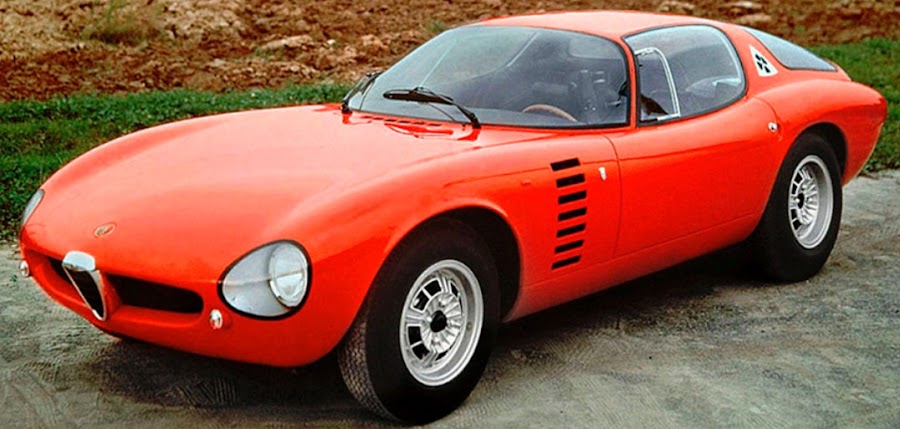
1964 Alfa Romeo Canguro

Susan Dey

1953 Maserati A6GCS/53 Spyder, via

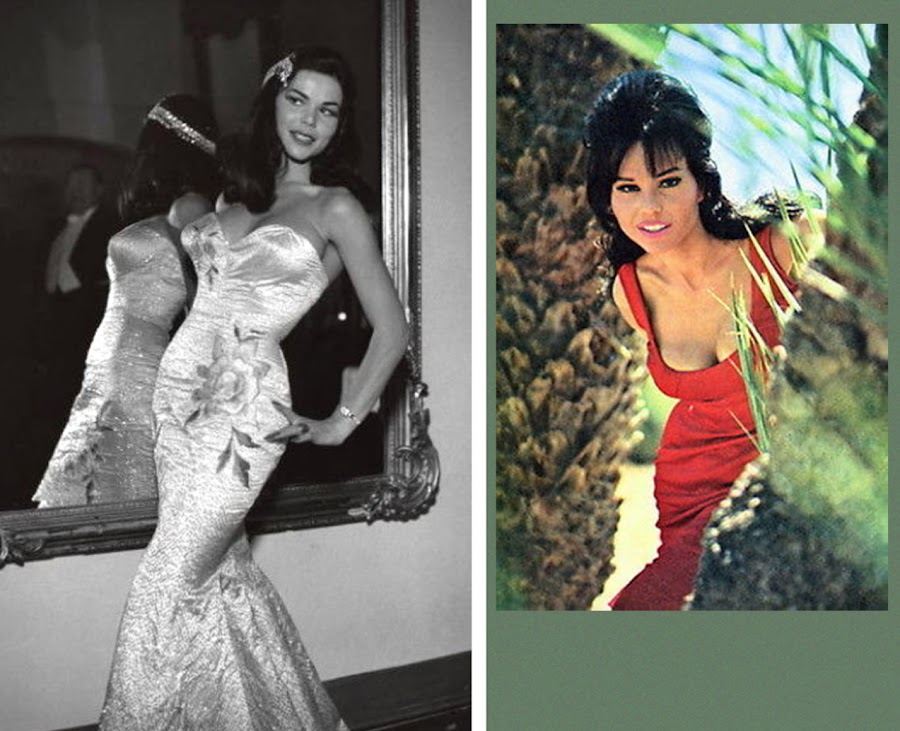
left: Christine Carere; right: Colleen Corby


German actress Laya Raki

Hayley Mills

Suzi Quatro


Right: Grace Kelly in "High Noon"

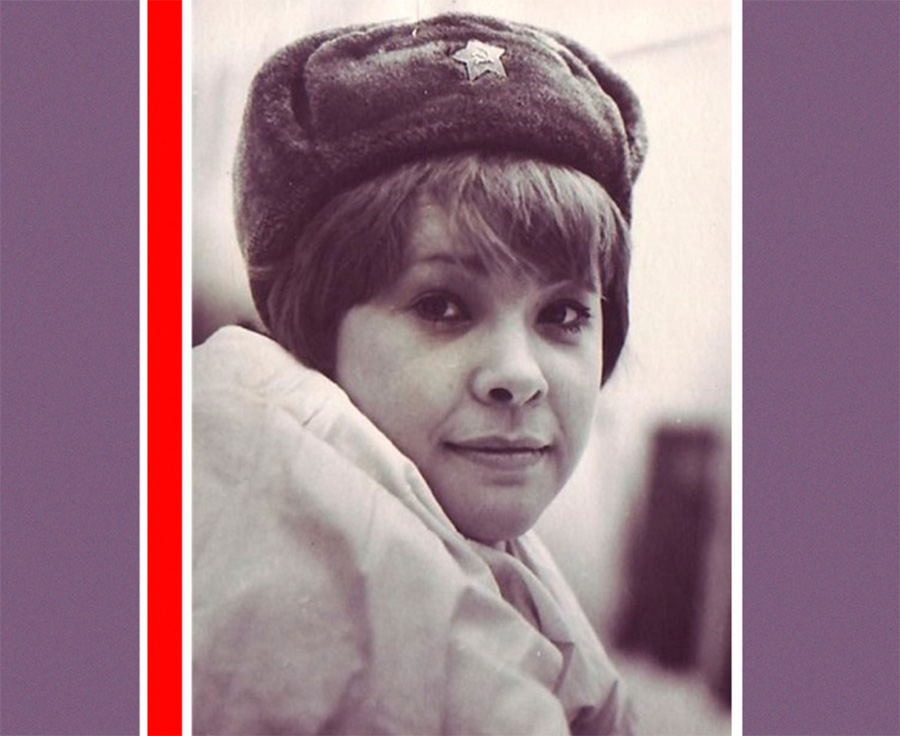
Russian actress Tatyana Dogileva

(original unknown)

(original unknown)

------------

Remember James Cameron's "Aliens"? -


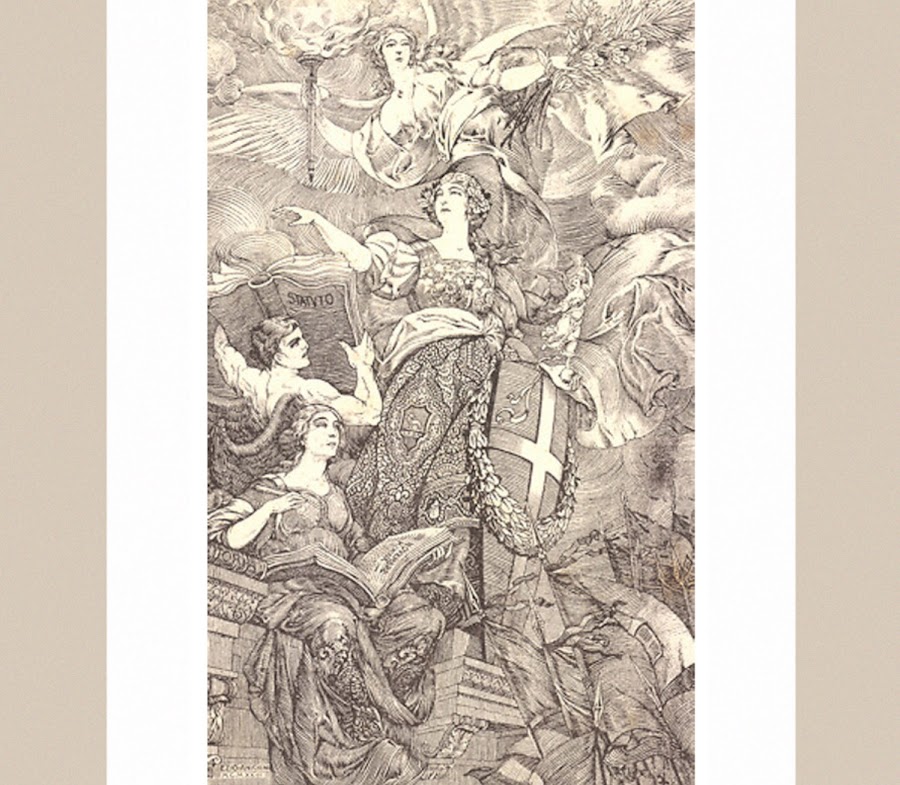
An Italian postcard from 1923:


See a lot more late 1800s/early 1900s postcards here.


Art from the Five Star Stories manga - click to enlarge for awesome details:


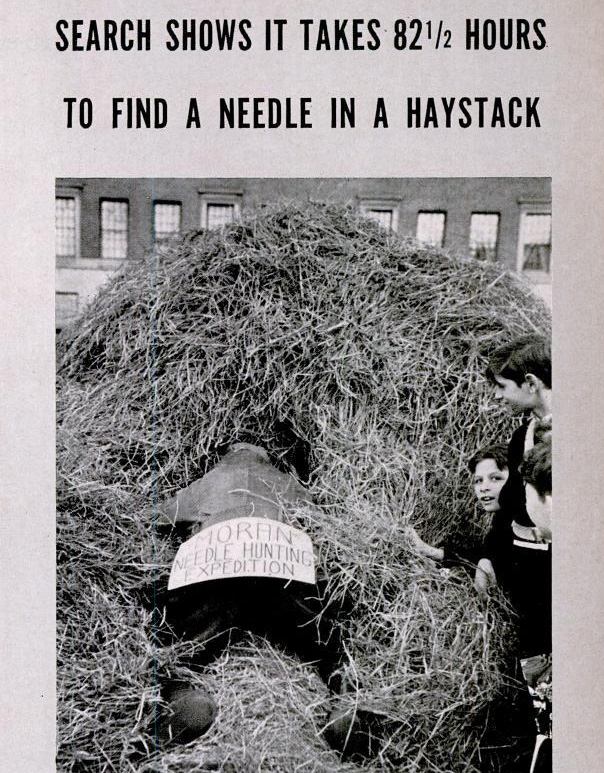
News from the LIFE Magazine, 1939:


Arrgh! I forgot to erase browser history! -


"Wandows is now working ngrmadly":


Until next time! Keep the sunshine, folks.


READ THE PREVIOUS ISSUE HERE ->


READ ALL "FEEL-GOOD" ISSUES! ->


19 Jan 20:06

San Luis Obispo, California by Mariel Cartin

San Luis Obispo, California
by Mariel Cartin from Costa Rica
http://www.marielcartin.com

This map was created as part of a California Road Trip book. To see the whole book, visit my website: www.marielcartin.com

19 Jan 20:05

Santa Barbara, California by Mariel Cartin

Santa Barbara, California
by Mariel Cartin from Costa Rica
http://www.marielcartin.com

This map was created as part of a California Road Trip book. To see the whole book, visit my website: www.marielcartin.com

19 Jan 20:05

Monterey & Carmel, California by Mariel Cartin

Monterey & Carmel, California
by Mariel Cartin from Costa Rica
http://www.marielcartin.com

This map was created as part of a California Road Trip book. To see the whole book visit my website: www.marielcartin.com

19 Jan 20:05

Big Sur, California by Mariel Cartin

Big Sur, California
Big Sur, California
by Mariel Cartin from Costa Rica
http://www.marielcartin.com

This map was created as part of a California Road Trip book. To see the whole book, visit my website: www.marielcartin.com

19 Jan 20:05

Oakland Cemetery in Atlanta, Georgia by June Brigman

Oakland Cemetery in Atlanta, Georgia
by June Brigman from United States

19 Jan 20:04

Cumberland Island, Georgia by Heather Lindsi Leech

Cumberland Island, Georgia
by Heather Lindsi Leech from Atlanta, Georgia

This is a map that highlights a few of the amazing attributes this historic island has to offer.

19 Jan 20:04

Howard Finster's Paradise Garden in Summerville, Georgia by Adela Pons

Howard Finster
Howard Finster's Paradise Garden in Summerville, Georgia
by Adela Pons from Maracaibo, Venezuela
http://www.adelapons.com

This map was created for Mike Lowery's class "Illustration Markets", at SCAD Atlanta.

19 Jan 20:01

A pinpointing of 3,600 breweries: Possibly the most beautiful...


A pinpointing of 3,600 breweries: Possibly the most beautiful map of the United States ever?

19 Jan 20:00

Waffle House Museum, Decatur, GA

Feature: Waffle House #1, restored as it was. ...
19 Jan 19:59

The Best Parts of Sean Penn’s Insane, Out of Touch 60 Minutes Interview

by Ashley Feinberg on Gawker, shared by Samer Kalaf to Deadspin

Last night, freshman journalism major Sean Penn attempted to explain his bizarre, widely criticized interview with El Chapo to Charlie Rose on 60 Minutes. So why does Sean Penn say Sean Penn is so misunderstood? Because unfortunately, we can’t all be Sean Penn.

Read more...


19 Jan 19:59

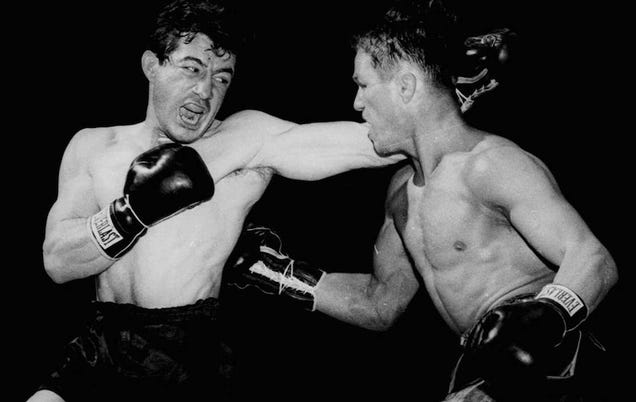
How Rocky Graziano Became Boxing's Greatest Muse

by Nathan Ward on The Stacks, shared by Tom Ley to Deadspin

In the late 1940s, a young Nebraskan actor named Marlon Brando had been starring for several months in A Streetcar Named Desire on Broadway when he was contracted to play a fighter in a TV pilot, Come Out Fighting! For the role, Brando decided to secretly study the famous New York tough guy with the hoodlum backstory, middleweight Rocky Graziano, and began training and hanging around Stillman’s on Eighth Avenue, where Graziano’s workouts regularly packed the house.

Read more...


19 Jan 19:56

How Wile E. Coyote Explains The World

by Albert Burneko on The Concourse, shared by Albert Burneko to Deadspin

A joke has structure. It has a central rule. Setup, punchline. The setup produces a tensed, expectant state; the punchline resolves the tension with a surprise. If the elements of the joke are not arranged into a setup and a punchline, it is not a joke. It is just a statement.

Read more...


19 Jan 19:55

Is There Any Reason to Keep Up with the News?

by Brett and Kate McKay

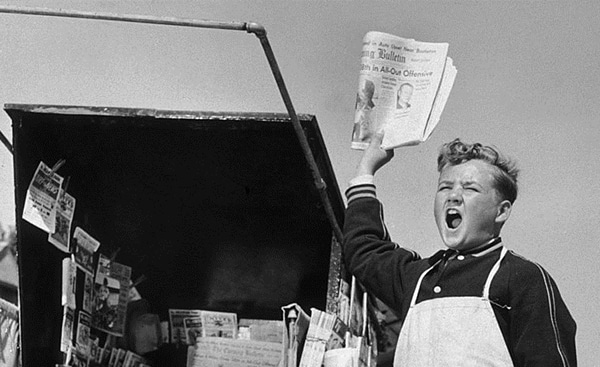
vintage paper boy selling newspapers from a stand

When I’m getting ready in the morning, particularly on the weekend, I like to tune into some of my favorite shows on NPR like Radiolab, the TED Radio Hour, and To the Best of Our Knowledge. Before such programs begin, however, the host will say, “But first, the news.”

I always instinctively find myself quieting down whatever it is I’m doing (like brushing my teeth) to hear what comes next.

The news!

The news is coming!

What’s happening in the news?!

What follows is a quick rundown of the day’s “big” stories: a mudslide has killed 25 in one country; there’s been an explosion in the downtown of another’s capital; the stock market is up/down; a sports team has won some title; a beloved celebrity has passed away.

There is very rarely anything particularly interesting or personally relevant going on. Yet the next time I hear “First, the news,” my must-tune-in reflex goes off once more.

The gap between my pull towards the news, and what I can honestly say I’ve ever really gotten from it, has formed a question in my mind that has niggled at me for years now: “Is there really any reason to keep up with the news?” 

The News: Modernity’s Unexamined Faith

News consumption — whether by radio, internet, or television — is a daily habit for billions of people around the globe.

It’s not a new habit. In primitive times, tribesmen pumped returning scouts for their observations on the happenings in nature and the neighboring village (the fact that what they had to say may have aided in survival is likely why we developed such a pull towards the news in the first place). Citizens a century ago didn’t have Facebook, Huffpo, or reddit, but did eagerly snatch up stacks of newspapers — which came out in multiple editions each day.

No, news consumption is not a new practice, simply one that’s become ever more accelerated and central to our lives.

In The News: A User’s Guide, philosopher Alain de Botton draws on the ideas of Hegel to posit that in fact, the news in modern cultures has in some ways replaced “religion as our central source of guidance and our touchstone of authority.”

Morning and evening prayers have been substituted with checking one’s news feed immediately upon rising and retiring to bed. While the faithful once sought inspiration in scripture, it’s now in the news “we hope to receive revelations, learn who is good and bad, fathom suffering and understand the unfolding logic of existence. And here, too, if we refuse to take part in the rituals, there could be imputations of heresy.”

If the news represents a new kind of faith, it is surely one of our least examined. The media rarely does stories on itself — reports that might examine their actual worth and credibility.

And in the larger culture, consuming the news (at least the “hard,” unbiased variety — though no one can quite agree on what qualifies as such), is surely our most dignified distraction. To not keep up with current events and geopolitics (“Can you believe how many Americans don’t know the name of Canada’s prime minister?!”) is to be seen as an ignorant rube. Knowledge of the news, the thinking goes, is fundamental to being an educated, engaged citizen.

Does the news really make us such though? Are our motivations for keeping up with it truly so lofty? Today we will examine these questions, as well as how large a role news consumption should play in a man’s life. At the risk of seeming heretical, I will argue that while the news is certainly not altogether worthless, we could get by with far less of it than we typically do.

Why We Say We Consume the News

I would argue that when it comes to keeping up with the news, there is a large gap between why we say we do it, and why we really do. Because when you examine the commonly stated reasons, they ultimately don’t hold much water:

The news illuminates truth/reality. The mission of journalists (at least the serious kind) is to report on what’s going on in the world; they feel it their duty to tell us “the truth.” Without the news, the thinking goes, we would remain ignorant about what’s “really” happening out there.

But the truth delivered by the media represents only one sliver of human reality — invariably the fraction that is new, novel, and most of all, negative. Studies show that the news consists of negative to positive stories by a ratio of 17:1. We get reports on the few dozen murderers and pedophiles who were up to no good on a given day, but no word on the millions of folks who went to work, ate dinner, and turned in, all without whacking their spouse or preying on small children. As de Botton observes:

“There is a plethora of headlines that would be both true and yet impossible to run:

Grandmother, 87, helped three flights up the stairs at railway station by 15-year-old bystander she didn’t know.

Teacher surmounts his feelings for a young student.

Man abandons rash plan to kill his wife after brief pause.

65 million people go to bed every night without murdering or hitting anyone.”

In the world of the news, danger lurks around every corner, every prominent figure is a hypocrite with a scandal waiting to be uncovered, and everyone has an 87.5% chance of getting cancer before age 70.

The lens the news media trains on the world is so narrow, that it invariably illuminates one small slice of it while distorting the rest of the picture. The media thus not only reports on reality, but helps shape it. For what we read in the news colors our perception of life — our beliefs about the state of our country and fellow human beings. The result is a perspective that is grimly pessimistic and cynical. Though a lot of things in our family and little community seem to be going just fine, the world as a whole appears to be going to pot.

Which truth is more true?

The news breaks down barriers of racism and prejudice. Keeping abreast of what’s going on in the world — the natural disasters, diseases, and wars of countries near and far — supposedly helps us to feel a part of a global community and builds our empathy.

Yet study after psychological study has found quite the opposite result. When faced with the suffering of an individual, we are moved with compassion for them. But presented with the suffering of dozens, hundreds, thousands, we tend to turn away. As Joseph Stalin bluntly put it, “The death of one person is a tragedy; the death of one million is a statistic.” In the face of mass suffering, our empathy antennae withdraw in fear of being overwhelmed by emotion.

Thus the news, rather than spurring us to humanize “the other,” may actually lead us to dehumanize them. Rather than making us more sensitive to the suffering of human beings, endless reports on a hundred killed in this explosion and a hundred killed by that disease, may make us desensitized to their plight.

The news keeps us informed so we can take action on important issues. When you were in grade or high school, you may have had a teacher who assigned you the task of reading the newspaper each day. Keeping up with the news, you were told, was a part of being an actively engaged citizen.

There’s undoubtedly truth to this idea. But it is often simplistically stated, and done so without some important caveats.

First, to truly be informed — to be able to make sense of the news in order know what action to take on it — requires more than the news itself. The news rarely gives context to what it reports, offering instead a ceaseless torrent of facts and data points. Background knowledge on history, psychology, philosophy, and so on, gleaned from books and other more stable, in-depth information sources, is required to make connections between these facts, stake out well-founded positions, and make sound decisions.

Second, not all news is actionable and relevant to you in the first place. In fact, the vast majority of it concerns issues you could not do anything about even if you wanted to. And even if a story is actionable and relevant, how often does it actually motivate you to do something? How many of the thousands upon thousands of news stories you’ve consumed in the last five years directly led to you making a different decision or taking a certain action? 1%? .01%?

One can in fact argue that consuming news about everything, everywhere is actually making us less apt to take any action, anywhere. Buried in an avalanche of stories on how absolutely broken and terrible everything is, we feel overwhelmed, paralyzed, apathetic. We are by turns irrationally fearful and impotently angry. What could we possibly do to change things, and what difference would it make?

As de Botton explains, consuming the news may ultimately lead us to become less engaged with the world, not more:

“A contemporary dictator wishing to establish power would not need to do anything so obviously sinister as banning the news: he or she would only have to see to it that news organizations broadcast a flow of random-sounding bulletins, in great numbers but with little explanation of context, within an agenda that kept changing, without giving any sense of the ongoing relevance of an issue that had seemed pressing only a short while before, the whole interspersed with constant updates about the colorful antics of murderers and film stars. This would be quite enough to undermine most people’s capacity to grasp political reality — as well as any resolve they might otherwise have summoned to alter it. The status quo could confidently remain forever undisturbed by a flood of, rather than a ban on, news.”

Why We Often Really Consume the News

While we can come up with a lot of noble-sounding rationales for keeping up with the news, most of the time, for most people, our reasons for consumption are decidedly less flattering:

For entertainment. At the heart of why we consume the news, is the reason we consume all media: it’s entertaining. There’s action, drama, turning points, and suspense. Each genre of fiction has its real life parallels in the news:

Mystery, Horror, & Suspense: Why would someone intentionally fly a plane into a mountain? What must it have been like for those doomed passengers right before the crash? Who’s responsible for that shooting? Is he innocent or guilty?

Romance: What celebrity is dating what celebrity? Who broke up? Who’s having an affair?

Comedy: Did you see the gaffe that politician/newscaster made? Cringe-worthily hilarious!

Morality Tale: Will that corrupt CEO/spoiled rich kid finally get his comeuppance? Tune in and see!

Sports (Actual and Otherwise): Who won the championship? Who’s out of the playoffs? Who won the debate? Who’s on top of the polls?

Full as it is of “athletic” contests, whodunit, and schadenfreude, the news can surely be a lot of fun to follow.

For monitoring the status of others. As we laid out in last year’s series on the subject, we’re all supremely status-sensitive creatures. We scroll through our Facebook feed to survey the field of our peers’ personal “news” and see how they’re doing in comparison to us. At the same time, the new media landscape has made us feel connected to powerful figures and celebrities of all kinds, so that they too seem to be members of our same status pool.

We thus flit between social media news feeds and the mainstream news to see who’s up and who’s down in the world. Seeing someone prominent fall from grace or get criticized (oddly enough, even someone whose work we like!) is particularly gratifying. Witnessing someone brought down a notch indirectly makes us feel a little higher in status ourselves.

As a badge of our own status. Knowledge of the news is in many ways like the possession of a college degree — it doesn’t necessarily mean someone is more intelligent and well-off than someone else, but we use it as an evaluative shortcut — a sorting mechanism. The non-news-follower is taken to be a more ignorant member of the lower class, while the man who can speak eruditely of current affairs is seen as an educated member of the bourgeoisie.

One generally doesn’t wish to be sorted into the former category, and so engaging in an obligatory scan of the day’s headlines becomes a requirement for winningly engaging in conversation, and maintaining one’s status.

In the hopes of hearing about an exciting, world-changing event. Most of our lives go along in a boring, predictable, 9-5 way. Though part of us doesn’t want a war or a disaster to occur, another part secretly hopes that something really big will happen. Much suffering results from large-scale tragedies and conflicts, but they also bring novelty, excitement, unification, and the feeling of greater meaning and purpose. We thus tune into the news simultaneously dreading, and hoping for, something crazy to have occurred.

To escape ourselves. Immersing ourselves in the drama being played out on the global stage can help us forget about the problems in our own little world. Scrolling through all the links on a news site acts like a kind of anesthetic for the brain — the emotional turmoil you’ve been wrestling with shuts off and is temporarily forgotten. For the same reason, watching television news, though it purports to be informative and thus mentally stimulating — has always been the perfect background noise for when you really want to zone out and forget your troubles.

As de Botton puts it: “To consult the news is to raise a seashell to our ears and to be overpowered by the roar of humanity.”

In the fear of missing out. The world moves more quickly today than ever before — governments are toppled in a week, politicians fall from grace overnight, and new technological and scientific advances are made all the time.

Not only do we want to avoid being out of the loop — being the guy in a conversation who’s unaware of what’s going on — we also fear we might miss some kind of discovery that could forever change our lives. Deep down, all of us feel that if we could just find the right diet, sleeping schedule, or planning app, we’d finally be able to achieve professional success, reach our goals, and, maybe, even escape mortality.

If we approach the news like a modern religion, then it’s a faith built on unceasingly upwards progress. We turn to the news in hopes of fresh revelations on living happier and longer. And the oracle obliges, Botton opines, by treating “the latest findings about red wine, gene therapy and the benefits of eating walnuts with a superstitious reverence not dissimilar to that which might once have inspired a devout Catholic pilgrim to touch the shin bone of Mary Magdalene — in the hope of thereby securing ongoing divine protection.”

In a time where news stories are generated by the thousands and turn over within 24 hours, we are ever beset with this worry: “What if I fail to check the news and thus miss the secrets to life?”

Extra! Extra! Read All About It! Or Not: The News, in Moderation

Even if we really don’t keep up with the news for the reasons we say we do, is there anything wrong with consuming some occasionally important, largely merely entertaining information?

In moderation? Surely not.

It’s tempting to completely disconnect from all news, altogether; such a baby + bathwater approach is satisfying internally and satisfying to tell one’s friends. It offers a gratification akin to pronouncing you’ve given up your television.

So too some of the great thinkers in history advocated for the cold turkey approach. Henry David Thoreau implored the public to “Read not the Times. Read the eternities.” And Thomas Jefferson proclaimed, “I do not take a single newspaper, nor read one a month, and I feel myself infinitely the happier for it.”

Yet these men, while they had no love for the press, weren’t exactly cut off from the news entirely. Each heard what was going on from exchanging letters with friends and vigorous conversations with their contemporaries. Thoreau knew enough about current events to be able to decide to protest against slavery and the Mexican-American War by not paying his poll taxes. And Jefferson kept sufficient tabs on what was going on in the nation and world to govern a country!

It’s the same today: when you dig into the details of a self-proclaimed news abstainer’s habits, it turns out their claims to abstention rest on their own personal definition of what exactly constitutes news — they consume a little of this, but completely avoid that.

The real question then is not whether or not to consume the news, but how much, and from where. The aim is conscious intention rather than complete abstention.

The news is merely one information source among many. Once you become honest about your reasons for consuming it, you free yourself from dutifully feeling it has value in and of itself, bestowing upon it a most-favored status, and consuming it simply because you believe you “should.”

All information sources are edifying, educational, and entertaining to varying degrees, and all information consumption comes with opportunity costs; that is, by choosing to consume one type, you have less time to consume another.

In coming to see the news as 90% entertainment, with an occasional dash of the educational, you can focus more on the fraction that is important, relevant, and actionable, while substituting much of the fluff for information that’s actually edifying.

There is no one-size-fits-all prescription for how much space to give over to the news in your overall “information diet.” But here’s the weight I give it in my own life as an example:

I scan the headlines of a “hard” news site and my city newspaper a few times a day, and listen to NPR some mornings while getting ready or driving around (which gives me both national and local news). This enables me to 1) be able to engage with people in conversation should they bring up current events (I do think there’s value to this), and 2) to see if there are any stories that are actionable and relevant to the issues I care about and my interests and profession. The great bulk of what I read/listen to doesn’t fit the bill, but very occasionally a story will indeed move me to action. For example, I called my senator when Congress was debating a bill on net neutrality and wrote to my city councilor when there arose talk of allowing an outlet mall to be built next to a local wilderness area.

I don’t spend much time following national politics and election battles, not because I don’t believe in exercising the rights and privileges of citizenship, but because where I live doesn’t allow me much chance to do so. Oklahoma is the reddest red state in the union, and thus it doesn’t matter which way I vote, or if I vote (though I do) — we’re still going to elect Republican congressmen and presidential candidates. If I lived in a swing state, I’d pay closer attention, because such news would then be actionable and relevant to me.

I spend even less time on international news. I know it’s supposedly part of being a cosmopolitan global citizen, but an infinitesimally small amount of it represents things I can do anything about. It would be information for information’s (and status’) sake, and, as thoroughly elucidated above, I don’t think there’s much value in that. Not to mention, I also don’t believe that “global citizenship” is either possible, or desirable.

I realize that runs counter to our prevailing faith in the news — the belief that it’s somehow good for us, even if we can’t prove or explain exactly how. But I’m content to let others partake in their daily rites and the belief that one day such secret knowledge will save them.

Whether it’s local, national, or international news I’m looking at, if I see a story that interests me, I’ll read it through. If I think it may be actionable or relevant, I’ll do further research and read opinions and analyses on it from both sides of the aisle. And I allow myself a few fluff pieces a day, in full conscious acknowledgement that they’re merely entertainment.

All in all, counting both reading and listening time, I probably spend 30 minutes a day keeping tabs on the news. I spend little-to-no time on clickbait, aggregator-type sites, and watch no talk shows or television news.

With the time I save in not following the news more, ahem, religiously, I take a (literal) page from the habits of Thoreau and Jefferson, and read books on a wide variety of topics. I personally find works on philosophy, history, sociology, science, and so on ultimately much more edifying and educational — more pertinent both to my personal and professional goals — than the news. While the truth of the news expires each 24 hours, such books often stay relevant for several years, and even centuries, and spark my mind in ways the news never does. As the businessman and author Rolf Dobelli observed:

“I don’t know a single truly creative mind who is a news junkie — not a writer, not a composer, mathematician, physician, scientist, musician, designer, architect or painter. On the other hand, I know a bunch of viciously uncreative minds who consume news like drugs. If you want to come up with old solutions, read news. If you are looking for new solutions, don’t.”

At the same time, books not only offer an education in their given subject, they also provide the context — the diverse mental models — that allow me to make greater sense of…what’s happening in the news.

19 Jan 19:55

‘The Revenant’ Director Iñárritu on the Real Story Behind ‘The Revenant’

by Christopher John Farley
The director stopped by the WSJ Cafe to talk about “The Revenant,” working with Leonardo DiCaprio, and the real story that inspired the making of his new film.
19 Jan 19:54

Listen to Lucinda Williams’s New Song ‘If My Love Could Kill’ (Exclusive)

by Mike Ayers
"I found because of the pain, it finally came out," the singer-songwriter says.
19 Jan 19:53

How to Build a Storage Bench

In the workshop, This Old House general contractor Tom Silva and host Kevin O'Connor build a storage bench for an entryway
19 Jan 19:53

7 Modern-Day Overlanders You Can Buy Today

Overlanding-Vehicles-Gear-Patrol-Lead-Featured

When the pavement stops and the road less traveled opens up, that's when you need a vessel worthy of the call of the wild.

...

Read More »
19 Jan 19:51

Backyard Biofuel: Home Converter Reuses Organic Waste

by admin
[ Filed under Science & in the Energy & Power category ]

backyard biofuel converter

Fueled by crowdfunding and pre-orders, this self-contained domestic waste-repurposing unit can produce enough gas for a 2 to 4 hours of cooking as well as 5 to 8 liters of liquid fertilizer daily, all using organic scraps.

backyard fuel converter

A complete system for sustainable recycling, HomeBiogas is the product of an Israeli startup and aimed at homeowners who want to something faster and more versatile in its outputs than traditional composting provides, using anything from animal waste to kitchen leftovers. The resulting organic fuel may not power your flying, time-traveling Delorean but it can sure help around the house.

reycling organic waste house

While it will work as well in the suburbs as anywhere, the system may have particular appeal for those living off-the-grid in remote places, where bringing in fertilizers and fuels may be costly or difficult and sustainable strategies can save both time and money.

backyard biogas home device

The the unit can convert just one kilogram of food waste into about 200 liters (7 cubic feet) of gas, more than enough to fuel an hour’s worth of cooking. At 88 pounds and a few feet long, it isn’t tiny but is still relatively portable (and well-suited to people with rural plots). The retail cost: $1,500 (or $900 presale), but like solar or wind power installations, the presumption is that the system will pay back for itself over time.


Share on Facebook

[ Filed under Science & in the Energy & Power category ]

[ Gajitz | Archives | Categories | Privacy | TOS ]

19 Jan 19:43

The Negro Travelers’ Green Book, the Pre-Civil Rights Guide to Traveling Safely in the U.S. (1936-66)

by Ayun Halliday

Green Book Cover

Popular entertainment has romanticized the idea of the road trip as a wholly spontaneous adventure, but for mid-century African American motorists, planning was essential. The lodgings, restaurants, and tourist attractions where they could be assured of a warm welcome were often few and far between in the era of segregation.

The Negro Travelers’ Green Book, first printed in 1936, was an invaluable resource for travelers of color, particularly when their route took them outside of urban areas. In the pre-Internet age, publisher Victor Green, a Harlem-dwelling mailman, relied on readers to supply feedback and new locations for subsequent editions:

There are thousands of first class business places that we don’t know about and can’t list, which would be glad to serve the traveler, but it is hard to secure listings of these places since we can’t secure enough agents to send us the information. Each year before we go to press the new information is included in the new edition. When you are traveling please mention the Green Book, in order that they might know how you found their place of business, as they can see that you are strangers. If they haven’t heard about this guide, ask them to get in touch with us so that we might list their place. If this guide has proved useful to you on your trips, let us know. If not, tell us also as we appreciate your criticisms and ideas in the improvement of this guide from which you benefit. There will be a day sometime in the near future when this guide will not have to be published. That is when we as a race will have equal opportunities and privileges in the United States. It will be a great day for us to suspend this publication for then we can go wherever we please, and without embarrassment. But until that time comes we shall continue to publish this information for your convenience each year.

– from the introduction to the 1949 edition

The New York Public Library’s Schomburg Center for Research in Black Culture has digitized 21 volumes of its Green Book collection for your browsing pleasure. It’s a trip back in time.

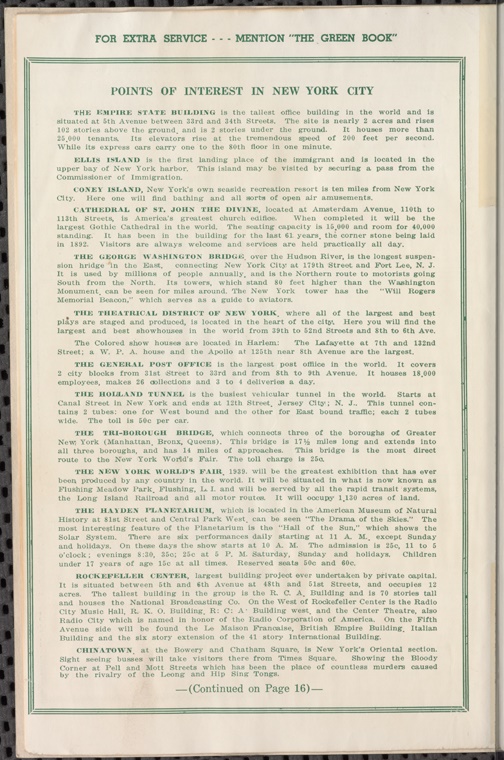
Green Book Points of Interest NYC

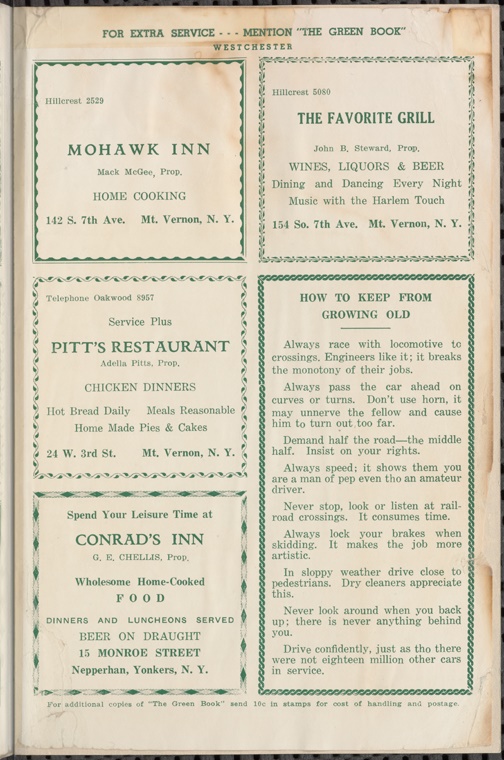
1936’s premier edition is geared toward visitors spending time in and around New York City. In appearance, it resembles a church bulletin or community theater program, with business card ads for beauty salons specializing in marcel waving and restaurants serving Southern home cooking. Publisher Green extols the wonders of Coney Island, Chinatown, and the Theatrical District, even as he notes that “the colored show houses are in Harlem.” He also seeks to give readers a laugh with “How to Keep From Growing Old,” a driver-specific list that could be read aloud from the passenger seat for the merriment of everyone in the car. (“In sloppy weather, drive close to pedestrians. Dry cleaners appreciate this.”)

Green Book Westchester

The Green Book soon swelled to include national listings, as tourists and business travelers heeded Green’s call to beef up the info.

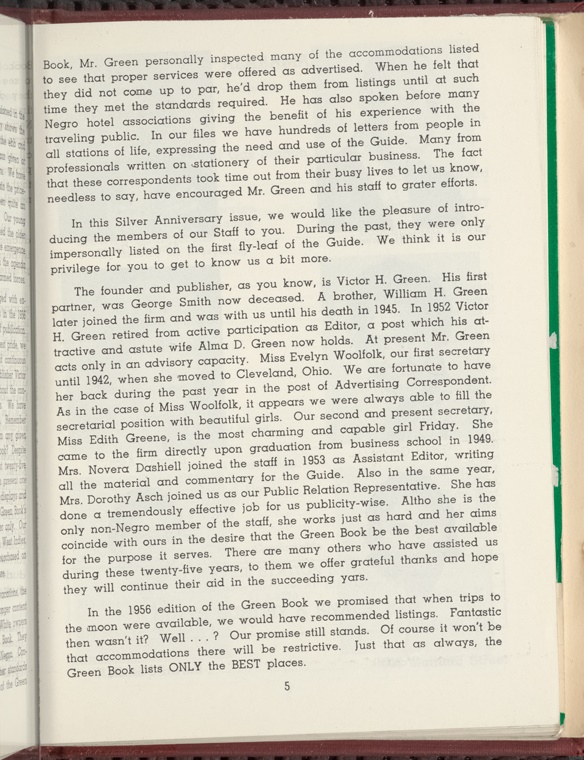
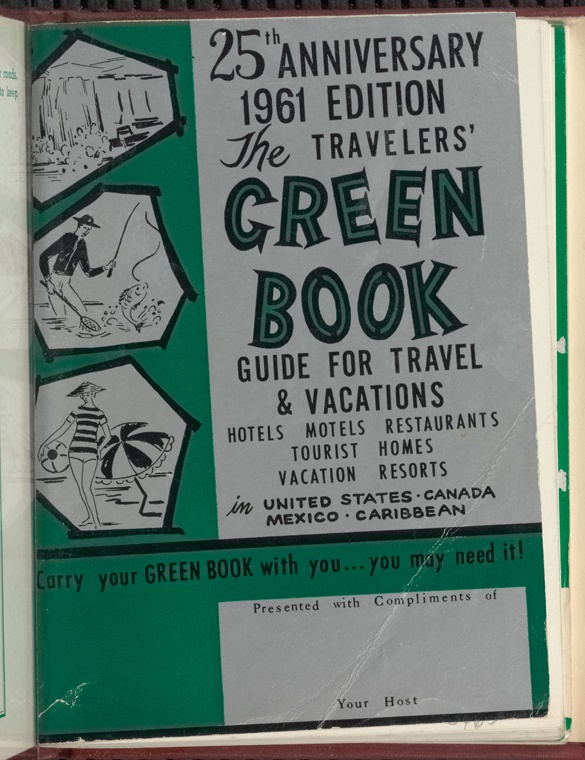
1961’s 25th anniversary edition includes a history of the enterprise, a fair amount of typos, newsy updates on the staff, and a renewed promise to list the best places on the moon, should lunar travel become an option.

Green Book Pg 5

Green Book 25th Anniversary

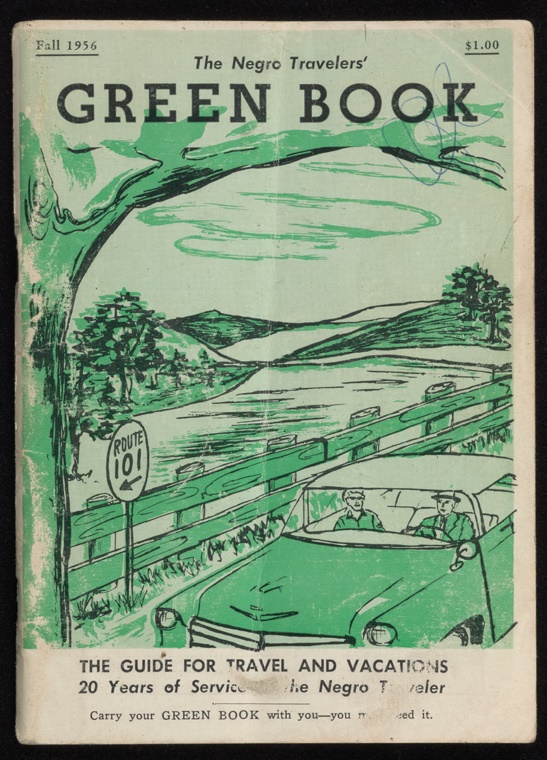
Armchair travelers can take the NYPL’s digitized collection out for a spin by entering coordinates into a mapping feature for 1947 or 1956.

Starting in my Indiana hometown with sights set on Manhattan took me to the Cottage Restaurant in Columbus, Ohio, the Jones Restaurant in Grafton, West Virginia, and the beautifully named Trott Inn in Philadelphia, before I finally lay my virtual head at the America Hotel. (These days, it would be the Millennium Broadway.)

Green Book 1956

Enjoy your trip. In the words of Victor Green, “let’s all get together and make motoring better.”

Related Content:

Read Martin Luther King and The Montgomery Story: The Influential 1957 Civil Rights Comic Book

Robert Penn Warren Archive Brings Early Civil Rights to Life

Vintage 1930s Japanese Posters Artistically Market the Wonders of Travel

Ayun Halliday is an author, illustrator, and Chief Primatologist of the East Village Inky zine. She documented her misadventures on the road in No Touch Monkey! And Other Travel Lessons Learned Too Late Follow her @AyunHalliday