Shared posts

01 Dec 15:06

In 1918, California Drafted Children Into a War On Squirrels

by Dave Gilson
article-image

In April 1918, as American doughboys faced down the Germans in France, California’s schoolchildren were enlisted to open a new Western Front. “We have enemies here at home more destructive, perhaps, than some of the enemies our boys are fighting in the trenches,” state horticulture commissioner George H. Hecke warned in an impassioned call-up for “School Soldiers.” He exhorted children to do their part for Uncle Sam by organizing “a company of soldiers in your class or in your school” and marching out to destroy their foe: “the squirrel army.”    

This children’s crusade was part of Squirrel Week, a seven-day frenzy in which California tried to kill off its ground squirrels. The state’s farmers and ranchers had long struggled to decimate the critters (also known as Otospermophilus beecheyi), which were seen as pests and a source of pestilence, particularly the bubonic plague. The burrowing foragers—not to be confused with tree squirrels—devoured an estimated $30 million worth of crops annually, about $480 million in current dollars.

article-image

Squirrel Week was the state’s first attempt at mass eradication. The anti-rodent campaign was announced in March 1918 at a meeting of the state’s horticultural commissioners as they lunched on grain-fed gophers. (“Liberal portions of beef were served to those who did not like gopher meat,” reported the San Francisco Chronicle.)

California set aside $40,000 from its emergency wartime funds for the campaign, which included an anti-squirrel publicity blitz: the state printed up 34,000 posters and distributed 500,000 leaflets. 

article-image

What made Squirrel Week unique was its reliance on kids to succeed where adults had failed. Hecke’s call to arms appeared in a pamphlet titled “Kill the Squirrels,” which sought to stir patriotic youngsters to sprinkle rodenticide outside squirrel burrows. In the pamphlet’s opening illustration, a young woman holding a pail of poison barley invites eager kids to get to work.

“Children, we must kill the squirrels to save food,” she smiles. “But use poisons carefully.” The pamphlet included a recipe for strychnine-laced grain as well as suggestions for other extermination methods, such as shooting, drowning, and poison gas.

Just in case civic duty wasn’t motivation enough, there were also rewards: $50 ($800 today) to each of the elementary and high schools whose pupils killed the most squirrels, and $30 and $20 to the runners-up.  

article-image

California’s war on squirrels was framed as an extension of United States’ declaration of war on Germany a year earlier. Part of this was practical: Future president Herbert Hoover, then the United States Food Administrator, offered his “hearty approval” of the effort to save “vast quantities of food which might otherwise be used for support of our armies abroad.”

But it also made for great propaganda. In the corners of the “Kill the Squirrels” cartoon, two members of the squirrel army stood at attention, wearing Pickelhauben—the distinctive spiked helmets of the German army. Another Squirrel Week poster showed a Teutonic squirrel family wearing spiked helmets and Iron Crosses. The father squirrel sported an oddly upturned mustache—just like Kaiser Wilhelm’s.

An article about Squirrel Week in the Lompoc Journal took the martial theme and ran with it, hailing the “growing army” amassing “casualties” in “initial engagements” against the enemy. “All the killing devices of modern warfare will be used in the effort to annihilate the squirrel army, including gas,” it continued. “Don’t wait to be drafted.”

article-image

The campaign also enlisted the help of Four-Minute Men—volunteers who delivered short speeches to rally public support for the war effort. Anti-squirrel talking points were issued so they might convince farmers and ranchers to go out and kill the “little ally of the [K]aiser”:

  • The BEST squirrel is the dead squirrel.
  • The Hotel California board bill for ground squirrels in 1917 […] was $30,000,000—yet unpaid.
  • The squirrel does not recognize daylight saving. He uses it all.
  • He preys on our crops in countless hordes. He fills the ranks of the killed in true military fashion.
  • Why hesitate? We can get ‘em. How? Poison ‘em, gas ‘em, drown em’, shoot ‘em, trap ‘em, submarine ‘em.
  • Are you not willing then to give your whole-hearted support to this state-wide movement to KILL THE SQUIRREL?
article-image

Children were asked to verify their kills by bringing in squirrel tails to their schools. Some impatient exterminators delivered their trophies directly to Commissioner Hecke even before Squirrel Week kicked off, causing a “pronounced odor” in his office. He requested that children not send him any more tails, and instructed his county commissioners to bury all tails after tallying them.

By the time Squirrel Week ended on May 4, children across the state had turned in 104,509 tails, though this was thought to represent a fraction of the total casualties. Even after the contest ended, the Commission of Horticulture reported that kids’ enthusiasm for killing squirrels continued for “an indefinite period.” During an anti-squirrel campaign in Lassen County later in the year, one girl brought in 3,780 tails; a boy brought in 3,770.

article-image

The state considered Squirrel Week a great success: Crop yields reportedly bounced back in areas cleared of ground squirrels. But total victory remained elusive. Nearly a century later, ground squirrels and are still considered prolific, expensive pests.

The militaristic edge of the squirrel war of 1918 hasn’t entirely faded: A contemporary University of California web page about the damage caused by ground squirrels features an image of a squirrel wearing a helmet and taking aim with a bazooka. All is not quiet on this Western Front.


30 Nov 15:33

Hermit Feud Murder Weapon, Gold Beach, OR

Feature: In 1933, a hermit ambushed and killed a neighbor with a booby trap gun. ...
30 Nov 15:32

Movers & Shakers: Jonathan Ward

by Jackson Scarlett
Featured journal ward wide

Editors Note: For our third catalog, we thought it would be fun to mix it up and ditch the motorcycles and float planes to profile some of the customers, partners, and friends we’ve met on our six-year journey. Guys who’ve inspired us, and we hope will inspire you too. We're bringing you an excerpt from the catalog because, as Ernest Hemingway once said, “as you get older it is harder to have heroes, but it is sort of necessary.”

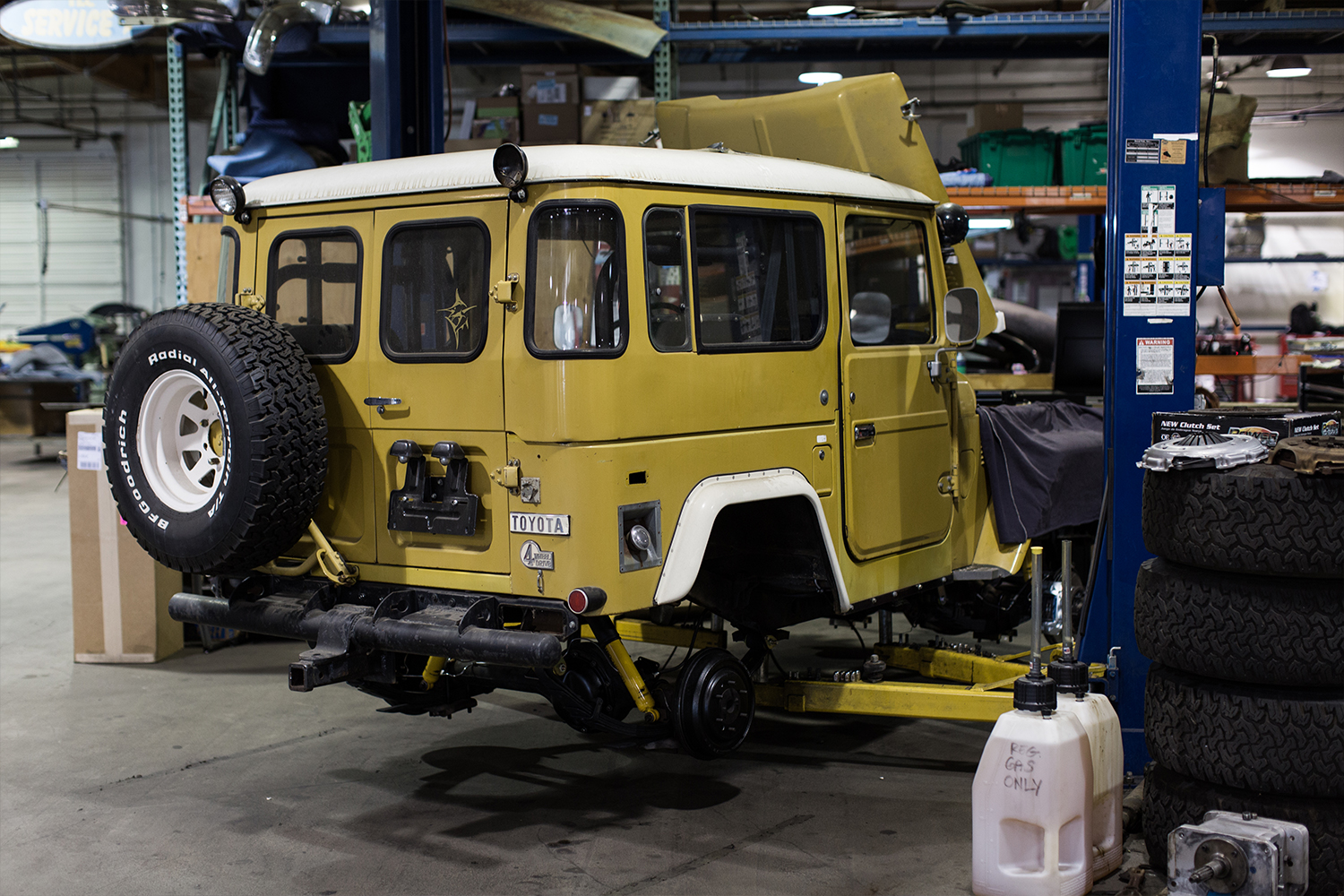
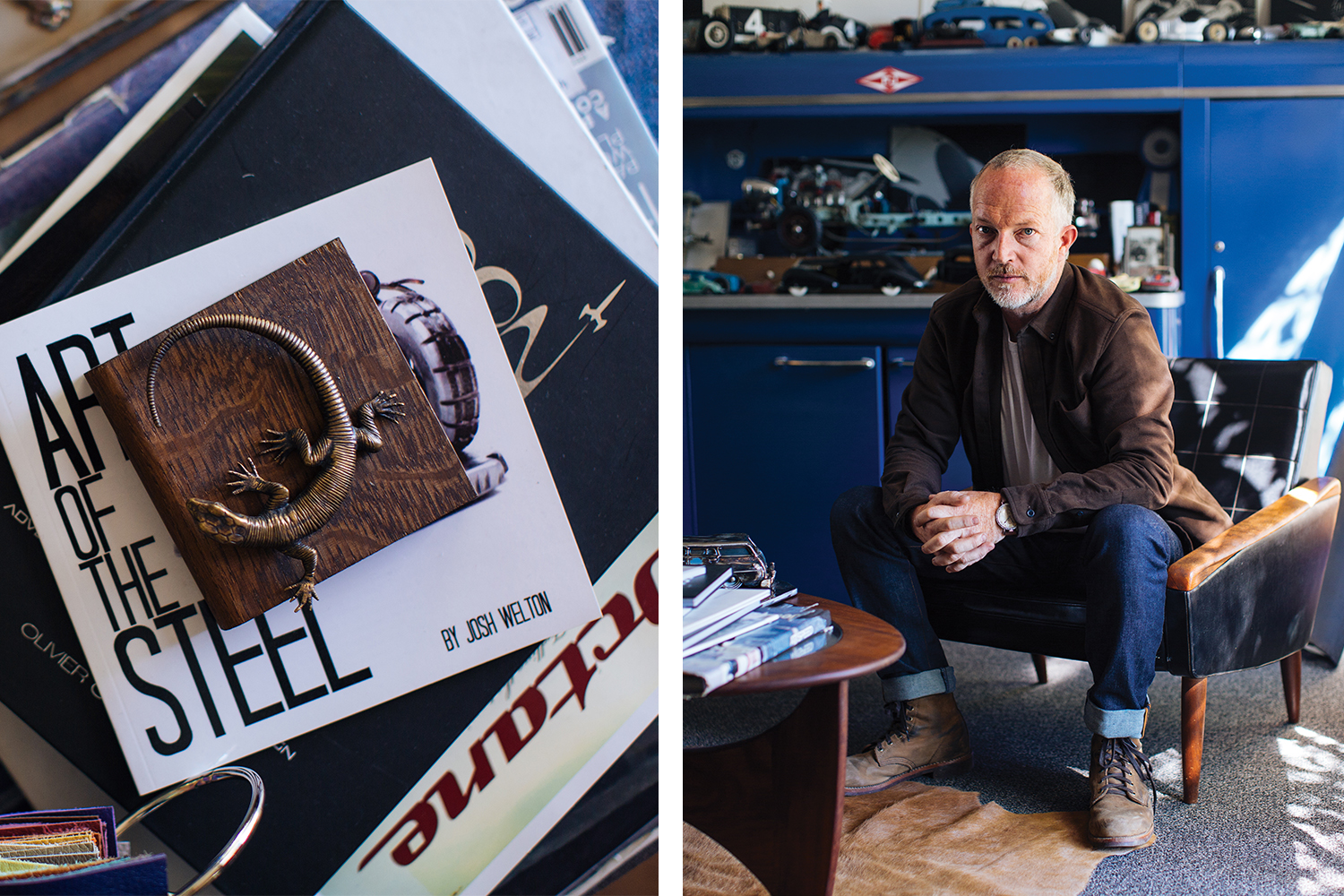
In 1996, Jonathan Ward and his wife Jamie started what would become the nation’s largest Land Cruiser Service center. Not long thereafter, the CEO of Toyota came knocking, and asked Jonathan to build three prototypes for the Japanese brand. One of them would ultimately become the 2007 Toyota FJ Cruiser, which got Jonathan thinking: what if he did his own take on the original Toyota Land Cruiser? How could he improve it, while staying true to its aesthetic and history? Jonathan decided to take on the challenge, and today, under the name ICON, he and his team are producing some of the most badass bespoke utility vehicles on the planet for a client list that spans from Jonathan Ive of Apple to Tom Hanks. We recently caught up with him in an ICON FJ40 in the hills above his office.

What are you world class at?

Vital Stats

  • Age: 45
  • Location: Chatsworth, CA
  • Occupation: CEO of ICON 4X4
  • Instagram: @icon4x4

I used to be sensitive to the fact that I have no formal training or degrees whatsoever. But over the years I’ve gained a deep confidence and respect for my natural perspective at design, and being lucky enough to manipulate that into a career has been kick ass. I say it too often but “respect your perspective” is my thing, for anyone doing anything, creating anything. Otherwise, you’re a ship without a sailor, just constantly reacting to what you think your customer wants or thinks they want.

I’m like a MacGyver Jack-of-all-trades almost to a fault. Over the years I’ve gotten into painting, dyeing, CAD, sculpting, fine woodwork, sketching, painting — the list goes on and on. I don’t think I’m great at any of it but it’s helped me widen my understanding of design.

What designers inspire you?

Marc Newson is a favorite. He’s probably best known for his work at Apple, but he’s designed products across a wide range of industries — boats, furniture, home goods, spoons, pottery, fucking dish strainers! Everything he touches, you smell Newson — from the surface tension to the radius. Then you look into the product further, and “son of a bitch, it is.” He’s like a good jazz sax player; you can hear his tone no matter how big the orchestra or what he’s playing, you know it’s that guy.

Another favorite is Gordon Buehrig, a great automotive designer from the early days. He did all sorts of important work like the Duesenberg, Cord, and Auburn cars. He’s got a great look.

And then for just being a freak in developing his own language and always going against the grain, I have to include Buckminster Fuller. It’s pretty wild to think that just from studying a water drop, he pioneered airflow before there were wind tunnels to prove it was working.

A true polymath, always following his nose.

Which I think there’s a lot to be said for. I think especially in design that’s totally lacking today because, everyone has been run through a system based on whatever design school they went to. Everyone is sort of corralled into a singular perspective. Often their unique way of seeing shape and form is bred out of them — it’s like design schools seem to run more like an MBA program.

Jonathan Recommends

Since you’re self-taught, what books have changed your behavior the most?

Cradle To Cradle had a significant impact on me as a human, a consumer, a creator. It made me think through the lifecycle of products and challenge the traditional cradle-to-the-grave approach of design and manufacturing. Not that we have every opportunity to apply this philosophy in what we do, but whenever we can, we do. It changed my perspective and is now a constant consideration.

I also love Raymond Loewy’s autobiography, Never Leave Well Enough Alone. He’s the guy who actually coined the term “industrial designer.” It didn’t exist until he made it up one day when he had to put something on his business card. He designed the Air Force One logo, Concorde interior, Lucky Strike packaging, Studebaker cars et al. He’s a lunatic and proves that it’s okay to be a lunatic and to be obsessive compulsive on the details, because the details are what matter. Ettore Bugatti’s biography and Napoleon Hill's Think and Grow Rich are also up there.

What’s a dream project you’d love to take on?

I love the idea of alternative history — what if this happened, what if that hadn’t happened — and one of my favorite decades for design is the 1930s; specifically around ’37, when one of my favorite design languages, Streamline Moderne, hit its apex. It’s just beautiful. I wish I had been alive in that era.

I’ve often thought: what if Streamline Moderne continued to evolve as a rich design language? What if the World War II hadn’t happened and the military industrial complex hadn’t corrupted product development into quantity trumping quality? Where would the Streamline Moderne design language have gone?

Having even more fun with this, now what if Buckminster Fuller and the famed automobile designer Gordon Buehrig visited Howard Hughes while he was still living in the Cabana in the Beverly Hill Hotels? I’m talking before Hughes went completely bat shit and moved to Vegas, but after he had built the H-1 Racer airplane. What if the three of them got together at Hughes’ Cabana one night and threw back one too many martinis? What would their napkin sketch look like? What car would Howard want them to design so he could take a Hollywood starlet out and impress her?

It just became a funny list of rules and constraints to define a product which I’ve yet to talk anyone into building. Eventually, I’ll have to build it myself for myself because it’s just driving me nuts and keeping me awake at night.

We can’t wait to see it. [H]


Editors Note: Our friends at Crown & Caliber's got a peek at Jonathan's unbelievable watch collection for their Watch Stories series. Check it out below:


30 Nov 15:31

Stop Wasting Money in 5 Minutes or Less

by Ben Stegner
stop-wasting-money

The most basic principle of getting in financial shape is to save more and spend less. Every dollar you don’t spend on something frivolous is one you can save for something important. Unfortunately, while this is easy to discuss, it’s a lot harder to live out in practice. We’ve recently talked about ways you could be wasting money without realizing it. Let’s continue this conversation and review some simple ways that you can stop wasting money. Whether in the form of mindsets or software, implementing these little tricks will help you keep more cash in your pocket. 1. Have a...

Read the full article: Stop Wasting Money in 5 Minutes or Less

30 Nov 15:28

How to Design and Print Your Own Awesome T-Shirts

by Harry Guinness
design-print-tshirt

T-shirts are a fashion statement. When you wear one, you can show your support for your favorite sports team, crack a joke at a friend’s expense, rep a cause you believe in, just look good, or any of a million other things. Sure, with the internet you’ve never had so much choice, but if you want a truly custom t-shirt, you’ve got to design your own. In this article, I’m going to show you how. To follow along, you’ll need to have a basic understanding of Photoshop. If you’re totally new, check out our beginner’s guide to Photoshop CC, any...

Read the full article: How to Design and Print Your Own Awesome T-Shirts

30 Nov 15:11

8 Creative Ideas To Recycle Your Mobile Phone Without Throwing It Out

by Mihir Patkar
recycle-smartphone

When you’ve got a new smartphone, what do you do with your old mobile phones? You could exchange it or sell it to get a few bucks. But you might be getting the bad end of that deal. Repurposing your phone is a much better idea. Think about it. That old phone, whether it’s an archaic Nokia or a recent Android or iPhone, has some sophisticated circuitry inside. As we move into a world of smart homes and connected devices, your phone’s technology is more useful than ever before. So while it might be technically obsolete as a phone, it...

Read the full article: 8 Creative Ideas To Recycle Your Mobile Phone Without Throwing It Out

30 Nov 15:04

You Must Try These 7 Creative Ideas With Your GoPro Camera

by Mihir Patkar
gopro-creative-ideas

There is a common misconception that a GoPro camera [CA] is only for those who lead an adventurous life. But even if you don’t go skydiving or white water rafting, you can do lots with an action camera. While this article focuses on the GoPro, there are other awesome action cameras for different prices. They all have similar features, so what you can do on a GoPro, you’ll be able to do on others too. So at this year’s Christmas party, instead of shooting granny sitting in one place with your action camera, do something creative. Here are a few...

Read the full article: You Must Try These 7 Creative Ideas With Your GoPro Camera

30 Nov 15:00

Floyd Table Legs

by mark

My husband and I recently moved to a wooded property in the southeast and are busy building all sorts of rustic tables from fallen trees. The question is always what type of legs to use? The Floyd Leg is our answer. The leg system is meant to be used by city dwellers to ease their pain of constructing disassembled furniture and frequent moves but we found it an easy solution for our handmade tables. The legs are simple to install and can be used on any flat surface (wood, glass, stone, etc.). And of course, the legs can be easily removed, transported, and reinstalled when necessary. They also come in various sizes for benches and other types of tables.

-- Penny Koppinger

The Floyd Leg – 29.5” comes with 4 solid steel legs ($285)

International Amazon link

Available from Amazon

30 Nov 14:46

There Are Hundreds of Secret Underground WWII Bases Hidden in British Forests

by Sarah Laskow
article-image

It’s almost impossible to find one of Britain’s secret, underground military bases unless you know what to look for. In the years since they were built, starting in 1940, many of them have collapsed or fallen into disrepair. While the bunkers are no longer camouflaged today, they still guard their secrets. To the untrained eye, their entrances might look like random holes in the ground.

The enthusiasts working to document these bases—and the clandestine Auxiliary Units that manned them—know what they’re looking for, though. The bases are usually located in woody areas convenient to arterial roads, railway lines, and the other domestic infrastructure they were meant to disrupt.

During World War II, the British Army built more than 600 of these underground bunkers—possibly upwards of 1,000—to serve as bases for small groups of fighters who’d be mobilized in the event of a German invasion. These local Auxiliary Units weren’t meant to last more than a few weeks: they might slow the Nazi army down, but they’d likely die fulfilling that mission.

article-image

The bases weren’t meant to last, either. After the war, they were supposed to be destroyed, but many were not. For decades, they remained hidden in the woods: the men meant to use them had been told to keep the bases a secret, and they did. One of the only reasons they’re known at all is that historians, enthusiasts, and veteran Auxiliaries has been documenting the history of these covert units and seeking out the remains of their secret underground bases—when they can find them.

“It’s like the jewel in the crown if you find one with the roof still on,” says Tom Sykes, the founder of the British Resistance Archive, a network of researchers documenting this history and its remains.

article-image

In 1940, the Nazi Army was sweeping quickly across Europe, into Norway, Denmark, and France. Paris fell in June, and by the end of the summer, German bombers were attacking Britain’s harbors and cities, and it seemed possible that Germany might invade England.

Under these circumstances, the British War Cabinet approved the creation of Auxiliary Units, which would serve as an anti-invasion force, trained by the military to use guerrilla tactics against enemy forces. Each unit of eight or so men had its own operational base, often constructed with the help of the Royal Engineers.

article-image

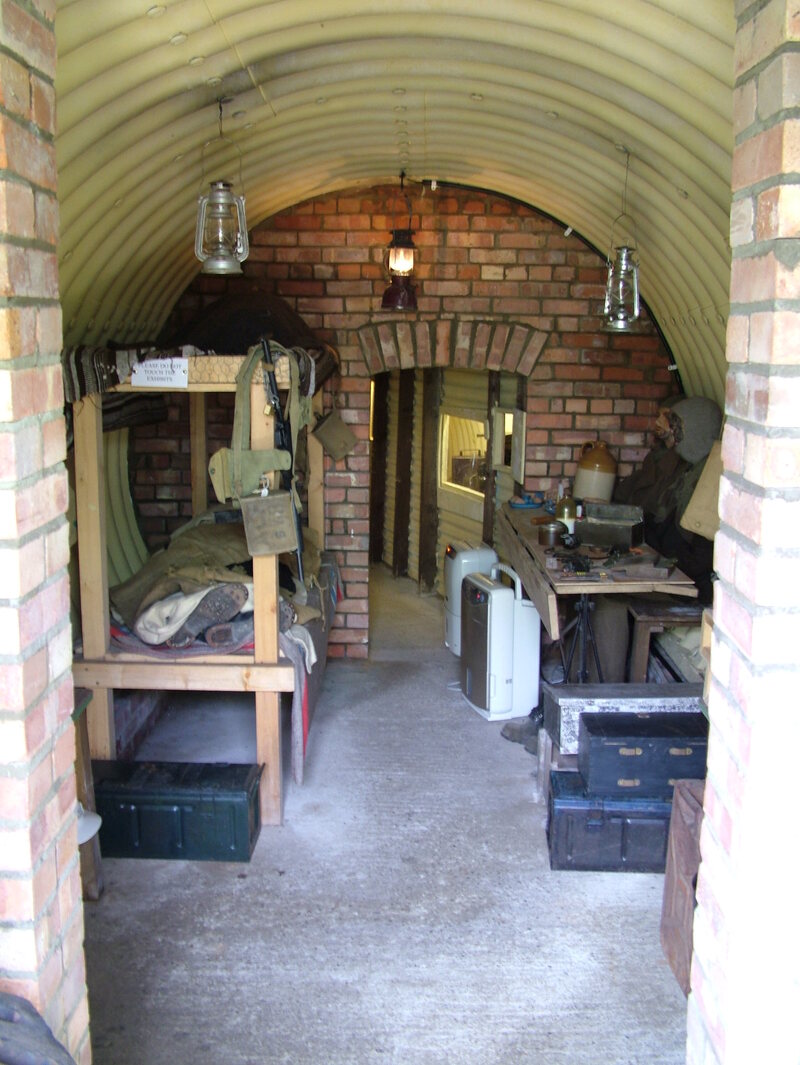
These bases were, in many ways, exactly what you’d imagine a guerrilla base that was literally underground would look like. They had a somewhat standardized form: after digging a giant hole, engineers would lay a concrete floor and roof it with a half-cylinder of corrugated iron.

The bunkers were usually about 12 to 15 feet in length and tall enough to stand up in. At one end there would be an entrance shaft, lined with brick or corrugated steel, and at the other end an escape tunnel, often a tube made of concrete, running 20 to 30 feet away from the base.

article-image

These small quarters were furnished with wooden bunk-beds, basic cooking equipment, and chemical toilets. They were reasonably well ventilated and stocked with rations, including rum: one secret document recommended that unit leaders “Be scrupulously fair in its distribution, and not over lavish. Best issued on return from Patrol.”

Some of these bases, though, were more creative in their construction. One was built below the basement of an abandoned, burnt-out manor house. Another was built in a badger’s den; another in an old root cellar. In Scotland, some bases were built in centuries-old rooms dug by Picts, who lived in the region up until the early medieval period. One underground fort, intended for men who’d been routed from their own bases, according to David Lampe, who wrote about the Auxiliary Units in his 1967 book The Last Ditch, could have held 120 people.

article-image

Some of the entrances made use of ingenious mechanisms. One, Lampe reported, was hidden below a six-foot tree trunk that could be swung aside to reveal the entrance. Another had a doorbell of sorts—anyone trying to gain entry would have to find a marble left on the ground and send it down a hole that led to a can inside the bunker, alerting the doorkeeper inside. Even the basic entrances had a clever mechanism that lifted the doors up from the ground and allowed them to twist aside.

Because the Germans never invaded, the bases were never used for anything other than training. After the war, they were supposed to be destroyed, but many were simply left to decay. One, for instance, collapsed not long after the war under the weight of a cow.

article-image

Researchers with the British Resistance Archive have spent hundreds of hours trying to rediscover the locations of the bases. In most counties in Britain, they’ve found, there are one or two members of Auxiliary units still alive, and they can help locate the bases. If there are no obvious leads, a landowner or farmer in the area might know exactly where to look.

“Nearly all of them are on private land, and we never divulge where the exact locations are,” says Sykes. “We don’t encourage anyone to go looking for them.”

Today, Britain's secret Anti-Nazi resistance bases are quickly disappearing: the archive’s researchers don’t try to preserve the ones they find, just document them so that there’s a record they were there at all, before the earth swallows them all back up for good.

30 Nov 14:40

10 Sailor-Related Terms That Were Lost at Sea

by Mark Peters

Here’s a sampling of terms that went overboard. Be their lexical lifeboat.

29 Nov 20:21

The Best TSA Approved Multi-Tools for Travel

submitted by Adam Molina

Traveling through airports never goes as smoothly as you'd hope to begin with, but getting your favorite multi-tool confiscated by security could be the unwelcome cherry on top. Still, multi-tools are some of the most versatile items you can carry, and going anywhere without one can leave you feeling woefully unequipped. Your best bet is to have a small TSA-friendly multi-tool for when you travel (even better, one you'd find useful even when you aren't). In this guide, we've rounded up 10 EDC tools designed to fly with you this travel season.

How to avoid getting your tools getting confiscated by security

One travel hack that works for some Everyday Carry members to avoid getting your multi-tool taken away is to open up all the tools and place it in the change tray.

If that doesn’t do the trick, another quick tip is to pack an envelope with pre-paid postage. That way, if you run into any problems, you can avoid confiscation by mailing it home or to a friend instead.

To avoid that situation altogether, here are some of the best TSA-friendly tools that you can take with you on your next trip.

Now, it’s worth mentioning that a TSA agent’s main priority is safety. If they feel like anything you have can be used as a weapon, it’s their job to make sure that doesn’t make it onto a plane. Keep in mind that that's ultimately up to the officer's discretion. That said, these tools are compliant with the most recent rules and regulations.

10 TSA Compliant Tools to EDC

Griffin Pocket Tool

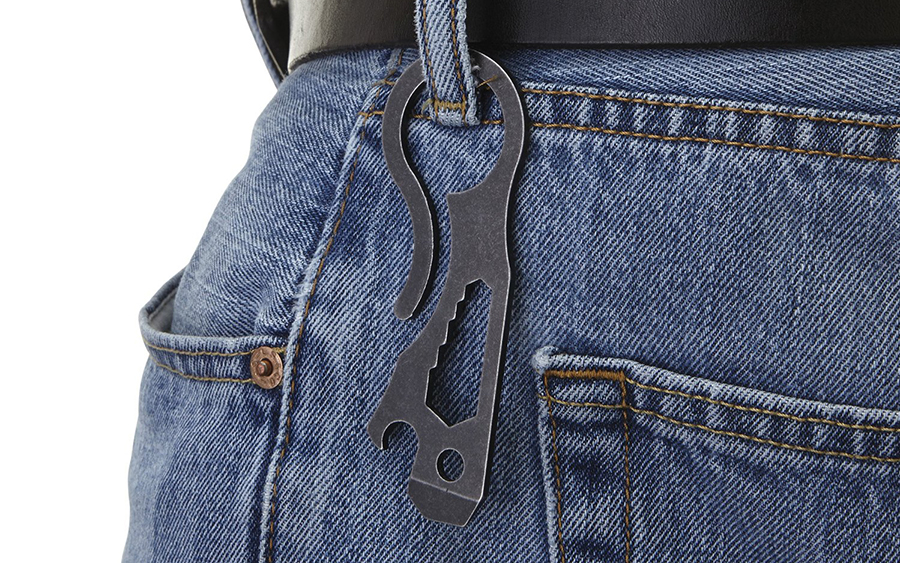
Sometimes a simple design is the most useful. The Griffin Pocket Tool is a prime example of this with a precisely cut unibody design that gives you a few handy tools. If you really want to kill two birds with one stone, you can also use it as a suspension hook to carry your keys without the pocket bulge. You’ll have a screwdriver, wrench, bottle opener, and pry tool right in your pocket. You can choose between brass, titanium, or stainless steel depending on which fits best with your carry.

Buy on Amazon


Victorinox Jetsetter 3

The iconic design of the Jetsetter makes it instantly recognizable and the name isn’t the only thing that shows it was designed for travel. You’re unlikely to come across a TSA-agent that's unfamiliar with a Swiss Army Knife. You won’t find any blades here for obvious reasons, but unless toothpicks are suddenly dangerous you shouldn’t have any problems getting this little useful tool through security. Instead, you get sturdy scissors and a screwdriver/bottle opener.

Buy on Amazon


Leatherman Style PS

Leatherman has plenty of tools to choose from, but the Style PS is the way to go if you’re going through airport security. Unfold it to reveal a Phillips screwdriver, scissors, and a pair of spring-action needle nose pliers that are surprisingly useful for their size. The stainless steel build can handle being tossed around, and it has a built-in carabiner so you can attach it to your bag if your pockets are full. At 0.3 ounces, you won’t even notice it’s there.

Buy on Amazon


NiteIze DooHicKey

The DooHicKey is one of those tools that might not even look like a tool to most. Look a little closer and you’ll find a discreet piece of stainless steel with seven useful tools hiding in plain sight. Whether you keep this on your belt loop or the bottom of a bag, the DooHicKey is one of those tools you don’t realize you need until you have it.

Buy on Amazon


Gerber Shard

One of the most recommended and most carried pocket tools on our site is the Gerber Shard. Its small size and lack of blades makes it perfect for airline travel but gives you plenty of the functionality of a larger multi-tool. A wire stripper, flathead driver, and bottle opener are crammed into this small tool that can easily fit in your pocket. You can also wrap the handle in your favorite color paracord to add style and a little extra practicality.

Buy on Amazon


Gerber Dime Travel

The Gerber Dime is an EDC classic for a reason. You have access to ten tools including scissors and the ever-useful needlenose pliers right on your keychain. The Dime can handle annoying travel inconveniences with ease and makes a great travel buddy at under 3” in length.

Buy on Amazon


BigIDesign TPT

The Titanium Pocket Tool from BigiDesign is one of those new breed of boxcutters. But instead of a utility blade, the TPT comes equipped with a finger-safe tape opener that doubles as a camping fork if you find yourself eating on the go. Its Grade 5 Titanium build makes it strong enough for prying or twisting, but it’s small enough to fit in the coin pocket of your jeans. For a discreet way to carry a screwdriver, pry bar, bottle opener, and more, make sure to check out the TPT.

Buy


CRKT Viva

If you’re trying to minimize the amount of items in your pocket, the CRKT Viva might be the tool for you. It hooks onto your belt or bag loop and stays out of your way until you need it. It measures only 4” in length but still manages to fit screwdriver and wrench functionality in your pocket. Its stainless steel construction makes it reliable when getting from point A to point B.

Buy on Amazon


SOG PowerLock Traveler

Not all travel tools need to sacrifice size. Case in point: the SOG PowerLock Traveler. This durable multi-tool was made with no compromises. You'll get high-powered Compound Leverage pliers, screw drivers, a can opener, a wire cutter, and more in a stainless steel tool that'll keep you prepared for anything.

Buy on Amazon


Zootility Tools Wildcard

There’s no easier way to carry something than to put it in your wallet. The Zootility Wildcard takes advantage of this and fits a pry bar, small blade, bottle opener, and more in a form factor that you can slide into your wallet. Once you’re done traveling you can still find use for this slick tool by attaching a locking blade for more robust cutting jobs.

Buy on Amazon


Do you have any travel hacks you'd recommend to anyone looking to bring a multi-tool on a trip? Make sure to share it in the comments below!

29 Nov 19:40

New Taqueria: Rreal Tacos

by Atlanta Magazine
Rreal TacosPork trompo, fish, and adobo grilled chicken tacos from Rreal TacosPhotograph by Josh Meister Former fine-dining chef Adrian Villarreal entered the crowded casual-fare arena with this fresh taqueria that pays homage to his Mexican roots. The tacos hit all the right notes, with impeccable ingredients (grilled fish, carnitas, beef barbacoa) stuffed into three different kinds of tortillas. You also can’t go wrong with the daily specials and housemade agua frescas. 100 Sixth Street, rrealtacos.com Back to Food & Dining Back to Best of Atlanta This article originally appeared in our December 2016 issue.View Original Post
29 Nov 19:36

Bike Repair: Loose Nuts Cycles

by Atlanta Magazine
1216_boa27_oneuseonlyGrant Park’s Loose Nuts combines the vibe of a biker bar (a mural by Swampy, bottle caps in a bucket) with the customer service of your local ice cream parlor. Make your way through the offerings from Surly and Fairdale to the shop downstairs, where expert bike techs address everything from tiny, nagging mech­anical issues to full drive-train swaps. Whether you’re a pro or a novice, you’ll leave feeling more informed. loosenutscycles.com Back to Shopping & Style Back to Best of Atlanta This article originally appeared in our December 2016 issue.View Original Post
29 Nov 19:34

How to make Star Provisions shortbread cookies

by Susan Puckett
Star Provisions cookiesThis time of year, shortbread cookies at Star Provisions come dressed for the season—as snowflakes, Christmas trees, and whatever else pastry chef Zibaa Sammander might dream up for this versatile, durable dough. It can be rolled thick or thin. It can be delicate and nearly white (baked slowly) or crisp-edged and golden (in a hotter oven). A tip: Instead of dusting the surface with flour to prevent sticking, roll the dough between sheets of parchment, then chill it for easy cutting. 1 For about three dozen 2½–inch cookies, measure 4 cups bleached all-purpose flour, 1 cup granulated sugar, and 1½ teaspoons kosher salt. Cube 4 sticks of high-quality unsalted butter and bring to room temperature. 2 Place sugar and salt, then butter, in the bowl…View Original Post

29 Nov 19:33

World's Largest Redwood Tree Service Station, Ukiah, CA

Feature: Constructed from a redwood tree trunk moved to Ukiah from a grove in 1936. ...
28 Nov 21:56

Caroline Cooks: From Teacakes to Tamales

by Jenna Mason
From Teacakes to Tamales features more than 100 culturally diverse recipes, handed down from grandparent to grandchild, along with black-and-white photographs and nostalgic stories centering on these family dishes.
28 Nov 21:51

Learn the Basics of Street Photography in Under 9 Minutes

iStock 157280931

When people think about street photography, they likely think of two things: first, amazing candid photos of people amidst the hustle and bustle of a busy city, and two, the anxiety-inducing task of photographing strangers, some of whom might not want their picture taken.

It’s certainly a risk vs. reward scenario!

In some cases, you can get shots like the one seen above, with subjects that are fully cooperative. In other cases, you might be confronted - not necessarily in a nice way either - by someone that simply does not want their likeness in your images.

Either way, street photography can be an extremely gratifying and exciting genre. But like with anything, getting started is usually the hardest part.

But, no worries! Matt Widgery knows what it takes to be a successful street photographer. In the video below, he offers up 10 prime tips to help you get started and find success as well.

Here’s a rundown of Matt’s tips:

  • Use a fast shutter speed (i.e. 1/250 seconds or faster), so you can freeze movement and avoid camera shake.

  • Use a moderate aperture (between f/8 and f/16), so you have a good depth of field without sacrificing sharpness.

  • Use zone focusing to speed up the time between pressing the shutter and the shutter actually being fired.

  • Be friendly! If you smile and say thank you, people are much more likely to be okay with you photographing them.

  • Use a wide lens. It forces you to get into the scene and closer to your subjects, and also looks a lot less weird than if you were to photograph strangers from afar with a long telephoto lens.

  • Use whatever camera you have already. There’s no need to go buy a new one!

  • Carry one camera and one lens. Taking all your gear will only make you move more slowly (and draw lots of attention to yourself too!).

  • Not all street photography has to be candid. If you find someone that is willing to pose for a portrait, go for it!

  • Check out the street photography work of other artists to find inspiration.

  • Shoot every day! Practice makes perfect, so the more you’re out there taking photos, the better you will become at street photography.

That’s it! Ten easy tips to get you into a good street photography workflow. Check out Matt’s video above for more in-depth explanations of each, then put what you’ve learned to the test by hitting the streets!


28 Nov 21:49

Repo man pays off elderly couple's car just in time for Thanksgiving

by Jason Marker
28 Nov 21:48

Dear Fujifilm, You are One Firmware Update Away from the Perfect Camera

by Guest Author

fuji_feat

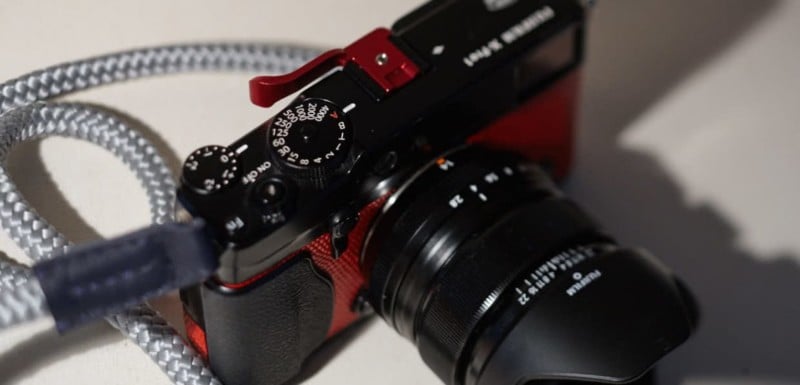
Last year I bought a new Fuji X-Pro 1. I bought it as a camera to keep in my pocket, not really as a serious option, but I’ve loved it from the moment I snapped the first pictures. I even bought a second one, used, and converted it to infrared.

The quality of the RAW files is incredible, and so is the quality of the lenses. I really enjoy the OVF and the option to switch to EVF as needed. Low or high ISO, the quality is superb, and I started to bring the camera with me everywhere—something I was not doing with the much bigger and heavier Canon 1DS Mk III I own. Every single time I develop the RAWs from this camera, I like it a little bit more.

I could not be happier, and I’m planning to get the X-Pro 2 very soon.

But…

I hate absolutely all the buttons and wheels that get pushed and moved anytime I grab the camera out of my bag. The macro function seems like it was designed only to make me worry that the OVF/EVF switch is broken every time I push it accidentally and get stuck in EVF. The exposure compensation is constantly being pushed out of the zero position, making it so I’m under- or over-exposing pictures because I don’t always have the display on to check.

All the buttons, sooner or later, get pushed accidentally. It makes me crazy!

So, dear Fuji, why do you not put an option in the firmware to disable the buttons and dials? I know, I’m a dinosaur—I need only shutter speed, aperture, and ISO 90% of the time. But Leica made money selling a model without even the display!

A few lines of code in the firmware, and we will be able to personalize the camera, turning off all the buttons we want. The camera could go back and forth, from normal to limited function, with something as simple as pressing one of the annoying buttons for more than 3 seconds or something similar.

Personally, I would be happy with all the buttons and dials inactive except for play, shutter speed, and aperture. Other people might have other needs, but I think it would be easy to customize the camera using a menu similar to the one used to choose what to show in the OVF. Plus, this could easily be done for all past, present, and future models in one fell swoop!

Dear Fuji, I already love you, but with that option you would save me a lot of money on therapy.

Written with love… and a little hate.


About the author: Luigi Barbano is a renowned Italian photographer, artist, and author, who divides his time between Italy and the USA. He started his professional career in 1994, and specializes in commercial and travel photography. You can find more of his work or get in touch through his website, Facebook, and LinkedIn. He’s also published a book, “Photography: The f Manual”, which revisits the classical approach to photography. This article was also published here.

28 Nov 20:58

Wes Anderson’s H

by Michele Debczak

A holiday commercial directed by Wes Anderson is exactly what you'd expect.

27 Nov 17:58

What to Pack Before You Go Off The Grid

by Lauren Young
article-image

You never know when disaster might strike. Amidst mass panic, fear, and chaos it’s understandably difficult to keep logic and reason in check. The last thing you’d want to do when it’s time to flee your home is frantically pack random items you think you’ll need to keep you alive while trekking to what you hope will be a safer location with greater resources and protection.

Whether a brewing hurricane, an unexpected tsunami, or the ultimate doomsday scenario, survivalists and emergency preparedness experts have come up with various guides to creating your ultimate bug out bag, a portable pack stocked up with the absolute necessities to help you stay alive for three days in the event of a natural or man-made disaster.

“Disaster can strike at any time and knowing what to do and how to respond in that time of emergency could mean the difference between life and death,” says Andrew, who declined to give his last name, co-founder of Bug Out Bag Academy, a website dedicated to the bug out bag. “I wish that didn’t sound so gloomy, but the flipside of that coin is having preparations like bug out bags can give us much needed hope and assurance in a time of chaos.”

In the face of a disaster, every minute counts. Being prepared with an up-to-date list of core items to quickly pack into a bug out bag could save crucial time. Andrew suggests reviewing the contents of a bug out bag at least every six months to make sure you’re adequately prepared.

article-image

The origin of the bug out bag is said to derive from military pilot “bail-out-bags” that contained several critical survival items in the event that the plane went down, Andrew explains. Today, these bags are meant to assist you when the environment you are in is no longer safe and hunkering down isn't an option. In these life-threatening scenarios, you are forced to move to a relative’s home or designated emergency shelter, such as a hospital, hotel, or church—a bug out site. However, bug out bags and survival kits are a widely debated topic. Some bug out bag items are obvious and ubiquitous (water and medical supplies), while others may rile up criticism. For instance, Bug Out Academy’s guide of 75 essential items differs from the Survivalist Blog’s list and the Navy SEALs’ survival bag. Some experts question the value of even having a bug out bag.

“Unfortunately, compiling a bug out bag isn’t as easy as pushing a button and ‘poof,’ there it is. We wish it was, but that’s just not practical given all the unique variables to an individual’s situation,” says Andrew.

While the contents of a bug out bag may vary based on numerous factors (personal needs, location, mode of transportation, the state of the disaster), there are some items and tips that many agree you may want to consider.

article-image

“One of the key points is that you want to go basic and you want to go simple,” advises Robert Kauffman, a parks and recreations professor at Frostburg State University in Maryland who teaches an emergency preparedness and doomsday preppers class. “Don’t assume that you’re going to have all this high-tech stuff with you. Don’t assume that cell phone towers are going to be working.”

Cellphone towers might be down or overloaded, rendering mobile devices useless. Richard Mitchell a wilderness survival instructor at Oregon State University recommends throwing out the cellphone completely, and instead learn how to read a topographic map and standard magnetic compass.  

“One the biggest, most recurring problems is navigation,” says Mitchell. “It’s the thing that’s most opaque these days because people have electronic instruments that they wave around in hopes that it’ll tell you where to go.”

article-image

After navigation, you should think about the basics of survival, maintaining fundamental body functions, such as core temperature and blood temperature, says Mitchell. He follows the “old rule of three”: you cannot survive three minutes without air, three hours without shelter (in most environments in the United States), three days without water, three weeks without food, and three months without human contact.  

Guides almost all include first aid items in the bag, like antibiotics, disinfectant bandages, and small surgical tools. A simple bar of soap to wash your clothes, clean your skin or an injury, can be a critical item, says Mitchell. Something that can’t be included in a first aid kit, but is essential are immunizations. “Diphtheria, tetanus, typhoid. Those in major disasters do become relevant,” he says.

Exposure, especially being wet, kills. To protect yourself from the elements, Bug Out Bag Academy and Mitchell recommend water proof clothing (from top to bottom) as well as multiple pairs of socks, underwear, a hat, gloves, and sunscreen. It’s useful to have tools to start a fire, such as a butane lighter, and flashlight or headlight for a light source.

article-image

There are other items to include in a bug out bag that don’t directly contribute to basic survival, but are staple necessities such as money in the form of cash—particularly small bills. During disasters, “cash is king,” says Kauffman. You may not be able to withdrawal cash or use credit or debit cards if electronic systems are down, he says. “If all you have are fifties and hundreds, you might go to a grocery store to find that they don’t give change.”

There are several recommended bug out bag items that have stirred heated discussion, such as cooking utensils which people argue add unnecessary weight. Bug Out Bag Academy’s guide mentions non-lubricated condoms in the miscellaneous section, earning some vocal feedback from community members. “You wouldn’t believe some of the comments we didn’t approve for viewing by the general public,” says Andrew, who explains that they are actually quite durable and can serve as a water container or keep fire tinder dry. “Items like this that can serve multiple purposes in your bug out bag are a great help to reduce weight and bulk.”

But perhaps the most controversial are self-defense tools. Some may choose to pack firearms to help with defense or with hunting. Others may opt for pepper spray or choose not to carry any weapon at all. “While we think a critical element to any bug out bag is the personal ability to defend yourself and hunt for food if need be, we leave that up to the individual to decide,” says Andrew. “We say this because not everyone is sufficiently trained to properly handle and use a firearm, nor defend themselves. Just like a bug out bag, a weapon will not protect you, unless you know how to properly use it.”

Nifty tools and weapons aside, one of the most powerful objects in a bug out bag is a trinket, good luck charm, or picture of a loved one, says Mitchell. “It’s worth all the ammunition in your 9-millimeter [handgun],” he says. “Something that reminds you of hope is a very powerful tool.”  

article-image

Mitchell and other experts argue that a bug out bag is seemingly inconsequential if you do not have the necessary skills to survive in an extreme disaster scenario. People are much more tool oriented than skill oriented, leaving many unprepared when encountered with uncertain conditions and events, he says.

“The biggest misconception is that bug out bags has to be that the bag and its contents will, in and of themselves, keep you alive. Nothing can be further from the truth,” says Andrew of Bug Out Bag Academy. Andrew, Mitchell, and Kauffman advise familiarizing yourself with your personalized bug out bag and the items within. You’ll be happy knowing basic survival and navigational skills when others scramble in panic during zombie apocalypse or alien invasion, or any cataclysmic event.

“If you don’t see why knowing about emergency preparedness is a good idea, just turn on the TV and watch the nightly news,” says Andrew. “Level heads prevail in times of calamity.”

27 Nov 17:54

The Tiny Kentucky Town That Eclipse Fans Are Obsessing Over

by Robbie Clark

Go ahead. Try to book a hotel room in Hopkinsville, Kentucky, for the third weekend in August next summer.

You can’t. They are completely booked from August 19th through August 22th. And the same goes for hotels and motels in nearby Cadiz, Hardin, Oak Grove, or any other interchange along Interstate 24. Across the state line, Clarksville, Tennessee, may have a few rooms up for grabs when you read this, but you’re going to pay hundreds of dollars for your stay.

You could say the stars have aligned for Hopkinsville. Or, more precisely, the Earth, sun and moon will be perfected aligned. Next summer will be the first time a total solar eclipse—when the moon completely blocks out the sun—can be witnessed in the continental United States since 1979. (Viewers could view a total solar eclipse in Hawaii in 1991.) And in a cosmic twist of fate, on August 21, 2017, Hopkinsville will be the star around which the astronomical world orbits. As the moon crosses the United States at about 2,000 miles per hour, casting its shadow from Portland, Oregon, to Charleston, South Carolina, Hopkinsville (population 33,000) has been identified as the “greatest eclipse” location.

article-image

What does that mean? Well, it’s technical. It boils down to that as the moon makes its run across the country that night (the phenomenon has been dubbed The Great American Eclipse), when it passes Hopkinsville it will be the closest to the Earth. The area will be plunged into midday darkness for about two minutes and forty seconds. (Note: there is already a sort of heavenly body battle brewing with Carbondale, Illinois, which can claim the “longest duration” eclipse; it will be about two tenths of a second longer than in Hopkinsville.)

What greatest eclipse really means for Hopkinsville is that tens of thousands of astronomy buffs and other curious onlookers are expected to descend on this western Kentucky community, and the lucky ones already have dibs on rooms at the Holiday Inn.

Dr. Richard Gelderman, the director of the Hardin Planetarium at Western Kentucky University in nearby Bowling Green, understands the attraction of experiencing a total solar eclipse—earlier this year, on a NASA grant, he went to Indonesia to witness one first hand.

article-image

“A total eclipse is a complete and total change. A total eclipse is something that should not happen, and your body knows it. And everything in your body totally sends off chemical alarms saying, ‘Beep, beep, beep. Something is wrong here, because in the middle of the day, the sun just disappeared,’ he said. “And the most common expression when you look at videos of people experiencing a total solar eclipse is ‘holy shit.’”

The Visit Hopkinsville office, the area’s convention and visitors bureau which oversees tourism in the region, has known about the celestial occurrence for almost a decade, and not because they had somebody checking moon charts on staff. Nine years ago Cheryl Cook, the Visit Hopkinsville executive director, received an email from a prudent vacation planner and avid eclipse chaser - somebody who has devoted their lives to experiencing astronomical events - inquiring about hotels and the best viewing spots.

“At first I thought it was a joke,” Cook said. “We don’t work 10 years out.”

article-image

Since that time, Cook and other city officials and business leaders have become ad hoc astronomers to promote Hopkinsville as the optimal place to experience the Great American Eclipse and to prepare for the throng of visitors. Along with securing lots of public viewing areas, they’ve been stockpiling eclipse essentials, such as folding lawn chairs and official total solar eclipse viewing glasses. 

“Right now I already have, in my office, 50,000 glasses,” Cook said. “I sold 50,000 to different businesses. And I'm getting ready to do another order. I may order another 50,000.”

In a strange coincidence, August 21,the day of the 2017 eclipse, carries a lot of significance for Hopkinsville. That’s the day, in 1955, that a local farmhouse in nearby Kelly received an alleged visit from a band of extraterrestrials and a fierce gunfight ensued. Local police and military police from nearby Fort Campbell investigated, and the incident received considerable coverage from the national press.

The community now celebrates the event annually with the “Little Green Men Days” festival. Next year’s four-day spectacular will be capped off with a total solar eclipse, and probably considerable UFO conspiracy theories.

“I like to say the aliens were here to pick out their viewing site early,” Cook joked.

Given the volume of expected travellers, Cook hopes some visitors plan to come early to ease traffic congestion and to enjoy all the area has to offer, such as the official Hopkinsville Summer Salute Festival or an area distillery—one has already planned a special eclipse edition of their moonshine, which will certainly come in handy if the weather turns cloudy on August 21. 

“If you can’t see the eclipse, you can have some eclipse moonshine and it’ll make your sky go dark too,” Cook said.

27 Nov 17:52

Breathtaking Photos of Ancient Trees Against Starry Skies

by Anika Burgess

A sequoia can live for over 3,000 years. There's one baobab tree specimen that has been dated at over 6,000 years old. These are some of the world’s most ancient trees—trees that have lived through countless generations of humans, under an infinite number of night skies. The timelessness of these trees and their starry backdrops inspired Beth Moon’s new photography book, Ancient Trees Ancient Skies

There were, of course, some logistics to consider for this project. In order to capture the most vibrant night stars, Moon sought out ancient trees in the most remote locations. As she writes in her introduction, “to find those skies, and the trees beneath them, I traveled for many hours without road signs, or even roads, to areas so remote and wild the darkness was almost palpable.”

Timing was also key. She needed to shoot under a new moon, and when the trees were bare, with clear weather. The results, in which each image is named after a star or constellation, is a vivid expression of the natural world's enduring beauty. 

article-image
article-image
article-image
article-image
article-image
article-image
article-image
article-image
article-image
article-image
27 Nov 17:49

How a Father And Son Helped Create Weather Forecasting as We Know It

by Claudia Geib
article-image

It’s an almost supernatural ability that most of us take for granted: at any given time, almost anywhere in the world, we can know the weather of the future. It’s all laid out for us, often on maps that show the movement of weather like armies colliding mid-air: triangles for cold fronts, half-circles for warm, and a mix of the two for occluded fronts, where a cold front overtakes a warm.

It wasn’t always this way. Though the very first committee dedicated to collecting and mapping weather data—the Franklin Institute in Philadelphia—was formed in 1831, all of the maps they produced had to be drawn after weather had already occurred. Predicting the weather remained largely based on superstition, like the famous “red sky at night, sailor’s delight” rhyme. In the mid-1840s, the newly-elected secretary of the Smithsonian Institution expressed his frustration with the lack of progress in meteorology. The Smithsonian's new program, he said, would focus on “solving the problem of American storms”—and yet American storms remained a problem.

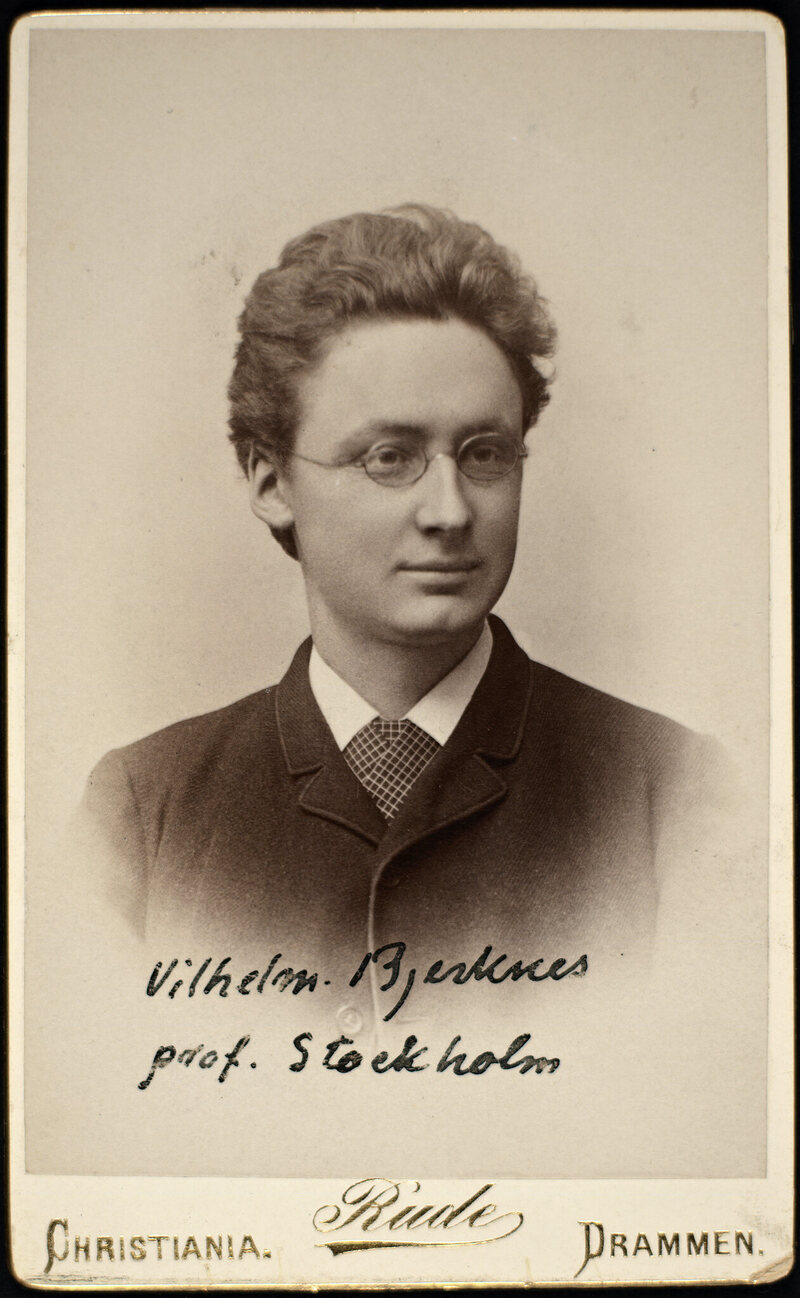
That all changed in the late 1800s and early 1900s, in no small part due to the work of a father and son pair of Norwegian geophysicists, Vilhelm and Jacob Bjerknes. The Bjerknes dedicated their lives to understanding the workings of our atmosphere, and in doing helped produce the weather models that we know today—and which are still based in the work the Bjerknes did almost 100 years ago.

article-image

Jacob Bjerknes and the future of weather forecasting were born in same year. That year, 1897, Jacob’s father Vilhelm had a breakthrough: he figured out a theorem that describes the motion of a vortex in a non-homogenous fluid—like the air masses interacting in our atmosphere. Vilhelm was sure that his calculations could be used to develop a system of predicting the weather, in all its complexity, days ahead of time. This was the aim of his work: as he would lay out in 1902, “The goal is to predict the dynamic and physical condition of the atmosphere at a later time, if at an earlier given time, this condition is well known.”

When applied to the motions of the ocean and the atmosphere, Vilhelm believed his new theorem should allow weather forecasting to be handled as a problem of mathematical physics, just like a calculation of friction or gravity. At the time, this concept was a revolutionary one.

In 1913, Vilhelm became director of a new geophysics institute at Germany’s University of Leipzig, where he was surrounded by talented students—one of them, Vagn Walfrid Ekman, would become known for his eponymous theory describing how wind drives the circulation of water currents (an idea that came to him one evening at a dinner party). By 1915, this group also included Vilhelm’s son Jacob, whom everyone called Jack.

It was not the easiest time for the Bjerknes’ studies. In July 1914, Austria-Hungary declared war on Serbia. Germany joined the fray only days later, setting World War I into motion. Much of the institute’s German students and staff were called into service, leaving the institute short-handed. Recent progress in the field also suffered. The first daily scientific maps displaying the globe’s weather, issued by the United States’ Weather Bureau, had to be suspended only seven months after the program began, when the war halted European telegraph transmissions. This must have been a particularly disappointing blow for Vilhelm—years earlier, he had suggested that weather observations and computations be combined on charts, allowing scientists to graphically derive maps in sequence, “just as one usually derives one equation from each other.” In a 1914 letter to the Carnegie Institution, one of his biggest funders, Vilhelm wrote worriedly: “I hope that the most unnecessary and most cruel of all wars shall not disturb the work which I am performing …”

Yet this was just the beginning of the curious entanglement of the military and war with the Bjerknes’ work—indeed, its entanglement with the development of weather forecasting itself.

article-image

In 1916, Herbert Petzold, one of Vilhelm’s doctoral students, was killed at the battle of Verdun. Though Vilhelm had written only a year earlier that his son was “still too young to devote himself to this work,” Jack took over Petzold’s studies, which examined the movement of “convergence lines,” or distinct masses of air in the atmosphere. Shortly afterward, Jack published his first scientific paper, describing that these lines of wind could be thousands of kilometers long, that they tended to drift to the east, and that they had some connection with clouds and precipitation.

By 1917, the fighting in Germany drove the Bjerknes’ to flee for their native soil. “I am now back again in Norway, not merely for a summer journey, but forever,” Vilhelm wrote solemnly. The elder Bjerknes became a professor at the new Geofysisk Institute at Norway’s Bergen Museum, where he developed the school of weather analysis that would become known as the Bergen School.

The Norwegian coast became the school’s laboratory: through negotiations with the government, Vilhelm increased the number of weather observing stations in the south by nearly tenfold. Jack and two other students were set up as forecasters. With the war severely limiting supplies—the scarce winter of 1916–17 became known as the Kohlrūbenwinter, or turnip winter—Vilhelm’s goal of figuring out how to predict the weather was not just a scientific quest, but a practical one, one with the urgently needed goal of “assist[ing] the production of breadstuff.”

The plethora of weather data the Bjerknes were receiving also allowed Jack to continue monitoring convergence lines and refining his theory. By the fall of 1918, he had made a discovery: these lines of weather were connected with cyclones—large air masses that rotate around low atmospheric pressure. He published his observations in 1919. Though he didn’t yet know it, Jack had identified one of the most characteristic features of weather maps and weather forecasting. These features, too, would be linked with war, named for their resemblance to the lines of advancing armies. Jack Bjerknes had discovered the “front.”

article-image

The Bergen School continued to work off of Jack’s theories through the course of World War I. The school used mathematical analysis and data from their weather stations to revolutionize its weather maps, including the differing lines of convergence that would later be known as “cold fronts” and “warm fronts,” and the fronts colliding in a process that Jack discovered and called occlusion. Another member of the Bergen school, Tor Bergeron, proposed the symbols currently used for different types of fronts—though it would take several decades before the symbols were adopted as the standard.

By the end of the war, the Bergen School had developed realistic structural models which laid out a set of rules for how storms would behave: how they would form, where they might move, and how they could disperse or intensify. This life cycle is intimately connected with the weather forecast. With such rules, dubbed the “Norwegian frontal cyclone model,” the Bergen school sought to remove subjectivity from meteorology, and to transform it into a science. 

article-image

Jack and Vilhelm’s physical paths split in the early 1920s, though their scientific goals remained united. Jack Bjerknes became the head of the Weather Forecasting Office for western Norway from 1920 until 1931. In 1926 Vilhelm moved to a professorship at the University of Oslo, where he remained until his retirement in 1932. He would remain scientifically active through his later years, up until his death in 1951. After leaving the Weather Forecasting Office, Jack followed in his father’s footsteps, teaching meteorology back at the Bergen Museum.

The 1920s were a time of exciting advancement in meteorology. The development of radio technology allowed faster and more detailed transmission of weather information; by 1922, 98 stations across 35 U.S. states were verbally broadcasting weather reports, forecasts, and advisories. That year also saw the beginning of an exchange of weather observations between France and the U.S. Weather Bureau, to be broadcast from the top of the Eiffel Tower to other European services. By 1924, pressure maps were being drawn daily for the northern pole and much of the Northern Hemisphere.

Yet it wasn’t long before war again caught up with the world, the younger Bjerknes, and his work. In July 1939, Jack and his family—his wife Hedvig Borthen and their two children—departed for a lecture tour in the United States. It was supposed to be an eight-month trip. But in April 1940, Nazi Germany invaded Norway. Almost immediately, the Norwegian weather alert service was forced to halt its work, and all weather transmissions. The Bjerknes family’s visit to America became a permanent one.

article-image

To the Allied war effort, of course, the expatriate (and soon citizen) Bjerknes was a valuable resource. With accurate weather information urgently needed by troops, the U.S. Air Force asked Jack to lead a new school for training Air Force weather officers. Jack chose the University of California’s Los Angeles campus for his school. The Department of Meteorology that he would develop there rapidly grew into one of the world’s leading centers of atmospheric science, and remains at the forefront of the field today.

Meanwhile, the model that the Bergen School had developed finally began widespread implementation—also thanks to the war. In 1942, the U.S. Army Signal Service began a new service to gather and distribute weather data, which would one day be combined with the Weather Bureau Air Force-Navy (WBAN) Analysis Center, the central source of weather charts and maps for national distribution. Late in 1942, it also began the first formal analysis of fronts on surface maps, using the Norwegian cyclone model.

As weather forecasting advanced over the following decades, Jack Bjerknes’ focus would turn to larger questions about our atmosphere; he was the first to identify that El Niño, previously known only as a phenomenon local to Peru, was actually the result of a global oscillation, and that it had significant impacts all over the world. After his death in 1975, biographer Arnt Eliassen wrote that “more than any other atmospheric scientist, Jack Bjerknes managed to create order and system in a seemingly disorderly atmosphere.”  

Indeed, while our increased understanding of the atmosphere, along with technology like satellite observation, has modernized weather maps beyond what the Bjerknes might have ever imagined, the theory that informs these predictions is the same. Much of weather forecasting today remains grounded in the Norwegian cyclone model, and the Norwegian cyclone model owes its existence to Jack and Vilhelm Bjerknes.

27 Nov 17:39

How Xerox Invented the Copier and Artists Pushed It To Its Limits

by Ernie Smith
article-image

A version of this post originally appeared on Tedium, a twice-weekly newsletter that hunts for the end of the long tail.

In an era where paper is becoming less important than ever, it feels a bit bizarre at this point to go back in time just 35 years ago, when paper was perhaps having its greatest moment of all time.

We were just a few years from the desktop publishing revolution, which expanded the sheer amount of stuff one could put on a page. The ‘zine movement was perhaps at its peak during this time, proving an important way to democratize content for the average person.

And around this time, the copier company Xerox was perhaps at the height of its powers both culturally and within the business world as a whole. And it did it all with a heck of a lot of paper.

It makes sense that its namesake technology was so popular, because the invention, when it first came about, was truly groundbreaking.

It also seemingly came out of nowhere. in the book Copies in Seconds: How a Lone Inventor and an Unknown Company Created the Biggest Communication Breakthrough Since Gutenberg, Harold E. Clark, an early Xerox employee, noted the factors that made Chester Carlson’s invention of xerography—the process of dry photocopying that gave the company its name—so unique.

article-image

“Xerography had practically no foundation in previous scientific work. Chet put together a rather odd lot of phenomena, each of which was relatively obscure in itself and none of which had previously been related in anyone’s thinking,” Clark explained. “The result was the biggest thing in imaging since the coming of photography itself. Furthermore, he did it entirely without the help of a favorable scientific climate.”

The technique, which combined electrically-charged ink (or toner), a slight amount of heat, and a photographic process, helped to change the office environment forever. Attempting to explain this process isn’t easy—just try following along with Carlson’s patent—but the end result made everyone’s lives easier.

(One area that Xerox does not lay claim to on the invention front is the color photocopier. In 1968, 3M beat them to the punch, launching its Color-in-Color device that year. The product required specially-coated paper to allow for the printing of photos. Xerox came out with its own rendition, the Xerox 6500, in 1973, and unlike its workhorse copiers of the era, it could only print four pages a minute. The market for color copiers struggled until the ‘90s.)

Just to give you an idea of how groundbreaking that was, here are just a few examples of the ways that people copied stuff before photocopiers came about:

Carbon paper: Invented at the turn of the 19th century, the ink-and-pigment material made it easy to write on more than one sheet of paper at once, which was at one point useful. It’s still around, but in very limited uses—these days, people who attempt to buy carbon paper are mocked by confused millennials.

article-image

Hectographs: Gelatin, which is secretly made of meat, isn’t just a good dessert food; it’s actually a pretty effective medium for making copies. This process involves creating a solid blob of gelatin, writing on a sheet of paper using ink, transferring the ink directly onto the gelatin, and then transferring that same ink onto new sheets of paper by placing them on the gelatin. (Here’s a video in case you’re curious.) Because it’s low-tech and relatively easy to make, it’s still a pretty common crafting technique.

Mimeographs: This system, which had the honor of having been partially invented by Thomas Edison, was one of the most popular ways to make copies before the Xerox came along. Basically, a page of text would be set up as a stencil inside of a metal drum, and users would fill the machine up with ink, then basically turn the drum to put words on the page. The result looked really good, but the process was somewhat complicated, as you had to basically create stencils out of any document you wanted to copy.

Ditto machines: If you went to school in the '70s or '80s, you probably ran into paper copied using one of these devices, which often came in a purplish hue. The devices, also known as spirit duplicators, worked somewhat similarly to the spinning motion of the mimeograph, but with an added touch—alcohol. The end result didn’t use ink, but it did have quite the smell. This scene in Fast Times at Ridgemont High doesn’t make sense unless you’re aware of what a ditto machine is.

Photostat machines: Perhaps the closest thing to a modern Xerox machine, these machines relied on literally taking photographs of sheets of paper, creating negatives out of those sheets, then reprinting them. It basically combined the camera and darkroom into a single machine. The machines were large and the process relatively slow, but unlike some of the other processes listed, it wasn’t destructive: Once a single negative was created, an infinite number of copies could be made. Like Xerox, Photostat became so popular that the term was genericized. Rectigraph, one of the Photostat’s largest competitors, eventually formed the bones of the modern Xerox company.


It wasn’t just offices who loved photocopiers, either. Just ask Andy Warhol.

Warhol likely was the first person to think that putting his face onto a photocopier was a good idea. In 1969, the pop artist walked into the art-supply store at the School of Visual Arts in New York and saw an early Xerox-style photostat machine that printed to photographic paper.

He was friendly with the owner of the store, Donald Havenick, so he tried to convince Havenick to let him mess around with the machine. Havenick warned that the bulbs were hot, but that didn’t deter either Warhol or superstar Brigid Berlin, who also got in on the photocopying fun. That led to the self-portrait of Warhol above, which has been widely imitated by people screwing around with photocopiers ever since.

article-image

“Back in 1969, after showing the piece to my wife, she said it looked like death!” Havenick told Artnet of the work in 2012. “She thought it was just too morbid to hang in our apartment—until now.“

It was just one tool for Warhol, who had spent a lot of time perfecting his skills with related techniques like silkscreens, printmaking, and photography. But the fact that his first instinct upon seeing a photocopier was to shove his face into it highlights just how innovative the photocopier had the potential to become for the art world.

Within a few years of Warhol’s face finding a new self-portrait strategy, the zine movement helped crystalize the importance of photocopying as a form of creativity. Punk 'zines like Sniffin’ Glue gained reach and influence thanks to copying machines, which made good stand-ins for Gutenberg presses.

Some zines made for particularly interesting art. Destroy All Monsters, a proto-punk band out of Ann Arbor, Michigan, built its early zines out of a wide variety of different copying techniques—from mimeographs to color Xerox copies. The band, which at one point included Stooges guitarist Ron Asheton, has remained fairly influential, but in recent years, it’s the band’s art that’s stood out, as both a subject of gallery showings and through a reprinted version of the band’s zine.

article-image

Part of the reason the band’s zine was so vibrant was because of the group’s proximity to the University of Michigan. That helped the band keep the costs down.

"Access to Xerox and mimeograph machines came through the school; some guy we knew worked in the art department and University of Michigan store. We could work all night and we didn’t have to pay,” Niagara, the band’s singer, explained in a 2011 interview.

Soon, Xeroxes would find their way to the hands of New York’s art scene. Before Jean-Michel Basquiat fully embraced painting, he was selling color Xeroxes of his artwork to Andy Warhol in the early ‘80s. Before Keith Haring embraced the world of his iconography, he was cutting up newspapers and creating his own shocking headlines, which he would then Xerox.

Perhaps the peak of what a Xerox machine could do came about in the early '90s, when director and visual artist Chel White created an elaborate three-minute animated short out of heaps of photocopies, a few tinted pieces of plastic, and a lot of faces.

Like retro computers nowadays, the process of photocopying in the '60s, '70s, and '80s carried an air of novelty in the art world, one that added possibilities rather than limits to what art could be.

Chester Carlson’s revolutionary approach to photocopying obviously had a lot more practical uses than simply printing zines—which is why you see them, or their competitors at least, in offices everywhere around the globe.

We expect to see them in movies and TV shows, too. And Xerox has tried to accommodate toward its legacy as necessary, donating vintage copiers to shows such as Mad Men. The company’s morgue is filled with old machines that tend to be put into movies and television as needed.

But perhaps the most interesting Xerox product to show up in a piece of entertainment wasn’t a copier, but a fax machine. In the 1968 Steve McQueen film Bullitt, there’s a scene in which a group of people stand tensely around a gigantic fax machine—a Xerox Telecopier, to be specific—waiting for it to do its job.

It’s ironic that the device is made by Xerox. See, a wait like that around a Photostat machine is what led Chester Carlson to invent something better. 

A version of this post originally appeared on Tedium, a twice-weekly newsletter that hunts for the end of the long tail.

article-image
27 Nov 00:32

America's First Le Mans Victory

by Ittai Geiger
Featured header geiger gt40

Last year I headed down to Monterey to cover their world famous “Car Week,” the annual, week-long event that’s been ongoing for over half a century, with crowds growing by the thousands each year. It’s as simple as showing up on Monday, finding a spot at one of the cafes downtown, and sipping espresso as you watch the parade of multi-million dollar cars roll by - cars that to the untrained eye seem merely old and shiny.

I had the pleasure of spending a day at Laguna Seca for the Monterey Historic races, where race cars that should be preserved in air-locked cases were being pushed to their limits. The following day was champagne with automotive design gurus and former Formula 1 champions, admiring machines that most did not believe still existed, at the Pebble Beach Concours D’Elegance.

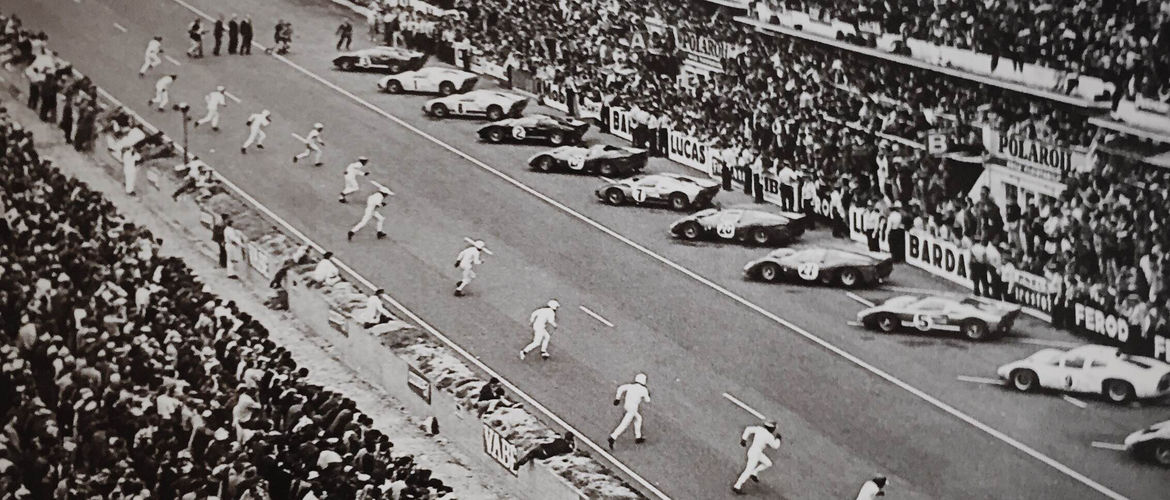
We’re back this year in Pebble Beach to honor the Ford GT40 and the 50th anniversary of a true American story; winning the most coveted endurance race in the world against Europe’s finest at the 24 hours of Le Mans, with a 1st, 2nd and 3rd place finish. Not to mention a four year dominance from 1966 until 1969.

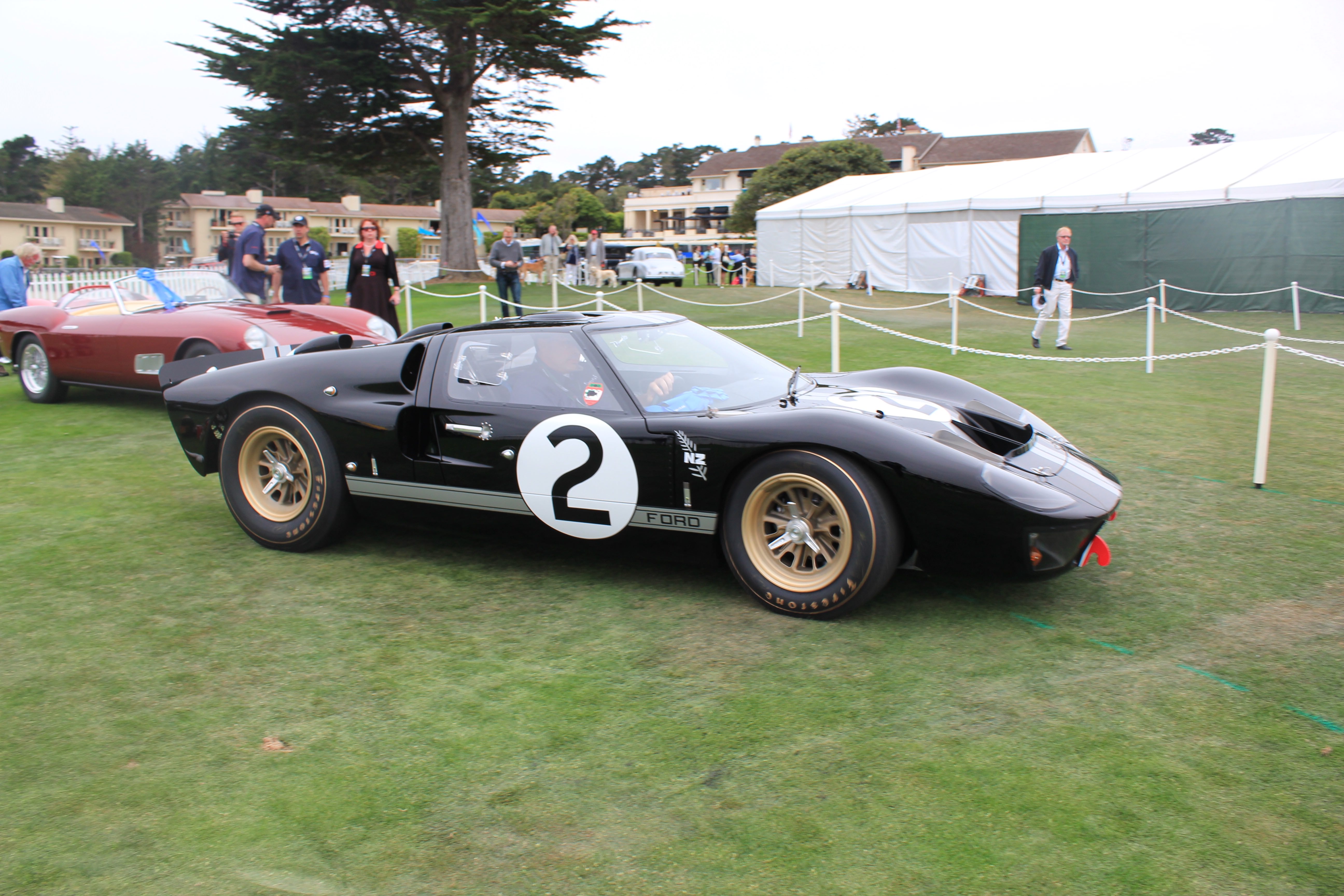
The restored Ford GT40 P/1046 on display at Monterey's Car Week


The 24 Hours of Le Mans

An hour or two of this course is enough to put a driver and his car into a wall or to make him call it quits

Leading up to the early 60’s, only a few races established themselves as global proving grounds for drivers, machines, and the manufactures that built those machines. The 24 Hours of Le Mans (LEH-m-auh) stands out from the rest.

Le Mans began in 1923. Only the brave take on the 9 mile road course in the heart of France, zipping through rural two lane roads, brick and midlevel cobble on either side, with the Mulsanne straight covering a straight shot distance of  four miles. Down this straight, vehicles reach upwards of 200 miles per hour and drivers never lift off of full throttle for up to three minutes.

An hour or two of this course is enough to put a driver and his car into a wall or to make him call it quits, but this endurance race lasts 24 hours. Just reaching the finish line is a remarkable achievement.

Today we idolize the legacy of Porsche, Jaguar and any other car maker that not only survived the grueling test, but won the race. Ferrari for example, won six years in a row starting in 1960. Meanwhile American manufacturers like Ford were no match for the elite European brands until an unexpected event in 1966.

Henry Ford II at Le Mans


Ford vs Ferrari

There are no other three syllable words that spark as much desire as the word “Ferrari.” Enzo Ferrari was a man of few words who ruled with an iron piston, crushing the competition in almost any race his vehicles competed in. He was also a man that believed there was no need for aerodynamics, just the power of a well-engineered motor that would rocket it’s pilot to victory. We can all agree that today Ferrari’s brand represents luxury and speed, and this was no different in the 60’s.

He was also a man that believed there was no need for aerodynamics, just the power of a well-engineered motor that would rocket it’s pilot to victory. 

In 1963 Henry Ford II was head honcho of the Ford Motor Company and found himself with the chance to merge Ferrari into his family’s business, therefore gaining the motorsport prowess that Ferrari had been able to establish. What seemed like a promising business opportunity soon turned into a standoff that would leave a ripple in the automotive space-time continuum. We remember Henry Ford II not just for jumpstarting the GT40 program, but for his courage of taking on the greatest name in motorsports and ultimately creating the Ford factory-team racing model that’s still used today.

Ford went after Ferrari where it would hurt them most.
 

THE GT40

Effective immediately - a racing program would be put in place, with the first set of GT40s attacking Ferrari head on in 1964.

The P/1046 propelled itself to a top speed of 210 miles per hour down the Mulsanne straight with McLaren behind the wheel - the fastest any car had ever gone down the stretch.

Standing only 40 inches in height (literally), the GT40 was first fitted with a 4.2-liter V8 Indy Car race motor in the middle of it’s chassis. The chassis and body were designed in Europe because no one in the US at the time knew how to build a proper mid-engine monocoque. After two years of failed attempts to bring Ferrari to it’s knees, Ford ordered the legendary Carol Shelby to work his magic. Shelby custom built and tested a 4.7-liter V8, but Ford later decided the 7.0-liter V8’s that were originally built for the NASCAR racing series would be the best option for the job. Shelby, however, was still put in charge of the racing operation.

Five evolutions of the GT40 competed at Le Mans, Mk I through Mk V with a handful of prototypes sprinkled in between, but the one that we remember most is the MkII that took the checkered flag in 1966, leaving Ferrari in the fresh French dust.

P/1046 was dressed in a black and silver livery that represented the colors of the New Zealand sporting colors, in part due to the two Kiwi’s piloting the beast - Chris Amon and Bruce McLaren. It packed a 427 cubic inch Ford big-block V8, pumping out 485hp and 475lb ft of Torque to the rear wheels, with a four speed manual transmission. Although American driver Dan Gurney set the lap record within just a few hours in a similar GT40, the P/1046 propelled itself to a top speed of 210 miles per hour down the Mulsanne straight with McLaren behind the wheel - the fastest any car had ever gone down the stretch. 

Standing inches from the car today, we see the Mk II just as Bruce McLaren would have 50 years ago. The level of detail in restoration is impeccable, as the current owner followed every step possible to recreate the original build process - down to the original paint errors seen in archive photos. With a slight crack of the throttle the original Holley carburetor opens, unleashing a symphony performance that only Shelby himself could conduct.

The owner replicated every detail, down to paint errors from archival photos, for his impeccable restoration


2016 – FORD GT WINS AGAIN AT LE MANS

It was a 1-2-3 finish just like 1966, with three Ford GT’s crossing the finish line.

Although major safety modifications have been made to the Le Mans race course, it is still used today as the ultimate battleground for humans and machines to test the limits of time and perseverance. There are two major “classes” of race car, each designating various regulations on what type of motor and body design can be used. The bottom class is as close to a road car you can get, while the top LMP1 prototype class might as well be comprised of space ships.

Ford saw GT’s in 2010 and 2011 hit the Le Mans field, but a third place finish in class was the best it could muster. This year Ford returned to Le Mans to take on Ferrari with a new GT, a brand new design and a brand new motor. After sunset and sunrise, 16 cars out of the 60 that entered saw their demise, while the 2016 Ford GT took top honors in its class on its maiden voyage. It was a 1-2-3 finish just like 1966, with three Ford GT’s crossing the finish line. 

If ever a sentence will remain echoing for generations of American motorsports fans, it will be those of Henry Ford II: “If that’s the way [Enzo Ferrari] want’s it… we’ll go out and whip his ass.”

Some might call it déjà vu, I call it destiny. [H]


Ittai Geiger is a local San Francisco car nerd and comedian. When he's not capturing a #streetfind, he's cruising around on his moto or putting in laps at the local kart track.


27 Nov 00:31

Pick a Side: Biscuits or Cornbread?

by kalexander

In the final weeks of a brutal presidential campaign, our friends at the Southern Foodways Alliance just stoked another heated rivalry at their fall symposium in Oxford, Mississippi: biscuits versus cornbread. The all-in-good-fun debate is a centerpiece of the annual event, a gathering of chefs, writers, academics, and other thought leaders; past contests have pitted cake against pie and competition against traditional barbecue. Yes, every Southerner knows there’s room for both biscuits and cornbread below the Mason-Dixon line. But which, asked the Southern Foodways Alliance, best represents the South? On stage, Birmingham-based writer Jennifer V. Cole vouched for biscuits and chef Kevin Gillespie, of Revival in Atlanta, stood up for cornbread. When put to the audience for a vote, however, no clear winner emerged. So we asked the two pros who led the buttery brawl to share their arguments with G&G. Now, we pose the question to you.

Biscuits-vs-Cornbread_0.jpg
Photographs by Peter Frank Edwards

Really, though, who won?

Jennifer V. Cole: Oh, I think there was a clear consensus. Kevin was a formidable opponent, but biscuits won—and I’m not just looking at this through butter-smeared glasses.

Kevin Gillespie: I honestly think biscuits won the debate. But I say that with a caveat, which is that the question was: ‘Which should be the symbol of the South?’ People took it as, ‘Which do you like to eat more?’ I admit it: Even a mediocre biscuit is still good, but only good cornbread is good. It’s hard to argue with that. As an emblem, though, cornbread won in a landslide.

Jennifer-Cole-Kevin-Gillespie.jpg
From left: Jennifer V. Cole; Chef Kevin Gillespie. (Photo courtesy of Brandall Atkinson)

Okay, give me your elevator pitches.

KG: America—and Southern food—would not exist without cornbread. Before there was a United States, Americans existed on different kinds of cornbread: tortillas, corn pone, et cetera. All of us were cornbread eaters, even if now we can afford to eat biscuits. I say that it’s okay to be proud of your ancestors’ humble agrarian roots.

JVC: Biscuits represent the aspirational quality of the South. To be able to get flour, leaveners, buttermilk, butter, and the refrigeration necessary to keep them—that signified that you’d made it. To me, the biscuit is that shining example of the forward movement of the South—of continuing to push forward and striving to be better.


If you’ve only ever had canned Grands biscuits or Jiffy mix cornbread, you might not know just how good homemade versions can be. What would you serve to somebody who’s on the fence?

JVC: I like it simple, with quality ingredients: good butter and real cultured buttermilk. Then there’s an art to bringing the ingredients of a biscuit together. We were joking that anybody can make cornbread. You just dump things together. A biscuit is an expression of love from the person who made it. So, a biscuit made with great ingredients by a person with a mastery of the process. As Kevin says, though, the worst biscuit is still much better than the worst cornbread. Bad cornbread is like crumbled up tree bark. It’s horrible.

KG: I feel like I’m a bit of an authority on this, because at Revival, the one item every person gets is cornbread. It’s a family recipe handed down through generations that—I will swear on my grandmother’s grave—is better than any cornbread you’ve ever had. It has the perfect texture, with that outside golden-brown bark that has an almost smoky, tannic quality from the skillet and the pork fat in it. The interior is simultaneously fluffy and creamy. You know, people overcook cornbread to a crumbly, fall-apart texture. That’s not right. There should be a juxtaposition between the hard outside and the very soft interior. You don’t need to serve that with anything.

Biscuits-Cornbread-Buttons.jpg
Photo courtesy of Brandall Atkinson
 

You’re both born-and-raised Southerners, so I know you have room in your hearts for both biscuits and cornbread. Do you have one nice thing to say about the other side?

KG: I do like biscuits. Truth be told, at breakfast I’d rather pour syrup on a biscuit than cornbread. It’s nostalgic for me. The way my granny made biscuits, they were very delicate. Rather than splitting them open, she’d put them on a plate and pour a little sorghum syrup on top. That and a nice pat of butter. You eat it like a stack of pancakes. That’s one of the most nostalgic flavors of my childhood.

JVC: Of course I love cornbread. When a pan of cornbread is done right, with a crisp crust, and when you take a bite it’s pillowy and ethereal… That’s a moment of magic no Southerner can deny. It’s almost like cracking into a corn crème brûlée.

So, G&G readers, what do you think? Which better represents the South: biscuits or cornbread?


Pick a Side: Biscuits or Cornbread?


27 Nov 00:30

The Mystery Books That Inspired ‘To Kill A Mockingbird’

by cjlotz

The best writers are often great readers. Take Harper Lee. In the 1930s, Lee’s older brother gave her two books, The Gray Ghost and Stoner’s Boy by Robert F. Schulkers. Part of a series called Seckatary Hawkins, the books later inspired themes in the Pulitzer Prize-winning To Kill a Mockingbird. This fall, the University Press of Kentucky re-released the very books that moved Lee eighty years ago. Complete with illustrations and sporting new cover art, the hardbacks are beautiful reissues of a classic children’s series, with introductions from Schulker’s grandson Randy Schulkers, and his great-niece Diane Schneider.

Seckatary-Hawkins-full.jpg
The re-released books. (Photos by Nikki Russell)

Seckatary Hawkins is a young adult mystery series that predated Nancy Drew and the Hardy Boys. Beginning in 1918, Schulkers wrote weekly story installments featuring a rag-tag crew of Kentucky pals for the Cincinnati Enquirer. The tales, inspired by his own youth exploring the riverbanks and caves of the Bluegrass region, soon spread to newspapers all over the country and evolved into radio broadcasts and eleven children’s books published between 1921 and 1932. Themes of courage and friendship inspired kids across the nation, including Harper Lee.

Harper-Lee-note.jpg
A “fair and square” inscription references a popular Hawkins phrase. Harper Lee signed this in a first edition of To Kill a Mockingbird.

Hawkins makes two appearances in To Kill a Mockingbird: When Jem Finch wins a bet and receives a copy of The Gray Ghost, and in the novel’s closing pages, when Atticus Finch reads it to Scout. She sleepily muses on how Gray Ghost’s “villain” is simply misunderstood. Scout’s understanding of the work connects to Mockingbird’s central story of acceptance:

“An’ they chased him ‘n’ never could catch him ‘cause they didn’t know what he looked like, an’ Atticus, when they finally saw him, why he hadn't done any of those things...Atticus, he was real nice...”

His hands were under my chin, pulling up the cover, tucking it around me.

“Most people are, Scout, when you finally see them.”

Consider these reissues as a gift for the young-adult reader or aspiring writer in your life. Or, if you’re curious about how the books stirred Harper Lee, order The Gray Ghost or Stoner’s Boy for yourself and savor them over the holidays, when you have a little extra reading time.

The-Grey-Ghost.jpg

Shared: 
5
27 Nov 00:25

Untangling the History of Christmas Lights

by Miss Cellania

The long Thanksgiving holiday weekend is the perfect time to get out the Christmas decorations and put up the colored lights that illuminate the dark winter nights. Those beautiful strings of electric lights replaced candles, which didn't last long, came only in flame color, and were extremely dangerous. The dawn of electric Christmas lights had a lot to do with Thomas Edison, as you might guess, but even more with Edward Hibberd Johnson, who was the first to use Christmas lights.

In 1871, Johnson hired Edison, then a 24-year-old inventor, as a consultant for the Automatic Telegraph Company. Edison “ate at this desk and slept in a chair,” Johnson later recalled. “In six weeks he had gone through the books, written a volume of abstracts, and made two thousand experiments...and produced a solution.”

So impressed was Johnson that when Edison left to start a new company, he followed, quickly making himself useful turning Edison’s brainstorms into cash. In 1877, after Edison invented the phonograph, Johnson took the machine on tour, charging crowds to drum up excitement. When Edison patented the light bulb in 1880, its exact value was hard to gauge; widespread electrification was still decades away. Still, Johnson, Edison and others invested $35,000 to form the Edison Lamp Company to sell the bulbs.

So you see, the guy who strung the first electric Christmas lights in 1882 had a financial stake in their success. Read how it all came about in the December issue of Smithsonian magazine.

26 Nov 16:42

How I Conducted Extensive Market Research Into The Purchase Of Weller 12 Bourbon In Kentucky

by John Navin, Contributor
Street level market research of a rare bourbon leads to a few important realizations.