
 The Massachusetts Commission Against Discrimination says the state's new ban on gender identity discrimination means that churches have to allow people to use the bathroom of their choice when holding a "secular event, such as a spaghetti supper, that is open to the general public."
Metric Giles got tired of looking at the trash-strewn vacant lot next to the offices of the Community Stabilization Project where he works in St. Paul, Minnesota. The lot was once the site of a church that was torn down due to code violations. So with permission of that church, which says it still owns the lot, he and some others cleaned it up and planted a garden. The state, which claims the space was forfeited years ago for back taxes, ordered Giles to remove the plants.
Officials at Toronto's Jackman Avenue Junior Public School were extremely unhappy that students were tossing their juice boxes into the garbage or putting them into recycling bins but leaving the straws in. Officials wanted to maintain the district's highest "EchoSchools" rating, so they banned juice boxes.
In the United Kingdom, Health Secretary Jeremy Hunt has directed restaurants to cut the portion sizes or reduce the sugar in desserts and other sweets. Efforts will be tracked on a government website, and those who don't comply with the demands will be publicly named.
Hazel Juco, a senior at Michigan's John Glenn High School, says she posted a photo of the discolored water coming out of a tap at a school sink on social media because she hoped it might spur some action. It did. She was suspended for using an electronic device in a school restroom.
Lee Miller of Port Orange, Florida, logged onto his bank's website to find his savings account had been emptied. Most of the money in his checking account was gone, too. Thinking he'd been hacked, he called the bank and found the federal government had drained his money, claiming he died back in 2012. Officials with the Social Security Administration say they'll work with him to correct the matter, but only after he signs an affidavit attesting that he's alive.
France is the first country to ban disposable plastic cups and plates. The new law requires "all disposable tableware to be made from 50% biologically-sourced materials that can be composted at home by January of 2020."
Veronica Welsh, who teaches at Smithtown High School West on Long Island, told her Facebook readers that the school has quite a few racists. You can spot them, she explained, by the Donald Trump gear they wear.
In Michigan, the Ottawa-Kent high school athletics conference has sent a letter to school administrators saying that fans at games can chant "U-S-A" only before or after the national anthem. Officials say using the chant at other times may be a way of taunting opposing players or fans, since the letters could stand for "U Suck Ass."
Greg Hughes, former director of the federal Veterans Crisis Line, says that more than one-third of the calls to the suicide prevention number go unanswered because of poor work habits by those manning the lines. Among other issues, many employees leave before their shifts are over.
The owner of a pub in Bavaria faces up to four years in prison after investigators found bottles of Führer Wine, with images of Adolf Hitler on the labels, in his pub. Officers say the man has no links to the far right. He received the wine as a gift and thought it was funny.

The picture above by G. Lecoeur, entitled Sardine Run, was selected as the Grand Prize winner in National Geographic's Nature Photographer of the Year contest. It was taken off Port Saint John’s in South Africa. He says,
I captured this image during the migration of the sardines along the wild coast of South Africa. Natural predation, sardines are preyed upon by cape gannet birds and common dolphins. The hunt begins with common dolphins that have developed special hunting techniques. With remarkable eyesight, the gannets follow the dolphins before diving in a free fall from 30 to 40 meters high, piercing the surface of the water head first at a speed of 80km/h to get their fill of sardines.
Sardine Run was also the winner of the Action category. See more of Lecoeur's photographs in his gallery.

Dragging You Deep Into the Woods! is the winner in the Animal Portrait category. This photo is by varun aditya, taken in Amboli, Maharashtra, India.

First place winner in the Landscape category is Struggle of Life by Jacob Kaptein, taken in Leuvenum, Gelderland, Netherlands. See all the winners in these and the Action and Environmental categories, as well as the awesome photographs that came in second and third in each category, plus honorable mentions, at NatGeo. All winning photographs are available as wallpapers, too! -via Boing Boing

All around the world, each public transit system has its own rules. These come in both the official and unspoken varieties, the former basically consistent from place to place, and the latter usually reflecting the mores of the society each system serves. The acceptability of talking to one’s fellow passengers, for instance, tends to vary, and in some countries even making eye contact counts as a no-no. You certainly won’t try it in Paris after witnessing the consequences when Steve Buscemi breaks that rule in Tuileries, this short directed by the Coen brothers that first appeared in the anthology film Paris, je t’aime.
“Paris is known as the City of Lights,” Buscemi’s apparent tourist reads in his guidebook as he sits awaiting a train in the station from which the film takes its name. “A city of culture… of fine dining and magnificent architecture. Paris is a city for lovers: lovers of art, lovers of history, lovers of food, lovers of… love.” Though he seems to be having a somewhat less than lovely time there, including getting pelted by a passing child’s spitballs, he endures. Not five seconds after reading about the no-eye-contact custom on Paris’ “reasonably clean” subway (a laugh line for any Parisian) does he look fatefully up, catching the eye of a girl across the tracks and sending her boyfriend into a jealous rage.
Foreigners have long felt as intimidated by Paris as they’ve admired it, a mixture of emotions the Coen Brothers play on without leaving the Tuileries platform, as does Alexander Payne in the altogether different experience of the American alone in the City of Lights he essays at the end of Paris, je t’aime. In the decade since the movie came out, we’ve seen a few other city-themed anthology films, including New York, I Love You, Rio, Eu Te Amo, and the unrelated Tokyo!, albeit none with a second contribution by the Coen brothers or a second appearance by Buscemi — whose character may have yet to recover from from his trip to Paris anyway.
Related Content:
How the Coen Brothers Storyboarded Blood Simple Down to a Tee (1984)
Watch the Coen Brothers’ TV Commercials: Swiss Cigarettes, Gap Jeans, Taxes & Clean Coal
World Cinema: Joel and Ethan Coen’s Playful Homage to Cinema History
1,150 Free Movies Online: Great Classics, Indies, Noir, Westerns, etc.Based in Seoul, Colin Marshall writes and broadcasts on cities and culture. He’s at work on a book about Los Angeles, A Los Angeles Primer, the video series The City in Cinema, the crowdfunded journalism project Where Is the City of the Future?, and the Los Angeles Review of Books’ Korea Blog. Follow him on Twitter at @colinmarshall or on Facebook.
Tuileries: The Coen Brothers’ Short Film About Steve Buscemi’s Very Bad Day in the Paris Metro is a post from: Open Culture. Follow us on Facebook, Twitter, and Google Plus, or get our Daily Email. And don't miss our big collections of Free Online Courses, Free Online Movies, Free eBooks, Free Audio Books, Free Foreign Language Lessons, and MOOCs.
They probably hate the sirens, too.
 Whole Hog at Scott’s BBQ is a thing to behold. Perfection on a plate. Now, with the planned addition of a Charleston, SC location of Rodney Scott’s Scott’s BBQ it’s time to get ready for whole hog that’s a lot easier to get to!
The secret to whole hog at Scott’s is roasting the whole animal. As simple as it sounds Rodney says most people don’t want to deal with it.
Take a look at the new video interview with Rodney Scott HERE and give a listen to a separate PODCAST interview with Rodney Scott below (also transcribed below).
Author Bill West
North and South Carolina are indeed different entities. One difference is in sauce appeal. Cross the state line headed north and things get a lot more sour in the the form of Western Carolina Vinegar sauce. Tart, hot, a li’l bit sweet, but thin enough to mix quietly into a pile of pulled pork without getting in the way of the smoke in the meat.
Rodney Scott's sauce is more Eastern North Carolina and unlike the "Scotts" commercial sauce in stores (no carb/different Scott) Rodney's sauce has a bit of sweetness.
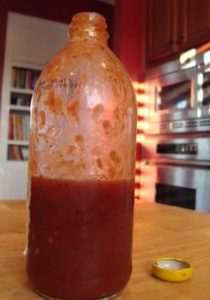
Use an empty 16oz bottle (from cider vinegar or the like) for this sauce to store and serve. Simmer ingredients in a small to medium sauce pan for ten minutes. Let cool before serving.
Cuisine BBQ
It doesn’t get anymore country than the innards of South Carolina. If you’re ever in the Myrtle Beach area (actually this isn’t even very close to Myrtle Beach). Hemingway, South Carolina, the home
of real country. It doesn’t get more country than Hemingway, South Carolina, and today our guest is from the world-famous Scott’s BBQ. At least whole hog at Scott’s is famous in my book. Sometimes on this podcast we’re going actually be talking to country singers, but also we can delve into real country food.
Again, nothing’s more country

Getting the spaceship tour from Mr Scott!!
than whole hog at Scott’s with Rodney Scott of Hemingway. Without any further ado, let’s check in with Rodney, Mr. Scott. Thanks for being here.

Rodney Scott:
My pleasure.
Bill West:
Rodney is world renowned in the world of whole hog BBQ pit cooking, and his store in Hemingway, South Carolina, which I love is, I would say—how long did it take you to drive here? An hour and 15 minutes?
Rodney Scott:
About an hour and 40 minutes.
Bill West:
Depends how fast you drive. Definitely worth a Saturday morning road trip, not only because of the pork, but you also do a mean, what was it a ribeye?
Rodney Scott:
Yeah. We do rib eyes on Saturday, a little something I came up with.
Bill West:
Something special. Have you ever done a book?
Rodney Scott:
Never done a book.
Bill West:
So, you just have been on all these BBQ shows. What’s all the national TV exposure you got?
Rodney Scott:
We’ve been featured on CBS Sunday Morning. We’ve done Anthony Bourdain, Andrew Zimmern’s show. We’ve done Kimberly Simply Southern. We’ve done Man Fire Food. Those are the ones that I know about. There have been several little spots that we’ve appeared on like BBQ Paradise or a little something like that.
Bill West:
They roll in and do it and—
Rodney Scott:
Yeah. They just give you a quick glance of Scott’s BBQ and other BBQ pit masters.
Bill West:
What are your hours over there at the store?
Rodney Scott:
Our hours in Scott’s BBQ, we’re open Wednesday from 9:30 until 6:00. Then, we’re open Thursday, Friday, Saturday from 9:30 until about 8:00.
Bill West:
That’s the dream. Actually, sometimes, that’s Thursday, Friday, Saturday hours. I’m like, that’s a great life. But there’s more to it than just those hours, because y’all are cooking and prepping. What’s that part of it look like?
Rodney Scott:
Oh, my God. Prepping is pretty tough. You have to start cutting wood to carry you throughout the week. You have to clean the pits every week. Just getting all of the hog count together and everything, preparing. It’s pretty physical, both preparing as well as cooking, because everything’s done manually the way that we do it. It starts as early as Tuesday morning, getting ready for Wednesday.
Bill West:
Does the wood come to you chopped?
Rodney Scott:
No. I wish.
Bill West:
You don’t do that anymore, right? Or do you—
Rodney Scott:
Well, I rarely get a chance to go and cut wood, but the guys that still work with us, they cut most of the wood now, and they cut it, bring it in, chop it, and keep the yard stocked up.
Bill West:
Well, I made a visit a couple weeks back and did some video. Just the burn barrel you have, it looks like it’s melting under the heat. That gets pretty intense, right?
Rodney Scott:
That heat is very intense. We get a lot of visitors in the wintertime, especially when it’s freezing.
Bill West:
That’s where people hang out?
Rodney Scott:
Yeah. That’s the hangout spot. Free heat. You just stand around and it’s comfortable.
Bill West:
This podcast started a couple weeks back. It’s about country music, country cooking, country food, which I don’t know that you can get more country than Hemingway, South Carolina, right?
Rodney Scott:
Oh, man. It’s pretty rural out there.
Bill West:
How would you define country cooking? Or country kitchen?
Rodney Scott:
Country cooking in my opinion is basically what you had around the farm or what you had available in your area. For example, you would take a whole hog that you’ve been raising for a while and you would BBQ later on, maybe around harvest season. Garden foods that you grew. That’s my opinion of country cooking. Basically, everything that’s around the house that was in the immediate area that you had to work with.
Bill West:
It almost sounds like farm to table kind of thing, right?
Rodney Scott:
Pretty much.
Bill West:
Which I guess with South Carolina has been pioneers with that, with Sean Brock is a friend and fan of yours, right?
Rodney Scott:
Yeah. Great friend, great guy.
Bill West:
When it comes to sourcing hogs and the things that you do, how hard is that to try and get local? What’s going on in that world? Because everybody’s talking organic and probably I would guess the BBQ world is probably later in the game, maybe, on paying attention to that sort of thing.
Rodney Scott:
Well, we try to keep a little focus on it ourselves. There’s one farmer that we dealt with for years, and because we weren’t able to go to the next farmer, so to speak, to move up, that left us to deal with this old-school guy that still fed his hogs by hand, that was still doing thing the way that he used to do way back. It benefits now because he has the most consistent when it comes to the yield of meat per hog, the flavor, the growth. His hogs come to me pretty healthy all the time, and he’s the only guy that I deal with.
Bill West:
How much difference is there? I grew up in Chicago, and to me, when I have a baby back rib or slab of baby back ribs that I remember in Chicago or spare ribs, it almost seems like a different animal to me, because I thought the bones where I was growing up were more spindly, for lack of a better term. They seemed maybe bigger boned down here in the South. Is that just the different breeds in where you get them?
Rodney Scott:
It can be breeds, and it also can be the age of the hog. Sometimes the older the hog is, the longer the bone or the bigger the bone. It’s usually a little tougher. Again, it’s the breeds. It all depends on which ones you get. A lot of times, you get a nice, like the Mangalica crossed with the Berkshire. He tends to grow pretty good. He’s tender, juicy, cooks real well. I cooked one just a few weeks ago and it came out awesome.
Bill West:
Tell me about those hogs, because that’s something I’m learning. I’ve obviously heard of Berkshire hogs.
Rodney Scott:
We’re all still learning. From what I know, that Mangalica is pretty much a bigger hog and more hairy, kind of like a wooly pig. He tends to grow a lot of intermuscular meat, which is more looking like a steak than pork when it’s raw. He cooks totally different than what you would see here grown just in the South. More of a heritage bred hog, more purebred.
Bill West:
And all that’s becoming more talked about these days? And you can get the information these days, because we have the Internet now and we can all look whole hog at Scott’s up. Your dad started the business, right?
Rodney Scott:
My dad started the business, yes.
Bill West:
Was he doing whole hog?
Rodney Scott:
He was doing whole hog. Whole hog was all we knew. We did the whole hogs from start to current date, and that’s the only thing I ever knew. When it came to cooking shoulders and quarters and halves, that was a whole new ballgame for me, because I was so used to cooking whole hogs.
Bill West:
Part of me says doing whole hog would be the most economical. You just get the whole thing there, but I’ve heard not really. You buy Boston butts or hams and you can pack more on a grill. You can ship more. What’s the reality? Is it more efficient to do a whole hog?
Rodney Scott:
In my opinion, flavor-wise, it’s more efficient to do the whole hog. Of course, you can get a little more meat with the butts, but there’s something that I’ve noticed about cooking a whole hog. Somewhere in that backbone area, that flavor comes out of those backbones when it’s all joined together. That’s just a little different than it is with just a butt by itself or with just a half of a hog split down the middle, even. It’s a big difference when you keep the whole hog together.
Bill West:
Really?
Rodney Scott:
Yeah. It’s amazing. It sounds crazy, but I’ve come to notice it in the last few years that, when you’ve got it all together, it tastes a whole lot different.
Bill West:
I was watching you the other day, mixing things up as you go and adding the sauce. I think there’s something to that as well, just paying attention to it. I remember you saying the bones, the bone-in cooking like that and we’ve all heard that before, like steak bone-in, there’s something that it—
Rodney Scott:
Something different.
Bill West:
That it gives it, and I’m sure the spine that’s in there, there’s a surface area all down that backbone. You think even when you have a half a hog, it’s different?
Rodney Scott:
It’s still different. It’s still a little different. The flavor’s still good, but someone who eats hogs as much as I do would kind of notice the difference in the hog cut in half versus him butterflied. Butterflied being just split down the spine, not completely apart.
Bill West:
No doubt, I think the flavor, when you go whole hog, there’s just nothing like it. The easy argument with that would be, of course, because you’ve got ribs in there. You’ve got the pork tenderloin. When you buy a whole hog, you’re paying for the ribs, too. In that regard, if somebody’s just doing a pulled pork BBQ, they would probably save money just by doing butts and shoulders.
Rodney Scott:
Exactly.
Bill West:
Okay. When you get Scott’s BBQ, you’re getting the bacon in there and everything, which just—
Rodney Scott:
You’re getting everything.
Bill West:
Makes it all just taste great. Have you ever done a commercial sauce? I know you sell it out of the store, but mass marketed?
Rodney Scott:
We’ve never done a commercial sauce, no. Never. There is a sauce out there with Scott’s name on it, but that is not us. The only sauce that we sell is right there at the store.
Bill West:
The Scott’s that I see, because I asked you the same thing. I saw a yellow-red out of North Carolina. In fact, the news guy just popped his head and said, oh, I love that sauce. That sauce is great and it’s a good low-carb thing. Your sauce is similar, but describe your sauce.
Rodney Scott:
Our sauce is vinegar and pepper based, of course. Same as that sauce, but we don’t have quite as many ingredients as Scott’s BBQ sauce with the red and yellow label. The ingredients that we have is not more of just dumped in, but there’s a technique to the way that we make our sauce. There’s a certain point when you add this to that. I’m not going to tell you exactly what it is. When you add it all together, that gives it a different flavor. It’s basically somewhat of the same ingredients, but less ingredients than the red and yellow label, but totally different flavor.
Bill West:
People can come by the store in Hemingway and pick up a gallon or half-gallon, I think I saw in there.
Rodney Scott:
Oh, yeah.
Bill West:
Is that something you want to do down the road, do a commercial sauce, or are you even worried about that?
Rodney Scott:
It’s still a thought. I would love for everybody to be able to get their hands on it. At the same time, I’d love for everybody to come out and see what we do, how we do it and enjoy the experience of visiting a rural BBQ spot out in country, and kind of see what it was like to see us as we grew up in the country, cooking whole hogs, eating pork. Then, you get to buy your sauce and your pork all at the same time, get an experience, and go back.
Bill West:
Yeah. Do a lot of people take a tour, or is that just whoever asks?
Rodney Scott:
Man, quite a few people come through wanting to walk through the pits, and of course I walk them through.
Bill West:
You don’t mind?
Rodney Scott:
I don’t mind. I don’t mind at all.
Bill West:
That’s a great experience, and actually, I saw the article in the newspaper six months ago, Charleston paper, about it being a whole new pit. It is space-age greenhouse meets smokehouse. What happened to the old smokehouse, and who designed this new thing and how’s it been working?
Rodney Scott:
Well, the old smokehouse was made out of cinderblock. There were three feet of cinderblock and the rest was wood. The insides were made out of a metal, an FRP material, and we had a fire. Pit fire led to the whole building catching and burning, and had to rebuild. Before we rebuilt, we consulted with some good friends, one of them being Reggie Gibson. He designed the new BBQ pit that you see now.
Bill West:
Any regrets? Anything you could change at this point?
Rodney Scott:
No regrets, none at all. I appreciate the pit itself. It’s different. It’s a lot cooler, a lot more spacious. It’s great to work in, and it has a sound system.
Bill West:
Yeah, yeah. Do you have to deal with noise ordinance out there?
Rodney Scott:
No. That’s the beauty of the country.
Bill West:
You were rocking and rolling when I was—I said I heard Clarence Carter stroking.
Rodney Scott:
Got to be stroking. Got to be stroking.
Bill West:
You have any plans to open up another location?
Rodney Scott:
Yes, definitely. Definitely want to open up another location. Being very cautious about where I go and what I want to do and how I want to do it. I would like to do it the same way I do it in Hemingway. Of course, my first choice is still Charleston.
Bill West:
Right. Would you look downtown, or would you look on the outskirts?
Rodney Scott:
Wow. Kind of torn. I love it downtown. There was one thought of having a rural feel to it, even in the city where there’s a little trip, but not too far. It’s kind of in between that right now.
Bill West:
Right. Y’all heard it here. Of all the big chains, what would you recommend—who does really good BBQ on a large scale?
Rodney Scott:
Really good beautiful on a large scale? Jim ‘N Nick’s BBQ. I don’t see them as a chain. I see them as a family.
Bill West:
And you know those guys, right?
Rodney Scott:
I know those guys very well.
Bill West:
They certainly do it right. I always said, if you don’t smell smoke when you go by, there’s an issue, and you definitely—
Rodney Scott:
Something’s wrong.
Bill West:
You smell smoke there, and actually there’s a lot of guys in town that do it the right way. Once you get out of South Carolina, though—
Rodney Scott:
It gets a little different. It gets a little different.
Bill West:
All of the greatest BBQ joints across the country, what would you say, what are in the top five?
Rodney Scott:
Wow. Of course, I just mentioned Jim ‘N Nick’s. Sam Jones over in North Carolina. Winterville, North Carolina. Great friend of mine. You got Pat Martin over in Tennessee. You got 4505 out in San Francisco. Those guys are great.
Bill West:
Are they doing hog? Are they doing their own thing?
Rodney Scott:
They’re all doing hogs. You’ve got Pegleg Porker over there in Nashville as well.
Bill West:
Really? There’s probably only a handful of people that are doing whole hog, though, right?
Rodney Scott:
Yeah.
Bill West:
Here, I guess probably Sweatman’s. I guess they’re doing whole hog.
Rodney Scott:
Yeah. I think Sweatman’s is still doing whole hogs.
Bill West:
Around here, of course, yeah. But really not that many.
Rodney Scott:
Yeah. When you leave the Southeast, it tends to get a little smaller as far as whole hogs go, from my travels. If they’re out there, they’re hidden. I’d love to find them and see what they’re doing and enjoy somebody else’s BBQ as well, but I have no idea who’s all doing whole hogs other than in the Southeast.
Bill West:
All right. I’ll wrap it up here. First of all, we brought the Heinz—you mentioned Sam.
Rodney Scott:
Sam Jones. Sam Jones, everybody.
Bill West:
Had you seen this before?
Rodney Scott:
I’ve seen it online. I’ve seen a couple of pictures, and Sam Jones is a great guy, very funny guy. Another guy that’s very into music like I am.
Bill West:
He’s into, you said, into the classic country.
Rodney Scott:
Yeah. He’s mostly into classic country.
Bill West:
We’ll get Sam on at some point. We need to talk to him about some country music.
Rodney Scott:
You’d love Sam Jones. He teaches me country music.
Bill West:
We mentioned, I’m holding in my hand, Heinz, they have a four-pack of four different sauces that were endorsed by regional guys, and the Carolina vinegar tangy was Sam Jones’s. He’s the partner there. So, kind of cool. All right. Real quick questions. I’m going to try to do rapid-fire. I have a feeling I know that we’re going to go down a rabbit trail here. What would you say the best place to get a hotdog is?
Rodney Scott:
Wow. Best place to get a hotdog? My favorite hotdog that I’ve had?
Bill West:
Yeah.
Rodney Scott:
Out in the county, in Pleasant Hill, there’s a little store called W.T. Owens. It’s about eight miles from my place in Hemingway. I will drive all the way out there just to get a hotdog.
Bill West:
Good answer. Favorite cheese?
Rodney Scott:
Favorite cheese? A lot of folks in my area call it hook cheese, which is basically a sharp cheddar. It’s sold in a round, wooden case, and it has a red rag around it. That’s how it’s recognized in my area, as a red rag. I have to say sharp cheddar.
Bill West:
Sharp cheddar. Lastly, your favorite chef? You got a favorite TV chef? Or real-life, real-world chef?
Rodney Scott:
Man, it’s so many. It’s so many favorite cooks out there. Friends, chefs, man that’s a toss-up.
Bill West:
You’ve kind of seen them all.
Rodney Scott:
I’ve seen quite a few. Quite a few. There’s quite a few that I know, guys from New Orleans. Don Link, Steven, Ryan, these guys out of Herbsaint and Peche down there. Nick Pihakis, great guy.
Bill West:
That’s Jim ‘N Nicks, right?
Rodney Scott:
That’s Jim ‘N Nicks. BBQ as well as some of his even Greek dishes, amazing. The list can go on and on. Sean Brock, Mike Lata. All of these guys.
Bill West:
A lot of these guys are right downtown.
Rodney Scott:
Yeah. These guys right around town here. They’re just great. If I go to your spot more than once, I like your food. Trust me.
Bill West:
Finally, what’s on your playlist in the smokehouse?
Rodney Scott:
Wow. My playlist in the smokehouse ranges from Clarence Carter to Michael Jackson. A lot of old-school hip-hop with Run DMC, Big Daddy Kane, Fat Boys. A lot of Anthony Hamilton. One of my favorite artists, Anthony Hamilton. You may hear him. Then, there’s another list that I have. You may hear Smokey and the Bandits theme song by Jerry Reed. You’ll hear Conway Twitty.
Bill West:
Favorite country song was?
Rodney Scott:
Oh, man. I have to say The Gambler. The Gambler would have to be one of my favorites, but Johnny Cash, oh my God. Johnny Cash.
Bill West:
You said you kind of know some of the Rucker fam, but you said—
Rodney Scott:
Wagon Wheel, yeah. Darius Rucker, Wagon Wheel, as well as the song with Lionel Richie that he did. What’s the title of the song?
Bill West:
Was it Stuck on You?
Rodney Scott:
Stuck on You, yeah. That one as well.
Bill West:
Man, I appreciate you giving us some of your time. It’s Scott’s BBQ. Hemingway, South Carolina, if you’re ever running through. You need to get that mail order business going.
Rodney Scott:
Oh, man. I’m working on it.
Bill West:
I know the guys at Rendezvous in Memphis. They do a crazy business with that. Of course, they’ve got the FedEx hub right there in their backyard.
Rodney Scott:
Yeah. They’ve got everything going, all the FedEx planes are in Memphis.
Bill West:
But go stop by and see Rodney Scott in Hemingway, South Carolina and keep an eye out for him all over the place. How do people get ahold of you if they want to find out more about all the stuff you got going?
Rodney Scott:
If you want to find out everything, I’m on Twitter @RodneyScottBBQ. I am on Facebook, Scott’s BBQ. You can also reach out to me. Hey, call the shop. 843-558-0134, basically how you’ll find me.
Bill West:
You’re there running things.
Rodney Scott:
I’m doing the best I can.
Bill West:
Rodney Scott. Bud, thank you for coming.
Rodney Scott:
Thank you.
Bill West:
Hey, that’s a wrap for me. It’s Bill West, BBQTricks.com; also NashFM969.com, if you want to find out more about us. Also, I’ve got to thank the crew over at NashCountryDaily.com for sharing out the podcast. Make sure you subscribe there. Jump online to iTunes or audioBoom and make a comment, make a rating, and follow us. It definitely helps spread the word about all the good country music. Plus, I’m taking some select reviewers and rewarding you with some music and things like that. More about me. Jump over to my website, BBQTricks.com. I just released a book called the BBQ Blueprint. I would love for you to check that out. If you don’t want to take the plunge a purchase that book just yet, how about a freebie there, which is a free book called BBQ Sauces and Sides just for checking in. We’d love to give that to you. Thanks again to Rodney Scott, Hemingway’s Scott’s BBQ. If you’re ever in the area out there, in the whole state of South Carolina, make a run up the road and see Rodney for the best whole hog that you will ever find. Also, by the way, the BBQ Blueprint book, I chat more in depth with how Rodney cooks his whole hogs. I’m going to leave you with a last words today from the late, great actor Humphrey Bogart, who once said, a hotdog at the ballgame beats roast beef at the Ritz.
END OF RECORDING
The post Whole Hog at Scott’s BBQ with Rodney Scott appeared first on Barbecue Tricks.

As 2016 draws to a close, just about everyone is thinking the same thing—boy, are we going to miss it! Every year must end, but something about this one was special: maybe the unceasing political turmoil, or the spate of celebrity deaths, or all those charming, friendly clowns.
Nothing gold can stay. But if you want to squeeze just a little more out of 2016, we've got just the place for you to do it: Baker Island, a tiny, saucer-shaped atoll in the middle of the Pacific Ocean. Located halfway between Hawaii and Australia, Baker Island is one of only two named pieces of land in the world to fall within the time zone UTC-12:00. (The other is its neighbor, Howland Island.) This makes it the last place on Earth where each day—and thus each year—finally ends. Below is a brief guide to this prime New Year's Eve location, where, surrounded by bird poop and boobies, 2016 will breathe its dying breath.

Baker Island is an atoll—an island made out of a jutting coral reef—about 1,500 miles southwest of Hawaii. It is not quite a mile square, and is, for the moment, completely uninhabited (by people, at least). Although it was certainly frequented by Polynesian sailors, its first "official" sighting was in 1818, by the occupants of the whaling ship Equator, and for a few decades after that it served mainly as a place to bury dead seamen. In 1855, it was sold to the American Guano Company, who set up camp there to harvest the plentiful mounds of bird poop, which one expert called the "finest he had seen."
Attempts to make the island anything more than a giant bird poop repository—a would-be settlement in 1935, a military air base project in 1943—have mostly been stymied by the enormous number of birds that already live there. In 1974, the US gave up and declared Baker Island a National Wildlife Refuge, part of the Pacific Remote Islands Marine National Monument.

Like most worthwhile New Year's Eve spots, if you want to visit Baker Island, you'll have to make your plans far in advance. The U.S. Fish and Wildlife Service sends a boat over once every two years or so to make sure everything is still going well. In order to be on it, you need a special permit that is generally only afforded to researchers and educators. If you get past these bureaucratic bouncers, you're facing eight days at sea, after which you'll arrive at a small landing on the island's west coast.
Baker Island is located just north of the equator. According to the CIA World Factbook, it enjoys "scant rainfall, constant wind, [and] burning sun"—so dress accordingly! For this special occasion, you may want to coordinate your outfit with the island's vegetation, which consists mostly of grasses, short shrubs, and vines that grow on the ground.

Currently, most of the residents of Baker Island are seabirds—largely boobies, frigatebirds, and sooty terns. Two types of reptiles, the snake-eyed skink and the hawksbill turtle, also hang out there, along with hermit crabs and various insects. A contingent of 40 bottle-nosed dolphins generally greets boats on arrival. There are also a heck of a lot of Norway rats, which eat bird eggs.
At a slim 0.8 square miles, you'd think there wouldn't be a lot of Baker Island to love—but what there is of the island packs a wallop. You can squelch around remnants of the guano trade—one 2006 travelogue describes a scraped-out basin beside several remaining "piles of low-grade guano." Once that gets old, there's an overgrown former airstrip, a decrepit radio tower, a lone cistern, and a crumbling day beacon that fills with shade-seeking hermit crabs during the hot days. The most stunning attraction, however, can't be visited at all—like most atolls, Baker Island lies atop an enormous underwater volcano, which dates back to the Cretaceous era. Just because it hasn't blown in a while doesn't mean it won't on New Year's Eve—think of the fireworks!

There is one other named piece of land that falls within the UTC-12:00 zone—Howland Island, which is much the same as Baker, with the added distinction of having been the intended destination of Amelia Earhart when she disappeared in 1937. Let's hope the same fate does not befall 2016—which, for all its faults, is at least guaranteed a final landing on these islands before it finally relegates itself to the guano heap of history.
Part of making real, meaningful connections with others is making them feel welcome, which includes being polite. But, the real key is being warm, which goes beyond just giving people what they need, or treating them with basic respect. Here’s what we mean.

Kate and I are always looking for new traditions to add to our family culture. We’ve developed a nice stable of Christmas traditions, but we really didn’t have any for New Year’s Day.
That is, until a couple years ago when we introduced the McKay Family New Year’s Day Prime Rib.
Yeah, all capitalized; it’s a bonafide occasion.
What better way to ring in the new year than with a giant roast of tender, juicy, pink meat surrounded by a delicious crust of salt and fat? My mouth’s watering just writing about it. Is it 2017 yet?
I’ve cooked a prime rib for New Year’s Day for the past two years and it’s something our family really looks forward to. If you’d like to add prime rib to your holiday festivities this year (it’s also great for Christmas!) or you’d just like to know how to cook delicious prime rib whenever the mood strikes, below I show you how to do it.
These instructions were handed down to me from my buddy and BBQ expert Karl Engel. They’re easy to follow and execute, and have delivered two impeccable prime rib roasts to my table.
The size of your roast and the number of your onions/carrots will depend on the size of the crowd you’re feeding. You’ll find tips for estimating how much meat to get below.
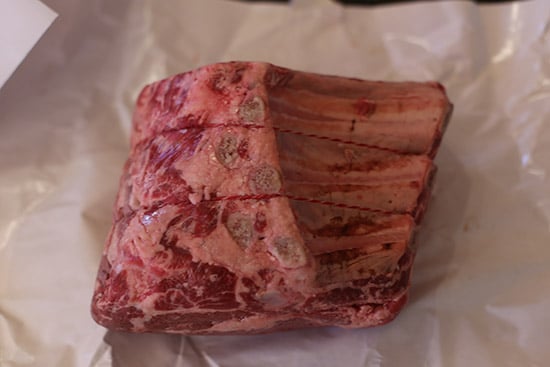
You’re not likely to find bone-in prime rib roasts at Wal-Mart. You’ll need to head to a local butcher instead. If you plan on cooking this for New Year’s, I’d suggest ordering it at least a week before to ensure that they have one available for you by then. Prime rib is a popular dish to serve around the holidays.
To figure out how big a prime rib you should order, a good rough and ready estimate is that a bone will serve about 2 people. So if you’ve got 6 people coming, order a three-bone prime rib roast, which weighs about 7 to 8.5 pounds. The prime rib that you see in the pictures is a three-bone prime rib roast.
When you order your prime rib, ask the butcher to cut the meat away from the bone, but not all the way. This will allow you to keep the bones in while cooking (which serves as a natural roasting rack), but makes it easy to take the bones out of the meat when you start carving. The butcher will likely tie everything up so it doesn’t fall apart while cooking
Pre-heat your oven to 275 degrees. You could cook your roast at a higher temperature and cook it faster, but Karl prefers low and slow. I do too.
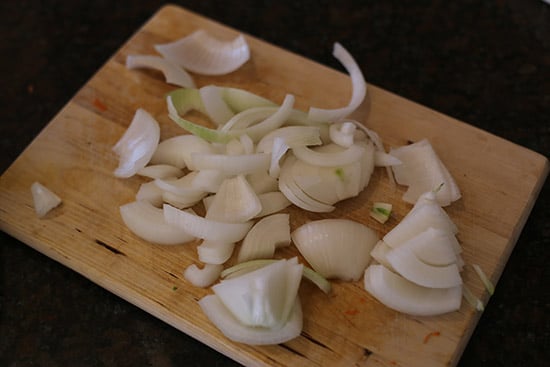
While your oven is warming up, slice up your carrots and onions. We’ll place these on the bottom of the roasting pan and then place our meat on top of the veggies. Keeping the roast elevated a little bit ensures it gets a nice crust on the bottom.
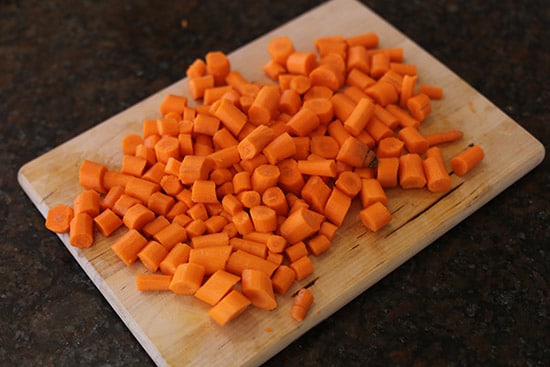
Next time I’m going to cut the carrot pieces bigger and add more carrots and onions in general. They cook down and shrivel up a ton and there weren’t enough to go around on this outing.
Rub generous amounts of salt, pepper, and garlic powder all over the outside of the roast. And by generous, I mean generous. More than you’d think you’d need. This will enhance your roast’s fatty, salty crust.
You can also insert garlic cloves throughout the roast for extra flavor. Just make an incision in the meat and place a clove in it.

Once the oven has reached 275 degrees, place the prime rib on top of the onions and carrots, with bone side facing down, and place in the oven.
At a cooking temperature of 275 degrees, you’ll want to cook your roast 15 to 20 minutes per pound. So for an 8-lb roast, total cooking time will be about 2-2.5 hours.
But instead of focusing on the time, focus on getting your meat to the internal temperature that you want. That’s why a good meat thermometer is important to have. Traditionally, prime rib is served rare, which is an internal temperature of about 125 degrees. For a medium rare, shoot for an internal temperature of 135 degrees. I wouldn’t go any higher than that for a prime rib because then it will be pretty tough and chewy. What’s nice about cooking it to medium rare is that you’ll have some parts on the roast that are medium well and well done for those people in your party who don’t appreciate the wonders of pink meat.
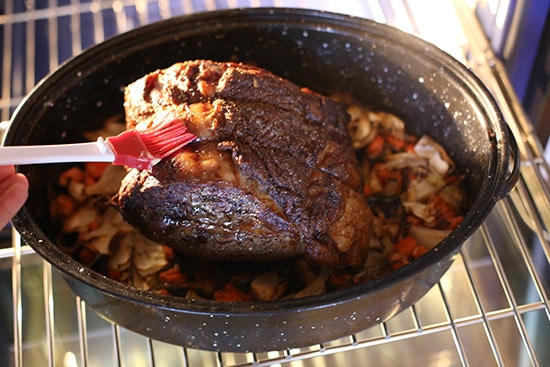
For added flavor, baste the outside of the prime rib with melted butter every 30-40 minutes or so.
And that’s how you cook a prime rib roast. I told you it was easy.
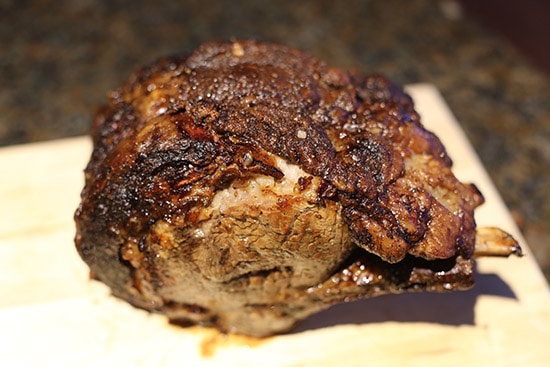
Boy, she’s purty.
Everyone has their own way of carving a prime rib. I like to cut all the bones off the bottom of the roast in one piece, leaving me with a nice fatty slab of roast to work with. From that slab, you can slice your meat as thick or as thin as you’d like. If a guest wants a bone and all the fat and meat that come with it, serve them one.
You’ve got your roasted onions and carrots that you cooked your prime rib on. They’ll be covered with delicious salty drippings and make a great side dish.
The other things I serve with prime rib are mashed potatoes and rolls.
With those side dishes and plenty of horseradish sauce, you’ll have a simple, easy-to-prepare but incredibly delicious New Year’s Day dinner and an annual tradition worth repeating.
Happy Holidays!
The post Your New, New Year’s Tradition: Prime Rib Roast appeared first on The Art of Manliness.
After listening all day to relentless warnings of “severe winter weather” and poring over equipment manuals to determine the lowest operating temperature for various pieces of photographic gear, I decided to stick with the plan. A few hours and several miles of snowshoeing later, I was hard at work in the diminishing February twilight, setting up lines of strobes and high-speed cameras along gaps in the tree canopy that framed a forest lake at the edge of Montana’s Bob Marshall Wilderness. I knew this lakeshore to be a primary movement corridor for a resident female northern flying squirrel (Glaucomys sabrinus), and based on observations from previous nights, I expected my nocturnal subject to launch herself across the lake sometime between 2:20 and 2:50 a.m.
By that time, the temperature was expected to be in the neighborhood of minus 30 degrees Fahrenheit, greatly increasing the chances of camera failure. But it was a risk I was willing to take, since I knew how spectacular that night’s acrobatics were likely to be. February marks the start of the northern flying squirrel’s mating season in Montana. On a typical night during this period, each female will be escorted through the forest by a squabbling squadron of ardent males. It was those energetic males and their dizzying aerial mating chases that I sought to film.

Until recently, flying squirrels were assumed to be passive gliders, using their expansive patagium—the furry wing membrane that spans from the squirrel’s neck to its forelimbs and back to its hind limbs—to simply prolong jumps across canopy gaps, and to lessen impacts upon landing. During passive gliding, travel occurs along a declining linear path. This is what paper airplanes do, trading height for horizontal distance. Although gliding like this is the cheapest form of locomotion, it is also the least stable, because any change in posture, wing symmetry, or weight distribution has the potential to disrupt the glide and result in an uncontrollable fall. Imagine a paper airplane with the sudden addition of a heavy weight on one side, or with one wing that suddenly changes size or shape.
Once scientists began studying flying squirrels in the lab, it didn’t take long to discover that there is nothing passive or constant about the species’ flight. Researchers would ultimately document in flying squirrels a wider variety of aerodynamic modifications and flight types than had been described in any other species of animal glider. In a single flight episode, a flying squirrel might use a dozen separate flight-control techniques and—frustratingly for the graduate students and research assistants tasked with documenting the patterns—different squirrels would use different combinations of these techniques. Ironically, the one type of flight that has never been observed in this species is passive gliding.

As more and more squirrels flew through wind tunnels and along blocked-off biology department corridors, it became clear that flying squirrels have a marked disregard for basic aerodynamic constraints. For example, the squirrels were frequently recorded moving through the air with extraordinarily high “angles of attack,” which is the angle between the wing—in this case the patagium—and the direction of oncoming airflow. Aircraft typically stall when their angle of attack reaches 15 to 20 degrees. Flying squirrels routinely reach 60 degrees, far exceeding values that would result in the stall and crash of even the most advanced military jets. Stalling is caused by a loss of lift. This occurs when the main source of lift, air vortices—the swirls of air that form at the leading edge of a wing as a result of differences in the pressure below and above the wing—essentially slide down the wing surface at high angles. Except, evidently, when the wing belongs to a flying squirrel.
Another lab research finding that challenged the basic aerodynamics of gliding was the flying squirrel’s ability to carry heavy objects in flight without compromising height or trajectory. In the lab, the squirrels are routinely observed generating lift forces up to six times their body weight, a feat that makes it possible for them to take flight with such things as stolen peanut-butter sandwiches—or, under more natural conditions, enormous pine cones. Indeed, even advanced stages of pregnancy seem to have little impact on the squirrels’ flying capabilities.

Laboratory studies also found that the squirrels fly at remarkably high speeds and have a puzzling ability to control their acceleration throughout the flight. The benefits of this are clear: Increased speed enhances maneuverability, which is critical for an animal that flies through an obstacle-strewn forest at night. However, the recorded speeds vastly exceed those that could be generated by a glide itself. Somewhere in the flying squirrel’s little body resides a mysterious mechanism that, without the power of flapping or internal combustion, generates exceptional lift, comparable to that of powered flight.
With each of thee discoveries, it became increasingly obvious that flying squirrels are so overbuilt for flight that simple laboratory challenges of gliding from perch to perch, or up and down flights of stairs at the prodding of research assistants, were not enough to reveal their complete flight repertoire. I needed to take my study to the wild, where flight performance is a question of life and death, or at least of mating success. And that is what brought me to this forest in northwestern Montana in the middle of a frigid February night.
On the lakeshore that night, shortly after 2:30 a.m. under a nearly full moon, I was treated to an unforgettable air show. It started with a cloud of snow dust kicked up by two males chasing each other on the upper branches of a spruce tree high overhead. One of the males lost his grip and dove into a glide over the lake, to be followed immediately by the rapidly accelerating glide of the second male. Both landed and resumed their squabble in the upper canopy on the other side of the lake, seemingly without much loss of elevation despite a glide of at least 50 meters.

Soon after, I spotted the female sitting quietly above me on a snow-covered branch. She was perched up against the tree’s trunk in mid-canopy, inspecting a large cone likely left by a red squirrel earlier in the day. A few seconds later, a third male parachuted down from a nearby tree, somehow steering at the end of his near vertical descent to land on the trunk just below the female. A moment later, the female crouched, and in a powerful 40-degree jump, with body fully extended and limbs outstretched, she launched herself high into the air.
For a second or so, her patagium remained completely folded, with her flattened tail held vertically, giving additional lift. When she reached the peak of her jump, with the high-speed strobes illuminating her every move, she spread the patagium wide, completely flattened the silvery fur on her body and tail and seemed to freeze in midair for a couple of moments before gracefully gliding out of view across the snow-covered lake. For several minutes, I could see the occasional puff of snow dust and could hear the muted squabbles drifting over the frozen expanse. Then, just like that, the group disappeared into the darkness and the night’s silence was restored.
I would spend the next several weeks analyzing frame-by-frame the footage I captured from this stunning performance, deciphering the array of elegant solutions the squirrels employed to solve major aerodynamic problems—some previously unknown, others suggested by laboratory research. Foremost among the latter was the squirrels’ extensive deployment of a “wing tip”—a protruding cartilaginous rod outside the wrist—sort of a long sixth finger. This trait was first described 20 years ago by mammalogist Richard Thorington at the Smithsonian Institution, who speculated that the wing tips were used in the same way as the winglets of modern jets. These vertical metal plates added to the ends of wings revolutionized air travel after NASA began installing them in the 1970s. Flying squirrels evolved wing tips about 20 million years earlier, and have been perfecting their use ever since.

In both the squirrels and the aircraft, the wing tips deflect and retain large air vortices that form along the leading edge of wings and thus generate substantial lift. But in a crucial difference compared to the aircraft, flying squirrels can independently and dynamically control their wing tips on the left and right, folding and extending them as needed to modify the speed and trajectory of glides in mid-flight. This enables them, for example, to make sharp turns in mid-air to avoid obstacles or evade attacking owls.
Generation after generation, natural selection has continued to refine flying squirrel aerodynamics. While air vortices tend to form naturally during a glide, flying squirrels take this a step further. They actively generate additional vortices, and increase lift, using an ingenious adaptation that human engineers copied in the design of the world’s first supersonic jet in 1969. Unlike most gliding mammals, flying squirrels have an additional fur-covered membrane between their necks and wrists that directs air flow to the main portion of the patagium just behind. This flap can be curved down, guiding airflow and generating significant forward acceleration and lift during take-off, then retracted during high-speed chases, or flattened and merged with the main patagium in long-distance glides. In the course of a single flight, the flying squirrel integrates precursors of some of the best inventions of human aircraft engineering over the last century, morphing flawlessly from a canard supersonic airplane design to an agile jet to a blended wing-body aircraft.
And then there is the squirrel’s ultimate secret weapon: the patagium itself. It appears early in each squirrel’s development as a massive outgrowth of skin between hind and forelegs—making a brood of baby flying squirrels in a nesting cavity look remarkably like a stack of pancakes. As the young squirrels grow into their oversized skin, diverse muscle and nerve groups fill the patagium. The result is distributed control of the membrane, with some muscles being controlled locally and others by distant nerve centers.

The importance of such distributed control is that the squirrel can adjust the membrane’s billowing and stiffness independently across the patagium, and between the left and right sides. Part of the wing can be rigid while the other part is pliable, all in response to nerve signals from local stretch receptors that detect minute changes in airflow. Combined with a wide range of limb movements during flight, such local control allows squirrels to actively modify wing size, shape, and stiffness during an aerial chase—from a thin, fully extended membrane in the middle of long-distance glides to fully inflated furry parachutes for slowing down at the end of steep descents. Designing a wing that can instantly change in stiffness and configuration in response to minute changes in local air pressure and flow remains a dream for human aircraft engineers.
Muscles in the patagium also control the orientation of specialized hairs at the membrane’s edges. For example, unusually long, stiff hairs on the leading edge of the patagium are often held at variable angles during take-off and landing, generating multiple mini-vortices that are then trapped on the wing’s surface, providing lift. A band of these hairs along the sides of patagium also generates substantial local turbulence during flight and—together with a pliable wing surface—seems to create a traveling corridor for air vortices along the edge of the gliding membrane.

It’s now clear from our field observations that mid-flight changes in lift and acceleration are closely associated with a change in billowing of the gliding membrane and, in particular, with the formation of waves on the patagium surface. Amazingly, the squirrels appear to actively direct trapped air vortices across the membrane surface. The closest analogy from human engineering would be tiltrotors—aircraft, such as the V-22 Osprey, with variably tilted rotors attached to fixed wings that combine the high speed and range of a conventional plane with the lift capacity and take-off versatility of a helicopter. The crucial difference is that flying squirrels can instantly modify the size, number, and location of their “rotors” in response to minute changes in airflow and pressure—an achievement that is well beyond modern aircraft engineering.
At the end of a long field season, while waiting in the Great Falls International Airport for my flight back to the University of Arizona, I walk through one of the largest private collections of aircraft models showcased there. Most inventions in aerodynamic design are represented—from the delta-wing and wing-body airplanes of the familiar Concord and B-2 stealth bomber to the lesser known variable-sweep wing design that converts a fighter jet into a long-range cruiser in mid-flight to bizarre looking canard airplanes with two pairs of wings.
As I browse, I try to imagine what a collection of nature’s innovations for animal flight would look like. Nature had about a billion years longer to experiment with various ways to get animals as diverse as insects, frogs, reptiles, and mammals airborne, so one would think such a collection would be enormous. Surprisingly, this is not the case. That’s because, over the course of evolution, a typical animal flier might accumulate dozens of redundant aerodynamic solutions—some nearly perfect, some half-working, but all contributing to getting an animal airborne, while at the same time preserving uninterrupted paths for future adaptations. The end result is a prized combination of functional versatility and exceptional robustness of nature’s flying solutions—something we have yet to achieve in human engineering. The flying squirrel is a premier example of this, easily encompassing in one small furry package the content of several of the display cases in front of me: the aerodynamic features of heavy transport planes, agile military jets, movable-rotor helicopters, flexible-wing parachute gliders, and many innovations we’ve yet to achieve.
A version of this story originally appeared on bioGraphic.com.





Instead of seeing how long you can go without breaking a dreaded New Year’s resolution, use the start of the year to freshen up your Mac. Today we’ll look at some easy-to-perform maintenance tasks that will keep your computer running in good condition. You’ll need macOS Sierra to perform some of these tasks, which you can download for free from the Mac App Store. 1. Check Free Space Each year, you use thousands of files on your computer. Some of those probably served one long-forgotten purpose, while others are so large they could be affecting your system’s drive space or performance. You should...
Read the full article: 6 Quick Ways to Tune Up Your Mac for the New Year

You can read something and hope that it’ll all be beamed into your brain for future application. Or you can read it and write down what you just learned, as if you were teaching someone else, and actually retain it. This is called the Feynman Technique.

You can earn a living with your DSLR. But can you earn a living with your smartphone camera? Camera technology has been at the heart of smartphones. And today, there are smartphones like the Google Pixel, iPhone 7, and Galaxy S7 that can turn you into a professional-grade photographer. But creativity doesn’t need a dual-pixel sensor. If you can take a unique shot, there’s always a market for it. One of the most democratic places for a professional photographer to sell his wares is 500px.com. The photo sharing website makes your job easier with a mobile app called RAW. RAW...
Read the full article: How to Shoot, Edit, and Sell Your Photos With One App

It’s comforting to believe that you can control everything, but you’ll be disappointed when you fail despite your best efforts. To prepare yourself for the inevitable failure once in a while, use reserve clauses when describing your plans.